ABS AUDI S8 2014 Owner's Manual
[x] Cancel search | Manufacturer: AUDI, Model Year: 2014, Model line: S8, Model: AUDI S8 2014Pages: 314, PDF Size: 78.47 MB
Page 229 of 314
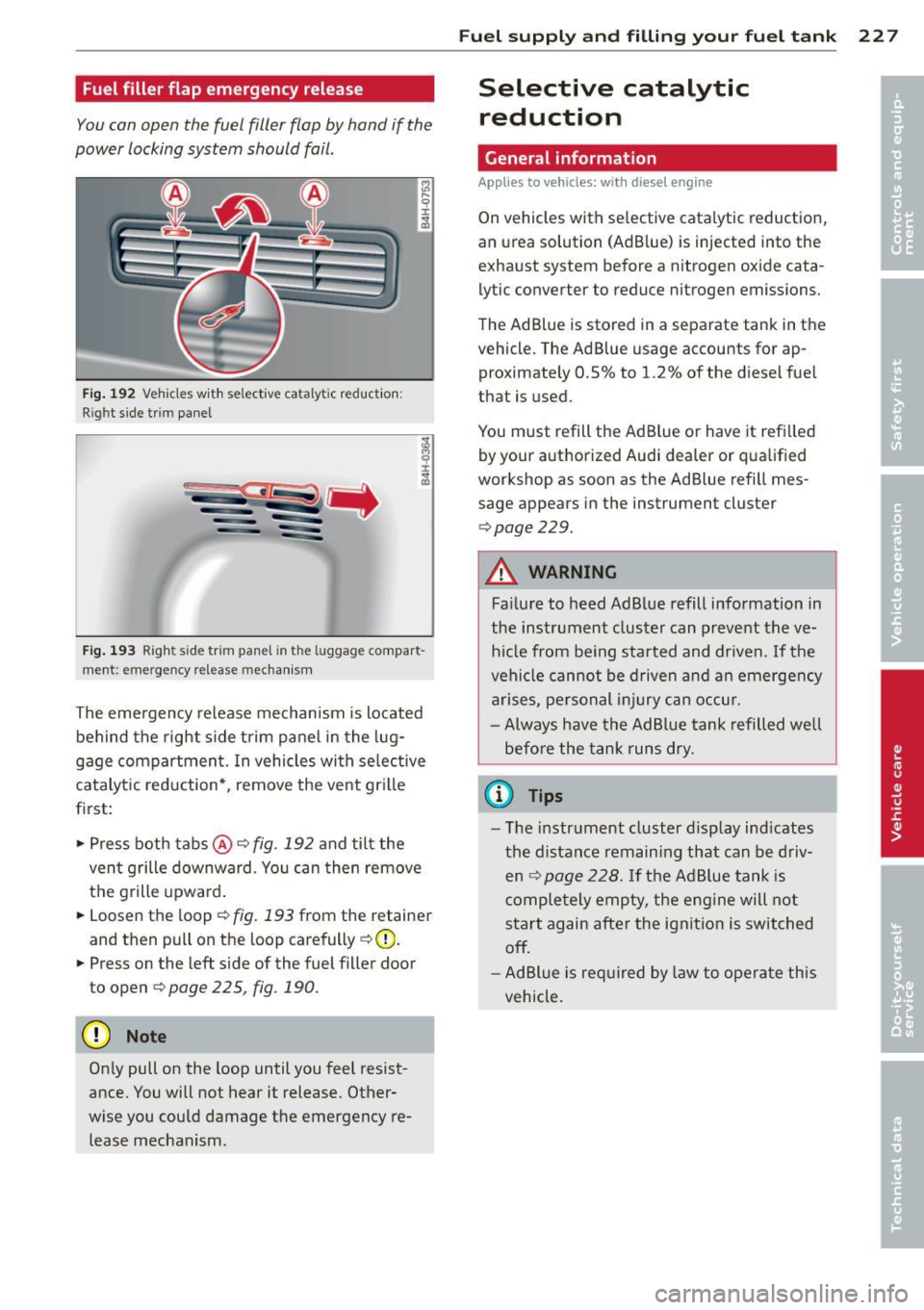
Fuel filler flap emergency release
You can open the fuel filler flap by hand if the
power locking system should fail.
Fig . 192 Veh icles w it h select ive catalytic reduct ion :
R ig ht side trim pane l
Fig . 1 93 Right side trim pa ne l in the lu ggage compart
ment: emergency release mechan ism
The emergency release mechanism is located
behind the right side trim pa ne l in the lug
gage compartmen t. In vehicles with se lec tive
catalyt ic red uction *, remove the ve nt gri lle
first:
• Press b oth tabs @
r:::;, fig. 192 and ti lt the
ven t grille downward . You can then remove
t h e g rille upwa rd .
• Loosen the loop
r:::;, fig. 193 from the retainer
and then pull on the loop carefully
r:::;, (D ,
• Press on the left s ide of the fuel filler door
to open
r:::;, page 225, fig . 190.
(D Note
O nl y pull on the loop until you feel resist
ance. You will not hear it release. Other
w ise you cou ld damage t he emergency re
lease mechanism .
Fuel suppl y and filli ng your fuel t ank 22 7
Selective catalytic
reduction
General information
Applies to vehicles: wi th diesel engine
On vehicles with se lective cata lytic reduction,
an urea solution (AdB lue) is injected into the
exhaust system before a n itrogen oxide cata
lytic converter to reduce nitrogen emissions.
The Ad Blue is stored in a separate tank in t he
vehicle. The Ad Blue usage accounts for ap
proximately 0.5% to 1.2% of the d iesel fue l
that is used.
You must refill the Ad Blue or have it refi lled
by your aut horized Audi dea ler or qua lified
workshop as soon as the Ad Blue refill mes
sage appears in the instrument cluster
c;, page 229.
A WARNING
Failure to heed AdBlue refill information in
the instrument clus ter can prevent the ve
hicl e from be ing started and dr iven. If the
vehi cle can not be driven and an emergen cy
ar ises, pe rsonal inju ry c an o ccu r.
- Always have the Ad Blue tank refi lled we ll
befo re the tank runs dry.
(i'} Tips
- Th e instr ument cluster d isplay ind icates
t he distance remain ing that can be d riv
en
r:::;, page 228. I f th e A d Bl ue tank is
c omple tely empty, t he eng ine will not
sta rt ag ain afte r th e ig niti on is swit ched
off.
-Ad Blue is requi red by law t o opera te th is
vehicle.
Page 244 of 314
242 Checking and filling
-The auxiliary e lectric fan is temperature
controlled and can switch on suddenly
even when the engine is not runn ing.
- The auxiliary radiator fan switches on au
tomatically when the engine coolant
reaches a certain temperature and will
continue to run until the coolant temper
ature drops .
Brake fluid
Checking brake fluid level
The brake fluid level can be checked with a
quick glance.
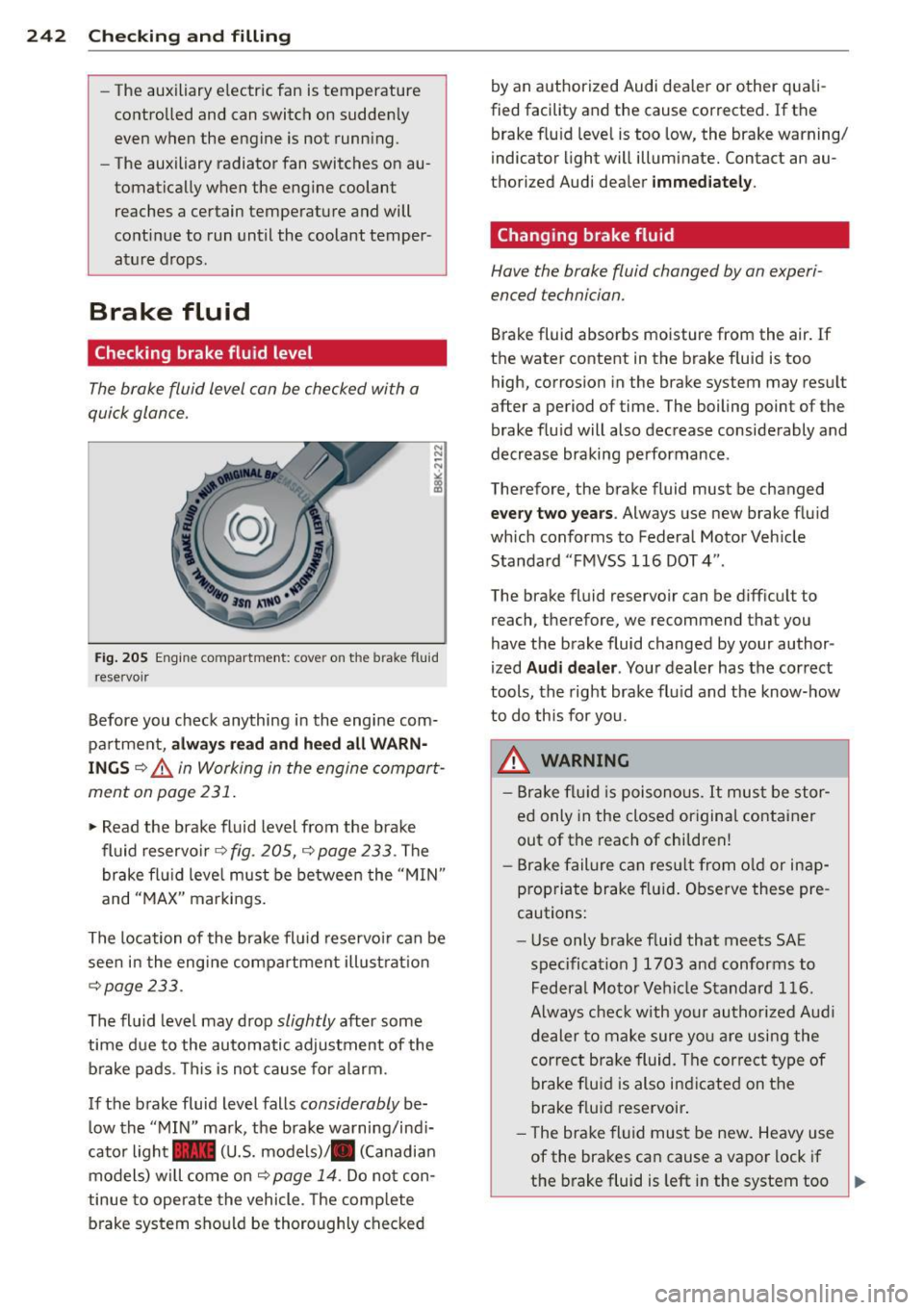
Fig . 205 E ng ine co mpartment: cove r on the brake fluid
r eservo ir
Before you check anything in the engine com
partment,
always read and heed all WARN
INGS 9 &_ in Working in the engine compart
m ent on page 231.
.. Read the brake fluid level from the brake
fluid reservoir
9 fig . 205, q page 233. The
brake fluid leve l must be between the "MIN"
and "MAX" markings.
The location of the brake fl uid reservoir can be
seen in the engine compartment illustrat ion
9 page233.
The fluid level may drop slightly after some
time due to the automatic adjustment of the
brake pads. This is not cause for alarm.
If the brake fluid level falls
considerably be
low the "MIN" mark, the brake warning/ind i
cator light
1111 (U.S. models)/ . (Canadian
models) will come on
q page 14. Do not con
tinue to operate the vehicle . T he complete
brake system should be thoroughly checked by an authorized Audi dealer or other quali
fied fac ility and the cause corrected.
If th e
brake flu id level is too low, the brake wa rning/
indicator light will illuminate. Contact an au
thorized Audi dealer
immediately.
Changing brake fluid
Have the brake fluid changed by on experi
enced technician.
Brake fluid absorbs moisture from the air. If
the water content in the brake fluid is too
high, corrosion in the brake system may result
a fter a period of time. The boiling point of the
brake fluid will also decrease considerably and
decrease braking performance .
Therefore, the brake fluid must be changed
every two years. Always use new brake flu id
which conforms to Federal Motor Veh icle
Standard "FMVSS 116 DOT 4" .
The brake fluid reservoir can be difficu lt to
reach, therefore, we recommend that you
have the brake fluid changed by your author
ized
Audi dealer . Your dealer has the correct
tools, the right brake fluid and the know-how
to do this for you .
.&, WARNING
-Brake fluid is poisonous. It must be stor
ed only in the closed origina l container
out of the reach of children!
- Brake failure can result from old or inap
propriate brake fluid. Observe these pre
cautions:
- Use only brake fluid that meets SAE
spec ification
J 1703 and conforms to
Federa l Motor Vehicle Standard 116.
Always check with your authorized Aud i
dealer to make sure you are using the
correct brake fluid. The correct type of
brake fluid is also indicated on the
brake fluid reservoir .
- The brake fluid must be new. Heavy use
of the brakes can cause a vapor lock if
the brake fluid is Left in the system too
lllJ.
Page 245 of 314
long. This can seriously affect the effi
ciency of the brakes as well as yo ur
safety. This could result in an acc ident.
0 Note
Brake f luid will damage the paint of your
vehicle.
@ For the sake of the environment
Because of the problem of proper d isposa l
of brake fl uid as we ll as the special tools
req uired and the necessa ry expert ise, we
recommend that you have the brake fluid
changed by your author ized Audi dealer.
Battery
General information
Under normal operating conditions, the bat
tery in your A udi does not need any mainte
nance . With
high outside temperatures or
long dai ly dr ives we recommend that you have
the electro lyte level checked by a service fa
cility. T he electrolyte level shou ld also be
checked each time the battery is charged
-:;, page 245.
Have the battery checked when you take your
ve hicle in for service. You are well adv ised to
replace a battery that is older than 5 years.
W ith certa in types o f airbag deployment, the
battery is d isconnected from the vehicle elec
tr ica l system for safety reasons¢
& in Re
pair, care and disposal of the airbags on
page 167.
Disconnect ing the battery terminals
Some vehicle functions (power w indow regu
lators, for example) are lost if the battery ter
minals a re d isconnected. These functions have
to be relearned after the battery terminals a re
connected again . To prevent this, the battery
should only be d isconnected from the vehicle
e lec trica l system whe n absolu tely ne cessa ry
f or repairs.
Checkin g and fillin g 243
Vehicles not driven for long periods
If you do no t drive your vehicle over a period
of seve ra l days o r weeks, e lectr ica l compo
nents are g radually cut back or switched off .
This reduces energy consumption and main
ta ins starting capability over a longer period
¢
page 204. Some of the convenience func
tions may not operate, such as the inter ior
l igh ts or the power seat adjus tment. The con
venience functions will be ava ilab le aga in
whe n you swi tch on the ignition and sta rt the
engine.
Winter operation
During the winte r months, battery capacity
tends to dec rease as temperatures drop. This
i s because more power is a lso consumed wh ile
s ta rt ing, and the headlight s, rea r window de
fogger, e tc., are used more ofte n.
Avoid unnecessary powe r consumpt ion, par
ticu larly in city traffic o r when traveling only
sho rt distances. Let yo ur au thoriz ed Aud i
de aler check the cap acity of the vehicle b at
tery before winter sets in~ page 245. A well
charged bat tery will not on ly prevent starting
problems w hen the weather is cold, but w ill
a lso last longer.
{!) Tips
If yo ur vehicle is left s tandin g for seve ral
weeks at extreme ly low tem peratures, the
vehicle battery sho uld be removed and
stored w here it w ill not freeze . T his will
prevent it from be ing damaged and having
to be replaced.
Working on the battery
Be especially careful when working on or near
the battery.
The battery is located in the luggage compart
ment under the floor. Before you check any
th ing in the luggage compartment,
read and
heed all WARNINGS
¢ .&_ .
Always heed the safety warnings , when work
ing on the vehicle battery or the vehicle e lec
trical system to prevent injury. •
•
Page 269 of 314
remain continuously illuminated. This se
quence will continue upon subsequent vehicle
start-ups as long as the malfunction exists.
When the malfunction indicator is illuminat
ed, the system may not be able to detect or
signal low tire pressure as intend ed . TPMS
malfunctions may occur for a variety of rea
sons, including the installation of replace
ment or alternate tires or wheels on the vehi
cle that prevent the TPMS from functioning
properly . Always check the TPMS malfunction
telltale after replacing one or more tires or
wheels on your vehicle to ensure that the re
placement or alternate tires and wheels allow
the TPMS to continue to function properly.
Tire pressure indicator appears
Applies to vehicles: with tire pressure monitoring system
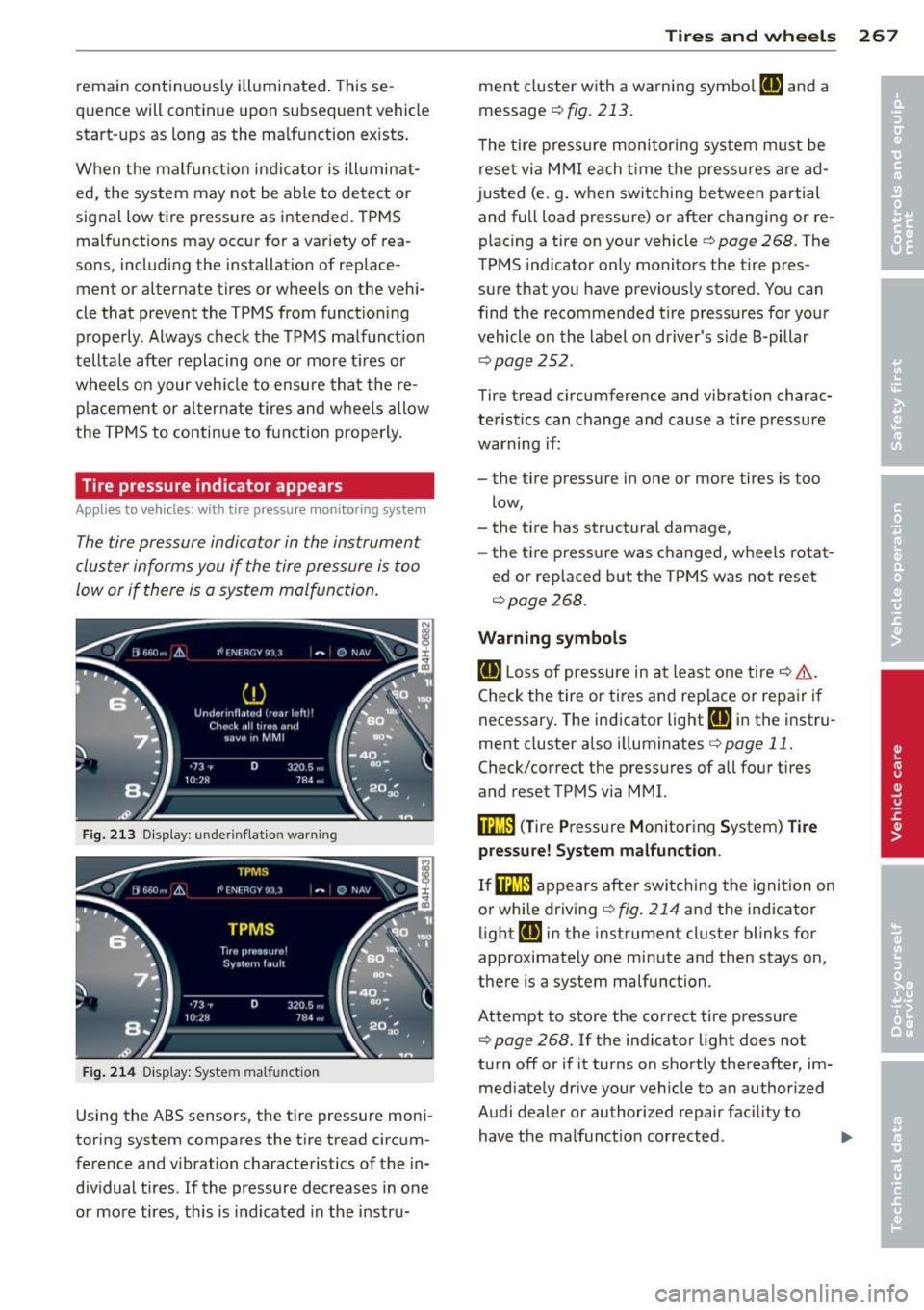
The tire pressure indicator in the instrument
cluster informs you if the tire pressure is too
low or if there is a system malfunction.
Fig. 213 Display : underi nflatio n warning
Fig. 214 Di splay: Syste m mal functio n
Using the ABS sensors, the tire pressure moni
toring system compares the tire tread circum
ference and vibration ch arac teristics of the in
dividual tires. If the pressure decreases in one
or more tires, this is indicated in the instru-
Tires and wheels 267
ment cluster with a warning symbol [I] and a
message
r::!) fig. 213.
The tire pressure monitoring system must be
reset via MMI each time the pressures are ad
justed (e.g. when switching between partial
and full load pressure) or after changing or re
placing a tire on your vehicle
r::!) pag e 268. The
TPMS indicator only monitors the tire pres
sure that you have previously stored. You can
find the recommended tire pressures for your
vehicle on the label on driver's side 8-pillar
<=:>page 252 .
Tire tread circumference and vibration charac
teristics can change and cause a tire pressure
warning if:
- the tire pressure in one or more tires is too
low,
- the tire has structural damage,
- the tire pressure was changed, wheels rotat-
ed or replaced but the TPMS was not reset
r::!) page 268 .
Warning symbols
[I] Loss of pressure in at least one tire q &..
Check the tire or tires and replace or repair if
necessary. The indicator light
[I] in the instru
ment cluster also illuminates
¢page 11.
Check/correct the pressures of all four tires
and reset TPMS via MMI.
i:mJ) (Tire Pressure Monitoring System) Tire
pressure! System malfunction .
If@m appears after switching the ignition on
or while driving
q fig. 214 and the indicator
light
[I] in the instrument cluster blinks for
approximately one minute and then stays on,
there is a system malfunction .
Attempt to store the correct tire pressure
¢ page 268. If the indicator light does not
turn off or if it turns on shortly thereafter, im
mediately drive your vehicle to an authorized
Audi dealer or authorized repair facility to
have the malfunction corrected .
Page 270 of 314
268 Tire s and wheel s
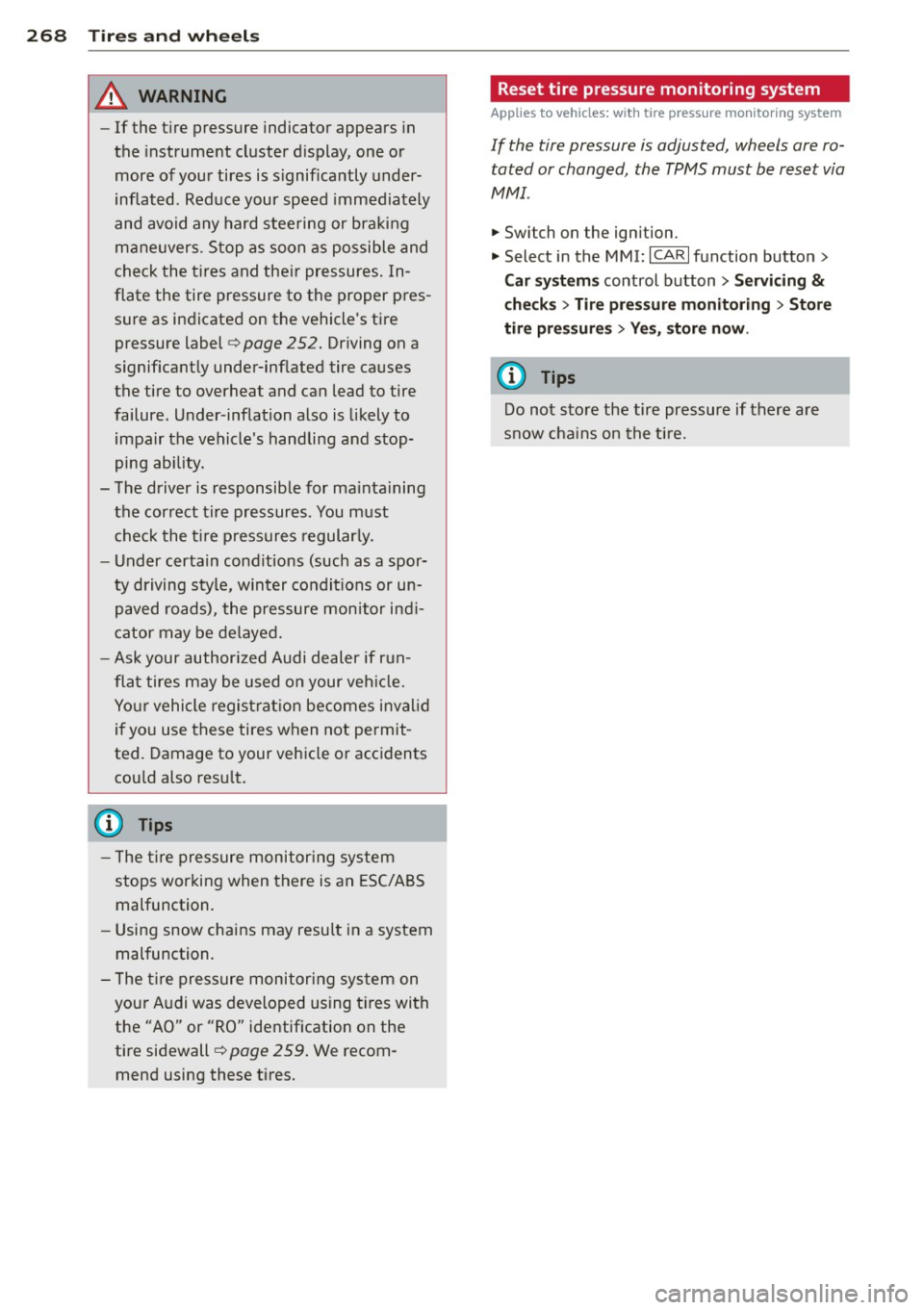
_&. WARNING
-If th e tire pressure indicator appea rs in
the instrument cluster d isplay, one or
more of your tires is s ignificantly under
inflated. Reduce your speed immediately
and avoid any hard steering or bra king
maneuvers . Stop as soon as possible and
check the t ires and the ir pressures. In
flate the tire pressure to the proper pres
sure as indicated on the vehicle 's t ire
pressure label
q page 252. Driving on a
signif icant ly under-inflated tire causes
the tire to overheat and can lead to tire
failure. Under-inflation also is likely to impair the vehicle's handling and stop
ping ab ility .
- The driver is responsible for ma inta ining
the correct tire pressures. You must check the t ire pressures regula rly.
- Under certain cond itions (such as a spor
ty driving style, winter condit ions or un
paved roads), the pressure mon itor ind i
cator may be de layed.
- Ask your author ized Audi dealer if r un
flat tires may be used on your veh icle.
Yo ur vehicle regist rat ion becomes inval id
if yo u use these tires when not permit
ted. Damage to your vehicle or acc idents
cou ld also resu lt.
(D Tips
- The tire pressure monitoring system
stops working when there is an ESC/ABS
malfunction.
- Using snow chains may result in a system
malfunction.
- The tire pressure monitoring system on
you r A udi was developed using t ires with
the "AO" or "RO" identification on the
tire sidewall ~
page 259 . We recom
mend using these t ires.
Reset tire pressure monitoring system
Applies to vehicles: with tire pressure monitoring system
If the tire pressure is adjusted, wheels are ro
tated or changed, the TPMS must be reset via
MMI .
.. Switch on the ignition.
.. Select in the MMI :
ICARI function button>
Car system s control button > Servicing &
check s > Tire pres sure monitoring > Store
tire pre ssur es > Ye s, store now .
@ Tips
Do not sto re the tire pressure if there are
s now cha ins on the tire.
Page 299 of 314
A
A/C (automatic climate control) . ... .. .. 80
ABS
refer to Anti-lock braking system .. .. . 199
Accessories .. ............. .... .. ... 294
Adapt ive a ir s uspension/sport .. .. .. .. . 110
Adapt ive cruise control ......... .... ... 94
C leaning the sensor .......... .... .. 217
M essages .. ............. .... .. ... 10 1
Request for drive r in terven tion .. .. .. .. 99
S top-and-go traffic ....... .. .. .. .. .. 98
Adapt ive Lig ht (defect ive) .... ... . ... .. 22
AdBlue . ... .. .. .. .. .. .... ... .. .. ... 227
F il ling . .. .. .. ............. .. .. ... 229
Messages in the instrument cluster dis-
p lay ... .. .. ................. .. ... 228
Adding Engine coolant . ... .... ... .. .. .. ... 240
Eng ine oi l .. ............. .... .. .. . 237
W indshield washer fluid . .. .. .. .. .. . 247
Add it ives
Eng ine oil . ..... ...... ... .. .. .. ... 237
Adjustab le steer ing column .. .. .. .. .. .. 83
Ad justing
A ir distribution (automatic climate con-
trol) . .. .. .. .. ........ ... .. ... ... .. 81
Front seats . . . . . . . . . . . . . . . . . . . . . . . . 58
Instrument illum inat ion .... ... ... ... 51
Steer ing colum n .......... .. .. .. .. .. 83
Temperatu re (automat ic climate co ntrol) 8 1
Airbag system . . . . . . . . . . . . . . . . . 153 , 172
Advanced A irbag System ....... . ... . 157
Advanced Airbag System components . 160
Ca re . .. .. .. .. .. ........... .. .. ... 166
C hildr en . .. ............. .... .. ... 178
Ch ild restra ints ........... .... .. .. . 179
Components (front airbags) . ... .. ... 160
Danger of fitting a child seat on the front
passenger seat . . . . . . . . . . . . . . . . . . . . 155
Disposal . .. .. ........... .. .. .. ... 166
Front airbags . . . . . . . . . . . . . . . . 157, 158
H ow do the front airbags work? . ..... 162
H ow many airbags does my vehicle
h ave? ... .. .. ........ ... .. ... ... . 160
H ow the Advan ced Airbag Sys tem com-
ponents wor k toge ther .... .. .. .. .. . 16 1
Inde x 297
Important sa fety inst ruct ions on the
knee airbag system .. ... .... ... .. .. 170
Important t hings to know .... ... .. .. 153
Knee a irbags . .. .. ................. 168
Monitoring .. .. .. .... ............. 164
PASSENGER AIR BAG OFF light ....... 164
Repa irs ... .. .. .. .. . .. .... .... .. .. 166
Safety instr uctions .. .............. . 166
S ide a irbags . .. .. .. . .............. 171
S ide cur tain airbags ............ .. .. 17 4
Warning/ind icator lights ..... ... .. .. . 18
Wa rning/Indicato r lights .... ... .. .. 164
Weight -sensing mat . ... .... ... .. .. 178
When must the system be inspected? 164
A ircraft
T ranspo rting yo ur vehicle
Alcanta ra 2
87
Cleaning ........ .. ............... 219
A ll Wheel Drive .. .. .... ............. 204
Winter tires . .. .. .. ............... 263
Alternator
refer to Gene rator . .. .. ..... ... .. .. . 16
Amb ience light ing ... ... ..... ... .... . SO
Anti-freeze
refer to Eng ine coolant ............. 239
Anti -lock b raking system . ..... ... .. .. 199
Warning/indicator lights . . . . . . . . . 18, 19
Ant i-s lip regu lation .... ......... .. .. 199
W arning/ind icator lights ........ .. .. . 18
Anti-theft systems Electronic immob ilizer ............. .. 32
ASR
refer to Anti-slip regulation 199
Audi braking gu ard
refer to Braking gua rd .. ..... ... .. .. . 94
Audi drive selec t
refer to Drive se lect . .............. . 110
Audi Serv ice Repair Manuals and Litera-
ture ..... .. .. .. .. .. ............... 292
A UTO
Automatic climate contro l .... ... .. .. . 80
A utomat ic head lights ....... ... .. .. . 46
A uto Lock .. .. .. .. ................. . 33
Automat ic be lt retractor ............. 148
Automatic climate control Air vents . ... .... .. . .. .. ..... ... .. . 81
Automat ic recirc ulation ............. . 82
•
•
Page 310 of 314
308 Index
Trailer towing
212
Operating instructions .............. 212
Park ing system ............ ... .... . 132
Technical requirements .... .. .. 212,213
Trailer towing tips .......... .. .... . 214
Train (transporting your vehicle) .... .. . 287
Transm ission . .............. ... .. ... 116
Transmission malfunction (indicator light) . .. .. .. ............. .. .. .. ... 120
Transport Canada .............. .... . 143
Transporting your vehicle .... .. .. .. .. . 287
Tread Wear Indicator (TWI) ... ... .. .. . 258
Trip odometer ............. .. .. .... .. 27
What does it mean when DEF appears in
the trip odometer d isplay? ......... .. 27
Trunk
refer to Luggage compartment lid . .. . . 37
Trunk escape handle ........ .. .. .... . 269
Turn signa ls . ................. ..... .. 48
Warning/indicator lights ........... . . 23
u
Unfasten ing safety belts 150
Unidirectional tires ............. .. .. . 248
Uniform tire quality grading ....... .. . 262
Unlock ing
L uggage compartment lid .. .. .. .. .. . . 37
Power locking switch ...... .. .. .... .. 36
Remote control .................... 35
Using the key ...................... 36
V
Valet parking ................. ..... .. 42
Vanity mirrors . . . . . . . . . . . . . . . . . . . 51, 52
Vehicle care/cleaning .............. .. .... . 216
Vehicle e lectrical system ...... .. .... .. 16
Vehicle identification label . ........ .. . 289
Vehicle Identification Number (VIN) ... . 289
Vehicle jack . . . . . . . . . . . . . . . . . . . 270, 275
Vehicle literature . . . . . . . . . . . . . . . . . . . . . 5
Vehicle shutt-down .......... ... .... . 209
Vehicle transport . .......... ... .. .. . 287
Venti lation ............... .. .. .... .. 79 Vinyl
Cleaning . ..... .. ................ . 219
w
Warning/indicator lights ............. . 11
Airbag system ... ............. ..... 18
Anti- lock braking system (ABS) ........ 19
Brake system . . . . . . . . . . . . . . . . . . . . . . 14
Electromechanical parking brake . .... . 15
Electronic power control . . . . . . . . . . . . . 20
Electronic Stabilization Control ( E5C) .. . 18
Generator ... .. .. ....... ...... .. .. . 16
Glow p lug system . . . . . . . . . . . . . . . . . . 20
Instrument cluster ............. .. .. . 10
Malfunction Ind icator Lamp (MIL) .. .. . 20
Safety be lt . ... .. ................ .. 16
T urn signals ..... ............. ..... 23
Warning/Indicator lights
Airbag system ... ............. .... 164
Dynamic steering . ............. .. .. . 22
PASSENGER AIR BAG OFF ........ ... 164
Warranty coverages .............. ... 292
Washer reservoir .. ................ . 247
Wear indicator .. .. ............. .... 258
Weights .. .. .. ... ... ... ..... ... .. .. 289
What happens if you wear your safety belt
too loose? .. .... .. ................ . 149
What happens to unbelted occupants? .. 146
What impairs driving safety? .... .. .. .. 136
What shou ld I do after changing a
whee l? ......... .. ................ . 255
What should I do after replac ing wheels? 255
Wheel bolts Torque .... .... ................... 265
Wheels ... ..... .. ................ . 248
Checking tire pressure .............. 254
Cleaning .. .... .. ............. .... 217
Cold tire inflation pressure ...... .. .. 252
General notes .. .. ............. .... 248
Glossary of tire and loading terminolo -
gy ........ ... .. .. ... ....... ... .. 249
New tires and whee ls ... ... ..... .. .. 259
T ires and veh icle load limits ..... .. .. 256
When must a safety belt be replaced? .. 148
When must the airbag system be inspect -
ed? ......... ... .. .. ............... 164