service AUDI S8 2014 Owner's Manual
[x] Cancel search | Manufacturer: AUDI, Model Year: 2014, Model line: S8, Model: AUDI S8 2014Pages: 314, PDF Size: 78.47 MB
Page 210 of 314
208 Driving and en vir onm ent
Catalytic converter
Appl ies to vehicles: with gasoline e ngin e
It is very important that your emission con
trol system (catalytic converter) is function
ing properly to ensure that your vehicle is run
ning in an environmentally sound manner .
.. Always use lead-free gasoline i=> page 222,
Fuel supply .
.. Never run the tank down all the way to emp-
ty .
.. Never put too much motor oil in your engine
¢ page 23 7, Adding engine oil
The catalytic converter is an eff ic ient "clean
up" device built into the exhaust system of
the vehicle. The catalyti c converter burns
many of the pollutants in the exhaust gas be
fore they are released into the atmosphere.
The exclus ive use of unleaded fuel is cr itically
important for the l ife of the cata lytic convert
e r and proper functioning of the engine.
A WARNING
T he temperature of the exhaust system is
high, both when driving and after stopping
the engine .
- Never touch the exhaust tail pipes once
they have become hot. This could result
in burns.
- Do not park or operate the vehicle in
areas where the hot exhaust system may
come in contact with dry grass, brush,
fuel spill or other material which can
cause a fire.
- Do not apply additional undercoating or
rustproofing on or near the exhaust
man ifold, exhaust p ipes, catalytic con
verter or heat shields . During driving, the
substance used for undercoating cou ld
overheat and cause a fire.
@) Note
- Be aware that just one tank f illing with
leaded fuel will already seriously de
grade the performance of the cata lytic
conve rter. -
Do not exceed the correct engine oil level
i=>page 237.
-Do not drive until the fue l tank becomes
completely empty . The engine co uld mis
fire . Unburned fuel could also get into
the exhaust system and this cou ld cause
the catalytic converter to overheat.
- Do not switch off the ignition while the
vehicle is mov ing.
- Do not continue to operate your vehicle
under these conditions, as otherwise fuel
can reach the catalyt ic converter. Th is
cou ld result in overheating of the con
verter, requir ing its replacement .
- To assure efficient operation of the Emis
sion Control System:
- Have you r vehicle maintained p roperly
and in accordance w ith the service rec
ommendations in your Warranty & Maintenance book let.
- Lack of prope r maintenance as we ll as
improper use of the vehicle wi ll impair
the function of the em ission contro l
system and could lead to damage.
@) For the sa ke of the en vironment
Even when the Emission Control System is
ope rat ing properly, the exhaust gas can
have a sulfur-like exhaust gas smell under
some operat ing states. This depends on
the sulfur content of the fuel being used .
Using a different brand of fuel may help,
or f illing the tank with lead-free super
grade gasoline.
Diesel particulate filter
Applies to vehicles: with diese l eng ine
The diesel part icu late filter filters nearly all of
the soot pa rticles out of the exhaust . T he fil
ter cleans itself automat ica lly unde r no rma l
dr iv ing cond itions . If the filte r cannot clean it
self (for example, because you are on ly driving
short distances), the filter becomes clogged
with soot and the
II symbol for the diesel
particulate filter i lluminates
i=> page 21. ..,.
Page 212 of 314

210 Driving and environment
The consumption estimates as published
by ENVIRONMENTAL PROTECTION AGENCY
(EPA) and Transport Canada may not corre
spond to your actual consumption on the
road, which will vary depending upon vehi
cle load and speed, road and weather con
ditions, trip length, etc.
Drive smoothly and keep a lookout
ahead
Vehicles use the most fuel when they are ac
celerating.
• Avoid unnecessary accelerating and braking.
Vehicles use the mo st fuel when they are ac
celerating. If you anticipate what is going to happen next, you will need to brake less and,
thus , accelerate less. Let the vehicle coast
whenever possible -for example when you see
that the next traffic light is red.
Avoid full throttle
Driving at moderate speeds saves fuel and
improves your mileage.
• Try and keep well below your car's maximum
speed .
Accelerating gently reduces fuel consump
tion, engine wear, and does not disturb the
environment .
Fuel consumption, exhaust emissions and en
gine noise increase disproportionately at high
speeds. If you drive at approximately three
quarters of top speed, fuel consumption will
be reduced by one half. Never drive faster
than the posted speed limit and weather con
ditions permit.
Reducing unnecessary idling
Even when your car is just idling it burns up
fuel.
• Shut the engine off when you are not driving
the vehicle. •
Do not warm up the vehicle by letting the
engine run at idle.
The idling phase is automatically reduced for
vehicles with the Start/Stop system. It is effi
cient to switch off the engine in vehicles with
out the Start-Stop-System when stopped at
railroad crossings and long red lights. Turning
the engine off for jus t 30-40 seconds saves
more fuel than is burned by starting the en-
. . gme again.
It takes a long time for the engine to warm up
fully when it is running at idle. However, wear
and noxious emissions are especially high
when the engine is warming up . So you should
drive away as soon as you start the engine and
avoid running at high rpms while the engine is
still warming up.
W Note
Do not leave engine idling unattended af
ter starting . If warning lights should come
on to indicate improper operation, they
would go unheeded. Extended idling also
produces heat, which could result in over
heating or other damage to the vehicle or
other property.
Regular maintenance
A badly tuned engine unnecessarily wastes a lot of fuel.
• Have your vehicle serviced at regular inter-
vals.
By having your vehicle regularly serviced by an
Audi dealer helps to ensure that it runs prop
erly and economically. The condition of your
vehicle not only affects its safety and ability to
hold its value, it also affects
fuel consump
tion.
Check your oil each time you
fill your tank.
The amount of oil used is related to engine
load and speed.
It is normal for the oil consumption of a new
engine to reach its lowest value after a certain
mileage has been driven . ..,.
Page 213 of 314
You must drive your vehicle about 3,000 miles (5,000 kilometers) before you can properly
assess o il consumption.
This also applies to fuel consumption and en
gine output.
(D Note
- Have yo ur vehicle maintained properly
and in accordance with the service rec
ommendations in your Warranty
& Main
tenance booklet. Lack of proper mainte
nance as well as improper use of the ve
hicle will impair the funct ion of the
emission control system and could lead
to damage .
- Do not alter or remove any component of
the Em ission Control System unless ap
proved by the manufacturer.
- Do not alter or remove any dev ice, such
as heat shields, switches, ignition wires,
valves, wh ich are designed to protect
your vehicle's Emission Control System
and other important veh icle compo
nents.
Fewer short trips
Fuel consumption will always be relatively
high on short trips .
.,. Try to avo id driving short distances with a
cold engine .
The engine and catalyt ic converter have to
reach their optimal
operating temperature to
reduce fuel consumption and noxious emis
sions effect ively.
Just after starting, a cold engine in a mid-size
car only achieves a fuel economy of 6 -8 miles
per gallon (30-40 l/100 km). After about a
half a mile, fuel economy climbs to 12 mpg
(20 l/100 km). Afte r abo ut
2.5 m iles (4 km),
the eng ine is at its proper operating tempera
ture and fue l economy has reached a normal
l eve l. So you can see that you should avoid
short trips whenever possible.
Driving and environment 211
The outside temperature is also critical in this
regard . Your car consumes more fue l in the
winter than in the summer.
•
•
Page 225 of 314
-Blend must contain not more than 1S%
MTBE.
Seasonally adjusted gasoline
Many gasoline grades are blended to perform
espec ially we ll for winter or summer driving.
During seasonal change-over, we suggest that
you fill up at busy gas stat ions where the sea
sonal adjustment is more likely to be made in
time .
(D Note
-Methanol fuels which do not meet these
requirements may cause corrosion and
damage to plastic and rubber compo
nents in the fuel system.
- Do not use fue ls that fail to meet the
specified criter ia in this chapter.
- If you are unable to determine whether
or not a particular fue l blend meets the
specifications, ask your service station or
its fuel supp lier.
- Do not use fuel for which the contents
cannot be identified.
- Fuel system damage and performance
problems resulting from the use of fuels
different from those specified are not
the responsibility of Audi and are not
covered under the New Vehicle or the Emission Control System Warranties.
- If you experience a loss of fuel economy
or driveability and performance prob l ems due to the use of one of these fuel
blends, we recommend that you switch
to unblended fuel.
Gasoline additives
Applies to vehicles : wit h gasoli ne e ng in e
A majo r concern among many auto manufac
ture rs is carbon deposit build-up caused by
the type of gasoline you use.
Although gasoline grades differ from one manufacturer to another , they have certain
things in common. All gasoline g rades contain
substances that can cause deposits to collect
on vital engine parts, such as fuel injectors
and intake valves. Although most gasoline
Fuel supply and filling your fuel tank 223
brands include additives to keep engine and
fuel systems clean, they are not equally effec
tive .
Audi recommends using TOP TIER Detergent
Gasoline . For more information on TOP TIER
Detergent Gasoline, please go to the official
webs ite (www.toptiergas.com).
After an extended per iod of using inadeq uate
fuels, carbon deposit build-ups can rob your
engine of peak performance.
(D Note
Damage or malf unct ion due to poor fuel
quality is not covered by the Audi New Ve
hicle Limited Warranty.
Diesel fuel
Applies to veh icles: w ith diesel engine
Always use ULSD (Ultra Low Sulfur Diesel) sul
fur content 15 ppm or less.
The ULSD (U ltra Low Sulfur Diesel) meets the
ASTM-D-97S (grade 2).
Die sel fuel with a higher concentration than
ULSD-Die sel No. 2 ASTM D975 and Bio-die
sel with a higher concentration than 5
% like
Bl 1 , B20 or B100 are strictly prohibited.
Service station fue l pumps are labeled with
the correct fuel information for easy recogni
tion by the user. If the diesel fuel pump is not
labeled ask the station operator what fuel is
being dispensed before filling up your vehicle.
Serv ice stations offering Diesel fuel are gener
ally located on truck routes or major high
ways . Directories of Diesel fuel stations are
usually available at Diese l fuel stations.
Some states in the USA require permits to
purchase Diesel fuel. Check with your State
Motor Vehicle Department .
Diesel fuel may not be available outside the
USA and Canada. Be sure to check before trav-
eling to other countries .
Ill-
•
•
Page 237 of 314
Because engine oil that meets the Audi oil
standard may not be available everywhere
when you need it, we strongly recommend
that you always carry with you an extra quart (liter) of oil that expressly conforms to the
VW 502 00 (vehicles with gasoline engine) or
VW 507 00 (vehicles with diesel engine) spec ification, in case you have to top off the oil
while on the road .
Applies to vehicles with gasoline engine on
ly:
Only if the level of the oil is at or below the
minimum mark on the oil dipstick - and no oil
that expressly conforms to Audi oil standard
VW 502 00 specifications is available - may
you top off with a high quality engine oil, pref erably synthetic-based, that meets ACEA A3
or API SM specifications, but even then, only in viscosity grades SA E SW-40, SAE SW-30, or
SAE OW-40 . However, during the entire time
between oil change intervals, never top off
with more than a total of 0 .5 qt/liter engine
oil that does not conform to Audi oil specifica
tion VW 502 00 .
Applies to vehicles with diesel engine only:
Only if the level of the oil is at or below the
minimum mark on the oil dipstick - and no oil
that expressly conforms to Audi oil standard
VW 507 00 specifications is available - may
you top off with a high quality engine oil, that
meets ACEA C3 or API CF specifications , but
even then, only in viscosity grades SAE
SW-40, SAE SW-30, or SAE OW-40. However,
during the entire time between oil change in
tervals, never top off with more than a total
of 0.5 qt/liter engine oil that does no t con
form to Audi oil specification VW 507 00 .
For more information about engine oil that
has been approved for your vehicle, please
contact either your authorized Audi dealer or
Audi Customer Relations at 1 (800) 822-2834
or visit our web site at www.audiusa.com or
www.audicanada.ca. Here you will also find a
current list of oils (manufacturers , brand
names etc.) that conform to Audi oil standard
VW 502 00 (vehicles with gasoline engine) or
VW 507 00 (vehicles with diesel engine).
Changing the engine oil
Checking and filling 235
The engine oil and oil filter must be changed
according to the mileage (kilometers) and
time intervals specified in your vehicle's War
ranty
& Maintenance booklet. Do not exceed
these intervals -harmful deposits from old
engine oil can reduce engine performance and
can lead to expensive engine repairs.
Changing the oil at the recommended inter
vals is so very important because the lubricat
ing properties of oil decrease gradually during
normal vehicle use . If you are not sure when
you have your oil changed, ask your author ized Audi Service Advisor.
Under some circumstances the engine oil
should even be changed more frequently. Change oil more often if you drive mostly
short distances, operate the vehicle in dusty
areas or mostly under stop-and-go traffic con
ditions, or when you use your vehicle where
temperatures stay below freezing point for
long periods.
Detergent additives in the oil will make fresh
oil look dark after the engine has been run
ning for a short time. This is normal and is not
a reason to change the oil more often than recommended.
Damage or malfunctions due to lack of
maintenance
It is essential that you change your oil at the
recommended intervals using only engine oil
that complies with Audi oil standard
VW 502 00 (vehicles with gasoline engine) or
VW 507 00 (vehicles with diesel engine). Your
Limited New Vehicle Warranty does not cover
damage or malfunctions due to failure to fol
low recommended maintenance and use re
quirements as set forth in the Audi Owner's
Manual and Warranty
& Maintenance booklet.
Your dealer will have to deny warranty cover
age unless you present to the dealer proof in
the form of Service or Repair Orders that all
scheduled maintenance was performed in a
timely manner.
•
•
Page 240 of 314
238 Check ing and filling
- The oil filler cap must be properly se
cured to prevent oil from being sprayed
on the hot engine and exhaust system
when the engine is running - fire hazard!
- If your skin has come in contact w ith the
engine oil, you must subsequently
cleanse it thoroughly .
(D Note
-Check the oil level. If the message
Pl ea se r educe oil le vel appears, contact
your authorized Audi dea ler or other
qualified workshop to have excess o il ex
tracted if necessary .
-Aud i do es not recommend the use of o il
addit ive s. They ma y damag e the engin e
and ad versely affect yo ur New Vehicle
Warrant y.
@, For the sake of the environment
- Under no circumstances can the oil come
in contact w it h the sewage network or
the soil.
- Observe and follow lega l regulations
when disposing of empty oil containers.
Changing the engine oil
We recommend that have your oil changed by
an authorized Audi dealer or a qualified serv
ice station .
Before you check anything in the engine com
partment,
al ways read and h eed all WARN
INGS c::> &. in Working in the engine compart
ment on page 231.
The engine oil must be changed according to
the intervals spec ified in your Warra nty
&
Maintenance book let . This is very important
because the lubricating prope rties of oil di
minish gradua lly dur ing normal veh icle use .
Under some c ircumstances the eng ine o il
should be changed more frequently . Change
oil more often if you drive most ly short dis
tances , operate the vehicle in dusty areas or
under predominantly stop-and-go traffic con
ditions , or have your vehicle where tempera -tu res remain below freezing for extended pe
riods.
Detergent additives in the oil will make fresh
o il look dar k after the engine has been run
ning for a sho rt time. This is normal and is not
a reason to change the oil more oft en than
recommended.
Because of the problem of proper disposal,
along with the specia l tools and necessary ex
pertise required, we strongly recommend that
you have your oil changed by an authorized
Aud i deale r or a qualified service station.
If yo u choo se to chan ge your o il yours elf ,
please note the fo llowing important informa
t ion:
A WARNING
To reduce the risk of personal injury if you
must change the eng ine oil in your vehicle
yourself:
- Wear eye protect ion.
- To reduce the risk of burns from hot en-
gine oil, let the engine cool down to the
touch.
- When removing the oil dra in p lug with
your fingers, stay as far away as possible.
Always keep your forearm parallel to the ground to help prevent hot oil from run
n ing down you r arm.
- Dra in the oil into a container designed
for this purpose, one large enough to hold at least the tota l amount of o il in
your engine .
- Engine oil is poisonous . Keep it well out
of the rea ch of children.
- Continuous contact with used eng ine o il
is harmful to your sk in . Always protect
your skin by washing oil
off tho roughly
wit h soap and wate r.
(D Note
Neve r mix oil additives with you r engine
oi l. These additives can damage your en
gine and adversely affect your Audi Limit
ed New Veh icle War ranty.
Page 241 of 314
@ For the sake of the environment
-Before changing your oil, first make sure
you know where you can properly dispose
of the used o il.
- Always dispose of used engine oil proper
l y. Do not dump it on garden soi l, wood
ed areas, into open streams or down
sewage dra ins.
- Recycle used engine oil by taking it to a
used engine oil collection facility in your
area, or contact a service station .
Engine cooling system
Coolant
The engine coolant performs two functions: it
keeps the engine from overheating and it pro tects the engine from freezing in the winter.
The cooling system is sea led and generally re
q uir es lit tle atten tion .
The cooling system has been filled at the fac
tory with a pe rmanent coo lant which does not
need to be c hanged. The coolant consists of a
mixture o f spec ial ly conditioned water and the
manuf acturer 's glyco l-based cool ant ad di-
tiv e G13 antifreeze with ant icorros ion addi
tives (50% for USA models ; 60% for Canadian
mod els) . This mixture both assures the neces
sary frost protection and p rotect s metal com
ponents in the engine's coo ling system from
corrosion and scaling . It a lso raises the boil
i ng point of the coolant .
Do not reduce the concentration o f the coo l
ant in the summer by adding plain water.
The
proportion of coolant add it ive must be at
l e a st 50 % but not mor e than 60 %
to main
tain antifreeze protection and coo ling efficien
cy .
If the coolant frost protect io n is too low,
the coolant cou ld free ze and dam age the veh i
cle heating and eng ine cooling system.
For yea r-round driving, antifreeze is added at
the fac to ry for tempera tures down to:
-- 31°F( -35°C)USA
- -40 °F ( -40 °C) Canada.
Checkin g and fillin g 239
If you must add coo lant, use a mixture of wa
ter and coolant additive . Mix ing the coo lant
additive with distilled water is recommended.
_& WARNING
Before you c heck anything in the engine
compartment, always read and heed a ll
WARNINGS
c> .& in Working in the engine
comportment on page 231.
Q) Note
- Before winter sets in, have the coo lant
checked to see if the coolant additive in
your vehicle is sufficient to meet the cli mate condi tions. This is especi ally impor
tan t if you live i n a region wher e th e win
ter is ex treme ly co ld. If necessary, i n
crease t he p ropo rtion of coo lant add itive
to 60% .
- Whe n ad ding coolant additive t o yo ur
c ooling sys tem, reme mbe r:
- We recommend using on ly coolant ad
d itive G12++ or Gl3 for your vehicle .
This coolant additive is availab le at au
thor ized Audi dealers . O ther types of
a ntifreeze can s ignifica ntly reduc e cor
rosion prote ction. The result ing cor ro
sion can cau se a loss o f coolan t and se
rio us engine d amage .
- Do not add any ty pe of rad iator leak seal
a nt to yo ur vehicle 's engine c oolant .
A dd ing radia tor repair fl uid may adverse
ly affect the f unction and pe rformance of
your cooling system and co uld resu lt in
damage not covered by your New Ve hicle
L imited Warranty.
-
•
•
Page 245 of 314
long. This can seriously affect the effi
ciency of the brakes as well as yo ur
safety. This could result in an acc ident.
0 Note
Brake f luid will damage the paint of your
vehicle.
@ For the sake of the environment
Because of the problem of proper d isposa l
of brake fl uid as we ll as the special tools
req uired and the necessa ry expert ise, we
recommend that you have the brake fluid
changed by your author ized Audi dealer.
Battery
General information
Under normal operating conditions, the bat
tery in your A udi does not need any mainte
nance . With
high outside temperatures or
long dai ly dr ives we recommend that you have
the electro lyte level checked by a service fa
cility. T he electrolyte level shou ld also be
checked each time the battery is charged
-:;, page 245.
Have the battery checked when you take your
ve hicle in for service. You are well adv ised to
replace a battery that is older than 5 years.
W ith certa in types o f airbag deployment, the
battery is d isconnected from the vehicle elec
tr ica l system for safety reasons¢
& in Re
pair, care and disposal of the airbags on
page 167.
Disconnect ing the battery terminals
Some vehicle functions (power w indow regu
lators, for example) are lost if the battery ter
minals a re d isconnected. These functions have
to be relearned after the battery terminals a re
connected again . To prevent this, the battery
should only be d isconnected from the vehicle
e lec trica l system whe n absolu tely ne cessa ry
f or repairs.
Checkin g and fillin g 243
Vehicles not driven for long periods
If you do no t drive your vehicle over a period
of seve ra l days o r weeks, e lectr ica l compo
nents are g radually cut back or switched off .
This reduces energy consumption and main
ta ins starting capability over a longer period
¢
page 204. Some of the convenience func
tions may not operate, such as the inter ior
l igh ts or the power seat adjus tment. The con
venience functions will be ava ilab le aga in
whe n you swi tch on the ignition and sta rt the
engine.
Winter operation
During the winte r months, battery capacity
tends to dec rease as temperatures drop. This
i s because more power is a lso consumed wh ile
s ta rt ing, and the headlight s, rea r window de
fogger, e tc., are used more ofte n.
Avoid unnecessary powe r consumpt ion, par
ticu larly in city traffic o r when traveling only
sho rt distances. Let yo ur au thoriz ed Aud i
de aler check the cap acity of the vehicle b at
tery before winter sets in~ page 245. A well
charged bat tery will not on ly prevent starting
problems w hen the weather is cold, but w ill
a lso last longer.
{!) Tips
If yo ur vehicle is left s tandin g for seve ral
weeks at extreme ly low tem peratures, the
vehicle battery sho uld be removed and
stored w here it w ill not freeze . T his will
prevent it from be ing damaged and having
to be replaced.
Working on the battery
Be especially careful when working on or near
the battery.
The battery is located in the luggage compart
ment under the floor. Before you check any
th ing in the luggage compartment,
read and
heed all WARNINGS
¢ .&_ .
Always heed the safety warnings , when work
ing on the vehicle battery or the vehicle e lec
trical system to prevent injury. •
•
Page 258 of 314
256 Tire s and wheel s
the function of the tire pressure monitor
ing system*.
- Always inflate tires to the recommended
and correct tire pressure before driving
off.
- Driv ing with under inflated tires bend
more, letting them get too hot resu lting
in tread separation, sudden t ire fail ure
and loss of control.
- Excess ive speed and/overloading can
cause heat bui ld-up, sudden t ire failure
and loss of control.
- If the t ire pressure is too low or too high,
the tires w ill wear prematurely and the
vehicle will not hand le we ll.
- If the t i re is not flat and you do not have
to change a wheel immed iate ly, dr ive at
reduced speed to the nearest service sta
t ion to check the tire pressure a nd add
air as required.
0 Note
Dr iving without va lve stem caps can cause
damage to the t ire va lves . To prevent this,
always ma ke sure that facto ry installed
valve stem caps on all wheels a re secu re ly
mou nte d on the valve.
@) For the sake of the environment
Unde rinflated tires will a lso inc reas e the
fue l cons umption .
Tires and vehicle load limits
There are limits to the amo unt of load or
weight that any vehicle and any t ire can carry .
A vehicle that is overloaded w ill not handle
well and is more difficult to stop. Overloading
can not only lead to loss of vehicle contro l,
but can also damage import ant parts of the
ve hicle and can lead to sudde n tire failure, in
cluding a blowout and sudden deflation that
can cause t he veh icle to crash .
Your safety and that of your passengers a lso
depends on making sure that load limits are
not exceeded . Vehicle load includes everybody
and everyth ing in and on the vehicle. These load lim
its are technically referred to as the
vehicle's
Gro ss Vehicle Weight R ating
("GVWR").
T he "GVWR" includes t he weight of the basic
vehicle , a ll f actory installed accessories, a f ull
tank of fuel, oi l, coo lant and other f luids plus
maximum load. The max imum load incl udes
the number of passengers that the vehicle is
intended to carry ("seat ing capac ity ") with an
assumed we ight of 150 lbs (68 kg) for each
passenger at a designated seating posit ion
and the total weight of a ny luggage in the ve
hicle. If you tow a trai le r, the we ight of the
t ra ile r hi tc h and the tongue we ight of the
l oaded tra iler mus t be include d as part of the
vehicle load .
T he
Gro ss Ax le Weight Rating ("GAWR ") is
the max imum load that can be applied a t each
of the veh icle's two axles .
T he Gross Vehicle Weight Rat ing and the
G ross Ax le Weig ht Ra ting are listed on the
sa fety comp lian ce s ticke r label located on the
driver's side B-pillar. Yo ur Audi has 5 seat ing
pos itions , 2 in the front and 3 in the rea r fo r
total seati ng capacity of 5. Vehicles with pow
er indiv idual rear seats * have 4 seating posi
tions, 2 in the front and 2 in the rear for total
seat ing capac ity of 4. Each seating position
has a safety belt¢
page 145, Safety belts.
The fact that there is an upper limit to yo ur
vehicle's Gross Vehicle Weight Rating means
that the to tal weight of wha tever is being car
ried in the vehicle ( includ ing t he weight of a
t ra ile r hitch and the tongue weight of the
loaded tra ile r) is lim ited. The more passe n
gers in the vehicle or passengers w ho are
he avier th an t he st andard we igh ts assumed
mean that less we igh t can be carried as lug
gage.
T he tire pre ssure label o n your Audi also lis ts
t h e max imum combine d weig ht of all of the
occupants and luggage or o ther cargo that
the vehi cle can carry . For the location of the
l abel ¢
page 252, fig . 208. liJJ>
Page 260 of 314
258 Tires and wheels
ve hi cle. C onsult thi s m anual
t o deter mine how this re
d uce s the availabl e cargo
a nd lug gage lo ad ca pacity of
yo ur vehicle .
.,.Che ck the tire sidewall
(¢ page 259 , fig . 212 ) to de
termine the de signa ted lo ad
rating for a specific tire .
Tire service life
The service life of tires depends on a lot of
different things including proper installation
a nd balan cing, correct tire pressure and driv
ing style.
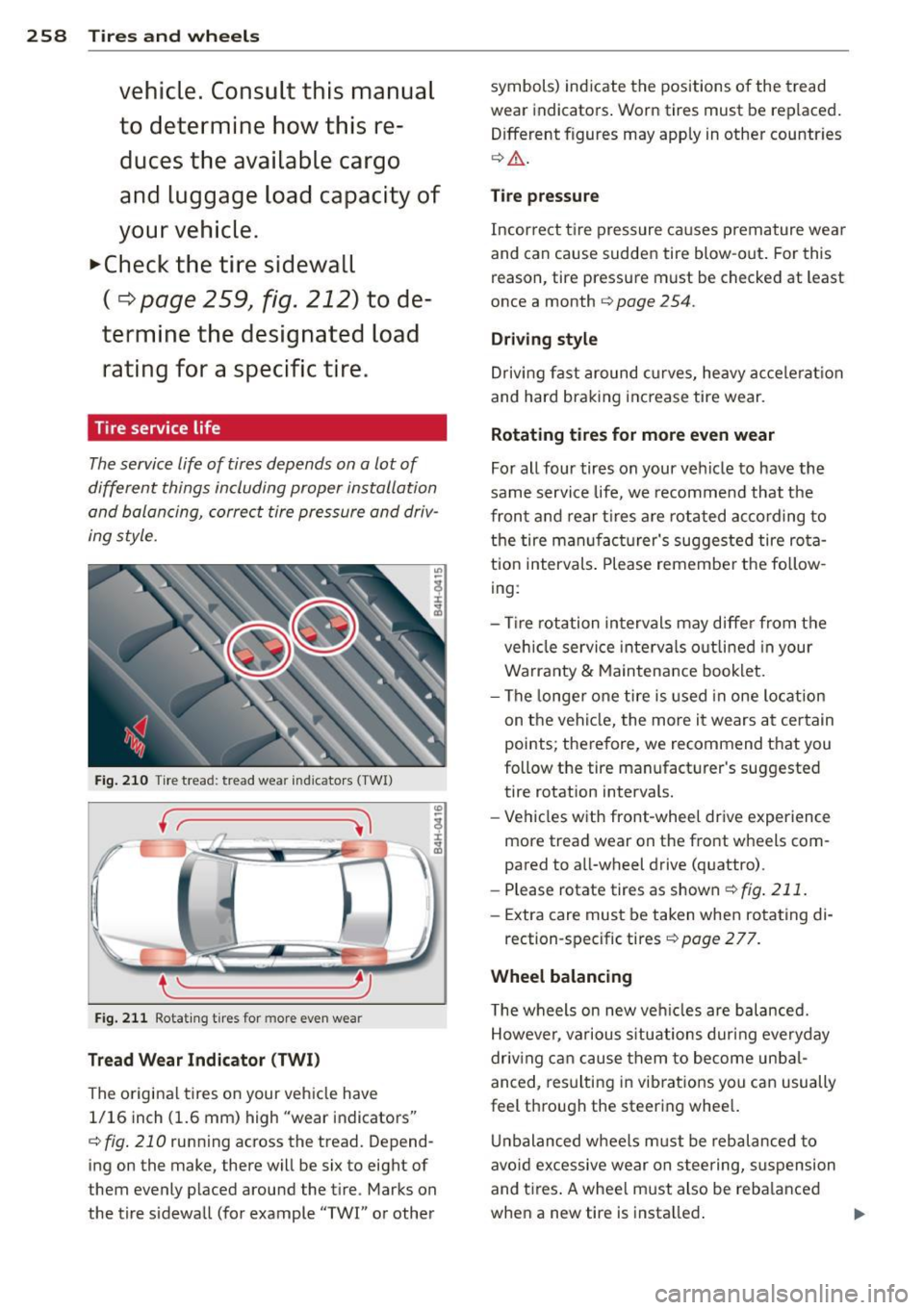
Fig . 210 Tire tread: tread wea r ind icato rs (TWI)
( r------
{ \.._ ______ _.
F ig. 211 Rotat ing t ires for more even wear
Tread Wear Indicator (TWI)
The o rigina l tires on your veh icle have
1/16 inch (1.6 mm) high "wear indicators"
c:::> fig . 210 running across the tread. Depend
ing on the make, there will be six to eight of
them evenly p laced around the t ire . Marks on
the tire s idewall (for example
"TWI" or other symbols) ind
icate the positions o f the tread
wear indicato rs . Worn tires must be replaced .
Different figures may app ly in other countr ies
¢ Ll:). .
Tire pressur e
Incorrect t ire pressure ca uses prema ture wear
and can cause sudden tire blow -out . For this
reason, tire pressure must be checked at least
once a month
c:::> page 254.
Driving style
Dr iving fast around c urve s, he avy a ccele rat ion
and hard braking inc rease tire wear.
Rotating tires for more even wear
Fo r all four tires on your veh icle to have th e
same service life, we recomme nd that the
fron t and rear tires a re rotated ac co rd ing to
the tire m an ufa ctu rer's suggested tire ro ta
tion intervals . Please remembe r th e fo llow
ing :
- Tire rotation in tervals may diffe r from the
ve hicle service inte rva ls o utlin ed in your
Warranty
& M aintena nce booklet.
- The longe r one tire is used in one lo cation
on t he veh icle, the more it wears at cer tain
points; there fore, we recommend that you
follow the tire manufact urer's suggested
tire rotation intervals.
- Vehicles w ith front-whee l dr ive experience
more tread wear on the front w heels com
pa red to a ll-wheel drive (q uattro).
- Please rotate tires as shown
c:::>fig . 211.
- Extra care mus t be taken when ro ta ting di-
rection-specific tires¢
page 2 77.
Wheel balancing
The wheels on new ve hicles are balanced.
However, va rious s ituatio ns dur ing everyday
driv ing c an cause them to become unbal
anced, res ulting in vib rations you can usually
feel thro ugh the steering whee l.
Un balanced w hee ls mu st be rebalanced to
avo id excessive wear on steering, s uspension
and t ires . A whee l m ust also be reba lance d
when a new tire is insta lled .
ll-