towing AUDI S8 2014 Owner's Manual
[x] Cancel search | Manufacturer: AUDI, Model Year: 2014, Model line: S8, Model: AUDI S8 2014Pages: 314, PDF Size: 78.47 MB
Page 259 of 314
A WARNING ,~
Overloading a vehicle can cause loss of ve
hicle control, a crash or other accident, se
rious persona l injury, and even death .
- Carrying more weight than your vehicle
was designed to carry will prevent the
vehicle from handling properly and in crease the risk of the loss of vehicle con
trol.
- The brakes on a vehicle that has been
overloaded may not be able to stop the
vehicle within a safe distance.
- Tires on a vehicle that has been overload
ed can fail suddenly, including a blowout
and sudden deflation, causing loss of
control and a crash.
- Always make sure that the total load be
ing transported -including the weight of
a trailer hitch and the tongue weight of a
loaded trailer -does not make the vehi
cle heavier than the vehicle's Gross Vehi
cle Weight Rating.
Determining correct load limit
Use the example below to cal
culate the total weight of the
passengers and luggage or oth
er things that you plan to trans
port so that you can make sure
that your vehicle will not be
overloaded.
Steps for Determining Correct Load Limit
1. Locate the statement "THE
COMBINED WEIGHT OF OC
CUPANTS AND CARGO
SHOULD NEVER EXCEED XXX
KG OR XXX LBS" on your ve
hicle's placard (tire inflation
Tires and wheels 257
pressure label) ¢ page 252,
fig. 208.
2. Determine the combined
weight of the driver and pas
sengers that will be riding in
your vehicle.
3. Subtract the combined weight of the driver and pas
sengers from
"XXX" kilo
grams or
"XXX" pounds
shown on the sticker
¢ page 252, fig. 208.
4. The resulting figure equals
the available amount of car
go and luggage load capaci
ty. For example, if the
"XXX"
amount equals 1400 lbs.
and there will be five 150
lbs. passengers in your vehi
cle, the amount of available
cargo and luggage load ca
pacity is 650 lbs. (1400-7 50
(5
X 150) = 650 lbs.)
5. Determine the combined weight of luggage and cargo
being loaded on the vehicle.
That weight may not safely
exceed the available cargo
and luggage load capacity
calculated in Step 4.
6. If your vehicle will be towing
a trailer, load from your trail
er will be transferred to your
i,,,.
•
•
Page 272 of 314
2 70 What do I do now ?
Vehicle tool kit
Vehicle tool kit and jack
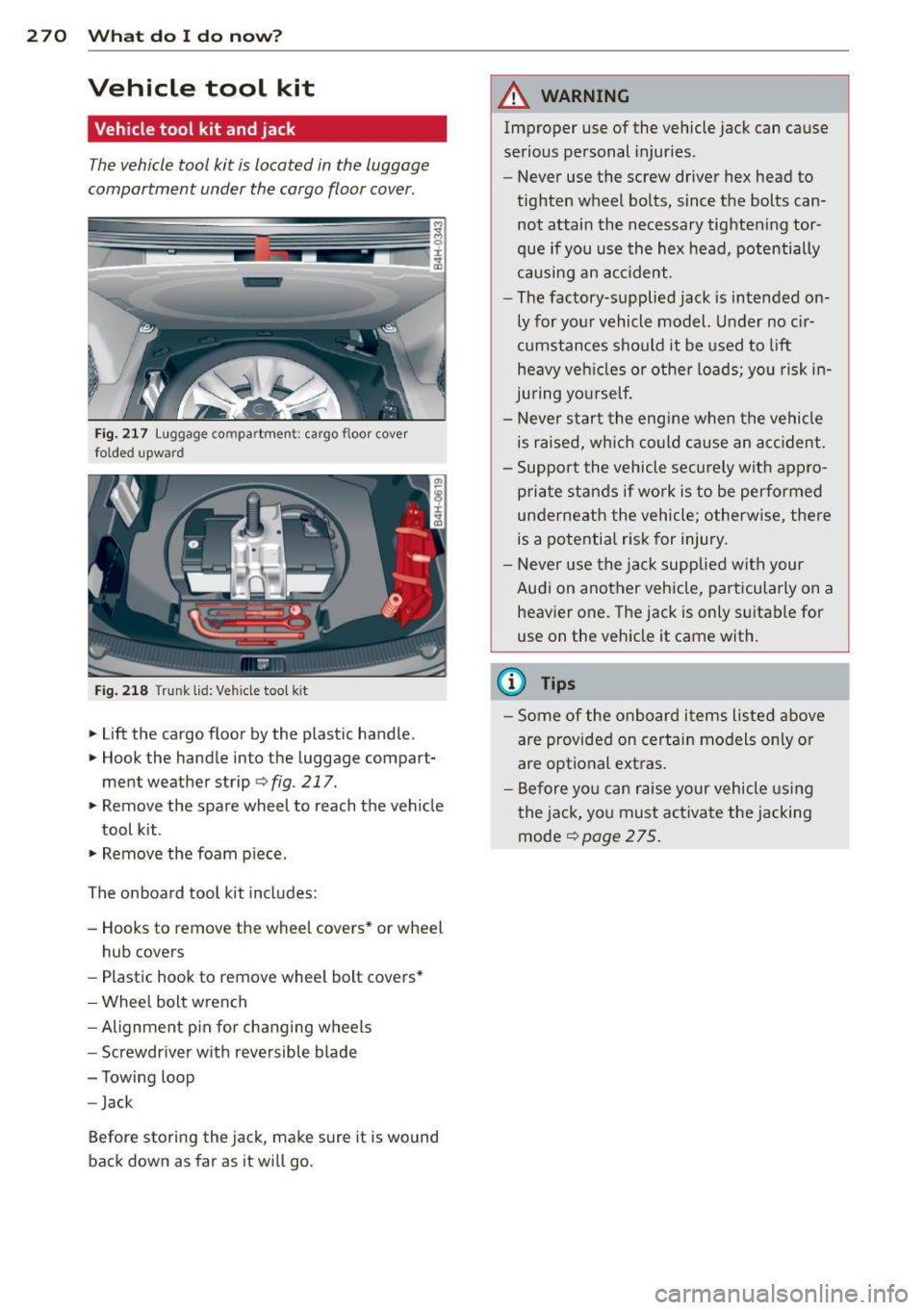
The vehicle tool kit is located in the luggage
compartment under the cargo floor cover .
Fig. 217 Luggage compartment: cargo floor cove r
folded upward
Fig . 218 Trunk lid: Vehicle tool k it
... Lift the cargo floor by the plastic handle.
... Hook the handle into the luggage compart
ment weather strip
c> fig. 217.
... Remove the spare wheel to reach the vehicle
tool kit .
.,. Remove the foam p iece.
The onboard tool kit includes:
- Hooks to
remove the wheel covers* or wheel
hub covers
- Plastic hook to remove wheel bolt covers*
- Wheel bolt wrench
- Alignment p in for changing wheels
- Screwdriver with reversible blade
- Towing loop
- Jack
Before storing the jack, make sure it is wound
back down as far as it will go.
A WARNING
-Improper use of the vehicle jack can cause
serious personal injuries.
- Never use the screw driver hex head to
tighten wheel bolts, since the bolts can
not attain the necessary tighten ing tor
que if you use the hex head, potentially
causing an accident.
- The factory-supplied jack is intended on
ly for your vehicle model. Under no cir
cumstances should it be used to lift
heavy vehicles or other loads; you risk in
juring yo urself.
- Never start the engine when the vehicle
is raised, wh ich could cause an acc ident.
- Support the vehicle securely with appro
priate stands if work is to be performed
underneath the vehicle; otherwise, there
is a potential risk for injury.
- Never use the jack supplied with your
Audi on another vehicle, particularly on a
heavier one. The jack is only suitable for
use on the vehicle it came with.
(D Tips
- Some of the onboard items listed above
are provided on certain models only or
are optional extras .
- Before you can raise your vehicle using
the jack, you must activate the jacking
mode
c> page 275 .
Page 274 of 314
272 What do I do now ?
Spare wheel
App lies to vehicles: with spare wheel
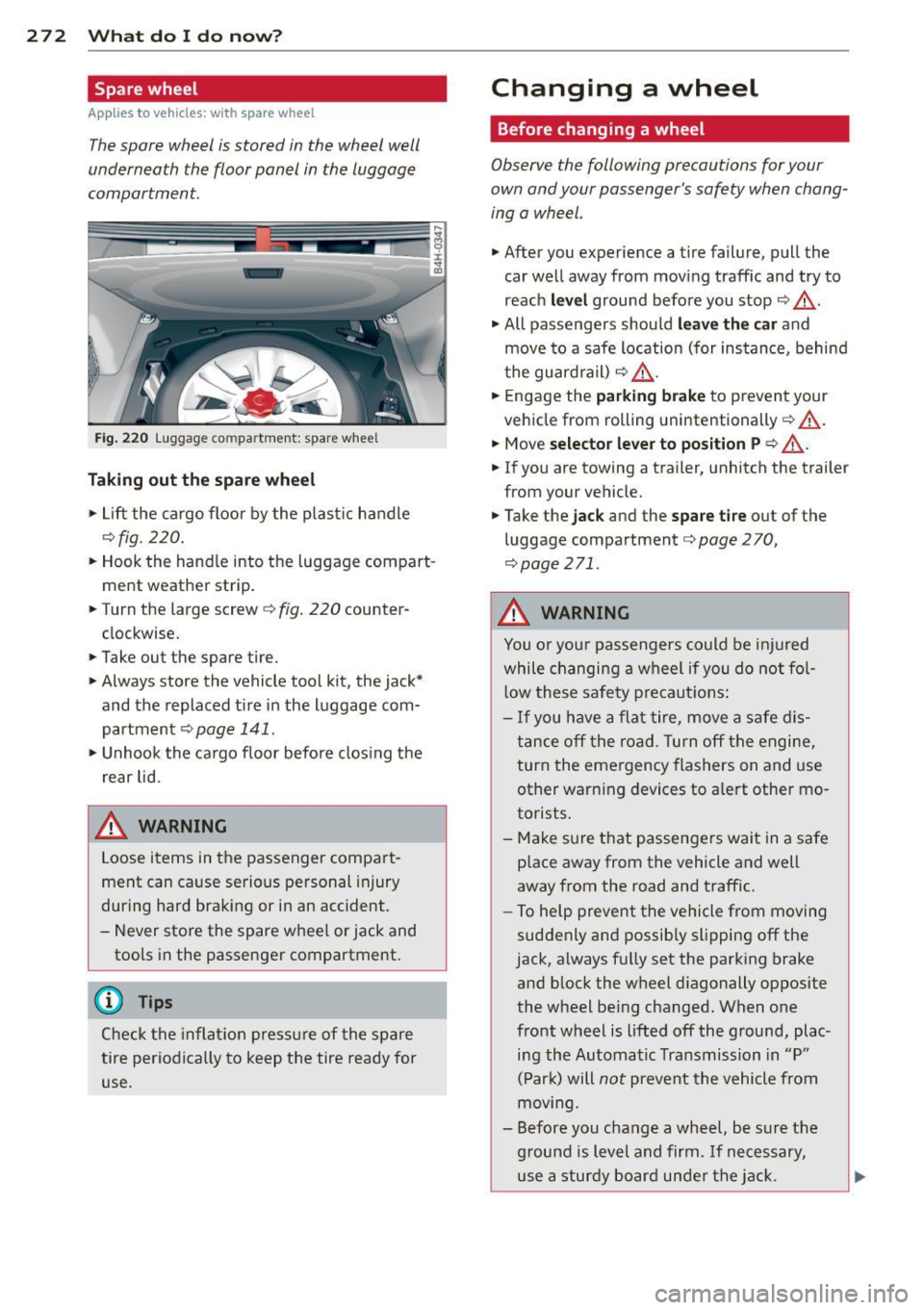
The spare wheel is stored in the wheel well
underneath the floor panel in the luggage
compartment.
Fig. 220 L uggage compartment: spare wheel
Taking out the spare wheel
.,. Lift the cargo floor by the plastic handle
¢fig. 220.
.. Hook the hand le into the luggage compart
ment weather strip .
.. Turn the large screw¢
fig. 220 counter
clockwise.
.. Take out the spare tire.
.. Always store the vehicle tool kit, the jack*
and the replaced tire in the luggage com
partment ¢
page 141.
.,. Unhook the cargo floor before closing the
rear lid.
&_ WARNING
-
Loose items in the passenger compart
ment can cause serious personal injury
during hard braking or in an accident.
- Never store the spare wheel or jack and
tools in the passenger compartment.
(D Tips
Check the inflat ion pressure of the spare
tire periodically to keep the tire ready for
use.
Changing a wheel
Before changing a wheel
Observe the following precautions for your
own and your passenger's safety when chang
ing a wheel.
.. After you experience a tire failure, pull the
car well away from moving traffic and try to
reach
level ground before you stop ¢ .&_ .
.. All passengers should leave the car and
move to a safe location (for instance, behind
the guardra il)¢ .&_ .
.. Engage the
parking brake to prevent your
vehicle from rolling unintentionally¢ .&_.
.. Move
selector lever to position P ¢ A .
.. If you are towing a trailer, unhitch the trailer
from your vehicle .
.,. Take the
jack and the spare tire out of the
luggage compartment¢
page 270,
¢page 271.
&_ WARNING
You or you r passengers could be injured
while changing a wheel if you do not fol
l ow these safety precautions:
-If you have a flat tire, move a safe dis
tance off the road. Turn off the engine,
turn the emergency flashers on and use
other warning devices to alert other mo
torists .
- Make sure that passengers wait in a safe
p lace away from the vehicle and well
away from the road and traffic.
- To help prevent the vehicle from moving
suddenly and possib ly slipping off the
jack, always fully set the parking brake
and block the wheel d iagonally opposite
the wheel be ing changed. When one
front wheel is lifted off the ground, plac ing the Automatic Transmission in "P"
(Par k) will
not prevent the vehicle from
mov ing.
- Before you change a wheel, be sure the
g rou nd is level and firm. If necessary,
use a sturdy board under the jack.
-
Page 285 of 314
Emergency situations
General
This chapter i s intended for trained emer
gency crews and working personnel who have the necessary tools and equipment to
perform these operations.
Starting by pushing or
towing
(D Note
Ve hicles w ith an au tomatic tra nsmission
cannot be started by pus hing o r tow ing.
Starting with jumper
cables
If necessary, the engine can be started by
connecting it to the battery of another vehi
cle.
If the engine shou ld fail to start because of a
discha rged o r wea k battery, the battery can be
connected to the battery o f
another vehicle,
using a
pair of jumper cables to start the en
g ine.
Jumper cables
Use only jumper cables of sufficiently la rge
c ross section to carry the starter c urrent safe
l y. Refer to the man ufacturer's specifications.
Use only jumper cables with
insulated te rm i
na l clamps wh ic h are d istinctly marked:
plus(+) cable i n mos t cases co lore d red
minu s(-) cable
in most cases colored black .
A WARNING
Batterie s contain e lec tricity, ac id, an d gas.
A ny of these can cause ve ry ser io us or fatal
inju ry. Follow the instructions below f or
safe han dling of your veh icle's b attery .
- Alway s shield you r eyes and avoid lean
ing over the bat te ry whenever possib le.
- A dis ch arged battery c an free ze at tem
peratures ju st be low 32 °F ( 0 °C ). Befo re
Emergency situations 283
connecting a jumpe r cab le, you must
thaw the frozen battery c omp lete ly, ot h
erwise it could explode.
- Do not allow battery acid to contact eyes
or skin. Fl ush any contacted area with
wate r immediately.
- Improper use of a booster battery to start a vehicle may cause an explosion.
- Vehicle batter ies genera te exp losive gas
es. Keep spar ks, flame and lighted c iga
rettes away from batte ries.
- Do not try to jump start any ve hicle w ith
a low ac id leve l in the battery.
- The vo ltage of the booste r batte ry m ust
a lso have a 12-Vol t rating. T he capacity
(Ah) of the booster battery sho uld not be
lowe r tha n that of the discharged bat
tery . Use of batte rie s of d iffe ren t voltage
or substantially diffe rent "Ah" rat ing
may c au se an exp losion and persona l in
JU ry.
- N ever cha rge a fro zen battery. Gas trap
pe d in the ice may cause a n ex plosion.
- Never cha rge or use a batte ry tha t h as
been fr ozen. T he battery case may have
be weakened.
- Us e of b atter ies of differe nt voltage or
sub stant ia lly diffe ren t ca pa city (Ah) ra t
i ng may c ause an ex plosion an d injury .
Th e capac ity (Ah) of the booster bat tery
should not be lower than that of the dis
charged batte ry .
- Before you chec k any thing in the engine
compa rtment, always read and hee d all
WARNINGS
¢page 231.
(D Note
-App lyin g a higher vo ltage booster ba t
t ery w ill cause expens ive damage to se n
sit ive e lectronic com ponents, such as
cont ro l units, relays, rad io, etc.
- The re must be no electrical contact be
tween the vehicles as ot herwise c urrent
co uld a lready start to f low as soon as the
p o sit ive(+) term inals a re connected. ..,. •
•
Page 287 of 314
-When connecting jumper cables, make
sure that they cannot get caught in any
moving parts in the eng ine compart
ment .
- Before you check anything in the engine
compartment, always read and heed all
WARNINGS
¢ page 231.
(D Note
Improper hook-up of jumper cables can r u
in the generator.
- Always connect POSITIVE( +) to POSI
TIVE(+), and NEGATIVE(-) to NEGATIVE
( - ) gro und post of the battery manager
control unit .
- Check that all screw plugs on the battery
cells a re screwed in firmly . If not, tighten
pl ugs p rior to connecting clamp on nega
tive battery term inal.
- Please note that the procedure f or con
nect ing a jump er cable as desc ribed
above appl ies spec ifically to the case of
you r vehi cle be ing jump started. When
you are giv ing a jump star t to an othe r ve
hi cle, do
not connec t the negat ive (-) ca
ble to the negat ive (-) terminal on the
discharged battery @¢
fig. 234. In
stead, securely connect the negative( -)
cable to e ithe r a solid metal component
that is firmly bolted to the engine block
or to the e ng ine block itse lf. If the bat
te ry tha t is being charged does not vent
to the outside, escaping batte ry gas
could igni te and exp lode!
Emergency towing
with commercial tow truck
General hints
Your Audi requires special handling for tow
tng.
The follow ing information is to be used by
commercia l tow tr uck operators who know
h ow to ope rate thei r equipme nt safe ly.
Emergenc y situ ation s 285
-Ne ver tow your Audi. Towing will cause
damage to the engine and tran smission.
- Never wrap the safety chain s or w inch ca
ble s around the brake lines.
- To prevent unnece ssary damage , your Audi
must be transported with a flat bed tru ck.
- To load the vehicle on to the fl at bed , use
the towing loop found in the vehicle tools
a nd attach to the front or rear anchora ge
¢ page 285 and ¢ page 286 .
_& WARNING
A vehicle being towed is not safe for pas
sengers. Never allow anyo ne to ride in a
vehicle be ing towed, for any reason.
Front towing loop
Only install the front towing loop when it is
needed.
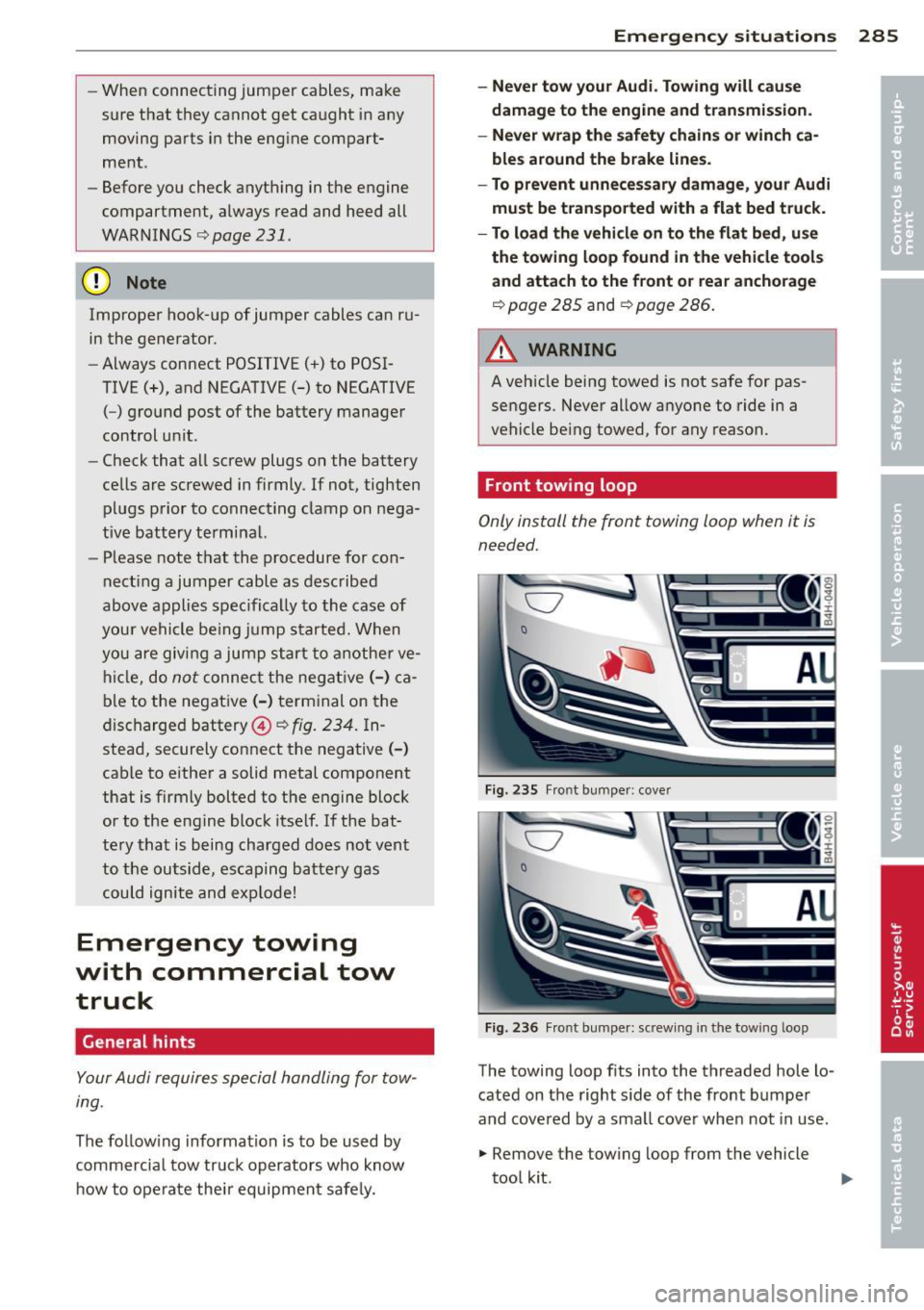
Fig. 23 5 Front bu mpe r: cove r
Fig. 236 Fr ont bu mpe r: sc rew ing in t he tow ing loop
-
The towing loop f its into the threaded hole lo
cated on the right s ide of the front bumpe r
and cove red by a sma ll cove r when not in use .
.. Remove the tow ing loop from the vehicle
too l kit .
Page 288 of 314
286 Emergency situations
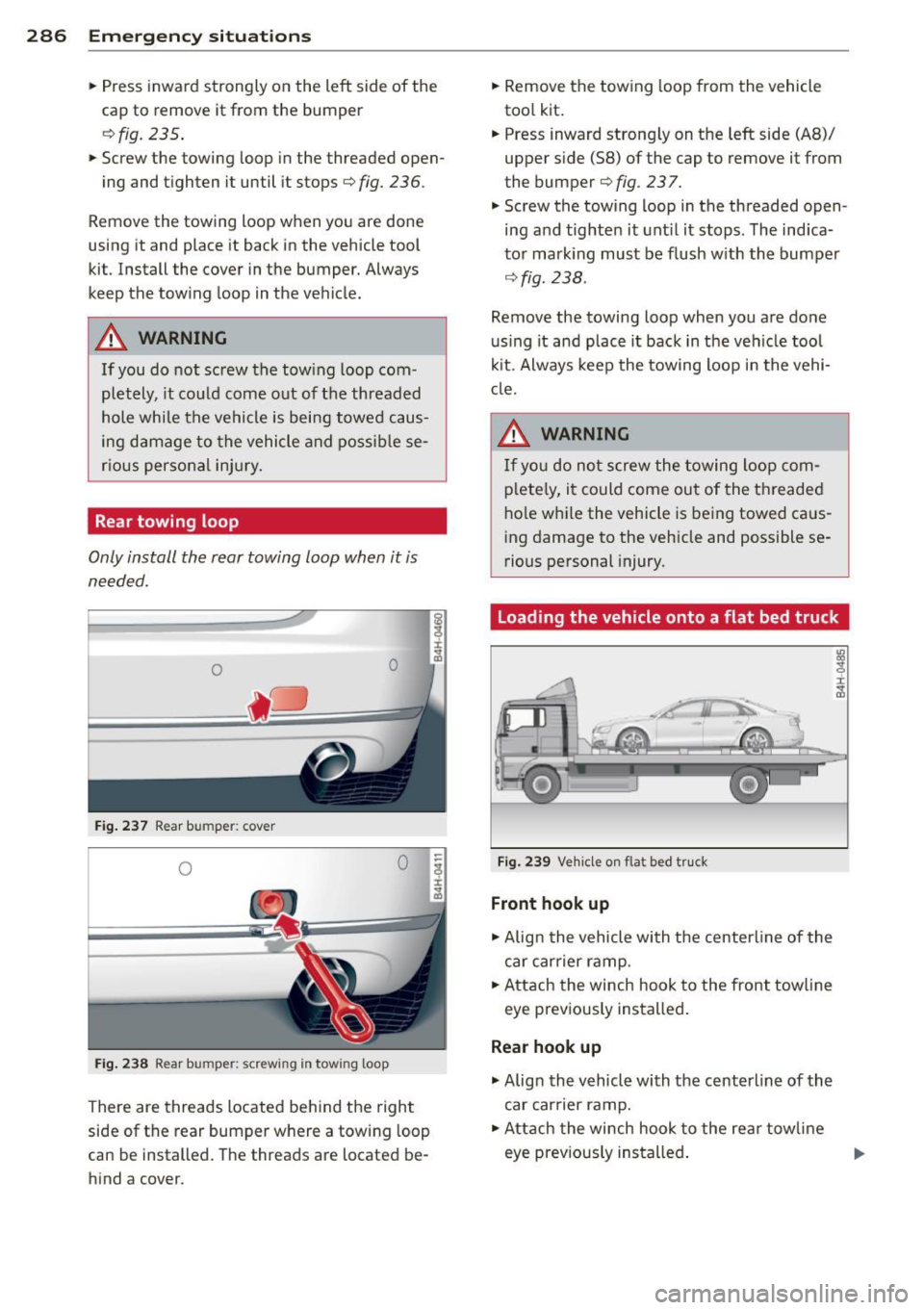
• Press inward strongly on the left side of the
cap to remove it from the bumper
¢ fig . 235 .
• Screw the towing loop in the threaded open-
ing and tighten it until it stops¢
fig. 236 .
Remove the towing loop when you are done
using it and place it back in the vehicle tool
kit. Install the cover in the bumper. Always
keep the tow ing loop in the vehicle.
A WARNING
If you do not screw the towing loop com
pletely, it could come out of the threaded
hole while the vehicle is being towed caus
ing damage to the vehicle and possible se
r iou s personal injury.
Rear towing loop
Only install the rear towing loop when it is
needed.
0 0
Fig. 237 Rear bumpe r: cover
0
Fig. 238 R e ar b umper: screw ing in tow ing loop
There are threads located behind the right
side of the rear bumper where a towing loop
can be installed. The threads are located be
hind a cover. •
Remove the towing loop from the vehicle
tool kit.
• Press inward strong ly on the left side (A8)/
upper side (58) of the cap to remove it from
the bumper
¢ fig . 237.
• Screw the towing loop in the threaded open
ing and tighten it until it stops . The indica
tor mark ing must be flush w ith the bumper
¢ fig. 238 .
Remove the towing loop when you are done
using it and place it back in the veh icle tool
kit. Always keep the towing loop in the vehi
cle.
A WARNING
If you do not screw the towing loop com
pletely, it could come out of the threaded
hole while the vehicle is being towed caus
ing damage to the vehicle and possible se
rious personal injury.
Loading the vehicle onto a flat bed truck
Fig. 239 Vehicle on flat bed tr uck
Front hook up
"" Align the vehicle with the centerl ine of the
car carrier ramp.
"" Attach the winch hook to the front towline
eye previously installed.
Rear hook up
"" Align the vehicle with the centerline of the
car earner ramp.
• Attach the winch hook to the rea r tow line
eye previous ly installed .
-
Page 294 of 314
292 Consumer Information
Consumer Information
Warranty coverages
You r Audi is covered by the following war
ranties:
- New Vehicle Limited Warranty
- Limited Warranty Against Corrosion Perfo-
ration
- Emissions Control System Warranty
- Emissions Performance Warranty
- California Emissions Control Warranty (USA
vehicles only)
- California Emissions Performance Warranty
(USA vehicles only)
Detailed information regarding your warran
ties can be found in your
Warranty & Mainte
nance booklet .
Operating your vehicle
outside the U.S.A. or
Canada
Government regu lations in the United States
and Canada require that automobiles meet
specific emission regulations and safety
standards. Therefore, veh icles built for the
U.S.A . and Canada differ from vehicles sold in
other countries .
If you p lan to take your vehicle outside the
continental limits of the United States or Can
ada, there is the possibility that:
- unleaded fuels for vehicles with cata lytic
converter may not be available;
- fuel may have a considerably lowe r octane
rating. Improper fuel may cause engine
damage ;
- service may be inadequate due to lack of
proper service facilities, tools or testing
equipment ;
- replacement pa rts may not be readily availa
ble.
- Navigation systems for vehicles built for the
U.S.A. and Canada will not necessar ily work
in Europe, and may not work in other coun
tries outside North America .
(D Note
Audi cannot be responsible for mechanical
damage that could result from inadequate
fuel, service or parts availability.
Audi Service Repair Manuals and Literature
Audi Official Factory Service Manuals and Lit
erature are published as soon as possible after
model introduction. Service manuals and lit
erature are available to order from the Audi
T echnical Literature Ordering Center at:
www.audi.techliterature.com
Maintenance
General
Your vehicle has been designed to help keep
maintenance requirements to a minimum.
However, a certain amount of regular mainte
nance is still necessary to assure your vehicle's
s afety, economy and rel iability. For detailed
vehicle maintenance consult your Warranty &
Maintenance booklet.
Under difficult operating conditions, for ex
ample at extremely low outside temperatures,
i n very dusty regions , when towing a trailer
very frequently, etc., some service work
should be performed between the intervals
specified. This applies particularly to:
- oil changes, and
- cleaning or replacing the air filter .
(® For the sake of the environment
By regularly maintaining your vehicle, you
help make sure that emission standards
are maintained, thus minimizing adverse
effects on the environment.
Important considerations for you and
your vehicle
The increasing use of electronics, sophisticat
ed fuel injection and emission contro l sys-
tems, and the genera lly increasing technical
liJJ,
Page 302 of 314
300 Index
Defrosting (windows) ......... .. .... .. 81
Deluxe automatic climate control . . . . . . . 80
Determining co rrect load limit ... ..... 257
D iese l fue l ..... ........... .... .... . 223
Diesel particulate filter . . . . . . . . . . 21,208
Digita l compass ............ ... .... .. 56
Dimensions .... ............. .. .... . 290
Dimming the rearview mirror .. .. ...... 56
Disp lays
C leaning ... ................ ..... . 218
Distance
. ... .......... ...... ... .. .. 25
Door/rear lid warning . . . . . . . . . . . . . . . . .
24
Doors
Mechanical child safety lock . ..... .. .. 41
Power child safety lock ........ .... . . 41
Driver information system
CD/radio display . . . . . . . . . . . . . . . . . . . . 24
Door/rear lid warning . . . . . . . . . . . . . . . 24
Efficiency program . . . . . . . . . . . . . . . . . . 26
Exterior temperature display ..... .. .. 24
On-board computer . . . . . . . . . . . . . . . . . 25
Driver seating position
drive select
adaptive air suspension/sport ... .. .. .
Ad . d
apt,ve ampers ......... ... .. .. .
Curve light . ... . ...... ... .. .. .. .. .
D . t . ynam,c s eering ....... .. .. .. .. .. .
Eng ine sound ............ .. .. .. .. .
Safety belt tensioner ....... ... .... .
Sport differential .......... ... .... .
Drive select .. ... .. ..... ... .. .. .. .. .
Driving safely .. ........... .. .. .... . 136
110
110
110
110
110
110
110
110
135
Driving through water ........ .. .. .. . 209
Driving time . . . . . . . . . . . . . . . . . . . . . . . . 25
Duplicate key . . . . . . . . . . . . . . . . . . . . . . . 31
Dust filter
refer to Pol lutant filter (automatic A/C
system) .... ................ ..... .. 79
Dynamic steering . . . . . . . . . . . . . . . 22, 110
E
Easy entry feature ............ .. .... .. 83
EDL
refer to E lectronic differentia l lock ... . 199 Efficiency
program . . . . . . . . . . . . . . . . . . . 26
Fuel economy messages . . . . . . . . . . . . . 26
Other equ ipment ................. .. 26
E lectr ica l accessories (sockets) . . . . . 68, 74
Electromechanical parking brake Emergency braking ............... .. 88
Operation . . . . . . . . . . . . . . . . . . . . . . . . . 86
Parking ... .. .. .. .. ........... .. .. . 87
Re leas ing and closing .............. . 86
Starting assist ... ............. .. .. . 87
Starting from rest ................ .. 87
Starting
off with a trailer ............. 88
Warning/indicator lights ........ ... .. 15
E lectronic differential lock .......... .. 199
Warning/ind icator lights ........ .... . 18
Electronic differential lock (EDL)
Warning/ind icator lights . ............ 19
E lectronic immobilizer . . . . . . . . . . . . 27, 32
E lectronic power control (EPC)
warning/indicator light . . . . . . . . . . . . . . 20
Electronic speed limiter ............. .. 30
E lectronic Stabilization Contro l (ESC) . .. 199
Warning/indicator lights ............ . 18
Emergency actuat ion
Doors ........ .. ............. ... .. 37
Luggage compartment lid .......... .. 40
Parking lock ..... ................ . 121
Power sunroof .................. .. . 44
Emergency brak ing . ... .......... .. .. . 88
Emergency flasher . ................ .. 47
Warning/ind icator lights ..... ... .. .. . 23
Emergency operation
Panoramic sunroof ............. .. .. . 45
Sun shade (roof) .............. .... . 4S
Emergency starting ................ . 283
Emergency towing ...... ........... . 285
Emergency warn ing triangle ...... .... 269
Energy management
Engine 204
Compartment .. .. ..... ........... . 233
Coolant ...... ... .. .............. . 239
Data ....... .. .. .. ........... .... 291
Start-Stop-System ............. .. .. . 88
starting ....... .. .. .............. .. 84
Starting with jumper cables ...... ... 283
St .
opping .. .... .. .. .............. .. 84
Page 309 of 314
Spare tire
refer to Compact spare tire
271
Spare wheel ....................... 272
Speedometer ....................... 27
Speed rating letter code .. ... .. .. .. .. . 260
Speed warn ing system ...... .. .. .. .. .. 91
Sport different ia l . ...... ... .. .. .. .. . 1 10
Indicator light . . . . . . . . . . . . . . . . . . . . . 23
S tart -Stop-System . . . . . . . . . . . . . . . . . . . 88
E ng ine does not switched off ... .. .. .. 89
Engine starts automatically . ... .. .. .. 89
Indicator lights . . . . . . . . . . . . . . . . . . . . 89
Messages ................... ...... 91
Starting/stopping the engine ......... 89
switch ing off/on .......... .. .. .. .. .. 90
S TART ENGINE STOP b utton ... .. .. .... 84
Start ing from rest . . . . . . . . . . . . . . . . . . . . 87
Starting off with a trailer .............. 88
S tarting the eng ine ..... ... .. .. .. .. .. 84
Steer ing whee l
Ad justing steering column ..... ...... 83
E asy en try featu re .................. 83
I ndicator ligh t . . . . . . . . . . . . . . . . . 17, 2 2
Shift paddles ... ...... ... .. .. .. .. . 119
Steering whee l heating . ... .. .. .. .. .. 82
Steps fo r determining co rrect load lim it . 257
Stopping the engine . . . . . . . . . . . . . . . . . . 84
S to rage ............................ 75
Sunroof ..... .. .. ........... .. .. .... 43
Sun shades Emergency closing (roof) ............. 45
Panoramic sunroof .................. 45
Reardoo~ ........................ 52
Rear window . . . . . . . . . . . . . . . . . . . . . . . 52
Sun visors ... .. ... ..... ... .. .. .. .... 51
Symbo ls
refer to W arning/Indica to r li gh ts ...... 11
T
Tachometer . . . . . . . . . . . . . . . . . . . . . 11, 24
Ta il lights
C leaning ......................... 217
TD I clean diese l
refer to Ad Blue .... .... ... .. .. .. ... 227
Techn ica l data ...................... 289
Technica l mod ifications .............. 295
Index 307
Temperat ure display . .. .. ..... ... .. .. . 24
T e ther anchors .. ................... 194
Tether strap . . . . . . . . . . . . . . . . . . . . . . . 194
T extiles
Cleaning . ... .. .. .. . ... ...... ... .. 219
The first 1,000 miles (1,500 km) and after-
wards ........ .. .... ............... 207
Tie-downs . . . . . . . . . . . . . . . . . . . . . 70, 142
T ips for the environmen t
Saving f uel .. .. .. .. . ... ...... ... .. . 73
tiptron ic (automatic t ransm ission) ..... 116
Tire pressure ....................... 254
T ire pressu re mon itor ing system ....... 266
L oss of air p ress ure .. .. ..... ... .. .. 267
Malfunction ....... . .. .. ..... ... .. 267
Resetting tire pressures . ..... ... .. .. 268
T ires .............................. 248
Serv ice life ....................... 258
speed ra ting lette r code ..... ... .. . .
Tire manu fact uring date ..... ... .. . .
Tire specifications . .. ... .... ... .. . .
Tread depth ..................... .
Uniform tire quality grading ........ .
W' t t' in er
ires ..................... . 2
60
260
260
258
262 263
T ires and vehicle load limi ts .... ... .. .. 256
Tires and wheels Check ing tire p ress ure .............. 254
Co ld tire infla tion pres sure .......... 252
D imens ions ....................... 259
General notes ...... . .. .. ..... ... .. 248
G lossary of tire and loading terminolo-
gy .............................. 249
Low aspect ratio tires ............... 265
New tires and wheels ............... 259
Rep laci ng ... .. ... ................ 260
S now cha ins ... ... ................ 264
Tires and veh icle load lim its ....... .. 256
Whee l bolts ...................... 265
Win ter tires ...................... 263
Tire service life .. .. .. . .. ....... ... .. 258
Too ls . ... .. .. .... .. . .. .. ..... ... .. 270
T o rn o r frayed safety belts ............ 148
Towing Tow truck procedures ............... 285
TPMS Tire pressure mo nitoring system ... .. 267
•
•
Page 310 of 314
308 Index
Trailer towing
212
Operating instructions .............. 212
Park ing system ............ ... .... . 132
Technical requirements .... .. .. 212,213
Trailer towing tips .......... .. .... . 214
Train (transporting your vehicle) .... .. . 287
Transm ission . .............. ... .. ... 116
Transmission malfunction (indicator light) . .. .. .. ............. .. .. .. ... 120
Transport Canada .............. .... . 143
Transporting your vehicle .... .. .. .. .. . 287
Tread Wear Indicator (TWI) ... ... .. .. . 258
Trip odometer ............. .. .. .... .. 27
What does it mean when DEF appears in
the trip odometer d isplay? ......... .. 27
Trunk
refer to Luggage compartment lid . .. . . 37
Trunk escape handle ........ .. .. .... . 269
Turn signa ls . ................. ..... .. 48
Warning/indicator lights ........... . . 23
u
Unfasten ing safety belts 150
Unidirectional tires ............. .. .. . 248
Uniform tire quality grading ....... .. . 262
Unlock ing
L uggage compartment lid .. .. .. .. .. . . 37
Power locking switch ...... .. .. .... .. 36
Remote control .................... 35
Using the key ...................... 36
V
Valet parking ................. ..... .. 42
Vanity mirrors . . . . . . . . . . . . . . . . . . . 51, 52
Vehicle care/cleaning .............. .. .... . 216
Vehicle e lectrical system ...... .. .... .. 16
Vehicle identification label . ........ .. . 289
Vehicle Identification Number (VIN) ... . 289
Vehicle jack . . . . . . . . . . . . . . . . . . . 270, 275
Vehicle literature . . . . . . . . . . . . . . . . . . . . . 5
Vehicle shutt-down .......... ... .... . 209
Vehicle transport . .......... ... .. .. . 287
Venti lation ............... .. .. .... .. 79 Vinyl
Cleaning . ..... .. ................ . 219
w
Warning/indicator lights ............. . 11
Airbag system ... ............. ..... 18
Anti- lock braking system (ABS) ........ 19
Brake system . . . . . . . . . . . . . . . . . . . . . . 14
Electromechanical parking brake . .... . 15
Electronic power control . . . . . . . . . . . . . 20
Electronic Stabilization Control ( E5C) .. . 18
Generator ... .. .. ....... ...... .. .. . 16
Glow p lug system . . . . . . . . . . . . . . . . . . 20
Instrument cluster ............. .. .. . 10
Malfunction Ind icator Lamp (MIL) .. .. . 20
Safety be lt . ... .. ................ .. 16
T urn signals ..... ............. ..... 23
Warning/Indicator lights
Airbag system ... ............. .... 164
Dynamic steering . ............. .. .. . 22
PASSENGER AIR BAG OFF ........ ... 164
Warranty coverages .............. ... 292
Washer reservoir .. ................ . 247
Wear indicator .. .. ............. .... 258
Weights .. .. .. ... ... ... ..... ... .. .. 289
What happens if you wear your safety belt
too loose? .. .... .. ................ . 149
What happens to unbelted occupants? .. 146
What impairs driving safety? .... .. .. .. 136
What shou ld I do after changing a
whee l? ......... .. ................ . 255
What should I do after replac ing wheels? 255
Wheel bolts Torque .... .... ................... 265
Wheels ... ..... .. ................ . 248
Checking tire pressure .............. 254
Cleaning .. .... .. ............. .... 217
Cold tire inflation pressure ...... .. .. 252
General notes .. .. ............. .... 248
Glossary of tire and loading terminolo -
gy ........ ... .. .. ... ....... ... .. 249
New tires and whee ls ... ... ..... .. .. 259
T ires and veh icle load limits ..... .. .. 256
When must a safety belt be replaced? .. 148
When must the airbag system be inspect -
ed? ......... ... .. .. ............... 164