weight AUDI S8 2014 Owner's Guide
[x] Cancel search | Manufacturer: AUDI, Model Year: 2014, Model line: S8, Model: AUDI S8 2014Pages: 314, PDF Size: 78.47 MB
Page 197 of 314
be su ppressed causing serious o r even
fatal injury to the child.
- If you must i nstall a rearward facing
child safety seat on the front passenger
seat because of exceptional circumstan
ces and the
PASS ENGER AIR BA G OFF
light does not come on an d stay on, im
med iately install the rear-facing child
safety seat in a rear seating position and
have the a irbag system inspected by you r
Audi dealer.
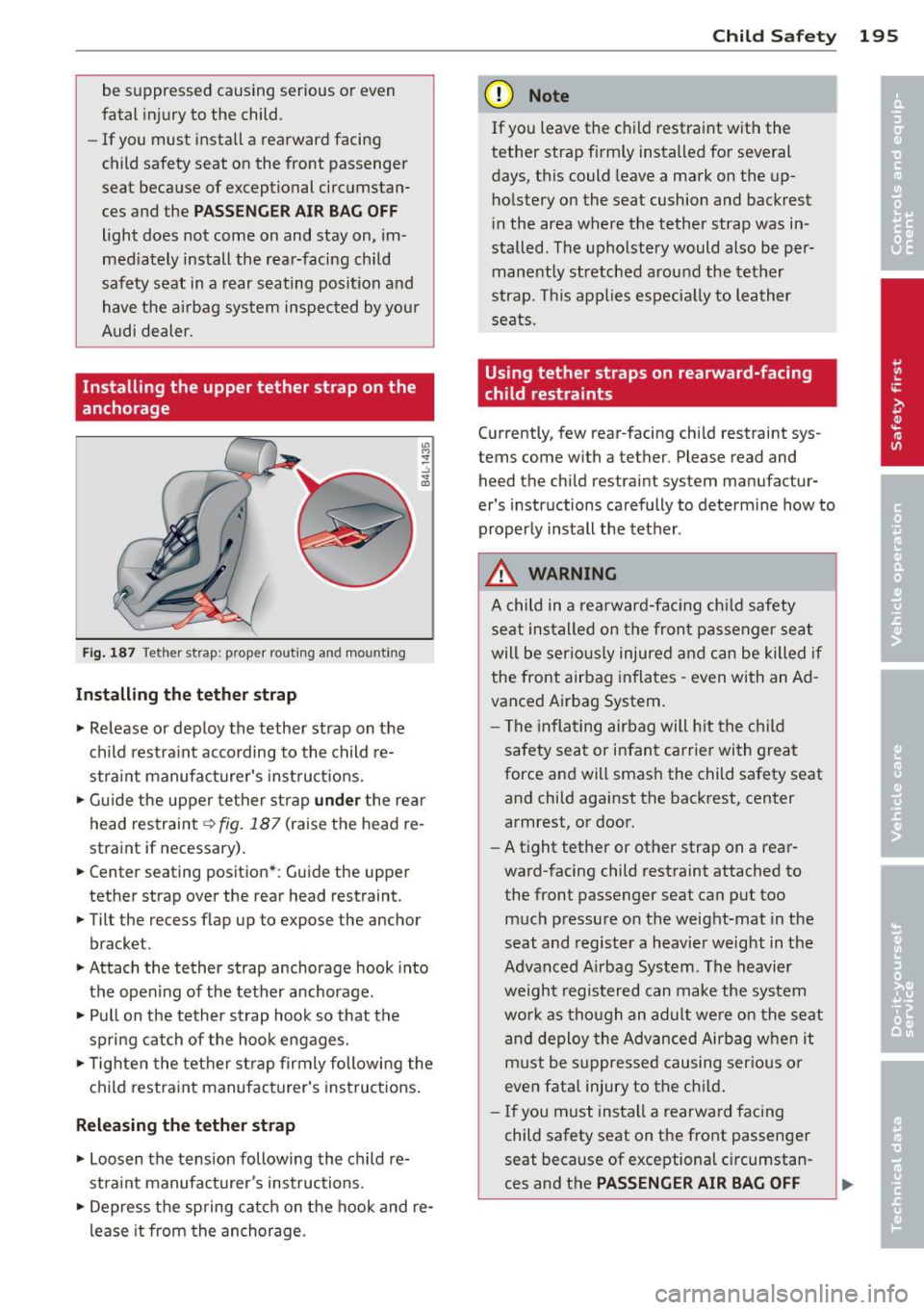
Installing the upper tether strap on the
anchorage
Fig. 187 Tether strap: prope r rout ing and mounting
Installing th e tether strap
• Release or dep loy the tether strap on the
child restra int according to the child re
stra int manufacturer's inst ruct ions .
• Gui de the upper tether strap
under the rear
head restraint
r=> fig. 187 (raise the head re
straint if necessary) .
• Center seating position* : Guide the upper
tether strap over the rear head restraint.
• Tilt the recess flap up to expose the anchor
bracket.
• Attach the tether strap anchorage hook into
the open ing of the tether anchorage .
• Pull on the tether strap hook so that the
spri ng catch of the hoo k engages.
• Tighte n the tet her st rap firmly following the
child restraint manufacturer's inst ruct ions .
Releasing the tether strap
• Loosen the tension following the ch ild re
stra int manufacturer's instructions.
• Depress the sp ring catch on the hook and re
l ease it from the anchorage.
Child S afety 195
(D Note
If you leave the c hild restraint with the
tether strap firmly installed for several
days, th is could leave a mark on the up
holstery on the seat cushion and backrest
i n the area where the tether strap was in
stalled. The upholstery would also be per manently stretched around the tether
strap. This app lies especia lly to leather
seats.
Using tether straps on rearward-facing
child restraints
Currently, few rear-facing child restraint sys
tems come with a tether. Please read and
heed the child restraint system manufactur
er's instructions carefully to determine how to
properly install the tether .
A WARNING ,.;; -
A child in a rearward-facing ch ild safety
seat installed on the fron t passenger seat
will be ser io usly injured and ca n be killed if
the front airbag inflates -even with an Ad
vanced Airbag System.
- The infla ting air bag will h it the ch ild
safety seat or i nfant carrier with great
force a nd will smas h the child safety seat
and child against the backrest, center
armrest, or door.
- A tight tether or other strap on a rear
ward-facing child restraint attached to
the front passenger seat can put too
muc h pressure on the weight-mat in the
seat and register a heavier weight in the
Advanced A irbag System. The heavier
weight regis tered can make the system
wo rk as tho ugh an adult we re on the seat
an d deploy the Advanced Airbag when it
m ust be s uppressed causing ser ious or
eve n fata l injury to the chi ld .
- If you must insta ll a rearward fac ing
child safety seat on the front passenger
seat because of exceptiona l circumstan
ces and the
PASSENGER AIR BAG OFF
Page 214 of 314

212 Trailertowing
Trailer towing Driving with a trailer
General information
Your Audi was designed primarily for passen
ger transportation .
If you plan to tow a trai ler, please remember
that the additional load will affect durability,
economy and performance .
Trailer towing not only places more stress on the vehicle, it also calls for more concentra
tion from the driver.
For this reason, always follow the operating
and driving instructions provided and use
common sense.
(D Note
If you are going to tow a trai ler, you must
activate the trailer operation mode
i::> page 212, Operating instructions .
Technical requirements
Trailer hitch
Use a weight-carrying hitch conforming to the
gross trailer weight. The hitch must be suita ble for your vehicle and trailer and must be
mounted securely on the veh icle 's chassis at a
technically sound location . Use only a trailer
hitch with a removable ball mount. A lways
check with the trai le r hitch manufacturer to
make sure that you are using the cor rect
hitch.
Do not use a bumper hitch.
The hitch must be installed in such a way that
it does not interfere with the impact-absorb
ing bumper system. No modifications should
be made to the vehicle exhaust and brake sys
tems. From time to time, check that all hitch
mounting bo lts remain securely fastened.
When you are not towing a trailer, remove the
trailer hitch ball mount. This prevents the
h itch from causing damage should your veh i
cle be struck from behind~ &.
Trailer brakes
If your trailer is equipped with a brak ing sys
tem, check to be sure that it conforms to all
regulations.
T he trailer hydraulic brake system must not be
direc tly connected to the vehicle's hydraulic
brake system .
Safety chains
Always use safety chains between your veh icle
and the tra iler.
Trailer lights
Trailer lights must meet all regulations. Be
sure to check with your Audi dealer for correct
wiring, switches and relays.
Mirrors
If you are unable to see the traffic behind you
using the regular outside mirrors, then you
must install extended mirrors. It is important
that you
always have clear v is ion to the rear .
A WARNING ,~ -
After removing the trailer hitch, do not
store it in your vehicl e. In case of sudden
braking, the hitch could fly forward and in
jure you or your passengers.
Operating instructions
Fig. 189 MMI display : tow ing mode on
Maximum traile r weight
A trai ler for your vehicle is limited to a typical
class 1 or class 2 trailer. .,.
Page 215 of 314
Trailer load distribution Be sure the load in the trailer is held securely
in place to prevent it from shifting forward,
backward or sideways.
Never allow a passenger to ride in a trailer
¢ .&. in Driving instructions on page 214.
Engine cooling system
Towing a trailer makes the engine work hard
er . It is important that the cooling system's
performance is up to the additional load .
Make sure that the cooling system has enough
fluid.
Tire pressure
When towing a trailer, inflate the tires of your
vehicle to the cold tire pressure listed under
"Full load" on the label located on the driver's
side B-pillar (visible when the door is open).
Inflate trailer tires to trailer and tire manufac
turers' specifications.
Lights
Check to make sure both vehicle and trailer
lights are working properly.
Safety chains Be sure trailer safety chains are properly con
nected from the trailer to the hitch on the ve
hicle . Leave enough slack in the chains to per
mit turning corners . When you install safety
chains, make sure they will not drag on the
road when you are driving.
The chains should cross under the trailer
tongue to prevent it from dropping in case of
separation from the hitch .
Adjusting the Audi drive select Make sure the vehicle is on a level surface
be
fore
hitching up the trailer and before adjust
ing the tongue weight. The vehicle must be in
auto or comfort driving mode and not raised
¢page 110, ~CD .
Make sure that the vehicle is lowered. In Info
tainment, select:
ICARI function button> low
er control button .
Trailer towing 213
If you must drive under poor road conditions,
you can raise the vehicle
after coupling the
trailer or
after adjusting the tongue weight
¢ page 112.
@ Note
- Changes in temperature or load can af
fect the height of the vehicle.
- Always select auto or comfort mode.
Otherwise, the tongue load specified for
your vehicle will no longer be applicable.
Driving instructions
Driving with a trailer always requires extra
core and consideration.
To obtain the best possible handling of vehicle
and trailer, please note the following:
.,. Do not tow a loaded trailer when your car it
self is not loaded .
.,. Be especially careful when passing other
vehicles.
.,. Observe speed limits.
.,. Do not drive at the maximum permissible
speed .
.,. Always apply brakes early .
.,. Monitor the temperature gauge.
Weight distribution
Towing a loaded trailer with an empty car re
sults in a highly unstable distribution of
weight. If this cannot be avoided, drive at very
low speeds only to avoid the risk of losing
steering control.
A "balanced" rig is easier to operate and con
trol. This means that the tow vehicle should be loaded to the extent possible and permissi
ble, while keeping the trailer as light as possi
ble under the circumstances . Whenever possi
ble , transfer some cargo to the luggage com
partment of the tow vehicle while observing
tongue load requirements and vehicle loading
considerations.
Speed
The higher the speed, the more difficult it be
comes for the driver to control the rig. Do not .,.
•
•
Page 216 of 314
214 Trailer towing
drive at the maximum permissible speed. Re
duce your speed even more if load, weather or
wind condit ions are unfavorable -part icu larly
when going downhill.
Reduce vehicle speed
immedi atel y if the trail
er shows the slightest sign of swaying .
Do not
tr y to stop th e sway ing by acceler ating .
Observe speed limi ts. In some areas, speeds
for vehicles towing trailers are lower than for
regular vehicles .
A lways apply brakes early. When driv ing
downhill, shift into a lower gear to use the en
gine braking effect to slow the vehicle . Use of
the brakes a lone can cause them to overheat
and fail.
Coolant t emperature
The coolant temperature gauge ¢ page 10
must be observed carefully. The coolant tem
perat ure can increase if you drive on long in
clines in a low gear at high engine speeds. Re
duce your speed immediate ly if the L EDs in
the top part of the display turn on.
F or more in formation about indicator lights,
refer to. ¢
page 16.
A WARNING
Anyone not properly restrained in a mov
ing veh icle is at a much greater risk in an
accident . Never let anyone ride in your car
who is not properly wear ing t he restra ints
provided by Aud i.
Trailer towing tips
Important to know
Your vehicle hand les different ly when towing
-
a trailer because of the addit ional weight and
d ifferent weight distribution . Safety, perform
ance and economy w ill greatly depend on how
carefully you load your trailer and operate
your rig.
Before you actually tow your trailer, practice
turning, stopp ing and back ing up in an area
away from traffic . Keep practicing until you have become completely familiar with the way
your vehicle-trailer combination behaves and responds .
Backing up is diffi cult and requ ires practice .
Backing up with a trailer gene rally req uires
steering action opposite to that when backing
up your vehicle without a tra iler.
Maintain a greater d ista nce between you r ve
hicle and the one in front of you . You wi ll need
more room to stop. To compensate for the
trailer, you w ill need a larger than normal
turning rad ius.
When passing, remember that you cannot ac
ce lerate as fast as you norma lly would be
ca use of the added load. Make sure yo u have
enough room to pass. After passing, allow
plenty of room for your trailer be fore chang
ing lanes again .
Avoid jerky starts, sharp turns or rapid lane changes.
(D Tips
- Do not tow a trailer during the break-in
period of your vehicle .
- If you tow a trailer, your Audi may re
quire more frequent maintenance due to
the extra load ¢
page 292.
Parking on a slope
Do not park on a slope with a trailer. If it can
not b e avoided, do so only after doing th e fol
lowing:
When par king:
.,. App ly the foot brake.
.,. Have someone p lace chocks under both the
vehicle and the tra iler wheels .
.,. With chocks in place, slowly release the
brakes unt il the wheel chocks absorb the
load .
.,. Turn the whee ls towards the curb .
.,. Apply the parking brake .
.,. Select the P se lector lever posit ion.
When re starting after parking:
.,. App ly the foot brake.
Page 250 of 314
248 Tire s and whee ls
Tires and wheels
Tires
General notes
Tires may be the least appreciated and most
abused parts of a motor vehicle .
Tires may be the least appreciated and most
abused parts of a motor vehicle . Tires are,
however, one of the most important parts of a
vehicle, particularly considering the compara
tive ly small patch of rubber on each tire that
assures that all -important contact between
you, your vehicle and the road.
Maintaining the correct tire pressure, making
sure that your vehicle and its tires do not have
to carry more weight than they can safe ly han
d le, avoiding damage from road hazards and
reg ularly inspecting t ires for damage includ
ing cuts, slashes irregu la r wear and overall
condition are the most important things that
you can do to he lp avoid sudden tire failure in
cluding tread separation and blowouts.
A vo idin g dama ge
I f you have to drive over a curb or similar ob
stacle, drive very slow ly and as close as possi
ble at a right angle to the curb.
A lways keep chem icals including grease, oil,
gasoline and b rake fluid off the tires.
Inspect the tires regularly for damage (cuts,
cracks or bl isters, etc.). Remove any foreign
bod ies embedded in the treads.
St orin g tire s
Mark tires when you remove them to indicate
the direction of rotation . Th is ensures you to
be ab le to mount them correctly when you re
install them.
When removed, the wheels or tires should be
stored in a cool, dry and preferably dark place .
Store tires in a vertical position if they are not mounted on rims, in a horizontal position if
they are mounted on rims. N
ew tir es
New t ires have to be broken in¢&,. .
The tread depth of new t ires may vary, accord
ing to the type and make of t ire and the tread
pattern .
Hidden damag e
Damage to tires and r ims is often not readily
vis ible . If you notice unusual vibrat ion or the
vehicle pulls to one s ide, th is may ind icate
that one of the t ires has been damaged . T he
t ir es must be checked immed iate ly by an au
tho rized Aud i dea le r or q ualified wor kshop.
Unidirecti onal t ires
A un idirectional tire can be identified by ar
rows on the sidewall, that po int in the direc
t ion the t ire is designed to rotate. You must
fol low the specified direction of rotation . This
is necessary so that these tires can develop
their optimum characteristics regarding grip, road noise, wear and hydrop laning resistance.
For more information ¢
page 2 77.
A WARNING
-New tires or tires that are old, worn or
damaged cannot provide maximum con
trol and braking ability .
-
-New tires tend to be slippery and must
be broken in . To reduce the risk of losing
control, a collision and ser ious personal
injuries, drive w ith special ca re for the
fi rst 350 m iles (560 km).
- Driving with worn or damaged tires can lead to loss of control, sudden tire fail
ure, including a blowou t and sudden de
flation, c rashes and serious personal in
juries . Have worn or damaged tires re
p laced immediate ly.
- Tires age even if they are not being used
and can fai l sudden ly, especially at high
speeds. Tires that are more than 6 years
old can only be used in an emergency
and then w ith special care and at low
speed.
Page 251 of 314
-Never mount used tires on yo ur vehicle if
yo u are not sure of their "previous histo
ry." Old used tires may have been dam
aged even though the damage cannot be
seen that can lead to sudden tire failure
and loss of vehicle control.
- If you notice unusual vibration or if the
vehicle pulls to one side when d riving, al
ways stop as soon as it is safe to do so
and check the wheels and tires for dam
age .
(D Note
Please note that summe r and wi nte r tires
are designed for the cond itions that are
Glossary of tire and loading terminology
Accessory weight means the comb ined weight (in excess of
those sta ndard items which may be rep laced)
of au toma tic transmission, power steer ing ,
power brakes, power windows, power seats,
radio, and heater, to the extent that these
items are availab le as factory-installed equip
ment (whether installed or not) .
Aspect ratio
means the rat io o f the height to the w idth of
the tire in percent . Numbers of 55 or lower in
dicate a low sidewall for improved steering re
sponse and better overa ll handling on dry
pavement .
Bead
means the part of the t ire t hat is made o f
steel wires, wrapped or reinforced by ply cords
and that is shaped to fit the r im.
Bead separation
means a b reakdown of the bond between
components in the bead .
Cord means the strands forming the plies in the
tire.
Tire s an d wheel s 249
typica l in those seasons . Aud i recommends
using winter tires during the winter
months . Low temperatures signif icant ly
dec rease the e lasticity of summer t ires,
which affects tract ion and brak ing ability.
If summer t ires are used i n very co ld tem
peratures, cracks ca n form o n the tread
bars , res ulting in perma nen t tire damage
that can cause loud driving noise and un
bala nced ti re s. Audi i s not respon sible for
th is type of damage .
Cold tire inflation pressure
means the t ire p ress ure recommended by t he
vehicle manufacture r fo r a tire o f a des ignated
s ize t hat has not bee n driven for more than a
coup le o f miles (k ilometers) at low speeds in
the three hour period before the tire press ure
is m easured or adjusted.
Curb weight
me ans the we ight of a motor ve hicle with
st andard equipmen t incl ud ing the max imum
capacity of fuel, oi l, and coolant, air condi
tioning and additional weig ht of optiona l
equipment.
Extra load tire
means a t ire design to oper ate a t higher load s
and at higher inflation pressures than the cor
responding standa rd tire . Extra load tires may
be identified as "XL", "x l", "EXTRA LOAD", o r
"RF" on the sidewal l.
Gross Axle Weight Rating ("GAWR")
me ans the load-ca rry ing capac ity of a single
axle system , measured at the tire -ground in
te rfaces.
Gross Vehicle Weight Rating ( "GVWR ")
mea ns the maximum total loaded we ight of
the ve hicl e. .,..
•
•
Page 252 of 314
250 Tires and wheels
Groove
means the space between two adjacent tread
ribs .
Load rating (code)
means the maximum load that a tire is rated
to carry for a given inflation pressure. You
may not find this informat ion on all tires be
cause it is not req uired by law.
Maximum load rating
means the load rating for a t ire at the max i
mum permissible inflation pressure for that
tire.
Maximum loaded vehicle weight
means the sum of:
(a) Curb weight
(b) Accessory weight
(c) Vehicle capacity we ight, and
(d) Production options weight
Maximum (permissible) inflation pressure
means the maximum cold inflation pressure
to which a tire may be inflated. Also called
"maximum inflation pressure ."
Normal occupant weight
means 150 lbs. (68 kilograms) times the
number of occupants seated in the vehicle up
to the total seating capacity of your vehicle .
Occupant distribution
means distribution of occupants in a vehicle.
Outer diameter
means the overa ll diameter of an inflated new
tire.
Overall width
means the linear distance between the exteri
ors of the sidewalls of an inflated tire, includ
ing elevations due to labeling, decorations, or
protective bands o r ribs .
Ply
means a layer of rubber-coated parallel cords.
Production options weight
means the combined weight of those insta lled
regular production options weighing over 5
lbs. (2.3 kg) in excess of those standard items
which they replace, not previously considered
in curb weight or accessory we ight, including
heavy duty brakes, ride levelers, roof rack,
heavy duty battery, and special tr im .
Radial ply tire
means a pneumat ic tire in which the ply cords
that extend to the beads are laid at substan
t ia lly 90 degrees to the center line of the
tread .
Recommended inflation pressure
see<=> page 249, Cold tire inflation pressure.
Reinforced tire
means a t ire design to operate at higher loads
and at h igher inflation pressures than the cor
responding standa rd tire. Reinforced tires
may be identified as "XL" "xl" "EXTRA LOAD"
' ' '
or "RF" on the sidewa ll.
Rim
means a metal support for a tire or a tire and
tube assembly upon which the tire beads are
seated.
Rim diameter
means nom inal diameter of the bead seat. If
you change your wheel s ize, you will have to
purchase new tires to match the new rim di
ameter.
Rim size designation
means r im diameter and width .
Rim width
means nominal distance between rim flanges.
Sidewall
means that portion of a tire between the
t read and bead.
Page 253 of 314
Speed rating (letter code)
means the speed at wh ich a tire is des igned to
be driven for extended periods of t ime . The
ratings range from 93 mph (150 km/h) to
186 mph (298 km/h) ¢
page 260 . You may
not find this information on all tires because
it is not required by law.
The speed rating letter code, where applica ble, is molded on the tire sidewall and indi
cates the maximum permissible road speeds
¢ &. in Winter tires on page 264.
Tire pressure monitoring system*
means a system that detects when one or
more of a vehicle's tires are underinflated and
illuminates a low tire pressure warn ing te ll
tale .
Tread
means that port ion of a tire that comes into
contact with the road.
Tread separation
means pulling away of the tread from the tire
carcass .
Treadwear indicators (TWI)
means the projections within the pr incipal
grooves designed to give a visual ind ication of
the degrees of wear of the tread. See
¢
page 258, Tread Wear Indicator (TWI) for
mo re inf ormat ion on measuring tire wear.
Uniform Tire Quality Grading
is a tire information system developed by the
United States National Highway Traffic Safety
Admin istration (N HTSA) that is designed to
help buyers make relative comparisons among
tires . Th e U TQG is not a safety rating and not a
g ua ran tee that a tir e will last for a prescribed
number of mi les (kilometers) or perform in a
certain way.
It simply gives tire buyers addi
tional information to combine with other con-
Tires and wheels 251
siderations, such as price, brand loyalty and
dealer recommendations. Under UTQG, tires
are graded by the t ire manufacturers in three
areas : treadwear, traction, and temperature
resistance. The UTQG informat ion on the tires,
molded into the sidewalls .
U.S. DOT Tire Identification Number (TIN)
This is the tire's "serial number" It begins
with the letters "DOT" and indicates that the
tire meets all federa l standards. The next two
numbers or letters indicate the plant where it
was manufactured, and the last four numbers
represent the week and year of manufacture.
For example,
DOT ... 2213 ...
means that the tire was produced in the 22nd
week of 2013. The other numbers are market
ing codes that may or may not be used by the
tire manufacturer. This information is used to
contact consumers if a tire defect requires a
recall.
Vehicle capacity weight
means the rated cargo and luggage load plus
150 lbs. (68 k ilograms) times the vehicle's to
tal seating capacity as listed on the label lo
cated on the driver's side B -pillar .
Vehicle maximum load on the tire
means that load on an individual tire that is
determined by distributing to each axle its
share of the maximum loaded vehicle weight
and dividing by two.
Vehicle normal load on the tire
means that load on an individual tire that is
determined by distributing to each ax le its
share of the curb weight, accessory weight,
and normal occupant weight (distr ibuted in
accordance with table below¢
page 252)
and dividing by two.
•
•
Page 254 of 314
252 Tires and wheels
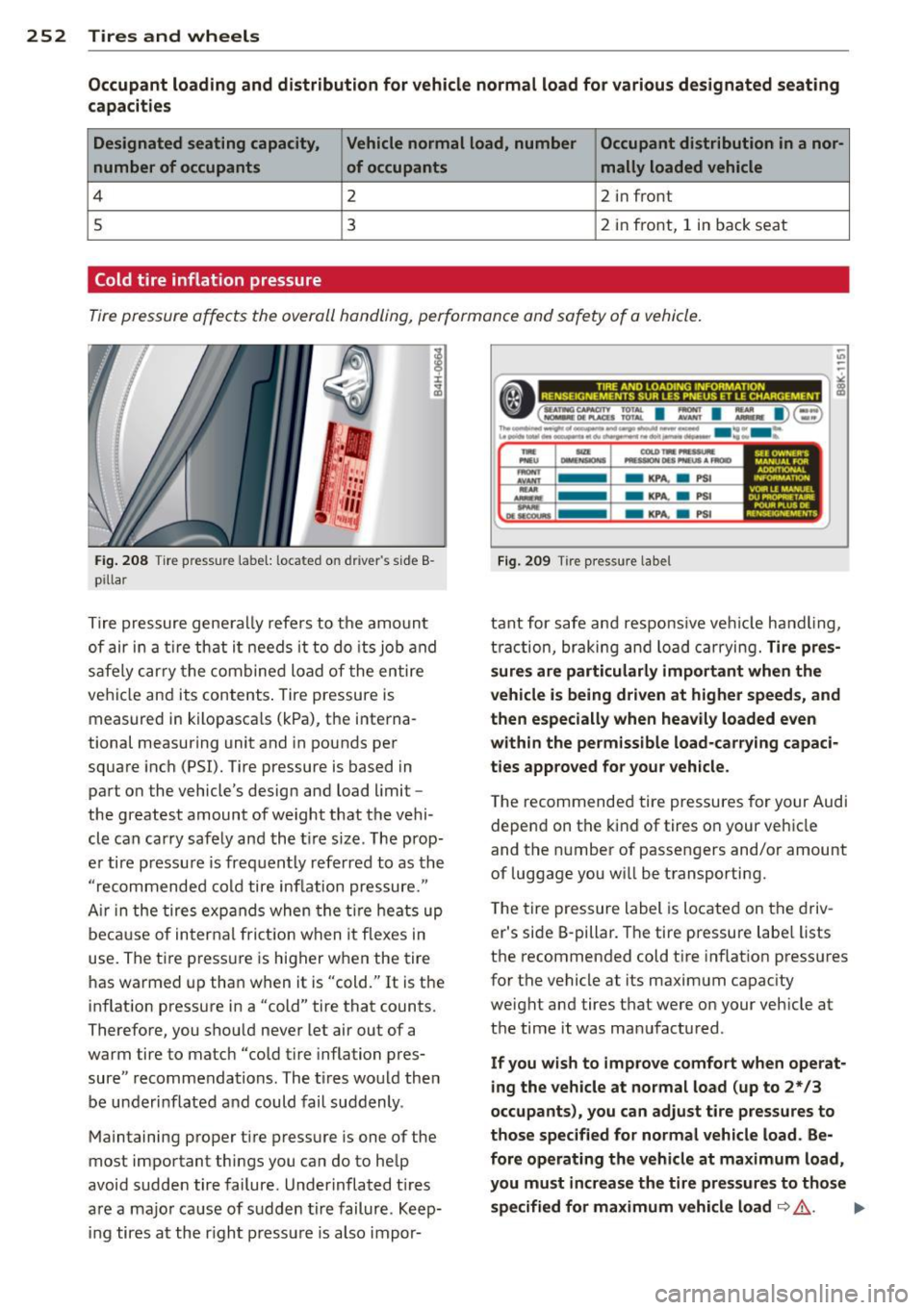
Occupant loading and distribution for vehicle normal load for various designated seating
capacities
Designated seating capacity, Vehicle normal load , number Occupant distribution in a nor -
number of occupants of occupants mally loaded vehicle
4 2 2 i
n front
5 3 2 i n fro nt, 1 in back seat
Cold tire inflat ion pressure
Tire pressure affects the overall handling, performance and safety of a vehicle.
Fi g. 20 8 Tire p ressu re label: located on drive r's si de 8 -
p ill ar
T ire pressure gene ra lly refers to the amo unt
of air i n a tir e th at i t needs it to do its job and
s a fe ly c arry the combined load of the entire
ve hicl e and its contents . Tire pressure is
measured in kilopasca ls (kPa), the i nterna
tional measuring unit and in pounds per
squa re inc h (PSI). Tire pressure is based in
part o n the vehicle's design and load limit -
the greatest amount of we ight that the vehi
cle can car ry safely an d the t ire s ize . The prop
e r tire p ressu re is freq uen tly referred to as the
"recommende d cold tire inf lation pressure."
A ir in the tires exp ands when the ti re heats up
beca use of in ter nal fri ct ion when i t flexes in
use. The tire p ress ure is higher when the tire
has warmed up tha n when it is "cold." It is the
inflat ion pressure in a "cold" tire that counts.
Therefore, you sho uld never let air out of a
warm tire to match "cold ti re inflation pres
sure" recommendations. The t ires wo uld the n
be underinflated a nd could fail suddenly .
Maintaining proper t ire p ress ure is one of the
most important things you can do to he lp
avoid sudden tire failure . Underinflated t ires
a re a majo r ca use of s udden tire failure. Keep
ing tires a t the r ight pressu re is also impor-
-~
-
( • (==. ~r: I := I :... 1)-~- -:-i
n. ........... ....,. .................... ,...,,.. ...... ...... .. '--............................................... ·-..
TN IIZE CO.O TN.,,.... ,.,._u OWlHSIONt ......,., DU ,.,._ua .-,--
-.....
--...........
- KP aPSI
- ICPA. a PSI
- ICPA. a PSI
Fig. 209 Tire p ressu re labe l
SEEOWHf:ft"S MA. NUAl FOR
IHFOll:MA TION Va.t Lf M>.MJ!:L
OU PltOPfllE f A.IN: ,ol.M "-.UtDf NNSCIOM.:MErtf5
tant for safe an d respo ns ive ve hicle ha ndling,
t raction, br aking and load ca rrying .
Tire pres
sures are particularly important when the
vehicle i s being dr iven at higher speeds, and
then especially when heavily loaded even
within the permissible load-carrying capaci
ties approved for your vehicle .
The recommende d tire pressures for your Audi
depen d on t he kind of tires o n your vehicle
and the number of passengers and/or amount
of luggage you w ill be transporti ng.
T he tire pressure label is located on the d riv
er's side B -pillar . The tire pressure labe l lists
the recommended cold t ire inflat ion pressures
fo r the vehicle at its maxim um capac ity
weight and tires t hat were on your veh icle at
t h e time it was ma nufactured.
If you wish to improve comfort when operat
ing the vehicle at normal load (up to 2* /3
occupants ), you can adjust t ire pressures to
those specified for normal vehicle load. Be·
fore operating the vehicle at maximum load,
you mu st increase the tire pres sures to those
specified for maximum vehicle load
i:::> .&, . II>-
Page 255 of 314
Tires an d wheel s 253
Bear in mind that the ti re press ure monitoring
system* can only monitor the tire pressures
you have stored. The system does not recog
n ize the load condit ion of your vehicle.
The effectiveness of the tire pressure monitor
ing system* will be impaired if you store nor
mal load pressures but then operate the vehi
cle at its maximum load
c;, &.
See the i llustration c;, fig. 208 for the location
of the label on driver's side B-pillar (co lor of
the actua l labe l and exact location on the ve
h icle wi ll vary slightly). Note that the
following table is accurate at
the time of going to press and is subject to
change. In the event of d iscrepancies, the tire
pressure label is located on the driver's side B
pillar always takes precedence.
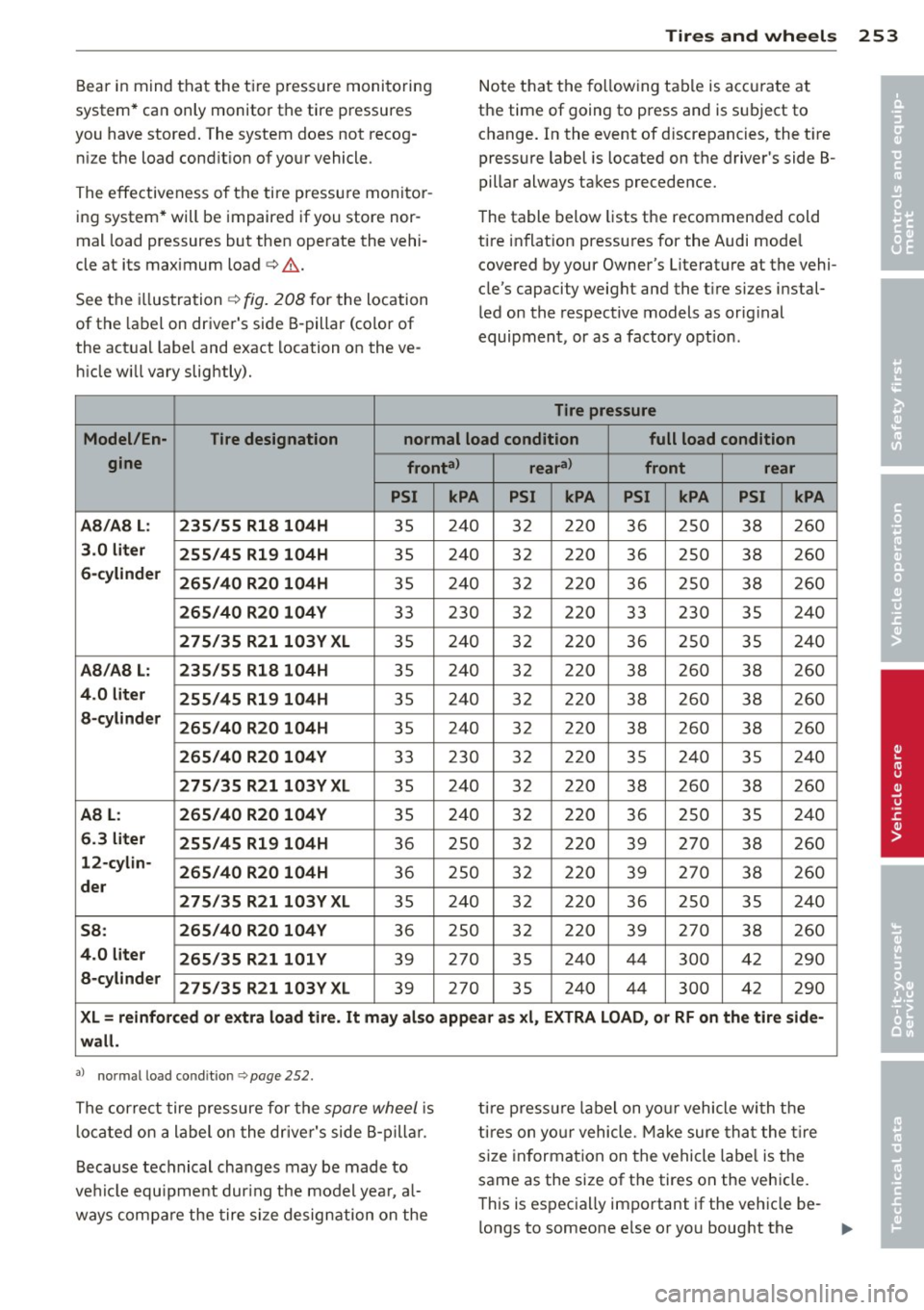
The table below lists the recommended cold
tire inflat ion pressures for the Audi mode l
covered by your Owner's Literature at the vehi
cle's capacity weight and the t ire sizes instal
led on the respective models as orig inal
equipment, or as a factory option.
Tire pressure
Model /En-
Tire design ation normal load condition
full load condition
gine fronta> reara>
front rear
PSI kPA PSI kPA PSI kPA PSI kPA
AB /AB L: 235/55 R18 104H
35 240 32 220 36 250 38 260
3 .0 lit er
255/45 R1 9 104H 35 240
32 220 36 250 38 260
6-cy lind er
26 5/40 R2 0 104H 35 240 32 220 36 250 38 260
265 /40 R20 104 V 33 230 32 220 33 230 35 240
275
/35 R 2110 3Y XL 35 240 32 220 36 250 35 240
A8/A8 L: 235 /55 R1 8 104H 35 240
32 220 38 260 38 260
4.0 l it e r
255/4 5 R19 104H 35 240 32 220 38 260 38 260
a-cy lind er
26 5/ 40 R 20 104H 35 240
32 220
38 260
38 260
2
6 5/40 R 20 104V 33 230 32 220 35 240 35 240
27
5/35 R2 110 3Y XL 35 240 32
220
38 260
38 260
AB L
: 265/40 R20 104 V 35 240 32 220 36 250 35 240
6.3 liter
255 /45 R1 9 104H 36 250 32 220
39 270
38 260
12
-cy lin-
26 5/40 R 20 104H 36 250 32 220 39 270 38 260
der
275/35 R 21 103 YXL
35 240 32 220 36 250
35 240
58
: 2 65/40 R 20 10 4V 36 250 32 220 39 270 38 260
4.0 liter
265 /35 R21101 Y 39 270 35 240 44 300 42 290
a-cy lind er
275/35 R 2110 3Y XL 39 270 35 240
44
300 42
290
XL= reinf orce d or extra lo ad tir e. It ma y als o appe ar a s x l, E XTRA LOAD, or RF on th e tire s ide-
w all .
al no rmal load co ndit ion c:> page 252.
The correct tire pressure for the spare wheel is
l ocated on a label on the dr iver's side B-pilla r.
Because technical changes may be made to
ve hicle equ ipment dur ing the model yea r, a l
ways compa re the tire size designation on the tire pressu
re label on you r vehicle with the
t ires on you r vehicle. Make sure that the t ire
size in formation on the vehicle labe l is the
same as the size of the tires on the vehicle.
This is especially important if the vehicle be-
l ongs to someone else or yo u bought the ...,
•
•