lock AUDI S8 2014 Manual PDF
[x] Cancel search | Manufacturer: AUDI, Model Year: 2014, Model line: S8, Model: AUDI S8 2014Pages: 314, PDF Size: 78.47 MB
Page 257 of 314

of people and the amount of luggage into ac
count when adjusting tire pressure for a trip -
even one that you would not consider to be
"long." See
c> page 256 , Tires and vehicle
load limits
for more important information.
Always use an accurate tire pressure gauge
when checking and adjusting inflation pres
sures . Check all of the tires and be sure not to
forget the spare tire. If the pressure in any tire
is too high when the tire is "cold," let air out
of the tire slowly with the edge of the tire
gauge and keep checking the pressure until
you reach the pressure that is correct for the
load (passengers and luggage) and kind of
driving you plan to do.
If the pressure in any tire is too low, note the
difference between the pressure in the cold
tire and the pressure you need and add the air
that you need to reach the correct pressure for
the vehicle load (passengers and luggage) for
the tires on your vehicle as listed on the on
your vehicle and in this manual and the kind
of driving you plan to do.
Never exceed the maximum inflation pres
sure listed on the tire sidewall for any rea
son.
Remember that the vehicle manufacturer, not
the tire manufacturer, determines the correct
tire pressure for the tires on your vehicle.
It is important to check the tire pressure when
the tires are cold.
- Read the required tire pressure from the tire
pressure label. The tire pressure label is lo
cated on the driver's side 8-pillar.
- Turn the valve stem cap counter-clockwise
to remove it from the tire valve.
- Place the air pressure gauge on the valve .
- The tire pressures should only be checked
and adjusted when the tires are cold . The
slightly raised pressures of warm tires must
not be reduced.
- Adjust the tire pressure to the load you are
carrying.
- Reinstall the valve stem cap on the valve .
Tires and wheels 255
When should I check the tire pressure?
The correct tire pressure is especially impor
tant at high speeds. The pressure should
therefore be checked at least once a month
and always before starting a journey. Do not
forget to check the tire pressure for the spare
wheel
c::;,page 271.
When should I adjust the tire pressures?
Adjust the tire pressure to the load you are
carrying. After changing a wheel
or replacing
wheels you have to adjust the tire pressures on all wheels. In addition, you must then
store the new tire pressures in the tire pres
sure monitoring system*
c::;, page 266 .
A WARNING
Incorrect tire pressures and/or underinfla
tion can lead sudden tire failure, loss of
control, collision, serious personal injury
or even death.
- When the warning symbol
[I] appears in
the instrument cluster, stop and inspect
the tires.
- Incorrect tire pressure and/or underinfla
tion can cause increased tire wear and
can affect the handling of the vehicle and
stopping ability.
- Incorrect tire pressures and/or underin
flation can also lead to sudden tire fail
ure, including a blowout and sudden de
flation, causing loss of vehicle control.
- The driver is responsible for the correct
tire pressures for all tires on the vehicle.
The applicable pressure values are locat
ed on a sticker on the driver's side B-pil
lar.
- Only when all tires on the vehicle are fil led to the correct pressure, the tire pres
sure monitoring* system can work cor rectly .
- The use of incorrect tire pressure values
can lead to accidents or other damage .
Therefore it is essential that the driver
observe the specified tire pressure values
for the tires and the correct pressures for
IIJ,
•
•
Page 264 of 314
26 2 T ire s and wheel s
Driving with different tires reduces vehi
cle handling and can lead to a loss of
co ntrol.
- I f the spare tire is not the same as the
t ires that are mounted on the veh icle -
for example with winter tires - only use
the spare tire for a short period of time
and dr ive with extra care . Refit the nor
ma l road wheel as soon as safely possi
ble.
- Never drive faste r than the maximum
speed for which the tires on your veh icle
are rated because ti res that a re driven
faster than their rated speed can fail
sudden ly .
- Overloading t ires cause heat build- up,
sudden tire failure, including a blowout
and sudden deflation and loss of control.
- T emperature grades app ly to tires that
are properly inflated and not over o r un
derinflated .
- For technical reasons it is not a lways
possible to use wheels from other
vehicles -in some cases not even wheels
from the same vehicle model.
- If you insta ll wheel trim discs on the ve
hicle whee ls, make sure that the air f low
to the brakes is not blocked. Reduced air
flow to the brakes can them to overheat, increasing stopping distances and caus
ing a collision .
- Run flat t ires may on ly be used on
vehicles that were equ ipped w ith them
at the facto ry . The vehicle must have a
chassis des igned for run f lat t ires . Incor
rect use of run flat tires can lead to vehi
cle damage or acc idents. Check with an
au thorized Aud i dealer or ti re specia list
to see if your vehicle can be equipped
with run f lat tires. If run flat tires are
used, they must be installed on all four
wheels . Mix ing tire types is not permit
ted .
(D Note
-For technica l reasons, it is not generally
possib le to use the whee l rims from oth- er veh
icles. This can hold true for wheels
of the same vehicle type.
- If the spare tire is d iffe rent from the
tires that yo u have mounted on your ve
hicle (for example winter tires o r wide
profi le tires), then use the spare tire for a
short period of time only and drive w ith
extra care. Replace the flat tire w ith the
tire matching the others on your vehicle as soon as possible .
- Never drive without the valve stem cap .
T he valves could get damaged .
® For the sake of the environment
Dispose of o ld tires in accordance with the
l ocal requirements.
Uniform tire quality grading
- Tread wear
- Traction AA A B C
- Temperature ABC
Quality grades can be found where applicab le
on the t ire s ide wall between tread shou lder
and maximum section width
c> page 259,
fig. 212 .
For example : Tread wear 200, Traction AA,
Temperature A.
All passenger ca r tires must conform to Feder
al Safety Requirements in addition to these
grades.
Tread wear
T he tread wear grade is a comparative rating
based on the wear rate of the t ire when tested
u nder contro lled conditions o n a specified
government test course .
For example, a tire graded 1S0 would wear
one and o ne ha lf ( 11/2) times as well on the
gover nment course as a t ire g raded 100 .
The relative performance of tires depends upon the actual conditions of their use, how
ever, and may depa rt s ignificantly from the
norm due to va ria tions in d riving hab its, se rv
ice practices and differences in road character-
istics and climate.
ll-
Page 266 of 314
264 Tires and wheels
The speed rating letter code( ¢ page 251) is
on the side wall of the tire¢ page
259.
A WARNING
Winter tires have maximum speed limits
that may be lower than your vehicle's max
imum speed . Always know the maximum
speed before driving off. Never drive faster
than the speed permitted for your specific
winter tires. This will cause damage to the
tires leading to an accident and serious
personal injury to you and your passen
gers.
A WARNING I>=
Driving faster than the maximum speed
for which the winter tires on your vehicle
were designed can cause tire failure in
cluding a blowout and sudden deflation,
loss of control, crashes and serious per
sonal injuries. Have worn or damaged tires
replaced immediately.
- Winter tires have maximum speed rating
that may be lower than your vehicle's
maximum speed .
- Never drive faster than the speed for
which the winter or other tires installed on your vehicle are rated.
A WARNING
Always adjust your driving to the road and
traffic conditions. Never let the good ac
celeration of the winter tires and all-wheel
drive tempt you into taking extra risks . Al
ways remember :
- When braking , an all-wheel drive vehicle
handles in the same way as a front drive
vehicle.
- Drive carefully and reduce your speed on
icy and slippery roads, even winter tires
cannot help under black ice conditions.
@) For the sake of the environment
Use summer tires when weather condi
tions permit. They are quieter, do not wear
as quickly and reduce fuel consumption.
Snow chains
Snow chains may be fitted only to the front
wheels, and only to certain tire sizes . Ask your
authorized Audi dealer on which tire sizes snow chains can be used.
If you are going to use snow chains, then you
must install them on the front wheels at
least.
The snow chains must have low-profile links
and must not be thicker than 0.4 inch
(10,5 mm) , including the lock.
Remove wheel center covers and trim discs
before putting snow chains on your vehicle
¢ (!) . For safety reasons cover caps must then
be fitted over the wheel bolts. These are avail
able from authorized Audi dealers.
A WARNING
=
Using the wrong snow chains for your vehi-
cle or installing them incorrectly can in
crease the risk of loss of control leading to
serious personal injury.
- Snow chains are available in different
sizes . Always make sure to follow the in
structions provided by the snow chain manufacturer.
- When driving with snow chains never
drive faster than the speed permitted for
your specific snow chains.
- Always observe local regulations.
(D Note
- Remove snow chains before driving on
roads not covered with snow to avoid
damaging tires and wearing the snow
chains down unnecessarily .
- Snow chains, which come into direct con
tact with the wheel rim, can scratch or damage it. Therefore, make sure that the
snow chains are suitably covered. Check
the position of the snow chains after
driving a few yards and correct if neces
sary. Follow the instructions from the
snow chain manufacturer when doing so.
-If the Adaptive Air Suspension should
malfunction, do not mount or use snow
11-
Page 273 of 314

Space-saving spare tire (compact spare
tire)*
A pplies to vehicles: with space-sav ing spa re tire
The spare tire/wheel is located in the luggage
compartment under the cargo floor cover. It
is intended for short-term use only.
F ig . 2 19 Spare t ire
Tak ing ou t the sp ar e tire
.. Lift the cargo floor by the plast ic handle
¢ fig. 219 .
.. Hook the hand le into the luggage compart
ment weather strip.
.. Turn the large screw
¢ fig. 219 counter
clockwise .
.,. Take out the spare tire.
.,. Always store the vehicle too l kit, the jack*
and the replaced tire i n the luggage com
partment ¢
page 141.
.. Unhook the cargo floor before clos ing the
rear lid.
Using the spare tire (compact spare tir e)
The compact spare tire is only intended for
emerge ncies until you can reach a repair shop.
Replace it as quickly as possible with a stand
ard wheel and tire.
There are some res trictions on the use of the
compact spare t ire. The compact spare t ire
h as been des igned specifically for you r type of
vehicle . It must not be swapped with a com
pact spare tire from another type of vehicle .
Snow chains
For technica l reasons, the use of snow chains
on the compa ct spare tire is
not p ermitt ed .
If you do have to dr ive with snow chains and a
front tire fails, mount the spar e whee l w ith
What do I d o now ? 271
tire instead of a rear tire. Install the snow
c hains o n the rear tire and use it to replace
the defect ive front tire.
_& WARNING
- Never use the spare t ire if it is damaged
or if it is worn down to the tread wear in
d icators .
-If the spare tire is more than 6 years old,
use it only in an emergency a nd with ex
treme caution and careful driv ing.
- The spare tire is intended only for tem
porary and short-term use. It should be
replaced as soon as poss ible with the
normal whee l and tire.
- After mounting the compact spare t ire,
the t ire pressure must be checked as
soon as possible. The tire pressure of the
compact spare t ire mu st be 4.2 bar; oth
erwise, you risk having an a cc id en t.
- Do not dr ive faste r than 50 mph (80 km/
h). You ri sk havi ng an accide nt.
- Avoid full-thro tt le acceleration, heavy
brak ing, and fast co rnering. You risk hav
ing an a ccident .
- Neve r drive using more than one spa re
wheel and ti re. You r is k having an ac ci
dent.
- Normal summer or w in ter tires must no t
be mou nted on t he compa ct spare w heel
rim.
- For technical reasons, the use of tire
ch ains on the spa re tire is not permi tted.
If i t is necessary to drive with t ire chains,
the spare wheel must be mounted on the
fro nt ax le in the event of a flat in a rear
tire. The newly available front wheel
m ust then be insta lled in place of the
rear whee l w ith the flat tire. Installing
the tire cha in before mounting the whee l
and tire is recomme nded.
- Loose items in the passenger compart
ment can cause se rious pe rsonal injury
du ring hard brak ing or in an accident.
Never store the inflatable spa re tire or
jack and tool s in t he passenger compart
men t.
Page 274 of 314
272 What do I do now ?
Spare wheel
App lies to vehicles: with spare wheel
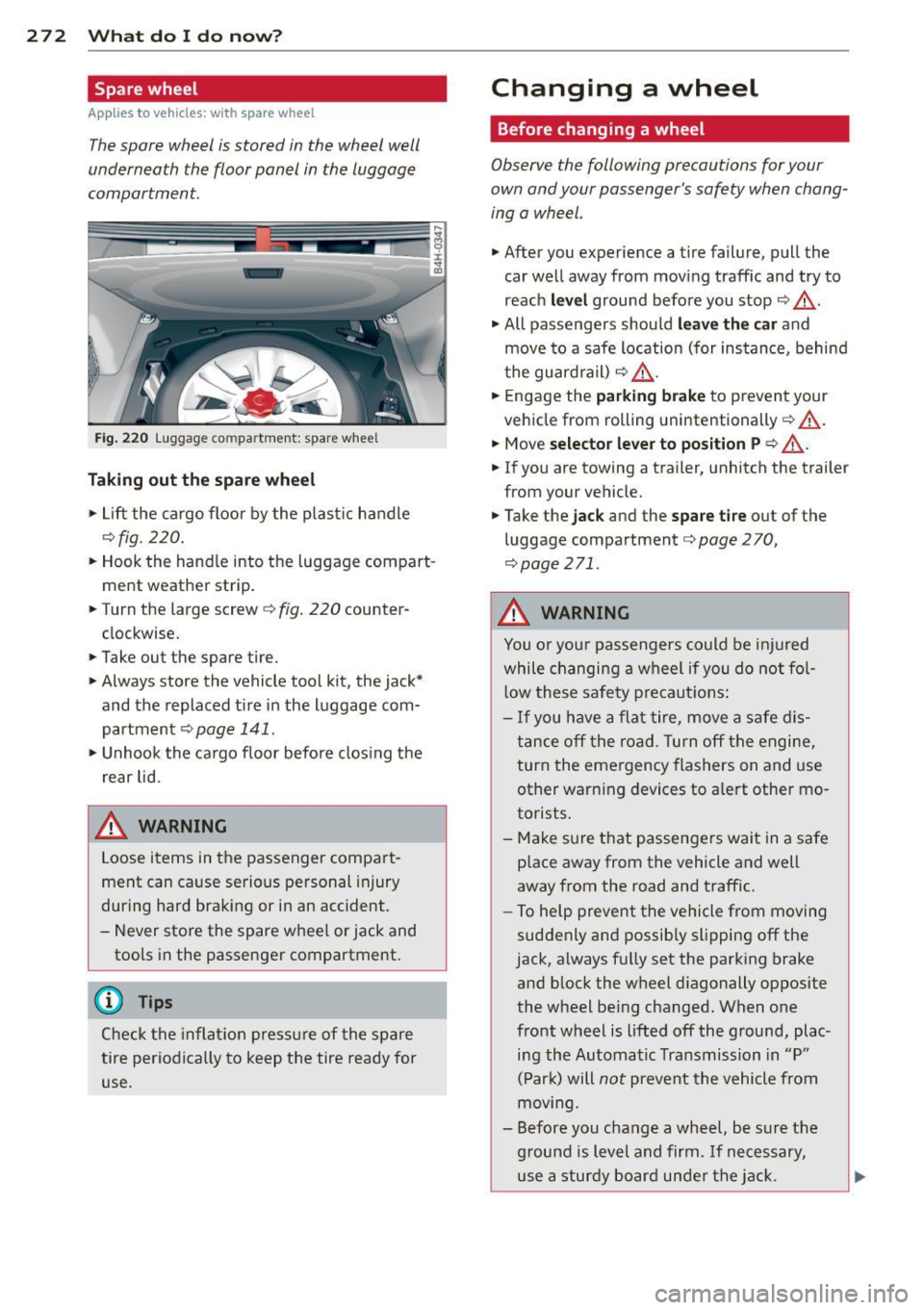
The spare wheel is stored in the wheel well
underneath the floor panel in the luggage
compartment.
Fig. 220 L uggage compartment: spare wheel
Taking out the spare wheel
.,. Lift the cargo floor by the plastic handle
¢fig. 220.
.. Hook the hand le into the luggage compart
ment weather strip .
.. Turn the large screw¢
fig. 220 counter
clockwise.
.. Take out the spare tire.
.. Always store the vehicle tool kit, the jack*
and the replaced tire in the luggage com
partment ¢
page 141.
.,. Unhook the cargo floor before closing the
rear lid.
&_ WARNING
-
Loose items in the passenger compart
ment can cause serious personal injury
during hard braking or in an accident.
- Never store the spare wheel or jack and
tools in the passenger compartment.
(D Tips
Check the inflat ion pressure of the spare
tire periodically to keep the tire ready for
use.
Changing a wheel
Before changing a wheel
Observe the following precautions for your
own and your passenger's safety when chang
ing a wheel.
.. After you experience a tire failure, pull the
car well away from moving traffic and try to
reach
level ground before you stop ¢ .&_ .
.. All passengers should leave the car and
move to a safe location (for instance, behind
the guardra il)¢ .&_ .
.. Engage the
parking brake to prevent your
vehicle from rolling unintentionally¢ .&_.
.. Move
selector lever to position P ¢ A .
.. If you are towing a trailer, unhitch the trailer
from your vehicle .
.,. Take the
jack and the spare tire out of the
luggage compartment¢
page 270,
¢page 271.
&_ WARNING
You or you r passengers could be injured
while changing a wheel if you do not fol
l ow these safety precautions:
-If you have a flat tire, move a safe dis
tance off the road. Turn off the engine,
turn the emergency flashers on and use
other warning devices to alert other mo
torists .
- Make sure that passengers wait in a safe
p lace away from the vehicle and well
away from the road and traffic.
- To help prevent the vehicle from moving
suddenly and possib ly slipping off the
jack, always fully set the parking brake
and block the wheel d iagonally opposite
the wheel be ing changed. When one
front wheel is lifted off the ground, plac ing the Automatic Transmission in "P"
(Par k) will
not prevent the vehicle from
mov ing.
- Before you change a wheel, be sure the
g rou nd is level and firm. If necessary,
use a sturdy board under the jack.
-
Page 276 of 314
274 What do I do now ?
• Pull off the dec orat ive wheel co ve r
Q fig. 221 .
Wheels with wheel bolt caps
Applies to vehicles: wit h wheel bo lts wit h caps
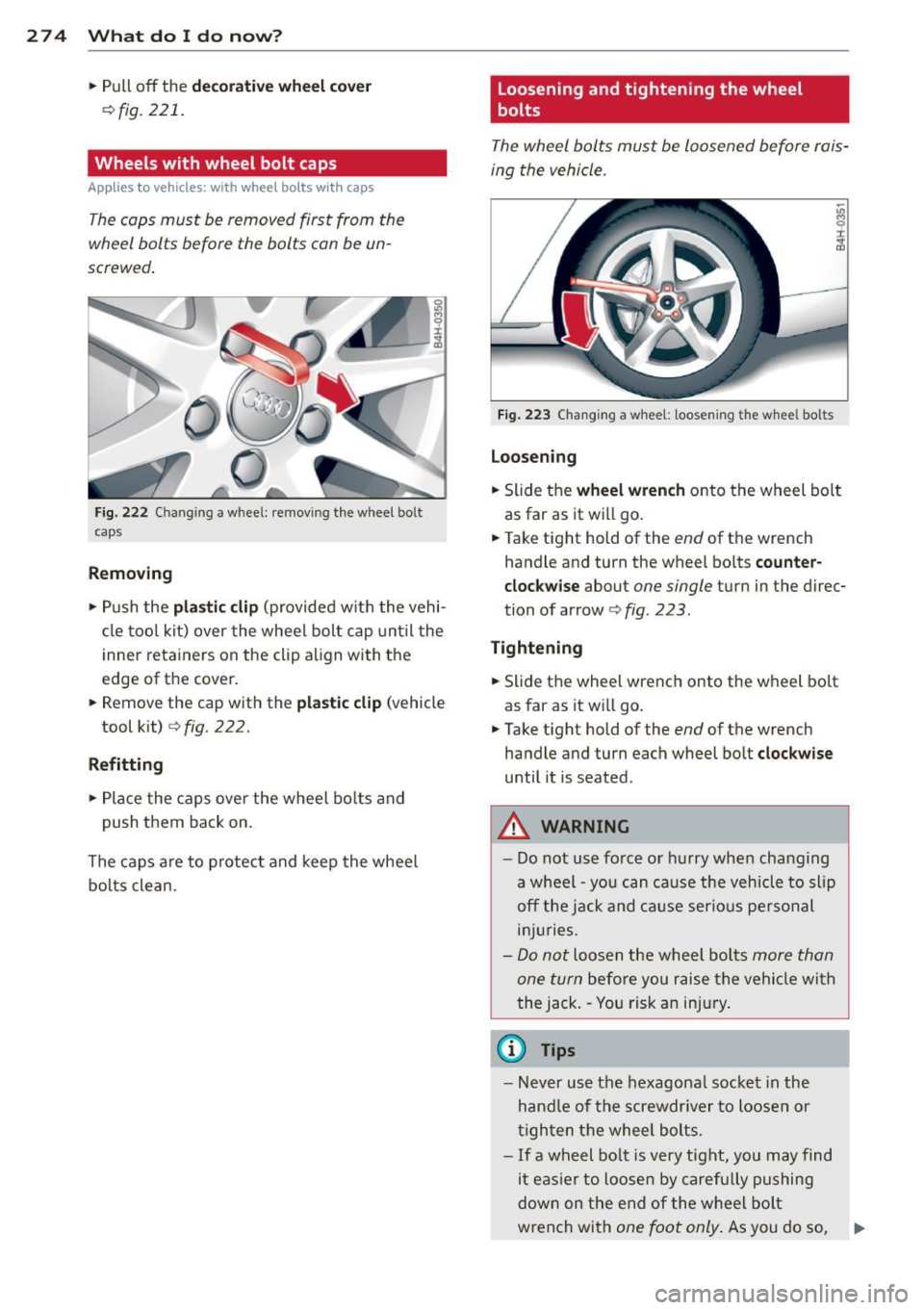
The caps must be removed first from the
wheel bolts before the bolts con be un
screwed .
Fig. 222 Chang ing a w hee l: remov ing the w hee l bo lt
c aps
R emoving
• Push the pl as tic clip (provided w ith the vehi
cl e tool kit)
over the whee l bolt cap unt il the
inner retainers on the clip align with the
edge of the cover.
• Remove the cap with the
pla sti c cl ip (vehicle
tool kit)
~ fig . 222.
Refittin g
• Place the caps ove r the wheel bo lts and
push them back on.
The caps are to protect and keep the wheel bo lts clean .
Loosening and tightening the wheel
bolts
The wheel bolts must be loosened before rais
ing the vehicle.
F ig . 223 C hanging a whe el: loosening the w hee l bol ts
L o os en ing
• Slide the wh ee l w rench onto the wheel bolt
as far as it will go.
• Take tight hold of the
end of the wrench
handle and turn the wheel bolts
c ou nte r
cl ockw ise
about one single turn in the direc
tion of arrow
Q fig . 223 .
Tight ening
• Slide t he wheel wrench onto the wheel bo lt
as far as it w ill go.
• Take tight hold of the
end of the wrench
handle and turn each wheel bolt
clock wise
until it is seated .
A WARNING
--Do not use force or h urry when changing
a wheel -you can cause the vehicle to slip
off the jack and cause serio us pe rsonal
in ju ries.
-Do not loosen the wheel bo lts more than
one turn
before you raise the vehicle with
the jack . - Yo u risk a n inju ry .
© Tips
- Never use the hexagona l socket in the
hand le of the screwdr iver to loose n or
tighten the whee l bolts.
- If a wheel bo lt is very tight, you may find
it eas ier to loosen by carefu lly pushing
dow n on the end of the wheel bolt
w rench with
one foot only. As you do so, ..,.
Page 283 of 314
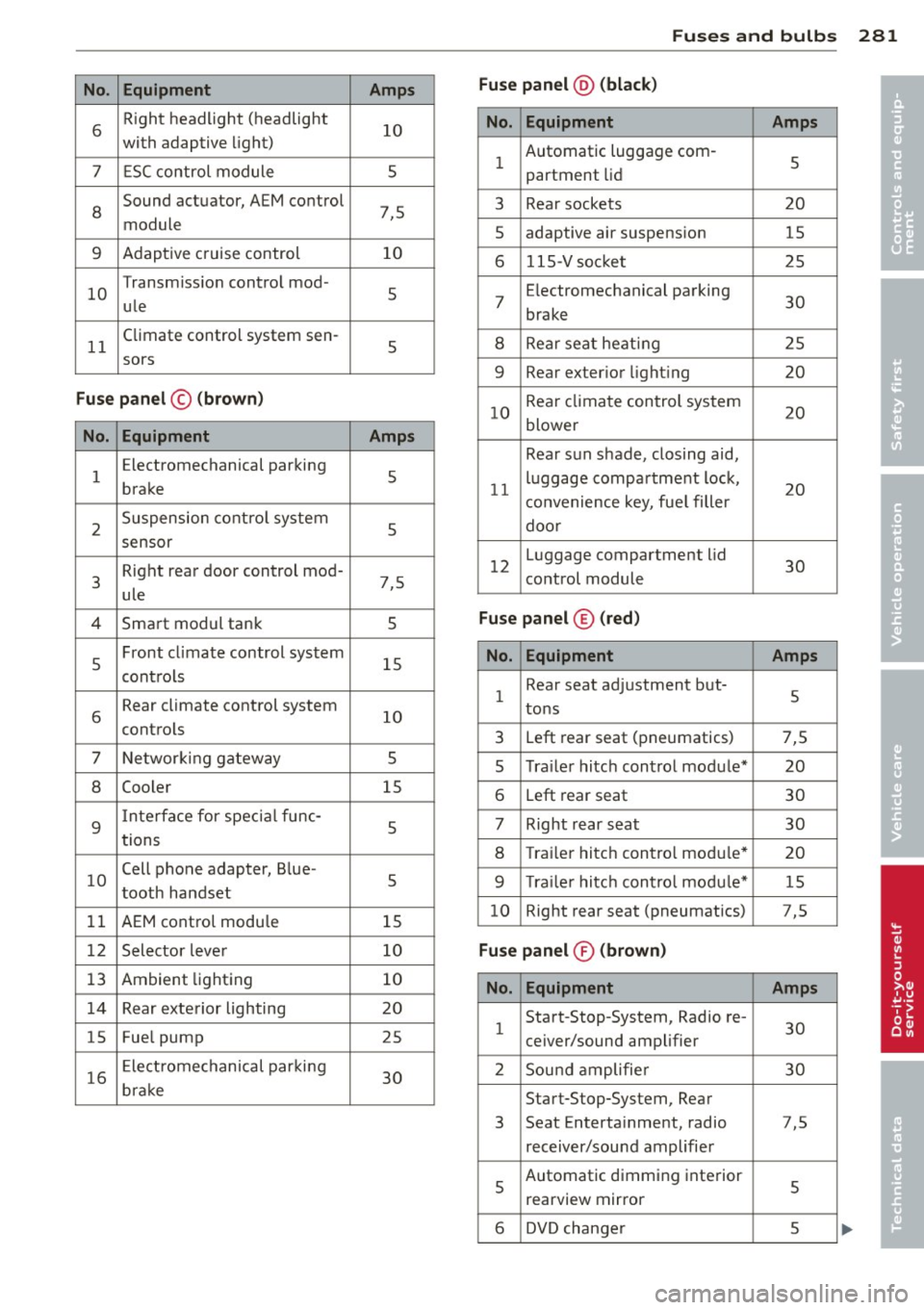
Fuses and bulb s 281
No . Equ ipment Amps Fus
e pan el@ (bla ck)
•
6 R
ight headlight (headlight
10
with adaptive light)
7 ESC control module 5 No. Equipment Amps
1 Automatic luggage com
-
5
partment lid
•
8
Sound actuator, AEM control
7,5
module 3 Rear
sockets 20
5 adaptive air suspension
15
9 Adaptive cruise control 10
6 115-Vsocket 25
10 Transmiss
ion control mod-
5
ule 7 E
lectromechanical parking
30
brake
11 Climate control
system sen-
5
8 Rear seat heating 25
sors
9 Rear exterior lighting 20
Fuse pan el© (bro w n)
No. Equipment Amps
10 Rear climate control system
20
blower
1 E
lectromechanical parking
5
brake
2 Suspension control system
5 Rear
sun shade, closing aid,
11 luggage
compartment lock,
20
convenience key, fue l filler
door
sensor
3 Right rear door
control mod-
7,5
ule 12
Luggage compartment
lid
30
control module
4 Smart modul tank 5
Fuse panel ® (red)
5 Front
climate control system
15
contro ls
6 Rear climate control
system
10
controls N o. Eq uipm ent Amps
1 Rear
seat adjustment but-
5
tons
3 Left rear seat (pneumatics) 7,5
7 Networking gateway 5
5 Tra
iler hitch control module* 20
8 Cooler
15
6 Left rear seat 30
9
Interface for specia l func-
5
tions 7 Right rear seat
30
8 Trailer hitch contro l module*
20
10 Cell phone
adapter, Blue-
5
tooth handset
9 T ra iler hitch control modu le* 15
11 AEM control modu le 15 10
Right rear
seat (pneumatics) 7,5
12 Selector lever 10
Fuse pan el® (bro wn)
13 Ambient lighting
10 No. Equipment Amps
14 Rear exterior lighting 20
15 Fuel
pump
25 1 Start-Stop-System,
Radio re-
30
ceiver/sound amplifier
16 Electromechanical parking
30
brake 2 Sound amplifie
r 30
Start-Stop-System, Rear
3 Seat
Entertainment, radio 7,5
receiver/sound amplifier
5 Automatic dimming interior
5
rearview mirror
6 DVD changer 5
Page 284 of 314
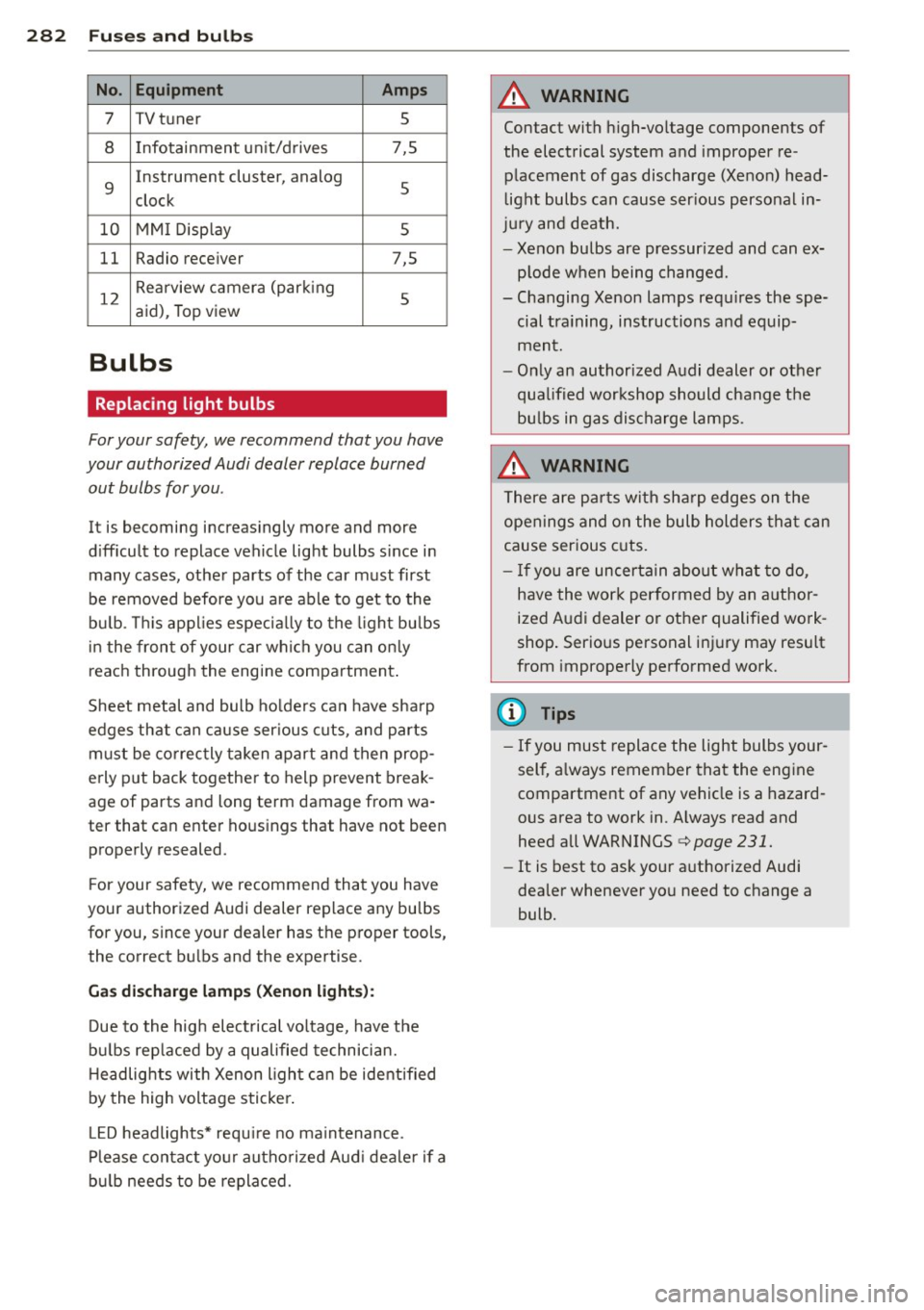
282 Fuses and bulb s
No. Equipment Amps
7 TV tuner 5
8 Infotainment un it/drives 7,5
9
I nstrument cluster, analog
5
clock
10 MMI Display 5
11 Radio receiver 7,5
1 2
Rearview camera (park ing
5 aid), Top view
Bulbs
Replacing light bulbs
For your safety, we recommend that you have
your authorized Audi dealer replace burned out bulbs for you .
It is becoming increasingly more and more
difficult to replace vehicle light bulbs s ince in
many cases, other parts of the car must first
be removed before you are able to get to the
bu lb . Thi s applies especially to the light bu lbs
in the front of your car which you can only
reach through the engine compartment .
Sheet metal and bulb holders can have sharp
edges that can cause ser ious cuts, and parts
must be correctly taken apart and then prop
erly put back together to help prevent break
age of parts and long term damage from wa
ter that can enter housings that have not been
properly resealed.
F or your safety, we recommend that you have
your authorized Audi dealer replace any bulbs
for you, since your dealer has the proper tools,
the correct bu lbs and the expertise.
Gas discharge lamps (Xenon lights):
Due to the high electrical vo ltage, have the
bu lbs rep laced by a qualified technician.
Headlights with Xenon light can be ident ified
by the high voltage sticke r.
LE D headlights* require no ma intenance .
Please contact your authorized Aud i dealer if a
bu lb needs to be replaced.
A WARNING
Contact with high-voltage components of
the electrical system and improper re
placement of gas discharge (Xenon) head
light bulbs can cause ser ious personal in
jury and death.
- Xenon bulbs are pressur ized and can ex
p lode when being changed.
- Changing Xenon lamps requ ires the spe
cial tra ining, instructions and equip
ment.
- Only an authorized Audi dealer or other
qualified workshop should change the
bu lbs in gas discharge lamps .
A WARNING
There are parts with sharp edges on the
openings and on the bulb holders that can
cause serious cuts.
- If you are uncertain about what to do,
have the work performed by an author
ized Audi dealer or other qualified work
shop. Serious personal injury may result
from improperly performed work.
(D Tips
-If you must replace the light bulbs your
self, a lways remember that the engine
compartment of any vehicle is a hazard
ous area to work in. Always read and
heed all WARNINGS
c> page 231.
-It is best to ask your authorized Audi
dealer whenever you need to change a
bulb.
-
Page 287 of 314
-When connecting jumper cables, make
sure that they cannot get caught in any
moving parts in the eng ine compart
ment .
- Before you check anything in the engine
compartment, always read and heed all
WARNINGS
¢ page 231.
(D Note
Improper hook-up of jumper cables can r u
in the generator.
- Always connect POSITIVE( +) to POSI
TIVE(+), and NEGATIVE(-) to NEGATIVE
( - ) gro und post of the battery manager
control unit .
- Check that all screw plugs on the battery
cells a re screwed in firmly . If not, tighten
pl ugs p rior to connecting clamp on nega
tive battery term inal.
- Please note that the procedure f or con
nect ing a jump er cable as desc ribed
above appl ies spec ifically to the case of
you r vehi cle be ing jump started. When
you are giv ing a jump star t to an othe r ve
hi cle, do
not connec t the negat ive (-) ca
ble to the negat ive (-) terminal on the
discharged battery @¢
fig. 234. In
stead, securely connect the negative( -)
cable to e ithe r a solid metal component
that is firmly bolted to the engine block
or to the e ng ine block itse lf. If the bat
te ry tha t is being charged does not vent
to the outside, escaping batte ry gas
could igni te and exp lode!
Emergency towing
with commercial tow truck
General hints
Your Audi requires special handling for tow
tng.
The follow ing information is to be used by
commercia l tow tr uck operators who know
h ow to ope rate thei r equipme nt safe ly.
Emergenc y situ ation s 285
-Ne ver tow your Audi. Towing will cause
damage to the engine and tran smission.
- Never wrap the safety chain s or w inch ca
ble s around the brake lines.
- To prevent unnece ssary damage , your Audi
must be transported with a flat bed tru ck.
- To load the vehicle on to the fl at bed , use
the towing loop found in the vehicle tools
a nd attach to the front or rear anchora ge
¢ page 285 and ¢ page 286 .
_& WARNING
A vehicle being towed is not safe for pas
sengers. Never allow anyo ne to ride in a
vehicle be ing towed, for any reason.
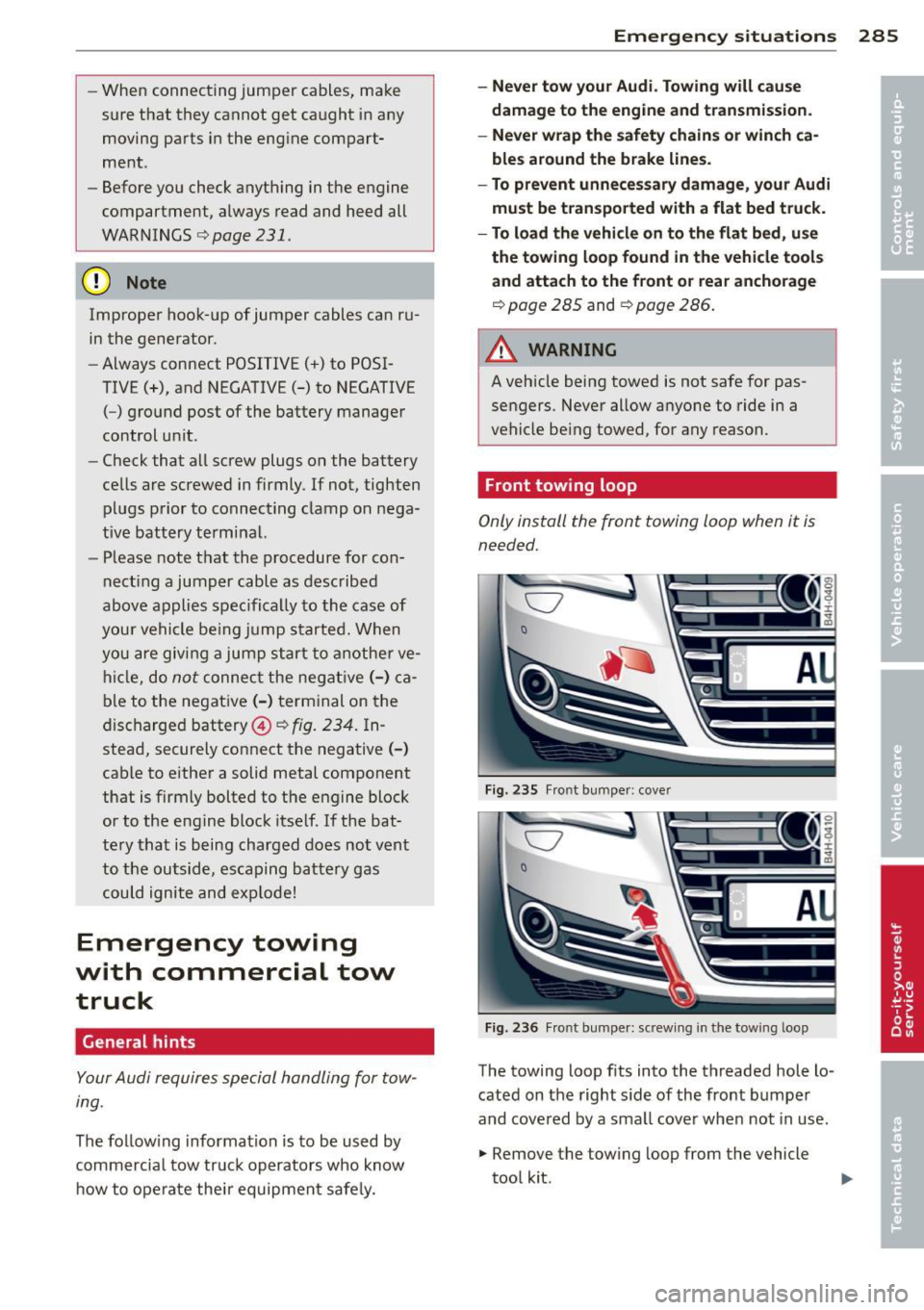
Front towing loop
Only install the front towing loop when it is
needed.
Fig. 23 5 Front bu mpe r: cove r
Fig. 236 Fr ont bu mpe r: sc rew ing in t he tow ing loop
-
The towing loop f its into the threaded hole lo
cated on the right s ide of the front bumpe r
and cove red by a sma ll cove r when not in use .
.. Remove the tow ing loop from the vehicle
too l kit .
Page 289 of 314
@ Tips
Check carefully to make sure the hook-up
is secure before moving the car up the flat
bed truck ramp .
Vehicle transport
Whenever you hov e your vehicle transported,
be sure to note the following :
(D Note
Mount the tie-down chains/cables over the
running surface (circumference) of the
tires. Never secure the vehicle by the axle,
the suspension struts or the front or rear
towline eye . For technical reasons, the
pressure in the suspension struts may
change du ring the transport and this will
adve rsely affect vehicle handling.
Lifting vehicle
Lifting with workshop hoist and with
floor jack
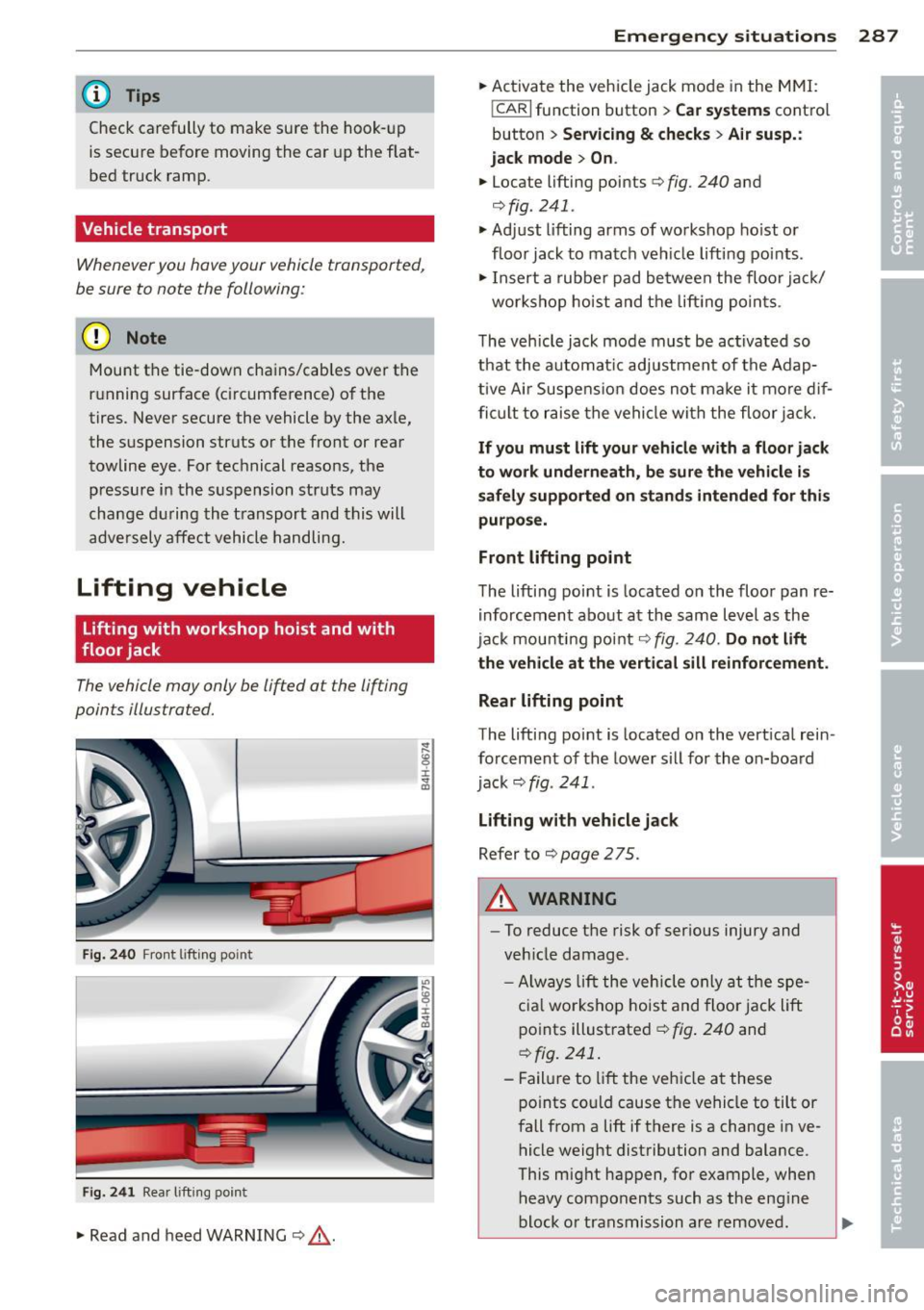
The vehicle may onl y be li~ed at the lif ting
points illu stra ted.
Fi g. 2 40 Front l ift ing po int
Fig. 2 41 Rea r lifti ng poin t
• Read and heed WARNING Q ,&. .
Emergenc y situ ation s 287
• Activate the vehicle jack mode in the MMI :
!CAR I function button > Ca r system s control
button>
Ser vici ng & ch ecks > Air su sp. :
jack mo de > On .
• Locate lifting poin ts Q fig . 240 and
¢ fig . 241 .
• Adjust lifting arms of wo rkshop hoist o r
floor jack to match veh icle lifting points.
• Insert a rubber pad be tween the floo r jack/
workshop hoist and the lift ing po ints .
The vehicle jack mode must be activated so
that the automat ic adjustment of the Adap
tive Ai r Suspens ion does not make it more dif
fic ult to raise the vehicle with the floor ja ck.
If you mu st l ift your vehicle with a fl oor jack
t o wo rk underneath , be sure the vehi cle i s
s af ely s upported on stand s intended for thi s
purpose.
Front lifting point
The lifting point is located on the floor pan re
i nforcement about at the same leve l as the
jac k mounting point
c:> fig . 240 . Do not lift
t h e v ehi cle at the verti cal sill reinf orcement .
Rear lifting point
The lifting point is located o n the vert ical rein
forcement of the lower sill for the on-board
jack ¢
fig. 241 .
Lifting with vehicle jack
Refer to ¢ page 275.
&_ WARNING ,-~
-To reduce the risk of serious injury and
vehicle damage .
- Always lift the vehicle only at the spe
c ia l workshop ho ist and floor jack lift
points illustrated
c:> fig . 240 and
c:> fig. 241 .
- Failure to lift the vehicle at these
po ints could cause the vehicle to tilt or
fall from a lift if there is a change in ve
hicle weight distribution and balance .
This might happen, for example, when h eavy components such as the eng ine
block or transmission are removed.