load capacity AUDI S8 2014 Owners Manual
[x] Cancel search | Manufacturer: AUDI, Model Year: 2014, Model line: S8, Model: AUDI S8 2014Pages: 314, PDF Size: 78.47 MB
Page 75 of 314
-When not in use, to reduce fuel consump
tion, wind noise and to guard against theft.
A WARNING
- Use of an unapproved roof rack or incor
rect mounting of an approved roof rack
can cause the roof rack or the items at
tached to it to fall off the roof onto the
road .
- Objects falling from the roof of a veh icle
can cause a crash and personal injury .
- Only mount the roof rack on the desig
nated locations on the roof
c::> fig . 74 .
-The roof rack system must be installed
exactly according to the instructions pro
vided.
- When driving w ith a roof rack system,
changes to the center of gravity and wind
resistance can change the veh icle han
dling and lead to a collision . Always
adapt your driv ing and your speed to the
current conditions.
0 Not e
-Your vehicle warranty does not cover any
damages to the vehicle caused by using
r oof racks or mount ing structures not
approved by Audi for your vehicle. The
same applies to damage resulting from
incorrect roof rack installation.
- Always check the roof rack mountings
and hardware before each trip and dur
ing a trip to make sure everything is se
cure ly tightened . If necessary, retighten
the mount ings and check the ent ire sys
tem from t ime to t ime.
- After mounting a roof rack system, or
when you transport objects on the roof
of your veh icle, the height of the vehicle
i s naturally increased. Be careful when
driv ing under low br idges or in parking
garages for example. This could cause
damage to the load and even the vehicle
i tself.
- Make sure the open rear lid and the sun
roof* do not come into contac t with the
roof rack .
Seat s an d sto rage 73
Loading the roof rack
Always distribute loads evenly. Make sure
anything on the roof rack is securely tied
down .
.. Always distribute the loads on the roof rack
even ly .
.. Always attach items to the roof rack securely
before you dr ive off.
The maximum permissible roof weight is
2 20
lb (100 kg ).
The roof weight is the total of
the weight of the roof rack, the attachments
and the cargo you a re carrying. You must also
not exceed the maximum load we ight for the
roof rack you are using .
When using a roof rack system which has a l ower load ca rrying capaci ty , you must not use
up the tota l maxim um permissible load car ry
i ng capacity specified above . Instead, you
sho uld load the roof rack system only to the
maximum capacity specified by the manufac
turer of the roof rack system.
A WARNING
---Weak, damaged or improper straps used
to secure items to the roof rack can fail
during hard braking or in a collis ion and
cause ser ious personal injury.
- Make sure the roof rack is installed exact
ly as specified above
c::> page 72.
- Always use su itable mount ing straps for
securing items to the roof rack to help
p revent items from sh ifting or flying for
ward.
- Items on the roof rack must always be
securely mounted.
- The use of a roof rack can negat ively af
fect the way a veh icle hand les. Cargo
that is large, heavy, bulky, long or flat
will have a greater negat ive influence on
the vehicle's aerodynamics, center of gravity and overall handling . Always
drive s lowly, avoid sudden braking and
maneuvers when transporting cargo on
the roof of your vehicle .
Page 76 of 314
7 4 Seats and storage
- Never exceed the maximum perm issible
load carrying capacity of the roof o f your
vehicle, the permissible axle weights and
the permissible total weight of your veh i
cle
c::, page 289, Weights .
@ For the sake of the environment
As a result of the increased wind resist
ance created by a roof rack, your vehicle is
using fuel unnecessarily. So remove the
roof rack after using it.
12-volt sockets
Applies to vehicles: 12-volt soc kets
Electrical accessories can be connected to ev
ery 12-volt socket.
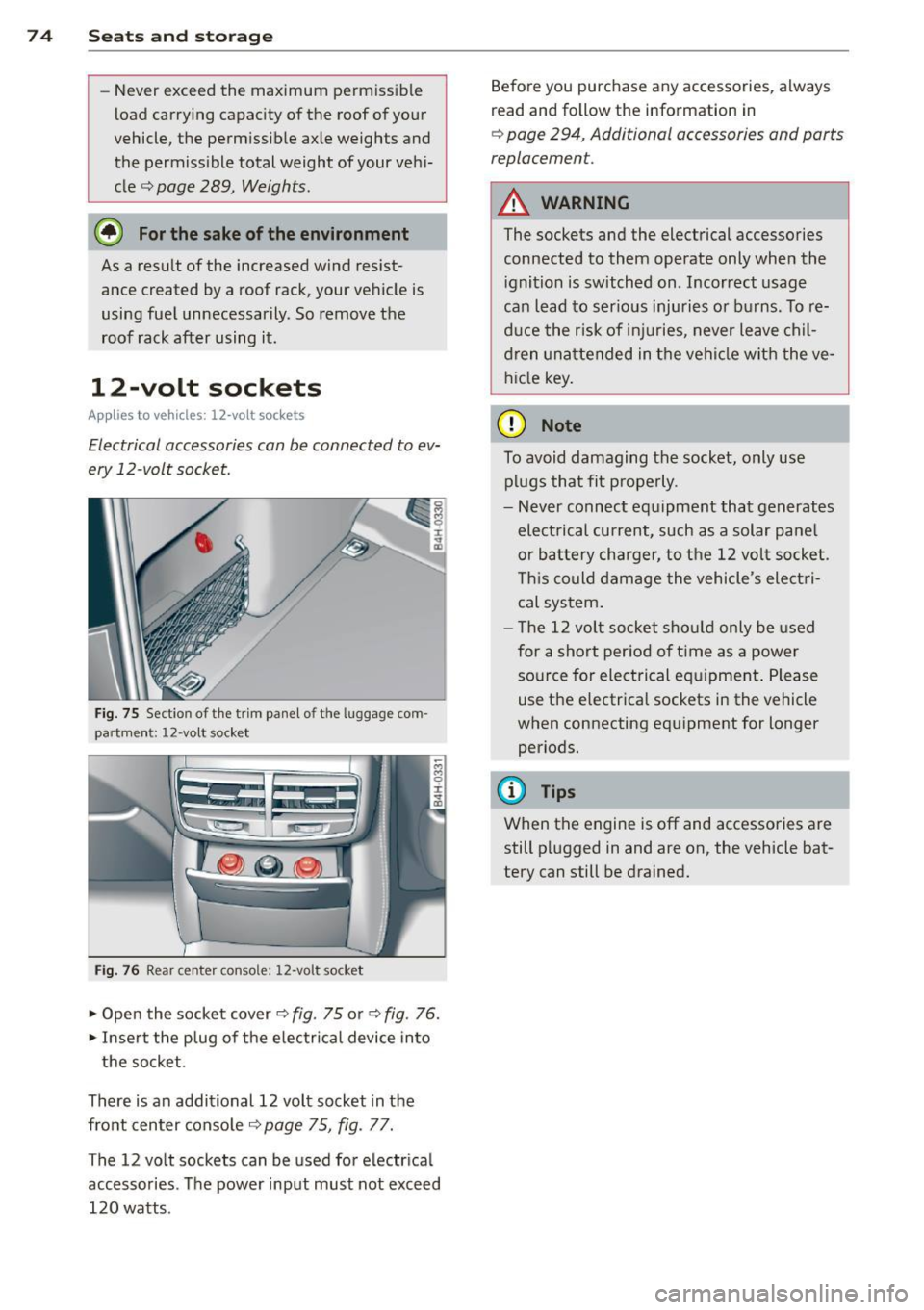
Fig. 75 Sect io n of the trim panel o f th e luggage com
part ment : 12 -vol t socket
Fig. 76 Rear center conso le: 12-vo lt socket
... Open the socket cover c::, fig . 75 or c::, fig . 76 .
... Inse rt the p lug of the e lectrical device into
the socket.
There is an additional 12 vo lt socket in the
fro nt center console
c::> page 75, fig. 77.
The 12 volt sockets can be used for electr ica l
accessories . Th e power input must not exceed
120 watts . Before you purchase any accessories
, always
read and follow the information in
c::, page 294, Additional accessories and parts
replacemen t.
A WARNING
The sockets and the electrical accessories
connected to them operate only when the
i gnition is switched on . Incorrect usage
ca n lead to ser ious injuries or burns. To re
duce the risk of inj uries, never leave ch il
dren unattended in t he vehicle with the ve
hicle key .
(D Note
To avoid damaging the socket, only use
plugs that fit p roperly.
- Never connect equ ipment that generates
elect rical current, such as a solar panel
or battery charger, to the 12 vol t socket .
T his could damage the vehicle 's elect ri
cal sys tem .
- The 12 volt socket shou ld only be used
for a short per iod of t i me as a power
so urce for electrical equ ipment . Please
use the electrical sockets in the vehicle
when connecting equipment for longer periods.
@ Tips
When the engine is off and accessories are
still plugged in and are on, the vehicle bat
tery can still be drained.
Page 79 of 314
- the temperature in the luggage compart
ment is below 131 °f (55 °C). The cooler
switches off automatically if the tempera
ture in the luggage compartment exceeds 131 °f (55 °C) . Once the temperature falls
below 131 °f (55 °C) again, the cooler
switches on aga in automat ically .
- t he battery is adequately charged . The cool
er switches off automatically if the vehicle
battery voltage falls below a minimum lev
el. This prevents the batte ry from discha rg
i ng . The cooler switches back on again auto
matically when the battery voltage increases
again (e.g . after starting the engine).
The cooler cools to 42.8 °f
(+ 6 °C) and the
freezer cools to 21.2 °f (- 6 °C) in opt imum
cooling cond itions . Th e cooling performance
is affected by the temperature in the luggage
compartment. The temperature inside the
cooler will be higher if the luggage compart ment is hot.
A WARNING
To avoid putting the occupants at any risk, please observe the following safety rules:
- The maximum capacity is 2.5 kg (5.5
lbs.).
- Never overload the cooler. This could cause injury in the event of a collision or
sudden braking.
- The coo ler lid must always be kept closed
while you are driving. Make sure the re
taining catch is securely engaged . The
contents of the coo ler could be thrown
forward into the passenger compart
ment in the event of a collision or under
sudden braking - risk of injury!
- Inflammable liquids, gas canisters, etc.
must not be stored in the cooler -risk of
exp losion! This also includes any prod
ucts that might emit volatile or inflam
mable gases.
- Liquids will freeze at temperatures at or
below 32 °f (0 °C) and may cause glass
bottles to burst!
Seats and storage 77
(D Note
-The venti lation openings for the cooler
are located on the back pane l trim in the
luggage compartment and
must be kept
clear at all t imes.
- If the cooler is not functioning properly, switch it off to prevent further damage.
Have it checked by a qualified workshop .
Operation
Applies to vehicles: wit h coo ler
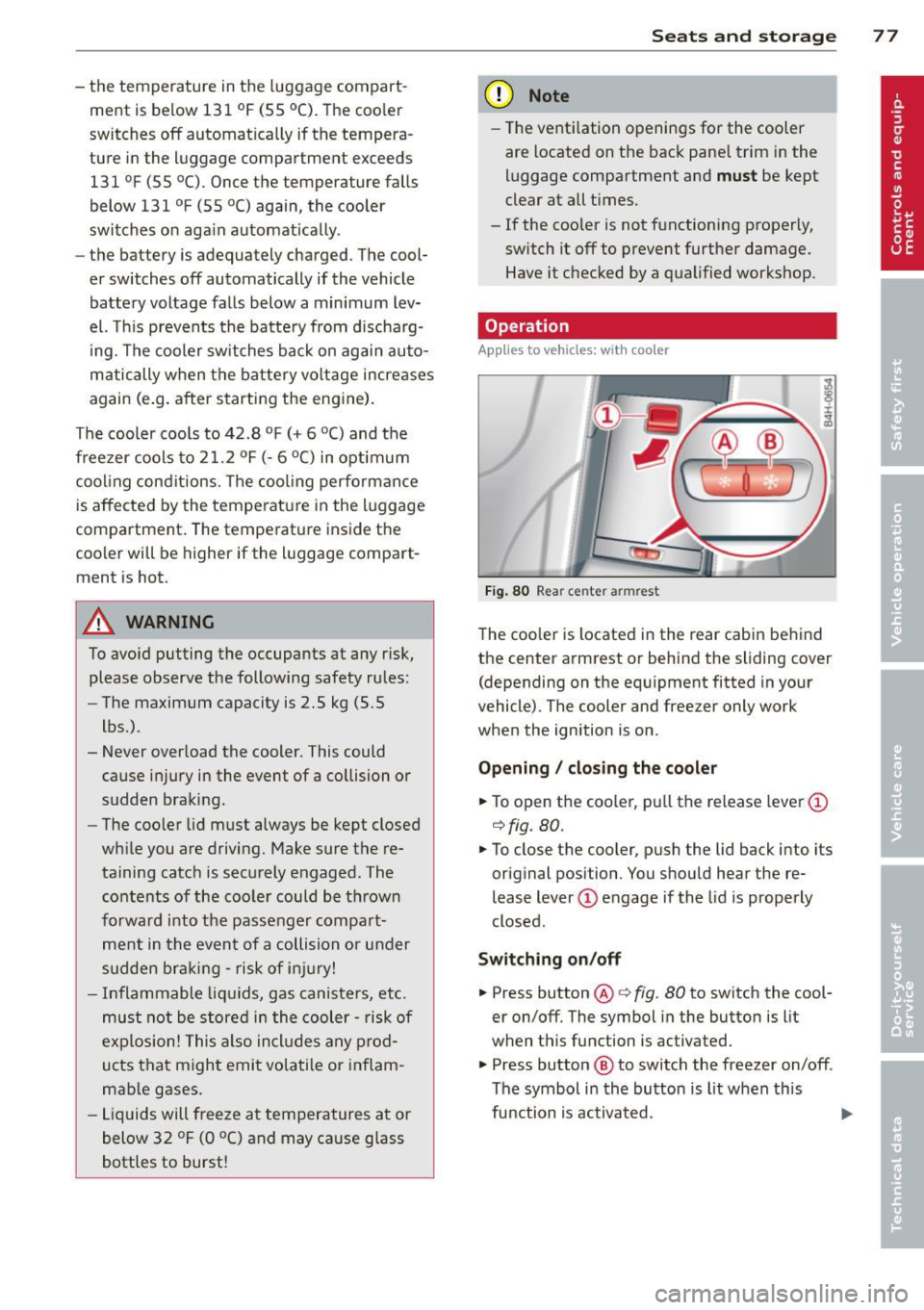
Fig. 80 Rear ce nter ar mrest
The cooler is located in the rear cabin behind
the center armrest or behind the sliding cover (depending on the equipment fitted in your
vehicle) . The cooler and freezer only work
when the ignition is on .
Opening / closing the cooler
.,. To open the cooler , pu ll the release lever@
c:!> fig. 80.
.,. To close the cooler, push the lid back into its
original position . You should hear the re
lease lever(!) engage if the lid is properly
closed.
Switching on /off
.,. Press button @ r:!> fig. 80 to switch the cool
er on/off. The symbol in the button is lit
when this function is activated .
.,. Press button
@ to switch the freezer on/off .
The symbol in the button is lit when this
function is activated .
Page 144 of 314
142 Driving Safely
-Always distribute the load as evenly as
possible.
- Place heavy objects as far forward in
the luggage compartment as possible.
- Never exceed the Gross Axle Weight Rat
ing or the Gross Vehicle Weight Rating
specified on the safety compliance stick
er on the left door jamb. Exceeding per
missible weight standards can cause the
vehicle to slide and handle differently.
- Please observe information on safe driv
ing
q page 135.
A WARNING
-
To help prevent poisonous exhaust gas
from being drawn into the vehicle, always keep the rear lid closed while driving.
- Never transport objects larger than those fitting completely into the luggage
area because the rear lid cannot be fully
closed.
- If you absolutely must drive with the rear
lid open , observe the following notes to
reduce the risk of poisoning:
- Close all windows,
- Close the power roof,
- Open all air outlets in the instrument
panel,
- Switch off the air recirculation,
- Set the fresh air fan to the highest
speed.
A WARNING
Always make sure that the doors, all win
dows, the power roof and the rear lid are
securely closed and locked to reduce the
risk of injury when the vehicle is not being
used.
- After closing the rear lid, always make
sure that it is properly closed and locked.
- Never leave your vehicle unattended es pecially with the rear lid left open. A
child could crawl into the vehicle through
the luggage compartment and close the
rear lid becoming trapped and unable to
get out . Being trapped in a vehicle can
Lead to serious personal injury .
-
-Never let children play in or around the
vehicle.
- Never let passengers ride in the luggage
compartment. Vehicle occupants must
always be properly restrained in one of
the vehicle's seating positions .
(D Tips
-Air circulation helps to reduce window
fogging. Stale air escapes to the outside
through vents in the trim panel, on the
Left side of the Luggage compartment.
Be sure to keep these slots free and
open .
- The tire pressure must correspond to the
load . The tire pressure is shown on the
tire pressure label. The tire pressure la
bel is located on the driver's side B-pillar.
The tire pressure Label lists the recom
mended cold tire inflation pressures for
the vehicle at its maximum capacity
weight and the tires that were on your
vehicle at the time it was manufactured.
For recommended tire pressures for nor
mal Load conditions, please see chapter
<=> page 252 .
Tie -downs
The luggage compartmen t is equipped wi th
four tie-downs to secure luggage and o ther
items.
Use the tie-downs to secure your cargo p rop
erly
c> page 141, Loading the luggage com
partment.
In a collision, the laws of physics mean that
even smaller items that are loose in the vehi
cle will become heavy missiles that can cause
serious injury. Items in the vehicle possess en
ergy which vary with vehicle speed and the
weight of the item. Vehicle speed is the most significant factor.
For example, in a frontal collision at a speed
of 30 mph (48 km/h), the forces acting on a 10-lb (4 .5 kg) object are about 20 times the
normal weight of the item. This means that
the weight of the item would suddenly be
Page 201 of 314
Intelligent technology Notice about data
recorded by vehicle
control modules
Your vehicle is not equipped with an Event Da
ta Recorder (EDR), installed by some manu
facturers for the express purpose of capturing
data for retrieval after an accident or crash
event. EDR's are sometimes called "crash re
corders".
Some state laws restrict the retr ieval or down
loading of data stored by EDR's that were in
stalled in a vehicle for the express purpose of
retrieving data after an accident or crash
event without the owner's consent.
Although your vehicle is not equipped with an
EDR, it is equipped with a number of electron
ic control modules for various vehicle systems
such as, for examp le, engine function, emis
sion control, as well as for the airbags and
safety belts.
These electronic control modules also record
vehicle-related data during norma l vehicle op
eration for diagnostic and repair purposes.
The recording capacity of the electronic con
trol modules is limited to data (no sound is re
corded) and only a small amount of data is ac
tually recorded over a very limited period of
time and stored when a system fault or other
condition is sensed by a control unit. Some of
the data then stored may relate to vehicle
speed, direction, braking as we ll as restraint
system use and performance in the event of a
crash or other condition. Stored data can only be read and downloaded with special equip
ment.
Electronic Stabilization
Control (ESC)
Description
ESC helps to improve road holding and vehicle
dynamics to help reduce the probability of
skidding and loss of veh icle control. It works
only when the engine is running. ESC detects
Intelligent technology 199
certain difficult driving situations, including
when the vehicle is beginning to spin (yaw)
out of control and helps you to get the veh icle
back under control by se lectively braking the
wheels, and/or reducing engine power and
providing steering ass istance to help hold the
vehicle on the driver's intended course. The in
dicator light
JjJ in the instrument cluster
blinks when ESC is taking action to help you
control the vehicle.
ESC has limitations .
It is important to remem
ber that ESC cannot overcome the laws of
physics.
It will not always be able to help out
under all conditions you may come up against.
For example, ESC may not always be able to
help you master situations where there is a
sudden change in the coefficient of friction of
the road surface. When there is a section of dry road that is suddenly covered with water,
slush or snow, ESC cannot perform the same
way it would on the dry surface. If the vehicle
hydroplanes (rides on a cushion of water in
stead of the road surface), ESC will not be
able to help you steer the vehicle because con
tact with the pavement has been interrupted
and the vehicle cannot be braked or steered .
During fast cornering, particularly on winding
roads, ESC cannot always deal as effectively
with difficult driving situations than at lower
speeds. When towing a trailer, ESC is not able
to help you regain control as it would if you
were not tow ing a trailer.
A lways adjust your speed and driving style to
road, traffic and weather conditions. ESC can
not override the vehicle's physical limits, in
crease the available traction, or keep a vehicle
on the road if road departure is a result of
driver inattention. Instead, ESC improves the
poss ibility of keeping the vehicle under con
trol and on the road dur ing extreme maneu
vers by using the driver's steering inputs to
help keep the vehicle going in the intended di
rection. If you are traveling at a speed that
causes you to run off the road before ESC can
provide any assistance, you may not experi
ence the benefits of ESC.
•
•
Page 251 of 314
-Never mount used tires on yo ur vehicle if
yo u are not sure of their "previous histo
ry." Old used tires may have been dam
aged even though the damage cannot be
seen that can lead to sudden tire failure
and loss of vehicle control.
- If you notice unusual vibration or if the
vehicle pulls to one side when d riving, al
ways stop as soon as it is safe to do so
and check the wheels and tires for dam
age .
(D Note
Please note that summe r and wi nte r tires
are designed for the cond itions that are
Glossary of tire and loading terminology
Accessory weight means the comb ined weight (in excess of
those sta ndard items which may be rep laced)
of au toma tic transmission, power steer ing ,
power brakes, power windows, power seats,
radio, and heater, to the extent that these
items are availab le as factory-installed equip
ment (whether installed or not) .
Aspect ratio
means the rat io o f the height to the w idth of
the tire in percent . Numbers of 55 or lower in
dicate a low sidewall for improved steering re
sponse and better overa ll handling on dry
pavement .
Bead
means the part of the t ire t hat is made o f
steel wires, wrapped or reinforced by ply cords
and that is shaped to fit the r im.
Bead separation
means a b reakdown of the bond between
components in the bead .
Cord means the strands forming the plies in the
tire.
Tire s an d wheel s 249
typica l in those seasons . Aud i recommends
using winter tires during the winter
months . Low temperatures signif icant ly
dec rease the e lasticity of summer t ires,
which affects tract ion and brak ing ability.
If summer t ires are used i n very co ld tem
peratures, cracks ca n form o n the tread
bars , res ulting in perma nen t tire damage
that can cause loud driving noise and un
bala nced ti re s. Audi i s not respon sible for
th is type of damage .
Cold tire inflation pressure
means the t ire p ress ure recommended by t he
vehicle manufacture r fo r a tire o f a des ignated
s ize t hat has not bee n driven for more than a
coup le o f miles (k ilometers) at low speeds in
the three hour period before the tire press ure
is m easured or adjusted.
Curb weight
me ans the we ight of a motor ve hicle with
st andard equipmen t incl ud ing the max imum
capacity of fuel, oi l, and coolant, air condi
tioning and additional weig ht of optiona l
equipment.
Extra load tire
means a t ire design to oper ate a t higher load s
and at higher inflation pressures than the cor
responding standa rd tire . Extra load tires may
be identified as "XL", "x l", "EXTRA LOAD", o r
"RF" on the sidewal l.
Gross Axle Weight Rating ("GAWR")
me ans the load-ca rry ing capac ity of a single
axle system , measured at the tire -ground in
te rfaces.
Gross Vehicle Weight Rating ( "GVWR ")
mea ns the maximum total loaded we ight of
the ve hicl e. .,..
•
•
Page 252 of 314
250 Tires and wheels
Groove
means the space between two adjacent tread
ribs .
Load rating (code)
means the maximum load that a tire is rated
to carry for a given inflation pressure. You
may not find this informat ion on all tires be
cause it is not req uired by law.
Maximum load rating
means the load rating for a t ire at the max i
mum permissible inflation pressure for that
tire.
Maximum loaded vehicle weight
means the sum of:
(a) Curb weight
(b) Accessory weight
(c) Vehicle capacity we ight, and
(d) Production options weight
Maximum (permissible) inflation pressure
means the maximum cold inflation pressure
to which a tire may be inflated. Also called
"maximum inflation pressure ."
Normal occupant weight
means 150 lbs. (68 kilograms) times the
number of occupants seated in the vehicle up
to the total seating capacity of your vehicle .
Occupant distribution
means distribution of occupants in a vehicle.
Outer diameter
means the overa ll diameter of an inflated new
tire.
Overall width
means the linear distance between the exteri
ors of the sidewalls of an inflated tire, includ
ing elevations due to labeling, decorations, or
protective bands o r ribs .
Ply
means a layer of rubber-coated parallel cords.
Production options weight
means the combined weight of those insta lled
regular production options weighing over 5
lbs. (2.3 kg) in excess of those standard items
which they replace, not previously considered
in curb weight or accessory we ight, including
heavy duty brakes, ride levelers, roof rack,
heavy duty battery, and special tr im .
Radial ply tire
means a pneumat ic tire in which the ply cords
that extend to the beads are laid at substan
t ia lly 90 degrees to the center line of the
tread .
Recommended inflation pressure
see<=> page 249, Cold tire inflation pressure.
Reinforced tire
means a t ire design to operate at higher loads
and at h igher inflation pressures than the cor
responding standa rd tire. Reinforced tires
may be identified as "XL" "xl" "EXTRA LOAD"
' ' '
or "RF" on the sidewa ll.
Rim
means a metal support for a tire or a tire and
tube assembly upon which the tire beads are
seated.
Rim diameter
means nom inal diameter of the bead seat. If
you change your wheel s ize, you will have to
purchase new tires to match the new rim di
ameter.
Rim size designation
means r im diameter and width .
Rim width
means nominal distance between rim flanges.
Sidewall
means that portion of a tire between the
t read and bead.
Page 253 of 314
Speed rating (letter code)
means the speed at wh ich a tire is des igned to
be driven for extended periods of t ime . The
ratings range from 93 mph (150 km/h) to
186 mph (298 km/h) ¢
page 260 . You may
not find this information on all tires because
it is not required by law.
The speed rating letter code, where applica ble, is molded on the tire sidewall and indi
cates the maximum permissible road speeds
¢ &. in Winter tires on page 264.
Tire pressure monitoring system*
means a system that detects when one or
more of a vehicle's tires are underinflated and
illuminates a low tire pressure warn ing te ll
tale .
Tread
means that port ion of a tire that comes into
contact with the road.
Tread separation
means pulling away of the tread from the tire
carcass .
Treadwear indicators (TWI)
means the projections within the pr incipal
grooves designed to give a visual ind ication of
the degrees of wear of the tread. See
¢
page 258, Tread Wear Indicator (TWI) for
mo re inf ormat ion on measuring tire wear.
Uniform Tire Quality Grading
is a tire information system developed by the
United States National Highway Traffic Safety
Admin istration (N HTSA) that is designed to
help buyers make relative comparisons among
tires . Th e U TQG is not a safety rating and not a
g ua ran tee that a tir e will last for a prescribed
number of mi les (kilometers) or perform in a
certain way.
It simply gives tire buyers addi
tional information to combine with other con-
Tires and wheels 251
siderations, such as price, brand loyalty and
dealer recommendations. Under UTQG, tires
are graded by the t ire manufacturers in three
areas : treadwear, traction, and temperature
resistance. The UTQG informat ion on the tires,
molded into the sidewalls .
U.S. DOT Tire Identification Number (TIN)
This is the tire's "serial number" It begins
with the letters "DOT" and indicates that the
tire meets all federa l standards. The next two
numbers or letters indicate the plant where it
was manufactured, and the last four numbers
represent the week and year of manufacture.
For example,
DOT ... 2213 ...
means that the tire was produced in the 22nd
week of 2013. The other numbers are market
ing codes that may or may not be used by the
tire manufacturer. This information is used to
contact consumers if a tire defect requires a
recall.
Vehicle capacity weight
means the rated cargo and luggage load plus
150 lbs. (68 k ilograms) times the vehicle's to
tal seating capacity as listed on the label lo
cated on the driver's side B -pillar .
Vehicle maximum load on the tire
means that load on an individual tire that is
determined by distributing to each axle its
share of the maximum loaded vehicle weight
and dividing by two.
Vehicle normal load on the tire
means that load on an individual tire that is
determined by distributing to each ax le its
share of the curb weight, accessory weight,
and normal occupant weight (distr ibuted in
accordance with table below¢
page 252)
and dividing by two.
•
•
Page 254 of 314
252 Tires and wheels
Occupant loading and distribution for vehicle normal load for various designated seating
capacities
Designated seating capacity, Vehicle normal load , number Occupant distribution in a nor -
number of occupants of occupants mally loaded vehicle
4 2 2 i
n front
5 3 2 i n fro nt, 1 in back seat
Cold tire inflat ion pressure
Tire pressure affects the overall handling, performance and safety of a vehicle.
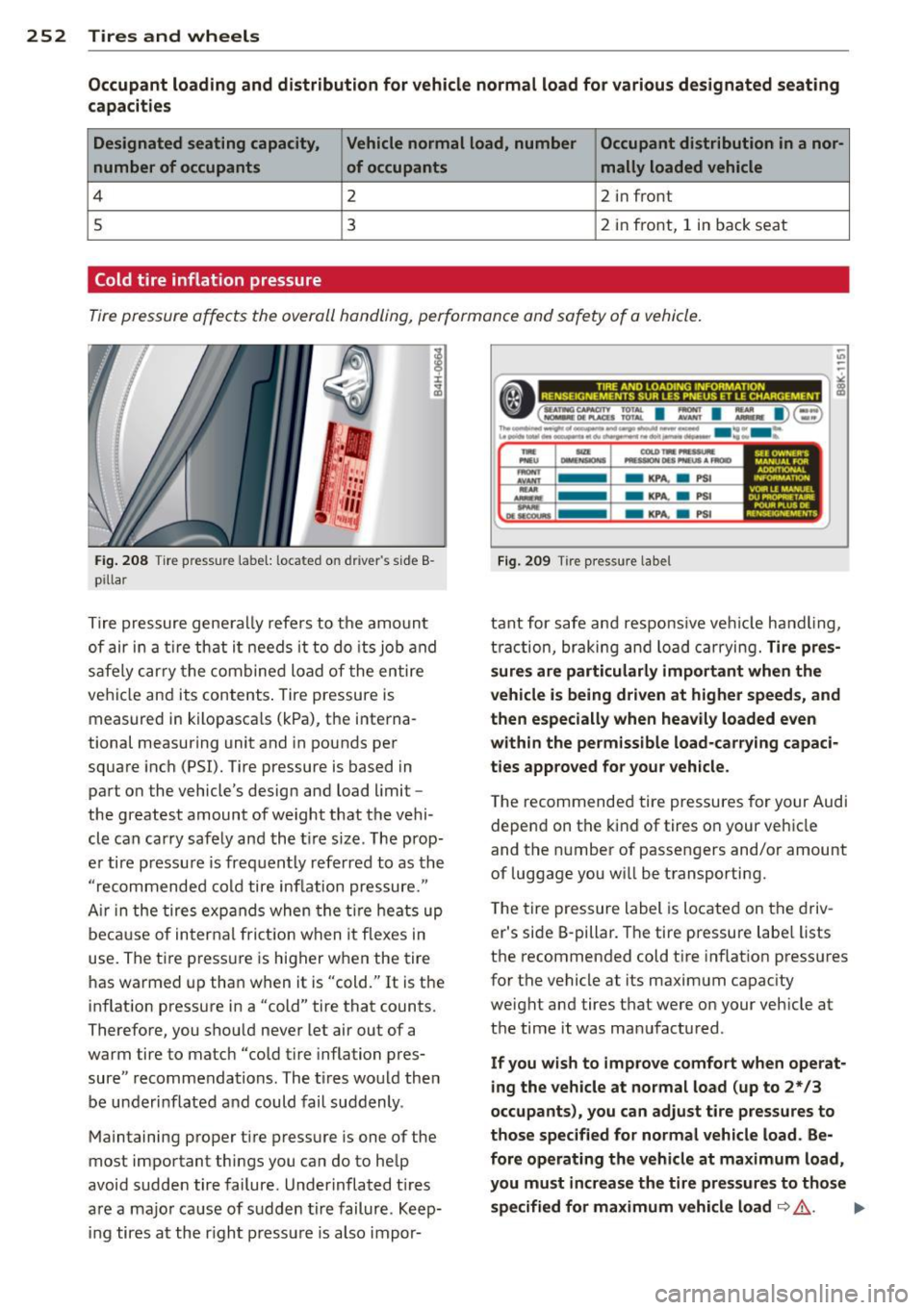
Fi g. 20 8 Tire p ressu re label: located on drive r's si de 8 -
p ill ar
T ire pressure gene ra lly refers to the amo unt
of air i n a tir e th at i t needs it to do its job and
s a fe ly c arry the combined load of the entire
ve hicl e and its contents . Tire pressure is
measured in kilopasca ls (kPa), the i nterna
tional measuring unit and in pounds per
squa re inc h (PSI). Tire pressure is based in
part o n the vehicle's design and load limit -
the greatest amount of we ight that the vehi
cle can car ry safely an d the t ire s ize . The prop
e r tire p ressu re is freq uen tly referred to as the
"recommende d cold tire inf lation pressure."
A ir in the tires exp ands when the ti re heats up
beca use of in ter nal fri ct ion when i t flexes in
use. The tire p ress ure is higher when the tire
has warmed up tha n when it is "cold." It is the
inflat ion pressure in a "cold" tire that counts.
Therefore, you sho uld never let air out of a
warm tire to match "cold ti re inflation pres
sure" recommendations. The t ires wo uld the n
be underinflated a nd could fail suddenly .
Maintaining proper t ire p ress ure is one of the
most important things you can do to he lp
avoid sudden tire failure . Underinflated t ires
a re a majo r ca use of s udden tire failure. Keep
ing tires a t the r ight pressu re is also impor-
-~
-
( • (==. ~r: I := I :... 1)-~- -:-i
n. ........... ....,. .................... ,...,,.. ...... ...... .. '--............................................... ·-..
TN IIZE CO.O TN.,,.... ,.,._u OWlHSIONt ......,., DU ,.,._ua .-,--
-.....
--...........
- KP aPSI
- ICPA. a PSI
- ICPA. a PSI
Fig. 209 Tire p ressu re labe l
SEEOWHf:ft"S MA. NUAl FOR
IHFOll:MA TION Va.t Lf M>.MJ!:L
OU PltOPfllE f A.IN: ,ol.M "-.UtDf NNSCIOM.:MErtf5
tant for safe an d respo ns ive ve hicle ha ndling,
t raction, br aking and load ca rrying .
Tire pres
sures are particularly important when the
vehicle i s being dr iven at higher speeds, and
then especially when heavily loaded even
within the permissible load-carrying capaci
ties approved for your vehicle .
The recommende d tire pressures for your Audi
depen d on t he kind of tires o n your vehicle
and the number of passengers and/or amount
of luggage you w ill be transporti ng.
T he tire pressure label is located on the d riv
er's side B -pillar . The tire pressure labe l lists
the recommended cold t ire inflat ion pressures
fo r the vehicle at its maxim um capac ity
weight and tires t hat were on your veh icle at
t h e time it was ma nufactured.
If you wish to improve comfort when operat
ing the vehicle at normal load (up to 2* /3
occupants ), you can adjust t ire pressures to
those specified for normal vehicle load. Be·
fore operating the vehicle at maximum load,
you mu st increase the tire pres sures to those
specified for maximum vehicle load
i:::> .&, . II>-
Page 255 of 314
Tires an d wheel s 253
Bear in mind that the ti re press ure monitoring
system* can only monitor the tire pressures
you have stored. The system does not recog
n ize the load condit ion of your vehicle.
The effectiveness of the tire pressure monitor
ing system* will be impaired if you store nor
mal load pressures but then operate the vehi
cle at its maximum load
c;, &.
See the i llustration c;, fig. 208 for the location
of the label on driver's side B-pillar (co lor of
the actua l labe l and exact location on the ve
h icle wi ll vary slightly). Note that the
following table is accurate at
the time of going to press and is subject to
change. In the event of d iscrepancies, the tire
pressure label is located on the driver's side B
pillar always takes precedence.
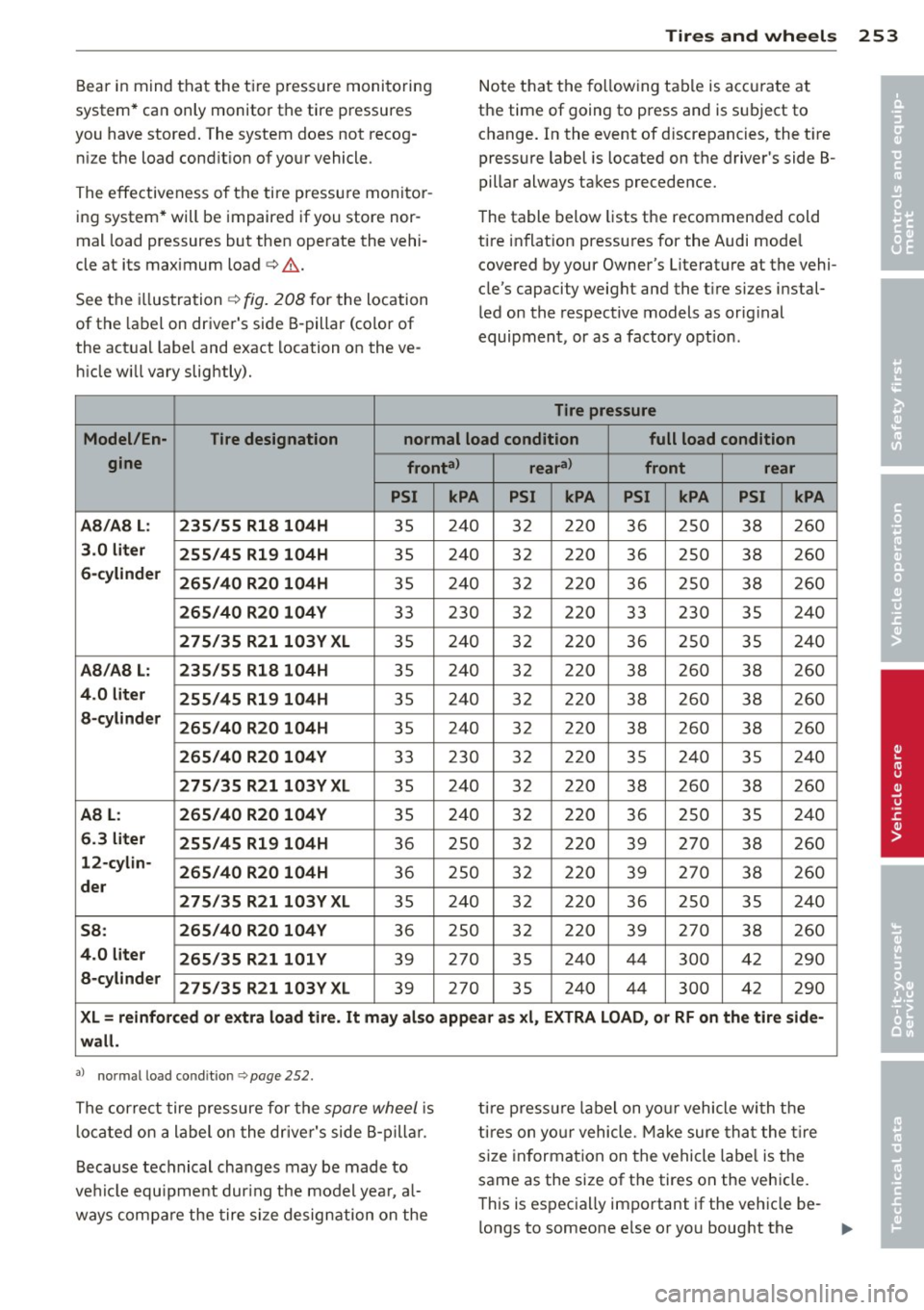
The table below lists the recommended cold
tire inflat ion pressures for the Audi mode l
covered by your Owner's Literature at the vehi
cle's capacity weight and the t ire sizes instal
led on the respective models as orig inal
equipment, or as a factory option.
Tire pressure
Model /En-
Tire design ation normal load condition
full load condition
gine fronta> reara>
front rear
PSI kPA PSI kPA PSI kPA PSI kPA
AB /AB L: 235/55 R18 104H
35 240 32 220 36 250 38 260
3 .0 lit er
255/45 R1 9 104H 35 240
32 220 36 250 38 260
6-cy lind er
26 5/40 R2 0 104H 35 240 32 220 36 250 38 260
265 /40 R20 104 V 33 230 32 220 33 230 35 240
275
/35 R 2110 3Y XL 35 240 32 220 36 250 35 240
A8/A8 L: 235 /55 R1 8 104H 35 240
32 220 38 260 38 260
4.0 l it e r
255/4 5 R19 104H 35 240 32 220 38 260 38 260
a-cy lind er
26 5/ 40 R 20 104H 35 240
32 220
38 260
38 260
2
6 5/40 R 20 104V 33 230 32 220 35 240 35 240
27
5/35 R2 110 3Y XL 35 240 32
220
38 260
38 260
AB L
: 265/40 R20 104 V 35 240 32 220 36 250 35 240
6.3 liter
255 /45 R1 9 104H 36 250 32 220
39 270
38 260
12
-cy lin-
26 5/40 R 20 104H 36 250 32 220 39 270 38 260
der
275/35 R 21 103 YXL
35 240 32 220 36 250
35 240
58
: 2 65/40 R 20 10 4V 36 250 32 220 39 270 38 260
4.0 liter
265 /35 R21101 Y 39 270 35 240 44 300 42 290
a-cy lind er
275/35 R 2110 3Y XL 39 270 35 240
44
300 42
290
XL= reinf orce d or extra lo ad tir e. It ma y als o appe ar a s x l, E XTRA LOAD, or RF on th e tire s ide-
w all .
al no rmal load co ndit ion c:> page 252.
The correct tire pressure for the spare wheel is
l ocated on a label on the dr iver's side B-pilla r.
Because technical changes may be made to
ve hicle equ ipment dur ing the model yea r, a l
ways compa re the tire size designation on the tire pressu
re label on you r vehicle with the
t ires on you r vehicle. Make sure that the t ire
size in formation on the vehicle labe l is the
same as the size of the tires on the vehicle.
This is especially important if the vehicle be-
l ongs to someone else or yo u bought the ...,
•
•