ABS AUDI S8 2015 Owner's Manual
[x] Cancel search | Manufacturer: AUDI, Model Year: 2015, Model line: S8, Model: AUDI S8 2015Pages: 312, PDF Size: 79.18 MB
Page 219 of 312

,....,
N ,....,
N
0 J:
'SI: ,...., \!) ..,.,
,...., ..,., ,....,
Vehicle care and cleaning 217
Component Situation Solution
Safety belts
Dirty Mild soap solutional, allow to dry before letting them re-
tract
Textiles, Stains adhering to Vacuum cleaner
Vinyl, the surface
Alcantara Water-based stains Absorbent cloth and mild soap solutiona>
such as coffee, tea,
blood, etc.
Oi l-based stains Apply a mild soap solutional, blot away the dissolved oil
such as oil, make- or dye, treat afterward with water, if necessary
up, etc .
Special stains such Special stain remover, blot with absorbent material,
as ballpoint pen, treat afterward with mild soap solutiona>, if necessary
nail polish, latex
paint, shoe polish,
etc.
Natural leather Fresh stains Cotton cloth with a mild soap solutiona >
Water-based stains Fresh stains: absorbent cloth
such as coffee, tea, Dried stains: stain remover suitable for leather
blood, etc.
Oil-based stains Fresh stains: absorbent cloth and stain remover suitable
such as oil, make- for leather
up, etc. dried stains: Oil cleaning spray
Special stains such Stain remover suitable for leather
as ballpoint pen ,
nail polish, latex
paint, shoe polish,
etc.
Care Regularly apply condit ion ing cream that protects from
light and penetrates into the material. Use specially-col-
ored conditioning cream, if necessary.
Cooler Dust and dirt Clean the ventilation openings in the luggage compart-
ment
Dirty Lukewarm
water, mild soap solutional if necessary, then
dry
Defrosting Empty the refrigerator, switch it off and let it thaw with
the door open, then dry
Carbon parts Dirty Clean the same way as p lastic parts
a) Mild soap so lu tion : maxim um two ta bl es poons neutr al soa p in 1 q uar t (l lit e r) of water
A WARNING
The windshield may not be treated with
water-repelling windshield coating agents.
Unfavorable conditions such as wetness,
darkness, or low sun can result in in- creased
glare. Wiper blade chatter is also
possible.
([) Note
-Headlights/tail lights
•
•
Page 226 of 312

224 Fuel supply and filling your fuel tank
-Always place a portable fuel container
on the ground before filling.
- Always keep the fi ller nozzle complete
ly inside the portable conta iner before
and during filling.
- If filling a portable container made of
metal , the filler nozz le must always be
in contact with the container. This will
help prevent static electricity from dis
charging and cause a fire .
- Never spill fuel inside the vehicle or
luggage compartment. Fuel vapors are
highly flammable .
- Always observe local and state/provin
cial laws regarding the use, storage
and transportation of fuel conta iners .
- Make certain the fuel container meets
industry standards (ANSI/ ASTM
F852 -86) .
Q) Note
If any fuel has spilled onto the car, it
should be removed immediately to prevent
damage to the paint.
@ For the sake of the environment
As soon as the correctly operated nozzle
sw itches off automatically for the first
time, the tank is full. Do not try to add
more fuel because fuel may spill out. In
add ition, the expansion space in the fuel
tank will be filled -caus ing the fue l to
overflow when it becomes warm and pol
lute the env ironment.
@ Tips
- Running yo ur engine while refuelling
may cause vapors to escape or
even
cause fue l to spill out of the tank. This
would then shut off the fuel nozzle be
fore the tank is full.
- Do not refuel your vehicle with the igni
tion switched on . The fuel gauge may
otherwise not indicate the correct fuel
level after refuelling.
- Diesel vehicles* are equipped with a die
se l m isfueling protector.
It allows the vehicle to be
fueled only with a diesel
fuel pump nozzle . A worn or damaged
nozzle or a nozzle that is too small may
not be ab le to open the diesel misfueling
protector. If this is the case, try turning
the nozzle before inserting it in the fuel
filler neck, use a different fuel pump or
see your authorized Aud i dealer or au
thorized repair facility for assistance.
- The fuel filler flap of your vehicle is not
locked when you lock the vehicle from
the inside .
Fuel filler flap emergency release
You can open the fuel filler flap by hand if the
power locking system should fail.
Fig. 192 V ehicl es with sele cti ve catalytic re d uc tion :
Right s ide tri m pan el
Fig. 19 3 Right s ide trim pan el in th e luggage compart·
m ent: em erg enc y re le ase m echani sm
The emergency release mechanism is located
behind the right side trim panel in the lug
gage compartment. In vehicles with selective
catalyt ic re duction* , re move th e vent gr ill e
first :
... Press both tabs@q
fig. 192 and tilt the
vent gr ille downward. You can then remove
the grille upward . ..,_
Page 241 of 312
- the temperature of the engine coolant rises
due to th e heat bui ld-up from the engine in
the engine compartment, or
- the engine compartment heats up because
the vehicle is parked in intense sunlight.
.&_ WARNING
- To reduce the r isk of personal injury nev
er touch the radiator fan.
- The auxiliary electr ic fan is temperature
controlled and can switch on sudden ly
even when the engine is not runn ing.
- The auxiliary radiator fan switches on au tomat ically when the engine coolant
reaches a certain temperature and will
continue to run until the coolant temper
at ure drops.
Brake fluid
Checking brake fluid level
The brake fluid level can be checked with a
quick glance.
N N
-N
i
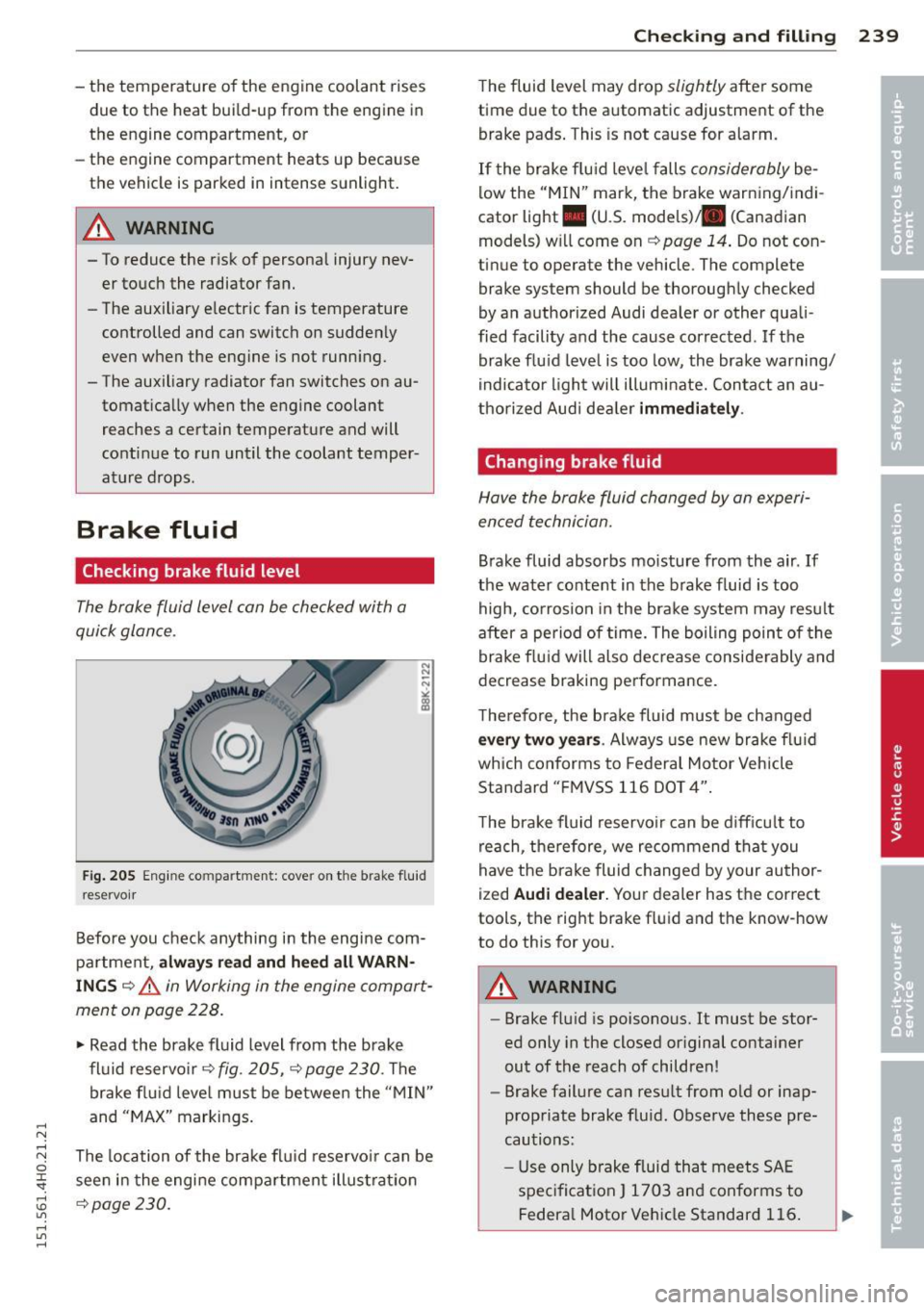
F ig . 2 05 Eng ine co mpartmen t: cove r on the b rake f lui d
r eservo ir
Before you check anything in th e engine com
partment,
alwa ys read and he ed all WARN
INGS c::> .&. in Working in the engine compart
ment on page 2 28.
~ Read the brake fluid level from the brake
fl uid reservo ir ~
fig . 205, c::> page 230. The
brake f luid leve l must be betwee n the "M IN"
and "M AX" marki ngs.
The location of the brake fl uid reservo ir can be
see n in t he engi ne comp artment illus trati on
c::> page 230.
Checkin g and fillin g 239
The fluid level may d rop slightly afte r some
time due to the automatic adjustment of the
brake pads . T his is not cause for alarm .
If the brake flu id leve l falls considerably be
low the "MIN" mark, the brake warning/indi
cator light . (U.S. models) . (Canadian
models) w ill come on
~ page 14 . Do not con
tin ue to operate the vehicle . The complete
brake sys tem should be thoroughly checked
by an authorized Audi dea ler or other quali
fied facility and the cause corrected.
If the
brake f lu id leve l is too low, the brake warning/
indica tor ligh t will illumi nate. Conta ct an au
thorized Aud i de aler
immediately .
Changing brake fluid
Have the brake fluid changed by an experi
en ced technician.
B rake fluid absorbs moisture from the air . If
the water content in the brake fluid is too
high, co rrosion in the brake system may resu lt
after a pe riod of time. The boiling point of the
brake f lu id will also dec rease conside rably and
decrease brak ing performance.
T herefo re , the bra ke fluid must be changed
every tw o year s. Always use new br ake f lu id
which con forms to Federal Mo tor Veh icle
Standard " FMVSS 116 DOT 4".
T he bra ke fluid reservo ir can be d iff icu lt to
reach, the refore, we recommend that you
have the bra ke fluid changed by your author
ized
Audi dealer. Your dealer has the cor rect
tools, the right brake fluid and the know -how
to do this for you.
A WARNING
---- Brake flu id is poisonous. It must be stor
ed only in the closed or iginal container
out of the reach of children!
- Brake failure can resu lt from old or inap
prop riate brake f lu id. Observe these pre
cautions:
- U se only brake fluid tha t meets SAE
specificat ion
J 1703 and conforms to
Federa l Motor Vehicle Standard 116.
Page 242 of 312
24 0 Ch eck ing and filling
Always check wi th your a uthorized Audi
dealer to make s ure you are using the
correct brake flu id. The correct type of
brake fluid is also indicated on the
brake fluid reservoir.
- The brake fluid must be new. Heavy use
of the brakes can cause a vapor lock if
the brake fluid is left in the system too
long. This can ser ious ly affect the effi
ciency of the b ra kes as well as yo ur
safety. This could result in an acc ident.
(D Note
Brake flu id will damage the paint of your
veh icle.
@ For the sake of the environment
Because of the problem of proper d isposa l
of brake flu id as wel l as the special tools
requ ired and the necessary expert ise, we
recommend that you have the b rake fluid
changed by your author ized Audi dealer.
Battery
General information
Under
normal operating conditions, the bat
tery in your Audi does not need any mainte
n ance . With
high outside temperatures or
l ong daily dr ives we recommend that you have
the elec trolyte level checked by a service fa
cili ty. The e lec trolyte level sho uld a lso be
checked each time the battery is charged
¢ page 242.
Have the b attery checked when you ta ke yo ur
ve hicl e in for service. Yo u are well adv ise d to
replace a battery that is older than S years .
W ith certa in types of airbag deployment, the
battery is d isconnected from the vehicle ele c
tr ica l system for sa fety reasons¢
& in Re
pair, care and disposal of the airbags on
page 165.
Disconnecting the battery terminals
Some veh icle func tions (power w indow regu
l ato rs, for example) a re los t if the b attery ter- mina
ls are disconnected. These functions have
to be relearned after the battery termina ls are
connected aga in. To prevent th is, the battery
sho uld only be disconnected from the ve hicle
electrical system when abso lutely necessary
for repairs.
Vehicle s not driven for long peri ods
If you do not d rive your vehicle over a period
of several days or weeks, e lectr ica l compo
nents are gradually cut back or sw itched off.
This reduces energy consumption and ma in
ta ins start ing capability over a longer period
¢
page 202. Some of the convenience func
t ions may not ope rate, such as the inter ior
li gh ts or the power seat adjus tment. The con
venience func tions will be ava ilable ag ain
when you switch on the ignition and start the
engine .
Winter operation D uring the winte r months, battery capac ity
tends to de crease as temperatures drop. This
is beca use more power is also consumed wh ile
sta rting, and the headlights, rear window de
fogger, etc ., are used more often .
Avoid unnecessary power consumpt ion, p ar
t icu lar ly in city traffic or whe n traveling only
short distances. Let yo ur au thorized Aud i
dealer check the capacity of the vehicle bat
tery before winter sets in ¢
page 242. A well
charged battery will not on ly prevent starting
problems when the weather is cold, but will
also last longer.
(!) Tips
If your vehicle is left standing for several
weeks at extremely low temperatures, the
vehicle battery sho uld be removed and
stored where it w ill not freeze. This will
prevent it from be ing damaged and having
to be repla ced.
Page 266 of 312

264 Tires and wheels
remain continuously illuminated. This se
quence will continue upon subsequent vehicle
start-ups as long as the malfunction exists.
When the malfunction indicator is illuminat
ed, the system may not be able to detect or
signal low tire pressure as intended . TPMS
malfunctions may occur for a variety of rea
sons , including the installation of replace
ment or alternate tires or wheels on the vehi
cle that prevent the TPMS from functioning
properly . Always check the TPMS malfunction
tellta le after replacing one or more tires or
wheels on your veh icle to ensure that the re
placement or alternate tires and wheels allow
the TPMS to continue to function properly.
Tire pressure indicator appears
The tire pressure indicator in the instrument
cluster informs you if the tire pressure is too
low or if there is a system malfunction.
Fig. 213 Display : underi nflatio n warning
Fig. 214 Display: System mal functio n
Using the ABS sensors , the tire pressure moni
toring system compares the tire tread circum
ference and vibration characteristics of the in
dividual tires . If the pressure decreases in one
or more tires, th is is indicated in the i nstru- ment
cluster with a warning symbol
[I] and a
message
r=> fig. 213 .
The tire pressure monitoring system must be
reset via MMI each time the pressures are ad
justed (e.g. when switching between partial
and full load pressure) or after changing or re
plac ing a tire on your vehicle
r=> page 265. The
TPMS indicator only monitors the tire pres
sure that you have previously stored. You can
find the recommended tire pressures for your
vehicle on the Label on dr iver's side B-pillar
r=> page 249.
Tire tread circumference and vibration charac
teristics can change and cause a tire pressure
warning if:
- the tire pressure in one or more tires is too
low,
- the tire has structural damage,
- the tire pressure was changed, wheels rotat -
ed or replaced but the TPMS was not reset
¢ page 265,
-the spare tire* is mounted.
Warning symbols
[I] Loss of pressure in at least one tire¢&,. .
Check the tire or tires and replace or repa ir if
necessary . The indicator light
[I] in the instru
ment cluster also illuminates
¢page 11.
Check/correct the pressures of all four tires
and reset TPMS via MMI.
Ill (T ire Pressure Monitoring System) Tire
pressure! System malfunction.
Iflll appears
after switching the ignition on or while driving
¢fig . 214 and the indicator light [I] in the in
strument cluster blinks for approximately one minute and then stays on, there is a system
malfunction . Attempt to store the correct tire
pressure ¢
page 265. If the indicator light
does not turn off or if it turns on shortly
thereafter , immediately drive your vehicle to
an a utho rized Aud i dealer or authorized repair
facility to have the malfunction corrected.
llll-
Page 297 of 312

,....,
N ,....,
N
0 J:
'SI: ,...., \!) 1.1'1 ,...., 1.1'1 ,....,
A
A/C (automatic climate control) .... .. .. 79
ABS
refer to Anti-lock braking system .. .. . 197
Accessories .. ................. .. ... 292
Active lane ass ist ............ .... .. . 101
Activating and deactivating ... .. .. .. . 102
C leaning the camera area . ... .. .. ... 215
Descr ipt ion ..... ...... ... .. .. ..... 101
Instrument cluster indicator light .... 102 Messages . . . . . . . . . . . . . . . . . . . . . . . . 102
Notes on instrument cluster display .. . 102
Sett ing the steering wheel vibrat ion .. . 103
Adaptive air s uspension/sport . ....... . 108
Adapt ive cru ise control ...... .. .. .. .. .. 9 2
C lean ing t he senso r ....... .. .. .. .. . 215
M essages . ... .... .... ... .. .. .. .... 99
Request for driver intervention . ... .. .. 97
Stop-and-go traffic . . . . . . . . . . . . . . . . . 96
Adapt ive Lig ht (defective) ... .. .. .. .. .. 2 2
AdBlue .... .. ................. .. ... 225
F illing . .. ... ...... ............. .. 226
Messages in the instrument cluster dis-
p lay . .... .. .......... ... .... .. .. . 225
Adding Eng ine coolant ........... .. .. .. ... 237
Eng ine oil ............ .... ... ... .. 234
W indshield was her fluid . ...... ... .. 244
Addit ives
Eng ine oil .. ............. .... .. ... 234
Ad justable s teer ing colum n .. .. .. .. .. .. 82
Adjusting Air dist ribution (automatic climate con-
trol) . .. .. .. .. .. ........... .. .. .... 80
Fr ont se ats . . . . . . . . . . . . . . . . . . . . . . . . 58
I ns trumen t illum ina tion ... .. .. .. .. .. 51
Steer ing colum n ....... ... .. .. .. .. .. 82
Temperature (automatic climate control) 80
A irbag system ............. .... 15 1, 170
Advan ced Airbag System . .. .. .. .. .. . 155
Advanced Airbag Sys tem components . 15 8
Ca re ... .. .. .. ... .. ..... ... .. .. ... 164
C hildren ... .... .. .... ... .. .. .. ... 175
Chil d restraints . ... .... ... .. .. .... . 176
Components (front airbags) .. .. .. .. . 158
Danger of fitting a child seat on the front
passenger seat . . . . . . . . . . . . . . . . . . . . 153
Inde x 295
Disposa l .. .. .... .. . .. .. ..... ... .. 164
Front airbags . . . . . . . . . . . . . . . . 155, 156
•
How do the front airbags work? . ... .. 160 •
How many a irbags does my vehicle
have? ...... .. .. .... ............. 158
How the Advanced Airbag System com -
ponents work togethe r ... .. ... ... .. 159
Impo rtant safety instructions on the
k nee a irbag sys tem . ........... .... 168
Impo rtant t hings to know ....... .. .. 151
K nee a irbags ... .. .. .. .. ...... ... .. 166
Monitoring . ..... ... .. .. ..... ... .. 161
PASSE NGER AIR BAG OF F light ... .. .. 162
Repa irs ... .. .. .. ................. 164
Safety instructions ................. 164
S ide a irbags . .. .. .... ............. 168
S ide curtain airbags . ............... 171
Warning/ind icator lights ... .... ... .. . 18
Wa rning/Indicato r lights ....... .. .. 161
Weigh t-sensing mat ........... .... 175
When must the sys tem be inspec ted? 161
A ircraft
T ranspo rting your vehicle 285
Alcantara Cleaning .. .. .. .. ............... .. 217
A ll Wheel Drive .. .. .... ............. 202
Winter tires ... .... . ... ...... ... .. 260
Alternato r
refer to Generator ............. .... . 16
Amb ience lighting . ................. . 50
Anti -freeze
refer to Engine coolant . ..... ... .. .. 236
An ti- lock b raking system ............ . 197
Warning/ind icator lights . . . . . . . . . 18, 19
Anti-slip regu lation .. ........... .... 197
Warning/ind icator lights .. .. ... ... .. . 18
Anti-theft systems Electronic immob ilizer ....... ... .. .. . 32
ASR
refer to A nt i-slip regula tion ..... .. .. 197
Audi braking guard
refer to Braking gua rd .. .. .. ... ... .. . 92
A udi drive select
refer to Drive se lect ............ .. .. 108
Audi Se rv ice Repair Manuals and Lit era-
ture .. ... .. .. .. .... . ... ...... ... .. 290
Page 308 of 312
306 Index
New tires and wheels . ... .. .. .. .... . 256
Rep lacing . .... . ...... ... .. .. .... . 257
Snow chains . .. ... .... ... .. .. .... . 261
Tires and vehicle load lim its .. .. ..... 253
Wheel bolts .. ............. .. .... . 262
W inter t ires .............. ... .. ... 260
Tire service life .. .. ..... ... .. .. .... . 255
Tools . .. .. ... ............ .. .. .. .. . 267
Torn or frayed safety belts . . . . . . . . . . . . 146
Towing Tow tr uck procedures . ... .. .. .... .. . 283
TPMS Tire pressure monitor ing system 263, 264
Trailer towing ................. .... . 210
Operating instructions .............. 210
Park ing system ..... ...... .. .. .. .. . 130
Technical requirements ........ 210,211
Trailer towing tips .......... .. .... . 212
Train (transporting your veh icle) .. ..... 285
Transm iss ion .... . ...... ... .. .. .... . 114
Transm iss io n malfunct ion (ind icator
light) . .. .. .. ..... ........... ... .. . 118
Transport Canada .......... .. .. .... . 141
Transport ing you r vehi cle . ... .. .. .... . 285
Tread Wear Indicato r (TWI) ....... .... 255
Trip odometer . . . . . . . . . . . . . . . . . . . . . . . 26
What does it mean when DEF appears in
the trip odometer d isplay? ... .. .. .. . . 26
Trunk
refer to L uggage compartme nt lid ... . . 37
T runk escape hand le . .... .... ... .. .. . 266
Turn signa ls .. .. . .......... .. .. .... .. 48
War ning/ indicator lights ....... .. .. .. 23
u
ULSD No . 2 (Diese l fuel) ..... .. .. .. .. . 221
Unfasten ing safe ty belts ............. 14 8
Un id irect iona l tires . ...... .. .. .. .. .. . 245
Uniform ti re quality grading ... .... .. . 259
Un lock ing
L uggage compartmen t lid ...... .. .. .. 37
P ower locking sw itch ................ 36
Remote contro l ..... ... .. .. .. .... .. 35
Using the key .. ..... ... .. .. .. .... .. 36
V
Valet parking .... .. ... .. ..... ... .. .. . 42
Vanity mir ro rs . . . . . . . . . . . . . . . . . . . 51, 52
Vehicle ca re/clean ing ..................... 214
Vehicle control modules ........ .. .. .. 196
Vehicle electr ical system . . . . . . . . . . . . . . 16
Vehicle identification label ..... ... .. .. 287
Vehicle Ident ifi cat io n Numbe r (V IN ) .. .. 28 7
Vehicle jack . .... .......... 267,272,273
Vehicle lite ratu re .. .. ... ..... ... .. .. .. 5
Vehicle shutt-down .................. 207
Vehicle transport ................... 285
Ventila tion . . . . . . . . . . . . . . . . . . . . . . . . . 78
Vinyl Cleaning . . . . . . . . . . . . . . . . . . . . . . . . . 217
w
Warning/ind icat or lights ........... .. . 11
Airbag system . . . . . . . . . . . . . . . . . . . . . 18
Anti- lock b rak ing system (ABS) . .. .. .. . 19
B rake system . . . . . . . . . . . . . . . . . . . . . . 14
El ectromechani cal pa rking brake . .... . 15
El ectronic power con trol . . . . . . . . . . . . . 20
El ectronic Stabilization Con tro l (ESC) . .. 18
Generator ..... .. .. ... ..... ... .. .. . 16
G low p lug system . . . . . . . . . . . . . . . . . . 20
Instrument cluster ............. .. .. . 10
Malfunction Indicator Lamp (MIL) .. .. . 20
Safety be lt . . . . . . . . . . . . . . . . . . . . . . . . 17
T urn signals . .. ............ ........ 23
Warning/Indicator lights
Airbag system . . . . . . . . . . . . . . . 161, 162
PASSENGER AIR BAG OFF ........... 162
Wa rranty coverages . .. .. ..... .... . .. 290
Washe r reservo ir .. ................ . 244
Wear indicato r .... .. ... ..... ... .. .. 255
Weights .. .. .... .. ............. .... 28 7
What happens if you wear your safety belt
too loose? ...... ....... ........... . 147
What happens to unbe lted occupants? . . 144
What impa irs d riving safety? .......... 134
Wha t should I do after changing a
whee l? ........ .... .... ........... . 252
What shou ld I do after replacing whee ls? 252