oil AUDI S8 2016 Owner's Manual
[x] Cancel search | Manufacturer: AUDI, Model Year: 2016, Model line: S8, Model: AUDI S8 2016Pages: 302, PDF Size: 75.68 MB
Page 228 of 302

Check ing and F illing
workshop to have excess oil ext racted if
necessary.
- Audi does not recommend the use of oil
addit ives. They may dam age the eng ine
and ad ve rs ely affe ct your New Vehicle
W arranty .
@ For the sake of the environment
-Under no circ umstances can the o il come in
contact with the sewage network or the soil.
- Observe and follow legal regu lations when
disposing of empty oil containers.
Changing the engine oil
We recommend that hove your oil changed by on
authorized Audi dealer or a qualified service sta
tion .
Before you check anyth ing in the eng ine compart
ment,
a lway s read and heed all WARNINGS¢.&.
in Working in the engine comportment on
page 220.
The engine oil must be changed accord ing to the
i n tervals specified in your Wa rranty
& Mainte
nance booklet . This is very important because the
lubricat ing properties of oi l diminish gradually
during normal vehicle use.
Under some circ umstances the engine oi l should
be changed more frequently. Change oil more of
ten if yo u drive most ly short distances, operate
the vehicle in dusty areas or under predominantly
stop-and-go traffic cond it ions, or have your vehi
cle where temperatu res remain below freezing
for extended periods .
Detergent additives in the oil will make fresh oil
look dark after the engine has been running for a
short t ime. Th is is normal and is not a reason to
cha nge the oil more often than recommended.
Because of the prob lem of proper disposal, along
with the special tools and necessary expertise re
qu ired, we strongly recommend that you have
your oil changed by an authorized
Audi dealer or
a qualified se rvice station .
If you choose to change your o il yourself , please
note the following important information:
226
A WARNING
--
To reduce the risk of persona l injury if you
must change the eng ine oil in your vehicle
yourself:
- Wea r eye protect ion.
- To reduce the r is k of b urns from hot engine
oil, let the engine cool down to the touch.
- When removing the oil drain plug with your
fingers, stay as far away as possible. Always
keep your forearm parallel to the ground to he lp prevent hot oil from run ning down your
arm.
- Drain the oil into a container designed fo r
this purpose, one la rge enough to hold at
least the tota l amount of oil in you r engine.
- Engine oil is poisonous. Keep it well out of the reach of children .
- Continuous contact with used engine o il is
ha rmf ul to your skin . Always protect your
skin by washi ng oil off thoroughly with soap
a nd water.
(D Note
Never mix oil additives with you r engine oil.
These add itives can damage your e ngine and
adverse ly affect yo ur Audi Limi ted New Vehi
cle War ranty.
@ For the sake of the environment
- Be fore chang ing your oi l, first make sure
you know where you can p roperly dispose of
t h e used oil.
- Always dispose of used e ngine o il properly .
Do not dump it on gard en so il, wooded
areas, into open streams or down sewage
drains.
- Recycle used e ngine o il by ta king it to a used
eng ine oil collect ion fac ility in yo ur area, or
c ont act a servi ce st ation.
Page 229 of 302
Cooling system
Coolant
The engine coolant performs two functions: it
keeps the engine from overheating and it pro
tects the engine from freezing in the winter .
The cooling system is sealed and generally re
quires little attention.
T he cooling system has been filled at the factory
with a permanent coolant which does not need to
be changed . The coolant consists of a mixture of
specially condit ioned water and the manufactur
er's glycol-based coolant additive Gl3 antifreeze
with anticorrosion additives (SO% for USA mod
e ls; 60% for Canadian mode ls). This m ixture
both ass ures the necessa ry frost protection and
protects metal components in the engine's coo l
ing system from corrosion and scaling .
It also
raises the boiling point of the coolant.
Do not red uce the concent ration of the coolant in
the summer by adding p lain water.
The propor
tion of coolant addit ive mu st be at least 50 %
but not more than 60 %
to mainta in antifreeze
protection and cooling efficiency. If the coolant
frost protection is too low, the coolant could
freeze and damage the vehicle heating and en
g ine cooling system .
For year-round driving, antifree ze is added at the
factory for temperatures down to :
- -31° F(- 3S°C)USA
- - 40 ° F ( - 40 °C) Canada.
If you must add coolant, use a m ixture of water
and coolant addit ive. M ixing the coolant additive
with d istilled water is recommended .
_& WARNING
Before you check anythi ng i n t he engine com
partment, always read and heed all WARN
INGS
¢ .&. in Working in the engine compart
ment on page 220 .
(D Note
-Befo re winter se ts in, have the coo lant
checked to see if the coolant additive in your
vehicle is sufficient to meet the cl imate con -
Check ing and Filling
ditions. This is especially important if you
live in a region where the winter is extreme
ly cold. If necessary, increase the proportion
of coolant additive to 60%.
- When adding coolant additive to your cool
ing system, remember :
- We recommend us ing only coolant add i
tive Gl2+ + or Gl3 for yo ur vehicle. This
coolant addit ive is avai lab le at aut horized
A udi dealers . O ther types of antifree ze can
significantly reduce corrosion pro tect ion .
The resulting corrosion can cause a loss of
coolant and serious engine damage.
- Do not add any type of radiator leak sealant
to your vehicle's engine coolant. Adding ra
diator repair fluid may adversely affect the
function and performance of your cooling system and cou ld resu lt in damage not cov
ered by your New Veh icle Limited Warra nty .
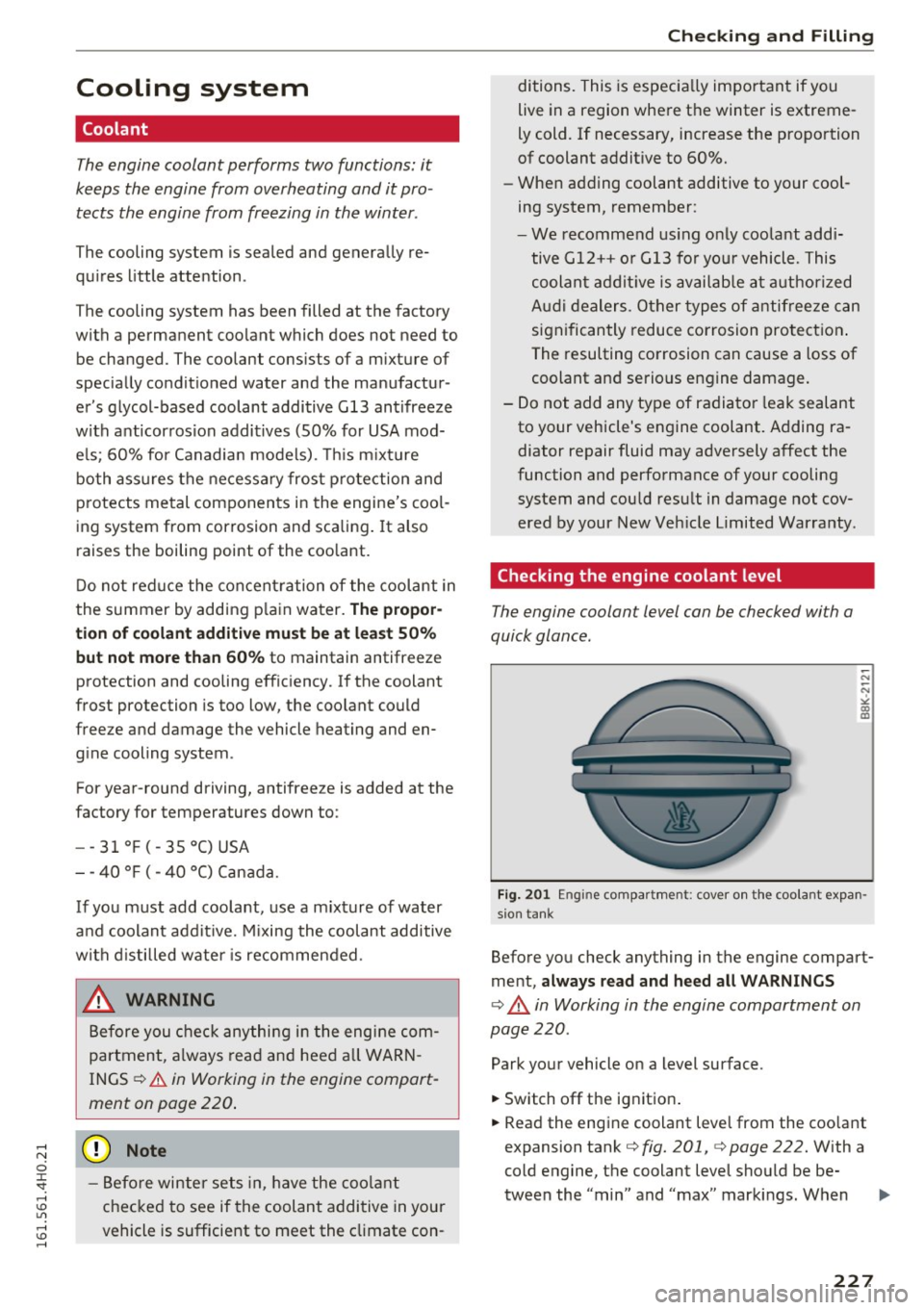
Checking the engine coolant level
The engine coolant level can be checked with a
quick glance.
Fi g. 2 01 Engin e compar tmen t: cover o n th e coo lant expan
sion t ank
Before you check anything in the engine compart
ment,
always read and heed all WARNINGS
¢ A in Working in the engine compartment on
page 220 .
Park your vehicle on a level surface .
.,. Switch off the ignition .
.,. Read the engine coolant level from the coo lant
expansion tank
¢ fig . 201, ¢page 222. With a
cold engine, the coolant level should be be-
tween the "min" and "max" markings. When .,.
227
Page 230 of 302
Checking and Filling
the engine is warm, the level may be slightly above the "max" marking.
The location of the coolant expansion tank can be
seen in the engine compartment illustration
¢ page 222.
To obtain an accurate reading, the engine must
be switched off.
The expansion tank in your vehicle is equipped
with an electric coolant level sensor.
When the coolant level is too low, the warning
light in the Auto-Check System¢
page 15 will il
luminate until you add coolant and the level has
been restored to normal. Even though there is an
electric coolant level sensor, we still recommend
you check the coolant level from time to time .
Coolant loss
Coolant loss may indicate a leak in the cooling
system . In the event of coolant loss, the cooling
system should be inspected immediately by your
authorized Audi dealer.
It is not enough merely
to add coolant.
In a
sealed system, losses can occur only if the
boiling point of the coolant is exceeded as a re
sult of overheating.
_& WARNING
The cooling system is under pressure and can
get very hot. Reduce the risk of scalding from
hot coolant by following these steps.
- Turn off the engine and allow it to cool
down.
- Protect your face, hands and arms from es
caping fluid and steam by covering the cap
with a large, thick rag.
- Turn the cap slowly and very carefully in a
counter-clockwise direction while applying
light, downward pressure on the top of the
cap.
- To avoid being burned, do not spill anti
freeze or coolant on the exhaust system or
hot engine parts. Under certain conditions,
the ethylene glycol in engine coolant can
catch fire.
228
(D Note
Do not add any type of radiator leak sealant
to your vehicle's engine coolant. Adding radia
tor repair fluid may adversely affect the func
tion and performance of your cooling system
and could result in damage not covered by
your New Vehicle Limited Warranty .
Adding coolant
Be very careful when adding engine coolant.
Before you check anything in the engine compart
ment,
always read and heed all WARNINGS
¢.& in Working in the engine compartment on
page 220 .
.. Requirement: There must be a residual amount
of coolant in the expansion tank ¢(D .
.. Turn off the engine .
.. Let the engine cool down .
.. Place a thick rag over the coolant expansion
tank ¢
page 22 7, fig. 201 and carefully twist
the cap counter-clockwise ¢&, .
.,. Add coolant mixed in the correct ratio
r::!> page 22 7, Coolant up to the MAX marking.
.. Make sure that the fluid level remains stable.
Add more coolant if necessary .
.. Twist the cap on again
tightly.
Replacement engine coolant must conform to ex
act specifications ¢
page 22 7, Coolant.
We recommend using only coolant additive G12+
+, G13 or in an emergency G12+ . Do
not use a
different additive. In an emergency use plain wa
ter until you can get the correct additive and can
restore the correct ratio. This should be done as
soon as possible.
If you have lost a considerable amount of cool
ant, then you should add cold antifreeze and cold
water only when the engine is cold.
Always use
new engine coolant when refilling.
Do not fill coolant above the "MAX" mark . Excess
coolant will be forced out through the pressure
relief valve in the cap when the engine becomes
hot.
~
Page 232 of 302
Checking and Filling
Brake fluid
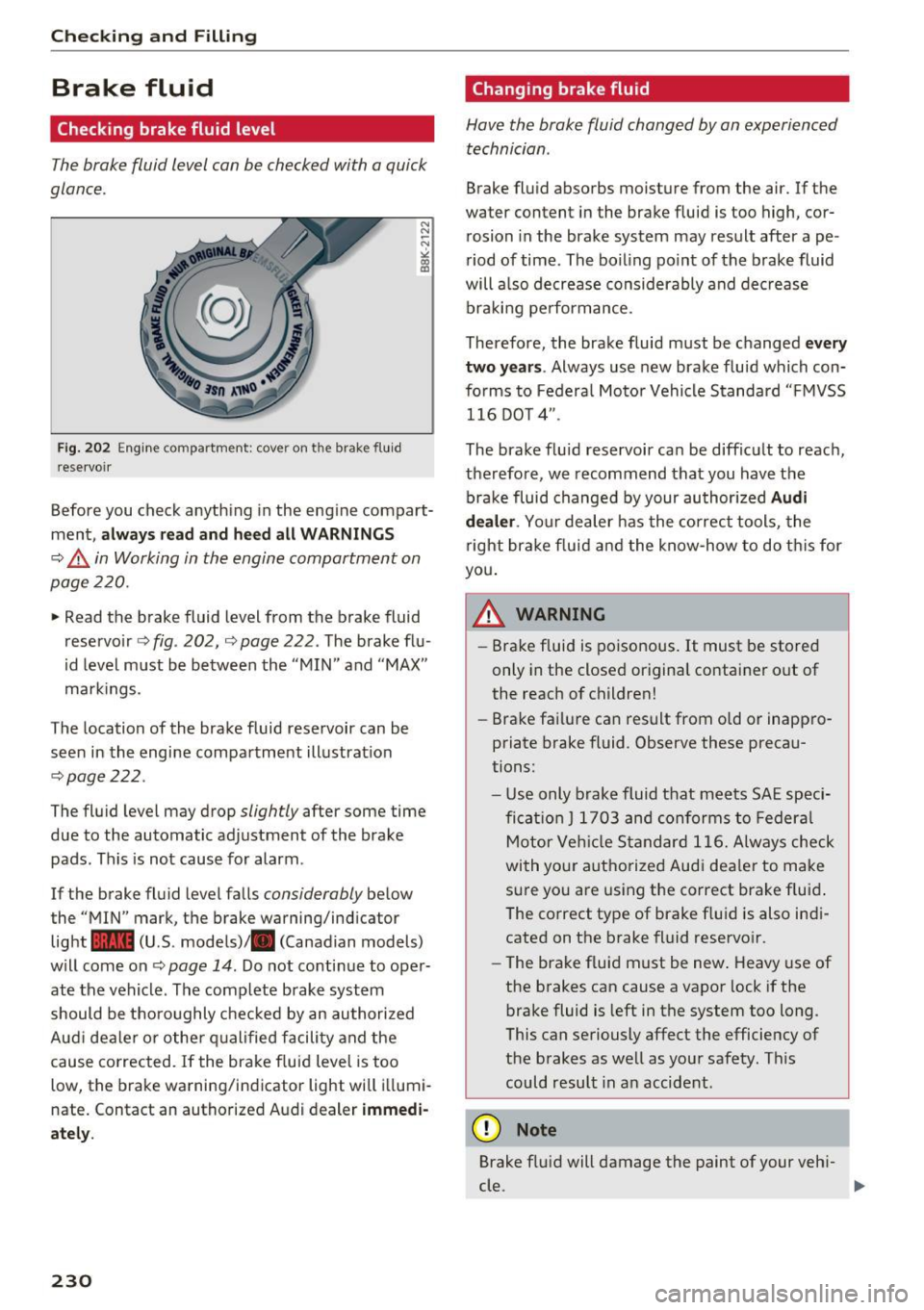
Checking brake fluid level
The brake fluid level can be checked with a quick
glance.
Fig. 202 Eng ine compartment: cove r o n th e brake flu id
r eservoi r
Before you check anything in the engine compart
ment,
always re ad a nd hee d all W ARNING S
¢ A in Working in the engine compartment on
page 220.
., Read the brake fluid level from the brake fluid
reservoir
<=> fig . 202, ¢page 222. The brake flu
id level must be between the "MIN" and "MAX"
mark ings.
The location of the brake fluid reservoir can be seen in the engine compartment illustration
¢ page 222.
The fluid level may drop slightly after some time
due to the automatic adjustment of the brake
pads . This is not cause for alarm .
If the brake fluid level falls
considerably below
the ' 'MIN" mark, the brake warning/indicator
light
1111 (U.S. models)/ . (Canadian models)
will come on¢
page 14 . Do not continue to oper
ate the vehicle . The complete brake system
should be thoroughly checked by an authorized
Aud i dealer or other q ualified facili ty and the
cause corrected.
If the brake f luid level is too
low, the brake warning/indicator light will i llumi
nate. Contact an authorized Audi dealer
immedi
at ely.
230
Changing brake fluid
Have the brake fluid changed by an experienced
technician .
Brake fluid absorbs moisture from the air. If the
water content in the brake fluid is too high, cor rosion in the brake system may result after ape
riod of time . The boiling po int of the brake fluid
will a lso decrease considerably and decrease
braking performance.
Therefore , the brake fluid must be changed
eve ry
two y ears . Always use new brake fluid which con
forms to Feder-al Motor Vehicle Standard "FMVSS 116 DO T 4".
The brake fluid reservoir can be difficult to reach ,
therefore, we recommend that you have the brake fluid changed by your author ized
Audi
d ea ler . Your dealer has the correct tools, the
right brake fluid and the know -how to do this for
you.
A WARNING
- Brake fluid is po isonous. It must be stored
only in the closed original container out of
the reach of children!
- Brake fai lure can result from o ld or inappro
priate brake fluid . Observe these precau
tions:
- Use only brake fluid that meets SAE speci ficat ion
J 1703 and conforms to Federal
Motor Ve hicle Standard 116. Always check
with your authorized Audi dealer to make
sure you are using the correct brake f luid .
The correct type of brake f luid is also indi
cated on the brake fluid reservoir.
- The brake fluid must be new . Heavy use of
the brakes can cause a vapor lock if the
brake fluid is left in the system too long .
This can seriously affect the efficiency of
the brakes as well as your safety. This
could result in an accident.
(D Note
Brake fluid will damage the paint of your vehi-
cle .
lilJJ,
Page 238 of 302
Wheels
Wheels
Wheels and Tires
General information
~check your tires regularly for
damage (punctures, cuts, cracks
and bulges). Remove foreign ob
jects from the tire tread.
~ If driving over curbs or similar
obstacles, drive slowly and ap
proach the curb at an angle.
~ Have faulty tires or rims re
placed immediately.
~ Protect your tires from oil,
grease and fuel.
~ Mark tires before removing
them so that the same running direction can be maintained if
they are reinstalled .
~ Lay tires flat when storing and
store them in a cool, dry location
with as little exposure to light as possible.
(i}) Note
-Please note that summer and
winter tires are designed for
the conditions that are typical i n those seasons. Audi recom
mends using winter tires dur
i ng the winter months. Low
temperatures significantly de crease the elasticity of summ
er tires, which affects traction
236
and braking ability. If summer
tires are used in very cold
temperatures, cracks can form on the tread bars, resulting in
permanent tire damage that
can cause loud driving noise
and unbalanced tires.
-Burnished, polished or chromed rims must not be used in winter driving condi
tions. The surface of the r ims
does not have sufficient corro
sion protection for th is and
could be permanently dam
aged by road salt or similar
substances.
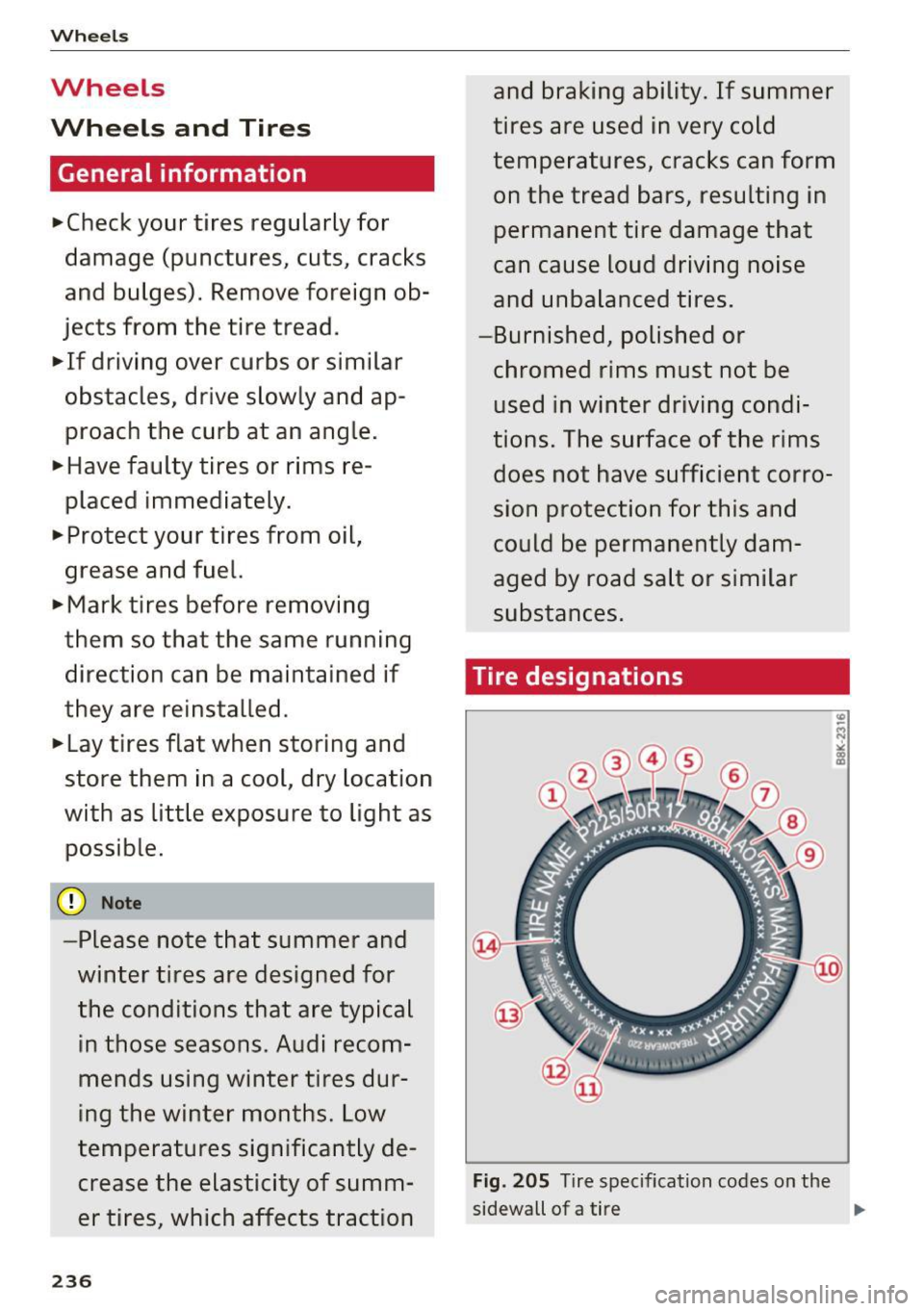
Tire designations
Fig. 205 Tire specifi cation codes on the
sidewall of a tire .,._
Page 251 of 302
Wheels
technically referred to as the vehi- sengers in the vehicle or passen-cle's
Gross Vehicle Weight Rat-gers who are heavier than the
ing ("GVWR"). standard weights assumed mean
The "GVWR" includes the weight that less weight can be carried as
of the basic vehicle, all factory in-luggage.
stalled accessories, a full tank of The Gross Vehicle Weight Rating
fuel, oil, coolant and other fluids and the Gross Axle Weight Rating
plus maximum load. The maxi- are listed on the safety compli-
mum load includes the number of ance sticker label located on the
passengers that the vehicle is in- driver's side B-pillar
c::::> page 246,
tended to carry ("seating capaci-fig. 207.
ty") with an assumed weight of
.&_ WARNING
150 lbs . (68 kg) for each passen-
Overloading a vehicle can cause
ger at a designated seating posi-
loss of vehicle control, a crash
tion and the total weight of any
or other accident, serious per-
luggage in the vehicle. If you tow
sonal injury, and even death.
a trailer, the weight of the trailer
-Carrying more weight than
hitch and the tongue weight of
your vehicle was designed to
the loaded trailer must be includ-
carry will prevent the vehicle
ed as part of the vehicle load.
from handling properly and
The
Gross Axle Weight Rating increase the risk of the loss of
("GAWR") is the maximum load vehicle control.
that can be applied at each of the -The brakes on a vehicle that
vehicle's two axles. has been overloaded may not
The fact that there is an upper be able to stop
the vehicle
limit to your vehicle's Gross Vehi- within a safe distance.
cle Weight Rating means that the -Tires
on a vehicle that has
total weight of whatever is being been overloaded can fail sud-
carried in the vehicle (including denly, including a blowout and
.... the weight of a trailer hitch and sudden deflation, causing loss
N the tongue weight of the loaded of control and a crash. ci ... :c ": trailer) is limited. The more pas-....
'° "? ....
'° ....
249
Page 269 of 302
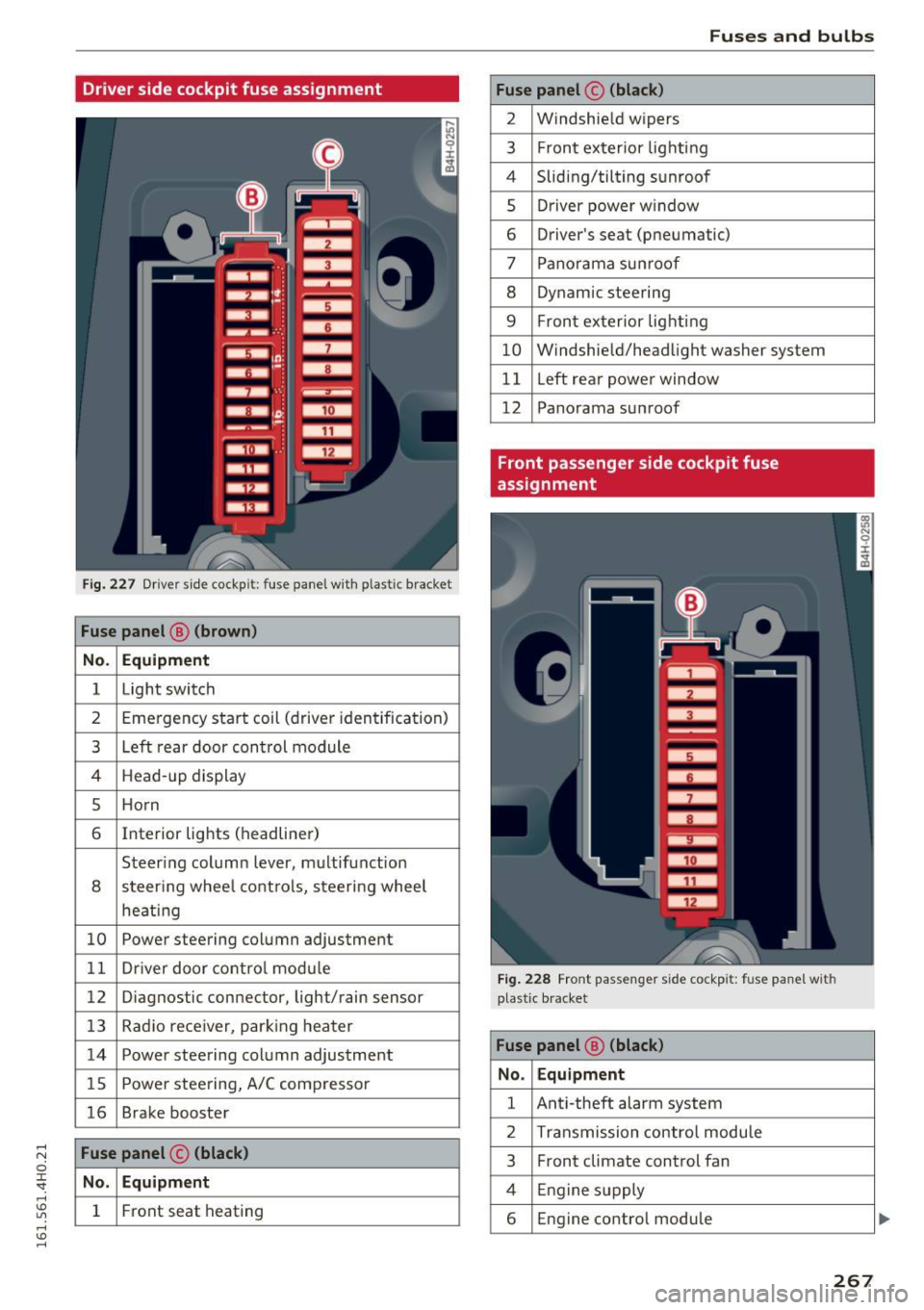
Driver side cockpit fuse assignment
Fig . 227 D river sid e cockpit: fuse panel with plastic bracket
Fuse panel @ (brown )
No . Equipment
1 Light switch
2 Emergency start coil (driver iden tification)
3 Left rear door con trol module
4 Head -up display
5 Ho rn
6 Interior lights (headliner)
Steering column lever, m ultifunction
8 steer ing whee l cont ro ls, steering wheel
heati ng
10 Powe r steering column adjustment
1 1 Dr iver door co ntro l mod ule
12 Diagnostic con nector, light/rain sensor
13 Radio rece iver, par king heater
14 Power steering column adjustment
15 Powe r stee ring, A/C comp resso r
16 Brake booster
Fuse panel © (black)
No . Equipment
1 Front seat heating
Fuses and bulbs
Fuse panel © (black)
2 Windshie ld w ipers
3 F ron t ex terior lig hti ng
4 Sliding/tilting s unroof
5 Dr iver power w indow
6 Driver's seat (pneumatic)
7 Pano rama su nroo f
8 Dynam ic steering
9 F ron t ex terior lig hting
10 W indshie ld/head light washer system
11 Left rea r powe r window
12 Panorama su nroof
Front passenger side cockpit fuse
assignment
Fig. 228 Front passenge r side cockp it: fuse panel with
p last ic b racket
Fuse panel @ (black)
No . Equipment
1 Ant i-theft alarm system
2 Transmission contro l modu le
3 Front climate control fan
4 Engine supply
6 Engine control module
267
Page 277 of 302
eye. For technica l reasons, the pres sure in the
suspension st ruts may change during the
t ra nspo rt a nd this will adverse ly affect vehicle
handling.
Raising the vehicle
Lifting with workshop hoist and with floor
jack
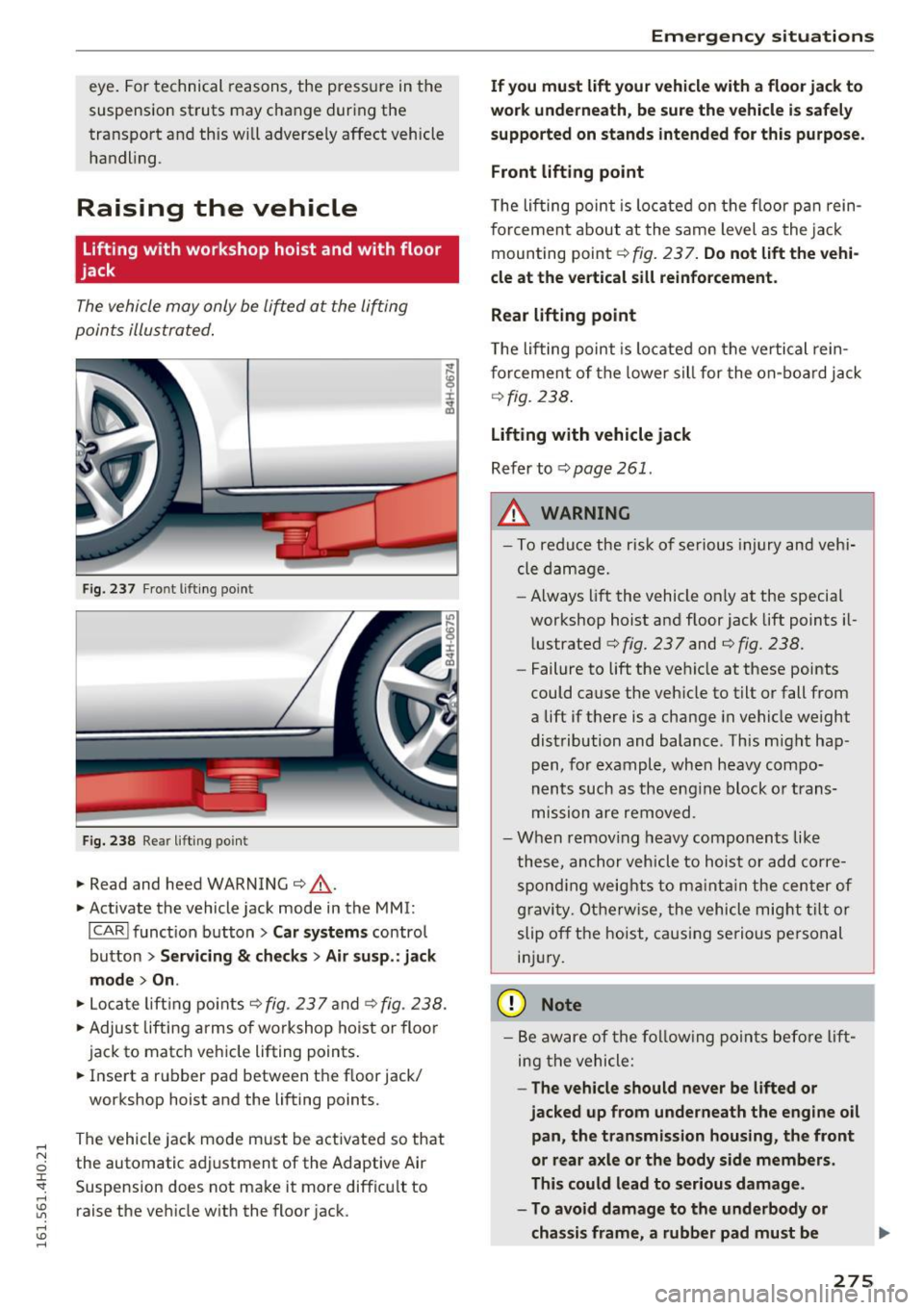
T he vehicle may only be lifted at the lifting
poin ts illus trated .
Fig . 237 Front lift ing point
F ig. 238 Rear lift ing po int
.,. Read and heed WARNING¢&_.
... Activate the vehicle jack mode in the MMI:
I CAR I funct io n button> Car system s control
button >
Servicing & checks > Air susp .: jack
mode > On .
... Loc ate lift ing po ints ¢fig. 237 and ¢ fig. 23 8 .
.,. Adjus t lifting arms of wo rkshop hoist or floo r
jack to matc h ve hicle lifting points .
... Inse rt a ru bber pad between t he f loor jack/
workshop hoist and the lifting points.
T h e vehicle jack mode m ust be act ivate d so that
the automatic adjustment of the Adaptive Air
Suspension does not ma ke it more diffic ult to
raise the ve hicle w it h the floor jack .
Emergency situations
If you must lift your vehicle with a floor jack to
work unde rneath , be sure the vehicle is safely
supported on stands intended for this purpose.
Front lifting point
T he li fting poi nt is locate d on the floor p an rein
f o rcement about at the sa me level as the ja ck
mounting point¢
fig. 237 . Do not lift the vehi
cle at the vertical sill re inforcement .
Rear lifting point
T he lif ting point is locate d on the vertical rei n
f o rcement of the lowe r sill for the on-bo ard j ack
¢fig. 238 .
Lifting with vehicle jack
Refer to¢ page 261 .
A WARNING
-- To reduce the r is k of se rious inju ry and veh i-
cle dama ge.
- Always lift the vehicle on ly at the special
w orkshop hoist and f loor jack lift points
il
lu strated¢ fig. 237 and¢ fig. 238.
- Failure to lift the ve hicle at these points
could cause the veh icle to tilt or fall fr om
a lift if t here is a change in vehicle weight
dist ribution and balance . Th is m ig ht hap
pen , fo r e xampl e, wh en heavy compo
n ents such as the eng in e block o r trans
mi ssion are removed.
- W hen re mov ing heavy componen ts like
t hese, anchor veh icle to hoist or add co rre
s p ondin g weig hts to maintai n the center of
g ra vity. O therw ise, the vehicle mig ht tilt or
slip
o ff th e hois t, c ausing se rious pe rsonal
i njur y.
(D Note
- Be aw are of the fo ll ow ing poi nts before lift
ing the vehicle:
-The vehicle should never be lifted or
jacked up from underneath the engine oil
pan, the transmission housing, the front
or rear axle or the body side members .
This could lead to serious damage .
- To avoid damage to the underbody or
chassis frame, a rubber pad must be
275
Page 279 of 302

Technical data
Vehicle identification
F ig. 239 Vehi cle Ident if ication N umber (VlN) plate : loca·
tion on dr iver 's side dash pane l
XXXXX XX -X -XX XX X XX XX
CD+ ~t :1 :: xxxxxxxx xx x x x xxx xxx
TVP /fffl XXX XXX
XX XXXXXXX XX X X XX
XXX
KW XXX
®i ~:J ·f lfils~~ XXXX XXX XXX
®-+ ~N:a=i~l xxxx ; xxxx xx x ; xx
11. • AUSS, I OPTIONS
E0 A
7D 5 4UB 6
XM 5SG 5R W
2E H
J0Z lL B l
A S lB A
3FC SM U 7Xl
F 0 A 9G3 0G7 0YH 0JF
TL 6 3KA 8EH UlA X 98 Q Z7
lXW 803 908 824 020
7T6 C V7 7 K0 4 X3 2 K2
3L4
4KC 3Y0 413 502
lSA 7GB 01 A 4G0
XX . X XX X XX X xxxx
Fig. 240 The vehicle identificat ion label- inside the lug
gage compartment
Veh icle Identification Number (VlN )
The Vehicle Identification Number is located in
different p laces:
- under the windshield on the driver's side
¢fig. 239.
-in the MMI: Select: Function button ICAR I > Car
systems > Servicing
& checks > VIN number .
~ -on the vehicle identification label.
0 J:
"". rl I.Cl U"I
rl I.Cl rl
Technical data
Vehicle identification label
The veh icle identification label is located in the
luggage compartment in the spare wheel we ll.
T he label¢
fig. 240 shows the following vehicle
data:
(D Vehicle Identification Number (VIN)
@ Vehicle type, eng ine output, transm ission
@ Engine and transmission code
@ Paint number and interior
® Optional equipment numbers
T he information of the veh icle identification label
can also be found in your Warranty
& Mainte
nance booklet.
Safety compliance sticker
The safety compliance sticker is your assurance
that your new vehicle complies w ith all applicable
Federal Motor Vehicle Safety Standards which
were in effect at the time the vehicle was manu
factured. You can find this sticker on the door
jamb on the driver's side. It shows the month and
year of production and the vehicle identification number of your vehicle (perforation) as well as
the Gross Vehicle Weight Rating (GVWR) and the Gross Axle Weight Rating (GAWR).
H igh voltage warning label
The high voltage warning label is located in the
engine compartment next to the engine hood re
lease. The spark ignition system complies with
the Canadian standard ICES-002.
Weights
Gross Vehicle Weight Rating
The Gross Vehicle Weight Rating (GVWR), and
the Gross Axle Weight Rating (GAWR) for front
and rear are listed on a sticker on the door jamb
on the driver 's side.
The Gross Vehicle Weight Rating includes the
weight of the basic vehicle plus full fuel tank, oil
and coolant, plus maximum load, which includes
passenger weight (150 lbs/68 kg per designated
seating position) and luggage weight
c:> .&, . .,.
277
Page 280 of 302
Tech nical data
Gross Axle Weight Rating
The G ross Ax le We ight Rating is the max imum
load that can b e applied at each axle of the vehi
cle ¢& .
Vehicle capacity weight
The vehicle capacity we ight (max . load) is l isted
eithe r on the dr iver's side 8-pillar o r inside the
fue l filler f lap.
A WARNING
- The actual Gross Axle Weight Rating at the
front and rear axles shou ld not exceed the
permissible weights, and their comb inat ion
must not exceed the Gross Veh icle Weight
Rating .
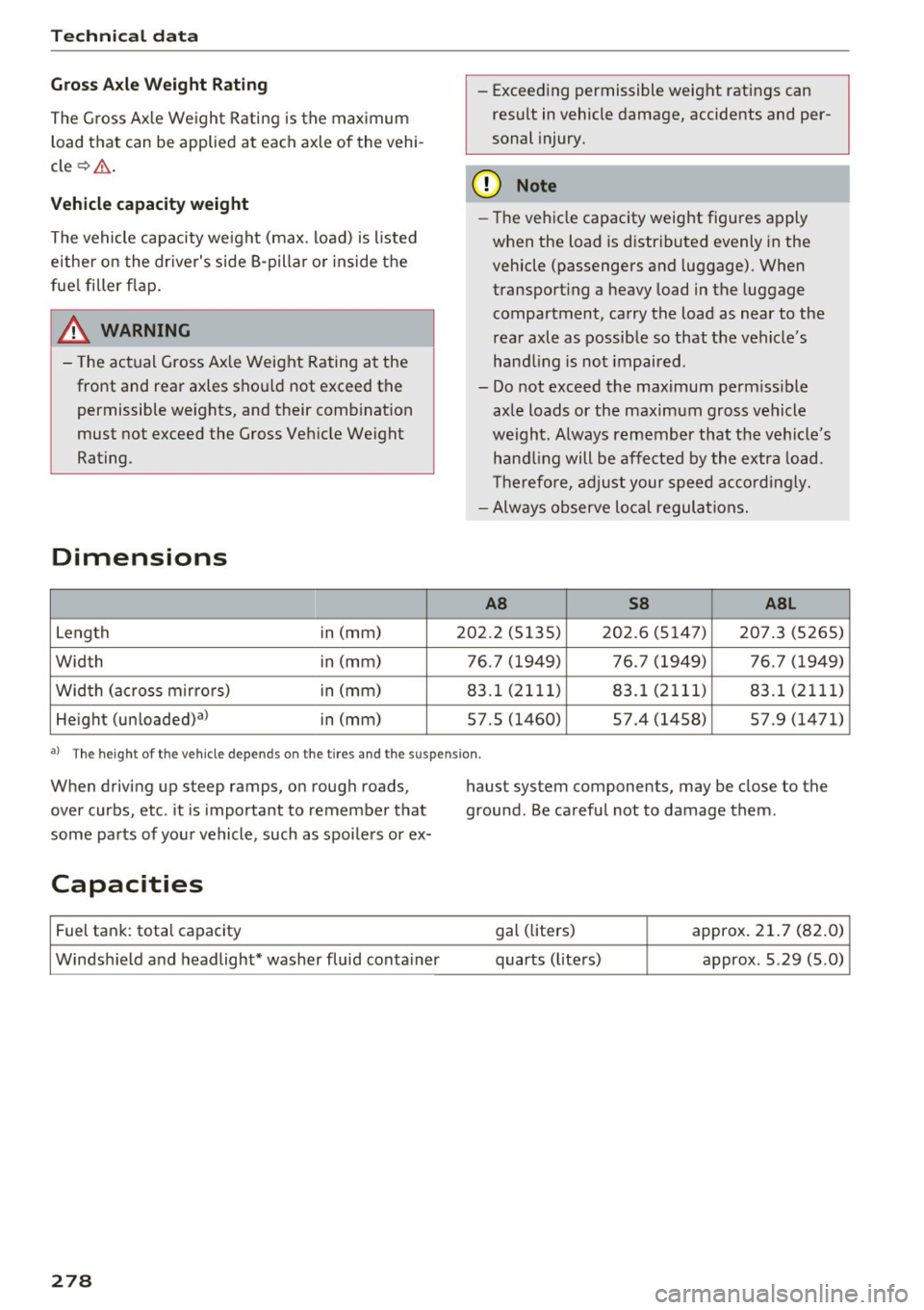
Dimensions
Length in (mm)
Width in (mm)
Width (across m irro rs) in (mm)
He ight (unloaded) al in (mm) -
Exceeding permissible weight ratings can
result in vehicle damage, accidents and per
sonal injury.
(D Note
- The vehicle capacity weight figures apply
when the load is distributed evenly in the
vehicle (passengers and luggage) . When
transporting a heavy load in the luggage
compartment, carry the load as near to the
rear axle as possible so that the vehicle's
hand ling is not impaired .
- Do not exceed the maximum perm iss ible
axle loads or the maximum gross vehicle
we ight. Always remember that the vehicle 's
hand ling will be affe cted by the extra load .
T herefore , adjust your speed acco rd ingly.
- Always observe local regulations.
AS SS ASL
202.2 (5135) 202.6 (5 147) 207 .3 (5265)
76.7 (1949) 76.7 (1949) 76.7 (1949)
83.1 (2111) 83.1 (2111) 83 .1 (2111)
57 .5 (1460) 57.4 (1458) 57 .9 (1471)
• > T h e heigh t of th e ve hicl e depends on the tir es and the s uspensio n.
When driving up steep ramps, on rough roads,
over curbs, etc . it is important to remember that
some parts of your vehicle , such as spoilers or ex-
Capacities
Fuel tank: total capacity
Windsh ield and headlight* washer fluid conta iner
278
haust system components, may be close to the
ground . Be careful not to damage them .
gal (liters) approx. 21.7 (82.0)
quarts (l iters) approx. 5 .29 (5 .0)