steering wheel AUDI TT 2012 Owner's Manual
[x] Cancel search | Manufacturer: AUDI, Model Year: 2012, Model line: TT, Model: AUDI TT 2012Pages: 132, PDF Size: 89.43 MB
Page 66 of 132

Downloaded from www.Manualslib.com manuals search engine Airbagsystem
Howknee airbags work
Theriskofinjurytothe legorea conbere
duced byfully inflated kneeairbags.
Fig.117Inflated airbagsprotectinginafrontalcollision
Thekneeairbagsystemhasbeendesigned50
thattheairbagsforthedriverandfrontpas
sengerdeployincertainbutnotallfrontal
collisions.
Ifthefrontairbagsdeploy,thekneeairbags
also deployinfrontalcollisionswhenthede
ploymentthresholdstoredinthecontrolunit
ismet.
Whenthesystemdeploys,theairbagsfill
with a
propellantgas,andinflatebetweenthe
lowerpartoftheinstrumentpanelandthe
driverandthelowerpartoftheinstrument
panelandthefrontpassengerQpage120,
fig.114.
Althoughtheyarenotasoftpillow,theycan
"cushion"
theimpactandinthiswaytheycan
help
toreducetheriskofinjurytothelower
extremities.
Allofthistakesplaceintheblinkofan eye,50
fastthatmanypeopledon'teven realizethat
theairbagshavedeployed. Theairbagsalso
inflatewithagreatdealofforceanditisim
portantforoccupantsafetythatnothing
shouldbeintheirwaywhentheydeploy.
Fully
inflatedairbagsincombinationwith
properly worn
safetybeltsslowdownandlim
it
theoccupant'sforwardmovementandhelp
toreducetheriskofinjury.
Importantsafety instructions onthekneeairbag system
Airbags areonly supplemental restraints.Al
ways wear
safetybeltscorrectly andrideina
praper seating position.
Thereisalotthatyouandyourpassengers
mustknowanddotohelpthesafetybeltsand
airbagstoprovidesupplementalprotection.
AWARNING
Aninflating kneeairbagcancauseserious
injury.Wearingsafetybeltsincorrectlyand
improperseatingpositions increasethe
riskofseriouspersonalinjuryanddeath
wheneveravehicleisbeing used.
- The knee airbag
systemcannotprotect
youproperly ifyouareseatedtooclose
toanyoftheairbagLocations.Whenad
justingtheirseatpositions, itisimpor
tantthatboththedriverandthefront
passengerkeeptheirupperbodiesand
kneesatthefollowingminimumsafe
distances:
-atleast10inches(25cm)betweenthe
chestandthesteeringwheel/instru
mentpanel.
-atleast4inches(l0cm)betweenthe
kneesandthelowerpartoftheinstru
mentpanel.
- The risk
ofpersonalinjuryincreasesif
you lean forward
6r-totheside, orifthe
seatisimproperlyposiNonedandyouare
notwearingyoursafetybelt.Theriskin
creasesevenmoreshouldtheairbag de
pLoy.
-Always makesurethatthekneeairbag
caninflatewithoutinterference.Objects
betweenyouandtheairbagcanincrease
theriskofinjuryinanaccidentbyinter
fering with
thewaytheairbag deploys or
bybeingpushedintoyouastheairbag
deploys.
- Never
letanybody, especially children
or
animalsrideinthefootwellinfront~
.-ofthepassengerseat.Iftheairbag de
ploys,
thiscanresultinseriousorfatal
injuries.
_Never carryobjectsofanykindinthe
footwellareainfrontofthedriver'sor
passenger'sseat.Sulkyobjects(shop
ping bags,
forexampLe) caninterfere
withorpreventproperdeploymentof
theairbag.Smallobjectscanbe
thrownthroughthevehicLe iftheair
bag deploys
andinjure youoryour pas
sengers.
_Makesuretherearenocracks,deep
scratchesorotherdamageintheareaof
theinstrumentpanelwheretheknee air
bagsarelocated.
-Ifchildren areincorrectlyseated,their
riskofinjury increasesinacollision
Qpage133,Child Safety.
5ideairbags
Descriptionofsideairbags
Theairbagsystemconprovide supplemental
protection topraperly restroined front
seat
occupants.
Fig.1185ideairbag locationinthedriver'sseat
Thesideairbagsarelocatedinthesidesofthe
frontseatbackrestsQfig.118facingthe
doors. Theyareidentifiedbytheword"AIR
BAG".
Thesideairbagsystembasicallyconsistsof:
-theelectroniccontrolmoduLeandexternal
sideimpactsensors
-thetwosideairbagsLocatedinthesidesof
thefrontbackrests
Airbagsystem1
-theairbag warning lightintheinstrument
cluster.
The
airbagsystemismonitoredelectronically
tomakecertainthatit is functioning properly
atalltimes.Eachtimeyouturnontheigni
tion,
theairbagsystemindicator lightwilL
comeonforafewseconds(seLfdiagnostics).
The side
airbagsystemsuppLementsthesafe
tybeltsandcanhelptoreducetheriskofin
jury
tothedriver'sandfrontpassenger'sup
pertorsoandheadonthesideofthevehicle
thatisstruckinasidecollision. Theairbagde
ploys
insideimpactsandonLywhenthevehi
cle acceleration
registeredbythecontrolunit
ishighenough.Ifthisrateisbelowtherefer
encevalueprogrammedintothecontrolunit,
th'e side
airbagswillnotbetriggered,even
thoughthecarmay bebadLydamagedasare
sultofthecollision.Itisnotpossibletode
fine anairbag
triggeringrangethatwill coyer
every possible
angleofimpact,sincethecir
cumstanceswillvary considerablybetween
onecollisionandanother.Importantfactors
include, forexample,thenature(hardorsoft)
oftheimpactingobject,theangleofimpact,
vehicLespeed,etc.Qpage131,Important
safetyinstructions onthe side airbag system.
Asidefromtheirnormalsafetyfunction,safe
tybeltsworktohelpkeepthedriverorfront
passengerinpositionintheeventofaside
collision50thatthesideairbagscanprovide
protection.
The airbagsystemisnotasubstituteforyour
safetybelt.Rather, itispartoftheoverall oc
cupantrestraintsysteminyourvehicle.Al
waysrememberthatthesideairbagsystem
canonly helptoprotectyouifyouarewearing
your
safetybeltandwearing itproperly. This
isanotherreasonwhyyoushouldalwayswear
yoursafetybelts,notjustbecausethelawre
quires you
todo50Qpage103,General
notes.
Itisimportanttorememberthatwhilethe
supplementalsideairbagsystemisdesigned
toreducethelikelihoodofseriousinjuries,
otherinjuries,forexample,swelling, bruising,~
Page 69 of 132
Downloaded from www.Manualslib.com manuals search engine 134ChildSafetyChildSafety1:
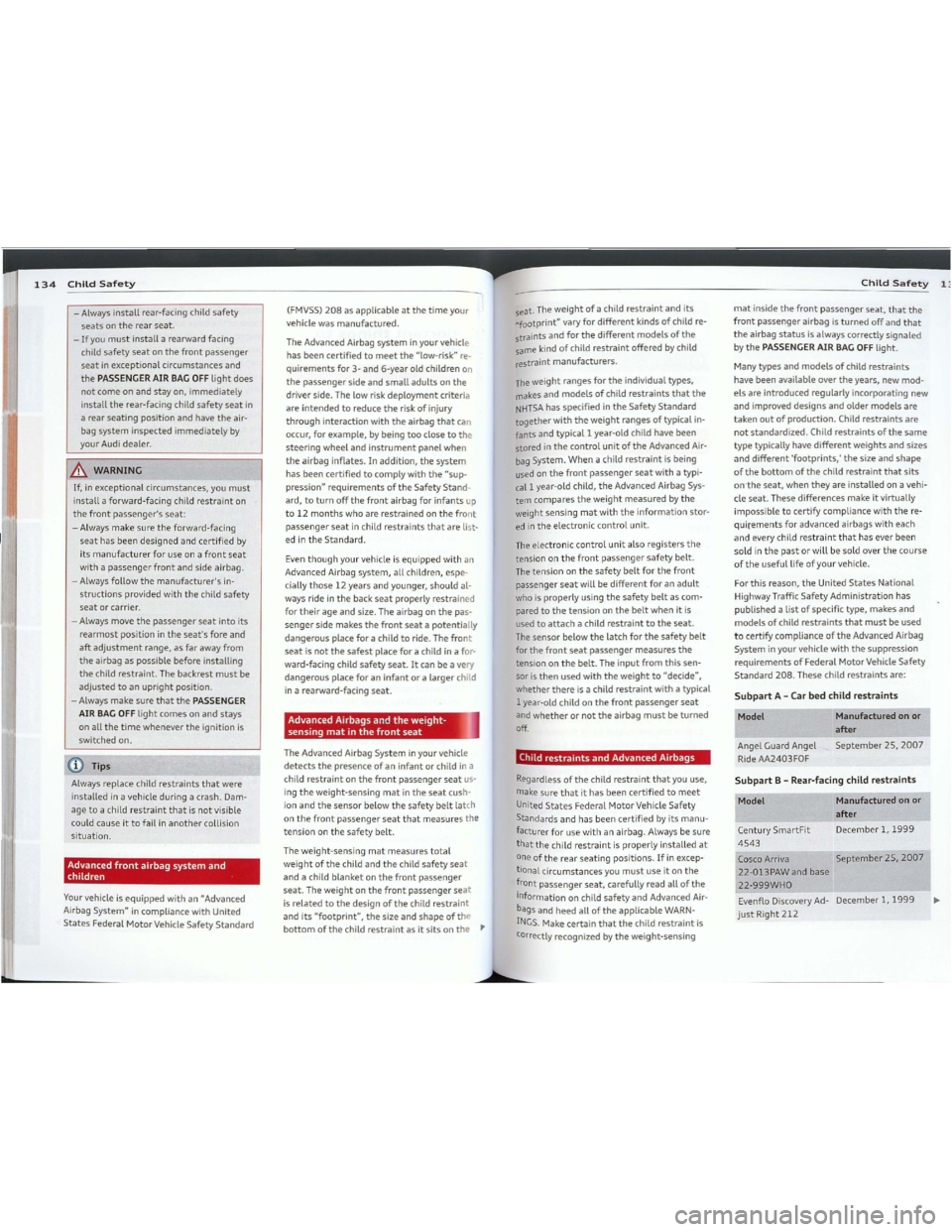
5ubpartB -Rear-facingchildrestraints
5ubpartA -Carbedchildrestraints
MadelManufacturedonor
after
CenturySmartFitDecember1,1999
4S43
CoscoArrivaSeptember2S,2007
22-013PAWandbase
22-999WHO
Evenflo Discovery Ad-December1,1999
justRight212
matinsidethefrontpassengerseat,thatthe
frontpassengerairbagisturnedoffandthat
theairbagstatusisalwayscorrectly signaLed
bythePASSENGER AIRBAGOFFlight.
Many
typesandmodelsofchildrestraints
havebeenavailableovertheyears, newmod
elsareintroducedregularly incorporating new
andimproveddesignsandoldermodelsare
takenoutofproduction.Childrestraintsare
notstandardized.Childrestraintsofthesame
typetypicallyhavedifferentweightsandsizes
anddifferent'footprints,'thesizeandshape
ofthebottomofthechildrestraintthatsits
ontheseat,whentheyareinstalled onavehi
cle
seat.Thesedifferencesmake itvirtually
impossibletocertifycompliancewiththere
quirementsforadvancedairbagswitheach
andevery childrestraintthathaseverbeen
soldinthepastorwill besold overthecourse
oftheusefullifeofyourvehicle.
For
thisreason,theUnitedStatesNational
Highway Traffic
SafetyAdministrationhas
published alistofspecific type,makesand
modelsofchildrestraintsthatmustbeused
tocertifycomplianceoftheAdvanced Airbag
Systeminyourvehicle withthesuppression
requirementsofFederalMotorVehicleSafety
Standard208.Thesechildrestraintsare:
Manufacturedonor
after----September2S,2007AngelGuard Angel
Ride AA2403FOF
Madel
Regardlessofthechildrestraintthatyouuse,
make sure
thatithasbeencertifiedtomeet
UnitedStatesFederal MotorVehicleSafety
Standardsandhasbeencertifiedbyitsmanu
facturerforusewithanairbag. Always besure
thatthechildrestraintisproperlyinstalledat
one oftherearseatingpositions.Ifinexcep
tional
circumstancesyoumustuseit onthe
frontpassengerseat,carefully readallofthe
information onchildsafetyandAdvancedAir
bagsandheedalloftheapplica bleWARN
INes.Makecertainthatthechildrestraintis
correctly recognizedbytheweight-sensing
ChildrestraintsandAdvancedAirbags
Theelectroniccontrolunitalsoregistersthe
tension onthefrontpassengersafetybelt.
The
tensiononthesafetybeltforthefront
passengerseatwillbedifferentforanadult
whoisproperly usingthesafetybeltascom
pared
tothetensiononthebeltwhenitis
usedtoattacha childrestrainttotheseat.
Thesensorbelowthelatchforthesafetybelt
forthefrontseatpassengermeasuresthe
tension onthebelt.Theinputfromthissen
soristhenusedwiththeweightto"decide",
whetherthereisachildrestraintwithatypical
1 year-old childon
thefrontpassengerseat
andwhetherornottheairbagmustbeturned
off.
seat.Theweightofachildrestraintandits
"footprint" varyfor
differentkindsofchild re
straintsandforthedifferentmodelsofthe
sam
ekindofchildrestraintofferedbychild
restraint
manufacturers.
Theweightrangesfortheindividual types,
makes
andmodelsofchildrestraintsthatthe
NHTSAhas specifiedintheSafetyStandard
togetherwiththeweightrangesoftypical in
fants
andtypicallyear-old childhavebeen
storedinthecontrolunitoftheAdvancedAir
bagSystem.Whenachildrestraintisbeing
used on
thefrontpassengerseatwith atypi
calIyear-old child,theAdvanced AirbagSys
temcomparestheweightmeasuredbythe
weightsensingmatwiththeinformationstor
edintheelectroniccontrolunit.
Even
thoughyour vehicleisequippedwithan
Advanced Airbag
system,allchildren,espe
ciallythose12yearsandyounger,shouldal
ways ride
inthebackseatproperlyrestrained
fortheirageandsize.Theairbag onthepas
sengersidemakesthefrontseatapotentially
dangerousplace forachildtoride. Thefront
seatisnotthesafestplace forachildinafor
ward-facing child
safetyseat.Itcanbeavery
dangerousplaceforaninfantoralargerchild
ina rearward-facingseat.
AdvancedAirbagsandtheweight-1sensingmatinthefrontseat
The Advanced Airbagsysteminyourvehicle
hasbeencertifiedtomeetthe"low-risk" re
quirementsfor3-and6-yearoldchildren on
thepassengersideandsmalladultsonthe
driverside.Thelowriskdeploymentcriteria
areintendedtoreducetheriskofinjury
throughinteractionwiththeairbagthatcan
occur,
forexample,bybeingtooclosetothe
steeringwheelandinstrumentpanelwhen
theairbaginflates. Inaddition,thesystem
hasbeencertifiedtocomplywiththe"sup
pression"
requirementsoftheSafetyStand
ard,toturnoffthefrontairbagforinfantsup
to12monthswhoarerestrainedonthefront
passengerseatinchildrestraintsthatare list
ed
intheStandard.
(FMVSS)208asapplicableatthetimeyour
vehicle
wasmanufactured.
The Advanced AirbagSysteminyourvehicle
detectsthepresenceofaninfantorchildina
child
restraintonthefrontpassengerseatus
ing
theweight-sensingmatintheseatcush
ion and
thesensorbelowthesafetybeltlatch
on
thefrontpassengerseatthatmeasuresthe
tensiononthesafetybelt.
Theweight-sensingmatmeasurestotal
weightofthechildandthechildsafetyseat
andachildblanketonthefrontpassenger
seat.Theweightonthefrontpassengerseat
isrelatedtothedesignofthechildrestraint
andits"footprint",thesizeandshapeofthe
bottomofthechildrestraintasitsitsonthe~
Always replace childrestraintsthatwere
installedinavehicle duringacrash. Dam
agetoachildrestraintthatisnotvisible
could
causeittofailinanothercollision
situation.
Advancedfrontairbagsystemandchildren
Vour vehicleisequippedwithan"Advanced
Airbag
System"incompliancewith United
StatesFederal MotorVehicleSafetyStandard
-Alwaysinstallrear-facing childsafety
seatsontherearseat.
-Ifyoumustinstallarearwardfacing
child
safetyseatonthefrontpassenger
seatinexceptionalcircumstancesand
thePASSENGER AIRBAGOFFlightdoes
notcomeonandstayon,immediately
installtherear-facingchildsafetyseatin
arearseatingpositionandhavetheair-
bag
systeminspectedimmediatelyby
yourAudi dealer.
ln.WARNING
If,inexceptionalcircumstances,youmust
installaforward-facing childrestrainton
thefrontpassenger'sseat:
-Alwaysmakesuretheforward-facing
seathasbeendesignedandcertifiedby
itsmanufacturerforuseonafrontseat
with apassengerfrontandsideairbag.
-Always followthemanufacturer'sin-
structionsprovided withthechildsafety
seatorcarrier.
- Always move
thepassengerseatintoits
rearmostpositionintheseat'sforeand
aftadjustmentrange,asfarawayfrom
theairbagaspossiblebeforeinstalling
thechildrestraint.Thebackrestmustbe
adjustedtoanuprightposition.
- Always
makesurethatthePASSENGER
AIR
BAGOFFlightcomesonandstays
on allthetimewhenevertheignitionis
switchedon.
'
Page 78 of 132
Downloaded from www.Manualslib.com manuals search engine AudiCustomerCARE
Tel.:(800)822-2834
---
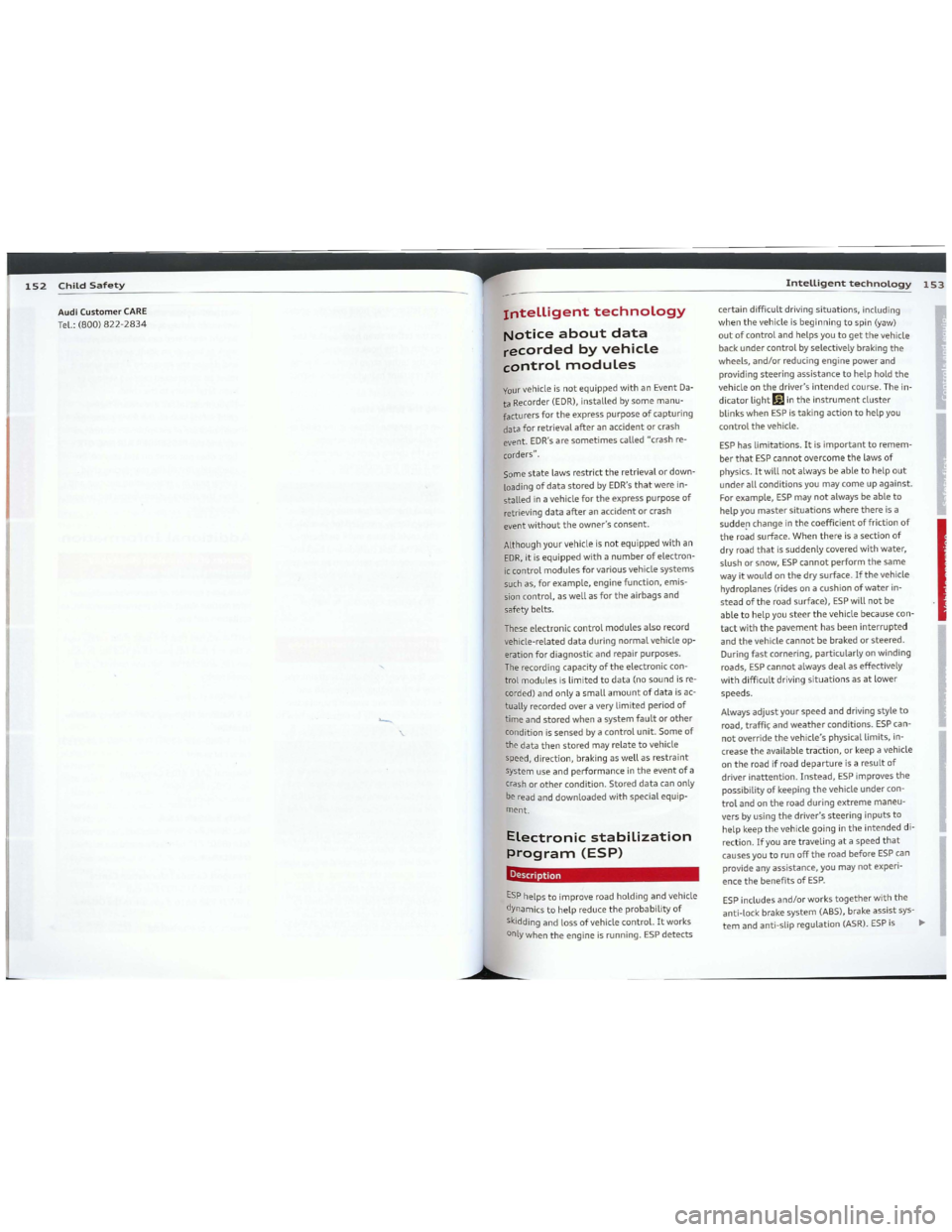
Intelligenttechnology
Noticeaboutdata
recordedbyvehicle
controlmodules
yourvehicleisnotequippedwithanEventDa
taRecorder(EOR),installedbysornemanu
facturersfortheexpresspurposeofcapturing
dataforretrievalafteranaccidentorcrash
event.
EOR'saresometimescalled"crashre
corders" .
Some
statelawsrestricttheretrieval ordown
loading
ofdatastoredbyEDR'sthatwerein
stalled
ina vehicle fortheexpresspurposeof
retrievingdataafteranaccidentorcrash
event
withouttheowner'sconsent.
Althoughyourvehicleisnotequippedwithan
EOR,itisequippedwith anumberofelectron
iccontrolmodulesforvarious vehiclesystems
suchas,forexample,enginefunction,emis
sioncontrol,aswell asfortheairbagsand
safety belts.
These electronic
controlmodulesalsorecord
vehicle-related
dataduringnormalvehicle op
eration
fordiagnosticandrepairpurposes.
The recording capacityoftheelectroniccon
trol
modulesis limitedtodata(nosoundisre
corded)
andonly asmallamountofdataisac
tually recorded overavery limited period
of
timeandstoredwhenasystemfaultorother
condition issensedbyacontrolunit.Someof
thedatathenstoredmayrelatetovehicle
speed, direction, braking
aswellasrestraint
systemuseandperformanceintheeventofa
crash or
othercondition.Storeddatacanonly
bereadanddownloadedwithspecialequip
ment.
ElectronicstabiLization
program(E5P)
Description
ESPhelpstoimprove roadholdingandvehicle
dynamics
tohelpreducetheprobabilityof
skiddingandlossofvehiclecontrol.Itworks
only
whentheengineis running.ESPdetects
certaindifficult drivingsituations,including
whenthevehicleisbeginningtospin(yaw)
outofcontrolandhelpsyoutogetthevehicle
back
undercontrolbyselectively brakingthe
wheels,and/orreducingenginepowerand
providingsteeringassistancetohelpholdthe
vehicle onthedriver'sintendedcourse. Thein
dicatorlightDlintheinstrumentcluster
blinkswhenESPistakingactiontohelp you
controlthevehicle.
ESPhaslimitations.Itisimportanttoremem
berthatESPcannotovercomethelawsof
physics.Itwillnotalways beabletohelpout
underallconditionsyoumaycomeupagainst.
Forexample,ESPmaynotalways beableto
helpyoumastersituationswherethereisa
sudde!lchangeinthecoefficientoffrictionof
theroadsurface.Whenthereisasectionof
dryroadthatissuddenlycovered withwater,
slushorsnow,ESPcannotperformthesame
wayitwould onthedrysurface.Ifthevehicle
hydroplanes(ridesonacushionofwaterin
steadoftheroadsurface),ESPwillnotbe
abletohelp yousteerthevehiclebecausecon
tactwiththepavementhasbeeninterrupted
andthevehiclecannotbebraked orsteered.
Ouringfastcornering, particularly onwinding
roads,
ESPcannotalwaysdealaseffectively
with difficult driving
situationsasatlower
speeds.
Alwaysadjustyourspeedanddrivingstyleto
road,traffiçandweatherconditions.ESPcan
notoverridethevehicle'sphysicallimits,in
creasetheavailabletraction,orkeep avehicle
on
theroad ifroaddepartureisaresultof
driverinattention.Instead,ESPimprovesthe
possibilityofkeepingthevehicleundercon
trolandontheroadduringextrememaneu
versbyusingthedriver'ssteeringinputsto
helpkeepthevehicle goingintheintendeddi
rection.
Ifyou aretravelingataspeedthat
causesyoutorunofftheroadbeforeESPcan
provide anyassistance,youmaynotexperi
encethebenefitsofESP.
ESPincludesand/orworkstogetherwiththe
anti-lock brakesystem(ABS),brakeassistsys-
temandanti-slipregulation(ASR).ESPis~
Page 81 of 132
Downloaded from www.Manualslib.com manuals search engine Intelligenttechnology
overheatreducingtheeffectivenessof
theentirebrakesystem.
-Failureofonebrake circuit willimpair
thebraking capabilityresultinginanin
creasedstoppingdistance.Avoid driving
thevehicleandhaveittowedtothenear
estAudidealerorqualifiedworkshop.
-Neverletthevehicle rolltoastopwith
theengineshutoff.
-
Ifthebrakeboosterisnotworking,for
examplewhentowingyourvehicle,or
becausethebrakeboosterhassomehow
beendamaged,thebrakepedalmustbe
pressedconsiderablyhardertomakeup
forthelackofboosterassistance.
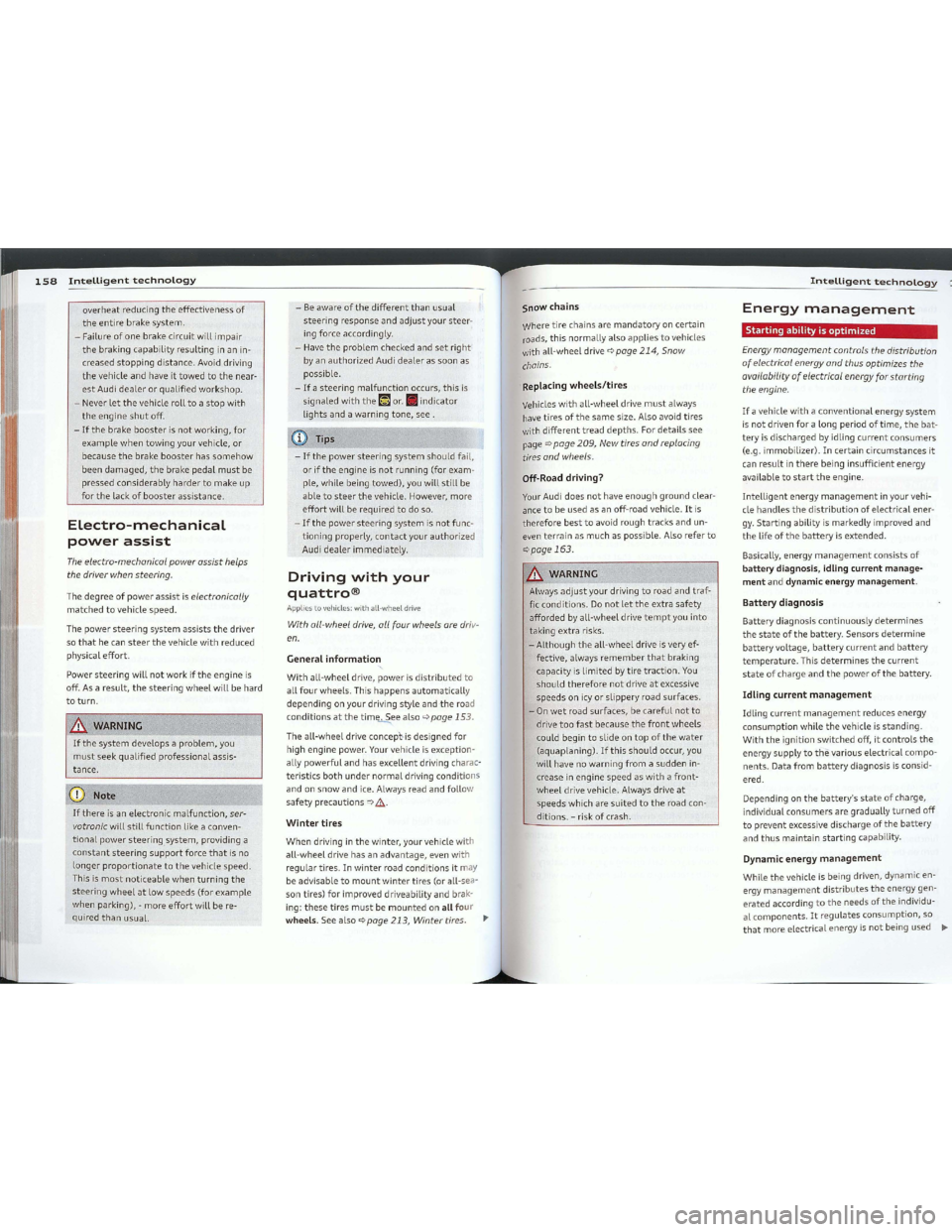
ELectro-mechanicaL
powerassist
Theelectro-mechanicalpowerassisthelps
thedriver whensteering.
Thedegreeofpowerassistiselectronically
matchedtovehiclespeed.
Thepowersteeringsystemassiststhedriver
50thathecansteerthevehiclewithreduced
physical
effort.
Powersteeringwillnotwork iftheengineis
off.Asaresult,thesteeringwheelwillbehard
toturn.
ÂWARNING
Ifthesystemdevelopsaproblem,you
mustseekqualifiedprofessionalassis
tance.
CDNote
Ifthereisanelectronicmalfunction,ser
votronic
willstillfunctionlike aconven
tionalpowersteering.system,providing a
constantsteeringsupportforcethatisno
longerproportionatetothevehiclespeed.
Thisismostnoticeablewhenturningthe
steeringwheelatlowspeeds(forexample
whenparking),-moreeffortwillbere
quired
thanusual.
-Beawareofthedifferentthanusual
steeringresponseandadjustyoursteer
ing force accordingly.
- Have
theproblemcheckedandsetright
byanauthorizedAudidealerassoonas
possible.
-Ifasteeringmalfunctionoccurs,thisis
signaledwiththe~or..indicator
lightsandawarningtone,see.
(DTips
-Ifthepowersteeringsystemshouldfail,
oriftheengineisnotrunning (forexam
ple,while beingtowed),youwillstillbe
abletosteerthevehicle. However,more
effortwiIIbereq u iredtodo50.
-Ifthepowersteeringsystemisnotfunc
tioningproperly,contactyourauthorized
Audidealerimmediately.
Drivingwithyour
quattro®
Appliestavehides:with all-wheel drive
Withall-wheel drive,ailfour wheels aredriv
en.
Generalinformation
Withall-wheeldrive,powerisdistributedto
allfourwheels.Thishappensautomatically
dependingonyourdrivingstyleandtheroad
conditionsatthetim~eealso.=;.page153.
Theall-wheeldriveconcepî:-isdesignedfor
highenginepower. Yourvehicleisexception
ally
powerfulandhasexcellentdriving charac
teristicsbothundernormaldrivingconditions
andonsnowandice.Always readandfollow
safetyprecautions.=;.,&.
Wintertires
Whendrivinginthewinter,yourvehiclewith
all-wheeldrivehasanadvantage,evenwith
regulartires.Inwinterroadconditionsitmay
be
advisabletomountwintertires(or all-sea
sontires)forimproved driveabilityandbrak
ing:
thesetiresmustbemountedonailfour
wheels.Seealso.=;.page213,Winter tires.~
Snowchains
Wheretirechainsaremandatoryoncertain
roads,thisnormallyalsoappliestovehicles
with
all-wheeldrive'=;'page214,Snow
chains.
Replacingwheels/tires
Vehicleswithall-wheeldrivemustalways
have
tiresofthesamesize. Alsoavoidtires
withdifferenttreaddepths.Fordetailssee
page.=;.page209,Newtiresandreplacing
tires
andwheels.
Off-Raaddriving?
YourAudidoesnothaveenoughgroundclear
ance
tobeusedasan off-road vehicle.Itis
thereforebesttoavoidroughtracksandun
eventerrainasmuchaspossible.Alsoreferto
'=;'page163.
&.WARNING
Alwaysadjustyourdrivingtoroadandtraf
ficcond itions.Donotlettheextrasafety
affordedbyall-wheeldrivetemptyouinto
taking
extrarisks.
-
Althoughtheall-wheeldrive isveryef
fective,alwaysrememberthatbraking
capacity
islimited bytiretraction.Vou
shouldthereforenotdriveatexcessive
speedsonicyorslipperyroadsurfaces.
-Onwetroadsurfaces,becarefulnotto
drivetoofastbecausethefrontwheels
couldbegintoslideontopofthewater
(aquaplaning).Ifthisshouldoccur, you
will have no
warningfromasuddenin
creaseinenginespeedaswithafront
wheeldrive vehicle. Alwaysdriveat
speedswhicharesuitedtotheroadcon
ditions. -risk
ofcrash.
Intelligenttechnology
Energymanagement
Startingabilityisoptimized
Energymanagementcon troisthedistribution
ofelectricalenergyandthusoptimizesthe
availabilityofelectrical energyforstarting
theengine.
Ifavehiclewithaconventionalenergysystem
isnotdrivenfora long periodoftime,thebat
teryisdischargedbyidlingcurrentconsumers
(e.g. immobilizer). Incertaincircumstancesit
can
resultintherebeing insufficientenergy
availabletostarttheengine.
Intelligentenergymanagementinyourvehi
cle
handlesthedistributionofelectricalener
gy.Startingabilityismarkedly improvedand
thelifeofthebatteryisextended.
Basically,energymanagementconsistsof
batterydiagnosis,idlingcurrentmanage
mentanddynamicenergymanagement.
Batterydiagnosis
Batterydiagnosiscontinuouslydetermines
thestateofthebattery.Sensorsdetermine
batteryvoltage,batterycurrentandbattery
temperature.Thisdeterminesthecurrent
stateofchargeandthepowerofthebattery.
Idlingcurrentmanagement
Idlingcurrentmanagementreducesenergy
consumptionwhilethevehicleisstanding.
Withtheignitionswitchedoff,itcontrolsthe
energysupplytothêvarious electricalcompo
nents.Datafrombatterydiagnosisisconsid
ered.
Depending onthebattery'sstateofcharge,
individualconsumersaregraduallyturnedoff
topreventexcessivedischargeofthebattery
andthusmaintainstartingcapability.
Dynamicenergymanagement
Whilethevehicle isbeing driven,dynamicen
ergy
managementdistributestheenergygen
eratedaccordingtotheneedsoftheindividu-
al
components.Itregulatesconsumption,50
thatmoreelectricalenergyisnotbeingused~
Page 101 of 132
Downloaded from www.Manualslib.com manuals search engine Tiresand\NheeLs
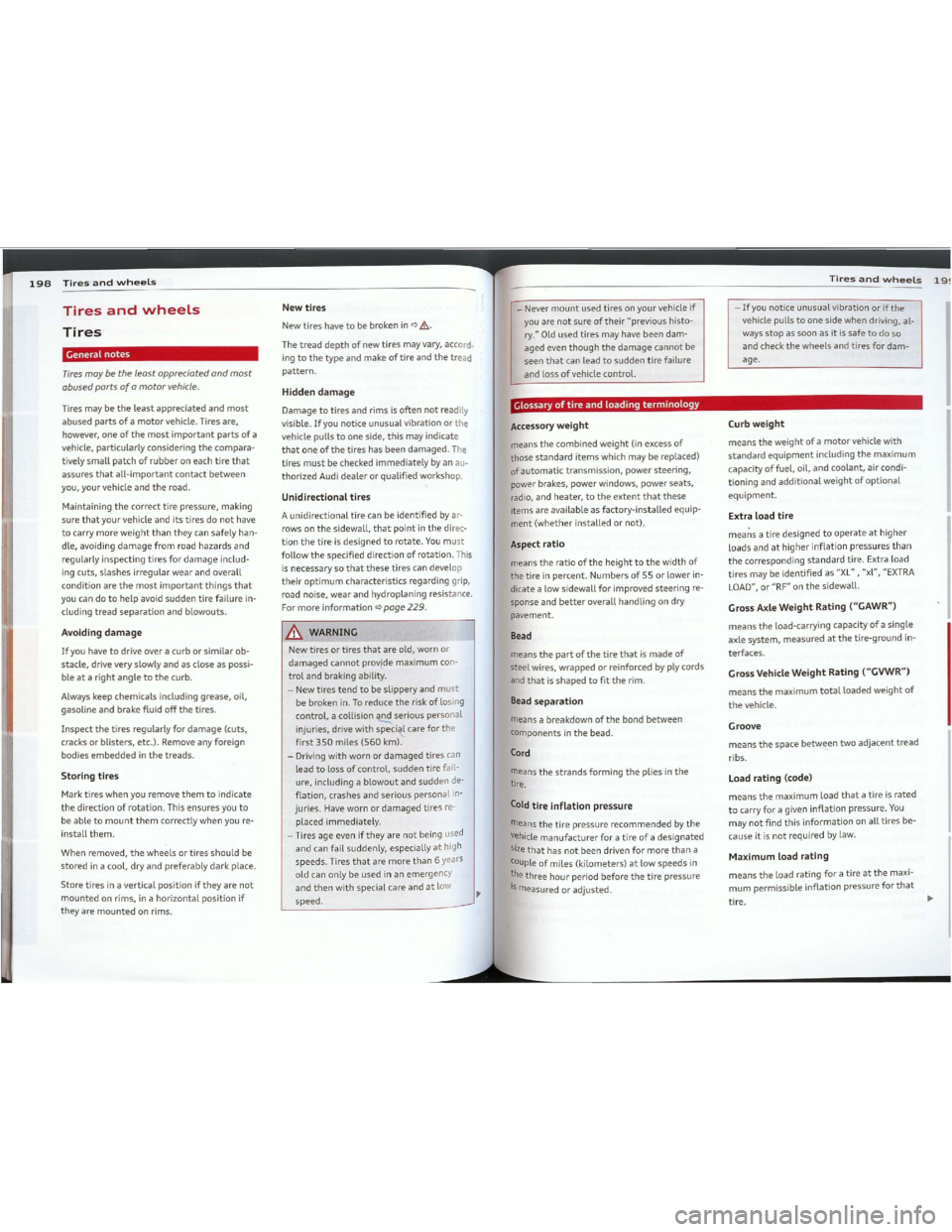
Tiresandwheels
Tires
Generalnotes
Tiresmaybethe[eastappreciated andmost
abusedpartsofamotorvehicle.
Tiresmaybetheleastappreciatedandmost
abusedpartsofamotorvehicle. Tiresare,
however,
oneofthemostimportantpartsofa
vehicle, particularly considering
thecompara
tivelysmallpatchofrubberoneach tirethat
assuresthatall-importantcontactbetween
you,your vehicleandtheroad.
Maintaining
thecorrecttirepressure,ma king
surethatyour vehicleanditstiresdonothave
tocarrymoreweightthantheycansafely han
dle, avoiding
damagefromroadhazardsand
regularly
inspectingtiresfordamageinclud
ing cuts,
slashesirregularwearandoverall
condition
arethemostimportantthingsthat
you candotahelpavoidsuddentirefailure in
cluding
treadseparationandblowouts.
Avoidingdamage
Ifyouhavetadrive overacurb orsimilarob
stacle,drive veryslowlyandascloseaspossi
ble
atarightangletathecurb.
Always keep
chemicalsincludinggrease,ail,
gasolineandbrakefluidoffthetires.
Inspectthetiresregularlyfordamage(cuts,
cracks or
blisters,etc.).Remove anyforeign
bodies
embeddedinthetreads.
Storingtires
Marktireswhenyou removethemtaindicate
thedirectionofrotation.Thisensuresyouto
beabletomountthemcorrectlywhenyoure
install
them.
Whenremoved,thewheelsortiresshouldbe
storedina cool, dryandpreferablydarkplace.
Storetiresinavertical positioniftheyarenot
mountedonrims,inahorizontalposition if
theyaremountedonrims.
Newtires
NewtireshavetobebrokeninqlA.
Thetreaddepthofnewtiresmay vary, accord
ing
tathetypeand makeoftireandthetread
pattern.
Hiddendamage
Damagetatiresandrimsisoftennotreadily
visible.
Ifyounoticeunusualvibration orthe
vehiclepullstaoneside,thismayindicate
thatoneofthetires hasbeendamaged.The
tiresmustbecheckedimmediatelybyanau
thorizedAudidealerorqualified workshop.
Unidirectionaltires
Aunidirectional tirecanbeidentifiedbyar
rows onthesidewall,thatpointinthedirec
tion
thetireisdesignedtorotate.Youmust
followthespecified directionofrotation.This
isnecessarysothatthesetirescandevelop
theiroptimumcharacteristicsregarding grip,
road noise,
wearandhydroplaning resistance.
For
moreinformationqpage 229.
AWARNING
Newtiresortiresthatareold,worn or
damagedcannatprovidemaximumcon
trolandbraking ability.
- New
tirestendtabe slipperyandmust
bebroken in.Toreducetheriskoflosing
control,acollisiona~seriouspersonal
injuries, drivewith
speci~careforthe
first350miles(s60km).
-Driving withwornordamagedtirescan
lead
talossofcontrol,suddentire fail
ure, including a
blowoutandsuddende
flation,crashesandseriouspersonalin
juries.Havewornordamagedtiresre
placed immediately.
- Tires
ageEveniftheyarenotbeing used
andcanfailsuddenly, especiallyathigh
speeds.Tiresthataremorethan6years
old can only
beused inanemergency
andthenwithspecialcareandatlow
speed.
_Nevermountusedtiresonyourvehicle if
you are
notsureoftheir"previous histo
ry." Old
usedtiresmay havebeendam
agedeventhoughthedamagecannotbe
seenthatcanleadtosuddentirefailure
andlossofvehiclecontrol.
Glossaryoftireandloadingterminology
Accessoryweight
meansthecombinedweight(inexcessof
thosestandarditemswhich maybereplaced)
of
automatictransmission,powersteering,
power brakes,powerwindows,powerseats,
radio,andheater,tatheextentthatthese
itemsareavailableasfactory-installedequip
ment(whetherinstalledornot).
Aspectratio
meanstheratiooftheheighttothewidthof
thetireinpercent.Numbersof55orlowerin
dicate alowsidewallforimprovedsteeringre
sponse
andbetteroverallhandlingon dry
pavement.
Bead means
thepartofthetirethatismadeof
steel wires,wrappedorreinforcedbyplycards
andthatisshapedtafittherim.
Bead
separation
means abreakdownofthebondbetween
componentsinthebead.
Cord
means
thestrandsformingthepliesinthetire.
Cold
tireinflationpressure
meansthetirepressurerecommendedbythe
vehiclemanufacturerfor atireofadesignated
sizethathasnotbeendrivenformorethana
COupleofmiles (kilometers)atlowspeedsin
thethreehourperiodbeforethetirepressure
ismeasuredoradjusted.
Tiresand\NheeLs
-Ifyounoticeunusualvibration orifthe
vehiclepullstaonesidewhendriving, al
ways
stopas soonasitissafetadosa
andcheckthewheelsandtiresfordam
age.
Curbweight
meanstheweightofamotorvehicle with
standardequipmentincludingthemaximum
capacityoffuel,oil,andcoolant,aircondi
tioning
andadditionalweightofoptional
equipment.
Extraloadtire
mea~sa tiredesignedtaoperateathigher
loadsandathigher inflationpressuresthan
thecorrespondingstandardtire.Extra load
tiresmaybeidentified as"XL","xl","EXTRA
LOAD",or"RF"onthesidewall.
GrossAxleWeightRating(uGAWRU
)
meanstheload-carrying capacityofasingle
axlesystem,measuredatthetire-groundin
terfaces.
GrossVehicleWeightRating(uGVWR")
meansthemaximumtotalloadedweightof
thevehicle.
Groove
meansthespacebetweentwoadjacenttread
ribs.
Loadrating(code)
meansthemaximumloadthatatireisrated
tacarryfora given inflation pressure.You
maynotfindthisinformationonall tires be
causeitisnotrequiredbylaw.
Maximumloadrating
meanstheloadrating foratireatthemaxi
mumpermissibleinflationpressureforthat
tire.
Page 106 of 132
Downloaded from www.Manualslib.com manuals search engine 208Tiresandvvheels
0:>fig.152runningacrossthetread.Depend
ing on
themake,therewill besixtoeightof
themevenlyplacedaroundthetire. Marks on
thetiresidewall(forexample"TWI"orother
symbols)indicatethepositionsofthetread
wearindicators. Worntiresmustbereplaced.
Different
figuresmay applyinothercountries
o:>A.
Tirepressure
Incorrecttirepressurecausesprematurewear
andcancausesuddentireblow-out. Forthis
reason,tirepressuremustbecheckedatleast
once amonth0:>page204.
Drivingstyle
Drivingfastaroundcurves, heavyacceleration
and hard braking increase tirewear.
Rotatingtiresformoreevenwear
Forallfourtiresonyour vehicletohavethe
sameservice life,werecommendthatthe
frontandreartiresarerotatedaccordingto
thetiremanufacturer'ssuggestedtire rota
tion intervals.
Pleaserememberthefollow
ing:
- Tire
rotationintervalsmay differfromthe
vehicle service intervalsoutlinedinyour
Warranty&MaintenanceBooklet.
- The
longeronetireisusedinonelocation
onthevehicle,themoreitwearsatcertain
points;therefore,werecommendthatyou
follow
thetiremanufacturer'ssuggested
tirerotationintervals.
- Vehicles with
front-wheeldriveexperience
moretreadwearonthefrontwheelscom
pared
toall-wheeldrive(quattro"').
- Pleaserotatetiresasshown0:>fig.153.
-Extra caremustbetakenwhenrotatingdi-
rection-specifie tires
0:>page229.
Wheelbalancing
Thewheelsonnewvehiclesarebalanced.
However, varioussituationsduringeveryday
driving can
causethemtobecomeunbal
anced,resultinginvibrations youcanusually
feelthroughthesteeringwheel.
-----Unbalancedwheelsmustberebalancedto
avoid excessivewearonsteering,suspension
and tires. A
wheelmustalsoberebalanced
whenanewtireisinstalled.
Incorrectwheelalignment
Incorrectwheelalignmentcancauseexces
sive tirewear, impairing
thesafetyofthevehi
cle.Iftiresshowexcessive wear,havethe
wheelalignmentcheckedbyanauthorized
Audi
dealerorqualified workshop.
all-wheeldrive
Vehicleswithquattro"'mustalwayshavetires
ofthesamesize,constructionandtreadtype.
For
detailssee0:>page158.
.&.WARNING
Suddentire failure canleadtolossofcon
trol,acrash andseriouspersonalinjury!
- Never driveavehicle
whenthetreadon
any tireisworn downtothewearindica
tors.
-Worn tiresareasafetyhazard,theydo
notgrip well onwetroads andincrease
yourriskof"hydroplaning" andlossof
control.
- Always keep
chemicalsthatcancause
tiredamage,suchasgrease,oil,gasoline
andbrake fluidawayfromtires.
- Tires
ageeven iftheyarenotbeing used
andcanfailsuddenly, especiallyathigh
speeds.Tiresthataremorethan6years
old can only beused
inanemergency
andthenwith special careandatlower
speeds.
-Nevermountusedtireson your vehicleif
youarenotsureoftheir"previous histo'
ry."
Oldused tiresmayhave beendam'
agedeventhoughthedamagecannotbe
seenthatcanleadtosuddentirefailure
andlossofvehicle control. New
tiresandreplacingtiresandwheels
Newtiresandwheels
havetobebroken in.
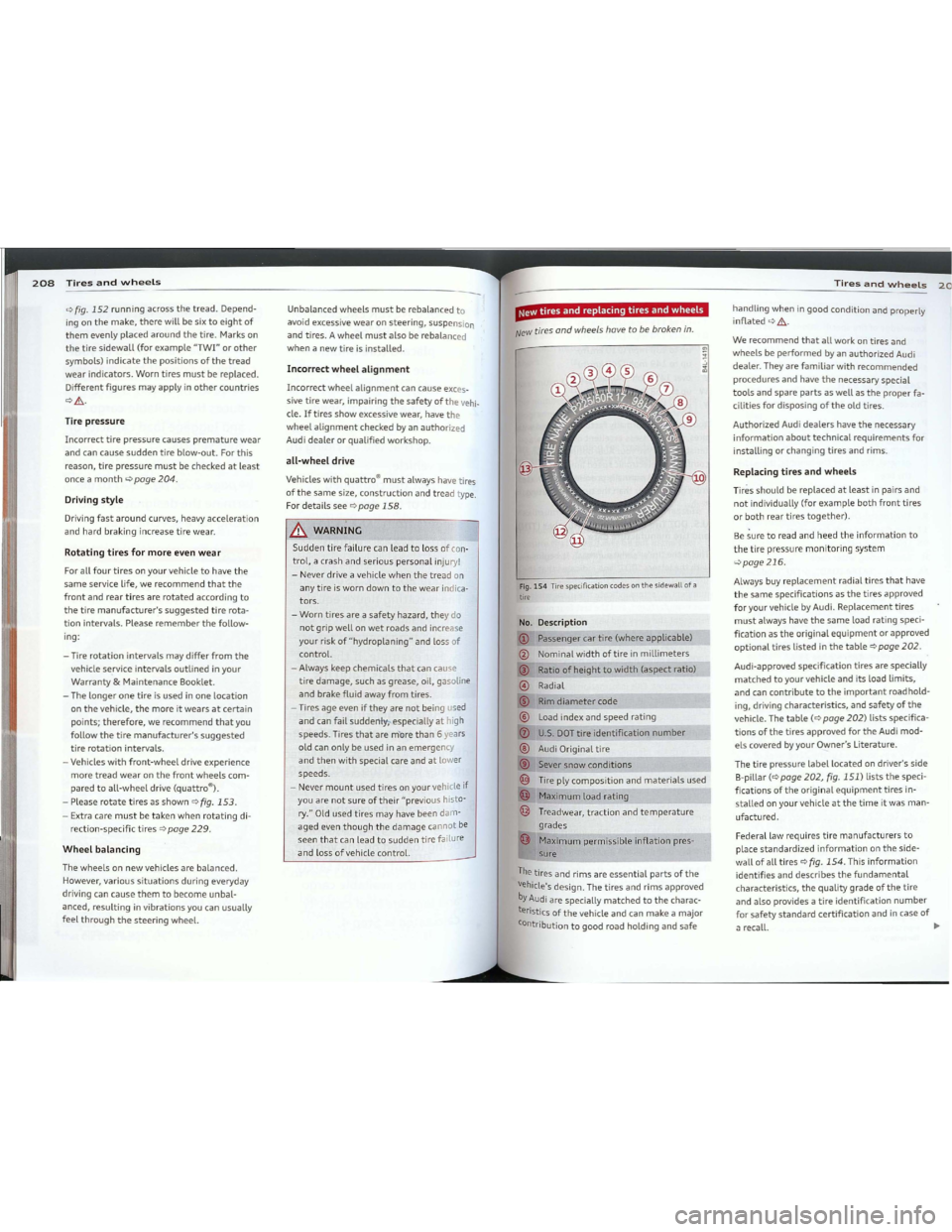
Fig.154Tirespecification codesonthesidewall ofatire
No.Description
@Passengercartire(where applicable)
®Nominal widthoftireinmillimeters
®Ratioofheighttowidth(aspectratio)
@Radial
®Rimdiametercode
®Loadindex andspeedrating
@Maximum loadrating
@Treadwear,tractionandtemperature
grades
@Maximum permissible inflationpres
sure
Thetiresandrimsareessentialpartsofthe
vehicle's design.Thetires andrims approved
byAudiarespeciallymatchedtothecharac
teristics
ofthevehicleandcanmakea major
COntribution
togood roadholding andsafe
Tiresandvvheels20
handling wheningoodcondition andproperly
inflated0:>A.
Werecommendthatallwork ontires and
wheelsbeperformedbyanauthorized Audi
dealer. Theyarefamiliar with
recommended
proceduresandhavethenecessary speciaL
toolsandsparepartsaswellastheproperfa
cilities fordisposing
oftheoLdtires.
Authorized Audi
dealershavethenecessary
information
abouttechnicalrequirementsfor
installing
orchanging tiresandrims.
ReplacingtiresandwheeLs
Tiresshould bereplacedatleastinpairsand
notindividually (forexamplebothfronttires
orbothreartirestogether).
Se sure
toread andheedtheinformationto
thetirepressuremonitoringsystem
0:>page216.
Always buyreplacementradialtiresthathave
thesamespecifications asthetiresapproved
foryourvehiclebyAudi.Replacementtires
mustalways havethesameloadrating speci
fication
astheoriginalequipmentor approved
optionaL tireslisted
inthetableo:>page202.
Audi-approved specificationtiresarespecially
matchedtoyourvehicleanditsload limits,
andcancontributetotheimportantroadhold
ing, driving characteristics, and
safetyofthe
vehicle.Thetable(0:>page202)listsspecifica
tionsofthetires approved fortheAudimod
elscoveredbyyourOwner's Literature.
The tire
pressurelabellocatedondriver'sside
S-pillar
(0:>page202,fig.151)liststhespeci
fications
oftheoriginalequipmenttires in
stalledonyour vehicleatthetimeitwasman·
ufactured.
Federallawrequires tiremanufacturersto
placestandardizedinformation ontheside
wall
ofall tires0:>fig.154.This information
identifies anddescribes
thefundamental
characteristics,thequalitygradeofthetire
andalso provides atireidentificationnumber
forsafetystandardcertification andincaseof
arecall.~
Page 110 of 132

Downloaded from www.Manualslib.com manuals search engine 216Tiresand\NheelsTiresand\Nheels217
Tirepressure
monitoringsystem
GeneralnotesApptiestovehicles:withtirepressuremonitoringsystem
Eachtire,includingthespare(ifprovided),
shouldbecheckedmonthlywhencoldandin
flatedtotheinflationpressurerecommended
bythevehiclemanufactureronthevehicle
placard
ortireinflationpressurelabel.(Ifyour
vehiclehastiresofadifferentsizethanthe
sizeindicatedonthevehicleplacardortirein
flationpressurelabel,youshoulddetermine
thepropertireinflationpressureforthose
tires.)
Asanaddedsafetyfeature,yourvehiclehas
beenequippedwithatirepressuremonitoring
system(TPMS)thatilluminatesa lowtire
pressuretelltalewhenoneormoreofyour
tiresissignificantlyunder-inflated.According
ly,whenthelowtirepressuretelltaleillumi
nates,youshouldstopandcheckyourtiresas
soonaspossible,andinflatethemtothe
properpressure.Drivingonasignificantlyun
der-inflatedtirecausesthetiretooverheat
andcanleadtotirefailure.Under-inflational
soreducesfuelefficiencyandtiretreadlife,
andmayaffectthevehicle'shandlingand
stoppingability.
PleasenotethattheTPMS isnotasubstitute
forpropertiremaintenance,anditisthedriv
er'sresponsibilitytomaintaincorrecttire
pressure,evenifunder-inflationhasnot
reachedtheleveltotriggerilluminationofthe
TPMSlowtirepressuretelltale.
Yourvehiclehasalsobeenequippedwitha
TPMS
malfunctionindicatortoindicatewhen
thesystemisnotoperatingproperly.The
TPMSmalfunctionindicatoriscombinedwith
thelowtirepressuretelltale.Whenthesys
temdetectsamalfunction,thetelltalewill
flashforapproximatelyoneminuteandthen
remaincontinuouslyilluminated.Thisse
quencewillcontinueuponsubsequentvehicle
start-upsaslongasthemalfunctionexists.
Whenthemalfunctionindicatorisilluminat
ed,thesystemmaynotbeabletodetector
signallowtirepressureasintended.TPMS
malfunctionsmayoccurfora varietyofrea
sons,includingtheinstallationofreplace
mentoralternatetiresorwheelsonthevehi.
cle
thatpreventtheTPMSfromfunctioning
properly. AlwayschecktheTPMSmalfunction
telltaleafterreplacingoneormoretiresor
wheelsonyourvehicletoensurethatthere
placementoralternatetiresandwheelsallow
theTPMStocontinuetofunctionproperly.
Tire pressure indicator appears •
Appliestovehicles:withtirepressuremonitoringsystem
Thetirepressure indicatorintheinstrument
c/uster informs you
ifthetire pressureistoo
LoworifthereisasystemmaLfunction.
Fig.1S6Display: Systemmalfunction
UsingtheABSsensors,thetirepressuremoni
toringsystemcomparesthetiretreadcircurn
ferenceandvibrationcharacteristicsofthein
dividualtires.Ifthepressuredecreasesinone
ormoretires,thisisindicatedintheinstru
mentclusterwithawarningsymbolganda
messageqfig.155.The drivermessageinthe
displaygoesoutafter5seconds.Thedriver
messagecanbedisplayedagainbypressing
the[CHECKIbutton®qpage10,fig.3.Ifon
lyonetireisaffected,thedisplaywillindicate
itsposition.
Thetirepressuremonitoringmustberesetin
themenudisplayeachtimethepressuresare
adjusted(e. g.whenswitchingbetweenparti
alandfullloadpressure)orafterchangingor
replacing atireonyourvehicleqpage218.
Voucanfindtherecommendedtirepressures
foryourvehicleonthelabelonthedriver's
door pillar
qpage202.
Tiretreadcircumferenceandvibrationcharac·
teristicscanchangeandcauseatirepressure
warningif:
_thetirepressureinoneormoretiresistoo
low,
-
thetirehasstructuraldamage,
_thetirepressurewaschanged,wheelsrotat
edorreplacedbuttheTPMSwasnotreset
qpage218.
Warning symbols
[D]Lossofpressureinatleastonetireq/D,.
Checkthetireortiresandreplaceorrepairif
necessary. The
indicatorlightgintheinstru
mentclusteralsoilluminatesqpage13.
Check/correctthepressuresofallfourtires
andresetTPMSinthemenudisplay.
~(TirePressureMonitoringSystem)Tire
pressure!Systemmalfunction.IflDmap
pearsafterswitchingtheignitiononorwhile
drivingqfig.156andtheindicatorlightgin
theinstrumentclusterblinksforapproxi
matelyoneminuteandthenstayson,thereis
a
systemmalfunction.Seeyourauthorized
Audidealerassoonaspossible.
AWARNING
-Ifthetirepressureindicatorappearsin
theinstrumentclusterdisplay,oneor
moreofyourtiresissignificantlyunder
inflated.Reduceyourspeedimmediately
andavoidanyhardsteeringorbraking
maneuvers.Stopassoonaspossibleand
checkthetiresandtheirpressures.In
fla
tethetirepressuretotheproperpres-
sureasindicatedonthevehicle'stire
pressurelabelqpage202.Drivingona
significantlyunder-inflatedtirecauses
thetiretooverheatandcanleadtotire
failure.Under-inflationalsois likelyto
impairthevehicle'shandlingandstop
ping ability.
-
Thedriverisresponsibleformaintaining
thecorrecttirepressures.Youmust
checkthetirepressuresregularly.
-
Undercertainconditions(suchasaspor
tydrivingstyle,winterconditionsorun
paved
roads),thepressuremonitorindi
catormaybedelayed.
- AskyourauthorizedAudidealerif run
flattiresmaybeusedonyourvehicle.
Your vehicle
registrationbecomesinvalid
if
yàuusethesetireswhennotpermit
ted.Damagetoyourvehicleoraccidents
couldalsoresult.
-Ifyouswitchbetweenstandardandrun
flattires,anauthorizedAudidealeror
qualifiedworkshopmustreprogramthe
controlmodule.
1Tips
- The
tirepressuremonitoringsystem
stopsworkingwhenthereis an ESP/ABS
malfunction.
-Usingsnowchainsmayresultin asystem
malfunction.
-Tireswiththeidentification"AD"or"RD"
have
beenspeciallymatchedwithyour
Audi.Werecommendusingonlythese
tiresbecausetheymeetthehighest
standardsregardingsafetyanddriving
characteristicswhenusedcorrectly. Your
authorizedAudidealerwillgladlypro
vide you
withmoreinformation.
Page 112 of 132
Downloaded from www.Manualslib.com manuals search engine 220Tiresandwheels
CDNote
Run-flat
tireshave specialcharacteristics
andrequirements,thatareverydifferent
fromconventionaltires. Run-flattiresre
quire special rims
forrun-flatuseandcan
notbeusedonconventionalwheelrims.
Tips
-
Ifyouarenotabletocontinuedriving
with
run-flattires,pleaseseekprofessio
nalassistance.
- PleasecontactyourauthorizedAudi
dealerorAudiofAmerica, Inc.ifyou
have
questionsabouttiresandrims.
Driving
withrun-flat tires
Appliestavehicles:withRun-flat tires
Handling characteristics changewhentire
pressure
islaw.
Driving ontireswithlowtirepressurechanges
theway avehiclehandles,particularLywhen
corneringandbraking. Thehandling charac
teristicsofrun-flattiresdonotseemto
changealotEvenwhendrivingonlow pres
sureorintherun-fLatmode.Neverthelessyou
muststilltakespecialprecautionswhenoper
atingavehicleonrun-flattireswhentire pres
sureisLoworthetirets) isflat:
~The Electronic Stabilization Program(ESP)
mustbeswitchedon.
~Neverdrivefasterthan50mph(80km/hl
q.&..
~Planaheadwhendrivingandanticipate
whatyouwilLhavetodoconsidering traffic
androadconditionsupahead.
~Acceleratecarefully.
~Avoidunnecessaryandsuddensteeringand
brakingmaneuvers.
~Reduceyourspeedinplentyoftimebefore
intersections,curvesandotherplaceswhere
youmay havetoreactquickly.
Please
see:qpage219,Whenitisnatpossi
bLeta continue driving,Evenwithrun-fLat
tires?
Handling characteristics changewhen
driving withlowairpressure orwithflattires evenwithspecial run-flat tires
A low
pressureorflatfront tireaffectsvehicle
handlingcharacteristicsbypullingthevehicle
slightlytothesidewherethetireismounted
andreducesbrakingperformance.
AlowpressureorfLatreartirealsoaffects
drivingcharacteristicsbypullingtotheside
wherethetireismountedandalso reduces
braking
performance.Theeffecton vehicle
handling
ismostnoticeablewhendriving
aroundcurves.
.&..WARNING
Changed vehiclehandlingcharacteristics
whendrivingintherun-flatmodecan
causelossofvehiclecontrol,acrash and
seriouspersonalinjury.
- Driving onspecial
run-flattiresinthe
run-flatmodewillchangevehicle han
dling
characteristicsduringbraking,
whencorneringandunderheavy acceler
ation.
-Never drivefasterthanthemaximum
ratedspeedof50mph(80km/hlwhen
driving
intherun-flatmode.
- Alwaysadjustvehiclespeedtotraffic,
road
andweathercond itionsanddrive
slowerthanthemaximumratedspeedif
necessaryweathera~roadconditions
aretakenintoaccount.
- Always obey
speedlimitsandothertraf
fic laws.
CDNote
We always
recommenddriving withEven
morecarewhenusingthesespecialtiresin
therun-flatmode.Always avoidsudden
maneuvers.
Replacing run-flattiresandrims
APpliestavehlcles:wlthRun-flattires
yourvehicLewasespeciaLLydesignedtause
speciaL run-fLat tires.
Voumayuseandcombineonlyapprovedrun
fIat tires
andspecialmatchingrimsthathave
been
designedforrun-flattires. Mounting
special
run-flattiresonstandardwheelswilL
not workandwillnotprovidetheadvantages
fotherun-faltfeature.Neverusespecialrun
flat tires on
standardwheelrims.
After driving withatire
intherun-flatmode,
always havethevehicleandaffectedtirets)
and rimes)
inspectedbyanauthorizedAudi
dealer. Tires
thathavebeendrivenintherun
flat
modemustbe replaced.
fbWARNING
Useofdamagedrun-flattiresandrims can
cause vehicle
damagethatcanLeadtoloss
ofvehiclecontrol,acrashandseriousper
sonal
injury.
- Always have
thevehicleandaffected
tirets)andrimes)inspectedbyanauthor
izedAudidealerafterdriving atireinthe
run-flatmode.
-Tiresthathavebeendrivenintherun
flatmodemustbereplaced.
Tiresandwheels
Page 126 of 132

Downloaded from www.Manualslib.com manuals search engine TechnicalModifications
OurguideLinesmustbecompLiedwithwhen
technical modifications oremade.
AlwaysconsultanauthorizedAudidealerbe
forestartingworkonanymodifications.
This willhelpensurethatvehiclefunction,
performanceandsafetyarenotimpaired
q.&..
Attemptingtoworkonelectroniccomponents
andthesoftwareusedwiththemcancause
malfunctions.Becauseofthewayelectronic
componentsareinterconnectedwitheach
other,suchmalfunctionscanalso haveanad
verseaffectonothersystemsthatarenotdi
rectly involved. This
meansthatyouriskboth
asubstantialreductionintheoperational
safetyofyourvehicleandanincreasedwearof
vehiclepartsq.&..
Authorized Audidealerswillperformthis
workinaprofessionalandcompetentmanner
or,inspecialcases,referyoutoaprofessional
companythatspecializesinsuchmodifica
tions.
AWARNING
Improperrepairsandmodificationscan
changethewayvehiclesystemsworkand
causedamagetothevehicleandserious
personalinjury.
CDNotej
Ifemergencyrepairsmustbeperformed
elsewhere,havethevehicleexaminedby
anauthorizedAudidealershipassoonas
possible.
DeclarationofCompliance,TelecommunicationorElectronicSystems
Radio Frequency DevicesandRadiocommuni
cation Equipment UserManual Notice.
Themanufacturerisnotresponsibleforany
radio
orTVinterferencecausedbyunauthor
izedmodificationstothisequipment.
Deviees
The following deviceseachcomplywithFCC
Part15.19,FCCPart15.21andR55-GenIssue
1:
-Cellphonepackage
- Electronicimmobilizer
-HomeLink® universalremotecontrol
-Remotecontrolkey
FcePart15.19
Thisdevicecomplieswithpart15oftheFCC
Rules.Operationissubjecttothefollowing
twoconditions:
(1)This device maynotcauseharmfulinter
ference,and
(2)thisdevicemustacceptanyinterference
received, includinginterferencethatmay
causeundesiredoperation.
FeePart15.21
CAUTION:
Changesormodificationsnotexpressly ap
proved by
thepartyresponsibleforcompli
ancecouldvoidtheuser'sauthoritytooperate
theequipment.
RSS-GenIssue1
Operationissubjecttothefollowingtwocon
ditions:
(1)
thisdevice maynotca~interference,,and
(2)thisdevicemustacceptanyinterference,
includinginterferencethatmaycauseunde
sired
operationofthedevice.
A
AlCoperation73
Accessories247
Acousticparkassist81
Adaptivelight46
defective. . . . . . . . . . . . . . . . . . . . . . . ...21
Adding Engine
coolant190
Engine oil187
Windshieldwasherfluid196
Additionalaccessories247
Additives
Engine oil
187
Adjustablesteeringcolumn75
Adjustingfrontseats57
Adjustingsteeringcolumn75
Adjustingtheseats58
Advanced Airbag5ystem
Children134
Components118
Frontairbags116
Howthecomponentsworktogether..119
Monitoring122
Weight-sensingmat134
Airbag
Warning/indicatorlights16
Airbagsystem.. . . . . . . . . . . . . ...111,130
Care125
Childrestraints135
Components(frontairbags)118
Dangeroffittingachildsafetyseaton
thefrontpassengerseat113
Disposal125
Frontairbags115
How dothefrontairbagswork?120
Howmanyairbagsdoesmyvehicle
have?
118
Importantsafetyinstructionsonthe
kneeairbagsystem128
ImportantthingstoknowIII
Indicatorlight122
Kneeairbags126
Monitoring122
PASSENGERAIRBAGOFFlight122
Repairs125
5ideairbags129
Whenmustthesystembeinspected?.122
All-wheel drive158
Wintertires213
Alloywheels171
Alternator
refertaGenerator16
Anti-freeze
refer taEngine coolingsystem189
Anti-lock brakesystem
Warning/indicatorlights18
Anti-lock brakingsystem153
Anti-slipregulation153
Anti-theftsystems
Anti-theftalarmsystem42
Eledronicimmobilizer36
Ashtray67
Asterisk
Whatdoesitmeanwhensomethingis
markedwithanasterisk?. . . . . . . . 6
Audi
magneticride.. . . . . . . . . . . ...21,80
Description.. . . . . . . . . . . . . . . . . . . .80
Indicatorlight21
Audi 5ervice RepairManualsandLitera-
ture245
Automaticbeltretractor107
Automaticcarwash
refertaWashing168
Automatictransmission.. . . . . . . . . . . ...83
DrivingNotes...... . . . . . . . . . . . . . ...85
Emergencyprogram88
Emergencyrelease. . . . . . . . . . . . . . . ...89
Ignitionkeysafetylock76
Kick-down . . . . . . . . . . . . . . . . . . . . . . ...88
LaunchControlProgram88
Selectorleverlock. . . . . . . . . . . . . . . ...84
Selectorleverpositions. . . . . . . . . . . ...83
Tiptronic '87
Tiptroniccontrolsonthesteeringwheel87
Auto5afetyHotline101
Averagefuelmileage24
Averagespeed. . . . . . . . . . . . . . . . . . . . ...24
Avoiddamagingthevehicle163
B
Battery192,195
Charging196
Checkingbatteryacidlevel195
Page 130 of 132
Downloaded from www.Manualslib.com manuals search engine Index2!:
Parkingbrakewarning15
Parking onadecline (downhill)78
Parking onanincline(uphill)78
Partsreplacement247
PA5SENGERAIRBAGOFFlight122
Passivesafetysystem93
Pedals98
Physical principlesofafrontalcollision .104
Polishing169
Pollenfilter71
Pollutantfilter71
Powerlocking switch40
Powerlockingsystem37
Convenienceclose/openfeature44
Lockingandunlockingthevehiclefrom
inside40
Openingandclosingthewindows44
Rearlid/trunklid41
Remotecontrol35
Unlockingandlocking vehicle38
Poweroutlets68
Powerseats
Adjustingtheseatback60
Adjustment59
Foldingtheseatbackforward60
Powersteering
refertaElectro-mechanical poweras-
sist17,158
Powerwindowswitches43
Reactivatingthesystem44
Pregnantwomen
Specialconsiderationswhenwearing a
safetybelt108
ProgrammingtheHomeLink® universalre
motecontrol. . . . . . . . . . . . . . . . . . . . . ...90
Properoccupantseatingpositions94
Propersafetybeltposition108
Properseatingposition
Front
passenger95
accupants. . . . . . . . . . . . . . . . . . . . . . ...94
Rearpassengers96
Q
Quartzclock11
quattro®
refertaAll-wheel drive158
Question
Whathappenstounbeltedoccupants?105
Why
safetybelts?103
R
Radiator fan 191
Rain
sensordefective . . . . . . . . . . . . . . . 21
Reading
lights48
Rear lid41
Emergencyrelease. . . . . . . . . . . . . . . ...42
Rearlightdefective 20
Rear
spoiler156
Rear view mirror 50
Rear
windowdefogger74
Rearwindowshelf62
Refuelling
180
Release leverforhood182
Remotecontrol.. . . . . . . . . . . . . . ...35,39
Remotecontrolgaragedooropener
(HomeLink®) . . . . . . . . . . . . . . . . . . . . .90
Remotemasterkey
Unlocking
andlocking38
Remoterear lidrelease41
Repairmanuals245
Repairs
Airbag
system125
Replacementparts247
Replacing
Wheelrims209
Replacing afuse~230
Replacinglightbulbs:233
Replacing
tiresandwheels' 209
Replacing windshield wiper
blades54
Reporti ng
5afetyDefects '101
Reset
button' 12
Resettingremotecontrol'39
Retractor'107
Reverse (Automatictransmission). ..'84
Rims
Cast alloy 171
Replacing 209
Steelrims'171
Roofrack
Loading . . . . . . . . . . . . . . . . . . . . . .
65
Mounting locations65
Safemounting64
Roofweight'65
Run-flattires219
Driving220
Introduction219
Replacingdefectsparts221
5
SAFE12
Safedrivinghabits93
Safetybeltposition108
Safetybeltswornbypregnantwomen.108
5afetybeltpretensioner
Serviceanddisposal110
Safetybelts107
Cleaning176
Dangertopassengerswhodonotweara
safetybelt105
Fastening107
Improperlyworn109
Notworn105
pretensioners109
5afetybeltposition108
Safetyinstructions106
securingchildsafetyseats143
Specialconsiderationsforpregnant
women108
Unfastening109
Warning/indicatorlight103
WhyVOUMUSTwearthem103
Worn properly105
safetybeltwarninglight. . . ...16,103
safetycompliancesticker240
safetyequipment93
safetyfeaturesforoccupantrestraintand
protection'93
safetyguidelines
seatadjustment. . . . . . . . . . . . . . . . . ...57
safetyinstructions
Enginecompartment182
forusingchildsafetyseats136
Forusingsafetybelts106
MonitoringtheAdvanced Airbag5ys-
~mlM
safetylock(Ignitionkey)76
seatadjustment
Driver'sseat57
Frontpassenger'sseat. . . . . . . . . . . . ...58
Frontseats57
Headrestraints97
Headrestraints,frontseat61
Lumbarsupport.. . . . . . . . . . . . . . .61
Manualcontrols. . . . . . . . . . . . . . . . . ...58
Powerseats59
5afetyguidelines. . . . . . . . . . . . . . . . ...57
seatbackangle58
Seatingcapacity103
Seatingposition
Driver
94
Frontpassenger95
Howtoadjustthefrontseats95
Incorrectseatposition97
accupants. . . . . . . . . . . . . . . . . . . . . . ...94
Rearpassengers96
Seats
Numberofseats103
Selectorleveremergencyrelease89
Selectorleverpositions83
Serviceanddisposal
Safetybeltpretensioner110
Service interval display29
Servicepositionforwindshield wipers53
Setmenu.. . . . . . . . . . . . . . . . . . . . . . . .27
Setting
Datedisplay11
Digital clock . . . . . . . . . . . . . . . ...11
Sideairbags
Description129
Howtheywork130
Sidemarkerlights45
Snowchains214
Sockets67,68
Soundsystemdisplay23
Sourcesofinformationaboutchildre-
straintsandtheiruse151
Speedometer12
Speedratinglettercode210
Speedwarningsystem31
Sportbutton81
Sportmode.. . . . . . . . . . . . . . . . ...81,155