air condition AUDI TT 2013 Owner´s Manual
[x] Cancel search | Manufacturer: AUDI, Model Year: 2013, Model line: TT, Model: AUDI TT 2013Pages: 262, PDF Size: 65.91 MB
Page 152 of 262
150 Intelligent technology
Intelligent technology
Notice about data
recorded by vehicle
control modules
Your vehicle is not equipped with an Event Da
ta Recorder (EDR), installed by some manu
facturers fo r the express purpose of capturing
data for retrieval after an accident or crash
event . EDR's are sometimes ca lled "crash re
corders".
Some state laws restrict the retr ieval or down
loading of data stored by EDR's that were in
stalled in a vehicle for the express purpose of
retrieving data after an accident or crash
event without the owner's consent.
A lthough your vehicle is not equipped with an
EDR, it is equipped with a number of electron
ic control modules for various vehicle systems
such as, for examp le, eng ine function, em is
sion control, as well as for the airbags and
safety belts.
These electronic contro l modules also record
vehicle-re lated data during normal vehicle op
eration for diagnostic and repair purposes.
The recording capacity of the electronic con
trol modules is limited to data (no sound is re
corded) and only a small amount of data is ac
tually recorded over a very limited pe riod of
time and stored when a system fault or other
condition is sensed by a control unit. Some of
the data then stored may relate to vehicle
speed, direction, braking as we ll as restraint
system use and performance in the event of a
crash or other condition. Stored data can only
be read and downloaded with special equip
ment.
Electronic Stabilization
Control (ESC)
Description
ESC helps to improve road holding and vehicle
dynamics to help reduce the probability of
skidd ing and loss of vehicle control. It works
only when the engine is running. ESC detects certain difficult driving situat
ions, including
when the vehicle is beginning to spin (yaw)
out of control and helps you to get the veh icle
back under control by se lectively braking the
wheels, and/or reducing engine power and
providing steering assistance to help hold the
vehicle on the driver's intended course. The in
dicator light
G) in the instrument cluster
blinks when ESC is taking action to help you
control the vehicle.
ESC has limitations.
It is important to remem
ber that ESC cannot overcome the laws of
physics. It wi ll not always be able to help out
under all conditions you may come up against.
For example, ESC may not always be able to
help you master situations where there is a
sudden change in the coefficient of friction of
the road surface. When there is a section of
dry road that is suddenly covered with water,
slush or snow, ESC cannot perform the same
way it wou ld on the dry surface . If the vehicle
hydroplanes (rides on a cushion of water in
stead of the road surface), ESC will not be
able to help you steer the vehicle because con
tact with the pavement has been interrupted
and the vehicle cannot be braked or steered.
During fast cornering, particularly on winding
roads, ESC cannot always deal as effectively
with difficult driving situations as at lower
speeds.
Always adjust your speed and driving style to
road , traffi<;: and weather conditions. ESC can
not override the vehicle's physical limits, in
crease the available tract ion, or keep a vehicle
on the road if road departure is a result of
driver inattention . Instead, ESC improves the
poss ibility of keeping the vehicle under con
t rol and on the road during extreme maneu
vers by using the driver's steering inputs to
help keep the vehicle going in the intended di
rection . If you are traveling at a speed that
causes you to run off the road before ESC can
provide any assistance, you may not experi
ence the benefits of ESC.
ESC includes and/or works together with the
anti- lock brake system (ABS), brake assist sys-
tem and anti-slip regu lation (ASR). ESC is .,..
Page 157 of 262
overheat reducing the effectiveness of
the ent ire brake system.
- Failure of one brake circuit will impair
the braking capability resulting in an in
creased stopp ing distance. Avoid driv ing
the vehicle and have it towed to the near est Aud i dealer or qualified workshop .
- Never let the vehicle roll to a stop w ith
the engine shut off.
- If the brake booster is not working, for
example when towing your ve hicle, or
because the brake booste r has somehow
been damaged, the brake pedal must be
pressed considerab ly harder to make up
for the lack of booster assistance.
Electro-mechanical
power assist
The electro-mechanical power assist helps
the driver when steering.
The degree of power assist is electronically
matched to vehicle speed.
The power steer ing system ass ists the driver
so that he can stee r the veh icle w ith red uced
phys ica l effort.
Power steering w ill not work if the engine is
off. As a result, the steering wheel w ill be hard
to turn.
& WARNING
If the system develops a prob lem, you
must seek qualified professional assis
tance.
(D Note
-
If there is an electronic malfunct ion, ser
votronic
wi ll sti ll function like a conven
tional power steering system, providing a
constant steering support force that is no
longer proportionate to the vehicle speed.
This is most noticeable when turning the
steer ing wheel at low speeds (for example
when parking), -more effort will be re
quired than usual.
Int ellig ent technolog y 155
-Be aware of the different than usual
steering response and adjust your steer
ing force accordingly.
- Have the problem checked and set right
by an authorized Audi dea ler as soon as
possible.
- If a steering malfunction occurs, this is
signaled with the,~ , or .• indicator
lights and a warn ing tone, see.
(D Tips
- If the power steering system sho uld fail,
or if the engine is not running (for exam
ple, while being towed), you will still be
able to steer the vehicle. However, more
effort will be required to do so.
- If the power steering system is not func
tioning properly, contact your authorized
Audi dealer immediately.
Driving with your
quattro ®
Applies to vehicles : wit h all -w hee l d rive
With oil -wheel drive, oil four wheels ore driv
en.
General information
With a ll-wheel drive, power is distr ibuted to
all four wheels. This happens automatically
depend ing on your driving style and the road
conditions at the time. See also
c::> page 1 SO.
The all-whee l dr ive concept is des igned for
high eng ine power. Your veh icle is except ion
ally powerfu l and has excellent driving charac
teristics both under normal driving conditions
and on snow and ice. Always read and follow
safety precautions
c::> &. .
Winter tires
When dr iving in the winter, your vehicle with
all-wheel drive has an advantage, even with
regular tires. In winter road conditions it may
be advisable to mount winter tires (or all-sea
son tires) for improved driveability and brak
ing: these tires must be mounted on
all fou r
wheels. See also c::> page 211, Winter tires. ..,_
•
•
Page 166 of 262
164 Cleaning and protection
Cleaning and
protect ion
General information
Regular core preserves vehicle value .
Any automobile is exposed to industrial
fumes, corrosive road salt, etc. A well cared
for Audi can look like new many years after purchase . Regular and correct care w ill con
tr ibute to maintaining the beauty and value of
your Aud i.
Furth erm ore, goo d car e m ay be a c onditi on
for substantiat ing a warrant y claim shou ld
c orrosion dam age or paint d efe ct s occ ur.
Your author ized Audi dealer has a variety of
d ed ica ted vehicl e-ca re product s and can ad
vise which ones to use for cleaning the exter i
or and inte rior of your vehicle .
Whether you use products recommended by
Aud i or other commercially ava ilable clean ing
agents, please make sure you apply them cor
rectly .
A WARNING
-Cleaning agents may be poisonous. Keep
them out of the reach of children.
- Heed all caut ion labels.
- Always read directions on the container
before using any product . Follow the di
rect ions carefu lly.
- Most chemical cleaners are concentrated
and have to be diluted.
- Use spot removing fluids only in well
ventilated areas.
- Do not use gasoline, kerosene, d iesel
fuel, nail pol ish remover or other volati le
fluids. They may be toxic, flammab le or
hazardous in other ways. Do not wash,
wax or dry the vehicle with the ignit ion
on or the engine running.
- Do not clean the undersides of chassis,
fenders, wheel covers, etc. without pro
tecting your hands and arms. You may
c u t yourself on sharp-edged metal parts . -
Moisture and ice on brakes may impair
brak ing eff ic iency
c::> page 153 , General
information.
Test the brakes carefully
each time you wash the vehicle .
@ For the sake of the environment
Select on ly environ mentally friendly clean
i ng products. Leftover cleaning products
should not d isposed of in the househo ld
waste .
Care of exterior
Washing
Frequent washing protects the vehicle .
The best protection against environmental in
fluences is
frequent washing and waxing . How
often this is required depends on:
- How much the veh icle is used
- Where the veh icle is parked (garage, in the
open under trees, etc.)
- The seasona l and weather conditions
- Environmental infl uences
T he longer b ird droppings, insects, tree resin,
road and indus tria l gr ime, ta r, soot, road salt
and other materials remain on the vehicle paint, the more lasting their destructive ef
fects wi ll be .
High tempera tures, as from expos ure to in
tense sunlight, intensify the corrosive e ffect
particularly when humidity is high as well.
Under certa in ci rc u mstances,
we ekly washing
may be necessary. Unde r othe r cond it ions, a
monthly washing and waxing may be ade
quate.
After the winter, the unders ide of the vehicle
sho uld be thoro ughly washed p re ferab ly in a
pro fessional ca r wash.
A WARNING ~
A lways read and heed all WARNINGS and
the information
c::> page 164.
Page 185 of 262
oils available today provide better engine lu
brication that can outlast traditional petrole
um-based oils, making them a smart choice
for use throughout the life of your Audi.
Whether you use synthetic or petroleumbased engine oil, the oil that you use must
conform to Audi's oil quality standard
VW 502 00 to help keep your vehicle's engine running smoothly and help prevent the for
mation of harmful deposits, sometimes called
" sludge," that over t ime can lead to expensive
repairs .
At the time of printing, engine oils available in the U .S . and Canada that meet the exacting
specifications of Audi oil standard VW 502 00
are synthetic engine oils . This does not mean,
however, that every synthetic engine oil will
meet Audi oil standard VW 502 00 . So always
be sure that you use an approved oil.
To help prevent the formation of harmful de posits use only oil with the following specifi
cations printed on the oil container :
Audi oil standard VW S02 00
Oil container labels may carry the specifica
tion singly or in combination with other desig
nations and oil quality standards .
Viscosity
Engine oils are graded according to their vis
cosity . The proper viscosity grade oil for your
engine depends on climactic or seasonal con
ditions where you drive. You can use oil with a
viscosity grade of SA E SW40 across all tem
perature ranges for normal driving conditions.
However, if engine oil viscosity grade SAE
SW40 is not available, you can also use viscos
ity grade SAE SW-30 or SAE OW-40 as long as
it meets Audi oil quali ty standard VW 502 00
specifications .
Because engine oil that meets the Audi oil
standard may not be available everywhere
when you need it, we strongly recommend
that you always carry with you an extra quart (liter) of oil that expressly conforms to the
Checking and filling 183
VW 502 00 specification, in case you have to
top
off the oil while on the road.
Only if the level of the oil is at or below the
minimum mark on the oil dipstick - and no oil
that expressly conforms to Audi oil standard
VW 502 00 specifications is available - may
you top
off with a high quality engine oil, pref
erably synthetic-based, that meets ACEA A3
or API SM specifications, but even then, only
in viscosity grades SA E SW-40, SA E 5W -30, or
SAE OW-40. However, during the entire time
between oil change intervals, never top
off
with more than a total of 0.5 qt/liter engine
oil that does not conform to Audi oil specifica
tion VW 502 00.
For more information about engine oil that
has been approved for your vehicle, please
contact either your autho rized Audi dealer or
Audi Customer Relations at 1 (800) 822-2834
or visit our web site at www.audiusa .com or
www.audicanada.ca . Here you will also find a
current list of oils (manufacturers, brand
names etc.) that conform to Audi oil standard
vw 502 00.
Changing the engine oil
The engine oil and oil filter must be changed
according to the mileage (kilometers) and
time intervals specified in your vehicle's War
ranty
& Maintenance booklet. Do not exceed
these intervals -harmful deposits from old
engine oil can reduce engine performance and
can lead to expensive engine repairs.
Changing the oil at the recommended inter
vals is so very important because the lubricat
ing properties of oil decrease gradually during
normal vehicle use. If you are not sure when
you have your oil changed, ask your author
ized Audi Serv ice Adv isor.
Under some circumstances the engine oil
should even be changed more frequently. Change oil more often if you drive mostly
short distances, operate the vehicle in dusty
areas or mostly under stop-and-go traffic con
ditions, or when you use your vehicle where
temperatures stay below freezing point for
long periods.
•
•
Page 189 of 262
@ For the sake of the environment
- Before changing your oil, first make sure
you know where you can properly dispose of the used oil.
- Always dispose of used engine oil proper
l y. Do not dump it on garden soi l, wood
ed areas, into open streams or down
sewage drains.
- Recycle used engine oil by taking it to a
used engine oil collection facility in your
area, or contact a service station.
Engine cooling system
Coolant
The engine coolant performs two functions: it
keeps the engine from overheating and it pro
tects the engine from freezing in the winter.
The cooling system is sea led and generally re
qu ires little at tention.
The cooling system has been filled at the fac
tory with a permanent coolant which does not n eed to be changed. The coolant consists of a
mixture of wa ter and the man ufacturer's g ly
col-based coolan t addi tive Gl3 ant ifree ze
with ant icorrosion add itives (50% for USA
models; 60% for Canadian models) . This mix
ture both assures the necessary frost protec
tion and protects metal components in the
engine's cooling system from corrosion and
scaling. It also raises the boiling po int of the
coolant.
Do not reduce the concentration of the coo l
ant in the summer by adding plain water.
The
proportion of coolant add itive must be at
lea st 50°/4 but not more than 60°/4
to ma in
tain antifreeze protection and cooling efficien cy. If the coolant frost pro tect io n is too low,
the coolant cou ld freeze and dam age the veh i
cle heating and eng ine cooling system.
For year-round driving, antifreeze is added at
the facto ry for temperatures down to:
- -31°F( -35°C)USA
- -40 °F ( -40 °C) Canada.
Checkin g and fillin g 187
A WARNING
Before you c heck anything in the engine
compartment, always read and heed all
W ARNI NGS~ &.
in Working in the engine
comportment on page 180.
(D Note
- Before winter sets in, have the coolant
checked to see if the coolant additive in
your v ehicle is sufficient to meet the cli
mate conditions. This is especia lly impo r
t an t if you live in a region where t he win
t er is ex treme ly cold. If ne cessary, in
cr ease t he p ro portion of coo lant add itive
to 60%.
- Whe n adding cool ant additive to yo ur
c ooling sys tem, remember:
- We recommend us ing on ly coolant ad
d itive Gl2++ or Gl3 (check the labe l)
for your veh icle. This coolant additive is
ava ilable at autho rized Aud i dea le rs.
Othe r types of antifree ze can sig nifi
cantly reduce cor ros io n protec tion. The
res ulting co rrosion can cause a loss of
coolant an d serio us en gine damage.
- Do not add any type of rad iator le ak seal
ant to yo ur vehicle 's eng ine coolant .
Adding radiator repair flu id may adverse
ly affect the function and performance of
your cooling system and co uld resu lt in
damage not covered by you r New Ve hicle
Limited War ranty.
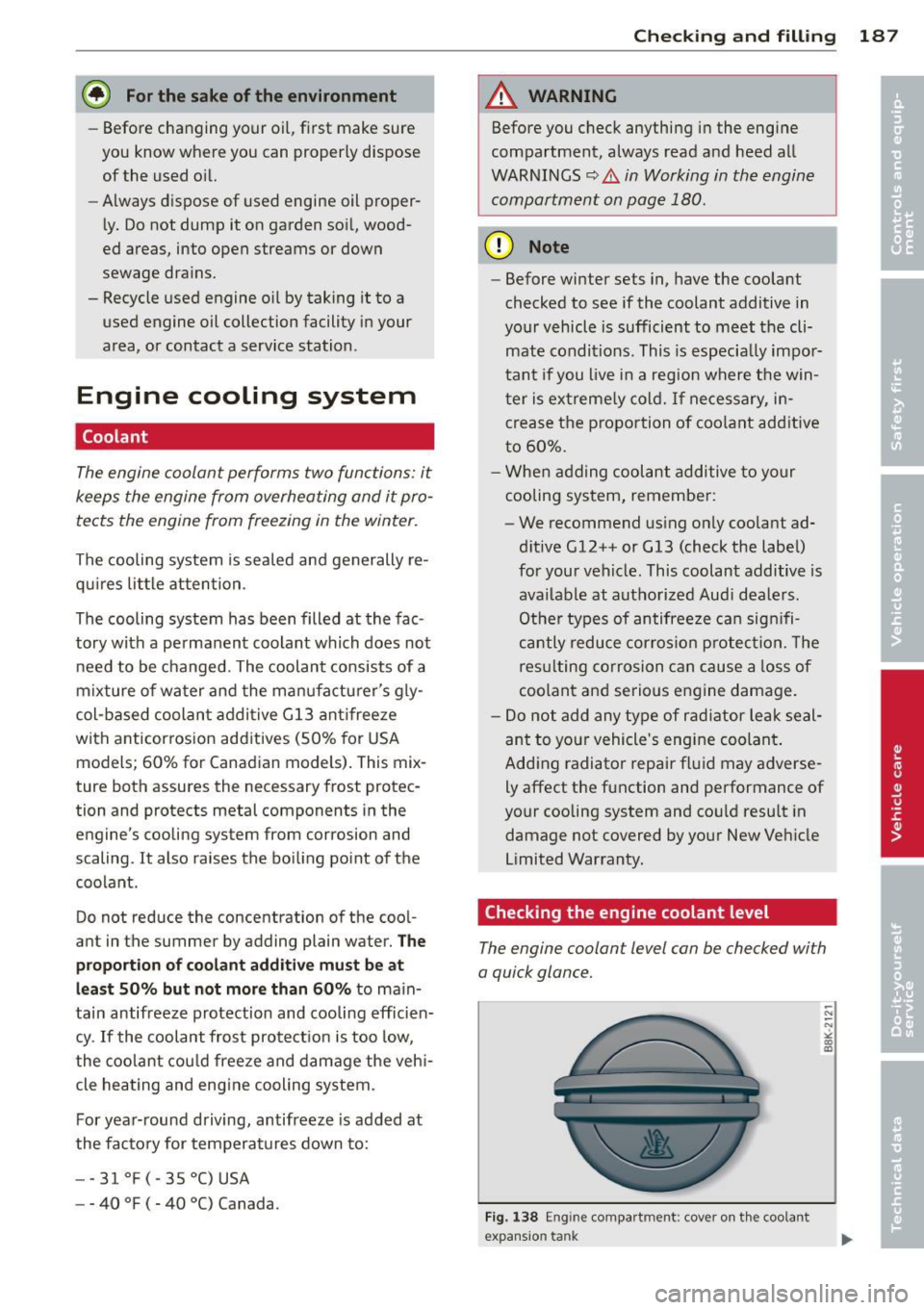
Checking the engine coolant level
The engine coolant level con be checked with
a quick glance.
Fig. 138 Eng ine compa rtment : cove r on t he coola nt
expansio n tank
Page 203 of 262
Tires and wheels 201
you have stored. The system does not recog
nize the load condition of your vehicle.
The effectiveness of the tire pressu re monitor
ing system w ill be impaired if you store nor
mal load pressures but then operate the vehi
cle at its maximum load¢,& .
See the illustration ¢
fig. 142 for the location
of the label on driver's side B-pillar (color of
the actual labe l and exact location on the ve
hicle will vary slig htly) .
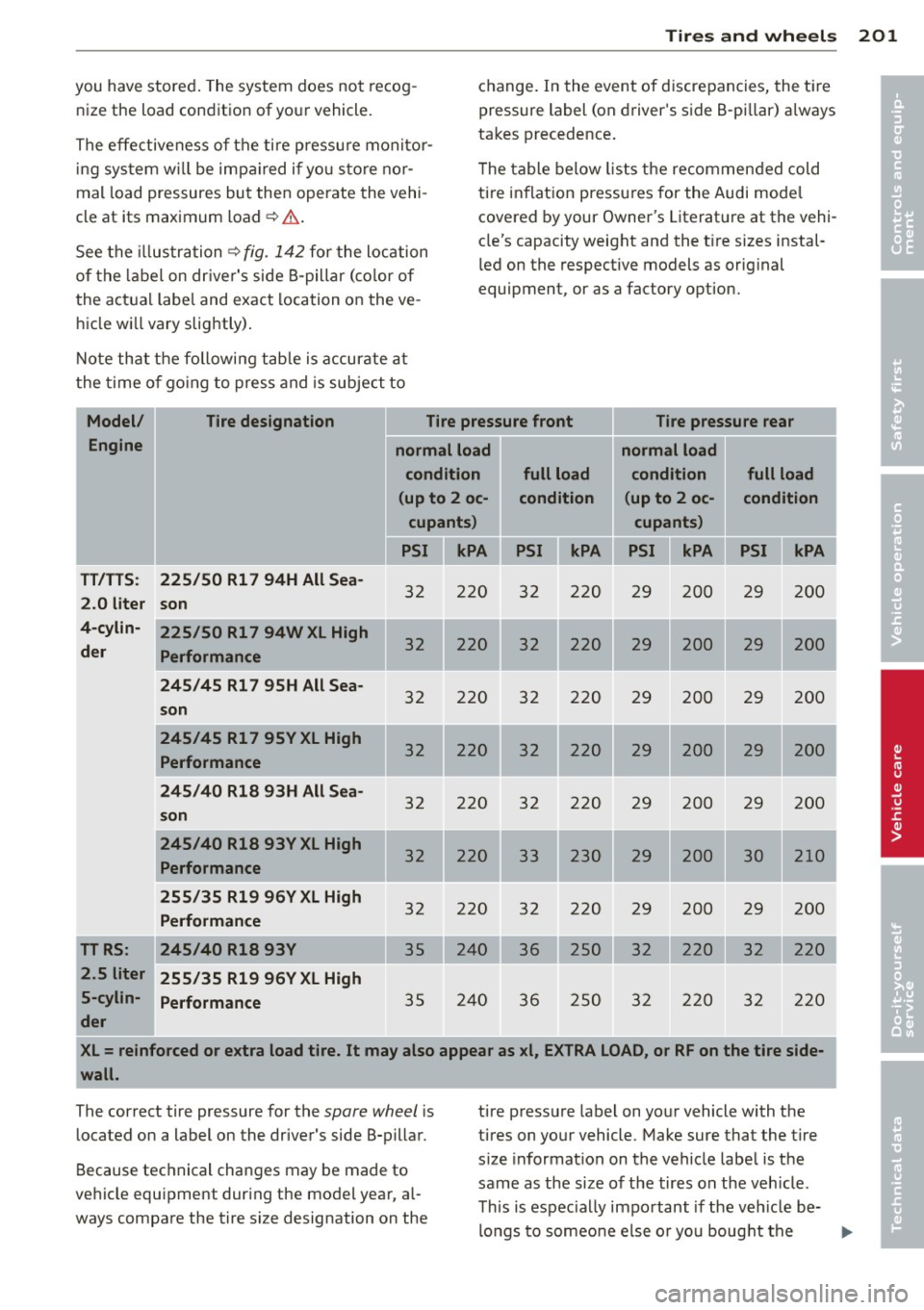
Note that the following table is accurate at
the time of go ing to press and is subject to change.
In the event of discrepancies, the tire
pressure label (on driver's side B-pi llar) always
takes precedence.
T he table below lists the recommended cold
ti re inflation pressures for the Audi mode l
covered by your Owner's Literature at the vehi
cle's capacity weight and the tir e sizes instal
l ed on the respective models as orig inal
equipment, or as a factory option.
I
Model/ U Tire designation Tire pressure front Tire pressure rear
Engine normal load normal load
condition full load condition full load
(upto 2 oc- condition (up to 2 oc-
condition
cupants) cupants)
PSI JI kPA PSI ]I kPA PSI II kPA PSI II kPA '.
TT/TIS: 225/50 Rl 7 94H All Sea-
32 220 32 220 29 200 29 200
2.0 liter son
4-cylin-
225/50 Rl 7 94W XL High
der Performance
32 220 32 220 29 200 29 200
245/45 R17 95H All Sea- 32 220 32 220 29 200 29 200
son
245/45 R17 95VXL High
32 220 32 220 29 200 29 200
Performance
245/40 R18
93H All Sea-
32 220 32 220 29 200 29 200 son
245/40 R18 93V XL High
32 220 33 230 29 200 30 210
Performance J
255/35 R19 96V XL High
32 220 32 220 29 200 29 200
Performance
TT RS:
245/40 R18 93V 220
2.5 liter
255/35 R19 96V XL High
5-cylin- Performance
35 240 36 250 32 220 32 220
der
XL= reinforced or extra load tire. It may also appear as xl, EXTRA LOAD, or RF on the tire side-
wall.
The correct tire pressure for the spore wheel i s
located on a label on the driver's side B-pillar.
Because technical changes may be made to
ve hicle equipment during the model year, a l
ways compare the tire size designation on the tire press
ure label on your vehicle with the
tires on your vehicle. Make sure that the tire
s ize info rmat ion on the vehicle label is the
same as the size of the tires on the veh icle .
This is especially important if the vehicle be-
long s to someone e lse o r you boug ht the ..,.
•
•
Page 210 of 262
208 Tires and wheels
handling when in good condition and properly
inflated ¢
.&..
We recommend that all work on tires and
wheels be perfo rmed by an authorized A udi
dealer. They are familiar with recommended
procedures and have the necessary special
tools and spare parts as well as the proper fa
cilities for disposing of the old tires .
Authorized Audi dealers have the necessary information about technica l requirements for
installing or changing tires and r ims.
Replacing tires and wheels
Tires should be rep laced at least in pairs and
not individually (for example both front tires
or both rear tires together).
Be sure to read and heed the information to
the tire pressure monitoring system
¢ page 214.
Always buy rep lacement radial tires that have
the same specifications as the tires approved
fo r your vehicle by Audi. Replacement tires
must always have the same load rating speci
fication as the original equipment or approved
optional tires listed in the table ¢
page 200.
Audi-approved specification tires are specially
matched to your vehicle and its load limits,
and can contribute to the important road hold
ing, driving characteristics, and safety of the
vehicle. The table
( q page 200) lists specifica
tions of the tires approved for the Audi mod
els covered by your Owner's Literature .
The tire pressure labe l located on driver's side
B-pillar
( q page 200, fig. 143) lists the speci
f ications of the orig inal equipment tires in
stalled on your veh icle at the time it was man
ufactured .
Federal law requires tire manufacturers to
place standardized information on the s ide
wall of all tires
¢ fig. 146. This information
identifies and describes the fundamental
characterist ics, the quality grade of the tire
and also provides a tire ident ificat ion number
fo r safety standard certificat ion and in case of
a recall.
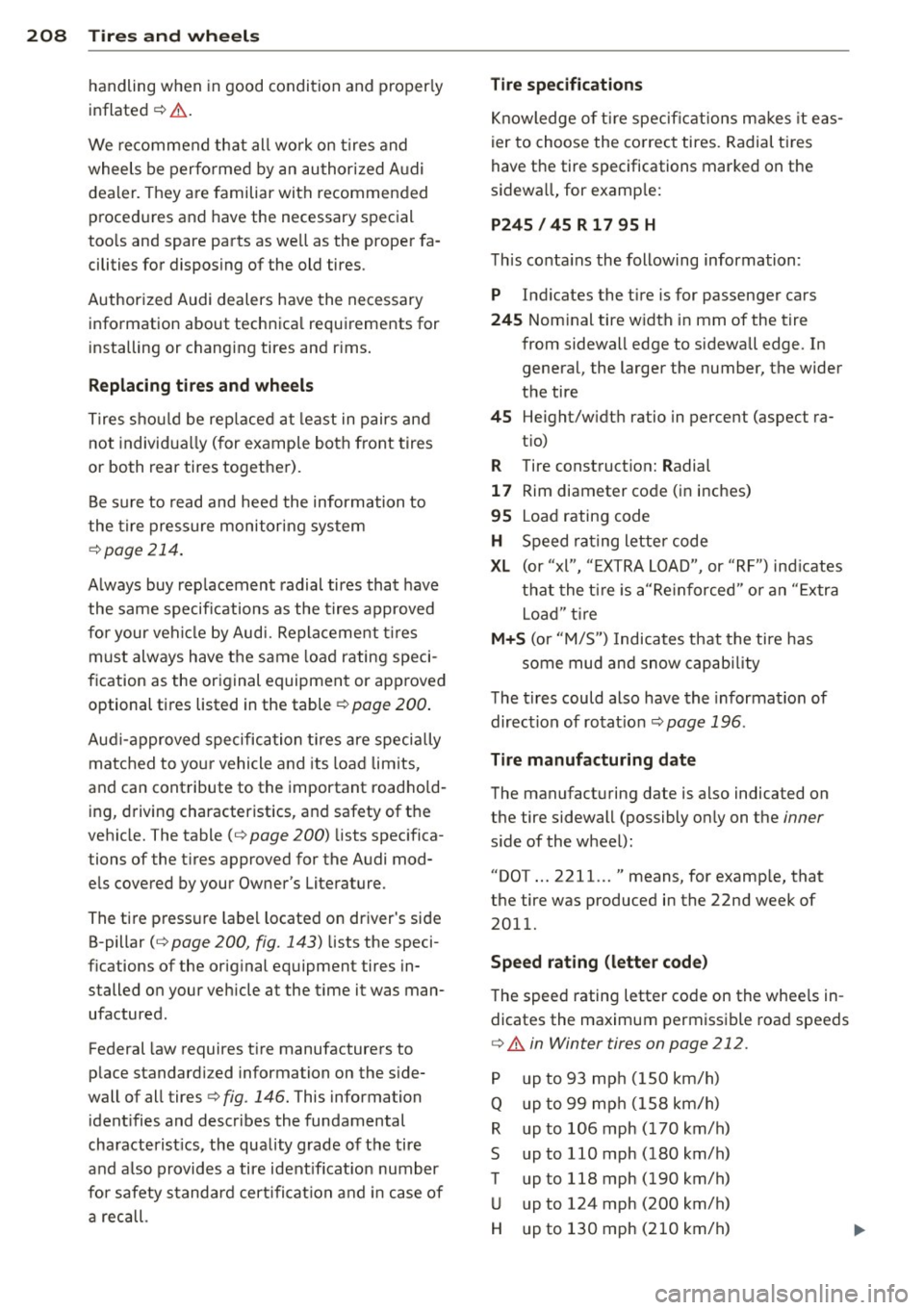
Tire specifications
Knowledge of tire specifications makes it eas
ier to choose the correct tires. Radial ti res
have the tire specifications marked on the
sidewa ll, for examp le:
P245/45R1795H
This conta ins the following information :
P Indicates the tire is for passenger cars
245 Nominal tire width in mm of the tire
from sidewall edge to sidewall edge. In
general, the larger the number, the wider
the tire
45 Height/w idt h ratio in percent (aspect ra-
t io)
R Tire construct ion: Radial
17 Rim diameter code (in inches)
95 Load rating code
H Speed rating letter code
XL (or "xl", "EXTRA LOAD", or "RF") indicates
t h at the t ire is a"Reinforced" or an "Extra
Load " tire
M+S (or "M/5") Indicates that the ti re has
some mud and snow capability
The tires could also have the information of
direction of rotat ion
q page 196.
Tire manufacturing date
The manufact uring date is also indicated on
the tire sidewall (possibly only on the
inner
side of the wheel):
"DOT ... 2211 ... "means, for examp le, that
the tire was produced in the 22nd week of
2011.
Speed rating (letter code)
The speed rating letter code on the whee ls in
dicates the maximum permissible road speeds
¢.&. in Winter tires on page 212 .
p up to 93 mph (150 km/h)
Q up to 99 mph (158 km/h)
R up to 106 mph ( 170 km/h)
s up to 110 mph (180 km/h)
T up to 118 mph (190 km/h)
u up to 124 mph (200 km/h)
H up
to 130 mph (210 km/h)
Page 212 of 262
210 Tire s and wheel s
Driving with different tires reduces vehi
cle handling and can lead to a loss of
co ntrol.
- If the spare tire is not the same as the
t ires that are mounted on the veh icle -
for example with winter tires - on ly use
the spare tire for a short period of time
and dr ive with extra ca re. Refit the nor
ma l road whee l as soon as safely possi
ble.
- Never drive faste r than the maximum
speed for which the tires o n your veh icle
are ra ted because ti res th at are driven
faster than their rated speed can fail
sudden ly .
- Over loading t ires c ause heat b uild- up,
sudden tire failure, including a blowout
and sudden deflation and loss of control.
- T emperature grades app ly to tires t hat
are properly inflated and not over o r un
derinflated.
- F or technical reasons it is not a lways
possible to use wheels from other
vehicles -in some cases not even w heels
from the same vehicle model.
- If you insta ll wheel trim discs on t he ve
hicle whee ls, make sure that the air f low
to the brakes is not blocked. Reduced air
flow to the brakes can them to overheat, increasing stopping distances and caus
ing a collision.
- Run flat t ires may on ly be used on
vehicles that were equ ipped w it h them
at the facto ry. The vehicle must have a
chassis des igned for run f lat t ires and a
fac to ry-installed t ire p ress ure moni to r
ing system that ind ic a tes a loss of tire
pressure. Incorrect use of run flat tires
can lead to vehicle damage or accidents .
Check with an a uth orized Audi dea ler or
t i re spec ialist to see i f your vehicle can be
equipped with run flat tires. If r un flat
t ires a re used, they must be installed on
all four wheels . M ixing tire types is not
permitted . (D Note
-For technical reasons, it is not generally
poss ible to use the w heel rims from oth
er ve hicles. T his can hold tr ue for wheels
of the same vehicle type.
- If the spare tire is diffe rent from the
tires that you have mounted on your ve
hicle (for example winter tires or wide
profi le tires), then use the spare tire for a
short period of time only and drive w ith
extra care. Replace the flat tire w it h the
ti re mat ching the othe rs on your vehicle
as soon as possi ble.
- N ever d rive without the valve stem cap.
T he v alves co ul d get damaged.
@ For the sake of the environment
Dis pose of o ld tires in accordance w ith the
l ocal requirements.
Uniform tire quality grading
- Tread wear
- Tra ction AA A B (
- Temperature ABC
Quality grades can be found where applicab le
o n the tire s ide wall between tread shoulder
and maximum section width
¢ page 207,
fig. 146.
For example: Tread wear 200 , Traction AA,
Temperature A.
All passenger car ti res must conform to Feder
al Safety Req uirements in add ition to these
grades .
Tread wear
The tread wear g rade is a comparative rating
based on the wear rate of the tire when tested
u nder contro lled conditions o n a specified
government test course.
F o r example, a tire gra ded 150 wo uld wear
one and one ha lf (11/2) times as well on the
government course as a ti re graded 100.
Page 213 of 262
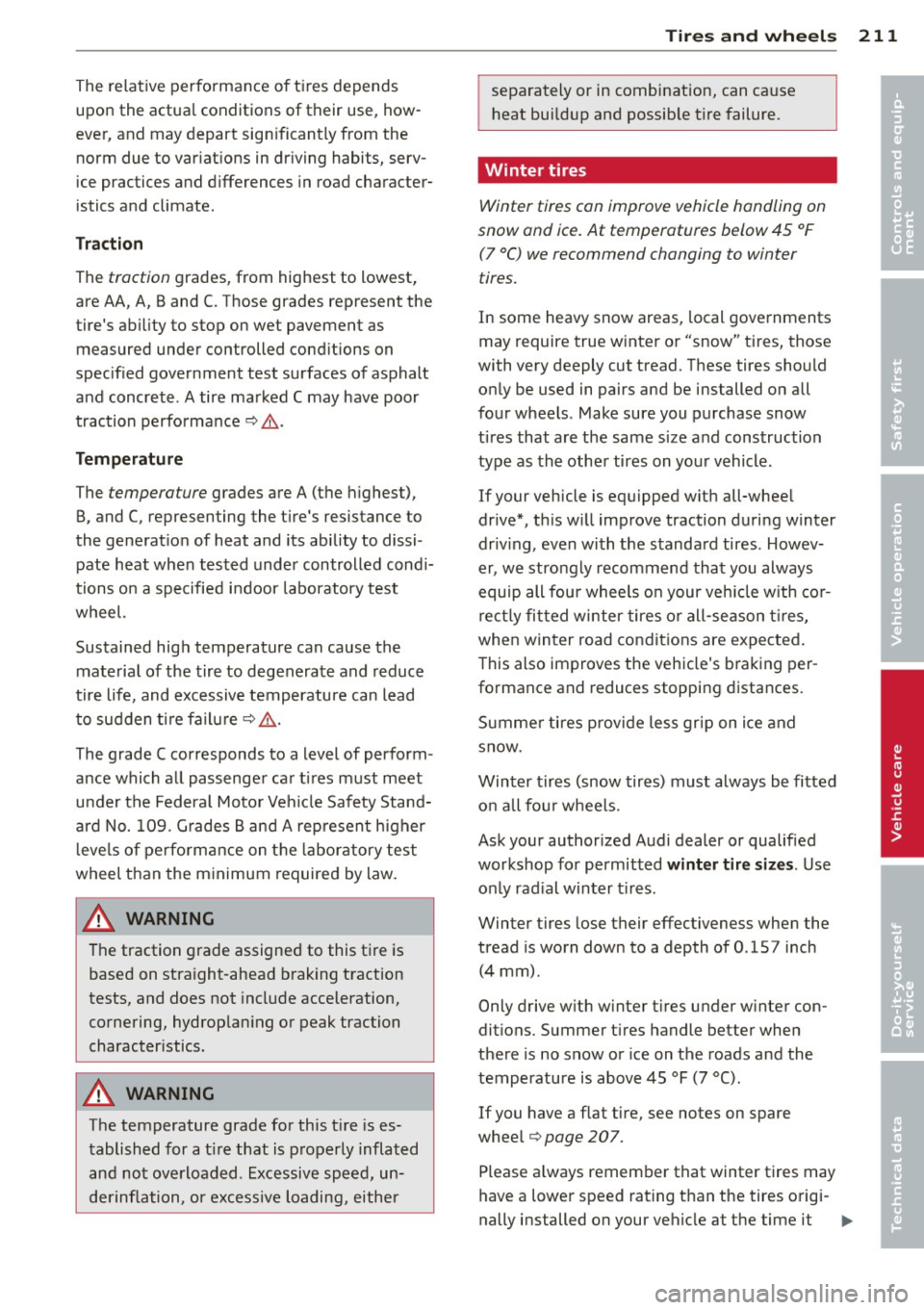
The relative perform a nee of ti res depends
upon the actua l conditions of their use, how
ever, and may depart sign ificantly from the
norm due to var iat ions in dr iving habits, serv
ice practices and differences in road character
istics and climate .
Trac tion
The traction grades, from highest to lowest,
are AA, A, Band
C. Those grades represent the
tire's ability to stop on wet pavement as measured under controlled cond itions on
specified government test surfaces of asphalt
and concrete . A tire marked C may have poor
traction performance ¢,&. .
Temp erature
The temperature grades are A (the h ighest),
B, and
C, representing the t ire's resistance to
the generat ion of heat and its ability to dissi
pate heat when tested under controlled condi
tions on a specified i ndoor laboratory test
wheel.
Sustained high temperature can cause the
material of the tire to degenerate and reduce
tire life, and excessive temperature can lead
to sudden ti re fa ilu re ¢ ,&. .
The grade
C corresponds to a level of perform
ance which all passenger car tires must meet
u nder the Federa l Moto r Veh icle Safety Stand
ard No.
109. G rades Band A represent h igher
l eve ls of perfo rmance on the laboratory tes t
wheel than the minimum required by law .
A WARNING
The traction grade assigned to this tire is
based on stra ight-ahead b raking traction
tests, and does not include acceleration,
cornering, hydroplan ing or peak traction
character istics.
A WARNING
The temperature grade for this t ire is es
tablished for a t ire that is p roperly inflated
and not overloaded. Excessive speed, un
derinflation, or excessive loading, either
-
Tire s an d wheel s 211
separately or in combinat ion, can ca use
heat bui ldup and possible tire failure.
Winter tires
Winter tires can improve vehicle handling on
snow and ice. At temperatures below 45 °F (7 °C) we recommend changing to winter
tires.
In some heavy snow areas, local governments
may require true winter or "snow" tires, those
with very deeply cut tread. These tires should
o nly be used in pairs and be installed on all
four wheels . Make sure you purchase snow
t ires that are the same size and construction
type as the other tires on your vehicle.
If your vehicle is equipped w ith all-whee l
drive*, th is w ill improve traction during winter
driv ing, even with the standa rd tires. Howev
er, we strongly recommend that you always
equip all fou r wheels o n your veh icle w ith cor
rect ly fitted winter tires o r all-season t ires,
when winter road condit ions are expe cted .
T his also improves the veh icle's braking per
formance and reduces stopping distances.
Summe r tires provide less grip on ice and
snow.
Winter tires (snow tires) must always be fitted
o n all fo ur wheels .
Ask your authorized Audi dealer or qualified
workshop for permitted
winter tire siz es. Use
only rad ial w inter t ires.
Winter tires lose their effectiveness when the
tread is worn down to a depth of
0 .157 inch
(4 mm) .
Only drive w ith w inter t ires under w inter con
dit ions. Summer t ires handle better when
there is no snow or ice on the roads and the
temperature is above 45 °F (7 °() .
If you have a flat tire, see notes on spare
whee l
¢page 207.
Please a lways remember that winter tires may
have a lower speed rating than the tires origi -
nally installed on your vehicle at the time it .,.
•
•
Page 218 of 262
216 Tires and wheels
Inflate the tire pressure to the proper
pressure as indicated on the vehicle's tire
pressure label¢
page 200. Driving on a
significantly under-inflated tire causes
the tire to overheat and can lead to tire
failure. Under-inflation also is likely to
impair the vehicle's handling and stop
ping ability .
- The driver is responsible for maintaining
the correct tire pressures. You must
check the tire pressures regularly.
- Under certain conditions (such as a spor
ty driving style, winter conditions or un
paved roads), the pressure monitor ind i
cator may be delayed.
- Ask your authorized Audi dealer if run
flat tires may be used on your vehicle .
Your vehicle registration becomes invalid
if you use these tires when not permit
ted. Damage to your veh icle or accidents
could also result.
- If you switch between standard and run
flat tires, an authorized Audi dealer or
qualified workshop must reprogram the
control module .
@ Tips
-The tire pressure monitoring system
stops working when there is an ESC/ABS
malfunction.
- Using snow chains may result in a system
malfunction .
- The tire pressure monitoring system on
your Audi was developed using t ires with
the "AO" or "RO" identification on the
tire sidewall ¢
page 207. We recom
mend using these tir es.
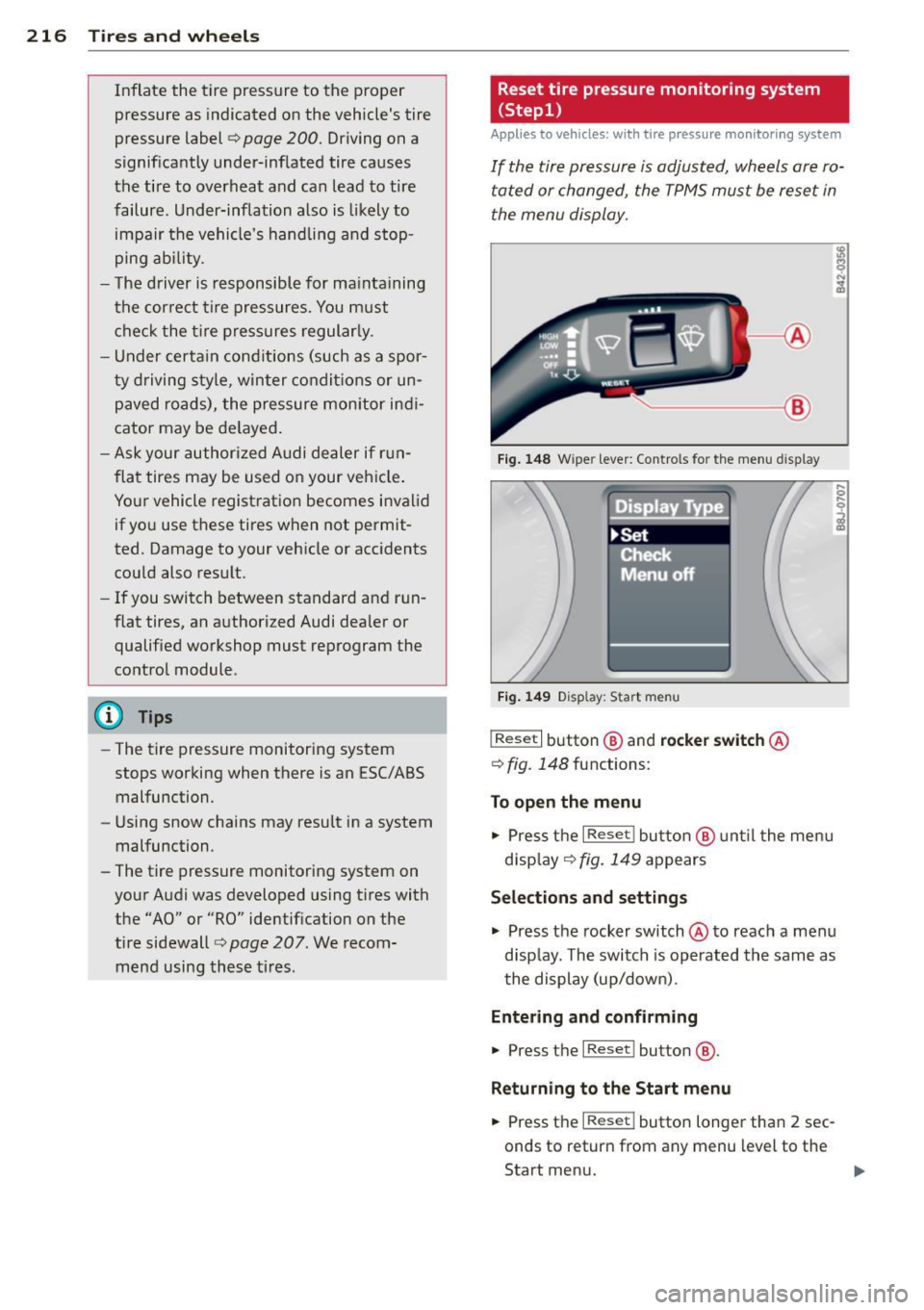
Reset tire pressure monitoring system
(Stepl)
Applies to veh icles: w ith tire pressure monitoring system
If the tire pressure is adjusted, wheels are ro
tated or changed, the TPMS must be reset in
the menu display.
----- ®
Fig. 148 Wipe r lever: Contro ls fo r the menu d isplay
Fig. 149 Disp lay: S ta rt m enu
I Rese t I button @ and rocker switch @
¢
fig. 148 functions:
To open the menu
" Press the I Reset ! button @ unt il the menu
disp lay
~fig. 149 appears
Selections and settings
" Press the rocker switch @ to reach a menu
disp lay. The switch is operated the same as
the display (up/down) .
Entering and confirming
" Press the I Reset I button @.
Returning to the Start menu
" Press the I Rese t I button longer than 2 sec
onds to return from any menu level to the
Start menu.