change wheel AUDI TT 2013 Owner´s Manual
[x] Cancel search | Manufacturer: AUDI, Model Year: 2013, Model line: TT, Model: AUDI TT 2013Pages: 262, PDF Size: 65.91 MB
Page 217 of 262
remain continuous ly illuminated . This se
quence will continue upon subsequent vehicle
start-ups as long as the ma lfunction ex ists.
When the malfunct ion indicator is ill uminat
ed, the system may not be able to detect or
signa l low tire pressure as intended. TPMS
malfunct ions may occur for a variety of rea
sons, including the installat ion of replace
ment or alternate tires or wheels on the veh i
cle that prevent the TPMS from funct io ni ng
properly. Always check the TPMS malfunct ion
tellta le afte r replacing one or more t ires or
wheels on your veh icle to ensure that the re
p lacement or a lternate tires and wheels allow
the TPMS to continue to function properly.
Tire pressure indicator appears
Applies to vehicles: with tire pressure monitoring system
The tire pressure indicator in the instrument
cluster informs you if the tire pressure is too
low or if there is a system malfunction.
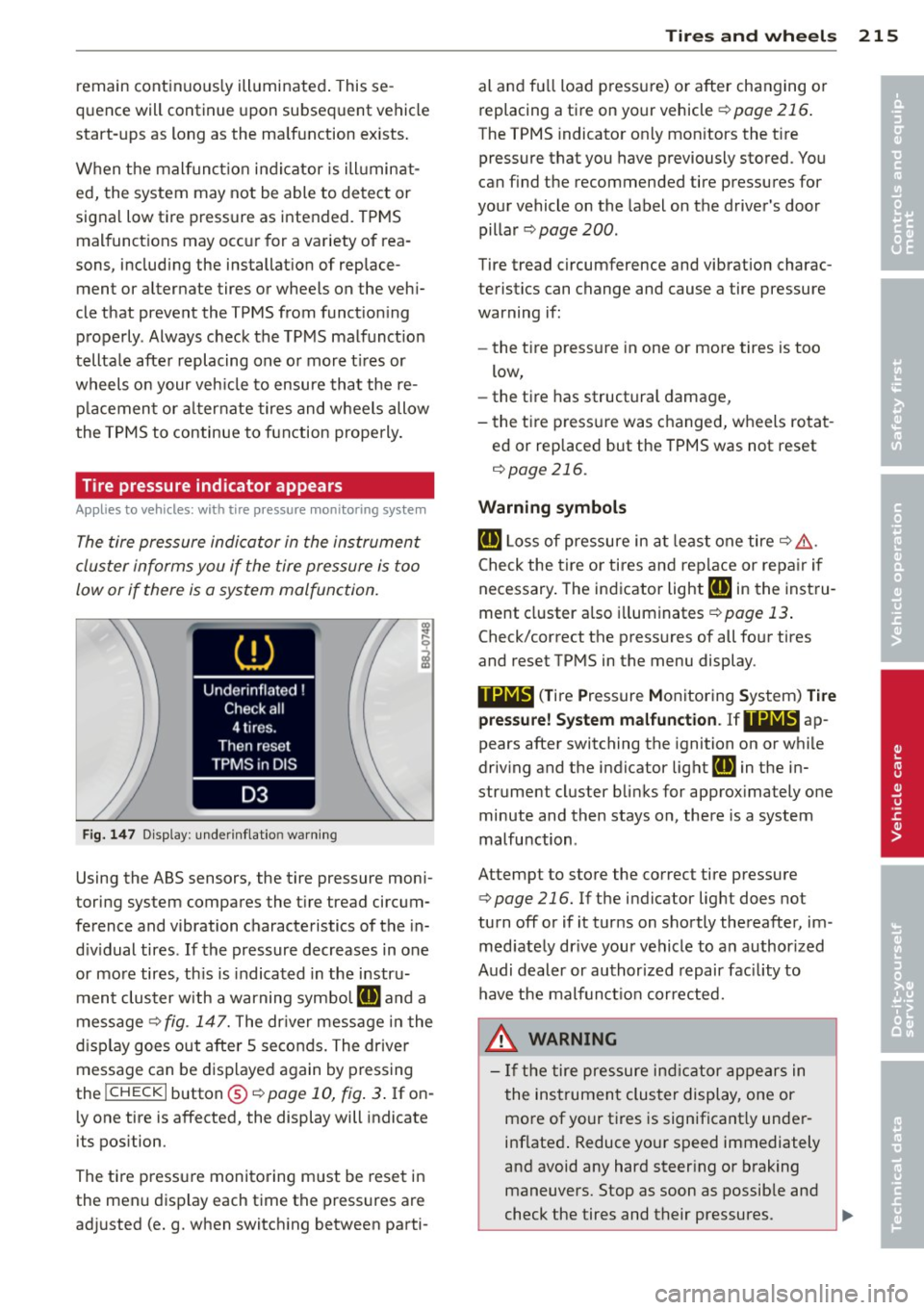
F ig. 1 47 Disp lay : under infla tion warn ing
Using the ABS sensors, the tire pressure moni
toring system compares the t ire tread circum
fe rence and vibration characteristics of the in
d iv idual tires . If the pressure decreases in one
or mo re tires, th is is indicated in the instru
ment clus ter with a warning symbol
RE and a
message
'* fig. 147. The dr iver message in the
d isp lay goes out after 5 seconds. The driver
message can be d isplayed again by pressing
the
! CHECK I button @¢ page 10, fig . 3 . If on
ly one tire is affected, the display will indicate
its pos ition.
The ti re pressure monito ring m ust be reset in
the menu display each time the pressures are
ad justed (e.g. when switching between parti-
Tire s an d wheel s 215
al and fu ll load pressure) or after changing o r
replacing a tire on your vehicle '*
page 216.
The TPMS indicator on ly mon itors the t ire
pressure that you have previously stored . You
can f ind the recommended tire pressures for
your vehicle on the label on the driver's door
pillar ¢
page 200.
Tire tread circumference and vibration charac
teristics can change and cause a tire pressure
warning if:
- the t ire press ure in one or more tires is too
low,
- the tire has structural damage,
- the t ire press ure was changed, wheels rotat -
ed or rep laced but the TPMS was not reset
¢ page 216.
Warning symbo ls
RE L oss of pressure in a t least one tire ¢ ,&..
Check the tire or tires and rep lace or repa ir if
necessary . The indicator light
RE in the inst ru
ment cluster a lso i lluminates
¢ page 13 .
Check/correct the press ures of all four tires
and reset TPMS in the menu display .
Iii;~, (T ire Pressure Monitoring System) Ti re
pre ssure! System malfun ction .
Ifllilff' ap
pears after switching the ignition on or whi le
driv ing and the indicator light
RE in the in
strument cluster blinks for approx imately one
minute and then stays on, there is a system
malfunction .
Attempt to store the correct tire pressure '*
page 216. If the indicator light does not
turn off or if it turns on shortly thereafter, im
med iate ly dr ive your vehicle to a n author ized
Audi dealer or author ized repair fac ility to
have the malfunct io n cor rected.
.8, WARNING
-
- If the tire pressure ind ic a tor ap pears in
the ins trumen t cluster display, one or
more of your tires is significant ly under
inflated . Reduce yo ur speed immediately
and avoid any hard steer ing or braking
maneuvers. Stop as soon as possible and
check the tires and their pressures.
~
•
•
Page 218 of 262
216 Tires and wheels
Inflate the tire pressure to the proper
pressure as indicated on the vehicle's tire
pressure label¢
page 200. Driving on a
significantly under-inflated tire causes
the tire to overheat and can lead to tire
failure. Under-inflation also is likely to
impair the vehicle's handling and stop
ping ability .
- The driver is responsible for maintaining
the correct tire pressures. You must
check the tire pressures regularly.
- Under certain conditions (such as a spor
ty driving style, winter conditions or un
paved roads), the pressure monitor ind i
cator may be delayed.
- Ask your authorized Audi dealer if run
flat tires may be used on your vehicle .
Your vehicle registration becomes invalid
if you use these tires when not permit
ted. Damage to your veh icle or accidents
could also result.
- If you switch between standard and run
flat tires, an authorized Audi dealer or
qualified workshop must reprogram the
control module .
@ Tips
-The tire pressure monitoring system
stops working when there is an ESC/ABS
malfunction.
- Using snow chains may result in a system
malfunction .
- The tire pressure monitoring system on
your Audi was developed using t ires with
the "AO" or "RO" identification on the
tire sidewall ¢
page 207. We recom
mend using these tir es.
Reset tire pressure monitoring system
(Stepl)
Applies to veh icles: w ith tire pressure monitoring system
If the tire pressure is adjusted, wheels are ro
tated or changed, the TPMS must be reset in
the menu display.
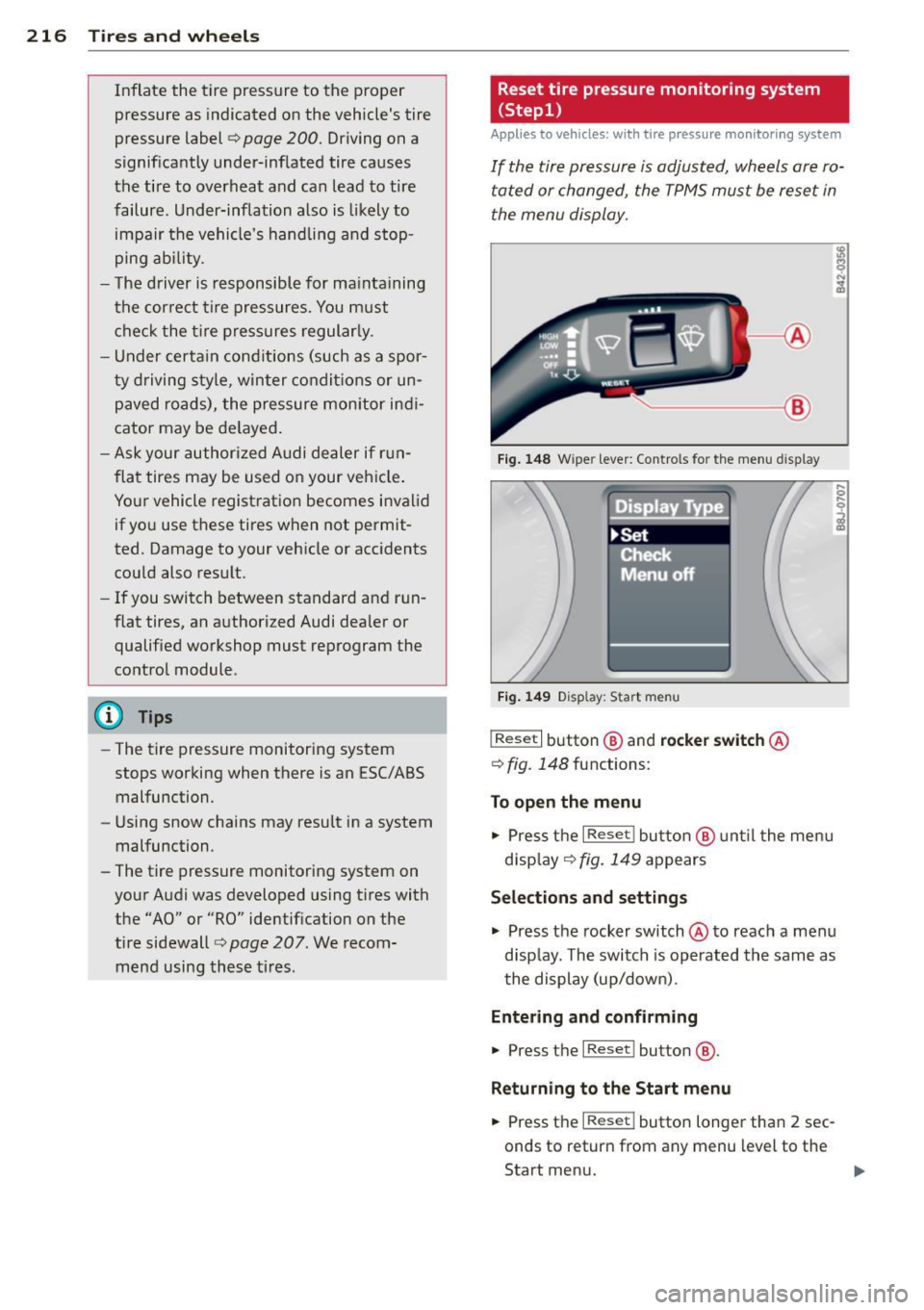
----- ®
Fig. 148 Wipe r lever: Contro ls fo r the menu d isplay
Fig. 149 Disp lay: S ta rt m enu
I Rese t I button @ and rocker switch @
¢
fig. 148 functions:
To open the menu
" Press the I Reset ! button @ unt il the menu
disp lay
~fig. 149 appears
Selections and settings
" Press the rocker switch @ to reach a menu
disp lay. The switch is operated the same as
the display (up/down) .
Entering and confirming
" Press the I Reset I button @.
Returning to the Start menu
" Press the I Rese t I button longer than 2 sec
onds to return from any menu level to the
Start menu.
Page 219 of 262
@ Tips
-Before resetting the TPMS, the current
pressures of
all four tires must corre
spond t o the specified va lues. Adjust the
tire pressu re and reset the pressure in
the tire pressure mon itor ing system ac
cord ing to the load yo u are carry ing
c::> page200.
- Do not store the tire pressure if there are
snow cha ins on the tire .
Reset tire pressure monitoring system
(Step2)
A pplies to vehicles: with t ire pressure monitoring syste m
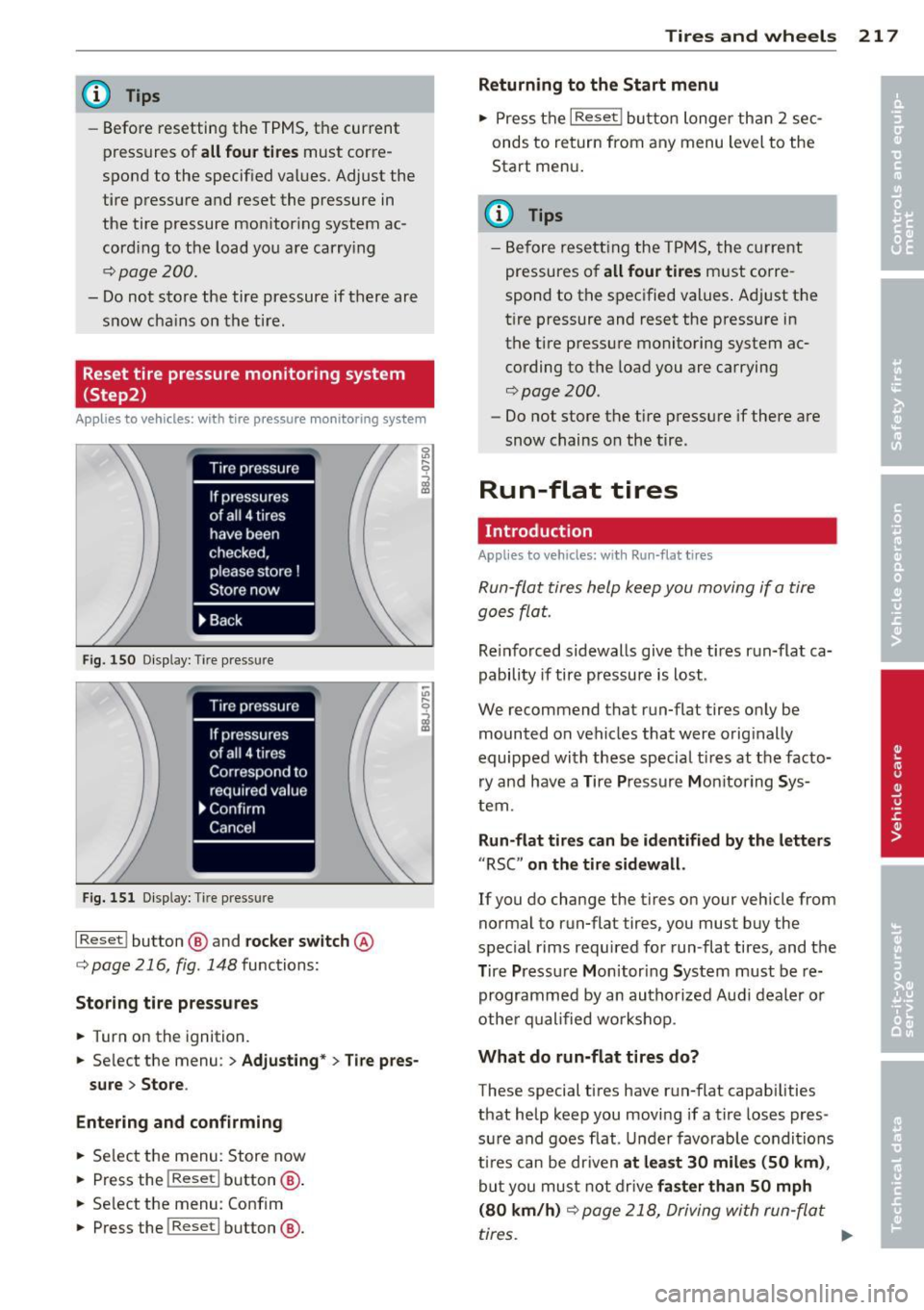
Fig. 150 D isplay: Tire pressure
Fig. 151 D isp lay: Tir e pressure
I Reset ! button @ and rocker sw itch @
c::> page 216, fig. 148 functions:
Storing tire pressure s
.,. Turn on the ignition.
.,. Se lect the menu :
> Adjusting* > Tire pres-
sure
> Store .
Entering and confirming
.,. Se lect the menu: Store now
.,. Press the
!Reset I button @.
.,. Se lect the menu: Confim
.,. Press the
!Reset I button @. Tires and wheels 21
7
Returning to the Start menu
.,. Press t he I Reset l butto n longer tha n 2 sec
onds to re turn from any menu level to the
Start men u.
(D Tips
-Before rese tt ing the TPMS, the c urrent
pressures o f
all four tires must corre
spond to t he spec ified values . Adj ust t he
t ir e pr essure and reset the pressure in
the tire pressu re monitoring system ac
co rding to the load you are ca rrying
c::> page 200.
- Do not store the tire pressure if there are
snow chains on the tire.
Run-flat tires
Introduction
Applies to vehicles: wit h Run-fla t tires
Run-flat tires help keep you moving if a tire
goes flat.
Re inforced sidewalls give the t ires r un-flat ca
pabili ty if tire pressure is lost .
We recommend that run-flat tires o nly be
mounted on vehicles that were orig inally
equipped with these special t ires at the facto
ry an d have a Tire Pressu re Monitoring Sys
tem .
Run-flat tir es can be identifi ed by th e letters
"RSC" on the tire sidewall.
If you do change the tires on your veh icle from
no rma l to run-flat tires, you must buy the
special rims required fo r run-flat tires, and the
T ire Pressu re M on itor ing System must be re
programmed by an authorized Aud i d ealer o r
othe r qualified wo rkshop .
What do run -flat tires do?
These special tir es have run-flat capab ilities
that help keep you moving if a tire loses pres
s ur e and goes flat. Under favorab le condi tions
t ir es can be dr iven
at least 30 miles (SO km) ,
but you mus t not drive fa ster than SO mph
( 80 km/h)
c::> page 218, Driving with run-fla t
tires .
Ill-
Page 220 of 262
218 Tires and wheels
When it is not possible to continue
driving , even with run-flat tires?
-If the E lectronic Stabilization Control (ESC)
is not working or keeps coming on.
- If the
Tire Pr essure Monitoring System does
not work .
- If the tire has been severely damaged, in a
crash , for example. The tread can separate
from a damaged tire as the wheel turns, and
hit parts of the vehicle, such as the fuel tank
filler neck , fuel lines or brake lines.
- Do not continue driving if severe vibration occurs or if the tire starts to smoke because
the tire is running hot.
- Do not continue driving if damage to the
tire, such as cracks in the sidewall, appears.
A WARNING
Improper use of run-flat tires can cause
vehicle damage that can lead to loss of ve
hicle control, a crash and serious personal
lnJUry.
- Run-flat tires can only be used with spe
cial rims.
- Run-flat tires must always be mon itored
with a properly programmed Tire Pre
ssu re Monit oring Sys tem.
- Always inspect a tire that has lost air to
make sure it is safe to drive with the tir e
in the run-flat mode.
- Never drive with run-flat tires that have
been damaged in a collision.
- Never drive with run-flat tires if heat
build-up causes the tire to give off
smoke.
- Never drive with run-flat tires if the vehi
cle shakes or vibrates severely.
- Never drive with a run-flat tire that de
velops sidewall cracks or other damage
wh ile in use .
-If you switch between standard and run
flat tires, an authorized Audi dealer or
qualified workshop must reprogram the
control module.
(D Note
Run-flat tires have specia l characteristics
and requirements, that are very different
from conventional tires. Run-flat tires re
quire special rims for run-flat use and can
not be used on conventional wheel rims.
(D Tips
- If you are not able to cont inue driv ing
w ith run-flat tires, please seek professio
nal assistance.
- Please contact your authorized Audi
dealer or Audi of America, Inc. if you
have questions about tires and rims .
Driving with run-flat tires
Applies to vehicles: wit h Run -flat tires
Handling characteristics change when tire
pressure is low .
Driving on tires with low tire pressure changes
the way a veh icle handles, particularly when
cornering and braking. The handling charac
teristics of run-flat tires do not seem to
change a lot even when driving on low pres
sure or in the run-flat mode . Nevertheless you
must still take spec ia l precautions when oper
at ing a vehicle on run-flat tires when tire pres
sure is low o r the tire(s) is flat:
.,. Th e Electronic Stabilization Control (ESC)
must be switched on.
.,. Never drive faster than SO mph (80 km/h)
q &_ .
.,. Plan ahead when driving and anticipate
what you will have to do considering traffic
and road conditions up ahead .
.,. Accelerate carefully.
.,. Avo id unnecessary and sudden steering and
brak ing maneuvers .
.,. Reduce your speed in plenty of time before
intersections, curves and other places where
you may have to react qu ickly.
Please see:
qpage 218, When it is not possi
ble to continue driving, even with run-flat
tires?
Page 221 of 262
Handling characteristics change when
driving with low air pressure or with flat
tires even with special run-flat tires
A low pressure or flat front tire affects vehicle
handling characteristics by pu lling the vehicle
slightly to the side where the tire is mounted
and reduces braking performance .
A low pressure or flat
rear tire also affects
driving character istics by pulling to the side
where the tire is mounted and also reduces
brak ing performance. The effect on vehicle
handling is most not iceable when driving
around curves.
A WARNING
Changed vehicle handling character istics
when driving in the run -f lat mode can
cause loss of vehicle contro l, a crash and
serious personal injury.
- Driving on special run-flat tires in the
run-f lat mode wi ll change vehicle han
dling characteristics during braking,
when cornering and under heavy acceler
ation.
- Never drive faster than the maximum
rated speed of 50 mph (80 km/h) when
dr iv ing in the run -flat mode.
- Always adjust vehicle speed to traffic,
road and weather cond itions and drive
slower than the max imum rated speed if
necessary weather and road conditions
are taken into account.
- Always obey speed limits and other traf
fic laws.
Q) Note
We always recommend driving w ith even
more care when using these special t ires in
the run-flat mode . Always avo id sudden
maneuvers.
Tires and wheels 219
Replacing run-flat tires and rims
App lies to veh icles : w it h Run -flat t ires
Your vehicle was especially designed to use
special run-flat tires.
You may use and combine only approved run
flat tires and special matching rims that have
been designed for run-flat tires . Mounting
special run-flat tires on standard wheels will not work and w ill not prov ide the advantages
fo the ru n-falt feature . Never use spec ial run
flat tires on standa rd wheel rims.
After dr iving with a tire i n the run-flat mode,
always have the vehicle and affected tire(s)
and rim(s) inspected by a n authorized Audi
dealer. Tires that have been driven in the run
f lat mode must be rep laced .
A WARNING
-Use of damaged run-flat tires and rims can
cause vehicle damage that can lead to loss
of vehicle control, a crash and serious per
sonal injury.
- Always have the vehicle and affected
tire(s) and r im(s) inspected by an author
ized Audi dealer after driving a tire in the
run-flat mode .
- Tires that have been dr iven in the run
flat mode must be replaced.
•
•
Page 226 of 262
224 What do I do now?
What should I be
aware of when
changing a tire?
General information
The following sections will provide you with
important information on how to change a
tire using the vehicle tool kit.
However, we recommend that you have a
qualified service center change the tire and
perform all work associated with changing it .
Wheels with cap-covered wheel bolts
Applies to vehicles: with cap-covered whee l bolts
The caps must be removed first from the
wheel bolts before the bolts can be un
screwed .
Fig. 157 Wheel change: removing the wheel bolt caps
Removing
• Push the plastic clip provided with the on
board tool kit down over the wheel bolt cap
u ntil it engages.
• Pull on the properly engaged
plastic clip to
extract the cap¢
fig. 157 .
Refitting
• Place the caps over the wheel bolts and
push them back in.
The caps are there to protect and keep the
wheel bolts clean.
Decorative wheel covers
Applies to vehicles: with decorative wheel covers
The decorative wheel covers must be removed
first to access the wheel bolts .
Fig. 158 Wheel change: removing the wheel cover
Removing
• Insert the hook prov ided with the on board
tool kit into the hole on the center hub
piece.
• Pull off the
decorative wheel cover
¢fig. 158.
Loosening and tightening the wheel
bolts
The wheel bolts must be loosened before rais
ing the vehicle.
Fig. 159 Wheel change: loosening the wheel bolts
Loosening
• Fit the wheel bolt wrench over the wheel
bolt and push it down as far as it will go.
• Close your grip around the
end of the
wrench handle for maximum torque and
turn the wheel bolts
counter-clockwise
about one single turn in the direction of ar -
row
r:!> fig. 159. .,..
Page 227 of 262
Tightening
• Fit the wh eel b olt wren ch over t he wheel
bolt and push it down as far as it will go .
• Close your gr ip aro und the
end of the
wrench handle for maximum torque and
turn each whee l bolt
cl ock wise until it sits
tight.
A WARNING
- Us ing force without control to speed the
wheel change up can cause the veh icle to
slip off the jack and cause serious pe r
sonal inj uries.
- Do not loosen the wheel bolts more than
one turn
before you ra ise the veh icle with
the jack. -Risk of inj ury!
@ Tips
- Never t ry and use the hexagonal socket
i n the handle of the screwdriver to loos
en o r tighten the wheel bolts .
- If a wheel bolt sits very t ight, you may
find it easie r to loosen by carefully push
i ng down on the end of the whee l bolt
wre nch w ith
one foot only. As you do,
ho ld on to the ca r to keep yourse lf stable
and ta ke care not to slip .
Raising the vehicle
The vehicle must be li~ed with the jack first
before the wheel can be removed .
Fig. 160 Sill pa nels : m arkin gs
What do I d o now ? 225
Fig. 1 61 Sill : pos itio ning the veh icle jac k
• Apply the parkin g brake firmly to prevent
your veh icle from rolling unintentionally.
• Shift into
1st gear on vehicles with manual
transm iss ion, or move the
se lecto r l ever to
the P p ositio n
on vehicles with automatic
transm ission .
• Pos it ion the jack be low the door sill under
the
mounting point that is closest to the
wheel to be changed
r=> fig. 160.
.. Extend the jack under the lifting point on
the door sill until its arm is posit ioned di
rectly under the l ifting point ¢&_ .
• Align the jack so that its arm@¢
fig. 161
engages in the designated lifting point in
the door s ill and the movable base ® lies
flat on the ground. The base @ must be
ver
tical
under the lifting point @.
• Wind the jack up further until the flat t ire
comes off the ground
r=> &_ .
Position the vehicle jack
onl y under the desig
nated lifting points on the si ll
r=> fig. 160.
There is exactly one locat io n for each wheel.
The jack must not be positioned at any other
location
r=> ,&. r=>(D .
An un stab le su rfa ce under the jack can cause
the veh icle to slip off the jack . Always provide
a firm base for the jack on the ground . If nec
essary place a sturdy board or similar support
under the jack . On
hard , slipper y surf aces
(such as tiles) use a rubbe r mat or similar to
prevent the jack from slipping
c:::> .&. .
A WARNING
-You or your passengers co uld be in ju red
while changing a wheel if you do no t fo l
low safety precautions :
Page 228 of 262
226 What do I do now ?
-Position the vehicle jack only at the
designated lifting points and align the
jack. Otherwise, the vehicle jack could slip and cause an injury if it does not
have sufficient ho ld on the vehicle.
- A soft or unstab le surface under the
jack may cause the vehicle to slip off the jack. Always prov ide a firm base for
the jack on the ground.
If necessary,
use a sturdy board un der the ja ck .
- On hard, slippery surfac e (such as tiles)
use a rubber mat o r similar to prevent
the j ack fr om s lipp ing.
- T o he lp p revent injury to yoursel f and
yo ur passenge rs:
- Do not raise the vehicle unti l yo u are
sure the jack is sec urely engaged.
- Passenge rs must not rema in in the ve
h icle when it is jac ked up .
- Make sure that passen gers wait in a
safe p lace away from the vehicle and
well away from the roadway and traffic.
- Make sure jack position is correct, ad
just as necessary and then contin ue to
ra ise the jack.
0 Note
A floor jack or the pads on the hoist arms
m ust
not be positioned at the points
shown
-arrows-.
Taking the wheel off
Follow these instructions step -by -step for
changing the wheel.
Fi g. 1 62 W heel change : us ing the screwd river ha ndle
(w ith the b lade removed) to turn the bolts
Fig. 163 Whee l cha nge : alig nme nt pin in side the top
hole
After you have loosened all wheel bo lts and
raised the vehicle off the ground, pe rform t he
fo llowing steps to remove and replace the
wheel:
Removing the wheel
.,. Use the
hexagonal s ocket in the screwdri v·
er handle
to completely tur n out the top
most whee l bolt and set it aside on a
clean
surface c;, fig. 162.
.,. Screw the threaded end of the alignment
pin from t he too l kit hand-t ight into t he
now vacant bolt hole
c:> fig. 163 .
.,. Then completely unscrew the other wheel
bolts as desc ribed above.
.,. Take off the whee l leav ing the a lignment
p in in the bo lt ho le
c;, (D .
Putting on the wheel
.,. Lift the spa re wheel and carefully s lide it
over the alignmen t pin to g uide it in place
c;, (D .
.,. Use the he xagonal socke t in the screwdr iver
h and le to screw in and tig hten all whee l
bolts
slightly .
.,. Unscrew the alignment pin and insert and
tighten the remaining whee l bolt slightly
like the rest .
.,. Turn the jack handle co unte r-clockwise to
lower the vehicle until the jack is fully re
leased .
.,. Use the wheel bo lt wrench to tighten all
wheel bo lts firm ly
c;, page 224 . Tighten
t hem
cro sswise, from o ne bol t to the ( ap
proxima tely) opposi te one, to keep the
wheel cente red.
Page 229 of 262
(D Note
When removing or installing the wheel,
the rim could hit the bra ke rotor and dam
age the rotor . Wor k carefully and have a
second person help you.
N ever use the hexa gonal s ocket in the ha n
d le of the screwdriver to loosen or t ighten
the wheel bolts.
- Pull the reversib le blade from the screw
drive r before yo u use the hexagonal
socket in t he handle to t urn the whee l
bo lts .
- When mounting tires with
unid irectional
tread design
make s ure the tread pat
te rn is poi nte d the r ight way
¢pag e 227.
-The wheel bolts should be clea n and easy
to tu rn . Ch eck for dirt and corros ion on
the mat ing su rfaces of both the whee l
a nd th e hu b. Remove a ll dir t fro m these
s ur fa ces before remo unting the wheel.
Notes on wheel change
Pl ease rea d the information ¢ page 207, New
tires and replacing tires and wheels,
i f you are
going to use a spare t ire which is different
from the tires on your ve hicle.
Afte r you change a tire:
- Check the tire pressure on the spare imme
diately after mounting .
- Have the wheel bolt tightening torque
che cked with a torque wrench as soon as
possible by your authorized Audi dealer or
a qualified service station.
- With steel and alloy wheel rims, the wheel
bolts are correctly tightened at a torque of
90 ft lb (120 Nm) .
- If you notice while changing a tire that the
wheel bolt s are co rroded and diffi cult to
turn , then they should be replaced before
you check the t ightening torque.
What do I do now? 227
- Replace the flat tire with a new one and
have it installed on your vehicle as soon as
possible. Remount the wheel cover .
Until then , drive with extra care and at re
duced speeds.
A WARNING
-
- If you are go ing to e quip your ve hicl e
wit h tires o r rims which differ from those
which were factory installed, t hen be
sure to read the information¢
page 207,
New tires and replacing tires and
wheels .
-Always sto re the tools secu rely in lug
gage compartment. Othe rwise, in a n ac
cident o r su dd en maneuv er they cou ld fly
forwa rd, causi ng injury to passe ngers in
the vehicle.
Tires with unidirectional tread design
Tires with unidirectional tr ead design must be
mounted with their tread pattern pointed the
right dire ction.
A u nidirectional tire can be identified by ar
rows on the sidewall,
which point in the direc
tion of t he rota tion. Yo u m ust follow the
s p ecifie d direction of rot ation. This i s nece ssa
r y in order fo r these tires to develop t heir op
timum character istics regard ing grip, road
no ise, wear, and hydrop la ning.
•
•