oil level AUDI TT 2013 Owner´s Manual
[x] Cancel search | Manufacturer: AUDI, Model Year: 2013, Model line: TT, Model: AUDI TT 2013Pages: 262, PDF Size: 65.91 MB
Page 187 of 262
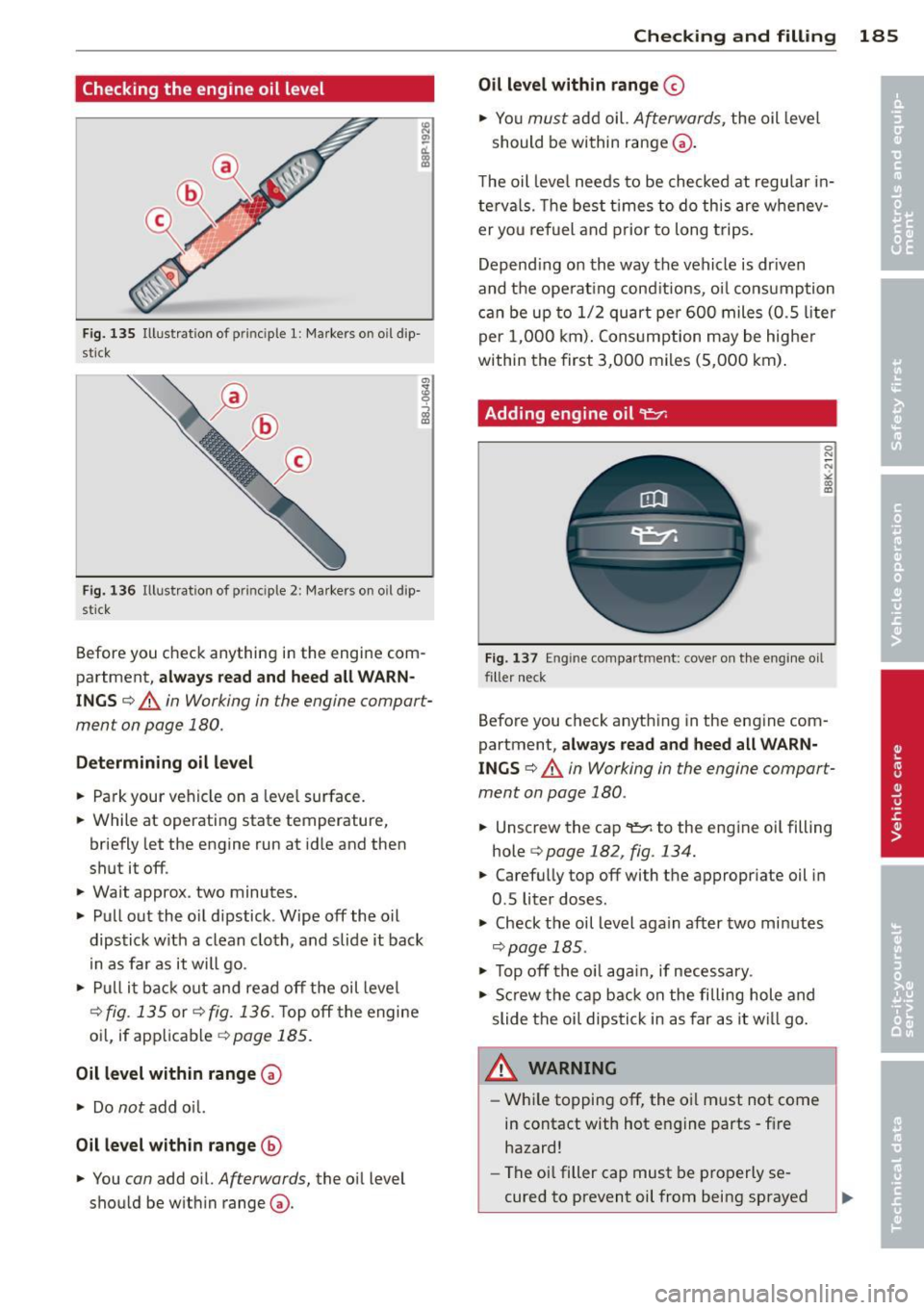
Checking the engine oil level
Fig . 135 Illust rat ion of principle 1: Ma rkers on o il dip
st ick
F ig . 13 6 Illust rat io n of principle 2: Markers o n oil dip·
st ic k
Before you check anything in the engi ne com
partment,
always read and heed all WARN
INGS ¢ A in Working in the engine compart
ment on page 180.
Determining oil level
• Park your vehicle on a leve l surface.
• While at operating state temperature,
briefly let the engine run at idle and then
shut it off.
• Wait approx . two minutes.
• Pull out the o il dipstick . Wipe off the oil
dipstick w ith a clean cloth, and slide it back
i n as far as it will go .
• Pull it back o ut and read off the oil level
¢ fig. 135 or ¢ fig. 136 . Top off the engine
oi l, if app licable ¢
page 185.
Oil level within range~
• Do not add o il.
Oil level with in range @
• You can add o il. Afterwards, the o il level
shou ld be w ith in range @.
Checking and filling 185
Oil level within range 0
• Yo u must add oil. Afterwards, the oil leve l
should be wi thin range @.
T he oil leve l needs to be checked at regu lar in
terva ls. The best t imes to do th is are w henev
er yo u ref uel and prior to long t rips.
Depend ing on the way the vehicle is dr iven
and the ope rat ing cond it ions, oi l consumption
can be up to 1/ 2 quart per 6 00 miles (0. 5 lite r
per 1,000 km) . Cons umption m ay be highe r
within the first 3,000 miles (5,000 km) .
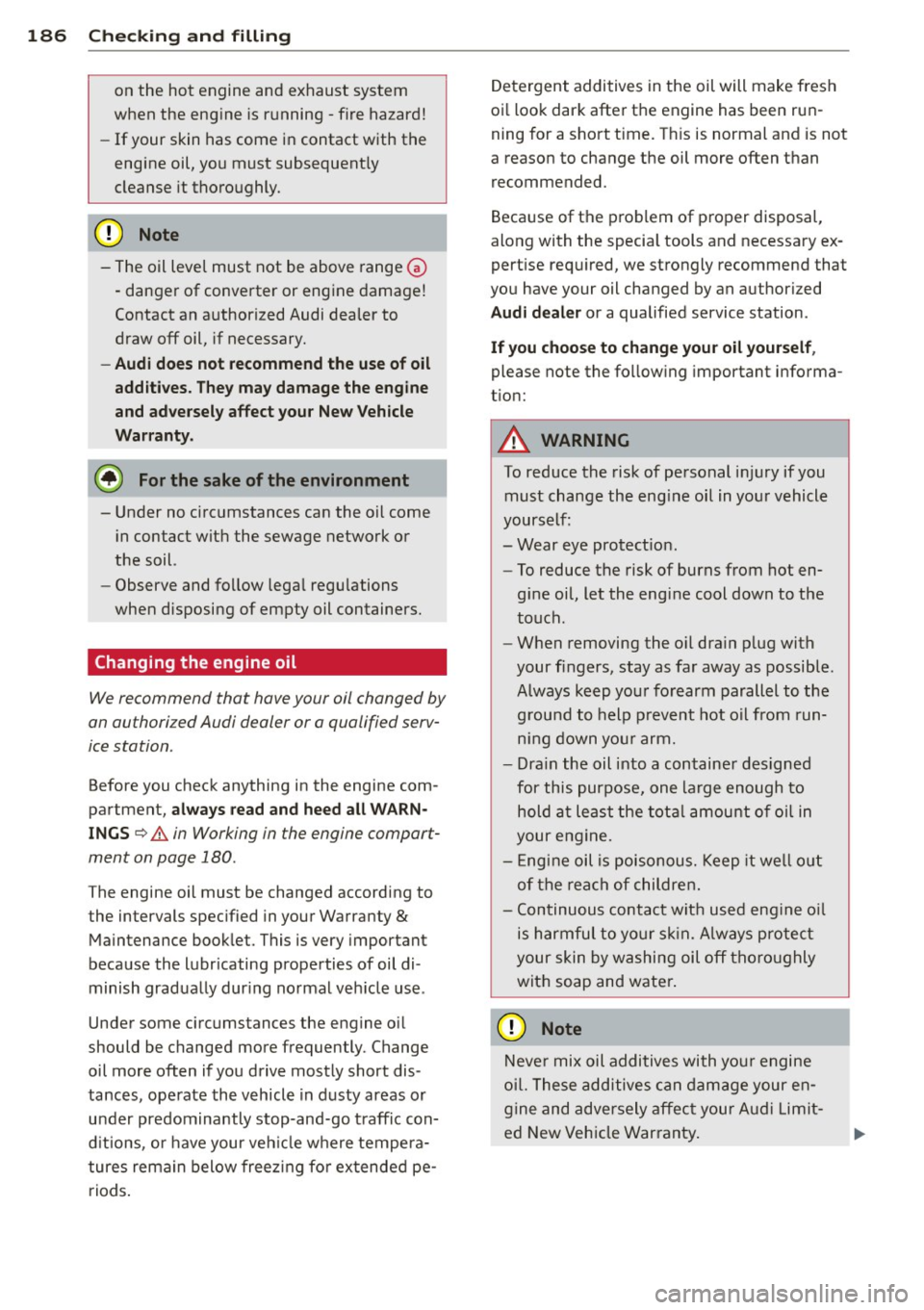
Adding engine oil ci::,,.
0 N ;.
>< (D m
Fig. 137 Engine compa rtment: cover on the engi ne oil
filler neck
Before you check anyth ing in the engine com
partment,
alw ays read and heed all WARN
INGS ¢ A in Working in the engine compart
ment on page 180 .
• Unsc rew the cap 'l::r. to the engine oi l filling
hole
¢ page 182, fig. 134.
• Carefully top off with the appropriate oil in
0.5 liter doses.
• Check the oil level aga in after two minutes
¢ page 185.
• Top off the oil aga in, if necessary .
• Scr ew the c ap back on the filling hole and
slide the oi l dipsti ck in as far as it w ill go.
A WARNING ,...__
-Wh ile topping off, the o il m ust not come
in contact with hot e ngine parts -fir e
hazard!
- The oi l filler cap must be pro perly se
cured to prevent oil from being sprayed
Page 188 of 262
186 Checking and filling
on the hot engine and exhaust system
when the engine is running -fire hazard!
- If your skin has come in contact with the
engine oil, you must subsequently
cleanse it thoroughly .
(D Note
- The oil level must not be above range 0
-danger of converter or engine damage!
Contact an authorized Audi dealer to
draw off oil, if necessary.
- Audi does not recommend the use of oil
additives. They may damage the engine
and adversely affect your New Vehicle
Warranty.
@ For the sake of the environment
- Under no circumstances can the oil come
in contact with the sewage network or
the soil.
- Observe and follow legal regulations
when disposing of empty oil containers.
Changing the engine oil
We recommend that have your oil changed by
an authori zed Audi dealer or a qualified serv
ice station .
Before you check anything in the engine com
partment,
always read and heed all WARN·
INGS
¢ & in Working in the engine compart
ment on page 180 .
The engine oil must be changed according to
the intervals specified in your Warranty &
Maintenance booklet. This is very important
because the lubricating properties of oil di
minish gradually during normal vehicle use .
Under some circumstances the engine oil
should be changed more frequently . Change
oil more often if you drive mostly short dis
tances , operate the vehicle in dusty areas or
under predominantly stop-and-go traffic con
ditions, or have your vehicle where tempera
tures remain below freezing for extended pe riods. Detergent
additives in the oil will make fresh
oil look dark after the engine has been run
ning for a short time. This is normal and is not
a reason to change the oil more often than
recommended.
Because of the problem of proper disposal,
along with the special tools and necessary ex
pertise required, we strongly recommend that
you have your oil changed by an authorized
Audi dealer or a qualified service station .
If you choose to change your oil yourself,
please note the following important informa
tion:
A WARNING
=
To reduce the risk of personal injury if you
must change the engine oil in your vehicle
yourself:
- Wear eye protection.
- To reduce the risk of burns from hot en-
gine oil, let the engine cool down to the
touch.
- When removing the oil drain plug with
your fingers, stay as far away as possible. Always keep your forearm parallel to the
ground to help prevent hot oil from run
ning down your arm.
- Drain the oil into a container designed
for this purpose, one large enough to
hold at least the total amount of oil in
your engine.
- Engine oil is poisonous. Keep it well out
of the reach of children.
- Continuous contact with used engine oil
is harmful to your skin. Always protect
your skin by washing oil off thoroughly
with soap and water.
(D Note
Never mix oil additives with your engine
oil. These additives can damage your en
gine and adversely affect your Audi Limit
ed New Vehicle Warranty.
Page 189 of 262
@ For the sake of the environment
- Before changing your oil, first make sure
you know where you can properly dispose of the used oil.
- Always dispose of used engine oil proper
l y. Do not dump it on garden soi l, wood
ed areas, into open streams or down
sewage drains.
- Recycle used engine oil by taking it to a
used engine oil collection facility in your
area, or contact a service station.
Engine cooling system
Coolant
The engine coolant performs two functions: it
keeps the engine from overheating and it pro
tects the engine from freezing in the winter.
The cooling system is sea led and generally re
qu ires little at tention.
The cooling system has been filled at the fac
tory with a permanent coolant which does not n eed to be changed. The coolant consists of a
mixture of wa ter and the man ufacturer's g ly
col-based coolan t addi tive Gl3 ant ifree ze
with ant icorrosion add itives (50% for USA
models; 60% for Canadian models) . This mix
ture both assures the necessary frost protec
tion and protects metal components in the
engine's cooling system from corrosion and
scaling. It also raises the boiling po int of the
coolant.
Do not reduce the concentration of the coo l
ant in the summer by adding plain water.
The
proportion of coolant add itive must be at
lea st 50°/4 but not more than 60°/4
to ma in
tain antifreeze protection and cooling efficien cy. If the coolant frost pro tect io n is too low,
the coolant cou ld freeze and dam age the veh i
cle heating and eng ine cooling system.
For year-round driving, antifreeze is added at
the facto ry for temperatures down to:
- -31°F( -35°C)USA
- -40 °F ( -40 °C) Canada.
Checkin g and fillin g 187
A WARNING
Before you c heck anything in the engine
compartment, always read and heed all
W ARNI NGS~ &.
in Working in the engine
comportment on page 180.
(D Note
- Before winter sets in, have the coolant
checked to see if the coolant additive in
your v ehicle is sufficient to meet the cli
mate conditions. This is especia lly impo r
t an t if you live in a region where t he win
t er is ex treme ly cold. If ne cessary, in
cr ease t he p ro portion of coo lant add itive
to 60%.
- Whe n adding cool ant additive to yo ur
c ooling sys tem, remember:
- We recommend us ing on ly coolant ad
d itive Gl2++ or Gl3 (check the labe l)
for your veh icle. This coolant additive is
ava ilable at autho rized Aud i dea le rs.
Othe r types of antifree ze can sig nifi
cantly reduce cor ros io n protec tion. The
res ulting co rrosion can cause a loss of
coolant an d serio us en gine damage.
- Do not add any type of rad iator le ak seal
ant to yo ur vehicle 's eng ine coolant .
Adding radiator repair flu id may adverse
ly affect the function and performance of
your cooling system and co uld resu lt in
damage not covered by you r New Ve hicle
Limited War ranty.
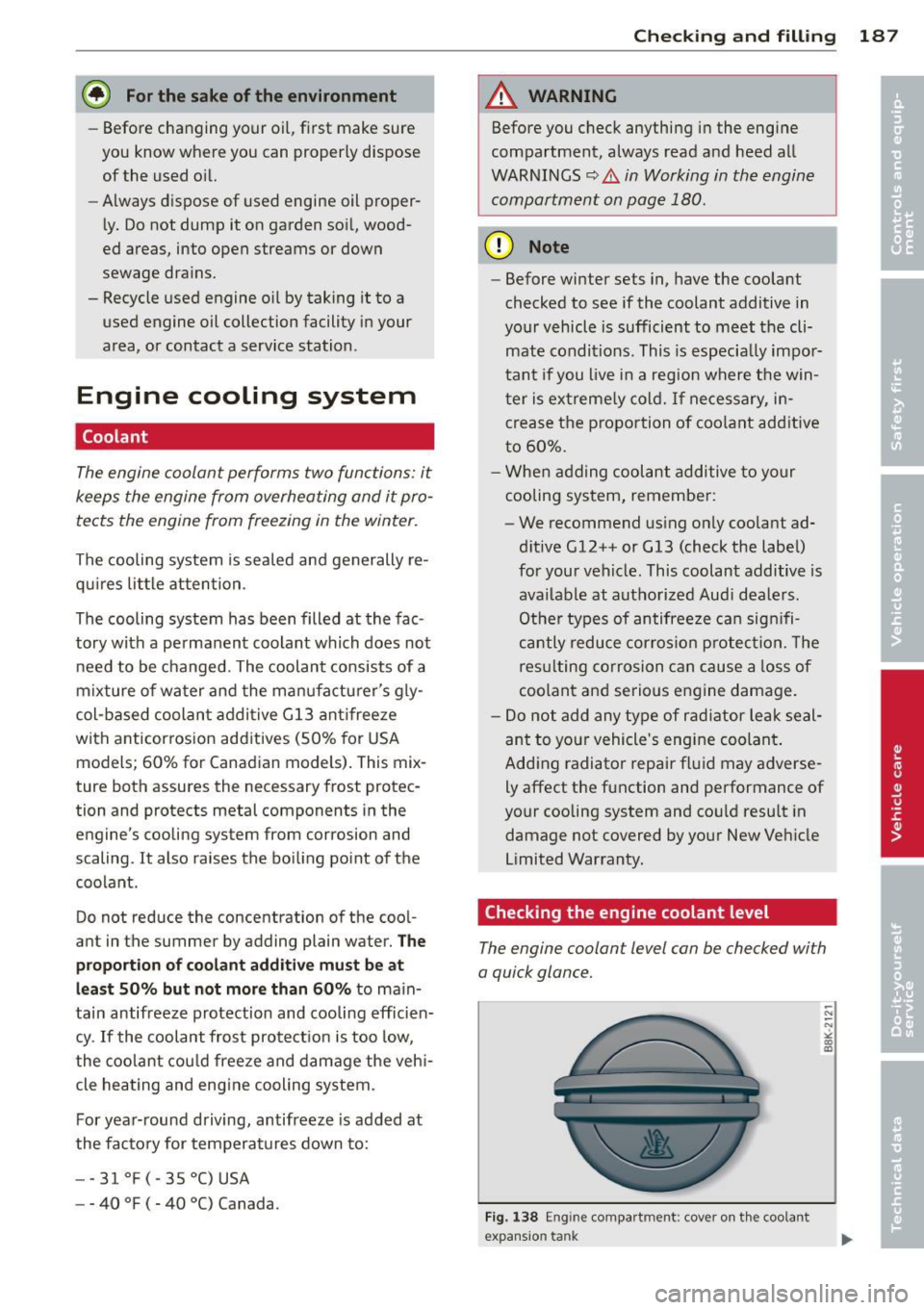
Checking the engine coolant level
The engine coolant level con be checked with
a quick glance.
Fig. 138 Eng ine compa rtment : cove r on t he coola nt
expansio n tank
Page 190 of 262
188 Checking and filling
Before you check anything in the engine com
partment,
alwa ys r ea d and heed all WARN
INGS ¢ A in Working in the engine compart
ment on page 180.
• Park your vehicle on a level surface.
• Switch the ignition off.
• Read the coolant level at the coolant expan
s ion tank ¢
page 182, fig . 134. With a cold
engine, it must be above the "min" mark .
With a hot engine, it ca n be a little above
the indicated range .
The location of the coolant expans ion tank
can be seen in the engine compartment illus
tration
¢ page 182.
To obtain an accurate read ing, the engine
must be switched off.
The expansion tank in yo ur vehicle is equipped
with an e lectric coolant level sensor .
When the coo lant level is too low, the warning
light in the A uto- Check System ¢
page 16 will
illuminate until yo u add coo lant and the level
has been restored to normal. Even though
there is an electric coo lant level sensor, we
still recommend you check the coolant leve l
from time to time .
Coolant loss
Coolant loss may indicate a leak in the cooling
system . In the event of coolant loss, the cool
ing system should be inspected immediately
by your author ized Audi dealer. It is not
enough merely to add coolant .
In a
sealed system, losses can occur only if
the boiling point of the coolant is exceeded as
a result of overheat ing.
(D Note
Do not add any type of radiator lea k seal
ant to your vehicle's eng ine coolant. Add
ing radiator repair f luid may adversely af
fect the function and performance of your
cooling system and could res ult in damage
not covered by your New Vehicle Limited
Warranty.
Adding coolant
Be very careful when adding engine coolant.
Before you check anyth ing in the engine com
partment,
always read and heed all WARN
INGS ¢ A in Working in the engine compart
ment on page 180 .
• Turn off the engine.
• Let the engine cool down.
• Place a thick rag over t he coo lant expansion
tank
¢ page 187, fig . 138 a nd carefully
tw ist the cap counter-clockwise ¢&_ .
• Add coo la nt.
• Twis t the cap on aga in
t ightly.
Replacement engine coolant must conform to
exact spec ificat ions ¢
page 18 7, Coolant.
Even in a n emerge ncy, if coolant add i-
t ive G1 2++, G12+ or G12 is not ava ilable , do
not use a d iffe ren t addit ive. Use plain water
instead unti l you can get the cor rect additive
and can restore the correct ratio . This sho uld
be done as soon as possible .
If you have los t a considerab le amount o f
coolant , then you sho uld add cold ant ifreeze
and co ld wate r on ly w hen the engine is cold.
Alw ays use
new engine coo la nt whe n refilling .
Do not fill coola nt above the "MAX" mark. Ex
cess coola nt wi ll be fo rced o ut through the
pressure relief valve in t he cap w hen the en
gine becomes hot.
,&. WARNING ~ -
- T he cooling system is under pressure and
can get very hot. Reduce the risk of
scalding from hot coolant by followi ng
these steps.
- T urn off the engine and allow it to coo l
down.
- Protect yo ur face, hands and arms from
escaping fluid and steam by covering
the cap w ith a large, t hick rag.
- T urn the cap s lowly a nd ve ry carefully
in a counter-clo ckwise direction while
applying light, downward pres sure on
the top of the cap.
Page 231 of 262
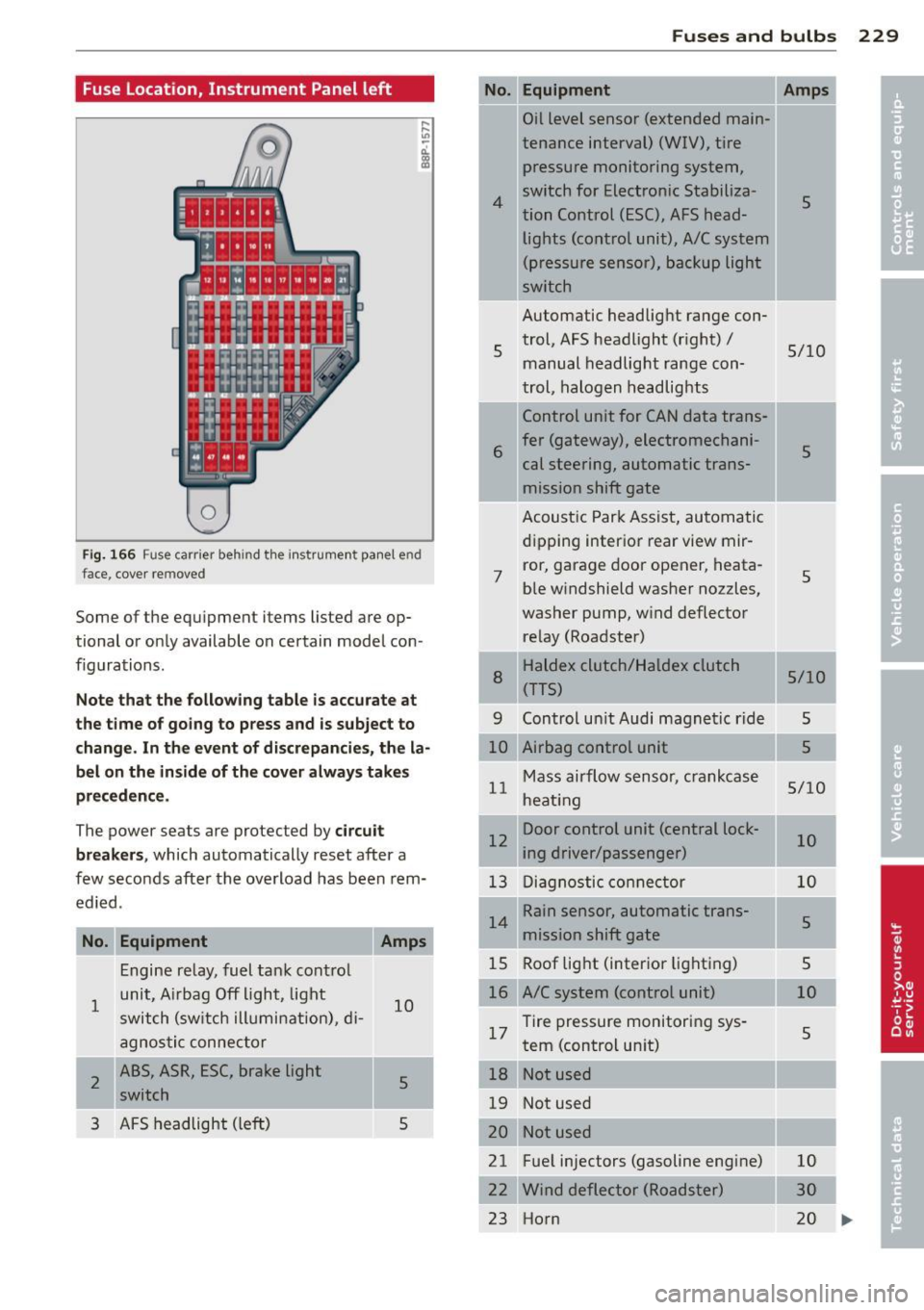
Fuse Location, Instrument Panel left
0
Fig. 166 Fu se ca rrier behin d th e in strum en t pane l end
fa ce, cover re move d
Some of the equipmen t items lis ted a re op
tional or only available on certain model con
f igurations.
N ote th at the foll ow ing table is ac curate at
the t ime of go in g to press and is subje ct to
c hang e. In t he event of d iscr epan cies, the la
b el on the in side of th e cove r alw ay s take s
precedence .
The power sea ts are pro te ct ed by circu it
break ers,
which automatically reset after a
few seconds after the overload has been rem
ed ied .
No. Equipment
1
2
3
Engine relay, fuel tank contro l
unit, A irbag Off light , light
switch (sw itch illumi nation), di -
agnosti c connector
ABS, ASR, ESC, brake light switch
AFS headlight (le ft)
Amps
10
5
5
Fu se s and bulb s 229
No.
4
5
Equipment
Oil level sensor (extended main-
tenance interval) (WIV), tire
pressure monitoring system,
switch for Electronic Stabiliza-
tion Control (ESC), AFS head-lights (control unit), A/C system
(pressure sensor), backup light
switch
Automatic headlight range con trol, AFS headlight (right) /
manual headlight range con
trol, halogen headlights
Control unit for CAN data trans-
6 fer (gateway), electromechani cal steering, automatic trans
mission shift gate
7 Acoust
ic Park Assist, automatic
dipping interior rear view mir-
ror, garage door opener, heata
ble windshield washer nozzles,
washer pump, w ind deflector
re lay (Roadster)
--r-HaldeX clutch/Haldex clutch
(TTS)
8
Amps
5
5/10
5
5
5/10
9 Control un it Audi magnetic ride 5
----10 Airbag control unit 5
Mass airflow sensor, crankcase
11 heat ing
Door control unit (central lock-
12 ing driver/passenger)
13 Diagnostic conne ctor
Rain sensor, automatic trans-
14 mission shift gate
15 Roof light (inter ior lighting)
16 A/C system (control unit)
17 Tire pressure monitoring sys
tem (control un it)
--~-18 Not used
19 Not used 5/10
10
10
5
5
10
5
I
I
I
20 -------21 Fuel injectors (gasoline engine) 10
22 Wind deflecto r (Roadster) 30
23 Horn 20
IIJ>,
Page 239 of 262
Lifting vehicle
lifting with workshop hoist and with
floor jack
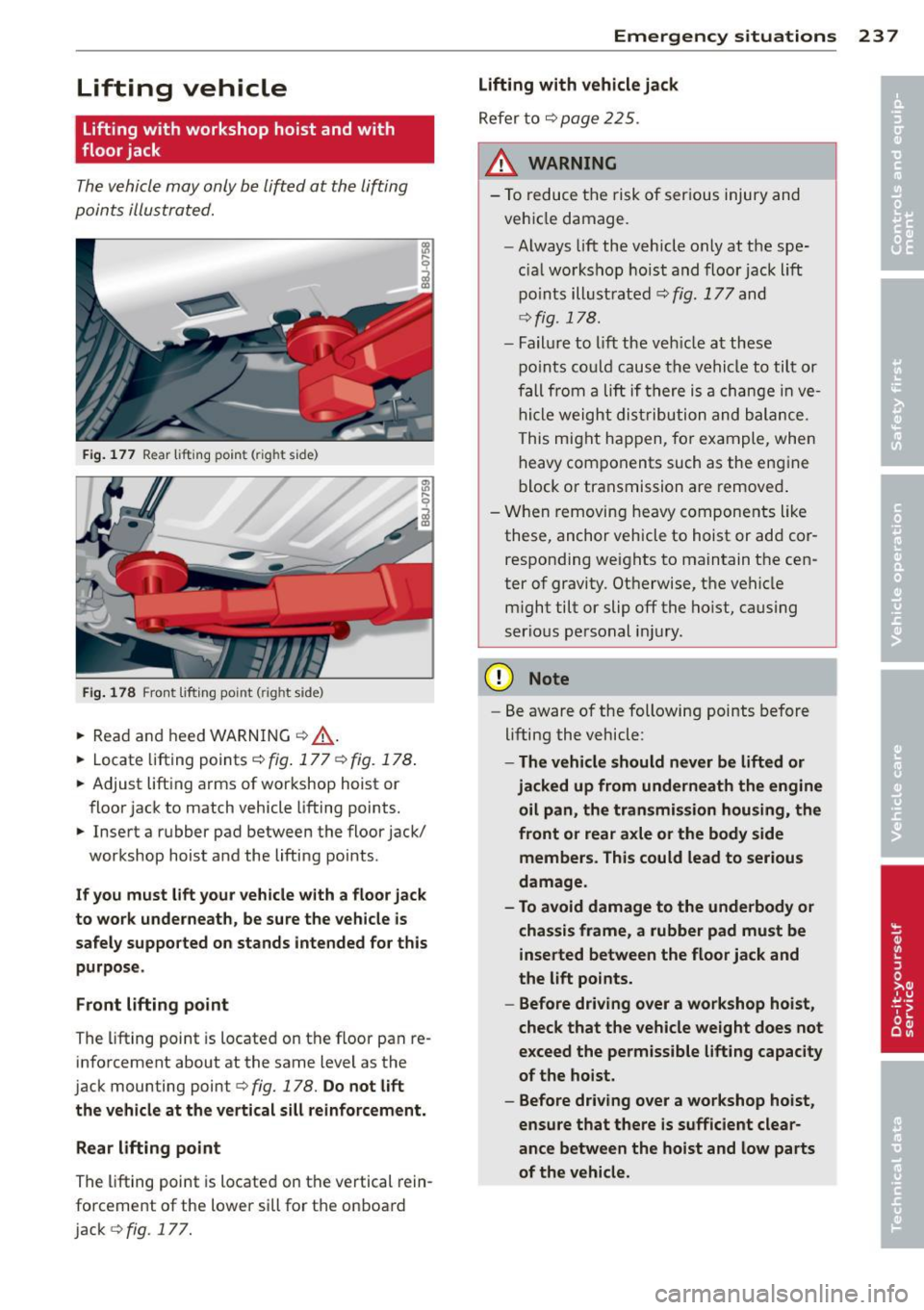
The vehicle may only be lift ed at the lifting
poin ts illustra ted.
F ig. 177 Rear lift ing point (r ig ht side)
Fi g. 178 Front lift ing po int frig h t side)
• Rea d and h eed WARN ING c:::> A-
• Locate lifting points c:::> fi g. 177 c:::> fig. 178 .
• Adjust lift ing arms o f wor kshop hoist or
f loor jac k to match vehicle lifting points.
• Inse rt a r ubber pad between the floor jac k/
workshop hoist a nd the lifti ng points.
If you must lift your vehicle with a floor jack
to work underneath, be sure the vehicle is safely supported on stands intended for this
purpose.
Front lifting point
The lifting point is locate d on the f loor pan re
info rcement about at the same level as the
jack mounting point
c:::> fig. 178. Do not lift
the vehicle at the vertical sill reinforcement .
Rear lifting point
The lifting poi nt is locate d on t he vertical rein
forcement of the lower sill for t he on boa rd
jack
c:::> fig. 177.
Emergency situations 237
lifting with vehicle jack
Re fer to c:::> page 225 .
_&. WARNING
-To re duce t he risk of ser ious injury an d
ve hicl e damage.
- Alwa ys lift the veh icl e only at the spe
c ial w orkshop hoist and floor jack lift
p oin ts ill ust rated
c:::> fig. 177 and
c:::> fig. 178 .
-Fa il u re to Lift th e ve hicl e at th ese
p o ints co uld cau se the ve hi cle to til t or
f all from a lift if th ere i s a cha nge in ve
h icl e weigh t distr ibu tion and balan ce.
This mi ght h app en, fo r ex am ple, whe n
h eavy co mpon ent s such as the eng ine
b lock o r transmission are remove d.
- Wh en removin g hea vy componen ts li ke
these, anchor vehicle to h oist or ad d cor
respo nding wei ghts to ma intain t he ce n
ter of gravity. Ot herwis e, th e ve hicle
might tilt or slip off the ho ist, caus ing
serio us pe rso nal i nju ry.
CI) Note
-Be aware of the following points before
lifting the vehicle:
- The vehicle should never be lifted or
jacked up from underneath the engine
oil pan, the transmission housing, the
front or rear axle or the body side
members. This could lead to seriou s
damage.
- To avoid damage to the underbody or
chassis frame, a rubber pad must be inserted between the floor jack and
the lift points.
- Before driving over a workshop hoist ,
check that the vehicle weight does not
exceed the permissible lifting capacity
of the hoist.
- Before driving over a workshop hoist ,
ensure that there is sufficient clear
ance between the hoist and low parts
of the vehicle.
-
Page 247 of 262
in "P" (Park position) (automatic trans
missi on) or Neutral (manual transmis
sion) and the hand brake is f irmly ap
plied .
@) For the sake of the environment
-Changi ng t he eng ine settin gs w ill ad
versely affect em ission levels. This is det
rimental to the enviro nment and increas
es fuel consumption .
- Always observe env ironmental regula
tions when disposing of old engine oil,
used brake fluid, dirty engine coolant,
spent batter ies or worn out t ires.
- Undeployed airbag modules and preten
s ioners might be classified as Perchlo
rate Mate rial -spec ia l hand ling may ap
ply, see www.dts c.ca .gov/haza rdous
was te/perch lorate. When the veh icle or
parts of the res traint system includ ing
a irbag modules safety belts wit h preten
sioners are scrapped, all applicable laws
and regulations must be observed. Your
a uthorized Audi dea ler is familiar w ith
these requirements and we recommend
that you have your dea ler perform this
se rv ice for you .
Additional accessories,
modifications and
parts replacement
Additional accessories and parts
replacement
Always consult an authorized Audi dealer be
fore purchasing acce ssories.
Your veh icle inco rporates the latest safety de
sig n featu res e nsu ring a high standard of ac
tive and passive safe ty .
This safety could be comp romised by non-ap
p roved changes to the ve hicle. For this reason ,
if pa rts have to be replaced, p lease observe
t he following points when ins tall ing addition
a l accessories:
Con sumer In formation 245
Approved Audi accesso ries and genuine Aud i
parts are available from authorized A udi deal
ers.
T hese de alers a lso have the necessary facili
ties, tools and tra ined spec ialists to install the
parts and accessories proper ly .
A WARNING
Using the wrong spare parts or using non
approved accessories can cause damage to
the vehicle and ser ious persona l injury.
- Use on ly accessories express ly approved
by Audi and gen uine Audi spare parts
- These parts and accessories have been
specially designed to be used on yo ur ve
hicle.
- Never install accessor ies such as tele
phone crad les or beverage ho lders o n air
bag covers or withi n the airbag deploy
ment zones . Do ing so will increase t he
ris k of injury if a irbags are triggered in an
accident!
- Before you check anything in the engine
compa rtment, always r ead and heed a ll
W ARNINGS
r:::;.page 174 .
(D Note
- If items other than genu ine A udi spare
parts, add-on equipmen t and accessory
items are used o r if repair wo rk is not
performed a ccord ing to spe cified met h
ods, this ca n resu lt in seve re damage to
yo ur vehicle's engine and body (such as
co rrosion) and adversely affect yo ur vehi
cle's warranty .
- T he innovat ive aluminium concep t of
yo ur Audi T T means that all servicing, re
pairs or other work on the vehicle body
must be carr ied out exclusive ly by an
Audi workshop .
- If emergency repairs must be performed
elsewhere, have the veh icle examined by
an authorized Audi dealership as soon as
possible .
- The manufacturer cannot be held liable
for damage wh ic h occurs due to failure
to comply with these stipu lations .
•
•
Page 249 of 262
A
A/C operation . . . . . . . . . . . . . . . . . . . . . . . 69
Accessories . . . . . . . . . . . . . . . . . . . . . . . . 245
Acoust ic park assist . . . . . . . . . . . . . . . . . . 78
Adapt ive light .. ........... .. .. .. .... 43
defect ive . . . . . . . . . . . . . . . . . . . . . . . . . . 20
Adding Eng ine coolant .............. .... . .
E ng ine oi l .. ............. .... .. .. .
W indshield washer fl uid ... .. .. .. .. .
Addit ional accessories .... .. .. .. .. .. .
Additives Engine oil .. .... .. .... ... .. .. .. .. . 188
185
194
245
185
Ad justab le steer ing colum n .. .. .. .. .. .. 7 1
Adjusting front seats ....... .. .. .. .. .. 54
Ad justing steering co lumn ... .. .. .. .. .. 71
Ad just ing the seats ............. ... ... 55
Advanced Airbag System Chi ldren . .. ............. .... .. .. .
Components ............. .... .. .. .
Front airbags ............... ... .. .
H ow the components work together ..
Mo nitor ing . .. ........... .. .. .. .. . 131
115
113
116
1 19
Weight-sens ing mat ...... .. .. .. .. . 13 1
Airbag War ning/ indicator lights . ...... ... ... 15
Ai rbag system . . . . . . . . . . . . . . . . . 108, 127
Care . .. .. .. .. .. ........... .. .. ... 122
C hi ld restra ints ........... .... .. .. . 132
Components (front airbags) . . . . . . . . . 115
Danger of fitting a child safety seat on
the front passenger seat . . . . . . . . . . . . 110
D isposal . . . . . . . . . . . . . . . . . . . . . . . . . 122
Fr ont airbag s ............ .... .. .. .
H ow do the front a irbags wo rk? . .. .. .
H ow many airbags does my vehi cle
have? ... .. .. .. ... . .... ... .. .. .. .
Important safety instructions on the knee airbag system ....... .. .. .. .. .
Important things to know .. .. .. .. .. .
Indicator light .. ...... ... .... .. .. . 1
12
1 17
115 125
108 119
Knee airbags . . . . . . . . . . . . . . . . . . . . . . 123
Mo nitor ing .... ........... ... ... .. 119
P ASSENG ER AIR BAG OFF light .. .. .. . 119
Repa irs .. .. ............. .... .. .. .
Side airbags .. ........... .. .. .. .. .
When must the system be inspected? . 12
2
126 1 19
Inde x 247
All- wheel drive . ..... . .. .. ..... ... . .
Winter tires ... .... . ... ...... ... . .
Alloy w heels .. .. .. ................ .
Alternator lSS
211 169
refer to Generator .. . ... .... ... .. .. . 16
Anti-freeze
refer to Engine cooling system ... .. .. 187
A nti- lock b rake system
W arning/ind icator lights ........ .. .. . 18
Anti -lock braking system ............. 150
Anti-slip reg ulation
150
Ant i-theft systems
An ti- theft a la rm system ........ .. .. . 38
El ectronic immob ilizer .......... .... . 33
Ashtray .......... .. ..... ........... 62
Aste risk
What does it mean when something is marked w it h an aster isk? . . . . . . . . . . . . . . 6
A udi magnet ic r ide . . . . . . . . . . . . . . . 2 1, 78
Desc ription . . . . . . . . . . . . . . . . . . . . . . . . 78
Indicator light ..... . ... ...... ... .. . 21
Audi Se rv ice Repair Manuals and Litera-
tu re ..... .. .. .. .. .... . · · · · · · · · · · · ·
Automat ic be lt retractor .. ...... .... .
Automatic car wash
refer to Washing ... . ... .... ... .. . . 243
104
165
Automa tic transm iss ion . ......... .... . 80
D rivi ng No tes .. .. ............... .. . 82
Emergency prog ram . .. ..... ... .. .. . 85
Emergency re lease . .. .. ..... ... .. .. . 86
Ignit ion key safety lock . ..... ... .. .. . 72
K ick-down . . . . . . . . . . . . . . . . . . . . . . . . . 85
Launch Control Program .......... .. .
8S
Se lector lever lock ... ... .... ... .. .. . 81
Se lector lever positions
80
Tiptronic .. .. .. .... ... ....... ...... 84
T iptronic controls on the stee ring wheel 84
Auto Safety Hotline ................. . 98
Ave rage fuel mileage . . . . . . . . . . . . . . . . . 23
Average speed . . . . . . . . . . . . . . . . . . . . . . . 23
Avoid damaging the vehicle .... ... .. .. 160
B
Battery . . . . . . . . . . . . . . . . . . . . . . 190, 193
Charg ing . ... .... .. . .. .. ..... ... .. 193
Checking battery acid level ........ .. 193
•
•
Page 250 of 262
248 Index
Connecting ...... ..... ... .. .. .... . 190
Disconnecting . ....... ... .. .. .... . 190
Important warn ings . .... ... .. .... . 192
Locat ion 192
Low . .. .. .... ........... ........ . 156
Replacing the battery ......... .. ... 191
State of charge ..... .... .. .. .. .. .. . 156
W inte r operation .......... ... .. .. . 190
Working on the battery .. ...... .. .. . 192
Battery voltage ................ .... .. 19
Before driving . . . . . . . . . . . . . . . . . . . . . . . 90
Blended gasoline ........... ... .. .. . 176
Body cavity sealing . . . . . . . . . . . . . . . . . . 170
Boost . .. .. .. .. . .......... .. .. .... .. 28
Booster seats .............. ... .. .. . 138
Boost pressure indicator . ... .. .... .. . . 28
Brake fluid
Changing the brake flu id . .. .. .. .. .. .
190
Chec king the bra ke fluid level . .. .... . 189
What is the correct brake fl uid leve l? .. 189
What should I do if the brake fluid warn-
ing light comes on? .. ... .. .. ... ... .
189
Brake fl uid reservo ir ........ .. .. .... . 189
Brake system .............. .... .... . 189
Anti -lock brake system ........ .. .... 18
Brake ass ist system . .. .. .. .. .. .. .. . 150
Brake fl uid . ... .. ..... ... .. .. .. .. . 189
Brake flu id spec ifica tions for refill and re-
p la cemen t ... ......... .. .. .. .. .. .
190
Brake light defect ive . ... .. .. .... .. . . 20
Brake pads .. .. .. ..... ... .. .. .... . 159
General information . ... .. .. ... ... . 153
How does the moisture or road sa lt affect
the brakes? .............. .. .. .... .
153
Malfunc tio n . . . . . . . . . . . . . . . . . . . . . . . 14
Warn ing/ indicator l ights ....... .. .... 14
Worn brake pads symbol . . . . . . . . . . . . . 18
Break- in period ............ .. .. .. .. . 159
Brake pads ... ........... .. .. .... . 159
Tires
Bulbs
C
159
23 1
Califo rni a Proposit ion 65 Warning .. .. . 18 1
Battery specif ic .. ..... ... .. .. .... . 193
Capac it ies . .. ..... ........... ... .. . 240
Car care . ... .... .. ... .. .. ... .... . .. 164
Interior . . . . . . . . . . . . . . . . . . . . . . . . . . 170
Plastic and vinyl . .... .. ..... ... .. .. 168
Care of ex ter ior .. .. ............. .. .. 164
Cargo area
refer to Luggage compartment ....... . 96
Cata lytic co nverter ... ... ..... ... .. .. 160
CD cha nger . .... .. ............. .... . 64
Certification . . . . . . . . . . . . . . . . . . . . . . . 246
Chang ing a flat t ire ... ... ..... ... .. .. 224
Chang ing engine oil ................ . 186
Chassis
Undercoating .. .. ............. .. ..
170
also refer to Audi magnet ic r ide .. .. .. . 78
Checking
Battery ac id leve l ... ... ..... ... .. ..
193
Engine coolant level . . . . . . . . . . . . . . . . 187
Checking t ire press ure ........... .. .. 2 02
Child restraint
Danger of using child rest raints in the
front seat . ...... ................ .
110
Child restraints
Where can I get additional informat ion
about child restraints and the ir use? ..
149
Child restraint system anchors . ... .. .. 143
Child saf ety . .. .. .. .. .. ...... ... .. .. 130
Co nvertib le loc king retractor ... .. .... 140
G ui dance fixtures for lower anc ho rages 1 4 5
Important sa fe ty instru ctions for using
child safety seats ... .... .... ... .. ..
133
Important things to know whe n driving
with children .... ............... ..
130
Installing a c hild restra int using the
LATCH system . . . . . . . . . . . . . . . . . . . . .
146
Mounting and releasing the anchorage
hook ...... ... .. .. ... ....... .... .
146
Tether anchors . .. ............. .... 14 7
Tether straps .. .. ............. .... 14 7
Child safety seat ..... ... ..... ... .. .. 135
Co nvertib le locking retractor ......... 140
Installing ... .. .. ... .. .. ... ..... .. 140
U nused safety be lts on the rear seat 135
Child safety seats
Booster seats .... ............... ..
138
Co nvertib le child seats ............ . 136
How do I properly i nstall a child safety
. h" l ? 133 seat in my ve 1c e .............. .. . .
Page 252 of 262
250 Index
Distance . . . . . . . . . . . . . . . . . . . . . . . . . . . 23
Driver information system Boost .......................... .. 28
E ng ine oi l tempe ratu re d isplay .. .. .... 26
Engine oil temperatu re indicator ...... 28
Menu button . . . . . . . . . . . . . . . . . . . . . . 25
Menu display . . . . . . . . . . . . . . . . . . . . . . 24
Open door or front lid warning . . . . . . . . 22
Outside temperature display .. .. .. .. . . 22
Red symbols ................. ...... 13
Service interval display ...... .. .. .. .. 28
Setting .. .. ... .... ...... ... ... .. .. 26
Sound system display . . . . . . . . . . . . . . . 22
Trip computer. . . . . . . . . . . . . . . . . . . . . . 23
ye llow symbo ls ......... .. .. .. .. .. .. 13
Driver seat
refer to Seat ing pos ition . ........ .. .. 91
Driving Run-flat tires . ........... .... .... . 218
Driving safely . . . . . . . . . . . . . . . . . . . . . . . 90
Driving through water ........ .. .. ... 160
Duplicate key .............. ... .... .. 32
Dust filter . ... .............. .. .. .. .. 67
E
Efficiency program . . . . . . . . . . . . . . . . . . . 26
Fuel economy messages ..... .. .. .... 27
Memory levels . . . . . . . . . . . . . . . . . . . . . 23
Other equipment ........... .. .. .. .. 27
Elapsed time . . . . . . . . . . . . . . . . . . . . . . . . 23
Electro-mechanical power assist . . . 17, 155
E lectronic diffe rent ial lock (EDL) .. .. ... 150
Warn ing/ indicator lights ....... .. .... 18
Electronic immobilizer . . . . . . . . . . . . 12, 33
Electronic power control EPC warning/indicator light . ..... .. .. 19
E lect ronic speed limiter . . . . . . . . . . . . . . . 31
Electronic Stability Control (ESC) Warning/indicator lights ..... .. .. .. . . 17
Electronic Stabilization Control (ESC) . .. 150
E mergency flasher . . . . . . . . . . . . . . . . . . . 45
Warn ing/ indicator l ights ... .... .... .. 21
Emergency locking ............. .... .. 37
Emergency operation
Rear lid . . . . . . . . . . . . . . . . . . . . . . . . . . . 38
E mergency starting ........ .... ..... 232 Emergency towing
.............. .... 234
Energy management . ............ ... 156
Battery power ................ .... 157
Driver notification ............. .. .. 157
Engine Checking and filling locations .... .. .. 182
Coolant . .. ... ... .. .......... ... .. 187
Hood . .... .. .. .. ............. .. .. 180
Starting . . . . . . . . . . . . . . . . . . . . . . 71, 72
Starting with jumper cables ... .. .. .. 232
Stopping .. .... .. .. .............. .. 73
Engine compartment ......... ... .. .. 182
Safety instructions ... .......... .. .. 180
Working in the eng ine compartment 180
Engine coolant system Malfunction ..... ... ........... ... . 16
Radiator fan . .. .. ..... ..... ... .. .. 189
Temperature gauge ....... ..... .. .. . 11
Engine cooling system ........... .... 187
Adding coolant ................ .... 188
Checking the engine coolant level ..... 187
Engine data ..... .. ................ . 240
Engine hood
Closing . .. .. .. .. ............... .. 180
How to release the hood .......... .. 180
Engine oil ...... .. .. ..... ... ... .. .. 182
Adding . ...... .. .. ..... ... ... .. .. 185
Additives .. .. .. .. .. ... ........ .... 185
Changi ng ... .. .. ............. .. .. 186
Checking the engine oil leve l ..... .... 185
Indications and conditions requiring ex-
tra checking ..... ................ . 185
Oil consumption . ................. . 184
Oil grades . ................... .... 182
Recommended oil check intervals . .. .. 185
Specification and viscosity . ...... .. .. 182
Temperature display ........ ... .. .. . 26
Engine oil level .... ................ .. 19
Engine oil pressu re (ma lfunction) .... .. . 16
Engine oil sensor defective . . . . . . . . . . . . 19
Engine oil temperature indicator ........ 28
Engine speed limitation . ......... .. .. . 19
Environment Break-in period .................... 159
Catalytic converter ....... ...... .. .. 160
Dispos ing of your veh icle battery . . . . . 191
Driving at high speeds . ...... ... .. .. 161