oil temperature AUDI TT 2013 Owner´s Manual
[x] Cancel search | Manufacturer: AUDI, Model Year: 2013, Model line: TT, Model: AUDI TT 2013Pages: 262, PDF Size: 65.91 MB
Page 185 of 262
oils available today provide better engine lu
brication that can outlast traditional petrole
um-based oils, making them a smart choice
for use throughout the life of your Audi.
Whether you use synthetic or petroleumbased engine oil, the oil that you use must
conform to Audi's oil quality standard
VW 502 00 to help keep your vehicle's engine running smoothly and help prevent the for
mation of harmful deposits, sometimes called
" sludge," that over t ime can lead to expensive
repairs .
At the time of printing, engine oils available in the U .S . and Canada that meet the exacting
specifications of Audi oil standard VW 502 00
are synthetic engine oils . This does not mean,
however, that every synthetic engine oil will
meet Audi oil standard VW 502 00 . So always
be sure that you use an approved oil.
To help prevent the formation of harmful de posits use only oil with the following specifi
cations printed on the oil container :
Audi oil standard VW S02 00
Oil container labels may carry the specifica
tion singly or in combination with other desig
nations and oil quality standards .
Viscosity
Engine oils are graded according to their vis
cosity . The proper viscosity grade oil for your
engine depends on climactic or seasonal con
ditions where you drive. You can use oil with a
viscosity grade of SA E SW40 across all tem
perature ranges for normal driving conditions.
However, if engine oil viscosity grade SAE
SW40 is not available, you can also use viscos
ity grade SAE SW-30 or SAE OW-40 as long as
it meets Audi oil quali ty standard VW 502 00
specifications .
Because engine oil that meets the Audi oil
standard may not be available everywhere
when you need it, we strongly recommend
that you always carry with you an extra quart (liter) of oil that expressly conforms to the
Checking and filling 183
VW 502 00 specification, in case you have to
top
off the oil while on the road.
Only if the level of the oil is at or below the
minimum mark on the oil dipstick - and no oil
that expressly conforms to Audi oil standard
VW 502 00 specifications is available - may
you top
off with a high quality engine oil, pref
erably synthetic-based, that meets ACEA A3
or API SM specifications, but even then, only
in viscosity grades SA E SW-40, SA E 5W -30, or
SAE OW-40. However, during the entire time
between oil change intervals, never top
off
with more than a total of 0.5 qt/liter engine
oil that does not conform to Audi oil specifica
tion VW 502 00.
For more information about engine oil that
has been approved for your vehicle, please
contact either your autho rized Audi dealer or
Audi Customer Relations at 1 (800) 822-2834
or visit our web site at www.audiusa .com or
www.audicanada.ca . Here you will also find a
current list of oils (manufacturers, brand
names etc.) that conform to Audi oil standard
vw 502 00.
Changing the engine oil
The engine oil and oil filter must be changed
according to the mileage (kilometers) and
time intervals specified in your vehicle's War
ranty
& Maintenance booklet. Do not exceed
these intervals -harmful deposits from old
engine oil can reduce engine performance and
can lead to expensive engine repairs.
Changing the oil at the recommended inter
vals is so very important because the lubricat
ing properties of oil decrease gradually during
normal vehicle use. If you are not sure when
you have your oil changed, ask your author
ized Audi Serv ice Adv isor.
Under some circumstances the engine oil
should even be changed more frequently. Change oil more often if you drive mostly
short distances, operate the vehicle in dusty
areas or mostly under stop-and-go traffic con
ditions, or when you use your vehicle where
temperatures stay below freezing point for
long periods.
•
•
Page 186 of 262
184 Checking and filling
Detergent additives in the o il will make fresh
oil look dark after the engine has been run
n ing for a short time . This is norma l and is not
a reason to change the oil more often than recommended.
D am ag e o r m alfun ction s due to lack of
m ainten ance
It is essent ial that yo u change your oil at the
recommended intervals using only engine oil
that complies with Audi oi l standard
VW 502 00 . Your Lim ited New Vehicle War
ranty does not cover damage or malfunctions
due to failure to follow recommended mainte
nance and use requ irements as set forth in
the Audi Owner's Manual and Warranty
&
M aintenance book let . Your dea ler will have to
deny warranty coverage un less you p resen t to
the dea ler proof in the form of Servi ce or Re
pa ir Orde rs that all schedu led maintenance
was performed in a timely manner.
Engine oil consumption
The engine in your vehicle depends on an ade
quate amount of oil to lubricate and cool all
of its moving ports.
I n o rder to prov ide effective lubr ication and
cooling of internal engine components, a ll in
ternal comb ustion engines consume a certain
amount of oil. Oi l consumption varies from
engine to engine and may change significantly
over the life of the eng ine . Typically, eng ines
with a specif ied break-in per iod (see
c::;, page 159) consume more oil during the
break-in per iod than they consume after oil
consumption has stabilized .
Under normal conditions, the rate of oil con
sumpt io n depends on the quality and viscosity
of the oil, the RPM (revolutions per m inute) at
which the engine is operated, the ambient
temperature and road cond it io ns. Furthe r fac
tors are the amo unt of o il d ilution from wate r
condensation or fuel residue and the ox ida
tion level of the oi l. As any engine is subject to
wear as mileage bui lds up, the oil consump
tion may increase over t ime until replacement
of worn components may become necessary. Wi
th a ll these variab les coming into p lay, no
standard rate of oil consumption can be es
tab lished or spec ified. There is no alte rnative
to regular and frequent check ing of the o il lev
el, see
Note .
If the yellow engine oil leve l warning symbo l
in the instr ument cluster
II lights up, you
sho uld check the oil leve l as soon as possib le
with the oil dipstick c::;, page 185. Top off the
o il at your earliest conven ience
c::;, page 185 .
A WARNING
-Before you chec k anything in the eng ine
compartment, a lways read and heed a ll
WAR NINGS
c::;, .& in Working in the engine
comportment on page 180.
CI) Note
D riving with an insufficient o il level is like
l y to cause sever e damage to the engine.
(D Tips
- The oil pressure warn ing display. is
not an indicator of the oil level. Do not
re ly on it . Instead, check the oil level in
your engine at regular intervals, pr ef
erably ea ch time you refu el, and alway s
before going on a long trip.
- If you have the impression yo ur engine
cons umes excessive amoun ts of oil, we
recommend that you consult your Aud i
dealer to have the cause of your concern
properly diagnosed. Keep in mind that
the accurate meas urement of o il con
sumption requ ires great care and may
take some t ime . Your Audi dea ler has in
struct ions about how to measure oil con
sumption acc urately.
Page 187 of 262
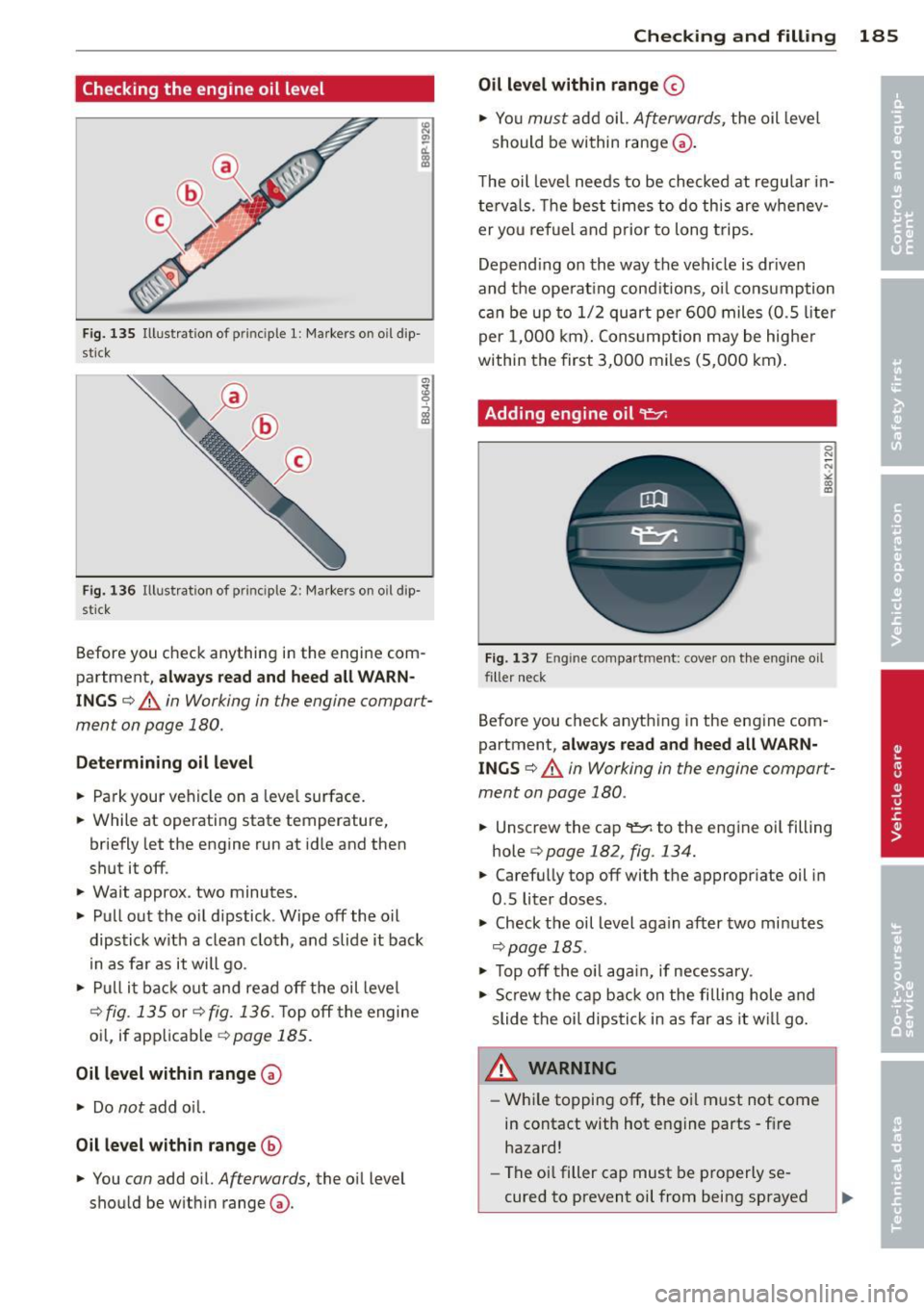
Checking the engine oil level
Fig . 135 Illust rat ion of principle 1: Ma rkers on o il dip
st ick
F ig . 13 6 Illust rat io n of principle 2: Markers o n oil dip·
st ic k
Before you check anything in the engi ne com
partment,
always read and heed all WARN
INGS ¢ A in Working in the engine compart
ment on page 180.
Determining oil level
• Park your vehicle on a leve l surface.
• While at operating state temperature,
briefly let the engine run at idle and then
shut it off.
• Wait approx . two minutes.
• Pull out the o il dipstick . Wipe off the oil
dipstick w ith a clean cloth, and slide it back
i n as far as it will go .
• Pull it back o ut and read off the oil level
¢ fig. 135 or ¢ fig. 136 . Top off the engine
oi l, if app licable ¢
page 185.
Oil level within range~
• Do not add o il.
Oil level with in range @
• You can add o il. Afterwards, the o il level
shou ld be w ith in range @.
Checking and filling 185
Oil level within range 0
• Yo u must add oil. Afterwards, the oil leve l
should be wi thin range @.
T he oil leve l needs to be checked at regu lar in
terva ls. The best t imes to do th is are w henev
er yo u ref uel and prior to long t rips.
Depend ing on the way the vehicle is dr iven
and the ope rat ing cond it ions, oi l consumption
can be up to 1/ 2 quart per 6 00 miles (0. 5 lite r
per 1,000 km) . Cons umption m ay be highe r
within the first 3,000 miles (5,000 km) .
Adding engine oil ci::,,.
0 N ;.
>< (D m
Fig. 137 Engine compa rtment: cover on the engi ne oil
filler neck
Before you check anyth ing in the engine com
partment,
alw ays read and heed all WARN
INGS ¢ A in Working in the engine compart
ment on page 180 .
• Unsc rew the cap 'l::r. to the engine oi l filling
hole
¢ page 182, fig. 134.
• Carefully top off with the appropriate oil in
0.5 liter doses.
• Check the oil level aga in after two minutes
¢ page 185.
• Top off the oil aga in, if necessary .
• Scr ew the c ap back on the filling hole and
slide the oi l dipsti ck in as far as it w ill go.
A WARNING ,...__
-Wh ile topping off, the o il m ust not come
in contact with hot e ngine parts -fir e
hazard!
- The oi l filler cap must be pro perly se
cured to prevent oil from being sprayed
Page 189 of 262
@ For the sake of the environment
- Before changing your oil, first make sure
you know where you can properly dispose of the used oil.
- Always dispose of used engine oil proper
l y. Do not dump it on garden soi l, wood
ed areas, into open streams or down
sewage drains.
- Recycle used engine oil by taking it to a
used engine oil collection facility in your
area, or contact a service station.
Engine cooling system
Coolant
The engine coolant performs two functions: it
keeps the engine from overheating and it pro
tects the engine from freezing in the winter.
The cooling system is sea led and generally re
qu ires little at tention.
The cooling system has been filled at the fac
tory with a permanent coolant which does not n eed to be changed. The coolant consists of a
mixture of wa ter and the man ufacturer's g ly
col-based coolan t addi tive Gl3 ant ifree ze
with ant icorrosion add itives (50% for USA
models; 60% for Canadian models) . This mix
ture both assures the necessary frost protec
tion and protects metal components in the
engine's cooling system from corrosion and
scaling. It also raises the boiling po int of the
coolant.
Do not reduce the concentration of the coo l
ant in the summer by adding plain water.
The
proportion of coolant add itive must be at
lea st 50°/4 but not more than 60°/4
to ma in
tain antifreeze protection and cooling efficien cy. If the coolant frost pro tect io n is too low,
the coolant cou ld freeze and dam age the veh i
cle heating and eng ine cooling system.
For year-round driving, antifreeze is added at
the facto ry for temperatures down to:
- -31°F( -35°C)USA
- -40 °F ( -40 °C) Canada.
Checkin g and fillin g 187
A WARNING
Before you c heck anything in the engine
compartment, always read and heed all
W ARNI NGS~ &.
in Working in the engine
comportment on page 180.
(D Note
- Before winter sets in, have the coolant
checked to see if the coolant additive in
your v ehicle is sufficient to meet the cli
mate conditions. This is especia lly impo r
t an t if you live in a region where t he win
t er is ex treme ly cold. If ne cessary, in
cr ease t he p ro portion of coo lant add itive
to 60%.
- Whe n adding cool ant additive to yo ur
c ooling sys tem, remember:
- We recommend us ing on ly coolant ad
d itive Gl2++ or Gl3 (check the labe l)
for your veh icle. This coolant additive is
ava ilable at autho rized Aud i dea le rs.
Othe r types of antifree ze can sig nifi
cantly reduce cor ros io n protec tion. The
res ulting co rrosion can cause a loss of
coolant an d serio us en gine damage.
- Do not add any type of rad iator le ak seal
ant to yo ur vehicle 's eng ine coolant .
Adding radiator repair flu id may adverse
ly affect the function and performance of
your cooling system and co uld resu lt in
damage not covered by you r New Ve hicle
Limited War ranty.
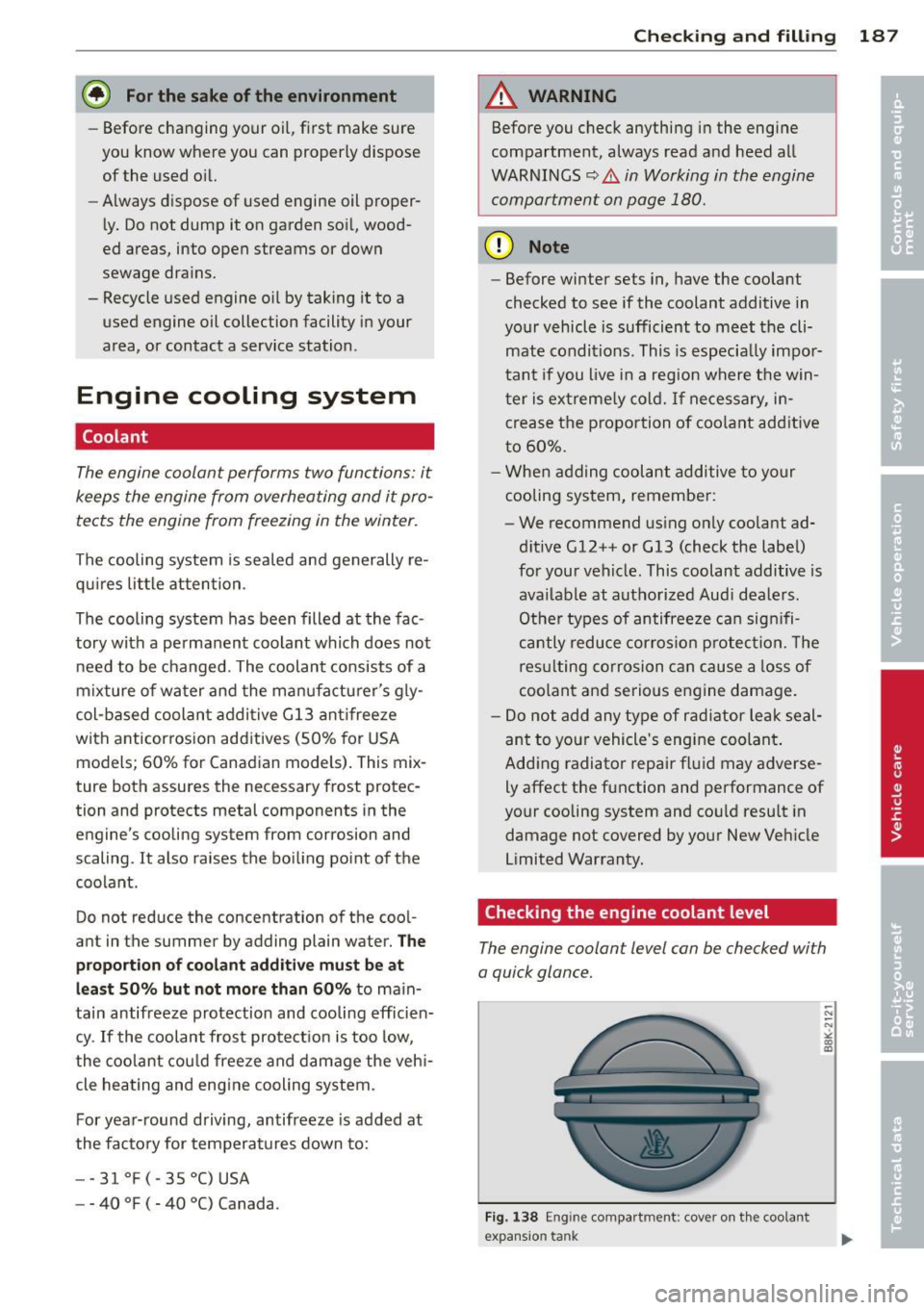
Checking the engine coolant level
The engine coolant level con be checked with
a quick glance.
Fig. 138 Eng ine compa rtment : cove r on t he coola nt
expansio n tank
Page 209 of 262
A WARNING
Sudden tire failure can lead to loss of con
trol, a crash and serious personal injury !
- Never drive a vehicle when the tread on
any tire is worn down to the wear indica
tors.
- Worn tires are a safety hazard, they do
not grip well on wet roads and increase
your risk of "hydroplaning " and loss of
control.
- Always keep chemicals that can cause
tire damage, such as grease, oil, gasoline
and brake fluid away from t ires.
- Tires age even if they are not be ing used
and can fail suddenly, especially at high
speeds . Tir es that are more than 6 years
old can only be used in an emergency
and then with special care and at lower
speeds.
- Never mount used tires on your vehicle if
you are not sure of their" previous histo
ry ." Old used tires may have been dam
aged even though the damage cannot be
seen that can lead to sudden tire failure
and loss of vehicle control.
Tires and wheels 207
New tires and replacing tires and wheels
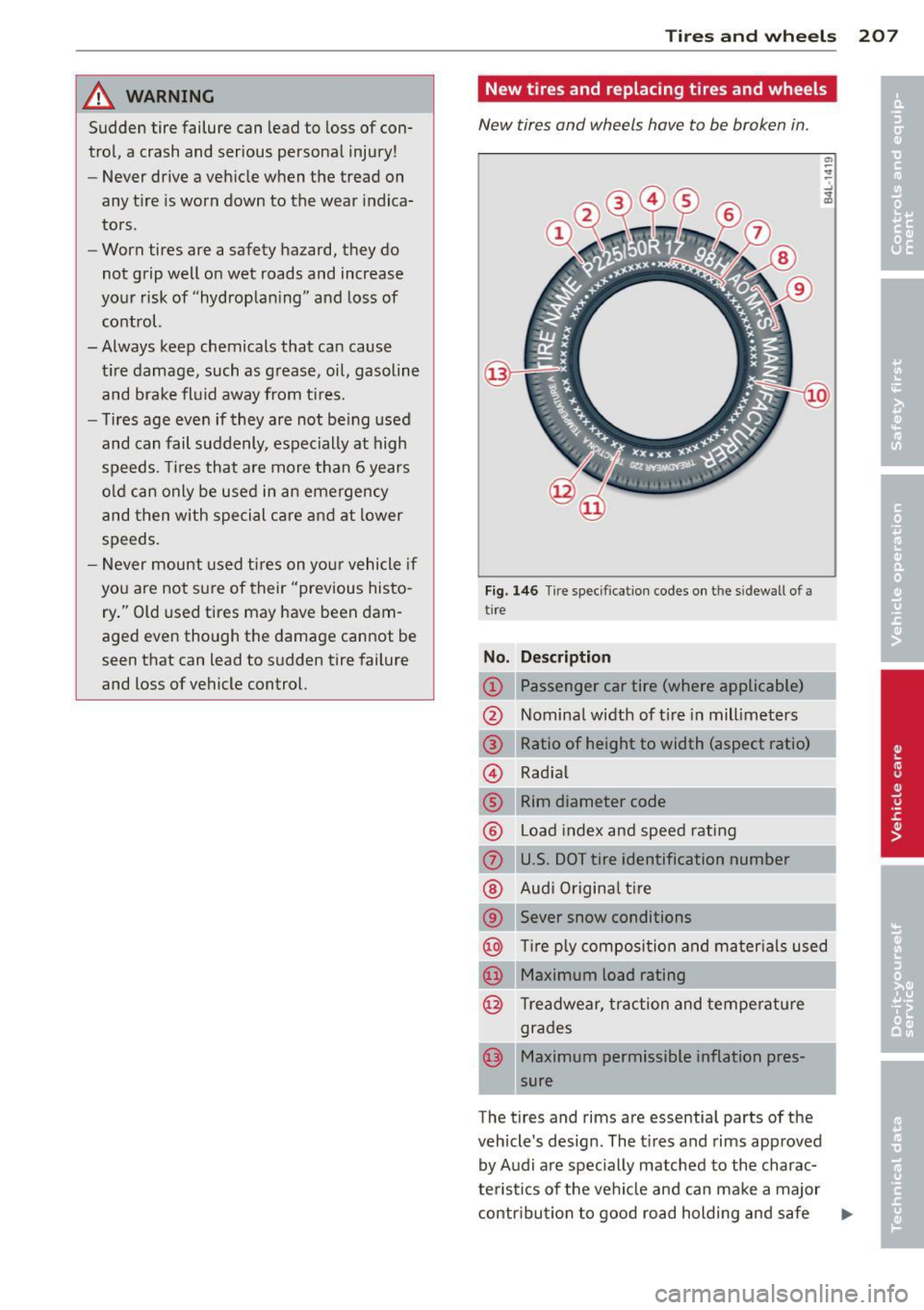
New tires and wheels have to be broken in .
Fig. 146 Tir e specifica tion codes on t he s idew all o f a
t ire
No. Description
CD Passenger car tire (where applicable)
@ Nominal width of tire in mill imeters
® Ratio of height to width (aspect ratio)
© Radial
® Rim diameter code
® Load index and speed rating
(f) U.S. DOT tire identification number
® Audi Original tire
® Sever snow conditions
@ Tire ply composition and materials used
@ Maximum toad rating
@ Treadwear, traction and temperature
grades
@ Maximum permissible inflation pres-
sure
The tires and rims are essential parts of the
vehicle's design . The tires and rims approved
by Audi are spec ially matched to the charac
teristics of the vehicle and can make a major
contribution to good road holding and safe .,.
•
Page 245 of 262
Consumer Information
Warranty coverages
Your Audi is covered by the following war
ranties :
-New Vehicle Limited Warranty
- Limited Warranty Against Corrosion Perfo-
ration
- Emissions Control System Warranty
- Emissions Performance Warranty
- California Emissions Con trol Warranty (USA
vehicles only)
- California Emissions Performance Warranty
(USA vehicles only)
Detailed information regarding your warran
ties can be found in your
Warranty & Mainte
nance booklet .
Operating your vehicle
outside the U.S.A. or
Canada
Government regulations in the United States
and Canada require that automobiles meet
specific emission regulations and safety
standards. Therefore, veh icles built for the
U.S.A. and Canada differ from vehicles sold in
other countries .
If you p lan to take your vehicle outside the
continental limits of the United States or Can
ada, there is the possibility that:
- unleaded fuels for vehicles with cata lytic
converter may not be available;
- fuel may have a considerably lower octane
rating . Improper fuel may cause engine
damage ;
- service may be inadequate due to lack of
proper service facilities, tools or testing
equipment ;
- replacement parts may not be readily availa
ble.
- Navigation systems for vehicles built for the
U.S.A. and Canada will not necessari ly work
in Europe, and may not work in other coun
tries outside of North America.
Consumer Information 243
@ Note
Audi cannot be responsible for mechanical
damage that could result from inadequate
fuel, service or parts availab ility.
Audi Service Repair
Manuals and Literature
Audi Offic ial Factory Service Manuals and Lit
erature are published as soon as possible after
model introduction. Service Manuals and liter
atu re are availabl e to order from the Audi
T echnical Literature Ordering Center at:
www.audi.techliterature.com
Maintenance
' General
Your vehicle has been designed to help keep
maintenance requirements to a minimum.
However, a certain amount of regular mainte
nance is still necessary to assure your vehicle's
safety, economy and reliability . For detailed
vehicle maintenance consult your Warranty
&
Maintenance booklet.
Under difficult operating conditions , for ex
ample at extremely low outside temperatures ,
in very dusty regions, etc., some service work
shou ld be pe rformed between the intervals
specified. This applies particularly to:
- oil changes, and
- cleaning or replacing the air fi lter.
@ For the sake of the environment
By regu larly maintaining your vehicle, you
help make sure that emission standards
are maintained, thus min imizing adverse
effects on the environment.
Important considerations for you and
your vehicle
T he increasing use of electron ics, soph isticat
ed fuel injection and emission control sys
tems, and the generally increasing technica l
complexity of today's automobiles, have ..,_
•
•
Page 252 of 262
250 Index
Distance . . . . . . . . . . . . . . . . . . . . . . . . . . . 23
Driver information system Boost .......................... .. 28
E ng ine oi l tempe ratu re d isplay .. .. .... 26
Engine oil temperatu re indicator ...... 28
Menu button . . . . . . . . . . . . . . . . . . . . . . 25
Menu display . . . . . . . . . . . . . . . . . . . . . . 24
Open door or front lid warning . . . . . . . . 22
Outside temperature display .. .. .. .. . . 22
Red symbols ................. ...... 13
Service interval display ...... .. .. .. .. 28
Setting .. .. ... .... ...... ... ... .. .. 26
Sound system display . . . . . . . . . . . . . . . 22
Trip computer. . . . . . . . . . . . . . . . . . . . . . 23
ye llow symbo ls ......... .. .. .. .. .. .. 13
Driver seat
refer to Seat ing pos ition . ........ .. .. 91
Driving Run-flat tires . ........... .... .... . 218
Driving safely . . . . . . . . . . . . . . . . . . . . . . . 90
Driving through water ........ .. .. ... 160
Duplicate key .............. ... .... .. 32
Dust filter . ... .............. .. .. .. .. 67
E
Efficiency program . . . . . . . . . . . . . . . . . . . 26
Fuel economy messages ..... .. .. .... 27
Memory levels . . . . . . . . . . . . . . . . . . . . . 23
Other equipment ........... .. .. .. .. 27
Elapsed time . . . . . . . . . . . . . . . . . . . . . . . . 23
Electro-mechanical power assist . . . 17, 155
E lectronic diffe rent ial lock (EDL) .. .. ... 150
Warn ing/ indicator lights ....... .. .... 18
Electronic immobilizer . . . . . . . . . . . . 12, 33
Electronic power control EPC warning/indicator light . ..... .. .. 19
E lect ronic speed limiter . . . . . . . . . . . . . . . 31
Electronic Stability Control (ESC) Warning/indicator lights ..... .. .. .. . . 17
Electronic Stabilization Control (ESC) . .. 150
E mergency flasher . . . . . . . . . . . . . . . . . . . 45
Warn ing/ indicator l ights ... .... .... .. 21
Emergency locking ............. .... .. 37
Emergency operation
Rear lid . . . . . . . . . . . . . . . . . . . . . . . . . . . 38
E mergency starting ........ .... ..... 232 Emergency towing
.............. .... 234
Energy management . ............ ... 156
Battery power ................ .... 157
Driver notification ............. .. .. 157
Engine Checking and filling locations .... .. .. 182
Coolant . .. ... ... .. .......... ... .. 187
Hood . .... .. .. .. ............. .. .. 180
Starting . . . . . . . . . . . . . . . . . . . . . . 71, 72
Starting with jumper cables ... .. .. .. 232
Stopping .. .... .. .. .............. .. 73
Engine compartment ......... ... .. .. 182
Safety instructions ... .......... .. .. 180
Working in the eng ine compartment 180
Engine coolant system Malfunction ..... ... ........... ... . 16
Radiator fan . .. .. ..... ..... ... .. .. 189
Temperature gauge ....... ..... .. .. . 11
Engine cooling system ........... .... 187
Adding coolant ................ .... 188
Checking the engine coolant level ..... 187
Engine data ..... .. ................ . 240
Engine hood
Closing . .. .. .. .. ............... .. 180
How to release the hood .......... .. 180
Engine oil ...... .. .. ..... ... ... .. .. 182
Adding . ...... .. .. ..... ... ... .. .. 185
Additives .. .. .. .. .. ... ........ .... 185
Changi ng ... .. .. ............. .. .. 186
Checking the engine oil leve l ..... .... 185
Indications and conditions requiring ex-
tra checking ..... ................ . 185
Oil consumption . ................. . 184
Oil grades . ................... .... 182
Recommended oil check intervals . .. .. 185
Specification and viscosity . ...... .. .. 182
Temperature display ........ ... .. .. . 26
Engine oil level .... ................ .. 19
Engine oil pressu re (ma lfunction) .... .. . 16
Engine oil sensor defective . . . . . . . . . . . . 19
Engine oil temperature indicator ........ 28
Engine speed limitation . ......... .. .. . 19
Environment Break-in period .................... 159
Catalytic converter ....... ...... .. .. 160
Dispos ing of your veh icle battery . . . . . 191
Driving at high speeds . ...... ... .. .. 161
Page 253 of 262
Driving to minimize pollution and noise 161
F ue l . .... .. .. ... ... .... ... .. .. ... 178
F ue l economy ... ........ ... .. .. .. . 161
Leakage from your veh icle .. .. .. .. .. . 180
Lett ing the vehicle stand and warm up. 162
Prope r disposal of drained brake fluid . 190
Prope r disposal of dra ined engine coo l-
ant ..... ... ................... .. 188
Pr ope r disposal of drained engine
oil . . . . . . . . . . . . . . . . . . . . . . . . . 185, 186
Recycl ing use d engine oil ... .. .. .. .. . 185
Un leaded fu el . . . . . . . . . . . . . . . . . . . . . 176
What should I do with an old battery? . 191
E PC
refer to Electronic powe r control . . . . . . 19
ESC (E lectronic Stabilization Control)
War ning/ indicator lights ....... ... ... 17
Event Data Recorder (EDR) . . . . . . . . . . . . 150
E xhau st tail p ipes
C le a ning . .. ............. .... .. .. . 170
Expansion tank ..................... 187
Exterior mirrors Ad justing .. ............. .... .. .. .. 47
Dimm ing . .. ............. .... .. .... 47
H eating ........................... 47
F
Fan ..... ... . .. .. ............. .. .. .. 67
Radiator . .. ............. .... .. ... 189
F astening
Booste r seats ... ...... ... .. .. .. .. . 138
Convertible c hild safety seats ... .. ... 136
Infant seats .. .. ......... .. .. .. ... 135
F asten ing eyelets .......... .. .. .. .. .. 59
F lat t ire
Changing .. ................. .. ... 224
Fl oor mats . . . . . . . . . . . . . . . . . . . . . . . . . . 95
F og lights . .. .... ......... .. .. .. .. .. 44
Foldi ng master key with remote control .. 32
F oot pedals .. .. .. .. .. .... ... .. .. .... 95
For the sake of the environment Gasoline fumes and the environment . . 178
L e tting you r engine warm up . .. .. .. .. 7 2
Refue ling .. ............. .... .. .. . 17 8
Saving fue l by early upshifting . ... .. .. 1 0
Inde x 251
Front ai rbags
Description . ... .... . ... ...... ... .. 112
How they wor k ... .. . .. ... .... ... .. 117
Fron tal coll is ions and the laws of p hysics 101
Front seats . . . . . . . . . . . . . . . . . . . . . . . . . 54
Adjust ing . . . . . . . . . . . . . . . . . . . . . . . . . 92
Adjusting the manual seats . . . . . . . . . . . 55
Child rest raints in the front seat ...... 110
Fuel Additives . . . . . . . . . . . . . . . . . . . . . . . . . 176
B le nded gasol ine ........ .......... 176
Current fuel mileage ................ 23
Fille r neck . . . . . . . . . . . . . . . . . . . . . . . . 17 7
Fuel gauge . . . . . . . . . . . . . . . . . . . . . . . . 12
F uel supply too low . . . . . . . . . . . . . . . . . 20
Gasoline . ... .. .... . ... ...... ... .. 176
Gasoline add itives .. . .. .. ..... ... .. 177
Octane rating .. .. .. . ... ...... ... .. 176
Recommendation . .... ............. 176
Ref uell ing . .. .. .. .. ............... 178
Rese rve ... .. .. .. .... ....... ....... 12
T ank capac ity .. ... ................ 240
U nlocking the fuel fi ller flap by hand .. 179
Fuel economy messages (efficiency pro-
gram) .............................. 27
Fuse a rrangement ... . .. .. ..... ... .. 2 29
G
Garage doo r opener ( Hom eLink ®) ....... 87
Gas d ischarge lamps ................. 231
Ga uges
Engine coolant temperature . . . . . . . . . . 11
Fuel ga uge . . . . . . . . . . . . . . . . . . . . . . . . 12
Tachometer . . . . . . . . . . . . . . . . . . . . . . . 10
Gearshift leve r .... .. . .. ... .... ... .. . 80
General illustration Instruments and controls ............. 8
Generator Warning/ind icator lights ............ . 16
G lossary of tire and loading terminology 197
Glove compartme nt . . . . . . . . . . . . . . . . . . 64
Gross Vehicle Weight Rating (GVWR) . .. 238
•
•
Page 255 of 262
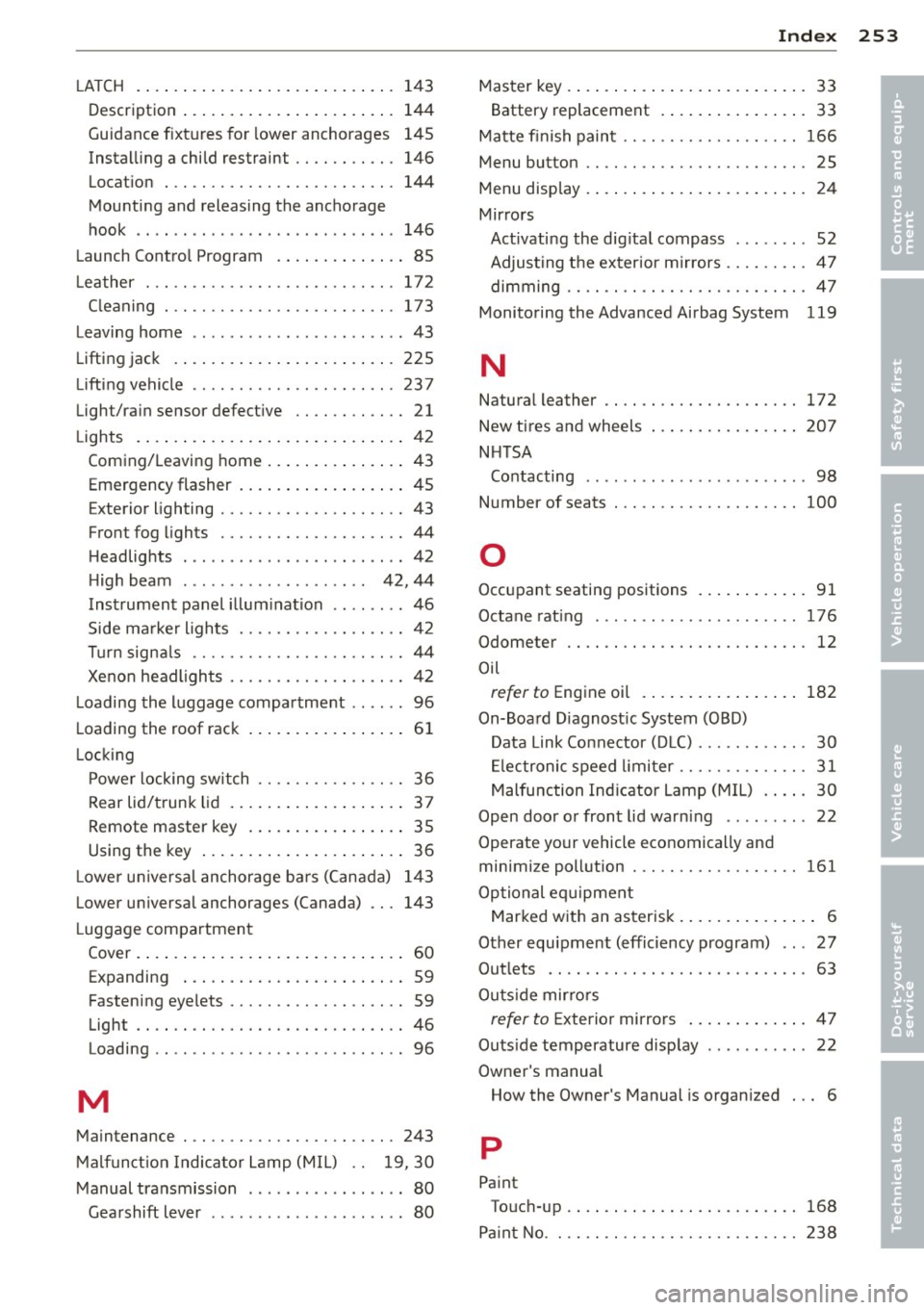
-----------------------------~I~ n~ d~ e~x 253
LA T CH . ..... .. ............ .... .... 143
Description ................. ... ... 144
Guidance f ixtures for lower anchorages 145
Installing a child restraint .. .... .. ... 146
Location
144
Mounting and releasing the anchorage
hook .. .. .. .. ........ ... .. ... ... . 146
Launch Control Program . . . . . . . . . . . . . . 85
L eather . . . . . . . . . . . . . . . . . . . . . . . . . . . 172
C leaning . .. ............. .. .. .. .. . 173
Leaving home ................ .... ... 43
Lifting jack .. ................ ... ... 225
Lifting vehicle ............. .. .. .. .. . 237
Light/rain sensor defective .. .. .. .. .. .. 21
Lights . ..... .. ................ ..... 42
Coming/Leaving home ........... .. .. 43
Emergency flasher .................. 45
Exterior lighting .......... .... .. .. .. 43
Front fog lights .......... .. .. .. .. .. 44
Headlights ............... ... ... ... 42
High beam . . . . . . . . . . . . . . . . . . . . 42, 44
Instrument panel illumination .. . ... .. 46
Side marker lights ........ .. .. .. .. .. 42
Turn signals .. ........... .. .. .. .... 44
Xenon headlights ......... .. .. .. .. .. 42
Loading the luggage compartment ...... 96
Loading the roof rack .......... ... .. .. 61
L ocking
Power locking switch ........ .. .. .. .. 36
Rear lid/trunk lid . . . . . . . . . . . . . . . . . . . 3 7
Remote master key .......... ... .. .. 35
Using the key .................. .... 36
L ower universal anchorage ba rs (Canada) 143
Lower universal anchorages (Canada) 143
L uggage compartment
Cover . ... .. .. ................ ..... 60
Expanding . . . . . . . . . . . . . . . . . . . . . . . . 59
Fastening eyelets ......... .. .. .. .. .. 59
Light .. ... . .... ............. .. .. .. 46
Loading . ... ... .. .. ...... .. .. .. .. .. 96
M
Maintenance . ............. .... .. ... 243
Malfunction Indicator Lamp (MIL) . . 19, 30
Manual transmission ............ .... . 80
Gearshift lever ... .. ...... .. .. .. .. .. 80 Master key ...
..... .................. 33
Battery replacement . . . . . . . . . . . . . . . . 33
Matte finish paint .. ................. 166
Menu button .. .. .. ................. . 25
Menu display . . . . . . . . . . . . . . . . . . . . . . . . 24
Mirrors Activating the dig ita l compass ...... .. 52
Adjusting the exterior mirrors .... .. .. . 47
dimming .. .. .. .. ... .. .......... .. . 47
Monitoring the Advanced Airbag System 119
N
Natural leather .. .. ................. 172
New tires and wheels
NHTSA 207
Contacting ...... .. ................ 98
Number of seats . .. .... ............. 100
0
Occupant seating positions .......... .. 91
Octane rating ... .. .... ........... . .
Odometer
.. .. .. .. ..................
Oil 176
12
refer to Engine oil ................ . 182
On-Board Diagnostic System (OBD)
Data Link Connector (DLC) ....... .. .. . 30
Electronic speed limiter ......... .. .. . 31
Malfunction Indicator Lamp (MIL) ... .. 30
Open door or front lid warn ing ....... .. 22
Operate your vehicle economically and
minimize pollution . ................. 161
Optional eq uipment
Marked with an asterisk . . . . . . . . . . . . . . . 6
Other equipment (efficiency program) .. . 27
Outlets ...... .. ...... ............. . 63
Outs ide mirrors
refer to Exterior mirrors ............. 47
Outs ide temperature display . . . . . . . . . . . 22
Owner's manual How the Owner's Manual is organized . .. 6
p
Paint
Touch-up ... ... .... ............... 168
Pa int No . 238
•
•