airbag AUDI TT 2013 Owner´s Manual
[x] Cancel search | Manufacturer: AUDI, Model Year: 2013, Model line: TT, Model: AUDI TT 2013Pages: 262, PDF Size: 65.91 MB
Page 108 of 262
106 Safety belts
Unfastening safety belts
Unbuckle the safety belt with the red release
button only after the vehicle has stopped .
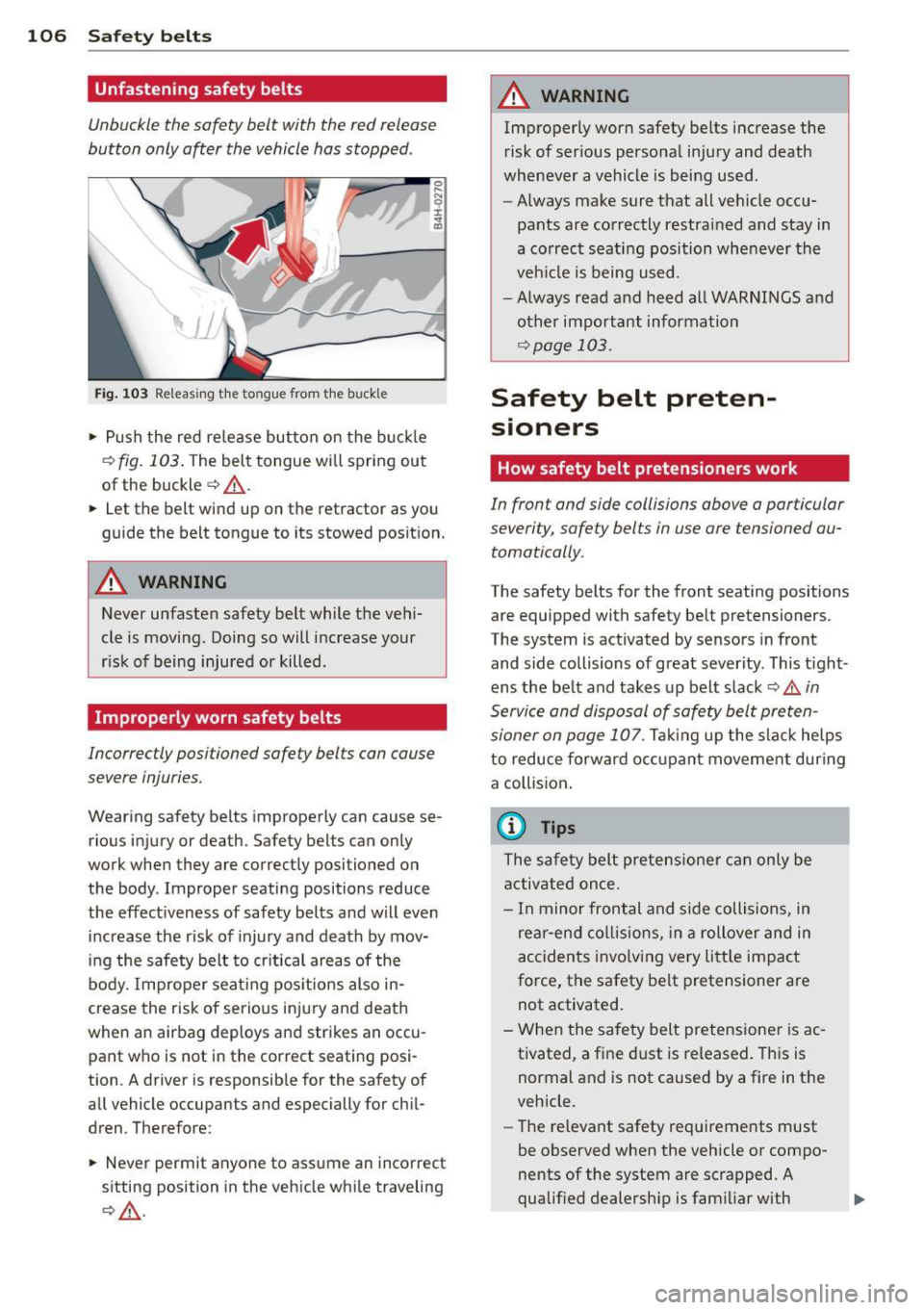
Fig. 103 Releasing the tongue from the buckle
• Push the red release button on the buckle
c> fig. 103. The belt tongue will spring out
of the buckle ~
,A.
0 r-N 0 ±.
"' a,
• Let the belt wind up on the retractor as you
guide the belt tongue to its stowed position.
A WARNING
Never unfasten safety belt while the vehi
cle is moving . Doing so will increase your
r isk of being injured or killed .
Improperly worn safety belts
Incorrectly positioned safety belts can cause
severe injuries.
Wearing safety belts improperly can cause se
rious injury or death. Safety belts can only
work when they are correctly positioned on the body . Improper seating positions reduce
the effectiveness of safety belts and will even
increase the risk of injury and death by mov
ing the safety belt to critical areas of the
body. Improper seating positions also in
crease the risk of serious injury and death
when an airbag deploys and strikes an occu
pant who is not in the correct seating posi
tion . A driver is responsible for the safety of
all vehicle occupants and especially for chil
dren. Therefore:
• Never permit anyone to assume an incorrect
sitting position in the vehicle while traveling
c>,&. .
A WARNING
-Improperly worn safety belts increase the
risk of ser ious personal injury and death
whenever a vehicle is being used.
- Always make sure that all vehicle occu
pants are correctly restrained and stay in
a correct seating position whenever the
veh icle is being used.
- Always read and heed all WARNINGS and
other important information
~ page 103.
Safety belt preten
sioners
How safety belt pretensioners work
In front and side collisions above a particular
severity, safety belts in use are tensioned au
tomatically .
The safety belts for the front seating positions
are equipped with safety belt pretensioners .
The system is activated by sensors in front
and side collisions of great severity. This tight
ens the belt and takes up belt slack
c> .&. in
Service and disposal of safety belt preten
sioner on page 107.
Taking up the slack helps
to reduce forward occupant movement during
a collision.
(D Tips
The safety belt pretensioner can only be
activated once .
- In minor frontal and side collisions, in
rear -end collisions, in a rollover and in
accidents involving very little impact
force, the safety belt pretensioner are
not activated.
- When the safety belt pretensioner is ac
tivated, a fine dust is released. This is normal and is not caused by a fire in the
vehicle.
- The relevant safety requirements must
be observed when the vehicle or compo
nents of the system are scrapped. A
qualified dealership is familiar with
II>
Page 109 of 262
these regulations and will be pleased to pass on the information to you.
- Be sure to observe all safety, environ
mental and other regulations if the vehi
cle or individual parts of the system, par
ticularly the safety belt or airbag, are to
be disposed. We recommend you have
your authorized Audi dealer perform this
service for you .
Service and disposal of safety belt
pretension er
The safety belt pretensioners are parts of the
safety belts on your Audi. Installing, remov
ing, servicing or repairing of belt pretension
ers can damage the saf ety belt system and
prevent it from working correctly in a colli
sion.
There are some important things you have to know to make sure that the effectiveness of
the system will not be impaired and that dis
carded components do not cause injury or pol
lute the environment .
A WARNING
Improper care, servicing and repair proce
dures can increase the risk of personal in
jury and death by preventing a safety belt
pretens ioner from activating when needed
or activating it unexpectedly:
- The belt pretensioner system can be acti
vated only once.
If belt pretens ioners
have been activated, the system must be
replaced.
- Never repair, adjust, or change any parts
of the safety belt system.
- Safety belt systems includ ing safety belt
pretensioners cannot be repaired. Spe
cial procedures are required for removal,
installation and disposal of this system.
- For any work on the safety belt system,
we strongly recommend that you see
your authorized Audi dealer or qualified technician who has an Audi approved re
pair manual, training and special equip
ment necessary .
Safety belts 107
@:) For the sake of the environment
Undeployed airbag modules and preten
sioners might be classified as Perchlorate
Material -special handling may apply, see
www . dtsc. ca.gov/hazard o u swa ste/ per-
ch lo rate . When the vehicle or parts of the
restraint system including airbag modules
safety be lts with pretensioners are scrap
ped, all applicable laws and regulations
must be observed. Your authorized Audi
dealer is familiar with these requirements
and we recommend that you have your
dealer perform this service for you. •
•
Page 110 of 262
108 Airbag sys tem
Airbag system
Important things to know
Importance of wearing safety belts and
sitting properly
Airbags are only supplemental restraints. For
airbags to do their job , occupants must al
ways properly wear their safety belts and be
in a proper seating position.
F or your safety and the safety of your passen
gers, before driving off, a lways:
• Adjust the dr iver's seat and steering wheel
properly ¢
page 91,
• Adjust the front passenger's seat properly
r=:;page 55,
• Wear safety be lts properly r=; page 103,
• Always properly use the proper child re-
stra int to protect children¢
page 130.
In a collision airbags must inflate within the
blink of an eye and with considerable force .
The supplementa l airbags can cause injuries if
the dr iver or the front seat passenger are not
seated properly . Therefore in order to help the
a irbag to do its job, it is impo rtant, both as a
d river and as a passenge r to s it prope rly at all
times.
By keeping room between your body and the
steering wheel and the front of the passenge r
compa rtment, the airbag can inflate fully and
comp lete ly and provide supp lemental protec
tion in ce rtain frontal collisions
r=:; page 91,
Proper occupant seating positions .
For detai ls
on the operat ion of the seat adjustment con
trols ¢
page 55 and c:, page 56.
It's especially important that children a re
properly restrained ¢
page 130.
There is a lot that the driver and the passen
gers can and must do to help the individua l
safety features installed in your A udi work to
gether as a system.
P rope r seat ing pos ition is important so that
the front airbag on the drive r side can do its
job. If yo u have a physical impa irment or con- dition that prevents yo
u from sitting properly
o n the driver seat with the safety belt properly
fastened and reaching the peda ls, or if you
have concerns with regard to the function or
operation of the Advanced Airbag System,
please contact your author ized Audi dealer or
qualified workshop, o r call Audi Customer Re
lations at 1-800-822-2834 fo r poss ible modi
fica tions to your ve hicle.
When the airbag system dep loys, a gas gener
ator will f il l the a irbags, break open t he pad
ded cove rs, and inflate between t he steering
whee l and the dr ive r and be tween the instru
ment pane l and the fron t passenger. The a ir
bags will deflate immediately after dep loy
me nt so that the front occupants can see
t hr ough the windshie ld again witho ut inter
ruption .
All of th is takes p lace in the b link o f an eye, so
fast that many peop le don't even realize tha t
t h e airbags have deployed. The airbags a lso
inflate with a great dea l of force and nothing
shou ld be in their w ay when they deploy.
Front a irbags in combination with properly
wor n safety belts slow down and lim it the oc
cupant's forward movement . T ogether they
help to prevent the drive r and front seat pas
senger from hitti ng pa rts of the inside the ve
hicle while reducing the forces acting on the
occupant dur ing the crash . In this way they
help to reduce the risk of injury to the head
and upper body in the crash. A irbags do not
protect the arms or the lower parts of the
body.
Both front airbags wi ll not inflate in all fronta l
collisions . The triggering of the airbag system
depends on the vehicle dece lerat ion rate
caused by the co llision and registered by the
electron ic control unit. If th is rate is below
the reference value programmed into the con
t rol unit , the airbags will not be trigge red,
even though the car may be badly damaged as
a res ult of the co llision . Ve hicl e damage, re
pair costs o r even the lack of ve hicle damage
is not necessari ly an indication of whether an
airbag shou ld inflate or not .
IJll-
Page 111 of 262
It is not possible to define a range of vehicle
speeds that will cover every possible kind and
angle of impact that will always trigger the
airbags, since the circumstances will vary con
siderably between one collision and another.
Important factors include, for example, the nature (hard or soft) of the object which the
car hits, the angle of impact, vehicle speed ,
etc. The front airbags will also not inflate in
side or rear collisions, or in roll-overs .
Always remember: Airbags will deploy only
once, and only in certain kinds of collisions.
Your safety belts are always there to offer pro
tection in those situations in which airbags
are not supposed to deploy , or when they have
already deployed ; for example , when your ve
hicle strikes or is struck by another after the
first collision.
This is just one of the reasons why an airbag is
a supplementary restraint and is not a substi
tute for a safety belt. The airbag system
works most effectively when used with the
safety belts. Therefore, always properly wear
your safety belts
c::;, page 100 .
A WARNING
Sitting too close to the steering wheel or
instrument panel will decrease the effec
tiveness of the airbags and will increase
the risk of personal injury in a collision.
- Never sit closer than 10 inches (25 cm)
to the steering wheel or instrument pan
el.
- If you cannot sit more than 10 inches
(25 cm) from the steering wheel, investi
gate whether adaptive equipment may
be available to held you reach the pedals
and increase your seating distance from
the steering wheel.
- If you are unrestrained, leaning forward,
sitting sideways or out of position in any
way, your risk of injury is much higher.
- You will also receive serious injuries and could even be killed if you are up against
the airbag or too close to it when it in
flates -even with an Advanced Airbag.
Airbag system 109
-To reduce the risk of injury when an air
bag inflates, always wear safety belts
properly
c::;, page 104, Safety belts.
- Always make certain that children age 12
or younger always ride in the rear seat. If
children are not properly restrained, they
may be severely injured or killed when an
airbag inflates .
- Never let children ride unrestrained or
improperly restrained in the vehicle. Ad
just the front seats properly .
- Never ride with the backrest reclined .
- Always sit as far as possible from the
steering wheel or the instrument panel
c::;, page 91, Proper occupant seating po
sitions .
- Always sit upright with your back against
the backrest of your seat.
- Never place your feet on the instrument
panel or on the seat. Always keep both
feet on the floor in front of the seat to help prevent serious injuries to the legs
and hips if the airbag inflates.
-Never recline the front passenger's seat
to transport objects. Items can also
move into the area of the side airbag or
the front airbag during braking or in a
sudden maneuver. Objects near the air bags can become projectiles and cause
injury when an airbag inflates .
A WARNING
Airbags that have deployed in a crash must
be replaced.
- Use only original equipment airbags ap
proved by Audi and installed by a trained
technician who has the necessary tools
and diagnostic equipment to properly re
place any airbag in your vehicle and as
sure system effectiveness in a crash .
- Never permit salvaged or recycled air bags to be installed in your vehicle. •
•
Page 112 of 262
110 Airbag sys te m
Child restraints on the front seat - some
important things to know
• Be sure to read the impo rtant in formation
and head the WARNINGS for important de
ta ils about ch ildren and Advanced Airbags
i=> page 130.
Even though your vehicle is equipped with an
Advanced Airbag System, make certain that
all children, especially those 12 years and
younger, a lways ride in the back seat properly
restra ined for their age and size. The airbag
on the passenger side makes the front seat a potentially dangerous place for a child to r ide .
The front seat is not the safest place fo r a
chi ld in a fo rward-facing chi ld safety seat. It
can be a very dangerous place for a n infan t or
a child in a rearward-facing seat.
The Advanced Airbag System i n your veh icle
has been certified to comply with the Requ ire
men ts of United States Federa l Mo to r Veh icle
Safety Standard 208 as applicable at the time
your vehicle was manufact ured.
The Standa rd requires the fron t air bag on t he
passenger side to be turned off ("sup
p ressed") if a ch ild up to about one yea r of
age restrained in one of the rear-facing or for
ward-facing infant restraints listed in Federal
Motor Vehicle Safety Standard 208 with which
the Advanced A irbag System in your vehicle
was certified has been installed on the front passenger seat . For a listing of the child re
straints that were used to certify compliance
with the US Safety Standard
c> page 132.
The PASSENGE R AIR BAG OFF light in the in
strument panel tells you when the front Ad
vanced A irbag on the passenger side has been
turned off by t he e lectronic control unit.
Each t ime you tur n on the ignition, the
PAS
SENGER AIR BAG OFF
l ight will come on for a
few seconds and:
- will stay on if the front passenger seat is not
occupied ,
- will stay on if there is a small child or child
restraint on the front passenger seat, -
will go off if the front passenger seat is oc
cupied by an adult as registered by the
weight -sensing mat
r::!) page 119, Monitor
ing the Advanced Airbag System.
T he PASSENGER AIR BAG OFF light comes on
when the control unit detects a tota l weight
on the front passenger seat that req uires the
front a irbag to be turned off .
If the total weight on the front passenge r
seat is more than that of a typica l 1 year -old
c h ild b ut less than the weight of a small
adult, the front airbag on the passenger side
can deploy (the
PASSENGER AIR BAG OFF
li ght does not come on). If the PAS SENGER
AIR BAG OFF
light does not come on, the
front a irbag on the passenger side has not
been turned off by the elect ronic con trol unit
and can deploy if the control uni t se nses an
impact that meets the cond itions stored in its
memory .
For exampl e, th e airbag ma y deplo y if:
-a small ch ild that is heav ie r than a typical 1
year-old ch ild is on the front passenger seat
( r egard less of whethe r the child is in one of
the child safety seats listed
<:!) page 132), or
- a child who has outgrown ch ild restraints is
on t he front passenger seat.
If the front passenger airbag is turned off, the
PASSENGER AIR BAG OFF light comes on in
the instrument pane l and stays on .
The front airbag on the passenger side may
not deploy (the PASSENGER AIR BAG OFF
light does not illum inate and stay lit) even if a
small adult o r teenager, or a passenger who is
not sitt ing up rig ht w ith their back against a
non- re cli ned ba ck res t w it h thei r feet on the
vehicle floor in front of the sea t is on the front
passenge r seat
c::> page 91, Proper seating po
sition for the driver.
If the front passenger a irbag dep loys, the
F ede ra l St andard req uires the airbag to meet
the "low risk" dep loyment criteria to reduce
the risk of injury t hro ugh interaction wit h the
airbag. "Low risk" dep loyment occ urs in those
crashes that take place at lower dece lerat ions ..,_
Page 113 of 262
as defined in the electronic control unit
¢ page 119, PASSENGER AIR BAG OFF light .
Always remember, a chi ld safety seat or infant
carrier installed on the front seat may be
struck and knocked out of position by the rap
id ly inflating passenger's airbag in a frontal
coll is ion . T he airbag cou ld greatly reduce the
effectiveness of the child restraint and even
seriously injure the child during inflat ion.
F or this reason, and because the back seat is
the safest p lace for children -when properly
rest ra ined accord ing to their age and si ze - we
s trongly recommend that children always sit
in the back seat¢
page 130, Child Safety.
A WARNING
A child in a rearward-facing child safety
seat insta lled on the front passenger seat
w ill be seriously injured and can be k illed if
t he front a irbag inf lates - even with an Ad
vanced Airbag System .
- The inflating a irbag w ill hit the child
sa fety seat or infant carrier w it h great
f orce and w ill smash the ch ild safety seat
and child against the backrest , door or
roof .
- Always install rear -facing child sa fety
seats on the rear seat.
- If you mus t install a rearward facing
child safety seat on the front passenger
seat because of exceptional circ umstan
ces and the
PASSENGER AIR BAG O FF
light does not come on and stay on, im
med iately install the rear-facing child
safety seat in a rear seating posit ion and
have the a irbag system inspected by you r
Audi dealer.
- Forward-fac ing ch ild safety seats instal
led on the front passenger's seat may in
terfere with the deployment of the air
bag and cause serious person al injury to
the ch ild .
WARNING
If, in exceptional c ir c umstances, you mus t
install a forwa rd -facing child restra int on
the front passenger's seat:
A irbag system 11 1
-Always ma ke sure the forward-facing
seat has been designed and certified by
its manufacturer for use on a front seat
with a passenger front and s ide a irbag.
- Never put the forward-facing child re
straint up against or very near the instru ment panel.
- Always move the passenger seat into its
rearmost position in t he seat's fore and
aft adj ustment range, as fa r away from
the airbag as possible before installing
the forward-fa cing ch ild restra int. The
backrest mu st be ad ju sted to an upright
posi tion.
- Ma ke sure that the
PASSENGER AIR BAG
OFF
li ght comes on and stays on all the
time wheneve r the ignit ion is swi tched
on.
A WARNING
To reduce the risk of serious injury, make
sure that the
PASSENGER AIR BAG OFF
light wi ll be displayed whenever a child re
straint is installed on the front passenger
seat and the ignition is sw itched on .
- If the
PASSENGER AIR BAG OFF light
does not stay on, perform the checks de
scribed ¢
page 119 , Monitoring the Ad
vanced Airbag System .
-Take t he chi ld restraint off the front pas
senger seat and install it properly at one
of the rear seat positions if the
PASSEN
GER AIR BAG OFF
li g ht does not stay on .
- Have the airbag system inspected by
your Aud i dea le r i mmediately .
- Always carefully follow instr uctions from
child restraint manufacture rs when in
stalling c hild restra ints .
A WARNING
If, in e xcept io na l circumstances, you must
ins tall a forward o r rearwa rd-facing child
restra int on the front passenger's se at:
- Imp roper install ation of ch ild restrai nts
can reduce their effec tiveness o r even
preven t them from providing any protec
tion. •
•
Page 114 of 262
112 Airbag system
-An improperly installed child restraint
can interfere with the airbag as it de
ploys and seriously injure or even kill the
child -even with an Advanced Airbag
System .
- Always carefully follow the manufactur
er's instructions provided with the child
safety seat or carrier.
- Never place additional items on the seat
that can increase the total weight regis tered by the weight-sensing mat and can
cause i njury in a crash .
Front airbags
Description of front airbags
The airbag system con provide supplemental
protection to properly restrained front seat
occupants.
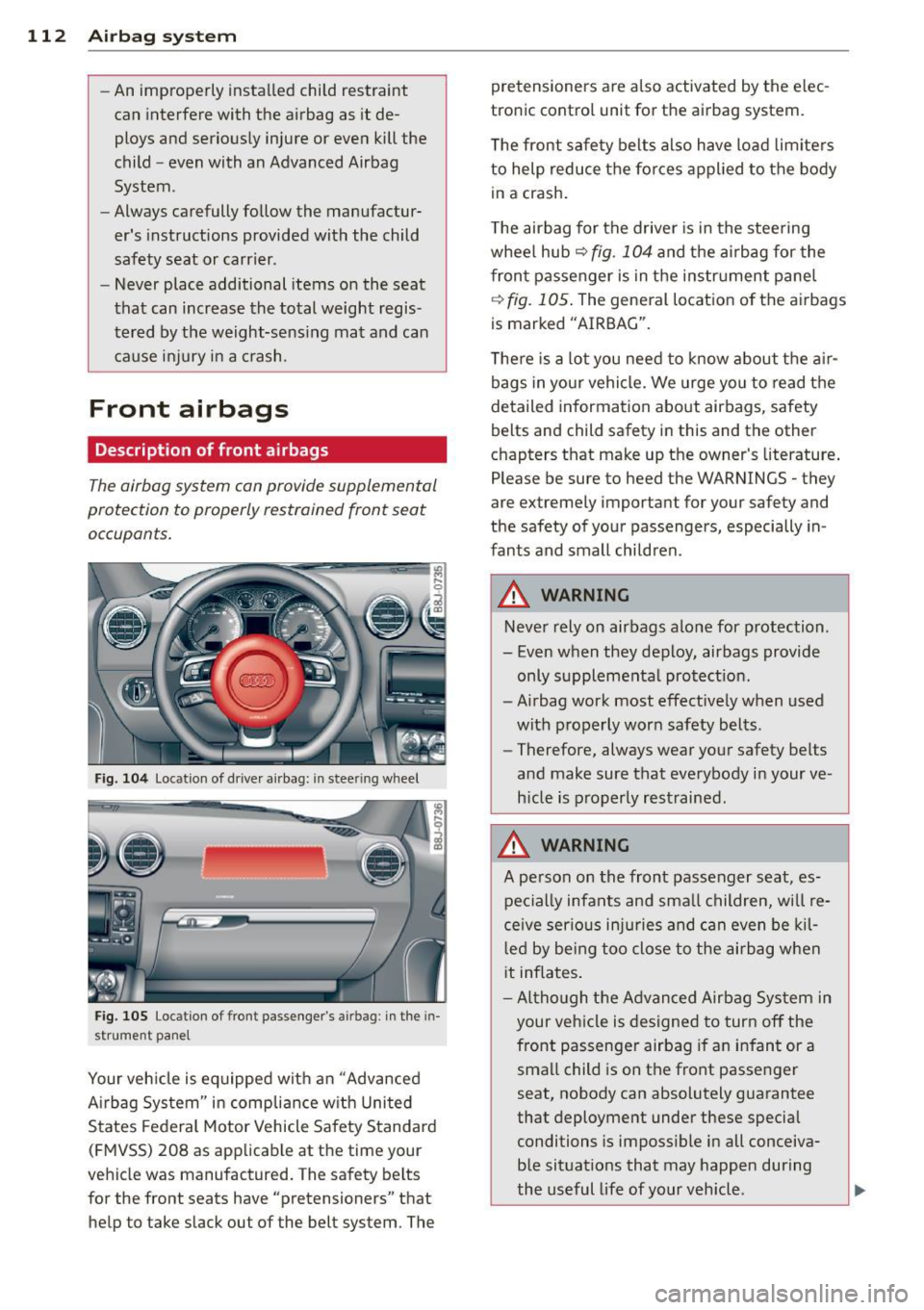
Fig. 104 Location of driver airbag: in stee ring wheel
Fig. 105 Location of front passenger's air bag : in the in
st rume nt panel
Your veh icle is equipped with an "Advanced
A irbag System" in compliance w ith United
States Federal Motor Vehicle Safety Standa rd
(FMVSS) 208 as applicab le at the time your
vehicle was manufactured. The safety belts
for the front seats have "pretensioners" that
help to take slack out of the belt system. The pretensioners are a
lso activated by the e lec
tronic contro l unit for the airbag system.
T he front safety belts also have lo ad lim ite rs
to help reduce the fo rces applied to the body
in a crash .
T he airbag for the d river is in the steering
wheel hub~
fig. 104 and the ai rbag for the
fron t passenger is in the instrument panel
~ fig. 105 . The general locat ion of the ai rbags
is marked "AIRBAG".
T he re is a lot you need to know about t he a ir
bags in you r vehicle. We urge yo u to read the
detailed information abo ut airbags, safety
belts and child safety in this and the other
chapters that make up the owner's literature .
P lease be sure to heed the WARNINGS - they
are extremely important for your safety and
the safety of your passengers, especially in
fants and small children .
A WARNING
Never rely on airbags alo ne for protection .
- Even when they deploy, airbags provide
only supplemental protect ion.
- Airbag work most effective ly when used
with properly worn safety belts.
- Therefore, always wear your safety belts
a nd make sure that eve rybody in your ve
h icle is p roperly rest rained.
A WARNING
A person on the front passenger seat, es
pec ially infants and sma ll children, w ill re
ceive serio us injuries and can even be kil-
l ed by be ing too close to the ai rbag when
i t inflates .
- Al tho ugh the Advanced Airbag System in
your veh icle is designed to tur n
off the
front passenge r airbag if an infant or a
small child is on the front passenger
seat, nobody can absolutely guarantee
that deployment under these special
conditions is impossible in all conceiva
b le situat ions that may happen during
-
the useful life of your vehicle . ~
Page 115 of 262
-The Advanced Airbag System can deploy
in accordance with the "low risk" option
under the U .S . Federal Standard if a child
that is heavier than the typical one-year
old child is on the front passenger seat
and the other conditions for airbag de
ployment are met .
-Accident statistics have shown that chil
dren are generally safer in the rear seat
area than in the front seating position.
- For their own safety, all children, espe
cially 12 years and younger, should al
ways ride in the back properly restrained
for their age and size.
Advanced front airbag system
Your vehicle is equipped with a front Advanced
Airbag System in compliance with United
States Federal Motor Vehicle Safety Standard
208 as applicable at the time your vehicle was
manufac tured.
The front Advanced Airbag System supple ments the safety belts to provide additional
protection for the driver's and front passeng
er's head s and upper bodies in frontal crashes.
T he airbags inflate only in frontal impacts
when the vehicle deceleration is high enough.
T he front Advanced Airbag System for the
front seat occupants is not a substitute for
your safety belts . Rather, it is part of the over
all occupant restraint system in your vehicle.
Always remember that the airbag system can
only help to protect you, if you are sitting up
right , wearing your safety belt and wearing it
properly . This is why you and your passengers
must always be properly restrained, not just
because the law requires you to be.
The Advanced Airbag System in your vehicle has been certified to meet the "low risk" re
quirements for 3 and 6 year-old children on
the passenger side and very small adults on
the driver side. The low risk deployment crite
ria are intended to help reduce the risk of in
jury through interaction with the front airbag that can occur, for example, by being too
Airbag system 113
close to the steering wheel and instrument
panel when the airbag inflates.
In addition, the system has been certified to
comply with the "suppression" requirements
of the Safety Standard, to turn off the front
airbag for infants 12 months old and younger
who are restrained on the front passenger
seat in child restraints that are listed in the
Standard ¢
page 132 , Child restraints and
Advanced Airbags .
"Suppression" requires the front airbag on the
passenger side to be turned off if:
- a child up to about one year of age is re
strained on the front passenger seat in one
of the rear-facing or forward-facing infant restraints listed in Federal Motor Vehicle
Safety Standard 208 with which the Ad
vanced Airbag System in your vehicle was
certified . For a listing of the child restraints
that were used to certify your vehicle's com pliance with the US Safety Standard
¢page 132,
-weight less than a threshold level stored in
the control unit is detected on the front pas
senger seat.
When a person is detected on the front pas senger seat, weighing more than the total
weight of a child that is about 1 year old re
strained in one of the rear-facing or forward
facing infant restraints (listed in Federal Mo
tor Vehicle Safety Standard 208 with which
the Advanced Airbag System in your vehicle
was certified), the front airbag on the passen ger side may or may not deploy.
The
PASSENGER AIR BAG OFF light comes on
when the electronic control unit detects a to
tal weight on the front passenger seat that re
quires the front airbag to be turned off. If the
PASSENGER AIR BAG OFF light does not
come on, the front airbag on the passenger
side has not been turned off by the control unit and can deploy if the control unit senses
an impact that meets the conditions stored in
its memory.
If the total weight on the front passenger
seat is more than that of a typical 1 year-old , ..,. •
•
Page 116 of 262
114 Airbag sys te m
but less than the weight of a small adu lt, the
front airbag on the passenger side may deploy (the
PASSENGER AIR B AG OFF light does not
come on).
F or exa mple , the air b ag m ay depl oy if:
- a small child that is heavier than a typical 1
year-o ld child is on the front passenger seat
(regardless of whe ther the child is in one of
the chi ld safety seats listed
~ page 132),
- a ch ild who has outgrown child rest raints is
on the front passenger seat.
If the front passenger airbag is turned off, the
PA SSENGER AIR BAG OFF light in the cente r
of the instrument panel w ill come on and stay
on.
The front a irbag on the passenger side may
not deploy (the PAS SENGER AIR BAG OFF
light does not illuminate and stay lit) if:
- a small adult or teenager is on the front pas
senger seat
- a passenger who is not sitt ing upright with
their back against a non-reclined backrest
with their feet on the veh icle floo r in front
of the seat is on the front passenger seat.
If the front passenger airbag deploys, the Federal Standard requires the airbag to meet
the "low risk " deployment criteria to help re
duce the risk of inju ry through interaction
with the airbag . "Low risk" deployment occurs
in those crashes that take place at lower de
celerations as defined in the e lectronic control
un it
~ page 119.
Alw ays re m emb er: Even tho ugh you r vehicle
is equipped with Advanced Airbags, the safest
p lace for children is properly restrained on the
back seat . Please be sure to read the impor
tant information in the sect ions that follow
and be sure to heed all of the WARNINGS.
A WARNING
To reduce the risk of injury when an airbag
inf lates, always wear safety belts properly.
- If you are unrestrained, lean ing forward,
sitting sideways or out of position in any
way, your risk of in jury is much higher . -
You will a lso receive serious injuries and
could even be killed if you are up aga inst
the airbag or too close to it when it in
flates - even w ith an Advanced A irbag
~ page 108 .
A WARNING '"----
A child in a rearward-fac ing ch ild safety
seat installed on the front passenger seat
will be serious ly injured and can be killed if
the front airbag infla tes - even with an Ad
vanced A irbag System.
- Altho ugh the Advanced Airbag System in
your veh icle is de signed to turn off the
front airbag when a rearward -facing
child restraint has been installed on the
front passenger seat, nobody can abso
lutely g uarantee that dep loyment is im
possible in all conceivable situations that
may happen dur ing the usefu l life of your
veh icle.
- The inflating airbag will h it the ch ild
safety seat or infant carrier with great
force and will smash the child safety seat and child aga inst the bac krest, door, or
roof .
- Always install rearward-facing ch ild re
straints in the back seat.
- If you must install a rearward fac ing
child safety seat on the front passenger
seat be cause of exceptiona l circumstan
ces and the
PASSENGER AIR BAG OFF
light does not come on and stay on, im
mediately insta ll the rear -fac ing child
safety seat in a rear seating position and
have the airbag system inspected by your
Aud i dealer.
A WARNING
If, in exceptional circumstances, you must
i nstall a forward-facing child restraint on
the front passenger's seat:
- Always make sure the forward-facing
seat has been designed and certified by
its manufacture r fo r use on a front seat
with a passenger front and s ide a irbag .
Page 117 of 262
-Never put the forward-facing child re
straint up against or very near the instru
ment panel.
- Always move the passenger seat into its
rearmost position in the seat's fore and
aft adjustment range, as far away from
the airbag as possible, before installing
the forward-facing child restraint . The
backrest must be adjusted to an upright
position.
- Make sure that the
PASSENGER AIR BAG
OFF
light comes on and stays on all the
time whenever the ignition is switched
on.
Advanced Airbag System components
The front passenger seat in your vehicle has a
lo t of very important parts of the Advanced
Airbag System in it. These parts include the
weight-sens ing mat, sensors, wiring, brack
ets, and more. The function of the system in
the front passenger seat is checked by the
electronic control unit when the ignition is on.
The control unit monitors the Advanced Air
bag System and turns the airbag indicator
light on when a malfunction in the system
components is detected. The function of the
airbag indicator light is described in greater
detail below. Because the front passenger
seat contains important parts of the Ad
vanced Airbag System, you must take care to
prevent it from being damaged. Damage to
the seat may prevent the Advanced Airbag for
the front passenger seat from doing its job in
a crash .
The front Advanced Airbag System
consists of the following:
- Crash sensors in the front of the vehicle that
measure vehicle acceleration/deceleration
to provide information to the Advanced Air
bag System about the severity of the crash.
-An electronic control unit, with integrated
crash sensors for front and side impacts .
The control unit "decides" whether to fire
the front airbags based on the information
r eceived from the crash sensors. The control
Airbag system 115
unit also "decides" whether the safety belt
pretensioners should be activated.
- An Advanced Airbag with gas generator for
the driver inside the steering wheel hub.
- An Advanced Airbag with gas generator in
side the instrument panel for the front pas
senger.
- A weight-sensing mat under the upholstery
padding of the front passenger seat cushion
that measures the total weight on the seat.
The inform ation registered is sent continu
ously to the electronic control unit to regu
late deployment of the front Advanced Air
bag on the passenger side.
- An airbag monitoring system and indicator
light in the instrument cluster
c:;. page 119.
-The PASSENGER AIR BAG OFF light comes
on and stays on in the center of the instru
ment panel
c:;. page 119, fig. 107 and tells
you when the front Advanced Airbag on the
passenger side has been turned off.
- A sensor below the safety belt latch for the
front seat passenger to measure the tension
on the safety belt. The tension on the safety
belt and the weight registered by the
weight-sensing mat help the control unit
"decide" whether the front airbag for the
front passenger seat should be turned off or
not
c:;. page 110, Child restraints on the
front seat -some important things to
know.
- A sensor in the safety belt latch for the driv
er and for the front seat passenger that
senses whether that safety belt is latched or
not and transmits this information to the
electronic control unit .
.&_ WARNING
Damage to the front passenger seat can
prevent the front airbag from working
properly.
- Improper repair or disassembly of the
front passenger and driver seat will pre
vent the Advanced Airbag System from
functioning properly.
- Repairs to the front passenger seat must
be performed by qualified and properly
-
trained workshop personnel. 111>
•
•