tire pressure AUDI TT 2013 Owner´s Manual
[x] Cancel search | Manufacturer: AUDI, Model Year: 2013, Model line: TT, Model: AUDI TT 2013Pages: 262, PDF Size: 65.91 MB
Page 212 of 262
210 Tire s and wheel s
Driving with different tires reduces vehi
cle handling and can lead to a loss of
co ntrol.
- If the spare tire is not the same as the
t ires that are mounted on the veh icle -
for example with winter tires - on ly use
the spare tire for a short period of time
and dr ive with extra ca re. Refit the nor
ma l road whee l as soon as safely possi
ble.
- Never drive faste r than the maximum
speed for which the tires o n your veh icle
are ra ted because ti res th at are driven
faster than their rated speed can fail
sudden ly .
- Over loading t ires c ause heat b uild- up,
sudden tire failure, including a blowout
and sudden deflation and loss of control.
- T emperature grades app ly to tires t hat
are properly inflated and not over o r un
derinflated.
- F or technical reasons it is not a lways
possible to use wheels from other
vehicles -in some cases not even w heels
from the same vehicle model.
- If you insta ll wheel trim discs on t he ve
hicle whee ls, make sure that the air f low
to the brakes is not blocked. Reduced air
flow to the brakes can them to overheat, increasing stopping distances and caus
ing a collision.
- Run flat t ires may on ly be used on
vehicles that were equ ipped w it h them
at the facto ry. The vehicle must have a
chassis des igned for run f lat t ires and a
fac to ry-installed t ire p ress ure moni to r
ing system that ind ic a tes a loss of tire
pressure. Incorrect use of run flat tires
can lead to vehicle damage or accidents .
Check with an a uth orized Audi dea ler or
t i re spec ialist to see i f your vehicle can be
equipped with run flat tires. If r un flat
t ires a re used, they must be installed on
all four wheels . M ixing tire types is not
permitted . (D Note
-For technical reasons, it is not generally
poss ible to use the w heel rims from oth
er ve hicles. T his can hold tr ue for wheels
of the same vehicle type.
- If the spare tire is diffe rent from the
tires that you have mounted on your ve
hicle (for example winter tires or wide
profi le tires), then use the spare tire for a
short period of time only and drive w ith
extra care. Replace the flat tire w it h the
ti re mat ching the othe rs on your vehicle
as soon as possi ble.
- N ever d rive without the valve stem cap.
T he v alves co ul d get damaged.
@ For the sake of the environment
Dis pose of o ld tires in accordance w ith the
l ocal requirements.
Uniform tire quality grading
- Tread wear
- Tra ction AA A B (
- Temperature ABC
Quality grades can be found where applicab le
o n the tire s ide wall between tread shoulder
and maximum section width
¢ page 207,
fig. 146.
For example: Tread wear 200 , Traction AA,
Temperature A.
All passenger car ti res must conform to Feder
al Safety Req uirements in add ition to these
grades .
Tread wear
The tread wear g rade is a comparative rating
based on the wear rate of the tire when tested
u nder contro lled conditions o n a specified
government test course.
F o r example, a tire gra ded 150 wo uld wear
one and one ha lf (11/2) times as well on the
government course as a ti re graded 100.
Page 215 of 262
snow c hains are suitably cove red . Check
the position of the snow chains after
driving a few yards and correct if neces
sary. Follow the instructions from the
snow cha in manufacturer when doing so.
Where snow cha ins are mandatory oncer
tain roads, this normally also applies to
veh icles with all-wheel dr ive.
Wheel bolts
Wheel bolts must always be tightened to the
correct torque.
The design of whee l bolts is matched to the
factory insta lled r ims . If different rims are fit
ted, the correct wheel bo lts with the right
length and correctly shaped bolt heads must
be used. This ensures t hat wheels are fitted
securely and that the brake system functions
correctly .
In certain circumstances, you may not use
wheel bo lts from a different vehicle -even if it
i s the same model
¢ page 245.
A WARNING
Imprope rly tig htened or maintained wh eel
bolts can become loose ca using loss of
con trol, a collision and serious person al in
jury.
- Always keep the w heel bolts and the
threads in the wheel hubs clea n so the
wheel bolts can tu rn easily and be p rop
er ly tightened .
- Never grease or oil the wheel bo lts and
the threads in the wheel hubs. They can become loose w hile d riving if greased or
o iled, even if tig htened to the specif ied
torque.
- Only use whee l bolts that belong to the
rim being installed.
- Never use different whee ls bolts on your
vehicle.
- Always maintai n the co rrect tig htening
torq ue fo r the wheel bo lts to reduce the
risk of a wheel loss. If the tightening tor-
Tire s an d wheel s 213
que of t he whee l bolts is too low, they
can loosen and come out when the vehi
cle is mov ing. If the tig htening torq ue is
too high, the wheel bolts and threads
can be damaged and the whee l can be
come loose.
(D Note
The specified torque for the whee l bolts is
90 ft lb (120 Nm) with a tolerance of± 7,4
ft lb(± 10 Nm). Torq ue whee l bolts diago
nally. After changing a whee l, the tor que
must be checked as soon as possible with a
torq ue w rench -prefe rably by an au thor
iz ed A udi de aler or qu alified workshop .
Low aspect ratio tires
Your Audi is factory -eq uipped w ith low aspect
r atio tires . These tires have been tho roughly
tested and been se lected specifically for your
model for their superb performance, road fee l
and handli ng under a var iety of driving condi
tions . Ask your authorized Audi dealer for
more d etails.
The low aspect ratio of these t ires is ind icated
by a numeral of
55 or less in the tire's s ize
designation . The numeral represents the ratio
of the t ire's sidewa ll height in relation to its
t read width exp ressed in pe rce ntage. Conven
t iona l tires have a he ight/w idth rat io of 60 or
more.
The performanc e of low-a spect-ratio tire s is
particularly sensitive to impr oper inflation
pre ssure .
It is therefore important that low
a spect ratio tire s are inflated to the specified
pres sure and that the inflation pressure is
regularly checked and maintained. Tire pre s
sures should be checked at least once a month and always befo re a long trip
¢ page 202, Checking tire pressure.
What you can do to avoid tire and rim
damage
Low aspect ratio tires can be damaged mo re
easily by impact w it h potholes, curbs, gul lies ..,.
•
•
Page 216 of 262
214 Tire s and wheel s
or ridges on the road, part icu larly if the tire is
u nderinflated.
I n o rder to m inim ize the o ccurrence of impact
damage to the t ires of your vehicle, we recom
mend that you observe the following precau
tions:
- Always maintain recommended infla tion
pressures. Check your t ire pressure every
2,000 miles (3,000
km) and add air if neces
sary .
- Drive carefu lly on roads with potholes, deep
gullies or ridges. The impact from driving
t h rough or over such obstacles can damage
your tires. Impact with a curb may also cause damage to your tires.
- After any impact, immediately inspect your
tires or have them inspected by the nearest
authorized Aud i dealer. Replace a damaged
t ire as soon as possible .
- Inspect your t ires every 2,000 miles (3,000
km) for damage and wear . Damage is not al
ways easy to see . Damage can lead to loss of
air and underinflation, wh ich could eventu
ally cause t ire failure . If you be lieve that a
t ire may have been damaged, replace the
t ir e as soon as possible.
- T hese tires may wea r mo re quick ly than oth
ers.
- Please a lso remember that, wh ile these t ires
deliver respons ive handling, they may ride
l ess comfortably and make mo re no ise than
other choices.
Reduced performance in winter /co ld
sea son condit ion s
All ti res a re des igned for certa in pu rposes.
The low aspect ratio, ultra high performance
tires originally installed on your vehicle are in
tended for max imum dry and wet road per
formance and handling. They are not suitable
for cold, snowy or icy weather condit ions. If
you dr ive under those circumstances, you
should equip your vehicle with all -season or
winter tires, which offer better traction under
those cond it ions. We suggest you use the rec
ommended snow or all-season tires specified
fo r your vehi cle, or their eq uivalent. Refer to
q page 211
for more detailed infor
mation regarding winter tires.
Tire pressure monitoring system
General notes
Applies to veh icles: w ith tire pressure monitoring system
Each tire, incl uding the spare ( if provided),
sho uld be checked monthly when co ld and in
flated to the inflation pressure recommended by the veh icle manufacturer on the veh icle
placard or tire inflation pressure label. (If your
vehicle has tires of a different size than the
s ize indicated on the vehicle placard or tire i n
flat ion p ressure label, you should dete rmine
the p roper t ire infla tion p ress ure fo r th ose
t i res.)
As an added safety feature, your ve hicle has
been equipped with a tire pressure mon itoring
system ( TPM S) tha t illum inates a low ti re
pressure tel ltale when one o r more of your
tires is significant ly under-inflated . Acco rding
l y, when the low tire pressure telltale i llumi
nates, you shou ld stop and check your tires as
soon as possib le, and inflate them to the
proper pressure. Driving on a sign ificantly un
der- inflated t ire causes the tire to overheat
and can lead to tire fa ilure . Under-inflat ion al
so reduces fuel effic iency and tire tread life ,
and may affect the vehicle 's hand ling and
stopp ing abili ty.
Please note that the TPMS is not a substitute
for proper tire ma intenance, and it is the driv
er's respons ibility to maintain co rrect tire
pressure, even if under-inflation has not
reached the leve l to tr igger illum inat ion of the
T PMS low tire pressu re tellta le .
You r vehicle has also been equipped with a
T PMS ma lf u nction indicator to ind icate when
the sys tem is not operating p roperly . Th e
T PMS ma lfunction indicator is combined w ith
t h e low tire pressure te lltale. When the sys
tem detects a malfunction, the telltale will
flash for approximately one min ute and then ..,_
Page 217 of 262
remain continuous ly illuminated . This se
quence will continue upon subsequent vehicle
start-ups as long as the ma lfunction ex ists.
When the malfunct ion indicator is ill uminat
ed, the system may not be able to detect or
signa l low tire pressure as intended. TPMS
malfunct ions may occur for a variety of rea
sons, including the installat ion of replace
ment or alternate tires or wheels on the veh i
cle that prevent the TPMS from funct io ni ng
properly. Always check the TPMS malfunct ion
tellta le afte r replacing one or more t ires or
wheels on your veh icle to ensure that the re
p lacement or a lternate tires and wheels allow
the TPMS to continue to function properly.
Tire pressure indicator appears
Applies to vehicles: with tire pressure monitoring system
The tire pressure indicator in the instrument
cluster informs you if the tire pressure is too
low or if there is a system malfunction.
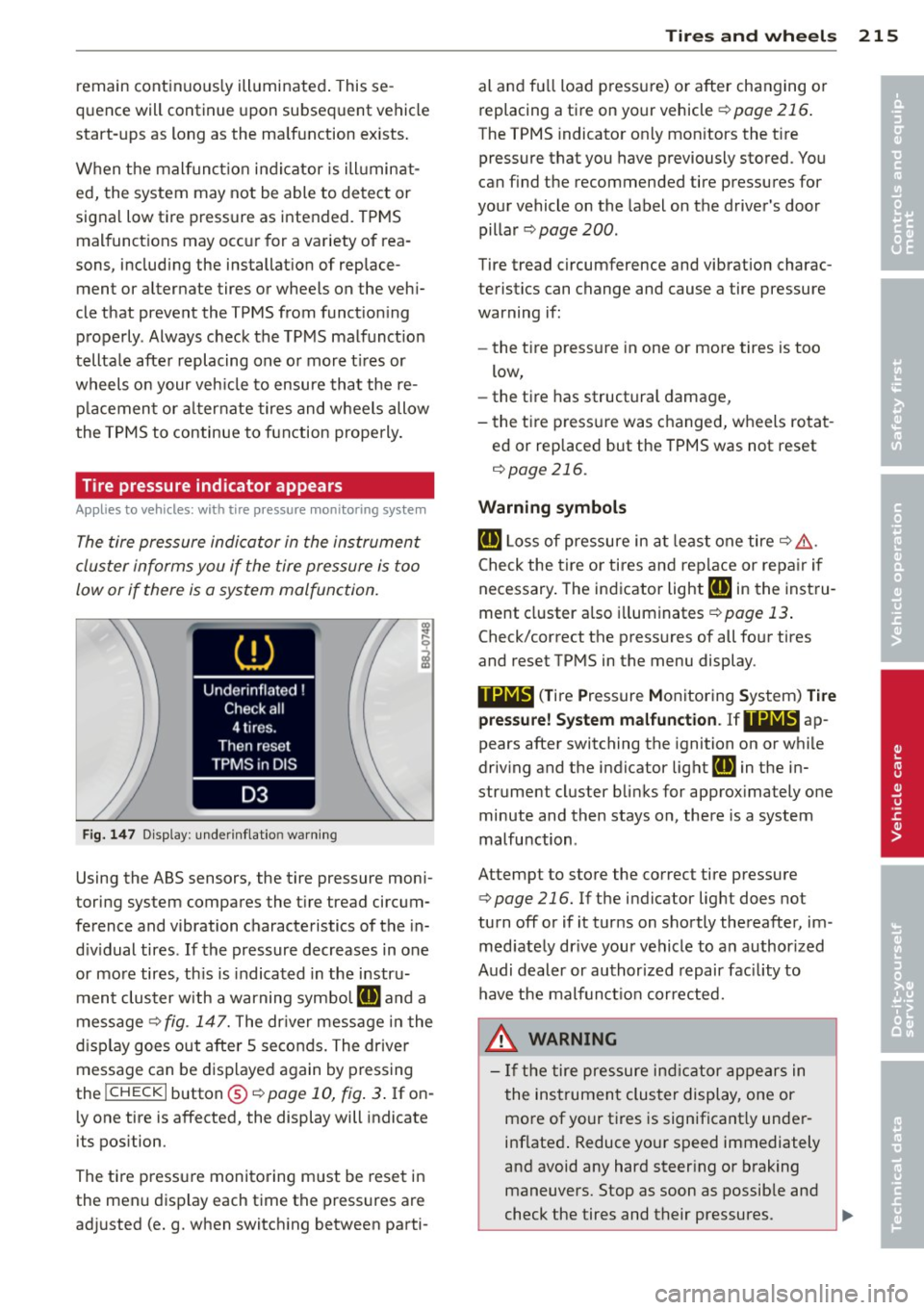
F ig. 1 47 Disp lay : under infla tion warn ing
Using the ABS sensors, the tire pressure moni
toring system compares the t ire tread circum
fe rence and vibration characteristics of the in
d iv idual tires . If the pressure decreases in one
or mo re tires, th is is indicated in the instru
ment clus ter with a warning symbol
RE and a
message
'* fig. 147. The dr iver message in the
d isp lay goes out after 5 seconds. The driver
message can be d isplayed again by pressing
the
! CHECK I button @¢ page 10, fig . 3 . If on
ly one tire is affected, the display will indicate
its pos ition.
The ti re pressure monito ring m ust be reset in
the menu display each time the pressures are
ad justed (e.g. when switching between parti-
Tire s an d wheel s 215
al and fu ll load pressure) or after changing o r
replacing a tire on your vehicle '*
page 216.
The TPMS indicator on ly mon itors the t ire
pressure that you have previously stored . You
can f ind the recommended tire pressures for
your vehicle on the label on the driver's door
pillar ¢
page 200.
Tire tread circumference and vibration charac
teristics can change and cause a tire pressure
warning if:
- the t ire press ure in one or more tires is too
low,
- the tire has structural damage,
- the t ire press ure was changed, wheels rotat -
ed or rep laced but the TPMS was not reset
¢ page 216.
Warning symbo ls
RE L oss of pressure in a t least one tire ¢ ,&..
Check the tire or tires and rep lace or repa ir if
necessary . The indicator light
RE in the inst ru
ment cluster a lso i lluminates
¢ page 13 .
Check/correct the press ures of all four tires
and reset TPMS in the menu display .
Iii;~, (T ire Pressure Monitoring System) Ti re
pre ssure! System malfun ction .
Ifllilff' ap
pears after switching the ignition on or whi le
driv ing and the indicator light
RE in the in
strument cluster blinks for approx imately one
minute and then stays on, there is a system
malfunction .
Attempt to store the correct tire pressure '*
page 216. If the indicator light does not
turn off or if it turns on shortly thereafter, im
med iate ly dr ive your vehicle to a n author ized
Audi dealer or author ized repair fac ility to
have the malfunct io n cor rected.
.8, WARNING
-
- If the tire pressure ind ic a tor ap pears in
the ins trumen t cluster display, one or
more of your tires is significant ly under
inflated . Reduce yo ur speed immediately
and avoid any hard steer ing or braking
maneuvers. Stop as soon as possible and
check the tires and their pressures.
~
•
•
Page 218 of 262
216 Tires and wheels
Inflate the tire pressure to the proper
pressure as indicated on the vehicle's tire
pressure label¢
page 200. Driving on a
significantly under-inflated tire causes
the tire to overheat and can lead to tire
failure. Under-inflation also is likely to
impair the vehicle's handling and stop
ping ability .
- The driver is responsible for maintaining
the correct tire pressures. You must
check the tire pressures regularly.
- Under certain conditions (such as a spor
ty driving style, winter conditions or un
paved roads), the pressure monitor ind i
cator may be delayed.
- Ask your authorized Audi dealer if run
flat tires may be used on your vehicle .
Your vehicle registration becomes invalid
if you use these tires when not permit
ted. Damage to your veh icle or accidents
could also result.
- If you switch between standard and run
flat tires, an authorized Audi dealer or
qualified workshop must reprogram the
control module .
@ Tips
-The tire pressure monitoring system
stops working when there is an ESC/ABS
malfunction.
- Using snow chains may result in a system
malfunction .
- The tire pressure monitoring system on
your Audi was developed using t ires with
the "AO" or "RO" identification on the
tire sidewall ¢
page 207. We recom
mend using these tir es.
Reset tire pressure monitoring system
(Stepl)
Applies to veh icles: w ith tire pressure monitoring system
If the tire pressure is adjusted, wheels are ro
tated or changed, the TPMS must be reset in
the menu display.
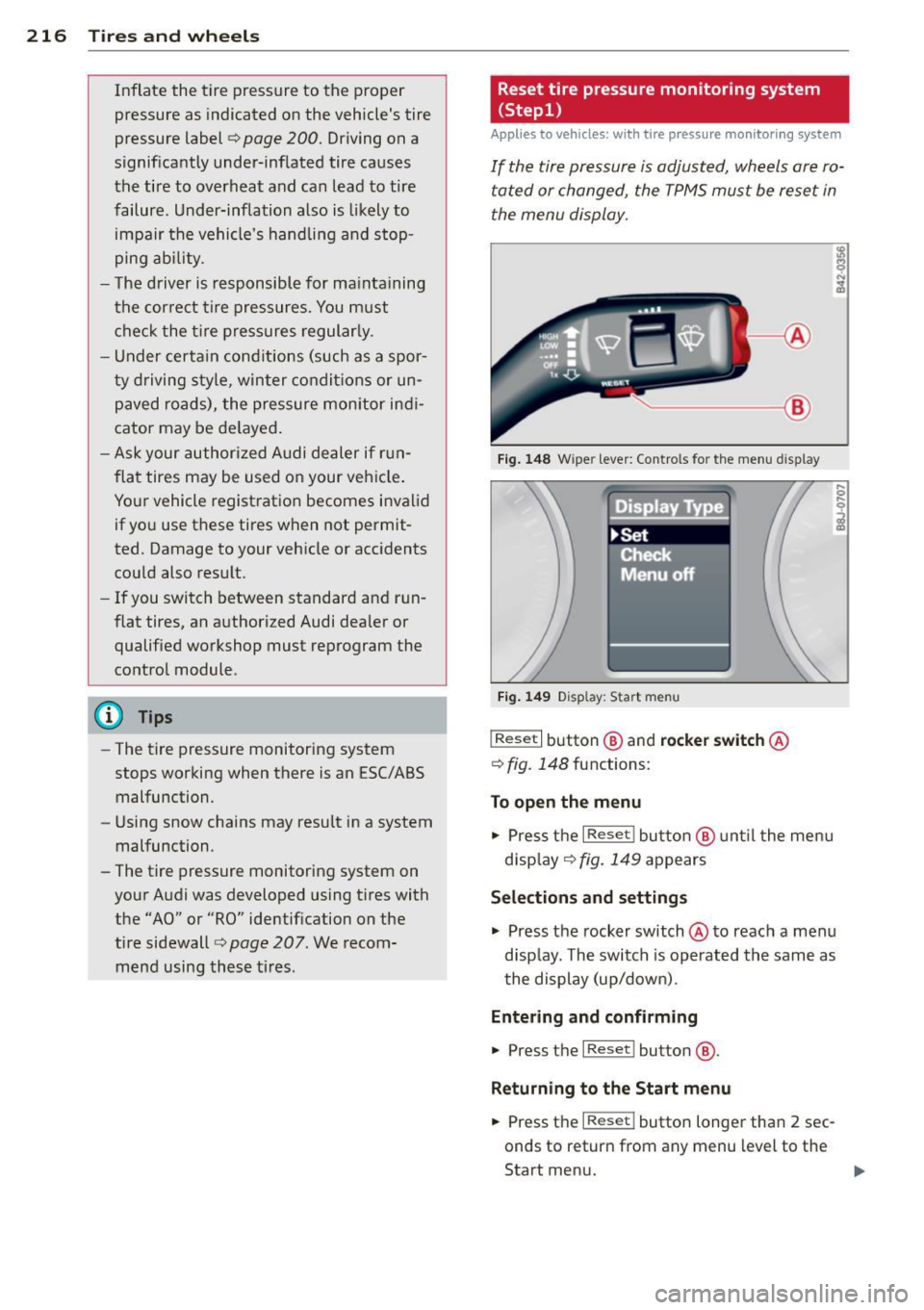
----- ®
Fig. 148 Wipe r lever: Contro ls fo r the menu d isplay
Fig. 149 Disp lay: S ta rt m enu
I Rese t I button @ and rocker switch @
¢
fig. 148 functions:
To open the menu
" Press the I Reset ! button @ unt il the menu
disp lay
~fig. 149 appears
Selections and settings
" Press the rocker switch @ to reach a menu
disp lay. The switch is operated the same as
the display (up/down) .
Entering and confirming
" Press the I Reset I button @.
Returning to the Start menu
" Press the I Rese t I button longer than 2 sec
onds to return from any menu level to the
Start menu.
Page 219 of 262
@ Tips
-Before resetting the TPMS, the current
pressures of
all four tires must corre
spond t o the specified va lues. Adjust the
tire pressu re and reset the pressure in
the tire pressure mon itor ing system ac
cord ing to the load yo u are carry ing
c::> page200.
- Do not store the tire pressure if there are
snow cha ins on the tire .
Reset tire pressure monitoring system
(Step2)
A pplies to vehicles: with t ire pressure monitoring syste m
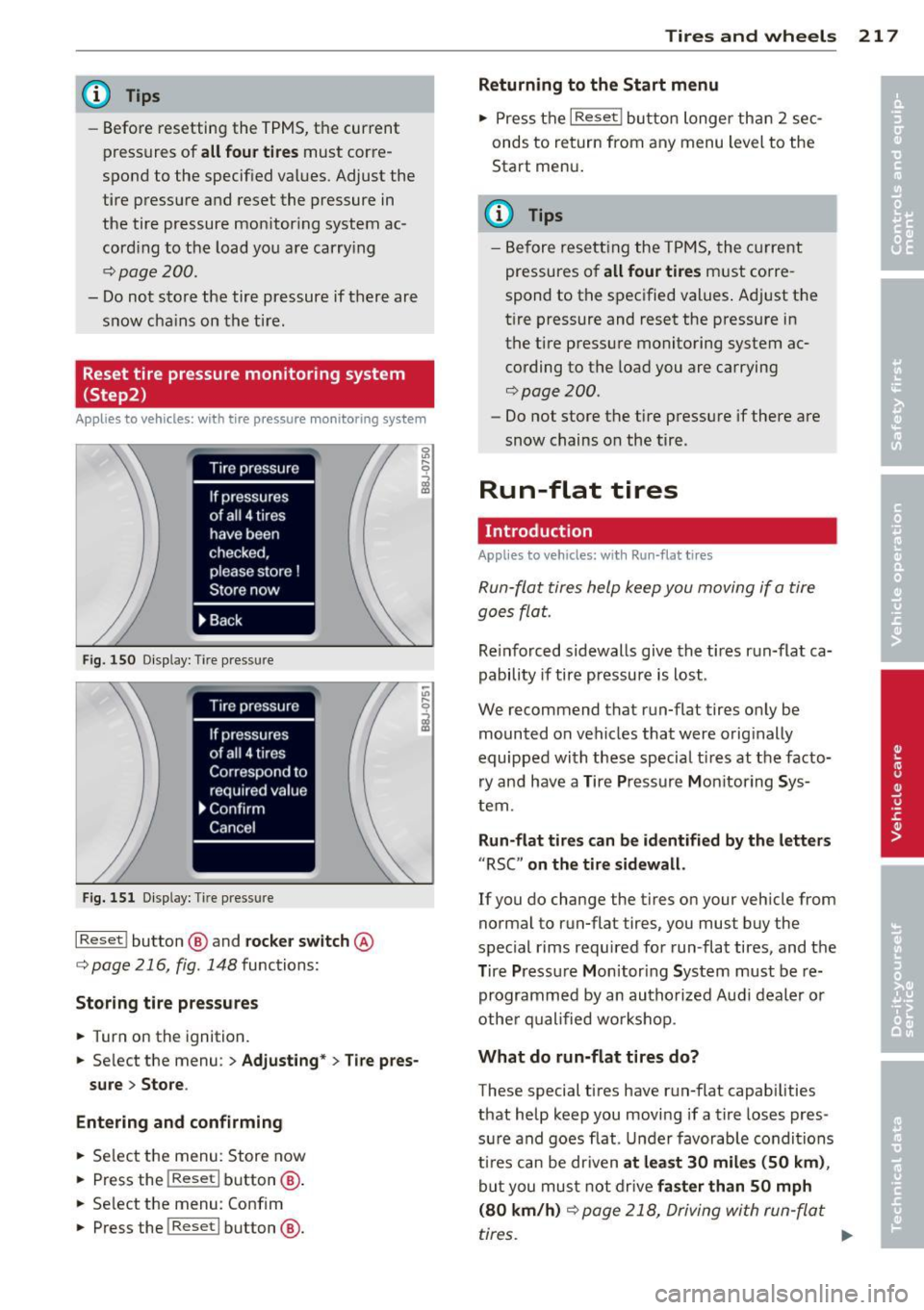
Fig. 150 D isplay: Tire pressure
Fig. 151 D isp lay: Tir e pressure
I Reset ! button @ and rocker sw itch @
c::> page 216, fig. 148 functions:
Storing tire pressure s
.,. Turn on the ignition.
.,. Se lect the menu :
> Adjusting* > Tire pres-
sure
> Store .
Entering and confirming
.,. Se lect the menu: Store now
.,. Press the
!Reset I button @.
.,. Se lect the menu: Confim
.,. Press the
!Reset I button @. Tires and wheels 21
7
Returning to the Start menu
.,. Press t he I Reset l butto n longer tha n 2 sec
onds to re turn from any menu level to the
Start men u.
(D Tips
-Before rese tt ing the TPMS, the c urrent
pressures o f
all four tires must corre
spond to t he spec ified values . Adj ust t he
t ir e pr essure and reset the pressure in
the tire pressu re monitoring system ac
co rding to the load you are ca rrying
c::> page 200.
- Do not store the tire pressure if there are
snow chains on the tire.
Run-flat tires
Introduction
Applies to vehicles: wit h Run-fla t tires
Run-flat tires help keep you moving if a tire
goes flat.
Re inforced sidewalls give the t ires r un-flat ca
pabili ty if tire pressure is lost .
We recommend that run-flat tires o nly be
mounted on vehicles that were orig inally
equipped with these special t ires at the facto
ry an d have a Tire Pressu re Monitoring Sys
tem .
Run-flat tir es can be identifi ed by th e letters
"RSC" on the tire sidewall.
If you do change the tires on your veh icle from
no rma l to run-flat tires, you must buy the
special rims required fo r run-flat tires, and the
T ire Pressu re M on itor ing System must be re
programmed by an authorized Aud i d ealer o r
othe r qualified wo rkshop .
What do run -flat tires do?
These special tir es have run-flat capab ilities
that help keep you moving if a tire loses pres
s ur e and goes flat. Under favorab le condi tions
t ir es can be dr iven
at least 30 miles (SO km) ,
but you mus t not drive fa ster than SO mph
( 80 km/h)
c::> page 218, Driving with run-fla t
tires .
Ill-
Page 220 of 262
218 Tires and wheels
When it is not possible to continue
driving , even with run-flat tires?
-If the E lectronic Stabilization Control (ESC)
is not working or keeps coming on.
- If the
Tire Pr essure Monitoring System does
not work .
- If the tire has been severely damaged, in a
crash , for example. The tread can separate
from a damaged tire as the wheel turns, and
hit parts of the vehicle, such as the fuel tank
filler neck , fuel lines or brake lines.
- Do not continue driving if severe vibration occurs or if the tire starts to smoke because
the tire is running hot.
- Do not continue driving if damage to the
tire, such as cracks in the sidewall, appears.
A WARNING
Improper use of run-flat tires can cause
vehicle damage that can lead to loss of ve
hicle control, a crash and serious personal
lnJUry.
- Run-flat tires can only be used with spe
cial rims.
- Run-flat tires must always be mon itored
with a properly programmed Tire Pre
ssu re Monit oring Sys tem.
- Always inspect a tire that has lost air to
make sure it is safe to drive with the tir e
in the run-flat mode.
- Never drive with run-flat tires that have
been damaged in a collision.
- Never drive with run-flat tires if heat
build-up causes the tire to give off
smoke.
- Never drive with run-flat tires if the vehi
cle shakes or vibrates severely.
- Never drive with a run-flat tire that de
velops sidewall cracks or other damage
wh ile in use .
-If you switch between standard and run
flat tires, an authorized Audi dealer or
qualified workshop must reprogram the
control module.
(D Note
Run-flat tires have specia l characteristics
and requirements, that are very different
from conventional tires. Run-flat tires re
quire special rims for run-flat use and can
not be used on conventional wheel rims.
(D Tips
- If you are not able to cont inue driv ing
w ith run-flat tires, please seek professio
nal assistance.
- Please contact your authorized Audi
dealer or Audi of America, Inc. if you
have questions about tires and rims .
Driving with run-flat tires
Applies to vehicles: wit h Run -flat tires
Handling characteristics change when tire
pressure is low .
Driving on tires with low tire pressure changes
the way a veh icle handles, particularly when
cornering and braking. The handling charac
teristics of run-flat tires do not seem to
change a lot even when driving on low pres
sure or in the run-flat mode . Nevertheless you
must still take spec ia l precautions when oper
at ing a vehicle on run-flat tires when tire pres
sure is low o r the tire(s) is flat:
.,. Th e Electronic Stabilization Control (ESC)
must be switched on.
.,. Never drive faster than SO mph (80 km/h)
q &_ .
.,. Plan ahead when driving and anticipate
what you will have to do considering traffic
and road conditions up ahead .
.,. Accelerate carefully.
.,. Avo id unnecessary and sudden steering and
brak ing maneuvers .
.,. Reduce your speed in plenty of time before
intersections, curves and other places where
you may have to react qu ickly.
Please see:
qpage 218, When it is not possi
ble to continue driving, even with run-flat
tires?
Page 221 of 262
Handling characteristics change when
driving with low air pressure or with flat
tires even with special run-flat tires
A low pressure or flat front tire affects vehicle
handling characteristics by pu lling the vehicle
slightly to the side where the tire is mounted
and reduces braking performance .
A low pressure or flat
rear tire also affects
driving character istics by pulling to the side
where the tire is mounted and also reduces
brak ing performance. The effect on vehicle
handling is most not iceable when driving
around curves.
A WARNING
Changed vehicle handling character istics
when driving in the run -f lat mode can
cause loss of vehicle contro l, a crash and
serious personal injury.
- Driving on special run-flat tires in the
run-f lat mode wi ll change vehicle han
dling characteristics during braking,
when cornering and under heavy acceler
ation.
- Never drive faster than the maximum
rated speed of 50 mph (80 km/h) when
dr iv ing in the run -flat mode.
- Always adjust vehicle speed to traffic,
road and weather cond itions and drive
slower than the max imum rated speed if
necessary weather and road conditions
are taken into account.
- Always obey speed limits and other traf
fic laws.
Q) Note
We always recommend driving w ith even
more care when using these special t ires in
the run-flat mode . Always avo id sudden
maneuvers.
Tires and wheels 219
Replacing run-flat tires and rims
App lies to veh icles : w it h Run -flat t ires
Your vehicle was especially designed to use
special run-flat tires.
You may use and combine only approved run
flat tires and special matching rims that have
been designed for run-flat tires . Mounting
special run-flat tires on standard wheels will not work and w ill not prov ide the advantages
fo the ru n-falt feature . Never use spec ial run
flat tires on standa rd wheel rims.
After dr iving with a tire i n the run-flat mode,
always have the vehicle and affected tire(s)
and rim(s) inspected by a n authorized Audi
dealer. Tires that have been driven in the run
f lat mode must be rep laced .
A WARNING
-Use of damaged run-flat tires and rims can
cause vehicle damage that can lead to loss
of vehicle control, a crash and serious per
sonal injury.
- Always have the vehicle and affected
tire(s) and r im(s) inspected by an author
ized Audi dealer after driving a tire in the
run-flat mode .
- Tires that have been dr iven in the run
flat mode must be replaced.
•
•
Page 223 of 262
The tire sea lant mu st not be us ed :
- for c uts or punctures in the tire which are
l arger than 0.16 inch (4 mm)
q fig. 153 (D
- for damage to the rim@
- if you have been driving with very low ti re
pressures or tires with no air @
Using the
TM S is described in the section
q page 221, Preliminary steps .
TMS can be used at temperatures down to
-4 °F ( -20 °() .
A WARNING
Take the following precautions after re
pairing the tire:
- Do not drive faster than
50 mph (80 km/
h)!
- Avoid full-throttle accelerat ion, heavy
braking and fast cornering .
- The veh icle's road behavior can be affect
ed .
- Tires sealed with
TMS are intended only
for
temporar y, short -term use.
-After using the t ire sealant the tire pres
sure monitoring system may no longer
work prope rly. Drive carefully to the next
professional repair fac il ity.
- TMS must NOT be used,
- for cuts or punctures in the tire which are larger t han 0.16 inch (4 mm)
- for damage to the rim
- if you have been driv ing with very low
tire pressures or t ires with no air
- Seek profess ional assistance if it is not
poss ible to repair the tire with the tire
sealant.
A WARNING
T he tire sealant must not come into con
tact w ith skin, eyes or cloth ing.
- If you get any tire sealant in your eyes or
come into contact with it, r inse the af
fec ted area t ho roughly with cle an wate r.
Find a physician immediately!
- Change any clot hing contaminated with
t ire sea lant immed iate ly.
- Do not inhale the vapo r!
-
What do I d o now ? 221
-If you have swallowed tire sealant, rinse
your mouth thoro ughly right away and
drink plenty of water.
- Do not induce vom it ing! Find a physi
c ian immediately!
- I f you have allergic react ions, find a
phys ician immediately.
- Keep the tire sealant away from children .
(D Note
Do not use commercially available tire
sealants . The e lectr ica l components of the
tire pressu re monitoring system will no
l onge r work properly .
@ For the sake of the env ironment
Used sealant bottles can be dropped off at
a recycling facility.
@ Tips
- If sea lant has run out, allow it to dry.
Then you can peel it off.
- Have the t ire sea lant replaced every 4
years at a dealership.
Preliminary steps
Applies to vehicles: with Tire Mobility System
Some preliminary steps are necessary for tire
repair.
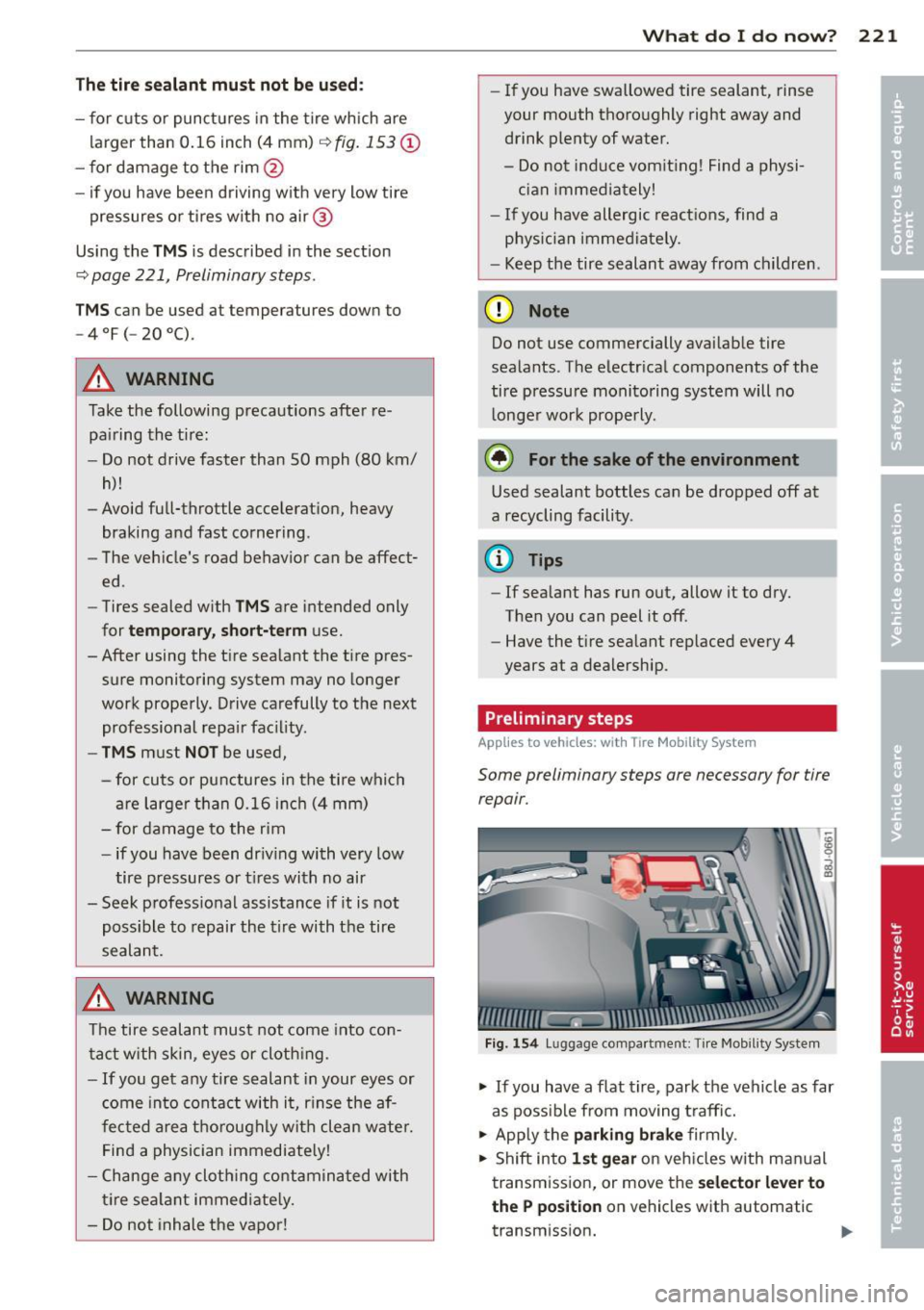
Fig. 154 Lu ggage compartment: Tire Mob ility System
.,.. If you have a flat tire, park the vehicle as far
as poss ib le from moving t raff ic.
.,.. App ly the
parking brake firmly .
.,.. Shift into
1st gear on veh icles with man ual
transmission, or move the
s electo r le ver to
the P po sit io n
on vehicles with automatic
transmiss ion.
Page 224 of 262
222 What do I do now?
• Check whether a repair using the Tire Mobi
li ty System is possible ¢
page 2 20, General
and safety pointers.
• Have all passengers leave the vehicle and
stay away from the danger zone ¢
&,..
• Take the sealant bottle and the electric air
pump from the luggage compartment un
der the floor ¢
fig. 154 .
• Remove the "max. SO mph" (80 km/h)
sticker from the sealant bottle and affix it to
the instr ument cluster in the driver's view.
~ WARNING
- Turn the hazard flashers on and set up
the warning triang le if you have a flat
t ire in moving traffic. In this way you pro
tect you rs elf and other road users.
- Make sure that all passengers are in a
safe place, out of the danger zone (for
example, behind a guard rail).
(D Note
Particular care is necessary if you are mak
ing a tire repair on a steep incline.
(D Tips
Obey all laws.
Making a tire repair
App lies to vehicles: with Tire Mobility System
Tire repair consists of the following sections.
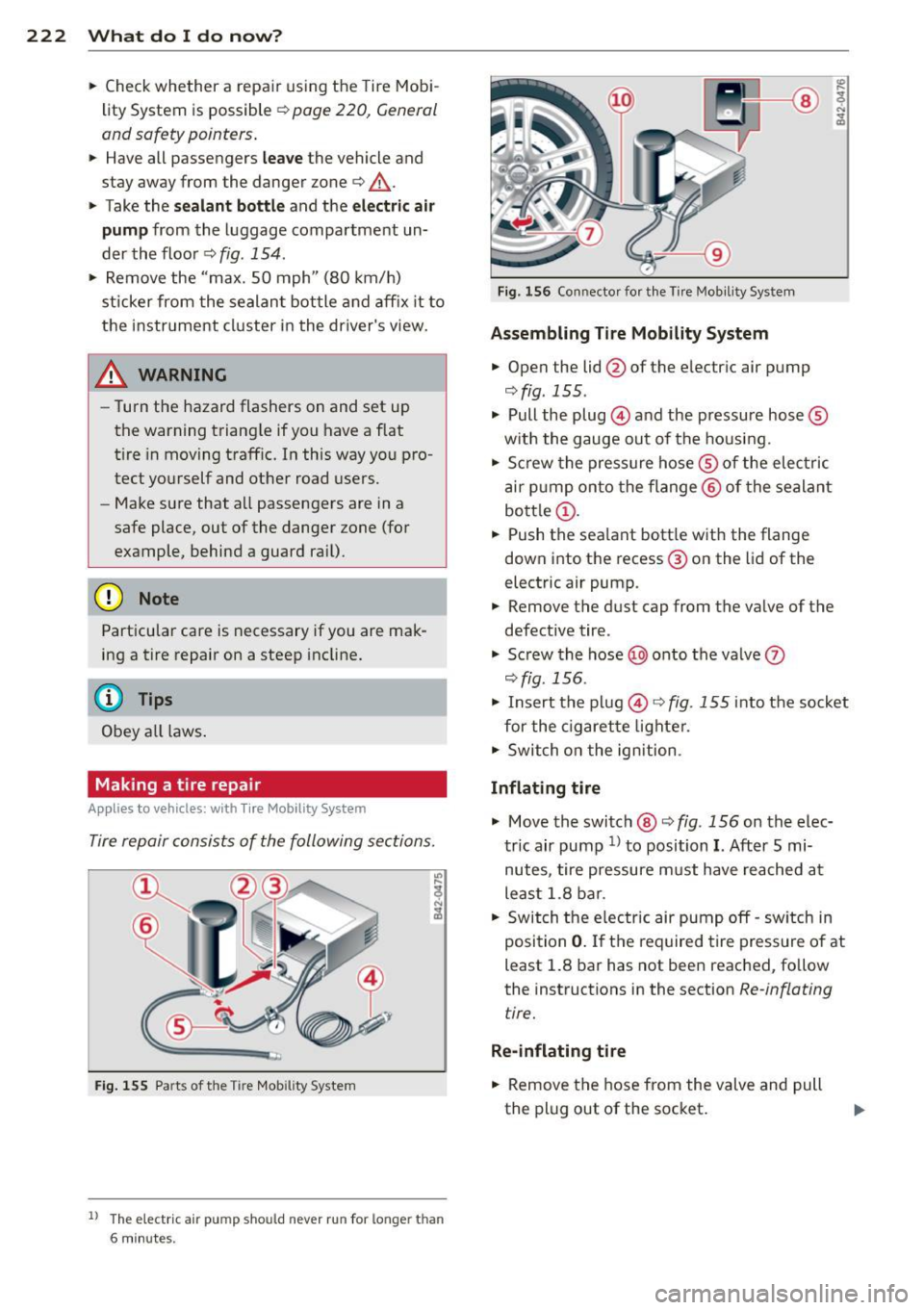
Fig. 155 Parts of the Tire Mobility System
-
1) The ele ctr ic a ir pump s hould never ru n for lo nger than
6 min utes.
Fig. 156 Connector for the Tire Mob ility System
Assembling Tire Mobility System
• Open the lid@ of the electric air pump
¢fig. 155.
• Pull the plug@and the pressure hose ®
w ith the gauge out of the housing.
• Screw the pressure hose ® of the electric
air pump onto the flange @ of the sealant
bott le
(D .
• Push the sea lant bott le with the flange
down into th e recess @ on the lid of the
electric air pump.
• Remove the dust cap from the valve of the
defective tire .
• Screw the hose (@onto the valve
(J)
¢ fig. 156.
• Insert the plug @¢fig . 155 into the socket
for the cigarette lighter.
• Switch on the ignition .
Inflating tire
• Move the switch @¢ fig. 156 on the elec
tric air pump
l) to position I. After 5 mi
nutes, tire pressure must have reached at
least 1.8 bar.
• Switch the e lectric air pump off -sw itch in
position
0. If the required tire pressure of at
least 1.8 bar has not been reached, follow
the instructions in the section
Re-inflating
tire.
Re-inflating tire
• Remove the hose from the valve and pull
the plug out of the socket.