engine AUDI TT 2013 Owner´s Manual
[x] Cancel search | Manufacturer: AUDI, Model Year: 2013, Model line: TT, Model: AUDI TT 2013Pages: 262, PDF Size: 65.91 MB
Page 188 of 262
186 Checking and filling
on the hot engine and exhaust system
when the engine is running -fire hazard!
- If your skin has come in contact with the
engine oil, you must subsequently
cleanse it thoroughly .
(D Note
- The oil level must not be above range 0
-danger of converter or engine damage!
Contact an authorized Audi dealer to
draw off oil, if necessary.
- Audi does not recommend the use of oil
additives. They may damage the engine
and adversely affect your New Vehicle
Warranty.
@ For the sake of the environment
- Under no circumstances can the oil come
in contact with the sewage network or
the soil.
- Observe and follow legal regulations
when disposing of empty oil containers.
Changing the engine oil
We recommend that have your oil changed by
an authori zed Audi dealer or a qualified serv
ice station .
Before you check anything in the engine com
partment,
always read and heed all WARN·
INGS
¢ & in Working in the engine compart
ment on page 180 .
The engine oil must be changed according to
the intervals specified in your Warranty &
Maintenance booklet. This is very important
because the lubricating properties of oil di
minish gradually during normal vehicle use .
Under some circumstances the engine oil
should be changed more frequently . Change
oil more often if you drive mostly short dis
tances , operate the vehicle in dusty areas or
under predominantly stop-and-go traffic con
ditions, or have your vehicle where tempera
tures remain below freezing for extended pe riods. Detergent
additives in the oil will make fresh
oil look dark after the engine has been run
ning for a short time. This is normal and is not
a reason to change the oil more often than
recommended.
Because of the problem of proper disposal,
along with the special tools and necessary ex
pertise required, we strongly recommend that
you have your oil changed by an authorized
Audi dealer or a qualified service station .
If you choose to change your oil yourself,
please note the following important informa
tion:
A WARNING
=
To reduce the risk of personal injury if you
must change the engine oil in your vehicle
yourself:
- Wear eye protection.
- To reduce the risk of burns from hot en-
gine oil, let the engine cool down to the
touch.
- When removing the oil drain plug with
your fingers, stay as far away as possible. Always keep your forearm parallel to the
ground to help prevent hot oil from run
ning down your arm.
- Drain the oil into a container designed
for this purpose, one large enough to
hold at least the total amount of oil in
your engine.
- Engine oil is poisonous. Keep it well out
of the reach of children.
- Continuous contact with used engine oil
is harmful to your skin. Always protect
your skin by washing oil off thoroughly
with soap and water.
(D Note
Never mix oil additives with your engine
oil. These additives can damage your en
gine and adversely affect your Audi Limit
ed New Vehicle Warranty.
Page 189 of 262
@ For the sake of the environment
- Before changing your oil, first make sure
you know where you can properly dispose of the used oil.
- Always dispose of used engine oil proper
l y. Do not dump it on garden soi l, wood
ed areas, into open streams or down
sewage drains.
- Recycle used engine oil by taking it to a
used engine oil collection facility in your
area, or contact a service station.
Engine cooling system
Coolant
The engine coolant performs two functions: it
keeps the engine from overheating and it pro
tects the engine from freezing in the winter.
The cooling system is sea led and generally re
qu ires little at tention.
The cooling system has been filled at the fac
tory with a permanent coolant which does not n eed to be changed. The coolant consists of a
mixture of wa ter and the man ufacturer's g ly
col-based coolan t addi tive Gl3 ant ifree ze
with ant icorrosion add itives (50% for USA
models; 60% for Canadian models) . This mix
ture both assures the necessary frost protec
tion and protects metal components in the
engine's cooling system from corrosion and
scaling. It also raises the boiling po int of the
coolant.
Do not reduce the concentration of the coo l
ant in the summer by adding plain water.
The
proportion of coolant add itive must be at
lea st 50°/4 but not more than 60°/4
to ma in
tain antifreeze protection and cooling efficien cy. If the coolant frost pro tect io n is too low,
the coolant cou ld freeze and dam age the veh i
cle heating and eng ine cooling system.
For year-round driving, antifreeze is added at
the facto ry for temperatures down to:
- -31°F( -35°C)USA
- -40 °F ( -40 °C) Canada.
Checkin g and fillin g 187
A WARNING
Before you c heck anything in the engine
compartment, always read and heed all
W ARNI NGS~ &.
in Working in the engine
comportment on page 180.
(D Note
- Before winter sets in, have the coolant
checked to see if the coolant additive in
your v ehicle is sufficient to meet the cli
mate conditions. This is especia lly impo r
t an t if you live in a region where t he win
t er is ex treme ly cold. If ne cessary, in
cr ease t he p ro portion of coo lant add itive
to 60%.
- Whe n adding cool ant additive to yo ur
c ooling sys tem, remember:
- We recommend us ing on ly coolant ad
d itive Gl2++ or Gl3 (check the labe l)
for your veh icle. This coolant additive is
ava ilable at autho rized Aud i dea le rs.
Othe r types of antifree ze can sig nifi
cantly reduce cor ros io n protec tion. The
res ulting co rrosion can cause a loss of
coolant an d serio us en gine damage.
- Do not add any type of rad iator le ak seal
ant to yo ur vehicle 's eng ine coolant .
Adding radiator repair flu id may adverse
ly affect the function and performance of
your cooling system and co uld resu lt in
damage not covered by you r New Ve hicle
Limited War ranty.
Checking the engine coolant level
The engine coolant level con be checked with
a quick glance.
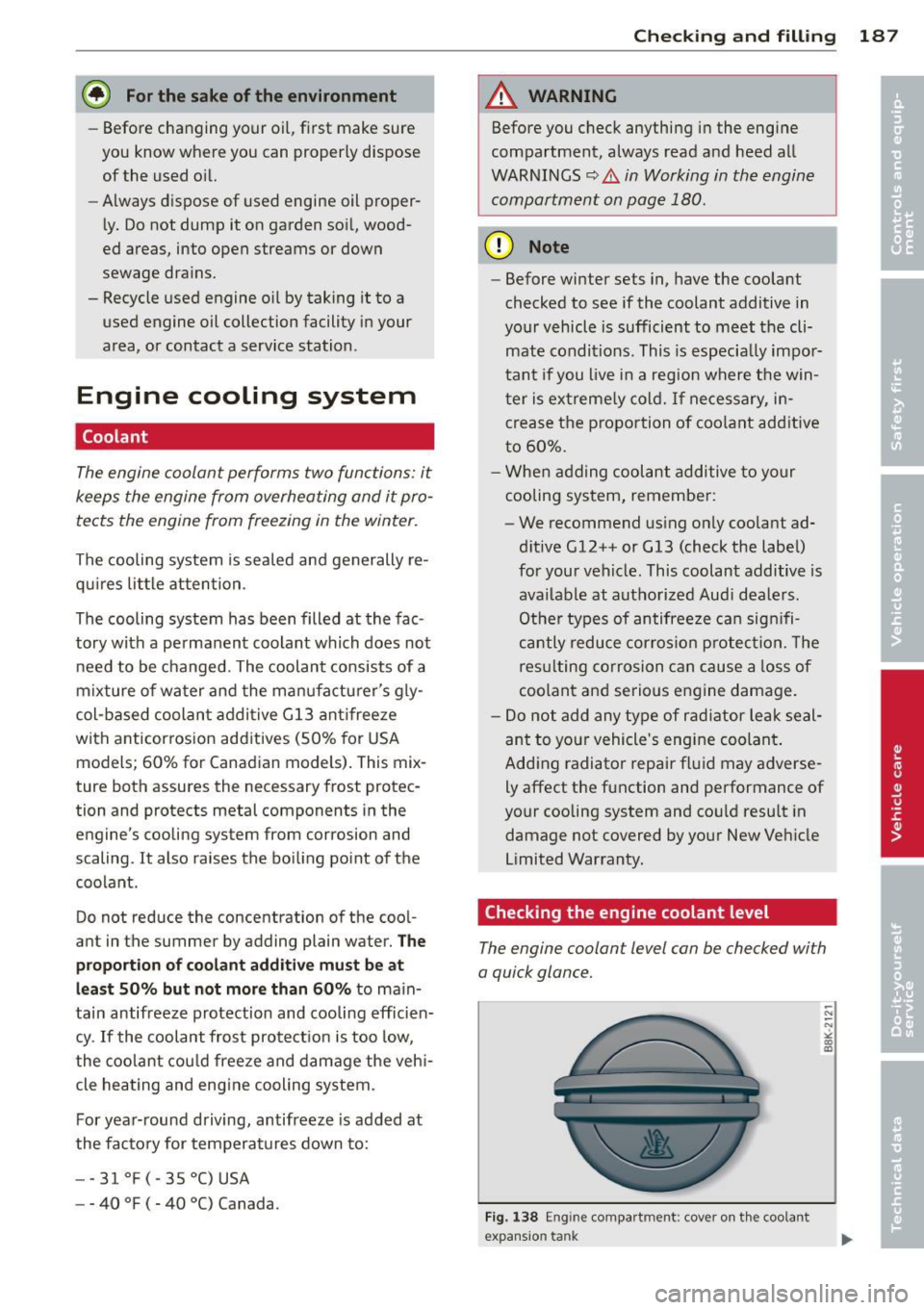
Fig. 138 Eng ine compa rtment : cove r on t he coola nt
expansio n tank
Page 190 of 262
188 Checking and filling
Before you check anything in the engine com
partment,
alwa ys r ea d and heed all WARN
INGS ¢ A in Working in the engine compart
ment on page 180.
• Park your vehicle on a level surface.
• Switch the ignition off.
• Read the coolant level at the coolant expan
s ion tank ¢
page 182, fig . 134. With a cold
engine, it must be above the "min" mark .
With a hot engine, it ca n be a little above
the indicated range .
The location of the coolant expans ion tank
can be seen in the engine compartment illus
tration
¢ page 182.
To obtain an accurate read ing, the engine
must be switched off.
The expansion tank in yo ur vehicle is equipped
with an e lectric coolant level sensor .
When the coo lant level is too low, the warning
light in the A uto- Check System ¢
page 16 will
illuminate until yo u add coo lant and the level
has been restored to normal. Even though
there is an electric coo lant level sensor, we
still recommend you check the coolant leve l
from time to time .
Coolant loss
Coolant loss may indicate a leak in the cooling
system . In the event of coolant loss, the cool
ing system should be inspected immediately
by your author ized Audi dealer. It is not
enough merely to add coolant .
In a
sealed system, losses can occur only if
the boiling point of the coolant is exceeded as
a result of overheat ing.
(D Note
Do not add any type of radiator lea k seal
ant to your vehicle's eng ine coolant. Add
ing radiator repair f luid may adversely af
fect the function and performance of your
cooling system and could res ult in damage
not covered by your New Vehicle Limited
Warranty.
Adding coolant
Be very careful when adding engine coolant.
Before you check anyth ing in the engine com
partment,
always read and heed all WARN
INGS ¢ A in Working in the engine compart
ment on page 180 .
• Turn off the engine.
• Let the engine cool down.
• Place a thick rag over t he coo lant expansion
tank
¢ page 187, fig . 138 a nd carefully
tw ist the cap counter-clockwise ¢&_ .
• Add coo la nt.
• Twis t the cap on aga in
t ightly.
Replacement engine coolant must conform to
exact spec ificat ions ¢
page 18 7, Coolant.
Even in a n emerge ncy, if coolant add i-
t ive G1 2++, G12+ or G12 is not ava ilable , do
not use a d iffe ren t addit ive. Use plain water
instead unti l you can get the cor rect additive
and can restore the correct ratio . This sho uld
be done as soon as possible .
If you have los t a considerab le amount o f
coolant , then you sho uld add cold ant ifreeze
and co ld wate r on ly w hen the engine is cold.
Alw ays use
new engine coo la nt whe n refilling .
Do not fill coola nt above the "MAX" mark. Ex
cess coola nt wi ll be fo rced o ut through the
pressure relief valve in t he cap w hen the en
gine becomes hot.
,&. WARNING ~ -
- T he cooling system is under pressure and
can get very hot. Reduce the risk of
scalding from hot coolant by followi ng
these steps.
- T urn off the engine and allow it to coo l
down.
- Protect yo ur face, hands and arms from
escaping fluid and steam by covering
the cap w ith a large, t hick rag.
- T urn the cap s lowly a nd ve ry carefully
in a counter-clo ckwise direction while
applying light, downward pres sure on
the top of the cap.
Page 191 of 262
-To avoid being burned, do not spill an
tifreeze or coolant on the exhaust sys tem or hot engine parts. Under certain
conditions, the ethylene glycol in en
gine coolant can catch fire.
- Antifreeze is poisonous. Always store an
tifreeze in its original container and well out of the reach of children.
- If you drain the coolant, it must be
caught and safely stored in a proper con
tainer clearly marked "poison".
(D Note
- Coolant pollutes the environment and
could cause an engine fire. Excess cool
ant will be forced out through the pres
sure relief valve in the cap when the en
gine becomes hot.
- If, in an emergency, only water can be
added, the correct ratio between water
and antifreeze¢
page 187 must be re
stored as soon as possible.
@ For the sake of the environment
Drained coolant should not be reused. Al
ways dispose of used coolant while observ ing all environmental regulations.
Radiator fan
The radiator fan switches on automatically by
itself
The electric radiator fan is controlled by ther
moswitches that switch on and off depending
on coolant and engine compartment tempera
tures.
An auxiliary electric radiator fan* switches on
and off depending on coolant temperature
and other vehicle operation conditions.
After you switch the engine off, the auxiliary
fan can continue running for up to 10 minutes
- even with the ignition off.
It can even switch
on again later by itself
c::> &., , if
- the temperature of the engine coolant rises due to the heat build-up from the engine in
the engine compartment, or
Checking and filling 189
- the engine compartment heats up because
the vehicle is parked in intense sunlight.
A WARNING
-To reduce the risk of personal injury nev
er touch the radiator fan .
- The auxiliary electric fan is temperature
controlled and can switch on suddenly
even when the engine is not running.
- The auxiliary radiator fan switches on au
tomatically when the engine coolant
reaches a certain temperature and will
continue to run until the coolant temper
ature drops.
Brake fluid
Checking brake fluid level
The brake fluid level can be checked with a
quick glance.
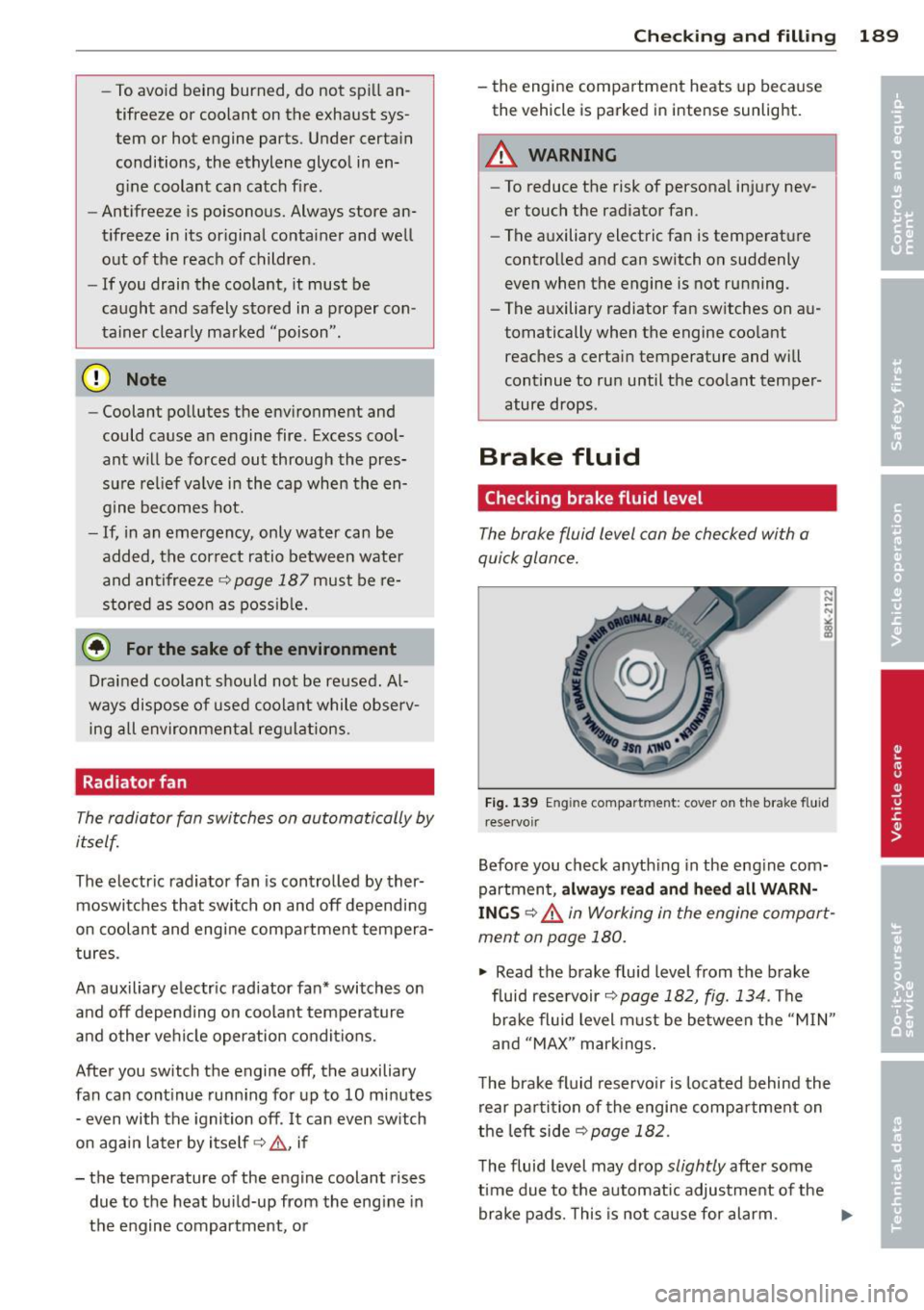
Fig. 139 Engin e compart ment: cover on th e br ake fluid
re se rvoir
Before you check anything in the engine com
partment,
always read and heed all WARN
INGS c::> .&. in Working in the engine compart
ment on page 180.
~ Read the brake fluid level from the brake
fluid reservoir
c::> page 182, fig. 134 . The
brake fluid level must be between the "MIN"
and "MAX" markings.
The brake fluid reservoir is located behind the
rear partition of the engine compartment on
the left side
c::> page 182.
The fluid level may drop slightly after some
time due to the automatic adjustment of the brake pads. This is not cause for alarm.
i,,.
Page 194 of 262
192 Checking and filling
Working on the battery
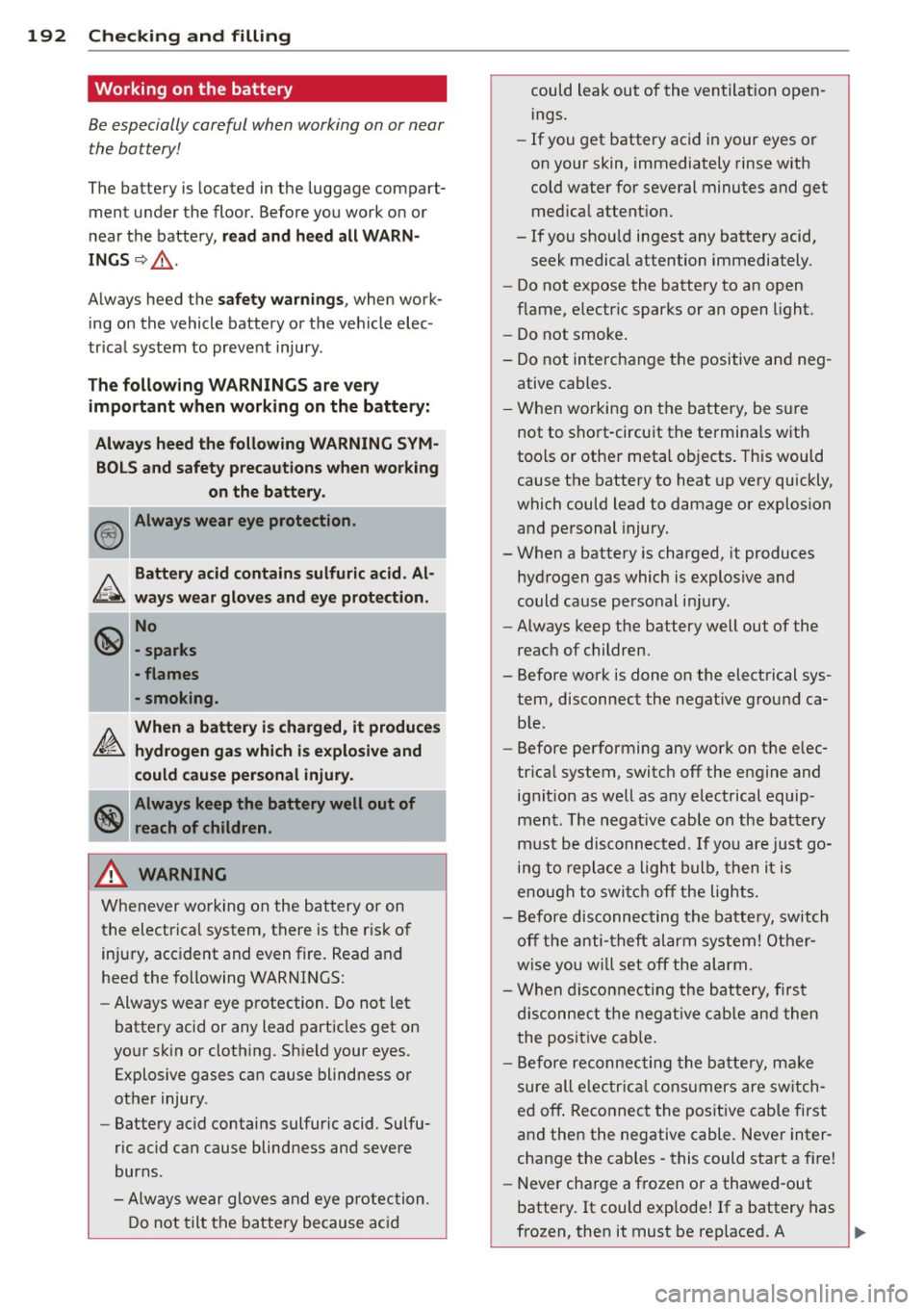
Be especially careful when working on or near
the battery!
The battery is located in the luggage compart
ment under the floor. Before you work on or
near the battery,
read and heed all WARN
INGS ~.&. -
Always heed the safety warnings, when work
ing on the vehicle battery or the vehicle elec
tr ical system to prevent injury .
The following WARNINGS are very
important when working on the battery:
Always heed the following WARNING SYM· BOLS and safety precautions when working
on the battery.
@ Always wear eye protection .
b,. Battery acid contains sulfuric acid. Al
~ ways wear gloves and eye protection.
~~-
No
@ -sparks
-flames
-smoking.
When a battery is charged , it produces
hyd rogen gas which is explosive and
could cause personal injury.
I ~ Always keep the battery well out of
V;!J/ reach of children .
A WARNING
=
Whenever working on the battery or on
the electrical system, there is the risk of
injury, accident and even fire. Read and
heed the following WARNINGS:
- Always wear eye protection. Do not let
battery acid or any lead particles get on
your sk in or cloth ing. Sh ield your eyes.
Explosive gases can cause blindness or
other injury .
- Battery acid contains sulfur ic acid. Sulfu
ric acid can cause blindness and severe
burns.
- Always wear gloves and eye protection.
Do not tilt the battery because ac id
-
could leak out of the ventilation open
ings.
- If you get battery acid in your eyes or
on your skin, immediately rinse with cold water for several minutes and get
med ical attention.
- If you shou ld ingest any battery acid,
seek medical attention immediately.
- Do not expose the battery to an open
flame, e lectr ic sparks or an open light.
- Do not smoke .
- Do not interchange the positive and neg -
ative cables .
- When working on the battery, be sure
not to short-circuit the terminals with
too ls or othe r metal objects . This would
cause the battery to heat up very quickly,
which could lead to damage or explosion
and personal injury.
- When a battery is charged, it produces
hydrogen gas which is explosive and
could cause personal injury.
- Always keep the battery well out of the
reach of children.
- Before work is done on the electrical sys tem, disconnect the negat ive ground ca
ble.
- Before performing any work on the e lec
tr ical system, switch off the engine and
ignit ion as well as any electrical equip
ment. The negative cable on the battery
must be disconnected .
If you are just go
ing to replace a light bulb, then it is
enough to switch off the lights.
- Before disconnecting the battery, switch
off the anti-theft alarm system! Other
wise you will set off the alarm.
- When disconnecting the battery, first disconnect the negative cable and then
the positive cab le .
- Before reconnecting the battery, make
sure all electr ica l consumers are switch
ed off . Reconnect the positive cable first
and then the negative cable. Never inter
change the cables - this could start a fire!
- Never charge a frozen or a thawed-out
battery. It could exp lode! If a battery has
frozen, then it must be replaced. A
llll-
Page 195 of 262
dischar ged battery can freeze over at
32 °F (0 °C).
- Make sure the vent hose is alw ays attach
ed to the opening on the side of the bat
tery.
- Never use batteries which are damaged .
Danger of explosion! A lways rep lace a
damaged battery.
A WARNING
California Propos ition 65 Warning:
- Battery posts, terminals and related ac
cessories contain lead and lead com pounds , chemicals known to the State of
Californ ia to cause cancer and reproduc
t ive p roblems. Wash ha nds after han
dling .
CD Note
-Do not d isconnect the vehicle battery
when the ignition is switched on or when
t h e engine is running, otherwise, you will
damage e lectronic components in the
ele ctr ical sy stem.
-If your vehicle is goi ng to stand for a
l ong pe riod of time wit ho ut being d riven,
p rotec t the battery from "freezing ", o th
erwise it will be d amaged and w ill t hen
h ave to be replaced.
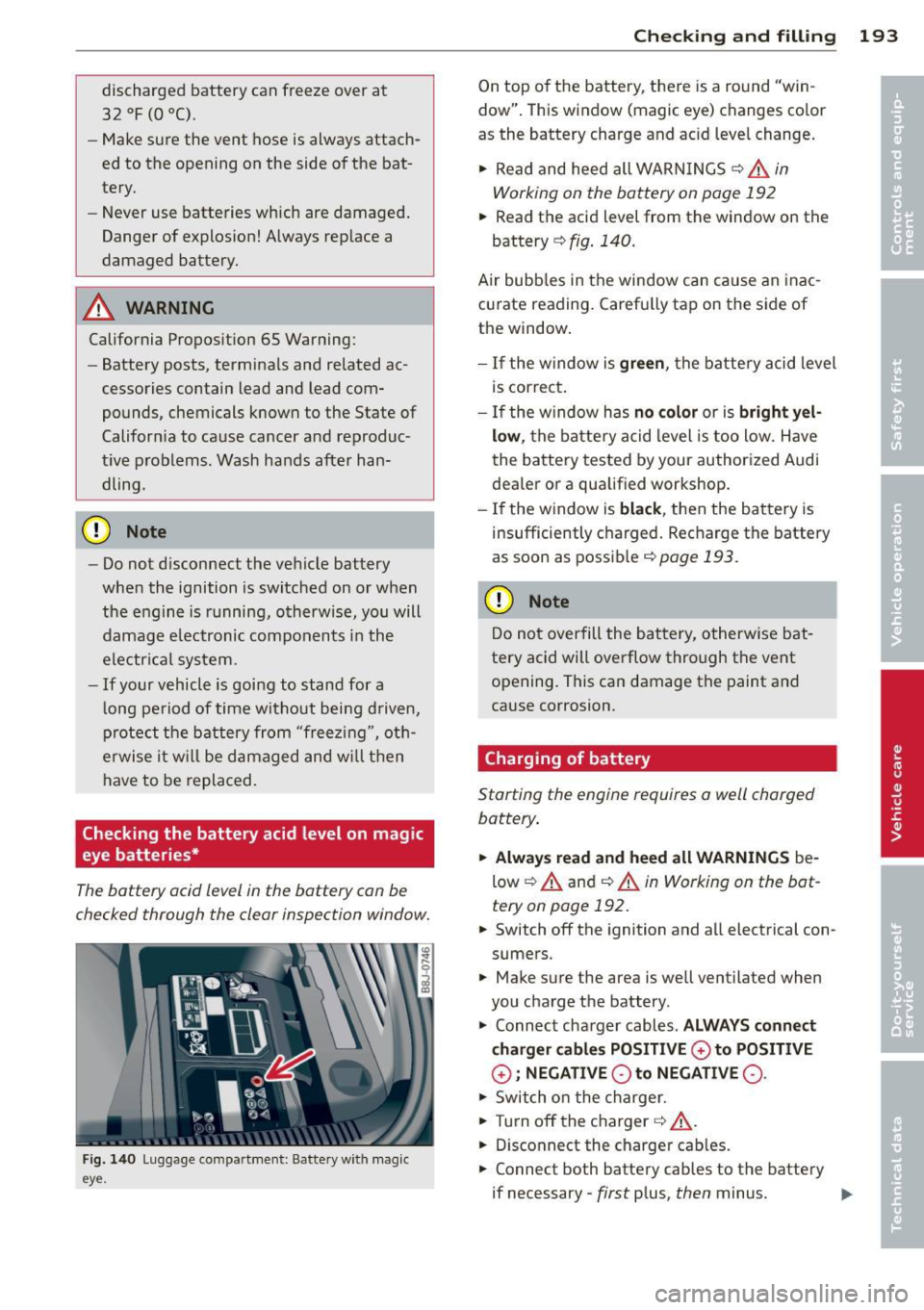
Checking the battery acid level on magic
eye batteries*
Th e battery acid level in the batt ery can be
checked through the clear inspection window.
F ig. 140 Lu ggag e co mpart ment : Bat te ry w it h m agi c
eye.
Checkin g and fillin g 193
On top o f the battery , there is a round "win
dow" . This window (magic eye) changes co lor
as the battery charge and ac id leve l change .
.. Read and heed all WARN INGS
c::> .&_ in
Working on the battery on page 192
.. Read the acid level from the window on the
battery c:>fig .140.
Air bubb les in the window can cause an inac
cu rate reading. Carefu lly tap on the s ide of
t h e window .
- If the window is green , the batte ry acid level
is cor rect .
- If the w indow h as
no color or is bright yel
low ,
the batte ry a cid level is too low. Have
the ba ttery tested by your authori zed Audi
dea ler or a qua lified workshop .
- If the window is black , then the ba ttery is
insufficiently charged. Recharge the battery
as soon as possib le
c::> page 193.
CD Note
Do not overfill the bat tery, otherwise b at
tery ac id will ove rflow through the vent
ope ning . This ca n damage the paint and
cause corrosion .
Charging of battery
Starting the engine requires a well charged
battery.
.. Alway s read and heed all WARNINGS be
low
c::> .&. and c::> .&. in Working on the bat
tery on page 192 .
.. Switch off the ignition and a ll electr ical con
sumers .
.. Make sure the area is well ven tilated when
you cha rge the battery .
.. Connect charger cables.
ALWAYS conne ct
charger cable s POSITIVE
G) to POSITIVE
G) ; NEGATIVE Oto NEGATIVE Q .
.. Swit ch o n the charge r .
.. Tu rn off the charger
c::> .&_ .
.. Disconnect the charger cab les.
.. Connect both battery cab les to the battery
if necessary -
first plus, then minus. II>-
Page 196 of 262
194 Checking and filling
When charging at low voltages (e.g . w ith a
tri ckle charger ), the battery cables do not
have to be d isconnected first. Be fore charging
at
high voltages, i.e. " fast charging ", you
must disconnect both cables. In e ither case,
follow the instruct ions from the ma nufacturer
of the charger .
Fastcharging a battery is
dangerous c:> .&. in
Working on the battery on page 192 .
It re
qu ires specia l charg ing equipment a nd the
k nowledge to go wi th it. We recomme nd hav
ing your battery fast charged on ly by a quali
fied workshop.
A discharged batte ry can
freeze at tempera
tures of on ly 32 °F (0
°(). A llow a frozen bat
tery to thaw completely befo re attempt ing to
cha rge it
c:> ,&. . Howeve r, we re comme nd not
usi ng a thawe d batt ery again bec ause t he bat
tery cas ing ca n be cracked d ue to ice forma
tion and can lea k bat tery aci d.
D o not open the batte ry caps whe n charg ing
the ba ttery.
_&. WARNING
-
Cha rging a batte ry can be dange rous.
- N ever charge a fro zen b att ery .
It may ex
plode beca use o f gas t rappe d in t he i ce.
Allow a frozen battery to thaw o ut first .
- D o no t reu se batte ries which we re fr o
zen . The batte ry housing m ay h ave
c rac ked an d weakened whe n the battery
froze .
- C harge the b attery in a we ll ven tilated
area . Kee p away from open flame o r elec
trical spa rk. Do not smoke. Hydrogen gas
generated by the battery is exp losive.
- To reduce the danger o f explosion, never
co nnect or disconnect charger cables
wh ile the charger is operating .
- Fast charg ing a battery is dangerous and
shou ld on ly be attempted by a compe
tent technician w ith the proper eq uip
me nt.
- Battery acid that may spill d uring charg
ing should be washed
off wit h a so lution
of warm water and baki ng soda to neu
t raliz e the aci d.
(D Note
Neve r use a fast charger as a booster to
start the eng ine. Th is w ill seriously dam
age sensit ive e lectronic components, such
as cont ro l units, re lays, radio, etc. , as well
as the battery charge r.
(D Tips
The vehicle batte ry must not be charged
with a standard small charger that plugs in to the c igarette lighter or outlet.
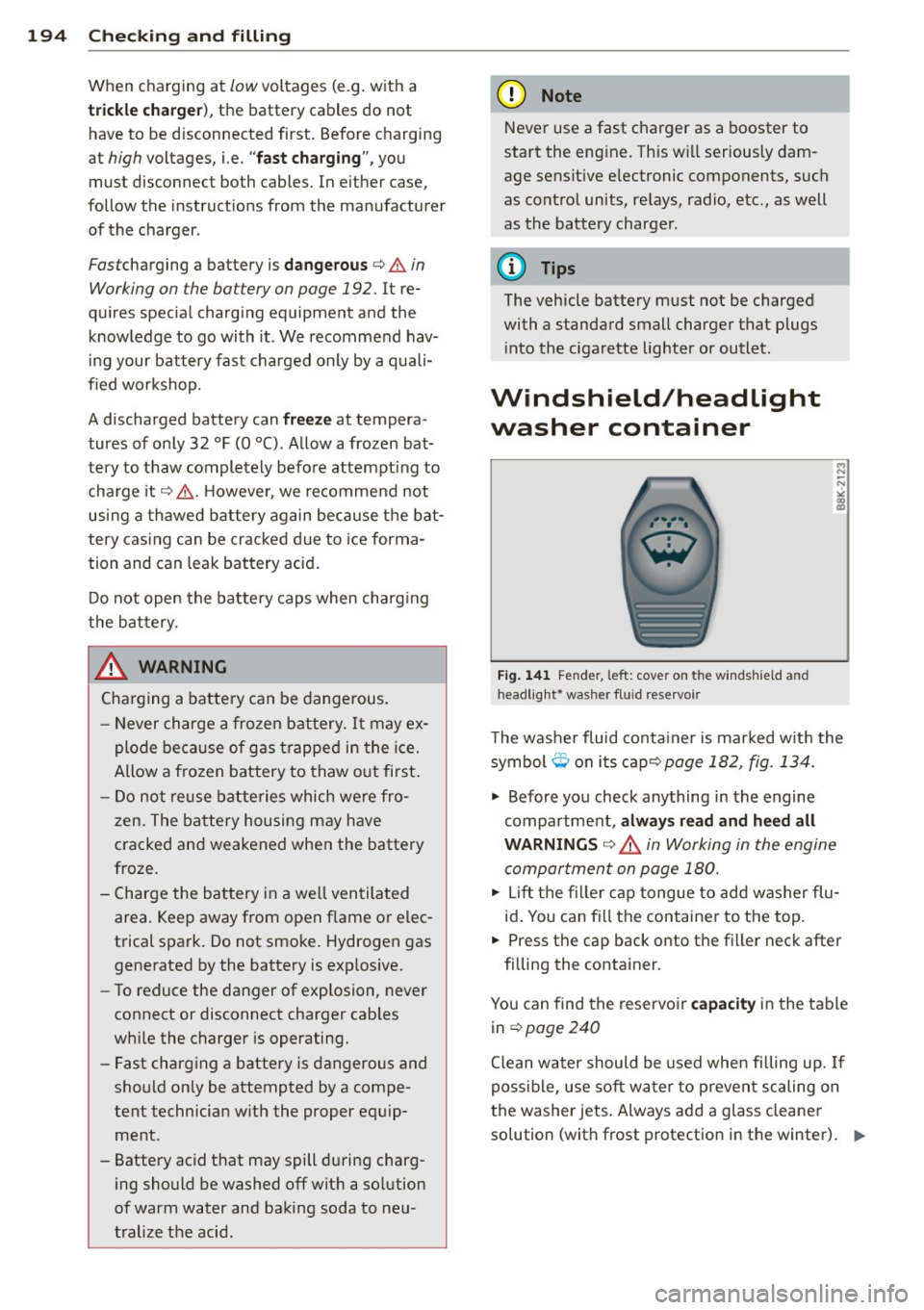
Windshield/headlight
washer container
Fi g. 141 Fen der, left: cove r o n th e w inds hield a nd
h ead lig ht• wa sher fl uid re se rvoir
T he was her fluid co nta iner is mar ked w it h the
symbol
Q o n its c a p<=> page 182, fig . 134.
""' Before yo u check anything in the engine
compa rtme nt,
always read and heed all
WARNINGS c:> ..&. in Wor king in the engine
c ompartment on page 18 0.
""' Lift th e fill er ca p tongue to ad d washer flu
id . You can f ill the containe r to the top .
""' Press the cap back o nto the fi ller neck after
fi lling the container.
You can find the reservo ir
capacity in t he table
in
<=> page 24 0
Clean wa ter should be used when filling up. If
poss ible, use so ft wat er to preven t sc aling o n
t h e washer jets . A lways ad d a glass clea ner
solution (with frost protection in the winter) . ..,.
Page 197 of 262
(D Note
-Do not mix engine coolant antifreeze or
any other additives to fill up the
windsh ield washer rese rvoir.
- Do not use glass cleane rs contain ing
paint solvent; you r isk damaging the
paint.
Checkin g and fillin g 195
•
•
Page 203 of 262
Tires and wheels 201
you have stored. The system does not recog
nize the load condition of your vehicle.
The effectiveness of the tire pressu re monitor
ing system w ill be impaired if you store nor
mal load pressures but then operate the vehi
cle at its maximum load¢,& .
See the illustration ¢
fig. 142 for the location
of the label on driver's side B-pillar (color of
the actual labe l and exact location on the ve
hicle will vary slig htly) .
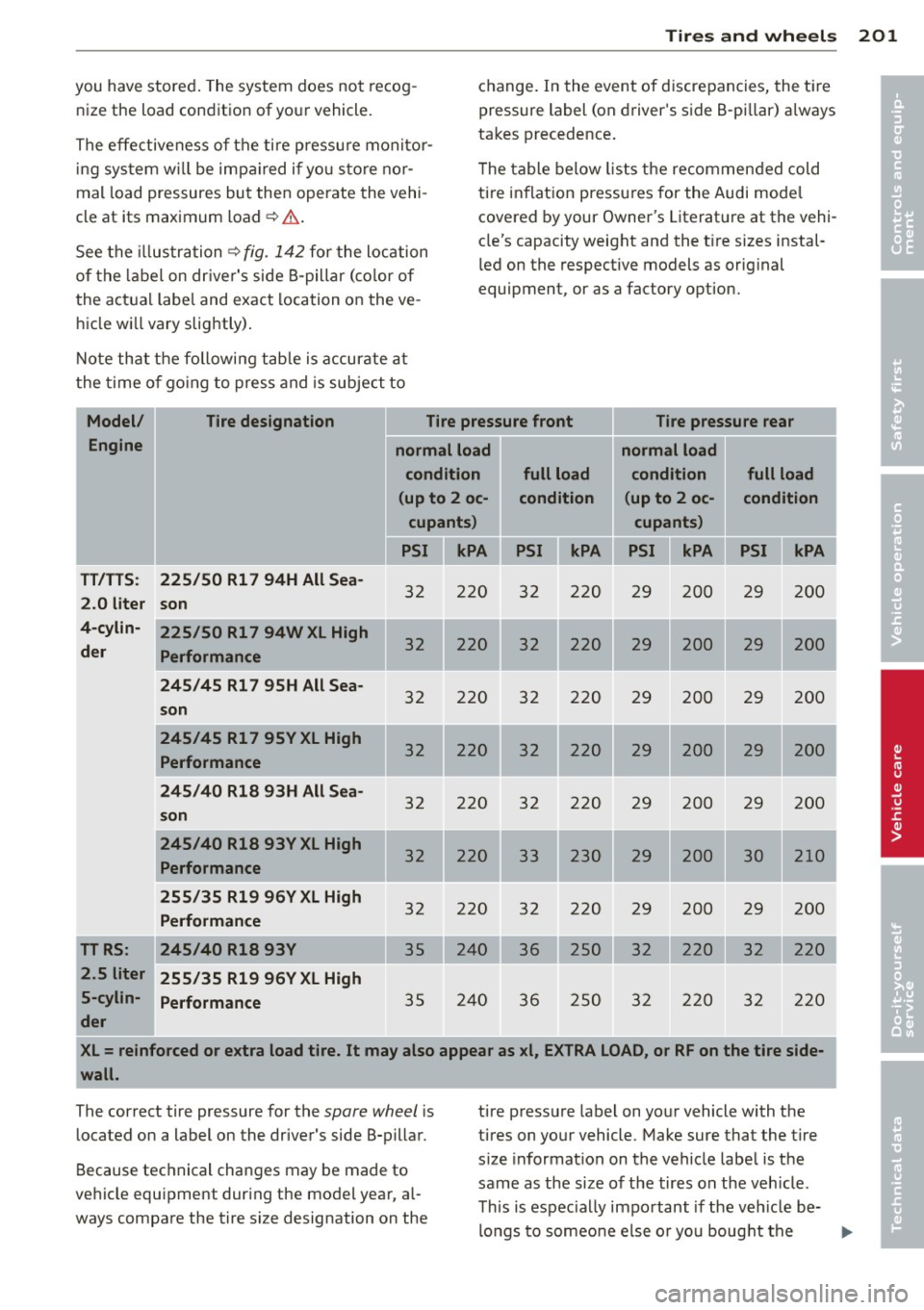
Note that the following table is accurate at
the time of go ing to press and is subject to change.
In the event of discrepancies, the tire
pressure label (on driver's side B-pi llar) always
takes precedence.
T he table below lists the recommended cold
ti re inflation pressures for the Audi mode l
covered by your Owner's Literature at the vehi
cle's capacity weight and the tir e sizes instal
l ed on the respective models as orig inal
equipment, or as a factory option.
I
Model/ U Tire designation Tire pressure front Tire pressure rear
Engine normal load normal load
condition full load condition full load
(upto 2 oc- condition (up to 2 oc-
condition
cupants) cupants)
PSI JI kPA PSI ]I kPA PSI II kPA PSI II kPA '.
TT/TIS: 225/50 Rl 7 94H All Sea-
32 220 32 220 29 200 29 200
2.0 liter son
4-cylin-
225/50 Rl 7 94W XL High
der Performance
32 220 32 220 29 200 29 200
245/45 R17 95H All Sea- 32 220 32 220 29 200 29 200
son
245/45 R17 95VXL High
32 220 32 220 29 200 29 200
Performance
245/40 R18
93H All Sea-
32 220 32 220 29 200 29 200 son
245/40 R18 93V XL High
32 220 33 230 29 200 30 210
Performance J
255/35 R19 96V XL High
32 220 32 220 29 200 29 200
Performance
TT RS:
245/40 R18 93V 220
2.5 liter
255/35 R19 96V XL High
5-cylin- Performance
35 240 36 250 32 220 32 220
der
XL= reinforced or extra load tire. It may also appear as xl, EXTRA LOAD, or RF on the tire side-
wall.
The correct tire pressure for the spore wheel i s
located on a label on the driver's side B-pillar.
Because technical changes may be made to
ve hicle equipment during the model year, a l
ways compare the tire size designation on the tire press
ure label on your vehicle with the
tires on your vehicle. Make sure that the tire
s ize info rmat ion on the vehicle label is the
same as the size of the tires on the veh icle .
This is especially important if the vehicle be-
long s to someone e lse o r you boug ht the ..,.
•
•
Page 222 of 262
220 What do I do now?
What do I do now?
Vehicle tool kit
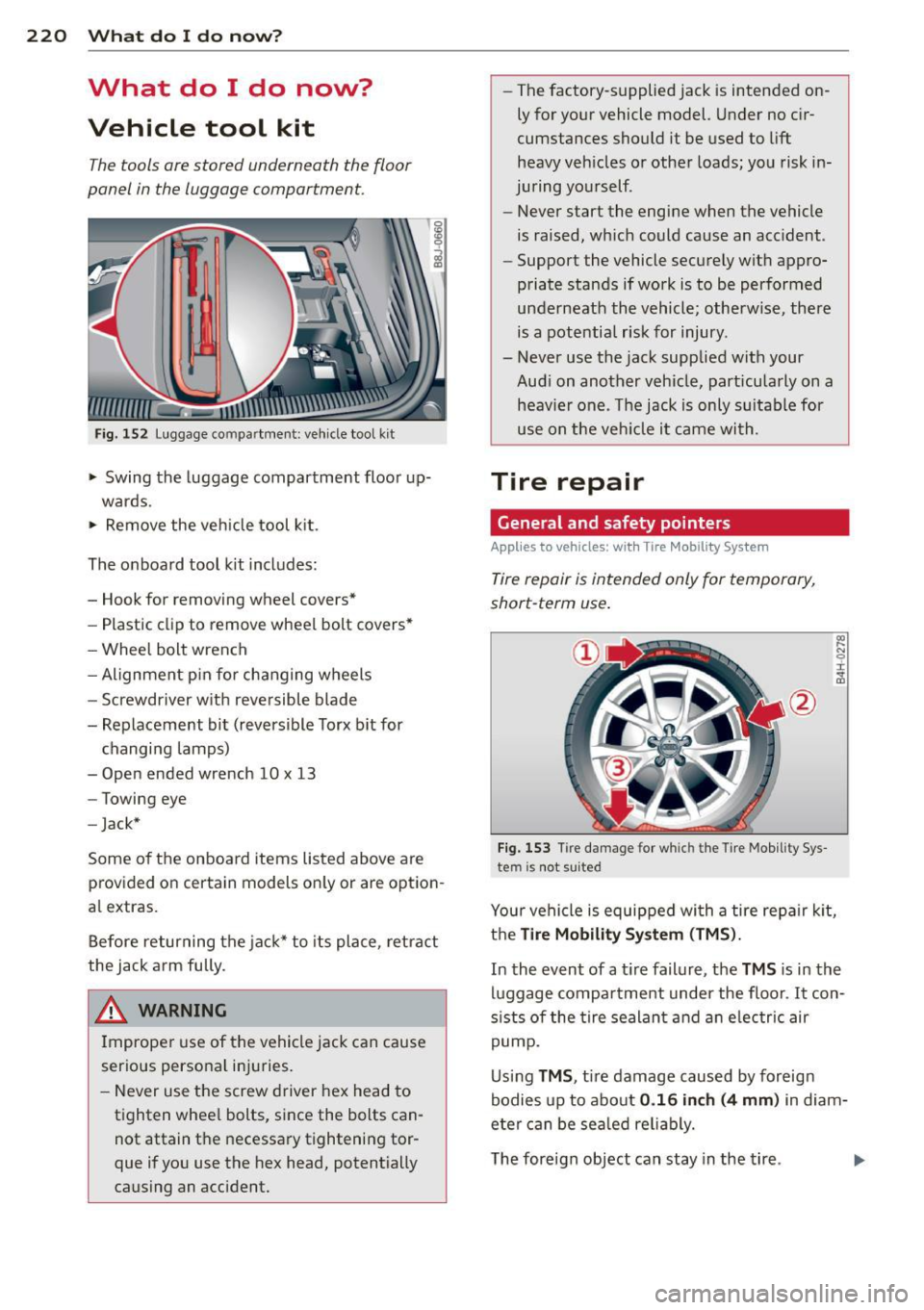
The tools ore stored underneath the floor
panel in the luggage comportment.
Fig. 152 Luggage compartment: vehicle tool kit
• Swing the luggage compartment floor up-
wards.
• Remove the veh icle tool kit .
The on board tool kit includes:
- Hook for removing wheel covers*
- Plastic clip to
remove wheel bolt covers*
-Wheel bolt wrench
- Alignment pin for changing wheels
- Screwdr iver w ith reversible blade
- Replacement bit (reversible Torx b it for
changing lamps)
- Open ended wrench 10 x 13
- Towing eye
- Jack *
Some of the on board items listed above are provided on certain models on ly or are opt ion
al extras.
Before returning the jack* to its place, retract
the jack arm fully.
_& WARNING
Improper use of the vehicle jack can cause
serious personal injuries.
- Never use the screw driver hex head to
tighten wheel bolts, since the bolts can not attain the necessary tightening tor
que if you use the hex head, potentially causing an accident. -
The factory-supplied jack is intended on
ly for your vehicle model. Under no cir
cumstances should it be used to
lift
heavy veh icles or other loads; you risk in
juring yourself .
- Never start the engine when the vehicle
is raised, which could cause an accident.
- Support the vehicle securely with appro
priate stands if work is to be performed
underneath the vehicle; otherwise, there is a potentia l risk for injury.
- Never use the jack supplied with your
Aud i on another vehicle, part icularly on a
heav ier one . T he jack is only s uitable for
use on the vehicle it came with.
Tire repair
General and safety pointers
Applies to vehicles: wit h Tire Mobility Sys tem
Tire repair is intended only for temporary,
short-term use .
Fig. 153 Tire damage for whic h the Tir e Mob ility Sys
tem is not suited
Your vehicle is equipped with a tire repa ir kit,
the
Tire Mobility System (TMS).
In the event of a tire failure, the TMS is in the
luggage compartment under the floor.
It con
s ists of the tire sealant and an electric air
pump .
Using
TMS , tir e damage caused by foreign
bodies up to about
0.16 inch (4 mm) in diam
eter can be sealed reliably.
The foreign object can stay in the tire .