engine overheat AUDI TT 2013 Owner´s Manual
[x] Cancel search | Manufacturer: AUDI, Model Year: 2013, Model line: TT, Model: AUDI TT 2013Pages: 262, PDF Size: 65.91 MB
Page 13 of 262
Instrument s and warning /indicator lights 11
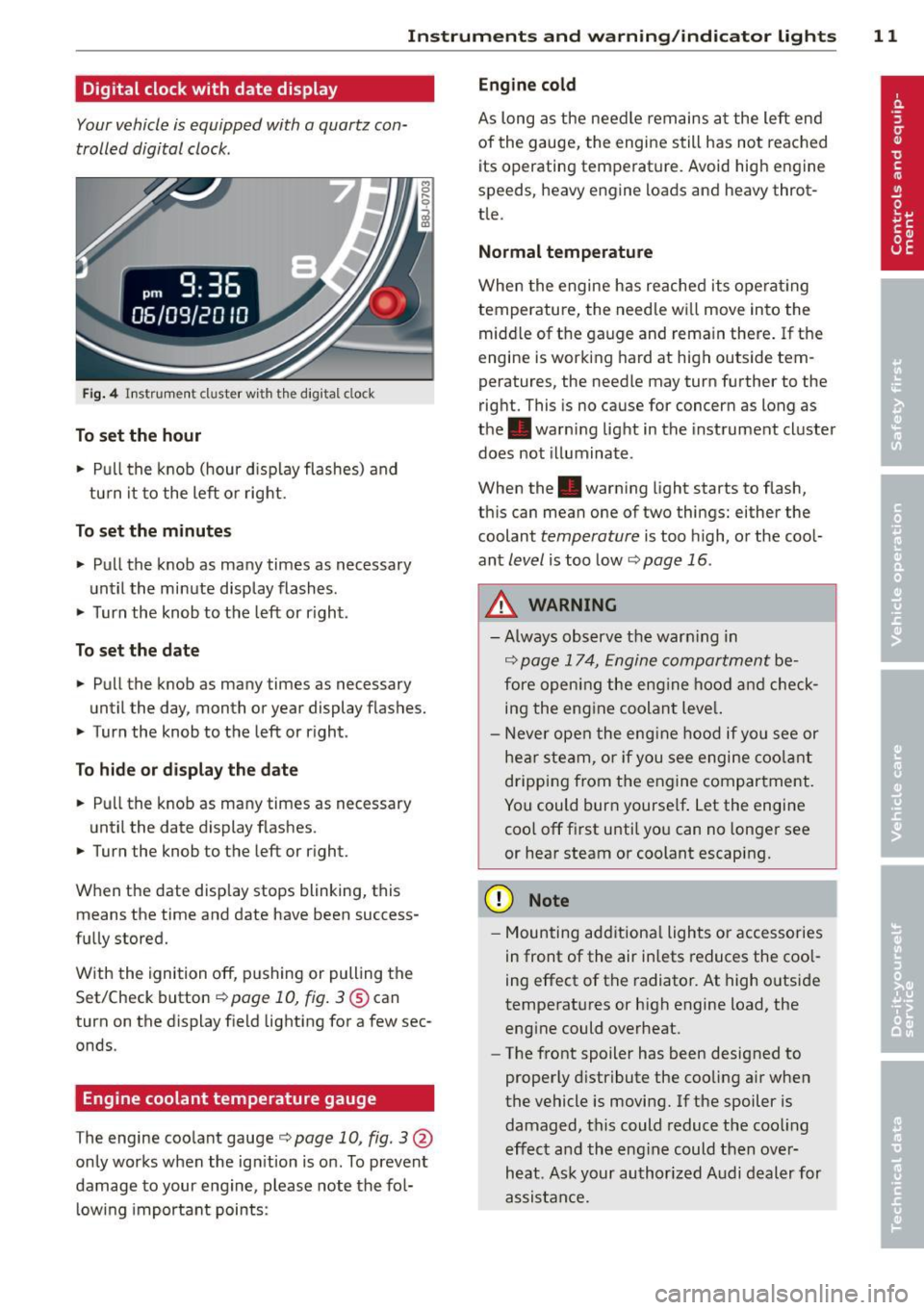
Digital clock with date display
Your vehicle is equipped with a quartz con
trolled digital clock .
Fig. 4 In str um en t cl uste r w it h t he dig ita l cloc k
To set the hour
.. Pu ll t he knob (hour d isp lay flashes) and
tu rn it t o the left or rig ht.
To set the minutes
.. Pull the knob as ma ny times as necessary
un til the mi nute display flash es.
.. Turn the knob to the left or r ight .
To set the date
.. Pull the knob as many times as necessary
until the day, month or year display flashes.
.. Turn the knob to the left or right .
To hide or d isplay the d ate
.. Pull the knob as many times as necessary
unti l the date display flashes.
.. Turn the knob to t he left or r ight.
When the date disp lay stops blinking, this
means the time and date have been success
fu lly stored.
W ith the ignition off, pushing or pulling the
Set/Check button¢
page 10, fig . 3@ can
turn on the dis play f ie ld lighting for a few sec
onds .
Engine coolant temperature gauge
The engine coo la nt gauge ¢ page 10 , fig. 3@
only works when the ign ition is on. To prevent
damage to your e ngine, please note the fo l
l owing important points:
Engine cold
As long as the nee dle rem ains a t the left end
of the gauge, the engine s till h as not reac hed
its operating temperat ure. Avoid high engine
speeds, heavy engine loads and heavy throt
tle.
Normal temperature
W hen the engine has re ache d its ope rat ing
temperature, the need le w ill move into the
mid dle of t he gauge and rema in there .
If the
engine is working hard at high outside tem
peratures, the needle may turn fu rther to the
right. This is no cause for concern as long as
the . warni ng lig ht in the inst rument cl uster
does not illuminate .
When the. war ning light starts to flash,
th is can mean one of two thi ngs: either the
coolant
temperature is too high, o r the coo l
ant
level is too low ¢ page 16 .
A WARNING
--Always obs erv e th e warn ing in
¢ page 1 7 4, Engine compar tment be
fore opening the eng ine ho od and check
in g the eng ine coolan t leve l.
- N ever open t he eng ine hood if you see or
he ar ste am, or if you see engi ne coo lant
drippi ng from t he en gine compar tment .
You could bur n yourse lf . Let the en gin e
coo l off fi rst u ntil yo u can n o longe r see
or hear steam or coolant escap ing.
(D Note
- M ounting ad ditiona l lights or accessories
i n fr ont of the air inlets reduces the coo l
ing effect of t he radiato r. At high o utsi de
tempe rat ures or h igh engine load, the
eng ine could overheat.
- The front spoiler has been designed to
properly d istribute the cooling a ir when
the vehicl e is movi ng. If the spoiler is
damaged, this c ould reduce the coo ling
e ff ect a nd th e eng ine could then ove r
h eat . As k yo ur au thori zed A udi deal er for
a ssis tan ce.
Page 15 of 262
Instrument s and warnin g/indic ator ligh ts 13
-The engine compartment of any motor
vehicle is a potentially hazardous area.
Before you check anything in the engine
compartment, stop the engine and let it
cool down. Always exercise extreme cau
t ion when working under the hood
¢ page 174, Engine compartment
(D Tips
Malfunctions or faults w ill be identified e i
ther with a red symbol (pr iority 1 -Dan
ger!) or with a yellow symbol (pr iority 2 -
Warn ing).
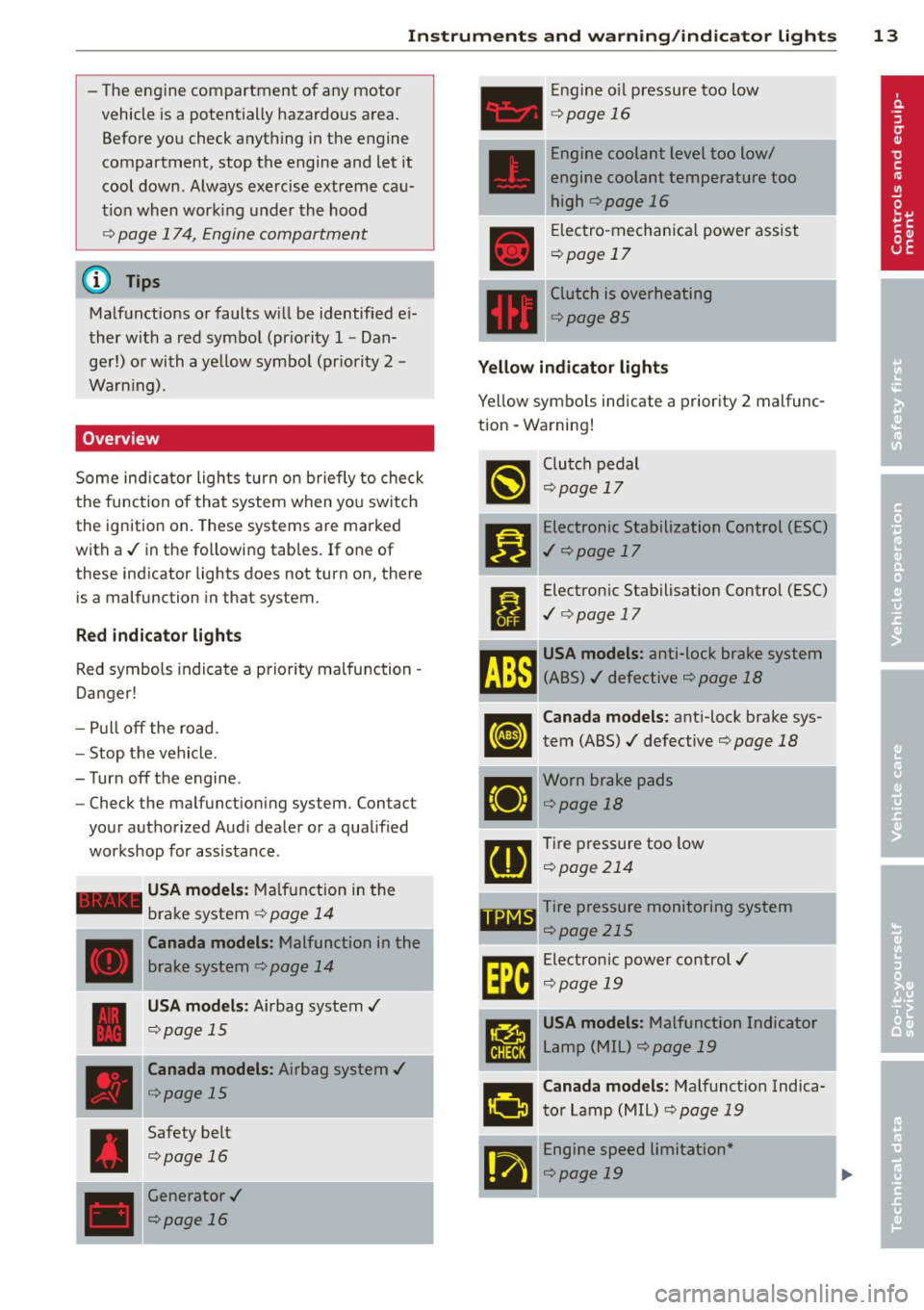
Overview
Some ind icator lights tu rn on briefly to che ck
the func tion of that system when yo u switch
the ignition on. These systems are marked
with a./ in the following tables. If one of
these ind icator lights does not turn on, there
is a malfunction in that system.
R ed indicator lights
Red symbols indica te a priority malfunction -
Danger!
- Pull
off the road.
- Stop the vehicle.
- Turn
off the engine.
- Check the ma lfunction ing system. Contact
your authorized Aud i dea ler or a qualified
workshop for assistance .
-USA models: Malf u nction in the
brake system
¢ page 14
D
D
Canada models : Malfunction in the
brake system
¢ page 1 4
USA models : Airbag system./
¢page 15
Canada models: Airbag system./
¢page 15
Safety belt
¢page 16
Generator ./
¢page 16 Engine o
il pressure too low
¢ page 16
Engine coolant level too low/
engine coolant tempe rature too
h igh
¢ page 16
Electro -mechanical power assist
¢ page 17
Clutch is overheating
¢page85
Yellow indicator light s
Yellow symbo ls indicate a priority 2 malfunc
tion -Warning!
Ji]
I
Clutch pedal
¢page 17
Electronic Stabilization Control (ESC)
./ ¢page 17
Electron ic Stabilisat ion Control (ESC)
./ ¢page 17
~ USA models: anti-lock brake system
~(ABS)./ defective ¢page 18
•
Canada models : anti-lock brake sys
tem (ABS) ./ defective
¢ page 18
Worn brake pads
¢page 18
Tire pressure too low
¢page 214
Tire pressure monitoring system ¢page 215
--~
~ Electron ic powe r control./
~ ¢page19
~ USA models: Malfunctio n Indicator
Bil Lamp (MIL) ¢page 19
11'!!1 Canada models : Malfunction Indica
mil to r Lamp (MIL) ¢page 19
Engine speed limitation*
¢page 19
Page 75 of 262
CD Note
-Avoid high engine speeds, fast accelera
tion or heavy engine loads whi le the en
gine is still cold. This could damage the
engine.
- The engine cannot be started by pushing or towing the veh icle.
@) For the sake of the environment
To avoid unnecessary engine wear and to
reduce exhaust emissions, do not let your
veh icle stand and warm up. Be ready to
drive off immediately after starting your
veh icle. Maintain moderate speed until the
eng ine is completely warm . Remember,
the engine performs best at operating
temperature .
Stopping the engine
~ Turn the ign ition key to position @
~page 71, fig. 71.
_& WARNING
-Never turn off the engine before the ve
hicle has come to a complete stop. The
full function of the brake booster and the
power steering is not guaranteed . You
must use more force to turn or brake if
necessary. Because you cannot steer and
brake as you usually would, this could
lead to crashes and serious injur ies.
- The radiator fan can continue to run for
up to 10 minutes even after you have
turned
off the engine and removed the
ignition key . The radiator fan can also
turn on again if the engine coolant heats
up because of intense sunlight or heat
build-up in the engine compartment.
CD Note
Do not stop the engine immed iate ly after
hard or extended driving. Keep the engine
running for approximately two minutes to
prevent excessive heat build-up.
On the road 73
Parking brake
Parking brake
When the parking brake is set, it prevents the
vehicle from rolling away unintentionally .
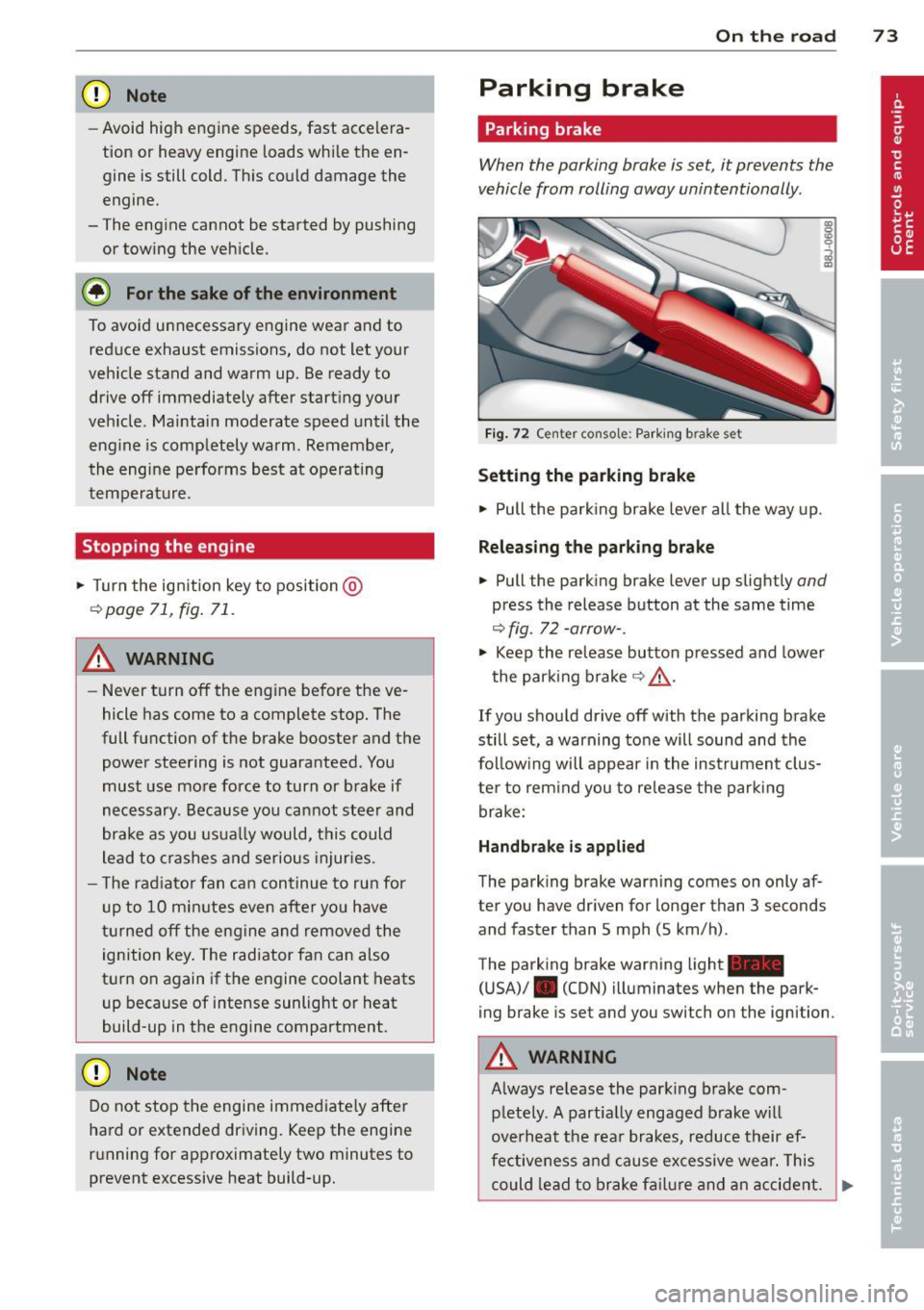
Fig. 72 Center console: Parki ng b rake set
Setting the parking brake
~ Pull the park ing brake lever all the way up.
Releasing the parking brake
~ Pull the parking brake lever up slightly and
press the release button at the same time
~ fig. 72 -arrow-.
~ Keep the release button pressed and lower
the parking brake~&_ .
If you should drive
off with the parking brake
still set, a warning tone will sound and the
follow ing will appear in the instrument clus
ter to rem ind you to release the parking
brake:
Handbrake is applied
The parking brake warning comes on only af
ter you have driven for longer than 3 seconds
and faster than 5 mph (5 km/h) .
The parking brake warning light_
(USA)/ . (CON) illuminates when the park
ing brake is set and you switch on the ignition .
A WARNING
Always re lease the park ing brake com -
pletely. A partially engaged brake will
overheat the rear brakes, reduce their ef
fectiveness and cause excessive wear. This
could lead to brake failure and an accident. .,.
Page 85 of 262
"rollback" 9 &,. Do not try to prevent the
vehicle from ro lling back by revving the en
gine wh ile it is in gear .
Starting on a h ill
.,. Apply the hand brake firm ly .
.,. With the eng ine in gear, gradua lly acce ler-
ate and release the hand b rake.
The engine can only be
s ta rt e d with the selec
tor lever in P o r N
9 page 72 . At low ambient
temperatures (14 °F / -10 °C), it is only poss i
b le to start the engine with the selector lever
in
P.
When parking on level gro und, it is sufficient
to p lace the selector lever in
P. On a steeply
sloping road, yo u should first app ly the park
ing b rake firm ly and then place the selector
l ever in
P. This way, yo u do not overload the
pawl mechanism and it is eas ier to move the
selector lever out of
P .
A WARNING
- Never leave you r vehicle with the eng ine
running wh ile in gear . If you must leave
yo ur vehicle with the engine running, set
the parking bra ke and engage the pa rk
lock.
- Whe n the engine is running and the
t ransmission is in gear (D,
5 or R) or in
"tiptronic" mode, it is essentia l that you
stop the vehicle with the footbrake .
When idling, the t ransmission of power
does not stop completely- the vehicle
"creeps" .
- Do not accelerate when you change the
selector lever position with the vehicle
stationary and the engine r unning -risk
of an accident!
- Never place the selector lever in the R or
N position while the vehicle is moving -
risk of a n accide nt!
- If you have to bring your vehicle to a stop
wh ile on an incl ine, keep the foot brake
depressed all the way down so tha t the
vehicle does not start to roll backward .
You should never hold the vehicle using
the clu tch if you are going to be stopped
Tran sm iss ion 83
on an incl ine. If you do, the cl utch w ill
start to slip when it ove rheats ca used by
the constant overload. This is dangerous because if the vehicle starts to roll back
ward, you co uld cause an acc iden t. If the
clutch should start to s lip, you w ill feel
the vehicle "jerk" and the se le ctor lever
disp lay w ill st art bl ink ing .
- Before driving down a steep slope, re
duce your speed and shift i nto a lowe r
gea r with "tiptronic".
- Do not ride the bra kes o r apply the bra ke
pe dal too often or too long. Const ant
brak ing c auses the brakes to overheat
and substantially reduces b raking per
formance, increases braking d istance or
causes complete fa il ur e of the brake sys
tem.
Hill Descent Assist
App lies to vehicles : wit h S t ronic
Hill Descent Assist helps the driver when driv
ing down inclines .
Hill Descent Assis t is activ ate d by pressing the
brake while descending when the se lec tor lev
er is in D/S. The
5 tronic transmission auto
matically shifts down to a gea r su itable for
the incline. H ill Descent Ass ist attempts to
maintai n the current veh icle speed w hen the
braking occurs, as far as physical and techn i
ca l limits allow. It may be necessary to adjust
the speed using the brakes .
Hill Descent Assist sw itches off when the in
cli ne leve ls out o r when the gas peda l is p ress
ed.
On vehicles with cruise control *
9 page 76,
Hill Descent Assist is also act ivated when the
speed is set .
A WARNING
Hill Descent Ass ist cannot overcome physi
cal limitations, so it may not be poss ible to
maint ain a constant vehicle speed under
all ci rcumst ances. A lways be re ady to ap
p ly the brakes.
Page 87 of 262
Kick-down feature
Applies to vehicles: with S tron ic
The kick-down feature allows maximum ac
celeration .
If you depress the accelerator pedal fully be
yond the full-throttle position, the transmis sion automatically downshifts one gear, de
pending on vehicle speed and engine rpm . The
upsh ift into the next higher gear takes place
as soon as the max imum specified engine
speed is reached.
A WARNING
Please note that the drive wheels can spin
if the kick-down is used on a smooth s lip
pery road - risk of skidding!
Launch Control Program
Applies to vehicles: with S tron ic
The Launch Control Program permits maxi
mum acceleration .
In o rder to u se La unch Control, the ASR (An ti
Slip Reg ulation) mus t be d is a b led. When ASR
is disab led, the ESC wa rning/ind icator light
IJ
in the inst rument cluster illuminates . So that
L aunch Cont ro l can be used, the engine must
be at operating temperature and the steer ing
wheel must not be turned.
~ With the eng ine running , brief ly press the
ESC button . The message "Stabilization pro
gram off" or "Sport control Warning! Re
stricted stability" in the driver information
system d isplay.
~ Sh ift the gear lever to "S" or the tiptronic ®
pos it ion .
~ Step on the b ra ke peda l w ith your left foot
and keep the bra ke peda l fully depressed for
at leas t one second .
~ With your right foot, step on the acce lera
tor to the w ide-open throttle position o r
K ickdown . The engine speed settles at about
3,200 rpm.
~ Take your left foot off the brake .
Transm iss ion 85
A WARNING
-Always adapt your dr iving to the traffic
f low.
- Onl y use Launch Control when road and
traffic cond itions allow it and other dr iv
ers will not be endangered or annoyed by
your driving and th e acce le rat ion of the
veh icle.
- Ma ke sure that ESC remains enab led.
With the ESC disab led, th e vehicle could
b ra ke away, part icularly on a s lick and
slippe ry ro ad - ris k of skid ding!
- Once acceleration is fi nished, switch AS R
on agai n by br iefly pushing t he ESC bu t
ton.
Back-up program
Applies to vehicles: with S tronic
In the event of a system malfunction, there is
a back-up program.
In the event of system ma lfunction, the auto
matic transmission switches to the fai l-safe
mode. All of t he se lector lever position d is
plays for the au tomatic tra nsmission a re hi gh
li gh ted wi th a light b ackgro und in t he i nstr u
ment cluster d isp lay . In some cases you can
not use reverse gea r any more.
If the t ransmission swi tches to fail-safe
mode, yo u should t ake the ve hicle to an au
t horized Audi dea le rship as soon as possib le
to have the condition corrected.
Clutch is overheating
Applies to vehicles: with S tronic
• Clutch is overheating ! Please stop veh i
cle!
If the symbols a re i lluminated, the clutch is
ove rheating a nd could be damaged if you con
tin ue to drive. Stop the vehicle and a llow the
transmission to cool with the se lector lever in
the P posit ion while the engine runs at idle. If
the warn ing does not turn off, do not continue
dr iv ing . See your author ized A udi dealer or
i,..
Page 89 of 262
Homelink®
Universal remote
control
General information
The HomeLink universal remote control can
be programmed with hand-held transmitters
from existing equipment.
You must first program the Homelink ® trans
mitter before you can use the system
~ page 87, Programming the HomeLink ®
transmitter .
In order to program the Home Link ® transmit
ter for devices utilizing rolling code, a second
person on a ladder who can safely reach the
garage door opener motor is recommended.
It is also necessary to locate the "learn" but
ton on your garage door opener motor . Refer
to the ope rating inst ructions for the opener ,
as the location and color of this bu tton may
vary by manufacturer .
You can still use the origina l remote control
fo r the device at any time.
A WARNING
-
- Never use the Homelink® transmitter
with any garage door opener that does
have not the safety stop and reverse fea
ture as requ ired by federal safety stand
ards. This includes any garage door open
er model man ufactured before April 1,
1982.
- A garage door opener which cannot de
tect an object, signaling the door to stop
and reverse does not meet current feder
al safety standards. Using a garage door
opener without these features increases
risk of serious injury or death.
- For safety reasons never release the
parking brake or start the engine while
anyone is standing in front of the vehicle.
- A garage door or an estate gate may
sometimes be set in motion when the Homelink ® remote control is being pro
grammed. If the device is repeatedly ac-
Homelin k® 87
tivated, this can overstrain motor and
damage its e lectrical components -an
overheated motor is a fire hazard!
- To avoid possible injuries or property
damage, please always make abso lutely
certain that no persons or objects are lo
cated in the range of motion of any
equipment being operated.
{!) Tips
- If you would like more information on
Homelink ®, where to purchase the
Homelink ® compatible products, or
would like to purchase the Homelink®
Home Lighting Package, please cal l to ll
free: 1-800-355-3515.
- For Declaration of Compliance to United
States FCC and Industry Canada regula
tions~
page 246.
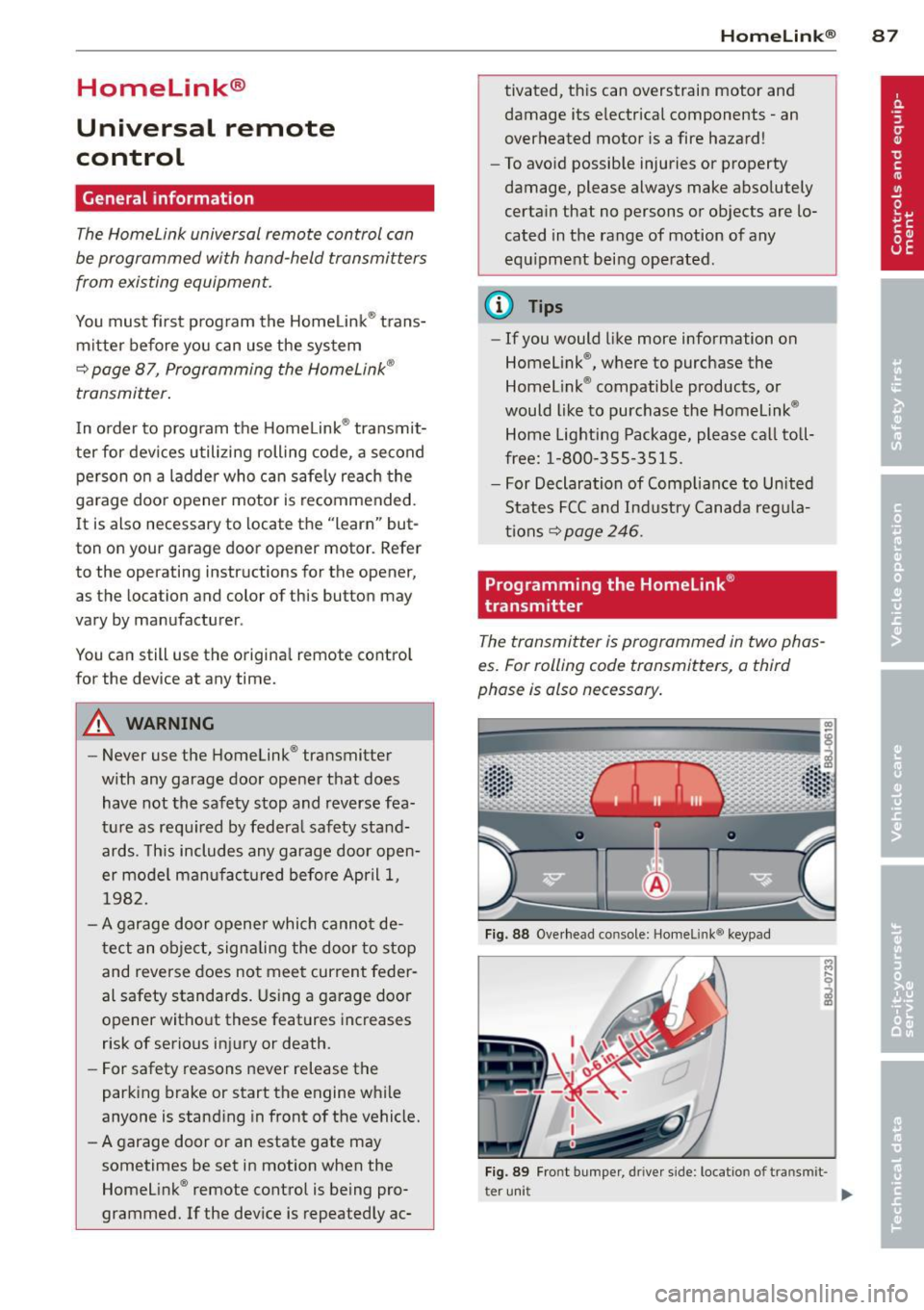
Programming the Homelink ®
transmitter
The transmitter is programmed in two phas
es. For rolling code transmitters, a third
phase is also necessary.
Fig . 88 Ove rhead co nsole: Homelink ® keypad
Fig. 89 Fro nt b umper , driver side : locatio n of tran smi t-
t er uni t
II>
Page 153 of 262
switched on all the time. In certain situations
when you need less traction, you can switch
off ESC by pressing the button
lru . Be sure to
switch ESC on again when you no longer need
less traction.
Anti -loc k brak ing s ystem (ABS )
ABS prevents the wheels from locking up
when braking . The vehicle can still be steered
even during hard braking. Apply steady pres
sure to the brake pedal. Do not pump the ped
al. A puls ing in the brake pedal indicates that
the system is helping you to brake the vehicle.
B rake ass is t system
The brake assist system can decrease braking
d istance. It increases braking power when the
driver presses the brake pedal quickly in emer
gency situations. You must press and hold the
brake pedal until the situation is over .
Anti-slip regulati on (ASR )
ASR reduces engine power when the drive
wheels begin to spin and adapts the force to
the road condit ions. This makes it easier to
start, accelerate and drive up hills.
Elect ronic diff erential lock (EDL )
The EDL brakes wheels that are spinning and
transfers the drive power to the other drive
wheel or whee ls if the vehicle is equipped with
all-wheel drive*. This function is available up
to about 60 mph (100 km/h).
In extreme cases, EDL automat ica lly switches
off to help keep the brake on the braked wheel
from overheating. EDL w ill switch on again au
tomatically when conditions have returned to normal.
..&, WARNING
- ESC, ABS, ASR and EDL cannot ove rcome
t he laws of physics. This is espec ia lly im
portant on slippery or wet roads.
If the
systems begin act ing to stab ilize your ve
hicle, you should immediately change
yo ur speed to match the road and traffic
condit ions. Do not let the increased safe
ty provided by these systems tempt you
Intelligen t technolog y 151
to take risks. Doing so will increase the
risk of a loss of vehicle control, co llision
and serious personal injuries.
- Always adapt your speed to road, traffic
and weather conditions. The risk of los
ing control of the vehicle increases when
driving too fast, espec ially through
curves and on slippery or wet roads, and
when driving too close to vehicles up ahead. ESC, ABS, the brake assist sys
tem, EDL and ASR cannot preven t coll i
sions.
- Always ac celera te with spe cial care on
even, smooth s urfaces su ch as those th at
are wet or covered with ice and snow.
The drive wheels can spin even with these assistance systems that cannot al
ways he lp to reduce the risk of loss of ve
hicle control.
@ Tips
- ABS and ASR only work correct ly when
all four whee ls are equipped with identi
cal tires. D ifferent tire sizes can lead to a
reduction in engine power.
- You may hear noises when the systems described are working.
-If the ind icator lightD] orE (USA
models)/ [iJ (Canada models) appears,
there may be a malfunction¢ page 18,
¢page 17.
TT/TTS: Switching on/off
Applies to vehicles: TT Coupe and TTS Coupe
ESC turns on automatically when you start
the engine.
Fi g. 126 Cente r console: ESC OFF button
Page 156 of 262
154 Intellig ent technolog y
down continuously. Pump the brakes at inter
va ls.
Noises may occur when braking depending on
the speed, braking force and outside condi
tions such as temperature and humidity.
Moistu re or road salt
Under certain conditions, for examp le, when
d riving through water or ve ry heavy rain, or
even after washing your vehicle , the bra king
effect can be reduced due to moisture (o r in
freezing conditions ice) on the brake pads. A
few cautious brake applications should dry off
the brake pads or remove any ice coatings.
The effectiveness of the b rakes can be reduced
when the vehicle is driven on a salt -covered
road and the brakes are not used. Likewise,
you clean off accumulated sa lt coating from
brake discs and pads with a few caut ious ap
plications of the brake
q .&. .
Co rrosion
There may be a tendency for dirt to bui ld up
on the brake pads and corrosion to form on
the discs if the car is not driven regularly or
only for short trips with little use of the brakes.
If the brakes are not used frequently, or if cor rosion has formed on the discs, it is advisable
to clean off the pads and discs by braking
f irmly a few times from a moderately high
speed
Q .&. .
Fa ults in th e brak e system
If you should notice a sudden increase in
brake peda l travel, then one of the two brake
circu its may have failed
q .&. .
Low brake flu id le vel
Malfunct ions can occur in the brake system if
the brake fluid level is too low. The brake fluid
leve l is monitored electronically.
B rake boo ste r
The brake booster increases the press ure that
you gene rate w it h the brake pedal. It works
on ly when the engine is running
.Q .&.
Brake lining wear statu s
Brake lining wear may be checked by visual in
spection of the condition of the brake pads
thro ugh the openings in the wheel. If neces
sary, the wheel may be removed for this in
spection
q page 224, What should I be
aware of when changing a tire?.
A WARNING
-- You shou ld perform braking maneuvers
for the purpose of cleaning the brake system only if road conditions permit .
Othe r road use rs must not be put at risk -
you may ca use an accident!
- Before descend ing a steep grade, reduce
speed and sh ift transmission into a lower
gear or lower dr iving range. Do not ride
the brakes or hold the pedal down too
long or too often. This could cause the
brakes to get hot and diminish braking
efficiency.
- Do not "ride the brakes" by rest ing your
foot on the pedal when you do not intend
to brake. This may cause the brakes to
overheat, premature wear and increased
stopping distance .
- Under certain climatic and operat ing
conditions such as passing through wa
ter, dr iving in heavy rain or after washing
the vehicle, the effectiveness of the b rakes can be reduced. In winte r, ice can
accumu late on the bra ke pads, lin ings,
d iscs and drums. Carefully app ly bra kes
for a test . Brakes will dry and ice coat
ings will be cleaned off after a few care
fu l brake applications.
- Driving for an extended period of time on salt-covered roads without using your brakes can a lso affect braking efficiency.
Clean off accumulated salt coating from
brake discs and pads with a few cautious
brake applications .
- If you damage the front spoiler, or if you
install a different spoiler, be sure the a ir
f low to the front brakes is not obstruct-
ed. Otherwise the brake system could
Ill>
Page 157 of 262
overheat reducing the effectiveness of
the ent ire brake system.
- Failure of one brake circuit will impair
the braking capability resulting in an in
creased stopp ing distance. Avoid driv ing
the vehicle and have it towed to the near est Aud i dealer or qualified workshop .
- Never let the vehicle roll to a stop w ith
the engine shut off.
- If the brake booster is not working, for
example when towing your ve hicle, or
because the brake booste r has somehow
been damaged, the brake pedal must be
pressed considerab ly harder to make up
for the lack of booster assistance.
Electro-mechanical
power assist
The electro-mechanical power assist helps
the driver when steering.
The degree of power assist is electronically
matched to vehicle speed.
The power steer ing system ass ists the driver
so that he can stee r the veh icle w ith red uced
phys ica l effort.
Power steering w ill not work if the engine is
off. As a result, the steering wheel w ill be hard
to turn.
& WARNING
If the system develops a prob lem, you
must seek qualified professional assis
tance.
(D Note
-
If there is an electronic malfunct ion, ser
votronic
wi ll sti ll function like a conven
tional power steering system, providing a
constant steering support force that is no
longer proportionate to the vehicle speed.
This is most noticeable when turning the
steer ing wheel at low speeds (for example
when parking), -more effort will be re
quired than usual.
Int ellig ent technolog y 155
-Be aware of the different than usual
steering response and adjust your steer
ing force accordingly.
- Have the problem checked and set right
by an authorized Audi dea ler as soon as
possible.
- If a steering malfunction occurs, this is
signaled with the,~ , or .• indicator
lights and a warn ing tone, see.
(D Tips
- If the power steering system sho uld fail,
or if the engine is not running (for exam
ple, while being towed), you will still be
able to steer the vehicle. However, more
effort will be required to do so.
- If the power steering system is not func
tioning properly, contact your authorized
Audi dealer immediately.
Driving with your
quattro ®
Applies to vehicles : wit h all -w hee l d rive
With oil -wheel drive, oil four wheels ore driv
en.
General information
With a ll-wheel drive, power is distr ibuted to
all four wheels. This happens automatically
depend ing on your driving style and the road
conditions at the time. See also
c::> page 1 SO.
The all-whee l dr ive concept is des igned for
high eng ine power. Your veh icle is except ion
ally powerfu l and has excellent driving charac
teristics both under normal driving conditions
and on snow and ice. Always read and follow
safety precautions
c::> &. .
Winter tires
When dr iving in the winter, your vehicle with
all-wheel drive has an advantage, even with
regular tires. In winter road conditions it may
be advisable to mount winter tires (or all-sea
son tires) for improved driveability and brak
ing: these tires must be mounted on
all fou r
wheels. See also c::> page 211, Winter tires. ..,_
•
•
Page 162 of 262
160 Driving and en vironm ent
Avoid damaging the
vehicle
When you are driving on poor roads, or over
curbs, steep ramps, etc ., make certain that
low-lying parts such as spoilers and exhaust
system parts do not bottom out and get dam
aged.
This is especially true for vehicles with low
slung chassis (sports chassis) and fully loaded
vehicles .
Driving through water
on roads
Note the following to avoid vehicle damage
when driving through water, for example on
flooded roads:
- T he water must not be any highe r tha n the
bottom of the vehi cle body.
- Do no t drive faster than wa lking speed.
_& WARNING
After d riving through water, m ud, slush,
etc., the brakes may be slow to take effect
because o f wet brake ro tors and pads . Dry
the brakes fi rst by braking carefully to re
store the full braking effect.
(]) Note
Vehicle components such as the engine,
transmiss ion, suspension or electrical sys
tem can be severely damaged by driving
through water.
- Check the depth o f the water before driv
ing through it.
- Do not stop the veh icle, dr ive in reverse
or switch the engine
off when driving
through water.
- Keep in mind that oncoming vehicles may c reate waves that raise the water
l evel and make it too deep for your vehi
cle to drive through safely.
- Avoid driving thro ugh salt water because
it can ca use corrosion.
-
Catalytic converter
It is very important that your emission con
trol system (catalytic converter) is function
ing properly to ensure that your vehicle is run
ning in an environmentally sound manner.
.,. Always use lead-free gasoline ¢ page 176,
Fuel supply .
.,. Never run the tank down all the way to
empty .
.,. Never put too much motor o il in your en-
gine ¢
page 185, Adding engine oil 'l::r. .
.,. Never try to push- or tow-sta rt you r vehicle.
The catalyt ic converter is an efficient "clean
u p" dev ice buil t into the exhaust system of
t h e vehi cle. The cata lytic conve rter bu rns
many of t he pollu tan ts in the exha ust gas be
f ore they are re leased into the atmosphere.
T he exclusive use of unleaded fuel is critica lly
important for the life of the catalyt ic convert
er and prope r fu nct ion ing of the engine.
A WARNING
- Do not park or operate the vehicle in
areas where the hot exha ust system may
come in contact with dry g rass, brush,
fue l spill or other material wh ich can
cause a fire.
- Do not app ly additiona l undercoating or
rustproofing on or near the exhaust
manifold, exhaust pipes, catalytic con
verter or heat sh ields. Dur ing driv ing, the
substance used fo r undercoating could
overheat and cause a fire.
(D Note
- Be aware that just one tank filling with
leaded fuel will already ser iously de-
grade the performance of the catalytic
converte r.
- Do not exceed the correct engi ne oil level
¢page 185.
-Do not drive until the fuel tank becomes
completely empty . The engine co uld mis-
fire. Unburned fuel could also get into ..,.