towing AUDI TT 2013 Owner´s Manual
[x] Cancel search | Manufacturer: AUDI, Model Year: 2013, Model line: TT, Model: AUDI TT 2013Pages: 262, PDF Size: 65.91 MB
Page 4 of 262
2 Table of contents Vehicle literature ............. .
About this Owner's Manual ...
Controls and equipment .. ... .
Cockpit ................... ... . .
General illustration .............. .
Instruments and warning/
indicator lights ............... .
Instruments ............ ... .. ... .
Warning/indicator lights .......... .
Driver information system .. .
Introduction .............. ... ... .
Trip computer ........... ... .. ... .
Menu display ................... .
Eng ine oil temperature display .. ... .
Efficiency program ............... .
Service interval display ......... .. .
Boost and engine oil temperature
ind icator ................ ....... .
Lap timer ....... ........ ...... . .
On-Board Diagnostic system (OBD) .. .
Opening and closing ...... .. . .
Keys .. .. .. ................ ... . .
Power locking system ..... .. .. ... .
Rear lid/trunk lid ................ .
Anti-theft alarm system .......... .
Power windows ................. .
Clear vision ......... ... .. .. ... .
Lights ... .. ................ .... .
Interior lights ................... .
V1s1on . ...... .............. .... .
Mirrors .. .. ... .... ...... ...... . .
Wiper and washer system ...... .. . .
Digital compass ................. .
Seats and storage ......... .. . .
General recommend ations ... .. .. . .
Adjusting front seats manually .. .. . .
5
6
8
8
8
10
10
12
22
22
23
24
26
26
28
28
29
30
32
32
34
37
38
39
42
42
45
46
47
48
52
54
54
55
Power seats . . . . . . . . . . . . . . . . . . . . . 56
H ead restraints .............. ... .
Rear seats . ............. .... .... .
Luggage compartment ........ ... .
Roof rack ....... ........ ...... . .
57
58
59
60
Cup holder .... .. .......... ..... .
Ashtray ... .... .. .. .......... ... .
Cigarette lighter/socket ........... . 62
62
63
Storage . . . . . . . . . . . . . . . . . . . . . . . . . 64
Warm and cold ............. .. .
Climate controls .. ............... .
Rear window defogger ............ .
Heated seats .... ............... .
On the road ... .............. . .
Steering ....................... .
Ignit ion lock and ignition sw itch .... .
Starting and stopping the engine ... .
Parking brake ... . .......... .... . .
Starting on hills ................. .
Speed warning system ............ .
Cruise control .... ............... .
Audi magnetic ride ............. .. .
Sport mode ..... .......... ..... .
Acoustic parking system
Transmission .. ............ ... .
Manual transmission ............. .
66
66
70
70
71
71
71
72
73
74
74
76
78
78
78
80
80
S tronic transmission . . . . . . . . . . . . . . 80
Homelink ® . . . . . . . . . . . . . . . . . . . . 87
Universal remote control . . . . . . . . . . . 87
Safety first . . . . . . . . . . . . . . . . . . . . 90
Driving Safely . . . . . . . . . . . . . . . . . 90
General notes . . . . . . . . . . . . . . . . . . . . 90
Proper occupant seating positions . . .
91
Driver and passenger side footwell . . . 95
Pedal area . . . . . . . . . . . . . . . . . . . . . . . 95
Stowing luggage . . . . . . . . . . . .. . . . . 96
Reporting Safety Defects . . . . . . . . . . . 98
Safety belts . . . . . . . . . . . . . . . . . . . 100
General notes . . . . . . . . . . . . . . . . . . . . 100
Why safety belts? . . . . . . . . . . . . . . . . 101
Safety belts . . . . . . . . . . . . . . . . . . . . . 104
Safety belt pretensioners . . . . . . . . . . 106
Airbag system . . . . . . . . . . . . . . . . . 108
Important things to know . . . . . . . . . . 108
Front airbags .... .......... ...... 112
Page 5 of 262
Monitoring the Advanced Airbag
System . . . . . . . . . . . . . . . . . . . . . . . . . 119
Knee airbags . . . . . . . . . . . . . . . . . . . . . 123
Side airbags . . . . . . . . . . . . . . . . . . . . . 126
Child Safety . . . . . . . . . . . . . . . . . . . 130
Important things to know .. .. .. .. . .
C hi ld safety seats ......... .... .. . .
Instal ling a child safety seat .. .. .. . .
LA TC H Lower anchorages and tethers
for ch ild ren . ................ .. .. .
Addit io n al Information
V ehicle operat ion ........ .. .. .
Intelligent technology .. .. .. . .
N ot ice about da ta recorded by vehi cle
con trol mod ules .......... .. .. .. . .
E lect ronic S tabilization Control (ESC) .
Rear spoiler . .... ..... ... .. .. .. . .
Braking .... .. .... .. .... ... .. .. . .
Electro-mechanical power assist . .. . .
Driving w ith your quattro ® ... .. .. . .
Energy management ...... .. .. .. . .
Dr iving and environment ... ..
The first 1,000 miles (1,500 km) and
afterwards ........... ...... .... .
Avoid damaging the vehicle ........ .
Driving through water on roads . .. . .
Cata lytic conve rter ........ .... .. . .
Opera te you r vehicle econom ic all y and
minim ize po llution ..... ... .. .. .. . .
Trailer towing .. .. ..... ... .. .. .. . .
Vehicle care .. ...... ... .. .. ... .
Cleaning and protection .. .. . .
Gene ral i nformation ... ... .. .. .. . . 130
135
140
1 4 3
1 4 9
150
150
1 50
1 5 0
153
153
155
155
156
159
159
160
160
160
16 1
163
164
164 164
Ca re of exterior . . . . . . . . . . . . . . . . . . 164
Care of interior . . . . . . . . . . . . . . . . . . . 170
Fuel suppl y and filling your
fuel tank . . . . . . . . . . . . . . . . . . . . . . .
176
Gasoline . . . . . . . . . . . . . . . . . . . . . . . . 176
Fue l tank . . . . . . . . . . . . . . . . . . . . . . . . 177
Checking and filling . . . . . . . . . . . 180
Eng ine hood . . . . . . . . . . . . . . . . . . . . . 180
Eng ine o il . . . . . . . . . . . . . . . . . . . . . . . 182
Table of contents 3
Engine cooling system .. ..... ... .. . 187
B rake fluid . ... .. .. . ... ...... ... . 189
•
Battery ... .. .. .. .. . .. ... .... ... . 190 •
Windsh ie ld/headlight washer
container . .. .. .. .... ........... . 194
Tires and wheels ............. . 196
Tires ..... .. .. .. .. . ............ .
196
Tire pressure mo nitoring system . .. . 214
R un -flat t ires .. .. .. . .. .... .... .. . 217
Do -it-yourself service ........ . 220
What do I do now? .. ...... ... . 220
Vehicle tool kit .... .............. . 220
T ire repa ir . .. .. .. ... .. .. ... ..... . 220
Wha t shou ld I be awa re of when
h . t
· ? c angmg a ire ... .. . ............ . 22 4
Fuses and bulbs ... ........... . 228
El ectr ica l fuses . .. ............... . 228
B ul bs ... .. .. .. .. .. .. .. .. .... ... . 231
Emergency situations ........ . 232
Gener al ..... .. ...... ........... . 232
Starting by pushing or towing . ... .. . 232
Starting with jumper cables .. ... .. . 232
Use o f ju mpe r cables . ....... ... .. . 233
Emergency towing with commercia l
tow tr uck . .. .. .. ... ............ . 234
Lifting vehicle .. ... .............. . 237
Technical data ................ . 238
General information .... ... .. . 238
Explanation of technical data ... ... . 238
Vehicle identification ............. . 238
We ights .. .... .. .. . ............ . 238
Dimens ions .. .. .. .... ........... . 239
Page 47 of 262
instrument cluster illuminates when the
high beams are on.
- The
headlight flasher works only as long as
yo u hold the lever -even if there are no
l ights turned on . The indicator light
El in
the instrument cluster illuminates when you
use the headlight flasher.
A WARNING
Do not use the hig h beam or headlight
flasher if you know that these could blind
oncoming traffic.
Emergency flasher
The emergency flasher makes other motorists
aware that you or your vehicle are in an emer
gency situation.
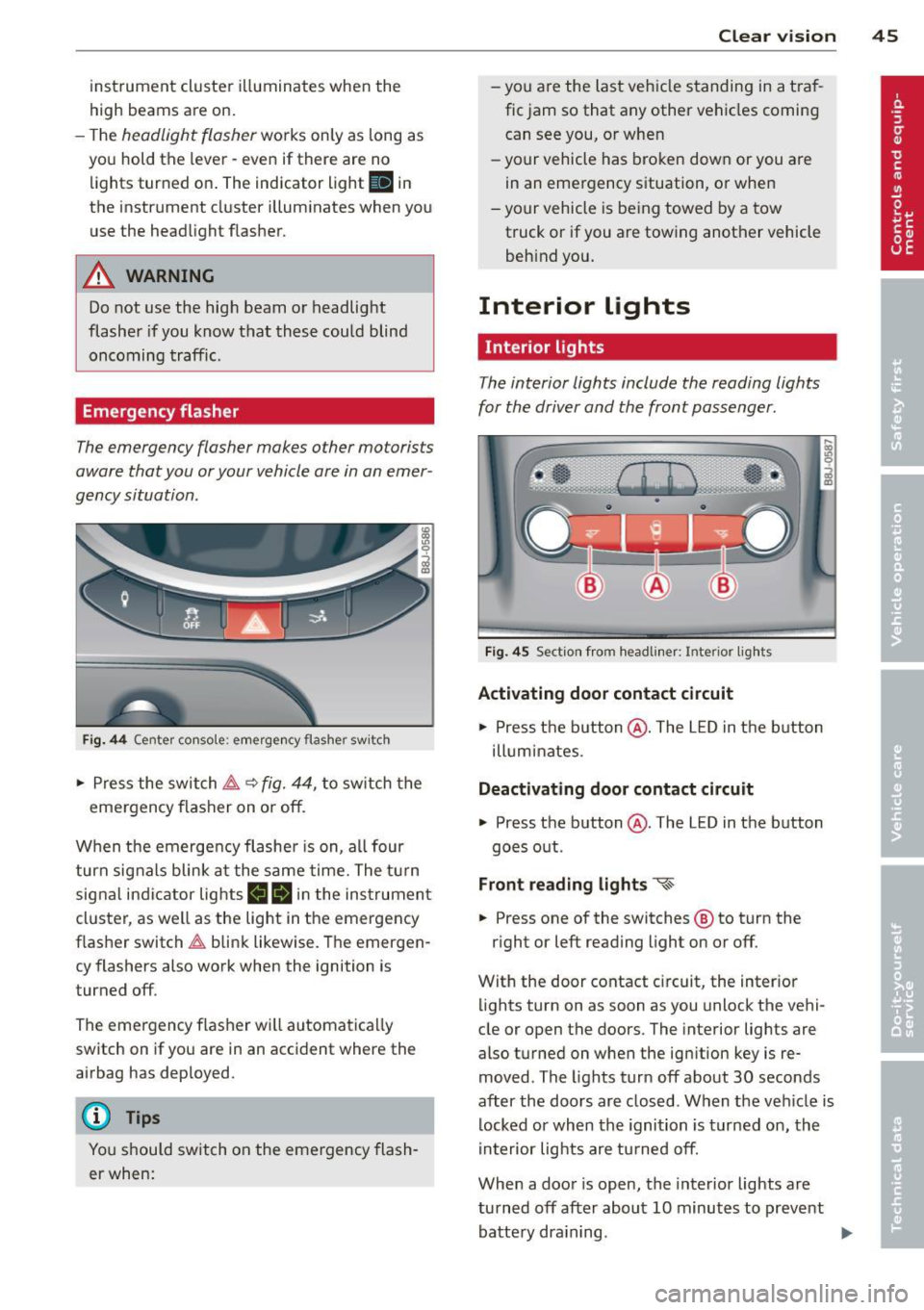
Fi g. 44 Cente r co nso le: emerge ncy flasher switch
.,.. Press the switch ~ ~fig. 44, to sw itch the
eme rgency flasher on or off.
When the emergency flashe r is on, all four
turn signals blink a t the same time. The tu rn
signa l indicator lights
BB in the ins trument
cluster, as we ll as the light in the emergency
f lasher switch ~ blink likewise. The emergen
cy flashers also work when the ignition is
turned off.
The emergency flasher will automatica lly
switch on if you are in an acc ident where the
airbag has deployed.
@ Tips
You shou ld switch on the emergency flash
er when: Clear vi
sion 45
- you are the last vehicle standing in a tra f
fic jam so that any other vehicles coming
can see you, or when
- your vehicle has broken down or you are
in an emergency s ituation, or when
- your vehicle is be ing towed by a tow
truck or if you are towing another vehicle
behind you.
Interior Lights
Interior lights
The interior lights include the reading lights
for the driver and the front passenger.
Fi g. 45 Sect ion from hea dlin er: Interior lights
Activating door contact circuit
.,.. Press the button @. The LED in the b utton
illuminates .
Deactivating door contact circuit
.,.. Press the button @. The LED in the button
goes out.
Front reading lights "<~
.,.. Press one of the switches ® to turn the
r ight or left reading light on or off.
With the door contact circuit, the inter ior
lights turn on as soon as you unlock the vehi
cle or open the doors. The interior lights are
also t urned on when the ignition key is re
moved. The lights turn off about 30 seconds
after the doors are closed. When the veh icle is
locked or when the ignition is turned on, the
interior lights are turned off.
When a door is open, the interior lights are
turned off after about 10 minutes to prevent battery dra ining.
Page 61 of 262
Luggage compartment
Expanding the luggage compartment
You can increase the available luggage space
by folding the rear seatback down .
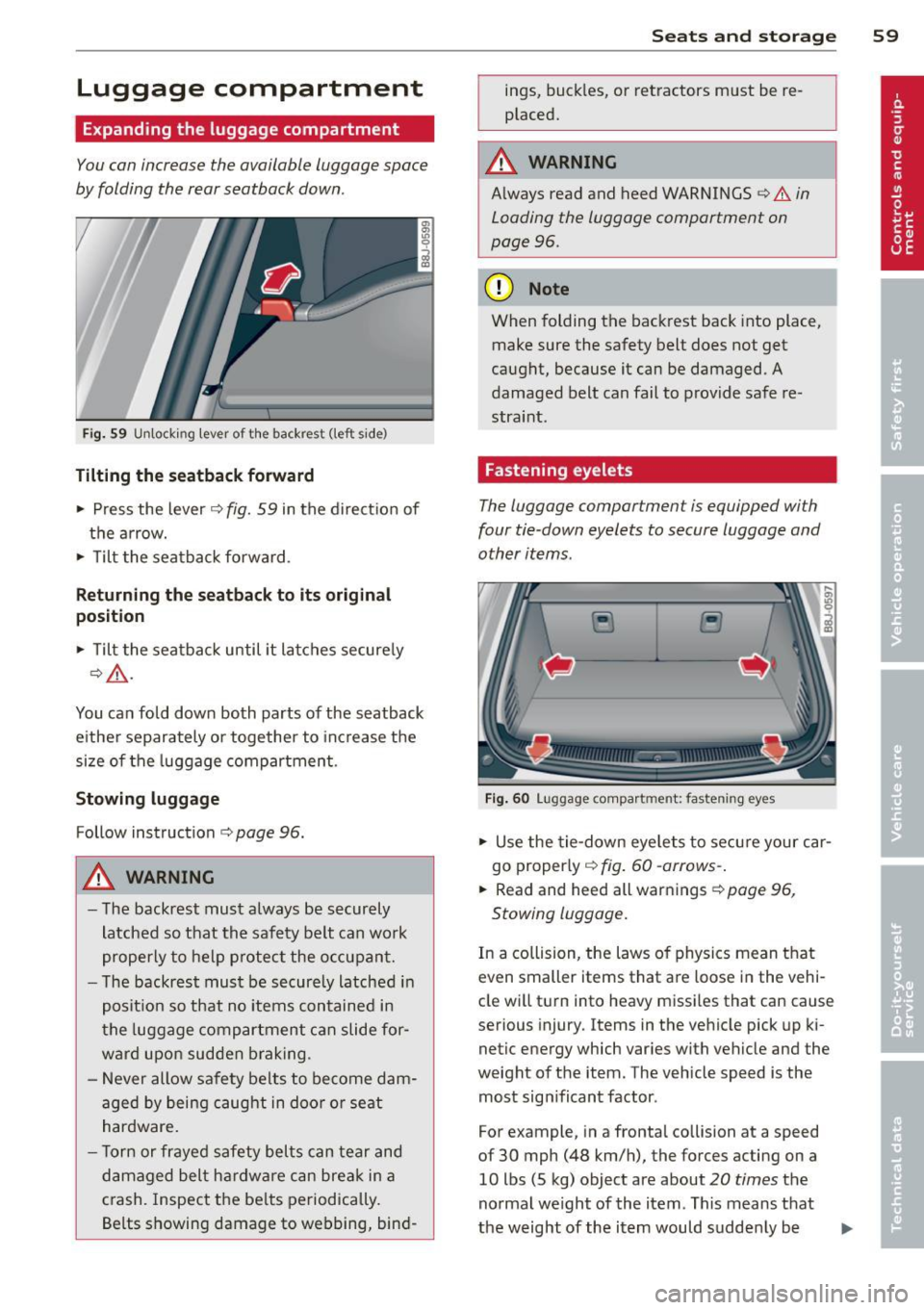
Fig. 59 Unlocking lever of the backrest (left sid e)
Tilting the seatback forward
~ Press the lever c:> fig. 59 in the direction of
the arrow.
~ T ilt the seatback forward .
Returning the seatback to its original
position
~ T ilt the seatback until it latches securely
¢ _&..
You can fold down both parts of the seatback
either separately or together to increase the
size of the luggage compartment .
Stowing luggage
Follow instruction c:> page 96.
A WARNING
- The backrest must always be securely
latched so that the safety belt can work
properly to help protect the occupant.
- The backrest must be securely latched in
position so that no items contained in
the luggage compartment can slide for
ward upon sudden braking .
- Never allow safety belts to become dam
aged by being caught in door or seat
hardware.
- T orn or frayed safety belts can tear and
damaged belt hardware can break in a
crash. Inspect the belts periodically.
Belts showing damage to we .bbing, bind-
Seats and storage 59
ings, buckles, or retractors must be re
placed.
A WARNING
Always read and heed WARNINGS <:> A in
Loading the luggage compartment on
page 96 .
(D Note
When folding the backrest back into place,
make sure the safety belt does not get
caught, because it can be damaged. A
damaged belt can fail to provide safe re
straint .
Fastening eyelets
The luggage compartmen t is equipped wi th
four tie-down eyelets to secure luggage and
other items .
Fig. 60 Lugg ag e compar tmen t: fa st enin g eyes
~ Use the tie-down eyelets to secure your car
go properly <:>
fig. 60 -arrows-.
~ Read and heed all warnings c:> page 96,
Stowing luggage.
In a collision, the laws of physics mean that
even smaller items that are loose in the vehi
cle will turn into heavy missiles that can cause
serious injury. Items in the vehicle pick up ki
netic energy which va ries with vehicle and the
weight of the item. The vehicle speed is the
most sign ificant factor .
For example, in a frontal collision at a speed
of 30 mph (48 km/h), the forces acting on a 10 lbs (5 kg) object are about
20 times the
normal weight of the item . This means that
the weight of the item would suddenly be
Page 75 of 262
CD Note
-Avoid high engine speeds, fast accelera
tion or heavy engine loads whi le the en
gine is still cold. This could damage the
engine.
- The engine cannot be started by pushing or towing the veh icle.
@) For the sake of the environment
To avoid unnecessary engine wear and to
reduce exhaust emissions, do not let your
veh icle stand and warm up. Be ready to
drive off immediately after starting your
veh icle. Maintain moderate speed until the
eng ine is completely warm . Remember,
the engine performs best at operating
temperature .
Stopping the engine
~ Turn the ign ition key to position @
~page 71, fig. 71.
_& WARNING
-Never turn off the engine before the ve
hicle has come to a complete stop. The
full function of the brake booster and the
power steering is not guaranteed . You
must use more force to turn or brake if
necessary. Because you cannot steer and
brake as you usually would, this could
lead to crashes and serious injur ies.
- The radiator fan can continue to run for
up to 10 minutes even after you have
turned
off the engine and removed the
ignition key . The radiator fan can also
turn on again if the engine coolant heats
up because of intense sunlight or heat
build-up in the engine compartment.
CD Note
Do not stop the engine immed iate ly after
hard or extended driving. Keep the engine
running for approximately two minutes to
prevent excessive heat build-up.
On the road 73
Parking brake
Parking brake
When the parking brake is set, it prevents the
vehicle from rolling away unintentionally .
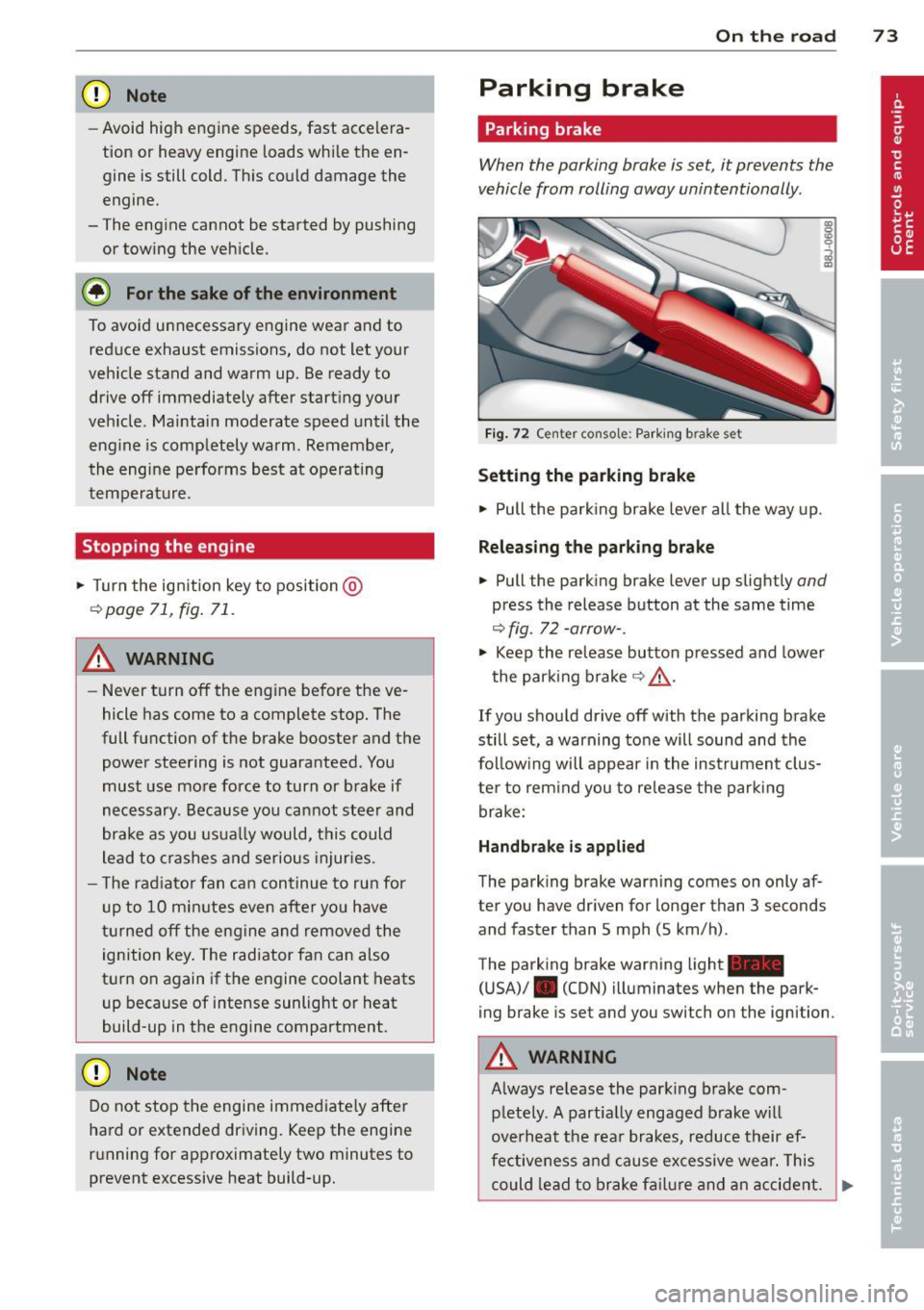
Fig. 72 Center console: Parki ng b rake set
Setting the parking brake
~ Pull the park ing brake lever all the way up.
Releasing the parking brake
~ Pull the parking brake lever up slightly and
press the release button at the same time
~ fig. 72 -arrow-.
~ Keep the release button pressed and lower
the parking brake~&_ .
If you should drive
off with the parking brake
still set, a warning tone will sound and the
follow ing will appear in the instrument clus
ter to rem ind you to release the parking
brake:
Handbrake is applied
The parking brake warning comes on only af
ter you have driven for longer than 3 seconds
and faster than 5 mph (5 km/h) .
The parking brake warning light_
(USA)/ . (CON) illuminates when the park
ing brake is set and you switch on the ignition .
A WARNING
Always re lease the park ing brake com -
pletely. A partially engaged brake will
overheat the rear brakes, reduce their ef
fectiveness and cause excessive wear. This
could lead to brake failure and an accident. .,.
Page 98 of 262
96 Driving Safely
Floor mats used in your vehicle must be at
tached to these fasteners. Properly securing
the floor mats will prevent them from sliding into positions that could interfere with the
pedals or impair safe operation of your vehicle
in other ways .
A WARNING
Pedals that cannot move freely can result
in a loss of vehicle control and increase the
risk of serious personal injury .
- Always make sure that floor mats are
properly secured.
- Never place or install floor mats or other
floor coverings in the vehicle that cannot
be properly secured in place to prevent
them from slipping and interfering with
the pedals or the ability to control the
vehicle.
- Never place or install floor mats or other
floor coverings on top of already instal
led floor mats. Additional floor mats and
other coverings will reduce the size of
the pedal area and interfere with the pedals.
- Always properly reinstall and secure floor
mats that have been taken out for clean
ing.
- Always make sure that objects cannot
fall into the driver footwell while the ve
hicle is moving. Objects can become
trapped under the brake pedal and accel
erator pedal causing a loss of vehicle
control.
Stowing luggage
Loading the luggage compartment
All luggage and other objects must be prop
erly stowed and secured in the luggage com
partment.
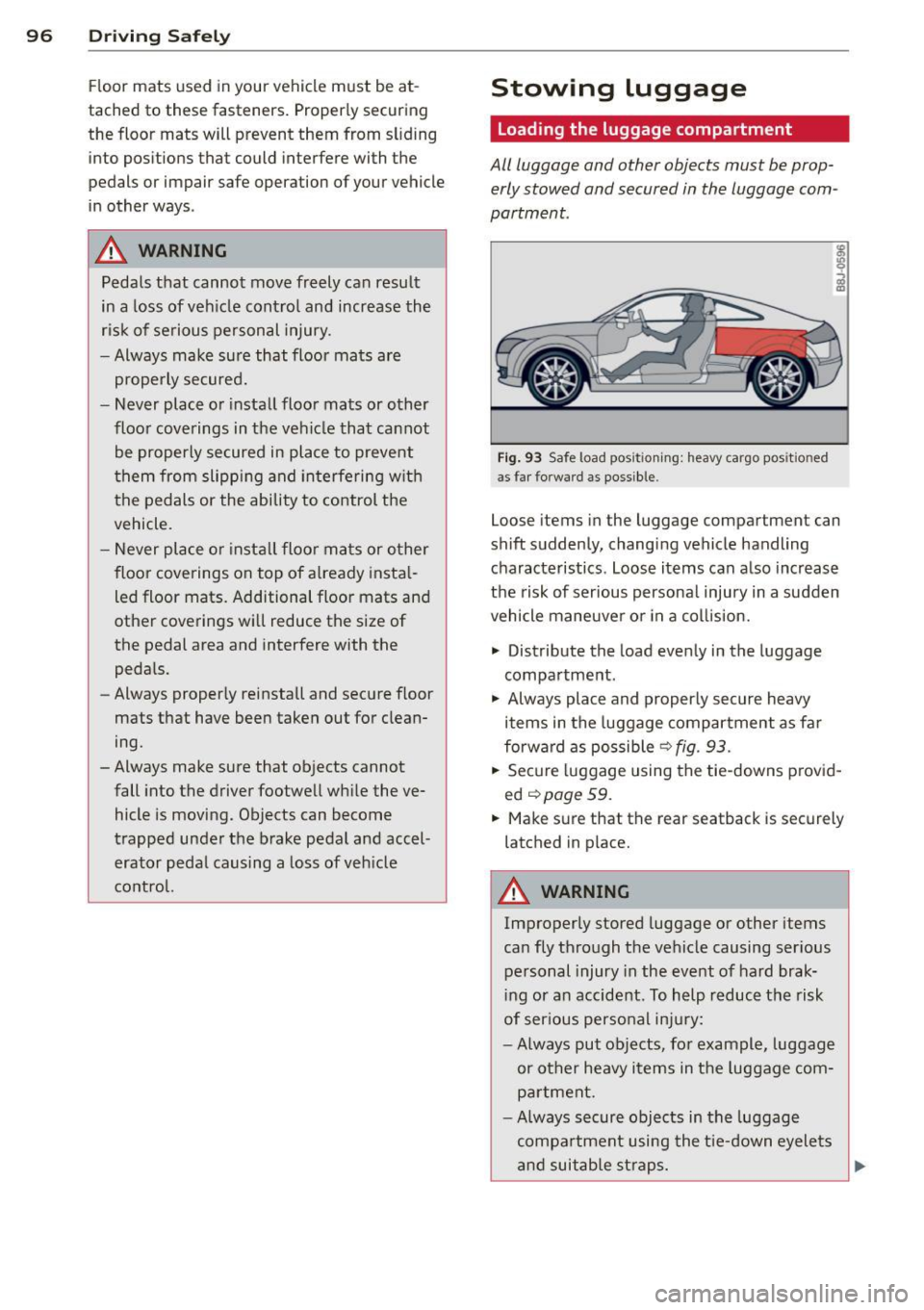
Fig. 93 Safe load posi tioning: heavy ca rgo pos it io ned
as far forwar d as possible.
Loose items in the luggage compartment can
shift suddenly, changing vehicle handling characteristics. Loose items can also increase
the risk of serious personal injury in a sudden
vehicle maneuver or in a collision.
.., Distribute the load evenly in the luggage
compartment.
.., Always place and properly secure heavy
items in the luggage compartment as far
forward as possible
r:::>fig . 93.
.,. Secure luggage using the tie-downs provid
ed
<:!) page 59.
... Make sure that the rear seatback is securely
latched in place.
A WARNING
-Improperly stored luggage or other items
can fly through the vehicle causing serious
personal injury in the event of hard brak
ing or an accident. To help reduce the risk
of serious personal injury:
- Always put objects, for example , luggage
or other heavy items in the luggage com
partment.
- Always secure objects in the luggage
compartment using the tie-down eyelets
and suitable straps.
~
Page 157 of 262
overheat reducing the effectiveness of
the ent ire brake system.
- Failure of one brake circuit will impair
the braking capability resulting in an in
creased stopp ing distance. Avoid driv ing
the vehicle and have it towed to the near est Aud i dealer or qualified workshop .
- Never let the vehicle roll to a stop w ith
the engine shut off.
- If the brake booster is not working, for
example when towing your ve hicle, or
because the brake booste r has somehow
been damaged, the brake pedal must be
pressed considerab ly harder to make up
for the lack of booster assistance.
Electro-mechanical
power assist
The electro-mechanical power assist helps
the driver when steering.
The degree of power assist is electronically
matched to vehicle speed.
The power steer ing system ass ists the driver
so that he can stee r the veh icle w ith red uced
phys ica l effort.
Power steering w ill not work if the engine is
off. As a result, the steering wheel w ill be hard
to turn.
& WARNING
If the system develops a prob lem, you
must seek qualified professional assis
tance.
(D Note
-
If there is an electronic malfunct ion, ser
votronic
wi ll sti ll function like a conven
tional power steering system, providing a
constant steering support force that is no
longer proportionate to the vehicle speed.
This is most noticeable when turning the
steer ing wheel at low speeds (for example
when parking), -more effort will be re
quired than usual.
Int ellig ent technolog y 155
-Be aware of the different than usual
steering response and adjust your steer
ing force accordingly.
- Have the problem checked and set right
by an authorized Audi dea ler as soon as
possible.
- If a steering malfunction occurs, this is
signaled with the,~ , or .• indicator
lights and a warn ing tone, see.
(D Tips
- If the power steering system sho uld fail,
or if the engine is not running (for exam
ple, while being towed), you will still be
able to steer the vehicle. However, more
effort will be required to do so.
- If the power steering system is not func
tioning properly, contact your authorized
Audi dealer immediately.
Driving with your
quattro ®
Applies to vehicles : wit h all -w hee l d rive
With oil -wheel drive, oil four wheels ore driv
en.
General information
With a ll-wheel drive, power is distr ibuted to
all four wheels. This happens automatically
depend ing on your driving style and the road
conditions at the time. See also
c::> page 1 SO.
The all-whee l dr ive concept is des igned for
high eng ine power. Your veh icle is except ion
ally powerfu l and has excellent driving charac
teristics both under normal driving conditions
and on snow and ice. Always read and follow
safety precautions
c::> &. .
Winter tires
When dr iving in the winter, your vehicle with
all-wheel drive has an advantage, even with
regular tires. In winter road conditions it may
be advisable to mount winter tires (or all-sea
son tires) for improved driveability and brak
ing: these tires must be mounted on
all fou r
wheels. See also c::> page 211, Winter tires. ..,_
•
•
Page 165 of 262
engine no less than two and a half miles
(4 km) of driving to warm up to its proper
operating tempe ratu re and ope rate at an
economic mileage. This explains w hy taking
t h e car for s hort tr ips is a rather wastefu l
convenience .
- The
outs ide temperature is also cr itical in
t hi s regard. Your car consumes more fuel in
the winter than in the summer .
Trailer towing
General information
Your Audi TT Coupe is not designed to tow a
trailer.
Tow ing a tra ile r with you r Audi T T Coupe is not
r eco mmended a nd can cause damage to t he
c a r. Damaged caused by towing a tra iler is not
covered by yo ur Audi War ranty .
Driving and environment 163
•
•
Page 207 of 262
Determining correct load limit
Use the example below to cal
culate the total weight of the
passengers and luggage or oth
er things that you plan to trans
port so that you can make sure
that your vehicle will not be overloaded.
Steps for Determining
Correct Load Limit
1. Locate the statement "THE
COMBINED WEIGHT OF OC
CUPANTS AND CARGO
SHOULD NEVER EXCEED XXX KG OR XXX LBS"on your vehi
cle's placard (tire inflation pressure label)
¢ page 200,
fig . 142 .
2. Determine the combined
weight of the driver and pas sengers that will be riding in
your vehicle .
3 . Subtract the combined
weight of the driver and pas sengers from
"XXX" kilo
grams or
"XXX" pounds
shown on the sticker
¢ page 200 , fig. 142.
4. The resulting figure equals
the available amount of car
go and luggage load capaci
ty. For example, if the
"XXX"
amount equals 1400 lbs.
Tires and wheels
and there will be five 150 lbs. passengers in your vehi
cle, the amount of available
cargo and luggage load ca pacity is 650 lbs. (1400-7 50
(5
X 150) = 650 lbs.)
5 . Determine the combined
weight of luggage and cargo
being loaded on the vehicle .
That weight may not safely exceed the available cargo
and luggage load capacity
calculated in Step
4.
6. If your vehicle will be towing
a trailer, load from your trail
er will be transferred to your
vehicle. Consult this manual
to determine how this reduces the available cargo
and luggage load capacity of
your vehicle.
,... Check the tire sidewall
(¢ page 207, fig. 146) to de
termine the designated load rating for a specific tire.
205
•
•
'
Page 222 of 262
220 What do I do now?
What do I do now?
Vehicle tool kit
The tools ore stored underneath the floor
panel in the luggage comportment.
Fig. 152 Luggage compartment: vehicle tool kit
• Swing the luggage compartment floor up-
wards.
• Remove the veh icle tool kit .
The on board tool kit includes:
- Hook for removing wheel covers*
- Plastic clip to
remove wheel bolt covers*
-Wheel bolt wrench
- Alignment pin for changing wheels
- Screwdr iver w ith reversible blade
- Replacement bit (reversible Torx b it for
changing lamps)
- Open ended wrench 10 x 13
- Towing eye
- Jack *
Some of the on board items listed above are provided on certain models on ly or are opt ion
al extras.
Before returning the jack* to its place, retract
the jack arm fully.
_& WARNING
Improper use of the vehicle jack can cause
serious personal injuries.
- Never use the screw driver hex head to
tighten wheel bolts, since the bolts can not attain the necessary tightening tor
que if you use the hex head, potentially causing an accident. -
The factory-supplied jack is intended on
ly for your vehicle model. Under no cir
cumstances should it be used to
lift
heavy veh icles or other loads; you risk in
juring yourself .
- Never start the engine when the vehicle
is raised, which could cause an accident.
- Support the vehicle securely with appro
priate stands if work is to be performed
underneath the vehicle; otherwise, there is a potentia l risk for injury.
- Never use the jack supplied with your
Aud i on another vehicle, part icularly on a
heav ier one . T he jack is only s uitable for
use on the vehicle it came with.
Tire repair
General and safety pointers
Applies to vehicles: wit h Tire Mobility Sys tem
Tire repair is intended only for temporary,
short-term use .
Fig. 153 Tire damage for whic h the Tir e Mob ility Sys
tem is not suited
Your vehicle is equipped with a tire repa ir kit,
the
Tire Mobility System (TMS).
In the event of a tire failure, the TMS is in the
luggage compartment under the floor.
It con
s ists of the tire sealant and an electric air
pump .
Using
TMS , tir e damage caused by foreign
bodies up to about
0.16 inch (4 mm) in diam
eter can be sealed reliably.
The foreign object can stay in the tire .