fold seats AUDI TT COUPE 2009 User Guide
[x] Cancel search | Manufacturer: AUDI, Model Year: 2009, Model line: TT COUPE, Model: AUDI TT COUPE 2009Pages: 316, PDF Size: 71.16 MB
Page 176 of 316
___ C_h_ i_ ld _ S_ a_ f_ e_ t_y ____________________________________________ _
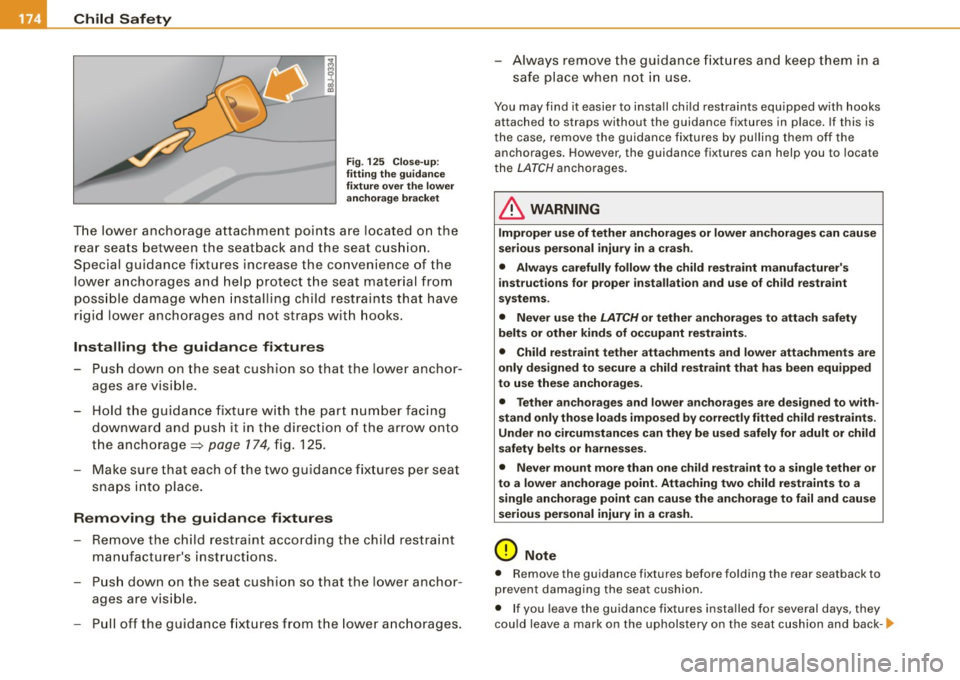
Fig. 125 Close-up:
fitting the guidance
fixture over the lower
anchorage bracket
The lower anchorage attachment points are located on the
rear seats between the seatback and the seat cushion .
Special gu idance fixtures increase the convenience of the
lower anchorages and help protect the seat material from
possible damage when installing ch ild restraints that have
rigid lower anchorages and not straps with hooks.
Installing the guidance fixtures
- Push down on the seat cushion so that the lower anchor
ages are visible.
- Hold the guidance fixture with the part number facing
downward and push it in the direction of the arrow onto
the anchorage =>
page 174, fig. 125.
- Make sure that each of the two guidance fixtures per seat
snaps into place.
Removing the guidance fixtures
-Remove the child restraint according the child restraint
manufacturer's instructions.
- Push down on the seat cushion so that the lower anchor
ages are visible.
- Pull off the guidance fixtures from the lower anchorages. - Always remove
the guidance fixtures and keep them in a
safe place when not in use.
You may find it easier to install child restraints equipped with hooks
attached to straps without the guidance fixtures in plac e. If this is
the case , remove the guidance fixtures by pulling them off the
anchorages . However , the guidance fixtures can help you to locate
the
LATCH anchorages .
& WARNING
Improper use of tether anchorages or lower anchorages can cause
serious personal injury in a crash.
• Always carefully follow the child restraint manufacturer's
instructions for proper installation and use of child restraint
systems.
• Never use the
LATCH or tether anchorages to attach safety
belts or other kinds of occupant restraints.
• Child restraint tether attachments and lower attachments are
only designed to secure a child restraint that has been equipped
to use these anchorages .
• Tether anchorages and lower anchorages are designed to with
stand only those loads imposed by correctly fitted child restraints.
Under no circumstances can they be used safely for adult or child
safety belts or harnesses.
• Never mount more than one child restraint to a single tether or
to a lower anchorage point. Attaching two child restraints to a single anchorage point can cause the anchorage to fail and cause
serious personal injury in a crash.
0 Note
• Remov e the guidance fixtur es before folding th e rear se atback to
prevent damaging the seat cushion.
• If you leave the guidance fixtures installed for several days, they
could leave a mark on the upholstery on the seat cushion and back-~
Page 207 of 316
_____________________________________________ C_ l_ e _a_ n_ in_ g_a _ n_d_ p_ r_ o_ t _e_ c_t _io _ n __ _
•
Chassis
Have the underco ating checke d for damage from time to
time .
The lower body shell of your Audi is a lso thorough ly protected
against corros ion.
Any damage to the undercoating caused by road hazards should be repa ired p romptly .
& WARNING
Too mu ch undercoat ing in the wrong place s can cau se a fire.
• Do not app ly additional undercoating or rustproofing on or
near the exhau st manifold , ex haust p ipe s, cat alytic con verter or
heat shields . While d riving, the sub stan ce used for undercoating
c o uld overhe at and cause a fire.
• Always read a nd heed all WARNINGS and other information
=> p age 198 . •
Care of interior
Aluminum trim
Use only neutral-pH products to remove spots and deposits from
a luminum surfaces. Chrome care products and alka line cleaners
w ill attack aluminum s urfaces and ca n damage them over time .
& WARNING
Always read and he ed all WARNINGS and the inform ation
=> page 198. •
Fabrics and fabric coverings
Fabrics and fabric coverings (e.g . seats, door trim pane ls, etc.)
shou ld be c leaned at regular intervals with a vacuum cleaner . This
removes surface dirt partic les which could become embedded in
t he fabric through use. Steam clea ners shou ld not be used, because
the steam tends to push the dirt deeper into the fabric and lock it
there .
No rmal cleaning
Genera lly, we recommend using a soft spo nge or a lint-free
microfiber c loth to the clean fabric . Brushes should on ly be used for
carpe ts and floor mats, since other fabric su rfaces co uld be harmed
by brushes.
N orma l surface stains can be cleaned using a commercially avail
able foam cleaner. Spread the foam on the surface o f the fabric with
a soft sponge and work it in gent ly. Do not saturate the fabric . Then
pat the foam dry us ing absorbent, dry cloths (e.g. microfiber cloth)
and vacuum it after it has dried completely .
C leaning stains
Stains caused by beverages (e.g. coffee, fruit juice, etc.) can be
t reated with a mild detergent so lution . Apply the detergent so lution
with a sponge. In the case of stubborn stains, a detergent paste can
be applied directly to the stain and worked into the fabric . After
wards, use copious amounts of clean water to remove the
re maining dete rgent . Apply the water w ith a damp cloth or sponge
and pat the fabric dry with an absorbent, dry c loth .
Stains from chocolate or makeup should have detergent paste (e.g .
ox -ga ll soap) rubbed into them. Afterwards, remove the soap with
water (damp sponge) .
A lcoho l can be used to treat s tains from grease, oi l, lipst ick or a ba ll
point pen . Melted grease or dye must be patted off using absorbent
ma terial. It may be neces sary to retrea t the areas with de tergent
paste and water. _.,
Vehicle care
I t •
Page 209 of 316
_____________________________________________ C_ l_ e _a_ n_ in_ g_a _ n_d_ p_ r_ o_ t _e_ c_t _io _ n __ !II
•
tance to wear and soiling in daily use. On the other hand, the typical
characteristics of natural leather are barely or not apparent.
However, this does not mean that the leather itself is of inferior
quality.
Care and handling
Because of the exclusive nature of the types of leather that Audi
uses and their unique properties (such as sensitivity to oils, grease,
soiling, etc.I, you will need to be somewhat careful with these
leathers , and a certain type of care is required. For example, dark
clothing materials can discolor leather seats (especially if such
clothing is damp and was not dyed correctly). Dust and dirt particles
in pores, folds, and seams can have an abrasive effect and can
damage the leather surface as well as weaken seams.
The leather should be cleaned regularly as needed . After having
been used for a relatively long time, your leather seats will acquire
a rich aged finish. This is a characteris tic of natural leather and a
sign of true quality.
In order to maintain the value of this natural product over the life of
your vehicle, you should follow the recommendations below :
0 Note
• To keep your leather from bleaching out, do not allow it to be
exposed to bright sunlight for long periods of time. If you have to
leave the vehicle parked outside for long periods, cover the leather
to protect it from direct exposure to sunlight.
• Sharp objects on clothing, such as zippers, rivets or sharp pieces
on belts can leave permanent scratches or scrape marks on the
surface of the leather.
[ i] Tips
• After each time you clean the leather and at regular intervals, use
a leather preservative creme that contains UV -blockers and that
works into the leather . This creme will nourish and moisturize the leather, helping it to breathe and stay supple
. It also helps to build
up a protective coating on the surface.
• Clean the leather every 2 -3 months, and clean any areas that get
soiled.
• Remove fresh marks made by ballpoint pens, ink, lipstick, shoe
polish, etc. as soon as possible.
• Preserve the color of the leather as needed by using a special
colored leather care creme to touch up areas of uneven color. •
Applies to ve hic les : w ith natu ra l lea ther
Cleaning and caring for leather upholstery
and trim
Natural leather requires special care and attention.
Normal cleaning
Clean soiled areas with a slightly moistened cotton or
woolen cloth.
More stubborn dirt
- More stubborn dirt can be removed using a cloth satu
rated with a mild soap solution (2 tablespoons mild
liquid soap).
Never allow the soap solution to saturate the leather, and
make certain that no water soaks into the seams.
- Wipe off the soap solution with a soft, dry cloth.
Cleaning spots
- Remove fresh water-based spots (such as coffee, tea,
juices, blood) with an absorbent cloth or paper towel.
Vehicle care I t •
Page 306 of 316

-Alphab eti ca l ind ex ----=------...:..:...::... ___________________________ _
Recommended oil check intervals .. 221
Specification and viscosity .. .. .. .. 219
Engine oil leve l .... .... ... ...... .... . 35
Engine oil pressure (malfunction) ... ... 35
Engine oil sensor defective ... .... .... . 35
Environment Break -in period . . . . . . . . . . . . . . . . . . 190
Catalytic converter . . . . . . . . . . . . . . . 191
Disposing of your vehicle battery . .. 228
Driving at high speeds ............ 192
Driving to minimize pollution and noise . 192
Fuel .... .... ... .. .... .... ...... . 213
Fuel economy . . . . . . . . . . . . . . . . . . . 192
Leakage from your vehicle . . . . . . . . . 217
Letting the vehicle stand and warm up . .
193
Proper disposal of drained brake fluid ... 227
Proper disposal of drained engine coolant ... .... .... .... .... .... . 225
Proper disposal of drained engine oil 222,223
Recycling used engine oil . .... .... 222
Un leaded fuel ... ... ..... .... .... 211
What should I do with an old battery? 228
EPC
See E lectronic power control . . . . . . . . 17
ESP
See Electronic Stability Program . ... 182
Event Data Recorder (EDR) . . . . . . . . . . . 182
Expansion tank .... .... .... .... ... .. 225
F
Fan .. ... .... .... ...... .... ... .. .... 87
Radiator . . . . . . . . . . . . . . . . . . . . . . . . 226
Fastening eyelets . .... .... .... .... ... 77
Flat t ire
Changing .... ....... .. ...... .... 268
Floor mats . . . . . . . . . . . . . . . . . . . . . . . . . 121
Fog lights, front ... .. ...... .... ... .. . 55
Fold ing master key with remote control . 38
Foot pedals . . . . . . . . . . . . . . . . . . . . . . . . 120
For the sake of the e nv ironment
Gasoline fumes and l the environment 213
Letting your engine warm up . .... .. 93
Reducing engine noise by early upshif ting ... ... ..... ... .... .... 12
Refue ling ... .. ...... ........ .... 213
Saving fuel by early upshifting .... .. 12
Front airbags Description . . . . . . . . . . . . . . . . . . . . . . 139
How they work . . . . . . . . . . . . . . . . . . . 144
Front seats . . . . . . . . . . . . . . . . . . . . . . . . . . 69
Ad ' .
Justing ...... .... ... .... .... .. 117
Adjusting the manual seats .. .... ... 71
Child restraints in the front seat .. .. 137
Fronta l collisions and the laws of physics .. .
126
Fuel Additives ...... ....... .... .... .. 211
Blended gasoline ........... .... .. 211
Current fuel mileage .. ... .... ..... . 26
Fi ller neck . .... ..... .. .... .... ... 212
Fuel gauge .............. .... ..... 14 Fuel supply too
low ..... .. . ... ... . . 35
Gaso line ... .... .... ... .... .... .. 211
Gasoline additives ................ 212
Octane rating .. .... .... .... .... .. 211
Recommendation .. ....... .... ... 211
Refue lling ... .. .... .... .... .... .. 213
Reserve ... ..... ... .... ... .... .... 14
Tank capacity ... .. .... .... .... ... 291
Un locking the fuel fi ller flap by hand 215
Fuel range ... ...... ... .. .... .... .... 26
Fuse arrangement ... .... ........ .... 275
G
Garage door opener . ...... ...... .... 107
Gas discharge lamps .... .. ... ... ... . 278
Gauges
Engine coolant temperature .... .. .. 13
Fuel gauge ............. ...... .... 14
Tachometer .... ....... ....... .... 12
Gear recommendation ........ ....... . 23
Gearshift indicator ... ...... ...... ... . 23
Gearshift lever
6 -speed manual transmission ... ... . 99
Generator Warning/indicator lights ........... . 18
G lossary of tire and loading terminology .. .
235
G love compartment ...... .... .... .... 8 4
Gross Vehicle Weight Rating (GVWR) ... 289