inflation pressure AUDI TT COUPE 2009 User Guide
[x] Cancel search | Manufacturer: AUDI, Model Year: 2009, Model line: TT COUPE, Model: AUDI TT COUPE 2009Pages: 316, PDF Size: 71.16 MB
Page 257 of 316

Tires and wheels -
----------------
•
& WARNING (continued)
• Do not adjust tire pressure when tire temperature is excessive.
This could lead to serious tire damage and even cause the tire to
burst, with the additional danger of an accident.
tread life.
[ i] Tips
• Each tire should be checked monthly when the temperature of
the tires is about the same as ambient air temperature and set to the
recommended inflation pressure as specified on the tire pressure
label =>
page 238.
• The factory supplied spare wheel is equipped with a sensor for
the tire pressure monitoring system *. As long as the spare wheel is
not mounted, the tire pressure of this tire will not be monitored.
• The tire pressure monitoring system * helps the driver to keep an
eye on tire pressures. But the driver still has the responsibility for
maintaining the correct tire pressure.
• Tire pressure must only be adjusted when the temperature of the
tires is about the same as ambient air temperature.
• When tires are replaced, the sensors and valves should not be
exchanged . The valve core, nut, valve sealing and seal washer
(replacement kit) needs to be replaced. If necessary, the valve and
the wheel electronics have to be replaced.
• If you should put different wheels and tires on your vehicle (e.g.
winter wheels and tires), you must be certain that the wheels and
tires are compatible with the tire pressure monitoring system*.
Otherwise the system will register a malfunction and a fault
message will be displayed. For more information, contact your Audi
dealer. •
Adjust the tire pressure and store the pressure in the tire pres
sure monitoring system* to the load you are carrying.
• For Declaration of Compliance to United States FCC and Industry
Canada regulations =>
page 296. •
Applies to vehicles : with tire pressu re mon itoring system
Significant loss of air pressure }
The yellow symbol appears in the event of a significant
loss of air pressure.
Fig. 153 Display:
yellow symbol with message
If the I warning light in the instrument cluster comes on
and then the(•' symbol appears in the display ~ fig. 153,
pressure in at least one tire is too low.
- Stop driving as soon as possible without endangering
yourself and other drivers on the road.
Inspect all tires.
- Change the tire if necessary ~
page 268.
The, warning light in the instrument cluster comes on when the
tire is significantly underinflated .
In addition, the tire symbol
J appears in the display together with
the message Please check tire pressure=> fig. 153. .._
Vehicle care
I t •
Page 258 of 316
___ T_ i_ r_e _s_ a_ n_ d_ w_ h_ e_ e _ ls _________________________________________________ _
After a few seconds, the message disappears again. If you would
like to show the message again, press the Set/Check button
=>
page 72 , fig. 2@ .
[ i) Tips
• In the case of an intentional loss of air pressure, for example,
when re -adjusting tire pressure, this has to be stored again after
wards=>
page 256.
• Tire pressure must only be adjusted when the temperature of the
tires is about the same as ambient air tempera ture.
• The yellow symbol disappears, when the tire pressure is
correc ted and the new pressure is stored in the system=>
page 256.
• After changing a wheel or replacing a wheel with the spare tire
you have to adjust the tire pressures on all wheels. In addition , you
must then initialize the new tire pressures in the tire pressure moni
toring system*=>
page 257. •
Ap plies to vehicles: w ith tir e pressure monitor in g system
Storing tire pressures
Correct storage of specified pressure is the basic require
ment for reliable tire pressure monitoring.
Fig. 154 SET-button :
Tire pressure moni
toring system
In order for the tire pressure monitoring system* to operate
appropriately, you have to re-save the specified pressures
whenever you adjust tire pressures, for example when the
load condition of your vehicle changes . Proceed as follows:
Correcting tire pressure
Check the pressure in the tires.
Adjust air pressure as needed to comply with the infor mation on the label located on the driver's side B -pillar
(vis ible when the door is open).
Saving tire pressures
Turn on the ignition.
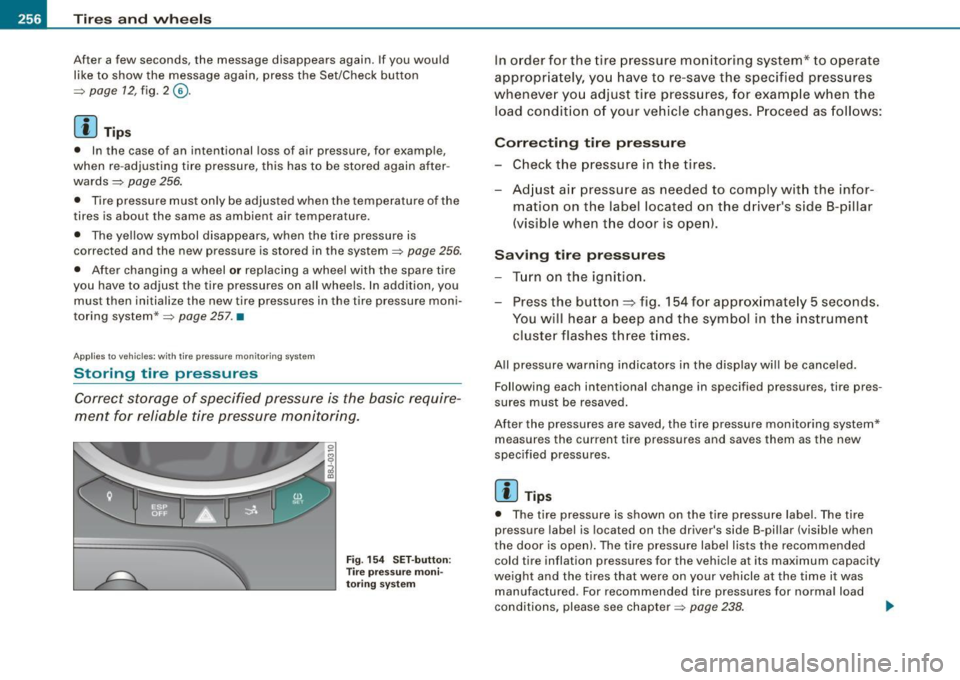
Press the button=> fig. 154 for app roximately 5 seconds.
You will hear a beep and the symbol in the instrument
cluster flashes three times.
All pressure warning indicators in the display will be canceled.
Following each intentional change in specified pressures, tire pres
sures must be resaved.
After the pressures are saved, the tire pressure monitoring system* measures the current tire pressures and saves them as the new
specified pressures.
[ i J Tips
• The tire pressure is shown on the tire pressure label. The tire
pressure label is located on the driver's side B-pillar (visible when
the door is open). The tire pressure label lists the recommended cold tire inflation pressures for the vehicle at its maximum capacity
weight and the tires that were on your vehicle at the time it was
manufactured . For recommended tire pressures for normal load
conditions, please see chapter
=> page 238. .,_
Page 269 of 316
_____________________________________________ W.:..:..; h:..:.= a:.:t ..:.d=-= o:....:... I .::d :.:o :....:.. n:.:o::.. w.:...:.. ?:...___J
Assembling Tire Mobility System
Fig . 160 Connector for
the Tire Mobility System
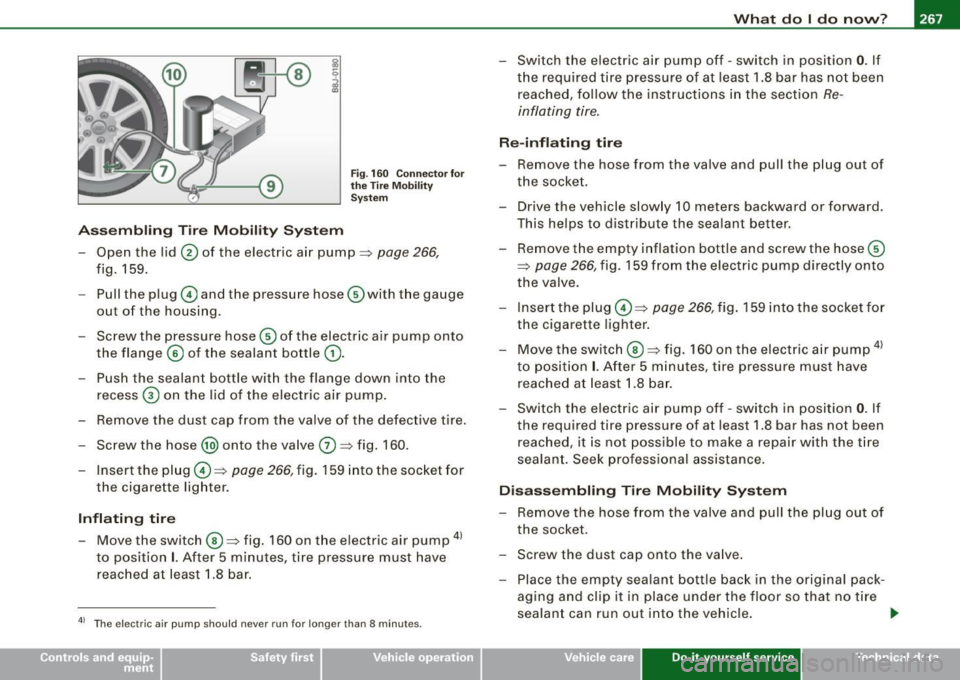
Open the lid 0 of the electric air pump:::;, page 266,
fig. 159.
- Pull the plug © and the pressure hose G)with the gauge
out of the housing.
- Screw the pressure hose© of the electric air pump onto
the flange © of the sealant bottle
G).
-Push the sealant bottle with the flange down into the
recess
0 on the lid of the electric air pump.
- Remove the dust cap from the valve of the defective tire.
- Screw the hose@) onto the valve
0:::;, fig. 160.
- Insert the plug©:::;,
page 266, fig. 159 into the socket for
the cigarette lighter.
Inflating tire
- Move the switch®:::;, fig. 160 on the electric air pump
4
l
to position I. After 5 minutes, tire pressure must have
reached at least 1.8 bar.
41 The electric a ir pump should never run for longer than 8 minutes .
-Switch the electric air pump off -switch in position 0. If
the required tire pressure of at least 1.8 bar has not been
reached, follow the instructions in the section
Re-
inflating tire.
Re-inflating tire
- Remove the hose from the valve and pull the plug out of
the socket.
- Drive the vehicle slowly 10 meters backward or forward.
This helps to distribute the sealant better.
- Remove the empty inflation bottle and screw the hose©
:::;, page 266, fig. 159 from the electric pump directly onto
the valve.
- Insert the plug ©:::;,
page 266, fig. 159 into the socket for
the cigarette lighter.
- Move the switch®:::;, fig. 160 on the electric air pump
4
l
to position I. After 5 minutes, tire pressure must have
reached at least 1.8 bar.
- Switch the electric air pump off -switch in position
0. If
the required tire pressure of at least 1.8 bar has not been
reached, it is not possible to make a repair with the tire
sealant. Seek professional assistance.
Disassembling Tire Mobility System
- Remove the hose from the valve and pull the plug out of
the socket.
- Screw the dust cap onto the valve.
- Place the empty sealant bottle back in the original pack-
aging and clip it in place under the floor so that no tire
sealant can run out into the vehicle. .,
Vehicle care Do-it-yourself service irechnical data
Page 304 of 316
___ A_l.:. p _h_ a_ b_e _t _ic _ a_l _in _ d_e _x ____________________________________________ _
Child safety ...... ... .... ...... . 157,162
Booster seats . . . . . . . . . . . . . . . . . . . . 165
Convertible child safety seats . . . . . . 163
Convertible locking retractor . . . . . . . 168
Guidance fixtures for lower anchorages
173
Important safety instructions for using child safety seats .... ....... .... 160
Important things to know when driving
with children ................... 157
Infant seats ..................... 162
Insta lling a child restraint using the
LATCH system . . . . . . . . . . . . . . . . . . 175
Lower anchorages . . . . . . . . . . . . . . . 173
Mounting and releasing the anchorage hook .. ...... .... ....... ....... 176
Older children and safety belts . . . . . 167
Safety belts and older children . . . . . 167
Tether strap . . . . . . . . . . . . . . . . . . . . . 176
Which restraint system should my older child wear? ................. ... 167
Child safety seat .. ........... ....... 162
Convertible locking retractor . . . . . . . 168
Installing . .... ... ..... ..... .. ... 168
child safety seat LATCH system . . . . . . . . . . . . . . . . . . . 175
Child safety seats How do I properly insta ll a chi ld safety
seat in my vehicle? ... .... ....... 160
Safety instructions . . . . . . . . . . . . . . . 160
Cigarette lighter ..................... 82
Cleaning Alcantara (synthetic suede) . . . . . . . . 208
Engine compartment ... .. .... .... 209 Fabrics and fabric c
,overings ....... 205
Instrument panel ... .... .... .... .. 206
Interior ......................... 205
Leather ......................... 207
Plast ic and vinyl ....... .... ...... 202
P lastic parts ............... ... ... 206
Safety belts . . . . . . . . . . . . . . . . . . . . . 209
Trim strips ... .... ... .. .... .. 201,202
Cleaning and protection .. ........ ... 198
Climate control A/C operation . . . . . . . . . . . . . . . . . . . . . 89
Air distribution .... ........ ....... 87
Automatic mode . . . . . . . . . . . . . . . . . . 88
Defrost ............. ...... ....... 88
Economical use ... ...... ..... ... .. 89
Fan ............................. 87
Heated seats . . . . . . . . . . . . . . . . . . . . . 90
Rear window defogger . . . . . . . . . . . . . 89
Switching on and o ff ...... .... .... 87
Climate controls ........ ........... .. 85
Air recirculation mode . ...... ...... 88
Controls . . . . . . . . . . . . . . . . . . . . . . . . . 85
Dust filter ..... ....... ............ 85
Heating .. .... .... ... .. .... .... ... 85
Pollen fi lter ... ....... ...... .... ... 85
Venti lation ... ... .. .... .... ....... 85
Clock ....... ....... ... .............. 13
Coat hooks ............... .... ... .... 84
Co ld tire inflation pressure ........... 238
Coming -home -function ... .... ....... . 55
Compass mirror ............... ...... 67
Compliance .. .... ... .... ... ... .. ... 296
Consumer Information .... ....... 123, 293 Contacting NHTSA
... .. .. .... .... ... 123
Controls and disp lays ...... ...... .... . 11
Convenience close/open feature Windows ... ... .... .... ... .... .... 49
Convertible child seats How do I properly install a convertible chi ld seat in my vehicle? ......... 163
Safety instructions .... .... .... ... 163
Convertible locking retractor Activating ............. .... ...... 170
Deactivating ... .... ....... .... ... 170
Using to secure a child safety seat .. 168,
170
Coolant System Expansion tank ... .... .... .... ... 225
Coolant system .. .... .... .... ....... 224
Cornering light ...................... 54
Cruise contro l ........ ... .... .... .... 96
Changing speed . ...... .... .... ... 97
Presetting your speed .......... .... 97
Switching off ... .. .... .... .... .... 97
Switching on ...... .... ... .... .... 96
Warning/indicator lights .... ....... . 18
Cup holder ... .... .... ....... .... .... 81
Current fuel mileage .................. 26
D
Damping
See Audi magnetic ride .... ... .. .... 98
Data .............................. 291
Data recorder ...................... 182
Datedisplay . ......... .... ... .... .... 13
Page 311 of 316

______________________________________________ A_ l_,_ p _h_ a_ b_e _t_i c_ a _ l _in _ d_e _ x __ lll
Seats
Number of seats 125
Selector lever positions Automatic transmission . .... ..... . 100
Service and disposal Safety belt pretensioner .. .... ..... 133
Service interval display ............... 23
Service position for windshield wipers .. 62
Set menu .. ... ... .. .... ..... .. ... ... 29
S etting
Date display . ....... .... .......... 13
Digi tal clock ........... ........... 13
Side airbags Description . ..... .... .... ....... . 154
How they work . . . . . . . . . . . . . . . . . . . 155
Snow chains ... .... ..... .. .... .... . 251
Sockets .... ... ....... .. ....... ... 82, 83
Sound system disp lay . ...... .. .. .... . 22
Speed rating letter code .. ... ..... ... . 247
Speed warning .. .... .... ... .... .... . 36
Speed warn ing system ... .... .. .. .... . 30
Speedomet er .. .. .... .... ... .... ... .. 14
Starting assistance ...... .... ... .... . 280
Starting the engine . ......... ... ... 92 , 93
What should I do if the engine does not start? ... .. ..... ....... ...... .. . 93
Stee l whee ls .... ... .... .... .. . .. .. . 203
Steering
See E lectro -mechanica l power assist
188
Controls and equip ment Safety first
20, Steering co
lumn
Adjusting .... ...... ........ ..... . 91
L ocking the steering .. ... ...... ... . 92
Steps for determining correct load limit 243
Stopping the eng ine . .... .... .... .... . 93
Storage . .... .... ...... .... ... .. ... .. 83
Compartment in the front sea ts ... ... 84
Cu p holder ..... ....... .... ... .. .. 81
G love compartment .. ... .... ...... . 84
Storage compartment Expanding .... ...... ........ ... .. . 76
Sun v isors ...... ... .... .... .... .... . 59
Switches Emergency flasher ..... ... .... ... .. 57
Symbols
T
Red symbols in the center display ... . 32
Yel low symbols in the center d isplay . 32
Tachomet er . .... ... ... ......... ... .. 12
Tank f lap
Un locking the f uel filler flap by hand 2 15
Technical modif ications . .... ... ... ... 296
Temperature .... .... .... .... ....... . 86
Tether strap ... .. .. . .. .. .... .... .... 1 76
Securing the upper t ether strap ..... 177
The first 1,0 00 mi les ( 1,500 km) and
afterward s ..... .. .. .... .... .... 1 90
Tie -downs ... ..... ... .... .... .... 77, 123
Tightening whee l bolts .... ... .... .... 268
Tips for the env ironment
Savi ng fuel ...... .... .... .... .... . 81 T
ire mobility system ..... ... . .. .. .... 264
Tire p ress ure .. ...... .... ... .... .. .. 241
Tire pressure monitoring system .. .... 254
Chan ging whee ls . .... .... .... ... . 257
Learning process .. .... ... .... ... . 256
Loss of air pressu re .... ... .... . 17, 255
Mal fu nct io ns ... .. .... .... .... .... 257
Se nso rs ...... .... .... ... .... .. .. 248
Stor ing tire pressures ... .. .... .. . . 256
Tires and wheels ...... ... .... .. . . 2 48
Valves . ...... .... .... ... .... .. .. 248
Warning ligh t .. ... ... .... ........ . 37
Tire repair kit .. .. .... .... ... .... .. .. 264
Tire service life ..... .... ............. 244
Tires .. ... .. .... .... .... ... .... .... 234
Replacing .. ...... .... ... .... 246 , 248
run -flat ... .... .... .... ... .... .... 258
Service life .... .... ... .... .... ... 244
speed rating letter cod e ...... .... . 247
T ire manufacturing date .. ... .. .... 247
Tire specifications ........... ..... 247
Tread depth ........ .. .... ...... . 244
Un iform tire quality grading .... .... 249
Winter tires ....... .... ... .. ...... 250
T ires and vehicle load limits .. ... ... .. 242
Tires and wheels Checking tire pressure ... .. .... ... 241
Co ld tire inflation pressure ..... ... . 238
Dimensions ... .... .... ... .... .... 246
Genera l notes .. ...... ... .... .... . 23 4
G lossary of tire and loading terminology
235
New tires and whee ls ..... .... .... 246
Vehicle operation Vehicle care Do-it-yourself service Technical data
Page 313 of 316

Alphab eti ca l ind ex -
-------------=----
What should I do after replacing wheels?
242
Wheel bolts Torque .. ... ... .. .... .... ....... . 252
Wheels . .... .... .... .... ... .... .... 234
Cast al loy ....... .... .... ....... . 204
Checking tire pressure . ...... .... . 241
Co ld tire inflation pressure ... .. .. .. 238
Genera l notes .................... 234
G lossary of tire and loading termino logy
235
New tires and wheels . ....... .... . 246
T ires and vehicle load limits .... .... 242
Wheelsffires Stee l wheels ...... .... ... .... .... 203 Winter operation
Battery ... .... ...... ...... .... ... 228
Coolant system .................. 224
Defrosting windows ............... 88
Hea ted seats (climate control) .. .... . 90
Tires ....... .. .... .... .... .... ... 189
Win dows ..... ... .... .... .... .... 202
Winter tires .... .... ... .... .. ....... 2 50
All -whee l drive ...... ...... .... ... 250
Wiper and washer system . ...... .... .. 60
I ntermittent wiping . ...... .... .... . 60
One -tap wiping .... ........ ....... . 60
Wiper blades Insta lling new wiper b lades .. ...... . 63
When must the airbag system be inspected?
X
146
When should I adjust the tire pressures? . . . Xeno n-Ligh ts . ...... .... .... .... .... 278
242
When sh ould I check the tire pressures? 242
Where can I find the tire pressures for my car? ... ... .. .... .... ... .. .. .... 241
Why sa fety belts? ... ........ .... 125, 126
Windows Cleaning .. ... .... .... ... .... .... 202
Convenience close/open feature ..... 49
Defrost ........ ............... ... 88
Windshield washer fluid ...... .... .... . 36
Windshield wipers Instal ling new wipe r blades . ...... .. 63
Service p osition ...... .... ... .... .. 62
Washer fluid reservoir .. ...... .... . 233
Controls and equip
ment Safety first Vehicle operation
Vehicle care Do-it-yourself service Technical data