parking brake AUDI TT COUPE 2009 User Guide
[x] Cancel search | Manufacturer: AUDI, Model Year: 2009, Model line: TT COUPE, Model: AUDI TT COUPE 2009Pages: 316, PDF Size: 71.16 MB
Page 104 of 316
• ..__T_ ra_ n_s_ m_ i_ s _s_ i_ o _ n ___________________________________________________ _
Applies t o vehi cles: with S tr oni c®
Driving Notes
The forward gears are shifted up or down automatically.
Starting from stop
-Step on and hold the brake pedal.
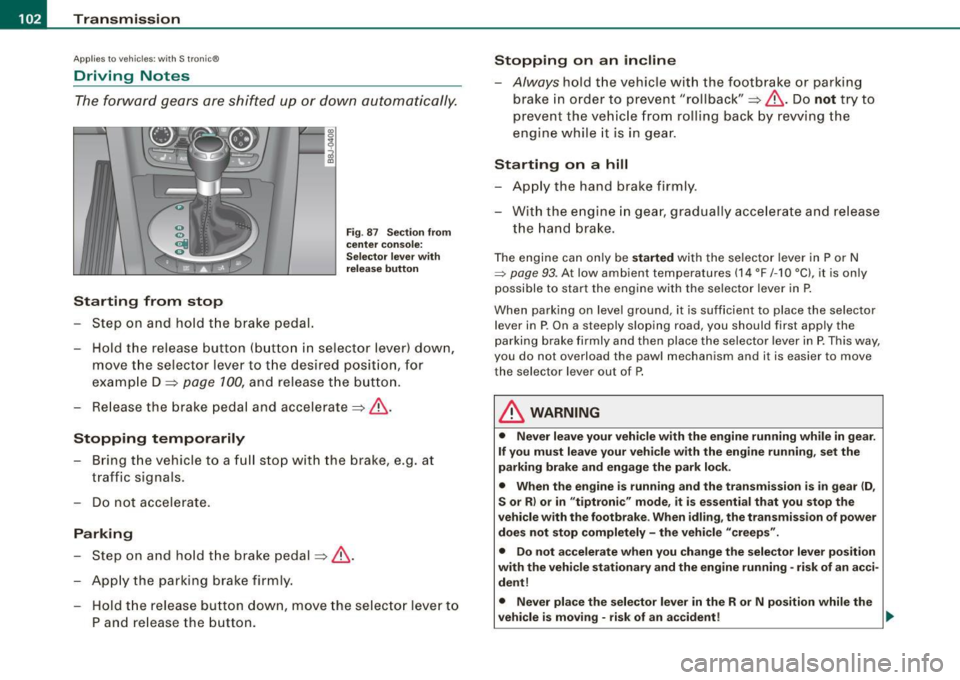
Fig. 87 Section from
center console:
Selector lever with
release button
- Hold the release button (button in selector lever) down,
move the selector lever to the desired position, for
example D =:>
page 100, and release the button.
- Release the brake pedal and accelerate =:>& .
Stopping temporarily
Bring the vehicle to a full stop with the brake, e.g. at
traffic signals.
Do not accelerate.
Parking
-Step on and hold the brake pedal =:> & .
Apply the parking brake firmly.
- Hold the release button down, move the selector lever to
P and release the button.
Stopping on an incline
-Always hold the vehicle with the footbrake or parking
brake in order to prevent "rollback"=:>& . Do
not try to
prevent the vehicle from rolling back by rewing the
engine while it is in gear.
Starting on a hill
- Apply the hand brake firmly.
- With the engine in gear, gradually accelerate and release
the hand brake.
The engine can only be started with the selector lever in P or N
=> page 93. At low ambient temperatures (14 °F /-1 O °C), it is only
possible to start the engine with the selector lever in P.
When parking on level ground, it is sufficient to place the selector
lever in P. On a steeply sloping road , you should first apply the
parking brake firmly and then place the selector lever in P. This way,
you do not overload the pawl mechanism and it is easier to move
the selector lever out of P.
& WARNING
• Never leave your vehicle with the engine running while in gear.
If you must leave your vehicle with the engine running, set the
parking brake and engage the park lock.
• When the engine is running and the transmission is in gear (D,
S or R) or in "tiptronic" mode, it is essential that you stop the
vehicle with the footbrake. When idling, the transmission of power
does not stop completely -the vehicle "creeps".
• Do not accelerate when you change the selector lever position
with the vehicle stationary and the engine running -risk of an acci
dent!
• Never place the selector lever in the R or N position while the
vehicle is moving -risk of an accident!
~
Page 108 of 316
• ..__T_ ra_ n_s_ m_ i_ s _s_ i_ o _n ___________________________________________________ _
• The manual shift program (tiptronic) is switched off in the fail
safe mode.
If the transmission switches to fail-safe mode, you should take the
vehicle to an authorized Audi dealership as soon as possible to have
the condition corrected .•
A pp lies to vehi cles: wit h S tronic ®
Emergency release for selector lever
If the vehicle's power supply fails, the selector lever can
be released in an emergency.
rr- ~v r::.~=::::::= ::;~~,:,:J ::: __ -tg
i
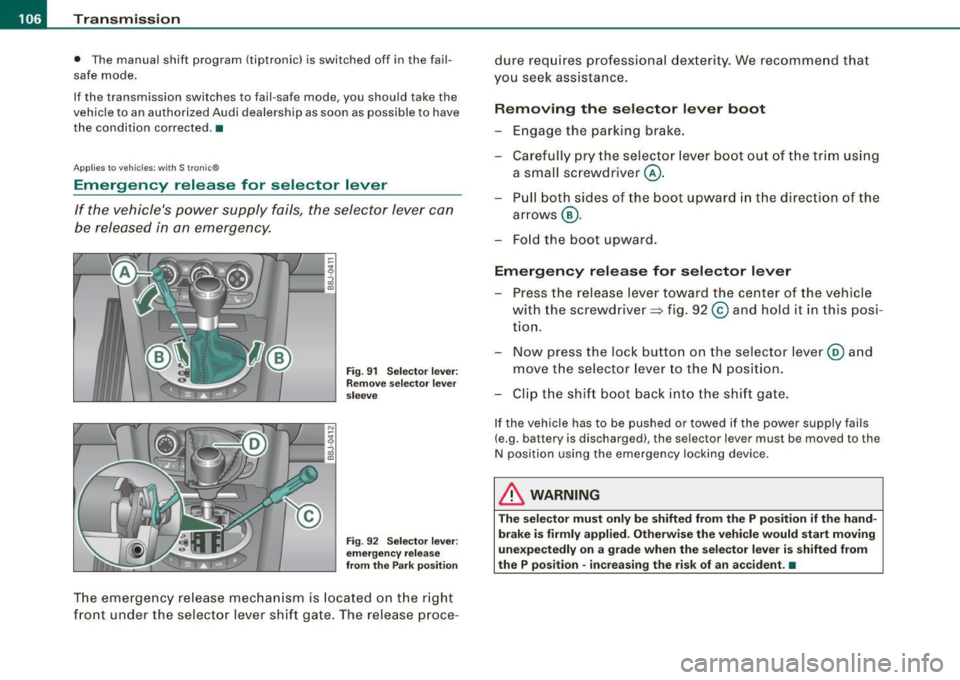
Fig. 91 Selector lever:
Remove selector lever
sleeve
Fig . 92 Selector lever:
emergency release
from the Park position
The emergency release mechanism is located on the right
front under the selector lever shift gate. The release proce- dure
requires professional dexterity. We recommend that
you seek assistance.
Removing the selector lever boot
-Engage the parking brake.
- Carefully pry the selector lever boot out of the trim using
a small screwdriver @.
- Pull both sides of the boot upward in the direction of the
arrows @.
- Fold the boot upward.
Emergency release for selector lever
-Press the release lever toward the center of the vehicle
with the screwdriver ~ fig. 92
© and hold it in this posi
tion.
- Now press the lock button on the selector lever@ and
move the selector lever to the N position.
- Clip the shift boot back into the shift gate.
If the vehicle has to be pushed or towed if the power supply fails
(e.g . battery is discharged), the selector lever mus t be moved to the
N position using the emergency locking device.
& WARNING
The selector must only be shifted from the P position if the hand
brake is firmly applied. Otherwise the vehicle would start moving
unexpectedly on a grade when the selector lever is shifted from
the P position -increasing the risk of an accident. •
Page 110 of 316
• ..__H_ o_m_ e_ L_ i_ n _k_ @_R __________________________________________________ _
Applies to vehicles: with Home li nk® universal remote control
Programming the Homelink ® transmitt er
The transmitter is programmed in two phases. For rolling
code transmitters, a third phase is also necessary.
1----------------.....:!i:l
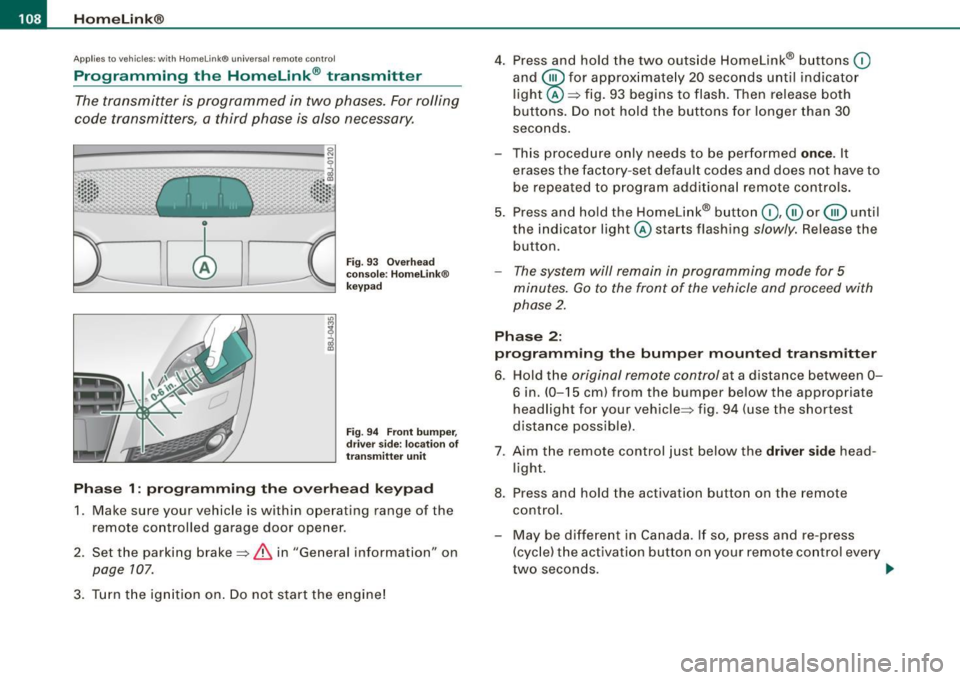
Fig . 93 Overhead
console : Homelink®
keypad
Fig. 94 Front bumper,
driver side: location of
transmitter unit
Phase 1: programming the overhead keypad
1. Make sure your vehicle is within operating range of the
remote controlled garage door opener .
2. Set the parking brake~
& in "General information" on
page 107.
3. Turn the ignition on. Do not start the engine! 4. Press and hold the two outside Homelink® buttons
(D
and
@for approximately 20 seconds until indicator
light @::::::, fig. 93 begins to flash. Then release both
buttons. Do not hold the buttons for longer than 30
seconds.
This procedure only needs to be performed
once . It
erases the factory-set default codes and does not have to
be repeated to program additional remote controls.
5. Press and hold the Homelink® button
(D , ® or @ until
the indicator light @starts flashing
slowly. Release the
button.
- The system will remain in programming mode for 5
minutes.
Go to the front of the vehicle and proceed with
phase 2.
Phase 2:
programming the bumper mounted transmitter
6. Hold the original remote control at a distance between 0-
6 in. (0-15 cm) from the bumper below the appropriate
headlight for your vehicle~ fig . 94 (use the shortest
distance possible) .
7. Aim the remote control just below the
driver side head
light.
8. Press and hold the activation button on the remote control.
- May be different in Canada. If so, press and re-press
(cycle) the activation button on your remote control every
two seconds. .-,,
Page 190 of 316
___ ln_ t _e_ ll-'"ig ...,_ e_ n_t _t_ e_ c_ h _ n_o _ l_o _,.g= y,_ __________________________________________ _
ABS operation
When a vehicle speed of about 10 mph (20 km/h) is reached, an au to
matic test sequence is run. Some noise from the pump may be
audible .
I f the speed of a whee l slows down too much relative to vehic le
speed and it starts to lock, brake pressure to this wheel is reduced.
This adj ustment process can be felt as a
pulsing motion of the brake
pedal ,
accompanied by some no ises. You as the driver are intention
a lly being given the infor mation tha t the wheels are tending t o lock
(ABS control range). In order for ABS to be ab le to operate optima lly
in this range, you must keep the b rake pedal depressed -do not
"pump the brakes".
Brake assistant
The brake power assist un it increases the pressure that you
genera te wi th the brake pedal. I t wo rks only when the e ngine is
running.
Automatic full braking
T his function al lows fu ll bra king in spite of high brake pedal forces
(e .g. whe n the brakes are seve rely s tressed beca use the veh ic le is
fully loaded) . T he driver not ices this function through a reduction of
pedal force a nd increased pedal t ravel. When the brake peda l is
re leased, fu ll braking assist switches off again automatically .
If there is an ABS failure, the brake assistant and automatic fu ll
brak in g ass ist are not available.
& WARNING
• ABS cannot suspend the la ws of physic s. You should keep this
in mind in parti cular on an icy or wet road . If ABS control of braking
intervenes , you should adjust your speed immediately to road and
traffic condit ions . Do not be tempted by the increased safety
provided to take risks -danger of an accident.
• Please keep in mind that the risk of an accident is increased by
driving too fast , particularly in bends and on icy or wet roads , and
& WARNING (continued )
by driving too close to the vehicle ahead . The increased risk of an
accident cannot be redu ced by the brake a ssistant -danger of an
accident .
[ i ] Tips
If a ma lfunction occurs in the ABS, this is signalled by an indicator
l ight, se e =>
pag e 20.
E ectro-mechan-;cal power assist
The electro -me chanical po wer assist helps the driver
w hen steering.
The degree o f pow er assis t is electronically matched t o ve h ic le
speed .
The power stee ring system as sists the driver so that he can steer the
vehic le with reduced physica l effort.
P ower steering wil l not work if the engine is off. As a result, the
s te eri ng wheel wi ll be hard to turn .
& WARNING
If the system develops a problem , you must seek qualified profes
s ional assist ance .
0 Note
If there is an electronic ma lfunction, servotronic wi ll st ill function
li ke a conve ntio nal power stee rin g system, prov iding a constant
steering support force that is no longer proportionate to the vehicle
speed. This is most no ticeable when turni ng the s teering wheel at
l ow speeds (for examp le when parking), -more effort will be
r e q uired than usual. ._
Page 219 of 316

___________________________________________ C_ h_e _c_ k_ i_n _g _ a_n _d_ f_il _li _n _g __ fflllll
•
Closing the engine hood
- Pull the hood down until the pressure from the struts is
reduced .
- Let the hood
drop down and latch in place. Do not try to
push it shut;
it may fail to engage => &.
& WARNING
A hood that is not completely latched could fly up and block your
view while driving.
• When you close the engine hood, check it to make sure the
safety catch has properly engaged. The hood should be flush with
the surrounding vehicle body parts.
• If you notice while driving that the hood is not secured prop
erly, stop at once and close it. •
Working in the engine compartment
Be especially careful whenever you work in the engine
compartment!
Whenever you must perform any work in the engine compartment,
for example checking and filling the different fluids, there is a risk of injury, burns and accidents. To prevent personal injury always
observe the following WARNINGS. The engine compartment of any
vehicle is a hazardous area!
~ &
& WARNING
To help avoid injury, before you check anything under the hood :
• Switch off the engine.
• Remove the ignition key.
• Apply the parking brake .
& WARNING (continued)
• Move selector lever of automatic transmission to "P" (Park);
put manual transmission in Neutral .
• Always let the engine cool down. Hot components will burn
skin on contact.
• To reduce the risk of being burned, never open the hood if you
see or hear steam or coolant escaping from the engine compart
ment. Wait until no steam or coolant can be seen or heard before
carefully opening the hood .
• Keep children away from the engine compartment.
• Never spill fluids on hot engine components . They can cause a
fire.
• Never touch the radiator fan. The auxiliary electric fan is
temperature controlled and can switch on suddenly.
• Never open the coolant reservoir cap when the engine is still
warm. The coolant system is pressurized and hot coolant could
spray out.
• Protect your face, hands and arm from steam or hot engine
coolant by placing a thick rag over the cap when you open the
coolant reservoir.
• If work on the fuel system or the electrical system is necessary:
- Always disconnect the battery.
- Never smoke or work near heaters or open flames. Fluids in
the engine compartment could start a fire .
- Keep an approved fire extinguisher immediately available.
• To avoid electrical shock and personal injury while the engine
is running or being started, never touch :
- Ignition cables
- Other components of the high voltage electronic ignition
system.
• If you must perform a check or repair with the engine running: ..,
Vehicle care
I t •
Page 268 of 316
1111...__W_ h_ a _ t_d_ o_ l _d _o_ n_ o_ vv_ ? ______________________________________________ _
[ i J Tips
• If sealant has run out, allow it to dry. Then you can peel it off .
• Have the tire sealant replaced every 4 years at a d ealership. •
Applie s to ve hicles: with T ire Mob ilit y Sy stem
Preliminary steps
Some preliminary steps ore necessary for tire repair.
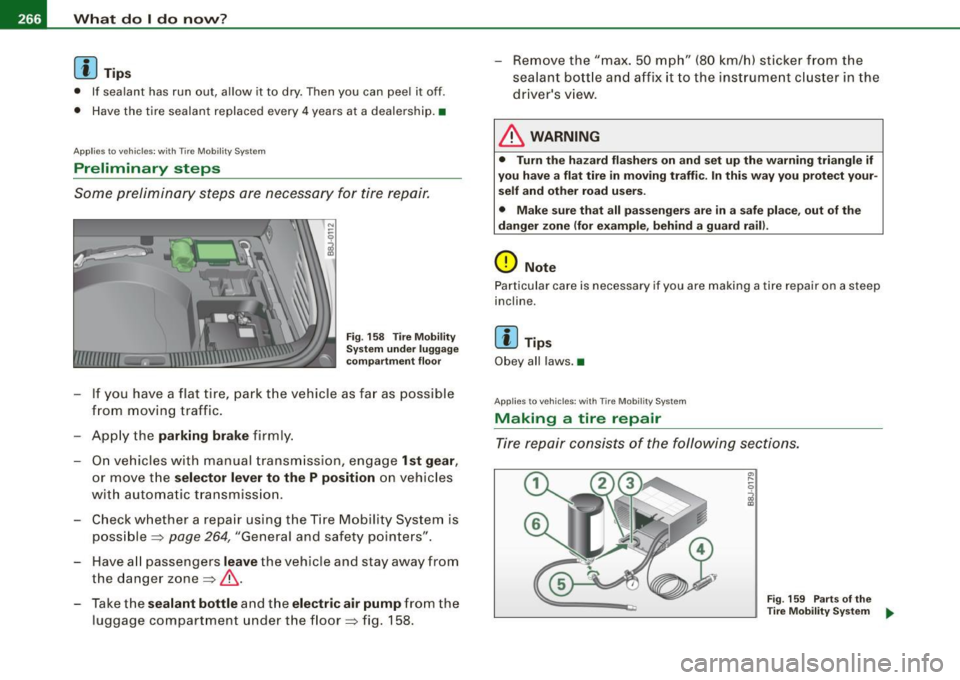
Fig . 158 Tire Mobility
System under luggage
compartment floor
- If you have a flat tire, park the vehicle as far as possible
from moving t raffic.
- Apply the
parking brake firmly.
- On vehicles w ith manual transmission, engage
1st gear,
or move the selector lever to the P position on vehicles
w ith automat ic transmission.
- Check whether a repair using the Tire Mob ility System is
possible ~
page 264, "General and safety po inters".
Have all passengers
leave the vehicle and stay away from
the danger zone~& .
- Take the
sealant bottle and the electric air pump from the
luggage compartment under the floor~ fig. 158. - Remove the "max. 50 mph"
(80 km/h) sticker from the
sealant bottle and affix it to the instrument cluster in the
driver's view.
& WARNING
• Turn the hazard flashers on and set up the warning triangle if
you have a flat tire in moving traffic. In this way you protect your
self and other road users.
• Make sure that all passengers are in a safe place, out of the
danger zone (for example, behind a guard raill.
(D Note
Particular care is necessary if you are making a tire repair on a steep
inc line .
[ i J Tips
Obey all laws. •
App lies to ve hicles: w ith T ire Mob ility System
Mak ing a tire repa ir
Tire repair consists of the following sections.
Fig. 159 Parts of the
Tire Mobility System ..
Page 302 of 316
___ A---" lp_ h_ a_b_ e_ t_ i_ c _ a_ l_ in_ d_ e_x ______________________________________________ _
A
A/C operation
Climate control ............ ....... 89
ABS See Anti -Lock Brake System . . . . . . . . 187
Accessories . . . . . . . . . . . . . . . . . . . . . . . . 295
Acoustic park assist rear . . . . . . . . . . . . . . . . . . . . . . . . . . . . . 95
Acoustic parking system .. .... ... .... . 95
Adaptive Light defective . . . . . . . . . . . . . . . . . . . . . . . . 37
Adaptive light . . . . . . . . . . . . . . . . . . . . . . . 54
Adding Engine coolant .. ... .... .... .... . 225
Engine oil ....................... 222
Windshield washer fluid . . . . . . . . . . 233
Additiona l accessories .. ........ .... . 295
Additives Engine oil ... ..... .... ... ... ... .. 222
Adjustable steering column .... .... ... 91
Adjusting front seats . ...... .... .... .. 69
Adjusting steering column ...... .. ... . 91
Adjusting the seats .... .... .... .... .. 71
Advanced Airbag System
Children ........................ 158
Components .. .... .... ......... . 142 Air distribution
Climate control ..... .. .... .... .... 87
Air recirculation mode Climate control ...... .... ... .. .... 88
Airbag Warning/indicator lights ......... .. 18
Airbag system .................. 135, 155
Care ............................ 149
Child restraints .... .... .... .... .. 159
Components (front airbags) .. ...... 142
Danger of fitting a chi ld safety seat on the
front passenger seat . . . . . . . . . . . . 137
Disposa I . . . . . . . . . . . . . . . . . . . . . . . . 149
Front airbags . . . . . . . . . . . . . . . . . . . . 139
How do the front airbags work? . . . . 144
How many airbags does my vehicle have?
142
Important safety instructions on the knee
airbag system . . . . . . . . . . . . . . . . . . 153
Important things to know . ... .. ... 135
Indicator light ....... .... ... .. ... 146
Knee airbags .... .... .... ... .... . 151
Monitoring . . . . . . . . . . . . . . . . . . . . . . 146
PASSENGER AIR BAG OFF light ... .. 147
Repairs . . . . . . . . . . . . . . . . . . . . . . . . . 149
Side airbags ... ...... ....... ..... 154
When must the system be inspected? ...
146 Anti-free
ze
See Engine coolant system ...... .. 224
Anti -glare inside day-night mirror .... .. 64
Anti-Lock Brake System .............. 187
Anti- lock brake system
Warning/indicator lights ............ 20
Anti -Slip Regulation System (ASR)
How the system works . . . . . . . . . . . . 184
Anti-theft systems Anti-Theft A larm System ...... ..... 47
Electronic immobilizer . .... .... .... 40
Ashtray ................... .......... 81
ASR How the Anti -S lip Regu lation System
works ... .... .... .... ... .... ... 184
Asterisk What does it mean when something is
marked with an asterisk? . .... ...... 6
Audi magnetic ride ......... .... ... 16, 98
Description ....................... 98
Indicator light ...... ..... ..... ... . 16
Audi Service Repair Manuals and Literature . 293
Auto Safety Hotline ... ..... .. ... ..... 123
Automatic belt retractor 129
Automatic car wash
See Washing .. ........ .... ...... 199
Front airbags ....... .... .... .... .
140 All Wheel Drive
......... ....... ..... 189 Automatic headlight control ........... 52
How the components work together 143 Alloy wheels ... .. ...... .... ... .. ... 204 Automatic headlights
Monitoring .. .... .... .... ... .... . 146 All-whee l drive defective .
.... ... .... .... .... ..... 37
Weight -sensing mat . ... .. .... .... 158 Winter tires ..................... 250 Automatic Transmission
air conditioning Alternator Automatic Transmission
.......... 103
Temperature . . . . . . . . . . . . . . . . . . . . . 86 See Generator . . . . . . . . . . . . . . . . . . . . 18
Page 309 of 316

______________________________________________ A_ l_,_ p _h_ a_ b_e _t_i c_ a _ l _in _ d_e _ x __ lll
Outside temperature display .. .. .. ... .. 22
Owner's manual How the Owner's Manual is organized . 6
p
Paint Touch -up . ... .... ...... ... .. ... .. 202
Paint No . .... .... .... .... .... .... ... 288
Parking . ...... .. ............ ....... . 94
Automatic transmission ... ... ... .. 102
Parking brake ........... .... ..... .. .. 94
Parking brake warning ................ 33
Parking on a decline (downhi ll) .. ... .. .. 94
Park ing on an incline (uphill) .. ..... .. .. 94
Parts replacement ..... .............. 295
P ASSENGER AI R BAG O FF light ... .. ... 147
Passive safety system ................ 114
Pedals .. ........ ... .... .... ........ 120
Physica l principles of a frontal collision 126
Polishing .......................... 201
Pollen filter ... .. ... ..... ... .... .... . 86
Pollutant fi lter . ... .. .... .... ... .... .. 86
P ower locking switch ... .... .... ...... 44
Power locking sys tem . ...... .... .... .. 41
Convenience close/open feature ... .. 49
Locking and unlocking the vehicle from inside .. .. ... ... .... ... .... .... . 44
Opening and c losing the windows .. . 49
Rear lid/trunk l id ... .. .... .... .... . 45
Remote control ...... .... ... .... .. 39
Un locking and locking vehicle ... .. .. 42
Controls and equip
ment Safety first
Power outlets .
...... ....... .. .. .... .. 83
Power seats
Adjusting the seatback .... .... .... . 73
Adjustment . ...... .... .... .... ... . 71
Fo lding the seatback forward .. ...... 73
Power steering
See Electro-mechanica l power assist 20,
188
Power window switches ... .. .... .... .. 48
Reactivating the system ...... ...... 50
Pregnant women Specia l considerations when wearing a
safety belt . .... ....... .... .... . 131
Prog ramming the Homelin k® universal re -
mote control .... ... ..... .... ... 107
P roper occupant seati111g pos itions ... .. 11 6
Proper safety belt posi tion ............ 130
P roper seating position
Front passenger .................. 117
Occupants ......... .. ... ... .. .... 116
Rear passengers ................. 118
a
Quartz clock .... .... ..... .. .... .... .. 13
quattro®
See All Wheel Drive .. .... .... .... . 189
Ques tion
What happens to u nbelted occupan ts? .
127
Why safety belts? ................. 125
R
Radiator fan ...... .. .... ........ .... 226
Rain sensor defective ..... ... .... .... . 37
Reading lights ....................... 59
Rear lid . ......... ... .... ..... .. ... .. 45
Emergency release ................ 46
Rear light defective ...... .... .... ... .. 36
Rear spoiler . .... ........ .... ...... . 185
Rear window defogger ... .... ... ..... . 89
Rear window shelf ... .... .... .... ... .. 76
Rearview mirror Inside rearview mirror .. ............ 64
See also Mirrors ... ... ... .. ...... .. 64
Refuelling .......................... 213
Release lever for hood . ...... .... .... 216
Remote control .. .... .... ...... .... .. 39
Resetting remote control ........... 43
Remote control garage door opener (Homelin k®l ................... 107
Remote control key Unlocking and locking .. ...... ... ... 42
Remote master key
Batte ry replacement ...... .... .... . 39
Check light . ...... .... ..... .. .... . 39
Remote rear lid release .... ... ... ... .. . 45
Repair manuals .. .... .... ........ ... 293
Repairs Airbag system .... .... .... ...... . 149
Replacement parts ... .... ... ... .... . 295
Replacing Wheel rims .................. 2 46, 248
Vehicle operation Vehicle care Do-it-yourself service Technical data
Page 312 of 316
___ A_ l..:,. p _ h_ a_ b_e _t_ic _ a_l _in _ d_e_ x ____________________________________________ _
Replacing . . . . . . . . . . . . . . . . . . . . . . . 246
Snow chains . ..... ....... ...... . 251
Tire pressure monitoring system ... 248
Tires and vehicle load limits ....... 242
Wheel bo lts . . . . . . . . . . . . . . . . . . . . . 252
Winter tires . . . . . . . . . . . . . . . . . . . . . 250
Tir es/Whe els
Low aspect ratio tires ........ ... .. 253
Tire mobili ty system . . . . . . . . . . . . . . 264
Tire pressure monitoring system 17, 254
Tire repair kit . . . . . . . . . . . . . . . . . . . . 264
Tool kit . . . . . . . . . . . . . . . . . . . . . . . . . . . . 264
Touch -up paint ...... ....... .... .... 202
Towing Fron t eyelet . . . . . . . . . . . . . . . . . . . . . 282
Rear eyelet . . . . . . . . . . . . . . . . . . . . . . 283
Tow truck procedures . . . . . . . . . . . . . 282
Trailer towing ..... .. .... .... ....... 194
Transmission 6-speed manual transmission ....... 99
S tronic transmission ...... .... .... 99
Transport Canada . . . . . . . . . . . . . . . . . . . 124
Tread Wear Indicator (TWI) .... ... .... 244
Trip computer .. ...... .... ........... 25
Trip odome ter . . . . . . . . . . . . . . . . . . . . . . . 14
What does it mean when dEF appears in the trip odom eter display? .... .... 14
Trunk lid .... ..... .. .... .... .... .... 45
Turn signals ....... .... ..... .. .. ... . 58
Wa rning /indicator ligh ts .. .... ... .. 18 u
Undercoating .... ...... .... ... .. ... 205
Unfastening safety belts . . . . . . . . . . . . . 132
Unidirectiona l tires .... .... .... .... .. 234
Uniform tire quality grading .. ... ..... 249
Universal Radio -Frequency Remote Control
(Homelink®) .............. ..... 107
Un locking
Power locking switch ... .... .... ... 44
Rear lid/trunk li d .. .... ...... ...... 45
Remote control k ey ... ........ ..... 42
Using the key . ...... .... ....... ... 43
V
Vanity mi rro r ........... ..... ... .... . 59
Vehicle electrical system . . . . . . . . . . . . . . 18
Vehic le Identification Number (VIN) .... 288
Vehicle jack ...... ... .... .... .... ... 270
Vehic le literature .......... .... ... .... . 5
Vehicle tool kit ..................... 264
Vehic le -care products . . . . . . . . . . . . . . . 198
Venti lation ..... .. ...... .... ...... ... 85
w
Wa rning light
Tire pressure monitoring system 37
Warning lights .. ... .... .... ... .. .... 15
Red symbols in the center display ... 32
Yellow symbols in the center display . 32 Warning/Indicator light
Rea r spoiler ... .... ..... .. .... .... 18
Warning /indicator lights ...... .... .... 12
Airbag system .... .... .... .... .... 18
Anti -lock brake system (ABS ) .... .... 20
Brake system .. .... .... ...... ... .. 19
Cruise contro l .... ... ... .. .... .... 18
Electronic power control . ...... .... 17
Electronic s tabiliza tion program (ESP ) 17
Generator . . . . . . . . . . . . . . . . . . . . . . . . 18
High beam .... .... .... ... .... .... 18
Malfunction Indicator Lamp (M IU .... 17
Parking brake ...... .... ........... 19
Safety belt . . . . . . . . . . . . . . . . . . . . . . . 19
Tire pressure monitoring system .... 17
Turn signals ... .... .... ...... ..... 18
Wa rranty coverages .. .... .... ... ... . 293
Washer reservoir ... .... ... .... ...... 233
Washing .... ... .. .... .... ...... .... 198
Automatic car wash . ...... .... .. . 199
byhand ........... ....... .... .. . 199
General information .... .. .. .... .. 198
with a power washer ... .... .... .. . 200
Wax ing .. .... .... .... .... ... .... ... 201
Wear indicator ................. ..... 244
Weatherstrips .... .... .... ....... .. . 203
Weights . ...... .. .... .... ..... .. ... 289
What happens if you wear your sa fety b elt too
loose? ..... ... ... .... ... .... ... 130
What happens to unbelted occupants? . 127
What impairs driving safety? ....... ... 115
What should I do after changing a wheel?
242