roof AUDI TT COUPE 2009 User Guide
[x] Cancel search | Manufacturer: AUDI, Model Year: 2009, Model line: TT COUPE, Model: AUDI TT COUPE 2009Pages: 316, PDF Size: 71.16 MB
Page 168 of 316
___ C_h_ i_ ld _ S_ a_ f_ e_ t_y ____________________________________________ _
& WARNING
Not using a booster seat, using the booster seat improperly , in cor
rectly installing a booster seat or using the vehicle safety belt
improperly in creases the risk of serious personal injury and death
in a collision or other emergency situation. To help reduce the risk
of serious personal injury and /or death:
• Always make sure to position the shoulder portion of the three
po int belt over the m iddle of ch ild's shoulder .
• Never let the shoulder portion of the belt rest against or across
the neck , face , chin, or throat of the child .
• Always make sure the lap belt portion of the three-point belt is
worn snug and passes as low as possible across the child 's pelvis.
Never let the belt pass over the soft abdomen.
• Failure to properly route safety belts over a child's body will
cause severe injuries in an accident or other emergency situation
=>
page 125 .
• Children on the front seat of any car, even with Advanced
Airbags , can be seriously injured or even killed when an airbag
inflates . A child in a rearward -facing child safety seat installed on
the front passenger seat will be seriously injured and can be killed
if the front airbag inflates.
• Never let a ch ild stand or kneel on any seat , for example the
front seat.
• Never let a child ride in the cargo area of your vehicle.
• Always remember that a child leaning forward , sitting s ide
ways or out of position in any way during an accident can be
struck by a deploying airbag . This will result in serious personal
injury or death .
• If you must install a rearward facing child safety seat on the
front passenger seat because of exceptional circumstances the
PASSENGER AIR BAG OFF light must come on and stay on, when
ever the ignition is switched on .
& WARNING (continued)
• If the PASSENGER AIR BAG OFF light does not come on and stay
on, perform the checks described=>
page 146, "Monitoring the
Advanced Airbag System ".
• Take the child restraint off the front passenger seat and in stall
it properly at one of the rear seat positions if the PASSENGER AIR
BAG OFF light does not stay on whenever the ignition is switched
on .
• Always read and heed all WARNINGS whenever using a child
restrained in a vehicle is being used =>
page 125, "Safety belts",
=>
page 135, " Airbag system " and => page 157, "Important things
to know" .•
Booster seats on the rear seat
Ch ildr en who are a bo ut 7 years and older, wh o weigh mor e tha n 55
l b ( 25 kg ) and ar e not taller than 4'1 1" (1.5 m) are best protected
when pro per ly restrained on the rea r seat.
D ue t o limite d re ar s eat he ad cleara nce chil dren 4'3" (1.3 m) a nd
tal ler must not use booster seats on the rear seat of your Audi TT
Co upe . T he rear sea t of yo ur A udi TT C oupe has been spec ially
designed to permit c hildr en who are b etween 4'3" (1. 3 m) and 4'11"
( 1. 5 m ) ta ll (a bout 7 to 1 2 years old) to u se the a vai lab le thr ee -point
l ap and shoulder safety belts.
& WARNING
• The rear seat area is too small to safely transport passengers
taller than 4'11" (1.5 ml.
• Persons taller than 4'11 " (1 .5 m) as well as children in booster
seats who are too close to the rear window and roof can suffer
severe head and neck injuries when the rear lid is closed or in a
crash .
Page 170 of 316
___ C_h_ i_ ld _ S_ a_ f_ e_ t_y ____________________________________________ _
& WARNING (continued )
• An improperly worn safety belt will not provide the best protec
tion in a crash and may cause serious personal injury . Always
m ake sure that children and other veh icle occupants properly
wear available restraint sy stem s. Carefully follow the instructions
provided by the manufacturers of child restraints . •
Installing a child safety seat
Securing a child safety seat using a safety
belt
S afety belts f or the rear sea ts an d the front pa ssenger can
b e l ocke d wit h th e co nv erti ble lockin g ret racto r to p rop
erly secu re c hild safety sea ts.
The safe ty be lts eme rgency loc king re tr acto rs for th e rea r s eat s
saf ety belts an d for t he front pass enger's seat safety be lt have a
co nve rtible lock ing retracto r for c hild r estra int s. The sa fet y b elt
must be loc ked so t hat belt we bbing cannot u nre el. T he r etrac to r
can be activated to lock the safety be lt and prevent the safety be lt
w eb bing fr om l oos enin g up dur ing n ormal dr ivi ng . A ch ild safe ty
seat can only be properly instal led when the safety belt is locked so
th at the chi ld and chi ld sa fety seat will st ay in pla ce.
Al ways rem embe r: Even t hough you r vehic le is equ ipped with an
A dva nced Airb ag s ystem, a ll chil dre n, esp ecia lly th ose 12 yea rs and
youn ger, s hou ld always ri de in the back seat prop erly rest rained for
thei r age and size .
& WARNING
Improperly installed child safety seats increase the risk of serious
personal injury and death in a collision .
& WARNING (continued)
• Always make sure that the safety belt retractor is locked when
installing a child safety seat . An unlocked safety belt retractor
cannot hold the child safety seat in place during normal driving or
in a crash.
• Always buckle the child safety seat firmly in place even if a
child is not sitting in it . A loose child safety seat can fly around
during a sudden stop or in a collision
• If the backrest is not securely latched, the child and the child
restraint will be thrown forward together with the backrest and
will strike parts of the vehicle interior . The child can be seriously
injured or killed .
• Never install rear-facing child safety seats or infant carriers on
the front passenger seat . A child will be seriously injured and can
be killed when the passenger airbag inflates .
• The inflating airbag will hit the child safety seat or infant
carrier with great force and will smash the child safety seat and child against the backrest, door or roof .
• Always install rear -facing child safety seats or infant carriers on
the rear seat.
• Forward-facing child safety seats or infant carriers installed on
the front passenger's seat may interfere with the deployment of
the airbag and cause serious injury to the child.
• It is safer to install a forward-facing child safety seat on the rear
seat .
• Always read and heed all WARNINGS whenever using a child
restrained in a vehicle is being used=> page
157 . Special precau
tions apply when installing a child safety seat on the front passenger seat=> page
137, "Child restraints on the front seat -
some important things to know" . ._
Page 171 of 316

____________________________________________ __:C:::. h :....:..:..:. il.:::d ~S :::.:::a.:.:fe :::. t:.! y~ _ffllll
& WARNING
Always take special precautions if you must install a forward or
rearward -facing child restraint on the front passenger's seat in
exceptional situations:
• Whenever a forward or rearward -facing child restraint is
installed on the front passenger seat , the PASSENGER AIR BAG
OFF light must come on and stay on whenever the ignition is
switched on.
• If the PASSENGER AIR BAG OFF light does not come on and stay
on , perform the checks described
=> page 146, "Monitoring the
Advanced Airbag System".
• Take the child restraint off the front passenger seat and install
it properly at one of the rear seat positions if the PASSENGER AIR
BAG OFF light does not stay on whenever the ignition is switched
on .
• Improper installation of child restraints can reduce the ir effec
tiveness or even prevent them from providing any protection .
• An improperly installed ch ild restraint can interfere with the
airbag as it deploys and seriously injure or even kill the child.
• Always carefully follow the manufacturer's instructions
provided with the child safety seat or carrier.
• Never place additional items on the seat that can increase the
total weight registered by the weight-sensing mat and can cause
injury in a crash .
& WARNING
Forward-facing child restraints:
• Always make sure the forward -facing seat has been designed
and certified by its manufacturer for use on a front seat with a
passenger front and side airbag .
• Never put the forward -facing child restraint up , against or very
near the instrument panel .
Controls and equip ment Safety first
Vehicle operation
& WARNING (continued )
• Always move the passenger seat into its rearmost position in
the seat's fore and aft adjustment range, as far away from the airbag as possible before installing the forward-facing child
restraint. The backrest must be adjusted to an upright position .
• Make sure that the PASSENGER AIR BAG OFF light comes on
and stays on all the time whenever the ignition is switched on.
& WARNING
Rearward -facing child restraints :
• A child in a rearward -facing child safety seat installed on the
front passenger seat will be seriously injured and can be killed if
the front airbag inflates -even with an Advanced Airbag System .
• The inflating airbag will hit the child safety seat or infant
carrier with great force and will smash the child safety seat and
child against the backrest , door or roof .
• Always be especially careful if you must install a rearward
fac ing child safety seat on the front passenger seat in e xceptional
circumstances .
• A tight tether strap on a rearward-facing child restraint
attached to the front passenger seat can put too much pressure
on the weight-mat in the seat and register a heavier weight in the
Advanced Airbag System. The heavier weight registered can make
the system work as though an adult were on the seat and deploy
the Advanced Airbag when it must be suppressed causing serious or even fatal injury to the child .
• Make sure that the PASSENGER AIR BAG OFF light comes on
and stays on all the time whenever the ignition is sw itched on .
• If the PASSENGER AIR BAG OFF light does not come on and stay
on , immediately install the rear-fac ing child safety seat in a rear
seating position and have the airbag system inspected by your
Audi dealer. •
Vehicle care Do-it-yourself service Technical data
Page 201 of 316
_____________________________________________ C_ l_ e _a_ n_ in_ g_a _ n_d_ p_ r_ o_ t _e_ c_t _io _ n __ lfflll
•
High temperatures, as from exposure to intense sunlight, intens ify
the corrosive effect particularly when humidity is high as well.
Under ce rtain circumstances , weekly washing may be necessary .
Under other conditions, a monthly washing and waxing may be
adequate.
After the winter, the underside of the vehicle should be thoroughly
washed preferably in a professional car wash.
& WARNING
Always read and heed all WARNINGS and the information
=> page 198 . •
Automatic car wash
The vehicle can be washed in almost any modern auto
matic car wash.
The vehicle paint is so durable that the vehicle can normally be
washed without problems in an automatic car wash . However , the
effect on the paint depends to a large extent on the design of the
facility, the filtering of the wash water, the type of wash and care
material, etc. If the paint has a dull appearance after going through
the car wash or is scratched, bring this to the attention of the oper
ator immediately . If necessary, use a different car wash .
Before going through a car wash, be sure to take the usual precau
tions such as closing the windows. Remove antenna if applicable .
If you have installed additional accessories on the vehicle -such as
spoilers, etc. -it is best to ask the car wash operator if these should
be remov ed.
& WARNING
Always read and heed all WARNINGS and the information
=> page 198. •
Washing the vehicle by hand
A lot of water is needed when washing a vehicle by hand.
- Before you start washing, make sure you have read and
understood the WARNINGS =:>
& in "General informa
tion" on
page 198.
-First soak all dried dirt until it is soft, then rinse it off.
- As you clean your vehicle, start with the roof and work
your way down to the bottom, using a sponge, a sponge
glove or a clean brush.
- Rinse the sponge or the sponge glove often, flushing it
clean each time.
- Use special car shampoo only for very persistent dirt.
- Rinse the car thoroughly with water.
- Use a chamois leather to gently w ipe the exterior dry.
Use a separate sponge for cleaning the wheels , door sills and other
regions exposed to road dirt. In this way, you will not scratch the
paint with coarse particles imbedded in the sponge the next time
you wash the car.
& WARNING
• Do not clean the underside of the chassis, fenders, wheel
covers, or other hard to reach parts without protecting your hands
and arms. You may cut yourself on sharp-edged metal parts.
• Always read and heed all WARNINGS and other information
=> page 198. .,.
Vehicle care I t •
Page 207 of 316
_____________________________________________ C_ l_ e _a_ n_ in_ g_a _ n_d_ p_ r_ o_ t _e_ c_t _io _ n __ _
•
Chassis
Have the underco ating checke d for damage from time to
time .
The lower body shell of your Audi is a lso thorough ly protected
against corros ion.
Any damage to the undercoating caused by road hazards should be repa ired p romptly .
& WARNING
Too mu ch undercoat ing in the wrong place s can cau se a fire.
• Do not app ly additional undercoating or rustproofing on or
near the exhau st manifold , ex haust p ipe s, cat alytic con verter or
heat shields . While d riving, the sub stan ce used for undercoating
c o uld overhe at and cause a fire.
• Always read a nd heed all WARNINGS and other information
=> p age 198 . •
Care of interior
Aluminum trim
Use only neutral-pH products to remove spots and deposits from
a luminum surfaces. Chrome care products and alka line cleaners
w ill attack aluminum s urfaces and ca n damage them over time .
& WARNING
Always read and he ed all WARNINGS and the inform ation
=> page 198. •
Fabrics and fabric coverings
Fabrics and fabric coverings (e.g . seats, door trim pane ls, etc.)
shou ld be c leaned at regular intervals with a vacuum cleaner . This
removes surface dirt partic les which could become embedded in
t he fabric through use. Steam clea ners shou ld not be used, because
the steam tends to push the dirt deeper into the fabric and lock it
there .
No rmal cleaning
Genera lly, we recommend using a soft spo nge or a lint-free
microfiber c loth to the clean fabric . Brushes should on ly be used for
carpe ts and floor mats, since other fabric su rfaces co uld be harmed
by brushes.
N orma l surface stains can be cleaned using a commercially avail
able foam cleaner. Spread the foam on the surface o f the fabric with
a soft sponge and work it in gent ly. Do not saturate the fabric . Then
pat the foam dry us ing absorbent, dry cloths (e.g. microfiber cloth)
and vacuum it after it has dried completely .
C leaning stains
Stains caused by beverages (e.g. coffee, fruit juice, etc.) can be
t reated with a mild detergent so lution . Apply the detergent so lution
with a sponge. In the case of stubborn stains, a detergent paste can
be applied directly to the stain and worked into the fabric . After
wards, use copious amounts of clean water to remove the
re maining dete rgent . Apply the water w ith a damp cloth or sponge
and pat the fabric dry with an absorbent, dry c loth .
Stains from chocolate or makeup should have detergent paste (e.g .
ox -ga ll soap) rubbed into them. Afterwards, remove the soap with
water (damp sponge) .
A lcoho l can be used to treat s tains from grease, oi l, lipst ick or a ba ll
point pen . Melted grease or dye must be patted off using absorbent
ma terial. It may be neces sary to retrea t the areas with de tergent
paste and water. _.,
Vehicle care
I t •
Page 222 of 316
-~_C_ h_e _c _ k_ i_n ...:::g::;...._ a_n_ d_ f_ i_ll _in -'g:::;.._ ___________________________________________ _
At the time of printing, engine oils available in the U.S. and Canada
that meet the exacting specifications of Audi oil standard VW 502 00
are synthetic engine oils. This does not mean, however, that every
synthetic engine oil will meet Audi oil standard VW 502 00. So
always be sure that you use an approved oil.
To help prevent the formation of harmful deposits use only oil with
the follow ing specifications printed on the oil container:
Audi oil standard VW 502 00
Oil container labels may carry the specification singly or in combi
nation with other designations and oil quality standards.
Viscosity
Engine oils are graded according to their viscosity. The proper
viscosity grade oil for your engine depends on climactic or seasonal conditions where you drive . You can use oil with a viscosity grade of
SAE 5W40 across all temperature ranges for normal driving condi
tions.
However, if engine oil viscosity grade SAE 5W40 is not available, you
can also use viscosity grade SAE 5W -30 or SAE 0W-40 as long as it
meets Audi oil quality standard VW 502 00 specifications.
Because engine oil that meets the Audi oil standard may not be
available everywhere when you need it, we strongly recommend
that you always carry with you an extra quart (liter) of oil that
e xpr ess ly conforms to the VW 502 00 specification, in case you have
to top off the oil while on the road.
Only if the level of the oil is at or below the minimum mark on the
oil dipstick -and no oil that expressly conforms to Audi oi l standard
VW 502 00 specifications is available -may you top off with a high
quality engine oi l, preferably synthetic-based, that meets ACEA A3,
ACEA A5 or ACEA B5, API SL or ILSAC GF-3 specifications, but even
then, only in viscosity grades SAE 5W -40, SAE 5W -30, or SAE 0W -40 .
However, during the entire time between oil change intervals, never
top off with more than a total of 0.5 qt/liter engine oil that does not
conform to Audi oi l specification VW 502 00. For
more information about engine oil that has been approved for
your vehicle, please contact either your authorized Audi dealer or
Audi Customer Relations at 1 (800) 822-2834 or visit our web site at
www .audiusa.com or www .audicanada.ca. Here you will also find a
current list of oils (manufacturers, brand names etc.) that conform
to Audi oil standard VW 502 00.
Changing the engine oil
The engine oil and oil filter must be changed according to the
mileage (kilometers) and time intervals specified in your vehicle's
Warranty
& Maintenance booklet. Do not exceed these intervals -
harmful deposits from old engine oil can reduce engine perfor
mance and can lead to expensive engine repairs.
Changing the oil at the recommended intervals is so very important
because the lubricating properties of oi l decrease gradually during
normal vehicle use. If you are not sure when you have your oil
changed, ask your authorized Audi Service Advisor .
Under some circumstances the engine oil should even be changed
more frequently. Change oil more often if you drive mostly short
distances, operate the vehicle in dusty areas or mostly under stop
and -go traffic conditions, or when you use your vehicle where
temperatures stay below freezing point for long periods.
Deterge nt additives in the oil will make fresh oil look dark after the
engine has been running for a short time . This is normal and is not
a reason to change the oil more often than recommended.
Damage or malfunctions due to lack of ma intenance
It is essential that you change your oil at the recommended interva ls
using only engine oil that complies with Audi oil standard
VW 502 00. Your Limited New Vehicle Warranty does not cover
damage or malfunctions due to failure to follow recommended
maintenance and use requirements as set forth in the Audi Owner's
Manual and Warranty
& Maintenance booklet. Your dea ler will have
to deny warranty coverage unless you present to the dealer proof in
the form of Service or Repair Orders that all schedu led maintenance
was performed in a timely manner. •
Page 231 of 316

_____________________________________________ C_h_ e_ c _ k_in -= g_a _ n_d _ f_il _li _n ..;::g =--____.""
When instal ling the battery, make sure the ignition and all electrica l
consumers are switched off~
0.
We recommend that you use maintenance -free or c yc le-re sis
tant/leak -proof
batteries according to the standards TL 825 06 (from
December 1997) and VW 7 50 73 (from August 2001 ) .
Rep lacing the battery should be carried by a qualified workshop .
Please follow the instruct ions on the battery cover.
0 Note
• All work on the battery requ ires technical knowledge . Please
contact an Audi dealership or another authorized facility for ques
t ions about the battery -dange r of acid burns and explosion hazard!
• T he battery must not be opened! Do not try to change the
battery 's liquid level, otherwise detona ting gas will escape from the
battery -explosion hazard I
• The AGM battery in the luggage compartmen t cannot lea k,
because the electrolyte for this battery is absorbed into a special
glass mat. Th is leak -proof battery must not be replace with a
conventional battery .
• Make sure the ventilation hose on the side of the battery is
connected, otherwise fumes or battery acid can leak out.
• Battery holder and term inals a lways have to be secured correctly.
• Before all work on the battery follow the
warnings below ~ & in
"Wor king on the battery" on
page 229 .
ci' For the sake of the environment
Because of the proble m of proper d isposal of a battery, we recom
mend your authorized Audi dealer change the battery for you.
Batteries contain sul furic acid and lead and m ust always be
disposed of properly in compliance with all environmenta l regula
t ions. Disposing of vehic le batteries improperly is ve ry dangerous to
the environment . Make sure that the removed battery cannot over
balance, otherwise su lfur ic ac id might escape!
[ i ] Tip s
If your vehic le is left standing for severa l weeks at extreme ly low
temperatures, the vehicle battery should be removed and stored
where it will not freeze. Th is will prevent it from being damaged and
having to be replaced .•
Working on the battery
Be especially ca ref ul when w orking on o r near the
battery!
F ig . 144 Luggag e
co mp artment :
AGM
battery
T h e ba ttery is loca ted in t he lug gage compartmen t.
Swing up the luggage compartment floor .
Remove the cover plate by t urning the thumb wheel.
The positive ( +l battery termina l is protected by a plastic cover. This
cover must be removed to access the posit ive ( +l terminal when
connecting jumper cab les to start the engine.
Always heed the
safety warning s, when working on the vehicle
battery or the vehicle e lectrica l system to prevent injury.
Vehic le care I I irechnical data
Page 238 of 316
-~_T_ ir_e_ s_ a_ n_d _ w_ h_ e_e _l_s _________________________________________________ _
Groove
means the space between two adjacent tread ribs.
Load rating (code)
means the maximum load that a tire is rated to carry for a given
inflation pressure . You may not find this information on all tires
because it is not required by law.
Maximum load rating
means the load rating for a tire at the maximum permissible infla
tion pressure for that tire.
Maximum loaded vehicle weight
means the sum of:
(a) Curb weight
(b) Accessory weight
(c) Vehicle capacity weight, and
(d) Production options weight
Maximum (permissible) inflation pressure
means the maximum cold inflation pressure to which a tire may be
in flated. Also called "maximum inflation pressure ."
Normal occupant weight
means 150 lbs. (68 kilograms) times the number of occupants
seated in the vehicle up to the total seating capacity of your vehicle.
Occupant distribution
means distribution of occupants in a vehicle .
Outer diameter
means the overall diameter of an inflated new tire.
Overall width
means the linear distance between the exteriors of the sidewalls of
an inflated tire, including elevations due to labeling, decorations, or
protective bands or ribs .
Ply
means a layer of rubber -coated parallel cords.
Production options weight
means the combined weight of those installed regular production
options weighing over 5 lbs. (2.3 kg) in excess of those standard
items which they replace, not previously considered in curb weight
or accessory weight, including heavy duty brakes, ride levelers, roof rack, heavy duty battery, and special trim.
Radial ply tire
means a pneumatic tire in which the ply cords that extend to the
beads are laid at substantially 90 degrees to the centerline of the
tread.
Recommended inflation pressure
see =:> page 235, "Cold tire inflation pressure".
Reinforced tire
means a tire designed to operate at higher loads and at higher infla
tion pressures than the corresponding standard tire. Reinforced
tires my be identified as "XL", "xi", "EXTRA LOAD", or "RF" on the
sidewall.
Rim
means a metal support for a tire or a tire and tube assembly upon
which the tire beads are seated .
Rim diameter
means nominal diameter of the bead seat. If you change your wheel
size, you will have to purchase new tires to match the new rim diam
eter.
Rim size designation
means rim diameter and width.
Rim width
means nominal distance between rim flanges .
Page 278 of 316

ffl.___F_ u_ s _ e_s _ a_n _ d_ b_ u_lb _ s _______________________________________________ _
Equipment No.
II Equipment
Amps I
Engine relay, fuel tank control unit, Airbag Off 16 A/C system (control unit) 10
1 light, light switch (switch illumination), diagnos-10
tic connector
17 Tire pressure monitoring system (control unit) 5
18 Not used
2 ABS, ASR, ESP, brake light switch 5
19
Not used
3 AFS headlight (left) 5 20
Not used
Oil level sensor (extended maintenance interval)
(WIVl, tire pressure monitoring system, switch
21 Fuel injectors (gasoline engine) 10
4 for Electronic Stability Program (ESP), AFS head-5 22 Wind deflector (Roadster) 30
lights (control unit), A/C system (pressure sen-23 Horn 20 llsorl, backup light switch
Automatic headlight range control, AFS head -
24 Transmission (control unit) 15
5
light (right)/ manual headlight range control, 5/10 25 Heater rear window Coupe/heated rear window 30/20
halogen headlights Roadster
Control unit for CAN data transfer (gateway),
26 Driver's side power window 30
6 electromechanical steering, automatic transmis-5 27 Passenger's side power window 30
sion shift gate
28 Not used
Acoustic Park Assist, automatic dipping interior
rear view mirror, garage door opener, heatable
29 Washer pump 15
7
windshield washer nozzles, washer pump, wind 5
30 Cigarette lighter 20
deflector relay (Roadster)
31 Starter 40
8
Haldex clutch 5 32 Steering column module 5
9
Control unit Audi magnetic ride 5 33
Instrument cluster 5
Airbag control unit 5 34 Radio navigation system, radio 15
1 1 Mass airflow sensor, crankcase heating 5/10
35
Audio amplifier 30
Door control unit (central locking driver/passen-12 10
36 Engine (control unit) 10 gerl
13 Diagnostic connector 10 37 CAN (Gateway) 5
Rain sensor, automatic transmission shift gate 5 38 Not used
15 Roof light (interior lighting) 5 39 Not
used
Page 291 of 316
_________________________________________________ G_ e_ n_ e_r _a _l_ i_n _f_o _ r_ m_ a_ t _i _o _ n __ lftlll
vehicle identification number of your vehicle (perforation) as well as
the Gross Vehicle Weight Rating (GVWR) and the Gross Axle Weight
Rating (GAWRl.
The high voltage warning label
is located on the lock carrier.
The spark ignition system complies with the Canadian
standard ICES-002. •
Displaying Vehicle Identification
Number in the Driver Information
display
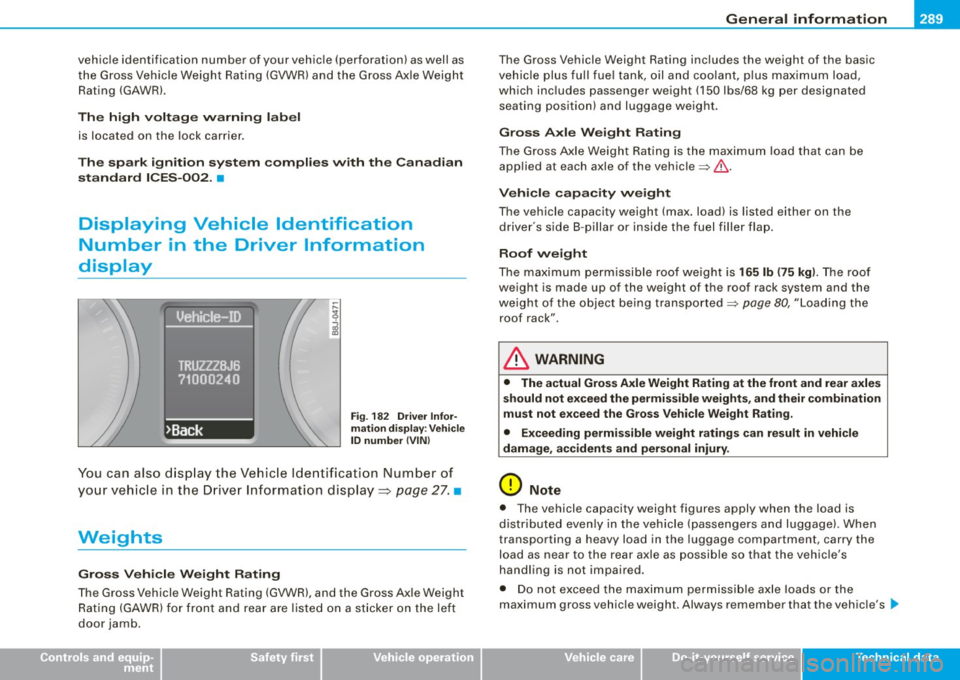
Fig. 182 Driver Infor
mation display: Vehicle
ID number (VIN)
You can also display the Vehicle Identification Number of
your vehicle in the Driver Information display~ page
27. •
Weights
Gross Vehicle Weight Rating
The Gross Vehicle Weight Rating (GVWR), and the Gross Axle Weight
Rating (GAWR) for front and rear are listed on a sticker on the left
door jamb.
Controls and equip ment Safety first Vehicle operation
The
Gross Vehicle Weight Rating includes the weight of the basic
vehicle plus full fuel tank, oil and coolant, plus maximum load,
which includes passenger weight (150 lbs/68 kg per designated
seating position) and luggage weight.
Gross Axle Weight Rating
The Gross Axle Weight Rating is the maximum load that can be
applied at each axle of the vehicle~&.
Vehicle capacity weight
The vehicle capacity weight (max. load) is listed either on the
driver's side 8 -pillar or inside the fuel filler flap.
Roof weight
The maximum permissible roof weight is 165 lb (75 kg). The roof
weight is made up of the weight of the roof rack system and the
weight of the object being transported
~ page 80, "Loading the
roof rack".
& WARNING
• The actual Gross Axle Weight Rating at the front and rear axles
should not exceed the permissible weights, and their combination
must not exceed the Gross Vehicle Weight Rating.
• Exceeding permissible weight ratings can result in vehicle
damage, accidents and personal injury.
0 Note
• The vehicle capacity weight figures apply when the load is
distributed evenly in the vehicle (passengers and luggage). When
transporting a heavy load in the luggage compartment, carry the
load as near to the rear axle as possible so that the vehicle's
handling is not impaired.
• Do not exceed the maximum permissible axle loads or the
maximum gross vehicle weight. Always remember that the vehicle's .,_
Vehicle care Do-it-yourself service Tec hn ica l da ta