gas type AUDI TT COUPE 2009 Owners Manual
[x] Cancel search | Manufacturer: AUDI, Model Year: 2009, Model line: TT COUPE, Model: AUDI TT COUPE 2009Pages: 316, PDF Size: 71.16 MB
Page 157 of 316
• in front -end collisions
• i n rea r-en d col lis ions
• in ro llovers.
In som e types o f acci dents th e fron t air bags a nd s ide airbags m ay
be trigge red together.
& WARNING
• Safety belts and the airbag system will only provide protect ion
when occupants are in the proper seating position
=> page 155 .
• If the a irbag indicator light comes on when the vehicle is being
used, have the system inspected immediately by your authorized
Audi dealer . The a irbag may not work properly when the vehicle
acceleration in a side collision is high enough to a ctivate the
airbag .•
How supplemental side airbags work
Side air bags deploy inst ant ly a nd con help reduce the risk
of u pper torso injuries for oc cupants wh o ore p roperly
restrained.
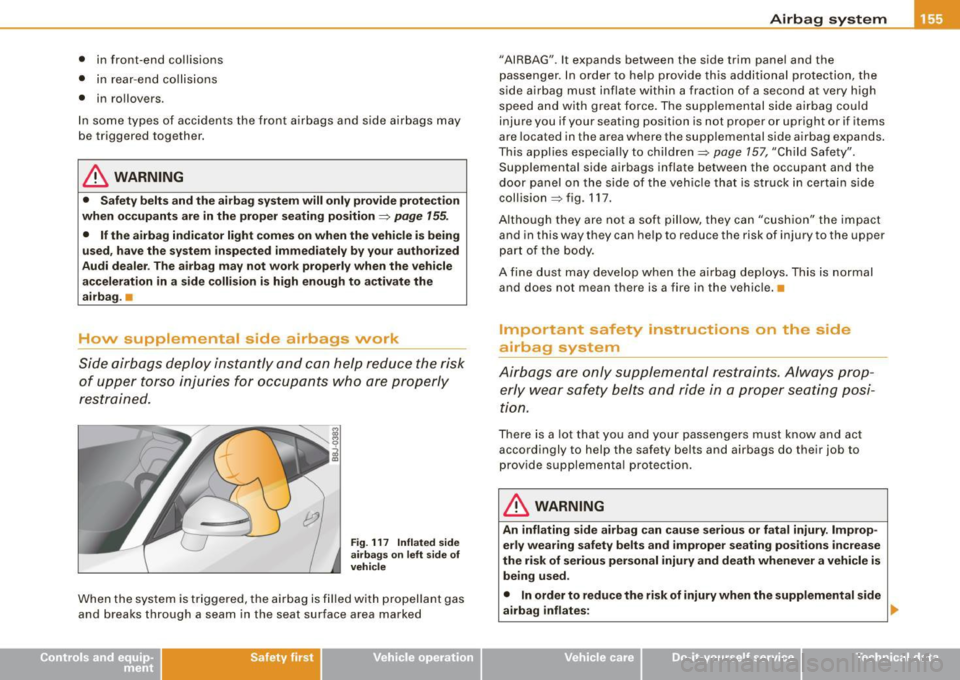
Fig . 117 Inflated side
a irba gs on left side of
vehic le
When the sys tem is triggered, the airbag is fille d with prop ellant gas
and br eaks through a seam in the seat sur face area marked
Safety first
Airbag system
"AIR BAG". It expands between the side trim pane l and the
passe nger. In o rder to hel p provide this a dditional protecti on, the
s ide a irbag must inflate w ithin a fraction of a second at very high
speed a nd w ith grea t force. T he suppleme ntal side ai rbag could
injure you if your seating position is not proper or upright or if items
are located in the a rea where the s upp lemental si de air bag expands .
This applies especial ly to child ren=>
page 157, "Ch ild Sa fe ty".
Sup plemental side airbags inflate between the o ccupant and the
d o or pa nel on the side of the vehicle tha t is str uck in certa in side
collision => fig . 117.
A lthough they a re not a s oft pillow, they ca n "cu shi on" the i mpact
and in this way they can help to reduce the risk of injury to the upper
par t of the bo dy.
A fin e dust may d evelop whe n the ai rbag deploys. T his is no rmal
and does not mean there is a fire in the vehic le .•
rmportant safety instructions on the side
airbag system
Ai rb ags o re on ly supplementa l restrai nts. A lwa ys p rop
e rly wea r safety belts and ride i n a prope r seatin g posi
ti on .
Ther e is a lo t th at you and your passenge rs m ust know a nd act
accordingly to help the safety belts and airbags do their job to
p rovide s upple men ta l pr otec tion .
& WARNING
An inflating side airbag can cause serious or fatal injury . Improp
erly wearing safety belts and improper seating positions increase
the risk of serious personal injury and death whenever a vehicle is being used.
• In order to reduce the risk of injury when the supplemental side
airbag inflates : .,
Vehicle care
I I irechnical data
Page 214 of 316

-Fuel supply and filling your fuel tank
-----=--=----:.------=-=---------------
Blend of gasoline and ethanol
(grain alcohol or ethyl alcohol}
• Anti-knock index must be 87 AKI or higher.
• Blend must not contain more than
10% ethanol.
Blend of gasoline and MTBE
• Anti-knock index must be 87 AKI or higher.
• Blend must contain not more than
15% MTBE.
Seasonally adjusted gasoline
Many gasoline grades are blended to perform especially well for
winter or summer driving. During seasonal change -over, we suggest
that you fill up at busy gas stations where the seasonal adjustment
is more likely to be made in time.
0 Note
• Methanol fuels which do not meet these requirements may
cause corrosion and damage to plastic and rubber components in
the fuel system.
• Do not use fuels that fail to meet the specified criteria in this
chapter.
• If you are unable to determine whether or not a particular fuel
blend meets the specifications, ask your service station or its fuel
supplier.
• Do not use fuel for which the contents cannot be identified.
• Fuel system damage and performance problems resulting from
the use of fuels different from those specified are not the responsi
bility of Audi and are not covered under the New Vehicle or the
Emission Control System Warranties.
• If you experience a loss of fuel economy or driveability and
performance problems due to the use of one of these fuel blends,
we recommend that you switch to unblended fuel. •
Gasoline additives
A major concern among many auto manufacturers is carbon
deposit build-up caused by the type of gasoline you use.
Although gasoline grades differ from one manufacturer to another,
they have certain things in common. All gasoline grades contain
substances that can cause deposits to collect on vital engine parts,
such as fuel injectors and intake valves. Although most gasoline
brands include additives to keep engine and fuel systems clean,
they are not equally effective.
Audi recommends using TOP TIER Detergent Gasoline. For more
information on TOP TIER Detergent Gasoline, please go to the offi
cial website (www.toptiergas.com).
After an extended period of using inadequate fuels, built-up carbon
deposits can rob your engine of peak performance.
(D Note
Damage or malfunction due to poor fuel quality is not covered by
the Audi New Vehicle Limited Warranty. •
Fuel tank
Fuel filler neck
The fuel filler neck is located on the right rear side panel behind the
fuel filler flap.
If the unlocking system should fail, you can still open the flap manu
ally -for detailed instructions see=>
page 215.
You can find the fuel tank capacity of your vehicle in Technical Data
=> page 291. .,_
Page 236 of 316
-~_T_ ir_e_ s_ a_ n_d _ w_ h_ e_e _l_s _________________________________________________ _
Tires and wheels
Tires
General notes
Tires may be the least appreciated and most abused parts
of a motor vehicle.
Tires may be the least appreciated and most abused parts of a
motor vehicle. Tires are, however, one of the most important parts
of a vehicle, particu larly considering the comparatively small patch
of rubber on each tire that assures that all -important contact
between you, your vehic le and the road.
Maintaining the correct tire pressure, making sure that your vehicle
and its tires do not have to carry more weight than they can safely
handle, avoiding damage from road hazards and regularly inspecting tires for damage inc luding cuts, s lashes irregular wear
and overa ll condition are the most important things that you can do
to help avoid sudden tire failure including tread separation and
blowouts.
A vo iding d am age
If you have to drive over a curb or similar obstac le, drive very slowly
and as close as possible at a right angle to the curb.
A lways keep chemica ls including grease, oi l, gaso line and brake
fluid off the tires.
Inspect the ti res regu larly for damage (cuts, cracks or b listers, etc.l .
Remove any foreign bodies embedded in the treads.
Storing tir es
Mark tires when you remove them to indicate the direction of rota
t ion. This ensures you to be able to mount them correctly when you
reinstal l them. When removed, the wheels or tires shou
ld be stored in a coo l, dry
and preferably dark place.
S tore tires in a vertical pos it ion if they a re not mounted on r ims, in
a horizonta l position if they are mounted on rims.
New tir es
New tires have to be broken in=>&.
The tread depth of new ti res may vary, according to the type and
make of tire and the tread pattern.
H idd en damage
Damage to tires and rims is often not readily visible. If you notice
unusual vibration or the vehicle pu lls to one s ide, this may indicate
that one of the tires has been damaged . The tires must be checked
immediately by an authorized Audi dealer or qualified workshop .
Unidire cti ona l t ires
A unidirectional tire can be identif ied by arrows on the sidewa ll, that
point in the direction the tire is designed to rotate . You must fo llow
t he specified directio n of rotation . This is necessary s o that these
tires can develop their optimum characteristics regarding grip, road noise, wear and hydrop laning resistance . For more information
=>
page 273.
& WARNING
New t ires o r ti re s th at a re old , worn or d am aged cann ot pro vid e
maximum cont rol and braking ability .
• New tires te nd to be slippery and mu st be bro ken in . To redu ce
the ri sk o f lo sin g co ntro l, a collis ion and serious per sonal injurie s,
dri ve w ith special care f or the fi rst 350 m ile s ( 560 km l.
• Driving w ith w orn or damaged tire s can lead to lo ss of control ,
sudd en tir e fa ilure , inc ludi ng a blowout a nd sudden defl atio n, ..,_
Page 303 of 316

______________________________________________ A_ l.:.. p _h_ a_ b_e _t_ic _ a _ l _in _ d_e _ x __ _
Automatic transmission ..... ... .. .... . 99
Driving Notes ... .. .... ... .... .... 102
Emergency program .. .... ... .... . 105
Emergency release . . . . . . . . . . . . . . . 106
Ignition key safety lock ....... .... .. 92
Kick-down .. ... .. .... .... ...... .. 105
Launch Control Program ........... 105
Selector lever lock .. ...... ...... .. 101
Selector lever positions ........... 100
Tiptronic ... .. .... .... ........... 103
Tiptronic controls on the steering wheel
104
Average fuel mileage ... .... .... .... .. 26
Average speed . ... .. .... .... .... .... . 26
Avoid damaging the vehicle ......... . 192
B
Battery . ...... ..... ... .... .... . 228, 231
Battery location inside the engine compartment ... .... .... .... 218,219
Charging . .... .... .... ... .... .... 232
Checking battery acid level .... 231, 232
Connecting ... ... ..... ... .... ... . 228
Disconnecting ....... ....... .... . 228
Important warnings when working on the
battery ..... .... ....... ...... .. 229
Replacing the battery . ....... .... . 228
Winter operation . .... .... ... .... . 228
Working on the battery ... .... .... . 229
Battery voltage ......... .... ......... 36
Before driving .. ...... .. ....... ..... 114
Bi -Xenon headlights ........... .. .... . 57
Blended gasoline ... .... .... ... .... . 211
Controls and equip
ment Safety first
Body
cavity sealing .... .. ..... ... ... . 204
Booster seats .... .... .... .... .... ... 165
How do I properly install a booster seat in
my vehicle? . ... ... ....... .. .... 165
Safety instructions ..... .... ... .... 165
Brake fluid Changing the brake fluid .. .... .... 227
Checking the brake fluid level ...... 227
What is the correct brake f luid level? 227
What should I do if the brake fluid warning
light comes on? . ........ ... ..... 227
Brake fluid reservoir ..... .... .... .... 227
Brake system . ... ...... ......... .... 227
Anti-lock brake system ... .... ... .. . 20
Brake Assistan t .... . .. .. .. . ... ... 187
Brake fluid .... ... .... ...... ...... 227
Brake fluid specifications for refi ll and
replacement . ... ..... ... .... .... 227
Brake light defective . .... .... .... .. 37
Brake pads ... ... ..... ... .... ... . 191
General information . .... .. .. .. ... 186
How does the moisture or road salt affect
the brakes? ............... ...... 1 86
Malfunction .... ........... ...... . 33
Warning/indicator lights .. ..... .... . 19
Worn brake pads symbo l .... ...... . 36
Break -in period ........ ............. 190
Brake pads ...... ..... ....... .... 191
Tires .... . ... ... ... ... .... .... ... 190
Bulbs ..... .. .... ..... .. ... ... ...... 278 C
California Proposition 65 Warning . .... 218
Battery specific .... ... .... .... .... 231
Capacities ... .... .... .... ... .... .... 291
Car care ... ..... .. .. .... .... .... .. . . 198
Interior .... ... .. .. .... ........ ... 205
Plastic and vinyl .. ............... . 202
Weatherstrips ... .. .... .. . .... ... . 203
Care of exterior . ..... ....... ....... . 198
Cargo area
See Luggage compartment . ... .... . 121
Cargo net .. .... .. .. .... .... .... .... . 78
Catalytic converter .. .... .... .... ... . 191
CD changer .... ... .. .... .... .... .. .. . 84
Certification .. ....... ....... ..... ... 296
Changing a flat tire ......... .... ... .. 268
Changing engine oi l .. .... ... .... .. .. 223
Chassis Undercoating . ... .... .... .... ... . 205
See also Audi magnetic ride .... .... . 98
Checking Battery acid level .. ....... .... 231, 232
Engine coolant level ...... .... .... 225
Checking tire pressure ..... .... ...... 241
Child restraint Danger of using ch ild restraints in the
front seat ... .... .... .... ... ... . 137
Child restraints What types of child restraint anchors are
avai lable? ... .... .... .... ...... . 171
Where can I get additional information
about child restraints? ........... 171
Vehicle operation Vehicle care Do-it-yourself service Technical data