heating AUDI TT COUPE 2017 User Guide
[x] Cancel search | Manufacturer: AUDI, Model Year: 2017, Model line: TT COUPE, Model: AUDI TT COUPE 2017Pages: 322, PDF Size: 79.73 MB
Page 90 of 322
Intelligent Technology
Intelligent Technology
Electronic stabilization
control (ESC)
Description
Electronic Stabilization Control (ESC) supports
driver safety.
It reduces the risk of slipping and
improves driving stability. ESC detects critical sit
uations such as the vehicle oversteering and un
dersteering or the wheels are spinning. The vehi
cle is stabilized by applying the brakes or reduc
ing engine torque. When ESC engages, the
G1 in
dicator light blinks in the instrument cluster.
The following systems are integrated in the ESC:
Anti-lock braking system (ABS)
ABS prevents the wheels from locking when brak
ing. The vehicle can still be steered even during
hard braking. Apply steady pressure to the brake
pedal. Do not pump the pedal. A pulsing in the
brake pedal indicates that the system is acting to
stabilize the vehicle .
Brake assist system
The brake assist system can decrease braking dis
tance. It increases braking power when the driver
presses the brake pedal quickly in emergency sit
uations . You must press and hold the brake pedal
until the dangerous situation is over .
Anti-slip regulation (ASR)
ASR reduces engine power when the drive wheels
begin spinning and adapts the force to the road
conditions. This makes it easier to start, acceler
ate and drive up hills .
Electronic differential lock (EDL)
EDL applies the brakes to a wheel that starts
spinning and transfers the drive power to the
other driving wheels. This function is not availa
ble at higher speeds.
In extreme cases, EDL automatically switches
off
to keep the brake on the braked wheel from over heating. The vehicle is still working correctly. EDL
will switch on again automatically when condi
tions have returned to normal.
88 Steering
recommendation
The ESC helps to stabilize the vehicle by changing
the steering torque.
Selective wheel torque control
Selective wheel torque control is used when driv
ing on curves. The front whee l on the inside of
the curve or both wheels on the inside of the
cu rve are braked selectively as needed. This al
lows more precise driving in curves. The applica
ble system may not activate when driving in wet
or snowy conditions.
A WARNING
- The ESC and its integrated systems cannot
overcome the limits imposed by natural physical laws. This is especially important
on slippery or wet roads. If the systems be
gin acting to stabilize your vehicle, you
should immediately alter your speed to
match the road and traffic conditions. Do
not let the increased safety provided tempt
you into taking risks. This could increase
your risk of a collision .
- Please note the risk of a collision increases
when driving fast, especially through curves
and on slippery or wet roads, and when driv ing too close to objects ahead. The ESC and
its integrated systems cannot always pre
vent collisions -there is still a risk of acci
dents!
- Press the accelerator pedal carefully when
accelerating on even, slippery surfaces such
as ice and snow. The drive wheels can spin
even when these control systems are instal
led and this can affect driving stability and
increase the risk of a collision.
(j) Tips
-The ABS and ASR only function correctly
when all four wheels have a similar wear
condition. Different tire sizes can lead to a
reduction in engine power.
- You may hear noises when the systems de
scribed are working.
Page 96 of 322
Intelligent Technology
greater than the amount being generated in or
der to maintain an optimal vehicle battery charge
level.
(D Tips
- Energy management cannot overcome the laws of physics. Note that the charge level
and length of the vehicle battery life are
limited.
- When the starting ability is jeopardized, the
(•j indicator light turns on¢ page 13.
What you should know
Maintaining the starting ability is the highest
priority.
A lot of stress is placed on the vehicle battery
when driving short distances, during city driving,
and at cold times of the year. A lot of energy is
used but little is generated. It is also critical
when the engine is not running but electrical
equipment is switched on. In this case, energy is used but none is generated .
In situations like this, energy management will
actively regulate the distribution of energy.
Long periods without use
If you do not drive your vehicle for several days or
weeks, electrical equipment is gradually scaled
back or switched off. This reduces energy use and
ensures the vehicle will be able to start after long
periods of time. Some convenience functions
such as opening with the remote control key may not be available . These convenience functions
will be available again once you switch the igni tion on and start the engine.
With the engine switched off
The vehicle battery will drain if you use Infotain ment functions such as listening to the radio
while the engine is switched off .
If the vehicle's ability to start may be impaired by
the energy use, a message will appear in the In
fotainment system display. The message indi cates that the system will switch off automatically soon .
If you would like to continue using the
functions, you must start the engine.
94
With the engine running
Although e lectrical energy is generated while
driving , the vehicle battery can drain . This can
happen if little energy is generated but much is
used, and the charge level of the vehicle battery
is not optimal.
To restore the balance of energy , components
that require large amounts of energy are tempo
rarily scaled back or switched off. Heating sys
tems in particular require a great deal of energy.
If you notice, for example, that the seat heating*
or rear window defroster is not working, then it has been temporarily reduced or switched off .
These systems are available again as soon as the energy supply has been restored.
In addition, you may notice that the idle speed
has slightly increased . That is normal and no
cause for concern . By increasing the idling speed ,
the additional required energy will be generated
and the vehicle battery will be charged.
Information about data
recorded by vehicle
control modules
Your vehicle is not equipped with a crash data re
corder . This device is installed by some vehicle
manufacturers to record data about crashes so
that it can be analyzed later. Crash data record
ers are also called "Event Data Recorders (EDR)".
In some legal jurisdictions, it is not permitted to
access or download data recorded by pre-instal
led crash data recorders in order to evaluate a
crash without clear consent of the vehicle owner.
Your vehicle is not equipped with a crash data re
corder. However it does contain a variety of elec
tronic control modules for various vehicle sys
tems such as engine function, exhaust treatment
or airbags and safety belts.
These electronic control modules record vehicle
data during normal driving for diagnosis and re
pair purposes. The recording capability of the
electronic control modules is limited to data only
- no sound is recorded. If the control module de
tects a system malfunction or other change in
status, a very limited amount of data is recorded .,,.
Page 253 of 322
CD
CD
.... N
" N .... 0
0
Ill co
Audi dealer or authorized Audi Service Facility
and have the cooling system inspected. If the
cooling system is not leaking, a loss can come
from the coolant boiling through overheating
and being pushed out of the cooling system.
A WARNING
The cooling system is pressurized and can be
come very hot . To reduce the risk of burns
from hot coolant:
- Do not open the coolant expansion tank cap when the eng ine is hot. This increases the
risk of burns.
- Stop the engine and allow it to cool.
- Protect your face, hands and arms from es-
caping coolant and steam by covering the
coolant tank cap with a large, thick cloth .
- Turn the coolant tank cap counterclockwise
slowly and keep light pressure on the cap .
- To reduce the risk of burns, do not allow any
antifreeze or coolant to drip onto the ex
haust system or hot engine components .
The ethylene g lycol in engine coolant can
catch fire under certain circumstances.
- The coolant add itive and the coolant can be
dangerous to your health. For this reason,
keep the coolant in the original container
and away from children. There is a risk of
poisoning.
- When working in the engine compartment,
remember that the radiator fan can sw itch
on even if the ignition is switched off, which
increases the risk of injury.
(D Note
Do not add coolant if the expansion tank is
empty . Air could enter the cooling system and
damage the engine. If this is the case, do not
cont inue driving. See an authorized Audi deal
er or authorized Audi Service Facility for assis
tance.
Checking and Filling
Brake fluid
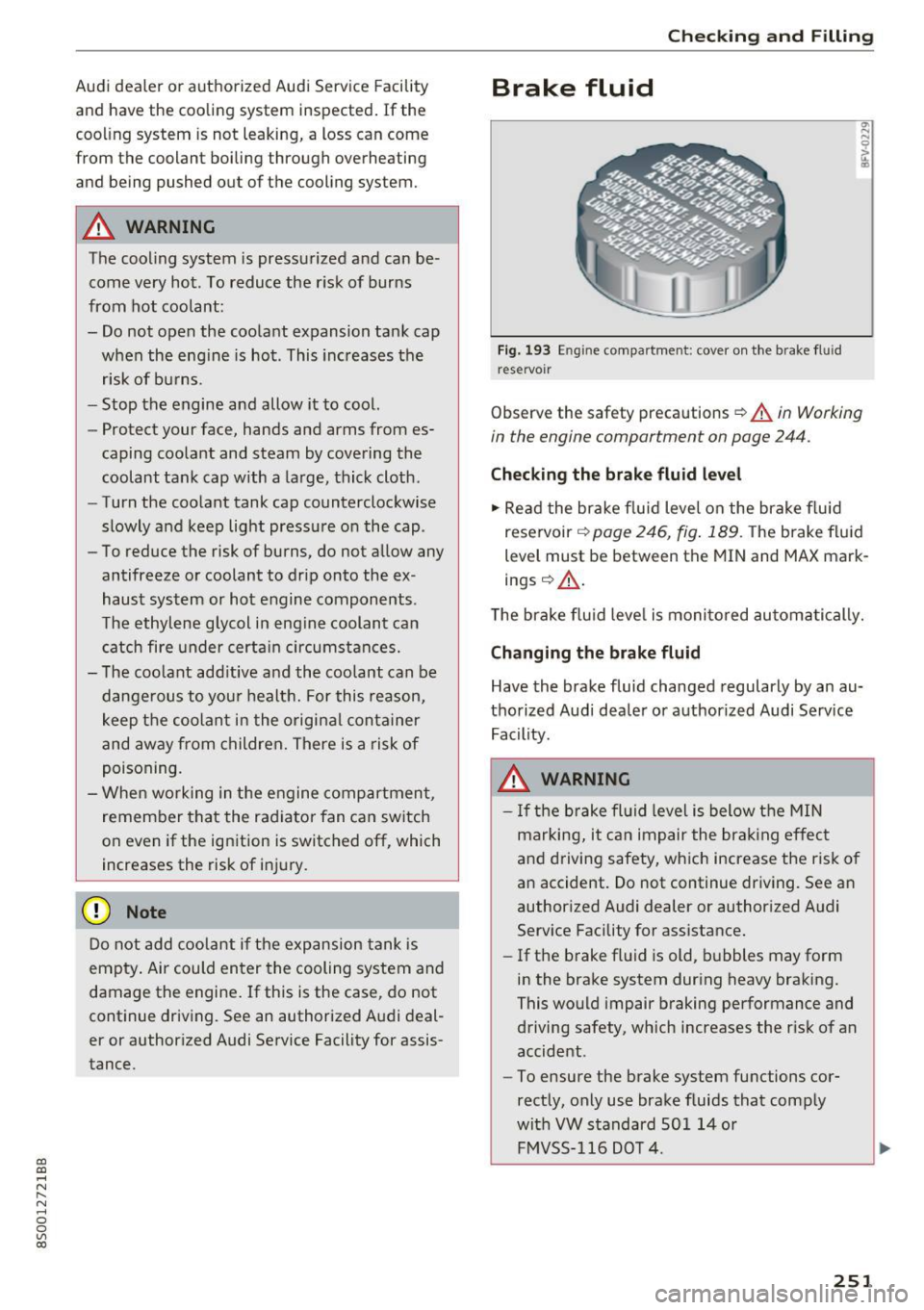
Fig. 193 En gi ne compartment: cover on the b rake fluid
rese rvoir
Observe the safety precautions QA in Working
in the engine compartment on page 244 .
Checking the brake fluid level
.,. Read the brake f luid level on the brake fluid
reservoir
Q page 246, fig . 189. The brake fluid
level must be between the MIN and MAX mark
ings
Q A .
The brake fluid level is monitored automatically.
Changing the brake fluid
Have the brake fluid changed regularly by an au
thorized Audi dealer or authorized Audi Service Facility.
.&_ WARNING
- If the brake fluid level is below the MIN
marking, it can impair the brak ing effect
and driving safety, which increase the risk of
an accident. Do not continue driving. See an
authorized Audi dealer or authorized Audi
Serv ice Facility for assistance.
- If the brake fluid is old, bubbles may form
in the brake system during heavy braking.
This would impair braking performance and
driving safety, which increases the risk of an
accident .
- To ensure the brake system functions cor
rectly, only use brake fluids that comply
with VW standard 501 14 or
FMVSS-116 DOT 4.
251
Page 281 of 322
co
co
.... N
" N .... 0
0
Vl c:o
-To avoid damage to the rear window de
fogger, do not apply any stickers on the
heating wires on the inside of the window.
- Decorative part .s/trim
- Never use chrome care or cleaning prod-
ucts .
-Paint
-To reduce the risk of scratches, the vehicle
must be free of dirt and dust before pol
ishing or waxing.
- To prevent paint damage, do not polish or
wax the vehicle in direct sunlight .
- To reduce the risk of paint damage, do not
polish away rust spots .
- Remove cosmetics and sunscreen immedi
ately- these could damage the paint.
-Instrument cluster
- Make sure that the instrument cluster is
switched
off and has cooled off before
cleaning it.
- The instrument cluster and the trim sur
rounding it must not be cleaned with dry
cleaning methods because they could get
scratched.
- Make sure no fluids enter the spaces be
tween the instrument cluster and the
trim, because that could cause damage.
-Controls
- Make sure that no fluids enter the con-
trols, because this could cause damage.
-Safety belts
- Do not remove the safety belts to clean
them.
- Never clean safety belts or their compo
nents chemically or with corrosive fluids
or solvents and never allow sharp objects
to come into contact with the safety belts.
This could cause damage to the belt web bing.
- If there is damage to the webbing, the
connections, the retractors or the buckles
,
have them replaced by an authorized Audi
dealer or authorized Audi Service Facility.
-Textiles/artificial leather/ Alcantara
- Never treat artificial leather/ Alcantara
with leather care products, solvents, floor
Care and cleaning
polish, shoe polish, spot remove or similar
products.
- Have a specialist remove stubborn stains
to prevent damage.
- Never use steam cleaners, brushes, hard
sponges, etc. when cleaning.
- Do not turn on the seat heating* to dry the
seat.
- Objects with sharp edges, such as zippers
or rivets on clothing or belts, can cause
damage to the surface.
- Open hook and loop fasteners, for exam
ple on clothing, can damage seat covers.
Make sure hook and loop fasteners are
closed.
- Natural leather
- Never treat leather with solvents, floor
polish, shoe polish, spot remover or simi
lar products .
- Objects with sharp edges, such as zippers
or rivets on clothing or belts, can cause
damage to the surface.
- Never use steam cleaners, brushes, hard
sponges , etc . when cleaning .
-Do not turn on the seat heating* to dry the
seat .
- To help prevent the leather from fading,
do not leave the vehicle in direct sunlight
for long periods of time. If leaving the ve
hicle parked for long periods of time, you
should cover the leather to protect it from
direct sunlight.
(D Tips
-Insects are easier to remove from paint that
has been freshly waxed.
- Regular waxing can prevent rust spots from
forming .
Placing your vehicle out
of service
If you would like to take your vehicle out of serv-
ice for a longer period of time, contact an author
ized Audi dealer or authorized Audi Service Facili
ty. They will advise you of important measures,
such as corrosion protection, service and storage ""
279
Page 292 of 322

Fuses and bulbs
Interior fuse assignment
Fig. 215 Vehicle inter ior: fuse assignme nt
No. Equipment
Fl Power top control modu
le (Roadster)
F2 Power top control module (Roadster)
F3 ESC control module
F4 Central computer processor (MIB-2)
FS Gateway
F6 Anti-theft alarm system Climate control system, selector lever (au-
F7 tomatic transmission), parking heater,
rear window heater relay coil
Diagnos is, electrical parking brake switch,
F8 light swi tch, rain/light sensor, interior
lighting
F9 Steering column switch module
Fl0 Display
F ll Haldex clutch
F12 MMI area
F 13 Adaptive dampers control module
F14 Climate control system blower
FlS Electronic steering co lumn lock
F16 MMI components, safety be
lt microphone
(Roadster)
290
No . Equipment
F17 Instrument cluster
F18 Rearview camera
F19 Convenience key system control module
F20 Power lumbar support adjustment
F22 Front passenger's side neck heating (Road-
ster)
F23 R
ig ht exterior lighting, on-board compute r
(right)
F 25 Driver's s
ide door (for example power win-
dows)
F26 Seat heating
F28 AMI H igh med ia port
F29 On-board computer
F31 Left on-board computer
F32 Driver assistance systems
F33 Airbag
Socket relay, interior sound, back-up light
F34 switch, temperature sensor, oil level sen-
sor
Diagnosis, headlight range control system,
F35 air quality sensor, automatic dimming
rearview mirror
F36 Right cornering light/ r ight LED-h eadlight
F37 Left cornering light/ left LED-headlight
F38 E
ng ine control module, ESC control mod-
ul e
F39 Front passenger's side door (for example
power windows)
F40 Cigarette lighter, sockets
F41 SCR relay and delivery unit
F42 Central locking area
F43 On-board computer
F45 Power adjustable driver's side seat
F46 Driver's side neck heat ing (Roadster)
F49 Starter, clutch sensor
FS0 ESC valves
F53 Rear window defogger
The power seats* are protected v ia
circuit break
ers
that automatically switch on after a few sec
onds after the overload has been reduced .
Page 293 of 322

CD
CD
.... N
" N .... 0
0
Ill co
Left engine compartment fuse assignment
Fig. 216 Engine compartment: fuse ass ignment
No. Equipment
Fl ESC control module
F2 ESC control module
F3 Engine control module
Engine cooling, engine components, auxili -
F4 ary heater coil re lay ( 1+2), secondary air
injection pump relay
FS E
ngine components, tank system
F6 Brake light sensor
F7 Engine components
F8 Oxygen sensor
F9 Engine components, exhaust door, glow
time control module
FlO Fuel injectors, fuel control module
Fll Auxiliary heater heating element 2
F 12 Auxiliary heater heating e
lement 3
F13 Automatic transmission cont rol module
FlS Horn
F16 Ignition coil
F17 ESC control module
, engine control mod-
ule
F18 Term inal 30 (reference voltage)
Fuses and bulbs
No . Equipment
Fl9 Windshield wipers
F20 Horn
F22 Terminal SO diagnos
is
F23 Starter
F24 Auxiliary heater heating element 1
F3 2 LED headlights
Bulbs
Message
Your vehicle is equ ipped with maintenance-free
headlights and tail lights . However, if a light bulb
needs to be replaced, p lease contact yo ur author
ized Audi dea ler or authorized Audi Service Facili
ty.
291
Page 311 of 322
co
co
.... N
" N .... 0
0
Vl c:o
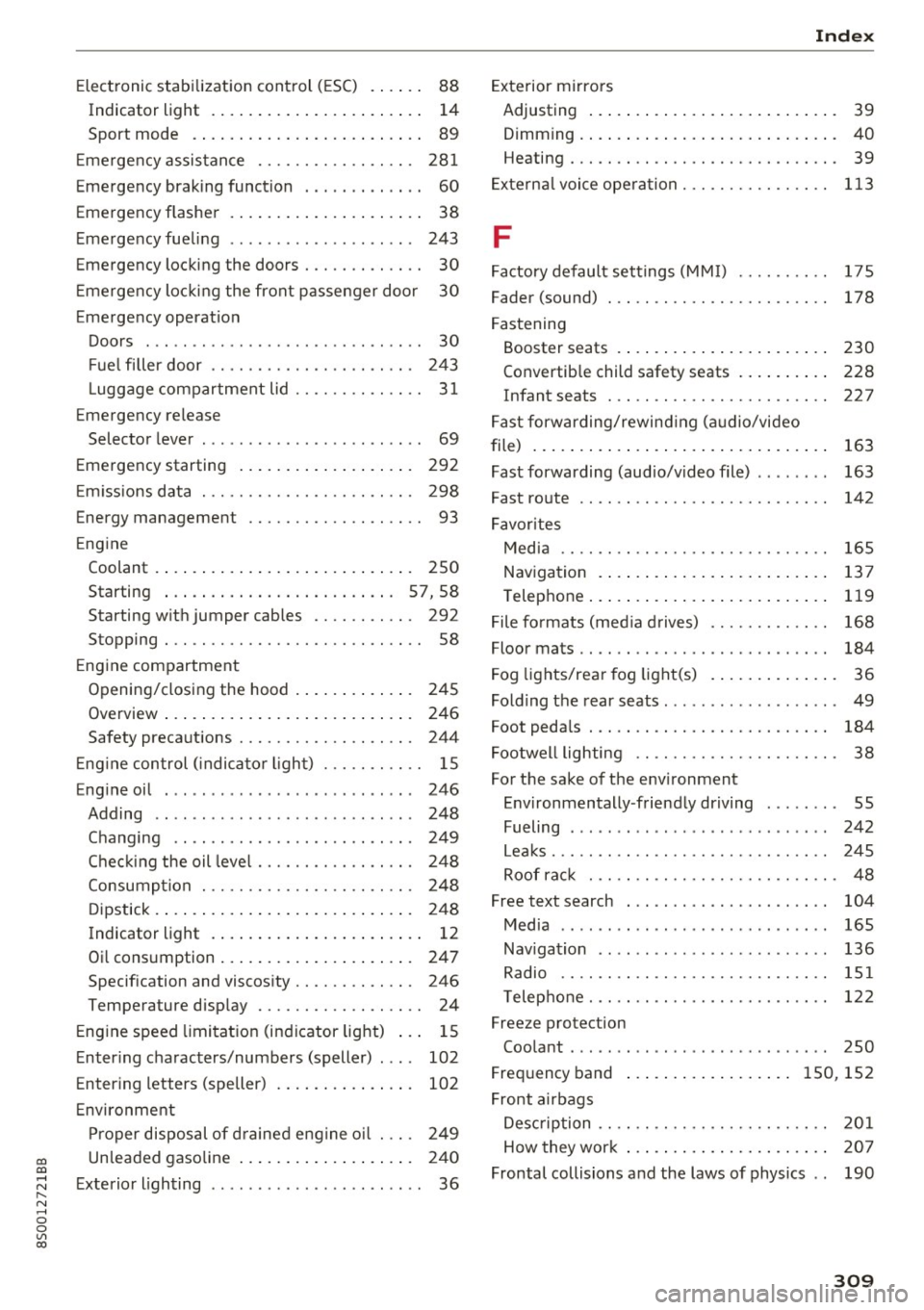
Electronic stabilization control (ESC) . . . . . . 88
Indicator light . . . . . . . . . . . . . . . . . . . . . . . 14
Sport mode . . . . . . . . . . . . . . . . . . . . . . . . . 89
E mergency assistance . . . . . . . . . . . . . . . . . 281
Emergency braking function . . . . . . . . . . . . . 60
Emergency flasher . . . . . . . . . . . . . . . . . . . . . 38
Emergency fueling . . . . . . . . . . . . . . . . . . . . 243
Emergency locking the doors . . . . . . . . . . . . . 30
Emergency locking the front passenger door 30
Emergency operation Doors . . . . . . . . . . . . . . . . . . . . . . . . . . . . . . 30
Fuel filler door . . . . . . . . . . . . . . . . . . . . . . 243
L uggage compartment lid . . . . . . . . . . . . . . 31
Emergency release Selector lever . . . . . . . . . . . . . . . . . . . . . . . . 69
Emergency starting . . . . . . . . . . . . . . . . . . . 292
E m issions data . . . . . . . . . . . . . . . . . . . . . . . 298
Energy management . . . . . . . . . . . . . . . . . . .
93
Engine
Coolant . . . . . . . . . . . . . . . . . . . . . . . . . . . . 250
Starting . . . . . . . . . . . . . . . . . . . . . . . . . 57, 58
Starting with jumper cables . . . . . . . . . . . 292
Stopping . . . . . . . . . . . . . . . . . . . . . . . . . . . . 58
Engine compartment
Opening/closing the hood . . . . . . . . . . . . . 245
Overview . . . . . . . . . . . . . . . . . . . . . . . . . . . 246
Safety precautions . . . . . . . . . . . . . . . . . . . 244
Engine control ( indicator light) . . . . . . . . . . . 15
Engine oil . . . . . . . . . . . . . . . . . . . . . . . . . . . 246
Adding .. .. .. ........ ..... ... ... .. . 248
Changing . . . . . . . . . . . . . . . . . . . . . . . . . . 249
Checking the oil level . . . . . . . . . . . . . . . . . 248
Consumption . . . . . . . . . . . . . . . . . . . . . . . 248
Dipstick . . . . . . . . . . . . . . . . . . . . . . . . . . . . 248
Indicator light . . . . . . . . . . . . . . . . . . . . . . . 12
Oil consumption . . . . . . . . . . . . . . . . . . . . . 247
Specification and viscosity . . . . . . . . . . . . . 246
Temperature display . . . . . . . . . . . . . . . . . . 24
Engine speed limitation (indicator light) . . . 15
Entering characters/numbers (speller) . . . . 102
Entering letters (speller) . . . . . . . . . . . . . . . 102
E nvironment
Proper disposal of d rained engine o il . . . . 249
Unleaded gasoline . . . . . . . . . . . . . . . . . . . 240
Exterior lighting . . . . . . . . . . . . . . . . . . . . . . . 36
Index
Exterior mirrors
Adjusting . . . . . . . . . . . . . . . . . . . . . . . . . . .
39
Dimming ... ... .. .. ................. . 40
Heating . . . . . . . . . . . . . . . . . . . . . . . . . . . . .
39
External voice operation . . . . . . . . . . . . . . . . 113
F
Factory default settings (MMI) . . . . . . . . . . 175
Fader (sound) . . . . . . . . . . . . . . . . . . . . . . . . 178
Fastening Booster seats . . . . . . . . . . . . . . . . . . . . . . . 230
Convertible child safety seats . . . . . . . . . . 228
Infant seats . . . . . . . . . . . . . . . . . . . . . . . . 227
Fast forwarding/rewind ing (audio/video
file) . . . . . . . . . . . . . . . . . . . . . . . . . . . . . . . . 163
Fast forwarding (audio/video file) . . . . . . . . 163
Fast route
Favorites Media 142
165
Navigation . . . . . . . . . . . . . . . . . . . . . . . . . 137
Telephone..... .. .. ................ . 119
File formats (med ia drives) . . . . . . . . . . . . . 168
Floor mat s . . . . . . . . . . . . . . . . . . . . . . . . . . . 184
Fog lights/rear fog light(s) . . . . . . . . . . . . . . 36
Folding the rear seats . . . . . . . . . . . . . . . . . . . 49
Foot pedals . . . . . . . . . . . . . . . . . . . . . . . . . . 184
Footwell lighting . . . . . . . . . . . . . . . . . . . . . . 38
For the sake of the environment Environmentally -friendly driving . . . . . . . . 55
Fueling . . . . . . . . . . . . . . . . . . . . . . . . . . . . 242
Leaks. .... .... .. ................. .. 245
Roof rack . . . . . . . . . . . . . . . . . . . . . . . . . . . 48
Free text search . . . . . . . . . . . . . . . . . . . . . . 104
Media . . . . . . . . . . . . . . . . . . . . . . . . . . . . . 165
Navigation . . . . . . . . . . . . . . . . . . . . . . . . . 136
Radio . . . . . . . . . . . . . . . . . . . . . . . . . . . . . 151
T elephone. . . . . . . . . . . . . . . . . . . . . . . . . . 122
Freeze protection Coolant . . . . . . . . . . . . . . . . . . . . . . . . . . . . 250
Frequency band . . . . . . . . . . . . . . . . . . 150, 152
Front airbags Description . . . . . . . . . . . . . . . . . . . . . . . . . 201
How they work . . . . . . . . . . . . . . . . . . . . . . 207
Frontal collisions and the laws of physics . . 190
309
Page 317 of 322

co
co
.... N
" N .... 0
0
Vl c:o
Safety features for occupant restraint and protection . . . . . . . . . . . . . . . . . . . . . . . . . . .
180
Safety instructions
for side curta in a irbags . . . . . . . . . . . . . . .
220
for using chi ld safety seats . . . . . . . . . . . . 225
For using safety belts . . . . . . . . . . . . . . . . 192
Monitoring the Advanced Airbag System . 211
Safety systems ( indicator light) . . . . . . . . . . . 15
Saving fuel
Recupera tion . . . . . . . . . . . . . . . . . . . . . . . .
23
Scan (radio) . . . . . . . . . . . . . . . . . . . . . . . . . . 151
Screen
refer to Audi virtual cockpit (instrument
cluster) . . . . . . . . . . . . . . . . . . . . . . . . . .
20, 22
Screwdriver . . . . . . . . . . . . . . . . . . . . . . . . . . 281
SD card reader . . . . . . . . . . . . . . . . . . . . . . . 156
sos
refer to Voice recognition system . . . . . . . 107
Search
refer to Free text search . . . . . . . . . . . . . . 104
Search area (point of interest) . . . . . . . . . . . 138
Searching for an entry . . . . . . . . . . . . . . . . . 104
Seat heating . . . . . . . . . . . . . . . . . . . . . . . . . . 53
Seating capacity . . . . . . . . . . . . . . . . . . . . . . 189
Seating position
Driver . . . . . . . . . . . . . . . . . . . . . . . . . . . . .
181
Front passenger . . . . . . . . . . . . . . . . . . . . . 182
H ow to adjust the front seats . . . . . . . . . . 182
Incorrect seat position . . . . . . . . . . . . . . . 183
Occupants. . . . . . . . . . . . . . . . . . . . . . . . . . 181
Rear passengers . . . . . . . . . . . . . . . . . . . . . 183
Seats
adj ust ing . . . . . . . . . . . . . . . . . . . . . . . . . . . 44
Correct seating position . . . . . . . . . . . . . .
181
Easy seat entry . . . . . . . . . . . . . . . . . . . . . . . 45
Folding . . . . . . . . . . . . . . . . . . . . . . . . . . . . . 49
Number of seats . . . . . . . . . . . . . . . . . . . . 189
Select ing a source
Multifunction steering wheel .........
22, 0
Selecting a source (media) . . . . . . . . . . . . . .
163
Selection menu . . . . . . . . . . . . 20, 98, 101, 102
Multifunction steering wheel . . . . . . . . . . . 22
Select ive whee l torque contro l . . . . . . . . . . . 88
Selector lever (automatic transmission)
Emergency operation . . . . . . . . . . . . . . . . . .
69
Pos1t1on . . . . . . . . . . . . . . . . . . . . . . . . . . . . 62
Service and disposal
Safety belt pretensioner
Ind ex
196
Service interva l display . . . . . . . . . . . . . . . . . 254
Settings
Directory . . . . . . . . . . . . . . . . . . . . . . . . . . .
124
Map ....... ... .. .. ... ....... .... ... 145
Media . . . . . . . . . . . . . . . . . . . . . . . . . . . . . 166
Navigation . . . . . . . . . . . . . . . . . . . . . . . . . 141
Radio . . . . . . . . . . . . . . . . . . . . . . . . . . . . . 153
System . . . . . . . . . . . . . . . . . . . . . . . . . . . . 174
T elephone. . . . . . . . . . . . . . . . . . . . . . . . . . 124
Setting the language . . . . . . . . . . . . . . . . . . 17 4
Shift paddles (automatic transmission) . . . .
66
Shuffle . . . . . . . . . . . . . . . . . . . . . . . . . . . . . 166
Side airbags
Description . . . . . . . . . . . . . . . . . . . . . . . . .
215
How they work . . . . . . . . . . . . . . . . . . . . . . 217
Side assist . . . . . . . . . . . . . . . . . . . . . . . . . . . . 76
Adjusting the brightness . . . . . . . . . . . . . . . 78
Cleaning the sensors . . . . . . . . . . . . . . . . . 276
Sensor range . . . . . . . . . . . . . . . . . . . . . . . . 77
switching on and off . . . . . . . . . . . . . . . . . . 78
Side curtain airbags . . . . . . . . . . . . . . . . . . . 218
Des cription . . . . . . . . . . . . . . . . . . . . . . . . . 218
How they work . . . . . . . . . . . . . . . . . . . . . . 219
Safety instructions . . . . . . . . . . . . . . . . . . . 220
SIM card reader . . . . . . . . . . . . . . . . . . . . . . 126
Snow cha ins . . . . . . . . . . . . . . . . . . . . . . . . . 270
Socket . . . . . . . . . . . . . . . . . . . . . . . . . . . . . . . 46
Software update
refer to System update (MMI) . . . . . . . . . . 177
Software (MMI)
License
179
Update . . . . . . . . . . . . . . . . . . . . . . . . . . . . 177
Version . . . . . . . . . . . . . . . . . . . . . . . . . . . . 177
Sources of information about child restraints
and their use . . . . . . . . . . . . . . . . . . . . . . . . .
239
Spare tire . . . . . . . . . . . . . . . . . . . . . . . . . . . 287
Speed-dependent volume increase . . . . . . . 178
Speed limiter . . . . . . . . . . . . . . . . . . . . . . . . . 70
Speedometer . . . . . . . . . . . . . . . . . . . . . . . . . 19
Speed warning system . . . . . . . . . . . . . . . . . . 70
Speller . . . . . . . . . . . . . . . . . . . . . . . . . . . . . . 102
Sport mode . . . . . . . . . . . . . . . . . . . . . . . . . . . 89
START Engine STOP button . . . . . . . . . . . . . . 57
Starting (engine) . . . . . . . . . . . . . . . . . . . . . . 57
3 15
Page 320 of 322
Index
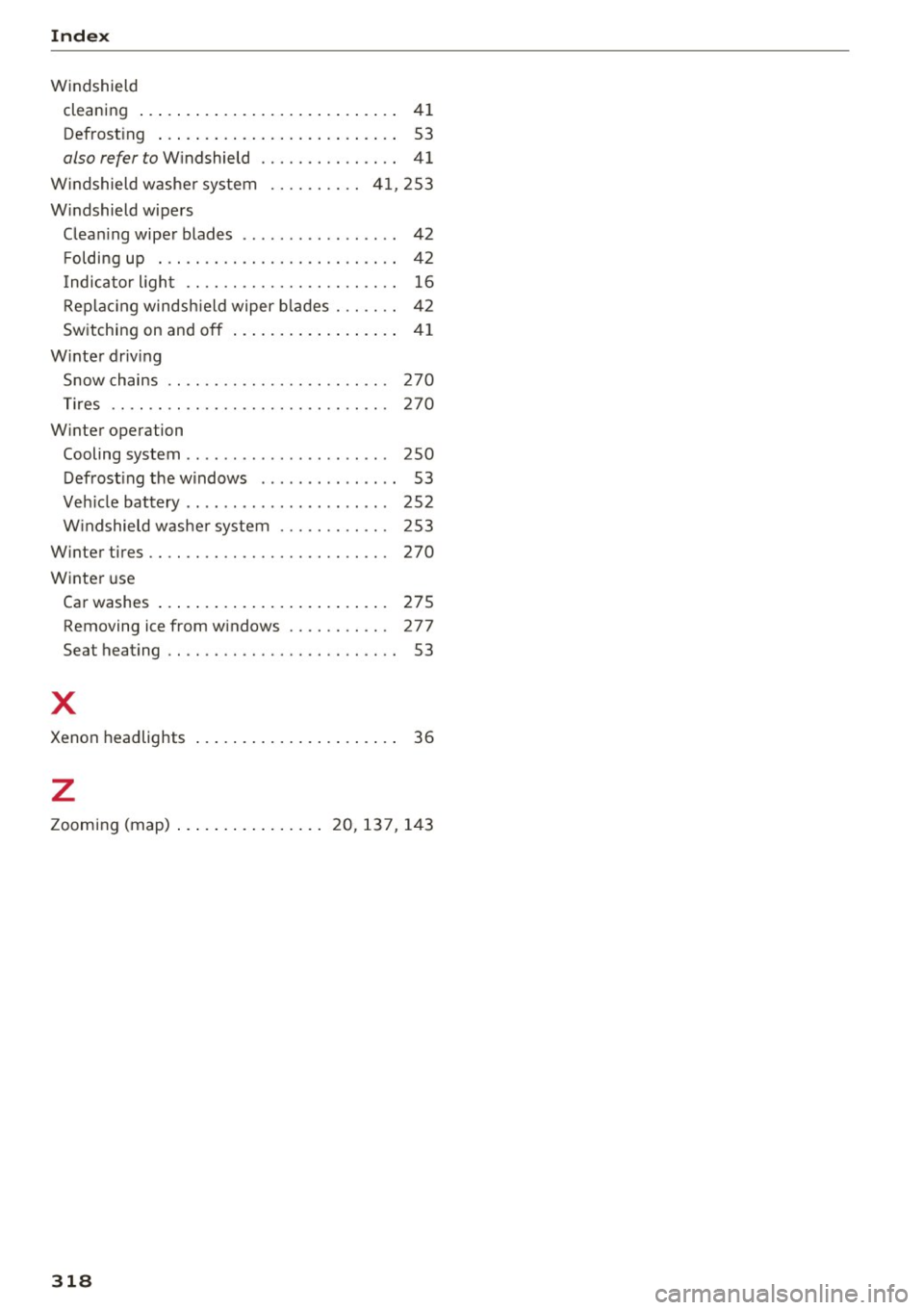
Windshield
cleaning . . . . . . . . . . . . . . . . . . . . . . . . . . . . 41
Defrost ing . . . . . . . . . . . . . . . . . . . . . . . . . . 53
also refer to Windshield . . . . . . . . . . . . . . . 41
W indshield w asher system . . . . . . . . . . 41, 2 53
W indshield wipers
C lea ning wipe r blades . . . . . . . . . . . . . . . . . 42
F oldi ng up . . . . . . . . . . . . . . . . . . . . . . . . . . 42
I ndicator l igh t . . . . . . . . . . . . . . . . . . . . . . . 16
Re plac ing windsh ield wiper b lades . . . . . . . 42
Sw itchi ng on and off . . . . . . . . . . . . . . . . . . 41
W inte r driv ing
Snow chains . . . . . . . . . . . . . . . . . . . . . . . . 270
Tires . . . . . . . . . . . . . . . . . . . . . . . . . . . . . . 270
W inter operation
Cooling system . . . . . . . . . . . . . . . . . . . . . . 250
D efrost ing the w indows . . . . . . . . . . . . . . . 53
Veh icle battery . . . . . . . . . . . . . . . . . . . . . . 252
W indshield w ashe r system . . . . . . . . . . . . 253
W inter tires . . . . . . . . . . . . . . . . . . . . . . . . . . 270
Winter use
Car washes . . . . . . . . . . . . . . . . . . . . . . . . . 275
Removing ice from w indows . . . . . . . . . . . 277
Seat heating . . . . . . . . . . . . . . . . . . . . . . . . . 53
X
Xenon headlights . . . . . . . . . . . . . . . . . . . . . . 36
z
Zoom ing (map) ... ... .. ..... ... 20, 137, 1 43
318