winter tires AUDI TT COUPE 2017 Owners Manual
[x] Cancel search | Manufacturer: AUDI, Model Year: 2017, Model line: TT COUPE, Model: AUDI TT COUPE 2017Pages: 322, PDF Size: 79.73 MB
Page 72 of 322
Ass is t
Assist
Electronic speed Limiter
Your vehicle may be factory equipped with tires
that are rated for a maximum speed of 130 mph (210 km/h). This is less than the maximum speed
of your vehicle. To reduce the risk of sudden tire
failure and loss of control if the vehicle is operat
ed at excessive speeds, your vehicle also has an
electronic speed limiter. The electronic speed
lim iter prevents your vehicle from going faster
than the t ire speed rating. For mo re information
~page 262.
If the engine control unit receives faulty vehicle
road speed signals, the Malfunction Indicator
L amp (MIL)
¢..ffi will illumina te. If this occurs,
con tact the nearest au thorized A ud i dealer for
assistance.
_& WARNING
Always observe the posted speed limits and
adjust you r speed to suit prevailing road, traf
fic and weather conditions. Never drive your
vehicle faster than the maximum speed rating
of the tires installed.
Speed warning system
Applies to: vehicles with speed warning system
The speed warning system helps you to stay be
low a specified maximum speed that can be set,
changed or deleted in the Infotainment system . -
The speed warning
system warns you if you are
exceeding the maximum speed that you have set.
A warni ng tone will sound as soon as you r speed
exceeds the sto red value s lightly. The
(OJ (USA
models)
I [OJ (Canada models) indicator light
and a message appear i n the ins trumen t cluster
d isp lay a t the same time. Th@
Hll (USA models)/
[O](Canada models) in dicator light and the mes
sage turn off when the vehicle speed drops be low
the stored maximum speed.
Se tting a threshold is rec om mended if you would
like to be reminded when yo u reach a certa in
maximum speed . Situations where you may want
to do so include driving in a country w it h a ge ne r-
70
al speed limit or if there is a spec ified maximum
speed for winter tires.
Setting the warning threshold
.,. Select in the Infotainment system: IMENU ! but
t on
> Vehicle > left con trol b utton > Driver as
sistance > Speed warning > Manu al.
a) Tips
Regar dless of the speed warning sys tem, you
sh ould alw ays mon itor your spee d using the
speedometer and tnake s ure yo u are fo llow ing
the lega l speed limit.
Cruise control system
Switching on
Applies to: vehicles with cruise control system
The cruise control system makes it possible to
drive at a constant speed starting at 15 mph
(20kmlh).
0
f
~
0
F ig. 70 Operat ing lever: crui se control system
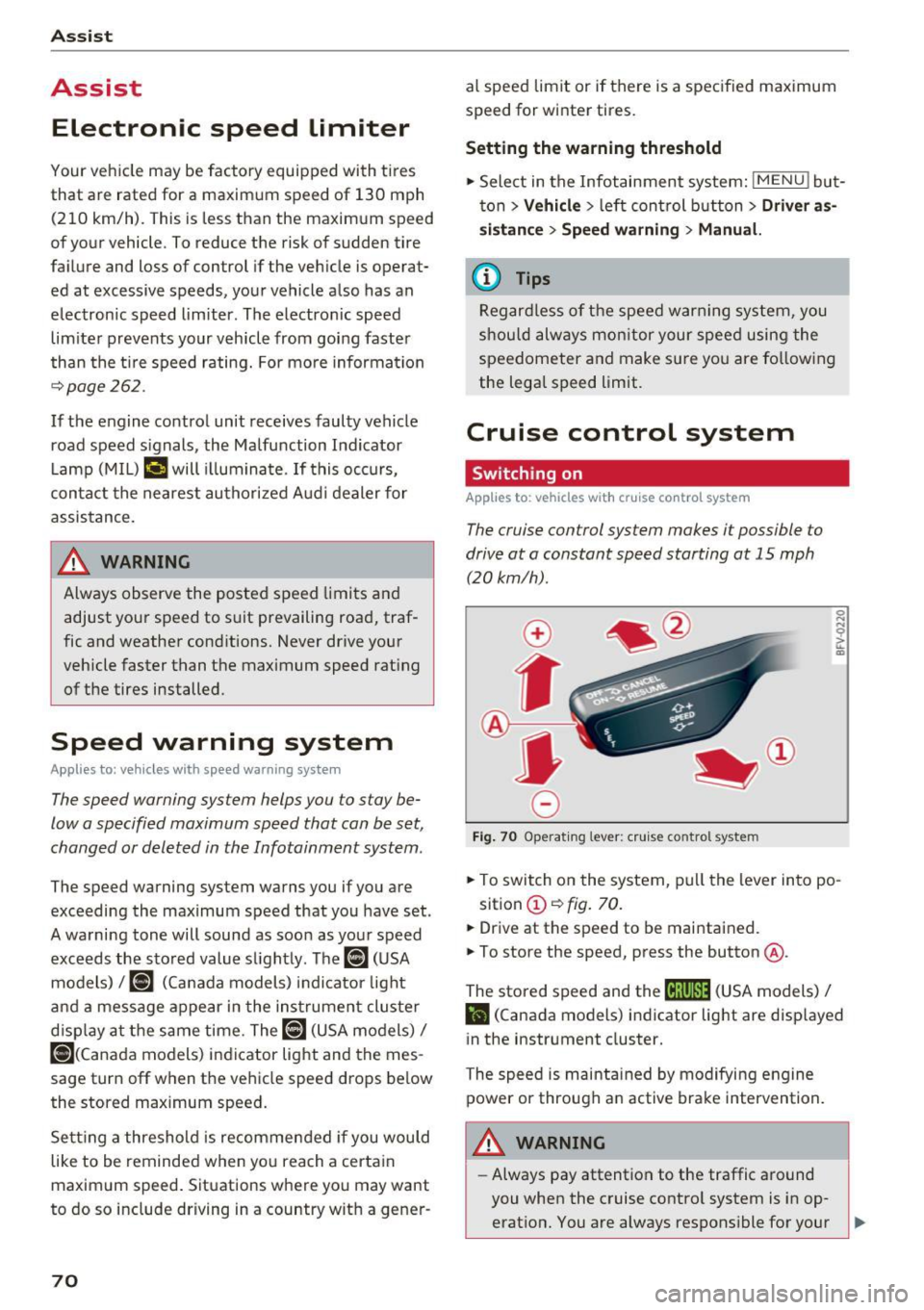
.,. To switch on the system, pu ll the lever into po -
sition @~
fig. 70.
.,. Drive at the speed to be maintained.
.,. To store the speed, press the button @.
The stored speed and the
M;\1)~1j (USA models) /
l'I (Canada models) indicator light are displayed
in the instrument cluster.
The speed is maintained by modifying engine
power or through an active brake intervention.
_& WARNING
-Always pay attention to the traffic around
you when the cruise contro l system is in op
erat ion. You are always respons ible for your ,...
Page 94 of 322
Intelligent Technology
snow and ice. Always read and follow safety pre
cautions
¢ & .
Winter tires
By using all wheel drive, your vehicle has good
forward motion with standard tires in winter con
ditions. However, in winter we recommend using
winter or all season tires on
all four wheels, be
cause this will improve the
broking effect.
Snow chains
If there are snow chain laws, snow chains must
also be used on vehicles with all wheel drive
¢ page 2 70, Snow chains.
Replacing tires
For vehicles with all wheel drive, only whee ls with
the same rolling circumference should be used .
Avoid using tires with different tread depths
¢ page 262, New tires or wheels.
Offroad vehicle?
Your Aud i is not an offroad vehicle - there is not
enough ground clearance. For this reason, avoid
difficult terrain.
_&. WARNING
-Also, in vehicles with all wheel drive, adapt
your driv ing style to the current road and
t ra ffic conditions. Do not let the increased
safety provided tempt you into taking risks,
because this increases the r isk of an acci
dent.
- The braking ability of your vehicle is limited
to the traction of the wheels. In this way, it
is not different from a two wheel drive vehi
cle. Do not be tempted to accelerate to a
high speed when the road is slippery, be
cause this increases the risk of an accident.
- Note that on wet streets, the front wheels
can "hydroplane" if driving at speeds that
are too high. Unlike front whee l drive
vehicles, the eng ine does not rev highe r sud
denly when the vehicle begins hydroplaning.
For this reason, pay attention to the road
conditions regardless o f your speed.
92
Rear spoiler
Appl ies to: vehicles with retractable rear spoile r
The extendoble rear spoiler increases driving sta
bility.
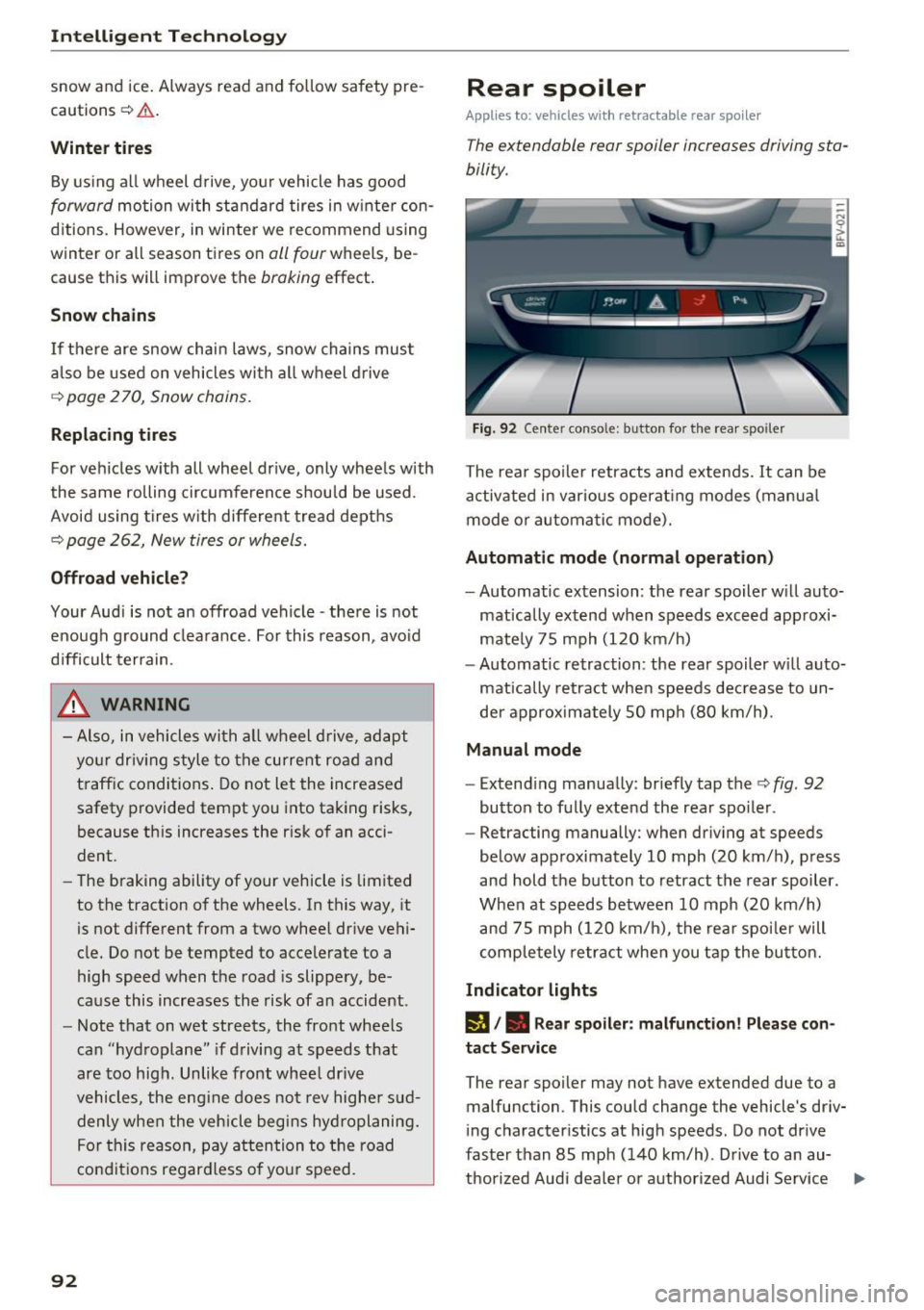
Fig. 92 Center conso le: button for the rear spoiler
The rear spoiler retracts and extends. It can be
activated in various operat ing modes (manua l
mode or automatic mode).
Automatic mode (normal operation)
- Automatic extension: the rear spoiler w ill auto-
mat ically extend when speeds exceed approxi
mately 75 mph
(120 km/h)
- Automatic retraction: the rear spoiler w ill auto
matically retract when speeds decrease to un
der approximately 50 mph (80 km/h).
Manual mode
-Extend ing manually : briefly tap the¢ fig. 92
button to fully extend the rear spoiler .
- Retracting manually: when driving at speeds
below approximately
10 mph (20 km/h), press
and hold the b utton to retract the rear spoiler .
When at speeds be tween
10 mph (20 km/h)
and 75 mph
(120 km/h), the rea r spoi ler will
completely retract when you tap the button.
Indicator lights
IJ,. Rear spoiler: malfunction! Please con
tact Service
The rear spoiler may not have extended due to a
malfunction. This could change the vehicle's driv
ing characteristics at high speeds. Do not drive
faster than 85 mph
(140 km/h) . Drive to an au-
thorized Audi dea ler or authorized Audi Service ..,.
Page 257 of 322
"'
"' ... N
" N ... 0 0
"' CX)
Wheels
Wheels and Tires
General information
.,.Check your tires regularly for
damage (punctures, cuts, cracks
and bulges). Remove foreign ob
jects from the tire tread.
.,. If driving over curbs or similar
obstacles, drive slowly and ap
proach the curb at an angle.
.,.Have faulty tires or rims re
placed immediately.
"'Protect your tires from oil,
grease and fuel.
.,.M ark tires before removing
them so that the same running
direction can be maintained if
they are reinstalled.
"'Lay tires flat when storing and
store them in a cool, dry location
with as little exposure to light as
possible.
(D Note
-Please note that summer and
winter tires are designed for
the conditions that are typical in those seasons. Audi recom
mends using winter tires dur
ing the winter months. Low
temperatures significantly de crease the elasticity of summ
er tires, which affects traction
Wheels
and braking ability. If summer
tires are used in very cold
temperatures, cracks can form
on the tread bars, resulting in
permanent tire damage that
can cause loud driving noise
and unbalanced tires.
-Burnished, polished or
chromed rims must not be
used in winter driving condi
tions. The surface of the rims
does not have sufficient corro
sion protection for this and
could be permanently dam aged by road salt or similar
substances.
Tire designations
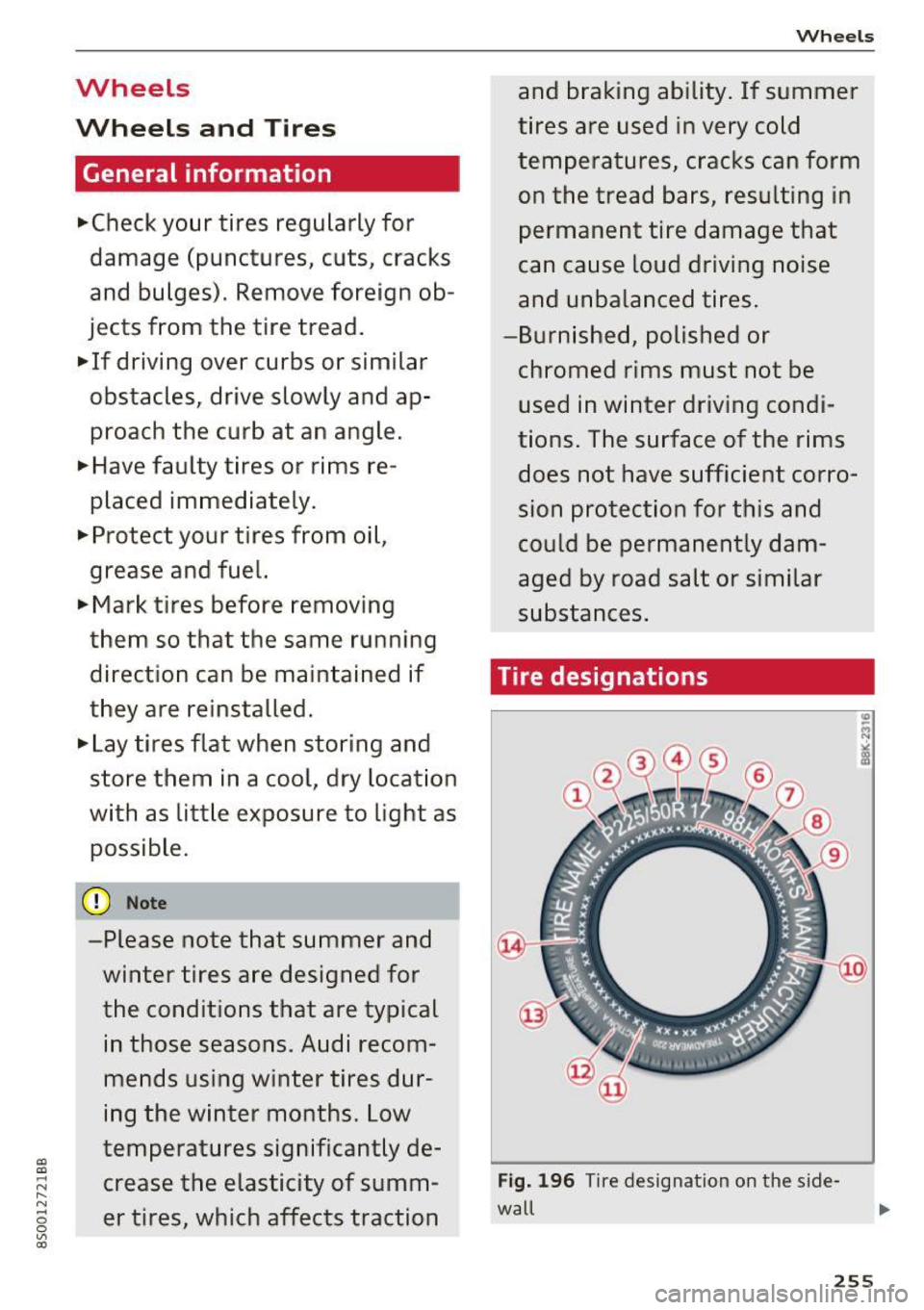
Fig. 196 T ir e designation on the side
wall
255
Page 258 of 322
Wheels
(D Tires for passenger vehicles
(if applicable)
P indicates a tire for a passenger
vehicle. T indicates a tire desig
nated for temporary use.
@ Nominal width
Nominal width of the tire be
tween the sidewalls in millime
ters. In general: the larger the
number, the wider the tire.
@ Aspect ratio
Height/width ratio expressed as a
percentage.
@ Tire construction
R indicates a radial tire.
® Rim diameter
Size of the rim diameter in inches.
@ Load index and speed rating
The load index indicates the tire's
load-carrying capacity.
The speed rating indicates the maximum permitted speed
¢ & in
Winter tires on page 2
70.
"EXTRA LOAD", "xl" or "RF" indi
cates that the tire is reinforced or
is an Extra Load tire.
Speed rat- Maximum permitted speed
ing
p
up to 93 mph (150 km/h)
Q up to 99 mph (160 km/h)
256
Speed rat- Maximum permitted speed
Ing
R
up t o 106 mph (170 km/h)
s up to 110 mph (180 km/h)
T up to 1 18 mph (190 km/h)
u up to 124 mph (200 km/h)
H up to 130 mph (210 km/h)
V up to 149 mph (240 km/h)al
z above 149 mph (240 km/h)al
w up to 168 mph (270 km/h)al
y up to 186 mph (300 km/h)al
a) For tires above 149 mph (240 km/h),
tire manufacturers sometimes use the
code "ZR".
(j) US DOT number (TIN) and
manufacture date
The manufacture date is listed on
the tire sidewall (it may only ap
pear on the inner side of the tire):
DOT ... 2216 ...
means, for example, that the tire
was produced in the 22nd week of
the year 2016.
@ Audi Original equipment
tires
Audi Original equipment tires
with the designation "AO" have
been specially matched to your
Audi. When used correctly, these
tires meet the highest standards
for safety and handling. An au
thorized Audi dealer or author
ized Audi Service Facility will be
Page 262 of 322
Wheels
Rim
means a metal support for a tire
or a tire and tube assembly upon
which the t ire beads are seated .
Rim diameter
means nominal diameter of the
bead seat . If you change your
wh eel size, you will have to p ur
chase new tires to match the new
rim d iameter .
Rim size designation
means rim diameter and w idth.
Rim width
means nomina l distance between
r im flanges .
Sidewall
means that portion of a t ire be
twee n the tread and bead .
Speed rating (letter code)
means the speed at which a t ire is
designed to be driven for extend
ed periods of ti me. The ratings
range from 93 mph (150 km/h)
to 186 mph (298 km/h)
¢ table
on page 256 .
You may not find
this information on all tires be
cause it is not required by law.
The speed rating letter code,
wh ere applicable, is molded on
the tire sidewall and ind icates the
260
maximum permissible road
speeds
¢ A in Winter tires on
page 270 .
Tire pressure monitoring
system *
means a system that detects
when one or mo re of a vehicle's
tires a re underinflated and illumi
nates a low tire pressure war ning
telltale .
Tread
means that portion of a tire that
comes into contact wi th the road.
Tread separation
means pulling away of the tread
from the tire carcass .
Treadwear indicators (TWI)
means the project ions wi thin the
pr inc ipal grooves designed to g ive
a visua l indication of the degrees
of wear of the tread . See
¢ page 264, Treadwear indicator
for mo re information on meas ur
ing tire wear.
Uniform Tire Quality Grading
i s a tire informa tion system devel
oped by the Unite d States Nation
a l Highway Traffic Safety Admin
istration (NHTSA) that is designed
to help buyers make re lative
..
Page 264 of 322
Wheel s
Occupant loading and distri
bution for vehicle normal load
for various designated seat ing
capacit ies
Refer to the tire inflation pres
sure label for the number of seat ing positions . Refer to the table
c:::> table on page 267 for the
number of people that corre
spond to the vehicle normal load .
New tires or wheels
Audi recommends having all work
on tires or wheels performed by
an authorized Audi dealer or au
thorized Audi Service Facility.
These facilities have the proper knowledge and are equipped with
the required tools and replace ment parts .
.,.. New tires do not yet have the
optimum gripping properties.
Dr ive carefully and at moderate
speeds for the first 350 miles (500 km) with new tires.
.,.. Use tires of the same construc
tion, size (rolling circumference)
and as close to the same tread
pattern as possible on all four
wheels .
.,.. Do not replace tires individually.
At least replace both tires on the same axle at the same time.
262
.,.. Audi recommends that you use
Aud i Orig inal Tires. If you would
like to use different tires, please
note that the tires may perform
diffe rently even if they are the
same size
c:::> &. -
.,.. If you would like to equip your
vehicle with a tire/rim combina
tion that is different from what
was installed at the facto ry, con
sult with an authorized Audi
dealer or authorized Audi Service
Facility before making a pur
chase
c:::> & -
The spare tire* is different from the regular tires installed on the
vehicle -for example, if winter
tires or wide t ires are installed -
so only use the spare tire* tempo
rarily in case of emergency and
drive carefully while it is in use . It
should be replaced with a regular
tire as soon as possible.
On
all wheel drive vehicles, all
four wheels must be equipped
with tires that are the same brand and have the same construction
and tread pattern so that the
drive system is not damaged by
different tire speeds . For this rea
son, in case of emergency, only
use a spare tire* that is the same .,..
Page 272 of 322
Wheels
rims yourse lf, because this increases the risk
of an accident.
Winter tires
W inter tire s significan tly improve the vehicle 's
handling when driving in w inter condi tions. Be
cause of the ir construction (width, compound,
tread pattern) , summe r tires p rovide less trac
tion o n ice and snow.
.. Use w inter t ires o n all four wheels .
.. Only use w inter t ires that are approved for your
vehicle .
.. Please note that the maximum permitted
speed may be lower with winter tires
¢ & -An
a utho riz ed Aud i dea le r o r authorized Audi Serv
ice Facility can inform you about the maximum
permitted speed fo r you r tires.
.. Check the tire pr essu re after installing whee ls
¢ page 265.
The effectiveness of winter tires is reduced great
ly whe n the tread is wor n down to a depth of
0 .157 in (4 mm). The character istics of winter
tires also decrease great ly as the tire ages, re
gardless of the remaining tread.
A WARNING
- Never dr ive faste r than the maxim um per
mitted speed for your t ires . This cou ld cause
the tires to heat up too much. This increases
t h e risk of an a cciden t be ca use i t can c ause
t h e tire to burst.
- Always adapt yo ur driv ing to t he r oad and
t ra ffic conditions. Drive ca refully and red uce
yo ur sp eed on icy or slippery roads. Even
winte r tires can lose traction on black ice .
@ For the sake of the environment
Reinstall su mme r tir es at the approp ria te
t ime, because they provide bet ter ha ndling
when ro ads are free of snow a nd ice. S ummer
t ires cause less road noise, ti re wea r and fuel
consumption.
270
(D Tips
You can also use a ll season tires instea d of
winter tires . Please note that in some coun
tries where winter tires are required, on ly
winter tires w it h the
& symbol may be per
mitted.
' Snow chains
S now cha ins not on ly improve the driv ing in win
te r road cond it io ns, but a lso the b raking .
.. On ly install snow chai ns on the front wheels .
T his applies also to vehicles with all wheel
dr ive*.
.. Check and co rrect t he seating of the snow
chains after driving a few feet, if nece ssary. Fol
low t he inst ructions from the m anufac turer.
.. Note the max imum speed of 3 0 mph (50 km/
h). Note the local regulations.
U se of snow c hains is only permitte d wit h cert ain
rim/ tire comb inat ions due to technical reasons.
Check with a n authorized Audi dealer or author
i zed Audi Service Facility to see if you may use
snow chains.
You m ust remove the snow chains on roads wi th
out snow . Otherwise, you co uld impair driving
ability and damage the t ires .
A WARNING
Using incor rect snow chains or installing snow
cha ins incor rectly can result in loss of vehicle
control, which increases the risk of an acci
dent .
(D Note
-Snow chains can damage the rims/wheel
covers* if the c hains come into direct con
tact with them. Remove the w heel covers *
first . Use coated snow cha ins .
- Us ing snow c hains that add more tha n 0.53
in (13,5 mm) of height can seve rely damage
the whee l housings and o ther vehicle com
ponents .
Page 273 of 322
co
co
.... N
" N .... 0
0
Vl c:o
@ Tips
When using snow chains, it may be useful to
switch on sport mode¢
page 89.
Low aspect ratio tires
Your Aud i is factory-equipped with low aspect ra
tio tires. These t ires have been thoroughly tested
and been selected specifically for your model for
their supe rb performance, road feel and handling
u nder a va riety of d riving conditions. As k your au
thor ized Audi dealer for mo re details.
The low aspect ratio of these t ires is indicated by
a numeral of
55 or l ess in the tire's size designa
tion. The numera l rep resents the rat io of the
tire's sidewall he igh t in relat io n to its tread w idth
expressed in pe rcen tage. Conventional t ires have
a height/w idth rat io of 60 or more .
The performan ce of low -a spe ct-ratio tire s is par
ticular ly sen sit iv e to improper inflation pre s
s ur e. It i s therefore import ant that low a spect
ratio tire s are infl ate d to the specified pre ssure
and that the inflation pre ssure i s regularl y
c hecked and mai nta ined . Tir e pre ssure s should
b e che cked at least once a month and alw ay s
before a long tri p ¢
page 265.
What you can do to avoid tire and rim
damage
Low aspect ratio tires can be damaged more easi
ly by impact with potholes, curbs, gullies or
ridges on the road, particularly if the t ire is un
derinflated .
In order to minimize the occurrence of impact
damage to the tires of your vehicle, we recom
mend that you observe the follow ing precau
tions:
- Always maintain recommended inflation pres
sures. Check your tire pressure every 2,000
miles (3,000 km) and add a ir if necessary .
- Drive carefully on roads with potho les, deep
gul lies or ridges. The impact from driving
t h rough or ove r such obstacles can damage
you r tires. Impact w ith a curb may also cause
damage to your tires.
Wh eel s
- After any impac t, immed iate ly inspect your
tires or have them inspected by the nearest au thorized A udi dealer. Replace a damaged tire as
soon as possible.
- Inspect your tires every 2,000 mi les (3,000 km)
for damage and wear. Damage is not a lways
easy to see. Damage can lead to loss of air and
underinflation, wh ic h could eventually cause
tire fa ilure . If you believe that a t ire may have
been damaged, replace the tire as soon as pos
sible.
- These tires may wear more quickly than others.
- Please also remember that, while these tires
delive r responsive handling, they may ride less
comfortably and make mo re noise than other
choices.
Reduced pe rfo rmance in winter /cold season
conditions
All t ires are des igned for certai n purposes. The
low aspect ratio, ultra h igh performance tires
o rigi na lly installed o n your vehicle are intended
fo r m aximum d ry and wet road per formance and
handling . They are not sui table for co ld, snowy or
icy weather conditions . If you drive under those
circumstances, you should equip yo ur vehicle
with all-season or winter tires, which offer better
tract ion under those conditions. We suggest you
use the recommended snow or all-season tires
specified for your veh icle, or their equivalent.
Refer to¢
page 2 70 for more detailed informa
t ion regarding winter tires.
Uniform tire quality grading
-T read wear
- Traction AA A 8 C
- Temperature ABC
Quali ty g rades can be fo und whe re applicable o n
the tire side wall between tread sho ulder and
maximum section width
¢page 255, fig. 196 .
For exampl e: Tread wear 200, Traction AA, Tem
peratu re
A .
All passenger car t ires must conform to Fede ral
Safety Req uirements i n addit io n to these grades . .,,_
271
Page 275 of 322

co
co
.... N
" N .... 0
0
Vl c:o
Your vehicle has also been equipped with a TPMS
malfunction indicator to indicate when the sys
tem is not operating properly. The TPMS mal
function indicator is combined with the low tire pressure telltale. When the system detects a
malfunction, the telltale will flash for approxi
mately one minute and then remain continuously
illuminated . This sequence will continue upon
subsequent vehicle start-ups as long as the mal
function exists .
When the malfunction indicator is illuminated,
the system may not be able to detect or signal low tire pressure as intended. TPMS malfunctions
may occur for a variety of reasons, including the
installation of replacement or alternate tires or
wheels on the vehicle that prevent the TPMS
from functioning properly . Always check the
TPMS malfunction telltale after replacing one or
more tires or wheels on your vehicle to ensure
that the replacement or alternate tires and
wheels allow the TPMS to continue to function properly.
If the Tire Pressure Monitoring System
indicator appears
The tire pressure indicator in the instrument
cluster informs you if the tire pressure is too low
or if there is a system malfunction .
Using the ABS sensors, the tire pressure monitor
ing system compares the tire tread circumfer
ence and vibration characteristics of the individu
al tires. If the pressure changes in one or more
tires, this is indicated in the Infotainment system
display w ith an indicator light
RE and a message.
If only one tire is affected, the location of that
tire will be indicated.
The tire pressures must be stored in the Infotain
ment system again each time the pressures
change (switching between partial and full load
pressure) or after changing or replacing a tire on
your vehicle
c::;, page 274 . The tire pressure moni
toring system only monitors the tire pressure you have stored. Refer to the tire pressure label for
the recommended tire pressure for your vehicle
¢ page 265, fig. 199.
Wheels
Tire tread circumference and vibration character
istics can change and cause a tire pressure warn
ing if :
- the tire pressure in one or more tires is too low.
- the tire has structural damage.
- the tire was replaced or the tire pressure was
changed and it was not stored
c::;, page 274.
- the spare tire* is installed .
Indicator lights
RE-Loss of pressure in at least one tire c::;, &,.
Check the tires and replace or repair if necessary.
Check/correct the pressures of all four tires and
store the pressure again in the Infotainment sys
tem
¢ page 274.
mm (Tire Pressure Monitoring System) Tire
pressure: malfunction! See owner's manual -If
mm appears after switching on the ignition or
while driving and then the indicator light
RE in
the instrument cluster also starts to blink for
about one minute and then stays on permanent
ly, there is a system malfunction. Try to store the
correct tire pressures
c::;, page 2 74 . If the indica
tor light does turn off or turns on again after a short period of time, drive to an authorized Audi
dealer or authorized Audi Service Facility immedi
ately to have the malfunction corrected.
A WARNING
..-
- If the tire pressure indicator appears in the
display, reduce your speed immediately and
avoid any hard steering or braking maneu
vers. Stop as soon as possible and check the
tires and their pressure.
- The driver is responsible for maintaining the
correct tire pressures . You must check the
tire pressures regularly .
- Under certain conditions (such as a sporty
driving style, winter conditions or unpaved
roads), the pressure monitor indicator may
be delayed.
- Do not use run-flat tires on your vehicle . Us
ing them when not permitted can lead to
vehicle damage or accidents.
273
Page 290 of 322
Emerg enc y assis ta nc e
necessary by an authorized Audi dealer or author
ized Audi Service Facility as soon as possible.
There are some restric tions on the use of the
compact spare tire. The compact spare tire has
been designed specifically for your type of vehi
cle. Do not replace it with the spare tire from an
other type of vehicle .
Remo ving th e spar e tire
.,. Turn the handle~ fig. 211 @counter-clock-
wise.
.,. Remove the spare tire.
Remov ing th e vehicle jac k
.,. Lift up the cover on the right side of the lug
gage compartment and remove the vehicle
jack.
Snow chain s
For technical reasons, the use of snow cha ins on
the compact spare t ire is not permitted.
If you have to drive with snow chains and a front
tire fails, mount the spare wheel in place of a
rear tire. Install the snow cha ins on the rear tire
that you removed, and install that in place of the
front tire that failed .
.&, WARNING
-
-After installing a spare t ire, the tire p res
s u re must be checked as soon as poss ible.
T he tire pressure is available on
~ page 265,
fig . 199.
-If the spare tire is more than 6 years o ld,
use it only in an emergency and with ex
treme caution and carefu l driving.
- T he spare tire is intended on ly for tempora
ry and short-term use. It shou ld be replaced
as soon as possible with the norma l wheel
and tire.
- After mounting the compact spare tire, the
tire pressure must be checked as soon as
poss ible. The tire pressure of the compact
spare tire must be 61 psi (420 kPA); other
wise, you risk hav ing an accident.
- Do not drive faster than SO mph (80 km/h).
You risk hav ing an accident.
288
- Avoid full-throttle acceleration, heavy brak
ing, and fast cornering. You r isk having an
accident.
- Never drive using more than one spare
wheel and tire. You r isk having an accident.
- Normal summer or winter tires must not be
mounted on the compact spare wheel rim.
- For technical reasons, the use of tire chains
on the spare tire is not permitted. If it is
necessary to drive w ith tire chains, the spare
wheel must be mounted on the front axle in
the event of a flat in a rear t ire. The newly
ava ilable front wheel must then be installed
in place of the rear wheel with the flat tire.
Installing the tire chain before mounting
the wheel and tire is recommended.
- Loose items in the passenger compartment
can cause se rious personal injury during
ha rd bra king or in an accident. Never store
the inflatable spare tire or jack and tools in
the passenger compartment .
- Normal summer or winter tires must not be
mounted on the compact spare wheel rim .