weight AUDI TT ROADSTER 2008 User Guide
[x] Cancel search | Manufacturer: AUDI, Model Year: 2008, Model line: TT ROADSTER, Model: AUDI TT ROADSTER 2008Pages: 316, PDF Size: 70.1 MB
Page 160 of 316
___ A_ ir_ b_ a-g _ s_y _s_ t_ e_ m _________________________________________________ _
• a car bed has been installed on the front seat, or
• a rearward-facing child restraint has been installed on the front
passengerseat,or
• a forward-facing child restraint has been insta lled on the front
passenger seat, or
• the weight registered on the front passenger seat is equal to or
less than the combined weight of a typical 1 year -old restrained in
one of the rear-facing or forward-facing infant restraints listed in Federal Motor Vehicle Safety Standard 208 with which the Advanced
Airbag Sys tem in your vehicle was certified.
If the front passenger seat is not occupied, the front airbag wi ll not
deploy, and the
P ASS ENGER AIR B AG OFF light will stay on. Never
install a rearward -facing child restraint on the front passenger seat,
the safest place for a chi ld in any kind of child restraint is at one of
the seating positions on the rear seat=>
page 147, "Child restraints
on the front seat -some important things to know" and=>
page 168,
"Chi ld Safety" .
If the PA SS ENG ER A IR BAG OFF l ight com es on when one of the
conditions listed above is met, be sure to check the light regularly
to make certain that the
P ASSE NG ER AIR BAG OFF light stays on
continuously whenever the ignition is on. If the
PASSENGER AIR
B AG OFF
light does not appear and not stay on all the time, stop as
soon as it is safe to do so and
• reactivate the system by turning the ignition off and then turning
it on again;
• remove and re install the child restraint. Make sure that the chi ld
restraint is properly insta lled and that the safety belt for the front
passenger seat has been correct ly routed around the ch ild restraint
as described in the child restraint manufacturer's instructions;
• make sure that the convertible locking feature on the safety belt
for the front passenger seat has been activated and that the safety
belt has been pulled tight. The be lt must not be loose or have loops
of slack so that the sensor below the safety belt latch on the seat can
do its job=>
page 177 .
• make sure that things that may increase the weight of the child
and child safety seat are not being t ransported on the front
passenger seat;
• make sure that the safety belt tension sensor is no t blocked.
Shake the safety belt latch on the front passenger seat back and
forth;
• If a strap or tether is being used to tie the chi ld safety seat to the
front passenger seat, make sure that it is no t so tigh t that it causes
the weight -sensing mat to measure more weight than is actually on
t he seat .
If the PA SSEN GER AIR BAG OFF lig ht still doe s no t c om e on and does
not stay on continuously (when the ignition is switched on),
• t ake the child restraint off the front passenger seat and install it
proper ly at one of the rear seat positions. Have the airbag system
inspected by your Audi dealer immediately.
• move the child to a rear seat position and make sure that the
child is properly restrained in a child restra int that is appropriate for
its size and age .
T he
PASSENGER AIR BAG OFF light shou ld NOT come on when the
ignition is on and an adult is sitting in a proper seating position on
the front passenger seat . If the
PASSENGER AIR BAG O FF light
comes on and stays on or flashes for about 5 seconds wh ile driving,
under these circumstances, make sure that:
• the adu lt on the front passenger seat is properly seated on the
center of the seat cushion with his or her back up against the back
rest and the backrest is not reclined=>
page 130, "Proper occupant
seating positions",
• t he adu lt is not taking weight off the seat by holding on to the
passenger assist handle above the front passenger door or
supporting their weight on the armrest,
• the safety belt is being proper ly worn and that there is not a lot
of slack in the safety belt webbing,
• accessory seat covers or cushions or other things that may cause
an incorrect reading or impress ion on the weight-sensing mat ...
Page 161 of 316
__________________________________________________ A_ i_ r _b _a...; g::- s_ y=--- s_t _e _m __ lffl!III
under the upho lstery of the seat have been removed from th e front
p assenge r sea t,
• a safety belt extender has not been left in the safety be lt latch for
the fr ont pass enge r se at .
I n addition to the PASSENGER AIR BAG OFF l ight in the center of the
instrument pane l, the message PASSENGER AIR BAG OFF or
PASSENGER AIR BAG ON will br iefly appear in the instrument c luster
display . Thi s is to inform the drive r of the current front passenger
a ir b ag status .•
Important safety instructions on monitoring
the Advanced Airbag System
& WARNING
An airbag system that is not functioning prope rly cannot prov ide
supplemental protection in a frontal crash.
• If the airbag ind icator light comes on , it means that there may
be something wrong with the Advanced Airbag System . It is
possible that the airbag will inflate when it is not supposed to , or
will not inflate when it should.
• Have the airbag system inspected immediately by your Audi
dealer.
& WARNING
If the front airbag inflates , a child without a child restraint, in a
rearward-facing child safety se at or in a forward-facing child
restraint that has not been properly installed will be seriously
injured and can be killed.
• Even though your vehicle is equipped with an Advanced Airbag
System , make certain that all ch ildren , especially 12 years and
younger, always ride on the back seat properly restrained for their age and size .
Controls and equip ment Safety first
Vehicle operation
& WARNING (continued )
• If you must in stall a rearward-facing child safety seat on the
front passenger seat because of exceptional circumstances and
the PASSENGER AIR BAG OFF light does not appear and stay on ,
immediately install the rear -facing child safety seat in a rear
seating posit ion and have the airbag system inspected by your
Audi dealer .
• A tight tether or other strap on a rearward-fa cing child restraint
attached to the front passenger seat can put too much pressure
on the weight-sensing mat in the seat and reg ister more weight
than is actually on the seat. The heavier weight registered can make the system work as though an adult were on the seat and
deploy the Advanced Airbag when it must be suppressed causing
serious or even fatal injury to the child .
• If, in exceptional circumstances, you must in stall a forward
fac ing child restra int on the front passenger seat , always move the
seat into its rearmost position in the seat's fore and aft adjust
ment range , as far away from the airbag as possible. The backrest
must be adjusted to an upright position . Make sure that the
PASSENGER AIR BAG OFF light comes on and stays on all the time
whenever the ignition is switched on .
& WARNING
• If the PASSENGER AIR BAG OFF light does not go out when an
adult is sitting on the front passenger seat after taking the steps
described above, have the airbag system inspected by your Audi
dealer before transporting anyone on the front passenger seat .
[ i ] Tips
I f the wei ght -sens ing mat in the front passenger seat detects an
empty seat, t he fron t airbag o n the pa ssenge r sid e wil l be tu rne d
o ff , and PASSENGER AIR BAG OFF will stay on .•
Vehicle care Do-it-yourself service Technical data
Page 168 of 316
-Airbag system -----~~---------------------------------------------------------
Important safety instructions on the side
airbag system
Airbags are only supplemental restraints. Always prop
erly wear safety belts and ride in a proper seating posi
tion.
There is a lot that you and your passengers must know and act
accordingly to help the safety belts and airbags do their job to
provide supplemental protection.
& WARNING
An inflating side airbag can cause serious or fatal injury. Improp
erly wearing safety belts and improper seating positions increase
the risk of serious personal injury and death whenever a vehicle is
being used.
• In order to reduce the risk of injury when the supplemental side
airbag inflates:
- Always sit in an upright position and never lean against the
area where the supplemental side airbag is located.
- Never let a child or anyone else rest their head against the
side trim panel in the area where the supplemental side airbag
inflates.
- Always make sure that safety belts are worn correctly,
- Do not let anyone sitting in the front seat put their hand or
any other parts of their body out of the window.
• Always make sure that the side airbag can inflate without inter
ference.
-Never install seat covers or replacement upholstery over the
front seat backs that have not been specifically approved by
Audi.
- Never use additional seat cushions that cover the areas
where the side airbags deploy .
& WARNING (continued)
-Damage to the original seat covers or to the seam in the area
of the side airbag module must always be repaired immedi
ately by an authorized Audi dealer .
• Objects between you and the airbag can increase the risk of
injury in an accident by interfering with the way the airbag unfolds
or by being pushed into you as the airbag inflates. -Never place or attach accessories or other objects (such as
cup holders, telephone brackets, or even large, bulky objects)
on the doors, over or near the area marked "AIRBAG" on the
seat backrests.
- Such objects and accessories can become dangerous projec
tiles and cause injury when the supplemental side airbag deploys.
- Never carry any objects or pets in the deployment space
between them and the airbags or allow children or other
passengers to travel in this position.
• Always use the built-in coat hooks only for lightweight
clothing. Never leave any heavy or sharp-edged objects in the
pockets that may interfere with side airbag deployment and can
cause personal injury in an accident.
• Always prevent the side airbags from being damaged by heavy
objects knocking against or hitting the sides of the seatbacks.
• The airbag system can only be triggered once.
If the airbag has
been triggered, the system must be replaced by an authorized
Audi dealership.
• Damage (cracks, deep scratches etc.I to the original seat covers
or to the seam in the area of the side airbag module must always
be repaired immediately by an authorized Audi dealer.
• If children are seated improperly, their risk of injury increases
in the case of an accident ~
page 168, "Child Safety" .
• Never attempt to modify any components of the airbag system
in anyway. _.,
Page 170 of 316
___ C_h_ i_ ld _ S_ a_ f_ e_ t_y ____________________________________________ _
Child Safety
Important things to know
Introduction
The physical principles of what happens when your veh ic le is in a
crash apply also to children=>
page 139, "What happens to occu
pants no t wearing safety belts?" . But un like adu lts and teenagers,
their musc les and bones are not fully developed. In many respects
children are at g reater risk of serious injury in crashes than adul ts .
Because chi ldren's bodies are not fully developed, they require
restraint systems especial ly designed for their size, weight, and
body structure. Many countries and all s tates of the United States
and provinces of Canada have laws requiring the use of approved
chi ld restraint syste ms for in fants and sma ll children.
In a fronta l crash at a speed of 20 -35 mph (30 -56 km/h) the forces
acti ng on a 13 -p o und (6 kg) infant wil l be m ore tha n 20 times the
weight of the child. This means the weight of the child would suddenly be more than 260 pounds (120 kg). Under these condi
tions, on ly an appropriate child restraint properly used can reduce
the risk of serious injury . Child restraints, like adult safety belts,
m ust be used prope rly t o be e ffective. Used i mproper ly, they can
increase the risk of serious injury in an accident .
Co nsu lt the ch ild safety s eat manu fact ure r's ins truc tions to be su re
the seat is right for your child's size=>
page 171, "Important safety
instruct ions for using child safe ty seats" . Please be sure to read and
heed a ll of the important information and WARN INGS about chi ld
safety, Advanced Airbags, and the installation of child restraints in
this chap ter.
There is a lot you need to know about the Advanced Airbags in your
veh ic le and how they work when infants and chi ldre n in child
restra ints are on the front passenger seat. Because of the large
a m ount of impo rtant informati on, we can not repeat i t all here. We urge you to
read the detai led informat ion in this owner's manua l
about airbags and the Advanced Airbag System in your vehicle and
the very i mportant in formation about tra nsport ing chi ldren on the
front passenger seat. Please be sure to heed the WAR NINGS -they
are ext remely important for y our safe ty a nd the safe ty of you r
passengers, especia lly infants and small children.
& WARNING
All vehicle o ccupants and especially children must be restrained
properly wheneve r riding in a vehicle. An unrestrained or improp
erly restrained child could be injured by striking the interior or by
be ing e je cted from the vehicle during a sudden maneuver or
impa ct. An unrestrained or improperly restrained child i s also at
greater risk of injury or death through contact with an inflating
airbag .
& WARNING
Children on the front seat of any car even w ith Adv anced Airbags
can be seriously injured or even killed when an airbag infla tes. A
child in a rearward-fa cing child safety seat installed on the front
passenger seat will be seriously injured and can be killed if the
front airbag inflate s.
• The inflating airbag will hit the child safety seat or infant
c arrier with great fo rce and will smash the child safety seat and
child against the backrest, door or roof.
• Never install a rearward fa cing child safety seat on the front
pa ssenger seat unles s the PASSENGER AIR BAG OFF light comes
on and stays on . If the PASSENGER AIR BAG OFF light does not
come on and stay on , have the airbag system in spected immedi -
ately by your Audi dealer . _,.
Page 171 of 316
_____________________________________________ C_ h _ il_d _S_ a _ fe_t.....: y'----""
& WARNING
If , in e xceptional circum sta n ce s, y ou mu st in stall a forward -fa cing
c hild re straint on the front pa ssenger' s seat:
• Always m ake sure the forw ard-f acing se at has b een de signed
and cert ified by it s manufa cturer for use on a front seat with a
p ass eng er fro nt and side airbag .
• Alwa ys follow the manufacturer' s instruc tion s provided with
the child s afet y seat or carrier .
• Alway s move the p assenger sea t into it s rearmo st po sition in
the seat's fore and aft adjustme nt r ange , as far a way from the
airbag as po ssible before in stalling the child restraint. The ba ck
rest must be adju sted to an upr ight p osition .
• Alway s m ake sure th at the PASSEN GER AIR BA G OFF l ight
c ome s on and stay s on all the time wheneve r the ignition is
s witched on. •
Advanced front airbag system and children
Your vehicle is equipped with a dual-stage front "Advanced Airbag
System" in comp liance with United States Federal Motor Vehicle
Safety Standard (F MVSS) 208 as applicab le at the t ime your vehic le
was manufactured .
The Advanced Airbag sys tem in yo ur vehicle has been cer tified to
meet the "low -risk" requirements for 3 and 6 year -old children on
the passenger side and small adults on the d river side. The low risk
deployment criteria are intended to reduce the risk of injury through
interaction with the airbag that can occur, for examp le, by being too
close to the steering wheel and instrument pane l when the airbag
inflates . In addition, the system has been certified to comp ly with
the "suppression" requirements of the Safety Standa rd, to turn off
the front airbag for infants up to 12 months who are restrained on
the front passenger sea t in child restraints that are listed in the
Standard .
Controls and equip
ment Safety first Vehicle operation
Even though your vehicle is equipped with an Advanced Airbag
system, a child should always ride in theseat pr operly restrained for
its age and size. The airbag on the passenger side makes the front
seat a potentially dangerous place for a child to ride. The front seat
is not the safest place for a child in a forward -facing child safety
seat . It can be a very dangerous p lace for an infant or a larger child
in a rearward -facing seat. •
Advanced Airbags and the weight -sensing
mat in the front seat
The Advanced A irbag System in your vehicle detects the presence
of an infan t or child in a chi ld rest rain t on the front passenger seat
using the weight -sensing mat in the seat cushion and the sensor
below the safety belt latch on the front passenger seat that
measures the tension on the sa fety belt.
The weight -sensing mat measures total weight of the child and the
child safety seat and a chi ld blanke t on the front passenger seat . The
weight on the front passenger seat is related to the design of the
child res tra int a nd i ts "footprin t", the size and shape o f the b ottom
of the child restraint as it sits on the seat . T he weight of a child
restra in t and its " footprint" va ry for different kinds of ch ild
restraints and for the different models of the same kind of chi ld
restraint offered by child restraint manufacturers .
The weight ranges for the ind ividual types, makes and models of
child restraints that the NHTSA has specified in the Safety Standard
t ogether with the weight ranges of typical infan ts and typica l 1 year
old chi ld have been stored in the control unit of the Advanced
Airbag Sys tem. When a child res traint is being used on the front
passenger seat with a typical 1 year-old chi ld, the Advanced Airbag
System compares the weight measured by the we ight sensing ma t
with the information stored in the e lectronic control unit.
The electronic contro l unit also registers the tension on the front
passenger safe ty bel t. The tension on the safety be lt for the front
passenger seat will be different for an adult who is properly using •
Vehicle care Do-it-yourself service Technical data
Page 172 of 316
___ C_ h_ il_ d _S_ a_fe _ ty ______________________________________________ _
the safety belt as compared to the tension on the belt when it is
used to attach a child restraint to the seat. The sensor below the latch for the safety belt for the front seat passenger measures the
tension on the belt. The input from this sensor is then used with the
weight to "decide", whether there is a child restraint with a typical 1
year-old child on the front passenger seat and whether or not the
airbag must be turned off. •
Child restraints and Advanced Airbags
Regardless of the child restraint that you use, make sure that it has
been certified to meet United States Federal Motor Vehicle Safety
Standards and has been certified by its manufacturer for use with
an airbag. If in exceptional circumstances you must use it on the
front passenger seat, carefully read all of the information on child
safety and Advanced Airbags and heed all of the applicable WARN
INGS. Make certain that the child restraint is correctly recognized by
the weight-sensing mat inside the front passenger seat, that the
front passenger airbag is turned off and that the airbag status is
always correctly signaled by the
PASSENGER AIR BAG OFF light.
Many types and models of child restraints have been available over
the years, new models are introduced regularly incorporating new
and improved designs and older models are taken out of produc
tion. Child restraints are not standardized. Child restraints of the same type typically have different weights and sizes and different
'footprints,' the size and shape of the bottom of the child restraint
that sits on the seat, when they are installed on a vehicle seat. These
differences make it virtually impossible to certify compliance with
the requirements for advanced airbags with each and every child restraint that has ever been sold in the past or will be sold over the
course of the useful life of your vehicle.
For this reason, the United States National Highway Traffic Safety
Administration has published a list of specific type, makes and
models of child restraints that must be used to certify compliance
of the Advanced Airbag System in your vehicle with the suppression requirements of Federal Motor Vehicle Safety Standard 208.
These
child restraints are:
A. Car beds, manufactured on or after September 1,
2004:
• Cosco Dream Ride 02 -719
B. Rear facing child restraint systems, manufactured
on or after September 1, 2004:
(When the restraint system comes equipped with a removable base,
compliance has to be certified with or without the base).
• Britax Handle with Care 191
• Century Assura 4553
• Century Smart Fit 4543
• Cosco Arriva 02727
• Evenflo Discovery Adjust Right 212
• Evenflo First Choice 204
• Graco Infant 8457
C. Forward-facing convertible child restraint systems,
manufactured on or after September 1, 2004:
• Britax Roundabout 161
• Britax Expressway
• Century Encore 4612
• Century STE 1000 4416
• Cosco Olympian 02803
• Cosco Touriva 02519
• Evenflo Horizon V 425
• Evenflo Medallion 254
• Safety First Comfort Ride 22-400
Page 173 of 316
Child Safety -
--------------------''---
& WARNING
To reduce the risk of serious injury, make sure that the PASSENGER
AIR BAG OFF light comes on and stays on whenever a child restraint is installed on the front passenger seat and the ignition
is switched on.
• Never install a rearward facing child safety seat on the front
passenger seat unless the PASSENGER AIR BAG OFF light comes
on and stays on. If the PASSENGER AIR BAG OFF light does not
come on and stay on the inflating airbag will hit the child safety
seat or infant carrier with great force and will smash the child
safety seat and child against the backrest, door or roof. Have the
airbag system inspected immediately by your Audi dealer.
[ i] Tips
The child seats listed in categories A to C have been tested by Audi
only for the Advanced Airbag function. •
Important safety instructions for
using child safety seats
Correct use of child safety seats substantially reduces the
risk of injury in an accident!
As the driver, you are responsible for the safety of every
body in the vehicle, especially children:
- Always use the right child safety seat for each child and
always use it properly ::::>
page 173.
-Always carefully follow the child safety seat manufac
turer's instructions on how to route the safety belt prop
erly through the child safety seat.
Controls and equip ment Safety first Vehicle operation
-
When using the vehicle safety belt to install a child safety
seat, you must first activate the convertible locking retractor on the safety belt to prevent the child safety
seat from moving ::::>
page 177.
-Push the child safety seat down with your full weight to
get the safety belt really tight so that the seat cannot
move forward or sideways more than one inch (2.5 cml.
Always remember: Even though your vehicle is equipped with an
Advanced Airbag system, a child should always ride in the seat
properly restrained for its age and size.
& WARNING
Not using a child safety seat, using the wrong child safety seat or
improperly installing a child restraint increases the risk of serious
personal injury and death.
• All vehicle occupants and especially children must always be
restrained properly whenever riding in a vehicle.
-An unrestrained or improperly restrained child can be injured
or killed by being thrown against the inside of the vehicle or by
being ejected from it during a sudden maneuver or impact.
- An unrestrained or improperly restrained child is at much
greater risk of injury or death by being struck by an inflating
airbag.
• Commercially available child safety seats are required to
comply with U.S. Federal Motor Vehicle Safety Standard (FMVSS)
213 (in Canada CMVSS 213).
- When buying a child restraint, select one that fits your child
and the vehicle.
- Only use child restraint systems that fully contact the flat
portion of the seat cushion. The child restraint must not tip or
lean to either side. Audi does not recommend using child safety
seats that rest on legs or tube-like frames. They do not provide
adequate contact with the seat. ..
Vehicle care Do-it-yourself service Technical data
Page 175 of 316
Child safety seats
Infant seats
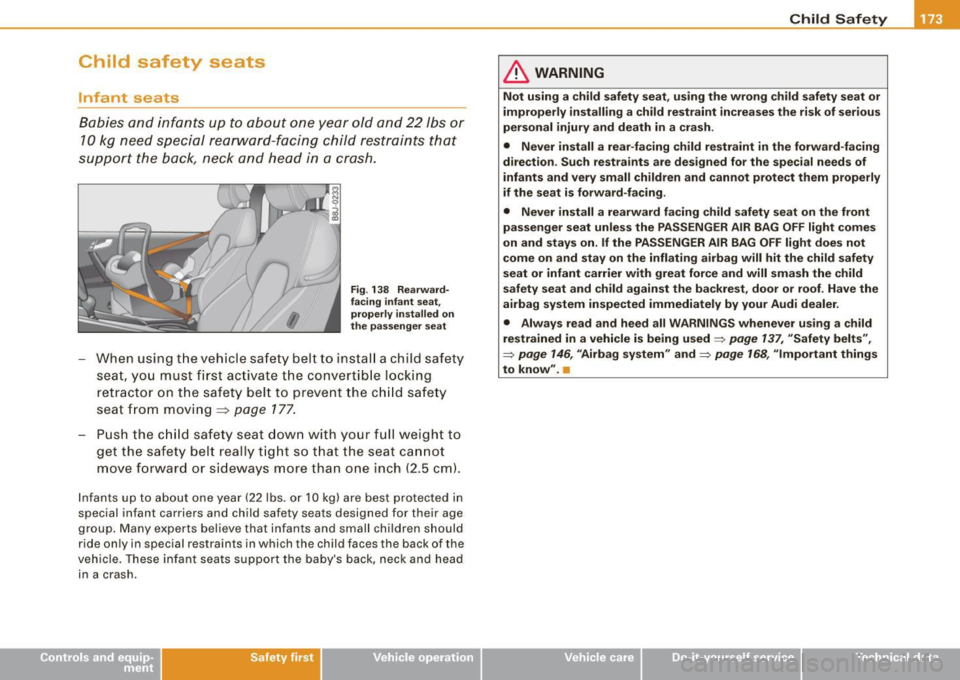
Babies and infants up to about one year old and 22 lbs or
10 kg need special rearward-facing child restraints that
support the back, neck and head in a crash.
Fig. 138 Rearward
facing infant seat,
properly installed on
the passenger seat
- When using the vehicle safety belt to install a child safety
seat, you must first activate the convertible locking
retractor on the safety belt to prevent the child safety
seat from moving ::::,
page 177.
-Push the child safety seat down with your full weight to
get the safety belt really tight so that the seat cannot
move forward or sideways more than one inch (2.5 cm).
Infants up to about one year (22 lbs. or 10 kg) are best protected in
special infant carriers and child safety seats designed for their age
group. Many experts believe that infants and small children should
ride only in special restraints in which the child faces the back of the
vehicle. These infant seats support the baby's back, neck and head
in a crash.
Safety first
Child Safety
& WARNING
Not using a child safety seat, using the wrong child safety seat or
improperly installing a child restraint increases the risk of serious
personal injury and death in a crash .
• Never install a rear-facing child restraint in the forward-facing
direction. Such restraints are designed for the special needs of
infants and very small children and cannot protect them properly
if the seat is forward-facing.
• Never install a rearward facing child safety seat on the front
passenger seat unless the PASSENGER AIR BAG OFF light comes
on and stays on. If the PASSENGER AIR BAG OFF light does not
come on and stay on the inflating airbag will hit the child safety
seat or infant carrier with great force and will smash the child
safety seat and child against the backrest, door or roof. Have the
airbag system inspected immediately by your Audi dealer.
• Always read and heed all WARNINGS whenever using a child
restrained in a vehicle is being used~
page 137, "Safety belts",
::::, page 146, "Airbag system" and::::, page 168, "Important things
to know". •
Vehicle care I I irechnical data
Page 176 of 316
___ C_h _i_ld _ S_a_ f_e _t .:..y ____________________________________________ _
Convertible child safety seats
Properly used convertible child safety seats can help
protect toddlers and children over age one who weigh between 20 and 40 lbs. (10 and 20 kg) in a crash.
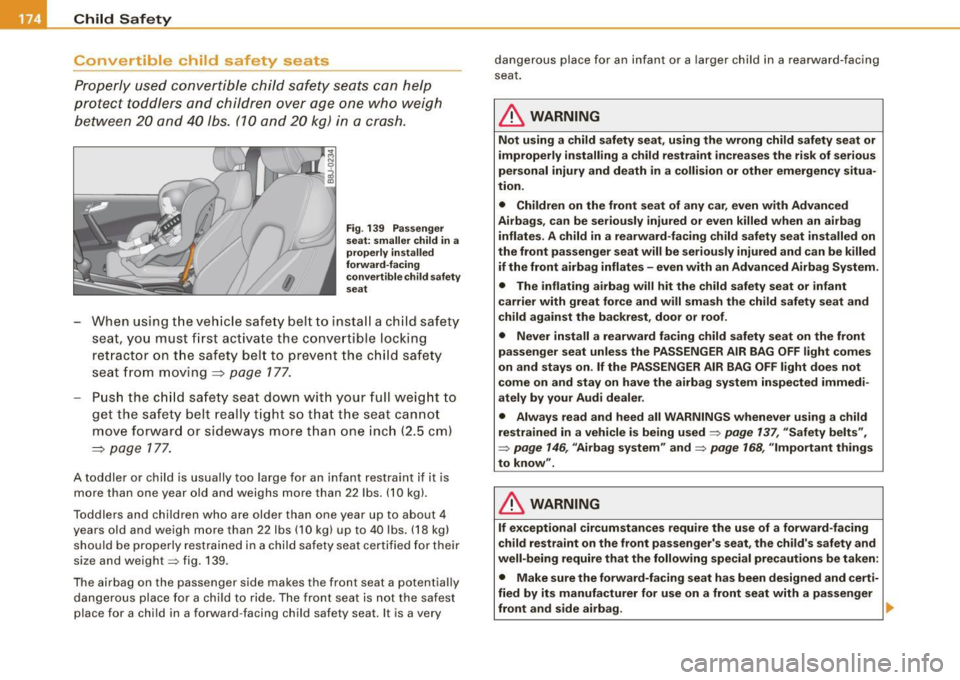
Fig. 139 Passenger
seat: smaller child in a
properly installed
forward-facing
convertible child safety
seat
When us ing the vehicle safety belt to install a child safety
seat, you must first activate the convert ible locking
retractor on the safety belt to prevent the child safety
seat from moving ~
page 177.
Push the child safety seat down with your full weight to
get the safety belt really tight so that the seat cannot move forward or sideways more than one inch (2.5 cm)
~ page 177.
A toddler or child is usually too large for an infant restraint if it is
more than one year old and weighs more than 22 lbs. (1 0 kg).
Toddlers and children who are older than one year up to about 4
years old and weigh more than 22 lbs (10 kg) up to 40 lbs. (18 kg) should be properly restrained in a child safety seat certified for their
size and weight=> fig. 139 .
The airbag on the passenger side makes the front seat a potentially dangerous place for a child to ride. The front seat is not the safest place for a child in a forward -facing child safety seat. It is a very dangerous place for an infant or a
larger child in a rearward-facing
seat.
& WARNING
Not using a child safety seat, using the wrong child safety seat or
improperly installing a child restraint increases the risk of serious
personal injury and death in a collision or other emergency situa
tion.
• Children on the front seat of any car, even with Advanced
Airbags, can be seriously injured or even killed when an airbag
inflates. A child in a rearward-facing child safety seat installed on
the front passenger seat will be seriously injured and can be killed
if the front airbag inflates -even with an Advanced Airbag System.
• The inflating airbag will hit the child safety seat or infant
carrier with great force and will smash the child safety seat and
child against the backrest, door or roof.
• Never install a rearward facing child safety seat on the front
passenger seat unless the PASSENGER AIR BAG OFF light comes
on and stays on. If the PASSENGER AIR BAG OFF light does not
come on and stay on have the airbag system inspected immedi
ately by your Audi dealer.
• Always read and heed all WARNINGS whenever using a child
restrained in a vehicle is being used=>
page 137, "Safety belts",
=>
page 146, "Airbag system" and=> page 168, "Important things
to know".
& WARNING
If exceptional circumstances require the use of a forward-facing
child restraint on the front passenger's seat, the child's safety and
well-being require that the following special precautions be taken:
• Make sure the forward-facing seat has been designed and certi
fied by its manufacturer for use on a front seat with a passenger
front and side airbag . .,
Page 180 of 316
___ C_ h_ il_d _S_ a_f _e _ty ~----------------------------------------------
& WARNING
Improperly installed child safety seats increase the risk of serious
personal injury and death in a collision.
• Always make sure that the safety belt retractor is locked when
installing a child safety seat. An unlocked safety belt retractor
cannot hold the child safety seat in place during normal driving or
in a crash.
• Always buckle the child safety seat firmly in place even if a
child is not sitting in it. A loose child safety seat can fly around
during a sudden stop or in a collision
• The inflating airbag will hit the child safety seat or infant
carrier with great force and will smash the child safety seat and
child against the backrest, door or roof.
• Forward-facing child safety seats or infant carriers installed on
the front passenger's seat may interfere with the deployment of
the airbag and cause serious injury to the child .
• Always read and heed all WARNINGS whenever using a child
restrained in a vehicle is being used=>
page 168. Special precau
tions apply when installing a child safety seat on the front passenger seat=>
page 147, "Child restraints on the front seat -
some important things to know" .
& WARNING
Always take special precautions if you must install a forward or
rearward-facing child restraint on the front passenger's seat in
exceptional situations :
• Whenever a forward or rearward-facing child restraint is
installed on the front passenger seat , the PASSENGER AIR BAG
OFF light must come on and stay on whenever the ignition is
switched on.
• If the PASSENGER AIR BAG OFF light does not come on and stay
on , perform the checks described=>
page 157, ''Monitoring the
Advanced Airbag System".
& WARNING (continued)
• If the PASSENGER AIR BAG OFF light does not come on and stay
on whenever the ignition is switched on the inflating airbag will
hit the child safety seat or infant carrier with great force and will
smash the child safety seat and child against the backrest , door or
roof . Have the airbag system inspected immediately by your Audi
dealer.
• Improper installation of child restraints can reduce their effec
tiveness or even prevent them from providing any protection .
• An improperly installed child restraint can interfere with the
airbag as it deploys and seriously injure or even kill the child.
• Always carefully follow the manufacturer's instructions
provided with the child safety seat or carrier .
• Never place additional items on the seat that can increase the
total weight registered by the weight -sensing mat and can cause
injury in a crash .
in. WARNING
Forward-facing child restraints:
• Always make sure the forward-facing seat has been designed
and certified by its manufacturer for use on a front seat with a
passenger front and side airbag .
• Never put the forward-facing child restraint up , against or very
near the instrument panel.
• Always move the passenger seat into its rearmost position in
the seat's fore and aft adjustment range, as far away from the
airbag as possible before installing the forward -facing child
restraint. The backrest must be adjusted to an upright position.
• Make sure that the PASSENGER AIR BAG OFF light comes on
and stays on all the time whenever the ignition is switched on.
~