instrument panel AUDI TT ROADSTER 2008 Owner's Manual
[x] Cancel search | Manufacturer: AUDI, Model Year: 2008, Model line: TT ROADSTER, Model: AUDI TT ROADSTER 2008Pages: 316, PDF Size: 70.1 MB
Page 158 of 316
-Airbag system ----=---'---------------------------------------------
& WARNING (continued)
• To reduce the risk of injury when the airbags inflate, the driver
and passengers must always sit in an upright position, must not
lean against or place any part of their body too close to the area
where the airbags are located .
• Occupants who are unbelted, out of position or too close to the
airbag can be seriously injured by an airbag as it unfolds with
great force in the blink of an eye~ page
147.
& WARNING
A child in a rearward -facing child safety seat installed on the front
passenger seat will be seriously injured and can be killed if the
front airbag inflates -even with an Advanced Airbag System .
• The inflating airbag will hit the child safety seat or infant
carrier with great force and will smash the child safety seat and
child against the backrest, center arm rest, door or roof.
• If you must install a rearward facing child safety seat on the
front passenger seat because of exceptional circumstances and
the PASSENGER AIR BAG OFF light does not come on and stay on ,
immediately install the rear -facing child safety seat in a rear
seating position and have the airbag system inspected by your
Audi dealer .
& WARNING
Objects between you and the airbag will increase the risk of injury
in a crash by interfering with the way the airbag unfolds or by
being pushed into you as the airbag inflates .
• Never hold things in your hands or on your lap when the vehicle
is in use .
• Never transport items on or in the area of the front passenger
seat . Objects could move into the area of the front airbags during
& WARNING (continued)
braking or other sudden maneuver and become dangerous projec
tiles that can cause serious personal injury if the airbags inflate.
• Never place or attach accessories or other objects (such as cup
holders, telephone brackets, large , heavy or bulky objects) on the
doors , over or near the area marked "AIRBAG" on the steering
wheel, instrument panel , seat backrests or between those areas
and yourself . These objects could cause injury in a crash, espe
cially when the airbags inflate .
• Never recline the front passenger's seat to transport objects .
Items can also move into the area of the side airbag or the front
airbag during braking or in a sudden maneuver . Objects near the
airbags can become projectiles and cause injury, particularly when
the seat is reclined.
& WARNING
The fine dust created when airbags deploy can cause breathing
problems for people with a history of asthma or other breathing
conditions.
• To reduce the risk of breathing problems , those with asthma or
other respiratory conditions should get fresh air right away by
getting out of the vehicle or opening windows or doors .
• If you are in a collision in which airbags deploy, wash your
hands and face with mild soap and water before eating .
• Be careful not to get the dust into your eyes, or into any cuts or
scratches .
• If the residue should get into your eyes , flush them with
water. •
Page 162 of 316
___ A_ ir_ b_ a-g _ s_y _s_ t_ e_ m _________________________________________________ _
Repair, care and disposal of the airbags
Parts of the airbag system are installed at many different places on
your Audi. Ins tal li n g, r em ovin g, s erv ic ing o r re pairi ng a part in an
area of the veh icle can damage a part of an a irbag system and
prev ent th at system from working pr oper ly in a c ollisio n.
There are some important things you have to know to make sure
that the effect ive ness of the system will not be impai red and that
discarded co mpone nts do not cause inju ry or po llute t he env iro n
ment .
& WARNING
Improper care , servicing and repair procedures can increase the
r isk of personal injury and death by preventing an airbag from
deploying when needed or deploying an airbag unexpectedly:
• Never cover , obstruct , or change the steering wheel horn pad
or airbag cover or the instrument panel or modify them in any way.
• Never attach any objects such as cup holders or telephone
mountings to the surfaces covering the airbag units.
• For cle aning the horn pad or instrument panel , use only a soft ,
dry cloth or one moi stened with plain water. Solvents or cleaners
could damage the airbag cover or change the stiffness or strength
of the material so that the airbag cannot deploy and protect prop
erly .
• Never repair , adjust , or change any parts of the airbag system.
• All work on the steering wheel , instrument panel, front seats or
electrical system (including the installation of audio equipment ,
cellular telephones and CB radios, etc .} must be performed by a
qualified technician who has the training and spec ial equipment
ne cessary .
• For any work on the airbag system , we strongly recommend
that you see your authorized Audi dealer or qualified workshop .
• Never modify the front bumper or parts of the vehicle body.
& WARNING (continued)
• Always make sure that the side airbag can inflate without inter
ference :
- Never install seat covers or replacement upholstery over the
front seatbacks that have not been specifically approved by
Audi .
- Never use addit ional seat cushions that cover the areas
where the side airbags inflate.
- Damage to the original seat covers or to the seam in the area
of the side airbag module must always be repaired immedi
ately by an authorized Audi dealer .
• The airbag system can be activated only once . After an airbag
has inflated, it must be replaced by an authorized Audi dealer or
qualified technician who has the technical information , training
and special equipment necessary.
• The airbag sy stem can be deployed only once . After an airbag
has been deployed , it must be replaced with new replacement
parts designed and approved especially for your Audi model
version. Replacement of complete airbag systems or airbag
components must be performed by qualified workshops only .
Make sure th at any airbag service action is entered in your Audi
Maintenance
& Warranty booklet under AIRBAG REPLACEMENT
RECORD .•
Other things that can affect Advanced Airbag
performance
Changing the vehic le 's suspension system can change the way that
th e A dva nced Ai rbag Sys te m p erform s in a c ras h. F or example,
using tire -rim combinations not approved by Audi, lowering the
ve hicle, c hanging the stiff ness of th e sus pensi on, in clud ing the
springs, suspens ion struts, shock absorbers etc . can chang e the
forces that a re measured by the airbag sensor s and sent to the e lec -
tronic control unit. Some suspension changes ca n, for example, .,_
Page 163 of 316
increase the force levels measured by the sensors and ma ke the
a irbag sy ste m d eploy in crashes in which it wou ld not deploy if the
changes had no t been made . Other kinds of changes may reduce
the force levels measured by the sensors and prevent the airbag
from deploying when it should.
The sensors in the safety belt buckle for the driver and front
passenger seat te ll the electronic control module i f the safety belt is
latched or not. If the safety belt is being used, the front airbag will
deploy at a sligh tly h igher rate of vehic le d ece leration than if the
safety belt is not being used. Therefore , in a particular co llision , it is
possible that an ai rbag will not deploy at a seating position where
the safety belt is being used but will inflate at the posi tion where the
safety belt is not being used . It is important tha t nothing interfere
with the safety belt buckles so t hat the sensors can send the co rrect
information about safe ty belt use to the elec tronic control unit.
& WARNING
Changing the vehicle's suspen sion including use of unapproved
tire -rim combinations can change Advan ced Airbag performan ce
and in crease the risk of serious personal injury in a cra sh.
• Never in stall su spen sion compone nts that do not have the
same performance characteristics as the components originally
in stalled on your vehi cle.
• Never use tire -rim combination s that have not been approved
by Audi.
& WARNING
Items stored between the safety belt bu ckle and the center
console can cau se the sen so rs in the buckle to send the wrong
inform ation to the ele ctron ic control module and prevent the
Advanced Airbag System from working properly .
• Always make sure that nothing can interfere with th e safety
belt buckle s and that they are not obstructed.
Safety first
Airbag sy ste m
ffi For the sake of the environment
Undeployed airbag modu les and pretensioners might be classified
as Perchlorate Material -specia l handling may apply, see
www.dtsc .ca.gov/hazardouswaste/perchlorate. When the vehicle or
parts of the restraint system including airbag modules safety belts
with prete nsioners are scrapped, all appl icable laws and regu la
tions must be observed . Your au thori zed Audi dealer is familiar wi th
t hese requirements a nd we rec ommend that y ou have your dea ler
perform this service for you. •
Knee airbags
Description of knee airbags
The air bag system can pr ovide supplemen tal pr otec tio n
to pro perly restrained fron t seat occupants.
Fi g. 13 4 D rive r's
airba g
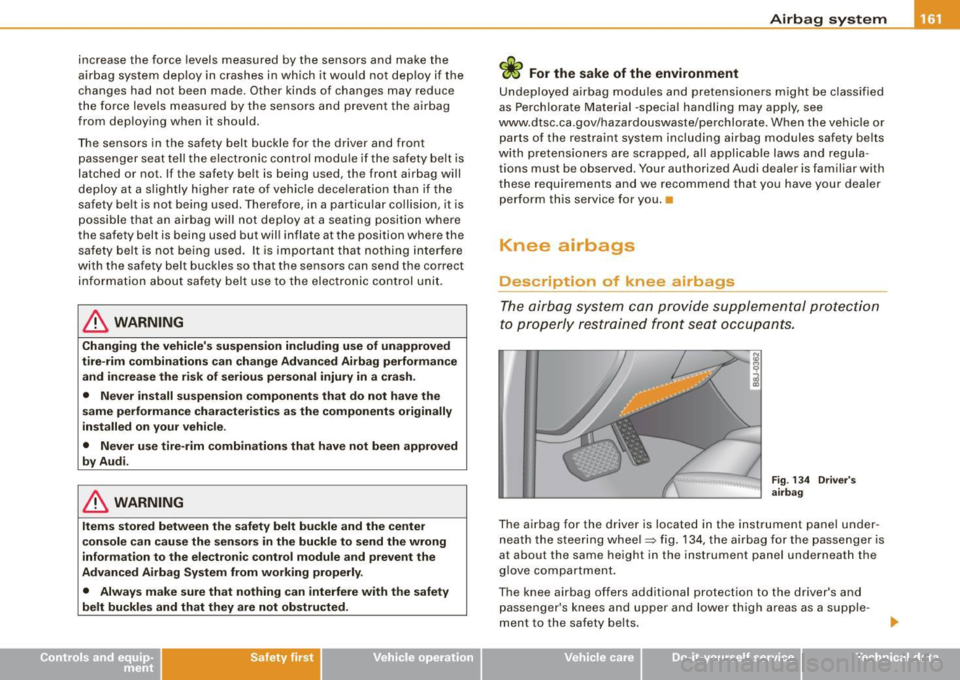
The ai rbag for the driver is located in the instrument panel under
neath the steering wheel:=:, fig. 134 , the airbag for the passenger is
at about the same height in the instrum ent panel underneath the
glove compartment.
T he knee airbag offers add itional protection to the driver 's and
p assenger 's knees and upper and lower thigh areas as a supple -
ment to the safety belts . •
Vehicle care I I irechnical data
Page 164 of 316
___ A_ ir_ b_ a-g _ s_y _s_ t_ e_ m _________________________________________________ _
If the front airbags deploy, the knee airbags also deploy in frontal
collisions above a certain severity=:>
page 155, "More important
things to know about front airbags".
Besides their normal safety function, safety belts work to help keep
the driver or front passenger in position in case of a frontal collision
so that the airbags can provide protection.
The airbag system is not a substitute for your safety belt. Rather, it
is part of the overall occupant restraint system in your vehicle .
Always remember that the airbag system can only help to protect
you if you are wearing your safety belt and wearing it properly. This
is why you should always wear your safety belt, not just because the
law requires you to do so=:>
page 137, "Gene ral notes" .
The safety belt buckle for the driver and front seat passenger have
switches that tell the airbag control module if the safety belt is
being used or not. If the safety belt is being used, the front airbag
will deploy at a slightly higher rate of deceleration than if the belt is
not being used. Therefore, in a particular collision, it is possible that
an airbag will not deploy at a seating position where the safety belt
is being used but will inflate at the position where the safety belt is
not being used .
Remember too, airbags will deploy only once and only in certain
kinds of accidents -your safety belts are always there to offer
protection in those accidents in which airbags are not supposed to
deploy or when they have already deployed, for example when your
vehicle strikes or is struck by another after the first collision.
This is just one of the reasons why an airbag is not a substitute for
the safety belt . The airbag system works most effectively when used
with the safety belts. Therefore, always wear your safety belts
correctly.
It is important to remember that while the supplemental airbag
system is designed to reduce the likelihood of serious injuries, other
injuries, for example, swelling, bruising, and minor abrasions can
also be associated with airbags . The knee airbag system basically consists of:
• The electronic control module
• Two inflatable airbags (airbag and gas generator), one for the
driver and one for the front passenger
• Th e airbag indicator light in the instrument panel
The knee airbag system will not deploy:
• when the ignition is turned off
• in front-end collisions when the deceleration measured by the
control unit is too low
• in side collisions
• in rear-end collisions
• in rollovers
• in the event of a system malfunction (warning/indicator light illu
minated) =:>
page 19.
&, WARNING
• Safety belts and the airbag system can only provide protection
when occupants are in the proper seating position=:>
page 155.
• If the airbag indicator light comes when the vehicle is being
used, have the system inspected immediately by your authorized
Audi dealer. The airbag may not work properly when the vehicle
acceleration in a side collision is high enough to deploy the airbag.
See also =:>
page 19. •
Page 165 of 316
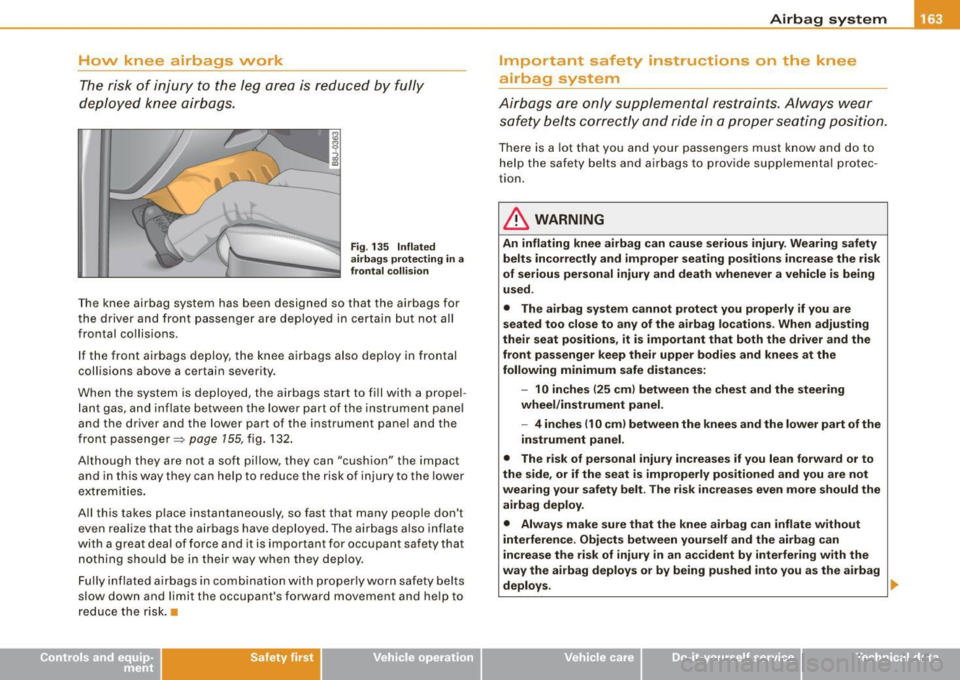
How knee airbags work
The risk of injury to the leg area is reduced by fully
deployed knee airbags.
F ig . 13 5 Infla te d
a ir b ags protect ing i n a
fr ont al co llisio n
The knee airbag system has been designed so that the airbags for
the driver and front passenger are deployed in certain but not all
frontal co llisions .
I f the front airbags deploy, the knee airbags also deploy in frontal
col lisions above a certain severity.
When the system is deployed, the airbags start to fill with a propel
lant gas, and inflate between the lower part of the instrument panel
and the driver and the lower part of the instrument panel and the
front passenger ~
page 155, fig. 132 .
Although they are not a soft pillow, they can "cushion" the impact and in this way they can help to reduce the risk of injury to the lower
extremities .
All this takes place instantaneously, so fast that many people don 't
even reali ze that the a irbags have deployed. The airbags a lso inflate
with a great deal of force and it is important for occupant safety that
nothing should be in their way when they dep loy.
Ful ly inflated airbags in combination with properly worn safety belts
s low down and limit the occupant's forward movement and he lp to
reduce the risk. •
Safety first
Airbag sy ste m
Important safety Instructions on the knee
airbag system
Airbags are only supplemental restraints. Always wear
safety belts correctly and ride in a proper seating position.
There is a lot that you and you r passengers must k now and do to
help the safety belts and airbags to provide supplemental protec
tion.
& WARNING
An inflating knee airbag can cau se se riou s inju ry . We aring safety
belt s inc orrectl y and improper seat ing po sitio ns incre as e th e risk
of seriou s pers on al injur y and death whenever a vehi cle i s be ing
u sed .
• The airbag sy stem cannot p rotect you properly if you ar e
s eat ed too clo se t o any of the a irbag l ocation s. When adju sting
their seat position s, it is important that both the driver and the
fro nt pass e nger ke ep thei r upper bod ies and knee s at the
following minimum safe di sta nces:
- 10 in che s (25 cm ) betwe en the che st and the ste ering
whee l/in strument pan el.
- 4 in ches (1
O c m ) between the knee s and the lo wer part of the
in strum ent panel .
• The r isk of per sonal injur y in crea ses if you le an forw ard or t o
t he side, or if the seat i s improperly po sitioned an d you are not
w ea ring your safet y belt . The r is k i ncreases even more should the
airbag deplo y.
• Alway s m ake su re that the knee airb ag can inf late witho ut
interferen ce. Obje cts betwe en your self and the airba g can
in crease the ris k of inju ry in an a ccident b y inte rferi ng w ith the
wa y th e airbag deploy s or b y being pushed into you a s the airbag
deploy s. •
Vehicle care I I irechnical data
Page 166 of 316
__ .....:.A..:..::..:. ir-=b :....:a=- g=- s= y-=s -=t -=e -=m.;._;_ ________________________________________________ _
& WARNING (con tinued )
-No persons (children ) or animals should ride in the footwell
in front of t he passenger s eat . If the airbag deploy s, thi s can
result in serious or fatal injuries .
- No objects of any kind should be carried in the footwell area
in front of the driver's or pa ssenger' s seat. Bulky objects (shop
ping bag s, for example ) can hamper or prevent p roper deploy
ment of the airbag . Small objects can be thrown through the
vehicle if the airbag deploys and injure you or your passenger s.
• Make sure there are no cra cks , deep scratches or other damage
in the area of the in strument panel where the knee airbags are
located .
• If ch ildren are incorrectly seated , their risk of injury increases in
the case of an accident =>
page 168, "Child Safety". •
Side airbags
Description of side airbags
The air ba g s ystem c an pro vid e sup plemen tal p ro tection
to p rope rly re straine d front seat occup ants.
Fig . 13 6 Side airbag
locat ion in the driver 's
seat
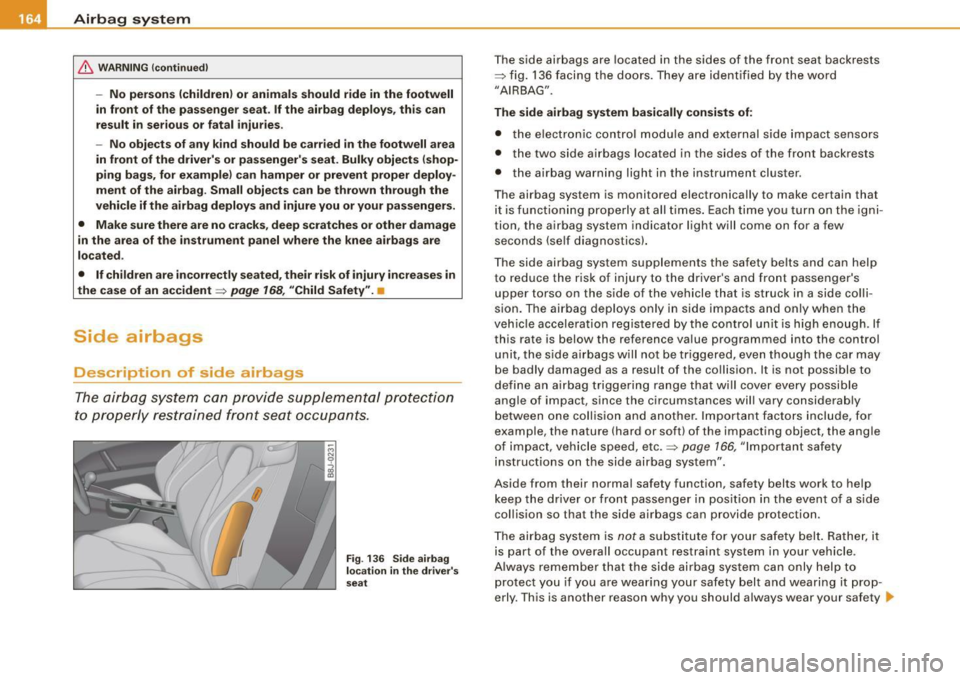
T he side airbags are located in the sides of the front seat backrests
=> fig . 136 facing the do ors. T hey ar e id en tified by the word
"AIRBAG ".
The side airbag system basically consists of :
• the e lec tro nic c ontrol m odule an d ex ternal sid e im pact sens ors
• the two side airbags located in the sides of the front backrests
• the airbag war ning light in the instrument clus ter .
T he airbag system is monitored electronicall y to make certain that
it is functioni ng properly at all times . Each time you turn on the igni
tion, the airbag system indicator light will come on for a few
se co nds (self diag nostics).
The side airbag system supplements the safety belts and can help
to reduce the risk of injury to the drive r's and fr ont passenger's
upper torso on the side of the vehicle that is struck in a side co lli
s ion. The ai rbag deploys only in side impacts and only when the
vehic le acc ele ration re gis te red by the control unit is high eno ugh . If
this rate is below the refe rence va lue programmed into the control
unit, the s ide airbags will no t be tr iggered, ev en thoug h the car may
be badly damaged as a resu lt of the co llision. It is not possible to
de fin e an ai rb a g trigge ring r ange t hat wi ll cov er ev er y possible
angle of impact , since the circumstances will vary considerab ly
bet ween one collision a nd an othe r. Importa nt fac tors include, fo r
example, the na ture (hard or soft) of the impacting object, the ang le
o f im pact, vehicle speed , et c.
=> p age 166, "Importan t safety
i nstructions on th e side airba g sys tem".
Aside from their normal safety function, safety belts wo rk to h elp
ke ep the drive r or front passenger i n pos ition i n th e ev ent o f a side
col lision so that the side ai rbags can provide pro tec tion .
T he airbag system is
not a su bstit ute for y our sa fety belt . Ra the r, it
is part of the overa ll occupa nt restrain t system in your vehicl e.
A lwa ys reme mber tha t the side ai rbag sys tem can only help to
pro tect you if you are w ear ing your sa fety bel t and wear ing it prop
e rly. Th is is another reason why you should always wear your safety .,
Page 180 of 316
___ C_ h_ il_d _S_ a_f _e _ty ~----------------------------------------------
& WARNING
Improperly installed child safety seats increase the risk of serious
personal injury and death in a collision.
• Always make sure that the safety belt retractor is locked when
installing a child safety seat. An unlocked safety belt retractor
cannot hold the child safety seat in place during normal driving or
in a crash.
• Always buckle the child safety seat firmly in place even if a
child is not sitting in it. A loose child safety seat can fly around
during a sudden stop or in a collision
• The inflating airbag will hit the child safety seat or infant
carrier with great force and will smash the child safety seat and
child against the backrest, door or roof.
• Forward-facing child safety seats or infant carriers installed on
the front passenger's seat may interfere with the deployment of
the airbag and cause serious injury to the child .
• Always read and heed all WARNINGS whenever using a child
restrained in a vehicle is being used=>
page 168. Special precau
tions apply when installing a child safety seat on the front passenger seat=>
page 147, "Child restraints on the front seat -
some important things to know" .
& WARNING
Always take special precautions if you must install a forward or
rearward-facing child restraint on the front passenger's seat in
exceptional situations :
• Whenever a forward or rearward-facing child restraint is
installed on the front passenger seat , the PASSENGER AIR BAG
OFF light must come on and stay on whenever the ignition is
switched on.
• If the PASSENGER AIR BAG OFF light does not come on and stay
on , perform the checks described=>
page 157, ''Monitoring the
Advanced Airbag System".
& WARNING (continued)
• If the PASSENGER AIR BAG OFF light does not come on and stay
on whenever the ignition is switched on the inflating airbag will
hit the child safety seat or infant carrier with great force and will
smash the child safety seat and child against the backrest , door or
roof . Have the airbag system inspected immediately by your Audi
dealer.
• Improper installation of child restraints can reduce their effec
tiveness or even prevent them from providing any protection .
• An improperly installed child restraint can interfere with the
airbag as it deploys and seriously injure or even kill the child.
• Always carefully follow the manufacturer's instructions
provided with the child safety seat or carrier .
• Never place additional items on the seat that can increase the
total weight registered by the weight -sensing mat and can cause
injury in a crash .
in. WARNING
Forward-facing child restraints:
• Always make sure the forward-facing seat has been designed
and certified by its manufacturer for use on a front seat with a
passenger front and side airbag .
• Never put the forward-facing child restraint up , against or very
near the instrument panel.
• Always move the passenger seat into its rearmost position in
the seat's fore and aft adjustment range, as far away from the
airbag as possible before installing the forward -facing child
restraint. The backrest must be adjusted to an upright position.
• Make sure that the PASSENGER AIR BAG OFF light comes on
and stays on all the time whenever the ignition is switched on.
~
Page 211 of 316
![AUDI TT ROADSTER 2008 Owners Manual _______________________________________________ C_l_e _a_ n_ in _____ g ___ a_n_ d ___ p_r _o _t_ e_ c_ t _i _o _ n __ lfll
•
[ i ] Tip s
Open Ve lcro fasteners on your cloth ing can d](/img/6/57671/w960_57671-210.png "AUDI TT ROADSTER 2008 Owners Manual _______________________________________________ C_l_e _a_ n_ in _____ g ___ a_n_ d ___ p_r _o _t_ e_ c_ t _i _o _ n __ lfll
•
[ i ] Tip s
Open Ve lcro fasteners on your cloth ing can d")
_______________________________________________ C_l_e _a_ n_ in _____ g ___ a_n_ d ___ p_r _o _t_ e_ c_ t _i _o _ n __ lfll
•
[ i ] Tip s
Open Ve lcro fasteners on your cloth ing can damage the seat cover .
Please make sure that Ve lcro fasteners are closed .•
Plastic parts and instrument panel
Always use a c lean cloth moistened in clear water to clean these
areas . For persis tent dirt use an Audi approved
solvent -free plastic
cleaner/protectant.
& WARNING
Solvents can change the propertie s of some plastics and make it
harder for the airbag to deploy .
• Never clean the instrument p anel or the surface of Airbag
modules with cleanin g prod ucts that contain solvents .
• Products containing solvent s will make the surface of th is part
poro us.
• Serious injuries can re sult if pla stic parts come loo se when the
airbag is deployed .
• Alway s read and heed all WARNING S and the i nformation
~ page 200 .
0 Note
Cleaning agents containing solvents wil l attack the material and can
change the way it behaves. •
Instrument cluster glass
-Clean the g lass w ith a soft, damp cloth.
I n order to preserve the anti -glare properties of the instrument
c luster glass, it should o nly be cleaned wi th a so ft. dam p clot h.•
App lies to veh ic les: with nat ural leat her
Natural leather
Aud i m akes gre at effo rts to maint ain th e pr oper ties,
n atur al look and feel of interi or le ather.
Gener al
We offe r many d ifferent types of leathe r on our vehicles. Mo st are
different types of nappa leather , which has a smooth surface and
comes in various co lo rs.
The intensity o f the color determ ines the visua l characteristics and
appearance. If the surface of the leather has a typical natura l look,
then t he leather is a nappa lea ther that has bee n left in a re latively
natura l condition. This leather offers particu lar ly good comfort and
b reathes well. Fi ne veins, closed g ra ins, insect bites, skin folds, an d
subtle variations in co lor remain visib le. These characteristics
dem onstrate that the mater ial is natural.
Natura l nappa leather is not covered by a co lor finish . It is therefore
more sensitive to soil ing and wear, which is something you need to
consider if chi ldren, animals or other fac tors might prove to be
particularly hard on the leather.
By con trast, leather types that are covered by a colo red fin ish layer
are more durable. This has a positive effect on the leather's resis
tance to wea r and s oiling i n daily use . On the ot her hand, the typical
characteristics of natura l leather are barely or not apparent .
However, this does not mean that the leather itself is of inferior
qua lity .
Care and handling
Because of the exclusive nature of the types of leather that Audi
u ses and thei r unique p rope rties (suc h as sens it ivity to oi ls, g rease,
soi ling, etc .), you wi ll need to be somewhat careful w ith these
leathers, and a certain type of care is required. For example, dark .,.
Vehicle care I t •
Page 221 of 316
_____________________________________________ C_h_ e_ c _ k_in -= g_a _ n_d _ f_il _li _n ..;::g =-- ____.ffllll
Checking and filling
Engine hood
Releasing the engine hood
The engine hood is released from inside the vehicle.
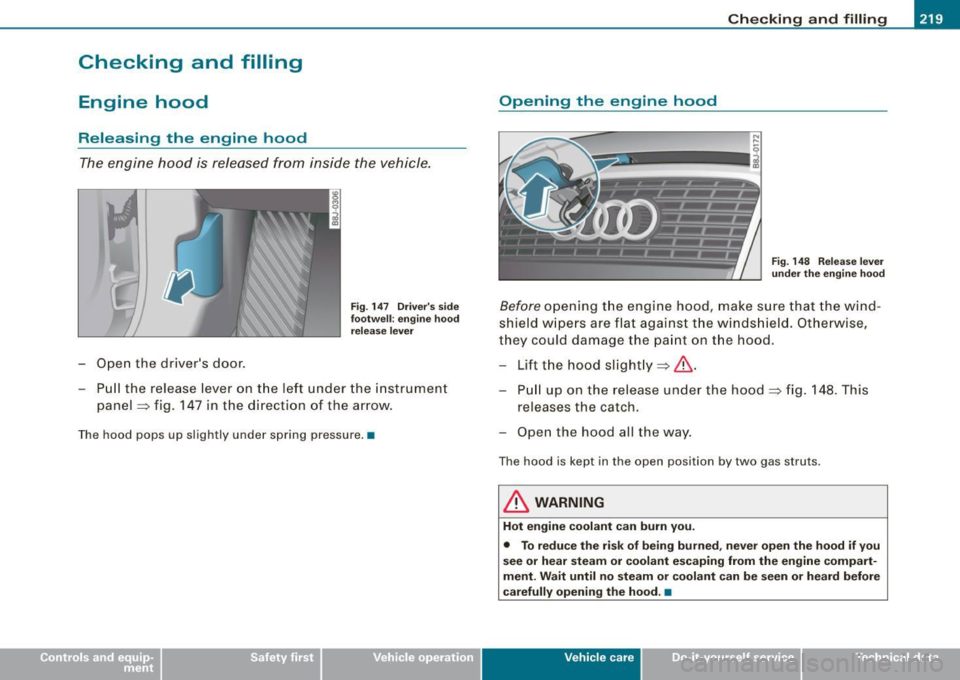
- Open the driver's door .
Fig. 147 Driver's side
footwell: engine hood
release lever
- Pull the release lever on the left under the instrument
panel => fig. 147 in the direction of the arrow.
The hood pops up slightly under spring pressure. •
Opening the engine hood
Fig. 148 Release lever
under the engine hood
Before opening the engine hood, make sure that the wind
shield wipers are flat against the windshield. Otherwise,
they could damage the paint on the hood.
Lift the hood slightly =>& .
Pull up on the release under the hood=> fig. 148. This
releases the catch.
- Open the hood all the way.
The hood is kept in the open position by two gas struts.
& WARNING
Hot engine coolant can burn you.
• To reduce the risk of being burned, never open the hood if you
see or hear steam or coolant escaping from the engine compart
ment. Wait until no steam or coolant can be seen or heard before
carefully opening the hood. •
Vehicle care I I irechnical data
Page 275 of 316
Fuses and bul bs -
------------------
Fuses and bulbs
Fuses
Replacing a fuse
A problem in the electrical system may be caused by a
blown fuse.
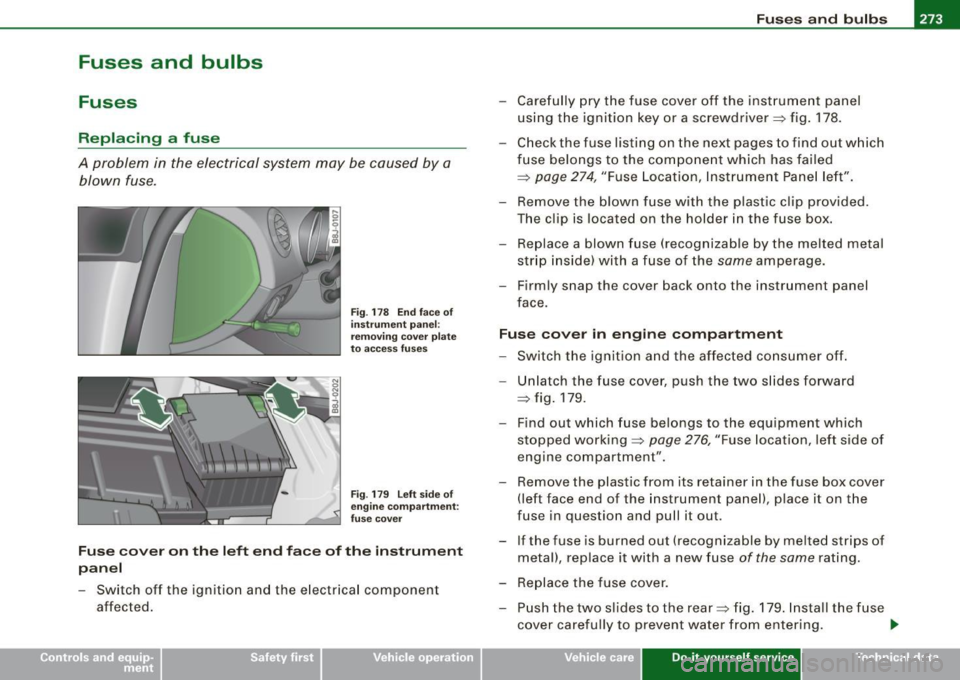
Fig . 178 End face o f
i n str ume nt pan el:
re m ov ing cover pla te
t o access f uses
Fig . 179 Left si de o f
engine co mpartm ent:
fu se cover
Fus e cove r on the left end face of the instrum ent
panel
- Switch off the ignition and the e lectr ica l component
affected . - Carefully pry the fuse cover off the instrument panel
using the ignition key or a screwdriver=> fig. 178.
- C heck the fuse listing on the next pages to find out w hich
fuse belongs to the component which has failed => page 274, "F use Location, Instrument Pane l le ft".
- Remove the blown fuse with the plastic clip provided .
The clip is located on the holder in the fuse box .
Replace a blown fuse (recognizable by the melted metal
str ip inside) with a fuse of the same amperage.
- Firmly snap the cover back onto the instrument panel
face.
Fuse cov er in engin e compartment
- Switch the ignition a nd the affec ted co nsumer off .
- Unlatch the fuse cover, push the two s lides forward
=> fig . 179.
- Find out which fuse belongs to the equipment which
stopped working=> page 276, "Fuse location, left side of
engine compartment".
- Remove the plastic from its retainer in the fuse box cover (left face end of the instrument pane l), place it on the
fuse in question and pull it out.
- If the fuse is burned out (recognizable by melted strips of metal), replace it with a new fuse of the same rating.
- Replace the fuse cover.
- Push the two slides to the rear=> fig. 179 . Install the fuse
cover carefully to prevent water from entering. .,
Vehicle care Do-it-yourself service irechnical data