water AUDI TT ROADSTER 2008 Owner's Manual
[x] Cancel search | Manufacturer: AUDI, Model Year: 2008, Model line: TT ROADSTER, Model: AUDI TT ROADSTER 2008Pages: 316, PDF Size: 70.1 MB
Page 226 of 316
-L~C~ h~ e~c ~k ~in ~ g~a~ n~d ~ f ~i~ ll ~in ~ g~------------------------------------------
Engine oil consumption
The engine in your vehicle de pen ds on an ade quate
amount of oil to lubric ate and co ol all of its moving parts.
In order to provide effective lubrication and cooling of interna l
engine components, al l internal co mbustion engines consume a
certain amount of oil. Oil consumption varies from engine to engine
and may change sign ificant ly over the life of the engine . Typ ical ly,
engines with a specified break -in period (see=>
page 192) consume
more oil duri ng the brea k-in period than they consume afte r oil
consumption has stabi liz ed.
Unde r no rmal conditions, the rate of oil consumption depends on
the quality and viscosity of t he oil, the RPM ( revo lutions per m inute)
at which the engine is operated, the ambient temperature and road
co nd itions. Further factors are the amount of oi l dilut io n from water
condensation or fue l residue and the oxidation leve l of the oil. As
any e ng ine is subject to wear as mil eage builds up, the o il consump
tion may increase over time until replacement of worn components
may become necessary .
With all these var iables com ing into p lay, no standard rate of oil
consu mption can be es tab lished or speci fied. There is no a lternative
t o regular and frequent checking of the oi l leve l, see Note.
If the yellow engine oi l level warning symbol in the instrumen t
cluster _ lights up, y ou should check the oil level as soon as
possible
with the oil dipstick=> page 224. Top off the oil at your
ea rlies t conve nience =>
page 225.
ln. WARNING
Before you check anything in the engine compartment , alway s
re ad and heed all WARNINGS =>
& in "Working in the engine
c ompartment" on
page 220.
0 Note
D riving with an insufficient o il level is lik ely to cause seve re damage
to the engine .
[ i ] Tips
• The oil pressure warning display 't!:r. is not an indicator of the oil
level. Do not rely on it. Instead , check the oil level in your engine at
regular intervals , preferab ly ea ch time you refuel , and alw ays before
going on a long trip.
• I f you have the impression your engine consumes excessive
a m oun ts o f oi l, we recommend tha t you consu lt your Audi dealer to
have the cause of your concern properly diagnosed . Keep in mind
that the acc urate measure ment o f oil co nsum ptio n requires grea t
care and may take some time . Your Audi dea ler has instructions
about how to measu re oil consump tion accurately. •
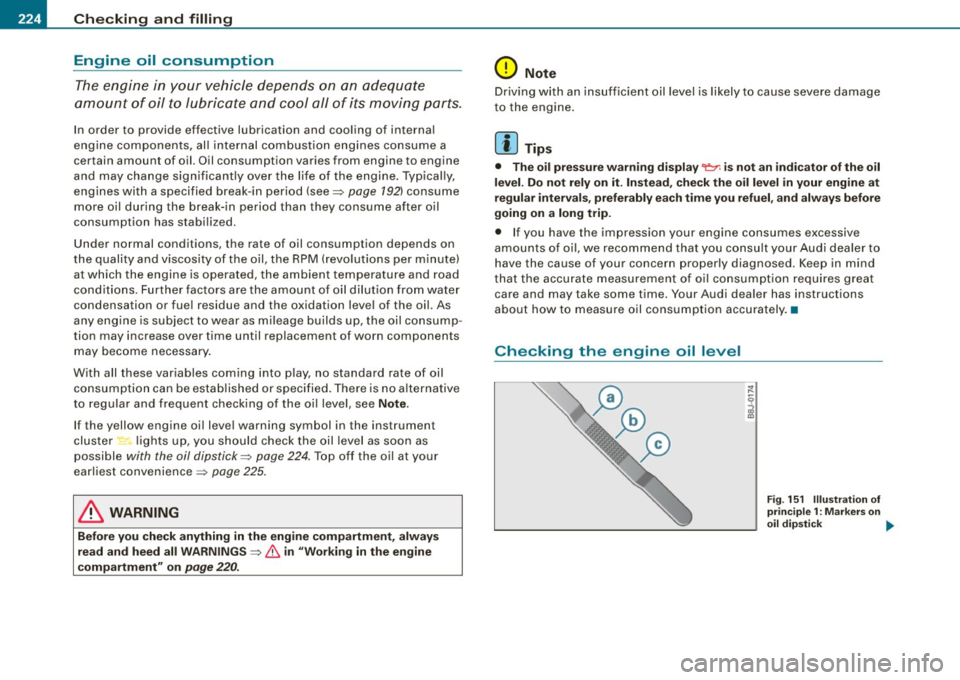
Checking the engine oil level
Fig . 151 Illust rat ion of
principle 1 : Marker s on
oil dip stic k
~
Page 229 of 316
_____________________________________________ C_h_ e_ c_k _in ____ g_ a_n _d_ f_il _li _n __ g ____ fflllll
•
0 Note
Never mix oil additives with your engine oil. These additives can
damage your engine and adversely affect your Audi Limited New
Vehicle Warranty .
W For the sake of th e environm ent
• Before changing your oi l, first make sure you know where you
can properly dispose of the used oil.
• Always dispose of used engine oil properly. Do not dump it on
garden soil, wooded areas, into open streams or down sewage
drains .
• Recycle used engine oi l by taking it to a used engine oil collec
tion fac ility in your area, or contact a service station. •
Engine cooling system
Coolant
The engine coolant performs two functions: it keeps the
engine from overheating and it protects the engine from
freez ing in the winter.
The coo ling system is sealed and generally requires little attention.
T he coo ling system has been filled at the factory with a permanent
coolant which does not need to be cha nged . The coolant consists of
a mixture of water and the manufacturer's glycol-basedcoolant
addit ive G 12 + antifreeze with an ticorrosi on addit ives (50% for USA
models; 60% for Canadian models). This mixture both assures the
necessary frost protection and protects metal components in the
engine's cooling system from corrosion and scaling . It a lso raises
the boiling point of the coo lant .
Do not reduce t he concentration of the coolant in the summer by
adding plain water.
The prop ort ion of coolant additi ve mu st be at le
as t 50 % but not more th an 60 %
to maintain antifreeze protection
and co oling effic iency . If the coo lant fros t protect ion is too low, the
coolant could freeze and damage the vehic le heating and engine
coo ling system.
For year-round driving, antifreeze is added at the factory for temper
atures down to:
• - 31 °F ( - 35 °C) USA
• -40 °F ( -40 °C) Canada.
You can mix the G12 + coo lant additive with other additives (f or
examp le G11 or G12l. Always check with your authorized Audi
dea ler .
& WARNING
Before you check anything in the engine compartment , alway s
read and heed all WARNIN GS
=:> & in "Working i n the engine
c ompartment " on
page 220.
0 Note
• Before winter sets in, have the coolant checked to see if the
coolant additive in your vehicle is sufficient to meet the climate
conditions . This is especia lly important if you live in a region where
the winter is extremely cold. If necessary, increase the proport ion o f
coo lant additive to 60%.
• When adding coolant additive to your coo ling system,
remember :
- We recommend using only coolant additive G12+ (check the
label) for your vehicle. This coolant additive is avai lable at autho
rized Audi dealers. Other types of antifreeze can significantly
reduce corrosion protection. The resulting corrosion can cause a
loss of coolant and serious engine damage.
• Do not add any type of radiator leak sea lant to your vehicle's
engine coolant. Adding radiator repair fluid may adverse ly affect the _.,
Vehicle care I t •
Page 231 of 316
___________________________________________ C_ h_e _c_ k_ i_n _g _ a_n _d_ f_il _li _n _g __ ffllll
•
- Twist the cap on again tightly.
Replacement engine coolant must conform to exact specifications
=>
page 227, "Coolant ". If in an emergency coolant additive G12 + is
not avai lab le, do
not use a d ifferen t addit ive. Use p lain water
instead until you can get the correct additive and can restore the
correct ratio . This should be done as soon as possib le .
If you have lost a considerable amoun t of coolant, then you should
add cold antifreeze and cold water only when the engine is cold.
Always use
new engine coolan t when refilling .
Do not fi ll coolant above the "MAX" mark. Excess coo lant will be
forced out through the pressure relief va lve in the cap when t he
engine becomes hot.
& WARNING
• The cooling system is under pres sure a nd can g et very hot.
Reduce the ri sk of scald ing from ho t co olant b y following the se
s tep s.
- Turn off the engine and allow it to cool d own .
- Prote ct your fa ce , hand s and arm s from e scaping fluid and
st eam b y covering the cap with a l arge , thick rag .
- Turn the cap slo wly and very carefully in a count er-c lockw ise
dire ction while applying light , do wnward pres sure on th e top
o f the cap.
- To avoid b eing burned , do not spill antifre eze or coolant on
th e ex haus t syste m or hot e ngine parts . Under cert ain co nd i
tion s, the eth yle ne gly col in en gine co ola nt can cat ch fire .
• Antifr ee ze is poison ous. Alw ay s s tore antifr ee ze in its origi nal
c ontainer and well out of the re ach of children.
• If you dr ain th e coola nt , it mu st be caught and safe ly stored in
a proper contain er cle arly m ark ed "p oison ".
0 Note
• Coolant po llutes the env ironment and could cause an engine
fire . Excess coo lant wil l be forced out through the pressure relief
valve in the cap when the engine becomes ho t.
• I f, in an emergency, only water can be added, the correct ratio
between water and antifreeze=>
page 227must be restored as soon
as possib le .
<£> For the sake of the environment
Drained coolant should not be reused . Always dispose of used
coolant while observi ng all environmental regulations. •
Radiator fan
The radiator fan switches on automatically by itself.
The electric radiator fan is controlled by thermoswitches that switch
on and off depending on coolant and engine compartment temper
atures.
An auxiliary electric radiator fan * switches on and off depending on
coolant temperature and other vehic le operation conditions .
After you switch the eng ine o ff, the aux iliary fan can continue
running for up to 10 minutes -even with the ignition off. It can even
switch on again later by itself=>& , if
• the temperature of the engine coolant rises due to the heat
build -up from the engine in the engine compar tment, or
• the engine compartment heats up because the vehicle is parked
in intense sunlight.
& WARNING
• To reduc e the ri sk of per sonal in jur y nev er t ouch t he radiato r
f a n . .,_
Vehicle care
I t •
Page 232 of 316
___ C_h_ e_ c_k _in --== g'-- a_n _d_ f_il _li _n ..:::g:::..- ___________________________________________ _
& WARNING (continued)
• The auxiliary electric fan is temperature controlled and can
switch on suddenly even when the engine is not running.
• The auxiliary radiator fan switches on automatically when the
engine coolant reaches a certain temperature and will continue to
run until the coolant temperature drops. •
Brake fluid
Checking brake fluid level
The brake fluid level can be checked with a quick glance.
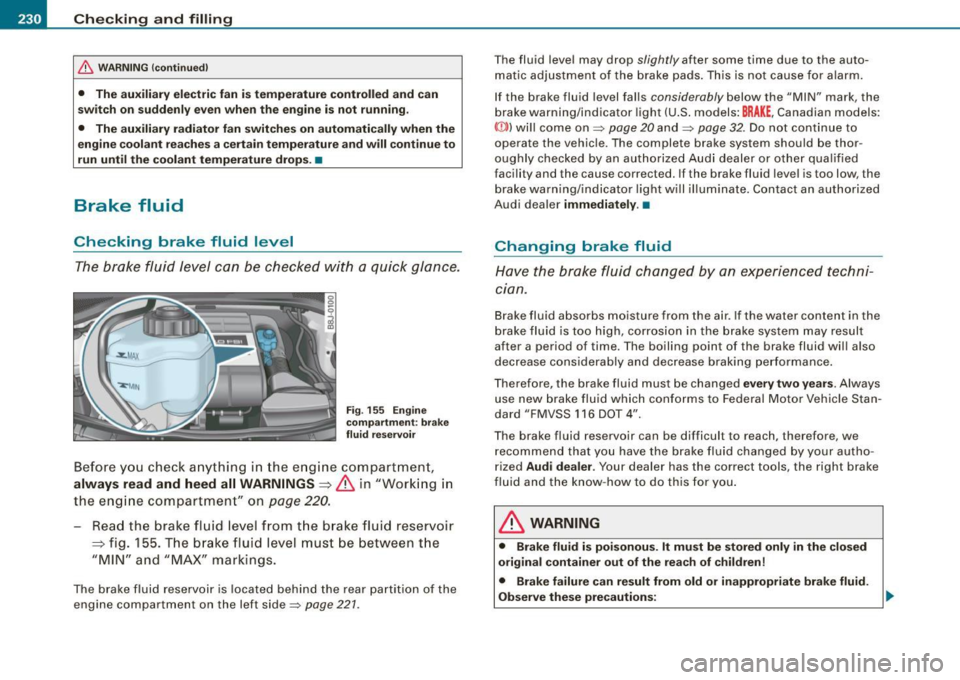
Fig. 155 Engine
compartment: brake
fluid reservoir
Before you check anything in the engine compartment,
always read and heed all WARNINGS =>
& in "Working in
the engine compartment" on
page 220.
- Read the brake fluid level from the brake fluid reservoir
~ fig. 155. The brake fluid level must be between the
"MIN" and "MAX" markings.
The brake fluid reservoir is located behind the rear partition of the
engine compartment on the left side~
page 221 .
The fluid level may drop slightly after some time due to the auto
matic adjustment of the brake pads. This is not cause for alarm.
If the brake fluid level falls
considerably below the "MIN" mark, the
brake warning/indicator light (U .S. models:
BRAKE , Canadian models:
ill) will come on~ page 20 and~ page 32. Do not continue to
operate the vehicle . The complete brake system should be thor
oughly checked by an authorized Audi dealer or other qualified
facility and the cause corrected. If the brake fluid level is too low, the
brake warning/indicator light will illuminate. Contact an authorized
Audi dealer
immediately .•
Changing brake fluid
Have the brake fluid changed by an experienced techni
cian.
Brake fluid absorbs moisture from the air. If the water content in the
brake fluid is too high, corrosion in the brake system may result
after a period of time. The boiling point of the brake fluid will als o
decrease considerably and decrease braking performance.
Therefore, the brake fluid must be changed
every two years. Always
use new brake fluid which conforms to Federal Motor Vehicle Stan
dard "FMVSS 116 DOT 4".
The brake fluid reservoir can be difficult to reach, therefore, we
recommend that you have the brake fluid changed by your autho
rized
Audi dealer . Your dealer has the correct tools, the right brake
fluid and the know -how to do this for you.
& WARNING
• Brake fluid is poisonous. It must be stored only in the closed
original container out of the reach of children!
• Brake failure can result from old or inappropriate brake fluid.
Observe these precautions : .,,_
Page 235 of 316
__________________________________________ C_ h _ e_c _k _in _ g =- a_ n __ df _i_ lli _n ___ g __ __
•
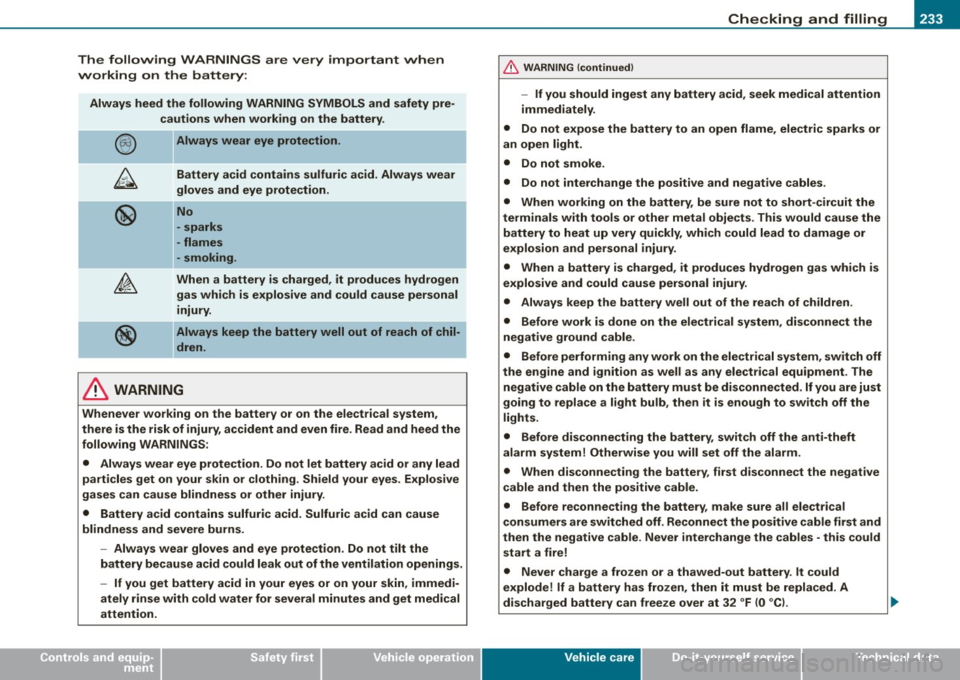
The following WARNINGS are very important when
working on the battery:
Always heed the following WARNING SYMBOLS and safety pre
cautions when working on the battery .
Always wear eye protection.
Battery acid contains sulfuric acid. Always wear
gloves and eye protection.
No
- sparks
- flames
- smoking.
When a battery is charged, it produces hydrogen
gas which is explosive and could cause personal
injury.
Always keep the battery well out of reach of chil
dren.
& WARNING
Whenever working on the battery or on the electrical system,
there is the risk of injury, accident and even fire. Read and heed the
following WARNINGS:
• Always wear eye protection. Do not let battery acid or any lead
particles get on your skin or clothing. Shield your eyes. Explosive
gases can cause blindness or other injury.
• Battery acid contains sulfuric acid. Sulfuric acid can cause
blindness and severe burns.
- Always wear gloves and eye protection. Do not tilt the
battery because acid could leak out of the ventilation openings.
- If you get battery acid in your eyes or on your skin, immedi
ately rinse with cold water for several minutes and get medical
attention.
& WARNING (continued)
-If you should ingest any battery acid, seek medical attention
immediately.
• Do not expose the battery to an open flame, electric sparks or
an open light.
• Do not smoke.
• Do not interchange the positive and negative cables .
• When working on the battery, be sure not to short -circuit the
terminals with tools or other metal objects. This would cause the battery to heat up very quickly, which could lead to damage or
explosion and personal injury.
• When a battery is charged, it produces hydrogen gas which is
explosive and could cause personal injury.
• Always keep the battery well out of the reach of children.
• Before work is done on the electrical system, disconnect the
negative ground cable.
• Before performing any work on the electrical system, switch off
the engine and ignition as well as any electrical equipment. The
negative cable on the battery must be disconnected.
If you are just
going to replace a light bulb, then it is enough to switch off the
lights.
• Before disconnecting the battery, switch off the anti-theft
alarm system! Otherwise you will set off the alarm.
• When disconnecting the battery, first disconnect the negative
cable and then the positive cable.
• Before reconnecting the battery, make sure all electrical
consumers are switched off. Reconnect the positive cable first and
then the negative cable . Never interchange the cables - this could
start a fire!
• Never charge a frozen or a thawed-out battery. It could
explode! If a battery has frozen, then it must be replaced. A
discharged battery can freeze over at 32 °F (0 °CI. .,,_
Vehicle care
I t •
Page 237 of 316
Checking and filling -
------------- --------=----" =---------
0 Note
Do not overfill the battery, otherwise battery acid will overflow
through the vent opening. This can damage the paint and cause
corrosion. •
Checking the battery acid level on
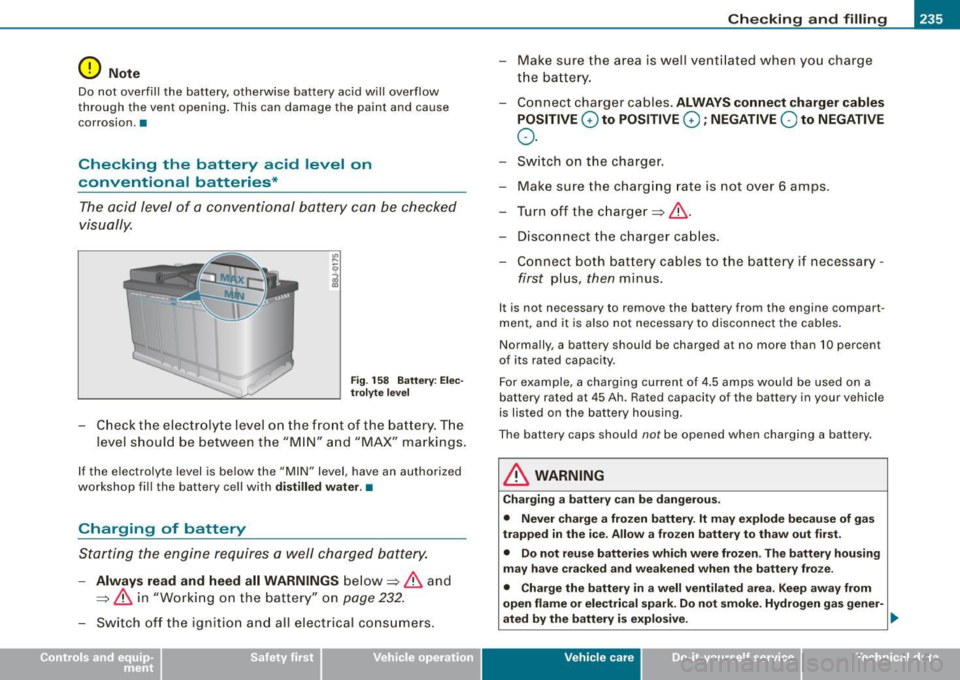
conventional batteries *
The acid level of a conventional battery can be checked
visually.
Fig. 158 Battery : Elec
trolyte level
-Check the electrolyte level on the front of the battery. The
level should be between the "MIN" and "MAX" markings.
If the electrolyte level is below the "MIN" level, have an authorized
workshop fill the battery cell with
distilled water.•
Charging of battery
Starting the engine requires a well charged battery.
-Always read and heed all WARNINGS below => & and
=> & in "Working on the battery" on
page 232.
- Switch off the ignition and all electrical consumers. - Make sure
the area is well ventilated when you charge
the battery.
- Connect charger cables.
ALWAYS connect charger cables
POSITIVE
(v to POSITIVE (v ; NEGATIVE Q to NEGATIVE
o.
- Switch on the charger.
- Make sure the charging rate is not over 6 amps.
- Turn off the charger=>&.
- Disconnect the charger cables.
- Connect both battery cables to the battery if necessary -
first plus, then minus.
It is not necessary to remove the battery from th e engine compart
ment, and it is also not necessary to disconnect the cables.
Normally, a battery should be charged at no more than 10 percent
of its rated capacity .
For example, a charging current of 4.5 amps would be used on a
battery rated at 45 Ah. Rated capacity of the battery in your vehicle
is listed on the battery housing.
The battery caps should
not be opened when charging a battery.
& WARNING
Charging a battery can be dangerous.
• Never charge a frozen battery. It may explode because of gas
trapped in the ice . Allow a frozen battery to thaw out first.
• Do not reuse batteries which were frozen. The battery housing
may have cracked and weakened when the battery froze .
• Charge the battery in a well ventilated area. Keep away from
open flame or electrical spark. Do not smoke. Hydrogen gas gener-
ated by the battery is explosive. .,_
Vehicle care I I irechnical data
Page 238 of 316
___ C_h_ e_ c_k _in --== g'-- a_n _d_ f_il _li _n ..:::g:::..- ___________________________________________ _
& WARNING (continued)
• To reduce the danger of explosion, never connect or disconnect
charger cables while the charger is operating.
• Fast charging a battery is dangerous and should only be
attempted by a competent technician with the proper equipment.
• Battery acid that may spill during charging should be washed
off with a solution of warm water and baking soda to neutralize
the acid.
0 Note
Never use a fast charger as a booster to start the engine. This will
seriously damage sensitive electronic components , such as control
units, relays, radio, etc., as well as the battery charger.
[ i ] Tips
The vehicle battery must not be charged with a standard small
charger that plugs into the cigarette lighter or outlet .•
Windshield /headlight washer
container
Using plain water is not adequate for filling the wind
shield washer system and the headlight washer system*.
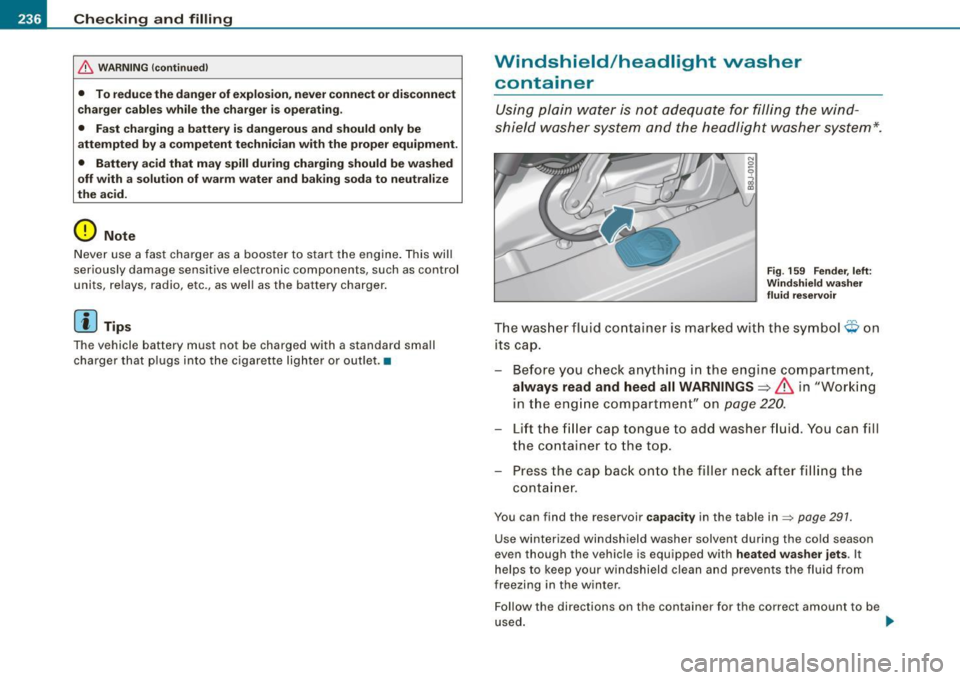
Fig . 159 Fender, left:
Windshield washer
fluid reservoir
The washer fluid container is marked with the symbol e.;. on
its cap.
- Before you check anything in the engine compartment,
always read and heed all WARNINGS=> & in "Working
in the engine compartment" on
page 220.
-Lift the filler cap tongue to add washer fluid. You can fill
the container to the top.
- Press the cap back onto the filler neck after filling the
container .
You can find the reservoir capacity in the table in~ page 291.
Use winterized windshield washer solvent during the cold season
even though the vehicle is equipped with heated washer jets. It
helps to keep your windshield clean and prevents the fluid from
freezing in the winter.
Follow the directions on the container for the correct amount to be
used.
~
Page 266 of 316
1111...__W_ h_ a _ t_d_ o_ l _d _o_ n_ o_ vv_ ? ______________________________________________ _
& WARNING (continued)
-if you have been driving with very low tire pressures or tires
with no air
• Seek professional assistance if it is not possible to repair the
tire with the tire sealant.
& WARNING
The tire sealant must not come into contact with skin, eyes or
clothing.
• If you get any tire sealant
in your eyes or come into contact
with it, rinse the affected area thoroughly with clean water. Find a physician immediately!
• Change any clothing contaminated with tire sealant immedi
ately.
• Do not inhale the vapor!
• If you have swallowed tire sealant, rinse your mouth thor
oughly right away and drink plenty of water .
- Do not induce vomiting! Find a physician immediately!
• If you have allergic reactions, find a physician immediately .
• Keep the tire sealant away from children .
0 Note
Do not use commercially available tire sealants. The electrical
components of the tire pressure monitoring system will no longer
work properly.
'i> For the sake of the environment
Used sealant bottles can be dropped off at a recycling facility.
[ i] Tips
• If sealant has run out, allow it to dry. Then you can peel it off.
• Have the tire sealant replaced every 4 years at a dealership. •
Applies to vehic les: with T ire Mob ility System
Preliminary steps
Some preliminary steps are necessary for tire repair .
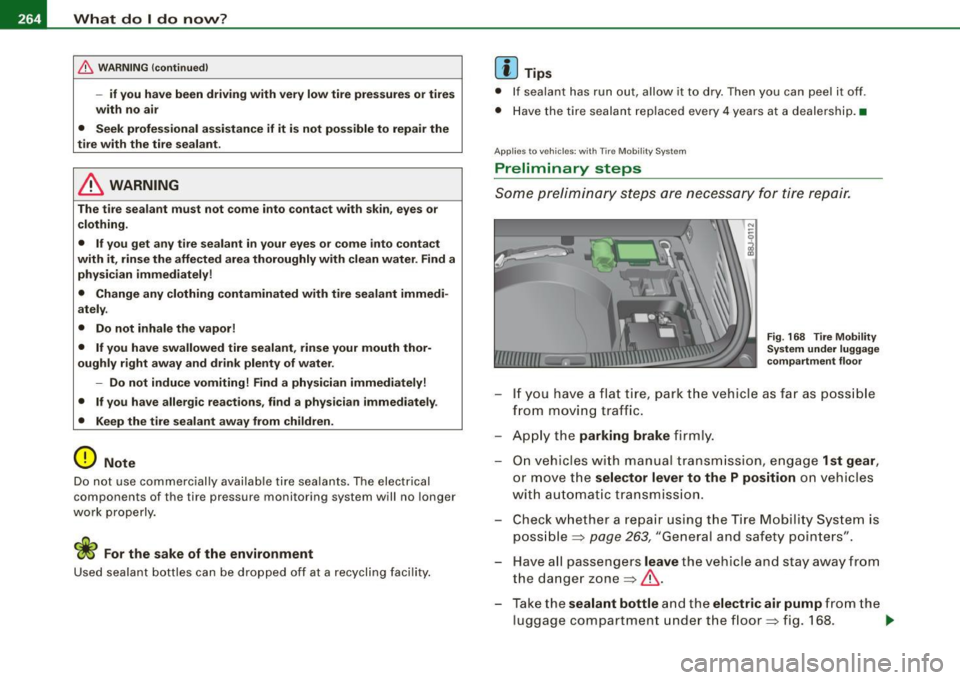
Fig. 168 Tire Mobility
System under luggage
compartment floor
- If you have a flat tire, park the vehicle as far as possible
from moving traffic.
- Apply the
parking brake firmly.
- On vehicles with manual transmission, engage
1st gear,
or move the selector lever to the P position on vehicles
w ith automatic transmission.
- Check whether a repair using the Tire Mobility System is
possible~
page 263, "General and safety pointers".
Have all passengers
leave the vehicle and stay away from
the danger zone~&.
- Take the
sealant bottle and the electric air pump from the
luggage compartment under the floor ~ fig. 168. .,_
Page 275 of 316
Fuses and bul bs -
------------------
Fuses and bulbs
Fuses
Replacing a fuse
A problem in the electrical system may be caused by a
blown fuse.
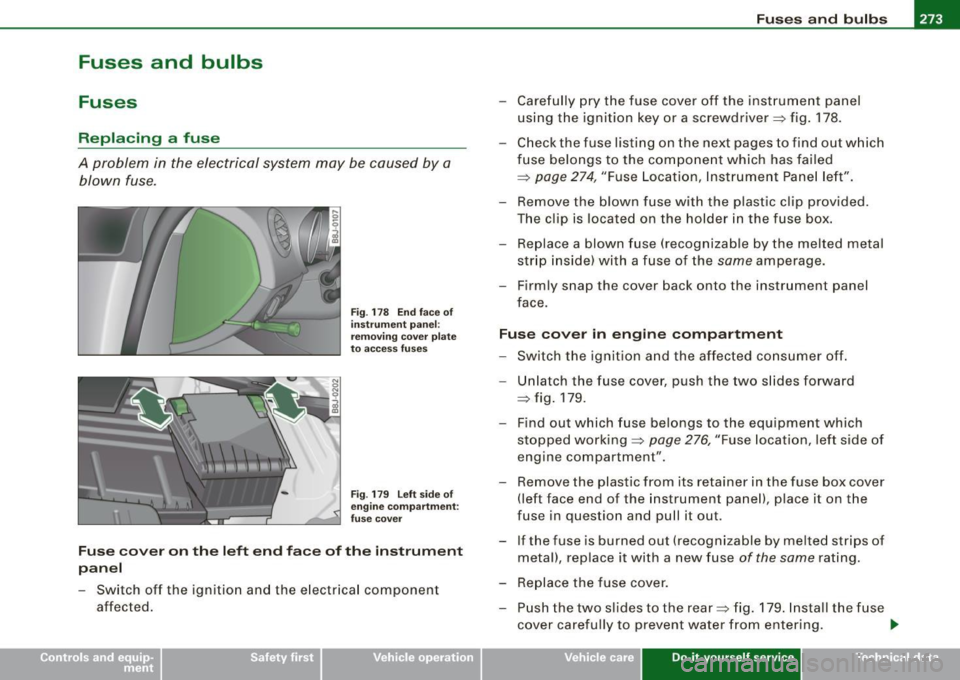
Fig . 178 End face o f
i n str ume nt pan el:
re m ov ing cover pla te
t o access f uses
Fig . 179 Left si de o f
engine co mpartm ent:
fu se cover
Fus e cove r on the left end face of the instrum ent
panel
- Switch off the ignition and the e lectr ica l component
affected . - Carefully pry the fuse cover off the instrument panel
using the ignition key or a screwdriver=> fig. 178.
- C heck the fuse listing on the next pages to find out w hich
fuse belongs to the component which has failed => page 274, "F use Location, Instrument Pane l le ft".
- Remove the blown fuse with the plastic clip provided .
The clip is located on the holder in the fuse box .
Replace a blown fuse (recognizable by the melted metal
str ip inside) with a fuse of the same amperage.
- Firmly snap the cover back onto the instrument panel
face.
Fuse cov er in engin e compartment
- Switch the ignition a nd the affec ted co nsumer off .
- Unlatch the fuse cover, push the two s lides forward
=> fig . 179.
- Find out which fuse belongs to the equipment which
stopped working=> page 276, "Fuse location, left side of
engine compartment".
- Remove the plastic from its retainer in the fuse box cover (left face end of the instrument pane l), place it on the
fuse in question and pull it out.
- If the fuse is burned out (recognizable by melted strips of metal), replace it with a new fuse of the same rating.
- Replace the fuse cover.
- Push the two slides to the rear=> fig. 179 . Install the fuse
cover carefully to prevent water from entering. .,
Vehicle care Do-it-yourself service irechnical data
Page 279 of 316
_______________________________________________ F_ u_ s _ e_s _ a _ n_d _ b_ u_ l_ b_ s __ ffllll
•
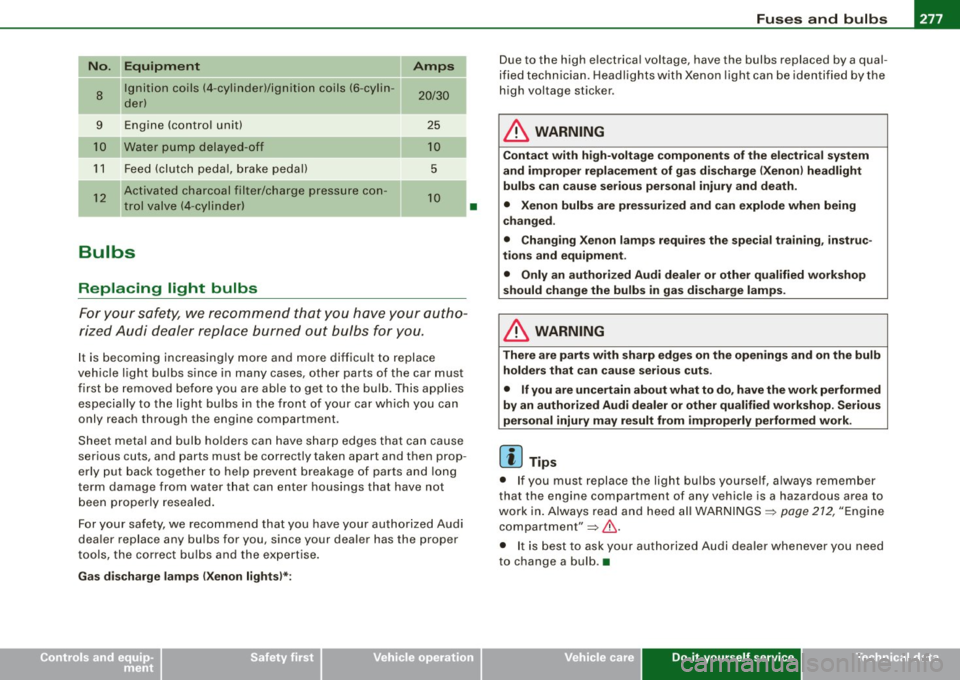
No. II Equipment Amps
8
Ignition coils (4 -cylinder)/ignition coils (6 -cylin -20/30 der)
-
9 Engine (control unit) 25
Water pump delayed-off 10
11 Feed (clutch pedal, brake pedal) 5
12
Activated charcoal filter/charge pressure con-10 trol valve (4-cylinder)
--
Bulbs
Replacing light bulbs
For your safety, we recommend that you have your autho
rized Audi dealer replace burned out bulbs for you.
It is becoming increasingly more and more difficult to replace
vehicle light bulbs since in many cases, other parts of the car must
first be removed before you are able to get to the bulb. This applies
especially to the light bulbs in the front of your car which you can
only reach through the engin e compartment .
Sheet metal and bulb holders can have sharp edges that can cause
serious cuts, and parts must be correctly taken apart and then prop
erly put back together to help prevent breakage of parts and long
term damage from wa ter that can enter housings that have not
been properly resealed.
For your safety , we recommend that you have your authorized Audi
dealer replace any bulbs for you, since your dealer has the proper
tools, the correct bulbs and the expertise.
Gas discharge lamps (Xenon lights)*:
•
Due to the high electrical voltage, have the bulbs replaced by a qual
ified technician. Headlights with Xenon light can be identified by the
high voltage sticker.
& WARNING
Contact with high-voltage components of the electrical system
and improper replacement of gas discharge (Xenon) headlight
bulbs can cause serious personal injury and death.
• Xenon bulbs are pressurized and can explode when being
changed.
• Changing Xenon lamps requires the special training, instruc
tions and equipment .
• Only an authorized Audi dealer or other qualified workshop
should change the bulbs in gas discharge lamps.
& WARNING
There are parts with sharp edges on the openings and on the bulb holders that can cause serious cuts.
• If you are uncertain about what to do, have the work performed
by an authorized Audi dealer or other qualified workshop. Serious
personal injury may result from improperly performed work.
[ i] Tips
• If you must replace the light bulbs yourself, always remember
that the engine compar tment of any vehicle is a hazardous area to
work in. Always read and heed all WARNINGS =>
page 212, "Engine
compartment"=> &.
• It is best to ask your authorized Audi dealer whenever you need
to change a bulb. •
Do-it-yourself service