door lock AUDI TT ROADSTER 2008 Owner's Guide
[x] Cancel search | Manufacturer: AUDI, Model Year: 2008, Model line: TT ROADSTER, Model: AUDI TT ROADSTER 2008Pages: 316, PDF Size: 70.1 MB
Page 218 of 316
Fuel supply and filling your fuel tank
The label on the inside of the fuel filler flap tells you the correct fuel
for your vehicle. For more information about fuel specifications, see
~ page 214.
Your vehicle fuel tank has an on -board refuelling vapor recovery
system. This feature helps to prevent fuel vapors from escaping
from the tank and polluting the environment while you refuel your
vehicle. In order to fill the tank properly while protecting the envi
ronmen t, please follow this refueling procedure carefully.
& WARNING
Under normal operating conditions, never carry additional fuel
containers in your car. Gas canisters and other containers used to
transport fuel can be dangerous. Such containers, full or empty,
may leak and could cause a fire in a collision. If you must transport
fuel to use for your lawn mower, snow blower, etc ., be very careful
and always observe local and state laws regarding the use, trans
portation and storage of such fuel containers . Make certain the
container meets industry standards (ANSI/ASTM F852 -861.
0 Note
Never drive your vehicle until the fuel tank is completely dry. The
irregular supply of fuel can cause misfiring . Gasoline could enter
into the exhaust system and damage the catalytic converter. •
Refuelling
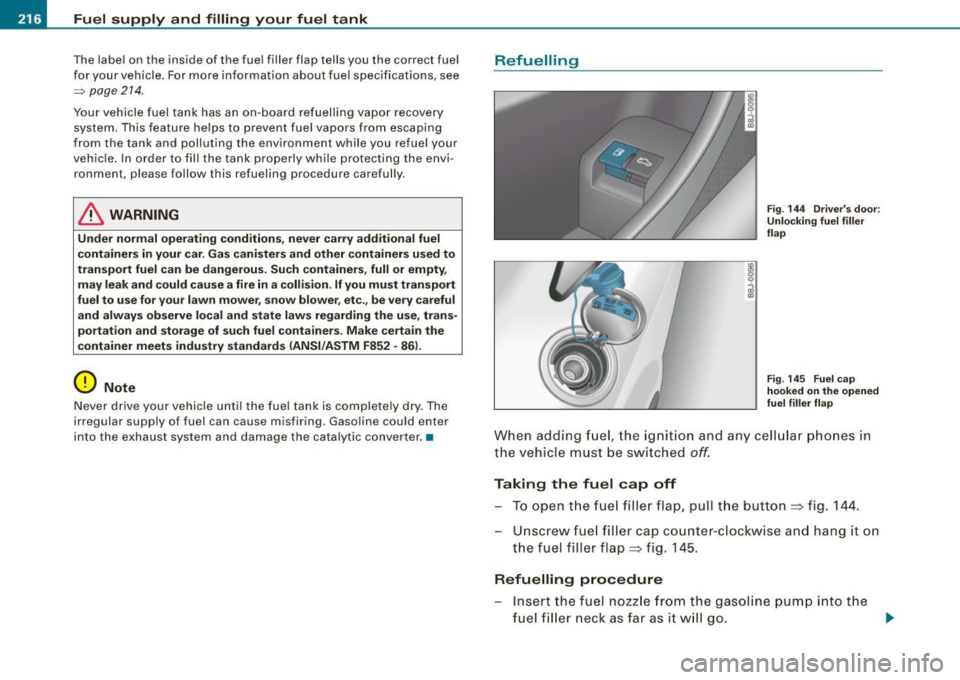
Fig. 144 Driver's door:
Unlocking fuel filler
flap
Fig . 145 Fuel cap
hooked on the opened
fuel filler flap
When adding fuel, the ignition and any cellular phones in
the vehicle must be switched
off.
Taking the fuel cap off
To open the fuel filler flap, pull the button ~ fig. 144.
Unscrew fuel filler cap counter-clockwise and hang it on
the fuel filler flap~ fig. 145 .
Refuelling procedure
Insert the fuel nozzle from the gasoline pump into the
fuel filler neck as far as
it will go. .,_
Page 219 of 316
_____________________________________ F_ u_ e_l _s _u-= pc...:... p_ly =--- a_ n_ d_ f_ i_ ll _in -=: gc.. y -=--- o-u_ r_ fu_ e_l _t _a _n_ k __ fflllll
•
- Select a medium refuelling rate so that the nozzle
switches off automatically when the tank is full.
Putting the fuel cap back on
- After filling your tank, twist the fuel filler cap clockwise
until you hear a definite click.
- Close the fuel filler flap.
To avoid fuel spilling or evaporating from the fuel tank always close
fuel filler cap properly and completely. An improperly closed fuel
filler cap may also cause a message in the driver information system =>
page 24 or cause the MIL lamp=> page 26 to come on.
& WARNING
Improper refueling or handling of fuel can cause fire, explosion
and severe burns .
• Fuel is highly flammable and can cause severe burns and other
injuries.
• Failure to shut the engine off while refueling and/or to insert
the pump nozzle fully into the fuel filler neck could cause fuel to
spray out of filler neck or to overflow. Fuel spray and overflowing
fuel can cause a fire.
• Never use a cellular telephone while refueling . The electromag
netic radiation can cause sparks that can ignite fuel vapors and
cause a fire .
• Never get back into your vehicle while refueling. If in excep
tional circumstances you must get back in your vehicle while refu
eling, make certain that you close the door and touch metal to
discharge static electricity before touching the filler nozzle again.
Static electricity can cause sparks that can ignite fuel vapors
released during refueling.
• Never smoke or have an open flame anywhere in or near your
vehicle when refueling or filling a portable fuel container.
& WARNING (continued)
• For your safety, we strongly recommend that you do not travel
with a portable fuel container in your vehicle. The container, full or empty may leak and could cause a fire, especially in a crash .
• If, under exceptional circumstances, you must transport a
portable fuel container, please observe the following: -Never fill a portable fuel container while it is anywhere in or
on the vehicle (for example, in the luggage compartment, or on
the trunk). Static electricity can build up while filling and can ignite fuel vapors causing a fire.
- Always place a portable fuel container on the ground before
filling.
- Always keep the filler nozzle completely inside the portable
container before and during filling.
- If filling a portable container made of metal, the filler nozzle
must always be in contact with the container. This will help
prevent static electricity from discharging and cause a fire.
- Never spill fuel inside the vehicle or luggage compartment.
Fuel vapors are highly flammable.
- Always observe local and state/provincial laws regarding the
use, storage and transportation of fuel containers
- Make certain the fuel container meets industry standards
(ANSI / ASTM F852-86l.
(D Note
If any fuel has spilled onto the car, it should be removed immedi
ately to prevent damage to the paint.
<£> For the sake of the environment
As soon as the correctly operated nozzle switches off automatically
for the first time, the tank is full. Do not try to add more fuel because
fuel may spill out. In addition, the expansion space in the fuel tank ..,_
Vehicle care
I t •
Page 277 of 316
Fuses and bulbs -
----------------
Equipment No. Equipment
Amps
Engine relay, fuel tank control unit, Airbag Off
16 A/C system (control unit) 10
1
light, light switch (switch illumination), diagnos-10
tic connector
17 Tire pressure monitoring system (control unit) 5
18
Not used
ABS, ASR, ESP, brake light switch
5 19
Not used
3 AFS headlight (left) 5
Not used
Oil level sensor (extended maintenance interval)
(WIV), tire pressure monitoring system, switch
21 Fuel injectors (gasoline engine) 10
4 for Electronic Stability Program (ESP), AFS head-5 Wind deflector (Roadster) 30
lights (control unit), A/C system (pressure sen -23 Horn 20 sorl, backup light switch
Automatic headlight range control, AFS head-
24 Transmission (control unit) 15
5
light (right)/ manual headlight range control, 5/10
25 Heater rear window Coupe/heated rear window 30/20
halogen headlights Roadster
Control unit for CAN data transfer (gateway),
26 Driver's side power window 30
6 electromechanical steering, automatic transmis-5
27 Passenger's side power window 30
sion shift gate
28 Not used
Acoustic Park Assist, automatic dipping interior
rear view mirror, garage door opener, heatable
29 Washer pump 15
7
windshield washer nozzles, washer pump, wind 5
30 Cigarette lighter 20
deflector relay (Roadster)
31 Starter 40
8
Haldex clutch 5 32 Steering column module 5
9
Control unit Audi magnetic ride 5 33
Instrument cluster 5
Airbag control unit 5 34 Radio navigation system, radio 15
1 1 Mass airflow sensor, crankcase heating 5/10
35
Audio amplifier 30
12 Door control unit (central locking driver/passen-10
36 Engine (control unit) 10 ger)
13 Diagnostic connector 10 37 CAN (Gateway) 5
Rain sensor, automatic transmission shift gate 5 38 Not used
15 Roof
light (interior lighting) 5 39 Not used
• Do-it
-yourself service
Page 291 of 316
_________________________________________________ G_ e_ n_ e_r _a _l_ i_n _f_o _ r_ m_ a_ t _i _o _ n __ lftlll
vehicle identification number of your vehicle (perforation) as well as
the Gross Vehicle Weight Rating (GVWR) and the Gross Axle Weight
Rating (GAWRl.
The high voltage warning label
is located on the lock carrier.
The spark ignition system meets all requirements of the Canadian
Interference-Causing Equipment Regulations. •
Displaying Vehicle Identification
Number in the Driver Information
display
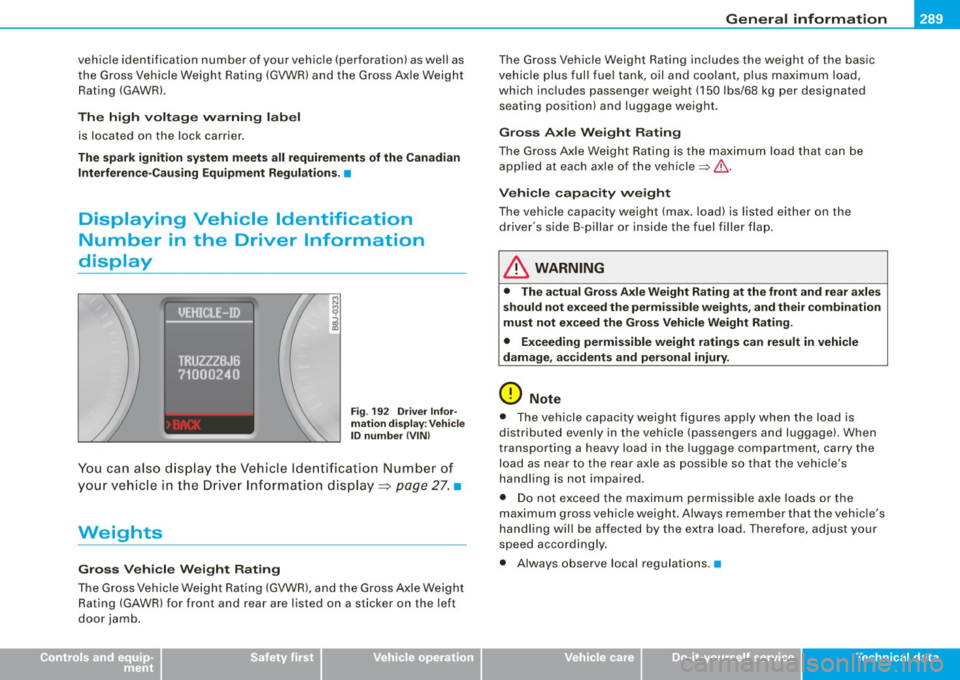
Fig . 192 Driver Infor
mation display: Vehicle
ID number (VIN)
You can also display the Vehicle Identification Number of
your vehicle in the Driver Information display=:>
page 27. •
Weights
Gross Vehicle Weight Rating
The Gross Vehicle Weight Rating (GVWR), and the Gross Axle Weight
Rating (GAWR) for front and rear are listed on a sticker on the left
door jamb.
Controls and equip ment Safety first Vehicle operation
The
Gross Vehicle Weight Rating includes the weight of the basic
vehicle plus full fuel tank, oil and coolant, plus maximum load,
which includes passenger weight (150 lbs/68 kg per designated
seating position) and luggage weight.
Gross Axle Weight Rating
The Gross Axle Weight Rating is the maximum load that can be
applied at each axle of the vehicle~&.
Vehicle capacity weight
The vehicle capacity weight (max. load) is listed either on the
driver's side 8 -pillar or inside the fuel filler flap.
& WARNING
• The actual Gross Axle Weight Rating at the front and rear axles
should not exceed the permissible weights, and their combination
must not exceed the Gross Vehicle Weight Rating.
• Exceeding permissible weight ratings can result in vehicle
damage, accidents and personal injury.
0 Note
• The vehicle capacity weight figures apply when the load is
distributed evenly in the vehicle (passengers and luggage). When
transporting a heavy load in the luggage compartment, carry the
load as near to the rear axle as possible so that the vehicle's
handling is not impaired.
• Do not exceed the maximum permissible axle loads or the
maximum gross vehicle weight. Always remember that the vehicle's
handling will be affected by the extra load. Therefore, adjust your
speed accordingly.
• Always observe local regulations. •
Vehicle care Do-it-yourself service Tec hn ica l da ta
Page 305 of 316
______________________________________________ A_ l_,_ p _h_ a_ b_e _t_i c_ a _ l _in _ d_e _ x __ lllll
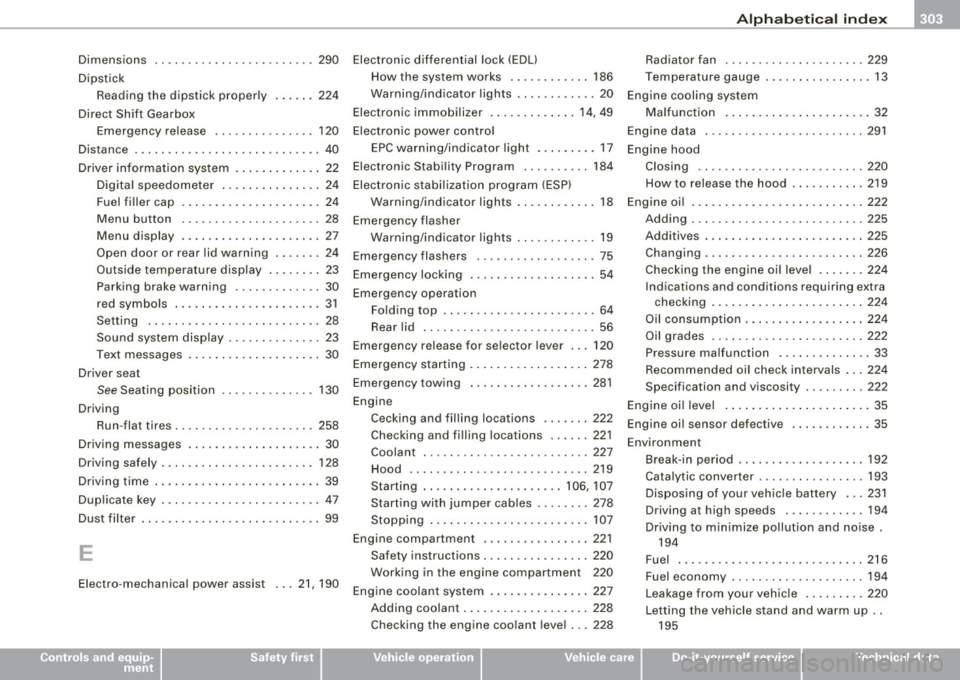
Dimensions ... .. ...... . .... .. .. .... 290 Electronic differential lock (EDU
Dipstick Reading the dipstick properly
Direct Shift Gearbox 224
Emergency release . . . . . . . . . . . . . . . 120
Distance ........ .... ....... ...... ... 40
Driver information system . .... .... ... . 22
Digital speedometer ... .. .... ...... 24
Fuel filler cap ...... ..... .... .... .. 24
Menu button ..................... 28
Menu display ..................... 27
Open door or rear lid warning . ......
24
Outside temperature display .. .... .. 23
Parking brake warning ............. 30
red symbols .. ............. ....... 31
Setting ...... .... ... .... ..... .. .. 28
Sound system disp lay ............ .. 23
Text messages . .... .... .... .... ... 30
Driver seat See Seating position . ............. 130
Driving Run -flat tires . .... .... ....... .... . 258
Dr iving messages ... ..... .. ... .... ... 30
Driving safely . . . . . . . . . . . . . . . . . . . . . . . 128
Driving time ... .... ... ..... .... .... .. 39
Duplicate key .... .... ...... ....... ... 47
Dust filter . ....... .... .... ........ ... 99
E
Electro -mechanical power assist ... 21, 190 How the system works
............ 186
Warning/indicator lights ............ 20
Electronic immobilizer ...... ... .. .. 14, 49
Electronic power cont ro l
EPC warning/indicator light ..... .... 17
Electronic Stability Program .......... 184
Electronic stabilization program (ESP! Warning/indicator lights ........ .... 18
Emergency flasher Warning/ind icator lights .. .... ...... 19
Emergency flashers .................. 75
Emergency locking . ... .... .... ... .. .. 54
Emergency operation Folding top ....................... 64
Rear lid .. .... ....... .... .... .... . 56
Emergency release for selector lever ... 120
Emergency starting ........ ... .... ... 278
Emergency towing .. ............. .. . 281
Engine Cecking and filling locations ... ... . 222
Checking and filling locations ...... 221
Coolant ... .. .... .... ..... .. ... .. 227
Hood . ..... .. ... ... .. .... ..... .. 219
Starting ..................... 106, 107
Starting with jumper cables ........ 278
Stopping .... .... ...... ...... ... . 107
Engine compartment .... ...... ...... 221
Safety instructions ................ 220
Working in the engine compartment 220
Engine coolant sys tem ..... .... ...... 227
Adding coolant .... .... ..... ... ... 228
Checking the engine coolant leve l .. . 228 Radiator fan
... .. .. .. .... .... .... 229
Temperature gauge ................ 13
Engine cooling system Malfunction ... .. .... .... .... ..... 32
Engine data .. ............... .... ... 291
Engine hood Closing .. ... ........ .... ... ..... 220
How to release the hood ... ... ... .. 219
Engine oil . ...... .... .... ... .... .... 222
Adding .... ....... .... ... .... .... 225
Additives .. .... .... ... .... .... ... 225
Changing . .... .... .... ..... ..... . 226
Checking the engine oi l leve l ... .... 224
Indications and conditions requiring extra checking .... .... .... .... .... ... 224
Oil consumption . ...... ..... .. .... 224
Oil grades . ....... .... .... ....... 222
Pressure malfunction .............. 33
Recommended oil check intervals ... 224
Specification and viscosity ......... 222
Engine oi l leve l .. .... .... ... .... .... . 35
Engine oil sensor defective .... ...... .. 35
Environment Break-in period ..... .. ... .... .... . 192
Catalytic converter .......... ... .. . 193
Disposing of your vehic le battery .. . 231
Driving at high speeds . ...... .... . 194
Dr iving to minim ize pollution and noise .
194
Fuel .. .... .... .... ... .... .... ... 216
Fuel economy ......... ........ ... 194
Leakage from your vehicle . .... .... 220
Letting the vehicle stand and warm up ..
195
Controls and equip ment Safety first Vehicle operation
Vehicle care Do-it-yourself service Technical data
Page 306 of 316
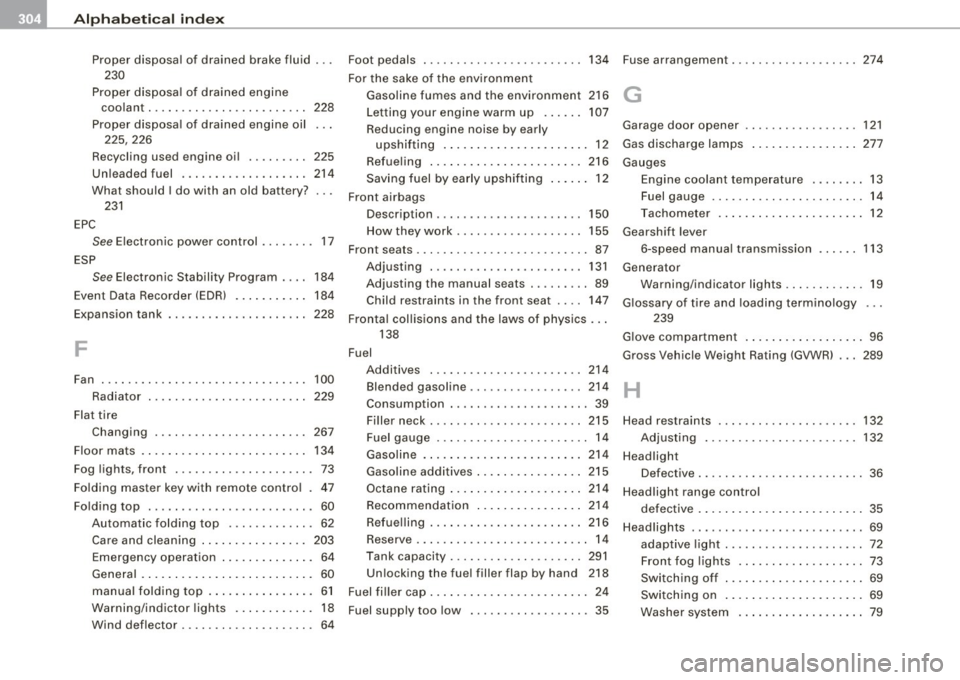
__ _!:_A~l'.!:p~ h~ a~ b~e~ t~ic ~a..'.... l ~in~d~e ~x~ --------------------------------------------
Proper disposal of drained brake fluid ...
230
Proper disposal of drained engine
coolant . ............ .... ...... . 228
Proper disposa l of drained engine oil
225,226
Recycling used engine oil ..... .... 225
Un leaded fuel .... ............... 214
What should I do with an old battery?
231
EPC
See Electronic power control . . . . . . . . 17
ESP
See Electronic Stability Program .... 184
Event Da ta Recorder (EDR) . . . . . . . . . . . 184
Expansion tank 228
F
Fan 100
Radiator . . . . . . . . . . . . . . . . . . . . . . . . 229
Flat tire Changing ....................... 267
Floor mats . . . . . . . . . . . . . . . . . . . . . . . . . 134
Fog lights, front ..................... 73
Folding master key with remote contro l . 47
Fo lding top .. ..... .. .... .... ........ 60
Automatic folding top . . . . . . . . . . . . . 62
Care and cleaning ...... ........ .. 203
Emergency operation . . . . . . . . . . . . . . 64
General . .... ... .. .... .... ...... .. 60
manual folding top ........... ..... 61
Warning/indictor lights .. ........ .. 18
Wind deflector . . . . . . . . . . . . . . . . . . . . 64 Foot pedals
. . . . . . . . . . . . . . . . . . . . . . . . 134
For the sake of the env ironment
Gasoline fumes and the environment 2 16
Letting your engine warm up . ..... 107
Reducing engine noise by early
upshifting .................. .... 12
Refueling ... .. .... .... .... ...... 216
Saving fuel by early upshifting ...... 12
Front airbags Description ..... ..... ...... ...... 150
How they work . . . . . . . . . . . . . . . . . . . 155
Front seats . . . . . . . . . . . . . . . . . . . . . . . . . . 87
Adjusting ......... .... .... ...... 131
Adjusting the manual seats .. .... ... 89
Child restraints in the front seat .... 147
Fronta l col lisions and the laws of physics ...
138
Fuel Additives .. ....... .... .......... 214
Blended gasoline ................. 214
Consumption .. ............. ...... 39
Fi ller neck . .... ........ ... ....... 215
Fuel gauge . . . . . . . . . . . . . . . . . . . . . . . 14
Gasoline ........... ... .... .... .. 214
Gasoline additives .... .... ... .. ... 215
Octane rating ... .. .... .... .... ... 214
Recommendation . . . . . . . . . . . . . . . . 214
Refuelling ..... ........ .... ... ... 216
Reserve .. .... ....... ...... .... ... 14
Tank capacity . .... ... .... ..... ... 291
Unlocking the fuel filler flap by hand 218
Fuel fi ller cap ......... .... .... ... .... 24
Fuel supply too low ........ ....... ... 35 Fuse
arrangement .... ... .. .. . .... .. . 274
G
Garage door opener ... .......... .... 121
Gas discharge lamps ...... ... .... ... 277
Gauges Engine coolant temperature ........ 13
Fuel gauge .... .... ....... .... .... 14
Tachometer ........... ...... .... . 12
Gearshift lever
6 -speed manual transmission ... ... 113
Generator Warning/indicator lights ............ 19
G lossary of tire and loading terminology ...
239
G love compartment ...... .... .... .... 96
Gross Vehicle Weight Rating (GVWR) ... 289
H
Head restraints ........ ... ........ .. 132
Adjusting .. ........... .... .... .. 132
Headlight Defective . . . . . . . . . . . . . . . . . . . . . . . . . 36
Headlight range control
defective .......... .... ....... .... 35
Headlights .... ....... .... ... .... .... 69
adaptive light ...... ........ .... ... 72
Front fog lights ... .... .... .... .... 73
Switching off ... .... ...... .... .... 69
Switching on ...... .... ....... .... 69
Washer system . . . . . . . . . . . . . . . . . . . 79
Page 308 of 316

__ _:._A..:.:l:.!: p :...:h..:.: a== b:..:e :...:t :.:..ic =-= a..:..l ..:.:in :..:..:: d:...:e :...:x-=-----------------------------------------------
Lights
Bi-Xenon headlights ... .... ...... .. 75
Coming-home/leaving-home-function 73
Emergency flasher . . . . . . . . . . . . . . . . 75
Front fog lights . . . . . . . . . . . . . . . . . . . 73
Headlights . . . . . . . . . . . . . . . . . . . . . . . 69
High beam . . . . . . . . . . . . . . . . . . . . 69, 76
High beam warning/indicator light ... 18
Instrument pane l illumination . ...... 74
Side marker lights . . . . . . . . . . . . . . . . . 69
Turn signals .. ..... ....... .... .... 76
Loading the luggage compartment 135
Locking Power locking switch . . . . . . . . . . . . . . 53
Rear lid/trunk lid .... .. ...... ... .. . 55
Remote control key . . . . . . . . . . . . . . . . 51
Using the key . .... .... .... ..... .. . 53
Luggage compartment Ligh t ........... .... .... ......... 77
Loading . . . . . . . . . . . . . . . . . . . . . . . . 135
Ski bag .. ... ..... .... .... ...... .. 93
Lumbar support ...... .... ........... 91
M
Maintenance ... .. ...... ...... .... .. 294
Malfunction Indicator Lamp (MIU 18 , 26
Manual folding top
closing ........ .... ..... ......... 61
Manual transmission ...... .... ...... 113
Maste r key . . . . . . . . . . . . . . . . . . . . . . . . . . 48
Battery replacement . . . . . . . . . . . . . . . 49
Menu button . . . . . . . . . . . . . . . . . . . . . . . . 28 Menu
display . . . . . . . . . . . . . . . . . . . . . . . . 27
Mileage Average .......... .... ....... .... 39
Instantaneous .. .... .. .... .... .... 39
Mirror Inside rearview mirror, manua l ...... 82
Mirrors Activa ting the digital compass . .... . 85
Anti-glare rearview mirror . ...... ... 82
Automatic d imming for the outs ide
mirrors .............. .... ..... .. 84
Automatically dimm ing inside mirror . 82
Manual glare dimming ... .... ...... 82
Outside mirrors .......... .... .... . 83
Monitoring the Advanced Airbag System
157
N
Natural leather 209
New tires and wh eels ... ... ... .... ... 249
NHTSA Contacting . . . . . . . . . . . . . . . . . . . . . . 136
Number of seats . . . . . . . . . . . . . . . . . . . . 137
0
Occupan t seating positions . . . . . . . . . . . 130
Octane rating .... .. . .. ... .... ... ... 214
Odometer . . . . . . . . . . . . . . . . . . . . . . . . . . . 14
Oil See Engine oil ....... ... .. ..... .. 222
Older children and safety belts . . . . . . . . 177 On-Board Diagnostic System (OBD)
Data Link Connec tor (DLC) . .... ..... 26
Electronic speed limiter ... ........ . 26
Malfunction Indicator Lamp (MIU .... 26
Open door or rear lid warning .. .... .... 24
Opening folding top
manually .. .... .... .... ...... ... .. 61
Operate your vehic le economically and mini-
mize pollution . ...... .... ..... .. 194
Optional equipment Marked with an asterisk .. ...... ..... 6
Outside mirrors ... ... .. .... .. ... .... . 83
Outside temperature display ... .... .. .. 23
Owner's manual How the Owner's Manual is organized . 6
p
Paint
Touch-up ......... .............. 205
Paint No. . . . ... ... .. .... .... .... ... 288
Parking ...... .... .... ........... .. . 108
Automatic transmission .... .... .. . 114
Parking brake . .. .. .. .... .... .... ... 108
Parking brake warn ing . ... .... .... ... . 30
Parking light
Defective . . . . . . . . . . . . . . . . . . . . . . . . . 36
Parking on a decline (downhil l) . ... .... 108
Parking on an incline (uphill) ...... .... 108
Parts replacement .... .... .... .... ... 296
PASSENGER AIR BAG OFF light .... .... 157
Passive safety system . . . . . . . . . . . . . . . 128
Page 309 of 316
______________________________________________ A_ l_,_ p _h_ a_ b_e _t_ic _ a _ l _in _ d_e _ x __ lll
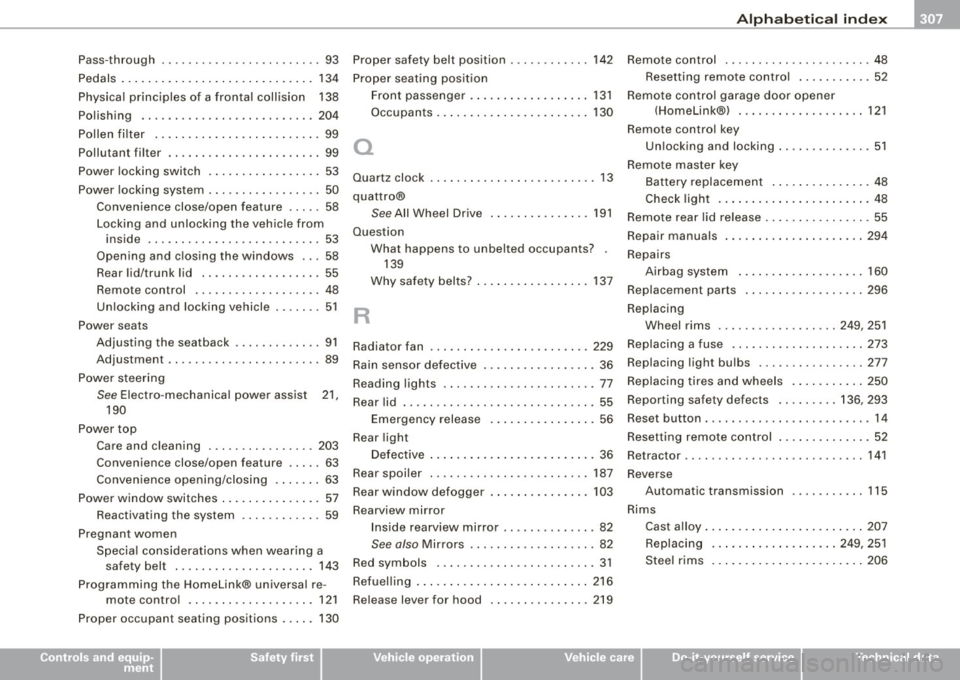
Pass-through .. ..... .... ... .... .... .. 93 Proper safety belt position . ... .. ...... 142 Remote control ....... ... .. .. ... .. ... 48
Pedals ...... .... ... ........ .... .... 134 Proper seating position Resetting remote control ...... ... .. 52
Physical principles of a frontal collision 138
Polishing ...... .... .... ....... .... . 204
Pollen filter ......................... 99
Pollutant filter .. .... .... .... .... ... .. 99
Power locking switch ........... .... .. 53
Power locking system ... .... .... .... .. 50
Convenience close/open feature .... . 58
Locking and unlocking the vehicle from
inside .. .. .. .... .... ... .... .... . 53
Opening and closing the windows ... 58
Rear lid/trunk lid ..... .... .... .... . 55
Remote control ...... .... .... ... .. 48
Unlocking and locking vehicle . .... .. 51
Power seats
Adjusting the seatback ....... .... .. 91
Adjustment .. .... .... .... ...... ... 89
Power steering
See Electro -mechanical power assist 21,
190
Power top
Care and cleaning . ....... .... .... 203
Convenience close/open feature ... .. 63
Convenience opening/closing ... .... 63
Power window switches ...... ...... ... 57
Reactivating the system .... .... .... 59
Pregnant women
Special cons iderations when wearing a
safety belt . .... .... .... ... .... . 143 Front
passenger . ...... ........... 131
Occupants .. ...... ...... ... .. .... 130
a
Quartz clock .. ...... ..... .. .... .... .. 13
quattro®
See All Wheel Drive ............... 191
Question
R
What happens to unbelted occupants? .
139
Why safety belts? ... .. .... .... .... 137
Radiator fan .... .... ..... .. .... .... . 229
Rain sensor defective ................. 36
Reading lights ... ... ..... ... .... .... . 77
Rear lid ........ ....... ...... .... .... 55
Emergency release ......... ...... . 56
Rear light
Defective . ................... .... . 36
Rear spoiler . .... .... ....... ........ 187
Rear window defoggeir ............... 103
Rearview mirror Inside rearview mirror .. .... .... ... . 82
See also Mirrors ........... ....... . 82
Red symbols . ... .... .... .... .... ... . 31
Programming the Homelink® universal re- Refuelling ............... .... .... ... 216
mote contro l ... .... .... ... .... . 121 Release lever for hood .. .... .... .... . 219
Proper occupant seating positions .. ... 130 Remote
control garage door opener
(Homelink®l .... .... .... .... ... 121
Remote control key Unlocking and locking ..... .... .... . 51
Remo te master key
Battery replacement ...... .... .... . 48
Check light .. ....... .. ...... ...... 48
Remote rear lid release .... ... .. ...... . 55
Repair manuals ...... .... .... .... ... 294
Repairs Airbag system ................... 160
Replacement parts ... .... ... .... .... 296
Replacing Wheel rims .... .... ... ....... 249, 251
Replacing a fuse .. ...... .... .... .... 273
Replacing light bulbs .. ... .. . .... .. . . 277
Replacing tires and wheels ...... ..... 250
Reporting safety defects .. ... .... 136, 293
Reset button . .... ........ .... ... .... . 14
Resetting remote control ......... .... . 52
Retractor .......... .. .... ...... .... . 141
Reverse Automatic transmission .... ... .... 115
Rims Cas t alloy ..... .... .... .... .... ... 207
Replacing .... .... ....... ... . 249, 251
Stee l rims . .... ... .... ...... ... .. 206
Controls and equip
ment Safety first Vehicle operation
Vehicle care Do-it-yourself service Technical data