ABS AUDI TT ROADSTER 2014 User Guide
[x] Cancel search | Manufacturer: AUDI, Model Year: 2014, Model line: TT ROADSTER, Model: AUDI TT ROADSTER 2014Pages: 244, PDF Size: 60.87 MB
Page 117 of 244
-a small adu lt or teenager is on the front pas
senger seat
- a passenger who is not sitting upright w ith
their back against a non-reclined backrest
with their feet on the vehicle floor in front
of the seat is on the front passenger seat.
I f the front passenger airbag deploys, the
Federal Standard requires the airbag to meet
the " low risk" deployment criteria to help re
duce the risk of injury through interaction
with the airbag . "Low risk" deployment occurs
in those crashes that take place at lower de
celerations as defined in the electron ic control
un it
¢ page 119 .
Alw ays rem emb er: Please be sure to read the
important information in the sections that
follow and be sure to heed all of the WARN
INGS.
A WARNING
To reduce the risk of injury when an airbag inflates, a lways wear safety belts prope rly.
- If you are unrestrained, lean ing forward,
sitting sideways or out of position in any
way, your risk of inj ury is much higher.
- You w ill also receive serious inju ries and
cou ld even be killed if you are up against
the a irb ag or too close to it when it in
flates - even with an Advanced Airbag
¢page 109 .
.&_ WARNING
-
A child in a rearward-facing child safety
seat installed on the front passenger seat
w ill be seriously injured and can be k illed if
the front a irbag inflates - even with an Ad
vanced Airbag System.
- Although the Advanced Airbag System in
your vehicle is designed to turn off the
front a irbag when a rearward-fac ing
child restraint has been installed on the
front passenger seat, nobody can abso l u te ly guarantee that deployment is im
poss ible in a ll conceivable situations that
may happen d uring the useful life of your
vehicle.
A irbag system 11 5
-The inflating airbag will hit the child
safety seat or infant carrier with great
force and will smash the child safety seat and child against the backrest, doo r, or
roof.
- If you must install a rearward fac ing
child safety seat on the front passenger
seat because of exceptional c ircumstan
ces and the
PASSENGER AIR BAG OFF
light does not come on and stay on have
the airbag sys tem inspected by your Audi
dea ler.
.&_ WARNING
I f, in except iona l circumstances, you must
install a forward-facing child restraint on
the front passenger's seat:
- Always make sure the forward -facing
seat has been designed and certified by its manufacturer for use on a front seat
with a passenger front and s ide a irbag.
- Never put the forward-facing child re
straint up against or very near the instru
ment panel.
- Always move the passenger seat into its
rearmost pos ition in the seat's fore and
aft adjustment range, as far away from
the airbag as possible, before installing
the forward-fac ing ch ild restra int. The
backrest must be ad justed to an upright
position.
- Make sure that the
PASSENGER AIR BAG
OFF
li ght comes on and stays o n all the
time wheneve r the ig nit ion is swit ched
on.
Advanced Airbag System components
T he front passenge r seat in yo ur vehicle has a
lot of very important parts of the Advanced
Airbag System in it . These parts include the
weight-sensing mat, sensors, wiring, brack ets, and more. The funct ion of the system in
the front passenger seat is checked by the
electronic control unit when the ignition is on .
The cont rol unit monitors the Advanced A ir
bag System and turns the airbag indicator
l igh t on when a malfunct ion in the system
•
•
Page 125 of 244
-Never modify the front bumper or parts
of the veh icle body.
- Always make sure that the side airbag
can inflate without interference:
- Never install seat covers or replace
ment upho lstery ove r the front seat
backs that have not been spec ifically
approved by Audi.
- Never use add itiona l seat cushions that
cover the areas where the side airbags
inflate .
- Damage to the o rigina l seat covers or
to the seam in the area of the side air
bag module must always be repa ired
immediate ly by an authorized Audi
dealer.
- The airbag system can be activated only
once . After an airbag has inflated, it
must be replaced by an author ized Audi
dealer or qualif ied technic ian who has
the techn ica l information, tra ining and
special equipment necessary.
- The airbag system can be deployed only
once. After an a irbag has been deployed,
it must be replaced w ith new replace
ment parts designed and approved espe
c ially for your Aud i model version. Re
placeme nt of complete ai rbag systems
or airbag componen ts m ust be per
f ormed by qualified workshops only.
Make su re that any airbag service act ion
is entered in your Audi Warranty
& Main
tenance booklet under
AIRBAG REPLACE
MENT RECORD.
- For safety reasons in severe accidents,
the a lternator and starter are separated
from the vehicle battery with a pyrotech
nic circuit interrupter.
- Wo rk on the pyrote chnic cir cu it inter
rupter must on ly be per formed by a
qualified dealer - risk of an accident!
- If the veh icle or the ci rcuit interrupter
is sc rapped, all applicable safety pre
cautions must be followed .
Airbag system 123
@:) For the sake of the environment
Un deployed airbag modules and p reten
sione rs might be classified as Perchlorate
Materia l -special handling may apply, see
www. dtsc. ca.gov/hazard o u swa ste/ per-
ch lo rate. When the veh icle or parts of the
restraint system including airbag modules
and safety be lts with pretensioners are
scrapped, all applicab le laws and regu la
tions mus t be obse rved. Your authori zed
A udi dealer is familia r wi th these require
ments and we recommend that you have
your dealer perform this service fo r you .
Other things that can affect Advanced
Airbag performance
Chang ing the veh icle's suspens io n system can
c h ange the way that the Advanced Airbag Sys
tem perfo rms in a crash. For examp le, using
tir e-rim combi nat ions not approved by A udi,
l ower ing the veh icle, chang ing the st iffness of
the suspens ion, including the spr ings, suspen
sion struts, shock absorbers etc. can change
the forces that are measured by the airbag
sensors and sent to the electronic contro l
u nit. Some suspension changes can, for exam
ple, i ncrease the force levels measured by the
sensors and make the airbag system deploy in c rashes in which it wou ld not deploy if the
c h anges had not been made. Other kinds of
c h anges may reduce the fo rce leve ls meas
ur ed by the sensors and preven t the airbag
from dep loying when i t should.
T he sensors in the safety be lt b uck le for the
d rive r and fr on t p assenger seat te ll the e lec
tron ic cont ro l modu le if the s afety be lt is
l atche d or no t. If the safety be lt is being used,
the front airbag will deploy at a slightly high er rate of veh icle deceleration t han i f th e safe
ty belt is not be ing used. Therefore, in a par
ticular coll is ion, it is possible t hat an airbag
will not deploy at a seat ing pos ition where the
safety belt is be ing used b ut w il l inflate at the
pos ition wher e th e safety be lt is not be ing
u sed. It is impo rtant that noth ing in terfere
Ill>
•
•
Page 144 of 244
142 Intelligent technology
Intelligent technology
Notice about data
recorded by vehicle
control modules
Your vehicle is not equipped with an Event Da
ta Recorder (EDR), installed by some manu
facturers fo r the express purpose of capturing
data for retrieval after an accident or crash
event . EDR's are sometimes ca lled "crash re
corders".
Some state laws restrict the retr ieval or down
loading of data stored by EDR's that were in
stalled in a vehicle for the express purpose of
retrieving data after an accident or crash
event without the owner's consent.
A lthough your vehicle is not equipped with an
EDR, it is equipped with a number of electron
ic control modules for various vehicle systems
such as, for examp le, eng ine function, em is
sion control, as well as for the airbags and
safety belts.
These electronic contro l modules also record
vehicle-re lated data during normal vehicle op
eration for diagnostic and repair purposes.
The recording capacity of the electronic con
trol modules is limited to data (no sound is re
corded) and only a small amount of data is ac
tually recorded over a very limited pe riod of
time and stored when a system fault or other
condition is sensed by a control unit. Some of
the data then stored may relate to vehicle
speed, direction, braking as we ll as restraint
system use and performance in the event of a
crash or other condition. Stored data can only
be read and downloaded with special equip
ment.
Electronic Stabilization
Control (ESC)
Description
ESC helps to improve road holding and vehicle
dynamics to help reduce the probability of
skidd ing and loss of vehicle control. It works
only when the engine is running. ESC detects certain difficult driving situat
ions, including
when the vehicle is beginning to spin (yaw)
out of control and helps you to get the veh icle
back under control by se lectively braking the
wheels, and/or reducing engine power and
providing steering assistance to help hold the
vehicle on the driver's intended course. The in
dicator light
G) in the instrument cluster
blinks when ESC is taking action to help you
control the vehicle.
ESC has limitations.
It is important to remem
ber that ESC cannot overcome the laws of
physics. It wi ll not always be able to help out
under all conditions you may come up against.
For example, ESC may not always be able to
help you master situations where there is a
sudden change in the coefficient of friction of
the road surface. When there is a section of
dry road that is suddenly covered with water,
slush or snow, ESC cannot perform the same
way it wou ld on the dry surface . If the vehicle
hydroplanes (rides on a cushion of water in
stead of the road surface), ESC will not be
able to help you steer the vehicle because con
tact with the pavement has been interrupted
and the vehicle cannot be braked or steered.
During fast cornering, particularly on winding
roads, ESC cannot always deal as effectively
with difficult driving situations as at lower
speeds.
Always adjust your speed and driving style to
road , traffic §&and weather conditions. ESC
cannot override the vehicle's physical limits,
increase the available traction, or keep a vehi
cle on the road if road departure is a result of
driver inattention . Instead, ESC improves the
poss ibility of keeping the vehicle under con
t rol and on the road dur ing extreme maneu
vers by using the driver's steering inputs to
help keep the vehicle go ing in the intended di
rection . If you are traveling at a speed that
causes you to run off the road before ESC can
provide any assistance, you may not experi
ence the benefits of ESC.
ESC includes and/or works togethe r with the
anti- lock brake system (ABS), brake assist sys-
tem and anti-slip regu lation (ASR). ESC is .,..
Page 145 of 244
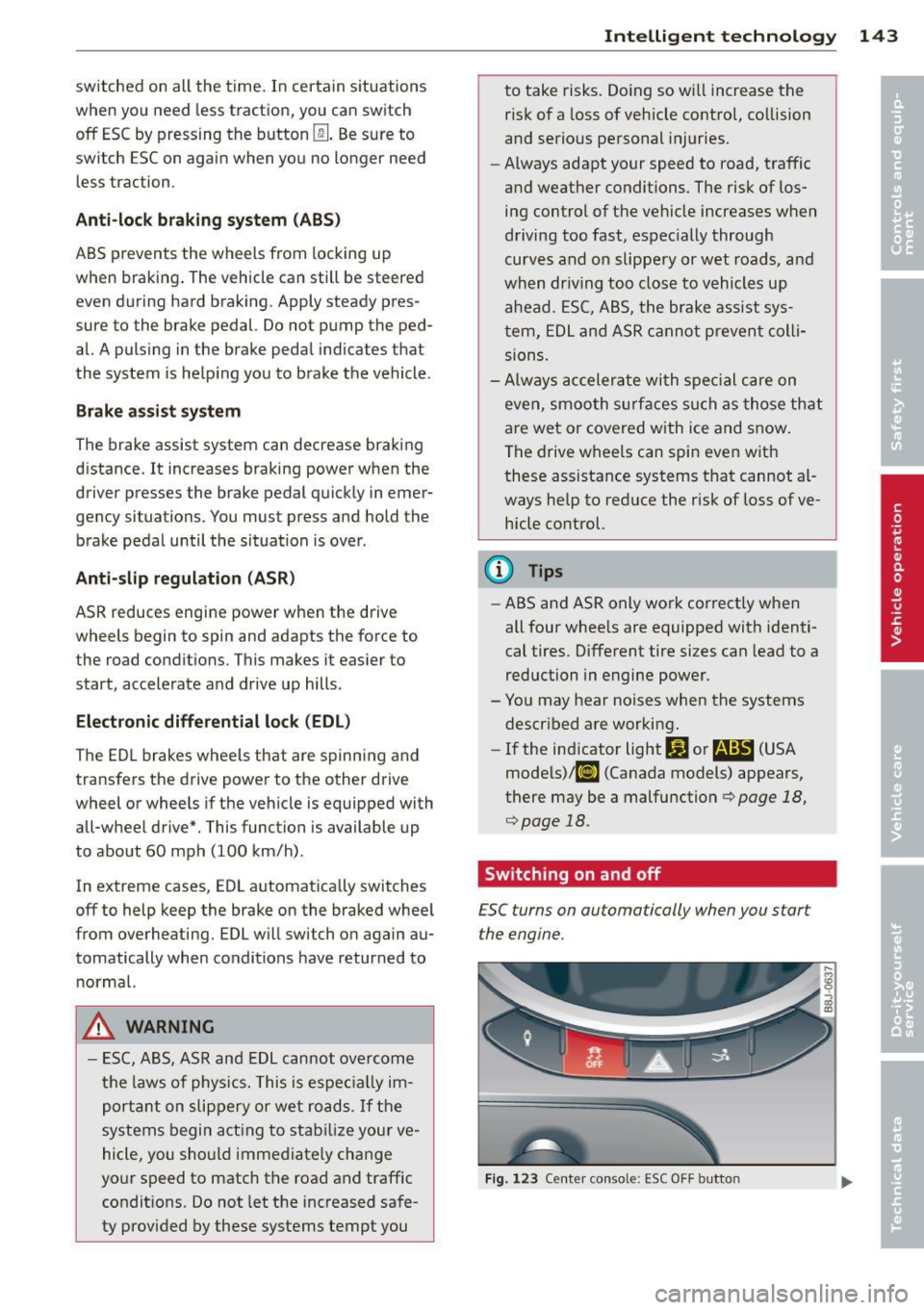
switched on all the time. In certain situations
when you need less traction, you can switch
off ESC by pressing the button
lru. Be sure to
switch ESC on again when you no longer need
less traction.
Anti-lock braking system (ABS)
ABS prevents the wheels from locking up
when braking . The vehicle can still be steered
even during hard braking . Apply steady pres
sure to the brake pedal. Do not pump the ped
al. A pulsing in the brake pedal indicates that
the system is helping you to brake the vehicle.
Brake assist system
The brake assist system can decrease braking
d istance. It increases braking power when the
driver presses the brake pedal quickly in emer
gency si tuations. You must press and hold the
brake pedal until the situation is over .
Anti-slip regulation (ASR)
ASR reduces engine power when the drive
wheels begin to spin and adapts the force to
the road condit ions. This makes it easier to
start, accelerate and drive up hills.
Electronic differential lock (EDL)
The EDL brakes wheels that are spinning and
transfers the drive power to the other drive
wheel or whee ls if the vehicle is equipped with
all-wheel drive*. This function is available up
to about 60 mph (100 km/h) .
In extreme cases, EDL automat ica lly switches
off to help keep the brake on the braked wheel
from overheating. EDL w ill switch on again au
tomatically when conditions have returned to
normal.
..&, WARNING
- ESC, ABS, ASR and EDL cannot overcome
th e laws of physics. This is especially im
portant on slippery or wet roads.
If the
systems begin acting to stabilize your ve
hicle, you should immediately change
your speed to match the road and traffic
condit ions. Do not let the increased safe
ty provided by these systems tempt you
Intelligent technology 143
to take risks. Doing so will increase the
risk of a lo ss of vehicle control, co llision
and serious personal injuries.
- Always adapt your speed to road, traffic
and weather conditions. The risk of los
ing control of the vehicle increases when
driving too fast, especially through
curves and on slippery or wet roads, and
when driving too close to vehicles up
ahead. ESC, ABS, the brake assist sys
tem, EDL and ASR cannot prevent colli
sions.
- Always accelerate with special care on
even, smooth surfaces such as those that
are wet or covered with ice and snow.
The drive wheels can spin even with
these assistance systems that cannot al
ways he lp to reduce the risk of loss of ve
hicle control.
@ Tips
- ABS and ASR only work correct ly when
all four whee ls are equipped with identi
cal tires. D ifferent tire si zes can lead to a
reduction in engine power.
- You may hear noises when the systems
described are working.
- If the ind icator lightD] orE (USA
models)/ [iJ (Canada models) appears,
there may be a malfunction¢
page 18,
¢ page 18.
Switching on and off
ESC turns on au tomatically when you start
the engine.
Fig . 123 Ce nter conso le: ESC OFF butto n
Page 160 of 244
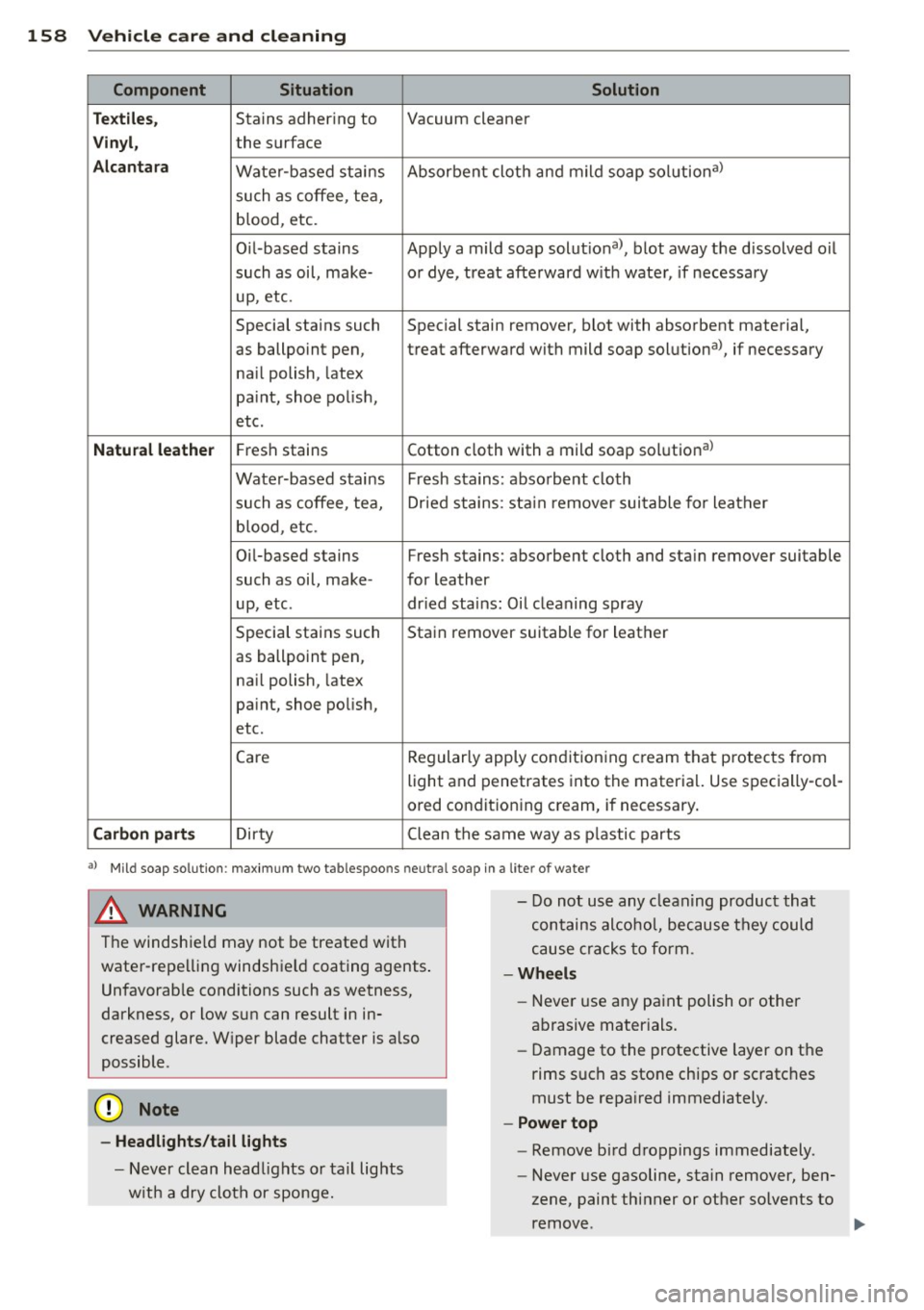
158 Vehicle care and cleaning
Component Situation Solution
T ex tile s,
Stains adhering to Vacuum cleaner
Vin yl, the surface
Alcan ta ra Water -based stains Absorbent cloth and mild soap solutiona>
such as coffee, tea,
blood, etc.
O il-based stains Apply a mild soap solutiona>, blot away the d issolved oil
such as oil, make- or dye, treat afte rward w ith water, if necessary
up, etc.
Special stains such Special stain remover, b lot with absorbent material,
as ballpoint pen, treat afterward with mild soap solutiona>, if necessary
na il polish, latex
pa int, shoe po lish,
etc.
Natu ral leather Fresh stains Cotton cloth with a mild soap solutiona>
Wate r-based stains Fresh s tains: absorbent cloth
such as coffee, tea, Dr ied stains: sta in remover sui table for leather
blood, etc.
Oi l-based stains Fresh stains: absorbent cloth and sta in remover suitable
such as oil, make- for leather
up, etc. dried stains: Oil cleaning spray
Special stains such Stain remover suitable for leather
as ballpo int pen,
na il polish, latex
pa int, shoe polish,
etc.
Care Regular
ly apply condit ion ing c ream that protec ts from
light a nd penetrates into the materia l. Use specially-col-
ored conditioning cream, if necessary.
Carbon part s Dirty Clean tlhe same way as plastic parts
a) Mi ld soap solut ion : maximum two tablespoons neut ra l soap in a lite r of wate r
& WARNING
The windshie ld may not be treated with
water -repe lling windshield coating agents .
Unfavorab le conditions such as wetness,
darkness, or low sun can result in in
creased glare. W iper blade chatter is a lso
possible .
(V Note
- Headlights /tail lights
- Never clean headlights or tail lights
w it h a dry cloth or sponge. -
Do not us e any cleaning product that
contains alcohol, because they could
cause cracks to form.
-Wheels
- Never use any paint polish or other
abrasive mater ials.
- Damage to the protective layer on the
rims such as stone chips or scratc hes
must be repa ired immediately.
- Power top
-Remove bird droppings immediately.
- Never use gasoline, stain remover, ben-
zene, paint thinner or other so lvents to
remove .
Page 177 of 244
Before you check anything in the engine com
partment,
always r ead and heed all WARN
ING S
~ A in Working in the engine compart
ment on page 165.
.. Read the brake flu id level from the brake
fluid reservoir
9 page 167, fig. 130 . The
brake f lu id leve l must be between the "MIN"
and "MAX" markings.
The brake f luid reservoir is located behind the
rear partition of the engine compartment on
the left side
9 page 167.
The fl uid level may drop slightly after some
time due to the automatic adjustment of the brake pads . This is not cause for alarm .
If the brake fluid level falls considerably be
l ow the "M IN" mark, the brake wa rning/indi
cator light (U .S . mode ls:
1111 , Canadian
models: .) will come on ¢
page 14 . Do not
continue to operate the vehicle. The complete
brake system shou ld be thoroughly checked
by an authorized Audi dealer or other quali
f ied fac ility and the cause corrected . If the
b rake fluid level is too low, the brake warn ing/
i ndicator light w ill illuminate . Co ntact an au
thor ized Audi dealer
immediately .
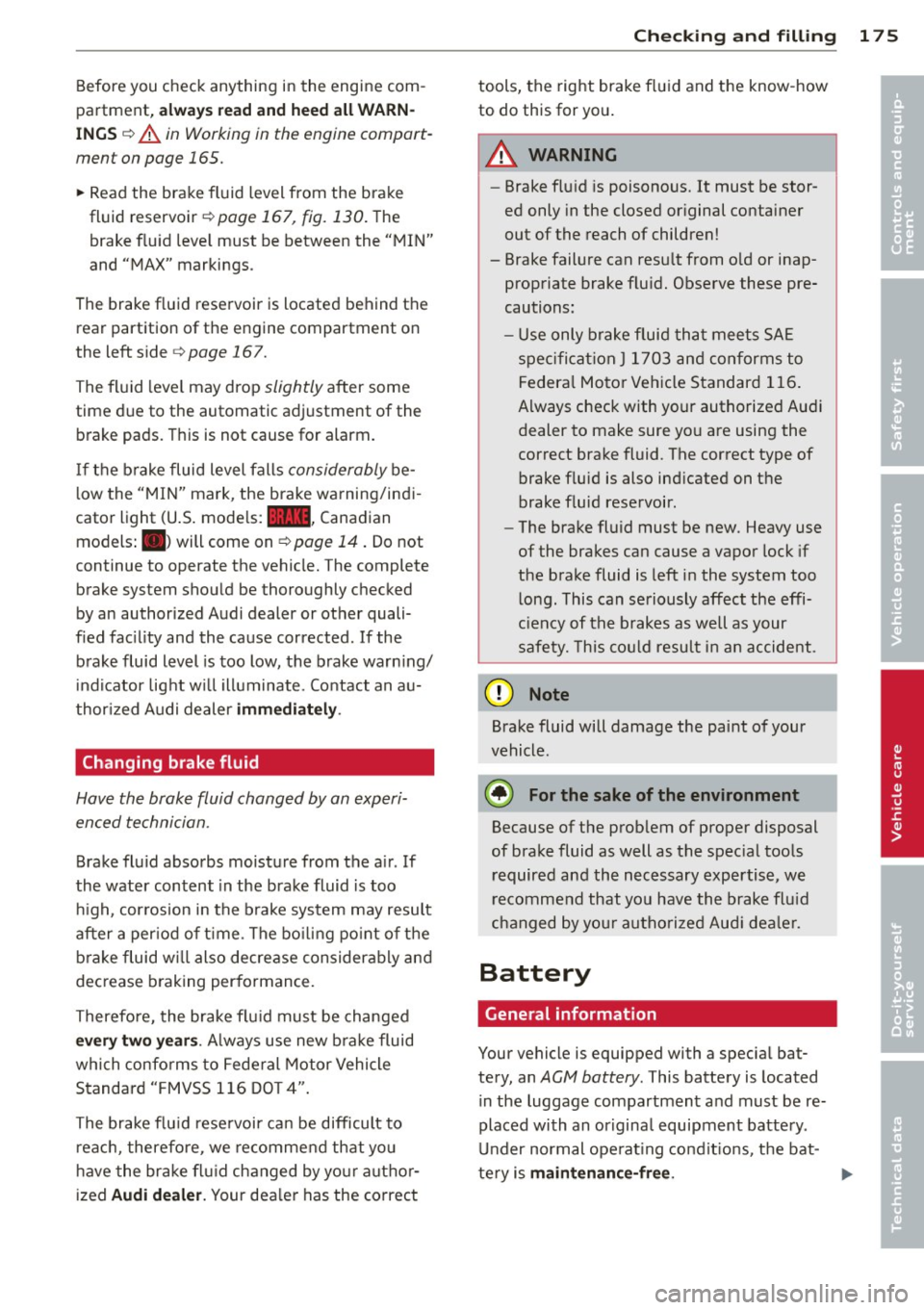
Changing brake fluid
Have the brake fluid changed by an experi
enced technician .
Brake fluid abso rbs moistu re from the a ir . If
the water content in the brake fluid is too
hi gh, cor ros ion in the b rake system may result
after a per iod of t ime . The bo iling po int of t he
b ra ke fluid w ill also decrease considerab ly and
decrease braking performance.
Therefore, the brake flu id must be changed
e very two year s. Always use new b rake fluid
which confo rms to Fede ral Motor Vehicle
Standard "FMVSS 1 16 DO T 4".
The brake flu id rese rvoi r ca n be difficult to
r each, therefo re , we recommend that yo u
h ave the brake fl uid changed by you r autho r
i zed
Audi dealer . Your deale r has the correct
Checkin g and fillin g 175
tools, the right brake fl uid and t he know -how
to do this for you .
A WARNING
-Brake flu id is poisonous. It must be stor
ed only in the closed or iginal container
out of the reach of children!
- Brake failure can res ult from o ld or inap
propriate brake f lu id. Observe these pre
cautions:
- Use only b rake fluid th at mee ts SA E
spe cificat ion
J 17 03 and conforms to
Federa l Mo to r Ve hicl e Standard 1 16.
Always check with yo ur authorized Au di
dealer to make sure yo u are using the
correct brake fluid. The cor rect type of
brake f luid is also ind icated on the
brake f luid reservoir .
- The bra ke fluid must be new. Heavy use
of the brakes ca n cause a vapor lock if
the brake fluid is left i n the system too
long. This can se riously affect the effi
c iency of the b rakes as well as your
safety , T his could result in an accide nt.
(!) Note
Brake fluid will damage the pai nt of your
vehicle.
@) For the sake of the environment
Because of the prob lem of proper disposal
of brake fluid as well as the spec ial too ls
r equired and the nec essary expertise, we
r ecommend that yo u have th e brake flu id
c hanged by you r aut ho rized Aud i dea le r.
Battery
General information
Your vehicle is equipped with a specia l bat
tery, an
ACM battery. This battery is located
in the luggage compartment and must be re
placed with an origina l equipment batte ry .
Un der normal ope rat ing condit io ns, t he bat-
te ry is
maintenanc e-free . .,.
•
•
Page 178 of 244
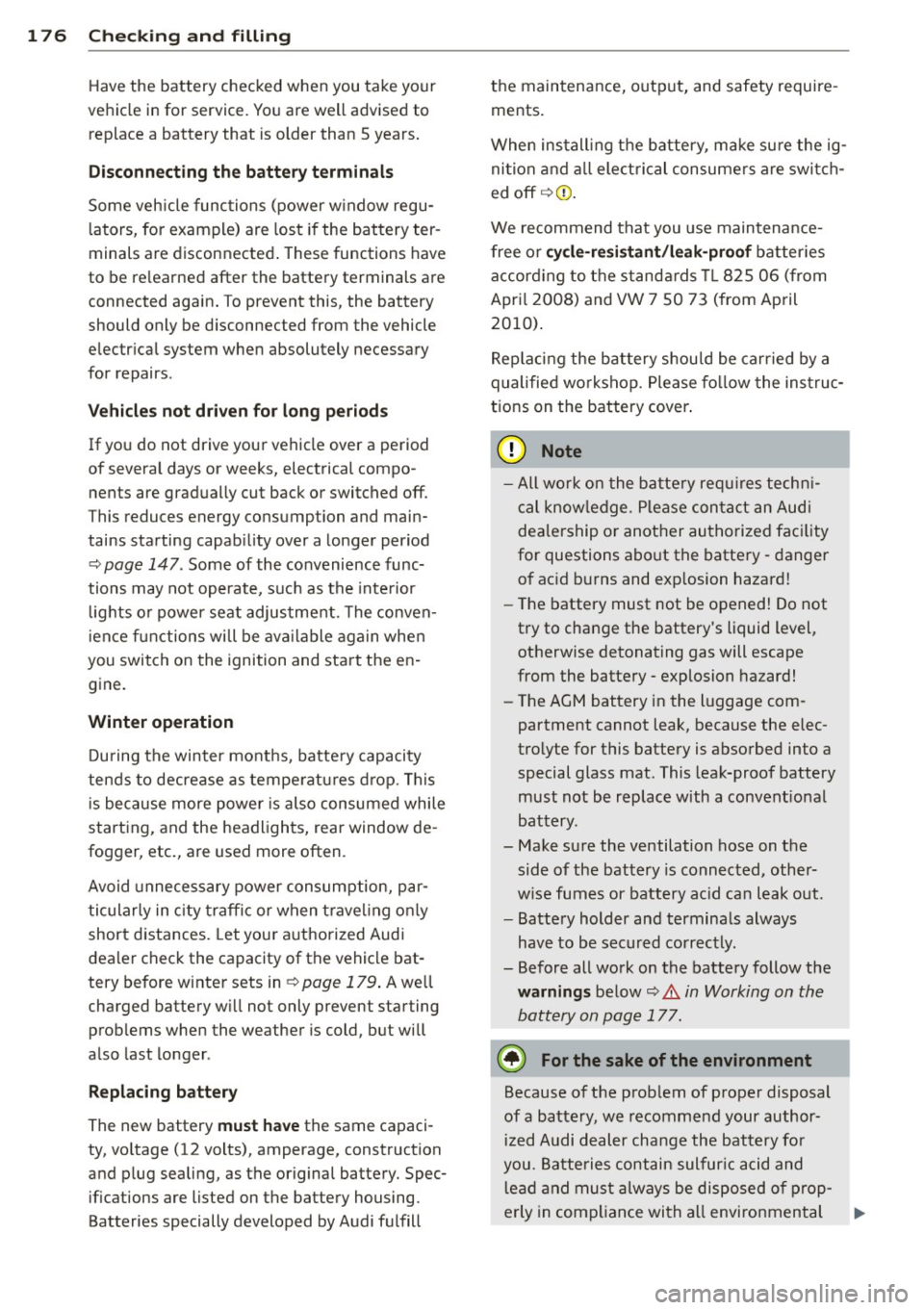
176 Check ing and filling
Have the battery checked when you take your
vehicle in for service. You are well advised to replace a battery that is older than S years .
Disconn ect ing the battery terminals
Some veh icle functions (power w indow regu
lators, for example) are lost if the battery ter
minals are disconnected . These functions have
to be re learned after the battery terminals are
connected again. To prevent this, the battery
should only be d isconnected from the vehicle
electr ical system when absolutely necessary
for repairs .
V ehicles not dri ven for l ong period s
If you do not drive your vehicle over a period
of several days or weeks, electrical compo nents are gradually cut back or switched off .
This reduces energy consumption and main tains starting capab ility over a longer period
c:::>
page 147. Some of the convenience func
tions may not operate, suc h as the inte rior
l ights or power seat adjustme nt. The conven
i ence functions wi ll be ava ilable aga in whe n
you switch on the ignition and start the en
gine.
Winter operati on
During the winter months, batte ry capacity
tends to decrease as tempe ratu res d rop . This
is because more powe r is also consumed while
start ing , and the headlights, rea r window de
fogger, etc., are used more often.
Avoid unnecessary power consumption, par
ticularly in c ity traffic or when t rave ling on ly
short distances. Let you r authorized Aud i
dea ler check the capacity of the vehicle bat
tery before winter sets inc:::>
page 179 . A we ll
charged battery w ill not only prevent starting
prob lems when the weather is cold, but will
a lso last longer .
Replacing battery
The new battery must have the same capaci
ty, vo ltage (12 volts), amperage, construction
and p lug sealing, as the origina l battery. Spec
if ications are listed on the battery housing.
Batteries specially developed by Audi fulfill the maintenance, outp
ut, and safety require
ments .
When install ing the battery, m ake su re the ig
ni tion and a ll ele ct rical consumers are switch
ed off
c:::> (i) .
We recommend that you use maintenance
free or
cy cle-re si stant /leak -proof b atter ies
accord ing to the s tanda rds TL 825 06 (from
Apri l 2008) and VW 7 SO 73 (from April
2010) .
Rep lac ing the bat tery shou ld be car ried by a
qualified wo rkshop. Please fo llow the instruc
tions on the battery cover .
(D Note
- All wo rk on the ba tte ry req uire s techn i
c al know ledge . Please con ta ct an Aud i
dealership o r another authorized faci lity
for questions abo ut the batte ry -danger
o f ac id burns and exp losion hazard!
- The battery must not be opened! Do not
try to change the battery's liquid level,
otherwise detonating gas will escape
from the battery - explosion hazard!
- The AGM battery in the l uggage com
partment cannot leak, because the elec
tro lyte for this battery is absorbed into a
special glass mat. This leak-proof battery
must not be replace with a convent ional
battery.
- Make sure the ventilation hose on the
side of the battery is connected, other
w ise fumes or battery ac id can leak out .
- Batte ry holder and termina ls always
have to be secured correctly .
- Before all work on the battery follow the
warnings be low c:::> .&. in Working on the
battery on page 177.
@ For the sake of the environment
Because of the prob lem of proper disposal
of a battery, we recommend your author
iz ed Audi dealer change the battery for
you. Batteries contain sulfur ic acid and
l ead and must a lways be disposed o f prop-
erly in compliance wi th al l envi ronmental ..,.
Page 202 of 244
200 Tires and wheels
remain continuo usly illuminated . This se
quence will continue upon subsequent vehicle
start-ups as long as the ma lfunction ex ists.
When the malfunction indicator is illuminat
ed, the system may not be able to detect or
signal low tire pressure as intended. TPMS
malfunctions may occur for a variety of rea
sons, including the installation of replace ment or alternate tires or wheels on the vehi
cle that prevent the TPMS from functioning properly . Always check the TPMS malfunction
tellta le after replacing one or more t ires or
wheels on your veh icle to ensure that the re
placement or alternate tires and wheels allow
the TPMS to continue to function properly.
Tire pressure indicator appears
Applies to vehicles: with tire pressure monitoring system
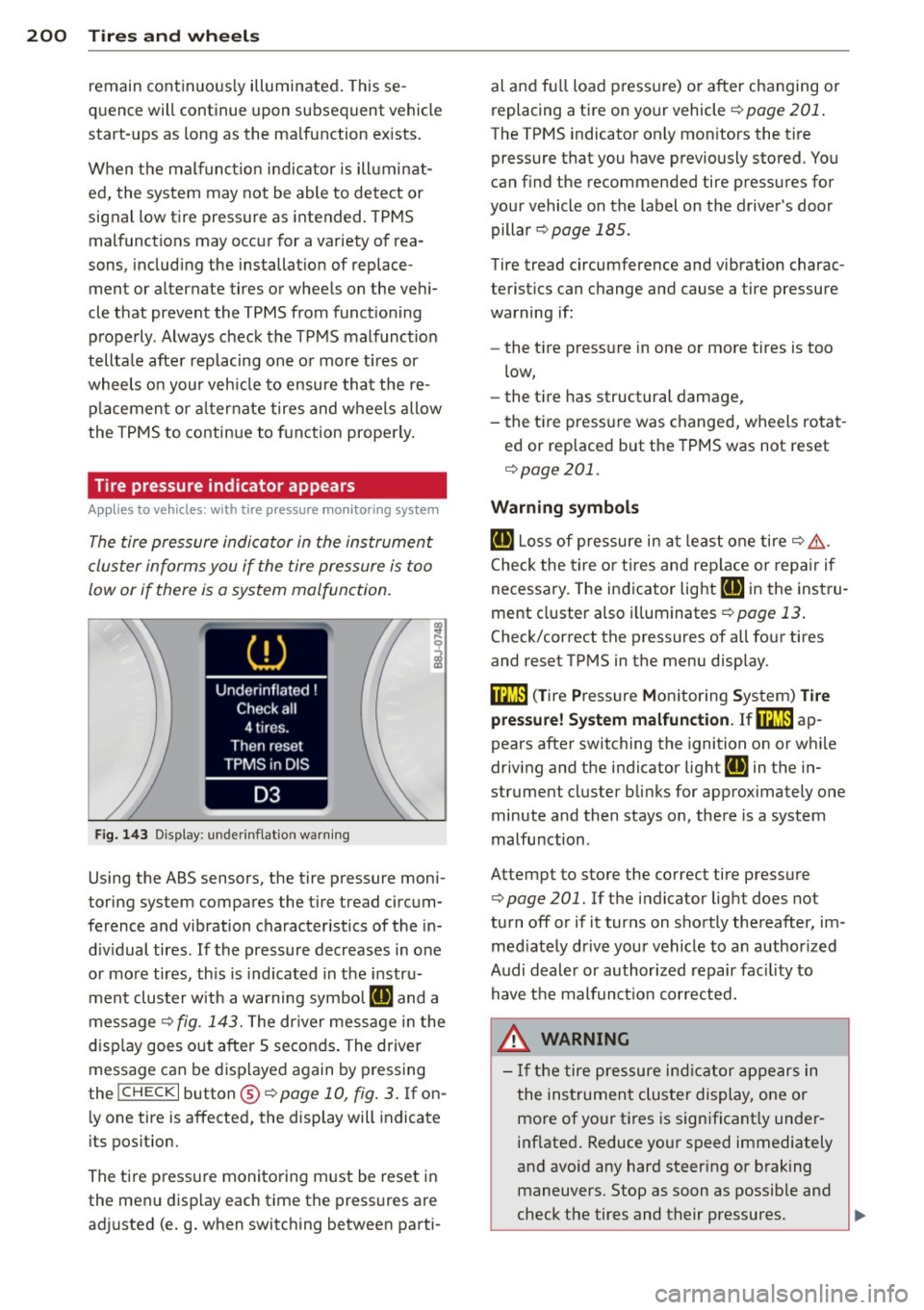
The tire pressure indicator in the instrument
cluster informs you if the tire pressure is too
low or if there is a system malfunction.
F ig. 143 Display : underi nflat io n warn ing
Using the ABS sensors, the tire pressure moni
toring sys tem compares the t ire tread circum
ference and vibration characteristics of the in
d iv idual tires . If the pressure decreases in one
or more tires, th is is indicated in the instru
ment clus ter with a warning symbo l
ail and a
message<>
fig. 143. The dr iver message in the
display goes out after 5 seconds . The driver
message can be displayed again by pressing
the
! CHECK I button @¢ page 10, fig . 3 . If on
l y one tire is affected, the display will indicate
its pos ition.
The tire press ure monitoring m ust be reset in
the menu display each time the pressures are
ad justed (e.g. when switching between parti- al and fu
ll load pressure) or after changing or
replacing a tire on your vehicle<>
page 201.
The TPMS indicator only mon itors the t ire
pressure that you have previously stored . You
can find the recommended tire pressures for
your vehicle on the label on the driver's door
pillar
¢ page 185.
Tire tread circumference and vibration charac
teristics can change and cause a tire pressure
warning if:
- the t ire pressure in one or more tires is too
low,
- the tire has structural damage,
- the tire pressure was changed, wheels rotat -
ed or replaced but the TPMS was not reset
¢ page 201.
Warning symbols
ail Loss of pressure in at least one tire¢& .
Check the tire or tires and replace or repa ir if
necessary . The indicator light
HE in the instru
ment cluster also illuminates
<>page 13.
Check/correct the pressures of all four tires
and reset TPMS in the menu display .
ffim (T ire Pressure Monitoring System) Tire
pressure! System malfunction. Ifffim
ap
pears after switching the ignition on or while
driv ing and the indicator lig ht
HE in the in
strument cluster blinks for approx ima tely one
minute and then stays on, there is a system
malfunction .
At tempt to store the correct tire pressure
¢ page 201. Ifthe indicator light does not
turn
off or if it turns on shortly thereafter, im
med iate ly drive your vehicle to an author ized
Audi dealer or author ized repair facility to
have the malfunction corrected.
_&. WARNING
-
- If the tire pressure indicat or appears in
the instrument cluster display, one or
more of your tires is significant ly under
inflated . Reduce your speed immediately
and avoid any hard steer ing or braking
maneuvers. Stop as soon as possible and
check the tires and their pressures.
IJJ,,
Page 203 of 244
Inflate the tire pressure to the proper
pressure as indicated on the vehicle's tire
pressure label¢
page 185. Driving on a
significantly under-inflated tire causes
the tire to overheat and can lead to tire
failure . Under-inflation also is likely to
impair the vehicle's handling and stop
ping ability.
- The driver is responsible for mainta ining
the correct tire pressures. You must
check the tire pressures regularly.
- Under certain conditions (such as a spor
ty driving style, wint er conditions or un
paved roads), the pressure monitor indi
cator may be delayed .
- Ask your authorized Audi dealer if run
flat tires may be used on your vehicle.
Your vehicle registration becomes invalid if you use these tires when not permit
ted. Damage to your vehicle or accidents
could also result.
- If you switch between standard and run
flat tires, an authorized Audi dealer or
qualified workshop must reprogram the
control module .
@ Tips
-The tire pressure monitoring system
stops working when there is an ESC/ABS
malfunction.
- Using snow chains may result in a system
malfunction.
- The tire pressure monitoring system on
your Audi was developed using tires with the "AO" or "RO" identification on the
tire sidewall¢
page 192. We recom
mend using these tires.
Tires and wheels 201
Reset tire pressure monitoring system
(Stepl)
Appl ies to vehicles: wi th tire p ress ure mo nito ring system
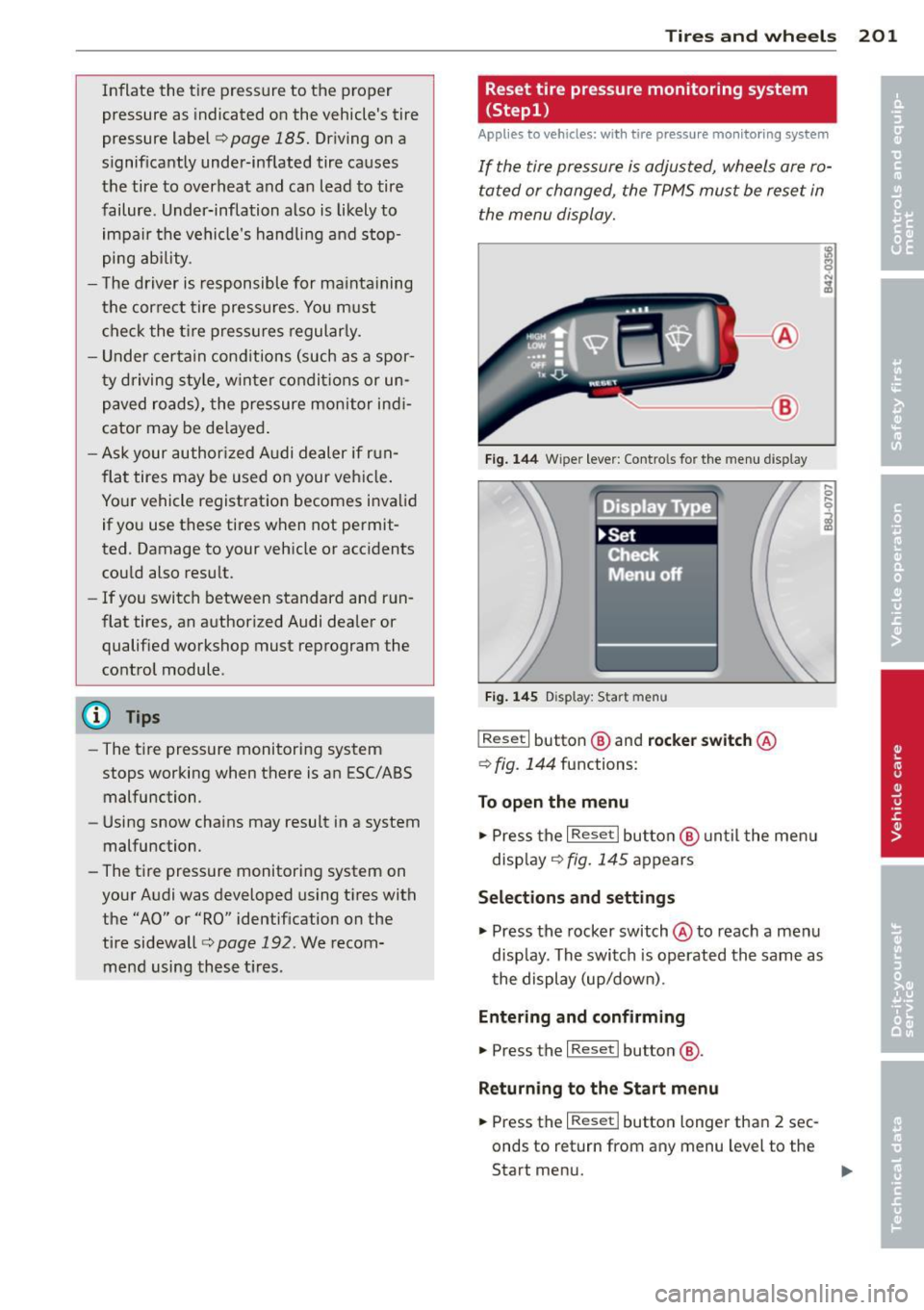
If the tire pressure is adjusted, wheels ore ro
tated or changed, the TPMS must be reset in
the menu display.
--- ®
Fig. 144 Wiper lever : Controls for the menu display
Fig. 145 Display: Start menu
I Reset I button @ and rocker switch @
¢
fig. 144 functions:
To open the menu
.,. Press the I Reset I button @ until the menu
disp lay
9 fig. 145 appears
Selections and settings
.,. Press the rocker switch@ to reach a menu
disp lay. The switch is operated the same as
the display (up/down) .
Entering and confirming
.,. Press the I Reset I button @.
Returning to the Start menu
.,. Press the I Reset I button longer than 2 sec
onds to return from any menu level to the
Start menu. "'
Page 216 of 244
214 Fuses and bulbs
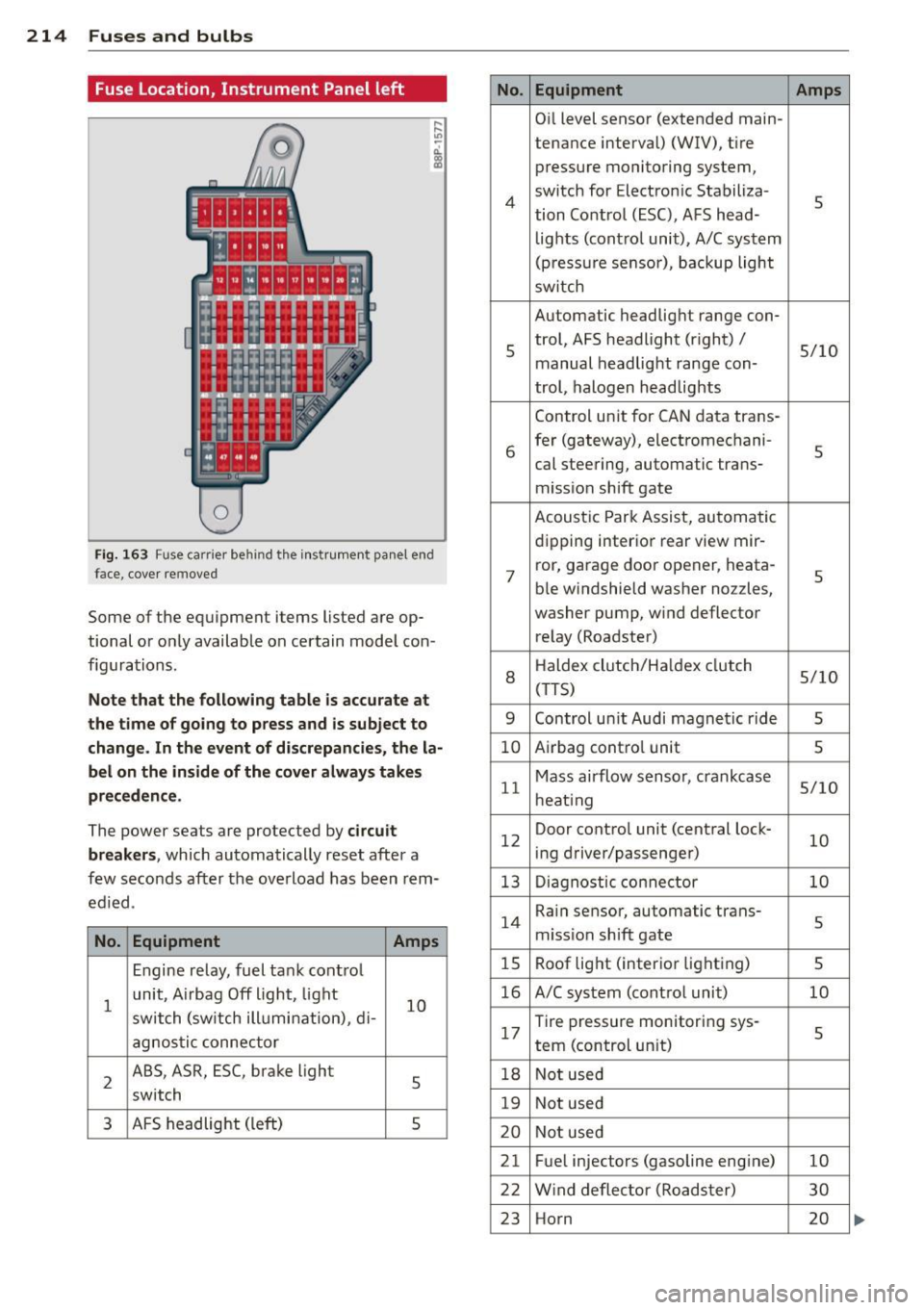
Fuse Location, Instrument Panel left
0
Fi g. 163 Fuse carrier behind the instrument panel end
face, cove r removed
Some of the equipment items listed are op
tional or only available on certain model con
figurations .
Note that the following table is accurate at
the time of going to press and is subject to
change. In the event of discrepancies, the la
bel on the inside of the cover always takes
preceden ce .
The power seats are protected by circuit
breaker s,
which automatically reset after a
few seconds after the overload has been rem
ed ied.
No . Equipment Amps
Engine relay, fuel tank control
1
unit, A irbag Off light, light
10 switch (sw itch illumination), d i-
agnos tic connector
2
ABS, ASR, ESC, brake light
5 switch
3 AFS headlight (left) s
No.
4
5
6
7
8
9
10
11
12
13
14
15
16
17
18
19
20
21
22
23
Equipment Amps
Oil level sensor (extended main-
tena nce interval) (WIV), tire
pressure monitoring system,
switch for Electronic Stabiliza-
s tion Control (ESC), AFS head-
lights (control unit), A/C system
(pressure sensor), backup light
sw itch
Automatic headlight range con-
trol, AFS headlight (right) /
5/10
manual headlight range con-
trol, halogen headlights
Control unit for CAN data trans-
fer (gateway), electromechani-
s cal steering, automatic trans-
mission shift gate
Acoustic Park Assist, automatic
dipping interior rear view mir- ror, garage door opener, heata-
s ble windshield washer nozzles,
washer pump, wind deflector
relay (Roadster)
H aldex clutch/Ha ldex clutch
5/10 (T TS)
Control un it Audi magnetic ride
s
Airbag contro l unit s
Mass airflow sensor, crankcase 5/10
heating
Door control unit (central lock-
10 ing driver/passenger)
Diagnostic connector
10
Rain sensor, automatic trans-
s miss ion shift gate
Roof light (interior lighting)
5
A/C system (control unit) 10
Tire pressure monitoring sys-
5 tern (control un it)
Not used
Not used
Not used
Fuel injectors (gasoline engine)
10
Wind deflector (Roadster) 30
Horn 20