air condition AUDI TT ROADSTER 2014 User Guide
[x] Cancel search | Manufacturer: AUDI, Model Year: 2014, Model line: TT ROADSTER, Model: AUDI TT ROADSTER 2014Pages: 244, PDF Size: 60.87 MB
Page 121 of 244
-The inflating airba g will hit the child
safety seat or infant carrier wit h great
f o rce and w ill smash t he ch ild safety seat
and child aga inst the backrest, center
arm rest, d oor or roof.
- Never install a r earward facing child
sa fety seat on the front pass eng er s eat
unless the
PASSENGER AIR BAG OFF
light c omes on and stays on. If the PAS
S ENGER AIR BAG OFF
ligh t does no t
come on and stay on, the inflating airbag
will hit the child safety seat or infant car
rier with great force and will smash the
child safety seat and child against the
backrest, door or roof. Have the airbag
system inspected immediately by your
authorized Audi dealer .
A WARNING
Objects between you and the a irbag will
increase the risk of injury in a crash by in
terfering with the way the airbag unfolds
or by being pushed into you as the a irbag
inflates.
- Never hold th ings in your hands or on
your lap when the vehicle is in use .
- Never transport items on or in the area
of the front passenge r seat. Objects
cou ld move into the area of the front air
bags dur ing braking or other s udden ma
neuver and become dangerous projec
ti les that can cause serious personal in
jury if the airbags inflate.
- Never place o r attach accessories or oth
er objects (such as cup ho lders, tele
phone brackets, large, heavy or b ulky ob
jects) on the doors, over or near the area
marked "AIRBAG" on the steering wheel,
instrument panel, seat backrests or be
tween those a reas and yourself. These
objects could cause injury in a crash, es
pecially when the airbags inflate.
- Never recline the front passenger's seat
to transport objects. Items can also
move in to the area of the side airbag or
the front airbag dur ing braking or in a
sudden maneuver . Objects near the air -
-
Airbag system 119
bags can become projectiles and cause
inju ry, partic ularly when the seat is re
clined.
A WARNING
The fine dust created when airbags deploy
can cause breathing prob lems for people
with a history of asthma or other breath
ing cond itions.
- To reduce the risk of breath ing problems,
those with asthma o r other respiratory
conditions shou ld get fresh air r ight
away by getting o ut of the veh icle or
open ing windows or doors.
- If you are in a collision in which airbags
deploy, was h your hands and fa ce with
mild soap and wate r before ea ting.
- Be ca reful not to get the dust into your
eyes, o r into any cuts or sc ratches .
- If the resid ue should get into your eyes,
f lush them w ith wate r.
Monitoring the
Advanced Airbag System
t!~ Airbag monitoring indicator light
Two separate indicators monitor the function
of the Advan ced Airbag System: the airbag
monitoring indi cator light and the
PASSEN
GER AIR BAG OFF
light.
T he Advanced A irbag System (including the
electron ic co ntro l unit, sensor circu its and sys
tem wir ing) is monitored con tinuously to
make sure that it is functioning properly
whenever the ignition is on. Each time you
turn on the ignition, the a irbag mon itoring in
dicator light
I will come on for a few seconds
(self diagnostics).
The sy stem mu st be in spected when th e
indicator light
I :
- does not come on when the ignition is
sw itched on,
- does not go out a few seconds after you
have switched on t he ignition, or
•
•
Page 132 of 244
130 Child Safety
Child Safety
Important things to know
Introduction
The physical principles of what happens when
your vehicle is in a crash apply also to children
c::> page 102, What happens to occupants not
wearing safety belts? .
But unlike adults and
teenagers, their muscles and bones are not
fully developed . In many respects children are
at greater risk of serious injury in crashes than
adults.
Because children's bodies are not fully devel
oped, they require restraint systems especial
ly designed for their size, weight, and body
structure . Many countries and all states of the
United States and provinces of Canada have
laws requiring the use of approved child re
straint systems for infants and small children.
In a frontal crash at a speed of 20-35 mph
(30-56 km/h) the forces acting on a 13-pound
(6 kg) infant will be more than 20 times the
weight of the child. This means the weight of
the child would suddenly be more than 260 pounds (120 kg). Under these conditions,
only an appropriate child restraint properly used can reduce the risk of serious injury.
Child restraints, like adult safety belts, must
be used properly to be effective. Used improp
erly, they can increase the risk of serious in
jury in an accident.
Consult the child safety seat manufacturer's instructions in order to be sure the seat is
right for your child's size
c::> page 133, Impor
tant safety instructions for using child safety
seats.
Please be sure to read and heed all of
the important information and WARNINGS
about child safety, Advanced Airbags, and the
installation of child restraints in this chapter.
There is a lot you need to know about the Ad
vanced Airbags in your vehicle and how they
work when infants and children in child re
straints are on the front passenger seat. Be
cause of the large amount of important infor- mation, we cannot repeat it all here. We urge
you to read the detailed information in this
owner's manual about airbags and the Ad
vanced Airbag System in your vehicle and the
very important information about transport ing children on the front passenger seat.
Please be sure to heed the WARNINGS - they
are extremely important for your safety and
the safety of your passengers, especially in
fants and small children.
A WARNING
-
All vehicle occupants and especially chil
dren must be restrained properly whenev
er riding in a vehicle. An unrestrained or
improperly restrained child could be in
jured by striking the interior or by being
ejected from the vehicle during a sudden maneuver or impact. An unrestrained or
improperly restrained child is also at great
er risk of injury or death through contact
with an inflating airbag.
_& WARNING
Children on the front seat of any car even
with Advanced Airbags can be seriously in
jured or even killed when an airbag in
flates. A child in a rearward-facing child
safety seat installed on the front passen
ger seat will be seriously injured and can
be killed if the front airbag inflates.
- The inflating airbag will hit the child
safety seat or infant carrier with great
force and will smash the child safety seat
and child against the backrest, door or roof.
- Never install a rearward facing child
safety seat on the front passenger seat
unless the
PASSENGER AIR BAG OFF
light comes on and stays on. If the PAS·
SENGER AIR BAG OFF
light does not
come on and stay on, have the airbag
system inspected immediately by your
Audi dealer.
.
Page 144 of 244
142 Intelligent technology
Intelligent technology
Notice about data
recorded by vehicle
control modules
Your vehicle is not equipped with an Event Da
ta Recorder (EDR), installed by some manu
facturers fo r the express purpose of capturing
data for retrieval after an accident or crash
event . EDR's are sometimes ca lled "crash re
corders".
Some state laws restrict the retr ieval or down
loading of data stored by EDR's that were in
stalled in a vehicle for the express purpose of
retrieving data after an accident or crash
event without the owner's consent.
A lthough your vehicle is not equipped with an
EDR, it is equipped with a number of electron
ic control modules for various vehicle systems
such as, for examp le, eng ine function, em is
sion control, as well as for the airbags and
safety belts.
These electronic contro l modules also record
vehicle-re lated data during normal vehicle op
eration for diagnostic and repair purposes.
The recording capacity of the electronic con
trol modules is limited to data (no sound is re
corded) and only a small amount of data is ac
tually recorded over a very limited pe riod of
time and stored when a system fault or other
condition is sensed by a control unit. Some of
the data then stored may relate to vehicle
speed, direction, braking as we ll as restraint
system use and performance in the event of a
crash or other condition. Stored data can only
be read and downloaded with special equip
ment.
Electronic Stabilization
Control (ESC)
Description
ESC helps to improve road holding and vehicle
dynamics to help reduce the probability of
skidd ing and loss of vehicle control. It works
only when the engine is running. ESC detects certain difficult driving situat
ions, including
when the vehicle is beginning to spin (yaw)
out of control and helps you to get the veh icle
back under control by se lectively braking the
wheels, and/or reducing engine power and
providing steering assistance to help hold the
vehicle on the driver's intended course. The in
dicator light
G) in the instrument cluster
blinks when ESC is taking action to help you
control the vehicle.
ESC has limitations.
It is important to remem
ber that ESC cannot overcome the laws of
physics. It wi ll not always be able to help out
under all conditions you may come up against.
For example, ESC may not always be able to
help you master situations where there is a
sudden change in the coefficient of friction of
the road surface. When there is a section of
dry road that is suddenly covered with water,
slush or snow, ESC cannot perform the same
way it wou ld on the dry surface . If the vehicle
hydroplanes (rides on a cushion of water in
stead of the road surface), ESC will not be
able to help you steer the vehicle because con
tact with the pavement has been interrupted
and the vehicle cannot be braked or steered.
During fast cornering, particularly on winding
roads, ESC cannot always deal as effectively
with difficult driving situations as at lower
speeds.
Always adjust your speed and driving style to
road , traffic §&and weather conditions. ESC
cannot override the vehicle's physical limits,
increase the available traction, or keep a vehi
cle on the road if road departure is a result of
driver inattention . Instead, ESC improves the
poss ibility of keeping the vehicle under con
t rol and on the road dur ing extreme maneu
vers by using the driver's steering inputs to
help keep the vehicle go ing in the intended di
rection . If you are traveling at a speed that
causes you to run off the road before ESC can
provide any assistance, you may not experi
ence the benefits of ESC.
ESC includes and/or works togethe r with the
anti- lock brake system (ABS), brake assist sys-
tem and anti-slip regu lation (ASR). ESC is .,..
Page 155 of 244
Avoid full throttle
Driving at moderate speeds saves fuel and
improves your mileage.
""Try and keep well below your car's maximum
speed.
Accelerating gently reduces fuel consump
tion, engine wear, and does not disturb the
environment.
Fu el consumption, exhaust emissions and en
g ine noise increase disproportionately at high
speeds. If you drive at approximately three
quarters of top speed, fuel consumption will
be reduced by one half. Never drive faster
than the posted speed limit and weather con
ditions permit .
Reducing unnecessary idling
Even when your car is just idling it burns up
fuel.
""Shut the engine off when you are not driving
the vehicle.
""Do not warm up the vehicle by letting the
engine run at idle .
It makes sense to shut
off the engine in traff ic
jams, when waiting for trains to pass at ra il
road crossings, or at traffic lights that have
l ong wa its on red. Turning the engine
off for
just
30-40 seconds saves more fue l than is
burned starting the engine again .
It takes a long time for the engine to warm up
fully when it is running at idle. However, wear
and noxious emissions are especially high
when the engine is warming up. So you should
drive away as soon as you start the engine and
avoid running at high RPMs whi le the engine
is sti ll warming up .
(D Note
Do not leave engine idling unattended af
ter starting . If warning lights should come
on to indicate improper operation, they
would go unheeded. Extended idling also
produces heat, which could result in over-
Driving and environment 153
'
heating or othe r damage to the vehicle or
other property.
Regular maintenance
A badly tuned engine unnecessarily wastes a
lot of fuel.
""H ave your veh icle serviced at regular inter-
vals.
By having your vehicle regu larly serviced by an
Audi dealer helps to ensu re that it runs prop
erly and economically. The condition of your
vehicle not only affects its safety and ability to
hold its value, it also affects
fuel consump
tion.
Check your oil each time you fill your tank.
The amount of o il used is related to engine
load and speed.
It is normal for the oil consumption of a new
engine to reach its lowest value after a certain
mileage has been driven.
You must drive your vehicle about 3,000 miles
(5,000 kilometres) before you can properly
assess oil consumpt ion.
This also app lies to fue l consumption and en
gine output.
(U) Note
- Have your vehicle maintained properly
and in accordance with the service rec
ommendations in your Warranty
& Main
tenance booklet. Lack of proper mainte
nance as well as improper use of the ve
hicle will impair the function of the
emission control system and could lead
to damage.
- Do not alter or remove any component of
the Emission Control System unless ap
proved by the manufacturer.
- Do not alter or remove any device, such
as heat shields, switches, ignition wires,
valves, which are designed to protect
your vehicle's Emission Control System
and other important vehicle compo
nents .
•
•
Page 170 of 244
168 Checking and filling
oils available today provide better engine lu
brication that can outlast traditional petrole
um-based oils, making them a smart choice
for use throughout the life of your Audi.
Whether you use synthetic or petroleum
based engine oil, the oil that you use must
conform to Audi's oil quality standard
VW 502 00 to help keep your vehicle's engine
running smoothly and help prevent the for
mation of harmful deposits, sometimes called
"sludge," that over t ime can lead to expensive
repairs .
At the time of printing, engine oils available in
the U .S . and Canada that meet the exacting
specifications of Audi oil standard VW 502 00
are synthetic engine oils. This does not mean, however, that every synthetic engine oil will
meet Audi oil standard VW 502 00. So always
be sure that you use an approved oil.
To help prevent the formation of harmful de posits use only oil with the following specifi
cations printed on the oil container:
Audi oil standard VW 502 00
Oil container labels may carry the specifica
tion singly or in combination with other desig
nations and oil quality standards .
Viscosity
Engine oils are graded according to their vis
cosity. The proper viscosity grade oil for your
engine depends on climactic or seasonal con
ditions where you drive. You can use oil with a
viscosity grade of SAE 5W40 across all tem
perature ranges for normal driving conditions.
However, if engine oil viscosity grade SAE
5W40 is not available, you can also use viscos
ity grade SAE 5W-30 or SAE OW-40 as long as
it meets Audi oil quality standard VW 502 00
specifications .
Because engine oil that meets the Audi oil
standard may not be available everywhere
when you need it, we strongly recommend
that you always carry with you an extra quart (liter) of oil that expressly conforms to the VW 502 00 specification, in case you have to
top
off the oil while on the road.
Only if the level of the oil is at or below the
minimum mark on the oil dipstick - and no oi l
that expressly conforms to Audi oil standard
VW 502 00 specifications is available -may
you top
off with a high quality engine oil, pref
erably synthetic-based, that meets ACEA A3
or API SM specifications, but even then, only
in viscosity grades SAE SW-40, SAE 5W-30, or
SAE OW-40 . However, during the entire time
between oil change intervals, never top
off
with more than a total of 0.5 qt/liter engine
oil that does not conform to Audi oil specifica
tion VW 502 00.
For more information about engine oil that
has been approved for your vehicle, please
contact either your authorized Audi dealer o r
Audi Customer Relations at 1 (800) 822-2834
or visit our web site at www.audiusa.com or
www.audicanada.ca . Here you will also find a
current list of oils (manufacturers, brand
names etc.) that conform to Audi oil standard
vw 502 00.
Changing the engine oil
The engine oil and oil filter must be changed
according to the mileage (kilometers) and
time intervals specified in your vehicle's War
ranty
& Maintenance booklet. Do not exceed
these intervals -harmful deposits from old
engine oil can reduce engine performance and
can lead to expensive engine repairs.
Changing the oil at the recommended inter
vals is so very important because the lubricat
ing properties of oil decrease gradually during
normal vehicle use. If you are not sure when
you have your oil changed, ask your author
ized Audi Service Advisor.
Under some circumstances the engine oil
should even be changed more frequently. Change oil more often if you drive mostly
short distances, operate the vehicle in dusty
areas or mostly under stop-and-go traffic con
ditions, or when you use your vehicle where
temperatures stay below freezing point for
long periods.
Page 174 of 244
172 Checking and filling
@ For the sake of the environment
- Before changing your oil , first make sure
you know where you can properly dispose
of the used o il.
- Always dispose of used engine oil proper
l y. Do not dump it on garden soi l, wood
ed areas, into open streams or down
sewage dra ins.
- Recycle used engine oil by taking it to a
used engine o il collection facility in your
area, or contact a service station .
Engine cooling system
Coolant
The engine coolant performs two functions: it
keeps the engine from overheating and it pro tects the engine from freezing in the winter.
The cooling system is sea led and generally re
q uir es little attention .
The cooling system has been filled at the fac
tory with a pe rmanent coolant which does not
need to be c hanged. The coolant consists of a
mixture of spec ia lly condi tioned water and the
manuf acturer 's glyco l-b asedcoolan t addi -
tive G l3 antifreeze with ant icorros ion addi
tives (50% for USA models ; 60% for Canadian
mod els). This mixture both assures the nec es
sary frost protection and p rotects metal com
ponents in the engine's cooling system from
corrosion and scaling . It a lso raises the boil
ing point of the coo lant .
Do not red uce the concentration o f the coo l
ant in the summer by adding plain water.
The
proportion of coolant add itive must be at
l e a st 50 % but not more than 60 %
to main
tain antifreez e protection and cooling efficien
cy . If the coolant frost prote ct ion is too low,
the coo lant cou ld free ze and damage the veh i
cle hea ting and eng ine cooling system.
For yea r-round d riving, antifreeze is added at
the fac to ry for temperatures down to:
-- 31°F( -35°C)USA
- -40 °F ( -40 °C) Canada. If
you must add coolant, use a mixture o f wa
ter and coolant additive . Mixing the coo lant
additive with distilled water is recommended.
A WARNING
-
Before you c heck anything in the engine
compartment, always read and heed a ll
WAR NINGS
c::, & in Working in the engine
compartment on page 165.
(D Note
- Before winter sets in, have the coo lant
checked to see if the coolant additive in
your vehicle is sufficient to meet the cli m ate conditions . This is especia lly impor
tan t if you live in a reg io n wher e the win
t er is ex treme ly col d. If ne cessa ry, i n
crease the proportion of coo lant add itive
t o 60%.
- Whe n adding coolant additive to yo ur
c oolin g sys tem, remembe r:
- We recommend using on ly coolant ad
d itive Gl2++ or Gl3 for your vehicle .
This coolant additive is avai lab le at au
thor ized Audi dealers . Other types of
ant ifre eze can s ignificant ly reduce cor
rosion prote ctio n. T he resulti ng cor ro
sion can ca use a lo ss o f coolan t and se
rio us en gine d amage.
- Do not add any ty pe of rad iator leak seal
a n t t o y our vehicle 's engine coolant.
Add ing radiator rep air fl uid may adverse
ly affect the function and performance of
yo ur cooling system and co uld resu lt in
damage not covered by yo ur New Vehicle
Limited Warranty.
-
Page 188 of 244
186 Tire s and wheel s
you have stored . The system does not
recognize the load condition of your vehicle.
The effectiveness of the tire pressu re monito r
ing system w ill be impaired if yo u store nor
mal load pressures but then operate the vehi
cle at its maximum load¢.&..
See the il lustration¢
fig. 138 for the location
of the label on dr iver's side 8-pillar (color of
the actua l labe l and exact location on the ve
hicle wi ll vary slightly).
Note that the followi ng tab le is accurate a t
the time o f go ing to press and is subject to change. In the
event of discrepancies, the t ire
pressure label (on driver's side 8-pi llar) a lways
takes precedence .
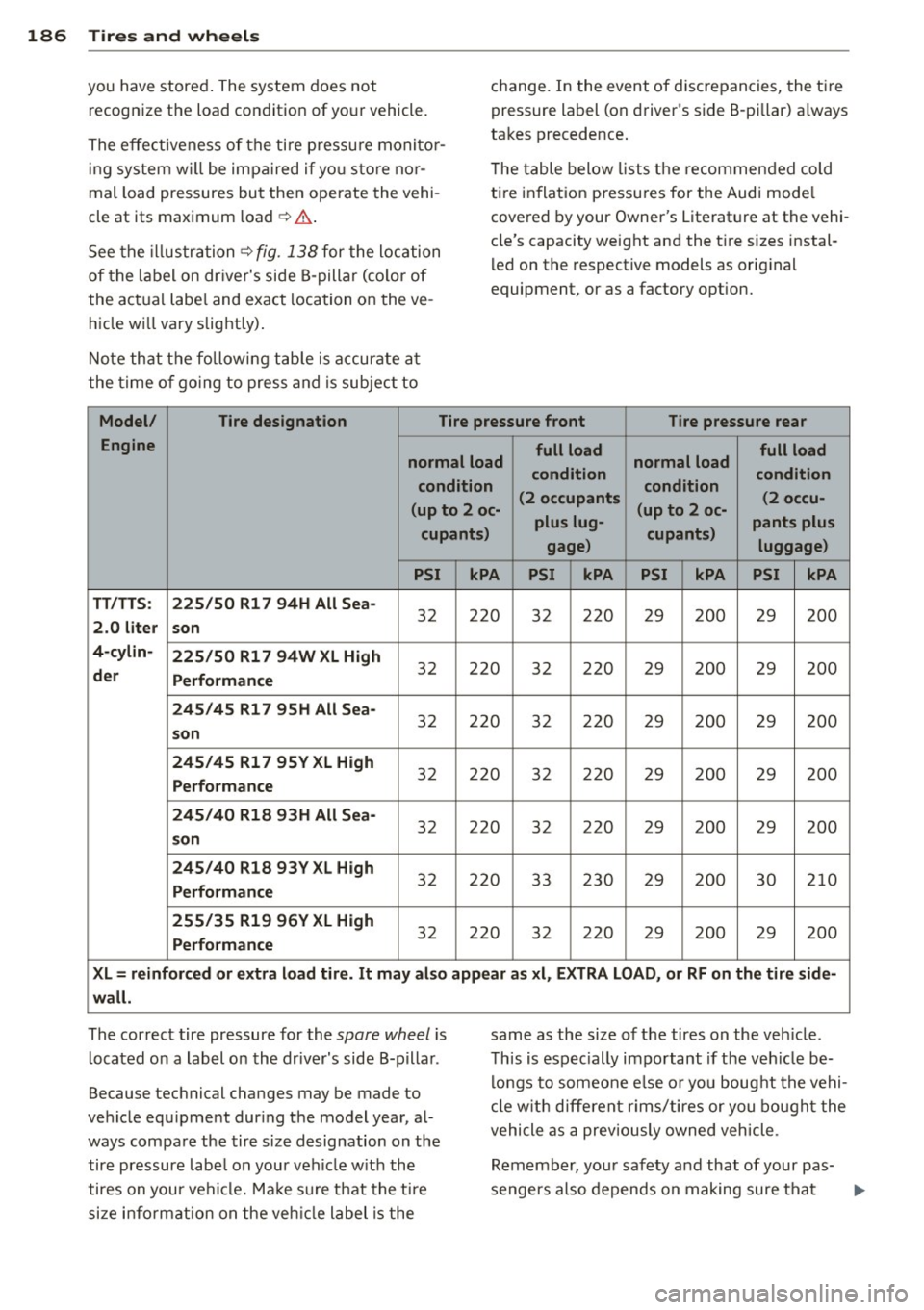
T he table below lists the recommended cold
ti re inflation pressu res for the Audi mode l
covered by your Owner's Literature at the vehi
cle's capacity weight and the t ire sizes instal
l ed on the respective models as original
equipment, or as a factory option.
Model/ Tire designation
Tire pressure front Tire pressure rear
Engine full load full load
no rmal load
condition normal load
condition
condition (2 occupants condition
(2 occu-
( up to 2 oc-
plus lug- (up to 2 oc-
pants plus
cupants)
gage) cupants)
luggage)
PSI kPA PSI kPA PSI kPA PSI kPA
TT /TTS : 22 5/50 Rl 7 94H All Sea -
32 220 32 220 29 200 29 200 2.0 liter son
4-c ylin-225 /50 Rl 7 94W XL High
d er
Perf orm ance
32 220 32 220 29 200 29 200
2
45 /4 5 Rl 7 95 H All Sea-
32 220 32 220 29 200 29 200 son
245 /45 Rl7 95YX L High
32 220 32 220 29 200 29 200 Perf ormance
245 /40 R1 8 93H All S ea-
32 220 32 220 29 200 29 200 son
2 45 /40 Rl8 9 3Y XL High
32 220 33 230 29 200 30 210 Perform ance
25 5/35 Rl 9 96Y XL Hi gh
32 220 32 220 29 200 29 200 Perf or mance
X L= r ein for ce d or e xtra lo ad tire . It m ay also a ppear as xl, EX TRA LO AD, or RF on th e tire side-
w all.
The correct tire pressure for the spare wheel is
l ocated on a label on the driver's side 8-pillar.
Because technical changes may be made to
vehicle equ ipment dur ing the model year, al
ways compare the tire size designation on the
tire pressure labe l on your vehicle w ith the
tires on your vehicle. Ma ke sure that the tire
size information on the vehicle label is the same
as the size of the tires on the veh icle.
T his is espec ially important if the veh icle be
longs to someone e lse or you boug ht the vehi
cle w ith different rims/tires or you bought the
vehicle as a previously owned veh icle.
Remember, your safety and that of your pas-
sengers also depends on making sure that
II>-
Page 195 of 244
handling when in good condition and properly
inflated¢&..
We recommend that all wo rk on tires and
wheels be perfo rmed by an au thorized A udi
dea ler. They are familiar with recommended
proced ures and have the necessary special
too ls and spare parts as we ll as the proper fa
cilities for dispos ing of the old tires.
Authorized Audi dealers have the necessary information about technica l requirements for
insta lling or changing tires and r ims.
R eplacing t ire s an d wheel s
Tires s hou ld be rep laced at least in pairs and
not individua lly (for example both front t ires
or both rear tires together).
Be sure to read and heed the information to
the t ire pressure monitor ing system
¢page 199.
Always buy rep lacement radial tires that have
the same specifications as the tires approved
for your ve hicl e by Audi. Replacement t ires
must always have the same load rating speci
fication as the original equipment or approved optional tires listed in the table
¢ page 185.
Aud i-approved specifica tion ti res are specially
matched to you r vehicle and its load limits,
and can contribute to the important road ho ld
ing, driving characteristics, and safety of the
vehicle. The table
( q page 185) lists specifica
tions of the t ires approved for the Audi mod
e ls covered by your Owner's Literature .
The tire pressure labe l located on driver's side
B-pillar
( q page 185, fig. 139) lists the speci
fications of the orig inal equipment tires in
stalled on your veh icle at the time it was man
ufactured .
Federal law requires t ire manufacturers to
place standard ized information on the s ide
wall of all tires
q fig. 142. This information
ident ifies and describes the fundamental
characterist ics, the quality grade of the tire
and a lso provides a tire identificat ion number
for safety standard certificat ion and i n case of
a recall.
Tire s an d wheel s 193
Tire specification s
Knowledge of tire specifications makes it eas
ier to choose the co rrect tires. Radial tires
have the tire specifications marked on the
sidewa ll, for examp le:
P245 / 45 R 17 95 H
This conta ins the following information:
P Indicates the tire is for passenger cars
2 45 Nominal tire width in mm of the tire
from sidewall edge to sidewall edge. In general, the larger the number, the wider
the tire
45 Height/w idt h ratio in percent (aspect ra-
tio)
R Tire construction: Radial
17 Rim diameter code (in inches)
95 Load rating code
H Speed rat ing letter code
XL (or "xl", "EXTRA LOAD", or "RF") ind icates
that the t ire is a"Re inforced" o r an " Extra
Load " tir e
M+5 (or "M/S") Indicates that the tire has
some mud and snow capabi lity
The t ires could also have the informat ion of
direction of rotat ion
q page 181 .
Tire manuf acturing d ate
The manufacturing date is also indicated on
the tire sidewall (possibly on ly on the
inner
s ide of the wheel) :
"DOT ... 2213 ... "means, for examp le, that
the tire was produced in the 22nd week of
2013.
Sp eed rating (letter code )
The speed rating letter code on the whee ls in
dicates the maximum permissible road speeds
q .&. in Winter tires on page 197.
p up to 93 mp h (150 km/h)
Q up to 99 mp h (158 km/h)
R up to 106 mph (170 km/h)
s up to 110 mph (180 km/h)
T up to 118 mph (190 km/h)
u up to 124 mph (200 km/h)
H u
p to 130 mph (210 km/h)
•
•
Page 197 of 244
Driving with different tires reduces vehi
cle handling and can lead to a loss of
control.
- If the spare tire is not the same as the
tires that are mounted on the vehicle -
for example with winter tires -only use
the spare tire for a short period of time
and drive with extra care. Refit the nor
mal road wheel as soon as safely possi
ble.
- Never drive faster than the maximum
speed for which the tires on your vehicle
are rated because tires that are driven
faster than their rated speed can fail
suddenly.
- Overloading tires cause heat build-up,
sudden tire failure, including a blowout
and sudden deflation and loss of control.
- Temperature grades apply to tires that
are properly inflated and not over or un
deri nflated.
- For technical reasons it is not always
possible to use wheels from other
vehicles -in some cases not even wheels
from the same vehicle model.
- If you install wheel trim discs on the ve
hicle wheels, make sure that the air flow
to the brakes is not blocked. Reduced air
flow to the brakes can them to overheat, increasing stopping distances and caus
ing a collision.
- Run flat tires may only be used on
vehicles that were equipped with them
at the factory . The vehicle must have a
chassis designed for run flat tires and a
factory-installed tire pressure monitor ing system that indicates a loss of tire
pressure. Incorrect use of run flat tires
can lead to vehicle damage or accidents.
Check with an authorized Audi dealer or
tire specialist to see if your vehicle can be
equipped with run flat tires .
If run flat
tires are used, they must be installed on
all four wheels. Mixing tire types is not
permitted .
Tires and wheels 195
@ Note
-For technical reasons, it is not generally
possible to use the wheel rims from oth
er vehicles. This can hold true for wheels
of the same vehicle type.
- If the spare tire is different from the
tires that you have mounted on your ve
hicle (for example winter tires or wide
profile tires), then use the spare tire for a
short period of time only and drive with
extra care. Replace the flat tire with the
tire matching the others on your vehicle
as soon as possible.
- Never drive without the valve stem cap .
The valves could get damaged.
(® For the sake of the environment
Dispose of old tires in accordance with the
local requirements.
Uniform tire quality grading
- Tread wear
- Traction AA A B C
- Temperature ABC
Quality grades can be found where applicable
on the tire side wall between tread shoulder
and maximum section width
¢ page 192,
fig. 142 .
For example: Tread wear 200, Traction AA,
Temperature A.
All passenger car tires must conform to Feder
al Safety Requirements in addition to these
grades.
Tread wear
The tread wear grade is a comparative rating
based on the wear rate of the tire when tested
under controlled conditions on a specified
government test course.
For example, a tire graded 1S0 would wear
one and one half (1 1/2) times as well on the
government course as a tire graded 100. •
•
Page 198 of 244
196 Tire s and wheel s
The relat ive performance of tires depends
upon the actua l conditions of their use, how
ever, and may depart sign ificantly from the
norm due to var iat ions in dr iving habits, serv
ice practices and differences in road character
istics and climate.
Tr action
The traction grades, from highest to lowest,
are AA, A, Band
C. Those grades represent the
tire's ability to stop on wet pavement as measured under controlled cond itions on
specified government test surfaces of asphalt
and concrete . A tire marked C may have poor
traction performance¢ .&,.
Temperature
The temperature grades are A (the h ighest),
B, and
C, representing the t ire's resistance to
the generat ion of heat and its abi lity to dissi
pate heat when tested under controlled cond i
tions on a specified indoor laboratory test
wheel.
Sustained high temperature can cause the
materia l of the tire to degenerate and reduce
tire life, and excessive temperature can lead
to sudden ti re fa il ur e~ .&, .
The grade
C corresponds to a level of perform
ance which all passenger ca r tires must meet
u nder the Federa l Moto r Veh icle Safety Stand
a rd No.
1 09. Grades Band A represent higher
l eve ls of performance on t he laboratory test
wheel than the minimum required by law .
.&_ WARNING
The traction grade assigned to this tire is
based on straight-ahead braking traction
tests, and does not include acceleration,
cornering , hydrop lan ing or peak traction
character istics.
.&_ WARNING
The temperature grade for this t ire is es
tablished for a t ire that is properly inflated
and not overloaded . Excessive speed, un
derinflation, or excessive loading, eithe r
-
separately or in combination, can ca use
heat bui ldup and possib le tire failure.
Winter tires
Winter tires can improve vehicle handling on
snow and ice. At temperatures below 45 °F (7 °C) we recommend changing to winter
tires.
In some heavy snow areas, local governments
may require true winter or "snow" tires, those
with very deeply cut tread . These tires should
only be used in pairs and be installed on all
four wheels . Make sure you purchase snow
tires that are the same s ize and construction
type as the othe r tires on your vehicle .
If your vehicle is equipped w ith all-whee l
drive", th is w ill improve traction during winter
driv ing, even with the standard tires . Howev
er, we st rongly recommend that you always
equip all fou r whee ls o n your ve hicle w ith cor
rect ly fit ted winter tires or all -season t ires,
when w inter road condit ions are expected.
T his also improves the vehicle's braking per
formance and reduces stopping distances.
Summe r tires provide less grip on i ce and
snow.
Winter tires (snow tires) must always be fitted on all four whee ls .
Ask your author ized Audi dealer or qualified
workshop for permitted
winter tir e siz es. Use
on ly rad ial winter t ires .
Winter tires lose their effectiveness when the
tread is worn down to a depth of
O .15 7 inch
(4 mm).
Only drive w ith w inter t ires under winter con
ditions. Summer t ires handle better when
there is no snow or ice on the roads and the
temperature is above 45 °F (7 °() .
If you have a flat ti re, see notes on spare
whee l
¢page 192.
Please a lways remember that winter tires may
have a lower speed rating than the tires origi -
nally installed on your vehicle at the time it .,.