service AUDI TT ROADSTER 2014 User Guide
[x] Cancel search | Manufacturer: AUDI, Model Year: 2014, Model line: TT ROADSTER, Model: AUDI TT ROADSTER 2014Pages: 244, PDF Size: 60.87 MB
Page 33 of 244
In o rder to connect the special diagnostic
equipment, push the plug into the Data Link
Connector (DLC) . The DLC is located to the
right of the hood re lease
c:> fig. 24.
Your authorized Audi dealer or a qualified
service station can interpret the code and per
form the necessary repair.
A WARNING
Do not use the diagnostic connector for
personal use. Incorrect usage can cause
malfunctions, which can increase the risk
of a coll is ion!
Electronic speed limiter
-
Your veh icle may be factory equipped with
tires that are rated for a maximum speed of 130 mph (210 km/h) . T his is less than the
maximum speed o f yo ur vehicle. To reduce the
risk of s udden tire failure and loss o f control if
the vehicle is operated at excessive speeds,
your vehicle also has an electronic speed limit
er. The electronic speed limiter prevents yo ur
ve hicle from going faster than the tire speed
rating. For more informat ion
c:> page 192 .
If the engine control unit receives fau lty vehi
cle roadspeed signa ls, the Ma lfunction Indica
tor Light (MIL)
ti w ill illuminate. If this oc
curs, contact the nearest author ized Audi
deale r for assistance .
S models
Your vehicle's top speed is e lectronically limit
ed to 155 mph (250 km/h) .
I f the engine control unit receives fa ulty vehi
cle roadspeed signa ls, the Ma lfunction Indica
tor Lamp (MIU
¢"4 will illuminate. If th is oc
curs, contact the nearest authori zed Audi
dealer for assistance.
A WARNING
-
Always observe the posted speed limits
and ad just you r speed to suit prevailing
road, t raff ic and weather conditions. Never
drive your vehicle faster than the maxi
mum speed rating of the tires insta lled.
Dr iver in formati on sys tem 3 1
Page 58 of 244
56 Clear vis ion
The washer jets extend forward out o f the
front bumper driven by water pressure to
spray the front headlights with water.
You shou ld inspect the headlights regularly
(for example when refueling) and clean
off
any solid dirt or insects from the lenses .
To ensure the system wo rks properly in wi nter,
keep the washer jets free of snow and remove
any ice using a de-icing spray.
Service position
It is only possible to change wiper blades if
you move the wiper arms to the service posi
tion .
In o rder to use the windsh ield wipers, t he
front lid mus t be comp lete ly closed.
Moving w iper blades to the service
position
• When there is a risk of frost, make s ure that
the wiper b lades a re not frozen to the wind
shield.
.. Switch the ignition on.
.. Move the wiper lever to position
0
c> page 54, fig. 63 .
.. Press the I Reset I button until the Displa y
typ e
menu appears in the Driver Informa
t ion System display .
.. Us ing the rocker switch and the
! Reset ! but
ton, select the
S et > W iper s > Front > Serv
ice positi on on
function. The winds hield
wiper arms move to the service position.
Moving wiper blades to park position
.. Make certain that the wiper arms are lying
against the windshie ld .
.. Switch the ign ition on and move t he wiper
l ever from posi tion
O to 4 c> page 54,
fig . 63 .
The wiper arms will move back to
the park position.
«I) Note
Never drive yo ur vehicle when the w ind
shie ld w iper arms are in the service pos i
tion and pulled away from the windshie ld .
When you dr ive faste r than 4 mp h (6 km/ h), the wiper a
rms automatically return to
the park position and cou ld cause paint
damage to the front lid!
(D Tips
- Yo u can also turn on the se rvice posit ion,
for example, if yo u want to protect the
w indshield from icing by using a cover .
- The service posit ion moves to
off a uto
matically when you operate the w ind
shield wiper lever, or speed exceeds
4 mph (6 km/h).
Cleaning windshield wiper blades
Clean the windshie ld w iper blades when they
begin to leave streaks.
.. Place the windshie ld w iper arms in the serv
ice pos it ion. Refer to
c> page 56.
.. Use a soft cloth and glass cleaner to clean
the windshield wiper blades .
A WARNING
Dirty windsh ield wipe r blades can impair
your view. This can lead to accidents .
Page 59 of 244
Replacing windshield wiper blades
Wiper blades in good condition help keep the
windshield clear .
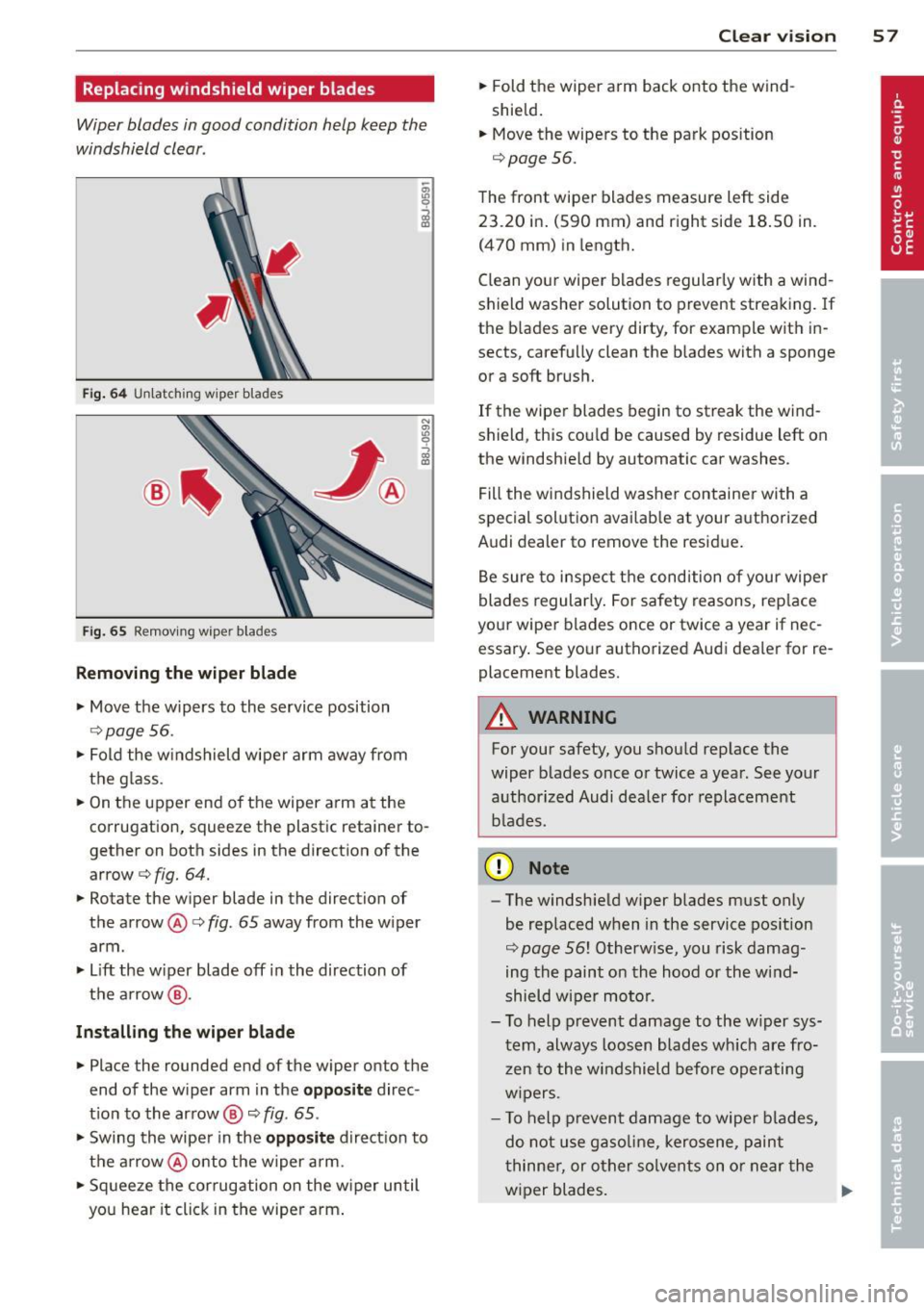
Fig. 64 U n l atc hing wiper bla des
Fi g. 6 5 Remov ing wipe r bla des
Removing the wip er blade
• Move the wipers to the service position
c::> page 56.
• Fold the w indshield wiper arm away from
the g lass.
• On t he upper end of the wiper a rm at the
corrugation, squeeze the plastic retainer to
gether on both sides in the direction of the
arrow c::>
fig. 64.
• Rotate the w iper blade in the direction of
the arrow @c::>
fig. 65 away from the w iper
arm .
• Lift the w iper blade off in the direction of
the a rrow @.
Inst alling the wiper blade
• Place the rounded end of the wiper onto the
end of the wiper arm in the
opposit e direc
t ion to the arrow @ c::>
fig. 65 .
• Swing the wiper in the opposite direction to
the a rrow @onto the wiper arm.
• Sq ueeze the corrugation on the w iper until
you hear it click in the wipe r arm .
Clear vi sion 5 7
• Fold the wiper arm back onto the wind
shield.
• Move the wipers to the park position
c::>
page 56.
The front wipe r blades measure left side
23 .20 in . (590 mm) and right side 18 .50 in.
(470 mm) in length.
C lean you r wiper blades regularly with a wind
shield washer solution to prevent streaking. If
the b lades are very dirty, for examp le with in
sects, carefully clean the b lades with a sponge
or a soft brush.
If the wiper blades begin to streak the wind
shield, this cou ld be caused by residue left on
the windshie ld by automatic car washes.
Fill the wi ndshield washe r container with a
spec ial solutio n availab le at your a uth orized
Audi dealer to remove the resid ue .
Be sure to inspect t he condition of your wiper
blades regularly. For safety reasons, rep lace
your wiper blades once or twice a year if nec
essary . See yo ur authorized Aud i dealer for re
placement blades.
A WARNING
For your safety, you shou ld rep lace the
wiper b lades once or twice a yea r. See your
a uthorized Audi dealer for replacement
b lades.
(D Note
- The w indshie ld w iper blades must only
be replaced w hen in the service pos ition
c::>
page 56! Otherw ise, you risk damag
ing the paint on the hood or the wind
shield wiper mo to r.
- T o help p revent damage to the w iper sys
tem, always loos en blades wh ich are fro
z en to the windshield before operating
w ipers.
- T o help p revent damage to wiper blades,
do not use gaso line, kero sene, paint
t hinne r, or other solvents on o r near the
w iper blades.
Page 71 of 244
The LED in the buttons illum inates when the
function is active.
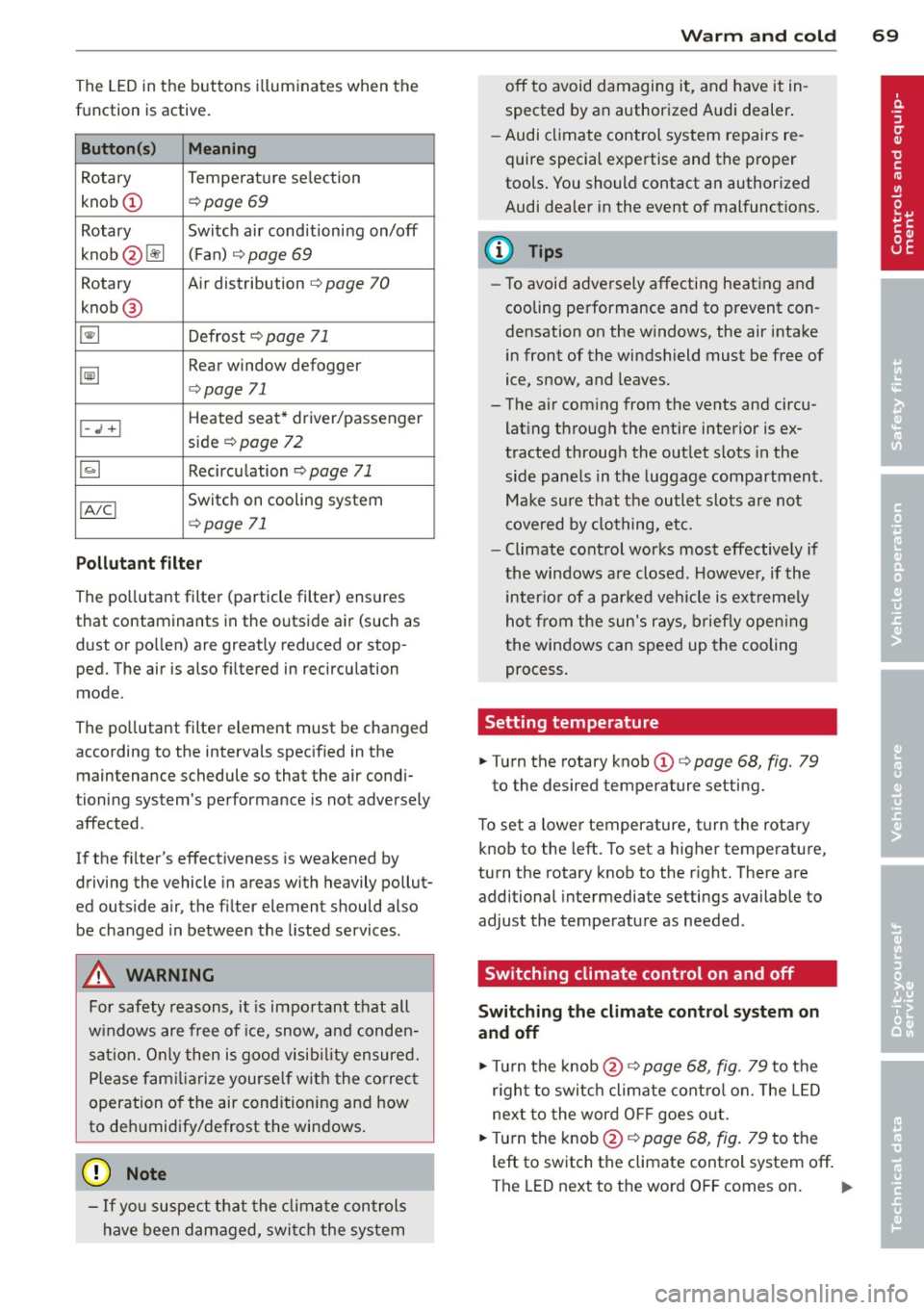
Button (s) Meaning
Rotary Temperature
selection
knob
CD ¢ page 69
Rotary Switch air conditioning on/off
knob @lil (Fan)
Q
page 69
Rotary A ir distribution Q
page 70
knob@
~ Defrost Q page 71
~
Rear window defogger
¢page 71
Heated seat* driver/passenger I-.., +I
side ¢ page 72
~ Recircu lation Q page 71
IA!CI Switch on cooling system
¢page 71
Pollutant filt er
The pollutant filter (particle filter) ensures
that contaminants in the outside air (such as
dust or po llen) are greatly reduced or stop
ped. The air is also filtered in recirculation
mode.
The pollutant filter element must be changed
according to the intervals specified in the
maintenance schedule so that the air condi
tioning system's performance is not adversely
affected .
If the fi lter's effectiveness is weakened by
driving the vehicle in areas with heavily pollut
ed outside air, the filter element should also
be changed in between the listed services.
A WARNING
For safety reasons, it is important that all
w indows are free of ice, snow, and conden
sa tion. Only then is good visib ility ensured.
Please fam iliarize yourse lf w ith the correct
operation of the air conditioning and how
to de humidify/defrost the windows .
(D Note
-If yo u suspect that the clima te controls
have been damaged, switch the system
Warm and c old 69
off to avoid damaging it, and have it in
spected by an authorized Audi dealer .
- Audi climate control system repairs re
quire special expertise and the proper
tools . You should contact an authorized
Audi dealer in the event of malfunctions.
(D Tips
- To avoid adversely affecting heating and
cooling performance and to prevent con
densation on the windows, the air intake
in front of the windshield must be free of
ice, snow, and leaves.
- The air coming from the vents and circu
lat ing through the entire interior is ex
tracted through the out let slots in the
side pane ls in t he luggage compartment.
Make sure that the outlet slots are not
covered by clothing, etc.
- Climate control works most effectively if
the windows are closed. Howeve r, if the
inter io r of a par ked vehicle is ext reme ly
hot from the sun's rays, briefly open ing
t he windows can speed up the cooling
process .
Setting temperature
.. Turn the rotary knob CD Q page 68, fig. 79
to the desired temperature setting.
To set a lower temperature, turn the rotary
knob to the left. To set a higher temperature,
turn the rotary knob to the right. There are
additional intermediate settings available to
adjust the temperature as needed .
Switching climate control on and off
Switching the climate control system on
and off
.. Tu rn the knob @Q page 68, fig. 79 to the
r ight to switc h climate cont ro l on. The LED
next to the word O FF goes o ut.
.. Turn the knob@¢
page 68, fig. 79 to the
left to switch the climate control system off.
The LED next to the word OFF comes on.
I)>
Page 109 of 244
& WARNING
Improperly worn safety belts increase the
risk of serious personal injury and death
whenever a vehicle is being used.
- Always make sure that all vehicle occu
pants are correctly restrained and stay in
a correct seating position whenever the
vehicle is being used.
- Always read and heed all WARNINGS and
other important information
Q page 103.
Safety belt preten
sioners
How safety belt pretensioners work
In front and side collisions above a particular
severity, safety belts in use are tensioned au
tomatically.
The safety belts are equipped with safety belt
pretensioners. The system is activated by sen
sors in front and side collisions of great se
verity. This tightens the belt and takes up belt
slack
Q &. in Service and disposal of safety
belt preten sioner on page 107.
Taking up the
slack helps to reduce forward occupant move
ment during a collision .
@ Tips
The safety belt pretensioner can only be
activated once.
- In minor frontal and side collisions, in
rear-end collisions, in a rollover and in
accidents involving very little impact
force, the safety belt pretensioner are not activated.
- When the safety belt pretensioner is ac
tivated, a fine dust is released. This is
normal and is not caused by a fire in the
vehicle.
- The relevant safety requirements must
be observed when the vehicle or compo
nents of the system are scrapped. A
qualified dealership is familiar with
these regulations and will be pleased to
pass on the information to you.
Safety belts 107
-Be sure to observe all safety, environ
mental and other regulations if the vehi
cle or individual parts of the system, par
ticularly the safety belt or airbag, are to be disposed. We recommend you have
your authorized Audi dealer perform this service for you.
Service and disposal of safety belt
pretensioner
The safety belt pretensioners are parts of the
safety belts on your Audi. Installing, remov
ing, servicing or repairing of belt pretension
ers can damage the safety belt system and
prevent it from working cor rectly in a colli
sion.
There are some important things you have to know to make sure that the effectiveness of
the system will not be impaired and tha t dis
carded components do no t cause injury or pol
lute the environment.
& WARNING
Improper care, servicing and repair proce
dures can increase the risk of personal in
jury and death by preventing a safety belt
pretensioner from activating when needed
or activating it unexpectedly :
- The belt pretensioner system can be acti
vated only once. If belt pretensioners
have been activated, the system must be
replaced.
- Never repair, adjust, or change any parts
of the safety belt system.
- Safety belt systems including safety belt
pretensioners cannot be repaired. Spe
cial procedures are required for removal,
installation and disposal of this system.
- For any work on the safety belt system,
we strongly recommend that you see
your authorized Audi dealer or qualified
technician who has an Audi approved re pair manual, training and special equip
ment necessary . •
•
Page 125 of 244
-Never modify the front bumper or parts
of the veh icle body.
- Always make sure that the side airbag
can inflate without interference:
- Never install seat covers or replace
ment upho lstery ove r the front seat
backs that have not been spec ifically
approved by Audi.
- Never use add itiona l seat cushions that
cover the areas where the side airbags
inflate .
- Damage to the o rigina l seat covers or
to the seam in the area of the side air
bag module must always be repa ired
immediate ly by an authorized Audi
dealer.
- The airbag system can be activated only
once . After an airbag has inflated, it
must be replaced by an author ized Audi
dealer or qualif ied technic ian who has
the techn ica l information, tra ining and
special equipment necessary.
- The airbag system can be deployed only
once. After an a irbag has been deployed,
it must be replaced w ith new replace
ment parts designed and approved espe
c ially for your Aud i model version. Re
placeme nt of complete ai rbag systems
or airbag componen ts m ust be per
f ormed by qualified workshops only.
Make su re that any airbag service act ion
is entered in your Audi Warranty
& Main
tenance booklet under
AIRBAG REPLACE
MENT RECORD.
- For safety reasons in severe accidents,
the a lternator and starter are separated
from the vehicle battery with a pyrotech
nic circuit interrupter.
- Wo rk on the pyrote chnic cir cu it inter
rupter must on ly be per formed by a
qualified dealer - risk of an accident!
- If the veh icle or the ci rcuit interrupter
is sc rapped, all applicable safety pre
cautions must be followed .
Airbag system 123
@:) For the sake of the environment
Un deployed airbag modules and p reten
sione rs might be classified as Perchlorate
Materia l -special handling may apply, see
www. dtsc. ca.gov/hazard o u swa ste/ per-
ch lo rate. When the veh icle or parts of the
restraint system including airbag modules
and safety be lts with pretensioners are
scrapped, all applicab le laws and regu la
tions mus t be obse rved. Your authori zed
A udi dealer is familia r wi th these require
ments and we recommend that you have
your dealer perform this service fo r you .
Other things that can affect Advanced
Airbag performance
Chang ing the veh icle's suspens io n system can
c h ange the way that the Advanced Airbag Sys
tem perfo rms in a crash. For examp le, using
tir e-rim combi nat ions not approved by A udi,
l ower ing the veh icle, chang ing the st iffness of
the suspens ion, including the spr ings, suspen
sion struts, shock absorbers etc. can change
the forces that are measured by the airbag
sensors and sent to the electronic contro l
u nit. Some suspension changes can, for exam
ple, i ncrease the force levels measured by the
sensors and make the airbag system deploy in c rashes in which it wou ld not deploy if the
c h anges had not been made. Other kinds of
c h anges may reduce the fo rce leve ls meas
ur ed by the sensors and preven t the airbag
from dep loying when i t should.
T he sensors in the safety be lt b uck le for the
d rive r and fr on t p assenger seat te ll the e lec
tron ic cont ro l modu le if the s afety be lt is
l atche d or no t. If the safety be lt is being used,
the front airbag will deploy at a slightly high er rate of veh icle deceleration t han i f th e safe
ty belt is not be ing used. Therefore, in a par
ticular coll is ion, it is possible t hat an airbag
will not deploy at a seat ing pos ition where the
safety belt is be ing used b ut w il l inflate at the
pos ition wher e th e safety be lt is not be ing
u sed. It is impo rtant that noth ing in terfere
Ill>
•
•
Page 154 of 244
152 Driving and en vironm ent
the exhaust system and this could cause
the catalytic converter to overheat.
- Do not turn off the ignition while the ve hicle is moving .
- Do not continue to operate yo ur vehicle
under these conditions, as otherw ise fuel
can reach the cata lytic converter . This
could result in overheating of the con
verter, requ iring its replacement.
- To assure efficient operation of the Emis
sion Control System:
- Have your veh icle ma intained properly
and in acco rdance with the service rec
ommendations in your Wa rranty
&
Ma intenance booklet.
- La ck of proper main tenance as well as
improper use of the vehicle will impa ir
t he funct ion of the emission control
system and cou ld lead to damage.
@ For the sake of the environment
E ven when the Emission Contro l System is
operating p roperly, the exhaust gas can
have a s ulfur -like exhaust gas smell under
some operating states. This depends on
the s ulfur content o f the fue l being used.
Using a different brand of fuel may help,
or filling the tank w it h lead-free super
grade gasoline.
Shutting down vehicle
If you wou ld like your veh icle to remain inop
erat ive for a longer period of time, contact an
Aud i or other specialized dealer . T hey ca n ad
vise you on necessary precautions e.g . corro
sion prevent ion, ma intenance and storage.
Pay atten tion to add it iona l information con
cerning the batte ry . Re fer to ~
page 175.
Operate your vehicle
economically and
minimize pollution
General
Your personal style of driving will determine
the economy of your vehicle, as well as ex
haust and noise levels .
Fuel economy, environmenta l impact, and
wear on your engine, brakes and tires largely
depend on three factors:
- your personal driving style
- oper ating conditions
- technical limitat ions
If you ant ic ipate what you need to do next and
drive economically, you can easily cut your
fuel consumpt ion by 1O-lS percent . This sec
t ion w ill give you some tips on how you can
help the env ironment and your pocketbook.
@ Tips
The consumption estimates as published
by ENVIRONME NTAL PROTEC TION AG ENCY
( EP A) and Transpo rt Canada may no t corre
spond to your actual consumption on the
r oad, which will va ry depending upon vehi
cle load and speed, road and weather con
ditions, trip length, etc.
Drive smoothly and keep a lookout
ahead
Vehicles use the most fuel when they ore ac
celerating.
Avoid unnecessary acce lerating and braking .
Vehicles use the mos t fu el when they are ac
ce le rat ing. If yo u ant icipate what is going to
happen next, you will need to brake less and,
t hu s, acce le rate less . Let the vehicle coast
whenever possible -for examp le when you see
that the next traff ic light is red.
Page 155 of 244
Avoid full throttle
Driving at moderate speeds saves fuel and
improves your mileage.
""Try and keep well below your car's maximum
speed.
Accelerating gently reduces fuel consump
tion, engine wear, and does not disturb the
environment.
Fu el consumption, exhaust emissions and en
g ine noise increase disproportionately at high
speeds. If you drive at approximately three
quarters of top speed, fuel consumption will
be reduced by one half. Never drive faster
than the posted speed limit and weather con
ditions permit .
Reducing unnecessary idling
Even when your car is just idling it burns up
fuel.
""Shut the engine off when you are not driving
the vehicle.
""Do not warm up the vehicle by letting the
engine run at idle .
It makes sense to shut
off the engine in traff ic
jams, when waiting for trains to pass at ra il
road crossings, or at traffic lights that have
l ong wa its on red. Turning the engine
off for
just
30-40 seconds saves more fue l than is
burned starting the engine again .
It takes a long time for the engine to warm up
fully when it is running at idle. However, wear
and noxious emissions are especially high
when the engine is warming up. So you should
drive away as soon as you start the engine and
avoid running at high RPMs whi le the engine
is sti ll warming up .
(D Note
Do not leave engine idling unattended af
ter starting . If warning lights should come
on to indicate improper operation, they
would go unheeded. Extended idling also
produces heat, which could result in over-
Driving and environment 153
'
heating or othe r damage to the vehicle or
other property.
Regular maintenance
A badly tuned engine unnecessarily wastes a
lot of fuel.
""H ave your veh icle serviced at regular inter-
vals.
By having your vehicle regu larly serviced by an
Audi dealer helps to ensu re that it runs prop
erly and economically. The condition of your
vehicle not only affects its safety and ability to
hold its value, it also affects
fuel consump
tion.
Check your oil each time you fill your tank.
The amount of o il used is related to engine
load and speed.
It is normal for the oil consumption of a new
engine to reach its lowest value after a certain
mileage has been driven.
You must drive your vehicle about 3,000 miles
(5,000 kilometres) before you can properly
assess oil consumpt ion.
This also app lies to fue l consumption and en
gine output.
(U) Note
- Have your vehicle maintained properly
and in accordance with the service rec
ommendations in your Warranty
& Main
tenance booklet. Lack of proper mainte
nance as well as improper use of the ve
hicle will impair the function of the
emission control system and could lead
to damage.
- Do not alter or remove any component of
the Emission Control System unless ap
proved by the manufacturer.
- Do not alter or remove any device, such
as heat shields, switches, ignition wires,
valves, which are designed to protect
your vehicle's Emission Control System
and other important vehicle compo
nents .
•
•
Page 164 of 244
162 Fuel supply and filling your fuel tank
Many gasoline grades are blended to perform
especially well for winter or summer driving.
During seasonal change-over, we suggest that
you fill up at busy gas stations where the sea sonal adjustment is more likely to be made in
time.
@ Note
- Methanol fuels which do not meet these
requirements may cause corrosion and
damage to plastic and rubber compo
nents in the fuel system.
- Do not use fuels that fail to meet the
specified criteria in this chapter .
- If you are unable to determine whether
or not a particular fuel blend meets the
specifications, ask your service station or i ts fuel supplier .
- Do not use fuel for which the contents
cannot be identified .
- Fuel system damage and performance
problems resulting from the use of fuels
different from those specified are not
the responsibility of Audi and are not
covered under the New Vehicle or the
Emission Control System Warranties.
- If you experience a loss of fue l economy
or driveability and performance prob
lems due to the use of one of these fuel
blends, we recommend that you switch
to unblended fuel.
Gasoline additives
A major concern among many auto manufac
turers is carbon deposit build-up caused by
the type of gasoline you use .
Although gasoline grades diffe r from one
manufac turer to another, they have certain
things in common. All gasoline grades contain
substances that can cause deposits to collect
on vital engine parts, such as fuel injectors
and intake valves. Although most gasoline
brands include additives to keep engine and
fuel systems clean, they are not equally effec
tive. Audi recommends
using TOP TIER Detergent
Gasoline . For more information on TOP TIER
Detergent Gasoline, please go to the official
website (www.toptiergas .com) .
After an extended period of using inadequate
fuels, built-up carbon deposits can rob your engine of peak performance.
(D Note
Damage or malfunction due to poor fuel
quality is not covered by the Audi New Ve
hicle Limited Warranty.
Fuel tank
Fuel filler neck
The fuel filler neck is located on the right rear
side panel behind the fuel filler flap.
If the unlocking system should fail, you can
still open the flap manually -for detailed in
structions see
~ page 164.
You can find the fuel tank capacity of your ve
hicle in~
page 224 .
The label on the inside of the fuel filler flap
tells you the correct fuel for your vehicle. For
more information about fuel specifications,
see
~ page 161 .
Your vehicle fuel tank has an on-board refuel
ling vapor recovery system. This feature helps
to prevent fuel vapors from escaping from the
tank and polluting the environment while you refuel your vehicle. In order to fill the tank
properly while protecting the environment,
please follow this refueling procedure careful
ly.
.&_ WARNING ~
Under normal operating conditions, never
carry additional fuel containers in your car.
Gas canisters and other containers used to
transport fuel can be dangerous. Such con
tainers, full or empty, may leak and could
cause a fire in a collision . If you must
transport fuel to use for your lawn mower, ..,.
Page 170 of 244
168 Checking and filling
oils available today provide better engine lu
brication that can outlast traditional petrole
um-based oils, making them a smart choice
for use throughout the life of your Audi.
Whether you use synthetic or petroleum
based engine oil, the oil that you use must
conform to Audi's oil quality standard
VW 502 00 to help keep your vehicle's engine
running smoothly and help prevent the for
mation of harmful deposits, sometimes called
"sludge," that over t ime can lead to expensive
repairs .
At the time of printing, engine oils available in
the U .S . and Canada that meet the exacting
specifications of Audi oil standard VW 502 00
are synthetic engine oils. This does not mean, however, that every synthetic engine oil will
meet Audi oil standard VW 502 00. So always
be sure that you use an approved oil.
To help prevent the formation of harmful de posits use only oil with the following specifi
cations printed on the oil container:
Audi oil standard VW 502 00
Oil container labels may carry the specifica
tion singly or in combination with other desig
nations and oil quality standards .
Viscosity
Engine oils are graded according to their vis
cosity. The proper viscosity grade oil for your
engine depends on climactic or seasonal con
ditions where you drive. You can use oil with a
viscosity grade of SAE 5W40 across all tem
perature ranges for normal driving conditions.
However, if engine oil viscosity grade SAE
5W40 is not available, you can also use viscos
ity grade SAE 5W-30 or SAE OW-40 as long as
it meets Audi oil quality standard VW 502 00
specifications .
Because engine oil that meets the Audi oil
standard may not be available everywhere
when you need it, we strongly recommend
that you always carry with you an extra quart (liter) of oil that expressly conforms to the VW 502 00 specification, in case you have to
top
off the oil while on the road.
Only if the level of the oil is at or below the
minimum mark on the oil dipstick - and no oi l
that expressly conforms to Audi oil standard
VW 502 00 specifications is available -may
you top
off with a high quality engine oil, pref
erably synthetic-based, that meets ACEA A3
or API SM specifications, but even then, only
in viscosity grades SAE SW-40, SAE 5W-30, or
SAE OW-40 . However, during the entire time
between oil change intervals, never top
off
with more than a total of 0.5 qt/liter engine
oil that does not conform to Audi oil specifica
tion VW 502 00.
For more information about engine oil that
has been approved for your vehicle, please
contact either your authorized Audi dealer o r
Audi Customer Relations at 1 (800) 822-2834
or visit our web site at www.audiusa.com or
www.audicanada.ca . Here you will also find a
current list of oils (manufacturers, brand
names etc.) that conform to Audi oil standard
vw 502 00.
Changing the engine oil
The engine oil and oil filter must be changed
according to the mileage (kilometers) and
time intervals specified in your vehicle's War
ranty
& Maintenance booklet. Do not exceed
these intervals -harmful deposits from old
engine oil can reduce engine performance and
can lead to expensive engine repairs.
Changing the oil at the recommended inter
vals is so very important because the lubricat
ing properties of oil decrease gradually during
normal vehicle use. If you are not sure when
you have your oil changed, ask your author
ized Audi Service Advisor.
Under some circumstances the engine oil
should even be changed more frequently. Change oil more often if you drive mostly
short distances, operate the vehicle in dusty
areas or mostly under stop-and-go traffic con
ditions, or when you use your vehicle where
temperatures stay below freezing point for
long periods.