brakes AUDI TT ROADSTER 2015 User Guide
[x] Cancel search | Manufacturer: AUDI, Model Year: 2015, Model line: TT ROADSTER, Model: AUDI TT ROADSTER 2015Pages: 244, PDF Size: 60.74 MB
Page 151 of 244
Driving and
environment
The first 1
1000
miles
(11500 km) and
afterwards
New engine
The engine needs to be run-in during the first
1,000 miles (1 ,500 km) .
For the first 600 mile s (1,000
kilometre s):
.,. Do not use full throttle .
.,. Do not drive at engine speeds that are more
than 2/3 of the max imimum permitted
RPM .
.,. Avoid high engine speeds.
From 600 to 1,000 miles (1 ,000 to
1,500 kilometres):
.. Speeds can gradually be increased to the
maximum pe rm iss ib le road or eng ine speed .
During and after break-in period
.. Do not rev the engine up to high speeds
when it is cold . T hi s applies whether the
transmission is in N (Neutral) o r in gear.
After the break- in period
.. Do not exceed max imum eng ine speed un
der any circumstances .
.. Upshift into the next hig her gear
before
reaching the red area at the end of the tach
ometer scale
<::;> page 10.
During the first few hours of driving, the en
g ine 's inter na l friction is higher than later
when all the moving pa rts have been broken
i n. How well this break-in p rocess is done de
pends to a considerable ex tent on the way t he
ve hicl e is driven d uring the first 1,000 miles
(1, 500 kilome tres) .
(D Note
Extremely high engine speeds a re auto
mat ic al ly reduced. However, t hese RPM-
Driving and environment 149
limits were programmed for an eng ine
well run-in, not a new eng ine.
@ For the sake of the environment
Do not d rive wi th unnecessar ily h igh en
gine speeds -upshifting ear ly saves f uel,
r educes noise and protects the environ
ment.
New tires
If your vehicle is running on new tires, drive
particularly carefu l for the first 350 miles
(500 ki lometres) after fitting .
A WARNING
-New tires tend to be s lippery and must a l-
so be "b roken-in". Be s ure to remembe r
this dur ing t he firs t 35 0 m iles (500 kilo
me tres) . Brake gent ly . Avo id following
closely behind other vehicles or other sit uations that m ight require sudden, hard
b raking.
New brake pads
Remember that new brake pads do not have a
full brak ing effect during the first 250 miles
(400 kilometres) after they are installed.
New brake pads have to be "burnished in" be
fore they have optima l grab¢ .&..
D uring the break-in period, yo u should avoid
putting seve re loads on the brakes . Severe
l oads include, for example, su dden hard brak
ing, in particular at very h igh speeds or, for
example, on mou nta in passes.
A WARNING
Until t hey develop the maximum "bite" fo r
best stopping power, the s urfaces on new
b rake pads requ ire some "brea king- in" dur
in g the initial 10 0 to 150 miles (15 0 to
20 0 kilome tres) of normal c ity dr iv ing. Yo u
can compensate for this by press ing the
b rake peda l more f irm ly . This applies
whenever new pads are installed.
•
•
Page 152 of 244
150 Driving and en vironm ent
Avoid damaging the
vehicle
When you are driving on poor roads, or over
curbs, steep ramps, etc ., make certain that
low-lying parts such as spoilers and exhaust
system parts do not bottom out and get dam
aged.
This is especially true for vehicles with low
slung chassis (sports chassis) and fully loaded
vehicles .
Driving through water
on roads
Note the following to avoid vehicle damage
when driving through water, for example on
flooded roads:
- T he water must not be any highe r tha n the
bottom of the vehi cle body.
- Do no t drive faster than wa lking speed.
_& WARNING
After d riving through water, m ud, slush,
etc., the brakes may be slow to take effect
because o f wet brake ro tors and pads . Dry
the brakes fi rst by braking carefully to re
store the full braking effect.
(]) Note
Vehicle components such as the engine,
transmiss ion, suspension or electrical sys
tem can be severely damaged by driving
through water.
- Check the depth o f the water before driv
ing through it.
- Do not stop the veh icle, dr ive in reverse
or switch the engine
off when driving
through water.
- Keep in mind that oncoming vehicles may c reate waves that raise the water
l evel and make it too deep for your vehi
cle to drive through safely.
- Avoid driving thro ugh salt water because
it can ca use corrosion.
-
Catalytic converter
It is very important that your emission con
trol system (catalytic converter) is function
ing properly to ensure that your vehicle is run
ning in an environmentally sound manner.
.. Always use lead-free gasoline¢ page 160,
Fuel supply .
.. Never run the tank down all the way to emp
ty.
.. Never put too much moto r o il in yo ur eng ine
¢ page 169, Adding engine oil ~-
.. Never try to push- or tow-st art you r vehicle.
The catalytic co nverter is an efficient "clean
u p" dev ice built into the exhaust system of
t h e vehi cle. The cata lytic conve rter bu rns
many of the pollutan ts in the exha ust gas be
f ore they are re leased into the atmosphere.
T he exclusive use of unleaded fuel is critically
impor tant for the life of the catalyt ic convert
er and prope r funct ion ing of the engi ne.
A WARNING
- Do not park or operate the vehicle in
areas where the hot exha ust system may
come in contact with dry g rass, brush,
fue l spill or other material wh ich can
cause a fire.
- Do not app ly additiona l undercoating or
r u stproofing on or near the exhaust
manifold, exhaust pipes, catalytic con
verter or heat sh ields. Dur ing driv ing, the
substance used fo r undercoating could
overheat and cause a fire.
(D Note
- Be aware that just one tank filling with
leaded fuel will already ser iously de-
grade the performance of the catalytic
converte r.
- Do not exceed the correct engi ne oil level
¢page 169.
-Do not drive until the fuel tank becomes
completely empty . The engine co uld mis-
fire. Unburned fuel could also get into ..,.
Page 153 of 244
the exhaust system and this could cause
the catalytic converter to overheat.
- Do not turn off the ignition while the ve
hicle is moving .
- Do not continue to operate yo ur vehicle
under these conditions, as otherwise fuel
can reach the cata lytic converter. This
could result in overheating of the con
verter, requ iring its replacement.
- To assure efficient operation of the Emis
sion Control System:
- Have your veh icle ma inta ined properly
and in acco rdance with the service rec
ommendations in your Warranty
&
Ma intenan ce booklet.
- Lac k of proper maintenance as well as
improper use of the vehicle will impa ir
t he funct ion of the emission control
system and cou ld lead to damage.
@ For the sake of the environment
Even when the Emission Contro l System is
operating p roperly, the exhaust gas can
have a s ulfu r- like exhaust gas smell under
some operating states. This depends on
the s ulfur content of the fue l being used.
Using a different brand of fuel may help,
or filling the tank w ith lead-free super
grade gasoline .
Shutting down vehicle
If you would like your veh icle to remain inop
erat ive for a longer period of time, contact an
Aud i or other specialized deale r. T hey can ad
vise you on necessary precautions e.g . corro
sion prevention, ma intenance and storage.
Pay attention to add itiona l information con
cerning the battery . Re fer to~
page 175.
Dri vin g and en vironm ent 151
Operate your vehicle
economically and
minimize pollution
General
Your personal style of driving will determine
the economy of your vehicle, as well as ex
haust and noise levels.
Fuel economy, environmenta l impact, and
wear on your eng ine, brakes and tires largely
depend on three factors:
- your personal d riving s tyle
- operati ng conditions
- technical limitat ions
If you ant ic ipate what you need to do next and
drive economically, you can easily cut you r
fuel consumpt io n by 1O-lS percent . T his sec
tion w ill give you some tips on how you can
help the env ironment and your po cketbook.
@ Tips
The consumption estimates as published
by ENVIRONME NTAL PROT ECTI ON AGENCY
( E PA) a nd Tra nsp o rt Canada may no t corre
spond to your actual consump tion on the
r oad, which will va ry depending upon vehi
cle load and speed, road and weather con
ditions, trip length, etc.
Drive smoothly and keep a lookout
ahead
Vehicles use the most fuel when they are ac
celerating.
Avoid unnecessary acce lerating and braking .
Vehicles use the most f ue l when they are ac
ce le rat ing. If you ant icipate what is going to
happen next, you will need to brake less and,
thus, acce lerate less . Let the vehicle coast
whenever possible - for examp le when you see
that the next traff ic light is red.
•
•
Page 157 of 244
Vehicl e ca re a nd cl eanin g 155
& WARNING
-Only wash the vehicle when the ignition
is off and follow the instructions from
the car wash operator to reduce the risk
of accidents.
- To reduce the risk of cuts, protect your
self from sharp meta l components when
washing the underbody or the inside of
the wheel housings.
- After washing the vehicle, the braking ef
fect may be delayed due to moisture on
the brake rotors or ice in the winter . The
brakes must be dried first with a few
careful brake applicat ions .
{[) Note
-If you wash the vehicle in an automatic
car wash, you must retract the extend a ble rear spo iler* if necessary, and fold
the exte rior m irrors in to reduce the risk
of damage. Power folding exterior mir rors* must only be folded in and out us
i ng the power folding function .
- To prevent pa int damage, do not wash
the veh icle in direct sunlight.
- To reduce the risk of damage, do not
wash the power top with a p ressure
washer. -
To reduce the r isk of damage, do not
wash decorative decals * with a pressure
washer.
- To reduce the risk of damage to the sur
face, do not use insect removing spong
es, kitchen sponges or similar items.
- Matte finish painted vehicle compo
nents:
- To reduce the risk of damage to the
surface, do not use polishing agents or hard wax.
- Never use car wash cycles that apply
protective wax.
It can destroy the
matte fi nish effect.
- Do not place any stickers o r magnet ic
signs on vehicle parts painted w ith
matte fin ish paint. The paint cou ld be
damaged when the stickers o r magnets
are removed.
@ For the sake of the environment
Only wash the vehicle in facilities spec ia lly
designed for that purpose. This will reduce
the risk o f dirty water contaminated with
oil from entering t he sewer system.
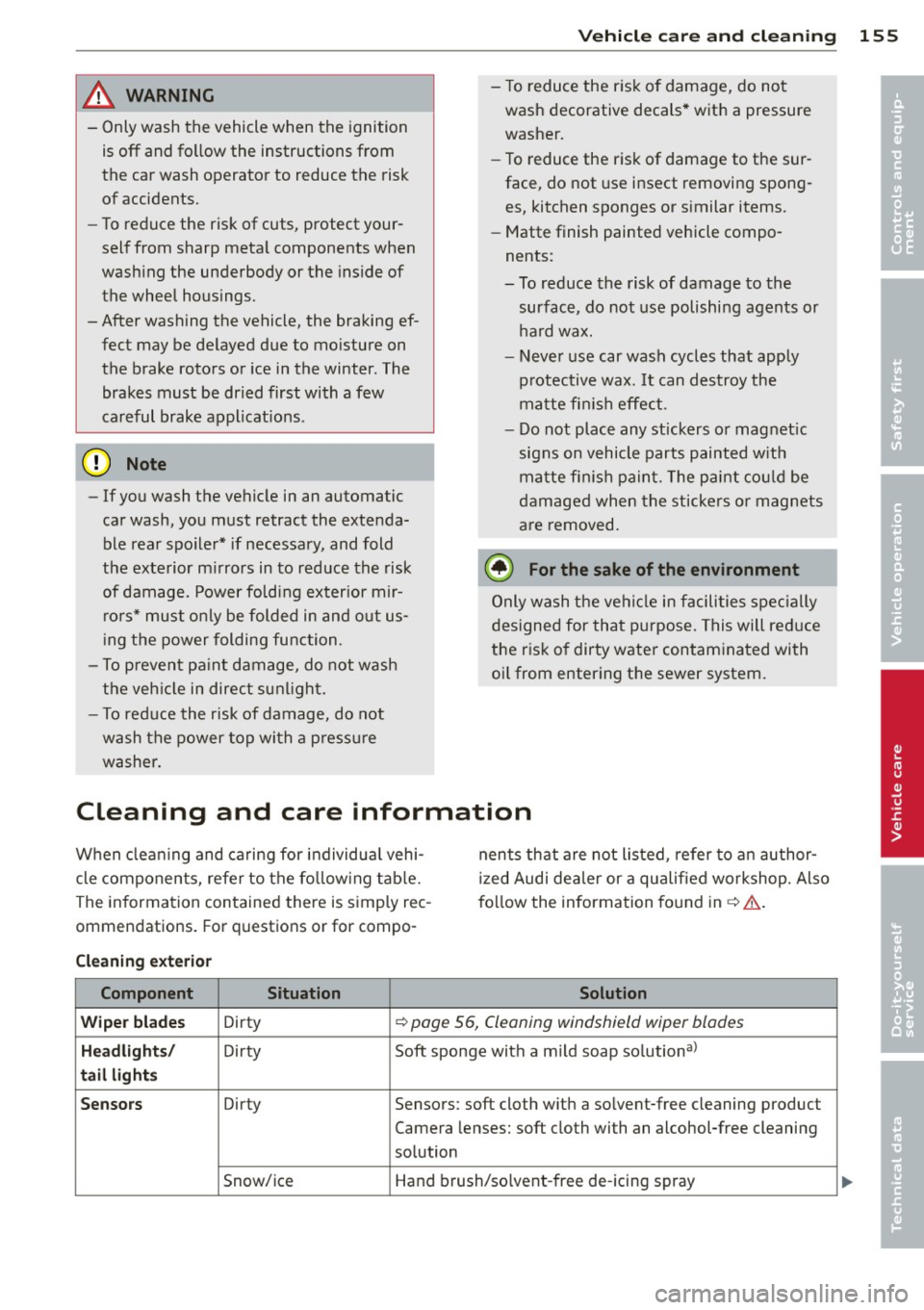
Cleaning and care information
When clean ing and caring for individual vehi
cle components, refer to the fo llow ing tab le.
The information contained there is simp ly rec
ommendations. For questions or for compo- nents that are not listed,
refer to an author
ized Audi dea ler or a qualified workshop. Also
follow the information found in ~ .&. -
Clean in g e xterior
Component Situ ation Solution
Wiper bl ade s
Dirty ~ page 5 6, Cleaning windshield wiper blades
Hea dligh ts/ Dirty Soft sponge with a mild soap solution al
tail ligh ts
Sen sor s
Dirty Sensors: soft cloth w ith a solvent-free cleaning product
Camera lenses: soft cloth with an alcohol-free cleaning
solution
Snow/ice Hand brush/so
lvent-free de-icing spray
•
•
...
Page 176 of 244
17 4 Che cking and filling
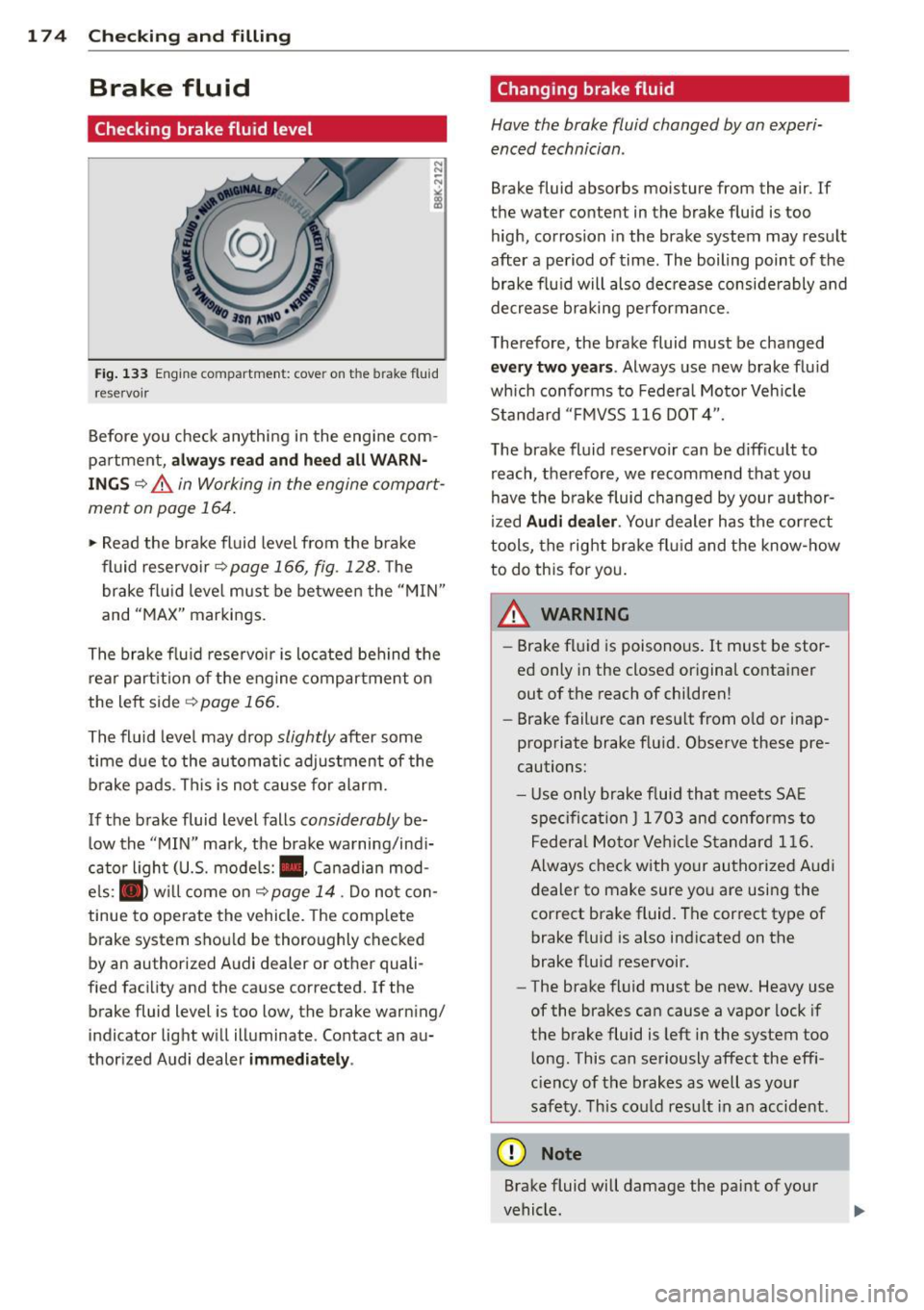
Brake fluid
Checking brake fluid level
Fig . 133 Engine compa rtment: cove r on the brake fluid
reservo ir
Before you check anything in the engine com
partment,
a lw ays read and h eed all WA RN
ING S ¢&. in Working in the engine compart
ment on page 164.
,.. Read the brake fluid level from the brake
fluid reservoir¢
page 166, fig . 128. T he
brake flu id leve l must be between the "MIN"
and "MAX" markings.
The brake flu id rese rvo ir is located behind the
rear part ition of the eng ine compartment o n
the left side ¢
page 166.
The fluid level may drop slightly after some
time due to the automatic adjustment of the b rake pads . This is not cause for alarm.
If the brake fluid level falls
considerably be
low the "MIN" mark, the brake warning/indi
cator light (U.S. models: . , Canadian mod
e ls: . ) w ill come on
¢page 14. Do not con
tinue to operate the vehicle. The comp lete
brake system shou ld be thoroughly checked
by an authorized A udi dealer or other quali
fied facility and the cause corrected.
If the
brake fluid level is too low, the brake warn ing/
indicator light w ill illuminate. Contact an au
thor ized Audi dealer
imm ediatel y.
Changing brake fluid
Have the brake fluid changed by an experi
enced technician .
Brake fluid absorbs moisture from the air. If
the water content in the brake fluid is too high, corrosion in the brake system may result
after a period of time . The boiling point of the
brake flu id will also decrease conside rably and
decrease braking pe rformance.
Therefore, the brake fluid must be changed
eve ry two y ears. Always use new brake flu id
which conforms to Federal Motor Veh icle
Standard "F MVSS 116 DOT 4".
The brake fluid reservoir can be diff icult to
reach, therefore, we recommend that you
have the brake fluid changed by your author
ized
Audi dealer . Your dealer has the correct
tools, the right brake fl uid and the know -how
to do this for you.
A WARNING
- Brake fluid is poisonous . It must be stor
ed only in the closed original container
out of the reach of children!
- Brake failure can resu lt from o ld or inap
propriate brake flu id. Observe these pre
cautions:
- Use only brake f luid that meets SA E
specifica tion
J 1 7 03 and conforms to
Federa l Moto r Ve hicl e Standard 1 16.
Always check with yo ur authorized Aud i
dealer to make sure yo u are using the
correct brake fluid. The correct type of brake f lu id is also ind icated on the
brake flu id reservoir.
- The brake fluid must be new. Heavy use
of the brakes can cause a vapor lock if
the brake fluid is left in the system too
l ong. This can seriously affect the effi
c iency of the brakes as well as your
safety. This cou ld resu lt in an accident.
(D Note
Brake fluid will damage the paint of your
vehicle .
Page 183 of 244
-Never mount used tires on yo ur vehicle if
yo u are not sure of their "previous histo
ry." Old used tires may have been dam
aged even though the damage cannot be
seen that can lead to sudden tire failure
and loss of vehicle control.
- If you notice unusual vibration or if the
vehicle pulls to one side when d riving, al
ways stop as soon as it is safe to do so
and check the wheels and tires for dam
age .
(D Note
-Please note that summer and winter
tires are designed for the cond itions that
are typ ic al in those seasons. Aud i recom
mends using w inter t ires du ring the win-
Glossary of tire and loading terminology
Accessory weight
means the comb ined weight (in excess of
those standard items which may be replaced)
of automatic tra nsmission, power steering,
power brakes, power windows, power seats,
radio, and heater, to the extent that these
items are availab le as factory-installed equip
ment (whether installed or not) .
Aspect ratio
means the ratio of the height to the width of
the tire in percent . Numbers of 55 or lower in
d icate a low sidewall for improved steering re
sponse and better overall handling on dry
pavement .
Bead
means the pa rt of the ti re that is made of
steel wires, wrapped or reinforced by ply cords
and that is shaped to fit the rim.
Bead s eparation
means a b reakdown of the bond between
components in the bead.
Cord
means the strands forming the plies in the
tire.
Tire s an d wheel s 181
ter months . Low temperatu res signifi
cantly decrease the elastic ity of summer
t ires, which affects traction and braking
ability. If summer tires are used in very
co ld temperatures, cracks can form on
the tread bars, res ulting in permanent
ti re damage that can cause loud drivi ng
noise and unbalanced tires. Aud i is not
responsib le for this type of damage.
- Burn ished, polished or chromed rims
must not be used in winter weather. Th e
surfa ce of the rims does not have suffi
c ien t cor rosion pro te cti on for this and
c o ul d be pe rmanen tly damaged by road
salt or similar substances. This damage
is not covered by warranty.
Cold tir e inflation pressure
me ans the t ire press ure re commended by the
vehicle manufacturer fo r a tire o f a des igna ted
size that has not bee n driven for more than a
coup le of miles (k ilomete rs) at low speeds in
the three hour pe riod before the tire press ure
is measured or adjusted.
Curb weight
means the weight o f a motor vehicle with
standard equipment including the maximum
capacity of fuel, o il, and coolant, air cond i
tion ing and additional weight of optiona l
equipment.
E xtra load tire
means a tire designed to operate at higher
l oads and at higher inflation press ures than
the corresponding standard tire. Extra load
tires my be ident ified as "XL", "xl", "EXTRA
LOAD", or "RF" on the sidewall.
Gross Axle Weight Rating ("GAWR")
means the load-carrying capacity of a single
axle system, measured at the tire-ground in-
ter~ces.
~
•
•
Page 184 of 244
182 Tires and wheels
Gross Vehicle Weight Rating ("GVWR")
means the maximum total loaded weight o f
the vehicle.
Groove
means the space between two adjacent tread
ribs.
Load rating (code)
means the maximum load that a tire is rated
to carry for a given inflat ion pressure. You
may not find this informat ion on all tires be
cause it is not requ ired by law .
Maximum load rating
means the load rating for a t ire at the maxi
mum permissible inflation pressure for that
tire .
Maximum loaded vehicle weight
means the sum of:
(a) Curb weight
(b) Accessory weight
(c) Vehicle capacity we ight, and
(d) Production opt ions weight
Maximum (permissible) inflation pressure
means the maximum cold inflation pressure
to which a tire may be inflated . Also called
"maximum inflation press ure."
Normal occupant weight
means 150 lbs. (68 kilog rams) times the
number of occupants seated in the vehicle up
to the tota l seating capacity of your vehicle.
Occupant distribution
means distribution of occupants in a veh icle.
Outer diameter
means the overall diameter of an inflated new
tire.
Overall width
means the linear distance between the exteri
ors of the sidewalls of an inflated tire, includ
ing elevations due to labeling, decorations, or
protective bands or ribs .
Ply
means a layer of rubbe r-coated parallel cords.
Production options weight
means the combined weight of those installed
regular production opt ions we ighing over 5
lbs. (2.3 kg) in excess of those standa rd items
wh ich they replace, not previously considered
in curb weight or accessory weight, including
heavy duty brakes, ride levelers, heavy duty
battery, and specia l trim .
Radial ply tire
means a pneumat ic tire in which the ply cords
that extend to the beads are laid at substa n
tially 90 deg rees to the centerline of the
tread.
Recommended inflation pressure
see <=;> page 181, Cold tire inflation pressure .
Reinforced tire
means a tire designed to operate at higher
loads and at higher inflation pressures than
the corresponding standard tire. Re inforced
t ir es my be identified as "XL", "xl", "EXTRA
LOAD", or "RF" on the sidewall.
Rim
means a metal support for a tire or a t ire and
tube assembly upon which the tire beads are
seated .
Rim diameter
means nominal diameter of the bead seat. If
you change your wheel s ize, you will have to
purchase new tires to match the new r im di
ameter .
Rim size designation
means rim diameter and width.
Rim width
means nom inal distance between rim flanges.
Sidewall
means that portion of a t ire between the
tread and bead .
Page 188 of 244
186 Tire s and wheel s
load limits a re not exceede d. Vehicle load in
cludes everybody and everything in and on t he
ve hicle . These load limits are technically refer
red to as the vehicle's Gross Vehicle We ight
Rating ("GVWR"). The Gross Axle Weight Rat
ing ("GAWR") is the maximum load that can
be applied at each of the veh icle 's two axles .
The Gross Vehicle Weight Rating and the
Gross Axle Weigh t Rat ing a re listed on the
safety compliance st ic k er labe l located on the
driver's side B-pill ar. T he tire pressure label on
your Audi lists the maximum combined weight of a ll of the occupants and luggage or
othe r cargo that the vehicle can carry. For the
locat ion of the tire pressure label¢
fig. 136.
A WARNING
Overloading a vehicle can cause loss of ve
hicle control, a crash or other acc ident, se
r ious personal in jury, and even death.
- Carry ing more weight than your vehicle
was desig ned to carry will prevent the
vehicle from hand ling p roperly and in
cr ease the risk of a loss of veh icle con
t ro l.
- T he brakes on a veh icle that has been
overloaded may not be ab le to stop t he
vehicle within a sa fe distance.
- Ti res on a vehicle that has been ove rload
ed can fail suddenly causi ng lo ss of con
tro l and a crash .
A WARNING
-Incorre ct tire pressures and/or underin
flation can lead to a serious o r fatal acci
dent.
- Incorrect tire pressures and/or underin
flation cause increase d tire wear and can
affect the handling of t he vehicle .
- Incorrect tire pressures and/o r underin
flation can also lead to sudden tire fa il
ure, incl uding a blowo ut and sudden de
flation, causing loss of vehicle control.
Checking tire pressure
The correct tire pressure for the tires original
ly installed on your vehicle is listed on the tire
pressure label located on driver's side 8-pil lar.
The recommended tire pressures are on the
t ir e p ressu re label a nd in the table
¢
page 184, Cold tire inflation pressure. This
means tha t the pressu re m ust be che cked and
adjus ted whe n the t ire has not been dr iven fo r
more than a couple of miles (kilometers) at
l ow speeds d uring the previous t hree ho urs.
Air in the tires expands when the tire heats up as a result of interna l frict ion as it flexes in
use. The tire pressure is higher when the tire
has warmed up than whe n it is "cold ."
It is the inflation pressure in a "co ld" t ire that
counts. Therefore, you should never let a ir o ut
of a warm tire to match "Cold t ire inflat ion
pressure" recommendat io ns ¢
page 184 . The
t ires wou ld then be unde rinflated and could
fail suddenly .
The tire pressure label on your Audi lists the recommended co ld tire inflation pressures fo r
the new, orig inal equ ipment tires that were
o n your veh icle at the time it was manufac
tu red. Fo r the lo cat ion of t he labe l
¢page 184, fig . 136.
Most t ires lose air naturally over t ime . They
can a lso lose some air if you d rive over a pot
hole or hit a curb while par king. It is usually
not poss ible to see whethe r the rad ial tires
u sed today are underinfla ted just by loo king
at them .
T he refore, be sure to check t ire p ressu res at
l east on ce a mo nth and a lways befo re going
o n a long trip. M ake s ure to ta ke the n umbe r
of peop le and the amount of luggage into ac
count when a djusting tire pressure for a trip -
even on e that yo u wo uld not conside r to be
" long." See ¢
page 188, Tires and vehicle
load limits
for more important information .
Always use an accurate tire press ure ga uge
when checking and ad justing inflat ion pres
s u res. Check all of the tires and be sure not to ..,.
Page 190 of 244
188 Tire s and wheel s
-If the tire pressure is too low or too high,
the tires w ill wear prematurely and the
vehicle will not handle well.
- If the t ire is not flat and you do not have
to change a wheel immed iately, drive at
reduced speed to the nearest service sta
t ion to check the tire pressure and add
air as required.
(D Note
Dr iving without va lve stem caps can cause
damage to the t ire va lves. To prevent this ,
always make sure that facto ry installed
valve stem caps on all wheels a re securely
mounted on the valve.
@ For the sake of the environment
Underinf lated tires will a lso increase t he
fue l cons umption .
Tires and vehicle load limits
There are limits to the amount of load or
weight that any veh icle and any t ire can c arry.
A vehicle that is overloaded w ill not h andle
well and is more difficult to s top. Over load ing
can not on ly lead to loss of vehicle contro l,
but can a lso damage important parts of the
ve hicle and can lead to sudden tire failure, in
cluding a blowout and sudden deflation that
can cause the veh icle to crash .
Your safety and that of your passengers a lso
depends on making sure that load limits are
not exceeded. Vehicle load includes everybody
and eve ryth ing in and on the vehicle . These
l oad limits a re tech nica lly refe rred to as the
ve hicl e's
Gross V ehicle Weight Rating
("GVWR").
The "GVWR" includes the we ight of the basic
vehicle , all factory insta lled accesso ries , a fu ll
tank of f uel, oi l, coo lant and othe r fluids pl us
maximum load. The maxim um load includes
the number o f passenge rs that t he vehi cle is
intended to carry ("seating capacity") with an
assumed weig ht of 150 lbs (68 kg) for each
passenger at a designated seating position and the total weight of any luggage
in the ve
hicle .
T he
Gro ss Axle Weight Rating (" G AWR") is
the max imum load th at ca n be applied at e ach
of the vehicle's two axles .
T he Gross Vehicle Weight Rat ing and the
G ross Ax le Weight Ra ting are listed on the
sa fety comp liance s ticke r label lo cated on the
driver's side B-pillar. Yo ur Audi has 2 seat ing
positions . Each seating position has a safety
belt
~ page 100, Safety belts.
T he fac t th at there is an upper limit to yo ur
vehicle's G ross Vehicle Weight Rating means
t h at the total weight of whatever is being car
ried in the vehicle is lim ited . T he more passen
gers in the vehicle or passengers who are
heavier than the standard we ights assumed
mea n that less we ight can be carried as lug
gage.
The tire pressure label on your Aud i also lists
the maximum combined weig ht of a ll of the
occupants and luggage or other cargo t hat
the vehicle can ca rry . For t he loca tion of the
label
~ page 184, fig . 136 .
.&, WARNING
Overloadi ng a veh icle can cause loss of ve
hicl e co ntr ol, a crash or o the r ac cident, se
rious personal injury, and even dea th .
- Ca rrying more we igh t tha n your ve hicle
was des igned to carry wi ll preve nt the
veh icle from handling proper ly an d in
crease the risk of the loss of ve hicle con
trol.
- The brakes on a ve hicle that has been
overloaded may not be able to stop the
veh icle w ith in a safe distance.
- Tires on a vehicle t hat has been over load
ed can fail s udden ly, incl uding a blowout
and sudden deflation, causing loss of
control and a crash .
Page 196 of 244
194 Tire s and wheel s
Driving with different tires reduces vehi
cle handling and can lead to a loss of
co ntrol.
- If the spare tire is not the same as the
t ires that are mounted on the veh icle -
for example with winter tires - on ly use
the spare tire for a short period of time
and dr ive with extra ca re. Refit the nor
ma l road whee l as soon as safely possi
ble.
- Never drive faste r than the maximum
speed for which the tires o n your veh icle
are ra ted because ti res th at are driven
faster than their rated speed can fail
sudden ly .
- Over loading t ires c ause heat b uild- up,
sudden tire failure, including a blowout
and sudden deflation and loss of control.
- T emperature grades app ly to tires t hat
are properly inflated and not over o r un
derinflated.
- F or technical reasons it is not a lways
possible to use wheels from other
vehicles -in some cases not even w heels
from the same vehicle model.
- If you insta ll wheel trim discs on t he ve
hicle whee ls, make sure that the air f low
to the brakes is not blocked. Reduced air
flow to the brakes can them to overheat, increasing stopping distances and caus
ing a collision.
- Run flat t ires may on ly be used on
vehicles that were equ ipped w it h them
at the facto ry. The vehicle must have a
chassis des igned for run f lat t ires and a
fac to ry-installed t ire p ress ure moni to r
ing system that ind ic a tes a loss of tire
pressure. Incorrect use of run flat tires
can lead to vehicle damage or accidents .
Check with an a uth orized Audi dea ler or
t i re spec ialist to see i f your vehicle can be
equipped with run flat tires. If r un flat
t ires a re used, they must be installed on
all four wheels . M ixing tire types is not
permitted . (D Note
-For technical reasons, it is not generally
poss ible to use the w heel rims from oth
er ve hicles. T his can hold tr ue for wheels
of the same vehicle type.
- If the spare tire is diffe rent from the
tires that you have mounted on your ve
hicle (for example winter tires or wide
profi le tires), then use the spare tire for a
short period of time only and drive w ith
extra care. Replace the flat tire w it h the
ti re mat ching the othe rs on your vehicle
as soon as possi ble.
- N ever d rive without the valve stem cap.
T he v alves co ul d get damaged.
@ For the sake of the environment
Dis pose of o ld tires in accordance w ith the
l ocal requirements.
Uniform tire quality grading
- Tread wear
- Tra ction AA A B (
- Temperature ABC
Quality grades can be found where applicab le
o n the tire s ide wall between tread shoulder
and maximum section width
¢ page 191,
fig . 140 .
For example: Tread wear 200 , Traction AA,
Temperature A.
All passenger car ti res must conform to Feder
al Safety Req uirements in add ition to these
grades .
Tread wear
The tread wear g rade is a comparative rating
based on the wear rate of the tire when tested
u nder contro lled conditions o n a specified
government test course.
F o r example, a tire gra ded 150 wo uld wear
one and one ha lf (11/2) times as well on the
government course as a ti re graded 100.