light AUDI TT ROADSTER 2015 Manual PDF
[x] Cancel search | Manufacturer: AUDI, Model Year: 2015, Model line: TT ROADSTER, Model: AUDI TT ROADSTER 2015Pages: 244, PDF Size: 60.74 MB
Page 134 of 244
132 Child Saf ety
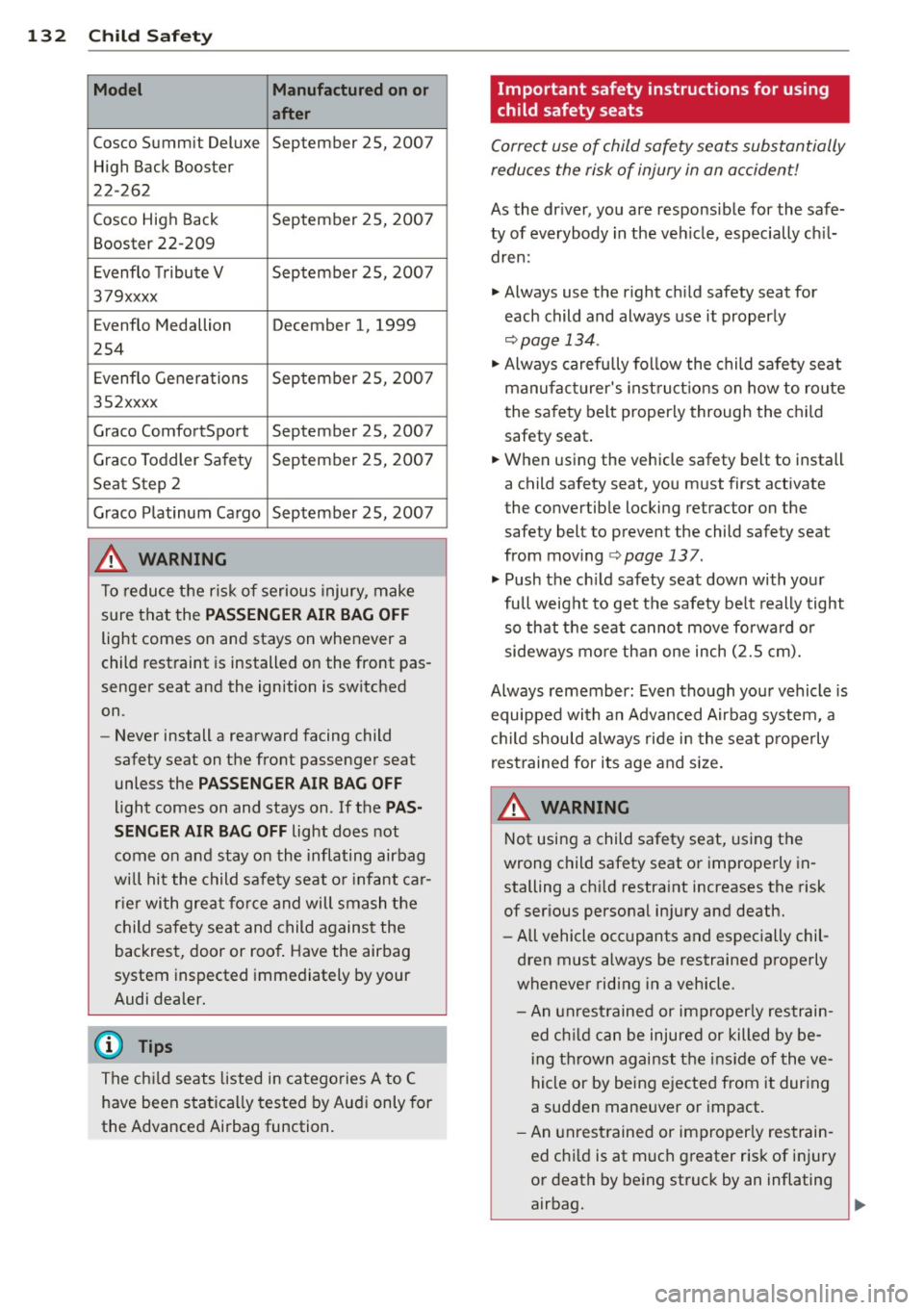
Model Manufactured on or
a fter
Cosco Summit Deluxe September 25, 2007
High Back Booster
22-262
Cosco High Back September 2S, 2007
Booster 22-209
Evenflo Tribute V September 2S, 2007
379xxxx
Evenflo Medallion December 1, 1999
2S4
Evenflo Generations September 2S, 2007
3S2xxxx
Graco ComfortSport September 2S, 2007
Graco Toddler Safety September 25, 2007
Seat Step 2
Graco Platinum Cargo September 25, 2007
_& WARNING
To reduce the risk of serious injury, make sure that the
PA SSENGER AIR BAG OFF
light comes on and stays on whenever a
child restraint is installed on the front pas
senger seat and the ignition is switched
on.
- Never install a rearward facing child
safety seat on the front passenger seat
unless the
PASSENGER AIR BAG OFF
light comes on and stays on. If the PA S
SENGER AIR BAG OFF
light does not
come on and stay on the inflating airbag
wi ll hi t the child safety seat o r infant car
rier with great force and will smash the
child safety seat and child against the
backrest, door or roo f. Have the airbag
system inspected immediately by your
Audi dealer.
@ Tips
The ch ild seats listed in categories A to C
have been statica lly tested by Aud i only for
the Advanced Airbag function.
Important safety instructions for using
child safety seats
Correct use of child safety seats substantially
reduces the risk of injury in an accident!
As the dr iver, you are respons ible for the safe
ty of everybody in the veh icle, especially ch il
dren:
.,. Always use the right ch ild safety seat for
each child and always use it properly
~page 134.
.,. Always carefully fo llow the child safety seat
manufac turer's inst ruct ions on how to ro ute
the sa fety belt properly through the child
safety seat .
.,. When using the vehicle safety belt to install
a child safety seat, you must first activate
the convertible locking retractor on the
safety belt to prevent the child safety seat
from mov ing
r=> page 137 .
.,. Push the ch ild safety seat down with you r
full weight to get the safety be lt really tight
s o that t he seat canno t move fo rward o r
sideways more th an one inch
(2.5 cm).
Always remember : Even though you r vehicle is
equipped with an Advanced Airbag system, a
c hi ld shou ld always ride i n the seat properly
r estrained for its age and s ize.
_& WARNING ,..___
Not using a child safety seat, using the
wrong child safety seat o r improperly in
stalling a ch ild restra int increases the risk
of ser ious personal in jury and death.
- All vehicle occupants and especially chil
dren must always be restrained properly
whenever rid ing i n a vehicle.
- An un rest rained or imp roperly restrain
ed ch ild ca n be injured or killed by be
ing t hrown agains t th e ins ide of the ve
hicle or by being e jected from it during
a sud den mane uver or impact.
- An unrestrained or improper ly res train
ed ch ild is at much greater risk of injury
or death by be ing struck by an inflating
airbag.
Page 135 of 244
-Commercially available child safety seats
are required to comply with U.S. Federal
Motor Vehicle Safety Standard (FMVSS)
213 (in Canada CMVSS 213).
- When buying a child restraint, select
one that fits your child and the vehicle.
- Only use child restraint systems that
fully contact the flat portion of the
seat cushion. The child restraint must not tip or lean to either side. Audi does
not recommend using child safety
seats that rest on legs or tube-like
frames. They do not provide adequate contact with the seat.
- Always heed all legal requirements per
taining to the installation and use of
child safety seats and carefully follow
the instructions provided by the manu
facturer of the seat you are using .
- Never let more than one child occupy a
child safety seat .
- Never let babies or older children ride in
a vehicle while sitting on the lap of an
other passenger .
- Holding a child in your arms is never a substitute for a child restraint system.
- The strongest person could not hold
the child with the forces that exist in
an accident. The child will strike the in
terior of the vehicle and can also be
struck by the passenger .
- The child and the passenger can also
injure each another in an accident.
- Never install a rearward facing child
safety seat on the front passenger seat
unless the
PASSENGER AIR BAG OFF
light comes on and stays on . If the PAS
SENGER AIR BAG OFF
light does not
come on and stay on the inflating airbag
will hit the child safety seat or infant car
rier with great force and will smash the
child safety seat and child against the
backrest, door or roof. Have the airbag
system inspected immediately by your
Audi dealer.
- Forward-facing child safety seats instal
led on the front passenger's seat can in-
Child Safety 133
terfere with the airbag when it inflates
and cause serious injury to the child.
- If exceptional circumstances require the
use of a forward-facing child restraint on
the front passenger's seat, the child's
safety and well-being require that the
following special precautions be taken:
- Make sure the forward-facing seat has
been designed and certified by its man
ufacturer for use on a front seat with a
passenger front and side airbag.
- Always carefully follow the manufac
turer's instructions provided with the
child safety seat or carrier.
- Always move the front passenger seat
into the rearmost position of the pas
senger seat's fore and aft adjustment range, and as far away from the airbag
as possible before installing the child restraint.
- Always make sure that nothing pre
vents the front passenger's seat from
being moved to the rearmost position
in its fore and aft adjustment range .
- Always make sure that the backrest is
in the upright position .
- Always buckle the child safety seat firmly
in place even if a child is not sitting in it.
A loose child safety seat can fly around
during a sudden stop or in a collision.
- Always read and heed all WARNINGS
whenever using a child restrained in ave hicle is being used<=>
page 100, Safety
belts,
<=> page 108, Airbag system and
<=> page 129, Child Safety.
A WARNING
To reduce the risk of serious injury, make
sure that the
PASSENGER AIR BAG OFF
light comes on and stays on whenever a
child restraint is installed on the front pas
senger seat and the ignition is switched
on .
- Never install a rearward facing child
safety seat on the front passenger seat
unless the
PASSENGER AIR BAG OFF
•
•
Page 136 of 244
134 Child Safe ty
light comes on and stays on. If the PAS·
SEN GER AIR BAG OFF
light does not
come on and stay on the inflating airbag
will hit the child safety seat or infant car
rier with great force and will smash the
child safety seat and child against the
backrest, door or roof. Have the airbag
system inspected immediately by your
Audi dealer .
Child safety seats
Infant seats
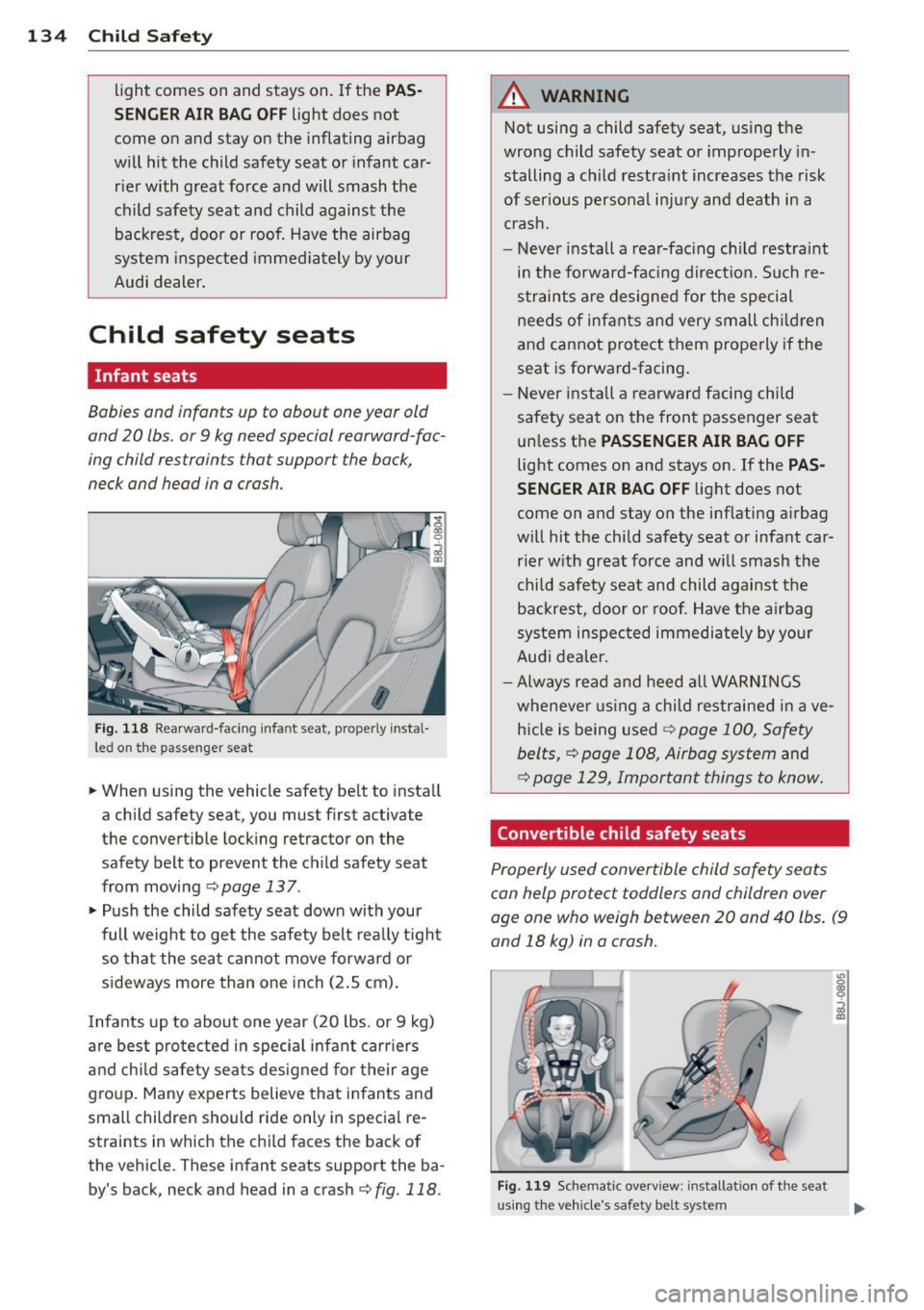
Babies and infants up to about one year old
and 20 lbs. or
9 kg need special rearward-fac
ing child restraints that support the back,
neck and head in a crash.
I
Fi g. 118 Rearwa rd-facing infant seat, proper ly insta l·
led on the passenge r seat
~ When using the vehicle safety belt to install
a child safety seat, you must first activate
the convertible locking retractor on the
safety belt to prevent the child safety seat
from moving
c:::;, page 13 7 .
~ Push the child safety seat down with your
full weight to get the safety belt rea lly t ight
so that the seat cannot move forward or
sideways more than one inch (2.5 cm).
I nfants up to about one year (20 lbs . or 9 kg)
are best protected in specia l infant carriers
and chi ld safety seats des igned for their age
group. Many experts believe that infants and
small children should ride only in special re
straints in which the child faces the back of
the vehicle. These infant seats support the ba·
by's back, neck and head in a crash
c:::;, fig. 118 .
A WARNING
-
Not using a child safety seat, using the
wrong child safety seat or improperly in
stalling a ch ild restra int increases the risk
of ser ious personal in jury and death in a
crash.
- Never install a rear-fac ing ch ild restra int
in the forward-fac ing direct ion. Such re
straints are designed for the special
needs of infants and very small ch ildren
and cannot protect them properly if the
seat is forward-facing.
- Neve r install a rearward faci ng ch ild
safety seat on the front passenger seat
un less the
PASSENGER AIR BAG OFF
light comes on and stays on. If the PAS
SENGER AIR BAG OF F
light does not
come on and stay on the inflating airbag
will hit the child safety seat or infant car
rier with great force and w ill smash the
child safety seat and child against the
backrest, door or roof. Have the a irbag
system inspected immediately by your
Aud i dealer.
- Always read and heed all WAR NINGS
wheneve r using a child res trained in ave
hicle is being used
c:::;, page 100, Safety
belts,
c:::;, page 108, Airbag system and
c:::;, page 129, Important things to know .
Convertible child safety seats
Properly used convertible child safety seats
can help protect toddlers and children over
age one who weigh between 20 and 40 lbs . (9
and 18 kg) in a crash .
Fig . 1 19 Schema tic overview: ins tallat ion of the seat
using the vehicle's safety be lt sys te m
Ill>
Page 137 of 244
~ When using the vehicle safety belt to insta ll
a chi ld safety seat, you must first activate
the convertible locking retractor on the
safety belt to prevent the ch ild safety seat
from moving
c:::, page 137.
~ Push the child safety seat down with your
f ull weight to get the safety belt really t ight
so that the seat cannot move forward or
s ideways more than one in ch (2.5 cm)
¢page 137.
A toddler or child is usually too large for an in
fant restra int if it is more than one yea r old
and weighs more than
20 lbs. (9 k g) .
Toddlers and c hildren who are older than one
yea r up to about
4 years o ld and weigh more
than
20 lbs. (9 k g) up to 40 lbs. (1 8 kg) must
always be properly restra ined in a ch ild safety
seat certified fo r the ir s ize and we ight
¢ fig . 119.
& WARNING
Not using a child safety seat, using the
wrong chi ld safety seat or improper ly in
stalling a child restraint increases the risk
of serious personal injury and death in a
co llision or othe r emergency s ituation.
- Children on the front seat of any car,
even with Advanced A irbags, can be seri
o usly injured or even killed when an a ir
bag inflates. A child in a rearward-facing
child safety seat installed on the front
pas senge r seat w ill be seriously injured
and can be killed if the fron t air bag in
fla tes -even with an Advanced Airbag
System .
-
- The inflating airb ag w ill hit the child
sa fety seat or infant carrier w it h great
force and w ill smash the ch ild safety seat
and child against the backrest, door or
roof.
- Never install a rearward facing child
sa fety seat on the front passenge r seat
unless the
PASSENGER AIR BAG OFF
light comes on and stays on. If the PAS
SENGER AIR BAG OFF
light does not
come o n and stay on have the airbag sys-
Child Sa fet y 135
tern inspected immediately by you r Audi
dea le r.
- Always rea d and heed all WAR NIN GS
whenever us ing a child restrained in ave
hicle is being used
c:::, page 100, Safety
belts,
c:::, page 108, Airbag system and
c:::, page 129, Important things to know.
A WARNING
If exceptional circ umstances require the
use of a forward -facing child r est raint on
the front passenge r's seat, the child's safe
ty an d we ll-being re quire t hat the fol low
ing spec ial prec autions be t aken:
- Ma ke sure the forward-facing seat has
been designed and certified by its m anu
f a cturer fo r use on a fro nt sea t wi th a
passenger front and side airbag.
- Always follow the manuf acturer's in
struc tions p rov ided with the ch ild safety
seat o r infant ca rr ier.
- Always move the fron t passenger sea t in
to the rearmos t position of the passen
ger seat's fo re and aft adjustment range,
and as far away f rom the airbag as possi
ble before installing the ch ild restraint.
- Always make sure that nothing prevents
the front passenger's seat from being
moved to the rearmost position in its
fore and aft adjustment range.
-Always make sure the backrest is in an upright pos ition.
- Make sure that the
PASSENGER AIR BAG
OFF
li ght comes on and stays on all the
time wheneve r the ignit ion is switched
on.
- If the light does not stay on, perform the
checks
c:::, page 118 , Monitoring the Ad
vanced Airbag System .
-If the PASSENGER AIR BAG OFF light
does not come on and stay on have the
airbag system inspec ted immedia tely by
your Aud i dea le r. •
•
-
Page 139 of 244
A WARNING ,~ ~
Not using a booster seat, us ing the boos
ter seat improperly, incorrectly install ing a
booster seat or using the vehicle safety
belt improperly increases the risk of seri
ous pe rsonal injury and death in a co llision
or other emergency s ituation. To help re
duce t he risk of serious persona l injury
and/or death:
- T he shoulder be lt mus t lie as close to t he
center o f the child's co llar bone as poss i
ble and must lie and snug on the upper
body . It must never lie across the throat
or neck. The lap belt must lie across the
pelvis and never across the stomach or
abdomen. Make sure the belt lies f lat
and snug . Pull on the belt to t ighten if
necessary .
- Failure to properly route safety belts over a ch ild's body will cause severe inju
ries in an acc ident or other emergency
situation
¢ page 100 .
-Children on the front seat of any car ,
even with Adva nced A irbags, can be seri
o usly injured or eve n killed when an a ir
bag inf lates.
- Never let a child stand or knee l on the
sea t.
- Never let a child ride in the ca rgo a rea of
yo ur vehicle .
- Always remember that a ch ild lean ing
forwar d, sit tin g s ideways o r out of posi
tio n in any way during an a ccident ca n be
stru ck by a deploying airbag. This will re
s u lt in serious personal injury or deat h.
- If you mus t inst all a b oos ter sea t on the
front passenger seat because of excep
tional circumstances the
PASSENGER
AIR BAG OFF
light must come on and
stay on, whenever the ignition is switch
ed on.
- If the
PASSENGER AIR BAG O FF light
does not come on and stay on, perform
the checks described
¢page 118, Moni
toring the Advanced Airbag System .
-If the PASSENGER AIR BAG OFF light
does not come on and stay on whenever
Child Sa fet y 137
the ignition is switched on the inflating
airbag w ill hit the child safety seat or in
fant carrier wit h great force and will
smash the child safety seat and child
aga inst the backrest, door o r roof . Have
the airbag system ins pected immed iately
by your Audi dea ler.
- Always read and heed all WAR NINGS
wheneve r us ing a child restrained in ave
hicle is being u sed
¢ page 100, Safety
bel ts,
¢ page 108, Airbag system and
¢ page 129, Important things to know .
Installing a child safety
seat
Securing a child safety seat using a
safety belt
Safety belts for the front passenger can be
Locked with the conver tible Locking retractor
to properly secure child safety seats .
The safety belts eme rgency locking retracto rs
for t he front passenger's seat safety belt h ave
a conver tible locking re trac to r f or c hild re
stra ints. The safety be lt must be locked so
that belt webb ing cannot unree l. The retrac
tor can be act ivated to lock the safety belt and
prevent the safety be lt webb ing from loosen
i ng up duri ng normal dr iv ing . A child safety
seat can only be properly insta lled when the
safe ty belt is locked so that the chi ld and child
safety seat w ill stay in place.
Always remember: Even tho ugh your vehicle is
equipped with an Advanced Airbag system, a
c hi ld should always ride in the seat prope rly
r est rained for its age and s ize .
A WARNING
Im properly installed chi ld safety seats in
cre ase the risk of serious personal injury
and deat h in a co llision.
- Always ma ke sure tha t the safe ty belt re
tr act or is lo cked w hen insta lling a chil d
safety sea t. An unlocke d safety bel t re
tracto r cannot hold the child safety seat
•
•
Page 140 of 244
138 Child Safety
in place during normal driving or in a
crash.
- Always buckle the child safety seat firmly
in place even if a child is not sitting in it.
A loose child safety seat can fly around
during a sudden stop or in a collision
- The inflating airbag will hit the child safety seat or infant carrier with great
force and will smash the child safety seat and child against the backrest, door or
roof.
- Forward-facing child safety seats or in
fant carriers installed on the front pas
senger's seat may interfere with the de
ployment of the airbag and cause serious
injury to the child.
- Always read and heed all WARNINGS
whenever using a child restrained in ave
hicle is being used
~page 129. Special
precautions apply when installing a child
safety seat on the front passenger seat
~ page 109, Child restraints on the front
seat -some important things to know.
A WARNING
-
Always take special precautions if you
must install a forward or rearward-facing
child restraint on the front passenger's
seat in exceptional situations:
- Whenever a forward or rearward-facing
child restraint is installed on the front
passenger seat, the
PASSENGER AIR
BAG OFF
light must come on and stay on
whenever the ignition is switched on.
- If the
PASSENGER AIR BAG OFF light
does not come on and stay on, perform
the checks described
~ page 118, Moni
toring the Advanced Airbag System.
- If the PASSENGER AIR BAG OFF light
does not come on and stay on whenever
the ignition is switched on the inflating
airbag will hit the child safety seat or in
fant carrier with great force and will smash the child safety seat and child
against the backrest, door or roof . Have
the airbag system inspected immediately by your Audi dealer . -
Improper installation of child restraints
can reduce their effectiveness or even
prevent them from providing any protec
tion .
- An improperly installed child restraint
can interfere with the airbag as it de
ploys and seriously injure or even kill the
child.
- Always carefully follow the manufactur
er's instructions provided with the child
safety seat or carrier.
- Never place additional items on the seat that can increase the total weight regis
tered by the weight-sensing mat and can
cause injury in a crash.
A WARNING
Forward-facing child restraints:
- Always make sure the forward-facing
seat has been designed and certified by
its manufacturer for use on a front seat
with a passenger front and side airbag.
- Never put the forward-facing child re
straint up, against or very near the in
strument panel.
- Always move the passenger seat into its
rearmost position in the seat's fore and
aft adjustment range, as far away from
the airbag as possible before installing
the forward-facing child restraint. The
backrest must be adjusted to an upright position.
- Make sure that the
PASSENGER AIR BAG
OFF
light comes on and stays on all the
time whenever the ignition is switched
on .
A WARNING ~
Rearward-facing child restraints:
- A child in a rearward-facing child safety
seat installed on the front passenger
seat will be seriously injured and can be
killed if the front airbag inflates - even
with an Advanced Airbag System.
- The inflating airbag will hit the child
safety seat or infant carrier with great
force and will smash the child safety seat
Ill>
Page 141 of 244
and child against the backrest, door or
roof.
- Always be especially caref ul if you must
install a rearward facing child safety seat
on the front passenger seat in exception
al circumstances.
- Make sure that the
PASSENGER AIR BAG
OFF
light comes on and stays on all the
t ime whenever the ignition is switched
on.
- Never install a rearward facing child
safety seat on the front passenger seat unless the
PASSENGER AIR BAG OFF
light comes on and stays on . If the PAS
SENGER AIR BAG OFF
light does not
c ome on and stay on have the airbag sys
tem inspected immediately by your Audi
dealer .
Activating the convertible locking
retractor
Use the convertible locking retractor to se
cure a child restraint.
A lways heed the child sa fety seat manufactur
er's instructions when installing a chi ld re
straint in your vehicle . To activate the conver
tible locking ret ractor:
.,. Place the child restraint on a seat.
.,. Slow ly pull the be lt
all the way out.
.,. Route it around or through the chi ld re
stra int be lt path
c:> &_ .
.,. Push the child safety seat down with your
full weight to get the safety belt really t ight.
.,. Insert the belt tongue into the buckle for
that seating position .
.,. Gu ide the safety belt back into the retractor
until the belt lies flat and snug on the chi ld
safety seat.
.,. You should hear a "clicking" noise as the
belt winds back into the inertia reel. Test the
convertible locking retractor by pulling on
the belt . You should no longer be able to
pull the belt out of the retractor. The con
vertib le locking retractor is now act ivated.
Child Sa fet y 139
.,. Make sure that the red release button is fac
ing away from the child restraint so that it
can be unbuckled qui ck ly.
.,. Pull on the belt to make sure the safety belt
is properly tight and fastened so that the
seat cannot move forward or sideways more
than one inch (2 . S cm).
A WARNING
Using the wrong child res traint o r an im
properly installed chi ld restraint can cause
serious personal injury or death in a crash.
- Always ma ke sure that the safety belt re-
tractor is loc ked when insta lling a child
safety seat . An unlocked safety belt re
tractor cannot hold the child safety seat in place during norma l driving or in a
crash.
- Always buckle the child safety seat firmly
in place even if a chi ld is not sitting in it.
A loose child safety seat can fly around during a sudden stop or in a crash.
- Always make sure the seat backrest to
which the child restraint is installed is in
an upright pos ition. Otherw ise, the seat
back with the ch ild safety seat attached
to it could fly forward in the event of an accident or other emergency situation .
-Always read and heed all WARNINGS
whenever using a child restrained in ave hicle is being used
c:> page 129. Special
precautions apply when insta lling a child
safety seat on the front passenger seat
c:> page 109, Child restraints on the front
seat -some important things to know .
Deactivating the convertible locking
, retractor
-
The convertible locking retractor for child re
straints will be deactivated automatically when the belt is wound all the way back in to
the retractor.
.,. Press the red button on the safety belt buck
le . The belt tongue will pop out of the buck
le .
.,. Guide the safety belt all the way back into
its stowed position . •
•
Page 143 of 244
Intelligent technology Notice about data
recorded by vehicle
control modules
Your vehicle is not equipped with an Event Da
ta Recorder (EDR), installed by some manu
facturers for the express purpose of capturing
data for retrieval after an accident or crash
event. EDR's are sometimes called "crash re
corders".
Some state laws restrict the retr ieval or down
loading of data stored by EDR's that were in
stalled in a vehicle for the express purpose of
retrieving data after an accident or crash
event without the owner's consent.
Although your vehicle is not equipped with an
EDR, it is equipped with a number of electron
ic control modules for various vehicle systems
such as, for examp le, engine function, emis
sion control, as well as for the airbags and
safety belts.
These electronic control modules also record
vehicle-related data during norma l vehicle op
eration for diagnostic and repair purposes.
The recording capacity of the electronic con
trol modules is limited to data (no sound is re
corded) and only a small amount of data is ac
tually recorded over a very limited period of
time and stored when a system fault or other
condition is sensed by a control unit. Some of
the data then stored may relate to vehicle
speed, direction, braking as we ll as restraint
system use and performance in the event of a
crash or other condition. Stored data can only be read and downloaded with special equip
ment.
Electronic Stabilization
Control (ESC)
Description
ESC helps to improve road holding and vehicle
dynamics to help reduce the probability of
skidding and loss of veh icle control. It works
only when the engine is running. ESC detects
Intelligent technology 141
certain difficult driving situations, including
when the vehicle is beginning to spin (yaw)
out of control and helps you to get the veh icle
back under control by se lectively braking the
wheels, and/or reducing engine power and
providing steering ass istance to help hold the
vehicle on the driver's intended course. The in
dicator light
B.J in the instrument cluster
blinks when ESC is taking action to help you
control the vehicle.
ESC has limitations .
It is important to remem
ber that ESC cannot overcome the laws of
physics.
It will not always be able to help out
under all conditions you may come up against.
For example, ESC may not always be able to
help you master situations where there is a
sudden change in the coefficient of friction of
the road surface. When there is a section of dry road that is suddenly covered with water,
slush or snow, ESC cannot perform the same
way it would on the dry surface. If the vehicle
hydroplanes (rides on a cushion of water in
stead of the road surface), ESC will not be
able to help you steer the vehicle because con
tact with the pavement has been interrupted
and the vehicle cannot be braked or steered .
During fast cornering, particularly on winding
roads, ESC cannot always deal as effectively
with difficu lt driving situations as at lower
speeds.
Always adjust your speed and driving style to
road, traffic §&and weather conditions. ESC
cannot override the vehicle's physical limits,
increase the available traction, or keep a vehi
cle on the road if road departure is a result of
driver inattention. Instead, ESC improves the
poss ibility of keeping the vehicle under con
trol and on the road dur ing extreme maneu
vers by usin g the driver's steering inputs to
help keep the vehicle going in the intended di
rection. If you are traveling at a speed that
causes you to run off the road before ESC can
provide any assistance, you may not experi
ence the benefits of ESC.
ESC includes and/or works together with the
anti- lock brake system (ABS), brake assist sys -
tem and anti-slip regu lation (ASR). ESC is
Ill>
•
•
Page 144 of 244
142 Intelligent technology
switched on all the time. In certain situations
when you need less traction, you can switch
off ESC by pressing the button
l!l . Be sure to
switch ESC on again when you no longer need
less traction.
Anti -toc k brak ing system (ABS)
ABS prevents the wheels from lock ing up
when braking . The vehicle can still be steered
even during hard brak ing . Apply steady pres
sure to the brake pedal. Do not pump the ped
al. A puls ing in the brake pedal ind icates that
the system is he lp ing you to brake the vehicle .
Brake assist sy stem
The brake assist system can decrease braking
d istance. It increases braking power when the
driver presse s the brake pedal quickly in emer
gency si tuations. You must press and hold the
brake peda l until the situation is over .
Anti-slip regulation (ASR)
ASR reduces engine power when the drive
wheels begin to spin and adapts the force to the road conditions . This makes it easier to
start, accelerate and drive up hills.
E lectronic differential lock (EDL )
The ED L brakes wheels that are spinning and
transfers the drive power to the other drive
wheel or whee ls if the vehicle is equipped with
all-wheel drive*. This function is available up
to about 60 mph (100 km/h) .
In extreme cases, EDL a utomatica lly switches
off to help keep the brake on the braked whee l
from overheating. EDL will switch on aga in au
tomatically when conditions have returned to normal.
A WARNING
- ESC, ABS, ASR and ED L can not ove rcome
t h e laws of phy sics. This is espe cial ly im
por tant on slip pery or wet ro ads .
If th e
sys tems begin a ct in g to stab ilize your ve
hicle, you shou ld imme diately change
yo ur speed to match the road and traffic
condit ions. Do not let the inc reased safe
ty provided by these systems tempt you to take risks. Do
ing so w ill increase the
risk of a loss of veh icle control, co llision
and serious pe rsonal injuries .
- Always adapt your speed to road, traffic
and weather conditions. The risk of los
ing control of t he vehicle increases when
driving too fast, espec ially through
curves and on slippe ry or wet roads, and
wh en dr iv ing too clos e to vehicl es u p
ahead. ESC, A BS, the brake ass ist sys
tem, ED L and ASR cannot p reven t coll i
si ons .
- Always acceler ate wi th sp ecial c are on
even, smoo th s urfaces such as those th at
are wet or covered with ice and snow .
The drive wheels can spin even with
these assistance systems that cannot al ways he lp to reduce the risk of loss of ve
h icle co ntrol.
(D Tips
- ABS an d ASR only wo rk correct ly when
all four whee ls are equipped with identi
cal tires . D ifferent tire si zes can lead to a
reduction in engine powe r.
- Yo u may hear noises when the systems
descr ibed are working.
- If the ind icator light Ii) or II (USA
mode ls)/ Ei] (Canada models) appears,
there may be a malfunction
¢ page 18,
¢ page 17.
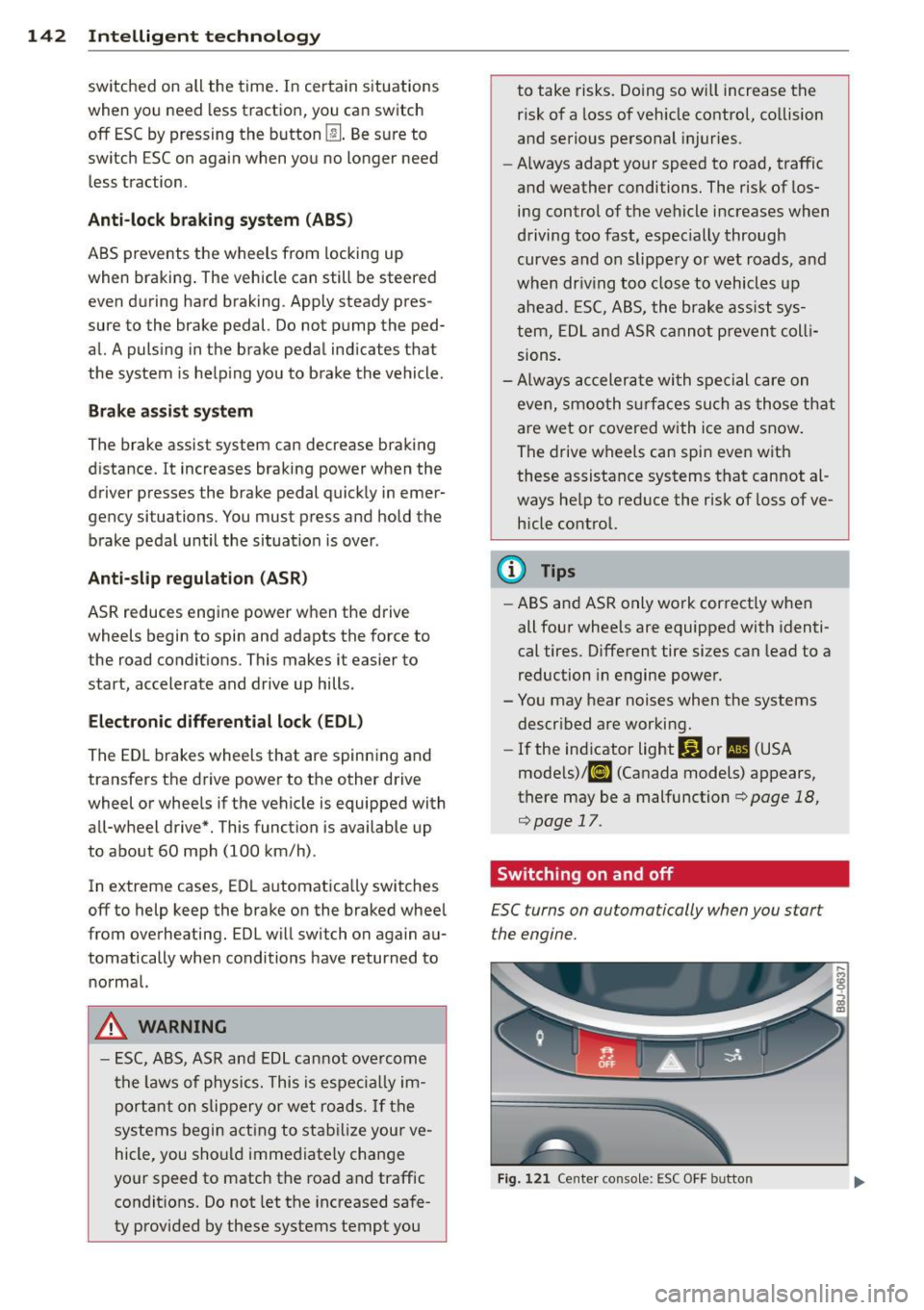
Switching on and off
£SC turns on automatically when you start
the engine.
Fig . 12 1 Ce nte r conso le: ESC OFF b utto n
Page 145 of 244
Switching ESC off (sport mod e)
I n ce rtain sit uat ions, it m ight make sense to
allow some slip. For example :
- Rocking the vehicle to free it when it is stuck
- Driving in deep snow or on loose ground
- Driving with snow cha ins
Press the[!] button . The ESC ind icator light
II turns on and Stab iliz ation p rogr am off
appears in the display. ASR deactivates com
p letely and the stabilizat ion effects from the
ESC system are lim ited .
Sw itchin g on
Press the[!] button again. The message
Sta b i
liz ation p rog ram on
appears briefly in the dis
p lay.
A WARNING
Only switch ESC sport mode on when your
driving abilities and the traffic s ituation
permit . Please note that the dr iv ing
w heels can spin and the vehicle can break
away in ESC sport mode, especia lly when
t he road is slippery.
(D Tips
If the re a re faults in the rear spo iler sys
tem or in Audi magnet ic r ide, it may not be
possible to act ivate ESC sport mode o r
normal mode may act ivate aga in a utoma t
ically.
Rear spoiler
Appl ies to vehicles: with retractable rear spoiler
The rear spoiler improves vehicle handling
and enhances driver control.
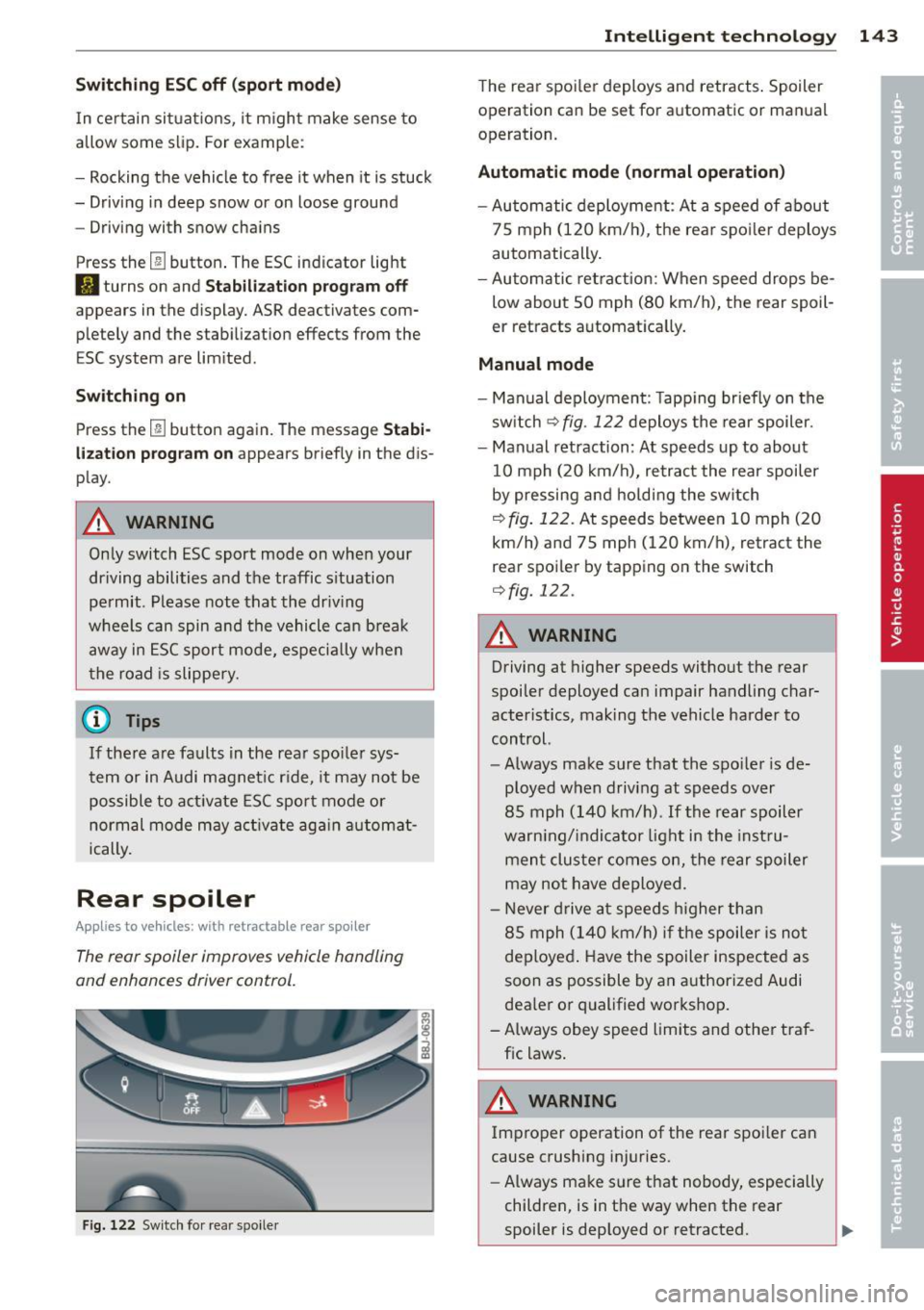
Fig. 122 Switch for rear spo ile r
Intelligen t technolog y 143
The rear spoi ler deploys and retracts . Spoiler
operation can be set for automatic or man ual
operation.
Aut omatic mode (normal ope ration )
- Automatic deployment : At a speed of about
75 mph (120 km/h), the rea r spo ile r deploys
automatically .
- Au tomatic retraction: When speed drops be
low about SO mph (80 km/h), the rear spoil
er retracts a utomatica lly.
Manual mode
- Man ual deployment : T app ing br iefly on the
sw itch
¢ fig . 122 deploys the rear spoiler.
- Manual retraction : At speeds up to about
10 mph (20 km/h), retract the rear spoiler
by pressing and holding the sw itch
¢ fig. 122. At speeds between 10 mph (20
km/h) and 75 mph (120 km/h), retract the
rear spoi ler by tapping on the switch
¢ fig. 122 .
A WARNING
-
Driving at higher speeds without the rear
spoiler deployed can impair handling char
acter istics, making the vehicle harder to
control.
- Always make su re that the spo ile r is de
ployed when driving at speeds over
85 mph (140 km/h) . If th e rear spoil er
warn ing/ indicator light in the inst ru
men t cluster comes on, the rear spoiler
may not have deployed.
- Never d rive a t speeds higher than
85 mph (140 km/h) i f th e spoiler is not
deployed . Have the spoiler inspected as
soon as possible by an authorized Audi
dea ler or qualified workshop.
- A lways obey speed limits and other traf
fic laws .
A WARNING
Improper operation of the rear spoi ler can
cause crushing injuries .
- Always make sure that nobody, especially
children, is in the way when the rear
spoiler is dep loyed or retracted.