alternator AUDI TT ROADSTER 2016 Owners Manual
[x] Cancel search | Manufacturer: AUDI, Model Year: 2016, Model line: TT ROADSTER, Model: AUDI TT ROADSTER 2016Pages: 306, PDF Size: 31.82 MB
Page 13 of 306
Downloaded from www.Manualslib.com manuals search engine 0
N
,.....
N
......
0
,.....
Vl
CX) Instruments
and warning/indicator lamps
The tank capacity of your vehicle is given in the
Technical data section ¢ page 288.
CD CAUTION
Never run the tank completely dry. If there is
an irregular fuel supply, misfiring can occur.
Unburnt fuel can then enter the exhaust sys
tem. This can lead to overheating and dam
age to the catalytic converter.
Warning and indicator
Lamps
Description
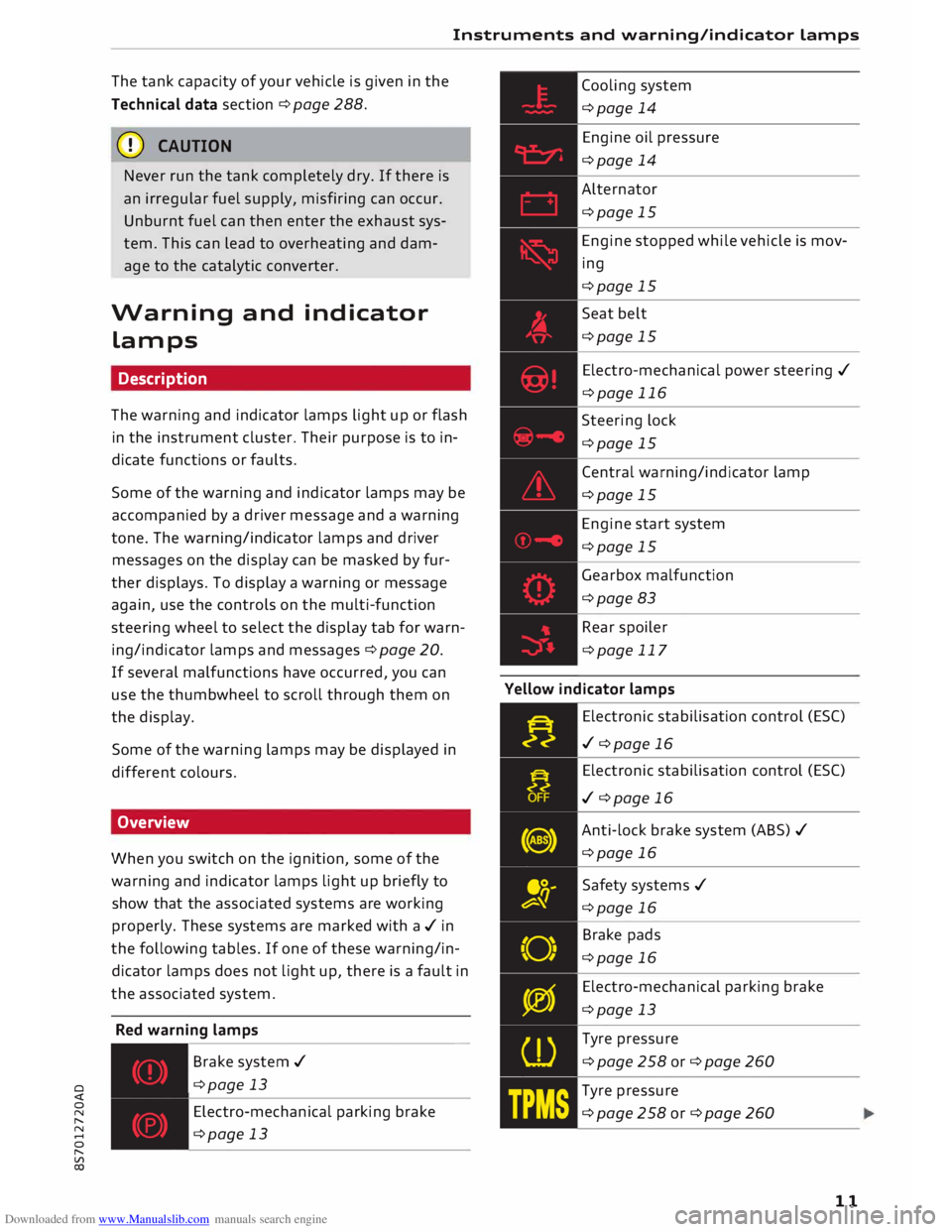
The warning and indicator lamps light up or flash
in the instrument cluster. Their purpose is to in
dicate functions or faults.
Some of the warning and indicator lamps may be
accompanied by a driver message and a warning
tone. The warning/indicator lamps and driver
messages on the display can be masked by fur
ther displays. To display a warning or message
again, use the controls on the multi-function
steering wheel to select the display tab for warn
ing/indicator lamps and messages ¢ page 20.
If several malfunctions have occurred, you can
use the thumbwheel to scroll through them on
the display.
Some of the warning lamps may be displayed in
different colours.
Overview
When you switch on the ignition, some of the
warning and indicator lamps light up briefly to
show that the associated systems are working
properly. These systems are marked with a../ in
the following tables. If one of these warning/in
dicator lamps does not light up, there is a fault in
the associated system.
Red warning lamps
---------------
Br a k e system ../
¢page 13
Electro-mechanical parking brake
¢page 13 Cooling
system
¢page 14
Engine oil pressure
¢page 14
Alternator
¢page 15
Engine stopped while vehicle is mov
ing
¢page 15
Seat belt
¢page 15
Electro-mechanical power steering ../
¢page 116
Steering lock
¢page 15
Central warning/indicator lamp
¢page 15
Engine start system
¢page 15
Gearbox malfunction
¢page 83
Rear spoiler
¢page 117
Yellow indicator lamps
Electronic stabilisation control (ES()
../ ¢page 16
Electronic stabilisation control (ES()
../ ¢page 16
Anti-lock brake system (ABS) ../
¢page 16
Safety systems ../
¢page 16
Brake pads
¢page 16
Electro-mechanical parking brake
¢page 13
Tyre pressure
¢page258or¢page260
Tyre pressure
¢page258or¢page260
11
Page 17 of 306
Downloaded from www.Manualslib.com manuals search engine 0
N
,.....
N
......
0
,.....
Vl
CX) Instruments
and warning/indicator lamps
(D) Note
The oil pressure warning lamp is not an indi
cator for the oil level. The oil level should
therefore be checked regularly.
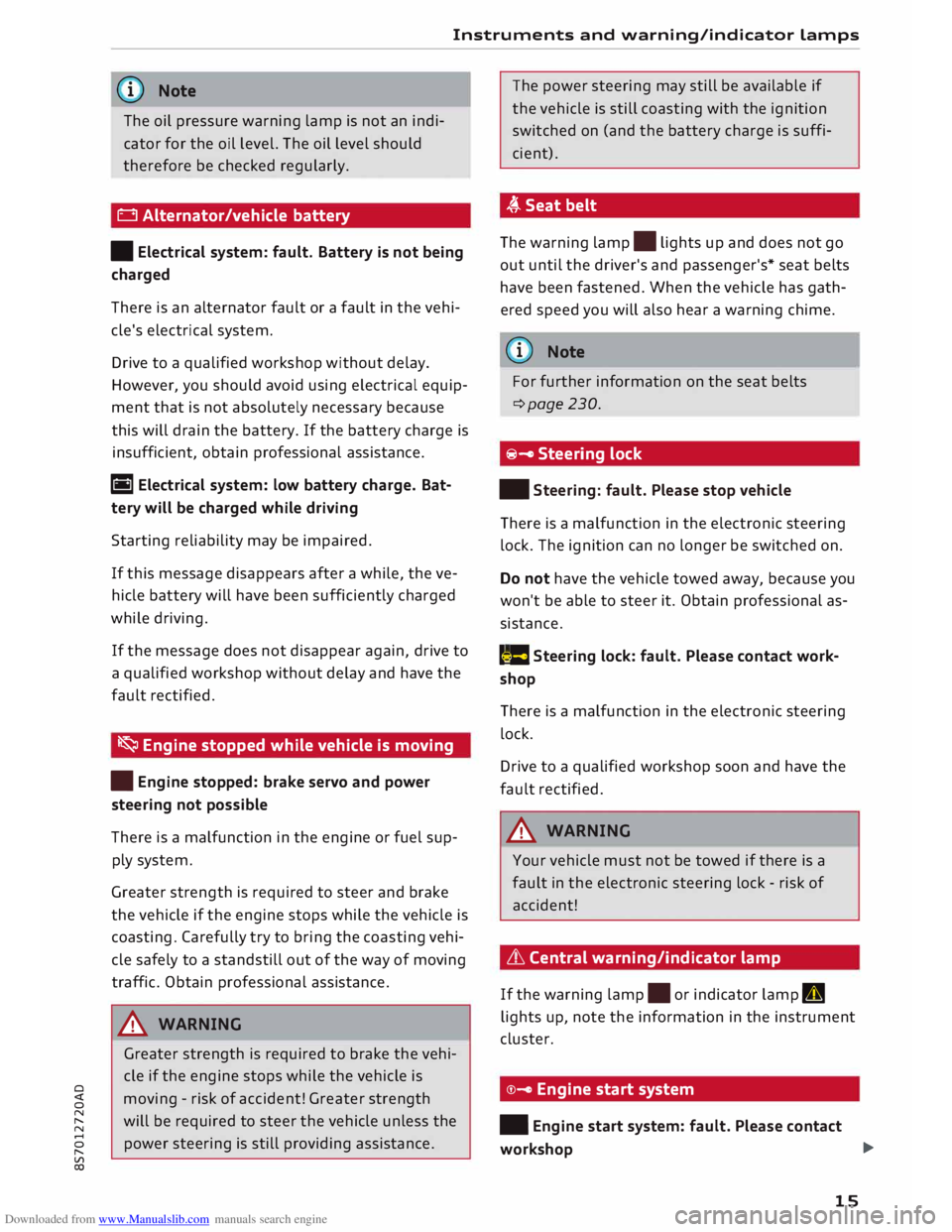
0 Alternator/vehicle battery
• Electrical system: fault. Battery is not being
charged
There is an alternator fault or a fault in the vehi
cle's electrical system.
Drive to a qualified workshop without delay.
However, you should avoid using electrical equip
ment that is not absolutely necessary because
this will drain the battery. If the battery charge is
insufficient, obtain professional assistance.
ri1 Electrical system: low battery charge. Bat
tery will be charged while driving
Starting reliability may be impaired.
If this message disappears after a while, the ve
hicle battery will have been sufficiently charged
while driving.
If the message does not disappear again, drive to
a qualified workshop without delay and have the
fault rectified.
� Engine stopped while vehicle is moving
• Engine stopped: brake servo and power
steering not possible
There is a malfunction in the engine or fuel sup
ply system.
Greater strength is required to steer and brake
the vehicle if the engine stops while the vehicle is
coasting. Carefully try to bring the coasting vehi
cle safely to a standstill out of the way of moving
traffic. Obtain professional assistance.
_& WARNING
Greater strength is required to brake the vehi
cle if the engine stops while the vehicle is
moving -risk of accident! Greater strength
will be required to steer the vehicle unless the
power steering is still providing assistance. The
power steering may still be available if
the vehicle is still coasting with the ignition
switched on (and the battery charge is suffi
cient).
,(,.Seatbelt
The warning lamp.
lights up and does not go
out until the driver's and passenger's* seat belts
have been fastened. When the vehicle has gath
ered speed you will also hear a warning chime.
(Q)) Note
For further information on the seat belts
¢page 230.
@- Steering lock
• Steering: fault. Please stop vehicle
There is a malfunction in the electronic steering
lock. The ignition can no longer be switched on.
Do not have the vehicle towed away, because you
won't be able to steer it. Obtain professional as
sistance.
(::$ Steering
lock: fault. Please contact work
shop
There is a malfunction in the electronic steering
lock.
Drive to a qualified workshop soon and have the
fault rectified.
_& WARNING
Your vehicle must not be towed if there is a
fault in the electronic steering lock -risk of
accident!
& Central warning/indicator lamp
If the warning lamp.
or indicator lamp II
lights up, note the information in the instrument
cluster.
©- Engine start system
• Engine start system: fault. Please contact
workshop ..,.
15
Page 70 of 306
Downloaded from www.Manualslib.com manuals search engine Driving
The tyre pressures should always be checked
when the tyres are cold.
Do not use winter tyres all through the year; they
will increase fuel consumption by up to 10 %.
Avoid carrying unnecessary loads
Every kilo of extra weight will increase the fuel
consumption, so it is worth checking the luggage
compartment occasionally to make sure that no
unnecessary loads are being transported.
Save electrical energy
The engine drives the alternator to generate elec
tricity. This means that fuel consumption rises
when more power is required for electrical equip
ment. Switch off electrical equipment when it is
not needed. Electrical equipment which uses a
lot of electricity includes the blower (at a high
setting), the rear window heating and the seat
heating*.
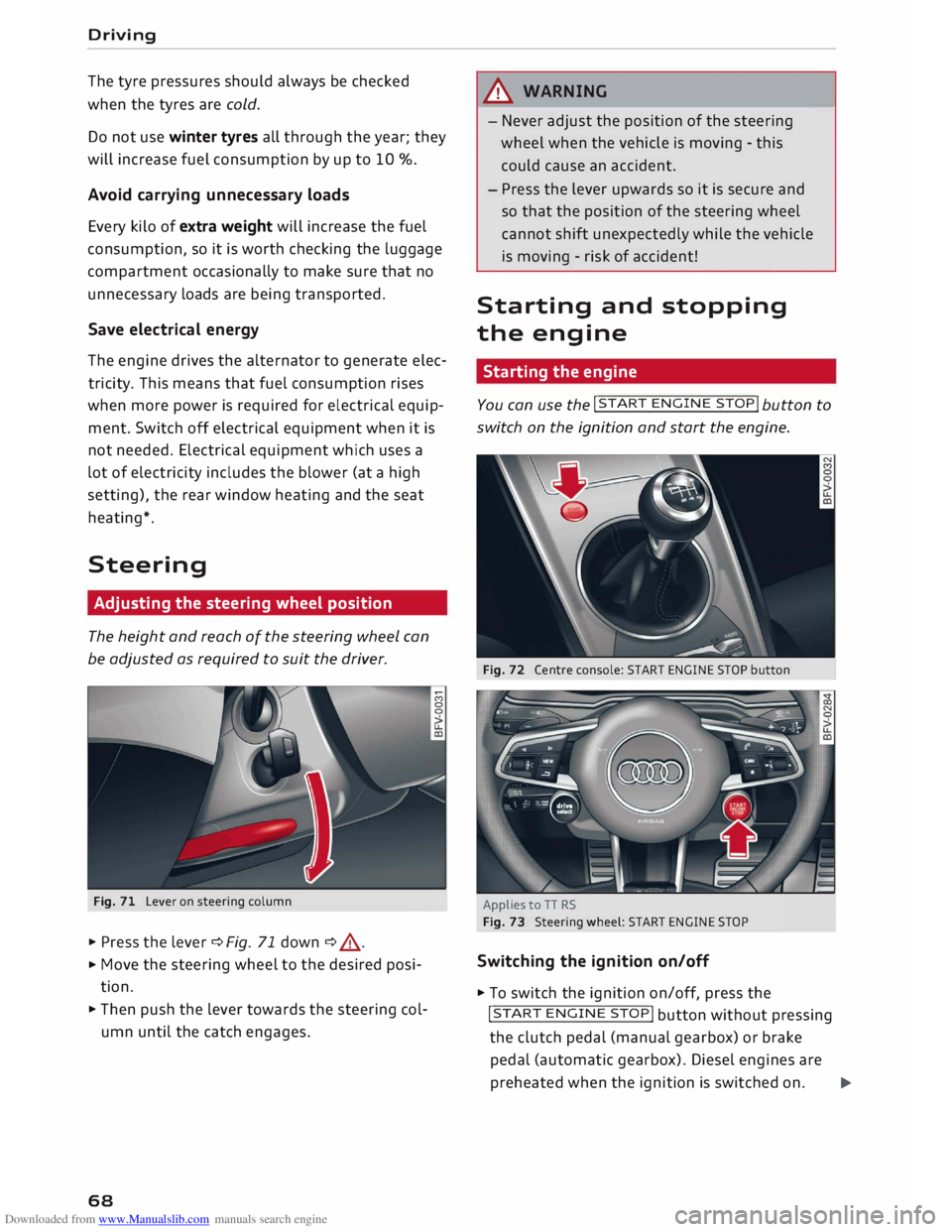
Steering Adjusting the steering wheel position
The height and reach of the steering wheel can
be adjusted as required to suit the driver.
Fig. 71 Lever on steering column
� Press the lever¢ Fig. 71 down ¢ .&, .
� Move
the steering wheel to the desired posi
tion.
� Then push the lever towards the steering col
umn until the catch engages.
68 A
WARNING
- Never adjust the position of the steering
wheel when the vehicle is moving - this
could cause an accident.
- Press the lever upwards so it is secure and
so that the position of the steering wheel
cannot shift unexpectedly while the vehicle
is moving -risk of accident!
Starting and stopping
the engine
Starting the engine -
You can use the !START
ENGINE STOP!
button to
switch on the ignition and start the engine.
Fig. 72 Centre console: START ENGINE STOP button
Applies to TT RS
Fig. 73 Steering wheel: START ENGINE STOP
Switching the ignition on/off
� To switch the ignition on/off, press the
!START ENGINE STOP!
button without pressing
the clutch pedal (manual gearbox) or brake
pedal (automatic gearbox). Diesel engines are
preheated when the ignition is switched on.�
Page 121 of 306
Downloaded from www.Manualslib.com manuals search engine 0
N
,.....
N
......
0
,.....
Vl
CX) consumed,
but only a small amount is supplied.
The situation is also critical if electrical equip
ment is in use when the engine is not running. In
this case power is consumed when none is being
generated.
In these situations you will be aware that the
power management system is intervening to con
trol the distribution of electrical power.
When the vehicle is parked for long periods
If you do not drive your vehicle for a period of
several days or weeks, the power management
will gradually shut off the on-board systems one
by one, or reduce the amount of current they are
using. This limits the amount of power consumed
and helps to ensure reliable starting even after a
long period. Certain convenience features, such
as remote control unlocking, may not be availa
ble. These functions will be restored when you
switch on the ignition and start the engine.
With the engine switched off
If you listen to the radio or use the other info
tainment functions when the engine is not run
ning, this will discharge the vehicle battery.
The infotainment display will show a warning
message before the battery power drops to a lev
el where the starting ability is impaired. This
message warns you that the system you are using
will soon be switched off automatically. You
should therefore start the engine if you wish to
continue using the system.
When the engine is running
Although the alternator generates electrical
power, the vehicle battery can still become dis
charged while the vehicle is being driven. This can
occur when a lot of power is being consumed but
only a small amount supplied, especially if the
vehicle battery is not fully charged initially.
To restore the necessary energy balance, the sys
tem will then temporarily shut off the electrical
components that are using a lot of power, or re
duce the current they are consuming. Heating
systems in particular use a large amount of elec
trical power. If you notice, for instance, that the
seat heating* or the rear window heater is not Intelligent
technology
working, they may have been temporarily switch
ed off or regulated to a lower heat output. These
systems will be available again as soon as suffi
cient electrical power is available.
You may also notice that the engine runs at a
slightly faster idling speed. This is quite normal,
and no cause for concern. The increased idling
speed allows the alternator to meet the greater
power requirement and charge the vehicle bat
tery at the same time.
Information saved in the
control units
The vehicle is fitted in the factory with electronic
control units that, among other things, control
the engine and the gearbox. The control units al
so monitor the exhaust system and the airbags.
The control units continually analyse data rele
vant to the vehicle while you are driving. In the
event of faults or anomalies in the vehicle data,
only these data are saved. As a rule, faults are
shown by the warning lamps in the instrument
cluster.
Data saved in the control units can only be read
and analysed with special equipment.
A qualified workshop is only able to recognise
and deal with faults by using the relevant saved
data. Among other things, the saved data may
contain the following information:
- Data relating to the engine and the gearbox
-Speed
- Direction of travel
- Braking force
- Seat belt warning system data
The control units installed will not under any cir
cumstances record conversations in the vehicle.
Event data recorder
Your vehicle is not equipped with an event data
recorder.
In an event data recorder, information about
the
vehicle is temporarily saved. In the event of an
accident, you can therefore obtain detailed infor-
mation about the course of events. On vehicles ...,.
119
Page 238 of 306
Downloaded from www.Manualslib.com manuals search engine Airbag
system
- The relevant safety requirements must be
observed when the vehicle or components
of the airbag or belt tensioner systems are
scrapped.
- For safety reasons, the alternator and the
starter are both disconnected from the bat
tery via a pyrotechnic circuit breaker in se
vere accidents.
- Any repairs to the pyrotechnic circuit
breaker must always be performed by a
qualified workshop -risk of accident!
- The relevant safety requirements must be
observed when the vehicle or the circuit
breaker are scrapped.
When are the airbags triggered?
One or more airbag systems are triggered in se
vere collisions, depending on the circumstances.
Factors determining the triggering response
It is not possible to define the exact triggering
response of the airbag system in all possible sit
uations, since the circumstances in different
types of accident will vary considerably. Impor
tant factors
include,
for example, the nature
(hard or soft) of the object which the car hits, the
angle of impact, vehicle speed and so on.
Whether the airbags are triggered depends pri
marily on the vehicle deceleration rate resulting
from the collision. By processing the signals from
the sensors located in the vehicle, the electronic
control unit is immediately able to evaluate the
severity of the collision and activate the restraint
systems accordingly. If the deceleration rate is
below the predefined reference value in the con
trol unit the airbags will not be triggered, even
though the accident may cause extensive damage
to the car. In these situations, the occupants are
protected by wearing the seat belts.
({D Note
The airbag may release a fine dust when it in
flates. This is quite normal and does not
mean there is a fire in the vehicle.
1 1
Not available in all export vehicles.
236 Front
airbags
Important notes on passenger's airbag
A AIRBAG
t '�
'\34 CII)
c:::::J
®
ClO
ClO
\t'� J�
a
-� �:&
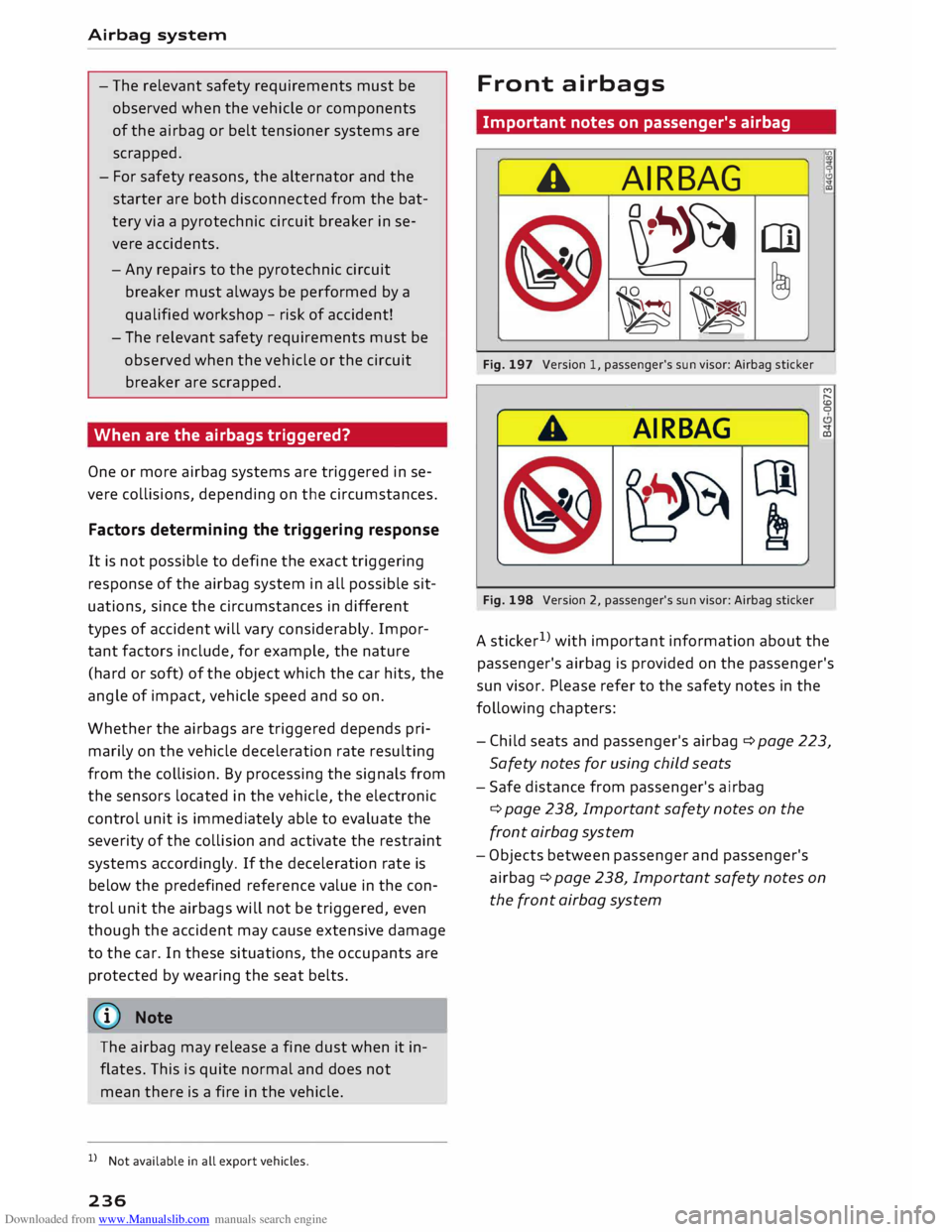
Fig. 197 Version 1, passenger's sun visor: Airbag sticker
AIRBAG
Fig. 198 Version 2, passenger's sun visor: Airbag sticker "'
M
....
c.o 0
"
A sticker 1
>
with important information about the
passenger's airbag is provided on the passenger's
sun visor. Please refer to the safety notes in the
following chapters:
- Child seats and passenger's airbag c:::> page 223,
Safety notes for using child seats
- Safe distance from passenger's airbag
c:::> page 238, Important safety notes on the
front airbag system
- Objects between passenger and passenger's
airbag c:::> page 238, Important safety notes on
the front airbag system
Page 247 of 306
Downloaded from www.Manualslib.com manuals search engine 0
N
,.....
N
......
0
,.....
Vl
CX) -
Never spill fluids on a hot engine. These flu
ids can cause a fire (e.g. radiator anti
freeze).
- Take care not to cause short circuits in the
electrical system, especially when working
on the battery.
- When working in the engine compartment
be aware that the radiator fan may start
running suddenly, even if the ignition is
switched off -risk of injury!
- Do not unscrew the cap on the expansion
tank when the engine is hot. The cooling
system is under pressure.
- Protect face, hands and arms by covering
the cap with a large, thick rag to protect
against escaping coolant and steam.
- Never remove the engine cover panel -risk
of burns!
- If any tests have to be performed with the
engine running, there is an extra safety risk
from the rotating parts, such as the drive
belts, alternator and radiator fan, etc., and
from the high-voltage ignition system.
- Vehicles with automatic gearbox: Never
open the throttle inadvertently (for instance
by hand from the engine compartment) if a
gear is engaged while the vehicle is station
ary with the engine running. The vehicle will
otherwise start moving immediately and
could cause an accident.
- Observe the following additional warnings if
work on the fuel system or the electrical
system is necessary:
- Do not smoke.
- Never work near naked flames.
- Always keep an approved fire extinguisher
immediately available.
- Any work on the batteries and electrical sys
tem in your vehicle entails a risk of injury
and chemical burns in addition to danger of
accident or fire. For this reason, you must
have the work carried out by a qualified
workshop.
CD CAUTION
When topping up fluids make sure the correct
fluid is put into the correct filler opening. This Checking
and topping up fluids
can otherwise cause serious malfunctions or
engine damage.
@ For the sake of the environment
Inspect the ground underneath your vehicle
regularly so that any leaks are detected at an
early stage. If you find spots of oil or other
fluids, have your vehicle inspected in the
workshop.
i Note
On right-hand drive vehicles* some of the
containers/ reservoirs mentioned below are
located on the other side of the engine com
partment.
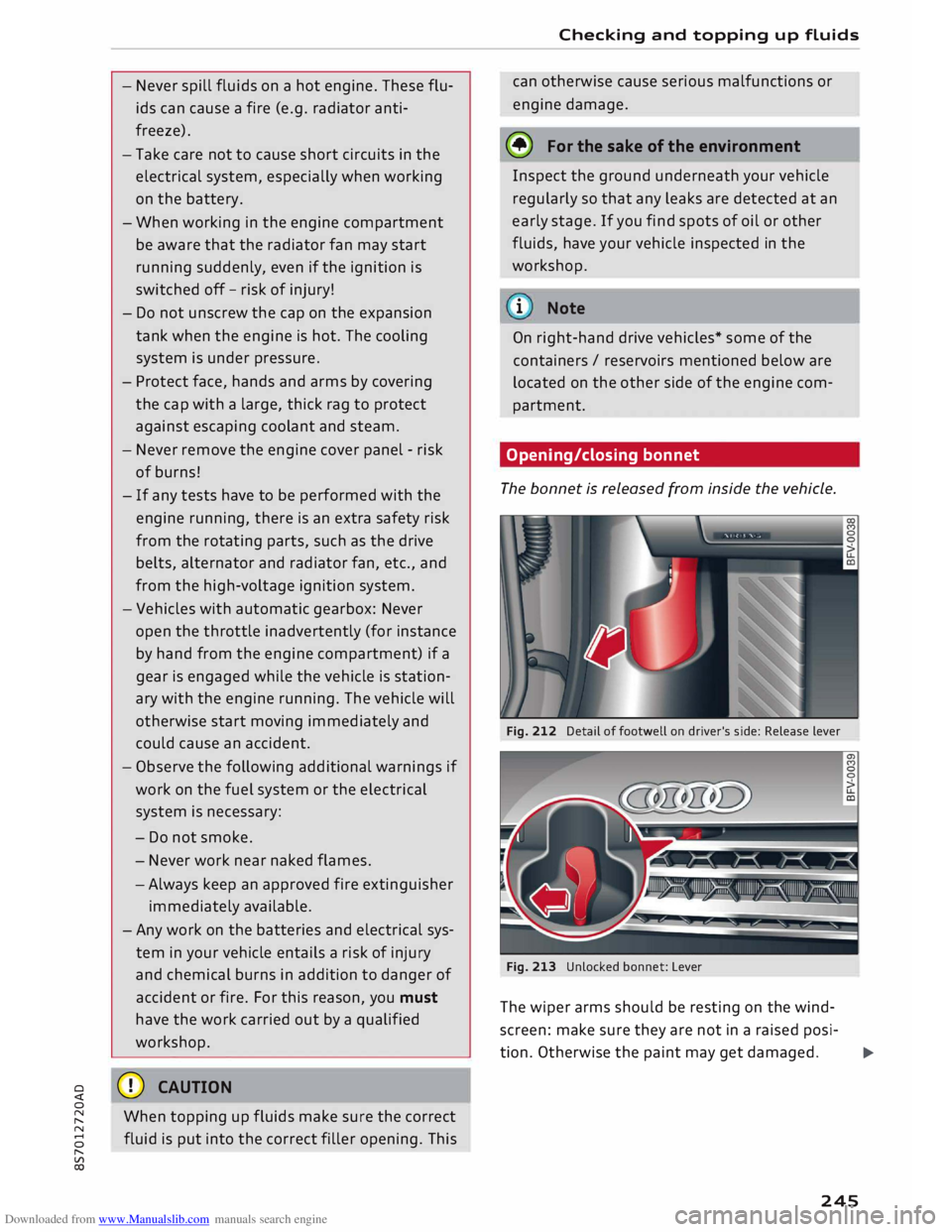
Opening/closing bonnet
The bonnet is released from inside the vehicle.
Fig. 212 Detail of footwell on driver's side: Release lever
Fig. 213 Unlocked bonnet: Lever
The wiper arms should be resting on the wind
screen: make sure they are not in a raised posi-
tion. Otherwise the paint may get damaged.
..,..
245
Page 292 of 306
Downloaded from www.Manualslib.com manuals search engine Index
Numbers and
Symbols
360 °
display
A 104
A/C (air conditioner) . . . . . . . . . . . . . . . . . 61, 62
ABS see Anti-lock brake system . . . . . . . . . . . .
113
Accelerator pedal . . . . . . . . . . . . . . . . . . . . .
226
Accessories 285
Active lane assist . . . . . . . . . . . . . . . . . . . . . . 92
Cleaning area around camera . . . . . . . . . . 264
Driver messages . . . . . . . . . . . . . . . . . . . . . .
93
Indicator lamp . . . . . . . . . . . . . . . . . . . . . . .
93
Setting steering vibration . . . . . . . . . . . . . .
94
Setting time of warning . . . . . . . . . . . . . . . .
94
Switching on/off . . . . . . . . . . . . . . . . . . . . . 93
Adaptive light (indicator lamp) . . . . . . . . . . . 19
Additional phone ................. 143,214
Airbag . . . . . . . . . . . . . . . . . . . . . . . . . . . . . .
235
Deactivating passenger's airbag . . . . . . . .
237
Front airbags . . . . . . . . . . . . . . . . . . . . . . .
236
Side airbags . . . . . . . . . . . . . . . . . . . . . . . .
239
Warning lamp . . . . . . . . . . . . . . . . . . . . . . . 16
Air conditioner (automatic)
Adjusting air outlets . . . . . . . . . . . . . . . 62, 63
Air distribution, air outlets . . . . . . . . . . . . . 62
Air recirculation mode . . . . . . . . . . . . . . . . . 63
AUTO (automatic mode) . . . . . . . . . . . . . . . 62
Blower . . . . . . . . . . . . . . . . . . . . . . . . . . . . .
62
Controls . . . . . . . . . . . . . . . . . . . . . . . . . . . .
62
Defrosting windows . . . . . . . . . . . . . . . . . . .
63
Drive select . . . . . . . . . . . . . . . . . . . . . . . . . 100
Rear window heating . . . . . . . . . . . . . . . . . .
63
Selecting temperature . . . . . . . . . . . . . . . . .
62
Air conditioner (manual)
Adjusting air outlets . . . . . . . . . . . . . . . 61, 63
Adjusting temperature . . . . . . . . . . . . . . . . 61
Air distribution,
air outlets . . . . . . . . . . . . .
61
Air recirculation mode . . . . . . . . . . . . . . . . . 61
Blower . . . . . . . . . . . . . . . . . . . . . . . . . . . . .
61
Controls . . . . . . . . . . . . . . . . . . . . . . . . . . . .
60
Defrosting windows . . . . . . . . . . . . . . . . . . .
61
Rear window heating . . . . . . . . . . . . . . . . . . 61
Air distribution, setting (air conditioner) 61, 62
Air outlets, adjusting . . . . . . . . . . . . . . . . . . . 63
290 Air
recirculation mode (air conditioner)
Alarm system 61,63
see Anti-theft alarm system . . . . . . . . . 27, 32
All-season tyres
see All-weather tyres . . . . . . . . . . . . . . . . .
257
All-weather lights . . . . . . . . . . . . . . . . . . . . . . 44
All-weather tyres . . . . . . . . . . . . . . . . . . . . . 257
Alterations to the vehicle . . . . . . . . . . . . . . .
285
Alternative routes . . . . . . . . . . . . . . . . . . . . . 177
Alternator (warning lamp) . . . . . . . . . . . . . . . 15
AMI see Audi music interface .......... 197,
198
Android Auto
see Audi smartphone interface . . . . . . . . .
210
Announcements (traffic programme) . . . . .
218
Anti-dazzle exterior mirrors . . . . . . . . . . . . . . 49
Anti-dazzle interior mirror . . . . . . . . . . . . . . . 49
Anti-freeze Coolant . . . . . . . . . . . . . . . . . . . . . . . . . . . . 249
Windscreen washer system . . . . . . . . . . . .
252
Anti-lock brake system . . . . . . . . . . . . . . . . .
113
Anti-theft alarm system . . . . . . . . . . . . . . . . . 32
Anti-theft wheel bolts . . . . . . . . . . . . . . . . . 273
Apple CarPlay
see Audi smartphone interface . . . . . . . . . 210
Armrest . . . . . . . . . . . . . . . . . . . . . . . . . . . . . .
55
Ashtray . . . . . . . . . . . . . . . . . . . . . . . . . . . . . .
56
ASR see Traction control system .......... .
Audi connect ........................ .
Data connection .................... .
Data protection .................... . 113
159
166
168
Personal hotspot . . . . . . . . . . . . . . . . . . . . 161
Services (overview) . . . . . . . . . . . . . . . . . . 162
Setup . . . . . . . . . . . . . . . . . . . . . . . . . . . . . 159
Audi magnetic ride
see Suspension control . . . . . . . . . . . . . . .
100
Audi music interface . . . . . . . . . . . . . . . . . . .
197
Audi music stream
see Wi-Fi . . . . . . . . . . . . . . . . . . . . . . . . . . .
195
Audio files . . . . . . . . . . . . . . . . . . . . . . . . . . . 200
Audio player
Bluetooth audio player
194
Audio players
Wi-Fi audio players . . . . . . . . . . . . . . . . . .
195
Audio track 203
Page 297 of 306
Downloaded from www.Manualslib.com manuals search engine 0
N
,.....
N
....
0
,.....
Vl
CX) Fuses
Changing 282
Fuse list . . . . . . . . . . . . . . . . . . . . . . . . . . .
283
In vehicle interior . . . . . . . . . . . . . . . . . . . .
282
G
GALA see Speed-dependent volume control . . . 217
Garage door opener (Homelink) . . . . . . . . . .
35
Gearbox malfunction (indicator lamp) 83
Generator see Alternator (warning lamp) . . . . . . . . . . 15
Global commands (speech dialogue system) .1.34
Glove box . . . . . . . . . . . . . . . . . . . . . . . . . . . . 57
G meter
see Sport displays . . . . . . . . . . . . . . . . . . . .
96
H
Handbrake see Electro-mechanical parking brake . . . . 74
Handsfree . . . . . . . . . . . . . . . . . . . . . . . . . . . 141
Hazard warning lights . . . . . . . . . . . . . . . . . . 47
Headlamp converter . . . . . . . . . . . . . . . . . . . . 47
Headlight range control . . . . . . . . . . . . . . . . . 44
Headlight range control (indicator lamp)
19
Headlights Headlight range control . . . . . . . . . . . . . . . 44
Washer system . . . . . . . . . . . . . . . . . . . . . .
50
Washing . . . . . . . . . . . . . . . . . . . . . . . . . . . 264
Heated Exterior mirrors . . . . . . . . . . . . . . . . . . . . . .
48
Rear window .. . . . . . . . . . . . . . . . . . . . . 61, 63
Washer jets . . . . . . . . . . . . . . . . . . . . . . . . .
50
Heater (supplementary heater for diesel en-
gine) . . . . . . . . . . . . . . . . . . . . . . . . . . . . . . . .
65
Heating Seats . . . . . . . . . . . . . . . . . . . . . . . . . . . . . . .
63
Heating/ventilation system
Adjusting air outlets . . . . . . . . . . . . . . . . . . 63
Controls . . . . . . . . . . . . . . . . . . . . . . . . . . . .
60
Hill hold assist . . . . . . . . . . . . . . . . . . . . . . . .
75
Hill starting
see Hill hold assist . . . . . . . . . . . . . . . . . . . . 75
Home address .................... 171, 175
Homelink (garage door opener) . . . . . . . . . . 35 Index
Horn . . . . . . . . . . . . . . . . . . . . . . . . . . . . . . . . . 8
Hubcaps , removing . . . . . . . . . . . . . . . . . . . . 272
I
Ignition (warning lamp) . . . . . . . . . . . . . . . . . 15
Immobiliser . . . . . . . . . . . . . . . . . . . . . . . . . . 27
Importing/exporting contacts . . . . . . . . . . . 154
Indicator lamps
see Warning lamps . . . . . . . . . . . . . . . . . . . 11
Inflation pressures
Tyre pressure monitoring system . . . . . . . 260
Inflation pressure
(tyres) . . . . . . . . . . . . . . . 258
Input level (media) . . . . . . . . . . . . . . . . . . . .
203
Inspection intervals . . . . . . . . . . . . . . . . . . . 252
Instrument cluster . . . . . . . . . . . . . . . . . . . . .
10
Instruments . . . . . . . . . . . . . . . . . . . . . . . . . .
10
Adjusting brightness . . . . . . . . . . . . . . . . . . 48
Interior lights . . . . . . . . . . . . . . . . . . . . . . 4 7, 48
Interior monitor . . . . . . . . . . . . . . . . . . . . . . . 32
Intermittent wipe (windscreen wipers) . . . . .
50
Internet see Audi connect . . . . . . . . . . . . . . . . . . . .
159
Internet radio . . . . . . . . . . . . . . . . . . . . . . . .
196
iPod see Audi music interface . . . . . . . . . .
197, 198
ISOFIX (securing child seats) . . . . . . . . . . . . 225
iTunes tagging . . . . . . . . . . . . . . . . . . . . . . .
185
J
Jack ........................ 270, 274, 276
Jacking points. . . . . . . . . . . . . . . . . . . . . . . 274
Jack plug (3.5 mm)
see AUX input . . . . . . . . . . . . . . . . . . .
198, 199
Joystick function (MMI) . . . . . . . . . . . . . . . .
126
Jukebox . . . . . . . . . . . . . . . . . . . . . . . . . . . . .
193
Jump-starting 277
K
Key-coded settings (air conditioner) . . . . . . . 60
Key-operated switch for passenger's airbag 23 7
Keys . . . . . . . . . . . . . . . . . . . . . . . . . . . . . . . . . 27
Driver messages . . . . . . . . . . . . . . . . . . . . . .
70
Emergency key . . . . . . . . . . . . . . . . . . . . 27, 28
295