jump start terminals AUDI TT ROADSTER 2016 Owners Manual
[x] Cancel search | Manufacturer: AUDI, Model Year: 2016, Model line: TT ROADSTER, Model: AUDI TT ROADSTER 2016Pages: 306, PDF Size: 31.82 MB
Page 248 of 306
Downloaded from www.Manualslib.com manuals search engine Checking
and topping up fluids
Opening the bonnet
� With the driver's door open, pull the Lever un
der the dashboard in the direction indicated
(arrow) ¢Fig. 212.
� Lift the bonnet slightly¢,&.
� Press the release Lever ¢Fig. 213 in the direc
tion indicated (arrow). This will release the ar
rester hooks.
� Open the bonnet.
Closing the bonnet
� To close the bonnet, pull it down to overcome
the spring pressure.
� Then Let it drop into the catches; do not press
down ¢,&.
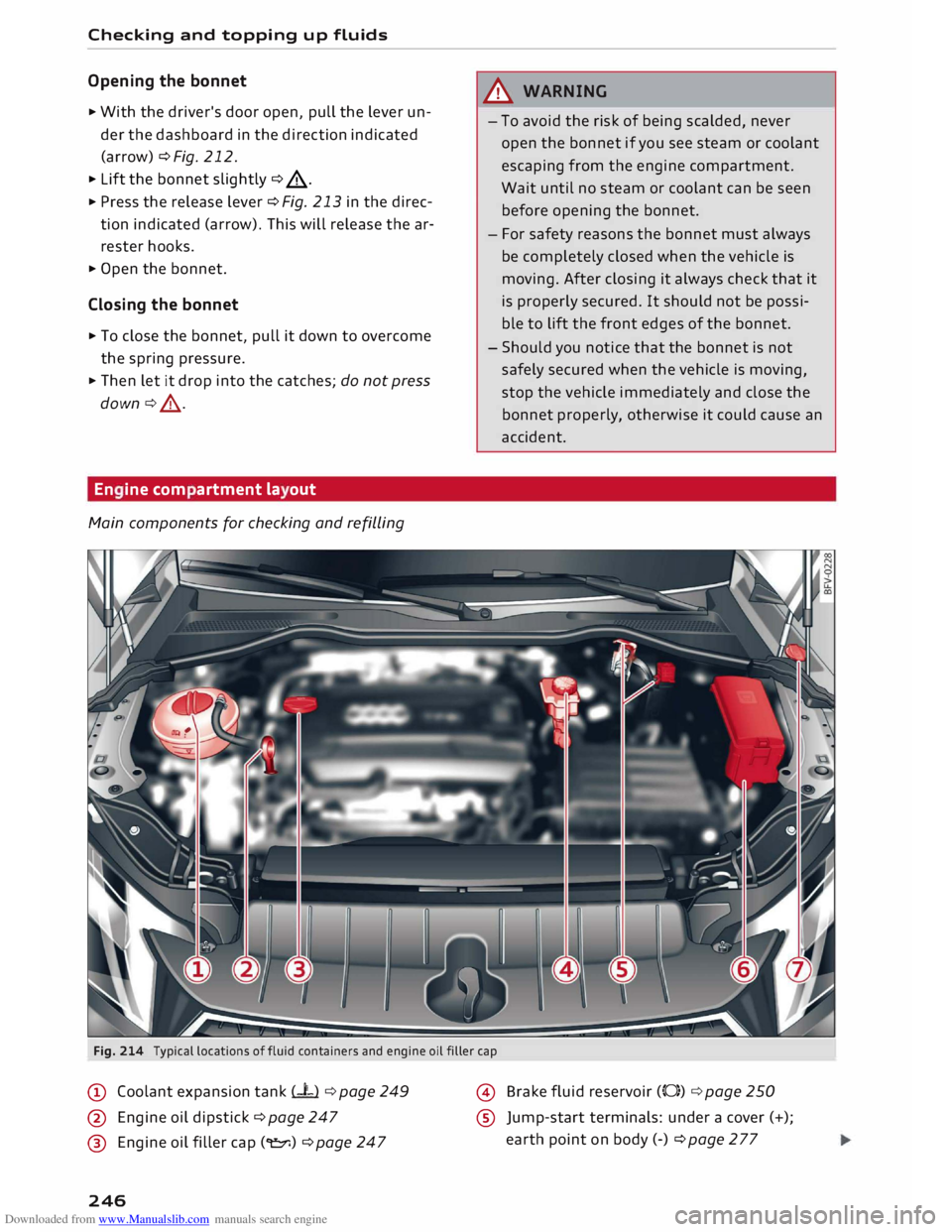
En ine com artment la out
Main components for checking and refilling A
WARNING
- To avoid the risk of being scalded, never
open the bonnet if you see steam or coolant
escaping from the engine compartment.
Wait until no steam or coolant can be seen
before opening the bonnet.
- For safety reasons the bonnet must always
be completely closed when the vehicle is
moving. After closing it always check that it
is properly secured. It should not be possi
ble to Lift the front edges of the bonnet.
- Should you notice that the bonnet is not
safely secured when the vehicle is moving,
stop the vehicle immediately and close the
bonnet properly, otherwise it could cause an
accident.
Fig. 214 Typical locations offluid containers and engine oil filler cap
@ Coolant expansion tank (-L) ¢ page 249
@ Engine oil dipstick ¢ page 247
@ Engine oil filler cap(�) ¢ page 247
246 @
Brake fluid reservoir (0)) ¢ page 250
® Jump-start terminals: under a cover (+);
earth point on body (-) ¢page277
Page 253 of 306
Downloaded from www.Manualslib.com manuals search engine 0
N
,.....
N
......
0
,.....
Vl
CX) Explanation
of warnings on vehicle battery:
® Wear safety
glasses!
A Battery
acid is extremely corrosive. Wear
protective gloves and safety glasses.
@ Keep
open flames, sparks, uncovered
Lights and Lit cigarettes away from the
battery!
� A
highly explosive mixture of gases may
be given off when the battery is under
charge!
® Keep children
away from batteries and
battery acid.
.&_ WARNING
Any work on the batteries and electrical sys
tem in your vehicle entails a risk of injury and
chemical burns in addition to danger of acci
dent or fire. For this reason, you must have
the work carried out by a qualified workshop.
CD CAUTION
If the car is left standing for Long periods,
protect the battery from frost. The battery
will be damaged irreparably if it is allowed to
freeze <=> page 2 51.
@ For the sake of the environment
'8 Batteries contain toxic substances including
sulphuric acid and Lead. Please contact a
qualified workshop if you have any questions.
Vehicle battery
The term "vehicle battery" refers to the 12 Volt
battery in your vehicle.
If the vehicle is not used for long periods
If you do not drive your vehicle for a period of
several days or weeks, the power management
will gradually shut off the on-board systems one
by one, or reduce the amount of current they are
using. This Limits the amount of power consumed
and helps to ensure reliable starting even after a
Long period <=> page 118. Certain convenience fea
tures, such as interior Lighting or electric seat ad
justment, may not be available. These functions Checking
and topping up fluids
will be restored when you switch on the ignition
and start the engine.
Even though some systems are deactivated auto
matically, certain electrical equipment continues
to draw current even when the ignition is off. If
the vehicle is Left standing for Long periods, this
can result in total battery discharge. If the vehi
cle battery is allowed to discharge completely, an
internal chemical reaction damages the battery
irreparably. To avoid this, the vehicle battery
should be recharged at Least once a month
<=> page 251. Please contact a qualified workshop
if you have any questions.
Winter conditions
Cold weather is very hard on the vehicle battery.
The starting capacity may be reduced as a result.
For this reason, you should have the vehicle bat
tery checked by a qualified workshop before the
start of winter.
Charging the vehicle battery
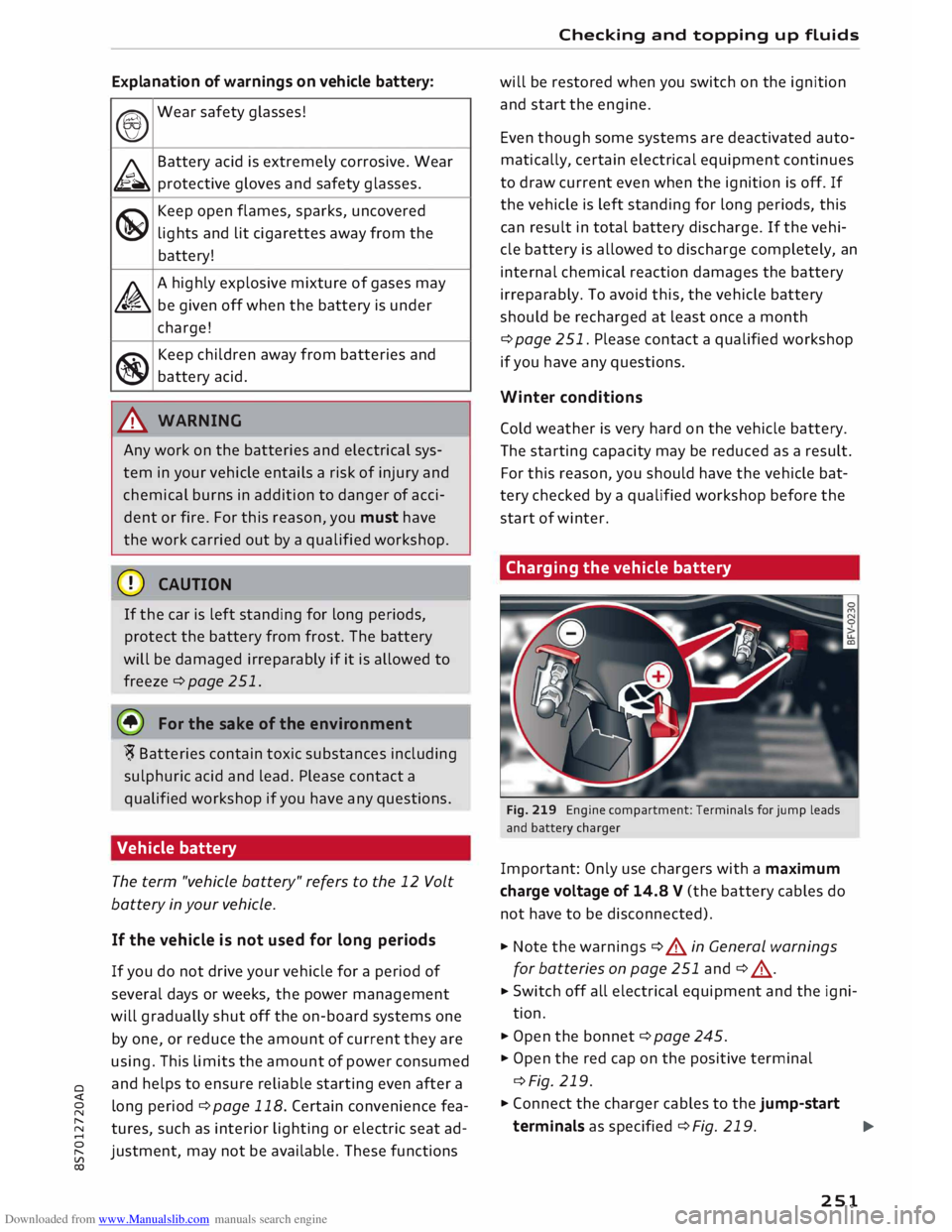
Fig. 219 Engine compartment: Terminals for jump leads
and battery charger
Important: Only use chargers with a maximum
charge voltage of 14.8 V (the battery cables do
not have to be disconnected).
� Note the warnings c:> A in General warnings
for batteries on page 251 and<=> A_ .
� Switch
off all electrical equipment and the igni
tion.
� Open the bonnet<=> page 245.
� Open the red cap on the positive terminal
<=>Fig. 219.
� Connect the charger cables to the jump-start
terminals as specified <=> Fig. 219.
�
251
Page 279 of 306
![AUDI TT ROADSTER 2016 Owners Manual Downloaded from www.Manualslib.com manuals search engine 0
<t
0
N
,.....
N
......
0
,.....
Vl
CX) ]ump-starting
Before starting the engine
If necessary, the engine can be started by](/img/6/57670/w960_57670-278.png "AUDI TT ROADSTER 2016 Owners Manual Downloaded from www.Manualslib.com manuals search engine 0
<t
0
N
,.....
N
......
0
,.....
Vl
CX) ]ump-starting
Before starting the engine
If necessary, the engine can be started by")
Downloaded from www.Manualslib.com manuals search engine 0
N
,.....
N
......
0
,.....
Vl
CX) ]ump-starting
Before starting the engine
If necessary, the engine can be started by con
necting it to the battery of another vehicle.
If the engine fails to start because of a dis
charged battery, the vehicle battery can be con
nected to the battery of another vehicle to start
the engine. Suitable jump leads are required.
Both vehicle batteries must be rated at 12 Volts.
The capacity (Ah) of the booster battery should
not be significantly lower than that of the dis
charged battery.
Jump leads
The jump leads must be heavy enough to carry
the starter current. Refer to the details given by
the manufacturer.
Only use jump leads with insulated battery
clamps.
Positive cable -usually red.
Negative cable -usually black.
A WARNING
- When it is discharged the battery can freeze
at temperatures around 0°
(. A frozen bat
tery must first be thawed out before con
necting the jump leads -risk of explosion
and chemical burns! After jump-starting the
vehicle, drive to a qualified workshop with
out delay and have the vehicle battery
checked.
- Note the safety warnings referring to work
ing in the engine compartment ¢ page 244.
ij}) Note
- There must be no contact between the two
vehicles as otherwise current could flow as
soon as the positive terminals are connec
ted. This would discharge the boosting bat
tery.
- The discharged vehicle battery must be
properly connected to the vehicle's electri
cal system. Mobility
- Switch off the car telephone if necessary.
Details will be given in the manufacturer's
instructions for the car telephone.
Starting the engine
The two jump Leads must be connected in the
correct sequence.
Fig. 240 Engine compartment: Terminals for jump leads
and battery charger
Fig. 241 Jump-starting with the battery of another vehi
cle: A -Discharged battery, B -Boosting battery
Preparations
... Apply the parking brake and move the gear lev
er to neutral (manual gearbox) or move these
lector lever to P (automatic gearbox).
... Switch off all electrical equipment and the igni-
tion on both vehicles.
Connecting and disconnecting the jump
leads
... Before jump-starting the vehicle you must open
the cap on the positive terminal.
... Connect one end of the red jump lead to the
positive terminal (!) ¢Fig. 241 ofthejump
start connection @ in your vehicle.
... Connect the other end of the red jump lead to
the positive terminal @of the boosting battery
® · �
277
Page 280 of 306
Downloaded from www.Manualslib.com manuals search engine Mobility
...
Connect one end of the black lead to the nega
tive terminal @of the boosting battery@.
... Connect the other end of the black jump lead to
the negative terminal© of the jump-start con
nection @ in your vehicle.
... Position
the jump leads in such a way that they
cannot come into contact with any moving
parts in the engine compartment.
Starting the engine
... Start
the engine of the vehicle with the boost
ing battery and let it run at idling speed.
... Now start the engine of the vehicle with the
discharged battery.
... If the engine fails to start: do not operate the
starter for longer than 10 seconds. Wait for
about 30 seconds and try again .
... Switch on the blower and the rear window heat
ing on the vehicle which has been jump-started
in order to offset excessive voltage which may
occur when disconnecting the leads. The head
lights must be switched off!
... When
the engines are running, disconnect the
leads in exactly the opposite sequence to that
described on ¢page 277, Connecting and dis
connecting the jump Leads. Make sure that the
leads cannot come into contact with any mov
ing parts in the engine compartment.
... Close the cap on the positive terminal.
... Switch off the blower and the rear window
heating again.
A WARNING
- The non-insulated parts of the battery
clamps must not be allowed to touch. The
jump lead attached to the positive battery
terminal must not touch metal parts of the
vehicle: this can cause short circuits.
- Do not lean over batteries -risk of chemical
burns!
- The screw plugs on the battery cells must be
screwed in firmly.
- Keep sparks, flame and lit cigarettes away
from vehicle batteries: the gases given off
can cause an explosion.
- If jump-starting another vehicle, position
the jump leads in such a way that they can
not come into contact with any moving
278 parts
in the engine compartment of the oth
er vehicle .
CD CAUTION
Please note that the above method of con
necting the leads is intended for jump-start
ing your vehicle. If jump-starting another ve
hicle, you should not connect the negative
Lead(-) to the negative terminal of the dis
charged vehicle battery, but directly to the
engine block or a solid metal part bolted to
the engine block. If the battery of the other
vehicle does not have a gas vent, there is a
risk that a mixture of oxygen and hydrogen
gas can accumulate and cause an explosion.
@ Note
- The vehicle battery is vented to the outside
to prevent gases entering the vehicle's inte
rior.
- Connect the battery clamps so they have
good metal-to-metal contact with the bat
tery terminals.
Tow-starting / towing
away
General notes
Some experience is required to tow or tow-start a
vehicle, especially when using a tow-rope. Both
drivers should be familiar with the technique re
quired for towing. Inexperienced drivers should
not attempt to tow-start or tow away another ve
hicle.
Do not pull too hard with the towing vehicle and
take care to avoid jerking the tow-rope. When
towing off-road, there is always a risk that the
anchorage points may be overloaded.
Tow-bar I tow-rope
It is easier and safer to tow the vehicle with a
tow-bar. You should only use a tow-rope if you do
not have a tow-bar. It is advisable to use a tow
rope made of elastic synthetic fibre or similarly
elastic material.
�