tires AUDI TT ROADSTER 2017 Owner's Manual
[x] Cancel search | Manufacturer: AUDI, Model Year: 2017, Model line: TT ROADSTER, Model: AUDI TT ROADSTER 2017Pages: 314, PDF Size: 76.54 MB
Page 264 of 314
Wheels
The low aspect ratio of these tires is i ndicated by
a numeral of
55 or less in the tire's si ze designa
tion. The numera l rep resents the rat io o f the
tire's sidewall he ight in relat ion to its tread width
expressed in percentage . Conventional tires have
a height/w idt h rat io of 60 o r more.
The performance of low -aspect-ratio tire s is par ·
ticularly sensitive to improper inflation pres
sure.
It i s therefore important that low aspect
ratio tires ar e inflat ed to the specifi ed pr essure
and that the inflation pre ssure is regularly
checked and maintained . Tire pre ssure s should
be checked at le ast once a month and always
before a long trip¢
page 256.
What you can do to avoid tire and rim
damage
Low aspect rat io tires can be damaged more easi
ly by impact wi th potholes, cu rbs, g ullies or
ridges on the road, pa rt ic ul arly if the tire is un
derinflated .
I n order to minim ize t he oc currence of impac t
d a mage to the t ires of your ve hicle, we recom
mend that you ob5erve the following precau
tions:
- Always mai nta in recommended inf lation pres
s ur es . Che ck your tire p ress ure every 2,000
miles (3, 000 km) and ad d air if necessary .
- Drive caref ully on roads with potho les, deep
gull ies or r idges . The im pact from d riving
th rough or ove r su ch obs tacles can damage
your tires. Impact with a curb may also cause
damage to your tires.
-A fter any impact, immediately inspect your
ti res or have them inspected by the nearest au
thori zed Audi dea ler. Replace a damaged tire as
soon as possib le.
- Inspect yo ur tires every 2,000 miles (3,000 km)
for damage and wear. Damage is not always easy to see. Damage can lead to loss of air and
underinflation, which cou ld eventually cause
ti re failure . If you believe that a tire may have
been damaged, re place the t ire as soon as pos
s ible.
- T hese tires may wear more qu ick ly than othe rs .
- Please a lso remember t hat, w hile these tires
deliver responsive handling, they may r ide less
262
comforta bly and make more noise than o ther
choices .
Reduced performance in winter/cold season
condition s
All tires are des igned for certain purposes . The
l ow aspect ratio , ultra h igh performance tires
o rigina lly installed on your vehicle are intended
for maximum d ry and wet road perfo rmance and
handling. They a re not suitable for co ld, snowy or
i cy weather conditions . If you drive under those
c ircumstances, you should equip you r vehicle
with all-season o r winter tires, which offer better
t ra ct ion unde r th ose condi tio ns. We suggest yo u
u se the recommen ded snow or a ll-season tires
spe cified for your vehicle, o r th e ir equiv alent.
Refer to¢
pag e 260 for more detailed informa
t ion regard ing winter tires.
Uniform tire quality grading
- Tr ea d wea r
- Tr actio n AA ABC
- T empe ratu re ABC
Quality grades can be found where applicable on
the tire side wall between tread shoulder and
max imum section width
¢ page 246, fig . 188.
For example : Tread wear 200 , Traction AA , Tem
perature
A .
All passenge r ca r tir es must conform to Federal
Safety Req uirements in a ddition to these grades.
Tread wear
The tread wear grade is a compa rative rating
based on the wea r ra te o f the tire w hen tested
u nder con trolled cond itions on a specified gov
ernment test course .
Fo r example, a tire g raded 150 wou ld wea r one
a n d one half (1 1/2) times as well o n the govern
ment cou rse as a t ire graded 100.
The re lative pe rformance of tires depends upon
t h e ac tual cond itions of the ir use, however, and
m ay dep art significan tly from the no rm due to
variations in driv ing habi ts, service pract ices and
diffe rences in road characteristics and climate. ..,.
Page 265 of 314
co
co
.... N
" N .... 0
" "' c:o
Traction
The traction grades, from highest to lowest, are
AA, A, B and
C. Those grades represent the tire's
ability to stop on wet pavement as measured un
der controlled conditions on specified govern
ment test surfaces of asphalt and concrete . A tire
marked C may have poor traction performance
¢ _& .
Temperature
The temperature grades are A (the highest), B ,
and
C, representing the tire's resistance to the
generation of heat and its ability to dissipate
heat when tested under controlled conditions on
a specified indoor laboratory test wheel.
Sustained high temperature can cause the mate rial of the tire to degenerate and reduce tire life,
and excessive temperature can lead to sudden
tire failure
c:> .& .
The grade C corresponds to a level of perform
ance which all passenger car tires must meet un
der the Federal Motor Vehicle Safety Standard No.
109 . Grades Band A represent higher levels
of performance on the laboratory test wheel than
the minimum required by law.
A WARNING
The traction grade assigned to this tire is
based on straight -ahead braking traction
tests, and does not include acceleration, cor
nering, hydroplaning or peak traction charac
teristics.
A WARNING
The temperature grade for this tire is estab
lished for a tire that is properly inflated and
not overloaded . Excessive speed, underinfla
tion, or excessive loading, either separately or
in combination, can cause heat buildup and
possible tire failure.
A WARNING
Temperature grades apply to tires that are properly inflated and not over or underinflat
ed.
Wheels
Tire pressure monitoring system
ill General notes
Each tire, including the spare (if provided),
should be checked monthly when cold and inflat
ed to the inflation pressure recommended by the
vehicle manufacturer on the vehicle placard or
tire inflation pressure label. (If your vehicle has
tires of a different size than the size ind icated on
the vehicle placard or tire inflation pressure la bel, you should determine the proper tire infla
tion pressure for those tires).
As an added safety feature, your vehicle has been equipped with a tire pressure monitoring system
(TPMS) that illuminates a low tire pressure tell
tale when one or more of your tires is significant
ly under-inflated. Accordingly, when the low tire
pressure telltale illuminates, you should stop and
check your tires as soon as possible, and inflate
them to the proper pressure . Driving on a signifi
cantly under-inflated tire causes the tire to over
heat and can lead to tire failure . Under-inflation
also reduces fuel efficiency and tire tread life,
and may affect the vehicle's handling and stop
ping ability .
Please note that the TPMS is not a substitute for
proper tire maintenance, and it is the driver's re
sponsibility to maintain correct tire pressure, even if under-inflation has not reached the level
to trigger illumination of the TPMS low tire pres
sure telltale .
Your vehicle has also been equipped with a TPMS malfunction indicator to indicate when the sys
tem is not operating properly . The TPMS mal
function indicator is combined with the low tire
pressure telltale. When the system detects a
malfunction, the telltale will flash for approxi
mately one minute and then remain continuously
illuminated. This sequence will continue upon
subsequent vehicle start-ups as long as the mal
function exists.
When the malfunction indicator is illuminated,
the system may not be able to detect or signal low tire pressure as intended. TPMS malfunctions
may occur for a variety of reasons, including the .,.
263
Page 266 of 314
Wheels
installation of replacement or alternate tires or
wheels on the vehicle that prevent the TPMS
from functioning properly. Always check the
TPMS malfunction telltale after replacing one or
more tires or wheels on your vehicle to ensure
that the replacement or alternate tires and
wheels allow the TPMS to continue to function
proper ly .
If the Tire Pressure Monitoring System
indicator appears
The tire pressure indicator in the instrument
cluster informs you if the tire pressure is too low
or if there is a system malfunction.
Using the ABS sensors, the tire pressure monitor
ing system compares the tire tread circumfer
ence and vibration characteristics of the individu
al tires. If the pressure changes in one or more
tires, this is indicated in the Infotainment system
disp lay with an indicator light
RR and a message.
If only one tire is affected , the location of that
tire will be indicated.
The tire pressures must be stored in the Infotain
ment system again each time the pressures
change (switching between partial and full load pressure) or after changing or replacing a tire on
your vehicle ¢
page 265 . The tire pressure moni
toring system only monitors the tire pressure you
have stored. Refer to the tire pressure label for
the recommended tire pressure for your vehicle
¢ page 256, fig.191.
Tire tread circumference and vibration character
istics can change and cause a tire pressure warn
ing if:
- the tire pressure in one or more tires is too low.
- the tire has structural damage .
- the tire was replaced or the tire pressure was
changed and it was not stored¢
page 265.
-the spare tire* is installed.
Indicator lights
RR -Loss of pressure in at least one tire ¢ ,& .
Check the tires and replace o r repair if necessary.
Check/correct the p ressures of a ll four tires and
store the pressure again in the Infotainment sys
tem ¢
page 265.
264
mm (T ire Pressure Monitoring System) Tire
pressure: malfunction! See owner's manual -
If
mm appears after switching on the ignit ion or
while driving and then the indicator light
RR in
the instrument cluster also starts to blink for
about one minute and then stays on permanent ly, there is a system malfunction. Try to store the
correct tire pressures¢
page 265. If the indica
tor light does turn off or turns on again after a
short period of time , drive to an authorized A udi
dealer or authorized Audi Service Facility immedi
ate ly to have the ma lfunction corrected.
_& WARNING
-If the tire pressure indicator appears in the
disp lay, reduce your speed immediately and
avoid any hard steering or brak ing maneu
vers. Stop as soon as poss ible and check the
tires and their pressure .
- The driver is responsible for maintain ing the
correct tire pressures . You must check the
tire pressures regularly .
- Under certain cond it ions (such as a sporty
driving style, w inter condit ions or unpaved
roads), the pressure monitor indicator may
be delayed.
- Do not use run-flat tires on your vehicle . Us
ing them when not perm itted can lead to
vehicle damage or accidents.
(D Tips
- The tire pressure monitoring system can al
so stop working when there is an ESC mal
function.
- Us ing snow chains may result in a system
ma lfunction.
- The tires w ith the identification "AO"
¢
page 253 have been matched w ith your
Audi t ire pressure monitoring system. We
recommend that you use these tires.
Page 268 of 314
Care and cleaning
Care and cleaning
General information
Regular, proper care helps to maintain your vehi
cle's value.
It can also be a requirement when
submitting warranty claims for corrosion damage
and paint defects on the body.
The necessary care products can be obtained
from an authorized Audi dealer or authorized
Audi Service Facility. Read and follow the instruc
tions for use on the packaging.
A WARNING
- Using cleaning and care products incorrectly
can be dangerous to your health .
- Always store cleaning and care products out
of reach of children to reduce the risk of poi
soning .
@ For the sake of the environment
- Preferably purchase environmentally-friend ly cleaning products.
- Do not dispose of leftover cleaning and care
products with household trash.
Car washes
The longer that deposits remain on the vehicle,
the more the surface may be damaged. High
temperatures such as those caused by sunlight
increase the damaging effect.
Before washing, rinse
off heavy deposits with
plenty of water.
Stubborn deposits such as bird droppings or tree
sap are best removed with plenty of water and a microfiber cloth.
Also, wash the underside of your vehicle once
road salt stops being used for the season.
Pressure washers
When washing your vehicles with a pressure
washer, always follow the operating instructions
provided with the pressure washer. This is espe
cially important in regard to the pressure and
spraying distance . Do not direct the stream of
water directly onto seals for the side windows,
266
doors, luggage compartment lid or hood or onto
the tires, rubber hoses, insulating material, sen
sors* or camera lenses*. Keep a distance of at
least 16 in (40 cm).
Do not remove snow and ice with a pressure
washer.
Never use cone nozzles or high pressure nozzles.
The water temperature must not be above 140 °F
(60 °().
Automatic car washes
Spray
off the vehicle before washing.
Make sure that the windows are closed and the
windshield wipers are
off. Follow instructions
from the car wash operator, especially if there
are accessories attached to your vehicle.
If possible, use car washes that do not have
brushes.
Washing
by hand
Clean the vehicle starting from the top and work
ing down using a soft sponge or cleaning brush.
Use solvent-free cleaning products.
Washing vehicles with matte finish paint
by
hand
To avoid damaging the paint when washing, first
remove dust and large particles from your vehi
cle. Insects, grease spots and fingerprints are
best removed with a special cleaner for matte
finish paint .
Apply the product using a microfiber cloth. To
avoid damaging the paint surface, do not use too
much pressure.
Rinse the vehicle thoroughly with water. Then
clean using a neutral shampoo and a soft micro
fiber cloth .
Rinse the vehicle thoroughly again and let it air
dry. Remove any water residue using a chamois .
A WARNING
-
- Only wash the vehicle when the ignition is
off and follow the instructions from the car
Page 276 of 314
Emerg ency assis ta nce
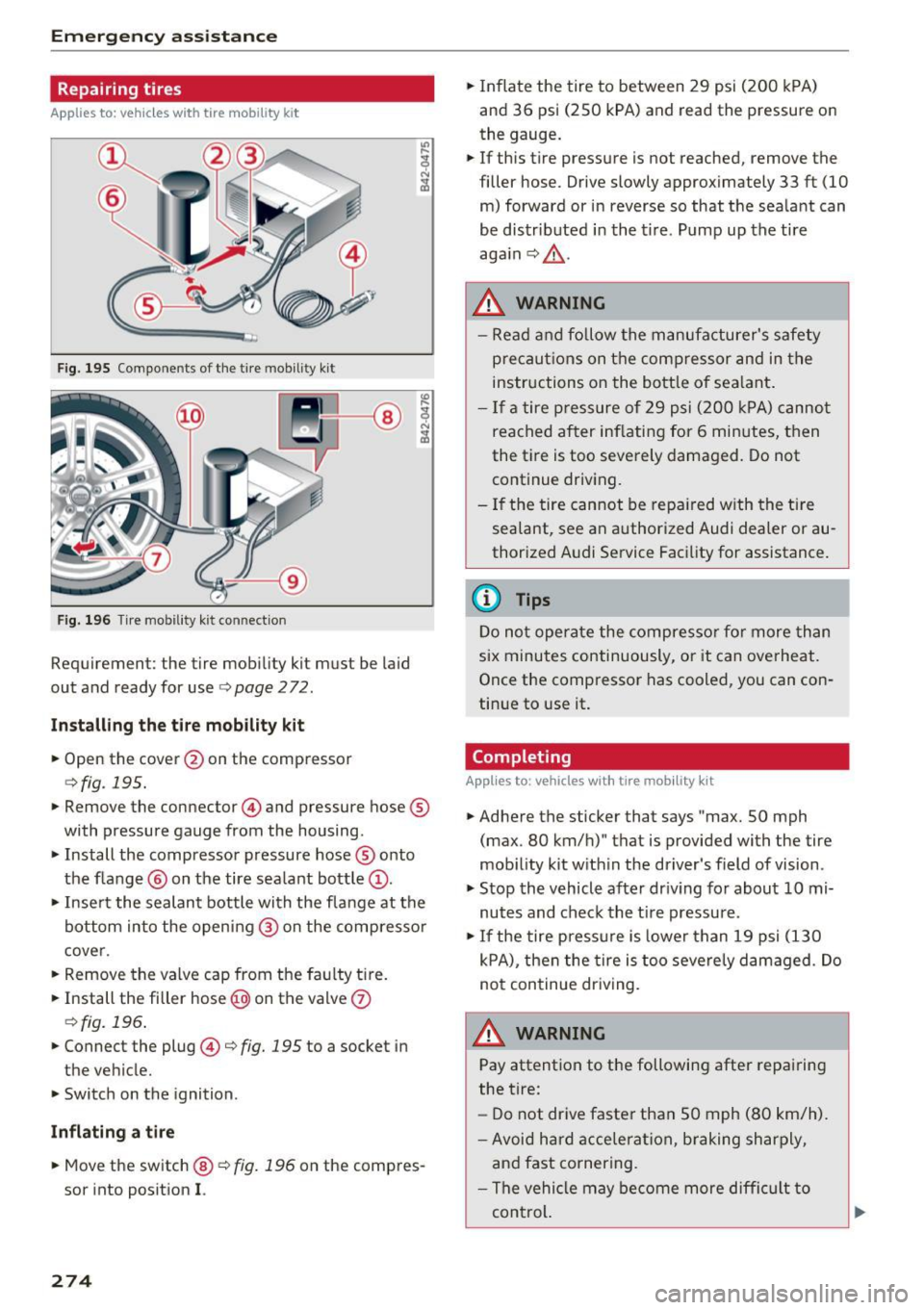
Repairing tires
Applies to: ve hicles w ith tire mob ility k it
Fig. 195 Compo nents of the ti re mobili ty k it
F ig . 196 T ire mo bility k it c onn ection
Requirement : the tire mobili ty kit mus t be laid
out and ready for use
o page 2 7 2.
In stall ing the t ir e mobility kit
.. Op en the cover @on the compressor
¢fig . 195 .
.. Remove the connector@) and pressu re hose ®
with pressure gauge from the housing.
• Install the compressor pressure hose ® onto
the f lange @ on the tire sea lant bottle
(D .
.. Inse rt the sealant bottle with the flange at the
bottom into the opening @ on the compresso r
cover .
.. Remove the valve cap from the fau lty tire.
.. Install the filler hose@) on the valve
(J)
ofig. 196 .
.. Connect the plug @¢ fig. 195 to a socket in
the vehicle.
.. Switch on the ignition .
Inflating a tire
.. Move the switch @ o fig. 196 on the compres
sor into posit ion
I.
274
.. Inflate the tire to between 29 psi (200 kPA)
and 36 ps i (250 kPA) and read the pressur e on
the gauge .
.. If this tire p ressure is not reached , remove the
filler hose . Drive slowly approximately 33 ft (10
m) forward or in reverse so that the sea lant can
be distributed in the t ire. Pump up the tire
aga in ¢ ,&. .
.&_ WARNING
-Read a nd follow the manufacturer's safety
precaut ions on the compressor and in the
instructions on the bottle of sea lant .
- I f a tire p ressure of 29 psi (200 kPA) canno t
reached after inflating for 6 minutes, then
the tire is too severely damaged. Do not
continue driv ing.
- If the tire cannot be repa ired with the tire
sealant, see an authorized Audi dealer or au
thorized Audi Service Facility for assistance.
(D Tips
Do not operate the compresso r fo r more than
six minutes continuously , or it can overheat.
Once the compressor has cooled, you can con
tin ue to use it.
Completing
App lies to : vehicles wit h tire mob ility kit
.. Adhere the sticker that says "max. SO mph
(max . 80 km/h)" that is provided with the tire
mob ility kit with in the driver 's field of vision.
.. Stop the vehicle after driv ing for about 10 mi
nutes and check the t ire pressure .
.. If the tire press ure is lower than 19 psi (130
kPA) , then the tire is too severely damaged . Do
not continue driving .
.&_ WARNING
Pay attention to the following after repairing
the tire:
- Do not drive faster than SO mph (80 km/h).
- Avoid hard acce leration, braking sh arply,
and fast cornering .
- The vehicle may become more diffi cult to
con trol.
Page 279 of 314
CD
CD
.... N
" N .... 0 r--. V, co
-To reduce the risk of injury, support the ve
hicle securely with suitable stands if work is
to be performed underneath the vehicle.
- To help prevent injury to yourself and your
passengers:
- Do not raise the vehicle until you are sure
the jack is securely engaged .
- Passengers must not remain in the vehicle
when it is jacked up.
- Make sure that passengers wait in a safe
place away from the vehicle and well away
from the road and traffic.
- Make sure jack position is correct, adjust
as necessary and then continue to raise
the jack.
- If work has to be done under the vehicle,
ensure that it is safely supported on suita
ble stands -risk of injury!
- Never start the engine when the vehicle is
on the jack -risk of accident!
(D Note
Do not lift the vehicle by the sill . Position the
vehicle jack* only at the designated mounting points on the side sill. Otherwise, your vehicle
will be damaged.
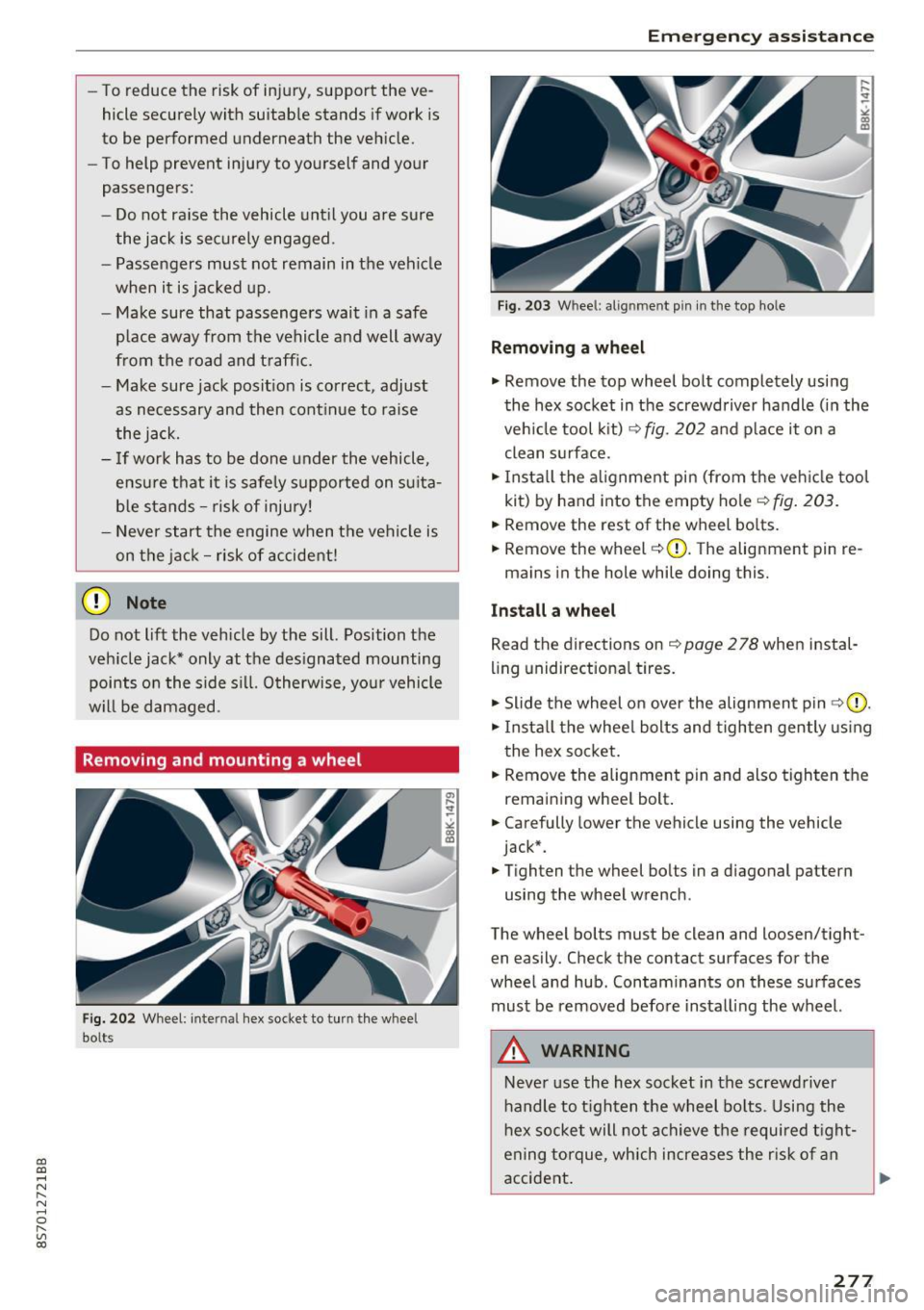
Removing and mounting a wheel
Fig. 202 Wheel : internal hex socket to turn the wheel
bolts
Emergency assistance
Fig. 203 W hee l: alignment pin in the top ho le
Removing a wheel
.,. Remove the top wheel bolt completely using
the hex socket in the screwdriver handle (in the
vehicle tool kit)
c::> fig. 202 and place it on a
clean surface.
.,. Install the alignment pin (from the vehicle tool
kit) by hand into the empty hole
c::>fig. 203 .
.,. Remove the rest of the wheel bolts.
.,. Remove the wheel
c::>0. The alignment pin re-
mains in the hole while doing this.
Install a wheel
Read the directions on c::> page 2 78 when instal
ling unidirectional tires.
.,. Slide the wheel on over the alignment pin
c::>(D.
.,. Install the wheel bolts and tighten gently using
the hex socket.
.,. Remove the alignment pin and also tighten the
remai ning wheel bolt .
.,. Carefully lower the vehicle using the vehicle
jack* .
.,. Tighten the wheel bolts in a diagonal pattern
using the wheel wrench .
The wheel bolts must be clean and loosen/tight
en easily. Check the contact surfaces for the
wheel and hub . Contaminants on these surfaces
must be removed before installing the wheel.
A WARNING
-
Never use the hex socket in the screwdriver
handle to tighten the wheel bolts . Using the
hex socket will not achieve the required tight
ening torque, which increases the risk of an
accident .
277
Page 280 of 314
Emergency assistance
CJ) Note
When removing or installing the whee l, the
r im could hit the brake rotor/ceramic bra ke
rotor* and damage the rotor. Work ca refu lly
and have a second person help yo u.
@ Tips
-W hen mounting tires w ith unidirectional
tread design
ma ke s ure the t read pattern is
po inted the r ight way
¢ page 278 .
- The wheel bolts should be clean and easy to
turn. Check for d irt and cor ros ion on the
mating s urfaces of both th e wheel and the
h ub. Remove all dirt from t hese surfaces be
fo re re mount ing th e wheel.
Unidirectional tires
A unid irec tional tire p rofile is ident ified by a rrows
th at poin t in the run nin g dir e cti on o n the tire
sidewall. You mus t always a dhere to the speci
fied running d irec tion. This is necessary ens ure
the t ire's optim um perfo rmance in regar d to a d
hes ion, r unning noise, fr iction and hydrop la ning.
T o be nefi t fu lly fro m the adv ant ages of the uni
d irect ional tire des ign, you sho uld replace faulty
tires as soon as possi ble an d restore the correct
r u nning di rect io n on all of the tires.
Finishing
.,. Reinstall the caps on the whee l bolts if neces
sary .
.,. Store the vehicle tool kit in its designated
place .
.,. If the re m oved whee l does not fi t in the sp are
whee l we ll, store it se cur ely in t he luggage
com partmen t
¢page 18 5.
.,. Check the tire press ure on the ins talled whee l
as soon as possible.
.,. Check the tire press ure and store it in the Info
ta inment system.
.,. The w heel bo lt tightening specification must be
90 ft lbs (120 Nm) . Check it as soon as poss ible
with a torq ue wrenc h. Drive ca refully unt il then .
.,. Have th e faulty wheel rep laced as quic kly as
poss ib le.
278
(D Tips
- If you not ice that t he w heel bo lts a re cor
rode d and difficult to tur n while changing a
t ir e, t hey s hou ld be replaced befo re yo u
check the t ightening torque.
- Drive at red uce d speed unti l yo u have the
t ightening to rques checked.
· Notes on wheel changing
Please read t he informat ion¢ page 253 if yo u
are going to use a spa re t ire wh ic h is diffe re nt
fro m the t ires on your ve hicle.
After you change a tire:
- Check the tire pressure on the spa re immedi
ately after installation.
- Have the wheel bolt tightening torque
checked with a torque wrench as soon as pos
sible by your authorized Audi dealer or a
qualified service station .
- With steel and alloy wheel rims, the wheel
bolts are cor rectly tightened at a torque of
90 ft lb (120 Nm) .
-If you notice that the wheel bolts are corroded
and difficult to turn while changing a tire,
they should be replaced before you check the
tightening torque .
- Replace the flat tire with a new one and have
it installed on your vehicle as soon as possi
ble. Remount the wheel cover .
Until then, dr ive with e xtra care and at reduced
speeds.
A WARNING
- If you are going to equip yo ur vehicle wi th
t ires or r ims which diffe r from those which
we re fac to ry insta lled , th en be su re to read
t he informa tion
¢ page 253 .
-Always make sure the damage d w heel or
ev en a fla t tire and the jack and to ol kit ar e
p ro p erl y se cured in t he lug gage co mpart
me nt an d ar e no t lo o se in the pas senge r
co mp artme nt.
- I n an ac cident or su dde n man euver they
co uld fl y forw ard , injur ing an yone i n t he ve
hicle.
Page 282 of 314
Emergency assistance
Installing the ti re chain before mounting
the wheel and t ire is recommended.
- Loose items in the passenger compartment
can cause ser ious personal in ju ry during
hard b raking or in an accident. Never store
t h e inflatable spa re t ire or jack and too ls in
the passenger compa rtment .
- Norma l summer or winter tires must not be
mounted on the compact s pare wheel rim.
280
Page 297 of 314
co
co
.... N
" N .... 0
" "' c:o
@ For the sake of the environment
-Changing the engine settings will adversely
affect emission levels. This is detrimental to
the environment and increases fuel con
sumption.
-Always observe environmental regulations
when disposing of old engine oil, used brake
fluid, dirty engine coolant, spent batteries
or worn out tires.
- Undeployed airbag modules and pretension
ers might be classified as Perchlorate Mate
rial -special handling may apply, see
www .dtsc.ca.gov/hazardouswaste/perchlo
rate . When the vehicle or parts of the re
straint system including airbag modules
safety belts with pretensioners are scrap
ped, all applicable laws and regulations
must be observed. Your authorized Audi
dealer is familiar with these requirements
and we recommend that you have your deal er perform this service for you.
Accessories and
technical changes
Additional accessories and parts replacement
Always consult on authorized Audi dealer before
purchasing accessories.
Your vehicle incorporates the latest safety design
features ensuring a high standard of active and passive safety.
This safety could be compromised by non-ap proved changes to the vehicle. For this reason, if
parts have to be replaced, please observe the fol
lowing points when installing additional accesso
ries:
Approved Audi accessories and genuine Audi parts are available from authorized Audi dealers.
These dealers also have the necessary facilities, tools and trained specialists to install the parts
and accessories properly .
Consumer information
A WARNING
Using the wrong spare parts or using non-ap
proved accessories can cause damage to the
vehicle and serious personal injury.
- Use only accessories expressly approved by
Audi and genuine Audi spare parts
- These parts and accessories have been spe
cially designed to be used on your vehicle.
- Do not use license plate brackets in the
front area that are different from the one
installed at the factory, or add additional li
cense plate brackets.
- Never install accessories such as telephone
cradles or beverage holders on airbag covers
or within the airbag deployment zones. Do
ing so will increase the risk of injury if air
bags are triggered in an accident!
- Before you check anything in the engine
compartment, always read and heed all
WARNINGS Qpoge 235.
(D Note
-If items other than genuine Audi spare
parts, add-on equipment and accessory
items are used or if repair work is not per
formed according to specified methods, this
can result in severe damage to your vehi
cle's engine and body (such as corrosion)
and adversely affect your vehicle's warranty.
- If emergency repairs must be performed
elsewhere, have the vehicle examined by an
authorized Audi dealer as soon as possible.
- The manufacturer cannot be held liable for
damage which occurs due to failure to com
ply with these stipulations.
Technical Modifications
Our guidelines must be complied with when tech
nical modifications ore mode.
Always consult an authorized Audi dealer
before
starting work on any modifications.
This will help ensure that vehicle function, per
formance and safety are not impaired
Q ,&.
295
Page 299 of 314
co
co
.... N
" N .... 0
" "' c:o
A
A/C (climate control system) . . . . . . . . . . . . . 53
Accessories . . . . . . . . . . . . . . . . . . . . . . . . . . 295
Active lane assist . . . . . . . . . . . . . . . . . . . . . . 7 4
Activating vibration warning . . . . . . . . . . . .
76
Adjusting steering time . . . . . . . . . . . . . . . . 76
Cleaning the camera area . . . . . . . . . . . . . 267
Indicator light . . . . . . . . . . . . . . . . . . . . . . . 75
Messages . . . . . . . . . . . . . . . . . . . . . . . . . . . 75
Switching on/off . . . . . . . . . . . . . . . . . . . . . 75
Adaptive dampers . . . . . . . . . . . . . . . . . . . . . . 80
Adaptive light . . . . . . . . . . . . . . . . . . . . . . . . . 80
Adapt ive light (indicator light) . . . . . . . . . . . 16
Additional phone ............ .. .. . 115, 176
Adjusting a ir distribution (Cl imate control sys-
tem) . . . . . . . . . . . . . . . . . . . . . . . . . . . . . . . .
53
Adjusting the air vents . . . . . . . . . . . . . . . . . . 54
Adjusting the center console lighting . . . . . . 42
Adjusting the sound . . . . . . . . . . . . . . . . . . . 179
Adjusting the temperature (climate control
system) . . . . . . . . . . . . . . . . . . . . . . . . . . . . . .
53
Advanced Airbag System
Children . . . . . . . . . . . . . . . . . . . . . . . . . . . 220
Componen ts . . . . . . . . . . . . . . . . . . . . . . . .
203
Front airbags . . . . . . . . . . . . . . . . . . . . . . . 201
How the components work together . . . . 204
Airbag . . . . . . . . . . . . . . . . . . . . . . . . . . . . . . 196
Indicator light . . . . . . . . . . . . . . . . . . . . . . . 14
Airbag system . . . . . . . . . . . . . . . . . . . . . . . . 215
Advanced Airbag-System . . . . . . . . . . . . . . 200
Care . . . . . . . . . . . . . . . . . . . . . . . . . . . . . . 210
Child restraints . . . . . . . . . . . . . . . . . . . . . 220
Components (front airbags) . . . . . . . . . . . 203
Danger of fitting a child safety seat on the
front passenger seat . . . . . . . . . . . . . . . . .
197
Disposal . . . . . . . . . . . . . . . . . . . . . . . . . . . 210
Front airbags . . . . . . . . . . . . . . . . . . . . . . . 200
H ow do the front airbags work? . . . . . . . . 205
H ow many airbags does my vehicle have? 203
Important information . . . . . . . . . . . . . . . 196
Important safety instructions on the knee
airbag system ................. ..... .
213
Knee airbags. ....................... 212
Monitoring . . . . . . . . . . . . . . . . . . . . . . . . . 207
PASSENGER AIR BAG light . . . . . . . . . . . . 208
Repairs ... . .. .. ............. .. .. .. . 210
Safety instructions . . . . . . . . . . . . . . . . . . . 209
Index
Side airbags . . . . . . . . . . . . . . . . . . . . . . . . 214
Warning/Indicator lights . . . . . . . . . . . . . 207
When must the system be inspected? . . . 207
Alarm system
refer to Anti-theft alarm system . . . . . . 24, 29
Alignment pin (changing the wheel) . . . . . . 272
All season tires . . . . . . . . . . . . . . . . . . . . . . . 260
All weather lights . . . . . . . . . . . . . . . . . . . . . . 39
All wheel drive . . . . . . . . . . . . . . . . . . . . . . . . 91
Alternative routes .. .. ................. 143
Ambient lighting . . . . . . . . . . . . . . . . . . . . . . 41
AMI
refer to Audi music interface . . . . . . . . . . . 162
Android Auto
refer to Audi smartphone interface
Announcements (settings)
refer to Voice guidance ........... .. . .
Anti-freeze
173
143
Windshield washer system . . . . . . . . . . . . 244
Anti-lock braking system (ABS) . . . . . . . . . . . 88
Anti-s lip regulat ion . . . . . . . . . . . . . . . . . . . . 88
Anti-theft alarm system . . . . . . . . . . . . . . . . . 29
Apple CarPlay
refer to Audi smartphone interface . . . . . 173
Armrest .......... .. .................. 48
Ashtray . . . . . . . . . . . . . . . . . . . . . . . . . . . . . . 48
Aspect rat io (video) . . . . . . . . . . . . . . . . . . .
167
Audi connect . . . . . . . . . . . . . . . . . . . . . . . . . 127
Data connection . . . . . . . . . . . . . . . . . . . . . 132
Data protection . . . . . . . . . . . . . . . . . . . . . 134
Services (overview) . . . . . . . . . . . . . . . . . . 129
Setup . . . . . . . . . . . . . . . . . . . . . . . . . . . . . 127
Audi magnetic ride
refer to Adaptive dampers . . . . . . . . . . . . . 80
Audi music interface . . . . . . . . . . . . . . . . . . . 162
Audi music stream
refer to W i- Fi . . . . . . . . . . . . . . . . . . . . . . . 160
Audio files . . . . . . . . . . . . . . . . . . . . . . . . . . . 164
Audio player
Bluetooth audio player . . . . . . . . . . . . . . .
159
Wi-Fi aud io player . . . . . . . . . . . . . . . . . . . 160
Audio track . . . . . . . . . . . . . . . . . . . . . . . . . . 167
Audi Service Repair Manuals and Literature 293
Audi smartphone interface ......... 173, 177
Audi virtual cockpit (instrument cluster) . . . . 8
297