child restraint AUDI TT ROADSTER 2017 Owners Manual
[x] Cancel search | Manufacturer: AUDI, Model Year: 2017, Model line: TT ROADSTER, Model: AUDI TT ROADSTER 2017Pages: 314, PDF Size: 76.54 MB
Page 183 of 314
co
co
.... N
" N .... 0
" "' c:o
Safe driving Basics
Safe driving habits
Please remember -safety first!
This chapter contains important information,
tips, instructions and warnings that you need to
read and observe for your own safety, the safety
of your passengers and others . We have summar
ized here what you need to know about safety
be lts, airbags, child restraints as well as child
safety. Yo ur safety is for us
priority number 1. Al
ways observe the info rmation and warn ings i n
this section - for you r own safety as well as that
of your passengers.
The information in this sect ion app lies to all
model ve rsions of your vehicle. Some of the fea
tures descr ibed in t his sec tions may be standa rd
equipment on some models, or may be optional
equipment on others . If you are not sure, ask
your authorized Audi dealer.
A WARNING
- Always make sure that you follow the in
struct ions and heed the WARNINGS in th is
Manual. It is in your interest and in the in
terest of your passengers .
-
-Always keep the complete Owner's Litera
ture in your Audi when you lend or sell your
vehicle so that this important information
will always be available to the d river and
passenge rs.
- Always keep the Owne r's literature handy so
that you can find it easily if you have ques
t ions.
Safety equipment
The safety features are part of the occupant re
straint system and work together to help reduce
the risk of injury in a wide variety of accident sit
uations.
Your safety and the safety of yo ur passenger
should not be left to c han ce. Advances in tech
nology have made a var iety of features ava ilab le
t o he lp reduce the risk of injury in an accident.
Safe d riv ing
The following is a lis t of just a few of the sa fe ty
features in yo ur Audi :
- sophisti cated safety be lts fo r dr ive r and pas -
senger seat ing pos ition,
- safety belt p re tensioners,
- safety belt force lim ite rs,
- front airbags,
- knee airbags*
- side airbags in the seats,
- specia l LATCH anchorages for child restraints,
- ad justab le steer ing colum n.
These ind iv idual safety features , ca n work to
gether as a system to he lp p rotect you and your
passenger in a w ide range of acc idents. These
f ea tures canno t work as a system if they are not
always correc tly ad justed and cor rect ly used.
Safet y is everybody's r esponsibility!
Important things to do before driving
Safety is everybody 's job! Vehicle and occupant
saf ety always depends on the informed and care
f1,1/ driver .
For your safety and the safety of your passenger,
before driv ing always:
.,. Make sure that all lights and s ignals are operat
ing correctly .
.,. Make sure that the tire pressure is correct .
.,. Ma ke sure that a ll w indows are clean and afford
good v isibility to the outs ide.
.,. Sec ure all luggage and othe r items c arefully
¢ page 185, ¢ page 49.
.,. Make sure that not hing can i nterfere with the
peda ls .
.,. Adj ust seat and mirro rs cor rectly for your
he ight .
.,. Make sure to use the right child restra int cor
rectly to protect children ¢
page 218, Child
safety .
.,. Sit p roper ly in you r seat a nd make sure that
your passenger do the same¢
page 47, Seats
and storage .
.,. Fasten your safety belt and wear i t properly . Al
so instruct your passenge r to fasten his safety
be lt properly
c:!:> page 189.
181
Page 186 of 314
Safe dri ving
Examples of improper seating positions
The occupant restraint system can only reduce
the risk of injury if vehicle occupants are properly
seated.
Improper seating positions can cause serious in
jury or death . Safety belts can only work when
they are properly positioned on the body . Im
proper seating positions reduce the effect iveness
of safety belts and w ill even increase the r isk of
inj ury and death by moving the safety be lt to crit
ical areas o f the body . Improper seating positions
also increase the risk of serious injury and death
when an airbag deploys and strikes an occupant
who is not in the proper seating position. A driver
is responsible for the safety of all vehicle occu
pants and especially for children. Therefore :
~ Never allow anyone to assume an incorrect
seating position when the vehicle is being used
c:> .&_ .
The fo llowing bulletins list only some sample po
sitions that will increase the risk of serio us inj ury
and death. Our hope is that these examples will
make you more aware of seating posit ions that
are dangerous .
Therefore, whenever the vehicle is moving:
- never stand up in the ve hicle
- never stand on the seats
- never knee l on the seats
- never r ide with the seatback reclined
- never lean up against the instrument panel
- never sit on the edge of the seat
- never sit s ideways
- never lean out the window
- never put yo ur feet out the window
- never put yo ur feet on the instrument panel
- never rest your feet on the seat cushion or back
of the seat
- never ride in the footwell
- never r ide in the cargo area
A WARNING
Improper seating posit ions increase the r isk
of se rious personal injury and death wheneve r
a vehicle is being used.
184 -
Always make sure that all vehicle occupants
stay in a proper seating posit ion and are
properly restrained whenever the vehicle is
be ing used .
Driver and passenger
side footwell
Important safety instructions
A WARNING
A lways make sure that the knee airbag can in
flate without interfe rence. Objects between
yourself and the airbag can increase the risk
of injury in an accident by interfering with the
way the ai rbag dep loys o r by being pushed in
to you as the airbag dep loys.
- No persons (chi ldren) or animals should ride
in the footwell in front of the passenger
seat. If the airbag deploys, this can res ult in
serious or fatal injuries.
- No objects of any kind should be carried in
the footwell area in front of the driver's or
passenger 's seat. Bu lky objects (shopping
bags, for examp le) can hamper or prevent
proper deployment of the airbag. Small ob
jects can be thrown through the vehicle if
the airbag deploys and injure you or your
passengers.
Pedal area
' Pedals
The pedals must always be free to move and
must never be interfered with by a floor mat or
any other object.
Make sure that all pedals move free ly without in
terference and that nothing prevents them from
returning to their original positions.
Only use floor m ats that leave the pedal area free
and can be secured with floor mat fasteners.
If a brake circuit fails , in creased brake pedal trav-
el is required to bring the vehicle to a fu ll stop. .,..
Page 191 of 314
co
co
..... N
" N ..... 0
" "' c:o
Safety belts
General notes
Always wear safety belts!
Wearing safety belts correctly saves lives!
This chapter explains why safety belts are neces
sary, how they work and how to adjust and wear
them correctly. .. Read all the information that follows and heed
all of the instructions and WARNINGS.
A WARNING
Not wearing safety belts or wearing them im
properly increases the risk of serious personal
injury and death .
- Safety belts are the single most effective
means available to reduce the risk of serious
injury and death in automobile accidents.
For your protection and that of your passen
gers, always correctly wear safety belts
when the vehicle is moving.
- Pregnant women, injured, or physically im
paired persons must also use safety belts.
Like all vehicle occupants, they are more
likely to be seriously injured if they do not
wear safety belts. The best way to protect a
fetus is to protect the mother -throughout
the entire pregnancy.
Number of seats
Your Audi TT Roadster has two seating positions. Each seating position has a safety belt .
A WARNING
Not wearing safety belts or wearing them im
properly increases the risk of serious personal
injury and death .
- Never strap more than one person, includ
ing small children, into any belt .
It is espe
cially dangerous to place a safety belt over a
child sit ting on your lap.
- Never let more people ride in the vehicle
than there are safety belts ava ilable.
Safety belts
-Be sure everyone riding in the vehicle is
properly restrained with a separate safety
belt or child restraint.
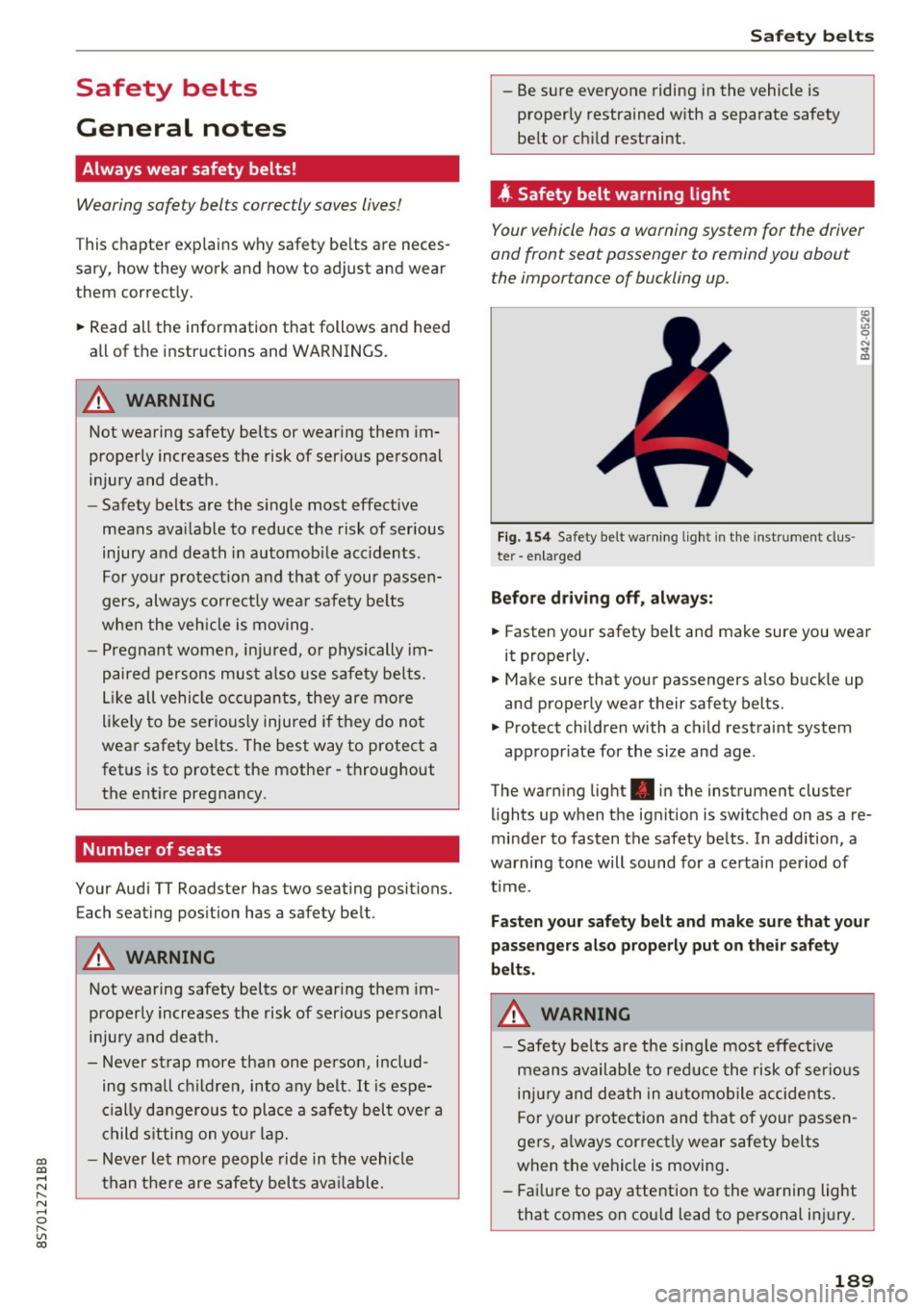
4 Safety belt warning l ight
Your vehicle hos o warning system for the driver
and front seat passenger to remind you about the importance of buckling up.
Fi g. 154 Safety belt warn ing light in the instrument clus
te r -enlarged
Before driving off, always:
.. Fasten your safety belt and make sure you wear
it properly.
.,. Make sure that your passengers also buckle up
and properly wear their safety belts.
.,. Protect children with a child restraint system
appropr iate for the size and age.
The warning light . in the instrument cluster
lights up when the ignit ion is switched on as a re
minder to fasten the safety belts . In addition, a
warning tone will sound for a certain period of
t im e.
Fasten your safety belt and make sure that your
passengers also properly put on their safety
belts.
A WARNING
-
- Safety belts are the sing le most effective
means available to reduce the risk of serious
injury and death in automobile accidents.
F or your protection and that of your passen
gers, a lways correctly wear safety belts
when the vehicle is moving .
- Failure to pay attention to the warning light
that comes on could lead to personal injury.
189
Page 198 of 314
Airbag syste m
Airbag system
Important information
Importance of wearing safety belts and
sitting properly
Airbags are only supplemental restraints . For
airbags to do their job, occupants must always
properly wear their safety belts and be in a prop
er seating position.
For your safety and the safety of your passen
ge rs , before driving off, always :
"' Adjust the driver's seat and steering wheel
properly ¢
page 182,
"'Adjust the front passenge r's seat properly
¢ page 183,
"'Wear safety belts p roperly ¢ page 191,
"'Always properly use the proper child restraint
to protect children
¢ page 218.
In a coll is io n ai rbags must inflate wi thin the b link
of an eye and with cons iderable force . The sup
p lemental airbags can ca use inj uries if the driver
or th e front seat passenger is not seated proper·
Ly. T herefore in order to help the airbag to do its
job, it is important, both as a dr iver and as a pas
senger to sit properly at all t imes .
By keeping room between your body and the
steering whee l and the front of the passenger
compartment, the a irbag can inflate fully and
completely and provide supplemental protect ion
in certain frontal collisions ¢
page 182, Correct
passenger seating positions .
For details on the
operation of the seat adjustment con trols
¢ page 47.
It's especially important that children are proper
ly restra ined
¢ page 218.
There is a lot that the driver and the passenger
can and must do to help the ind iv idual safety fea
tures installed in your Audi work together as a
system .
Proper seating posit ion is important so that the
front airbag on the drive r side can do its job. If
you have a physical impairment or cond ition that
prevents you from s itting properly on the driver
seat with the safety be lt properly fastened and
196
reaching the peda ls, or if yo u have concerns w ith
regard to the function or operation of the Ad
vanced Airbag System, please contact you r au
thori zed Audi dea ler or qua lified workshop, or
ca ll Audi Customer Relations at 1 (800)
822 -2834 for possib le mod ificat ions to your ve
hicle .
When the airbag system dep loys, a gas generator
will fill the airbags, break open the padded cov
ers, and inflate between the steeri ng wheel and
t h e d river and between the instrument pane l and
the front passenger . Th e a irbags w ill deflate im
med iate ly after deployment so that the front oc
cupan ts can see t hrou gh the windsh ield again
without interruption.
A ll of th is takes p lace in the b link of an eye, so
fast tha t many people don 't even rea lize that the
a irbags have deployed. The air bags also infl ate
with a great deal of force and no thing should be
in the ir way when they dep loy. Front airbags in
combination with properly worn safety belts slow
down and lim it the occupant's forward move
ment . Together they help to prevent the driver
and passenger from hitting pa rts of the inside
the ve hicle while reducing the forces acti ng on
the occ upant d uri ng the crash . In this way they
help to reduce the risk of in ju ry to the head and
u pper body in the crash . A irb ags do not p rotec t
t h e arms o r th e lowe r parts of the body .
Both front airbags will not inflate in all frontal
collisions. The trigge ring of the a irbag system de
pends on the veh icle deceleration rate caused by
t h e coll is ion and regis tered by the ele ctroni c con
tro l unit. If this ra te is be low the reference value
programmed into the contro l unit, the airbags
will not be t riggered, even tho ugh the car may be
badly damaged as a resu lt of the co llision . Vehi
cle damage, repa ir costs or even the lack of vehi
cle damage is not necessarily an indication of
whether an a irbag should inflate or not .
Since the c ircumstances will vary cons iderably
between one co llision and another, it is not possi
ble to define a range of veh icle speeds that will
cover every poss ible kind and angle of impact
that w ill always trigge r the a irbags . Importa nt
facto rs i nclude, for examp le, the nat ure (hard or
soft) of the objec t which the car h its, the angle of.,.
Page 199 of 314
co
co
.... N
" N .... 0
" "' c:o
impact, vehicle speed, etc. The front airbags will
also not inflate in side or rear collisions, or in roll-overs.
A lwa ys remember : Airbags will deploy only once,
and only in certain kinds of collisions . Your safety
be lts are always there to offer protection in those
situations in which airbags are not supposed to
deploy, or when they have already deployed; for
example, when your vehicle str ikes or is struck by
another vehicle after the first collis ion.
This is just one of the reasons why an airbag is a
supp lementary restraint and is not a substitute
for a safety belt. The airbag system works most
effect ively when used with the safety belts .
Therefore, always properly wear your safety belts
¢ page 189.
.8, WARNING
Sitting too close to the steer ing whee l o r i n
strument panel will decrease the effect ive
ness of the airbags and will increase the risk
of persona l injury in a co llision.
- Never sit closer than 1 0 in (25 cm) to the
steering wheel or instrument pane l.
-If you cannot si t mo re than 10 in (25 cm)
from the steer ing whee l, inves tigate wheth
er adaptive equipment may be avai lab le to
held yo u reach the pedals and increase your
seating distance from the steering wheel.
- If you are unrestrained, leaning forward, s it
ting s ideways or out of position in any way,
your risk of in jury is much h igher.
- Yo u will also receive serious injur ies and
cou ld even be killed if you are up against the
airbag or too close to it when it inf lates -
even with an Advanced Airbag.
- To reduce the risk of in jury when an airbag
inflates, a lways wear safety belts p roperly
¢ page 192, Safety belts .
- If children are not properly restrained, they
may be severely injured or killed when an
airbag inflates.
- Never let children ride unrestrained or im
properly restrained in the veh icle. Adjust the
front seats proper ly .
-
Airb ag sys tem
-Always sit as fa r as possible from the steer
ing wheel or the instrument panel
¢page 182.
-Always sit upright w ith your back against
the backrest of your seat.
- Never p lace your feet on the instrument
panel or on the seat. Always keep both feet
on the floor in front of the seat to help pre
vent ser ious injuries to the legs and hips if
the airbag inflates.
.8, WARNING
A irbags that have deployed in a crash must be
r eplaced.
- Use o nly orig inal equipment ai rbags ap
proved by A udi and installed by a trained
technician who has the necessary tools and
d iagnostic equipment to prope rly replace
any airbag in yo ur vehicle and ass ure system
effe ct iveness in a crash .
- Never permit salvaged or recycled airbags to
be installed in you r vehicle.
Child restra ints on the front seat -some
important things to know
.. Be sure to read the important informat ion and
head the WARNINGS for important details
about ch ildren and Advanced A irbags
¢page 218.
The airbag on the passenger side makes the front
seat a potent ially dangerous place for a child to
ride. The front seat is not the safest place for a
c h ild in a forward-fac ing c hild safety seat. It can
be a ve ry dange rous p lace for an infant or a ch ild
i n a rearward-fac ing seat.
The Advanced A irbag System in your vehicle has
been certified to com ply wit h the Requ irements
of United States Fede ral Motor Ve hicle Safety
Standa rd 208 as applicable at t he t ime you r vehi
cl e was manufac tured.
The Standard requires the front airbag on the passenger side to be turned off ("supp ressed") if
a ch ild up to abou t one yea r of age rest rained i n
one of the rear-fac ing o r forward-f acing infant re-
straints lis ted in Fede ral Motor Vehicle Sa fe ty ..,.
197
Page 200 of 314
Airbag system
Standard 208 with which the Advanced Airbag
System in your vehicle was cert ified has been in
stalled on the front passenger seat. For a listing
of the child restraints that were used to certify
compliance with the US Safety Standard
¢page 220.
The PASSENGER AIR BAG OFF~; light in the
headliner tells you when the front Advanced Air
bag on the passenger side has been turned off by
the electronic control unit.
Each t ime you turn on the ignition, the
PASSEN·
GER AIR BAG OFF,-;; ON ~
light will come on
for a few seconds and:
- PASSENGER AIR BAG OFF~; will come on if
the front passenger seat is not occupied,
- PASSENGER AIR BAG OFF ~; will come on if
the e lectrical capacitance measured by the ca
pacitive passenger detection system for the
front passenger seat equals the combined ca pacitance of an infant up to about one year of
age and one of the rearward-facing or forward
facing child restraints listed in Federal Motor
Vehicle Safety Standard 208 with which the Ad
vanced Airbag System in your vehicle was certi
fied. For a listing of the child restraints that
were used to certify your vehicle's compliance
with the U.S. Safety Standard¢
page 220.
-PASSENGER AIR BAG OFF ~; will come on if
there is a small child or chi ld restraint on the
front passenger seat,
- PASSENGER AIR BAG ON @will go off if the
front passenger seat is occupied by an adult as
registered by the capacitive passenger detec
tion system ¢
page 20 7, Monitoring the Ad
vanced Airbag System.
The PASSENGER AIR BAG OFF~; light comes on
when electrical capacitance registered on the
front passenger seat is equa l to or less than the
comb ined capacitance of a typ ica l 1 year-old in
fant and one of the rearward-fac ing or forward
facing ch ild restraints listed in Federal Motor Ve
h icle Safety Standard 208 with wh ich the Ad
vanced Ai rbag System in your vehicle was cert i
fied.
If the total electrical capac itance registered on
the front passenger seat is more than that of a
198
typical 1 year -old chi ld but less than the weight
of a sma ll adult, the front airbag on the passen
ger side can deploy (the
PASSENGER AIR BAG
OFF ~;
light does not come on).
If the
PASSENGER AIR BAG OFF~; light does
not come on, the front airbag on the passenger
s ide has not been turned off by the e lectron ic
contro l unit and can deploy if the control unit
senses an impact that meets the conditions stor
ed in its memory .
For example, the airbag may deploy if :
-a small child that is heav ier than a typical 1
year -old child is on the front passenger seat
(regard less of whether the child is in one of the
child safety seats listed¢
page 220), or
- a child who has outgrown child restraints is on
the front passenger seat.
If the front passenger airbag is turned off, the
PASSENGER AIR BAG OFF,-;; light comes on in
the headliner and stays on .
If the front passenger airbag deploys, the Feder
al Standard requ ires the airbag to meet the " low
risk" deployment criteria to reduce the risk of in
jur y through interaction with the airbag. "Low
risk" deployment occurs in those crashes that
take place at lower decelerations as defined in
the electronic control unit¢
page 208, PASSEN
GER AIR BAG OFF~; ON~ light.
Always remember, a child seat or infant carrier
installed on the front seat may be struck and
knocked out of posit ion by the rapidly inflating
passenger's airbag in a frontal collision. The a ir
bag could greatly reduce the effectiveness of the
ch ild restraint and even ser iously injure the child
during inflation.
.&, WARNING
-
A child in a rearward-facing child seat instal
l ed on the front passenger seat will be seri
ously injured and can be killed if the front air
bag inflates - even with an Advanced Airbag
System.
- The inflating airbag will hit the ch ild seat or
infant carrier with great force and will .,.
Page 201 of 314
co
co
.... N
" N .... 0
" "' c:o
smash the child seat and child against the
backrest, center armrest, door or roof.
- Forward-facing child seats installed on the
front passenger's seat may interfere with
the deployment of the airbag and cause se
rious personal injury to the child.
A WARNING
If, in exceptional circumstances, you must in
stall a forward-facing child restraint on the
front passenger's seat:
- Always make sure the forward-facing seat
has been designed and certified by its man
ufacturer for use on a front seat with a pas
senger front and side airbag.
- Never put the forward-facing child restraint
up against or very near the instrument pan
el.
- Always move the front passenger seat to
the highest position in the up and down ad
justment range and move it back to the
rearmost position in the seat's fore and aft
adjustment range, as far away from the air
bag as possible, before installing the for·
ward-facing child restraint.
- Always make sure that the safety belt upper
anchorage is behind the child restraint and
not next to or in front of the child restraint
so that the safety belt will be properly posi
tioned.
- Make sure that the
PASSENGER AIR BAG
OFF~;
light comes on and stays on all the
time whenever the ignition is switched on.
A WARNING
To reduce the risk of serious injury, make sure
that the
PASSENGER AIR BAG OFF~; light
will be displayed whenever a child restraint is
installed on the front passenger seat and the
ignition is switched on.
- If the PASSENGER AIR BAG OFF~; light
does not stay on, perform the checks descri
bed
Q page 20 7, Monitoring the Advanced
Airbag System.
- Have the airbag system inspected by your
Audi dealer immediately.
Airbag system
-Always carefully follow instructions from
child restraint manufacturers when instal
ling child restraints.
A WARNING
If, in exceptional circumstances, you must in
stall a forward or rearward-facing child re
straint on the front passenger's seat:
- Improper installation of child restraints can
reduce their effectiveness or even prevent
them from providing any protection.
- An improperly installed child restraint can
interfere with the airbag as it deploys and
seriously injure or even kill the child -even
with an Advanced Airbag System.
- Always carefully follow the manufacturer's
instructions provided with the child seat or
earner.
-Always make sure that there is nothing on
the front passenger seat that will cause the
capacitive passenger detection system in
the seat to signal to the Airbag System that
the seat is occupied by a person when it is
not, or to signal that it is occupied by some ·
one who is heavier than the person actually
sitting on the seat. The presence of addi
tional objects could cause the passenger
front airbag to be turned on when it should
be off, or could cause the airbag to work in a
way that is different from the way it would have worked without the object on the seat.
199
Page 203 of 314
co
co
.... N
" N .... 0
" "' c:o
that are large, heavy, or bulky) on the doors;
never attach then to the doors or the wind
shield; never place them over or near or at
tach them to the area marked ,.AIRBAG" on
the steering wheel, instrument panel or the
seat backrests; never place them between
these areas and you or any other person in
the vehicle.
- Never attach objects to the windshield
above the passenger front airbag, such as
accessory GPS navigation units or music
players. Such objects could cause serious in
jury in a collision, especially when the air bags inflate.
&_ WARNING
A person on the front passenger seat, especially infants and small children, will receive
serious injuries and can even be killed by be
ing too close to the airbag when it inflates.
- Although the Advanced Airbag System in
your vehicle is designed to turn off the front
passenger airbag if an infant or a small child
is on the front passenger seat, nobody can
absolutely guarantee that deployment un
der these special conditions is impossible in
all conceivable situations that may happen
during the useful life of your vehicle.
- The Advanced Airbag System can deploy in
accordance with the "low risk" option under
the U.S. Federal Standard if a child that is
heavier than the typical one-year old child is
on the front passenger seat and the other
conditions for airbag deployment are met.
- For its own safety, a child should always ride
properly restrained for its age and si ze.
Advanced front airbag system
Your vehicle is equipped with a front Advanced
Airbag System in compliance with United States
Federal Motor Vehicle Safety Standard (FMVSS)
208, as well as Canada Motor Vehicle Safety
Standard (CMVSS) 208 as applicable at the time
your vehicle was manufactured.
T he front Advanced Airbag System supplements
the safety belts to provide additional protection
Airbag system
for the driver's and front passenger's heads and
upper bodies in frontal crashes. The airbags in
flate only in frontal impacts when the vehicle de
celeration is high enough.
The front Advanced Airbag System for the front
seat occupants is not a substitute for your safety
belts. Rather, it is part of the overall occupant re
straint system in your vehicle . Always remember
that the airbag system can only help to protect
you, if you are sitting upright, wearing your safe
ty belt and wearing it properly. This is why you
and your passengers must always be properly re
strained, not just because the law requires you to
be.
The Advanced Airbag System in your vehicle has
been certified to meet the "low risk" require
ments for 3 and 6 year-old children on the pas
senger side and very small adults on the driver
side. The low risk deployment criteria are intend
ed to help reduce the risk of injury through inter
action with the front airbag that can occur, for
example, by being too close to the steering wheel
and instrument panel when the airbag inflates.
In addition, the system has been certified to
comply with the "suppression" requirements of
the Safety Standard, to turn off the front airbag
for infants 12 months old and younger who are res trained on the front passenger seat in child re
straints that are listed in the Standard
¢ page 220, Child restraints and Advanced front
airbag system.
"Suppression" requires the front airbag on the
passenger side to be turned off if:
- a child up to about one year of age is restrained
on the front passenger seat in one of the rear
facing or forward-facing infant restraints listed in Federal Motor Vehicle Safety Standard 208
with which the Advanced Airbag System in your
vehicle was certified . For a listing of the child
restraints that were used to certify your vehi
cle's compliance with the US Safety Standard
¢page 220,
-When a person is detected on the front passen
ger seat that has an electrical capacitance that
is more than the total electrical capacitance of
a child that is about 1 year old restrained in one .,.
201
Page 204 of 314
Airbag syste m
of the rear -facing or forward-facing infant re
straints (listed in Federal Motor Vehicle Safety
Standard 208 with wh ich the Advanced Airbag
System in your vehicle was certified), the front a irbag on the passenger side may or may not
deploy .
The
P A SSENGER AIR BAG OFF ~ ; light comes on
when the e lectron ic control un it detects a total
electrical capacitance on the front passenger seat
that requires the front airbag to be turned off. If
the
PASSEN GER AIR BA G OFF ~; light does not
come on, the front airbag on the passenger side has not been turned off by the control u nit and
can dep loy if t he con trol unit senses an impact
that meets the conditions stored in its memory.
If the tota l electrical capac itance registered on
the front passenger seat is more than that of a
typical 1 year-old, but less than the weigh t of a
small adu lt, the front airbag on the passenger
side may deploy (the
PASSENGER AIR BAG OFF
~ ; light does not come on) .
For example, the airbag may deploy if :
- a small child that is heavier than a typical 1
year-old ch ild is on the front passe nger seat
( r ega rdless of whether the child is in one of the
c hi ld se ats l isted
q page 220),
- a chi ld who has outg rown child restraints is on
t h e front passenger seat.
If the front passenger airbag is turned off, the
PASSENGER A IR BA G OFF ~; light in the head
line r will come on and stay on .
If the front passenger airbag deploys, the Feder
al Standard requires the airbag to meet the "low
risk " deployment criteria to help reduce the risk
of injury through inte raction with the airbag.
" Low risk" deployment occu rs in those c rashes
t hat take place at lower dece le rations as defined
in the electronic control unit
q page 207.
Alway s rememb er: Please be su re to read the im
portant information in the sections that follow
and be sure to heed all of t he WARNINGS.
A WARNING
To red uce the risk of inj ury when an airbag in
flates, a lways wear safety belts properly .
202
-If you are un restrained, leaning forward, sit
ting sideways or out of position in any way,
your risk of injury is much higher.
- You will a lso receive ser ious injuries and
could even be killed if you are up against the
airbag or too close to it when it inflates -
even with an Advanced Airbag
¢ page 196 .
A WARNING
A child in a rearward -facing child seat instal
led on the front passenger seat will be seri
ously injured and can be killed if the front air
bag inflates -even with an Advanced Airbag
Sys tem.
- Although the Advanced Airbag System in
your veh icle is designed to turn off the front
airbag when a rearwar d-fac ing ch ild re
straint has been installed on the front pas
senger seat, nobody can absolutely guaran
tee that dep loyment is impossib le in all con
ceivab le situat ions that may happen du ring
the useful life of your vehicle.
- The inflating airbag will h it the ch ild seat or
infant carrier with great force and will
smash the child seat and child against the
backrest, center armrest, doo r, or roof .
- If you must install a rearward facing child
safety seat on the front passenger seat be
cause of excep tional circumstances and the
PASSENGER AIR BAG OFF~; light does not
come on and stay on have the a irbag system
inspected by your Audi dealer.
A WARNING
I f, in ex ceptional ci rcums tances, you must in
stall a forward-facing child restraint on the
front passenger's seat:
- Always make sure the forward-facing sea t
has been des igned and certified by its man
ufacturer for use on a front seat with a pas
senger front and side airbag.
- Never put the forward -facing child restraint
up against or very nea r the instrument pan
el.
- Always move the front passenger seat to
the highest position in the up and down ad
justment range and move it back to the
Page 205 of 314
co
co
.... N
" N .... 0
" "' c:o
rearmost position in the seat's fore and aft
adjustment range, as far away from the air
bag as possible, before insta lling the for
ward-facing child restra int.
- lways make sure that the safety belt upper
anchorage is beh ind the child restraint and
not next to or in front of the child restraint
so that the safety belt will be properly pos i
tioned.
-Always make sure that there is nothing on the front passenger seat that w ill cause the
c apacit ive passenger detection system in
the seat to signa l to the Airbag Sys tem tha t
the seat is occupied by a person when it is
not, or to signa l that it is occ upied by some
one who is heavier than the person actua lly
sitting on the seat . The p resence of addi
t ional objects could cause the passenger
front airbag to be turned on when it shou ld
be off, or could cause the airbag to work in a
way that is different from the way it would
have worked witho ut the object on the seat.
- Make sure that the
PASSENGER AIR BAG
OFF ~;
light comes on and stays on a ll the
t ime whenever the ignition is switched on.
Advanced Airbag System components
The front passenger seat in yo ur vehicle has a lot
of
very important parts of the Advanced Airbag
Sys tem in it . These pa rts in cl ude the capacitive
passenger detection system, w iring, brackets,
and mo re. The control un it monitors the system
on the front passenger seat when the ign ition is
switched on and turns the airbag indicator light
on when a malfunct ion in the one of the system
components is detected
c::> page 208 . Because
the fro nt passenger seat contains important
pa rts of the Advanced Airbag System, you must
take ca re to preven t it from being damaged.
D amage to the seat may p revent the Advanced
Ai rbag System for the front passenger seat from
doi ng its job i n a crash.
The front Advanced Airbag System consists
of the follow ing :
- C rash sensors in the front of the vehicle that
measure vehicle accelerat ion/dece leration to
Airb ag sys tem
provide information to the Advanced A irbag
System about the severity of the cras h.
- An elect ronic contro l unit, with integrated
cras h sensors for front and side impacts . The
control un it "decides" whether to fire the front
airbags based on the information rece ived from
the crash sensors . The control unit also "de
cides" whether the safety belt pretensioners
should be activated.
- An Advanced A irbag w ith gas generator for the
driver inside the steeri ng wheel hub .
- An Advanced A irbag w ith gas generator inside
the instrument panel for the front passenger.
-A capacit ive passenger detection system under
neath the front passenger seat
cover. This sys
tem measures the e lectr ica l capacitance of the
person in the seat. The information registered
is sent continuously to the elect ronic contro l
un it to reg ulate dep loyment of the front Ad
vanced Airbag on the p assenger side.
- An airbag monitoring system and indicator
light
El in the inst rument cl uste r.
- A sensor in each front seat registe rs the d is
t ance betwee n the respective seat and the
steer ing whee l o r ins trumen t pa nel. The infor
mat ion registered is sent con tinuous ly to the
electronic contro l unit to regu late dep loyment
of the front Advanced Airbags .
- The
PASSENGER AIR BAG OFF~; lig ht comes
on and stays on in the headliner
c::> poge 208,
fig. 166 and tells you when the front Advanced
Airbag on the passenger side has been turned off.
- A sensor in the safety belt latch for the driver
and for the front seat passenger that senses
whether that safety be lt is latched or not and
transmits this information to t he electronic
cont rol un it .
A WARNING
Damage to the front passenge r seat can pre
vent the front airbag from working prope rly.
- Imp roper repair or d isassembly of the front
passenger and driver seat will p revent the
Advanced Airbag Sys tem from f unct ion ing
p roper ly. ...,
203