spare tire AUDI TT ROADSTER 2017 Owners Manual
[x] Cancel search | Manufacturer: AUDI, Model Year: 2017, Model line: TT ROADSTER, Model: AUDI TT ROADSTER 2017Pages: 314, PDF Size: 76.54 MB
Page 6 of 314
Table of content s
Safety belts . . . . . . . . . . . . . . . . . . . . . . . . 192
Safety belt tensioner . . . . . . . . . . . . . . . . . 194
Airbag system ... . ...... ... .. .. ... 19 6
I mportant info rmation . . . . . . . . . . . . . . . 196
F ront airbags . . . . . . . . . . . . . . . . . . . . . . . 200
Mon itoring the Advanced Airbag System . 207
Knee airbags........................ 212
Side airbags . . . . . . . . . . . . . . . . . . . . . . . . 214
Ch ild safety . . . . . . . . . . . . . . . . . . . . . . 218
Important information . . . . . . . . . . . . . . . 218
Ch ild seats . . . . . . . . . . . . . . . . . . . . . . . . . 223
Secur ing ch ild seats . . . . . . . . . . . . . . . . . . 227
Add it io nal info rmation . . . . . . . . . . . . . . . 230
Maintenanc e and Care . . . . . . . . . . . 23 1
Checking and Filling . . . . . . . . . . . . . 23 1
F ue l... .. .. .. .. ... .......... .... .. . 23 1
Refueling . . . . . . . . . . . . . . . . . . . . . . . . . . 232
E ng ine compartment . . . . . . . . . . . . . . . . . 235
Eng ine oi l .... .. ... .. ..... ... .. .. ... 237
Cooling system . . . . . . . . . . . . . . . . . . . . . . 241
Brake fluid . . . . . . . . . . . . . . . . . . . . . . . . . 242
Battery . . . . . . . . . . . . . . . . . . . . . . . . . . . . 243
W indshield washer system . . . . . . . . . . . . 244
Service interval display . . . . . . . . . . . . . . . 245
Wheels ... .. ... ............ .... .. . 246
Wheels and Tires . . . . . . . . . . . . . . . . . . . . 246
Tire pressure monitoring system 263
Care and cleaning . . . . . . . . . . . . . . . . 266
General information . . . . . . . . . . . . . . . . . 266
Ca r washes . . . . . . . . . . . . . . . . . . . . . . . . . 266
C lea ning and care information . . . . . . . . . 267
P lacing your veh icle o ut of se rvice 27 1
Troubleshooting . . . . . . . . . . . . . . . . . 27 2
Emergency assistance . . . . . . . . . . . 272
T runk es cape l atch . . . . . . . . . . . . . . . . . . . 27 2
G eneral informa tion . . . . . . . . . . . . . . . . . 272
Equipment . . . . . . . . . . . . . . . . . . . . . . . . . 272
Tire mobility k it . . . . . . . . . . . . . . . . . . . . . 273
Replac ing whee ls . . . . . . . . . . . . . . . . . . . . 275
Spare tire . . . . . . . . . . . . . . . . . . . . . . . . . . 279
4
Fuses and bulbs . . . . . . . . . . . . . . . . . . 281
E lectrica l fuses . . . . . . . . . . . . . . . . . . . . . . 281
Bu lbs. . . . . . . . . . . . . . . . . . . . . . . . . . . . . . 283
Emergency situations . . . . . . . . . . . . 2 8 4
Genera l . . . . . . . . . . . . . . . . . . . . . . . . . . . . 284
Start ing by push ing or tow ing . . . . . . . . . . 284
Start ing with jumper cables . . . . . . . . . . . 284
Use o f jumper cables . . . . . . . . . . . . . . . . . 28S
T owing with a tow truck . . . . . . . . . . . . . . 286
Raising the vehicle . . . . . . . . . . . . . . . . . . . 288
Accessories and technical data . . 290
Technical data . . . . . . . . . . . . . . . . . . . . 290
Vehicle spec ificat ions . . . . . . . . . . . . . . . . 290
Weights . . . . . . . . . . . . . . . . . . . . . . . . . . . 290
D imens ions. . . . . . . . . . . . . . . . . . . . . . . . . 291
Capaci ties . . . . . . . . . . . . . . . . . . . . . . . . . . 291
Gasoline engines . . . . . . . . . . . . . . . . . . . . 292
Consumer information and
technical data . . . . . . . . . . . . . . . . . . . .
293
Consumer information . . . . . . . . . . 293
Warranty coverages . . . . . . . . . . . . . . . . . . 293
Operat ing your vehicle outside the U.S.A.
or Canada . . . . . . . . . . . . . . . . . . . . . . . . . . 293
Audi Service Repair Manuals and Lite rat ure . . . . . . . . . . . . . . . . . . . . . . . . . . 293
Maintenance. . . . . . . . . . . . . . . . . . . . . . . . 293
Accessor ies a nd techn ica l changes 295
Index .......... ... ............. ... 297
Page 53 of 314
CD
CD
.... N
" N ...... 0 r--. V, co
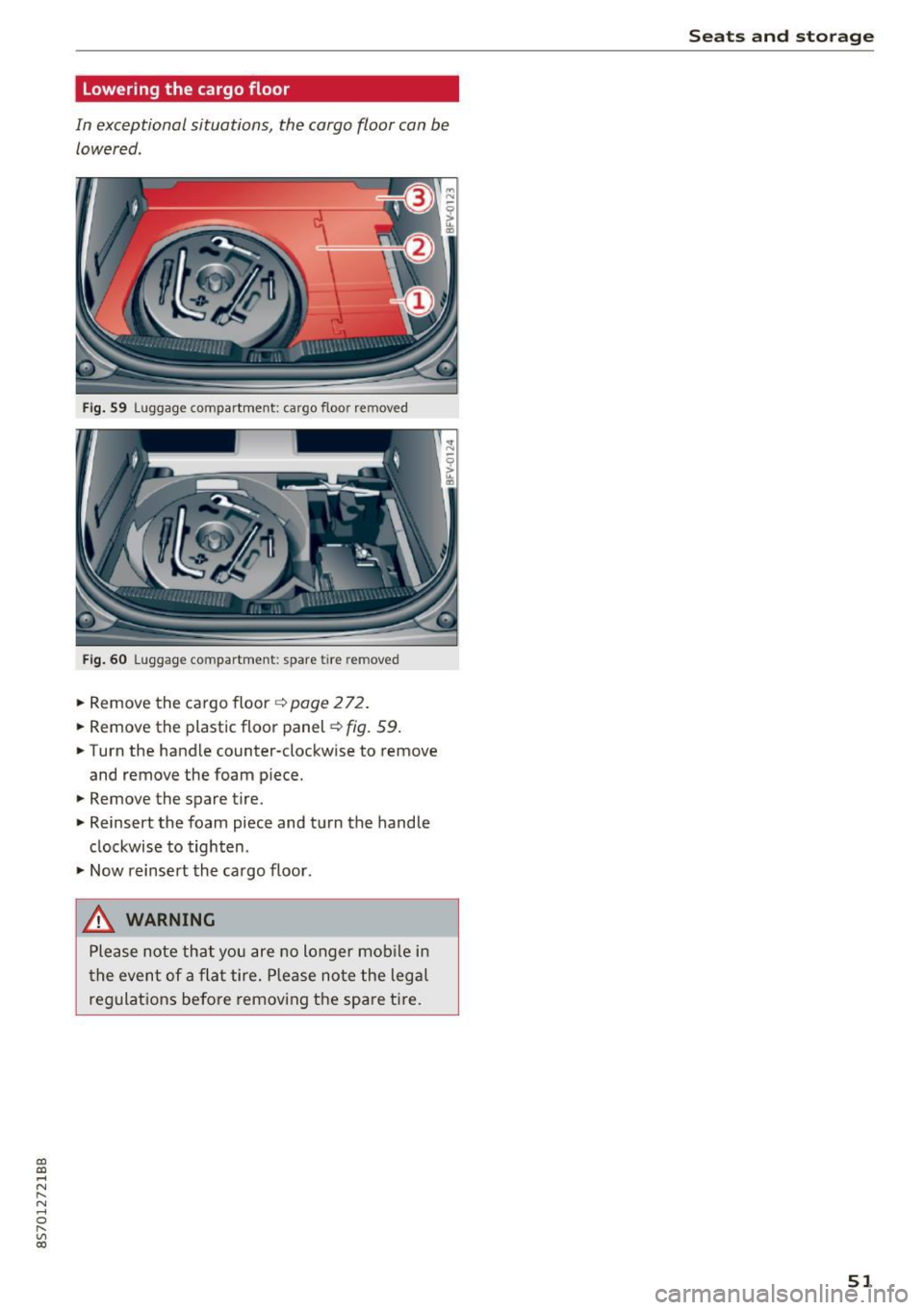
Lowering the cargo floor
In exceptional situations, the cargo floor can be lowered .
Fig. S9 Luggage compartment: ca rgo floor removed
Fig. 60 Luggage compartment: spare tire rem oved
.. Remove the cargo floor q page 2 72 .
.. Remove the plastic floor panel~
fig. 59 .
.. Turn the handle counter-clockwise to remove
and remove the foam p iece .
.. Remove the spare tire .
.. Reinsert the foam piece and turn the handle
clockwise to tighten .
.,. Now reinsert the cargo floor .
_& WARNING
Please note that you are no longer mob ile i n
t he event of a fla t tire. P lease no te the legal
regulat ions befo re removing the spa re tire.
Seats and storag e
51
Page 255 of 314
a, a, .... N
" N .... 0
" V, a:,
Occupant loading and distri
but ion for vehicle normal load
for various design ated se ating
c a pa cit ies
Refer to the tire inflation pres
sure label for the number of seat
ing positions. Refer to the table
¢ table on page 258 for the
number of people that corre
spond to the vehicle normal load.
New tires or wheels
Audi recommends having all work on tires or wheels performed by
an authorized Audi dealer or au
thorized Audi Service Facility.
These facilities have the proper knowledge and are equipped with
the required tools and replace ment parts.
... New ti res do not yet have the
optimum gripping properties.
Drive carefully and at moderate
speeds for the first 350 miles (500 km) with new tires.
... Use ti res of the same construc
tion, size (rolling circumference)
and as close to the same tread
pattern as possible on all four
wheels.
11> D0 not replace tires individually .
At least replace both tires on the
same axle at the same time .
Wheels
11> Audi recommends that you use
Audi Original Tires . If you would
like to use different tires, please
note that the tires may perform
differently even if they are the
same size
c:> A -
.. If you would like to equip your
vehicle with a tire/rim combina
tion that is different from what
was installed at the factory, con
sult with an authorized Audi
dealer or authorized Audi Service Facility before making a pur
chase
c:::> A .
The spare tire* is different from
the regular tires installed on the
vehicle -for example, if winter
tires or wide tires are installed -
so only use the spare tire* tempo
rarily in case of emergency and
drive carefully while it is in use . It
should be replaced with a regular
tire as soon as possible.
On
a ll w heel drive vehicles, all
four wheels must be equipped
with t ires that are the same brand
and have the same construction
and tread pattern so that the drive system is not damaged by
different tire speeds. For this rea
son, in case of emergency, only use a spare tire* that is the same .,.
253
Page 258 of 314
Wheels
through curves and when braking, which increases the risk of
an accident.
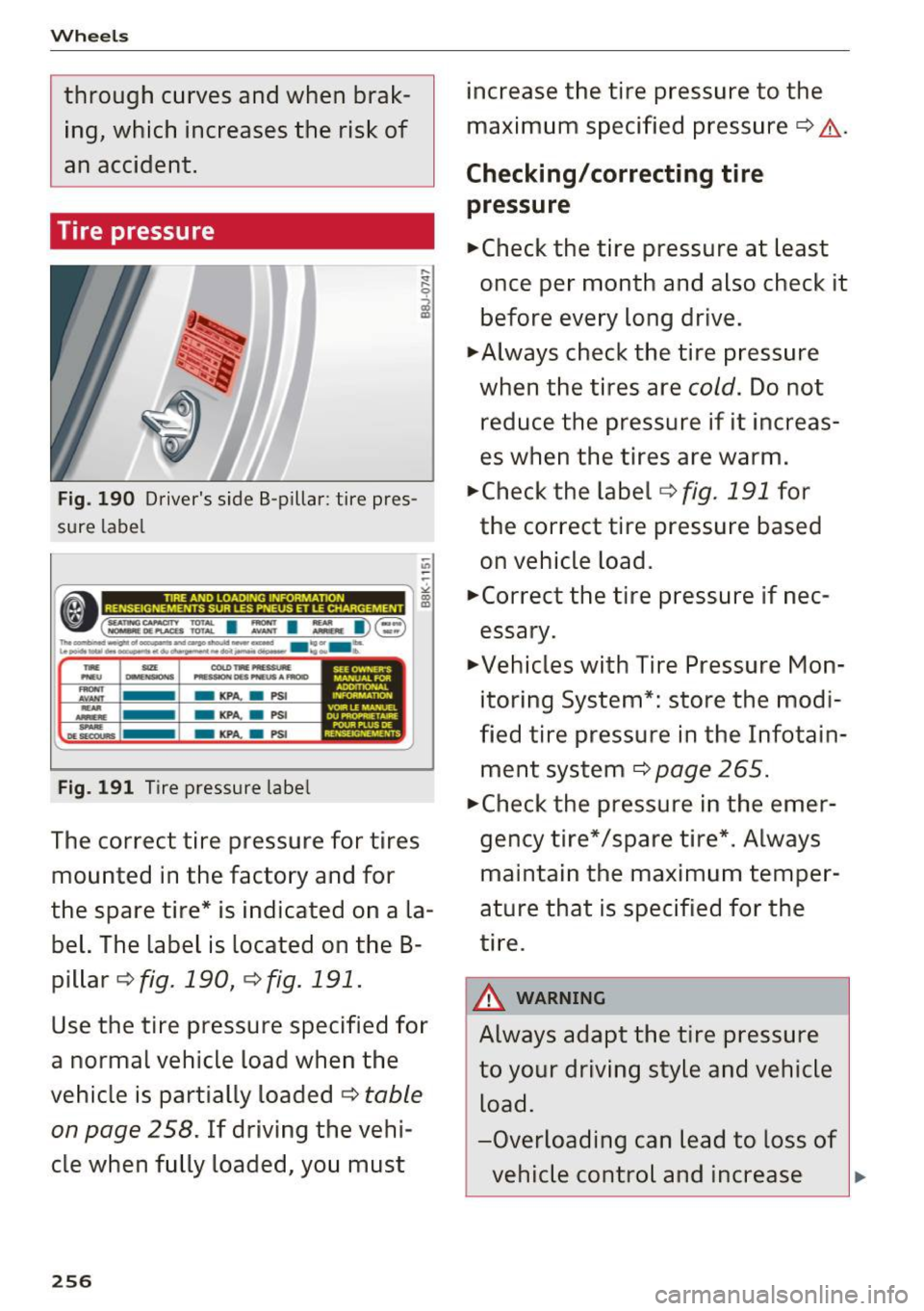
Tire pressure
Fig. 190 Driver's side 8-pillar: tire pr es
sure label
,_,
AVANT -KPA. -PSI
.::.. -KPA. -
PS I j
l~ "'= =-== ===- = KPA.= ·= PSI== ~~~
Fig. 191 Tire pressure label
The correct tire pressure for tires
mounted in the factory and for
the spare tire* is indicated on a la
bel. The label is located on the B
pillar
¢ fig. 190, ¢fig. 191.
Use the tire pressure specified for
a normal vehicle load when the
vehicle is partially loaded¢
table
on page 258.
If driving the vehi
cle when fully loaded, you must
256
increase the tire pressure to the
maximum specified pressure¢,&.
Checking/correcting tire
pressure
•Check the tire pressure at least
once per month and also check it
before every long drive.
•Always check the tire pressure
when the tires are
cold. Do not
reduce the pressure if it increas
es when the tires are warm.
•Check the label ¢
fig. 191 for
the correct tire pressure based
on vehicle load.
•Correct the tire pressure if nec
essary .
•Vehicles with Tire Pressure Mon
itoring System*: store the modi
fied tire pressure in the Infotain ment system ¢
page 265.
•Check the pressure in the emer
gency tire*/spare tire*. A lways
maintain the maximum temper
ature that is specified for the
tire.
A WARNING ~
Always adapt the t ire pressure
to your driving style and vehicle load.
-Overloading can lead to loss of vehicle control and increase .,.
Page 265 of 314
co
co
.... N
" N .... 0
" "' c:o
Traction
The traction grades, from highest to lowest, are
AA, A, B and
C. Those grades represent the tire's
ability to stop on wet pavement as measured un
der controlled conditions on specified govern
ment test surfaces of asphalt and concrete . A tire
marked C may have poor traction performance
¢ _& .
Temperature
The temperature grades are A (the highest), B ,
and
C, representing the tire's resistance to the
generation of heat and its ability to dissipate
heat when tested under controlled conditions on
a specified indoor laboratory test wheel.
Sustained high temperature can cause the mate rial of the tire to degenerate and reduce tire life,
and excessive temperature can lead to sudden
tire failure
c:> .& .
The grade C corresponds to a level of perform
ance which all passenger car tires must meet un
der the Federal Motor Vehicle Safety Standard No.
109 . Grades Band A represent higher levels
of performance on the laboratory test wheel than
the minimum required by law.
A WARNING
The traction grade assigned to this tire is
based on straight -ahead braking traction
tests, and does not include acceleration, cor
nering, hydroplaning or peak traction charac
teristics.
A WARNING
The temperature grade for this tire is estab
lished for a tire that is properly inflated and
not overloaded . Excessive speed, underinfla
tion, or excessive loading, either separately or
in combination, can cause heat buildup and
possible tire failure.
A WARNING
Temperature grades apply to tires that are properly inflated and not over or underinflat
ed.
Wheels
Tire pressure monitoring system
ill General notes
Each tire, including the spare (if provided),
should be checked monthly when cold and inflat
ed to the inflation pressure recommended by the
vehicle manufacturer on the vehicle placard or
tire inflation pressure label. (If your vehicle has
tires of a different size than the size ind icated on
the vehicle placard or tire inflation pressure la bel, you should determine the proper tire infla
tion pressure for those tires).
As an added safety feature, your vehicle has been equipped with a tire pressure monitoring system
(TPMS) that illuminates a low tire pressure tell
tale when one or more of your tires is significant
ly under-inflated. Accordingly, when the low tire
pressure telltale illuminates, you should stop and
check your tires as soon as possible, and inflate
them to the proper pressure . Driving on a signifi
cantly under-inflated tire causes the tire to over
heat and can lead to tire failure . Under-inflation
also reduces fuel efficiency and tire tread life,
and may affect the vehicle's handling and stop
ping ability .
Please note that the TPMS is not a substitute for
proper tire maintenance, and it is the driver's re
sponsibility to maintain correct tire pressure, even if under-inflation has not reached the level
to trigger illumination of the TPMS low tire pres
sure telltale .
Your vehicle has also been equipped with a TPMS malfunction indicator to indicate when the sys
tem is not operating properly . The TPMS mal
function indicator is combined with the low tire
pressure telltale. When the system detects a
malfunction, the telltale will flash for approxi
mately one minute and then remain continuously
illuminated. This sequence will continue upon
subsequent vehicle start-ups as long as the mal
function exists.
When the malfunction indicator is illuminated,
the system may not be able to detect or signal low tire pressure as intended. TPMS malfunctions
may occur for a variety of reasons, including the .,.
263
Page 266 of 314
Wheels
installation of replacement or alternate tires or
wheels on the vehicle that prevent the TPMS
from functioning properly. Always check the
TPMS malfunction telltale after replacing one or
more tires or wheels on your vehicle to ensure
that the replacement or alternate tires and
wheels allow the TPMS to continue to function
proper ly .
If the Tire Pressure Monitoring System
indicator appears
The tire pressure indicator in the instrument
cluster informs you if the tire pressure is too low
or if there is a system malfunction.
Using the ABS sensors, the tire pressure monitor
ing system compares the tire tread circumfer
ence and vibration characteristics of the individu
al tires. If the pressure changes in one or more
tires, this is indicated in the Infotainment system
disp lay with an indicator light
RR and a message.
If only one tire is affected , the location of that
tire will be indicated.
The tire pressures must be stored in the Infotain
ment system again each time the pressures
change (switching between partial and full load pressure) or after changing or replacing a tire on
your vehicle ¢
page 265 . The tire pressure moni
toring system only monitors the tire pressure you
have stored. Refer to the tire pressure label for
the recommended tire pressure for your vehicle
¢ page 256, fig.191.
Tire tread circumference and vibration character
istics can change and cause a tire pressure warn
ing if:
- the tire pressure in one or more tires is too low.
- the tire has structural damage .
- the tire was replaced or the tire pressure was
changed and it was not stored¢
page 265.
-the spare tire* is installed.
Indicator lights
RR -Loss of pressure in at least one tire ¢ ,& .
Check the tires and replace o r repair if necessary.
Check/correct the p ressures of a ll four tires and
store the pressure again in the Infotainment sys
tem ¢
page 265.
264
mm (T ire Pressure Monitoring System) Tire
pressure: malfunction! See owner's manual -
If
mm appears after switching on the ignit ion or
while driving and then the indicator light
RR in
the instrument cluster also starts to blink for
about one minute and then stays on permanent ly, there is a system malfunction. Try to store the
correct tire pressures¢
page 265. If the indica
tor light does turn off or turns on again after a
short period of time , drive to an authorized A udi
dealer or authorized Audi Service Facility immedi
ate ly to have the ma lfunction corrected.
_& WARNING
-If the tire pressure indicator appears in the
disp lay, reduce your speed immediately and
avoid any hard steering or brak ing maneu
vers. Stop as soon as poss ible and check the
tires and their pressure .
- The driver is responsible for maintain ing the
correct tire pressures . You must check the
tire pressures regularly .
- Under certain cond it ions (such as a sporty
driving style, w inter condit ions or unpaved
roads), the pressure monitor indicator may
be delayed.
- Do not use run-flat tires on your vehicle . Us
ing them when not perm itted can lead to
vehicle damage or accidents.
(D Tips
- The tire pressure monitoring system can al
so stop working when there is an ESC mal
function.
- Us ing snow chains may result in a system
ma lfunction.
- The tires w ith the identification "AO"
¢
page 253 have been matched w ith your
Audi t ire pressure monitoring system. We
recommend that you use these tires.
Page 275 of 314
CD
CD
.... N
" N ...... 0 r--. V, co
@ Tips
The vehicle jack* in your vehicle is maintena nee-free.
Tire mobility kit
Preparation
A ppl ies to: vehicles with tire mobility kit
~ Read and follow the impor tant safety precau-
tions r=;;,
page 2 72, General information.
~ Set the parking b rake.
~ Select the P selector lever position.
~ Check if a repair w ith the tire mobility kit is pos
sible r=;;,
page 273.
Using the tire mobility kit
Applies to: ve hicles w ith tire mobility kit
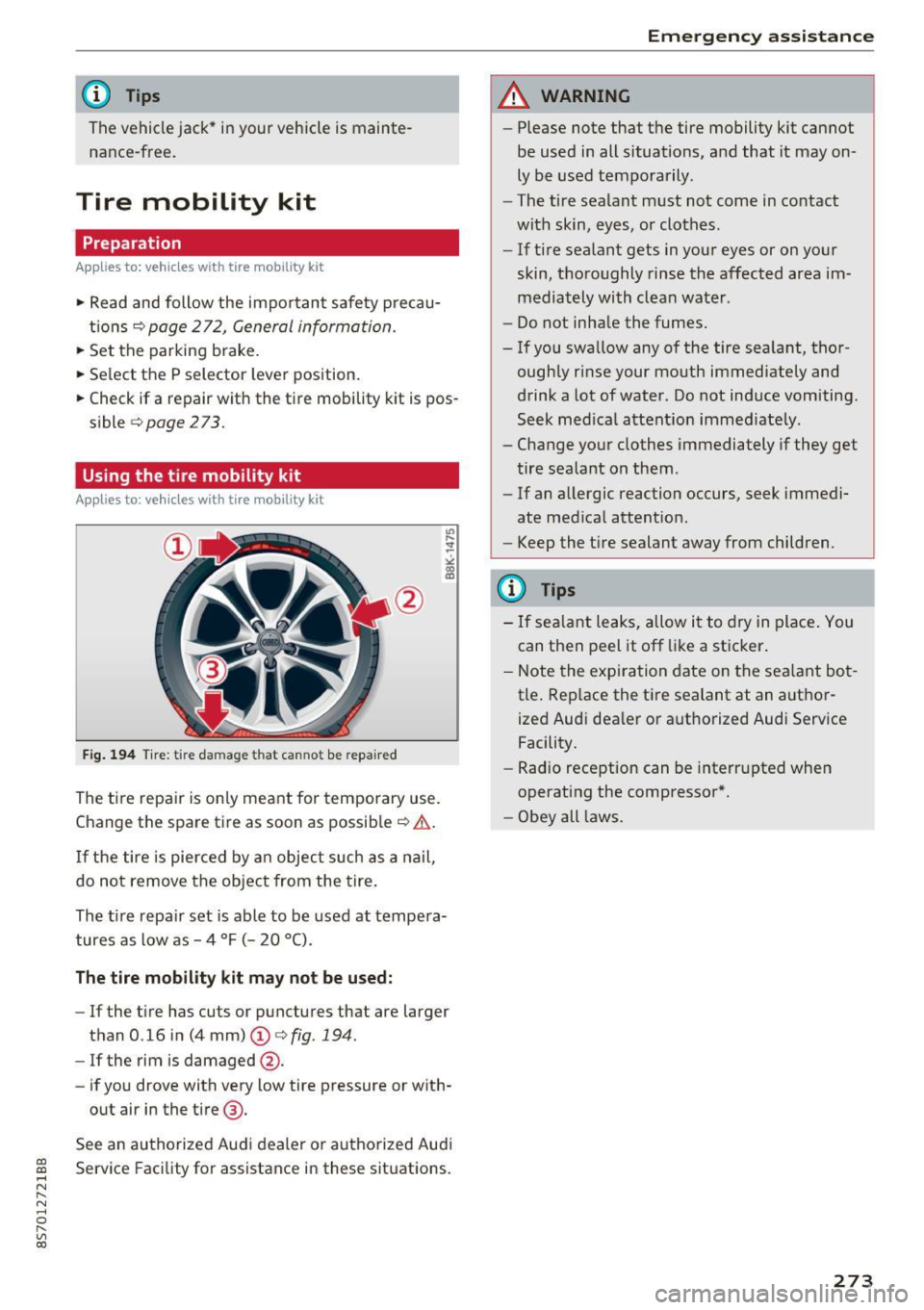
Fig . 194 Tire : tire damage that cannot be repa ired
The tire repair is only meant for temporary use.
Change the spare tire as soon as possible r=;;, & .
If the tire is pierced by a n objec t such as a na il,
do not remove the object from the tire .
The tire repa ir set is able to be used at tempe ra
tures as low as -4 °F ( -20 °C).
The tire mobility kit may not be u sed:
- If the t ire has cuts or punctures that are larger
than 0 .16 i n (4 mm)
(J) r=;;, fig. 194.
-If the rim is damaged @.
- if you drove with very low tire pressure or with-
out air in the tire @.
See an authorized Audi dealer or authorized Aud i
Service Faci lity for assistance in these situations.
Em ergen cy a ssis tanc e
A WARNING
--Please note that t he tire mobility kit cannot
be used in all situations, and that it may on
ly be used temporarily.
- The tire sealant must not come in contact
with skin, eyes , or clothes.
- If tire sealant gets in your eyes or on your
skin, t horoughly rinse the affected area im
mediately with clean water .
- Do not inha le the fumes .
- If you swa llow any of t he tire sea lant, thor-
ough ly rinse your mouth immediately and
drink a lot of water. Do not induce vomiting.
Seek med ica l attent ion immed iate ly.
- Change your clothes immediately if they get
tire sealant on them.
- If an a llergic reaction occurs, seek immedi
ate med ical attention.
- Keep the t ire sealant away from children.
(D Tips
- If sea lant leaks, allow it to d ry in place . You
can then peel it off like a st icker .
- Note the expi ra tion date on the sea lant bo t
tle . Rep lace the tire sealant at an a utho r
ized Audi dea ler or a uthorized Audi Service
Facility.
- Radio reception can be interr upted when
operating the compressor*.
- Obey all laws .
273
Page 277 of 314
CD
CD
.... N
" N .... 0 r--. V, co
-If the t ire is t oo severely damaged, see an
aut horized Aud i dealer or authorized Aud i
Service Facility for assistance .
@ For the sake of the environment
You can give the used tire sealant bottle to an
authorized Audi dealer or authorized A udi
Serv ice Facility for disposal.
@ Tips
Remember to obtain a new bottle of sea lant
from an authorized Audi dea ler or authorized
Aud i Service Facility after repair ing a tire.
Replacing wheels
Preparation
You must complete the preparation before
changing a tire .
.,. Read and follow the important safety precau-
t ions
¢ page 272, General information .
.,. Set the parking b rake .
• Se lect the P selector lever pos ition .
.,. Lay out the vehicle tool kit¢
page 2 72 and the
spare tire¢
page 279 .
A WARNING
If you are cha nging a tire on a steep hill, use a
block or similar object to block the oppos ite
wheel to prevent the vehicle from moving.
A WARNING
You or your passenger co uld be injured while
chang ing a wheel if you do not follow these
safety precautions:
- If you have a flat tire, move a safe distance off the road. Turn off the engine, turn the
emergency flashers on and use other warn
ing devices to alert othe r mo to rists.
- Make sure that passengers wa it in a safe
place away from the vehicle and we ll away
from the road and traffic.
- To help prevent the vehicle from movi ng
sudden ly and possibly slipping off the jack,
always fully set t he parking brake and block
t h e whee l di agona lly o ppos ite the wheel be-
Em ergen cy a ssis tanc e
ing changed. When one front whee l is lifted
off the ground, placing the Automatic
Transmiss ion in P (Park) will
not prevent the
veh icle from moving.
- Before you change a wheel, be sure the
ground is leve l and firm.
If necessary, use a
sturdy board under the jack.
- Always store the vehicle tool kit, the jack
and the replaced tire in the luggage com
pa rtment
¢ page 185.
@ Tips
Obey all laws.
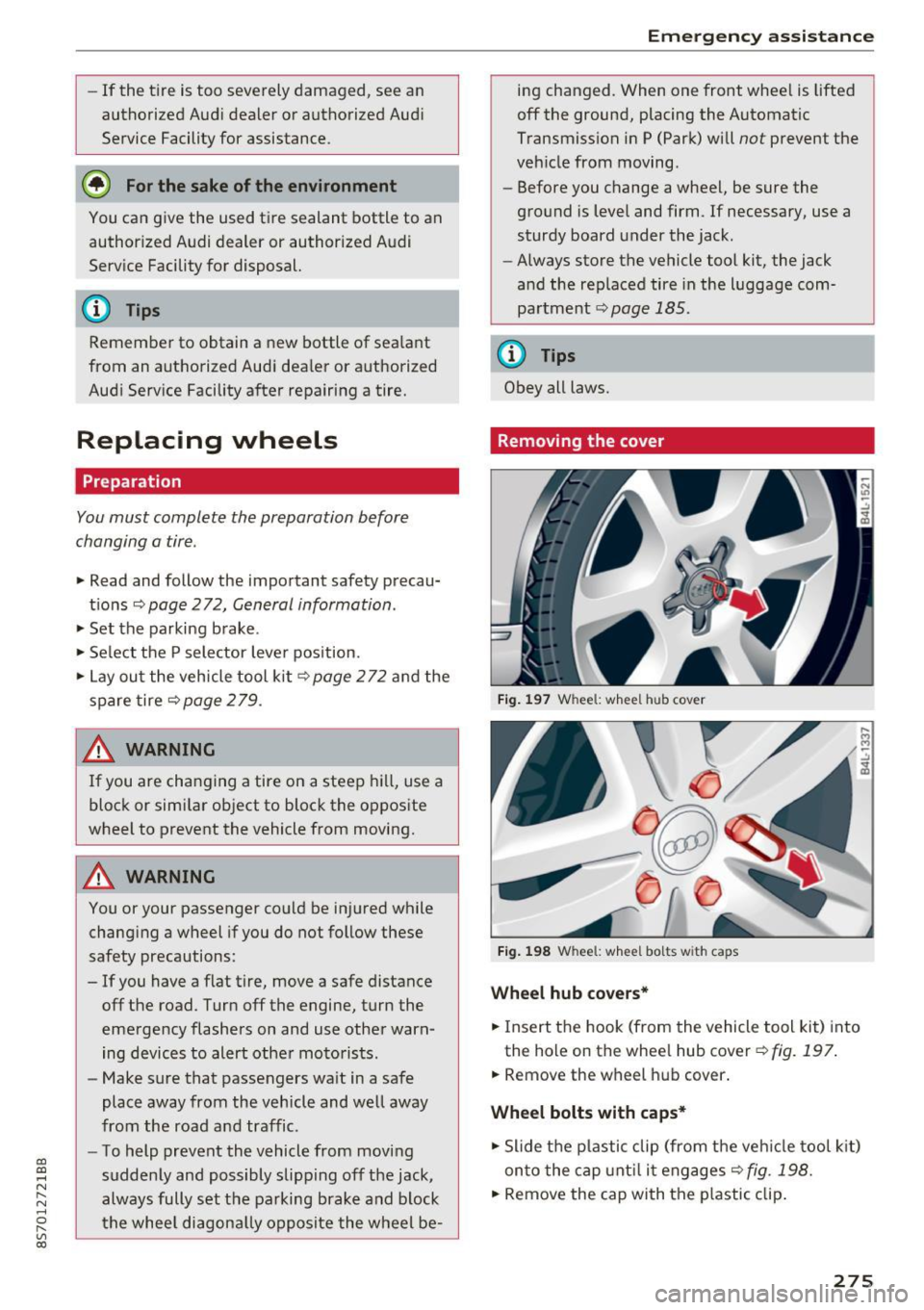
Removing the cover
Fig . 1 97 W hee l: whee l hub cover
F ig . 1 98 W hee l: whee l bolts w ith caps
Whe el hub covers*
.,. Insert the hook (from the vehicle tool kit) into
the ho le on the whee l hub cover ¢
fig. 197.
.,. Remove the wheel h ub cover .
Wheel bolts with caps*
.,. Slide the p lastic clip (from t he veh icle too l ki t)
on to the cap unt il it engages
¢ fig . 198.
• Remove the cap with the p lastic clip .
275
Page 281 of 314
CD
CD
.... N
" N .... 0 r--. V, co
-Always store damaged whee l, jack and too ls
securely in the luggage compartment. Oth erwise, in an accident or sudden maneuver
they could fly forward, causing injury to pas
sengers in the vehicle .
Spare tire
General information
Applies to: veh icles with space-saving spa re t ire (compact
spare tire)
A U DI
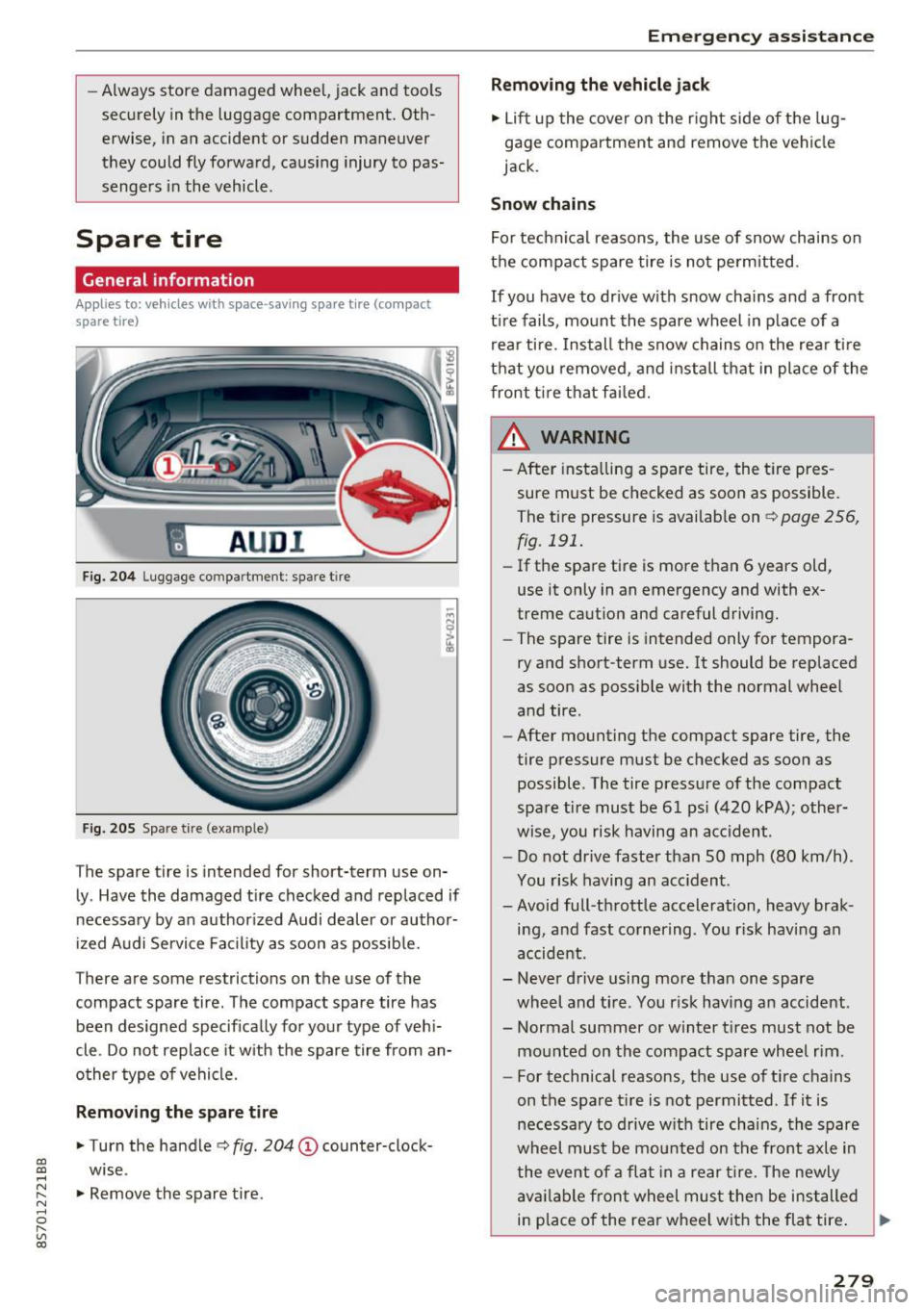
Fig. 204 Luggage co mpa rtment : spar e tir e
Fig. 205 Sp are t ire (ex ample)
The spare tire is intended for short-term use on
ly . Have the damaged t ire checked and replaced if
necessary by an author ized Audi dealer or author
ized Audi Service Fac ility as soon as possib le.
T here are some restrictions on the use of the
compact spare tire . The compact spare tire has
been designed specifica lly for your type of veh i
cle . Do not replace it w ith the spare tire from an
o ther type of vehicle.
Removing the spare t ire
.. Turn the handle c:> fig . 204 © counter-clock
wise .
.. Remove the spare tire .
Emergen cy a ssis tanc e
Removing the vehicle jack
.. Lift up the cover on the right side of the lug
gage compartment and remove the vehicle
jack.
Snow chains
For technical reasons, the use of snow chains on
t h e compact spare tire is not pe rmitted.
If you have to dr ive with snow chains and a front
t ire fails , mount the spare wheel in p lace of a
rear tire . Install the snow chains on the rea r tir e
t h at you removed, and i nstall that in place of the
front t ire that fai led.
A WARNING
-
- After insta lling a spare tire, the tire pres
sure must be checked as soon as possible .
The tire pressure is availab le on ¢
page 256,
fig. 191.
-If the spare tire is more t han 6 years old,
use it only in an emergency and with ex
treme caut ion and careful driving.
- The spare tire is intended only for tempora
ry and short-term use. It should be replaced
as soon as poss ible with the normal whee l
and tire .
- After mounting the compact spare tire, the
tire pressure must be checked as soo n as
possible . The tire pressure of the compact
spa re ti re must be 61 ps i (420 kPA); other
wise, you risk having an accident.
- Do not dr ive faster than SO mph (80 km/h) .
You risk having an acc ident.
-Avoid full -th rottle acceleration, heavy brak
ing, and fast corner ing . You r isk hav ing an
accident .
- Never drive using more than one spare wheel and ti re . You r isk having an accident .
- Normal summer or winter t ires must not be
mounted on the compact spare wheel rim .
- For technical reasons, the use of ti re chains
on the spare t ire is not permitted .
If it is
necessa ry to drive w it h tire cha ins, the spare
wheel mus t be mounted on the front axle in
the event of a flat in a rear t ire. The newly
a vailab le fro nt wheel mus t the n be ins talled
i n place o f the rear wheel wit h the flat tire .
~
279
Page 297 of 314
co
co
.... N
" N .... 0
" "' c:o
@ For the sake of the environment
-Changing the engine settings will adversely
affect emission levels. This is detrimental to
the environment and increases fuel con
sumption.
-Always observe environmental regulations
when disposing of old engine oil, used brake
fluid, dirty engine coolant, spent batteries
or worn out tires.
- Undeployed airbag modules and pretension
ers might be classified as Perchlorate Mate
rial -special handling may apply, see
www .dtsc.ca.gov/hazardouswaste/perchlo
rate . When the vehicle or parts of the re
straint system including airbag modules
safety belts with pretensioners are scrap
ped, all applicable laws and regulations
must be observed. Your authorized Audi
dealer is familiar with these requirements
and we recommend that you have your deal er perform this service for you.
Accessories and
technical changes
Additional accessories and parts replacement
Always consult on authorized Audi dealer before
purchasing accessories.
Your vehicle incorporates the latest safety design
features ensuring a high standard of active and passive safety.
This safety could be compromised by non-ap proved changes to the vehicle. For this reason, if
parts have to be replaced, please observe the fol
lowing points when installing additional accesso
ries:
Approved Audi accessories and genuine Audi parts are available from authorized Audi dealers.
These dealers also have the necessary facilities, tools and trained specialists to install the parts
and accessories properly .
Consumer information
A WARNING
Using the wrong spare parts or using non-ap
proved accessories can cause damage to the
vehicle and serious personal injury.
- Use only accessories expressly approved by
Audi and genuine Audi spare parts
- These parts and accessories have been spe
cially designed to be used on your vehicle.
- Do not use license plate brackets in the
front area that are different from the one
installed at the factory, or add additional li
cense plate brackets.
- Never install accessories such as telephone
cradles or beverage holders on airbag covers
or within the airbag deployment zones. Do
ing so will increase the risk of injury if air
bags are triggered in an accident!
- Before you check anything in the engine
compartment, always read and heed all
WARNINGS Qpoge 235.
(D Note
-If items other than genuine Audi spare
parts, add-on equipment and accessory
items are used or if repair work is not per
formed according to specified methods, this
can result in severe damage to your vehi
cle's engine and body (such as corrosion)
and adversely affect your vehicle's warranty.
- If emergency repairs must be performed
elsewhere, have the vehicle examined by an
authorized Audi dealer as soon as possible.
- The manufacturer cannot be held liable for
damage which occurs due to failure to com
ply with these stipulations.
Technical Modifications
Our guidelines must be complied with when tech
nical modifications ore mode.
Always consult an authorized Audi dealer
before
starting work on any modifications.
This will help ensure that vehicle function, per
formance and safety are not impaired
Q ,&.
295