instrument panel AUDI TT ROADSTER 2018 User Guide
[x] Cancel search | Manufacturer: AUDI, Model Year: 2018, Model line: TT ROADSTER, Model: AUDI TT ROADSTER 2018Pages: 310, PDF Size: 46.95 MB
Page 212 of 310
Airbag system
Knee airbags
Description of knee airbags
The knee airbag system can provide supplemen
tal protection to properly restrained front seat
occupants .
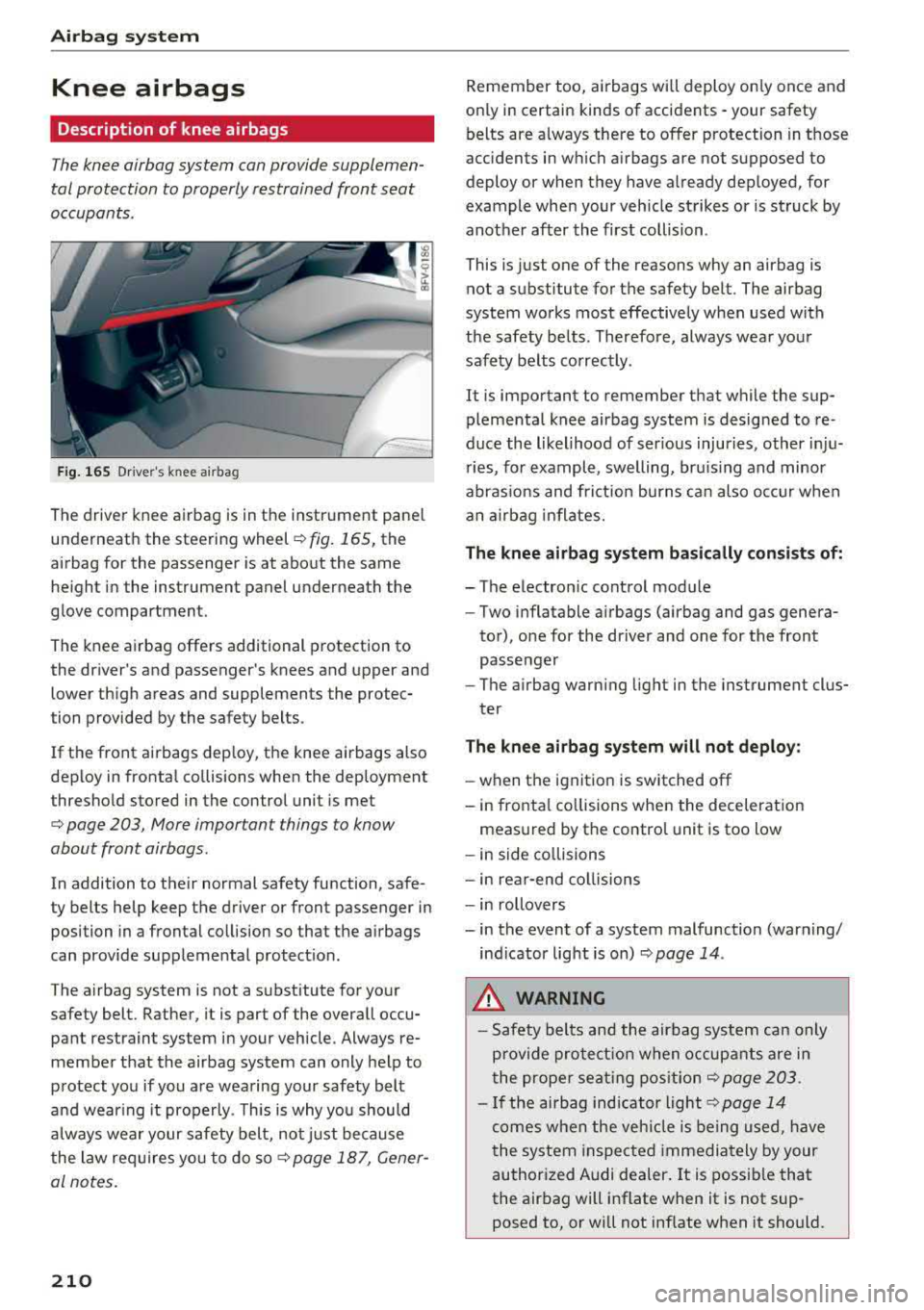
Fig. 165 Driver's k nee a irbag
The driver knee airbag is in the instrument panel
underneath the steering
wheel ¢ fig. 165, the
airbag for the passenger is at about the same
height in the instrument panel underneath the
glove compartment.
The knee airbag offers additional protection to
the driver's and passenger's knees and upper and
lower thigh areas and supplements the protec
tion provided by the safety belts.
If the front airbags deploy, the knee airbags also
deploy in frontal collisions when the deployment
threshold stored in the control unit is met
¢ page 203, More important things to know
about front airbags.
In addition to their normal safety function, safe
ty belts help keep the driver or front passenger in
posi tion in a frontal collision so that the airbags
can prov ide supplemental protection .
The airbag system is not a substitute for your safety belt. Rather, it is part of the overall occu
pant restraint system in your vehicle. Always re
member that the airbag system can only help to
protect you if you are wearing your safety belt
and wearing it properly . T his is why you should
always wear your safety belt, not just because
the law requires yo u to do so ¢
page 187, Gener
al notes.
210
Remember too, airbags will deploy only once and
on ly in certain kinds of accidents -your safety
belts are always there to offer protection in those
accidents in which airbags are not supposed to
deploy or when they have already deployed, for
example when your vehicle strikes or is struck by
another after the first collision .
This is just one of the reasons why an airbag is
not a substitute for the safety belt . The airbag
system works most effectively when used with
the safety belts. Therefore, always wear your
safety belts correctly.
It is important to remember that while the sup
plemental knee airbag system is designed to re
duce the likelihood of serious injuries, other inju
ries, for example, swelling, bruising and minor
abras ions and friction burns can also occur when
an airbag inflates.
The knee airbag system basically consists of:
-The electronic control module
-Two inflatable airbags (airbag and gas genera-
tor), one for the driver and one for the front
passenger
- The airbag warning light in the instrument clus-
ter
The knee airbag system will not deploy:
-when the ignition is switched off
- in frontal collisions when the decelerat ion
measured by the control unit is too low
-in side collisions
-in rear-end collisions
-in rollovers
-in the event of a system malfunction (warning/
ind icator light is on)
¢ page 14 .
.&, WARNING
-Safety belts and the airbag system can only
provide protection when occupants are in
the proper seating position
¢page 203 .
-If the airbag ind icator light ¢ page 14
comes when the vehicle is being used, have
the system inspected immediately by your
authorized Audi dealer.
It is possible that
the airbag will inflate when it is not sup
posed to, or will not inflate when it should.
Page 213 of 310
Cl co .... N ,....
N .... 0 ,....
Vl co
How knee airbags work
The risk of injury to the leg area can be reduced
by fully inflated knee airbags.
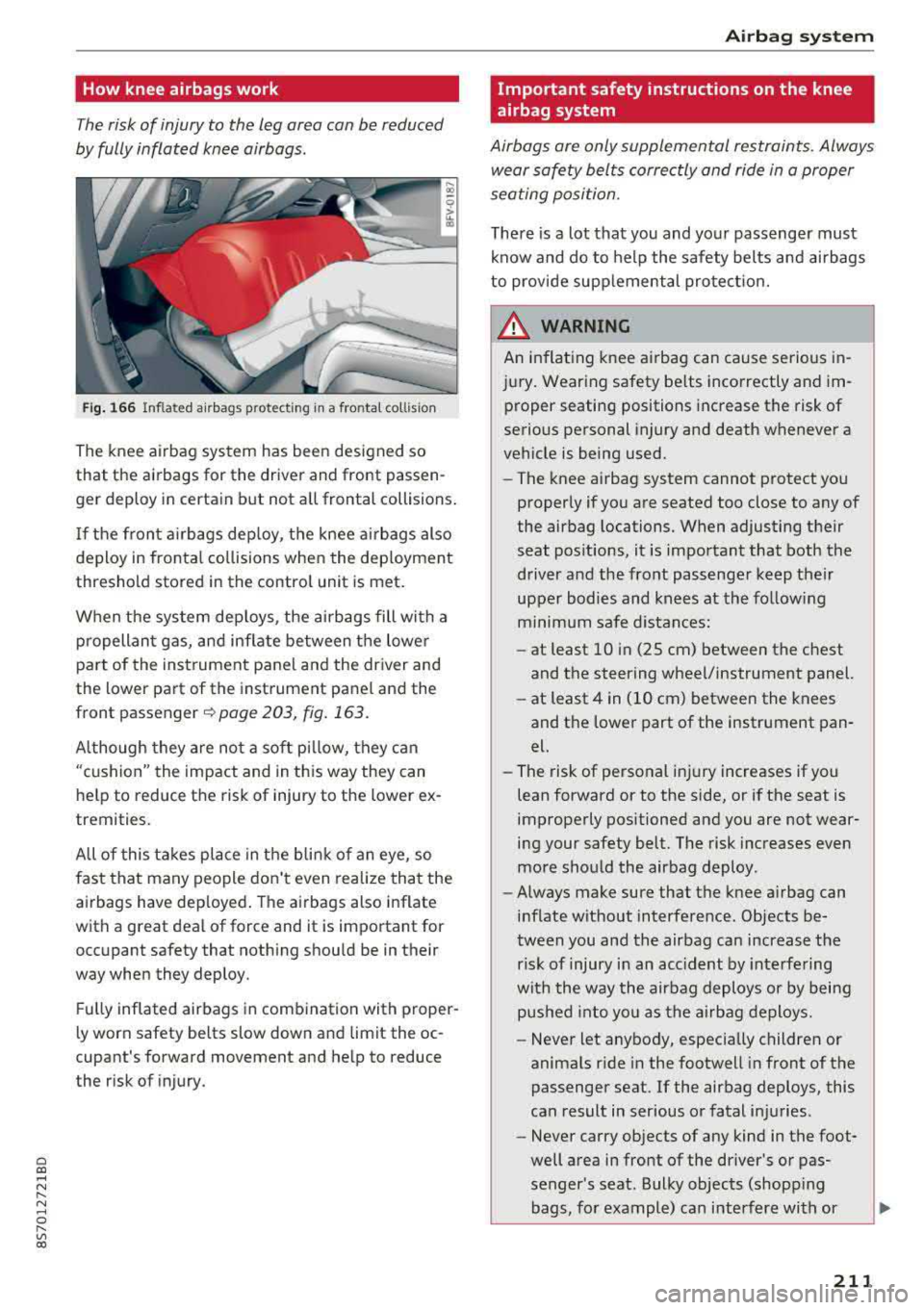
Fig. 166 Inflated airbags protecting in a frontal collision
The knee airbag system has been designed so
that the airbags for the driver and front passen
ger deploy in certain but not all frontal collisions.
If the front airbags deploy, the knee airbags also
deploy in frontal collisions when the deployment
threshold stored in the control unit is met.
When the system deploys, the airbags fill with a propellant gas, and inflate between the lower
part of the instrument panel and the driver and
the lower part of the instrument panel and the front
passenger ~ page 203, fig. 163.
Although they are not a soft pillow, they can
"cushion" the impact and in this way they can
help to reduce the risk of injury to the lower ex
tremities.
All of this takes place in the blink of an eye, so
fast that many people don't even realize that the
airbags have deployed. The airbags also inflate
with a great deal of force and it is important for
occupant safety that nothing should be in their
way when they deploy .
Fully inflated airbags in combination with proper
ly worn safety belts slow down and limit the oc
cupant 's forward movement and help to reduce
the risk of injury.
Airbag system
Important safety instructions on the knee
airbag system
Airbags are only supplemental restraints . Always
wear safety belts correctly and ride in a proper
seating position .
There is a lot that you and your passenger must
know and do to help the safety belts and airbags
to provide supplemental protection.
_& WARNING
-
An inflating knee airbag can cause serious in-
jury. Wearing safety belts incorrectly and im proper seating positions increase the risk of
serious personal injury and death whenever a
vehicle is being used.
-The knee airbag system cannot protect you properly if you are seated too close to any of
the airbag locations. When adjusting their
seat positions, it is important that both the
driver and the front passenger keep their
upper bodies and knees at the following minimum safe distances:
-at least 10 in (25 cm) between the chest
and the steering wheel/instrument panel.
-at least 4 in (10 cm) between the knees and the lower part of the instrument pan
el.
-The risk of personal injury increases if you
lean forward or to the side, or if the seat is
improperly positioned and you are not wear
ing your safety belt. The risk increases even
more should the airbag deploy .
- Always make sure that the knee airbag can
inflate without interference. Objects be
tween you and the airbag can increase the risk of injury in an accident by interfering
with the way the airbag deploys or by being pushed into you as the airbag deploys.
-Never let anybody, especially children or
animals ride in the footwell in front of the
passenger seat. If the airbag deploys, this
can result in serious or fatal injuries .
-Never carry objects of any kind in the foot
well area in front of the driver's or pas
senger's seat. Bulky objects (shopping bags, for example) can interfere with or
~
211
Page 214 of 310
Airbag system
prevent proper deployment of the airbag.
Small objects can be thrown through the
vehicle if the airbag deploys and injure you
or your passenger .
- Make sure there are no cracks, deep scratch
es or other damage in the area of the instru
ment panel where the knee airbags are lo
cated.
- If children are incorrectly seated, their risk
of injury increases in a collision
c:> page 216, Child safety.
Side airbags
Description of side airbags
The airbag system can provide supplemental
protection to properly restrained occupants.
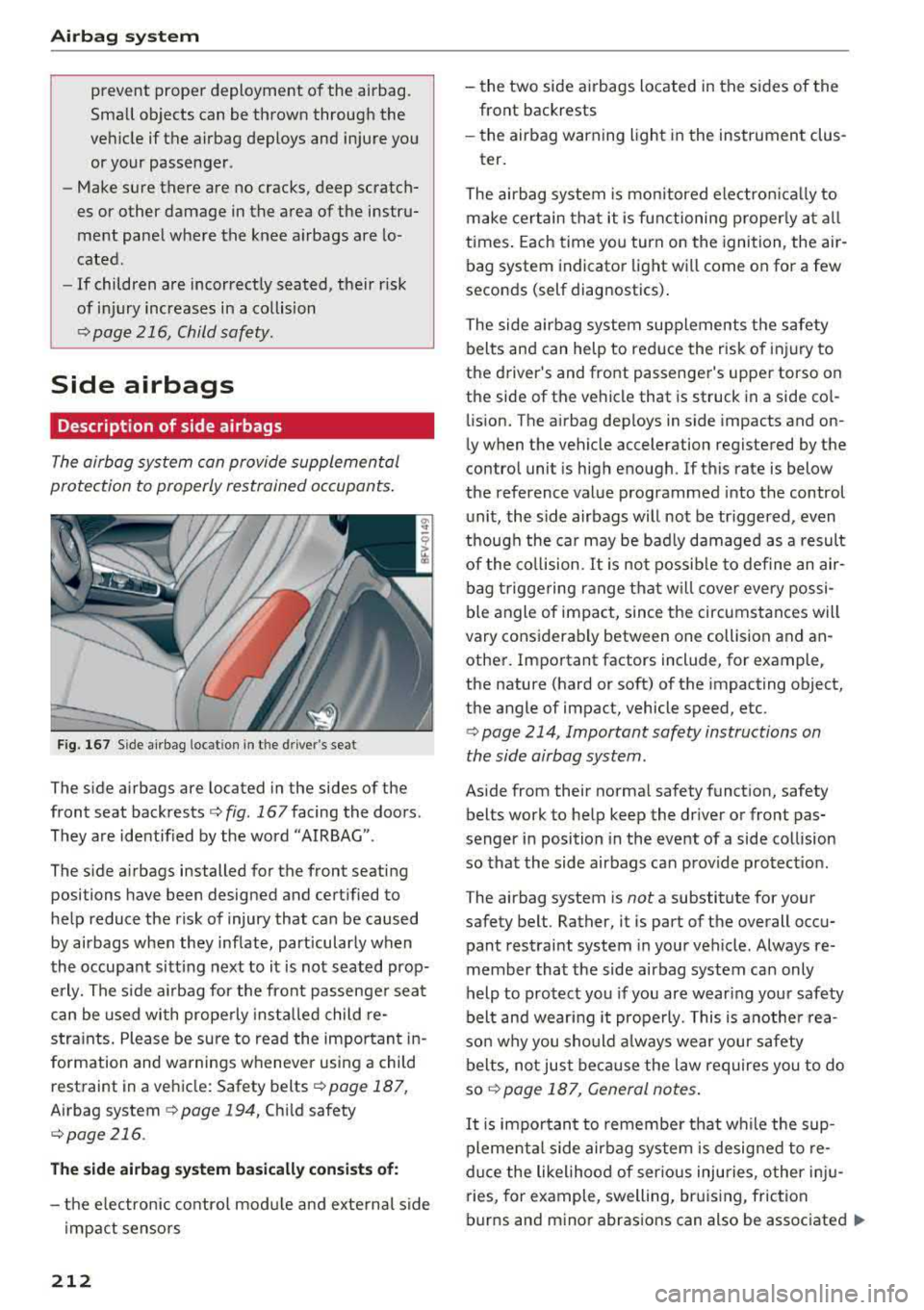
Fig. 167 Side airbag locat ion in t he drive r's se at
The side airbags are located in the sides of the
front seat backrests
c:> fig. 167 facing the doors .
They are identified by the word "AIRBAG".
The side airbags installed for the front seating
positions have been designed and certified to
help reduce the risk of injury that can be caused
by airbags when they inflate, particularly when
the occupant sitting next to it is not seated prop
erly. The side airbag for the front passenger seat
can be used with properly installed child re
straints. Please be sure to read the important in
formation and warnings whenever using a child
restraint in a vehicle: Safety belts
c:> page 187,
Airbag system c:>page 194, Child safety
c:> page 216 .
The side airbag system basically consists of:
-the electronic control module and externa l side
impact sensors
212
-the two side airbags located in the sides of the
front backrests
-the airbag warning light in the instrument clus-
ter.
The airbag system is mon itored electron ically to
make certain that it is functioni ng properly at all
times. Each time you turn on the ignition, the air
bag system indicator light will come on for a few
seconds (self diagnostics) .
The side airbag system supplements the safety
belts and can help to reduce the risk of injury to
the driver's and front passenger's upper torso on
the side of the vehicle that is struck in a side col
lision. The airbag deploys in side impacts and on
ly when the vehicle acceleration registered by the
control unit is high enough. If this rate is below
the reference value programmed into the control
unit, the side airbags will not be tr iggered, even
though the car may be badly damaged as a result
of the collision.
It is not possible to define an air
bag triggering range that w ill cover every possi
ble angle of impact, since the circumstances will
vary considerably between one collision and an
other. Important factors include, for example,
the nature (hard or soft) of the impacting object,
the angle of impact, vehicle speed, etc.
c:> page 214, Important safety instructions on
the side airbag system.
Aside from their normal safety function, safety
belts work to help keep the driver or front pas
senger in position in the event of a side collision
so that the side airbags can provide protection.
The airbag system is
not a substitute for your
safety belt. Rather, it is part of the overall occu
pant restraint system in your vehicle . Always re
member that the side airbag system can only
help to protect you if you are wear ing your safety
belt and wear ing it properly. This is another rea
son why you sho uld always wear your safety
belts, not just because the law requires you to do
so
c:> page 187, General notes.
It is impo rtant to remember that while the sup
plemental side airbag system is designed to re
duce the likelihood of ser ious injuries, other inju
ries, for example, swelling, bruising , friction
burns and minor abrasions can also be associated
...,
Page 220 of 310
Child sa fety
Advanced front airbag system and children
Your veh icle is equipped w ith a front "Advanced
A irbag System" in comp liance w it h United States
F edera l Motor Vehicle Safety Standard ( FMVSS)
208, as well as Canada Motor Vehicle Safety
Standard (CMVSS) 208 as applicable at the time
your vehicle was manufactured.
The Advanced Airbag system in your veh icle has
been certified to meet the " low-risk" require
ments for 3- and 6-year old children on the pas
senger side and small adults on the driver side.
The low risk deployment criteria are intended to
reduce the risk of injury through interaction with
the airbag that can occur, for example, by being
too close to the steering wheel and instrument
panel when the a irbag inflates. In addit ion, the
system has been certified to comply w ith the
" su ppress io n" req uirements of the Safety S tand
ard, to tu rn off the front airbag for infants up to
12 months who are restrained on the front pas
senger seat in child restraints that are listed in
the Standard.
E ven tho ugh yo ur vehicle is equipped with an
Ad a
vanced Airbag system, a chi ld should a lways ride
in the seat proper ly restrained for its age and
size. The airbag on the passenger side makes the
front seat a potentially dangerous p lace for a
child to r ide . The front seat is not the safest place
for a child in a forward-facing child safety seat .
It
can be a very dange rous place for a n infant or a
larger child in a rearward-fac ing seat.
The vehicle's Advanced Airbag System has a ca
pac itive passenger detect ion system in the front
passenger seat cush ion that ca n detect the pres
ence of a baby or a child in a ch ild restraint sys
tem on t his seat .
The capac it ive passenger detect ion system regis
ters the changes that result in an electr ical field
when a c hild, a child restra int, and a baby blanket
a re on the front passenge r seat. The change in
t he meas ured capacitance due to t he p resence o f
a child, a chi ld restraint, and a baby b lanket on
the front passenger seat is re lated to the chi ld
restraint system resting on the seat . The meas
ured capacitance of a ch ild restraint system var-
218
ies depending on the type of system and specific
make and mode l.
The elect rical capac ita nce of the va rious types,
makes, and models of child restra in ts speci fied
by the U.S . National Highway Tra ffic Safety Ad
ministration (NHTSA) in the relevant safety
standard are stored in the Advanced Airbag Sys
tem control unit together with the capacitances
typ ica l of infants and a 1-year old child. When a
c hi ld restraint is used on the front passenger
seat w it h a typical 1 year-old infant, t he Ad
vanced Airbag System compares the capacitance measured by the capacitive passenge r detect ion
system wi th the data stored in the e lec tronic co n
tro l unit .
Child restraints and Advanced front airbag
system
Regardless of the ch ild restraint that you use,
make sure that it has been certified to meet Safe
ty Standards and has been cert ified by its manu
factu rer for use w ith an airbag . If in exceptional
c ir cumstances you m ust use it on the front pas
senger seat, ca refully read all of the information
o n chi ld safety and Advanced Airbags and heed
a ll of th e app licab le WARNINGS . Make certain
that the chi ld and chi ld restraint are correctly
recognized by the capacitive passenger detection
system in the front passenger seat, that the front passenger a irbag is turned off, and that the air
bag status is always correct ly signa led by the
PASSENGER AIR BAG OFF ~; light.
Many types and models of child restra ints have
been available over the years, new models are in
troduced regularly incorporating new and im
proved designs and older models are taken out of
production . Ch ild rest rai nts are not standa rdized .
Child res tra ints of the same type typically have
d iffe rent weights and sizes and diffe re nt "foot
pr ints", the size and shape o f th e bo ttom of the
ch ild restraint that sits on the seat, w hen they
are installed on a vehicle seat . These differences
make it virtua lly impossib le to certify comp liance
with the requirements for advanced a irbags w ith
each and every child restra int that has ever been
sold in the past or will be sold over the course of
the useful life of your veh icle .
.,.