instrument panel AUDI TT ROADSTER 2019 User Guide
[x] Cancel search | Manufacturer: AUDI, Model Year: 2019, Model line: TT ROADSTER, Model: AUDI TT ROADSTER 2019Pages: 304, PDF Size: 80.77 MB
Page 201 of 304
8S8012721BA
Airbag system
— when the electrical capacitance measured by
the capacitive passenger detection system for
the front passenger seat indicates that the pas-
senger side frontal airbag must be switched off
by the electronic control unit (the PASSENGER
AIR BAG OFF %; light > page 200 and how they
work comes on and stays on).
ZA\ WARNING
Sitting in the wrong position can increase the
risk of serious injury in crashes.
—To reduce the risk of injury when the airbags
inflate, the driver and passengers must al-
ways sit in an upright position, must not
lean against or place any part of their body
too close to the area where the airbags are
located.
— Occupants who are unbelted, out of position
or too close to the airbag can be seriously in-
jured by an airbag as it unfolds with great
force in the blink of an eye > page 190.
Z\ WARNING
A child in a rearward-facing child seat instal-
led on the front passenger seat will be seri-
ously injured and can be killed if the front air-
bag inflates - even with an Advanced Airbag
System.
— The inflating airbag will hit the child seat or
infant carrier with great force and will
smash the child seat and child against the
backrest, center armrest, door or roof.
— Never install a rearward facing child safety
seat on the front passenger seat unless the
PASSENGER AIR BAG OFF %; light comes
on and stays on. If the PASSENGER AIR
BAG OFF #%; light does not come on and stay
on, the inflating airbag will hit the child
safety seat or infant carrier with great force
and will smash the child safety seat and
child against the backrest, door or roof.
Have the airbag system inspected immedi-
ately by your authorized Audi dealer.
ZA WARNING
Objects between you and the airbag will in-
ing with the way the airbag unfolds or by be-
ing pushed into you as the airbag inflates.
— Never hold things in your hands or on your
lap when the vehicle is in use.
— Never transport items on or in the area of
the front passenger seat. Objects could
move into the area of the front airbags dur-
ing braking or other sudden maneuver and
become dangerous projectiles that can
cause serious personal injury if the airbags
inflate.
— Never place or attach accessories or other
objects (such as cup holders, telephone
brackets, large, heavy or bulky objects) on
the doors, over or near the area marked
“AIRBAG” on the steering wheel, instrument
panel, seat backrests or between those
areas and yourself. These objects could
cause injury in a crash, especially when the
airbags inflate.
— Never recline the front passenger's seat to
transport objects. Items can also move into
the area of the side airbag or the front air-
bag during braking or in a sudden maneuver.
Objects near the airbags can become projec-
tiles and cause injury, particularly when the
seat is reclined.
— Never place or transport objects on the front
passenger seat. Objects on the front passen-
ger seat could cause the capacitive sensor in
the seat to signal to airbag system that the
seat is occupied by a person when it in fact is
not, or that the person on the seat is heavier
than he or she actually is. The change in
electric capacitance because of such objects
can cause the passenger front airbag to be
turned on when it should be off, or can
cause the airbag to work in a way that is dif-
ferent from the way it would have worked
without objects on the seat.
— Always make sure that there is nothing on
the front passenger seat that will cause the
capacitive passenger detection system in
the seat to signal to the Airbag System that
the seat is occupied by a person when it is
not, or to signal that it is occupied by some-
one who is heavier than the person actually
crease the risk of injury in a crash by interfer-
199
Page 205 of 304
8S8012721BA
Airbag system
from the airbag as possible. The backrest
must be adjusted to an upright position.
Make sure that the PASSENGER AIR BAG
OFF %; light comes on and stays on all the
time whenever the ignition is switched on.
ZA WARNING
If the PASSENGER AIR BAG OFF %; light does
not go out when an adult is sitting on the
front passenger seat after taking the steps
described above, have the airbag system in-
spected by your Audi dealer before transport-
ing anyone on the front passenger seat.
@ Tips
If the capacitive passenger detection system
determines that the front passenger seat is
empty, the frontal airbag on the passenger
side will be turned off, and the PASSENGER
AIR BAG OFF 3; light will stay on.
Repair, care and disposal of the airbags
Parts of the airbag system are installed at many
different places on your Audi. Installing, remov-
ing, servicing or repairing a part in an area of the
vehicle can damage a part of an airbag system
and prevent that system from working properly
in a collision.
There are some important things you have to
know to make sure that the effectiveness of the
system will not be impaired and that discarded
components do not cause injury or pollute the
environment.
ZA WARNING
Improper care, servicing and repair proce-
dures can increase the risk of personal injury
and death by preventing an airbag from de-
ploying when needed or deploying an airbag
unexpectedly:
— Never cover, obstruct, or change the steer-
ing wheel horn pad or airbag cover or the in-
strument panel or modify them in any way.
— Never attach any objects such as cup holders
or telephone mountings to the surfaces cov-
ering the airbag units.
— For cleaning the horn pad or instrument
panel, use only a soft, dry cloth or one mois-
tened with plain water. Solvents or cleaners
could damage the airbag cover or change
the stiffness or strength of the material so
that the airbag cannot deploy and protect
properly.
— Never repair, adjust, or change any parts of
the airbag system.
— All work on the steering wheel, instrument
panel, front seats or electrical system (in-
cluding the installation of audio equipment,
cellular telephones and CB radios, etc.)
must be performed by a qualified technician
who has the training and special equipment
necessary.
— For any work on the airbag system, we
strongly recommend that you see your au-
thorized Audi dealer or qualified workshop.
— Never modify the front bumper or parts of
the vehicle body.
— Always make sure that the side airbag can
inflate
without interference:
— Never install seat covers or replacement
upholstery over the front seatbacks that
have not been specifically approved by Au-
di.
— Never use additional seat cushions that
cover the areas where the side airbags in-
flate.
— Damage to the original seat covers or to
the seam in the area of the side airbag
module must always be repaired immedi-
ately by an authorized Audi dealer.
— The airbag system can deploy only once. Af-
ter an airbag has been deployed, it must be
replaced with new replacement parts de-
signed and approved especially for your Audi
model version. Replacement of complete
airbag systems or airbag components must
be performed by qualified workshops only.
Make sure that any airbag service action is
entered in your Audi Warranty & Mainte-
nance booklet under AIRBAG REPLACEMENT
RECORD.
— For safety reasons in severe accidents, the
alternator and starter are separated from
203
Page 206 of 304
Airbag system
the vehicle battery with a pyrotechnic circuit
interrupter.
— Work on the pyrotechnic circuit interrupter
must only be performed by a qualified
technicians who have the experience, in-
formation and special tools necessary to
perform the work safely.
— If the vehicle or the circuit interrupter is
scrapped, all applicable safety precautions
must be followed.
Other things that can affect Advanced
Airbag performance
Changing the vehicle's suspension system can
change the way that the Advanced Airbag System
performs ina crash. For example, using tire-rim
combinations not approved by Audi, lowering the
vehicle, changing the stiffness of the suspension,
including the springs, suspension struts, shock
absorbers etc. can change the forces that are
measured by the airbag sensors and sent to the
electronic control unit. Some suspension changes
can, for example, increase the force levels meas-
ured by the sensors and make the airbag system
deploy in crashes in which it would not deploy if
the changes had not been made. Other kinds of
changes may reduce the force levels measured by
the sensors and prevent the airbag from deploy-
ing when it should.
Z\ WARNING
Changing the vehicle's suspension including
use of unapproved tire-rim combinations can
change Advanced Airbag performance and in-
crease the risk of serious personal injury ina
crash.
— Never install suspension components that
do not have the same performance charac-
teristics as the components originally instal-
led on your vehicle.
— Never use tire-rim combinations that have
not been approved by Audi.
204
Knee airbags
Pye al) CooL Aide}
The knee airbag system can provide supplemen-
tal protection to properly restrained front seat
occupants.
2 8
2
z 6
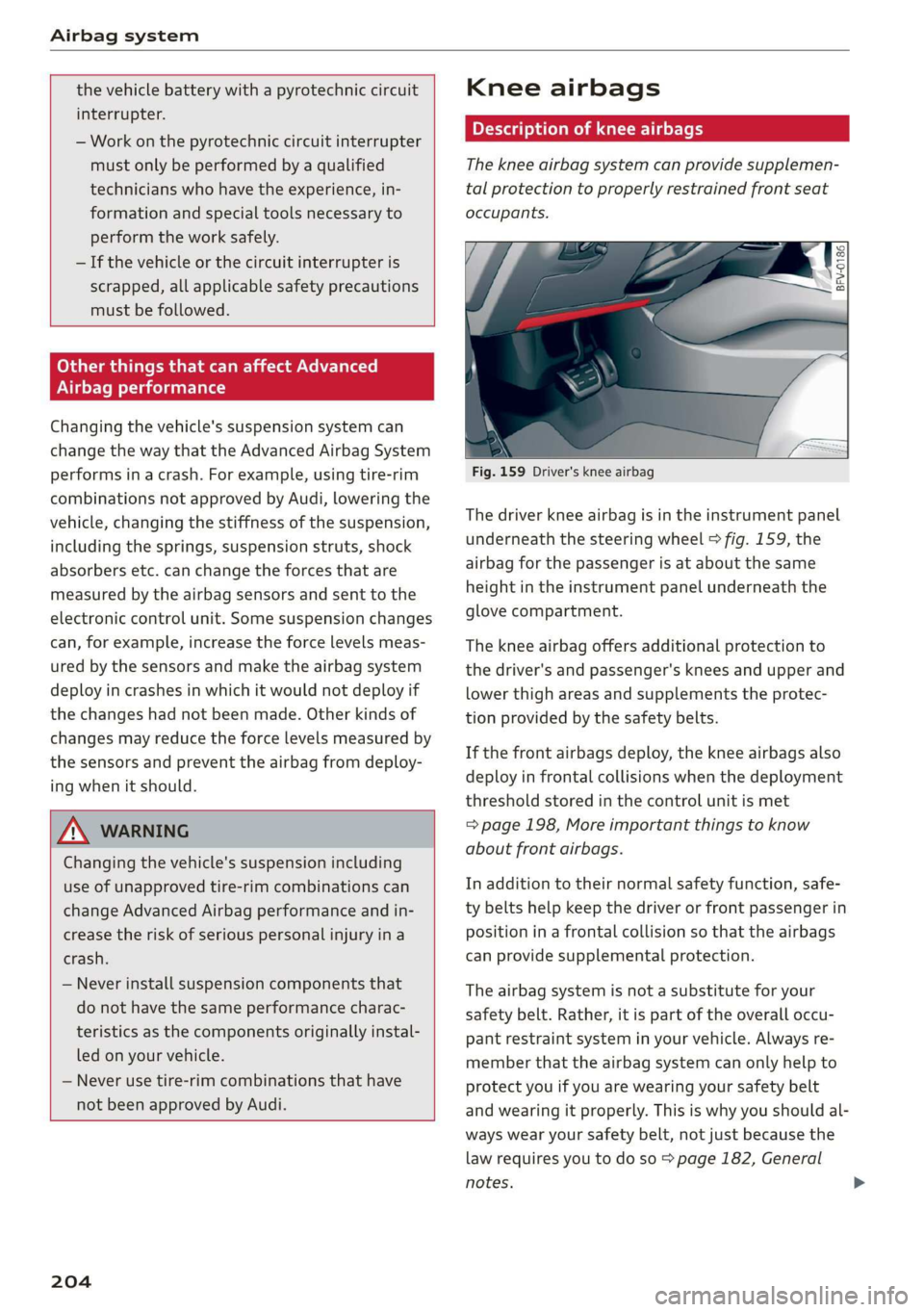
Fig. 159 Driver's knee airbag
The driver knee airbag is in the instrument panel
underneath the steering wheel > fig. 159, the
airbag for the passenger is at about the same
height in the instrument panel underneath the
glove compartment.
The knee airbag offers additional protection to
the driver's and passenger's knees and upper and
lower thigh areas and supplements the protec-
tion provided by the safety belts.
If the front airbags deploy, the knee airbags also
deploy in frontal collisions when the deployment
threshold stored in the control unit is met
= page 198, More important things to know
about front airbags.
In addition to their normal safety function, safe-
ty belts help keep the driver or front passenger in
position in a frontal collision so that the airbags
can provide supplemental protection.
The airbag system is not a substitute for your
safety belt. Rather, it is part of the overall occu-
pant restraint system in your vehicle. Always re-
member that the airbag system can only help to
protect you if you are wearing your safety belt
and wearing it properly. This is why you should al-
ways wear your safety belt, not just because the
law requires you to do so > page 182, General
notes.
Page 207 of 304
8S58012721BA
Airbag system
Remember too, airbags will deploy only once and
only in certain kinds of accidents - your safety
belts are always there to offer protection in those
accidents in which airbags are not supposed to
deploy or when they have already deployed, for
example when your vehicle strikes or is struck by
another after the first collision.
This is just one of the reasons why an airbag is
not a substitute for the safety belt. The airbag
system works most effectively when used with
the safety belts. Therefore, always wear your
safety belts correctly.
It is important to remember that while the sup-
plemental knee airbag system is designed to re-
duce the likelihood of serious injuries, other inju-
ries, for example, swelling, bruising and minor
abrasions and friction burns can also occur when
an airbag inflates.
The knee airbag system basically consists of:
— The electronic control module
— Two inflatable airbags (airbag and gas genera-
tor), one for the driver and one for the front
Passenger
— The airbag warning light in the instrument clus-
ter
The knee airbag system will not deploy:
— when the ignition is switched off
— in frontal collisions when the deceleration
measured by the control unit is too low
— in side collisions
—in rear-end collisions
—in rollovers
— in the event of a system malfunction (warning/
indicator light is on) > page 18.
Z\ WARNING
— Safety belts and the airbag system can only
provide protection when occupants are in
the proper seating position > page 198.
— If the airbag indicator light > page 18
comes when the vehicle is being used, have
the system inspected immediately by your
authorized Audi dealer. It is possible that
the airbag will inflate when it is not sup-
posed to, or will not inflate when it should.
aati S1e Rel
The risk of injury to the leg area can be reduced
by fully inflated knee airbags.
> 8 e z S
>...
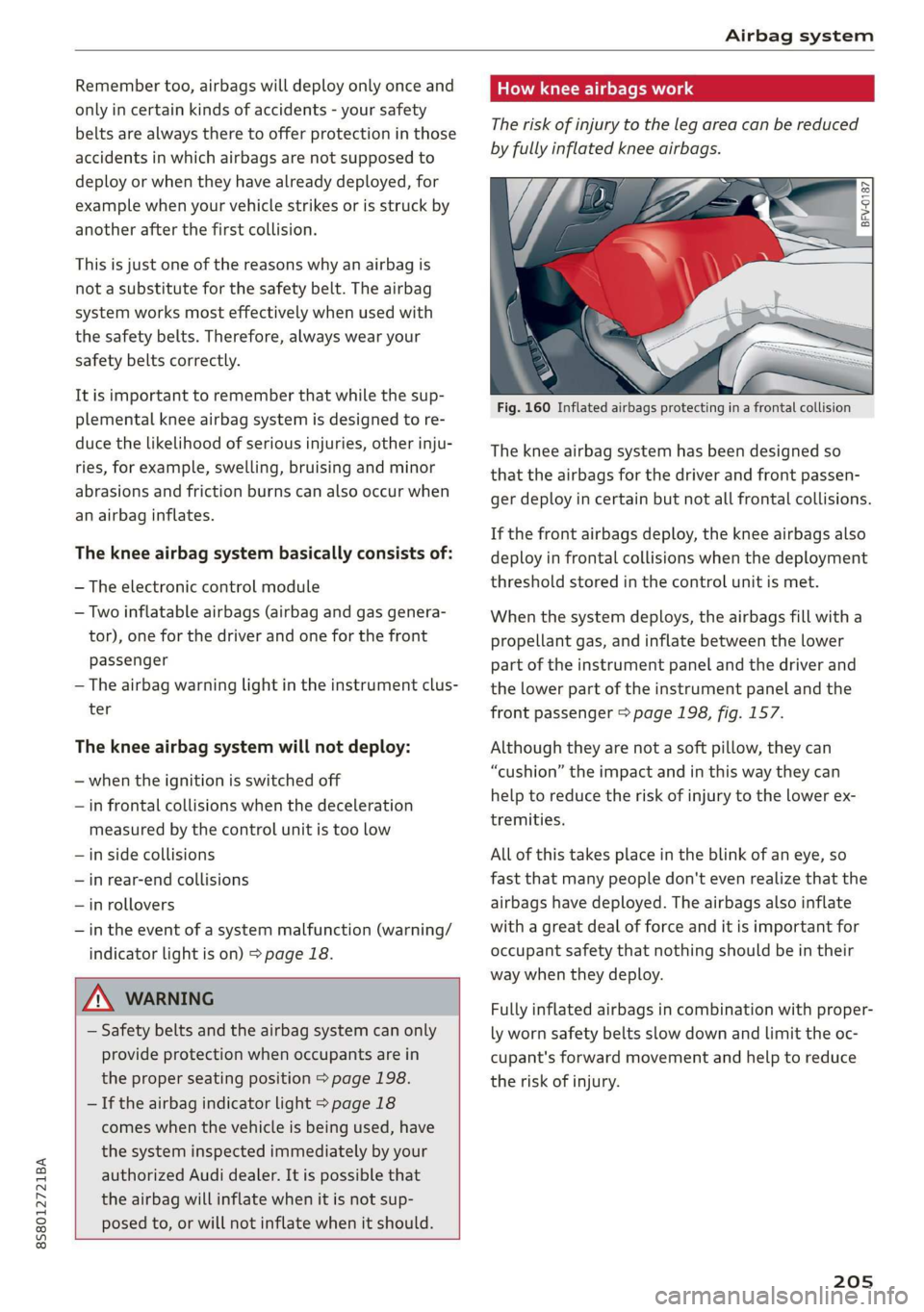
Fig. 160 Inflated airbags protecting in a frontal collision
The knee airbag system has been designed so
that the airbags for the driver and front passen-
ger deploy in certain but not all frontal collisions.
If the front airbags deploy, the knee airbags also
deploy in frontal collisions when the deployment
threshold stored in the control unit is met.
When the system deploys, the airbags fill with a
propellant gas, and inflate between the lower
part of the instrument panel and the driver and
the lower part of the instrument panel and the
front passenger > page 198, fig. 157.
Although they are not a soft pillow, they can
“cushion” the impact and in this way they can
help to reduce the risk of injury to the lower ex-
tremities.
All of this takes place in the blink of an eye, so
fast that many people don't even realize that the
airbags have deployed. The airbags also inflate
with a great deal of force and it is important for
occupant safety that nothing should be in their
way when they deploy.
Fully inflated airbags in combination with proper-
ly worn safety belts slow down and limit the oc-
cupant's forward movement and help to reduce
the risk of injury.
205
Page 208 of 304
Airbag system
Mii Selae eet Lamia adele Mol mate dal -1-)
airbag system
Airbags are only supplemental restraints. Always
wear safety belts correctly and ride in a proper
seating position.
There is a lot that you and your passenger must
know and do to help the safety belts and airbags
to provide supplemental protection.
ZA WARNING
An inflating knee airbag can cause serious in-
jury. Wearing safety belts incorrectly and im-
proper seating positions increase the risk of
serious personal injury and death whenever a
vehicle is being used.
— The knee airbag system cannot protect you
properly if you are seated too close to any of
the airbag locations. When adjusting their
seat positions, it is important that both the
driver and the front passenger keep their
upper bodies and knees at the following
minimum safe distances:
—at least 10 in (25 cm) between the chest
and
the steering wheel/instrument panel.
—at least 4 in (10 cm) between the knees
and the lower part of the instrument pan-
el.
— The risk of personal injury increases if you
lean forward or to the side, or if the seat is
improperly positioned and you are not wear-
ing your safety belt. The risk increases even
more should the airbag deploy.
— Always make sure that the knee airbag can
inflate without interference. Objects be-
tween you and the airbag can increase the
risk of injury in an accident by interfering
with the way the airbag deploys or by being
pushed into you as the airbag deploys.
— Never let anybody, especially children or
animals ride in the footwell in front of the
passenger seat. If the airbag deploys, this
can result in serious or fatal injuries.
— Never carry objects of any kind in the foot-
well area in front of the driver's or pas-
senger's seat. Bulky objects (shopping
bags, for example) can interfere with or
prevent proper deployment of the airbag.
206
Small objects can be thrown through the
vehicle if the airbag deploys and injure you
or your passenger.
— Make sure there are no cracks, deep scratch-
es or other damage in the area of the instru-
ment panel where the knee airbags are lo-
cated.
— If children are incorrectly seated, their risk
of injury increases in a collision > page 210,
Child safety.
Side airbags
Description of side airbags
The airbag system can provide supplemental
protection to properly restrained occupants.
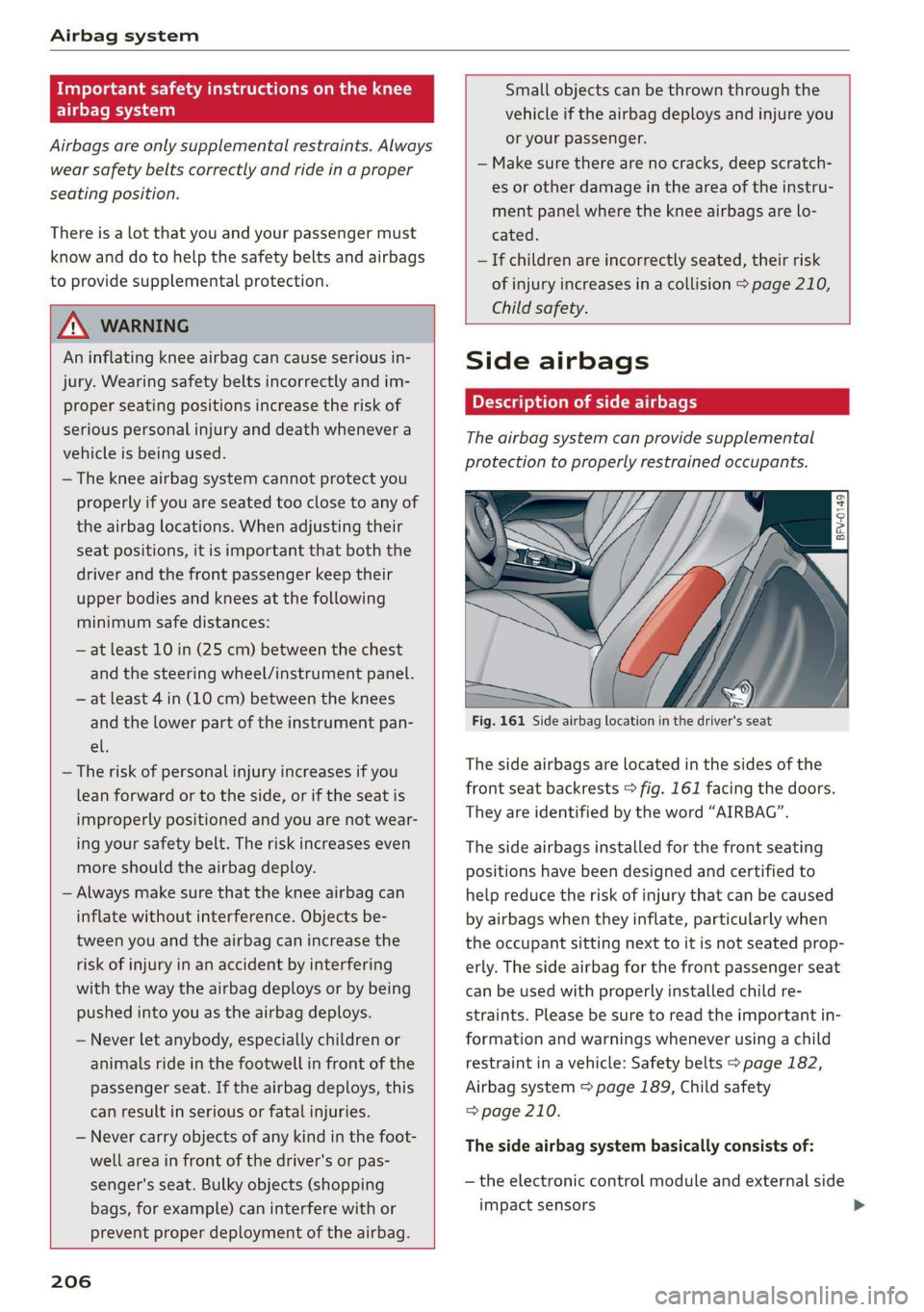
The side airbags are located in the sides of the
front seat backrests > fig. 161 facing the doors.
They are identified by the word “AIRBAG”.
The side airbags installed for the front seating
positions have been designed and certified to
help reduce the risk of injury that can be caused
by airbags when they inflate, particularly when
the occupant sitting next to it is not seated prop-
erly. The side airbag for the front passenger seat
can be used with properly installed child re-
straints. Please be sure to read the important in-
formation and warnings whenever using a child
restraint in a vehicle: Safety belts > page 182,
Airbag system > page 189, Child safety
=> page 210.
The side airbag system basically consists of:
— the electronic control module and external side
impact sensors
Page 214 of 304
Child safety
PNW ete miele laste Relea meal Cele)
Your vehicle is equipped with a front “Advanced
Airbag System” in compliance with United States
Federal Motor Vehicle Safety Standard (FMVSS)
208, as well as Canada Motor Vehicle Safety
Standard (CMVSS) 208 as applicable at the time
your vehicle was manufactured.
The Advanced Airbag system in your vehicle has
been certified to meet the “low-risk” require-
ments for 3- and 6-year old children on the pas-
senger side and small adults on the driver side.
The low risk deployment criteria are intended to
reduce the risk of injury through interaction with
the airbag that can occur, for example, by being
too close to the steering wheel and instrument
panel when the airbag inflates. In addition, the
system has been certified to comply with the
“suppression” requirements of the Safety Stand-
ard, to turn off the front airbag for infants up to
12 months who are restrained on the front pas-
senger seat in child restraints that are listed in
the Standard.
Even though your vehicle is equipped with an Ad-
vanced Airbag system, a child should always ride
in the seat properly restrained for its age and
size. The airbag on the passenger side makes the
front seat a potentially dangerous place for a
child to ride. The front seat is not the safest place
for a child in a forward-facing child safety seat. It
can be a very dangerous place for an infant or a
larger child in a rearward-facing seat.
The vehicle's Advanced Airbag System has a ca-
Pacitive passenger detection system in the front
passenger seat cushion that can detect the pres-
ence of a baby or a child ina child restraint sys-
tem on this seat.
The capacitive passenger detection system regis-
ters the changes that result in an electrical field
when a child, a child restraint, and a baby blanket
are on the front passenger seat. The change in
the measured capacitance due to the presence of
a child, a child restraint, and a baby blanket on
the front passenger seat is related to the child re-
straint system resting on the seat. The measured
capacitance of a child restraint system varies de-
212
pending on the type of system and specific make
and model.
The electrical capacitance of the various types,
makes, and models of child restraints specified
by the U.S. National Highway Traffic Safety Ad-
ministration (NHTSA) in the relevant safety
standard are stored in the Advanced Airbag Sys-
tem control unit together with the capacitances
typical of infants and a 1-year old child. When a
child restraint is used on the front passenger seat
with a typical 1 year-old infant, the Advanced Air-
bag System compares the capacitance measured
by the capacitive passenger detection system
with the data stored in the electronic control
unit.
Ce CM eee ANC Micra lia elle)
system
Regardless of the child restraint that you use,
make sure that it has been certified to meet Safe-
ty Standards and has been certified by its manu-
facturer for use with an airbag. If in exceptional
circumstances you must use it on the front pas-
senger seat, carefully read all of the information
on child safety and Advanced Airbags and heed
all of the applicable WARNINGS. Make certain
that the child and child restraint are correctly rec-
ognized by the capacitive passenger detection
system in the front passenger seat, that the front
passenger airbag is turned off, and that the air-
bag status is always correctly signaled by the
PASSENGER AIR BAG OFF #; light.
Many types and models of child restraints have
been available over the years, new models are in-
troduced regularly incorporating new and im-
proved designs and older models are taken out of
production. Child restraints are not standardized.
Child restraints of the same type typically have
different
weights and sizes and different “foot-
prints”, the size and shape of the bottom of the
child restraint that sits on the seat, when they
are installed on a vehicle seat. These differences
make it virtually impossible to certify compliance
with the requirements for advanced airbags with
each and every child restraint that has ever been
sold in the past or will be sold over the course of
the useful life of your vehicle.
Page 231 of 304
8S58012721BA
Checking and Filling
® Note
When filling fluids, be sure not to add any flu-
ids to the wrong reservoirs. Otherwise severe
malfunctions and engine damage will occur.
@) For the sake of the environment
You should regularly check the ground under
your vehicle in order to detect leaks quickly. If
there are visible spots from oil or other fluids,
bring your vehicle to an authorized Audi deal-
er or authorized Audi Service Facility to be
checked.
Opening and closing the hood
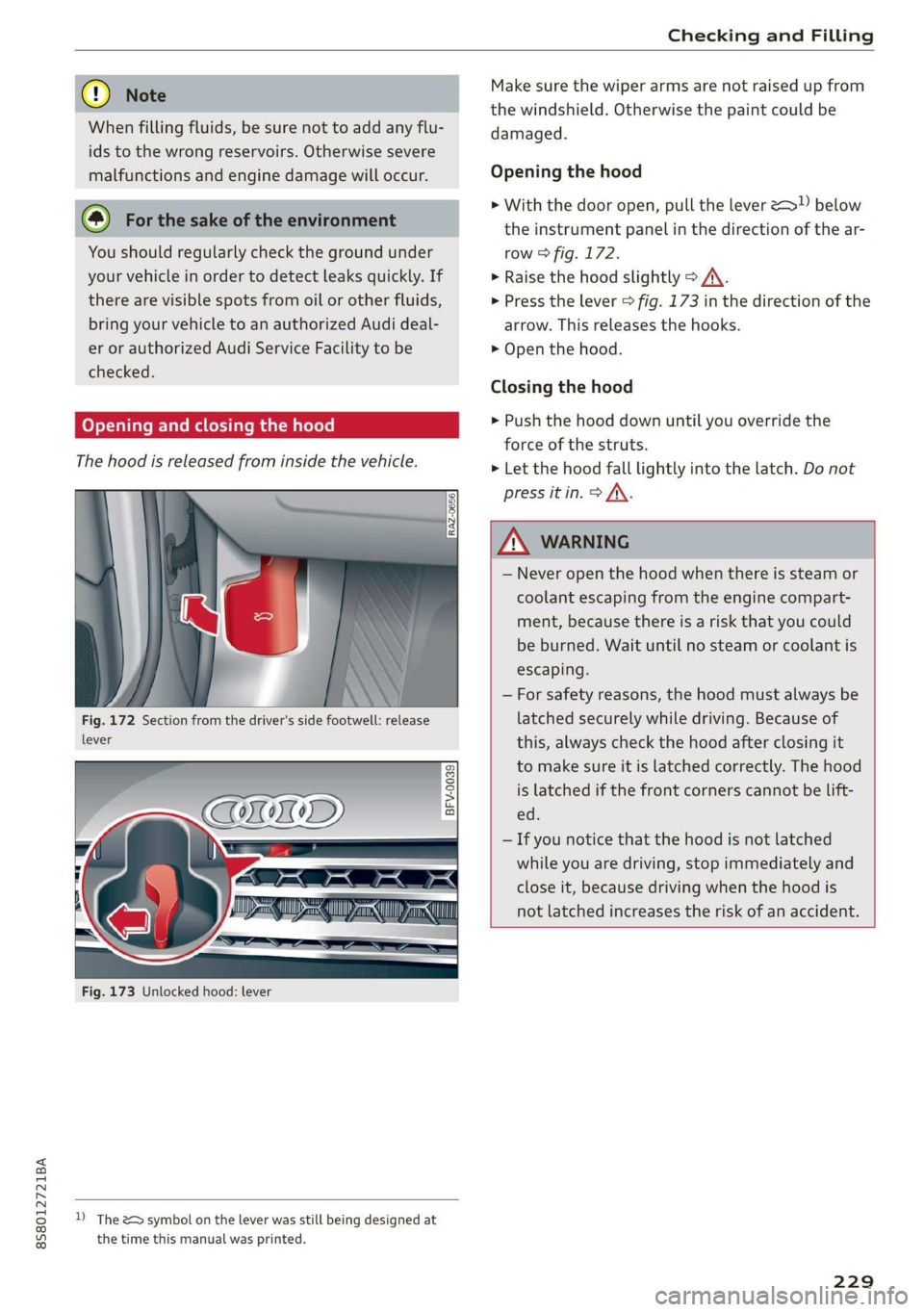
The hood is released from inside the vehicle.
fa i i \
Fig. 172 Section from the driver's side footwell: release
lever
Q 3
Ss
2 = a
ao
Fig. 173 Unlocked hood: lever
D) The &> symbol on the lever was still being designed at
the time this manual was printed.
Make sure the wiper arms are not raised up from
the windshield. Otherwise the paint could be
damaged.
Opening the hood
> With the door open, pull the lever <>”) below
the instrument panel in the direction of the ar-
row > fig. 172.
> Raise the hood slightly > /A\.
> Press the lever > fig. 173 in the direction of the
arrow. This releases the hooks.
> Open the hood.
Closing the hood
> Push the hood down until you override the
force of the struts.
> Let the hood fall lightly into the latch. Do not
press it in. > /\.
ZA WARNING
— Never open the hood when there is steam or
coolant escaping from the engine compart-
ment, because there is a risk that you could
be burned. Wait until no steam or coolant is
escaping.
— For safety reasons, the hood must always be
latched securely while driving. Because of
this, always check the hood after closing it
to make sure it is latched correctly. The hood
is latched if the front corners cannot be lift-
ed.
— If you notice that the hood is not latched
while you are driving, stop immediately and
close it, because driving when the hood is
not latched increases the risk of an accident.
229
Page 280 of 304
![AUDI TT ROADSTER 2019 User Guide Fuses and bulbs
Interior fuse assignment
ft
pl Bel Fe
» BEBE ERED
Poo
ns
[24] 25) rao) 27) Fe Ra
23 |
Fsacsomeemr STE 42)
eases eres] b
ro Wa a i ee
1F52) FOL
Re
B8V-0217](/img/6/57667/w960_57667-279.png "AUDI TT ROADSTER 2019 User Guide Fuses and bulbs
Interior fuse assignment
ft
pl Bel Fe
» BEBE ERED
Poo
ns
[24] 25) rao) 27) Fe Ra
23 |
Fsacsomeemr STE 42)
eases eres] b
ro Wa a i ee
1F52) FOL
Re
B8V-0217")
Fuses and bulbs
Interior fuse assignment
ft
pl Bel Fe
» BEBE ERED
Poo
ns
[24] 25) rao) 27) Fe Ra
23 |
Fsacsomeemr STE 42)
eases eres] b
ro Wa a i ee
1F52) FOL
Re
B8V-0217
No. | Equipment
F20 | Power lumbar support adjustment
Front passenger's side neck heating (Road-
F22
ster)
Right vehicle electrical system control
F24
module
F25 | Driver side door
F26 | Seat heating
Vehicle electrical system control module
Fae (terminal 30)
F28 | AMI High media port
F29 | Vehicle electrical system control module
F32 | Driver assistance systems
F33 | Airbag
Sockets, interior sound, tail light switch,
F34 | temperature sensor, oil level sensor, neck
heating, garage door opener
Fig. 202 Vehicle interior: fuse assignment
No. Equipment
Diagnosis, headlight range control, air
quality sensor, automatic dimming rear-
view mirror, center instrument panel
switch module
F35
F4 Central computer processor (MIB-2) F36 | Right cornering light / right LED headlight
FS Gateway (diagnostics) F37 | Left cornering light / left LED headlight
Fo Selector lever (automatic transmission)
F7
Climate control system controls, rear win-
dow defogger, tire pressure monitoring
Engine control module, ESC control mod-
F38
ule
F39 | Front passenger side door
F8
Switch for the electromechanical parking
brake, light switch, rain/light sensor, inte-
rior lighting, diagnostic connector, roof
electronics F40
| Cigarette lighter, sockets
F41 | Fuel tank diagnosis
F42 | Central locking area
FQ Steering column switch module
F44 | All wheel drive clutch control module
F10 Vehicle positioning
F45 | Power adjustable driver's side seat
Fll
All wheel drive clutch, left vehicle electri-
cal system control module
F46 | Driver's side neck heating (Roadster)
F49 | Engine start, clutch sensor
F12 Infotainment components
F52 | Control module for suspension control
F1l4 Climate control system blower fan
F53 | Rear window defogger
Fis Electronic steering column lock
F16
Infotainment system components, safety
belt microphone
F17 Instrument cluster
F18 Rearview camera
F19
Convenience access control module
278
The power seats* are protected via circuit break-
ers that automatically switch on after a few sec-
onds after the overload has been reduced.
Page 296 of 304
Index
Messages: « « sss 2 0 ssiswes «4 cannes @ o sneies ¥ 8 3 LL7
also refer to E-mail.............-00 eee 119
Mirror compass............0 20.0 2.0200005 44
Mirrors
Adjusting the exterior mirrors........... 4l
DIMMING = s sees + sees 5 eee 5 2 ees x ee 42
ManityMirrOr’s scscine © o sesvene «0 sasese © 0 avezens + © 42
MMI
refer to Multi Media Interface........... 92
MMI search
refer to Free text search............... 100
MMI touch........ 0... cece eee eee ee 94
Mobile device
refer to Telephone...........-.000e00 110
Mobile device reminder signal............ 171
Mobile hotspot
refer to Personal hotspot.............. 126
Monitoring the Advanced Airbag System... 200
MP3
refer to Jukebox: ¢ eee. se evys se eee gee 154
Multifunction steering wheel
BU GEONS wx = esos x = cosseme © 2 vamene © onsaene © = 2 12,14
Operating ......... 2... cee ee eee eee ee 12
Multi Media Interface.............000005 92
Music collection
refer to Jukebox. ............--000 eee 154
Mute... . cece cece eee 175
alsovréfer to. MUTING .« < cae « + same & 2 wo 175
Muting...............0 000.0020 0. eee 14
myAudi... 2... eee eee eee 127
N
Natural leather care and cleaning......... 265
NAV/MAP button ......... 000 eee eee 132
Navigation 5. suis so snags a 6 onus wo arenas aH ani 132
Control panel (MMI)................-. 132
also'réfer tO. Map « sass ss noms x yep sx 08 140
Neck Heating: < « ames = » seme : sees 5 Meme « 55
SY 282
Number of seats............2....2.20005 182
Oo
Occupant seating positions.............. 178
Octane rating (gasoline)................ 223
294
Odometer’. = ssccom x ssenses 6 aes ow aman © stato 11
Resetting... 6... cece eee eee eee 1
Oil
referto Engine oil............0eeeeeee 230
On-board computer.............0 eee eee TS
On/Off knob (MMI)... 0.0.22... 92
On Board Diagnostic System (OBD)........ 227
Online destinations
refer to Point of interest search......... 136
Online Map... .... eee eee eee 143
Online media.................02.0000. 157
Online services
refer toconnect.......... eee eee ee eee 125
Opening
Convenience opening..................5 29
Fuel filler:doOr ios ss wsona s x mace @ ewe a 6 224
Hood... .. cee ee 229
Luggage compartment lid............... 2p
WINdOWS§: « = aoscnw 2s mien oo eon 2 ae + 8 28
Opening and closing
refer to Unlocking and locking........ 21,24
Operating
Instrument cluster...............0005- 12
Multifunction steering wheel............ 12
MultiMedia Interface . oii. sci e ewes 93
Voice recognition system.............. 104
Optional equipment number............. 285
OptionSmeny « & esse sc sonar so saves 93,97,98
Overview (Cockpit) sss: ss vases ¥ o aes @ 8 sean a we 6
P
Paint Camag@ees « « ewws ¢ «ewe ov ees s ees 264
Paint number’: « « sees ¢ = eyes 5 e ewes 2 ees 285
Pailie BUtHOM 2 seus = x wean so wee 2s some 2 oe 24
Panic
function. ...............0 cece ee eee 24
Parental control.....................-5 164
Parking aid... .... eee eee eee ee 80
Ma lfitictionis « = saen = : savse sp eeu 2 2 cee 84
Parking brake
Indicator light:: s caws + ens as yew ao ewes 17
also refer to Electromechanical
parking brake.......... eee eee eee 59
Parking light. .......... 00. e cece cece eee 38
Parking system
refer to Parking systems............. 81, 82