heating BMW 128I 2009 E88 User Guide
[x] Cancel search | Manufacturer: BMW, Model Year: 2009, Model line: 128I, Model: BMW 128I 2009 E88Pages: 166, PDF Size: 5.01 MB
Page 99 of 166
Reference
At a glance
Controls
Driving tips
Mobility
97
Drive defensively
Avoid unnecessary acceleration and braking
maneuvers. To do so, keep an adequate dis-
tance to the forward vehicle. A defensive and
smooth driving style keeps fuel consumption
down.
Avoid high engine speeds
Only use first gear when setting off. In second
and higher gears, accelerate without hesitation
or pauses. When accelerating, shift up before
reaching high engine speeds.
When you reach the desired speed, shift into
the highest applicable gear and drive with the
engine speed as low as possible and at a con-
stant speed.
As a rule: driving at low engine speeds lowers
fuel consumption and reduces wear.
Coasting
When approaching a red light, take your foot off
the accelerator and coast to a stop in the high-
est applicable gear.
On a downhill slope, take your foot off the accel-
erator and coast in a suitable gear.
The fuel supply is interrupted when coasting.
Switch off the engine during lengthy
stops
Switch off the engine when stopping for lengthy
periods, e.g. at traffic lights, railroad crossings
or in traffic congestions. You achieve fuel sav-
ings even if standing time is as short as approx.
4 seconds.
Switch off functions you do not need at
the moment
Functions such as the air conditioner, seat
heating or rear window defroster draw large
amounts of power and consume additional fuel.
Especially in city traffic and in stop-and-go driv-
ing they have a considerable impact. Therefore,
switch these functions off when they are not
really needed.
Have the vehicle serviced
Have the vehicle serviced regularly to achieve
good economy and a long vehicle life. BMW
recommends having the vehicle serviced at a
BMW center. Also note the BMW service sys-
tem, refer to page118.
General driving notes
Close the luggage compartment lid
Operate the vehicle only when the lug-
gage compartment lid is closed. Other-
wise, exhaust fumes could enter the interior of
the vehicle.<
If the vehicle must be driven with the luggage
compartment lid open:
1.Close all windows and the glass roof.
2.Greatly increase the air volume of the heat-
ing or automatic climate control system,
refer to page80 or83.
3.Greatly increase the air volume of the auto-
matic climate control system, refer to
page83.
Hot exhaust system
In all vehicles, extremely high tempera-
tures are generated in the exhaust sys-
tem. Do not remove the heat shields installed in
its vicinity, and never apply undercoating to
them. When driving, standing at idle and while
parking, take care to avoid possible contact
between the hot exhaust system and any highly
flammable materials such as hay, leaves, grass,
etc. Such contact could lead to a fire, with the
risk of serious personal injuries and property
damage. Do not touch hot exhaust tail pipes.
Otherwise there is a risk of burns.<
Hydroplaning
When driving on wet or slushy roads,
reduce road speed. If you do not, a wedge
of water can form between tires and road sur-
face. This situation, known as hydroplaning,
means that the tire can completely lose contact
Page 100 of 166
Things to remember when driving
98 with the road surface, so that neither the car can
be steered nor the brake be properly applied.<
The risk of hydroplaning increases with declin-
ing tread depth on the tires, refer also to Mini-
mum tread depth on page111.
Driving through water
Drive through water on the road only if it is
not deeper than 1 ft/30 cm, and then only
at walking speed at the most. Otherwise, the
vehicle's engine, the electrical systems and the
transmission may be damaged.<
Use the parking brake on inclines
On inclines, do not hold the vehicle for a
lengthy period using the clutch; use the
parking brake instead. Otherwise greater clutch
wear will result.<
For more information about the drive-off assis-
tant, refer to page66.
Braking safely
Your BMW is equipped with ABS as a standard
feature. Applying the brakes fully is the most
effective way of braking in situations in which
this is necessary. Since the vehicle maintains
steering responsiveness, you can still avoid
possible obstacles with a minimum of steering
effort.
Pulsation of the brake pedal, combined with
sounds from the hydraulic circuits, indicate that
ABS is in its active mode.
Driving in wet conditions
When roads are wet or there is heavy rain,
briefly exert gentle pressure on the brake pedal
every few miles. Monitor traffic conditions to
ensure that this maneuver does not endanger
other road users. The heat generated in this
process helps dry the pads and rotors to ensure
that full braking efficiency will then be available
when you need it.
Hills
To prevent overheating and the resulting
reduced efficiency of the brake system,
drive long or steep downhill gradients in the gear in which the least braking is required. Even
light but consistent brake pressure can lead to
high temperatures, brake wear and possibly
even brake failure.<
You can increase the engine's braking effect by
shifting down, all the way to first gear if neces-
sary. This strategy helps you avoid placing
excessive loads on the brake system. Down-
shifting in manual mode of the automatic trans-
mission, refer to page50.
Never drive with the clutch held down,
with the transmission in neutral or with
the engine switched off; otherwise, engine
braking action will not be present or there will be
no power assistance to the brakes or steering.
Never allow floor mats, carpets or any other
objects to protrude into the area around the
pedals, otherwise pedal function could be
impaired.<
Corrosion on brake rotors
When the vehicle is driven only occasionally,
during extended periods when the vehicle is not
used at all, and in operating conditions where
brake applications are less frequent, there is an
increased tendency for corrosion to form on
rotors, while contaminants accumulate on the
brake pads. This occurs because the minimum
pressure which must be exerted by the pads
during brake applications to clean the rotors is
not reached.
Should corrosion form on the brake rotors, the
brakes will tend to respond with a pulsating
effect that even extended application will fail to
cure.
When the vehicle is parked
Condensation forms while the automatic cli-
mate control is in operation, and then exits
under the vehicle. Traces of condensed water
under the vehicle are therefore normal.
Before driving into a car wash
General information on caring for your BMW
can be found on page120.
Page 101 of 166
Reference
At a glance
Controls
Driving tips
Mobility
99
With convenient access and automatic
transmission
Insert the remote control into the ignition
switch.
The engine can be switched off when the selec-
tor lever is in position N. Refer also to page27.
Cargo loading
To avoid loading the tires beyond their
approved carrying capacity, never over-
load the vehicle. Overloading can lead to over-
heating and increases the rate at which damage
develops inside the tires. This can ultimately
result in a sudden blow-out.<
Make sure that no liquids are spilled or
leak from their containers in the cargo
bay, as this could result in damage to the vehi-
cle.<
Determining loading limit
1.Locate the following statement on your
vehicle's placard
*:
The combined weight of occupants
and cargo should never exceed
XXX kg or YYY lbs. Otherwise, overloading
can result in damage to the vehicle and
unstable driving conditions.<
2.Determine the combined weight of the
driver and passengers that will be riding in
your vehicle.
3.Subtract the combined weight of the driver
and passengers from XXX kilograms or YYY
pounds.
4.The resulting figure equals the available
amount of cargo and luggage load capacity. For example, if the YYY amount equals
1,400 lbs. and there will be five 150-lb. pas-
sengers in your vehicle, the amount of avail-
able cargo and luggage load capacity is
650 lbs:
1,400 lbs. minus 750 lbs. = 650 lbs.
5.Determine the combined weight of luggage
and cargo being loaded on the vehicle. That
weight may not safely exceed the available
cargo and luggage load capacity calculated
in step 4.
6.If your vehicle will be towing a trailer, part of
the load from your trailer will be transferred
to your vehicle. Consult the manual for
transporting a trailer to determine how this
may reduce the available cargo and luggage
load capacity of your vehicle.
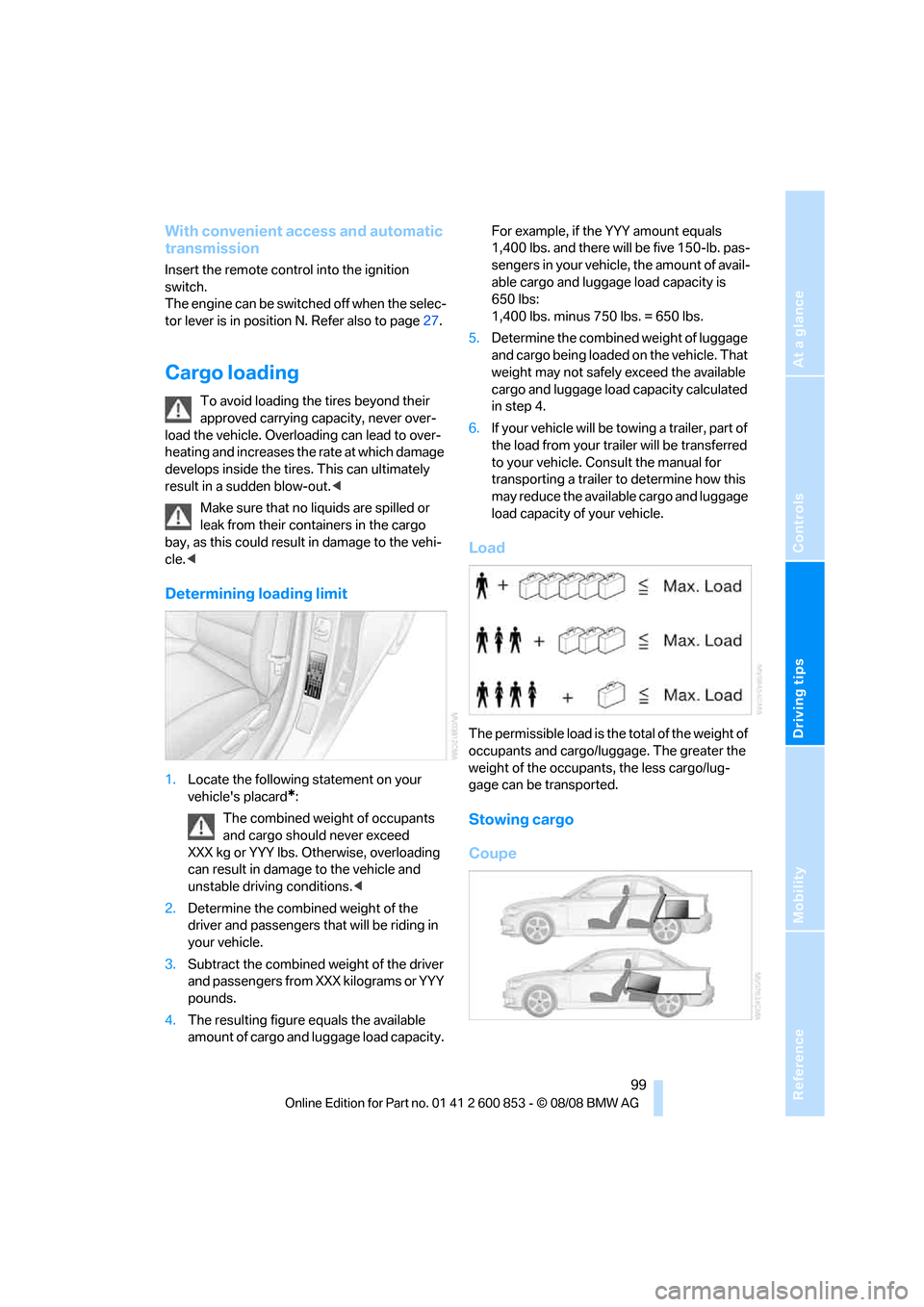
Load
The permissible load is the total of the weight of
occupants and cargo/luggage. The greater the
weight of the occupants, the less cargo/lug-
gage can be transported.
Stowing cargo
Coupe
Page 139 of 166
Reference
At a glance
Controls
Driving tips
Mobility
137
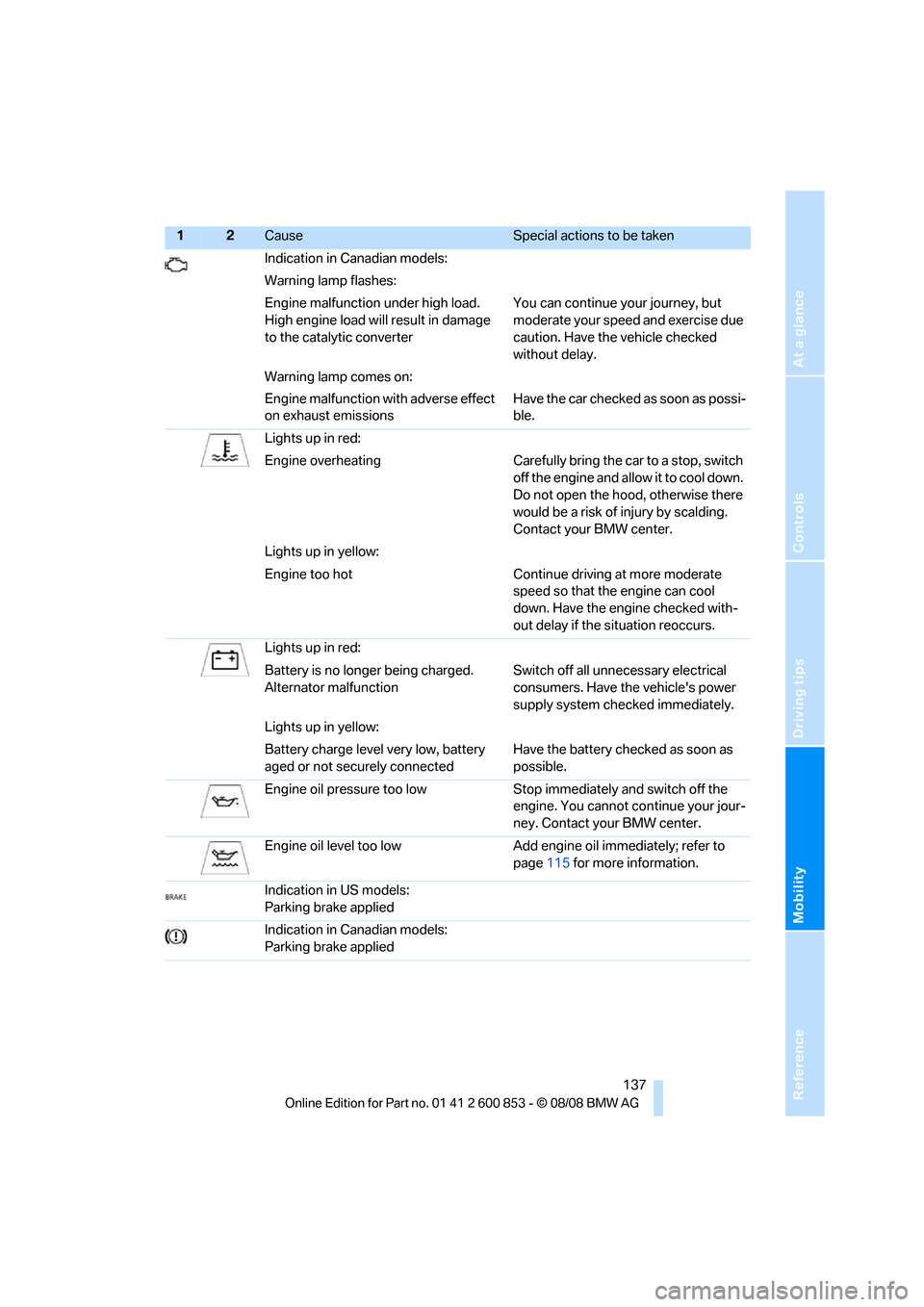
Indication in Canadian models:
Warning lamp flashes:
Engine malfunction under high load.
High engine load will result in damage
to the catalytic converterYou can continue your journey, but
moderate your speed and exercise due
caution. Have the vehicle checked
without delay.
Warning lamp comes on:
Engine malfunction with adverse effect
on exhaust emissionsHave the car checked as soon as possi-
ble.
Lights up in red:
Engine overheating Carefully bring the car to a stop, switch
off the engine and allow it to cool down.
Do not open the hood, otherwise there
would be a risk of injury by scalding.
Contact your BMW center.
Lights up in yellow:
Engine too hot Continue driving at more moderate
speed so that the engine can cool
down. Have the engine checked with-
out delay if the situation reoccurs.
Lights up in red:
Battery is no longer being charged.
Alternator malfunctionSwitch off all unnecessary electrical
consumers. Have the vehicle's power
supply system checked immediately.
Lights up in yellow:
Battery charge level very low, battery
aged or not securely connectedHave the battery checked as soon as
possible.
Engine oil pressure too low Stop immediately and switch off the
engine. You cannot continue your jour-
ney. Contact your BMW center.
Engine oil level too low Add engine oil immediately; refer to
page115 for more information.
Indication in US models:
Parking brake applied
Indication in Canadian models:
Parking brake applied
12Cause Special actions to be taken
Page 143 of 166
Reference
At a glance
Controls
Driving tips
Mobility
141
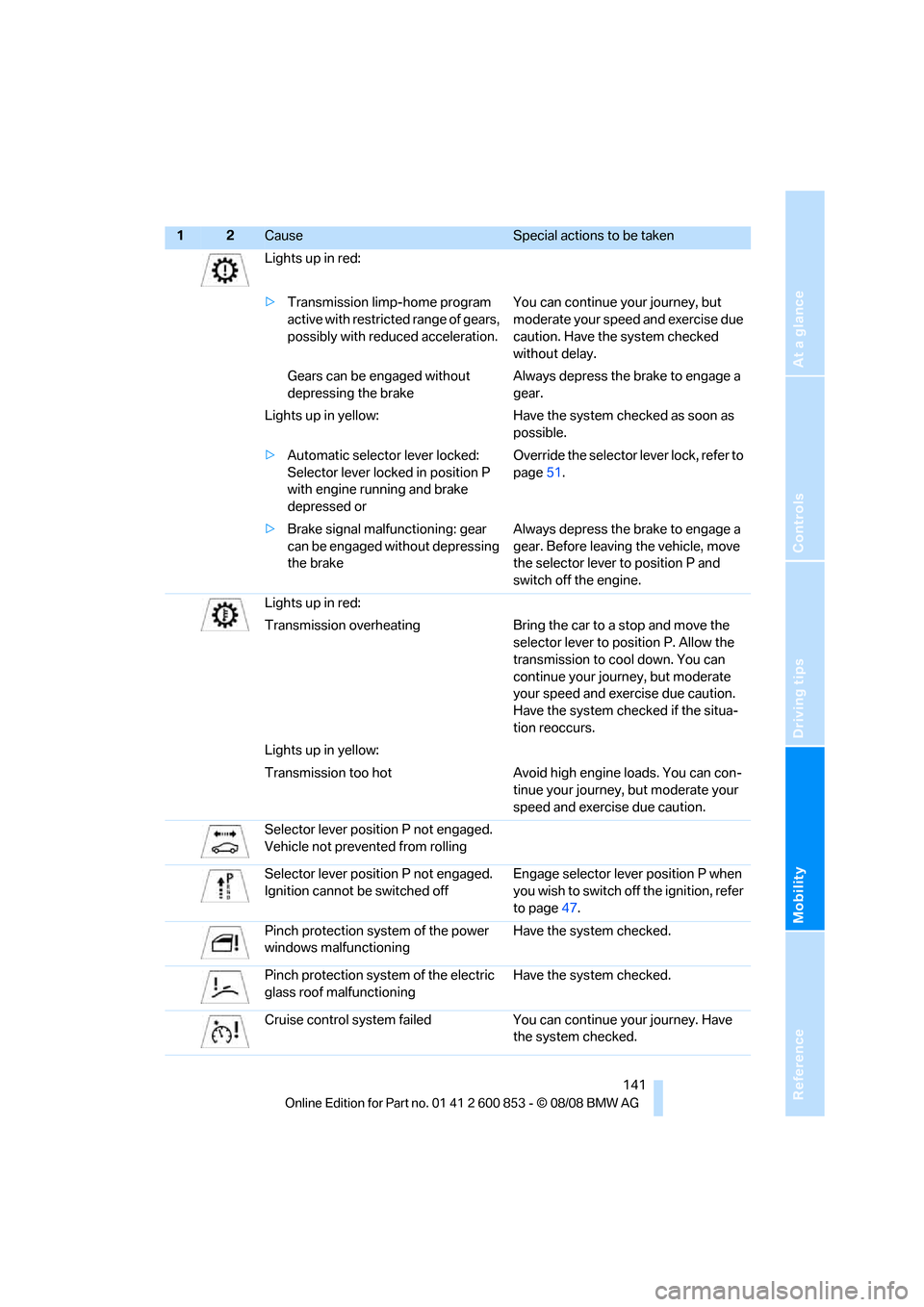
Lights up in red:
>Transmission limp-home program
active with restricted range of gears,
possibly with reduced acceleration. You can continue your journey, but
moderate your speed and exercise due
caution. Have the system checked
without delay.
Gears can be engaged without
depressing the brakeAlways depress the brake to engage a
gear.
Lights up in yellow: Have the system checked as soon as
possible.
>Automatic selector lever locked:
Selector lever locked in position P
with engine running and brake
depressed orOverride the selector lever lock, refer to
page51.
>Brake signal malfunctioning: gear
can be engaged without depressing
the brakeAlways depress the brake to engage a
gear. Before leaving the vehicle, move
the selector lever to position P and
switch off the engine.
Lights up in red:
Transmission overheating Bring the car to a stop and move the
selector lever to position P. Allow the
transmission to cool down. You can
continue your journey, but moderate
your speed and exercise due caution.
Have the system checked if the situa-
tion reoccurs.
Lights up in yellow:
Transmission too hot Avoid high engine loads. You can con-
tinue your journey, but moderate your
speed and exercise due caution.
Selector lever position P not engaged.
Vehicle not prevented from rolling
Selector lever position P not engaged.
Ignition cannot be switched offEngage selector lever position P when
you wish to switch off the ignition, refer
to page47.
Pinch protection system of the power
windows malfunctioningHave the system checked.
Pinch protection system of the electric
glass roof malfunctioningHave the system checked.
Cruise control system failed You can continue your journey. Have
the system checked.
12Cause Special actions to be taken
Page 157 of 166
Reference
At a glance
Controls
Driving tips
Mobility
155
Doors, emergency
operation22
DOT Quality Grades110
Draft-free ventilation81,84
Drinks holders, refer to Cup
holders89
Drive-off assistance, refer to
DSC65
Drive-off assistant66
Driving lamps, refer to Parking
lamps/low beams74
Driving notes96
Driving off on hills, refer to
Drive-off assistant66
Driving stability control
systems64
Driving through water98
Driving tips, refer to Driving
notes96
Dry air, refer to Cooling
function84
DSC Dynamic Stability
Control65
DTC Dynamic Traction
Control65
– indicator lamps65
Dynamic Brake Control
DBC65
Dynamic Stability Control
DSC65
Dynamic Traction Control
DTC
– indicator lamps66
E
EBV Electronic brake-force
distribution65
Electrical malfunction
– door lock22
– fuel filler door104
– glass roof30
Electronic brake-force
distribution EBV65
Electronic oil level check115
Electronic Stability Program
ESP, refer to Dynamic
Stability Control DSC65Emergency operation, refer to
Manual operation
– door lock22
– fuel filler door104
– glass roof30
– transmission lock, automatic
transmission51
Emergency release, luggage
compartment lid24
Emergency Request130
Emergency services, refer to
Roadside Assistance130
Energy, saving
– saving fuel96
Engine
– breaking in96
– data146
– speed146
– starting48
– starting, convenient
access26
– switching off48
Engine compartment115
Engine coolant, refer to
Coolant117
Engine oil
– adding116
– additives116
– BMW Maintenance
System118
– checking level115
– intervals between changes,
refer to Service
requirements61
– specified engine oils116
Engine output, refer to Engine
data146
Engine speed, refer to Engine
data146
Engine starting, refer to
Starting the engine48
ESP Electronic Stability
Program, refer to Dynamic
Stability Control DSC65
Event data recorders119
Exhaust system, refer to Hot
exhaust system97Exterior mirrors41
– adjusting41
– automatic dimming
feature43
– automatic heating42
– folding in and out42
Eyes
– for tow-starting and towing
away132
– for tying down loads100
F
Failure messages, refer to
Check Control62
Failure of an electrical
consumer128
False alarm, refer to Avoiding
unintentional alarms25
Fastening safety belts, refer to
Safety belts41
Filter of automatic climate
control, refer to Microfilter/
activated charcoal filter84
Filter of heating or air
conditioner, refer to
Microfilter81
First aid pouch130
Fixture for remote control,
refer to Ignition lock47
Flash when locking/
unlocking21
Flat tire
– Run-Flat Tires112
– Tire Pressure Monitor
TPM68
Flat Tire Monitor FTM66
– indicating a flat tire67
– initializing the system66
– malfunction67
– system limits66
Flat tires, refer to Tire
condition111
Fog lamps77
– indicator lamp77,134
Footbrake, refer to Braking
safely98
Footwell lamps77
For your own safety5
Page 158 of 166
Everything from A to Z
156 Front airbags71
Front seat setting35
Frost, removing from
windows, refer to Defrosting
windows81,84
FTM, refer to Flat Tire
Monitor66
Fuel104
– gauge57
– high-quality brands104
– quality104
– specifications104
– tank contents, refer to
Capacities150
Fuel clock, refer to Fuel
gauge57
Fuel consumption display,
refer to Average fuel
consumption58
Fuel consumption statistics,
refer to Average fuel
consumption58
Fuel display, refer to Fuel
gauge57
Fuel filler door104
– releasing in the event of
electrical malfunction104
Fuses128
G
Garage door opener, refer to
Integrated universal remote
control85
Gasoline, refer to Required
fuel104
Gasoline display, refer to Fuel
gauge57
Gear change
– with automatic
transmission50
– with manual transmission49
Gear display, with automatic
transmission49
Gearshift lever
– automatic transmission with
Steptronic50
– manual transmission49
General driving notes97Glass roof, electric29
– closing after electrical
malfunction30
– convenient operation22
– opening, closing29
– operation with convenient
access26
– pinch protection system29
– raising29
– remote control20
Glove compartment88
Grills, refer to Air vents79
Gross vehicle weight, refer to
Weights149
H
Halogen lamps
– replacing bulbs125
Handbrake, refer to Parking
brake49
Hands-free system14
Hazard warning flashers14
Head airbags71
Headlamp control,
automatic74
Headlamp cover125
Headlamp flasher51
Headlamps
– replacing bulbs125
Head restraints37
Heated
– seats39
Heated mirrors42
Heating79
– mirrors42
– seats39
– steering wheel43
Heating, rear window81,84
Heating and ventilation79
Heating during a stop83
Heavy loads, refer to Stowing
cargo99
Height, refer to
Dimensions147
Height adjustment
– steering wheel43High beams76
– indicator lamp134
– replacing bulbs125
High-pressure
washer120,121
High water, refer to Driving
through water98
Hills98
Holders for cups89
Hood114
Hot exhaust system97
Hydraulic brake assist, refer to
Dynamic Brake Control65
Hydroplaning97
I
Ice warning, refer to Outside
temperature
warning56
Identification marks
– tire coding110
Ignition47
– switched off47
– switched on47
Ignition key, refer to
Integrated key/remote
control18
Ignition key position 1, refer to
Radio readiness47
Ignition key position 2, refer to
Ignition on47
Ignition lock47
Imprint2
Indicator and warning
lamps13,134
– Tire Pressure Monitor
TPM69
Indicator lighting, refer to
Instrument lighting77
Individual air distribution80
Individual settings, refer to
Personal Profile18
Inflation pressure, tires106
Inflation pressure monitoring,
refer to Tire Pressure
Monitor TPM68
Page 159 of 166
Reference
At a glance
Controls
Driving tips
Mobility
157
Initializing
– compass, refer to
Calibrating88
Initializing, Flat Tire Monitor
FTM66
Instrument cluster12
Instrument lighting77
Integrated key18
Integrated universal remote
control85
Interior lamps77
– remote control20
Interior motion sensor25
Interior rearview mirror42
– automatic dimming
feature43
– compass87
Interlock50
Intermittent mode of the
wipers52
J
Jacking points128
Jumpering, refer to Jump
starting131
Jump starting131
K
Key, refer to Integrated key/
remote control18
Keyless go, refer to
Convenient access26
Keyless opening and closing,
refer to Convenient
access26
Key Memory, refer to Personal
Profile18
Kick-down50
Knock control104
L
Lamps
– Adaptive Head Light76
– instrument lighting77
– interior lighting77Lamps, refer to Parking lamps/
low beams74
Lamps and bulbs, replacing
bulbs124
Lashing eyes, refer to
Securing cargo100
LATCH child-restraint fixing
system45
Leather care122
LED Light-emitting
diodes124
Length, refer to
Dimensions147
License plate lamp, replacing
bulb127
Light-alloy wheels122
Light-emitting diodes
LED124
Lighter90
– socket90
Lighting
– lamps and bulbs124
– of instruments77
– of vehicle, refer to Lamps74
Light switch74
Limit, refer to Speed limit
– indicator lamp142
Load99
Load securing equipment,
refer to Securing cargo100
Lock buttons of doors, refer to
Locking23
Locking
– adjusting confirmation
signal21
– from inside23
– from outside20
– without remote control, refer
to Convenient access26
Locking and unlocking doors
– from inside22
– from outside19
Low-beam headlamps74
– automatic74
– replacing bulbs125
Lower back support, refer to
Lumbar support37
Luggage compartment, refer
to Cargo bayLuggage compartment lid23
– convenient access27
– emergency release24
– opening from outside23
– unlocking with remote
control20
Luggage rack, refer to Roof-
mounted luggage rack100
Lumbar support37
M
M+S tires, refer to Winter
tires113
Maintenance, refer to
– BMW Maintenance
System118
– Service booklet
Maintenance system118
Malfunction warnings, refer to
Check Control62
Manual car wash121
Manual operation
– door lock22
– fuel filler door104
– glass roof30
– transmission lock, automatic
transmission51
Manual operation with
automatic transmission50
Manual transmission49
Maximum cooling82
Maximum speed
– for winter tires113
Microfilter/activated-charcoal
filter for automatic climate
control84
Microfilter for heating or air
conditioner81
Microphone for telephone14
Mirror dimming feature43
Mirrors41
– automatic curb monitor42
– exterior mirrors41
– heating42
– interior rearview mirror42
Mobile phone, installation
location, refer to Center
armrest88
Page 161 of 166
Reference
At a glance
Controls
Driving tips
Mobility
159
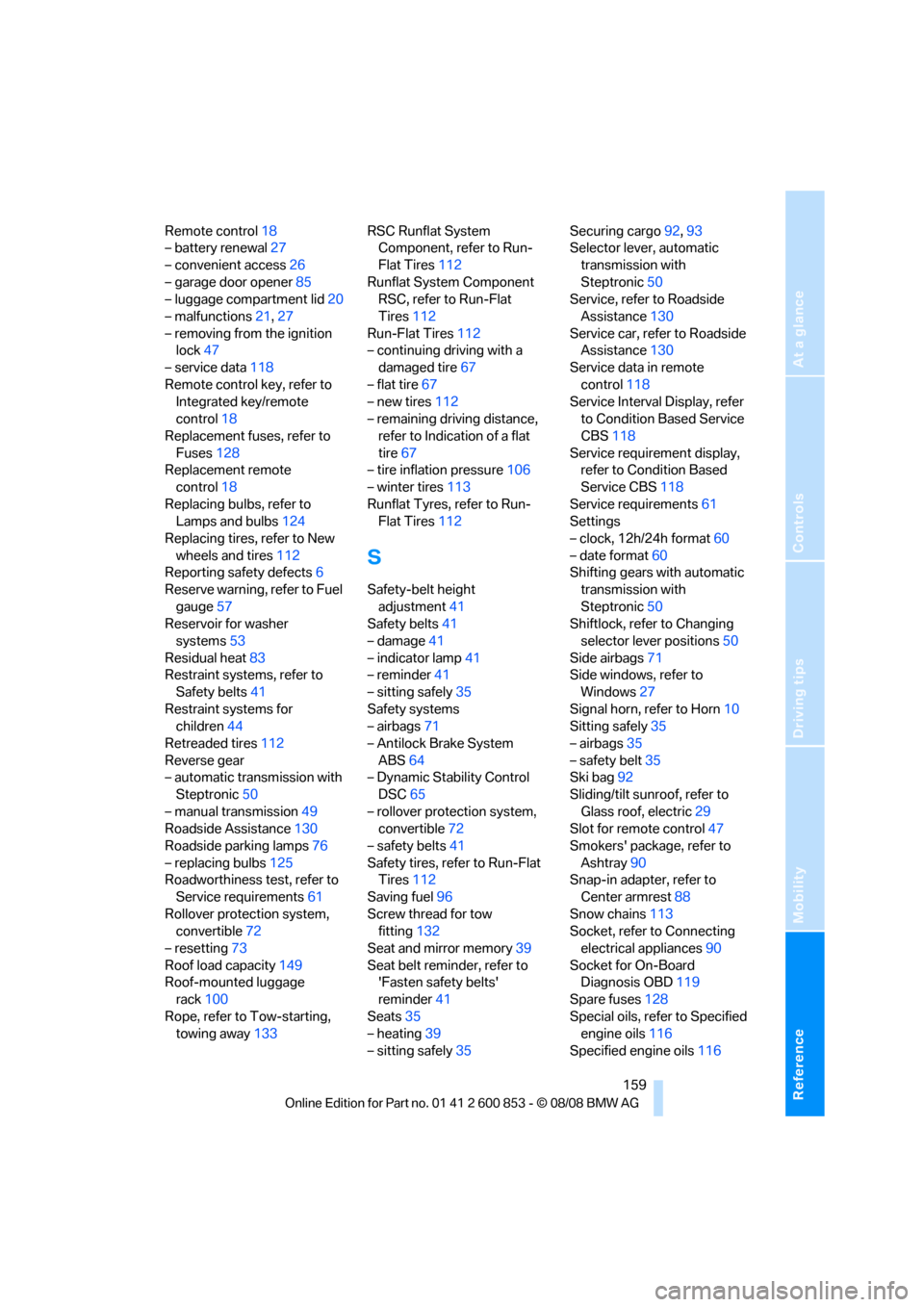
Remote control18
– battery renewal27
– convenient access26
– garage door opener85
– luggage compartment lid20
– malfunctions21,27
– removing from the ignition
lock47
– service data118
Remote control key, refer to
Integrated key/remote
control18
Replacement fuses, refer to
Fuses128
Replacement remote
control18
Replacing bulbs, refer to
Lamps and bulbs124
Replacing tires, refer to New
wheels and tires112
Reporting safety defects6
Reserve warning, refer to Fuel
gauge57
Reservoir for washer
systems53
Residual heat83
Restraint systems, refer to
Safety belts41
Restraint systems for
children44
Retreaded tires112
Reverse gear
– automatic transmission with
Steptronic50
– manual transmission49
Roadside Assistance130
Roadside parking lamps76
– replacing bulbs125
Roadworthiness test, refer to
Service requirements61
Rollover protection system,
convertible72
– resetting73
Roof load capacity149
Roof-mounted luggage
rack100
Rope, refer to Tow-starting,
towing away133RSC Runflat System
Component, refer to Run-
Flat Tires112
Runflat System Component
RSC, refer to Run-Flat
Tires112
Run-Flat Tires112
– continuing driving with a
damaged tire67
– flat tire67
– new tires112
– remaining driving distance,
refer to Indication of a flat
tire
67
– tire inflation pressure106
– winter tires113
Runflat Tyres, refer to Run-
Flat Tires112
S
Safety-belt height
adjustment41
Safety belts41
– damage41
– indicator lamp41
– reminder41
– sitting safely35
Safety systems
– airbags71
– Antilock Brake System
ABS64
– Dynamic Stability Control
DSC65
– rollover protection system,
convertible72
– safety belts41
Safety tires, refer to Run-Flat
Tires112
Saving fuel96
Screw thread for tow
fitting132
Seat and mirror memory39
Seat belt reminder, refer to
'Fasten safety belts'
reminder41
Seats35
– heating39
– sitting safely35Securing cargo92,93
Selector lever, automatic
transmission with
Steptronic50
Service, refer to Roadside
Assistance130
Service car, refer to Roadside
Assistance130
Service data in remote
control118
Service Interval Display, refer
to Condition Based Service
CBS118
Service requirement display,
refer to Condition Based
Service CBS118
Service requirements61
Settings
– clock, 12h/24h format60
– date format60
Shifting gears with automatic
transmission with
Steptronic50
Shiftlock, refer to Changing
selector lever positions50
Side airbags71
Side windows, refer to
Windows27
Signal horn, refer to Horn10
Sitting safely35
– airbags35
– safety belt35
Ski bag92
Sliding/tilt sunroof, refer to
Glass roof, electric
29
Slot for remote control47
Smokers' package, refer to
Ashtray90
Snap-in adapter, refer to
Center armrest88
Snow chains113
Socket, refer to Connecting
electrical appliances90
Socket for On-Board
Diagnosis OBD119
Spare fuses128
Special oils, refer to Specified
engine oils116
Specified engine oils116
Page 162 of 166
Everything from A to Z
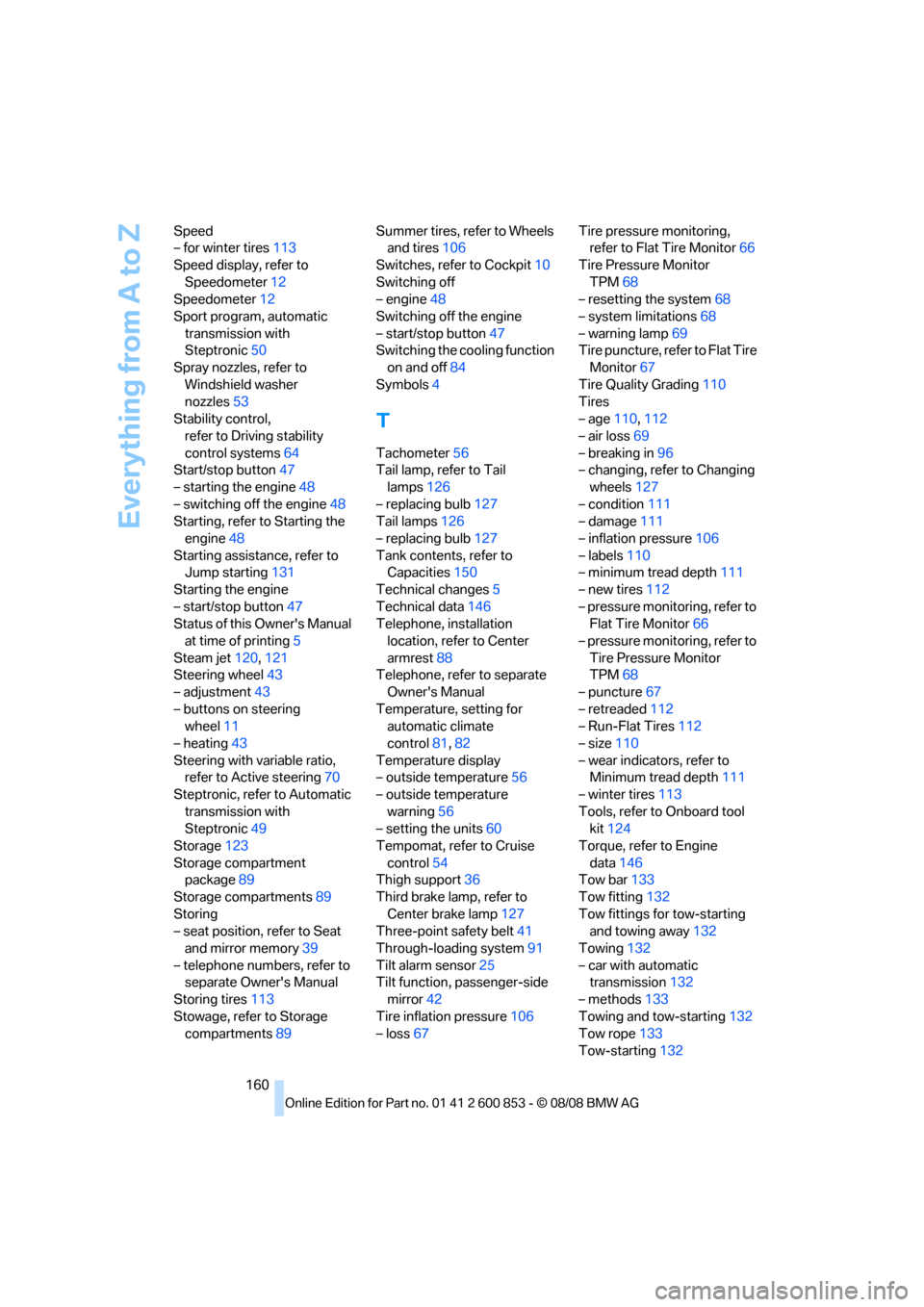
160 Speed
– for winter tires113
Speed display, refer to
Speedometer12
Speedometer12
Sport program, automatic
transmission with
Steptronic50
Spray nozzles, refer to
Windshield washer
nozzles53
Stability control,
refer to Driving stability
control systems64
Start/stop button47
– starting the engine48
– switching off the engine48
Starting, refer to Starting the
engine48
Starting assistance, refer to
Jump starting131
Starting the engine
– start/stop button47
Status of this Owner's Manual
at time of printing5
Steam jet120,121
Steering wheel43
– adjustment43
– buttons on steering
wheel11
– heating43
Steering with variable ratio,
refer to Active steering70
Steptronic, refer to Automatic
transmission with
Steptronic49
Storage123
Storage compartment
package89
Storage compartments89
Storing
– seat position, refer to Seat
and mirror memory39
– telephone numbers, refer to
separate Owner's Manual
Storing tires113
Stowage, refer to Storage
compartments89Summer tires, refer to Wheels
and tires106
Switches, refer to Cockpit10
Switching off
– engine48
Switching off the engine
– start/stop button47
Switching the cooling function
on and off84
Symbols4
T
Tachometer56
Tail lamp, refer to Tail
lamps126
– replacing bulb127
Tail lamps126
– replacing bulb127
Tank contents, refer to
Capacities150
Technical changes5
Technical data146
Telephone, installation
location, refer to Center
armrest88
Telephone, refer to separate
Owner's Manual
Temperature, setting for
automatic climate
control81,82
Temperature display
– outside temperature56
– outside temperature
warning56
– setting the units60
Tempomat, refer to Cruise
control54
Thigh support36
Third brake lamp, refer to
Center brake lamp127
Three-point safety belt41
Through-loading system91
Tilt alarm sensor25
Tilt function, passenger-side
mirror42
Tire inflation pressure106
– loss67Tire pressure monitoring,
refer to Flat Tire Monitor66
Tire Pressure Monitor
TPM68
– resetting the system68
– system limitations68
– warning lamp69
Tire puncture, refer to Flat Tire
Monitor67
Tire Quality Grading110
Tires
– age110,112
– air loss69
– breaking in96
– changing, refer to Changing
wheels127
– condition111
– damage111
– inflation pressure106
– labels110
– minimum tread depth111
– new tires112
– pressure monitoring, refer to
Flat Tire Monitor66
– pressure monitoring, refer to
Tire Pressure Monitor
TPM68
– puncture67
– retreaded112
– Run-Flat Tires112
– size110
– wear indicators, refer to
Minimum tread depth111
– winter tires113
Tools, refer to Onboard tool
kit124
Torque, refer to Engine
data146
Tow bar133
Tow fitting132
Tow fittings for tow-starting
and towing away132
Towing132
– car with automatic
transmission132
– methods133
Towing and tow-starting132
Tow rope133
Tow-starting132