brake BMW 1M 2011 E82 Owner's Manual
[x] Cancel search | Manufacturer: BMW, Model Year: 2011, Model line: 1M, Model: BMW 1M 2011 E82Pages: 48, PDF Size: 3.23 MB
Page 20 of 48
19
Technology for driving comfort and safety
Controls
Technology for driving comfort and safety
Vehicle equipment
In this chapter, all production, country, and
optional equipment that is offered in the model
range is described. For this reason, descrip-
tions will be given of some equipment that may
not be available in a vehi
cle, for example due to
the special options or national-market version
selected. This also app lies to safety related
functions and systems.
Driving stability control
systems
Contrary to the descript ion in the Owner's Man-
ual for Vehicle, your BMW 1-Series M Coupe is
not equipped with Dyna mic Traction Control
DTC.
Dynamic Stability Control DSC
DSC optimizes driving stability and traction. In
addition, the system recognizes unstable driv-
ing situations such as understeering and over-
steering, and helps keep the vehicle on a safe
course within physical lim its by reducing engine
power and applying the brakes on individual
wheels.
The laws of physics cannot be repealed,
even with DSC. An appropriate driving
style always remains the responsibility of the
driver. Therefore, do no t reduce the additional
s a f e t y m a r g i n a g a i n b y t a k i n g r i s k s , a s t h i s c o u l d
result in an accident.<
M Dynamic Mode MDM
M Dynamic Mode is a mode of the Dynamic
Stability Control DSC that permits greater
longitudinal and latera l acceleration when
driving on dry surfaces, yet with reduced driving
stability. Only at the absolute limit of stability
does the system intervene to stabilize the vehicle by reducing engine power and applying
the brakes on the wheels. In such situations,
additional corrective steering maneuvers may
be necessary.
M Dynamic Mode is switched off every time the
engine is started.
When the M Dynamic Mode is on, stabi-
lizing measures are pe rformed to a limited
degree only. Take acti on yourself, otherwise
there is a risk of an accident. <
To maintain vehicle stability, drive with
the DSC activated and the
M Dynamic Mode deactivated whenever possi-
ble. <
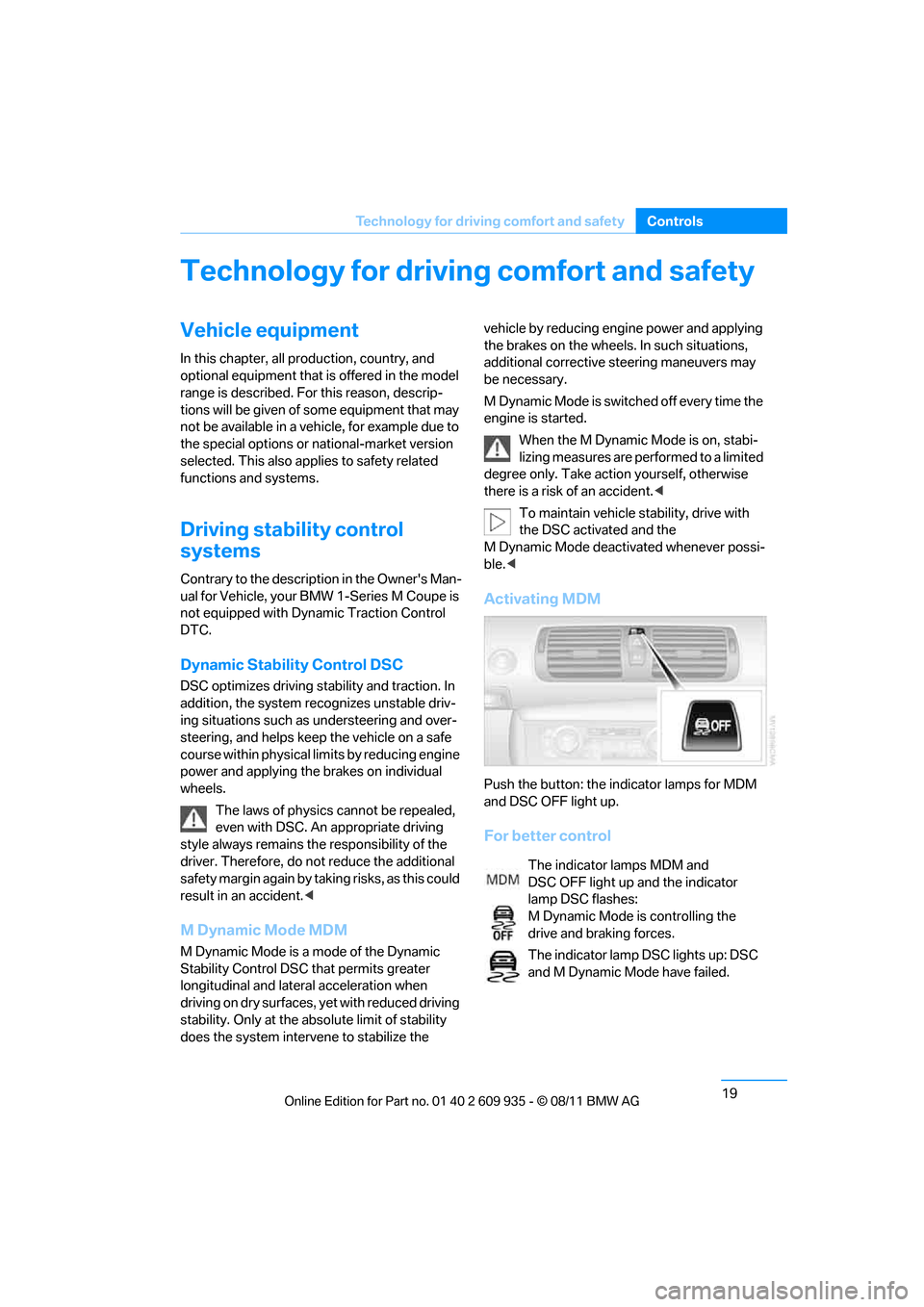
Activating MDM
Push the button: the indicator lamps for MDM
and DSC OFF light up.
For better control
The indicator lamps MDM and
DSC OFF light up and the indicator
lamp DSC flashes:
M Dynamic Mode is controlling the
drive and braking forces.
The indicator lamp DSC lights up: DSC
and M Dynamic Mode have failed.
Online Edition for Part no. 01 40 2 609 935 - \251 08/11 BMW AG
Page 21 of 48
20
ControlsTechnology for driving comfort and safety
Deactivating MDM
Press the button again; the indicator lamps in
the instrument cluster go out.
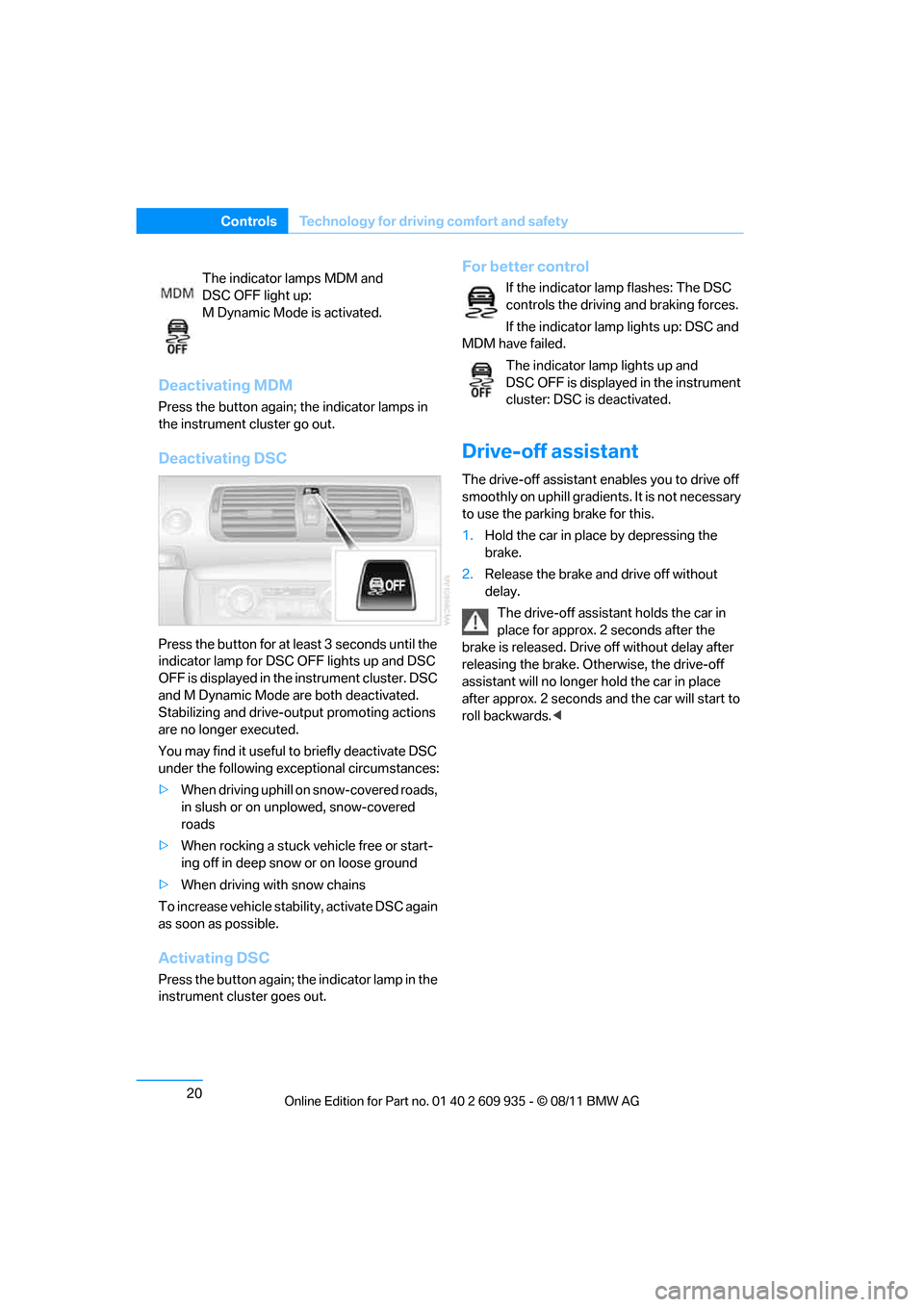
Deactivating DSC
Press the button for at le ast 3 seconds until the
indicator lamp for DSC OFF lights up and DSC
OFF is displayed in the instrument cluster. DSC
and M Dynamic Mode are both deactivated.
Stabilizing and drive-output promoting actions
are no longer executed.
You may find it useful to briefly deactivate DSC
under the following exce ptional circumstances:
> When driving uphill on snow-covered roads,
in slush or on unplowed, snow-covered
roads
> When rocking a stuck vehicle free or start-
ing off in deep snow or on loose ground
> When driving with snow chains
To increase vehicle stab ility, activate DSC again
as soon as possible.
Activating DSC
Press the button again; th e indicator lamp in the
instrument cluster goes out.
For better control
If the indicator lamp flashes: The DSC
controls the driving and braking forces.
If the indicator lamp lights up: DSC and
MDM have failed.
The indicator lamp lights up and
DSC OFF is displayed in the instrument
cluster: DSC is deactivated.
Drive-off assistant
The drive-off assistant enables you to drive off
smoothly on uphill gradients. It is not necessary
to use the parking brake for this.
1.Hold the car in place by depressing the
brake.
2. Release the brake and drive off without
delay.
The drive-off assistant holds the car in
place for approx. 2 seconds after the
brake is released. Drive off without delay after
releasing the brake. Otherwise, the drive-off
assistant will no longer hold the car in place
after approx. 2 seconds and the car will start to
roll backwards. <
The indicator lamps MDM and
DSC OFF light up:
M Dynamic Mode is activated.
Online Edition for Part no. 01 40 2 609 935 - \251 08/11 BMW AG
Page 25 of 48
24
Driving tipsThings to remember when driving
Things to remember when driving
Vehicle equipment
In this chapter, all pr oduction, country, and
optional equipment that is offered in the model
range is described. As a result, some equip-
ment described may not be available in a
particular vehicle, for example due to the
options or national-market version selected.
This also applies to safe ty related functions and
systems.
Break-in period
Note the following instructions for your
BMW 1-Series M Coupe that deviate from the
description in the Owner's Manual for Vehicle.
Engine and differential
Always obey all official speed limits.
Up to 1,200 miles/2,000 km
Drive at varying engine and road speeds, but do
not exceed an engine speed of 5,500 rpm and a
road speed of 105 mph/170 km/h.
Do not depress the ac celerator all the way.
From 1,200 miles/2,000 km to
3,000 miles/5,000 km
Engine and road speeds can be increased
gradually up to a traveling speed of 135 mph/
220 km/h. Use the maximum speed only for
brief intervals, e. g. when passing.
Transmission
The transmission begins functioning at an
optimal level only after a distance of approx.
300 miles/500 km. Do not exceed engine
speeds of 5,500 rpm during this period.
General driving notes
Clearance
Take into account the limited clearance of
your BMW 1-Series M Coupe, e. g. when
driving into underground parking garages or
over obstacles. Otherwise, the vehicle may be
damaged. <
Braking safely
Hills
To prevent overheating and the resulting
reduced efficiency of the brake system,
drive long or steep downhill gradients in the
gear in which the least br aking is required. Even
light but consistent brak e pressure can lead to
high temperatures, brake wear and possibly
even brake failure. <
You can increase the engine's braking effect by
shifting down, all the way to first gear if neces-
sary. This strategy helps you avoid placing
excessive loads on the brake system.
Never drive with the clutch held down,
with the transmission in neutral or with
the engine switched off; otherwise, engine
braking action will not be present or there will be
no power assistance to the brakes or steering.
Never allow floor mats, carpets or any other
objects to protrude into the area around the
pedals; otherwise, pedal function could be
impaired. <
Online Edition for Part no. 01 40 2 609 935 - \251 08/11 BMW AG
Page 26 of 48
25
Things to remember when driving
Driving tips
Corrosion on brake rotors
When the vehicle is driv
en only occasionally,
during extended periods when the vehicle is not
used at all, and in operating conditions where
brake applications are le ss frequent, there is an
increased tendency for corrosion to form on
rotors, while contaminan ts accumulate on the
brake pads. This occurs because the minimum
pressure which must be exerted by the pads
during brake applications to clean the rotors is
not reached.
This can also lead to a permanent loss in ride
comfort and to squealing noises during braking.
A loss in comfort can also be caused by
extended braking with little pressure on the
pedal.
Should corrosion form on the brake rotors, the
brakes will tend to respond with a pulsating
effect that even extended application will fail to
cure.
For information on brake system technology,
refer to Compound brake on page 26.
Right-hand/left-hand traffic
When crossing the border into countries in
which one drives on the other side of the road
than in the country of registration, it is neces-
sary to take steps to avoid blinding oncoming
traffic with the headlamps.
Your BMW center stocks adhesive film. Follow
the accompanying instructions for applying the
film.
When the headlamps have been covered with
the adhesive film, rotate the light switch to
position 2, refer to the Owner's Manual for the
vehicle to switch on the low beams, even with
automatic headlamp control.
Online Edition for Part no. 01 40 2 609 935 - \251 08/11 BMW AG
Page 27 of 48
26
Driving tipsBMW 1-Series M Coupe technology
BMW 1-Series M Coupe technology
Vehicle equipment
In this chapter, all pr oduction, country, and
optional equipment that is offered in the model
range is described. As a result, some equip-
ment described may not be available in a
particular vehicle, for example due to the
options or national-market version selected.
This also applies to safe ty related functions and
systems.
High-performance engine
With a displacement of 182 cu in/3 liters, the
high-performance engine produces a maximum
output of 335 hp and a maximum torque of
332 lb ft/450 Nm, with Overboost 369 lb ft/
500 Nm.
The engine is equipped with a reduced-weight
dual-mass flywheel to achieve very spontane-
ous response characteristics.
Warming up the engine
During the warm-up phase, the high-perfor-
mance V8 engine runs a little more roughly due
to its emissions control system.
For technical reasons, the exhaust system
sounds slightly metallic when the engine is
cold.
Compound brake
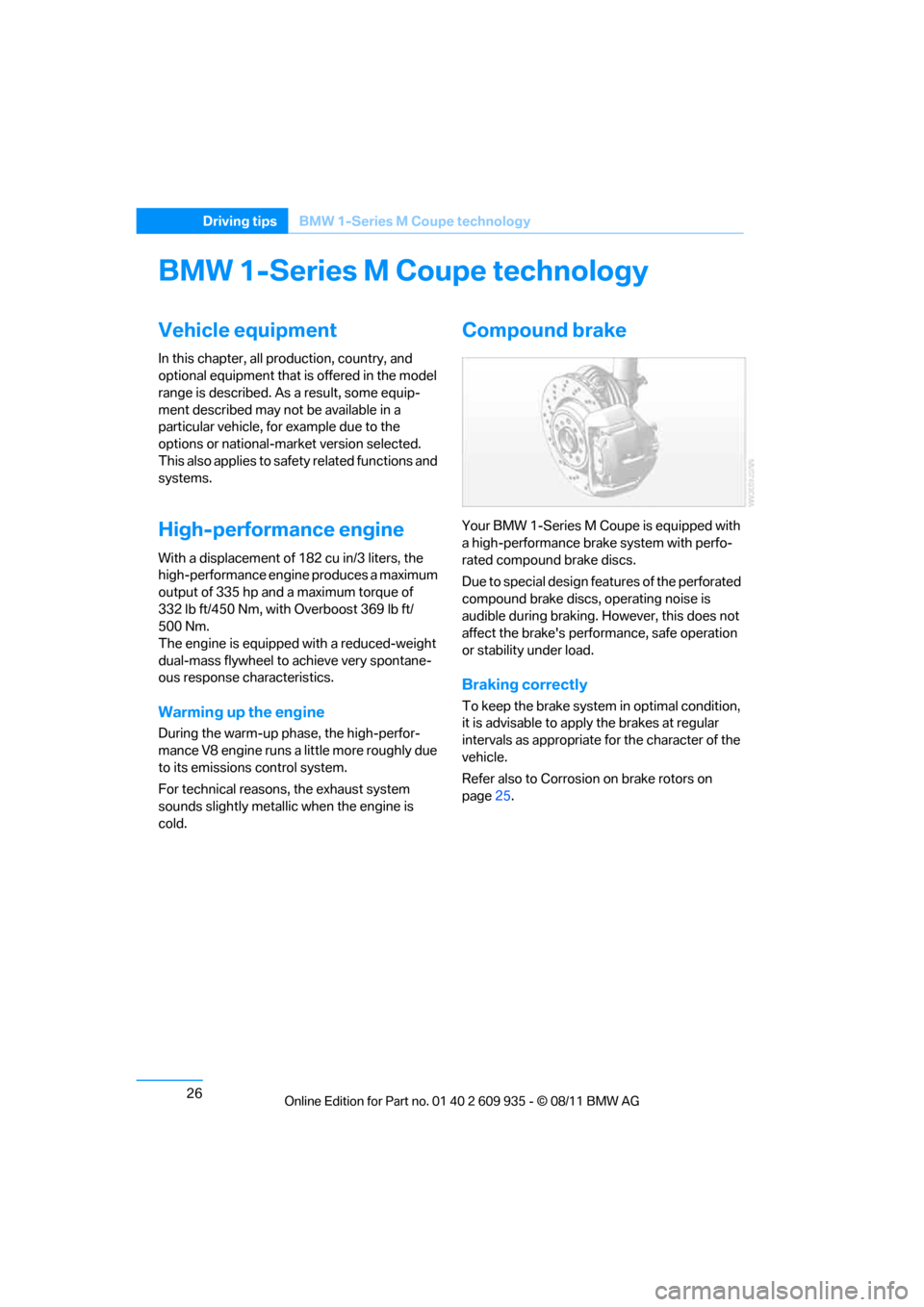
Your BMW 1-Series M Coupe is equipped with
a high-performance brake system with perfo-
rated compound brake discs.
Due to special design features of the perforated
compound brake discs, operating noise is
audible during braking. However, this does not
affect the brake's performance, safe operation
or stability under load.
Braking correctly
To keep the brake system in optimal condition,
it is advisable to apply the brakes at regular
intervals as appropriate for the character of the
vehicle.
Refer also to Corrosion on brake rotors on
page 25.
Online Edition for Part no. 01 40 2 609 935 - \251 08/11 BMW AG
Page 28 of 48
27
BMW 1-Series M Coupe technology
Driving tips
Drive train
In your BMW 1-Series M Coupe, special
emphasis has been placed on the direct con-
nection between the engine and drive. The tor-
sionally rigid execution of the drive train results
in acoustic feedback of the torque, as is typical
in sports cars. Clacking sounds can arise during
load changes. They do
not impair functionality
or shorten the lifespan of any component.
Driving on a race track
BMW recommends the following measures
before driving on a race track:
> Participate in a BMW driver training course
> Have the vehicle checked by your BMW
center
Operation on race tracks results in a
higher rate of wear. The BMW 1-Series M
Coupe is not designed for use in competitive
motor sports. This wear is not covered by the
vehicle warranty. <
The series brake pads and wear indicator are
not designed for operation on a race track. Your
BMW center will be glad to advise you.
Online Edition for Part no. 01 40 2 609 935 - \251 08/11 BMW AG
Page 33 of 48
32
MobilityReplacing components
Replacing components
Vehicle equipment
In this chapter, all pr oduction, country, and
optional equipment that is offered in the model
range is described. For this reason, descrip-
tions will be given of some equipment that may
not be available in a vehi cle, for example due to
the special options or national-market version
selected. This also app lies to safety related
functions and systems.
Flat tire, repairing
Safety measures in the event of a flat tire:
Park the vehicle as far away from moving
traffic as possible and on a firm surface. Switch
on the hazard warning flashers.
Set the parking brake and shift into first gear or
reverse. Have all occu pants leave the vehicle
and move beyond the danger zone, e. g. behind
the guard rails.
If necessary, set up a warning triangle or warn-
ing flasher at a suitable distance. Adhere to
country-specific regulations. <
BMW Mobility System
Notes
>Follow the instructions on using the
Mobility System found on the compressor
and the sealant bottle.
> Use of the Mobility System may not be
effective against tire damage larger than
approx. 0.16 in/4 mm.
> Contact the nearest BMW center if the tire
cannot be made drivable with the Mobility
System.
> If possible, leave any foreign bodies that
have penetrated th e tire in place. >
Remove the label with the speed restriction
from the sealant bottle and apply it to the
steering wheel.
Storage
The Mobility System is st ored in the cargo area
under the floor mat.
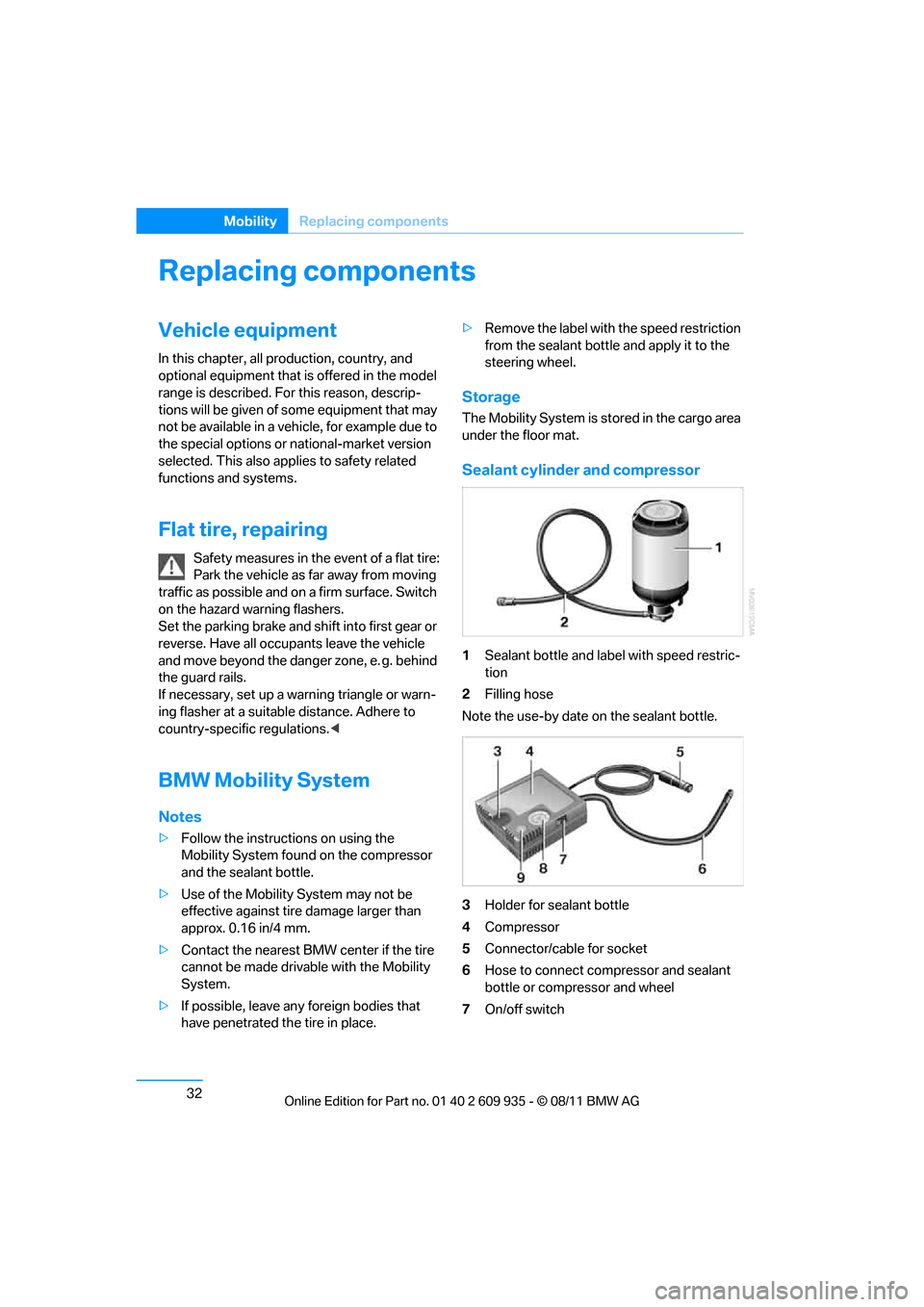
Sealant cylinder and compressor
1 Sealant bottle and label with speed restric-
tion
2 Filling hose
Note the use-by date on the sealant bottle.
3 Holder for sealant bottle
4 Compressor
5 Connector/cable for socket
6 Hose to connect compressor and sealant
bottle or compressor and wheel
7 On/off switch
Online Edition for Part no. 01 40 2 609 935 - \251 08/11 BMW AG
Page 38 of 48
37
Indicator and warning lamps
Mobility
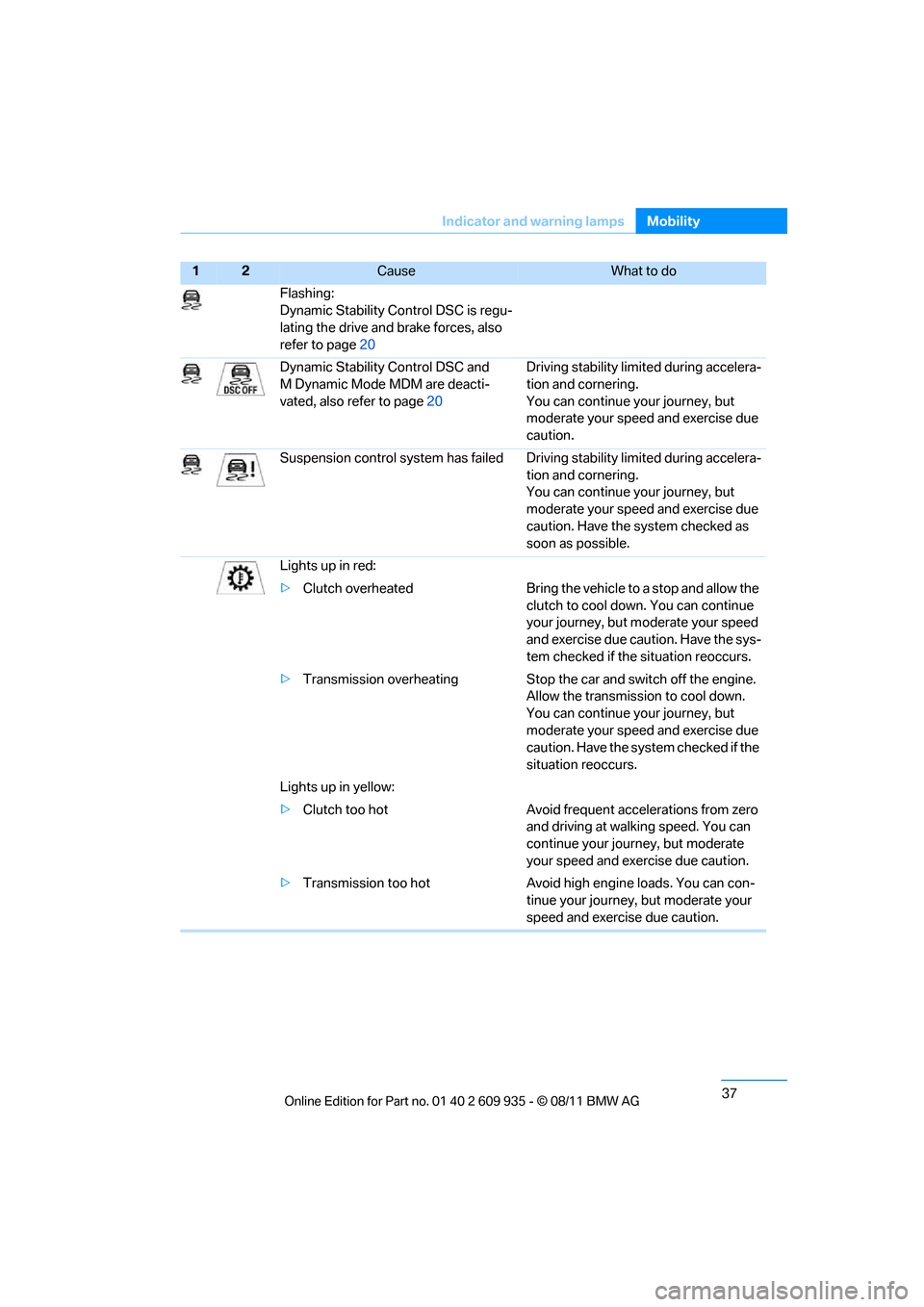
Flashing:
Dynamic Stability Control DSC is regu-
lating the drive and brake forces, also
refer to page
20
Dynamic Stability Control DSC and
M Dynamic Mode MDM are deacti-
vated, also refer to page 20Driving stability limited during accelera-
tion and cornering.
You can continue your journey, but
moderate your speed and exercise due
caution.
Suspension control system has failed Dri ving stability limited during accelera-
tion and cornering.
You can continue your journey, but
moderate your speed and exercise due
caution. Have the system checked as
soon as possible.
Lights up in red:
> Clutch overheated Bring the vehi cle to a stop and allow the
clutch to cool down. You can continue
your journey, but mo derate your speed
and exercise due caution. Have the sys-
tem checked if the situation reoccurs.
> Transmission overheating Stop the car and switch off the engine.
Allow the transmission to cool down.
You can continue your journey, but
moderate your speed and exercise due
caution. Have the system checked if the
situation reoccurs.
Lights up in yellow:
> Clutch too hot Avoid frequent accelerations from zero
and driving at walking speed. You can
continue your journey, but moderate
your speed and exercise due caution.
> Transmission too hot Avoid high engine loads. You can con-
tinue your journey, but moderate your
speed and exercise due caution.
12Cause What to do
Online Edition for Part no. 01 40 2 609 935 - \251 08/11 BMW AG
Page 45 of 48
44
ReferenceEverything from A to Z
Everything from A to Z
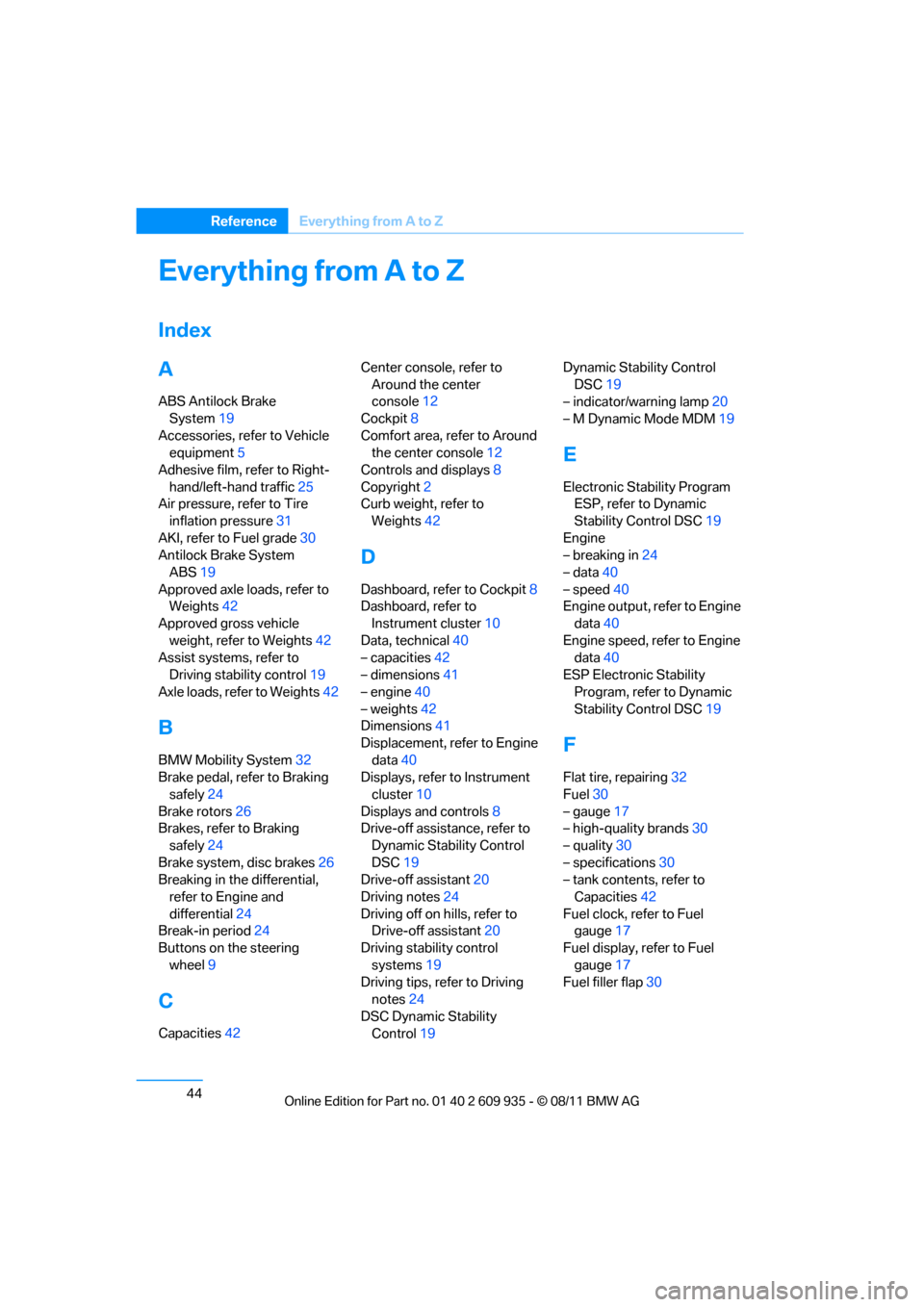
Index
A
ABS Antilock Brake
System 19
Accessories, refer to Vehicle equipment 5
Adhesive film, refer to Right- hand/left-hand traffic 25
Air pressure, refer to Tire
inflation pressure 31
AKI, refer to Fuel grade 30
Antilock Brake System
ABS 19
Approved axle loads, refer to Weights 42
Approved gross vehicle weight, refer to Weights 42
Assist systems, refer to
Driving stability control 19
Axle loads, refer to Weights 42
B
BMW Mobility System32
Brake pedal, refer to Braking safely 24
Brake rotors 26
Brakes, refer to Braking safely 24
Brake system, disc brakes 26
Breaking in the differential, refer to Engine and
differential 24
Break-in period 24
Buttons on the steering
wheel 9
C
Capacities 42 Center console, refer to
Around the center
console 12
Cockpit 8
Comfort area, refer to Around the center console 12
Controls and displays 8
Copyright 2
Curb weight, refer to
Weights 42
D
Dashboard, refer to Cockpit 8
Dashboard, refer to
Instrument cluster 10
Data, technical 40
– capacities 42
– dimensions 41
– engine 40
– weights 42
Dimensions 41
Displacement, refer to Engine
data 40
Displays, refer to Instrument cluster 10
Displays and controls 8
Drive-off assistance, refer to Dynamic Stability Control
DSC 19
Drive-off assistant 20
Driving notes 24
Driving off on hills, refer to Drive-off assistant 20
Driving stability control
systems 19
Driving tips, refer to Driving notes 24
DSC Dynamic Stability Control 19 Dynamic Stability Control
DSC 19
– indicator/warning lamp 20
– M Dynamic Mode MDM 19
E
Electronic Stability Program
ESP, refer to Dynamic
Stability Control DSC 19
Engine
– breaking in 24
– data 40
– speed 40
Engine output, refer to Engine
data 40
Engine speed, refer to Engine data 40
ESP Electronic Stability Program, refer to Dynamic
Stability Control DSC 19
F
Flat tire, repairing32
Fuel 30
– gauge 17
– high-quality brands 30
– quality 30
– specifications 30
– tank contents, refer to Capacities 42
Fuel clock, refer to Fuel gauge 17
Fuel display, refer to Fuel
gauge 17
Fuel filler flap 30
Online Edition for Part no. 01 40 2 609 935 - \251 08/11 BMW AG
Page 46 of 48
45
Everything from A to Z
Reference
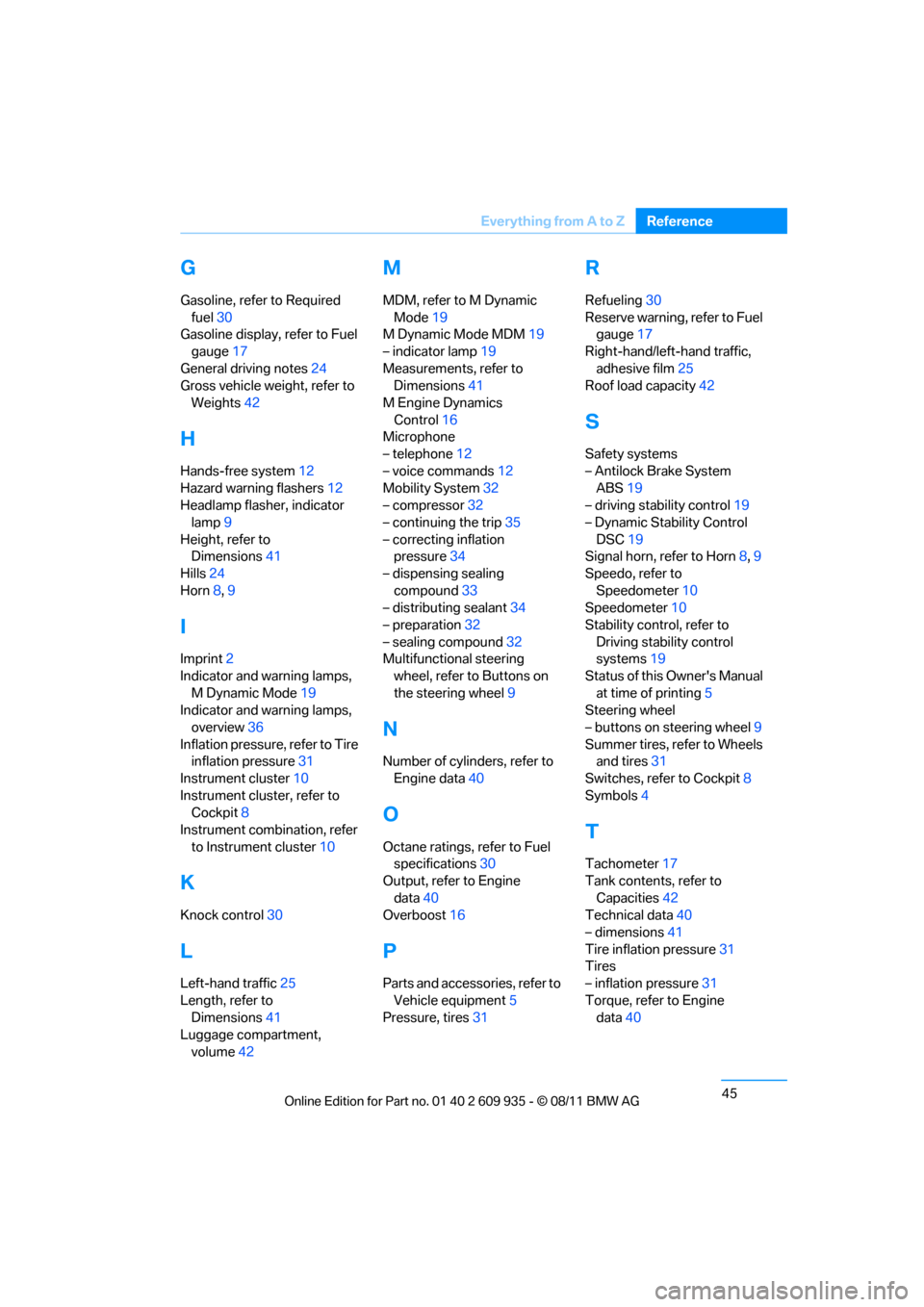
G
Gasoline, refer to Required
fuel 30
Gasoline display, refer to Fuel
gauge 17
General driving notes 24
Gross vehicle weight, refer to
Weights 42
H
Hands-free system 12
Hazard warning flashers 12
Headlamp flasher, indicator lamp 9
Height, refer to Dimensions 41
Hills 24
Horn 8,9
I
Imprint 2
Indicator and warning lamps,
M Dynamic Mode 19
Indicator and warning lamps, overview 36
Inflation pressure, refer to Tire inflation pressure 31
Instrument cluster 10
Instrument cluster, refer to Cockpit 8
Instrument combination, refer
to Instrument cluster 10
K
Knock control30
L
Left-hand traffic 25
Length, refer to Dimensions 41
Luggage compartment,
volume 42
M
MDM, refer to M Dynamic
Mode 19
M Dynamic Mode MDM 19
– indicator lamp 19
Measurements, refer to Dimensions 41
M Engine Dynamics Control 16
Microphone
– telephone 12
– voice commands 12
Mobility System 32
– compressor 32
– continuing the trip 35
– correcting inflation pressure 34
– dispensing sealing
compound 33
– distributing sealant 34
– preparation 32
– sealing compound 32
Multifunctional steering wheel, refer to Buttons on
the steering wheel 9
N
Number of cylinders, refer to
Engine data 40
O
Octane ratings, refer to Fuel
specifications 30
Output, refer to Engine
data 40
Overboost 16
P
Parts and accessories, refer to
Vehicle equipment 5
Pressure, tires 31
R
Refueling30
Reserve warning, refer to Fuel gauge 17
Right-hand/left-hand traffic, adhesive film 25
Roof load capacity 42
S
Safety systems
– Antilock Brake System
ABS 19
– driving stability control 19
– Dynamic Stability Control
DSC 19
Signal horn, refer to Horn 8,9
Speedo, refer to
Speedometer 10
Speedometer 10
Stability control, refer to
Driving stability control
systems 19
Status of this Owner's Manual
at time of printing 5
Steering wheel
– buttons on steering wheel 9
Summer tires, refer to Wheels and tires 31
Switches, refer to Cockpit 8
Symbols 4
T
Tachometer 17
Tank contents, refer to
Capacities 42
Technical data 40
– dimensions 41
Tire inflation pressure 31
Tires
– inflation pressure 31
Torque, refer to Engine data 40
Online Edition for Part no. 01 40 2 609 935 - \251 08/11 BMW AG