head restraint BMW 2 SERIES COUPE 2016 F22 Owner's Manual
[x] Cancel search | Manufacturer: BMW, Model Year: 2016, Model line: 2 SERIES COUPE, Model: BMW 2 SERIES COUPE 2016 F22Pages: 232, PDF Size: 5.76 MB
Page 52 of 232
AdjustingVehicle features and options
This chapter describes all standard, country-
specific and optional features offered with the
series. It also describes features that are not
necessarily available in your car, e. g., due to
the selected options or country versions. This
also applies to safety-related functions and
systems. The respectively applicable country
provisions must be observed when using the
respective features and systems.
Sitting safely The ideal seating position can make a vital
contribution to relaxed, fatigue-free driving.
The seating position plays an important role in
an accident in combination with:▷Safety belts, refer to page 52.▷Head restraints, refer to page 53.▷Airbags, refer to page 95.
Seats
Hints Do not adjust the seat while driving
Do not adjust the driver's seat while driv‐
ing, or the seat could respond with unexpected
movement and the ensuing loss of vehicle
control could lead to an accident.◀
Do not incline the backrest too far to the
rear
Do not incline the backrest too far to the rear
while driving, or there is a risk of slipping under
the safety belt in the event of an accident. This
would eliminate the protection normally pro‐
vided by the belt.◀
Keep the movement area unobstructed
When changing the seat position, keep
the seat's area of movement unobstructed;
otherwise, people might get injured or objects
damaged.◀
Manually adjustable seats
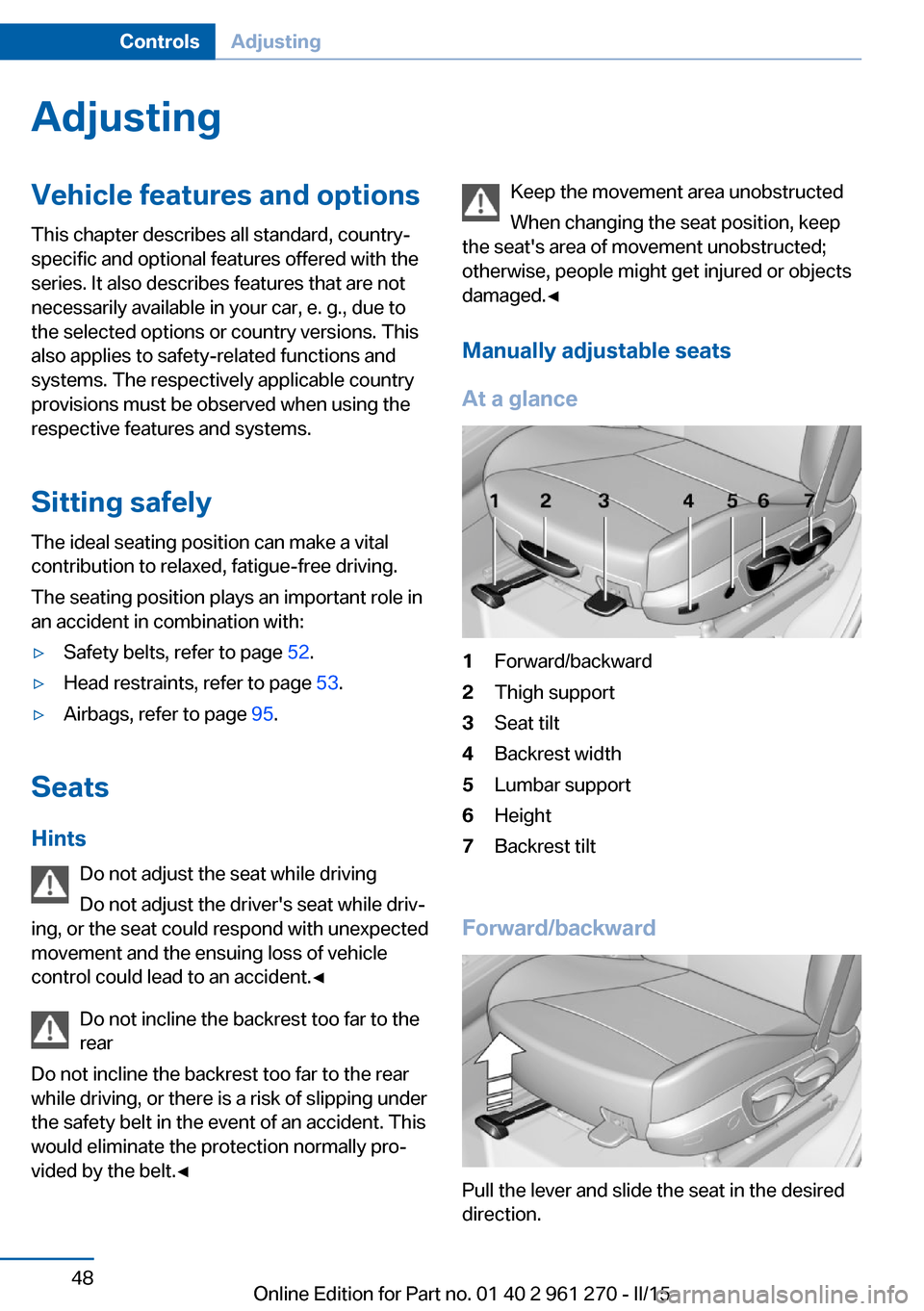
At a glance1Forward/backward2Thigh support3Seat tilt4Backrest width5Lumbar support6Height7Backrest tilt
Forward/backward
Pull the lever and slide the seat in the desired
direction.
Seite 48ControlsAdjusting48
Online Edition for Part no. 01 40 2 961 270 - II/15
Page 57 of 232
Safety belt reminder for driver's and
passenger's seat
The indicator lamp lights up and a sig‐
nal sounds. Make sure that the safety
belts are positioned correctly. The
safety belt reminder is active at speeds above
approx. 6 mph/10 km/h. It can also be activated
if objects are placed on the front passenger
seat.
Damage to safety belts Wear and tear after accidents or when dam‐
aged otherwise:
Have the safety belts, including the safety belt
tensioners, replaced and have the belt anchors
checked.
Check and replace safety belts
This should only be done by your service
center; otherwise, this safety feature might not
work properly.◀
Front headrests Correctly adjusted head restraint
A correctly adjusted head restraint reduces the
risk of injury to cervical vertebrae in the event
of an accident.
Adjusting the head restraint
Adjust the head restraints of all occupied
seats properly; otherwise, there is an increased
risk of injury in an accident.◀
Height
Adjust the head restraint so that its center is
approximately at ear level.
Distance Adjust the distance so that the head restraint
is as close as possible to the back of the head.
If necessary, adjust the distance by adjusting
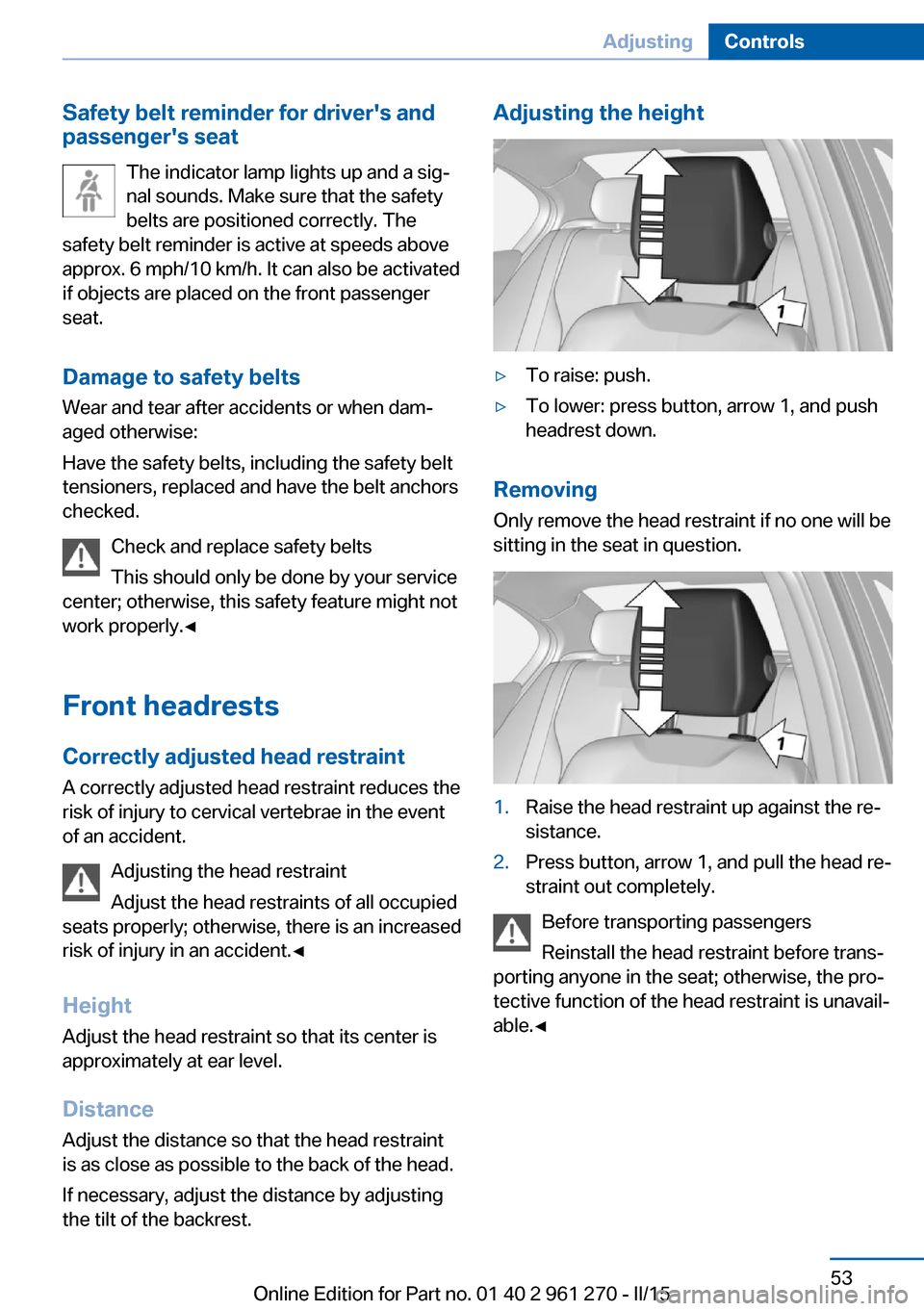
the tilt of the backrest.Adjusting the height▷To raise: push.▷To lower: press button, arrow 1, and push
headrest down.
Removing
Only remove the head restraint if no one will be
sitting in the seat in question.
1.Raise the head restraint up against the re‐
sistance.2.Press button, arrow 1, and pull the head re‐
straint out completely.
Before transporting passengers
Reinstall the head restraint before trans‐
porting anyone in the seat; otherwise, the pro‐
tective function of the head restraint is unavail‐
able.◀
Seite 53AdjustingControls53
Online Edition for Part no. 01 40 2 961 270 - II/15
Page 58 of 232
Rear head restraints
Correctly adjusted head restraint A correctly adjusted head restraint reduces the
risk of injury to cervical vertebrae in the event
of an accident.
Adjusting the head restraint
Adjust the head restraints of all occupied
seats properly; otherwise, there is an increased
risk of injury in an accident.◀
Height
Adjust the head restraint so that its center is
approximately at ear level.
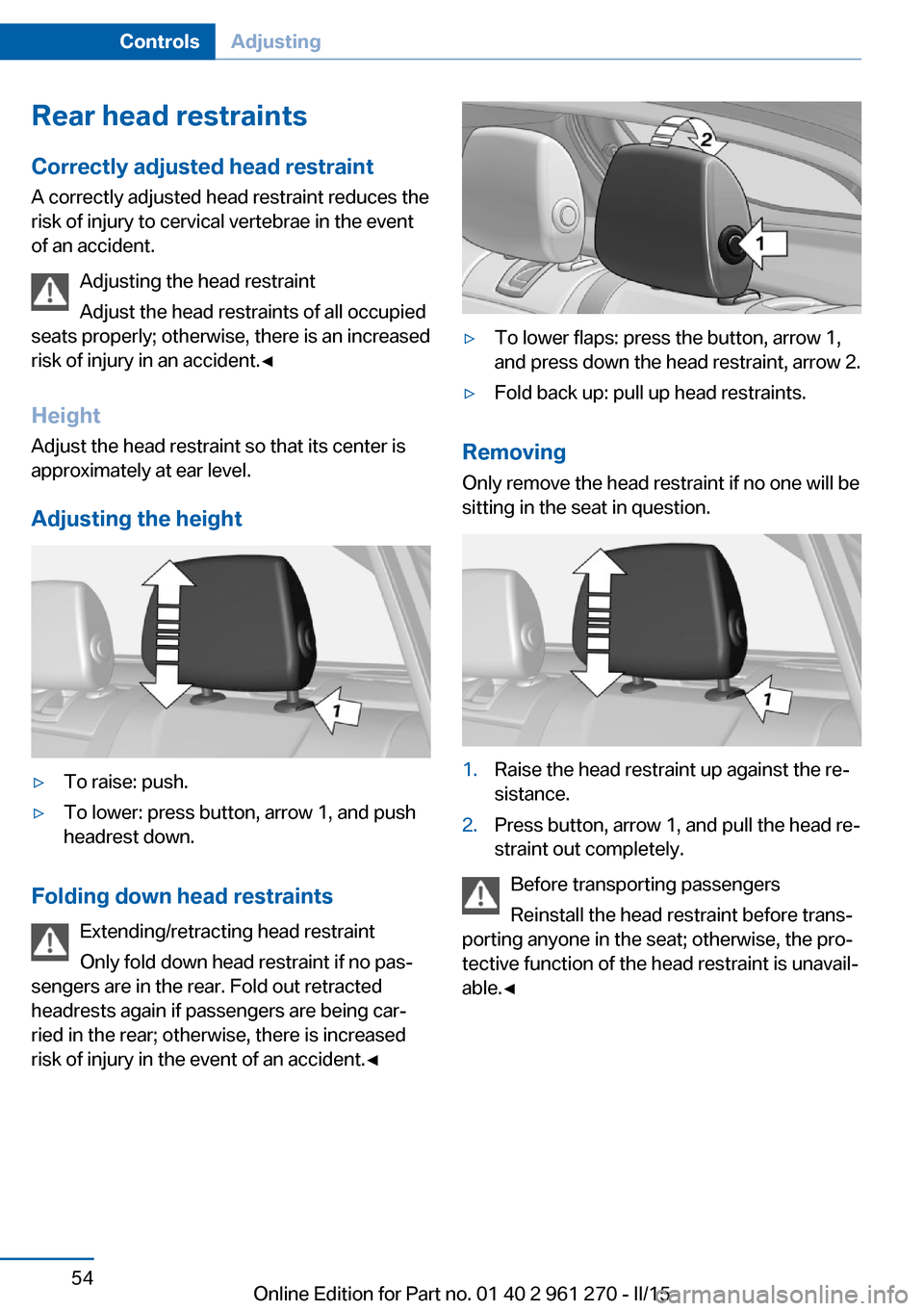
Adjusting the height▷To raise: push.▷To lower: press button, arrow 1, and push
headrest down.
Folding down head restraints
Extending/retracting head restraint
Only fold down head restraint if no pas‐
sengers are in the rear. Fold out retracted
headrests again if passengers are being car‐
ried in the rear; otherwise, there is increased
risk of injury in the event of an accident.◀
▷To lower flaps: press the button, arrow 1,
and press down the head restraint, arrow 2.▷Fold back up: pull up head restraints.
Removing
Only remove the head restraint if no one will be
sitting in the seat in question.
1.Raise the head restraint up against the re‐
sistance.2.Press button, arrow 1, and pull the head re‐
straint out completely.
Before transporting passengers
Reinstall the head restraint before trans‐
porting anyone in the seat; otherwise, the pro‐
tective function of the head restraint is unavail‐
able.◀
Seite 54ControlsAdjusting54
Online Edition for Part no. 01 40 2 961 270 - II/15
Page 63 of 232
Transporting children safelyVehicle features and optionsThis chapter describes all standard, country-
specific and optional features offered with the
series. It also describes features that are not
necessarily available in your car, e. g., due tothe selected options or country versions. This
also applies to safety-related functions and
systems. The respectively applicable country
provisions must be observed when using the
respective features and systems.
The right place for children
Note
Children in the vehicle
Do not leave children unattended in the
vehicle; otherwise, they could endanger them‐
selves and other persons, e.g., by opening the
doors.◀
Children should always be in the rear Accident research shows that the safest place
for children is in the back seat.
Transporting children in the rear
Only transport children younger than
13 years of age or shorter than 5 ft/150 cm in
the rear in child restraint systems provided in
accordance with the age, weight and size of
the child; otherwise, there is an increased risk
of injury in an accident.
Children 13 years of age or older must wear a
safety belt as soon as a suitable child restraint
system can no longer be used due to their age,
weight and size.◀
Children on the front passenger seat
Should it ever be necessary to use a child re‐
straint system in the front passenger seat,
make sure that the front, knee and side airbags
on the front passenger side are deactivated.
Automatic deactivation of front-seat passen‐
ger airbags, refer to page 97.Note
Deactivating the front-seat passenger
airbags
If a child restraint system is used in the front
passenger seat, deactivate the front-seat pas‐
senger airbags; otherwise, there is an in‐
creased risk of injury to the child when the air‐
bags are activated, even with a child restraint
system.◀
Installing child restraint
systems
Hints Manufacturer's information for child re‐straint systems
To select, mount and use child restraint sys‐
tems, observe the information provided by the
system manufacturer; otherwise, the protec‐
tive effect can be lost.◀
Ensuring the stability of the child seat
When installing child restraint systems,
make sure that the child seat is securely fas‐
tened to the backrest of the seat. Angle and
headrest of the backrest might need to be ad‐
justed or possibly be removed. Make sure that
all backrests are securely locked. Otherwise
the stability of the child seat can be affected,
and there is an increased risk of injury becauseSeite 59Transporting children safelyControls59
Online Edition for Part no. 01 40 2 961 270 - II/15
Page 66 of 232
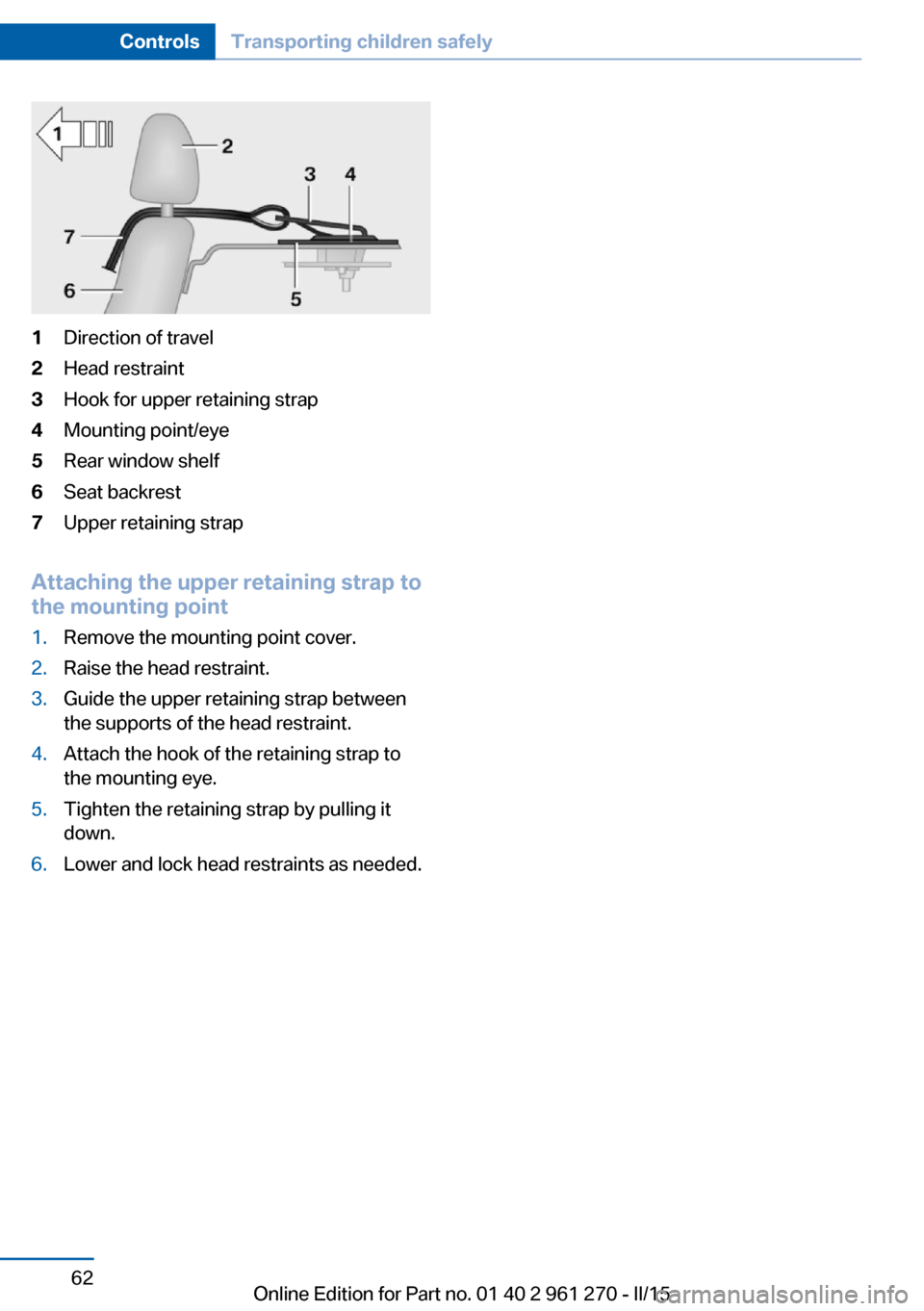
1Direction of travel2Head restraint3Hook for upper retaining strap4Mounting point/eye5Rear window shelf6Seat backrest7Upper retaining strap
Attaching the upper retaining strap to
the mounting point
1.Remove the mounting point cover.2.Raise the head restraint.3.Guide the upper retaining strap between
the supports of the head restraint.4.Attach the hook of the retaining strap to
the mounting eye.5.Tighten the retaining strap by pulling it
down.6.Lower and lock head restraints as needed.Seite 62ControlsTransporting children safely62
Online Edition for Part no. 01 40 2 961 270 - II/15
Page 99 of 232
SafetyVehicle features and options
This chapter describes all standard, country-
specific and optional features offered with the
series. It also describes features that are not
necessarily available in your car, e. g., due tothe selected options or country versions. This
also applies to safety-related functions and
systems. The respectively applicable country
provisions must be observed when using the
respective features and systems.
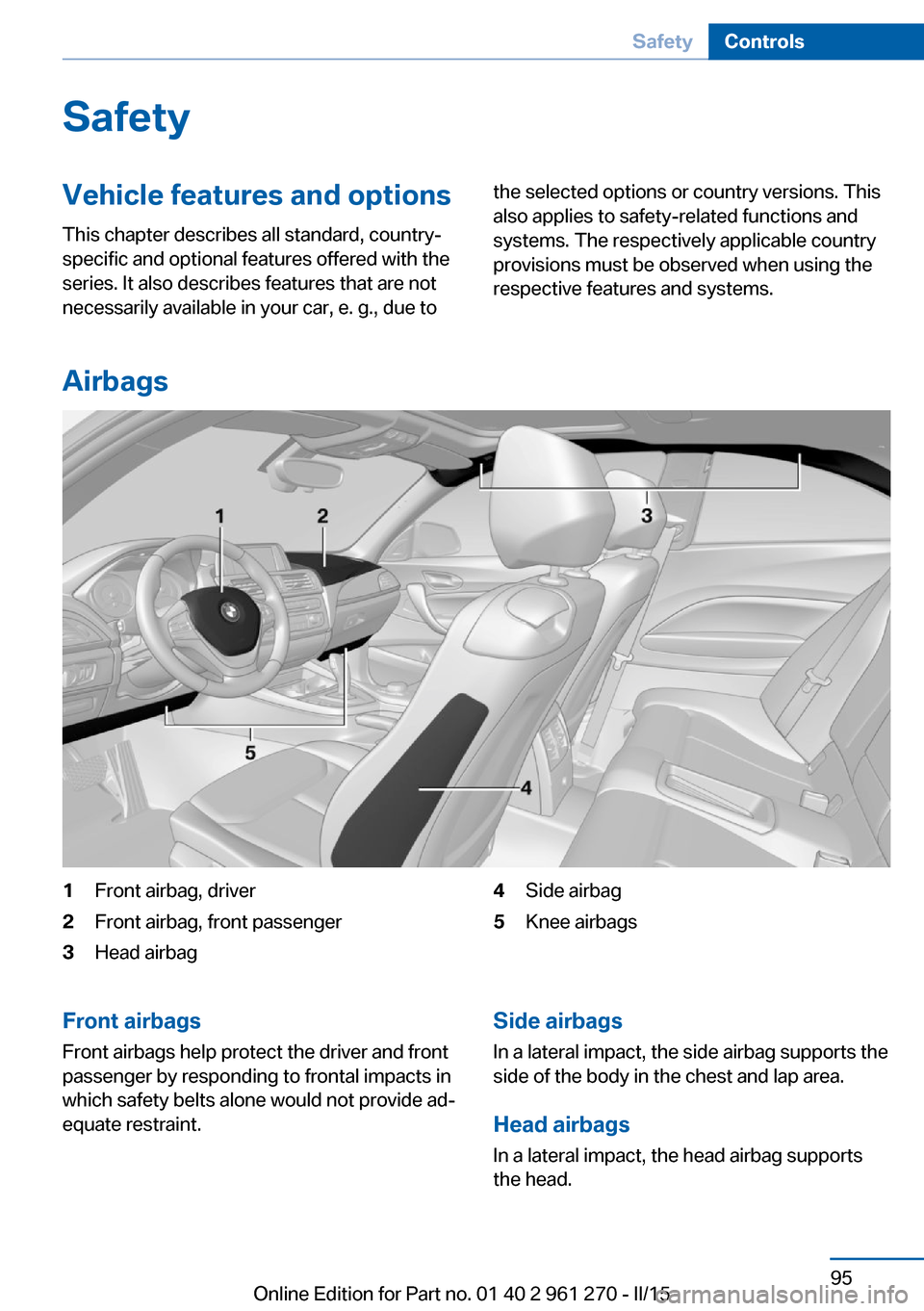
Airbags
1Front airbag, driver2Front airbag, front passenger3Head airbag4Side airbag5Knee airbagsFront airbags
Front airbags help protect the driver and front
passenger by responding to frontal impacts in
which safety belts alone would not provide ad‐
equate restraint.Side airbags
In a lateral impact, the side airbag supports the
side of the body in the chest and lap area.
Head airbags
In a lateral impact, the head airbag supports
the head.Seite 95SafetyControls95
Online Edition for Part no. 01 40 2 961 270 - II/15
Page 147 of 232
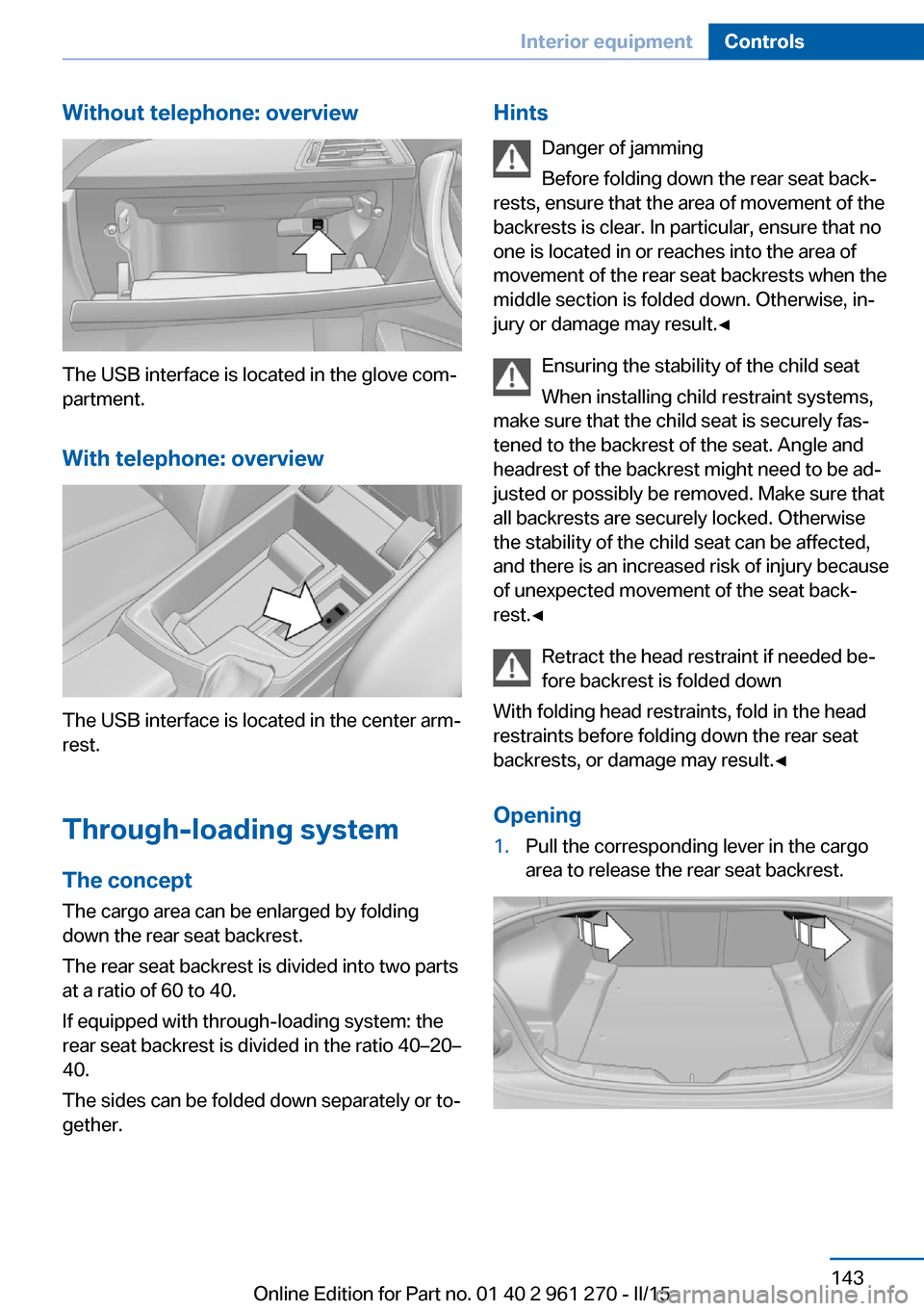
Without telephone: overview
The USB interface is located in the glove com‐
partment.
With telephone: overview
The USB interface is located in the center arm‐
rest.
Through-loading system The concept The cargo area can be enlarged by folding
down the rear seat backrest.
The rear seat backrest is divided into two parts at a ratio of 60 to 40.
If equipped with through-loading system: the
rear seat backrest is divided in the ratio 40–20–
40.
The sides can be folded down separately or to‐
gether.
Hints
Danger of jamming
Before folding down the rear seat back‐
rests, ensure that the area of movement of the
backrests is clear. In particular, ensure that no
one is located in or reaches into the area of
movement of the rear seat backrests when the
middle section is folded down. Otherwise, in‐
jury or damage may result.◀
Ensuring the stability of the child seat
When installing child restraint systems,
make sure that the child seat is securely fas‐
tened to the backrest of the seat. Angle and
headrest of the backrest might need to be ad‐
justed or possibly be removed. Make sure that
all backrests are securely locked. Otherwise the stability of the child seat can be affected,
and there is an increased risk of injury because
of unexpected movement of the seat back‐ rest.◀
Retract the head restraint if needed be‐
fore backrest is folded down
With folding head restraints, fold in the head
restraints before folding down the rear seat
backrests, or damage may result.◀
Opening1.Pull the corresponding lever in the cargo
area to release the rear seat backrest.Seite 143Interior equipmentControls143
Online Edition for Part no. 01 40 2 961 270 - II/15
Page 225 of 232
Exterior mirror, automaticdimming feature 57
Exterior mirrors 55
External start 203
External temperature dis‐ play 81
External temperature warn‐ ing 81
Eyes for securing cargo 156
F
Failure message, see Check Control 77
False alarm, refer to Uninten‐ tional alarm 45
Fan, refer to Air flow 131, 134
Filler neck for engine oil 188
Fine wood, care 210
First aid kit 203
Fitting for towing, see Tow fit‐ ting 206
Flat tire, changing wheels 199
Flat Tire Monitor FTM 102
Flat tire, Tire Pressure Moni‐ tor TPM 98
Flat tire, warning lamp 99, 102
Flooding 153
Floor carpet, care 211
Floor mats, care 211
Fogged up windows 131
Fold down the rear seat back‐ rest, see Though-loading
system 143
Fold-out position, wiper 70
Foot brake 153
Front airbags 95
Front-end collision warning with City Braking func‐
tion 104
Front fog lights 93
Front fog lights, front, bulb re‐ placement 197 Front lights 194
front-seat passenger airbags, automatic deactivation 97
Front-seat passenger airbags, indicator lamp 97
FTM Flat Tire Monitor 102
Fuel 170
Fuel consumption, refer to Average fuel consump‐
tion 86
Fuel filler flap 168
Fuel gauge 80
Fuel lid 168
Fuel quality 170
Fuel recommendation 170
Fuel, tank capacity 216
Fuse 201
G
Garage door opener, refer to Universal Integrated Remote
Control 137
Gasoline 170
Gear change, Steptronic transmission 72
Gear shift indicator 83
General driving notes 152
Glare shield 141
Glass sunroof, powered 46
Glove compartment 145
Gross vehicle weight, ap‐ proved 214
H
Halogen headlights, bulb re‐ placement 194
Handbrake, refer to parking brake 67
Hand-held transmitter, alter‐ nating code 138
Hazard warning flashers 202
Head airbags 95
Headlight control, auto‐ matic 91 Headlight courtesy delay fea‐
ture 91
Headlight flasher 68
Headlight flasher, bulb re‐ placement 196
Headlight glass 194
Headlights 194
Headlights, care 209
Headlight washer system 68
Head restraints 48
Head restraints, front 53
Head restraints, rear 54
Heavy cargo, stowing 156
High-beam Assistant 92
High beams 68
High beams/low beams, refer to High-beam Assistant 92
High beams, bulb replace‐ ment 196
Hills 154
Hill start assistant, refer to Drive-off assistant 116
Hints 6
Holder for beverages 147
Homepage 6
Hood 186
Horn 14
Hotel function, trunk lid 41
Hot exhaust system 153
Hydroplaning 153
I Ice warning, see External temperature warning 81
Icy roads, see External tem‐ perature warning 81
Identification marks, tires 176
Identification number, see ve‐ hicle identification num‐
ber 9
iDrive 18
Ignition key, refer to Remote control 34
Ignition off 63
Ignition on 63 Seite 221Everything from A to ZReference221
Online Edition for Part no. 01 40 2 961 270 - II/15
Page 227 of 232
Manual operation, rearviewcamera 123
Manual transmission 71
Marking on approved tires 179
Marking, run-flat tires 180
Master key, refer to Remote control 34
Maximum cooling 133
Maximum speed, display 83
Maximum speed, winter tires 179
Measure, units of 88
Medical kit 203
Memory, seat, mirror 55
Menu, EfficientDynamics 162
Menu in instrument clus‐ ter 84
Menus, operating, iDrive 18
Menus, refer to iDrive operat‐ ing concept 20
Messages, see Check Con‐ trol 77
Microfilter 132, 135
Minimum tread, tires 178
Mirror 55
Mirror memory 55
Mobile communication devi‐ ces in the vehicle 153
Mobility System 180
Modifications, technical, refer to Safety 7
Moisture in headlight 194
Monitor, refer to Control Dis‐ play 18
Mounting of child restraint systems 59
Multifunction steering wheel, buttons 14
N Navigation, see user's manual for Navigation, Entertain‐
ment and Communication Neck restraints, front, refer to Head restraints 53
Neck restraints, rear, refer to Head restraints 54
Neutral cleaner, see wheel cleaner 210
New wheels and tires 178
Nylon rope for tow-starting/ towing 206
O OBD Onboard Diagnosis 192
OBD, see OBD Onboard Di‐ agnosis 192
Obstacle marking, rearview camera 124
Octane rating, refer to Rec‐ ommended fuel grade 170
Odometer 80
Office, see user's manual for Navigation, Entertainment
and Communication
Oil 187
Oil, adding 188
Oil additives 188
Oil change 189
Oil change interval, service requirements 82
Oil filler neck 188
Oil types, alternative 189
Oil types, approved 189
Old batteries, disposal 200
On-board computer 85
On-board computer, refer to On-board computer 85
Onboard monitor, refer to Control Display 18
Onboard vehicle tool kit 193
Opening/closing via door lock 39
Opening and closing 34
Opening and closing, without remote control 39
Opening and closing, with re‐ mote control 37 Operating concept, iDrive 18
Optional equipment, standard equipment 6
Outside air, refer to Auto‐ matic recirculated-air con‐
trol 134
Overheating of engine, refer to Coolant temperature 80
P Paint, vehicle 209
Parallel parking assistant 125
Park Distance Control PDC 120
Parked-car ventilation 136
Parked vehicle, condensa‐ tion 154
Parking aid, refer to PDC 120
Parking assistant 125
Parking brake 67
Parking lights 90
Parking lights, bulb replace‐ ment 196
Parts and accessories 7
Passenger side mirror, tilting downward 56
Pathway lines, rearview cam‐ era 124
PDC Park Distance Con‐ trol 120
Pedestrian warning with city braking function 107
Personal Profile 35
Personal Profile, exporting profiles 36
Personal Profile, importing profiles 37
Pinch protection system, glass sunroof 47
Pinch protection system, win‐ dows 46
Plastic, care 210
Power failure 200
Power sunroof, glass 46
Power windows 45 Seite 223Everything from A to ZReference223
Online Edition for Part no. 01 40 2 961 270 - II/15