change wheel BMW 228I 2016 User Guide
[x] Cancel search | Manufacturer: BMW, Model Year: 2016, Model line: 228I, Model: BMW 228I 2016Pages: 234, PDF Size: 5.93 MB
Page 110 of 234
▷Check the tire pressure and correct as
needed.▷Carry out a reset of the system after a tire
change.
System limits
The system does not function properly if a re‐
set has not been carried out, e.g., a flat tire is
reported though tire inflation pressures are
correct.
The tire inflation pressure depends on the
tire's temperature. Driving or exposure to the
sun will increase the tire's temperature, thus
increasing the tire inflation pressure. The tire
inflation pressure is reduced when the tire
temperature falls again. These circumstances
may cause a warning when temperatures fall
very sharply.
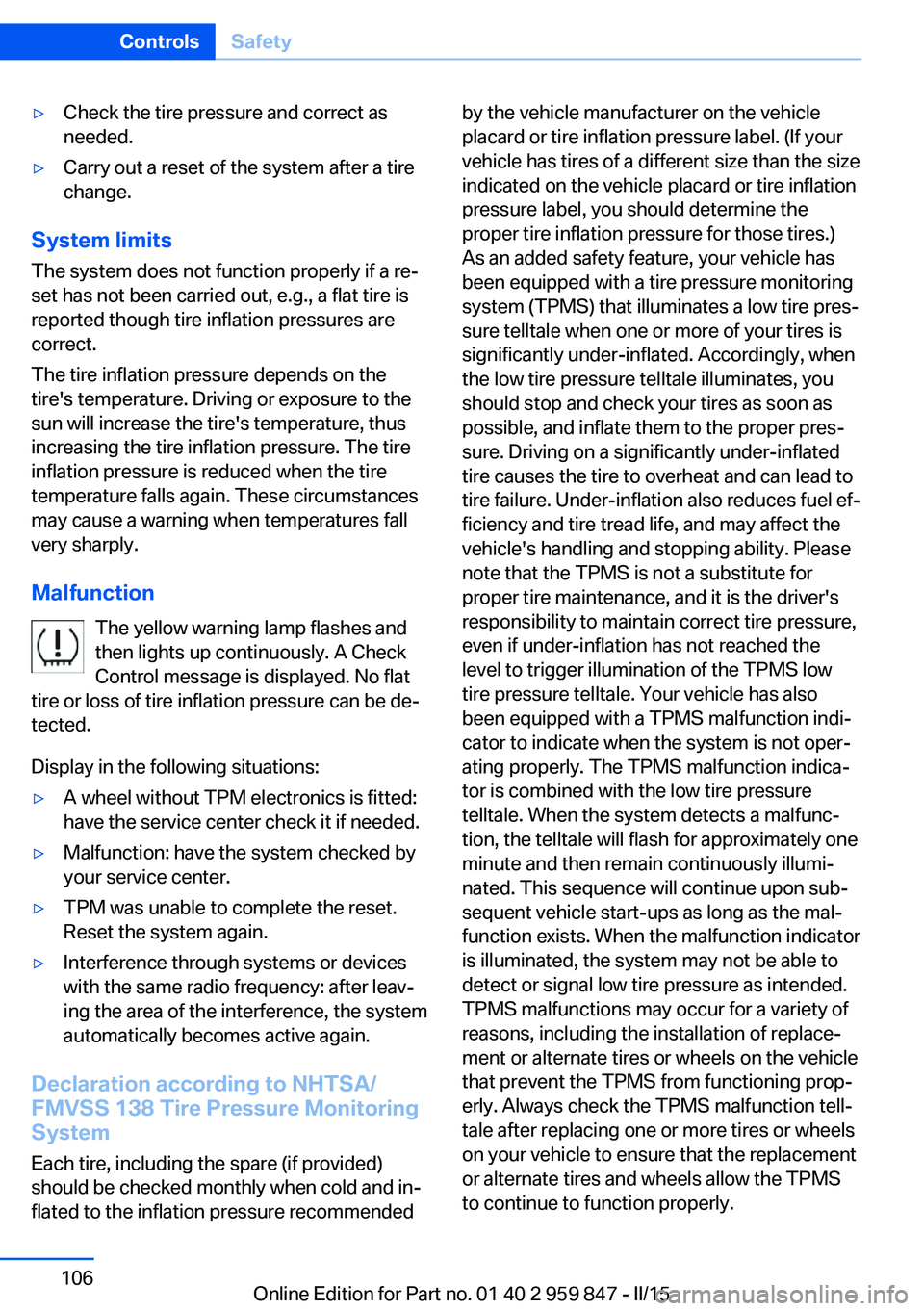
Malfunction The yellow warning lamp flashes and
then lights up continuously. A Check
Control message is displayed. No flat
tire or loss of tire inflation pressure can be de‐
tected.
Display in the following situations:
▷A wheel without TPM electronics is fitted:
have the service center check it if needed.▷Malfunction: have the system checked by
your service center.▷TPM was unable to complete the reset.
Reset the system again.▷Interference through systems or devices
with the same radio frequency: after leav‐
ing the area of the interference, the system
automatically becomes active again.
Declaration according to NHTSA/
FMVSS 138 Tire Pressure Monitoring
System
Each tire, including the spare (if provided)
should be checked monthly when cold and in‐
flated to the inflation pressure recommended
by the vehicle manufacturer on the vehicle
placard or tire inflation pressure label. (If your
vehicle has tires of a different size than the size
indicated on the vehicle placard or tire inflation
pressure label, you should determine the
proper tire inflation pressure for those tires.)
As an added safety feature, your vehicle has
been equipped with a tire pressure monitoring
system (TPMS) that illuminates a low tire pres‐
sure telltale when one or more of your tires is
significantly under-inflated. Accordingly, when
the low tire pressure telltale illuminates, you
should stop and check your tires as soon as
possible, and inflate them to the proper pres‐
sure. Driving on a significantly under-inflated
tire causes the tire to overheat and can lead to
tire failure. Under-inflation also reduces fuel ef‐
ficiency and tire tread life, and may affect the
vehicle's handling and stopping ability. Please
note that the TPMS is not a substitute for
proper tire maintenance, and it is the driver's
responsibility to maintain correct tire pressure,
even if under-inflation has not reached the
level to trigger illumination of the TPMS low
tire pressure telltale. Your vehicle has also
been equipped with a TPMS malfunction indi‐
cator to indicate when the system is not oper‐
ating properly. The TPMS malfunction indica‐
tor is combined with the low tire pressure
telltale. When the system detects a malfunc‐
tion, the telltale will flash for approximately one
minute and then remain continuously illumi‐
nated. This sequence will continue upon sub‐
sequent vehicle start-ups as long as the mal‐
function exists. When the malfunction indicator
is illuminated, the system may not be able to
detect or signal low tire pressure as intended.
TPMS malfunctions may occur for a variety of
reasons, including the installation of replace‐
ment or alternate tires or wheels on the vehicle
that prevent the TPMS from functioning prop‐
erly. Always check the TPMS malfunction tell‐
tale after replacing one or more tires or wheels
on your vehicle to ensure that the replacement
or alternate tires and wheels allow the TPMS
to continue to function properly.Seite 106ControlsSafety106
Online Edition for Part no. 01 40 2 959 847 - II/15
Page 111 of 234
FTM Flat Tire MonitorThe concept
The system detects tire inflation pressure loss
on the basis of rotation speed differences be‐
tween the individual wheels while driving.
In the event of a tire inflation pressure loss, the
diameter and therefore the rotational speed of
the corresponding wheel changes. This will be
detected and reported as a flat tire.
The system does not measure the actual infla‐
tion pressure in the tires.
Functional requirements
The system must have been initialized when
the tire inflation pressure was correct; other‐
wise, reliable flagging of a flat tire is not as‐
sured. Initialize the system after each correc‐
tion of the tire inflation pressure and after
every tire or wheel change.
Status display The current status of the Flat Tire Monitor canbe displayed on the Control Display, e.g.,
whether or not the FTM is active.1."Vehicle info"2."Vehicle status"3. "Flat Tire Monitor (FTM)"
The status is displayed.
Initialization
When initializing the once set inflation tire
pressures serve as reference values in order to
detect a flat tire. Initialization is started by con‐
firming the tire inflation pressures.
Do not initialize the system when driving with
snow chains.
On the Control Display:
1."Vehicle info"2."Vehicle status"3. "Perform reset"4.Start the engine - do not drive off.5.Start the initialization with "Perform reset".6.Drive away.
The initialization is completed while driving,
which can be interrupted at any time.
The initialization automatically continues when
driving resumes.
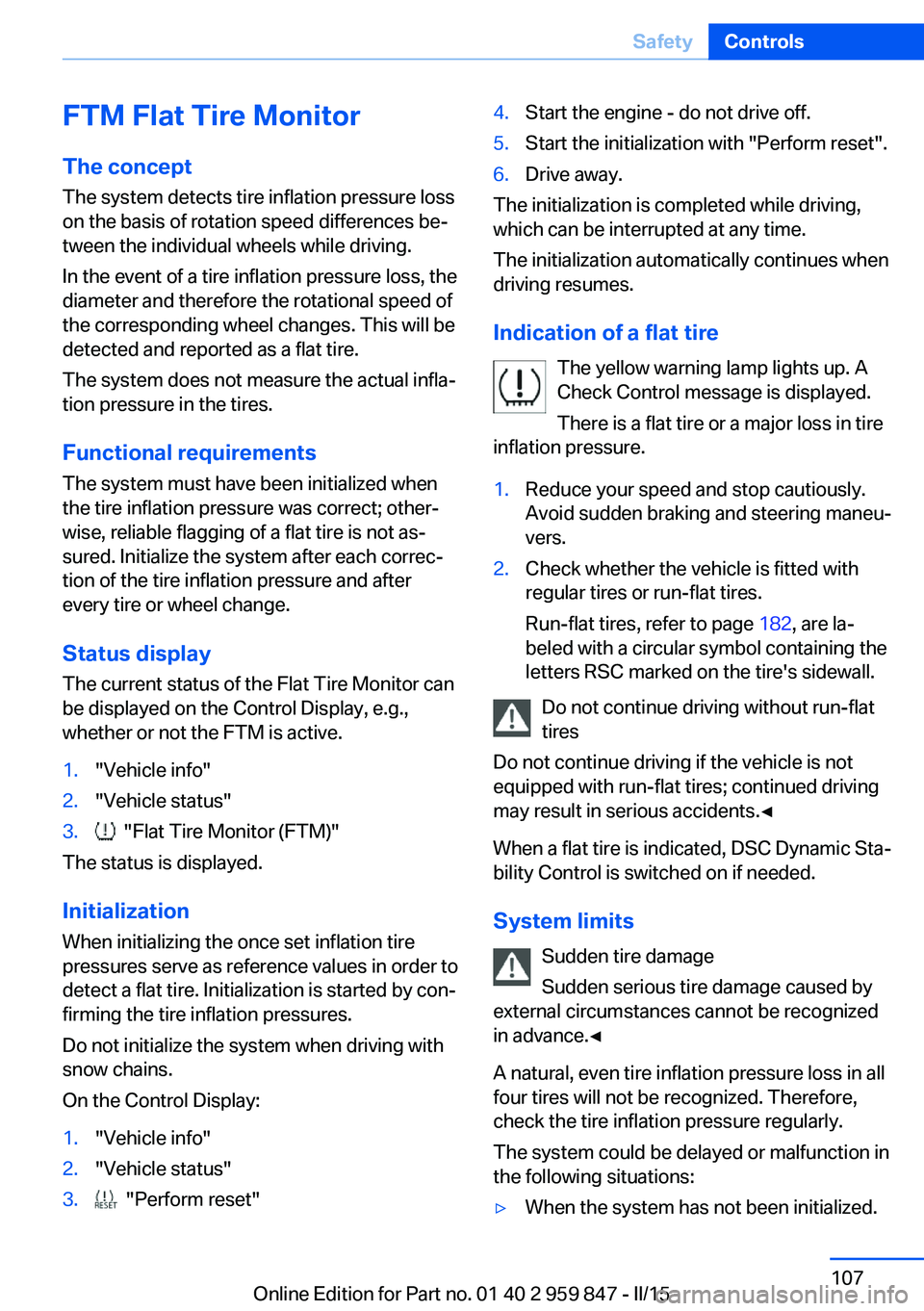
Indication of a flat tire The yellow warning lamp lights up. A
Check Control message is displayed.
There is a flat tire or a major loss in tire
inflation pressure.
1.Reduce your speed and stop cautiously.
Avoid sudden braking and steering maneu‐
vers.2.Check whether the vehicle is fitted with
regular tires or run-flat tires.
Run-flat tires, refer to page 182, are la‐
beled with a circular symbol containing the
letters RSC marked on the tire's sidewall.
Do not continue driving without run-flat
tires
Do not continue driving if the vehicle is not
equipped with run-flat tires; continued driving
may result in serious accidents.◀
When a flat tire is indicated, DSC Dynamic Sta‐
bility Control is switched on if needed.
System limits Sudden tire damage
Sudden serious tire damage caused by
external circumstances cannot be recognized
in advance.◀
A natural, even tire inflation pressure loss in all
four tires will not be recognized. Therefore,
check the tire inflation pressure regularly.
The system could be delayed or malfunction in
the following situations:
▷When the system has not been initialized.Seite 107SafetyControls107
Online Edition for Part no. 01 40 2 959 847 - II/15
Page 112 of 234
▷When driving on a snowy or slippery road
surface.▷Sporty driving style: spinning traction
wheels, high lateral acceleration (drifting).▷When driving with snow chains.
Actions in the event of a flat tire
Normal tires
1.Identify the damaged tire.
Do this by checking the air pressure in all
four tires.
If the tire inflation pressure in all four tires
is correct, the Flat Tire Monitor may not
have been initialized. In this case, initialize
the system.
If an identification is not possible, please
contact the service center.2.Rectify the flat tire on the damaged wheel.
Run-flat tires
Maximum speed
You may continue driving with a damaged tire
at speeds up to 50 mph/80 km/h.
Continued driving with a flat tire
If continuing to drive with a damaged tire:
1.Avoid sudden braking and steering maneu‐
vers.2.Do not exceed a speed of 50 mph/80 km/h.3.Check the air pressure in all four tires at
the next opportunity.
If the tire inflation pressure in all four tires
is correct, the Flat Tire Monitor may not
have been initialized. In this case, initialize
the system.
Possible driving distance with complete loss of
tire inflation pressure:
The possible driving distance after a loss of tire
inflation pressure depends on cargo load, driv‐
ing style and road conditions.
A vehicle with an average load has a possible
driving range of approx. 50 miles/80 km.
A vehicle with a damaged tire reacts differ‐
ently, e.g., it has reduced lane stability during
braking, a longer braking distance and different
self-steering properties. Adjust your driving
style accordingly. Avoid abrupt steering ma‐
neuvers or driving over obstacles, e.g., curbs,
potholes, etc.
Because the possible driving distance de‐
pends on how the vehicle is used during the
trip, the actual distance may be shorter or lon‐
ger depending on the driving speed, road con‐
ditions, external temperature, cargo load, etc.
Continued driving with a flat tire
Drive moderately and do not exceed a
speed of 50 mph/80 km/h.
Your car handles differently when you lose tire
inflation pressure, e.g., your lane stability is re‐
duced when braking, braking distances are
longer and the self-steering properties will
change.◀
Final tire failure
Vibrations or loud noises while driving
can indicate the final failure of a tire. Reduce
speed and stop; otherwise, pieces of the tire
could come loose and cause an accident. Do
not continue driving and contact your service
center.◀
Intelligent Safety
The concept Intelligent Safety enables central operation of
the driver assistance system.
Depending on how the vehicle is equipped, In‐
telligent Safety consists of one or more sys‐
tems that can help prevent a imminent colli‐
sion. These systems are active automatically
every time the engine is started using the
Start/Stop button:Seite 108ControlsSafety108
Online Edition for Part no. 01 40 2 959 847 - II/15
Page 127 of 234
Driving comfortVehicle features and options
This chapter describes all standard, country-
specific and optional features offered with the
series. It also describes features that are not
necessarily available in your car, e. g., due to
the selected options or country versions. This
also applies to safety-related functions and
systems. The respectively applicable country
provisions must be observed when using the
respective features and systems.
Cruise control The concept The system maintains a preset speed via the
buttons on the steering wheel. The system brakes on downhill gradients if engine braking
is insufficient.
General information
Depending on the driving settings, the features
of the cruise control can change in certain
areas.
Hints Unfavorable conditions
Do not use the system if unfavorable
conditions make it impossible to drive at a con‐
stant speed, e.g.:▷On winding roads.▷In heavy traffic.▷On slippery roads, in fog, snow or rain, or
on a loose road surface.
Otherwise, you could lose control of the vehi‐
cle and cause an accident.◀
Overview
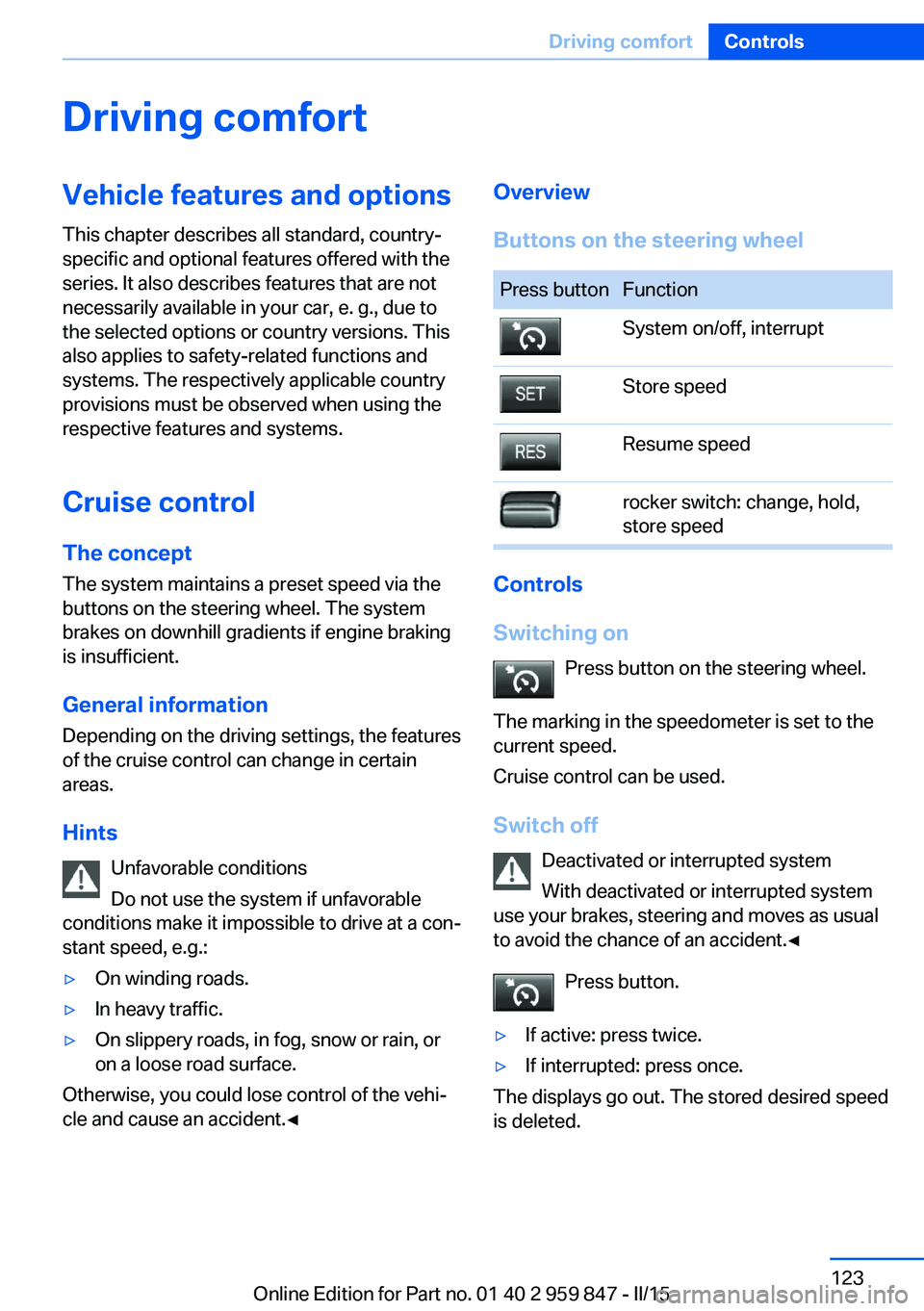
Buttons on the steering wheelPress buttonFunctionSystem on/off, interruptStore speedResume speedrocker switch: change, hold,
store speed
Controls
Switching on Press button on the steering wheel.
The marking in the speedometer is set to the
current speed.
Cruise control can be used.
Switch off Deactivated or interrupted system
With deactivated or interrupted system
use your brakes, steering and moves as usual
to avoid the chance of an accident.◀
Press button.
▷If active: press twice.▷If interrupted: press once.
The displays go out. The stored desired speed
is deleted.
Seite 123Driving comfortControls123
Online Edition for Part no. 01 40 2 959 847 - II/15
Page 145 of 234
This filter should be replaced during scheduled
maintenance, refer to page 193, of your vehi‐
cle.
Ventilation
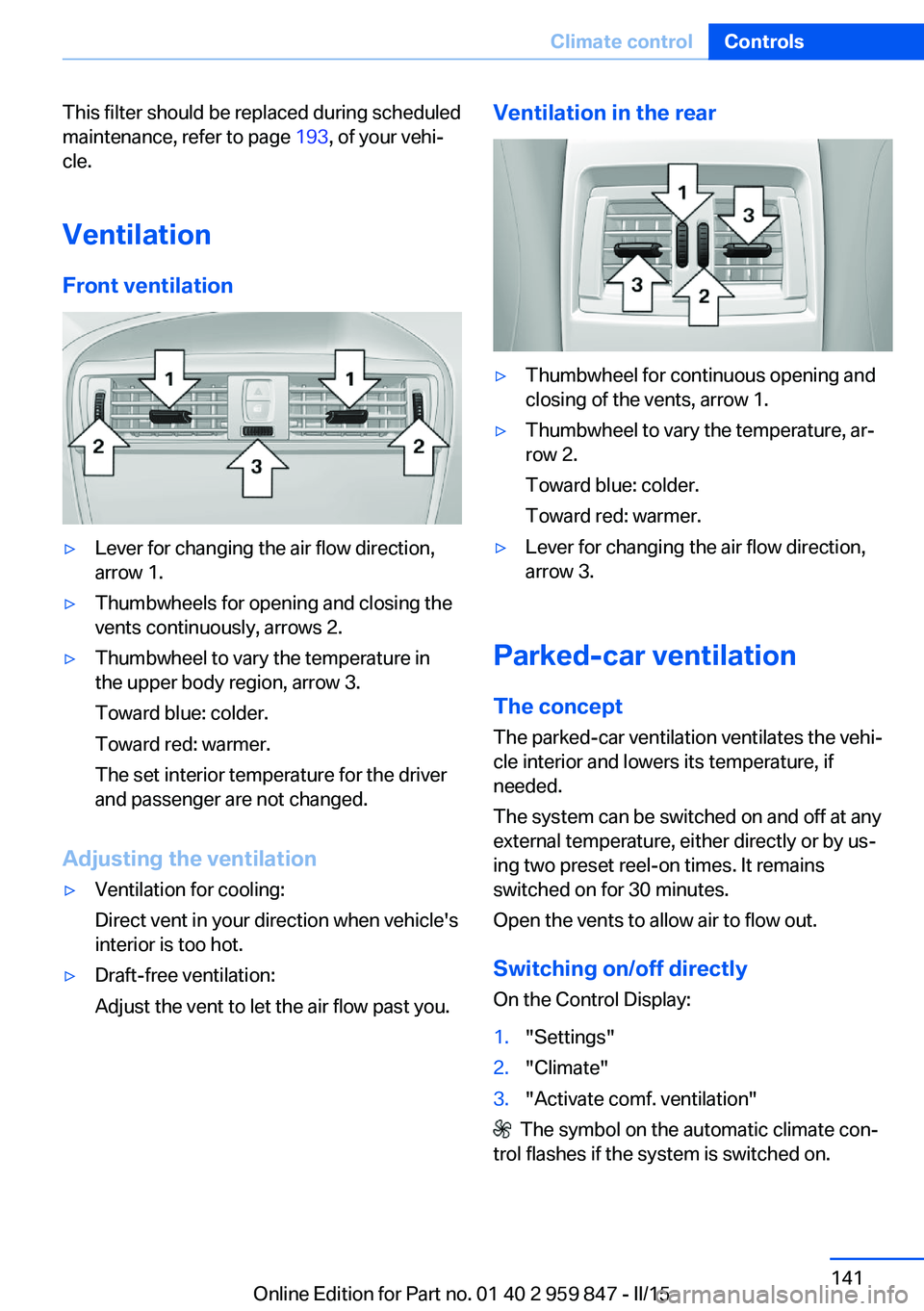
Front ventilation▷Lever for changing the air flow direction,
arrow 1.▷Thumbwheels for opening and closing the
vents continuously, arrows 2.▷Thumbwheel to vary the temperature in
the upper body region, arrow 3.
Toward blue: colder.
Toward red: warmer.
The set interior temperature for the driver
and passenger are not changed.
Adjusting the ventilation
▷Ventilation for cooling:
Direct vent in your direction when vehicle's
interior is too hot.▷Draft-free ventilation:
Adjust the vent to let the air flow past you.Ventilation in the rear▷Thumbwheel for continuous opening and
closing of the vents, arrow 1.▷Thumbwheel to vary the temperature, ar‐
row 2.
Toward blue: colder.
Toward red: warmer.▷Lever for changing the air flow direction,
arrow 3.
Parked-car ventilation
The concept The parked-car ventilation ventilates the vehi‐
cle interior and lowers its temperature, if
needed.
The system can be switched on and off at any
external temperature, either directly or by us‐
ing two preset reel-on times. It remains
switched on for 30 minutes.
Open the vents to allow air to flow out.
Switching on/off directly
On the Control Display:
1."Settings"2."Climate"3."Activate comf. ventilation"
The symbol on the automatic climate con‐
trol flashes if the system is switched on.
Seite 141Climate controlControls141
Online Edition for Part no. 01 40 2 959 847 - II/15
Page 205 of 234

bumper area. In addition to the two outer
fasteners, there is another inner fastener.4.Grasp the handle with one hand, arrow 1,
and brace with the free hand on the out‐
side, arrow 2. Carefully pry out the tail
lamp, arrow 3, until the rubber mount re‐
leases from the inner fastener.5.Remove the plug from the bulb holder.
Replacing the bulbs
1.Loosen the six fasteners on the tail lamp,
arrows 1, and remove the tail lamp from the
lamp holder, arrow 2.2.Press the defective bulb gently into the
socket, turn counterclockwise and remove.3.Proceed in the reverse order to insert the
new bulb and attach the bulb holder to the
tail lamp. Make sure that the bulb holder
engages in all fasteners.
Installing the tail lamp
1.Connect the plug to the bulb holder.2.Insert the tail lamp straight in and press it
in, arrow 1, until the rubber mount latches
in the inner fastener. Make sure when in‐
serting the tail lamp that the rubber lip, ar‐
row 2, on the top side of the tail lamp does
not fold over. Screw on the two nuts, ar‐
row 3, and close covers.
Central brake lamp and license plate
lamp
Follow general instructions, refer to page 195.
These lights are made using LED technology.
Contact your service center in the event of a
malfunction.
Changing wheels
Hints
When using run-flat tires or sealants, a tire
does not need to be changed immediately in
the event of pressure loss due to a flat tire.
Which is why no spare tire is available.
The tools for changing wheels are available as
accessories from your service center.
Seite 201Replacing componentsMobility201
Online Edition for Part no. 01 40 2 959 847 - II/15
Page 225 of 234
Bulb replacement 195
Bulb replacement, front 196
Bulb replacement, rear 200
Bulbs and lights 195
Button, Start/Stop 67
Bypassing, refer to Jump- starting 205
C
California Proposition 65 Warning 7
Camera lenses, care 214
Camera, rearview cam‐ era 128
Can holder, refer to Cu‐ pholder 153
Car battery 202
Car care products 211
Care, displays 214
Care, vehicle 211
Cargo 159
Cargo area, enlarging 149
Cargo area partition 49
Cargo area, storage compart‐ ments 153
Cargo, securing 160
Cargo straps, securing cargo 160
Car key, refer to Remote con‐ trol 34
Carpet, care 213
Car wash 210
Catalytic converter, refer to Hot exhaust system 157
CBS Condition Based Serv‐ ice 193
CD/Multimedia, see user's manual for Navigation, En‐
tertainment and Communi‐
cation
Center armrest 152
Center console 16
Central locking system 40
Central screen, refer to Con‐ trol Display 18 Changes, technical, refer to
Safety 7
Changing parts 195
Changing wheels 201
Changing wheels/tires 180
Chassis number, see vehicle identification number 9
Check Control 81
Checking the oil level elec‐ tronically 189
Children, seating position 64
Children, transporting safely 64
Child restraint fixing sys‐ tem 64
Child restraint fixing system LATCH 66
Child restraint fixing systems, mounting 64
Child seat, mounting 64
Child seats 64
Chrome parts, care 213
Cigarette lighter 147
Cleaning displays 214
Climate control 135, 138
Clock 85
Closing/opening via door lock 39
Closing/opening with remote control 37
Coasting 165
Coasting with engine decou‐ pled, coasting 165
Coasting with idling en‐ gine 165
Cockpit 14
Combination reel, refer to Turn signals 71
Combination switch, refer to Wiper system 72
Comfort Access 41
COMFORT program, Dy‐ namic Driving Control 121
Compartments in the doors 152
Compass 145 Compressor 182
Condensation on win‐ dows 140
Condensation under the vehi‐ cle 158
Condition Based Service CBS 193
Configuring driving pro‐ gram 121
Confirmation signal 43
ConnectedDrive, see user's manual for Navigation, En‐
tertainment and Communi‐
cation
ConnectedDrive Services
Connecting electrical devi‐ ces 147
Continued driving with a flat tire 105 , 108
Control Display 18
Control Display, settings 91
Controller 18, 19
Control systems, driving sta‐ bility 117
Convenient closing with the remote control 38
Convenient opening with the remote control 37
Convertible, convertible top 47
Convertible mode, automatic climate control 136, 139
Convertible program, auto‐ matic climate con‐
trol 136 , 139
Convertible top 47
Convertible top, care 212
Convertible top, cargo area partition 49
Convertible top, emergency operation 49
Convertible top, rollover pro‐ tection system 102
Coolant 192
Coolant level 192
Coolant temperature 84 Seite 221Everything from A to ZReference221
Online Edition for Part no. 01 40 2 959 847 - II/15
Page 227 of 234
Engine start during malfunc‐tion 35
Engine start, jump-start‐ ing 205
Engine start, refer to Starting the engine 68
Engine stop 68
Entering a car wash 210
Equipment, interior 143
Error displays, see Check Control 81
ESP Electronic Stability Pro‐ gram, refer to DSC 117
Exchanging wheels/tires 180
Exhaust system 157
Exterior mirror, automatic dimming feature 62
Exterior mirrors 61
External start 205
External temperature dis‐ play 85
External temperature warn‐ ing 85
Eyes for securing cargo 160
F
Failure message, see Check Control 81
False alarm, refer to Uninten‐ tional alarm 45
Fan, refer to Air flow 136, 140
Filler neck for engine oil 190
Fine wood, care 213
First aid kit 205
Fitting for towing, see Tow fit‐ ting 208
Flat tire, changing wheels 201
Flat Tire Monitor FTM 107
Flat tire, Tire Pressure Moni‐ tor TPM 103
Flat tire, warning lamp 104, 107
Flooding 157 Floor carpet, care 213
Floor mats, care 213
Fogged up windows 136
Fold down the rear seat back‐ rest, see Though-loading
system 149
Fold-out position, wiper 74
Foot brake 157
Front airbags 99
Front-end collision warning with City Braking func‐
tion 109
Front fog lights 97
Front fog lights, front, bulb re‐ placement 199
Front lights 196
front-seat passenger airbags, automatic deactivation 101
Front-seat passenger airbags, indicator lamp 101
FTM Flat Tire Monitor 107
Fuel 172
Fuel consumption, refer to Average fuel consump‐
tion 90
Fuel filler flap 170
Fuel gauge 84
Fuel lid 170
Fuel quality 172
Fuel recommendation 172
Fuel, tank capacity 219
Fuse 203
G
Garage door opener, refer to Universal Integrated Remote
Control 143
Gasoline 172
Gear change, Steptronic transmission 76
Gear shift indicator 87
General driving notes 156
Glare shield 147
Glove compartment 151 Gross vehicle weight, ap‐
proved 218
H
Halogen headlights, bulb re‐ placement 196
Handbrake, refer to parking brake 71
Hand-held transmitter, alter‐ nating code 144
Hazard warning flashers 204
Headlight control, auto‐ matic 95
Headlight courtesy delay fea‐ ture 95
Headlight flasher 72
Headlight flasher, bulb re‐ placement 198
Headlight glass 196
Headlights 196
Headlights, care 211
Headlight washer system 72
Head restraints 54
Head restraints, front 59
Head restraints, rear 59
Heavy cargo, stowing 160
High-beam Assistant 96
High beams 72
High beams/low beams, refer to High-beam Assistant 96
High beams, bulb replace‐ ment 198
Hills 158
Hill start assistant, refer to Drive-off assistant 121
Hints 6
Holder for beverages 153
Homepage 6
Hood 188
Horn 14
Hotel function, trunk lid 41
Hot exhaust system 157
Hydroplaning 157 Seite 223Everything from A to ZReference223
Online Edition for Part no. 01 40 2 959 847 - II/15
Page 229 of 234
Malfunction displays, seeCheck Control 81
Manual air distribu‐ tion 136, 140
Manual air flow 136, 140
Manual mode, Steptronic transmission 76
Manual operation, door lock 39
Manual operation, exterior mirrors 61
Manual operation, fuel filler flap 170
Manual operation, Park Dis‐ tance Control PDC 126
Manual operation, rearview camera 128
Manual transmission 75
Marking on approved tires 181
Marking, run-flat tires 182
Master key, refer to Remote control 34
Maximum cooling 139
Maximum speed, display 87
Maximum speed, winter tires 181
Measure, units of 92
Medical kit 205
Memory, seat, mirror 60
Menu, EfficientDynamics 165
Menu in instrument clus‐ ter 88
Menus, operating, iDrive 18
Menus, refer to iDrive operat‐ ing concept 20
Messages, see Check Con‐ trol 81
Microfilter 137, 140
Minimum tread, tires 180
Mirror 61
Mirror memory 60
Mobile communication devi‐ ces in the vehicle 157
Mobility System 182 Modifications, technical, refer
to Safety 7
Moisture in headlight 196
Monitor, refer to Control Dis‐ play 18
Mounting of child restraint systems 64
Multifunction steering wheel, buttons 14
N Navigation, see user's manual for Navigation, Entertain‐
ment and Communication
Neck restraints, front, refer to Head restraints 59
Neck restraints, rear, refer to Head restraints 59
Neutral cleaner, see wheel cleaner 213
New wheels and tires 180
Nylon rope for tow-starting/ towing 208
O OBD Onboard Diagnosis 194
OBD, see OBD Onboard Di‐ agnosis 194
Obstacle marking, rearview camera 129
Octane rating, refer to Rec‐ ommended fuel grade 172
Odometer 84
Office, see user's manual for Navigation, Entertainment
and Communication
Oil 189
Oil, adding 190
Oil additives 190
Oil change 191
Oil change interval, service requirements 86
Oil filler neck 190
Oil types, alternative 191 Oil types, approved 191
Old batteries, disposal 202
On-board computer 89
On-board computer, refer to On-board computer 89
Onboard monitor, refer to Control Display 18
Onboard vehicle tool kit 195
Opening/closing via door lock 39
Opening and closing 34
Opening and closing, without remote control 39
Opening and closing, with re‐ mote control 37
Operating concept, iDrive 18
Optional equipment, standard equipment 6
Outside air, refer to Auto‐ matic recirculated-air con‐
trol 139
Overheating of engine, refer to Coolant temperature 84
P Paint, vehicle 211
Parallel parking assistant 130
Park Distance Control PDC 125
Parked-car ventilation 141
Parked vehicle, condensa‐ tion 158
Parking aid, refer to PDC 125
Parking assistant 130
Parking brake 71
Parking lights 94
Parking lights, bulb replace‐ ment 198
Parts and accessories 7
Passenger side mirror, tilting downward 61
Pathway lines, rearview cam‐ era 129
PDC Park Distance Con‐ trol 125 Seite 225Everything from A to ZReference225
Online Edition for Part no. 01 40 2 959 847 - II/15
Page 231 of 234
Socket 147
Socket, OBD Onboard Diag‐ nostics 194
SOS button 204
Spare fuse 203
Specified engine oil types 191
Speed, average 90
Speed limit detection, on- board computer 90
Speed limiter, display 87
Speed Limit Information 87
Speed warning 91
Split screen 23
SPORT+ - program, Dynamic Driving Control 120
Sport displays, torque dis‐ play, performance dis‐
play 91
SPORT program, Dynamic Driving Control 120
Sport program, transmis‐ sion 76
Sport steering, variable 119
Stability control systems 117
Start/stop, automatic func‐ tion 69
Start/Stop button 67
Start function during malfunc‐ tion 35
Starting the engine 68
Status control display, tires 104
Status information, iDrive 23
Status of Owner's Manual 7
Steering assistance 119
Steering wheel, adjusting 63
Steering wheel heating 63
Steptronic Sport transmis‐ sion, refer to Steptronic
transmission 75
Steptronic transmission 75
Stopping the engine 68
Storage compartment in the rear 153
Storage compartments 151 Storage, tires 182
Storing the vehicle 214
Suitable engine oils 191
Summer tires, tread 180
Sun visor 147
Supplementary text mes‐ sages 83
Switch for Dynamic Driv‐ ing 119
Switch-on times, parked-car ventilation 142
Switch, refer to Cockpit 14
Symbols 6
Symbols in the status field 23
T Tachometer 84
Tail lights 200
Technical changes, refer to Safety 7
Technical data 218
Telephone, see user's manual for Navigation, Entertain‐
ment and Communication
Temperature, automatic cli‐ mate control 136, 138
Temperature display for ex‐ ternal temperature 85
Terminal, starting aid 206
Text messages, supplemen‐ tary 83
Theft alarm system, refer to Alarm system 44
Thigh support 56
Through-loading system 149
Tilt alarm sensor 45
Time of arrival 90
Tire damage 180
Tire identification marks 178
Tire inflation pressure 174
Tire inflation pressure moni‐ tor, refer to FTM 107
Tire Pressure Monitor TPM 103
Tires, changing 180 Tire sealant 182
Tires, everything on wheels and tires 174
Tires, run-flat tires 182
Tire tread 180
Tone, see user's manual for Navigation, Entertainment
and Communication
Tool 195
Total vehicle weight 218
Touchpad 21
Tow fitting 208
Towing 207
Tow lug, see Tow fitting 208
Tow-starting 207
Tow truck 207
TPM Tire Pressure Moni‐ tor 103
Traction control 118
TRACTION, driving dynam‐ ics 118
Transmission lock, electronic unlocking 78
Transmission, manual trans‐ mission 75
Transmission, Steptronic transmission 75
Transporting children safely 64
Tread, tires 180
Trip computer 90
Triple turn signal activa‐ tion 72
Trip odometer 84
Truck for tow-starting/ towing 207
Trunk, cargo area partition 49
Trunk lid closing 41
Trunk lid, emergency unlock‐ ing 41
Trunk lid, hotel function 41
Trunk lid opening 40
Trunk lid via remote con‐ trol 38
Turning circle lines, rearview camera 129 Seite 227Everything from A to ZReference227
Online Edition for Part no. 01 40 2 959 847 - II/15