Idle BMW 3 SERIES 1985 E30 User Guide
[x] Cancel search | Manufacturer: BMW, Model Year: 1985, Model line: 3 SERIES, Model: BMW 3 SERIES 1985 E30Pages: 228, PDF Size: 7.04 MB
Page 46 of 228
alignment mark on the camshaft sprocket and
rear timing cover to ensure correct refitting.
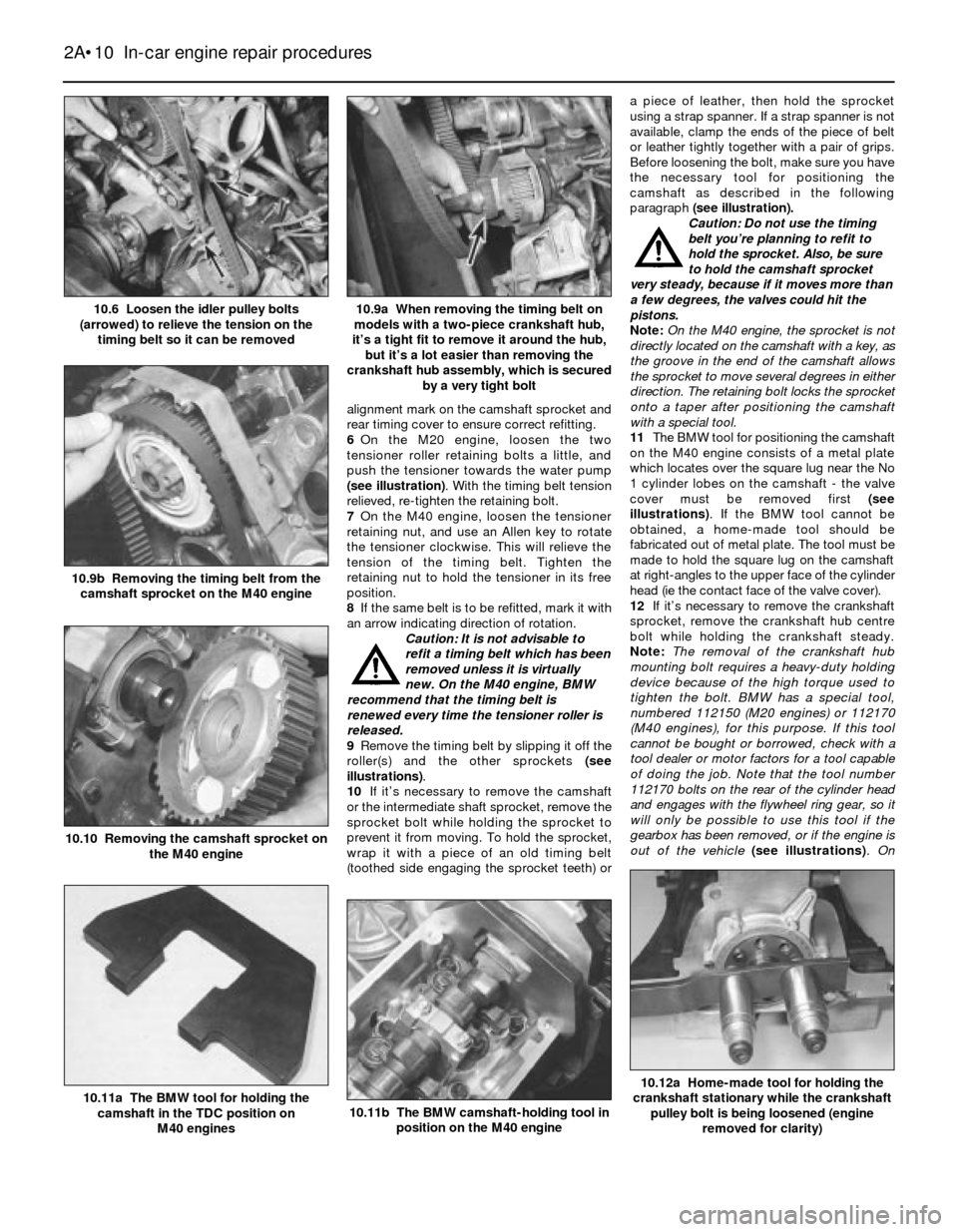
6On the M20 engine, loosen the two
tensioner roller retaining bolts a little, and
push the tensioner towards the water pump
(see illustration). With the timing belt tension
relieved, re-tighten the retaining bolt.
7On the M40 engine, loosen the tensioner
retaining nut, and use an Allen key to rotate
the tensioner clockwise. This will relieve the
tension of the timing belt. Tighten the
retaining nut to hold the tensioner in its free
position.
8If the same belt is to be refitted, mark it with
an arrow indicating direction of rotation.
Caution: It is not advisable to
refit a timing belt which has been
removed unless it is virtually
new. On the M40 engine, BMW
recommend that the timing belt is
renewed every time the tensioner roller is
released.
9Remove the timing belt by slipping it off the
roller(s) and the other sprockets (see
illustrations).
10If it’s necessary to remove the camshaft
or the intermediate shaft sprocket, remove the
sprocket bolt while holding the sprocket to
prevent it from moving. To hold the sprocket,
wrap it with a piece of an old timing belt
(toothed side engaging the sprocket teeth) ora piece of leather, then hold the sprocket
using a strap spanner. If a strap spanner is not
available, clamp the ends of the piece of belt
or leather tightly together with a pair of grips.
Before loosening the bolt, make sure you have
the necessary tool for positioning the
camshaft as described in the following
paragraph (see illustration).
Caution: Do not use the timing
belt you’re planning to refit to
hold the sprocket. Also, be sure
to hold the camshaft sprocket
very steady, because if it moves more than
a few degrees, the valves could hit the
pistons.
Note: On the M40 engine, the sprocket is not
directly located on the camshaft with a key, as
the groove in the end of the camshaft allows
the sprocket to move several degrees in either
direction. The retaining bolt locks the sprocket
onto a taper after positioning the camshaft
with a special tool.
11The BMW tool for positioning the camshaft
on the M40 engine consists of a metal plate
which locates over the square lug near the No
1 cylinder lobes on the camshaft - the valve
cover must be removed first (see
illustrations). If the BMW tool cannot be
obtained, a home-made tool should be
fabricated out of metal plate. The tool must be
made to hold the square lug on the camshaft
at right-angles to the upper face of the cylinder
head (ie the contact face of the valve cover).
12If it’s necessary to remove the crankshaft
sprocket, remove the crankshaft hub centre
bolt while holding the crankshaft steady.
Note:The removal of the crankshaft hub
mounting bolt requires a heavy-duty holding
device because of the high torque used to
tighten the bolt. BMW has a special tool,
numbered 112150 (M20 engines) or 112170
(M40 engines), for this purpose. If this tool
cannot be bought or borrowed, check with a
tool dealer or motor factors for a tool capable
of doing the job. Note that the tool number
112170 bolts on the rear of the cylinder head
and engages with the flywheel ring gear, so it
will only be possible to use this tool if the
gearbox has been removed, or if the engine is
out of the vehicle (see illustrations). On
2A•10 In-car engine repair procedures
10.12a Home-made tool for holding the
crankshaft stationary while the crankshaft
pulley bolt is being loosened (engine
removed for clarity)
10.11b The BMW camshaft-holding tool in
position on the M40 engine10.11a The BMW tool for holding the
camshaft in the TDC position on
M40 engines
10.10 Removing the camshaft sprocket on
the M40 engine
10.9b Removing the timing belt from the
camshaft sprocket on the M40 engine
10.9a When removing the timing belt on
models with a two-piece crankshaft hub,
it’s a tight fit to remove it around the hub,
but it’s a lot easier than removing the
crankshaft hub assembly, which is secured
by a very tight bolt10.6 Loosen the idler pulley bolts
(arrowed) to relieve the tension on the
timing belt so it can be removed
Page 47 of 228
models with a two-piece hub, after removing
the outer hub piece, you’ll then need to
remove the sprocket with a bolt-type puller
(available at most motor factors). When using
the puller, thread the crankshaft centre bolt in
approximately three turns, and use this as a
bearing point for the puller’s centre bolt.
Inspection
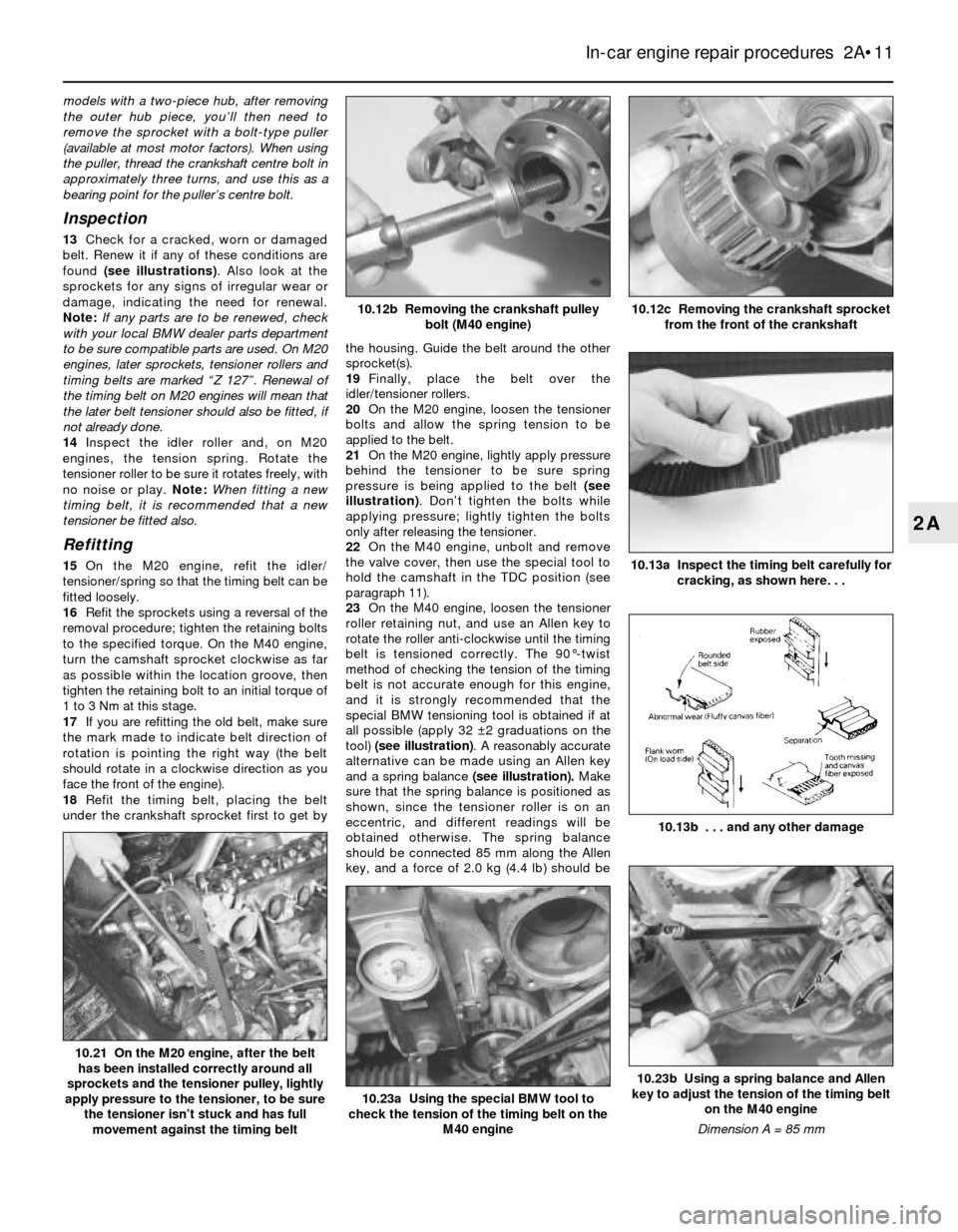
13Check for a cracked, worn or damaged
belt. Renew it if any of these conditions are
found (see illustrations). Also look at the
sprockets for any signs of irregular wear or
damage, indicating the need for renewal.
Note:If any parts are to be renewed, check
with your local BMW dealer parts department
to be sure compatible parts are used. On M20
engines, later sprockets, tensioner rollers and
timing belts are marked “Z 127”. Renewal of
the timing belt on M20 engines will mean that
the later belt tensioner should also be fitted, if
not already done.
14Inspect the idler roller and, on M20
engines, the tension spring. Rotate the
tensioner roller to be sure it rotates freely, with
no noise or play. Note:When fitting a new
timing belt, it is recommended that a new
tensioner be fitted also.
Refitting
15On the M20 engine, refit the idler/
tensioner/spring so that the timing belt can be
fitted loosely.
16Refit the sprockets using a reversal of the
removal procedure; tighten the retaining bolts
to the specified torque. On the M40 engine,
turn the camshaft sprocket clockwise as far
as possible within the location groove, then
tighten the retaining bolt to an initial torque of
1 to 3 Nm at this stage.
17If you are refitting the old belt, make sure
the mark made to indicate belt direction of
rotation is pointing the right way (the belt
should rotate in a clockwise direction as you
face the front of the engine).
18Refit the timing belt, placing the belt
under the crankshaft sprocket first to get bythe housing. Guide the belt around the other
sprocket(s).
19Finally, place the belt over the
idler/tensioner rollers.
20On the M20 engine, loosen the tensioner
bolts and allow the spring tension to be
applied to the belt.
21On the M20 engine, lightly apply pressure
behind the tensioner to be sure spring
pressure is being applied to the belt (see
illustration). Don’t tighten the bolts while
applying pressure; lightly tighten the bolts
only after releasing the tensioner.
22On the M40 engine, unbolt and remove
the valve cover, then use the special tool to
hold the camshaft in the TDC position (see
paragraph 11).
23On the M40 engine, loosen the tensioner
roller retaining nut, and use an Allen key to
rotate the roller anti-clockwise until the timing
belt is tensioned correctly. The 90°-twist
method of checking the tension of the timing
belt is not accurate enough for this engine,
and it is strongly recommended that the
special BMW tensioning tool is obtained if at
all possible (apply 32 ±2 graduations on the
tool) (see illustration). A reasonably accurate
alternative can be made using an Allen key
and a spring balance (see illustration).Make
sure that the spring balance is positioned as
shown, since the tensioner roller is on an
eccentric, and different readings will be
obtained otherwise. The spring balance
should be connected 85 mm along the Allen
key, and a force of 2.0 kg (4.4 lb) should be
In-car engine repair procedures 2A•11
10.13a Inspect the timing belt carefully for
cracking, as shown here. . .
10.13b . . . and any other damage
10.12c Removing the crankshaft sprocket
from the front of the crankshaft10.12b Removing the crankshaft pulley
bolt (M40 engine)
10.23b Using a spring balance and Allen
key to adjust the tension of the timing belt
on the M40 engine
Dimension A = 85 mm
10.23a Using the special BMW tool to
check the tension of the timing belt on the
M40 engine
10.21 On the M20 engine, after the belt
has been installed correctly around all
sprockets and the tensioner pulley, lightly
apply pressure to the tensioner, to be sure
the tensioner isn’t stuck and has full
movement against the timing belt
2A
Page 57 of 228

2B
General
Cylinder compression pressure (all engines) . . . . . . . . . . . . . . . . . . . . . 10 to 11 bars
Oil pressure (all engines)
At idle . . . . . . . . . . . . . . . . . . . . . . . . . . . . . . . . . . . . . . . . . . . . . . . . . 0.5 to 2.0 bars
Running (for example, at 4000 rpm) . . . . . . . . . . . . . . . . . . . . . . . . . . 4 bars or above (typically)
Cylinder head warpage limit
Except M40 engine . . . . . . . . . . . . . . . . . . . . . . . . . . . . . . . . . . . . . . . 0.10 mm
M40 engine . . . . . . . . . . . . . . . . . . . . . . . . . . . . . . . . . . . . . . . . . . . . . 0.03 mm
Minimum cylinder head thickness (do not resurface the head to a thickness less than listed)
M10 and M30 engines . . . . . . . . . . . . . . . . . . . . . . . . . . . . . . . . . . . . 128.6 mm
M20 engines . . . . . . . . . . . . . . . . . . . . . . . . . . . . . . . . . . . . . . . . . . . . 124.7 mm
M40 engine . . . . . . . . . . . . . . . . . . . . . . . . . . . . . . . . . . . . . . . . . . . . . 140.55 mm
Valves
Valve stem diameter (standard)
M10 and M30 engines . . . . . . . . . . . . . . . . . . . . . . . . . . . . . . . . . . . . 8.0 mm
M20 engine . . . . . . . . . . . . . . . . . . . . . . . . . . . . . . . . . . . . . . . . . . . . . 7.0 mm
M40 engine
Intake . . . . . . . . . . . . . . . . . . . . . . . . . . . . . . . . . . . . . . . . . . . . . . . 6.975 mm
Exhaust . . . . . . . . . . . . . . . . . . . . . . . . . . . . . . . . . . . . . . . . . . . . . . 6.960 mm
Minimum valve margin width
Intake . . . . . . . . . . . . . . . . . . . . . . . . . . . . . . . . . . . . . . . . . . . . . . . 1.191 mm
Exhaust . . . . . . . . . . . . . . . . . . . . . . . . . . . . . . . . . . . . . . . . . . . . . . 1.98 mm
Valve stem maximum lateral movement (see text) . . . . . . . . . . . . . . . . . 0.787 mm
Valve face angle
Intake . . . . . . . . . . . . . . . . . . . . . . . . . . . . . . . . . . . . . . . . . . . . . . . . . 45°
Exhaust . . . . . . . . . . . . . . . . . . . . . . . . . . . . . . . . . . . . . . . . . . . . . . . . 45°
Chapter 2 Part B:
General engine overhaul procedures
Compression check . . . . . . . . . . . . . . . . . . . . . . . . . . . . . . . . . . . . . 3
Crankshaft - inspection . . . . . . . . . . . . . . . . . . . . . . . . . . . . . . . . . . . 19
Crankshaft - refitting and main bearing oil clearance check . . . . . . . 24
Crankshaft - removal . . . . . . . . . . . . . . . . . . . . . . . . . . . . . . . . . . . . . 13
Crankshaft rear oil seal - refitting . . . . . . . . . . . . . . . . . . . . . . . . . . . 25
Cylinder head and components - cleaning and inspection . . . . . . . 9
Cylinder head - dismantling . . . . . . . . . . . . . . . . . . . . . . . . . . . . . . . 8
Cylinder head - reassembly . . . . . . . . . . . . . . . . . . . . . . . . . . . . . . . 11
Cylinder honing . . . . . . . . . . . . . . . . . . . . . . . . . . . . . . . . . . . . . . . . . 17
Engine - removal and refitting . . . . . . . . . . . . . . . . . . . . . . . . . . . . . . 5
Engine block - cleaning . . . . . . . . . . . . . . . . . . . . . . . . . . . . . . . . . . . 15
Engine block - inspection . . . . . . . . . . . . . . . . . . . . . . . . . . . . . . . . . 16
Engine overhaul - alternatives . . . . . . . . . . . . . . . . . . . . . . . . . . . . . . 6
Engine overhaul - dismantling sequence . . . . . . . . . . . . . . . . . . . . . 7Engine overhaul - general information . . . . . . . . . . . . . . . . . . . . . . . 2
Engine overhaul - reassembly sequence . . . . . . . . . . . . . . . . . . . . . 21
Engine removal - methods and precautions . . . . . . . . . . . . . . . . . . . 4
General information . . . . . . . . . . . . . . . . . . . . . . . . . . . . . . . . . . . . . . 1
Initial start-up and break-in after overhaul . . . . . . . . . . . . . . . . . . . . 27
Intermediate shaft - refitting . . . . . . . . . . . . . . . . . . . . . . . . . . . . . . . 23
Intermediate shaft - removal and inspection . . . . . . . . . . . . . . . . . . . 14
Main and connecting big-end bearings - inspection . . . . . . . . . . . . 20
Piston rings - refitting . . . . . . . . . . . . . . . . . . . . . . . . . . . . . . . . . . . . 22
Pistons/connecting rods - inspection . . . . . . . . . . . . . . . . . . . . . . . . 18
Pistons/connecting rods - refitting and big-end bearing oil
clearance check . . . . . . . . . . . . . . . . . . . . . . . . . . . . . . . . . . . . . . 26
Pistons/connecting rods - removal . . . . . . . . . . . . . . . . . . . . . . . . . . 12
Valves - servicing . . . . . . . . . . . . . . . . . . . . . . . . . . . . . . . . . . . . . . . 10
2B•1
Easy,suitable for
novice with little
experienceFairly easy,suitable
for beginner with
some experienceFairly difficult,
suitable for competent
DIY mechanic
Difficult,suitable for
experienced DIY
mechanicVery difficult,
suitable for expert
DIY or professional
Degrees of difficulty
Specifications Contents
Page 61 of 228
otherwise a small brush or even a bicycle tyre
pump will work). The idea is to prevent dirt
from getting into the cylinders as the
compression check is being done.
3Remove all the spark plugs from the engine
(see Chapter 1).
4Block the throttle wide open, or have an
assistant hold the throttle pedal down.
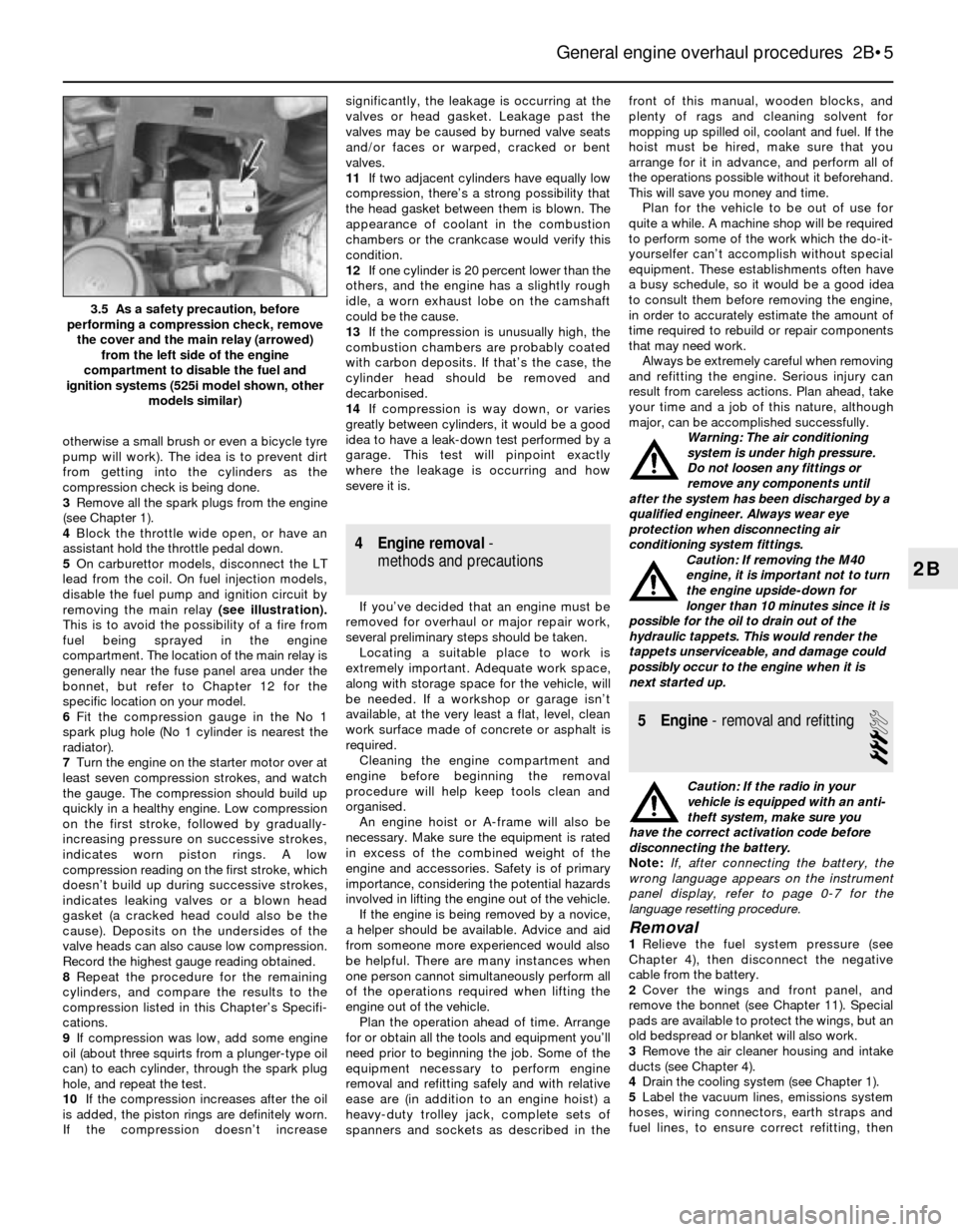
5On carburettor models, disconnect the LT
lead from the coil. On fuel injection models,
disable the fuel pump and ignition circuit by
removing the main relay(see illustration).
This is to avoid the possibility of a fire from
fuel being sprayed in the engine
compartment. The location of the main relay is
generally near the fuse panel area under the
bonnet, but refer to Chapter 12 for the
specific location on your model.
6Fit the compression gauge in the No 1
spark plug hole (No 1 cylinder is nearest the
radiator).
7Turn the engine on the starter motor over at
least seven compression strokes, and watch
the gauge. The compression should build up
quickly in a healthy engine. Low compression
on the first stroke, followed by gradually-
increasing pressure on successive strokes,
indicates worn piston rings. A low
compression reading on the first stroke, which
doesn’t build up during successive strokes,
indicates leaking valves or a blown head
gasket (a cracked head could also be the
cause). Deposits on the undersides of the
valve heads can also cause low compression.
Record the highest gauge reading obtained.
8Repeat the procedure for the remaining
cylinders, and compare the results to the
compression listed in this Chapter’s Specifi-
cations.
9If compression was low, add some engine
oil (about three squirts from a plunger-type oil
can) to each cylinder, through the spark plug
hole, and repeat the test.
10If the compression increases after the oil
is added, the piston rings are definitely worn.
If the compression doesn’t increasesignificantly, the leakage is occurring at the
valves or head gasket. Leakage past the
valves may be caused by burned valve seats
and/or faces or warped, cracked or bent
valves.
11If two adjacent cylinders have equally low
compression, there’s a strong possibility that
the head gasket between them is blown. The
appearance of coolant in the combustion
chambers or the crankcase would verify this
condition.
12If one cylinder is 20 percent lower than the
others, and the engine has a slightly rough
idle, a worn exhaust lobe on the camshaft
could be the cause.
13If the compression is unusually high, the
combustion chambers are probably coated
with carbon deposits. If that’s the case, the
cylinder head should be removed and
decarbonised.
14If compression is way down, or varies
greatly between cylinders, it would be a good
idea to have a leak-down test performed by a
garage. This test will pinpoint exactly
where the leakage is occurring and how
severe it is.
4 Engine removal-
methods and precautions
If you’ve decided that an engine must be
removed for overhaul or major repair work,
several preliminary steps should be taken.
Locating a suitable place to work is
extremely important. Adequate work space,
along with storage space for the vehicle, will
be needed. If a workshop or garage isn’t
available, at the very least a flat, level, clean
work surface made of concrete or asphalt is
required.
Cleaning the engine compartment and
engine before beginning the removal
procedure will help keep tools clean and
organised.
An engine hoist or A-frame will also be
necessary. Make sure the equipment is rated
in excess of the combined weight of the
engine and accessories. Safety is of primary
importance, considering the potential hazards
involved in lifting the engine out of the vehicle.
If the engine is being removed by a novice,
a helper should be available. Advice and aid
from someone more experienced would also
be helpful. There are many instances when
one person cannot simultaneously perform all
of the operations required when lifting the
engine out of the vehicle.
Plan the operation ahead of time. Arrange
for or obtain all the tools and equipment you’ll
need prior to beginning the job. Some of the
equipment necessary to perform engine
removal and refitting safely and with relative
ease are (in addition to an engine hoist) a
heavy-duty trolley jack, complete sets of
spanners and sockets as described in thefront of this manual, wooden blocks, and
plenty of rags and cleaning solvent for
mopping up spilled oil, coolant and fuel. If the
hoist must be hired, make sure that you
arrange for it in advance, and perform all of
the operations possible without it beforehand.
This will save you money and time.
Plan for the vehicle to be out of use for
quite a while. A machine shop will be required
to perform some of the work which the do-it-
yourselfer can’t accomplish without special
equipment. These establishments often have
a busy schedule, so it would be a good idea
to consult them before removing the engine,
in order to accurately estimate the amount of
time required to rebuild or repair components
that may need work.
Always be extremely careful when removing
and refitting the engine. Serious injury can
result from careless actions. Plan ahead, take
your time and a job of this nature, although
major, can be accomplished successfully.
Warning: The air conditioning
system is under high pressure.
Do not loosen any fittings or
remove any components until
after the system has been discharged by a
qualified engineer. Always wear eye
protection when disconnecting air
conditioning system fittings.
Caution: If removing the M40
engine, it is important not to turn
the engine upside-down for
longer than 10 minutes since it is
possible for the oil to drain out of the
hydraulic tappets. This would render the
tappets unserviceable, and damage could
possibly occur to the engine when it is
next started up.
5 Engine- removal and refitting
3
Caution: If the radio in your
vehicle is equipped with an anti-
theft system, make sure you
have the correct activation code before
disconnecting the battery.
Note: If, after connecting the battery, the
wrong language appears on the instrument
panel display, refer to page 0-7 for the
language resetting procedure.
Removal1Relieve the fuel system pressure (see
Chapter 4), then disconnect the negative
cable from the battery.
2Cover the wings and front panel, and
remove the bonnet (see Chapter 11). Special
pads are available to protect the wings, but an
old bedspread or blanket will also work.
3Remove the air cleaner housing and intake
ducts (see Chapter 4).
4Drain the cooling system (see Chapter 1).
5Label the vacuum lines, emissions system
hoses, wiring connectors, earth straps and
fuel lines, to ensure correct refitting, then
General engine overhaul procedures 2B•5
3.5 As a safety precaution, before
performing a compression check, remove
the cover and the main relay (arrowed)
from the left side of the engine
compartment to disable the fuel and
ignition systems (525i model shown, other
models similar)
2B
Page 89 of 228

4
Carburettor (Solex 2B4)
Main jet
Stage 1 . . . . . . . . . . . . . . . . . . . . . . . . . . . . . . . . . . . . . . . . . . . . . . . . X120
Stage 2 . . . . . . . . . . . . . . . . . . . . . . . . . . . . . . . . . . . . . . . . . . . . . . . . X90
Air correction jet
Stage 1 . . . . . . . . . . . . . . . . . . . . . . . . . . . . . . . . . . . . . . . . . . . . . . . . 135
Stage 2 . . . . . . . . . . . . . . . . . . . . . . . . . . . . . . . . . . . . . . . . . . . . . . . . 75
Venturi diameter
Stage 1 . . . . . . . . . . . . . . . . . . . . . . . . . . . . . . . . . . . . . . . . . . . . . . . . 24 mm
Stage 2 . . . . . . . . . . . . . . . . . . . . . . . . . . . . . . . . . . . . . . . . . . . . . . . . 28 mm
Idle/air jet
Stage 1 . . . . . . . . . . . . . . . . . . . . . . . . . . . . . . . . . . . . . . . . . . . . . . . . 50/120
Stage 2 . . . . . . . . . . . . . . . . . . . . . . . . . . . . . . . . . . . . . . . . . . . . . . . . 40/125
Float needle valve diameter . . . . . . . . . . . . . . . . . . . . . . . . . . . . . . . . . . 2.0 mm
Choke gap (pulldown) . . . . . . . . . . . . . . . . . . . . . . . . . . . . . . . . . . . . . . . 4.0 to 5.5 mm
Throttle positioner spring preload . . . . . . . . . . . . . . . . . . . . . . . . . . . . . 22.0 to 24.0 mm
Float level
Stage 1 float chamber . . . . . . . . . . . . . . . . . . . . . . . . . . . . . . . . . . . . 27.0 to 29.0 mm
Stage 2 float chamber . . . . . . . . . . . . . . . . . . . . . . . . . . . . . . . . . . . . 29.0 to 31.0 mm
Chapter 4 Fuel and exhaust systems
Accelerator cable - check, adjustment and renewal . . . . . . . . . . . . . 9
Air cleaner assembly - removal and refitting . . . . . . . . . . . . . . . . . . . 8
Air filter renewal . . . . . . . . . . . . . . . . . . . . . . . . . . . . . See Chapter 1
Airflow meter - check, removal and refitting . . . . . . . . . . . . . . . . . . . 16
Carburettor - cleaning and adjustment . . . . . . . . . . . . . . . . . . . . . . . 12
Carburettor - general information . . . . . . . . . . . . . . . . . . . . . . . . . . . 10
Carburettor - removal and refitting . . . . . . . . . . . . . . . . . . . . . . . . . . 11
Cold start injector and thermotime switch -
checkand renewal . . . . . . . . . . . . . . . . . . . . . . . . . . . . . . . . . . . . . 19
Engine idle speed check and adjustment . . . . . . . . . See Chapter 1
Exhaust system check . . . . . . . . . . . . . . . . . . . . . . . . See Chapter 1
Exhaust system servicing - general information . . . . . . . . . . . . . . . . 22
Fuel filter renewal . . . . . . . . . . . . . . . . . . . . . . . . . . . See Chapter 1
Fuel injection system - check . . . . . . . . . . . . . . . . . . . . . . . . . . . . . . 15
Fuel injection system - depressurising . . . . . . . . . . . . . . . . . . . . . . . 2Fuel injection system - fault finding . . . . . . . . . . . . See end of Chapter
Fuel injection - general information . . . . . . . . . . . . . . . . . . . . . . . . . . 13
Fuel injection systems . . . . . . . . . . . . . . . . . . . . . . . . . . . . . . . . . . . . 14
Fuel injectors - check and renewal . . . . . . . . . . . . . . . . . . . . . . . . . . 20
Fuel lines and fittings - repair and renewal . . . . . . . . . . . . . . . . . . . . 5
Fuel pressure regulator - check and renewal . . . . . . . . . . . . . . . . . . 18
Fuel pump, transfer pump and fuel level sender unit -
removal and refitting . . . . . . . . . . . . . . . . . . . . . . . . . . . . . . . . . . . 4
Fuel pump/fuel pressure - check . . . . . . . . . . . . . . . . . . . . . . . . . . . 3
Fuel system check . . . . . . . . . . . . . . . . . . . . . . . . . . . See Chapter 1
Fuel tank - removal and refitting . . . . . . . . . . . . . . . . . . . . . . . . . . . . 6
Fuel tank cleaning and repair - general information . . . . . . . . . . . . . 7
General information . . . . . . . . . . . . . . . . . . . . . . . . . . . . . . . . . . . . . . 1
Idle air stabiliser valve - check, adjustment and renewal . . . . . . . . . 21
Throttle body - check, removal and refitting . . . . . . . . . . . . . . . . . . . 17
4•1
Easy,suitable for
novice with little
experienceFairly easy,suitable
for beginner with
some experienceFairly difficult,
suitable for competent
DIY mechanic
Difficult,suitable for
experienced DIY
mechanicVery difficult,
suitable for expert
DIY or professional
Degrees of difficulty
Specifications Contents
Page 90 of 228

Carburettor (Solex 2BE)
Main jet
Stage 1 . . . . . . . . . . . . . . . . . . . . . . . . . . . . . . . . . . . . . . . . . . . . . . . . X120
Stage 2 . . . . . . . . . . . . . . . . . . . . . . . . . . . . . . . . . . . . . . . . . . . . . . . . X110
Air correction jet
Stage 1 . . . . . . . . . . . . . . . . . . . . . . . . . . . . . . . . . . . . . . . . . . . . . . . . 140
Stage 2 . . . . . . . . . . . . . . . . . . . . . . . . . . . . . . . . . . . . . . . . . . . . . . . . 70
Venturi diameter
Stage 1 . . . . . . . . . . . . . . . . . . . . . . . . . . . . . . . . . . . . . . . . . . . . . . . . 24 mm
Stage 2 . . . . . . . . . . . . . . . . . . . . . . . . . . . . . . . . . . . . . . . . . . . . . . . . 28 mm
Idle fuel jet
Stage 1 . . . . . . . . . . . . . . . . . . . . . . . . . . . . . . . . . . . . . . . . . . . . . . . . 47.5 mm
Idle air jet
Stage 2 . . . . . . . . . . . . . . . . . . . . . . . . . . . . . . . . . . . . . . . . . . . . . . . . 180
Float needle valve diameter . . . . . . . . . . . . . . . . . . . . . . . . . . . . . . . . . . 2.0 mm
Throttle positioner coil resistance . . . . . . . . . . . . . . . . . . . . . . . . . . . . . . 0.97 to 1.63 ohms
Intake air temperature resistance
-10º C . . . . . . . . . . . . . . . . . . . . . . . . . . . . . . . . . . . . . . . . . . . . . . . . . 8200 to 10 500 ohms
20º C . . . . . . . . . . . . . . . . . . . . . . . . . . . . . . . . . . . . . . . . . . . . . . . . . . 2200 to 2700 ohms
80º C . . . . . . . . . . . . . . . . . . . . . . . . . . . . . . . . . . . . . . . . . . . . . . . . . . 300 to 360 ohms
Float level
Stage 1 float chamber . . . . . . . . . . . . . . . . . . . . . . . . . . . . . . . . . . . . 27.0 to 29.0 mm
Stage 2 float chamber . . . . . . . . . . . . . . . . . . . . . . . . . . . . . . . . . . . . 29.0 to 31.0 mm
Fuel pressure checks (carburettor engines)
Fuel pump delivery pressure (engine idling) . . . . . . . . . . . . . . . . . . . . . . 0.1 to 0.3 bars
Fuel pressure checks (fuel injection engines)
Fuel system pressure (relative to intake manifold pressure)
3-Series (E30)
316i with M40/B16 engine . . . . . . . . . . . . . . . . . . . . . . . . . . . . . . . 3.0 ± 0.06 bars
318i with M10/B18 engine . . . . . . . . . . . . . . . . . . . . . . . . . . . . . . . 2.5 to 3.0 bars
318i with M40/B18 engine . . . . . . . . . . . . . . . . . . . . . . . . . . . . . . . 3.0 ± 0.06 bars
320i with M20/B20 engine (L-Jetronic) . . . . . . . . . . . . . . . . . . . . . . 2.5 to 3.0 bars
320i with M20/B20 engine (Motronic) . . . . . . . . . . . . . . . . . . . . . . . 2.5 ± 0.05 bars
325i with M20/B25 engine . . . . . . . . . . . . . . . . . . . . . . . . . . . . . . . 3.0 ± 0.05 bars
5-Series (E28/”old-shape”)
All models . . . . . . . . . . . . . . . . . . . . . . . . . . . . . . . . . . . . . . . . . . . . 2.5 to 3.0 bars
5-Series (E34/”new-shape”)
518i with M40/B18 engine . . . . . . . . . . . . . . . . . . . . . . . . . . . . . . . 3.0 ± 0.06 bars
All other models . . . . . . . . . . . . . . . . . . . . . . . . . . . . . . . . . . . . . . . 2.5 to 3.0 bars
Fuel system hold pressure . . . . . . . . . . . . . . . . . . . . . . . . . . . . . . . . . . . 2.1 bars
Fuel pump maximum pressure . . . . . . . . . . . . . . . . . . . . . . . . . . . . . . . . 6.3 to 6.9 bars
Fuel pump hold pressure . . . . . . . . . . . . . . . . . . . . . . . . . . . . . . . . . . . . 5.5 bars
Transfer pump pressure . . . . . . . . . . . . . . . . . . . . . . . . . . . . . . . . . . . . . 0.28 to 0.35 bars
Injectors
Injector resistance . . . . . . . . . . . . . . . . . . . . . . . . . . . . . . . . . . . . . . . . . 14.5 to 17.5 ohms
Accelerator cable free play . . . . . . . . . . . . . . . . . . . . . . . . . . . 1.0 mm
Torque wrench settingsNm
Carburettor mountings . . . . . . . . . . . . . . . . . . . . . . . . . . . . . . . . . . . . . . 10
Fuel pump to cylinder head . . . . . . . . . . . . . . . . . . . . . . . . . . . . . . . . . . 12
Throttle body nuts/bolts . . . . . . . . . . . . . . . . . . . . . . . . . . . . . . . . . . . . . 19 to 26
4•2 Fuel and exhaust systems
1 General information
With the exception of early models (316 and
518 models) all engines are equipped with
electronic fuel injection.
Early 316 and 518 models are equipped
with Solex carburettors. The carburettor fitted
is either a Solex 2B4 (early models) or
2BE (later models). The mechanical fuel pumpis driven by an eccentric lobe on the
camshaft.
Fuel injection models are equipped with
either the L-Jetronic or the Motronic fuel
injection system. From 1988, fuel injection
models are equipped with an updated version
of the Motronic system - this system is easily
distinguished from the earlier system by the
absence of a cold start injector. The electric
fuel pump is located beneath the rear of the
vehicle, or inside the fuel tank. The fuel pump
relay on Motronic systems is activated from aearth signal from the Motronic control unit
(ECU). The fuel pump operates for a few
seconds when the ignition is first switched on,
and it continues to operate only when the
engine is actually running.Air intake system
The air intake system consists of the air
filter housing, the airflow meter and throttle
body (fuel injection models), and the intake
manifold. All components except the intake
manifold are covered in this Chapter; for
Page 91 of 228
information on removing and refitting the
intake manifold, refer to Chapter 2A.
The throttle valve inside the throttle body or
carburettor is actuated by the accelerator
cable. When you depress the accelerator
pedal, the throttle plate opens and airflow
through the intake system increases.
On fuel injection systems, a flap inside the
airflow meter opens wider as the airflow
increases. A throttle position switch attached
to the pivot shaft of the flap detects the angle
of the flap (how much it’s open) and converts
this to a voltage signal, which it sends to the
computer.
Fuel system
On carburettor models, the fuel pump
supplies fuel under pressure to the
carburettor. A needle valve in the float
chamber maintains the fuel at a constant
level. A fuel return system channels excess
fuel back to the fuel tank.
On fuel injection models, an electric fuel
pump supplies fuel under constant pressure
to the fuel rail, which distributes fuel to the
injectors. The electric fuel pump is located
inside the fuel tank on later models, or beside
the fuel tank on early models. Early models
also have a transfer pump located in the fuel
tank. The transfer pump acts as an aid to the
larger main pump for delivering the necessary
pressure. A fuel pressure regulator controls
the pressure in the fuel system. The fuel
system also has a fuel pulsation damper
located near the fuel filter. The damper
reduces the pressure pulsations caused by
fuel pump operation, and the opening and
closing of the injectors. The amount of fuel
injected into the intake ports is precisely
controlled by an Electronic Control Unit (ECU
or computer). Some later 5-Series models
have a fuel cooler in the return line.
Electronic control system (fuel
injection system)
Besides altering the injector opening
duration as described above, the electronic
control unit performs a number of other tasks
related to fuel and emissions control. It
accomplishes these tasks by using data
relayed to it by a wide array of information
sensors located throughout the enginecompartment, comparing this information to
its stored map, and altering engine operation
by controlling a number of different actuators.
Since special equipment is required, most
fault diagnosis and repair of the electronic
control system is beyond the scope of the
home mechanic. Additional information and
testing procedures for the emissions system
components (oxygen sensor, coolant
temperature sensor, EVAP system, etc.) is
contained in Chapter 6.
2 Fuel injection system-
depressurising
1
Warning: Fuel is extremely
flammable, so take extra
precautions when you work on
any part of the fuel system. Don’t
smoke or allow open flames or bare light
bulbs near the work area. Also, don’t work
in a garage where a natural gas-type
appliance with a pilot light is present.
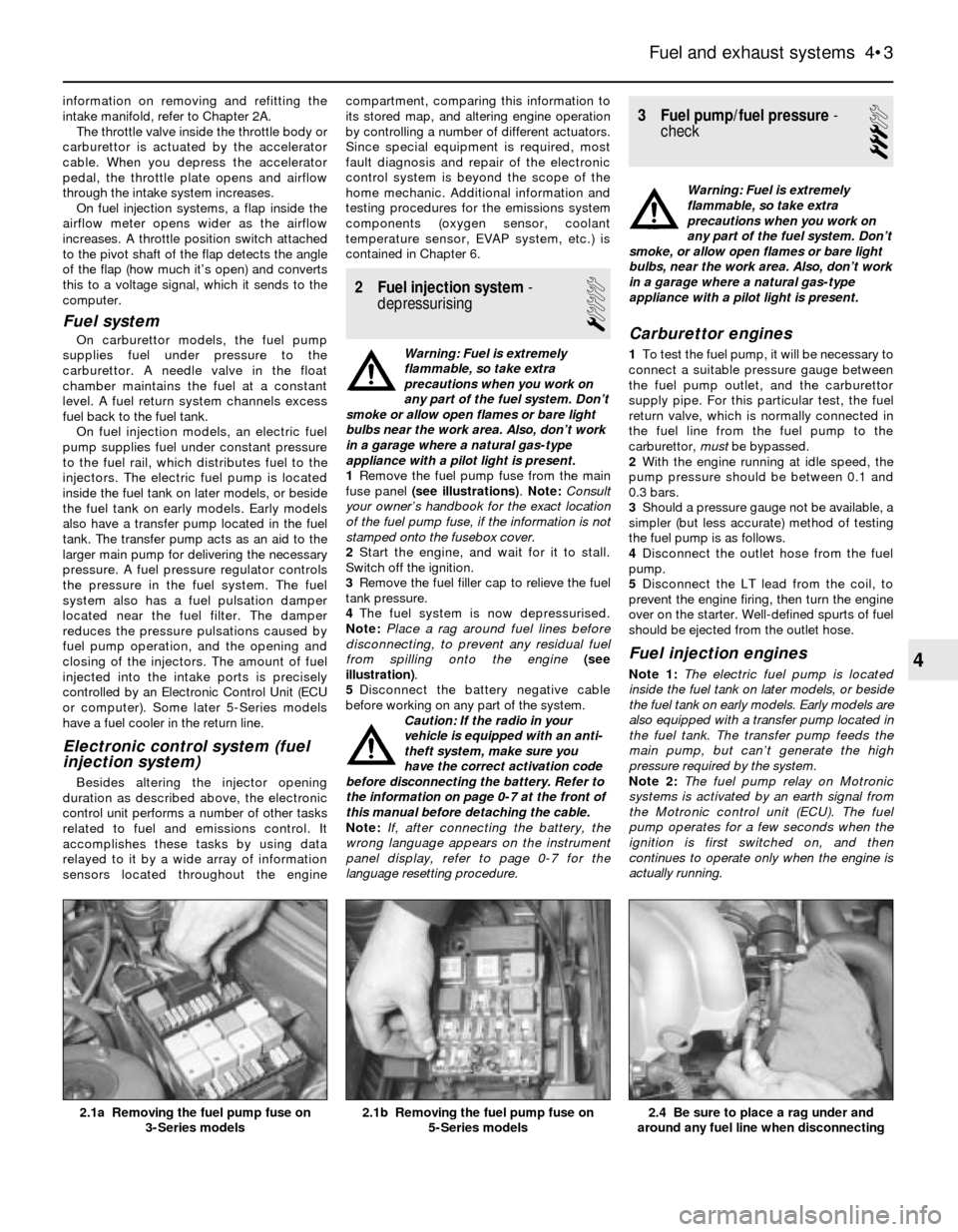
1Remove the fuel pump fuse from the main
fuse panel (see illustrations). Note:Consult
your owner’s handbook for the exact location
of the fuel pump fuse, if the information is not
stamped onto the fusebox cover.
2Start the engine, and wait for it to stall.
Switch off the ignition.
3Remove the fuel filler cap to relieve the fuel
tank pressure.
4The fuel system is now depressurised.
Note:Place a rag around fuel lines before
disconnecting, to prevent any residual fuel
from spilling onto the engine(see
illustration).
5Disconnect the battery negative cable
before working on any part of the system.
Caution: If the radio in your
vehicle is equipped with an anti-
theft system, make sure you
have the correct activation code
before disconnecting the battery. Refer to
the information on page 0-7 at the front of
this manual before detaching the cable.
Note: If, after connecting the battery, the
wrong language appears on the instrument
panel display, refer to page 0-7 for the
language resetting procedure.
3 Fuel pump/fuel pressure-
check
3
Warning: Fuel is extremely
flammable, so take extra
precautions when you work on
any part of the fuel system. Don’t
smoke, or allow open flames or bare light
bulbs, near the work area. Also, don’t work
in a garage where a natural gas-type
appliance with a pilot light is present.
Carburettor engines
1To test the fuel pump, it will be necessary to
connect a suitable pressure gauge between
the fuel pump outlet, and the carburettor
supply pipe. For this particular test, the fuel
return valve, which is normally connected in
the fuel line from the fuel pump to the
carburettor, mustbe bypassed.
2With the engine running at idle speed, the
pump pressure should be between 0.1 and
0.3 bars.
3Should a pressure gauge not be available, a
simpler (but less accurate) method of testing
the fuel pump is as follows.
4Disconnect the outlet hose from the fuel
pump.
5Disconnect the LT lead from the coil, to
prevent the engine firing, then turn the engine
over on the starter. Well-defined spurts of fuel
should be ejected from the outlet hose.
Fuel injection engines
Note 1:The electric fuel pump is located
inside the fuel tank on later models, or beside
the fuel tank on early models. Early models are
also equipped with a transfer pump located in
the fuel tank. The transfer pump feeds the
main pump, but can’t generate the high
pressure required by the system.
Note 2:The fuel pump relay on Motronic
systems is activated by an earth signal from
the Motronic control unit (ECU). The fuel
pump operates for a few seconds when the
ignition is first switched on, and then
continues to operate only when the engine is
actually running.
Fuel and exhaust systems 4•3
2.4 Be sure to place a rag under and
around any fuel line when disconnecting2.1b Removing the fuel pump fuse on
5-Series models2.1a Removing the fuel pump fuse on
3-Series models
4
Page 101 of 228
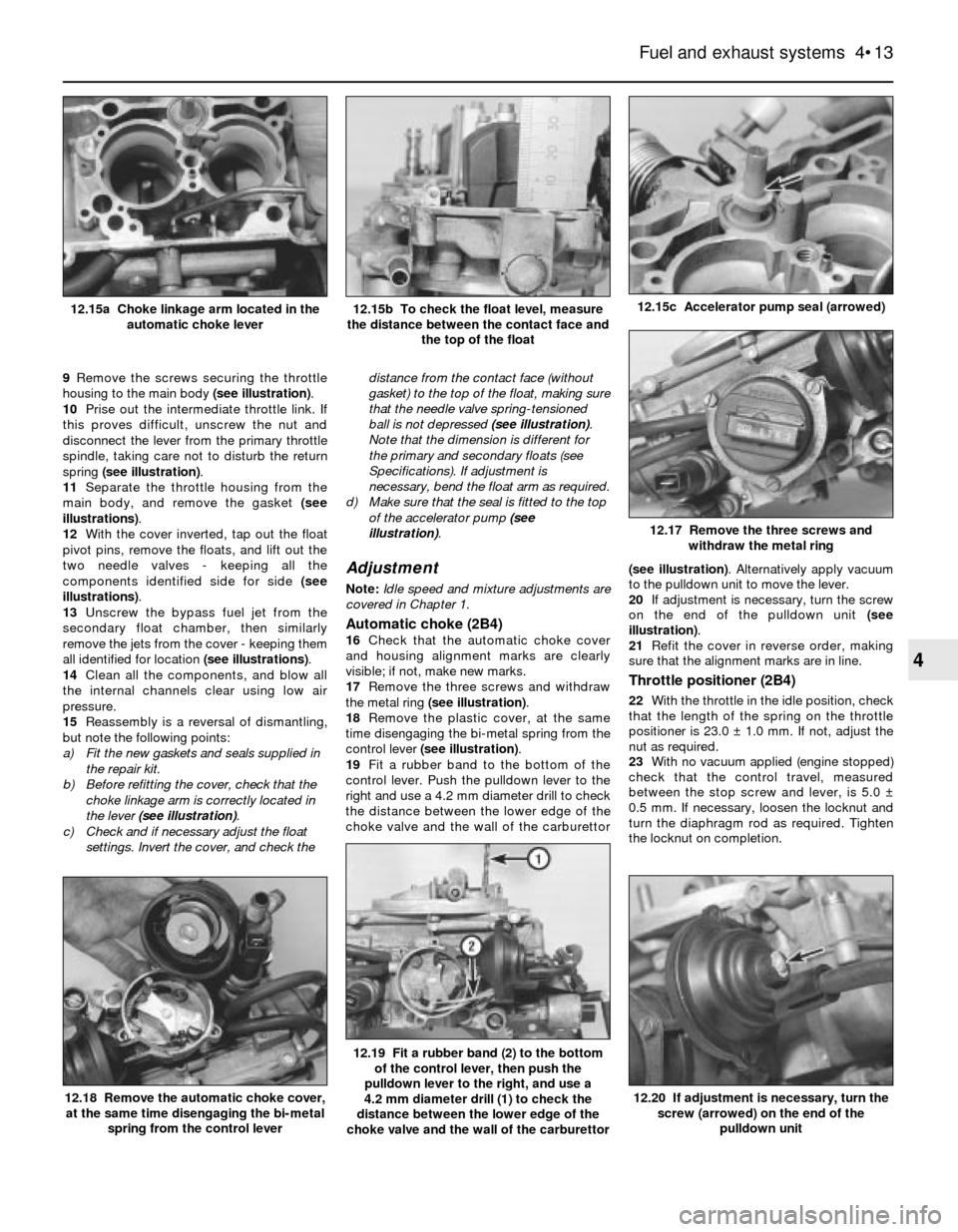
9Remove the screws securing the throttle
housing to the main body (see illustration).
10Prise out the intermediate throttle link. If
this proves difficult, unscrew the nut and
disconnect the lever from the primary throttle
spindle, taking care not to disturb the return
spring (see illustration).
11Separate the throttle housing from the
main body, and remove the gasket (see
illustrations).
12With the cover inverted, tap out the float
pivot pins, remove the floats, and lift out the
two needle valves - keeping all the
components identified side for side (see
illustrations).
13Unscrew the bypass fuel jet from the
secondary float chamber, then similarly
remove the jets from the cover - keeping them
all identified for location (see illustrations).
14Clean all the components, and blow all
the internal channels clear using low air
pressure.
15Reassembly is a reversal of dismantling,
but note the following points:
a) Fit the new gaskets and seals supplied in
the repair kit.
b) Before refitting the cover, check that the
choke linkage arm is correctly located in
the lever (see illustration).
c) Check and if necessary adjust the float
settings. Invert the cover, and check thedistance from the contact face (without
gasket) to the top of the float, making sure
that the needle valve spring-tensioned
ball is not depressed (see illustration).
Note that the dimension is different for
the primary and secondary floats (see
Specifications). If adjustment is
necessary, bend the float arm as required.
d) Make sure that the seal is fitted to the top
of the accelerator pump (see
illustration).
Adjustment
Note:Idle speed and mixture adjustments are
covered in Chapter 1.
Automatic choke (2B4)16Check that the automatic choke cover
and housing alignment marks are clearly
visible; if not, make new marks.
17Remove the three screws and withdraw
the metal ring (see illustration).
18Remove the plastic cover, at the same
time disengaging the bi-metal spring from the
control lever (see illustration).
19Fit a rubber band to the bottom of the
control lever. Push the pulldown lever to the
right and use a 4.2 mm diameter drill to check
the distance between the lower edge of the
choke valve and the wall of the carburettor(see illustration). Alternatively apply vacuum
to the pulldown unit to move the lever.
20If adjustment is necessary, turn the screw
on the end of the pulldown unit (see
illustration).
21Refit the cover in reverse order, making
sure that the alignment marks are in line.
Throttle positioner (2B4)
22With the throttle in the idle position, check
that the length of the spring on the throttle
positioner is 23.0 ± 1.0 mm. If not, adjust the
nut as required.
23With no vacuum applied (engine stopped)
check that the control travel, measured
between the stop screw and lever, is 5.0 ±
0.5 mm. If necessary, loosen the locknut and
turn the diaphragm rod as required. Tighten
the locknut on completion.
Fuel and exhaust systems 4•13
12.15b To check the float level, measure
the distance between the contact face and
the top of the float12.15a Choke linkage arm located in the
automatic choke lever
12.20 If adjustment is necessary, turn the
screw (arrowed) on the end of the
pulldown unit
12.19 Fit a rubber band (2) to the bottom
of the control lever, then push the
pulldown lever to the right, and use a
4.2 mm diameter drill (1) to check the
distance between the lower edge of the
choke valve and the wall of the carburettor
12.17 Remove the three screws and
withdraw the metal ring
12.15c Accelerator pump seal (arrowed)
12.18 Remove the automatic choke cover,
at the same time disengaging the bi-metal
spring from the control lever
4
Page 102 of 228
Throttle positioner (2BE)
24Special tools are required to carry out a
comprehensive adjustment on the 2BE
carburettor. This work should therefore be left
to a BMW dealer.
13 Fuel injection -
general information
The fuel injection system is composed of
three basic sub-systems: fuel system, air
intake system and electronic control system.
Fuel system
An electric fuel pump, located inside the
fuel tank or beside the fuel tank, supplies fuel
under constant pressure to the fuel rail, which
distributes fuel evenly to all injectors. From
the fuel rail, fuel is injected into the intake
ports, just above the intake valves, by the fuel
injectors. The amount of fuel supplied by the
injectors is precisely controlled by an
Electronic Control Unit (ECU). An additional
injector, known as the cold start injector (L-
Jetronic and early Motronic systems only),
supplies extra fuel into the intake manifold for
starting. A pressure regulator controls system
pressure in relation to intake manifold
vacuum. A fuel filter between the fuel pump
and the fuel rail filters the fuel, to protect the
components of the system.
Air intake system
The air intake system consists of an air filter
housing, an airflow meter, a throttle body, the
intake manifold, and the associated ducting.
The airflow meter is an information-gathering
device for the ECU. These models are
equipped with the vane-type airflow meter. A
potentiometer measures intake airflow, and a
temperature sensor measures intake air
temperature. This information helps the ECU
determine the amount of fuel to be injected by
the injectors (injection duration). The throttle
plate inside the throttle body is controlled by
the driver. As the throttle plate opens, the
amount of air that can pass through the
system increases, so the potentiometer opens
further and the ECU signals the injectors to
increase the amount of fuel delivered to the
intake ports.
Electronic control system
The computer control system controls the
fuel system and other systems by means of
an Electronic Control Unit (ECU). The ECU
receives signals from a number of information
sensors which monitor such variables as
intake air volume, intake air temperature,
coolant temperature, engine rpm,
acceleration/deceleration, and exhaust
oxygen content. These signals help the ECU
determine the injection duration necessary for
the optimum air/fuel ratio. These sensors and
their corresponding ECU-controlled outputactuators are located throughout the engine
compartment. For further information
regarding the ECU and its relationship to the
engine electrical systems and ignition system,
refer to Chapters 5 and 6.
Either an L-Jetronic system or a Motronic
system is fitted. Later models have an
updated version of the original Motronic
system.
14 Fuel injection systems
L-Jetronic fuel injection system
The Bosch L-Jetronic fuel injection system
is used on most 3-Series models up to 1987,
and on most E28 (“old-shape”) 5-Series
models. It is an electronically-controlled fuel
injection system that utilises one solenoid-
operated fuel injector per cylinder. The system
is governed by an Electronic Control Unit
(ECU) which processes information sent by
various sensors, and in turn precisely
meters the fuel to the cylinders by
adjusting the amount of time that the injectors
are open.
An electric fuel pump delivers fuel under
high pressure to the injectors, through the fuel
feed line and an in-line filter. A pressure
regulator keeps fuel available at an optimum
pressure, allowing pressure to rise or fall
depending on engine speed and load. Any
excess fuel is returned to the fuel tank by a
separate line.
A sensor in the air intake duct constantly
measures the mass of the incoming air, and
the ECU adjusts the fuel mixture to provide an
optimum air/fuel ratio.
Other components incorporated in the
system are the throttle valve (which controls
airflow to the engine), the coolant temperature
sensor, the throttle position switch, idle
stabiliser valve (which bypasses air around
the throttle plate to control idle speed) and
associated relays and fuses.
Motronic fuel injection system
The Motronic system combines the fuel
control of the L-Jetronic fuel injection system
with the control of ignition timing, idle speed
and emissions into one control unit.
The fuel injection and idle speed control
functions are similar to those used on the L-
Jetronic system described above. For more
information on the Motronic system, see
Chapter 6.
An oxygen sensor is mounted in the
exhaust system on later models with a
catalytic converter. This sensor continually
reads the oxygen content of the exhaust gas.
The information is used by the ECU to adjust
the duration of injection, making it possible to
adjust the fuel mixture for optimum converter
efficiency and minimum emissions.
15 Fuel injection system-
check
2
Warning: Fuel is extremely
flammable, so take extra
precautions when you work on
any part of the fuel system. Don’t
smoke, or allow open flames or bare light
bulbs, near the work area. Don’t work in a
garage where a natural gas-type appliance
(such as a water heater or clothes dryer)
with a pilot light is present. If you spill any
fuel on your skin, rinse it off immediately
with soap and water. When you perform
any kind of work on the fuel system, wear
safety glasses, and have a fire
extinguisher on hand.
1Check the earth wire connections. Check
all wiring harness connectors that are related
to the system. Loose connectors and poor
earths can cause many problems that
resemble more serious malfunctions.
2Make sure the battery is fully charged, as
the control unit and sensors depend on an
accurate supply voltage in order to properly
meter the fuel.
3Check the air filter element - a dirty or
partially-blocked filter will severely impede
performance and economy (see Chapter 1).
4If a blown fuse is found, renew it and see if
it blows again. If it does, search for an earthed
wire in the harness related to the system.
5Check the air intake duct from the airflow
meter to the intake manifold for leaks. Intake
air leaks can cause a variety of problems. Also
check the condition of the vacuum hoses
connected to the intake manifold.
6Remove the air intake duct from the throttle
body, and check for dirt, carbon and other
residue build-up. If it’s dirty, clean it with
carburettor cleaner and a toothbrush.
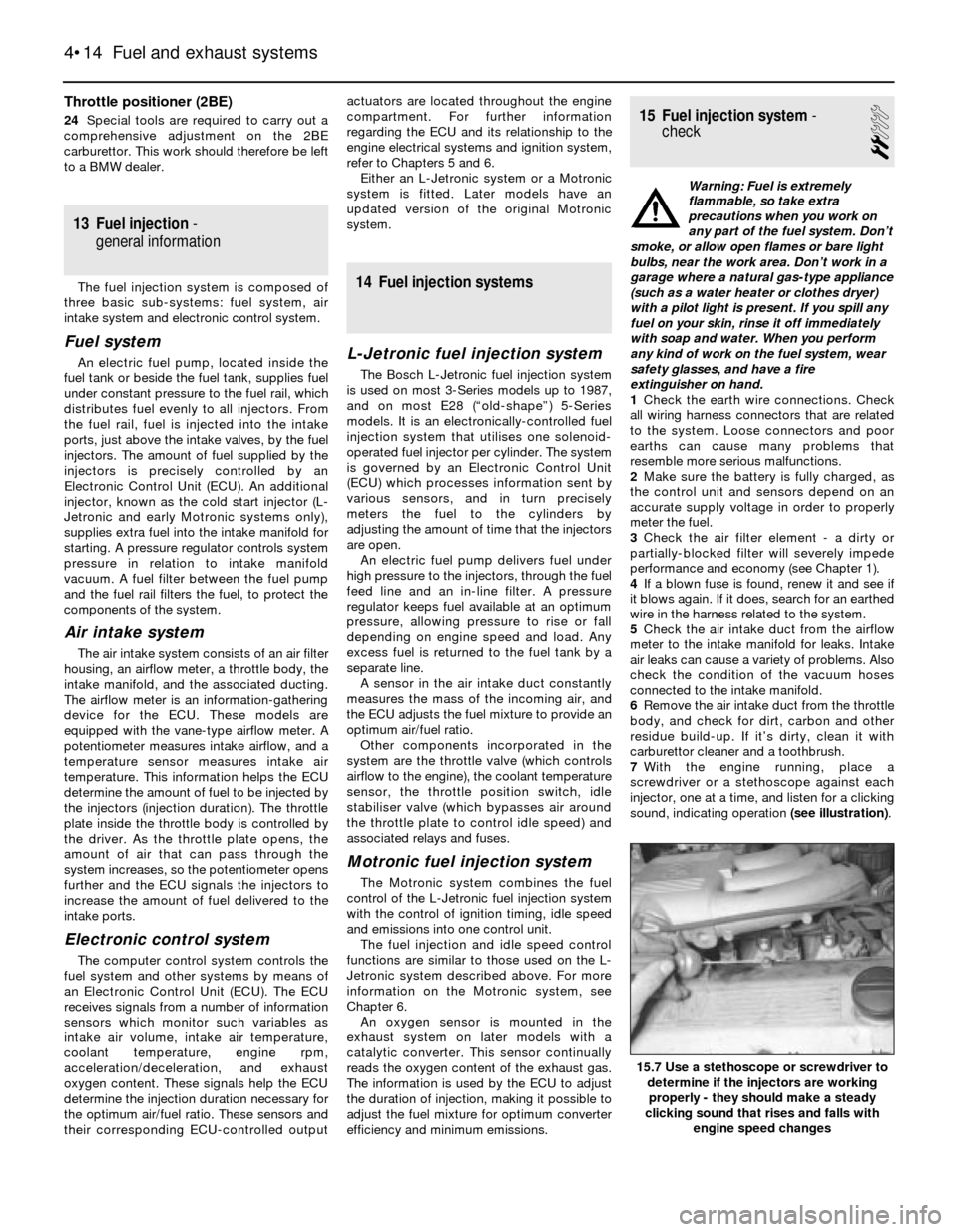
7With the engine running, place a
screwdriver or a stethoscope against each
injector, one at a time, and listen for a clicking
sound, indicating operation (see illustration).
4•14 Fuel and exhaust systems
15.7 Use a stethoscope or screwdriver to
determine if the injectors are working
properly - they should make a steady
clicking sound that rises and falls with
engine speed changes
Page 103 of 228
8Check the fuel system pressure (see
Section 3).
9If these checks do not locate the problem,
take the vehicle to a BMW dealer, who will be
able to read the fault codes stored in the ECU,
using special equipment.
16 Airflow meter- check,
removal and refitting
2
Check (L-Jetronic systems)
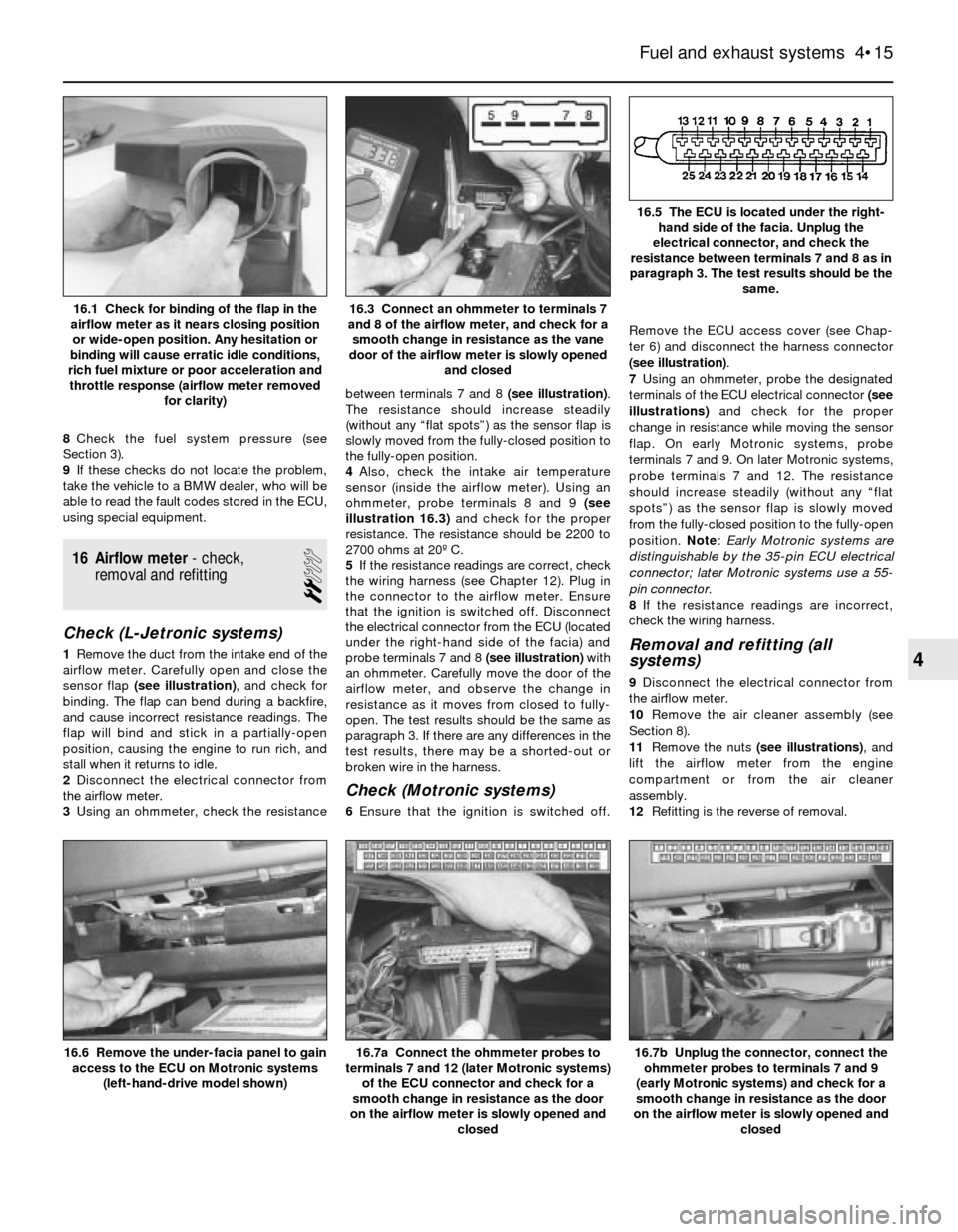
1Remove the duct from the intake end of the
airflow meter. Carefully open and close the
sensor flap (see illustration), and check for
binding. The flap can bend during a backfire,
and cause incorrect resistance readings. The
flap will bind and stick in a partially-open
position, causing the engine to run rich, and
stall when it returns to idle.
2Disconnect the electrical connector from
the airflow meter.
3Using an ohmmeter, check the resistancebetween terminals 7 and 8 (see illustration).
The resistance should increase steadily
(without any “flat spots”) as the sensor flap is
slowly moved from the fully-closed position to
the fully-open position.
4Also, check the intake air temperature
sensor (inside the airflow meter). Using an
ohmmeter, probe terminals 8 and 9 (see
illustration 16.3)and check for the proper
resistance. The resistance should be 2200 to
2700 ohms at 20º C.
5If the resistance readings are correct, check
the wiring harness (see Chapter 12). Plug in
the connector to the airflow meter. Ensure
that the ignition is switched off. Disconnect
the electrical connector from the ECU (located
under the right-hand side of the facia) and
probe terminals 7 and 8 (see illustration)with
an ohmmeter. Carefully move the door of the
airflow meter, and observe the change in
resistance as it moves from closed to fully-
open. The test results should be the same as
paragraph 3. If there are any differences in the
test results, there may be a shorted-out or
broken wire in the harness.
Check (Motronic systems)
6Ensure that the ignition is switched off.Remove the ECU access cover (see Chap-
ter 6) and disconnect the harness connector
(see illustration).
7Using an ohmmeter, probe the designated
terminals of the ECU electrical connector (see
illustrations)and check for the proper
change in resistance while moving the sensor
flap. On early Motronic systems, probe
terminals 7 and 9. On later Motronic systems,
probe terminals 7 and 12. The resistance
should increase steadily (without any “flat
spots”) as the sensor flap is slowly moved
from the fully-closed position to the fully-open
position. Note: Early Motronic systems are
distinguishable by the 35-pin ECU electrical
connector; later Motronic systems use a 55-
pin connector.
8If the resistance readings are incorrect,
check the wiring harness.
Removal and refitting (all
systems)
9Disconnect the electrical connector from
the airflow meter.
10Remove the air cleaner assembly (see
Section 8).
11Remove the nuts (see illustrations), and
lift the airflow meter from the engine
compartment or from the air cleaner
assembly.
12Refitting is the reverse of removal.
Fuel and exhaust systems 4•15
16.5 The ECU is located under the right-
hand side of the facia. Unplug the
electrical connector, and check the
resistance between terminals 7 and 8 as in
paragraph 3. The test results should be the
same.
16.3 Connect an ohmmeter to terminals 7
and 8 of the airflow meter, and check for a
smooth change in resistance as the vane
door of the airflow meter is slowly opened
and closed16.1 Check for binding of the flap in the
airflow meter as it nears closing position
or wide-open position. Any hesitation or
binding will cause erratic idle conditions,
rich fuel mixture or poor acceleration and
throttle response (airflow meter removed
for clarity)
16.7b Unplug the connector, connect the
ohmmeter probes to terminals 7 and 9
(early Motronic systems) and check for a
smooth change in resistance as the door
on the airflow meter is slowly opened and
closed16.7a Connect the ohmmeter probes to
terminals 7 and 12 (later Motronic systems)
of the ECU connector and check for a
smooth change in resistance as the door
on the airflow meter is slowly opened and
closed16.6 Remove the under-facia panel to gain
access to the ECU on Motronic systems
(left-hand-drive model shown)
4