fuel line BMW 3 SERIES 1985 E30 Workshop Manual
[x] Cancel search | Manufacturer: BMW, Model Year: 1985, Model line: 3 SERIES, Model: BMW 3 SERIES 1985 E30Pages: 228, PDF Size: 7.04 MB
Page 3 of 228

REPAIRS & OVERHAUL
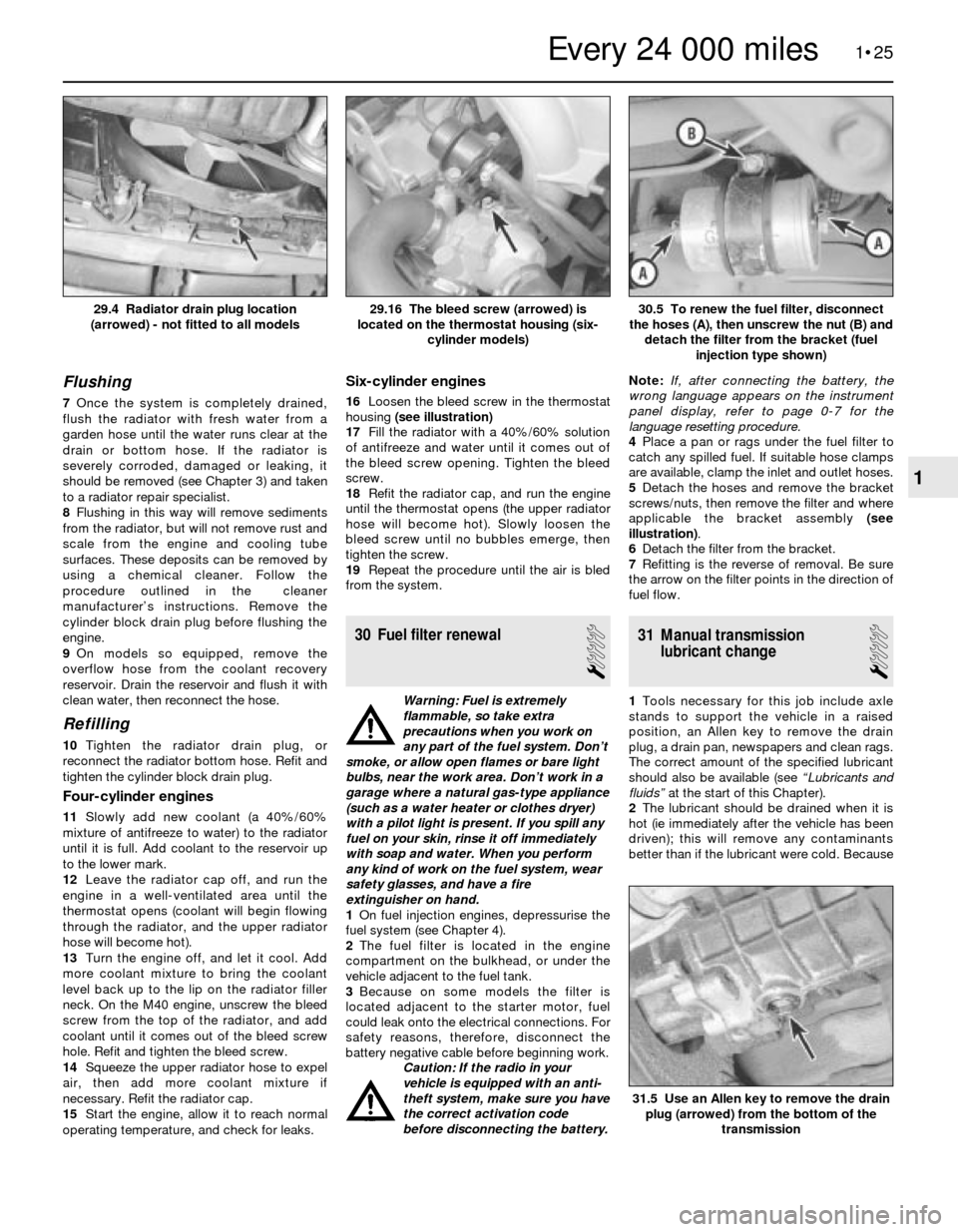
Engine and Associated Systems
In-car engine repair procedures Page 2A•1
General engine overhaul procedures Page2B•1
Cooling, heating and air conditioning systems Page3•1
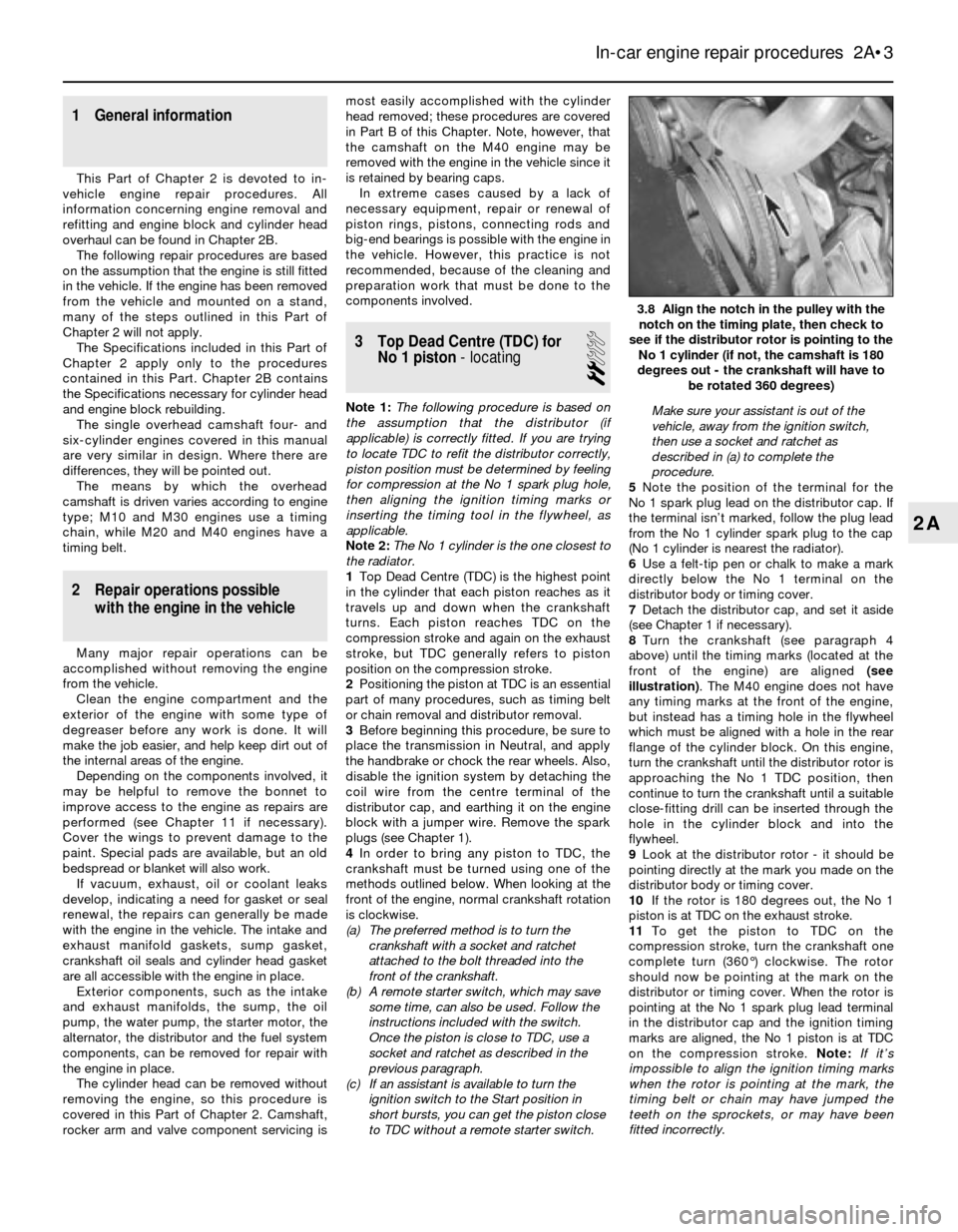
Fuel and exhaust systems Page 4•1
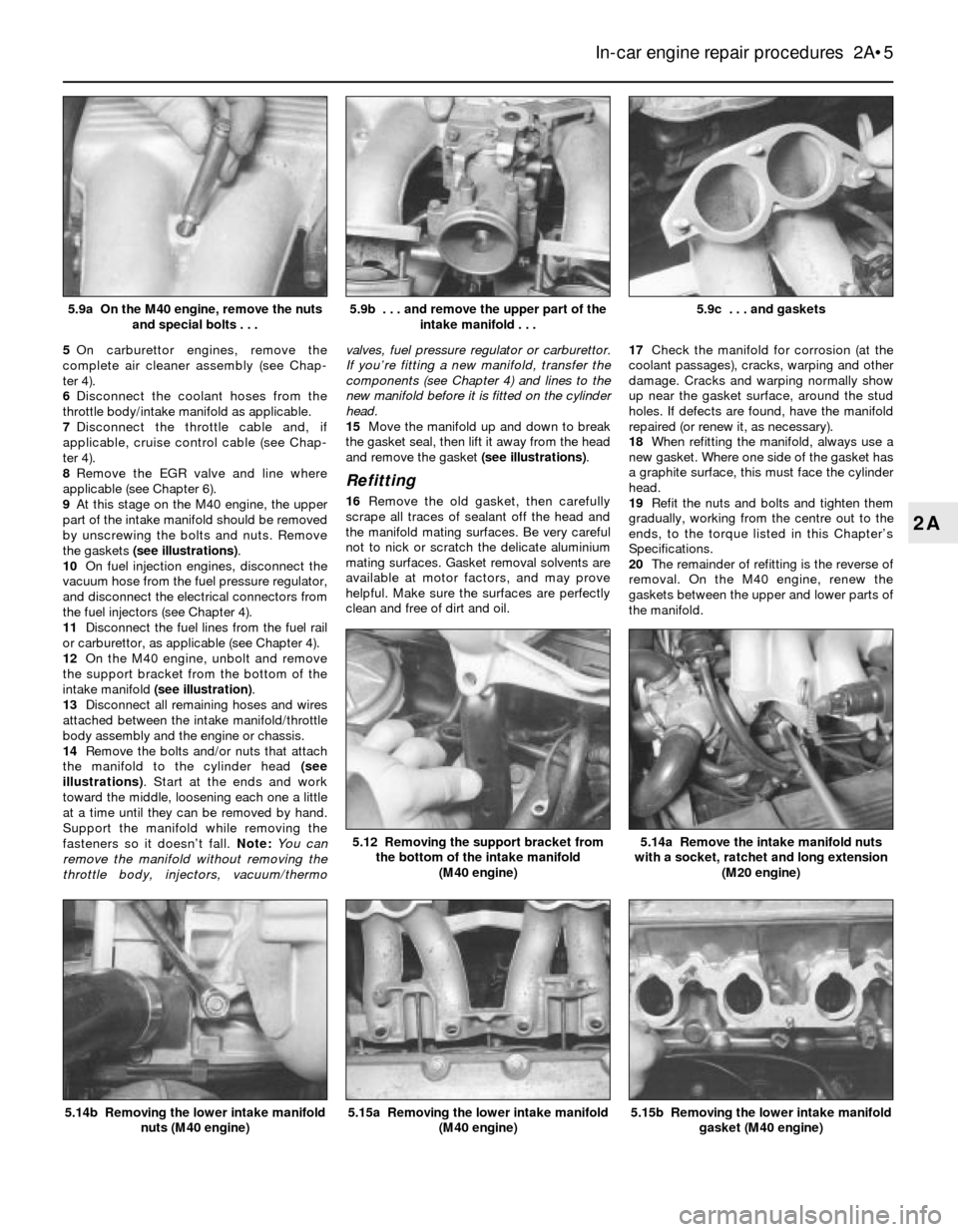
Engine electrical systems Page5•1
Engine management and emission control systems Page6•1
Transmission
Manual transmission Page7A•1
Automatic transmission Page7B•1
Clutch and driveline Page 8•1
Brakes
Braking systemPage 9•1
Suspension
Suspension and steering systems Page 10•1
Body Equipment
Bodywork and fittings Page 11•1
Electrical
Body electrical systems Page 12•1
Wiring DiagramsPage 12•10
REFERENCE
MOT Test Checks
Checks carried out from the driver’s seat PageREF•1
Checks carried out with the vehicle on the ground PageREF•2
Checks carried out with the vehicle raised PageREF•3
Checks carried out on your vehicle’s exhaust emission system PageREF•4
Tools and Working Facilities Page REF•5
General Repair Procedures Page REF•8
Fault FindingPage REF•9
Conversion factors PageREF•17
Automotive chemicals and lubricants PageREF•18
Buying spare parts and vehicle identification numbers PageREF•19
Glossary of Technical Terms PageREF•20
IndexPage REF•25
Contents
Page 4 of 228

0•4Introduction
The E30 3-Series range first became
available in the UK in March 1983, and
continued in production until April 1991, when
the revised E36 3-Series range (not covered
by this manual) was introduced. Convertible
and Touring (Estate) models were introduced
for 1988, and these models have continued in
E30 form to date.
The E28 5-Series models were introduced
in October 1981, and were superseded in
June 1988 by the revised E34 5-Series range,
Touring versions of which became available
from March 1992. Throughout this manual,
E28 models are also referred to as “old-
shape”, while E34 models are designated
“new-shape”.
The models covered by this manual are
equipped with single overhead cam in-line
four- and six-cylinder engines. Early 316 and
518 models are fitted with carburettors, but all
other models are fitted with fuel injection
systems. Transmissions are a five-speed
manual, or three- or four-speed automatic.
The transmission is mounted to the back of
the engine, and power is transmitted to the
fully-independent rear axle through a two-
piece propeller shaft. The final drive unit is
bolted solidly to a frame crossmember, and
drives the rear wheels through driveshaftsequipped with inner and outer constant
velocity joints.
The front suspension is of MacPherson
strut type, with the coil spring/shock absorber
unit making up the upper suspension link. The
rear suspension is made up of coil spring-
over-shock absorber struts, or coil springs
and conventional shock absorbers,
depending on model.
The brakes are disc type at the front, with
either drums or discs at the rear, depending
on model. Servo assistance is standard on all
models. Some later models are equipped with
an Anti-lock Braking System (ABS).
All models are manufactured to fine limits,
and live up to the BMW reputation of quality
workmanship. Although many of the models
covered by this manual appear complex at
first sight, they should present no problems to
the home mechanic.
Note for UK readers
The greater part of this manual was
originally written in the USA. Some of the
photographs used are of American-market
models, but the procedures given are fully
applicable to right-hand-drive models (or have
been amended where necessary).
Acknowledgements
Thanks are due to Champion Spark Plug,
who supplied the illustrations showing spark
plug conditions. Thanks are also due to
Sykes-Pickavant Limited, who provided some
of the workshop tools, and to all those people
at Sparkford who helped in the production of
this manual. Technical writers who
contributed to this project include Robert
Maddox, Mark Ryan and Mike Stubblefield.
We take great pride in the accuracy of
information given in this manual, but
vehicle manufacturers make alterations
and design changes during the production
run of a particular vehicle of which they do
not inform us. No liability can be accepted
by the authors or publishers for loss,
damage or injury caused by any
errors in, or omissions from, the
information given.
Project vehicles
The main project vehicle used in the
preparation of this manual for the UK market
was a 1988 BMW 318i with an M40/B18
engine.
Introduction to the BMW 3- and 5-Series
BMW 320i Saloon (E30)
Page 14 of 228
Maintenance schedule
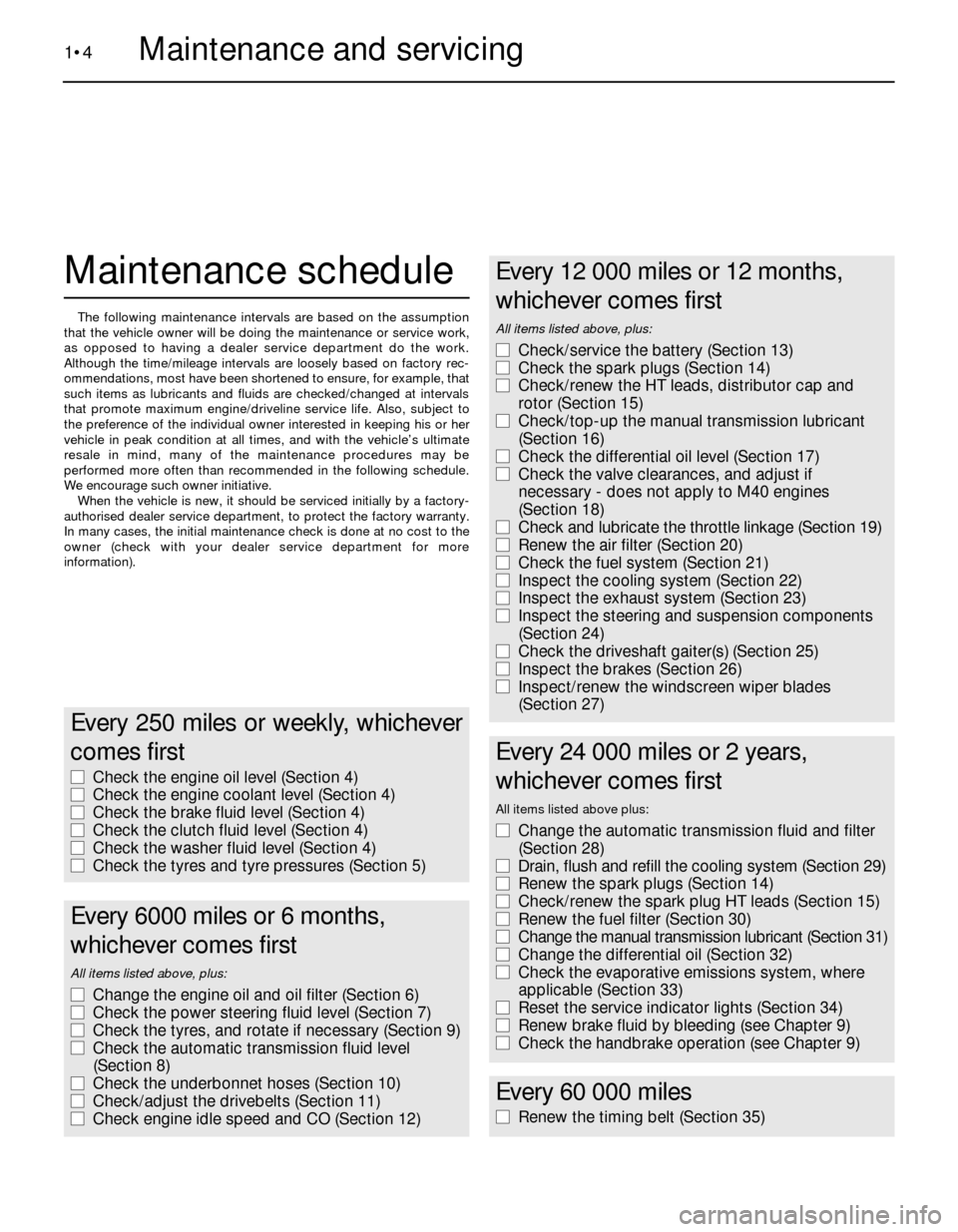
The following maintenance intervals are based on the assumption
that the vehicle owner will be doing the maintenance or service work,
as opposed to having a dealer service department do the work.
Although the time/mileage intervals are loosely based on factory rec-
ommendations, most have been shortened to ensure, for example, that
such items as lubricants and fluids are checked/changed at intervals
that promote maximum engine/driveline service life. Also, subject to
the preference of the individual owner interested in keeping his or her
vehicle in peak condition at all times, and with the vehicle’s ultimate
resale in mind, many of the maintenance procedures may be
performed more often than recommended in the following schedule.
We encourage such owner initiative.
When the vehicle is new, it should be serviced initially by a factory-
authorised dealer service department, to protect the factory warranty.
In many cases, the initial maintenance check is done at no cost to the
owner (check with your dealer service department for more
information).
1•4Maintenance and servicing
Every 250 miles or weekly, whichever
comes first
m mCheck the engine oil level (Section 4)
m mCheck the engine coolant level (Section 4)
m mCheck the brake fluid level (Section 4)
m mCheck the clutch fluid level (Section 4)
m mCheck the washer fluid level (Section 4)
m mCheck the tyres and tyre pressures (Section 5)
Every 6000 miles or 6 months,
whichever comes first
All items listed above, plus:
m mChange the engine oil and oil filter (Section 6)
m mCheck the power steering fluid level (Section 7)
m mCheck the tyres, and rotate if necessary (Section 9)
m mCheck the automatic transmission fluid level
(Section 8)
m mCheck the underbonnet hoses (Section 10)
m mCheck/adjust the drivebelts (Section 11)
m mCheck engine idle speed and CO (Section 12)
Every 12 000 miles or 12 months,
whichever comes first
All items listed above, plus:
m mCheck/service the battery (Section 13)
m mCheck the spark plugs (Section 14)
m mCheck/renew the HT leads, distributor cap and
rotor (Section 15)
m mCheck/top-up the manual transmission lubricant
(Section 16)
m mCheck the differential oil level (Section 17)
m mCheck the valve clearances, and adjust if
necessary - does not apply to M40 engines
(Section 18)
m mCheck and lubricate the throttle linkage (Section 19)
m mRenew the air filter (Section 20)
m mCheck the fuel system (Section 21)
m mInspect the cooling system (Section 22)
m mInspect the exhaust system (Section 23)
m mInspect the steering and suspension components
(Section 24)
m mCheck the driveshaft gaiter(s) (Section 25)
m mInspect the brakes (Section 26)
m mInspect/renew the windscreen wiper blades
(Section 27)
Every 24 000 miles or 2 years,
whichever comes first
All items listed above plus:
m mChange the automatic transmission fluid and filter
(Section 28)
m mDrain, flush and refill the cooling system (Section 29)
m mRenew the spark plugs (Section 14)
m mCheck/renew the spark plug HT leads (Section 15)
m mRenew the fuel filter (Section 30)
m mChange the manual transmission lubricant (Section 31)
m mChange the differential oil (Section 32)
m mCheck the evaporative emissions system, where
applicable (Section 33)
m mReset the service indicator lights (Section 34)
m mRenew brake fluid by bleeding (see Chapter 9)
m mCheck the handbrake operation (see Chapter 9)
Every 60 000 miles
m
mRenew the timing belt (Section 35)
Page 24 of 228
stripes moulded into them. Various systems
require hoses with different wall thicknesses,
collapse resistance and temperature
resistance. When fitting new hoses, be sure
the new ones are made of the same material.
5Often the only effective way to check a
hose is to remove it completely from the
vehicle. If more than one hose is removed, be
sure to label the hoses and fittings to ensure
correct refitting.
6When checking vacuum hoses, be sure to
include any plastic T-fittings in the check.
Inspect the connections for cracks which
could cause leakage.
7A small piece of vacuum hose can be used
as a stethoscope to detect vacuum leaks.
Hold one end of the hose to your ear and
probe around vacuum hoses and fittings,
listening for the “hissing” sound characteristic
of a vacuum leak.
Warning: When probing with the
vacuum hose stethoscope, be
careful not to touch moving
engine components such as the
drivebelt, cooling fan, etc.
Fuel hoses
Warning: There are certain
precautions which must be taken
when servicing or inspecting fuel
system components. Work in a
well-ventilated area, and do not allow open
flames (cigarettes, appliance pilot lights,
etc.) or bare light bulbs near the work
area. Mop up any spills immediately, and
do not store fuel-soaked rags where they
could ignite. If you spill any fuel on your
skin, rinse it off immediately with soap and
water. When you perform any kind of work
on the fuel system, wear safety glasses,
and have a fire extinguisher on hand.
8The fuel hoses are usually under pressure,
so if any fuel hoses are to be disconnected,
be prepared to catch spilled fuel.
Warning: On vehicles equipped
with fuel injection, you must
depressurise the fuel system
before servicing the fuel hoses.
Refer to Chapter 4 for details.9Check all rubber fuel hoses for deterioration
and chafing. Check especially for cracks in
areas where the hose bends, and just before
connectors, such as where a hose attaches to
the fuel pump or fuel filter, for example.
10Only high-quality fuel hose should be
used. Never, under any circumstances, use
unreinforced vacuum hose, clear plastic
tubing or water hose for fuel hoses.
11Band-type clamps are commonly used on
fuel hoses. These clamps often lose their
tension over a period of time, and can be
“sprung” during removal. Renew all band-type
clamps with screw clamps whenever a hose is
renewed.
Metal lines
12Sections of metal line are often used
between the fuel pump and fuel injection
system. Check carefully to make sure the line
isn’t bent, crimped or cracked.
13If a section of metal line must be renewed,
use seamless steel tubing only, since copper
and aluminium tubing do not have the
strength necessary to withstand the vibration
caused by the engine.
14Check the metal brake lines where they
enter the master cylinder and brake
proportioning or ABS unit (if used) for cracks
in the lines and loose fittings. Any sign of
brake fluid leakage calls for an immediate
thorough inspection of the braking system.
Power steering hoses
15Check the power steering hoses for leaks,
loose connections and worn clamps. Tighten
loose connections. Worn clamps or leaky
hoses should be renewed.
11 Drivebelt check, adjustment
and renewal
1
Check
1The drivebelts, sometimes called V-belts or
simply “fan” belts, are located at the front of
the engine, and play an important role in the
overall operation of the vehicle and itscomponents. Due to their function and
material make-up, the belts are prone to
failure after a period of time, and should be
inspected and adjusted periodically to prevent
major engine damage.
2The number of belts used on a particular
vehicle depends on the accessories fitted.
Drivebelts are used to turn the alternator,
power steering pump, water pump, and air
conditioning compressor. Depending on the
pulley arrangement, a single belt may be used
to drive more than one of these components.
3With the engine switched off, open the
bonnet and locate the various belts at the
front of the engine. Using your fingers (and a
torch, if necessary), move along the belts,
checking for cracks and separation of the belt
plies. Also check for fraying and glazing,
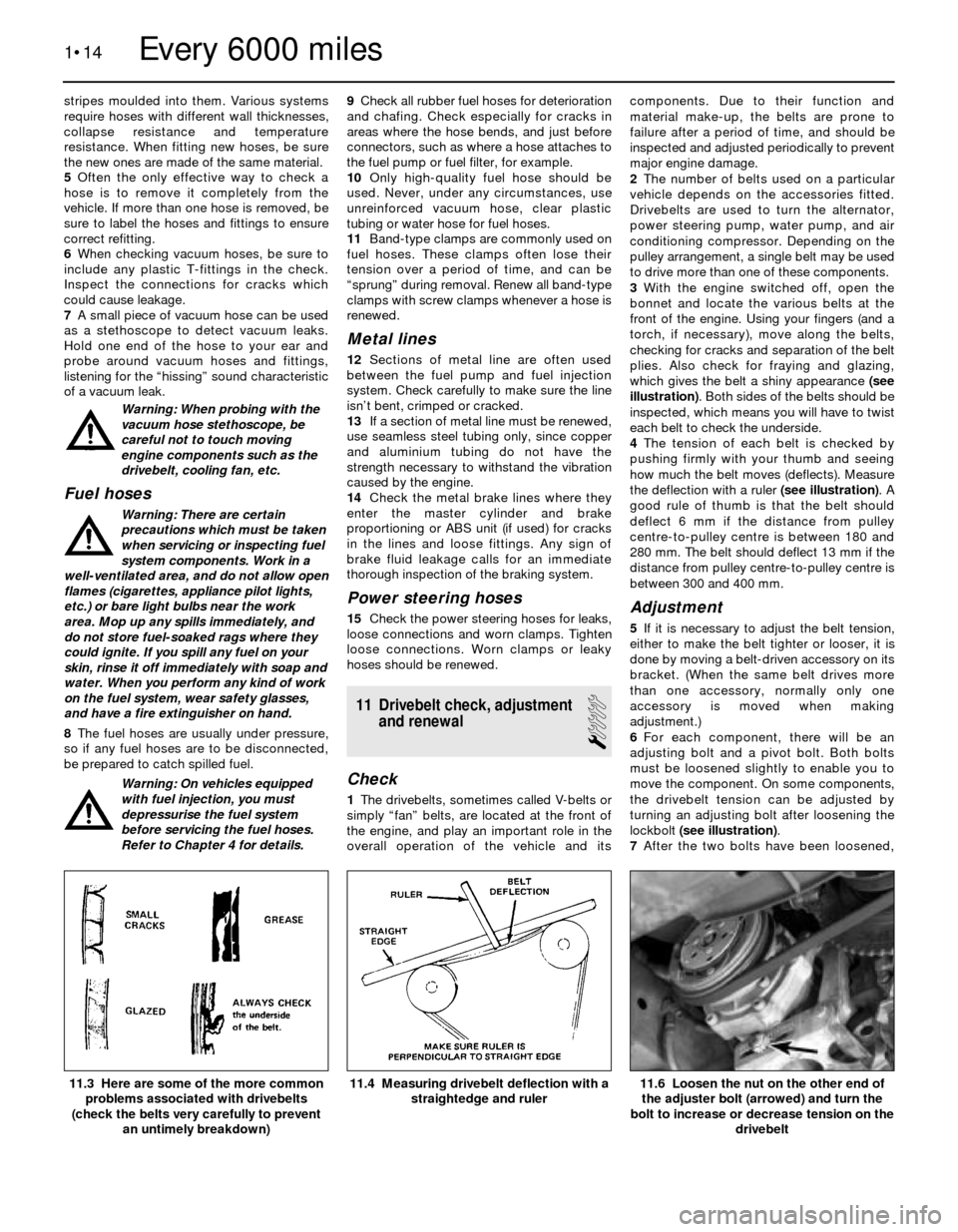
which gives the belt a shiny appearance (see
illustration). Both sides of the belts should be
inspected, which means you will have to twist
each belt to check the underside.
4The tension of each belt is checked by
pushing firmly with your thumb and seeing
how much the belt moves (deflects). Measure
the deflection with a ruler (see illustration). A
good rule of thumb is that the belt should
deflect 6 mm if the distance from pulley
centre-to-pulley centre is between 180 and
280 mm. The belt should deflect 13 mm if the
distance from pulley centre-to-pulley centre is
between 300 and 400 mm.
Adjustment
5If it is necessary to adjust the belt tension,
either to make the belt tighter or looser, it is
done by moving a belt-driven accessory on its
bracket. (When the same belt drives more
than one accessory, normally only one
accessory is moved when making
adjustment.)
6For each component, there will be an
adjusting bolt and a pivot bolt. Both bolts
must be loosened slightly to enable you to
move the component. On some components,
the drivebelt tension can be adjusted by
turning an adjusting bolt after loosening the
lockbolt (see illustration).
7After the two bolts have been loosened,
1•14
11.6 Loosen the nut on the other end of
the adjuster bolt (arrowed) and turn the
bolt to increase or decrease tension on the
drivebelt11.4 Measuring drivebelt deflection with a
straightedge and ruler11.3 Here are some of the more common
problems associated with drivebelts
(check the belts very carefully to prevent
an untimely breakdown)
Every 6000 miles
Page 30 of 228
drag when the feeler gauge is moved back
and forth.
6If the gap is too large or too small, loosen
the locknut, insert a hook made from large-
diameter metal wire, and rotate the eccentric
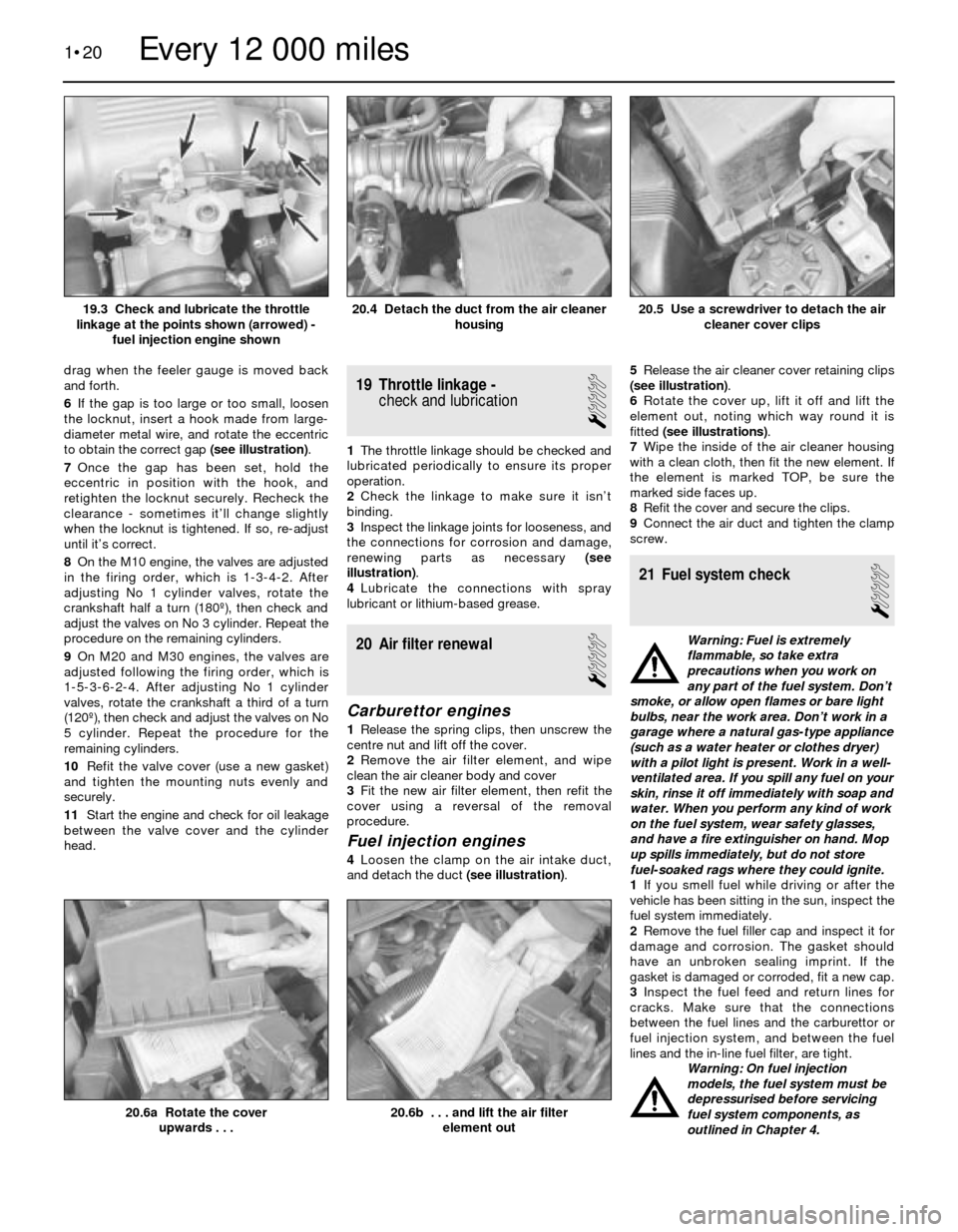
to obtain the correct gap (see illustration).
7Once the gap has been set, hold the
eccentric in position with the hook, and
retighten the locknut securely. Recheck the
clearance - sometimes it’ll change slightly
when the locknut is tightened. If so, re-adjust
until it’s correct.
8On the M10 engine, the valves are adjusted
in the firing order, which is 1-3-4-2. After
adjusting No 1 cylinder valves, rotate the
crankshaft half a turn (180º), then check and
adjust the valves on No 3 cylinder. Repeat the
procedure on the remaining cylinders.
9On M20 and M30 engines, the valves are
adjusted following the firing order, which is
1-5-3-6-2-4. After adjusting No 1 cylinder
valves, rotate the crankshaft a third of a turn
(120º), then check and adjust the valves on No
5 cylinder. Repeat the procedure for the
remaining cylinders.
10Refit the valve cover (use a new gasket)
and tighten the mounting nuts evenly and
securely.
11Start the engine and check for oil leakage
between the valve cover and the cylinder
head.19 Throttle linkage -
check and lubrication
1
1The throttle linkage should be checked and
lubricated periodically to ensure its proper
operation.
2Check the linkage to make sure it isn’t
binding.
3Inspect the linkage joints for looseness, and
the connections for corrosion and damage,
renewing parts as necessary (see
illustration).
4Lubricate the connections with spray
lubricant or lithium-based grease.
20 Air filter renewal
1
Carburettor engines
1Release the spring clips, then unscrew the
centre nut and lift off the cover.
2Remove the air filter element, and wipe
clean the air cleaner body and cover
3Fit the new air filter element, then refit the
cover using a reversal of the removal
procedure.
Fuel injection engines
4Loosen the clamp on the air intake duct,
and detach the duct (see illustration).5Release the air cleaner cover retaining clips
(see illustration).
6Rotate the cover up, lift it off and lift the
element out, noting which way round it is
fitted (see illustrations).
7Wipe the inside of the air cleaner housing
with a clean cloth, then fit the new element. If
the element is marked TOP, be sure the
marked side faces up.
8Refit the cover and secure the clips.
9Connect the air duct and tighten the clamp
screw.
21 Fuel system check
1
Warning: Fuel is extremely
flammable, so take extra
precautions when you work on
any part of the fuel system. Don’t
smoke, or allow open flames or bare light
bulbs, near the work area. Don’t work in a
garage where a natural gas-type appliance
(such as a water heater or clothes dryer)
with a pilot light is present. Work in a well-
ventilated area. If you spill any fuel on your
skin, rinse it off immediately with soap and
water. When you perform any kind of work
on the fuel system, wear safety glasses,
and have a fire extinguisher on hand. Mop
up spills immediately, but do not store
fuel-soaked rags where they could ignite.
1If you smell fuel while driving or after the
vehicle has been sitting in the sun, inspect the
fuel system immediately.
2Remove the fuel filler cap and inspect it for
damage and corrosion. The gasket should
have an unbroken sealing imprint. If the
gasket is damaged or corroded, fit a new cap.
3Inspect the fuel feed and return lines for
cracks. Make sure that the connections
between the fuel lines and the carburettor or
fuel injection system, and between the fuel
lines and the in-line fuel filter, are tight.
Warning: On fuel injection
models, the fuel system must be
depressurised before servicing
fuel system components, as
outlined in Chapter 4.
1•20
20.6b . . . and lift the air filter
element out20.6a Rotate the cover
upwards . . .
20.5 Use a screwdriver to detach the air
cleaner cover clips20.4 Detach the duct from the air cleaner
housing19.3 Check and lubricate the throttle
linkage at the points shown (arrowed) -
fuel injection engine shown
Every 12 000 miles
Page 31 of 228
4Since some components of the fuel system
- the fuel tank and some of the fuel feed and
return lines, for example - are underneath the
vehicle, they can be inspected more easily
with the vehicle raised on a hoist. If that’s not
possible, raise the vehicle and support it on
axle stands or ramps.
5With the vehicle raised and safely
supported, inspect the fuel tank and filler neck
for punctures, cracks or other damage. The
connection between the filler neck and the
tank is particularly critical. Sometimes a
rubber filler neck will leak because of loose
clamps or deteriorated rubber. Inspect all fuel
tank mounting brackets and straps, to be sure
the tank is securely attached to the vehicle.
Warning: Do not, under any
circumstances, try to repair a fuel
tank (except rubber
components). A welding torch or
any naked flame can easily cause fuel
vapours inside the tank to explode.
6Carefully check all flexible hoses and metal
lines leading away from the fuel tank. Check
for loose connections, deteriorated hoses,
crimped lines, and other damage. Repair or
renew damaged sections as necessary (see
Chapter 4).
22 Cooling system check
1
1Many major engine failures can be
attributed to cooling system problems. If the
vehicle has automatic transmission, the
engine cooling system also plays an importantrole in prolonging transmission life, because it
cools the transmission fluid.
2The engine should be cold for the cooling
system check, so perform the following
procedure before the vehicle is driven for the
day, or after it has been switched off for at
leastthree hours.
3Remove the radiator cap, doing so slowly
and taking adequate precautions against
scalding if the engine is at all warm. Clean the
cap thoroughly, inside and out, with clean
water. Also clean the filler neck on the
radiator. The presence of rust or corrosion in
the filler neck means the coolant should be
changed (see Section 29). The coolant inside
the radiator should be relatively clean and
clear. If it’s rust-coloured, drain the system
and refill with new coolant.
4Carefully check the radiator hoses and the
smaller-diameter heater hoses. Inspect each
coolant hose along its entire length, renewing
any hose which is cracked, swollen or
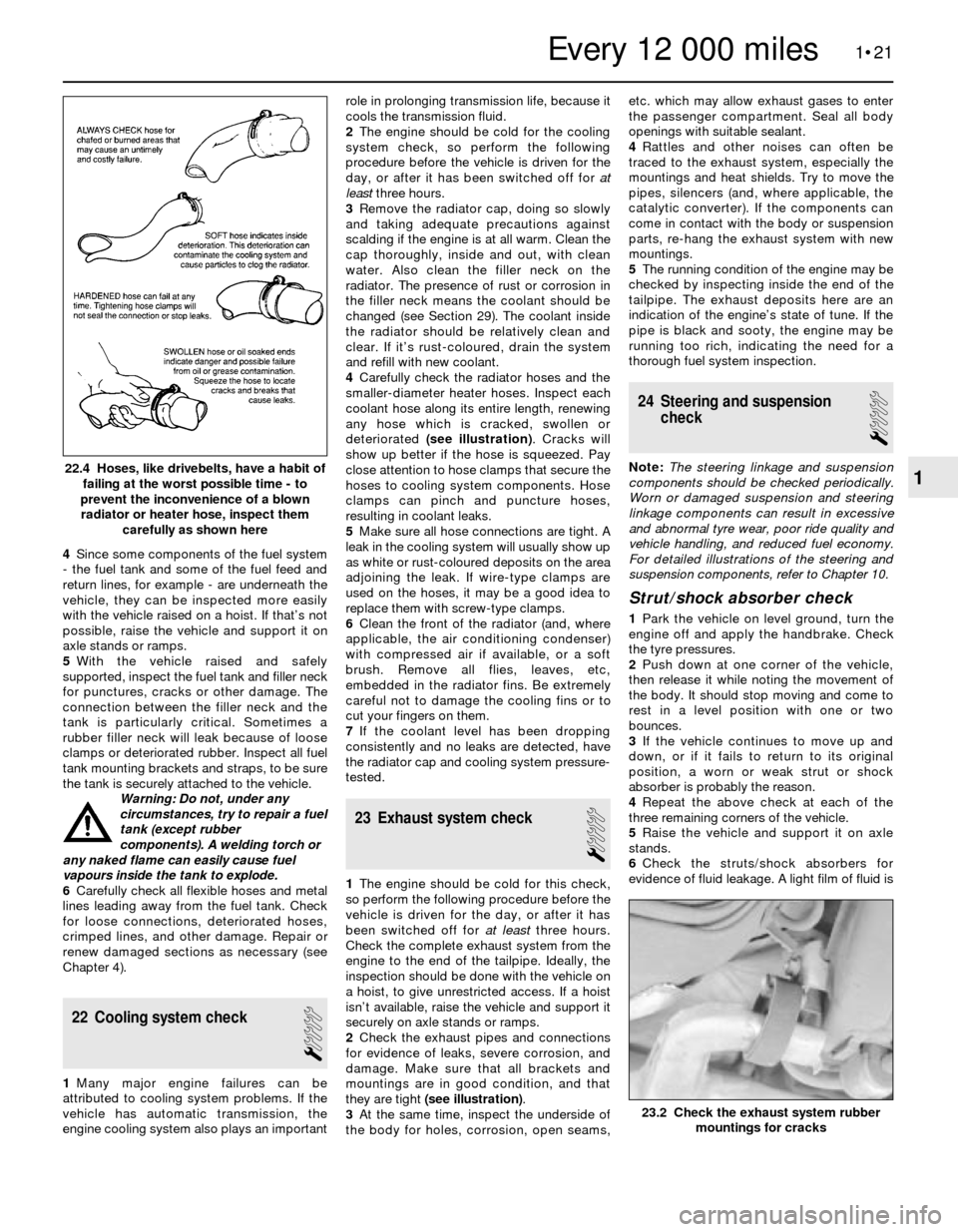
deteriorated (see illustration). Cracks will
show up better if the hose is squeezed. Pay
close attention to hose clamps that secure the
hoses to cooling system components. Hose
clamps can pinch and puncture hoses,
resulting in coolant leaks.
5Make sure all hose connections are tight. A
leak in the cooling system will usually show up
as white or rust-coloured deposits on the area
adjoining the leak. If wire-type clamps are
used on the hoses, it may be a good idea to
replace them with screw-type clamps.
6Clean the front of the radiator (and, where
applicable, the air conditioning condenser)
with compressed air if available, or a soft
brush. Remove all flies, leaves, etc,
embedded in the radiator fins. Be extremely
careful not to damage the cooling fins or to
cut your fingers on them.
7If the coolant level has been dropping
consistently and no leaks are detected, have
the radiator cap and cooling system pressure-
tested.
23 Exhaust system check
1
1The engine should be cold for this check,
so perform the following procedure before the
vehicle is driven for the day, or after it has
been switched off for at leastthree hours.
Check the complete exhaust system from the
engine to the end of the tailpipe. Ideally, the
inspection should be done with the vehicle on
a hoist, to give unrestricted access. If a hoist
isn’t available, raise the vehicle and support it
securely on axle stands or ramps.
2Check the exhaust pipes and connections
for evidence of leaks, severe corrosion, and
damage. Make sure that all brackets and
mountings are in good condition, and that
they are tight (see illustration).
3At the same time, inspect the underside of
the body for holes, corrosion, open seams,etc. which may allow exhaust gases to enter
the passenger compartment. Seal all body
openings with suitable sealant.
4Rattles and other noises can often be
traced to the exhaust system, especially the
mountings and heat shields. Try to move the
pipes, silencers (and, where applicable, the
catalytic converter). If the components can
come in contact with the body or suspension
parts, re-hang the exhaust system with new
mountings.
5The running condition of the engine may be
checked by inspecting inside the end of the
tailpipe. The exhaust deposits here are an
indication of the engine’s state of tune. If the
pipe is black and sooty, the engine may be
running too rich, indicating the need for a
thorough fuel system inspection.
24 Steering and suspension
check
1
Note: The steering linkage and suspension
components should be checked periodically.
Worn or damaged suspension and steering
linkage components can result in excessive
and abnormal tyre wear, poor ride quality and
vehicle handling, and reduced fuel economy.
For detailed illustrations of the steering and
suspension components, refer to Chapter 10.
Strut/shock absorber check
1Park the vehicle on level ground, turn the
engine off and apply the handbrake. Check
the tyre pressures.
2Push down at one corner of the vehicle,
then release it while noting the movement of
the body. It should stop moving and come to
rest in a level position with one or two
bounces.
3If the vehicle continues to move up and
down, or if it fails to return to its original
position, a worn or weak strut or shock
absorber is probably the reason.
4Repeat the above check at each of the
three remaining corners of the vehicle.
5Raise the vehicle and support it on axle
stands.
6Check the struts/shock absorbers for
evidence of fluid leakage. A light film of fluid is
1•21
22.4 Hoses, like drivebelts, have a habit of
failing at the worst possible time - to
prevent the inconvenience of a blown
radiator or heater hose, inspect them
carefully as shown here
23.2 Check the exhaust system rubber
mountings for cracks
1
Every 12 000 miles
Page 35 of 228
Flushing
7Once the system is completely drained,
flush the radiator with fresh water from a
garden hose until the water runs clear at the
drain or bottom hose. If the radiator is
severely corroded, damaged or leaking, it
should be removed (see Chapter 3) and taken
to a radiator repair specialist.
8Flushing in this way will remove sediments
from the radiator, but will not remove rust and
scale from the engine and cooling tube
surfaces. These deposits can be removed by
using a chemical cleaner. Follow the
procedure outlined in the cleaner
manufacturer’s instructions. Remove the
cylinder block drain plug before flushing the
engine.
9On models so equipped, remove the
overflow hose from the coolant recovery
reservoir. Drain the reservoir and flush it with
clean water, then reconnect the hose.
Refilling
10Tighten the radiator drain plug, or
reconnect the radiator bottom hose. Refit and
tighten the cylinder block drain plug.
Four-cylinder engines
11Slowly add new coolant (a 40%/60%
mixture of antifreeze to water) to the radiator
until it is full. Add coolant to the reservoir up
to the lower mark.
12Leave the radiator cap off, and run the
engine in a well-ventilated area until the
thermostat opens (coolant will begin flowing
through the radiator, and the upper radiator
hose will become hot).
13Turn the engine off, and let it cool. Add
more coolant mixture to bring the coolant
level back up to the lip on the radiator filler
neck. On the M40 engine, unscrew the bleed
screw from the top of the radiator, and add
coolant until it comes out of the bleed screw
hole. Refit and tighten the bleed screw.
14Squeeze the upper radiator hose to expel
air, then add more coolant mixture if
necessary. Refit the radiator cap.
15Start the engine, allow it to reach normal
operating temperature, and check for leaks.
Six-cylinder engines
16Loosen the bleed screw in the thermostat
housing (see illustration)
17Fill the radiator with a 40%/60% solution
of antifreeze and water until it comes out of
the bleed screw opening. Tighten the bleed
screw.
18Refit the radiator cap, and run the engine
until the thermostat opens (the upper radiator
hose will become hot). Slowly loosen the
bleed screw until no bubbles emerge, then
tighten the screw.
19Repeat the procedure until the air is bled
from the system.
30 Fuel filter renewal
1
Warning: Fuel is extremely
flammable, so take extra
precautions when you work on
any part of the fuel system. Don’t
smoke, or allow open flames or bare light
bulbs, near the work area. Don’t work in a
garage where a natural gas-type appliance
(such as a water heater or clothes dryer)
with a pilot light is present. If you spill any
fuel on your skin, rinse it off immediately
with soap and water. When you perform
any kind of work on the fuel system, wear
safety glasses, and have a fire
extinguisher on hand.
1On fuel injection engines, depressurise the
fuel system (see Chapter 4).
2The fuel filter is located in the engine
compartment on the bulkhead, or under the
vehicle adjacent to the fuel tank.
3Because on some models the filter is
located adjacent to the starter motor, fuel
could leak onto the electrical connections. For
safety reasons, therefore, disconnect the
battery negative cable before beginning work.
Caution: If the radio in your
vehicle is equipped with an anti-
theft system, make sure you have
the correct activation code
before disconnecting the battery.Note: If, after connecting the battery, the
wrong language appears on the instrument
panel display, refer to page 0-7 for the
language resetting procedure.
4Place a pan or rags under the fuel filter to
catch any spilled fuel. If suitable hose clamps
are available, clamp the inlet and outlet hoses.
5 Detach the hoses and remove the bracket
screws/nuts, then remove the filter and where
applicable the bracket assembly (see
illustration).
6Detach the filter from the bracket.
7Refitting is the reverse of removal. Be sure
the arrow on the filter points in the direction of
fuel flow.
31 Manual transmission
lubricant change
1
1Tools necessary for this job include axle
stands to support the vehicle in a raised
position, an Allen key to remove the drain
plug, a drain pan, newspapers and clean rags.
The correct amount of the specified lubricant
should also be available (see “Lubricants and
fluids”at the start of this Chapter).
2The lubricant should be drained when it is
hot (ie immediately after the vehicle has been
driven); this will remove any contaminants
better than if the lubricant were cold. Because
1•25
30.5 To renew the fuel filter, disconnect
the hoses (A), then unscrew the nut (B) and
detach the filter from the bracket (fuel
injection type shown)29.16 The bleed screw (arrowed) is
located on the thermostat housing (six-
cylinder models)29.4 Radiator drain plug location
(arrowed) - not fitted to all models
31.5 Use an Allen key to remove the drain
plug (arrowed) from the bottom of the
transmission
1
Every 24 000 miles
Page 39 of 228
1 General information
This Part of Chapter 2 is devoted to in-
vehicle engine repair procedures. All
information concerning engine removal and
refitting and engine block and cylinder head
overhaul can be found in Chapter 2B.
The following repair procedures are based
on the assumption that the engine is still fitted
in the vehicle. If the engine has been removed
from the vehicle and mounted on a stand,
many of the steps outlined in this Part of
Chapter 2 will not apply.
The Specifications included in this Part of
Chapter 2 apply only to the procedures
contained in this Part. Chapter 2B contains
the Specifications necessary for cylinder head
and engine block rebuilding.
The single overhead camshaft four- and
six-cylinder engines covered in this manual
are very similar in design. Where there are
differences, they will be pointed out.
The means by which the overhead
camshaft is driven varies according to engine
type; M10 and M30 engines use a timing
chain, while M20 and M40 engines have a
timing belt.
2 Repair operations possible
with the engine in the vehicle
Many major repair operations can be
accomplished without removing the engine
from the vehicle.
Clean the engine compartment and the
exterior of the engine with some type of
degreaser before any work is done. It will
make the job easier, and help keep dirt out of
the internal areas of the engine.
Depending on the components involved, it
may be helpful to remove the bonnet to
improve access to the engine as repairs are
performed (see Chapter 11 if necessary).
Cover the wings to prevent damage to the
paint. Special pads are available, but an old
bedspread or blanket will also work.
If vacuum, exhaust, oil or coolant leaks
develop, indicating a need for gasket or seal
renewal, the repairs can generally be made
with the engine in the vehicle. The intake and
exhaust manifold gaskets, sump gasket,
crankshaft oil seals and cylinder head gasket
are all accessible with the engine in place.
Exterior components, such as the intake
and exhaust manifolds, the sump, the oil
pump, the water pump, the starter motor, the
alternator, the distributor and the fuel system
components, can be removed for repair with
the engine in place.
The cylinder head can be removed without
removing the engine, so this procedure is
covered in this Part of Chapter 2. Camshaft,
rocker arm and valve component servicing ismost easily accomplished with the cylinder
head removed; these procedures are covered
in Part B of this Chapter. Note, however, that
the camshaft on the M40 engine may be
removed with the engine in the vehicle since it
is retained by bearing caps.
In extreme cases caused by a lack of
necessary equipment, repair or renewal of
piston rings, pistons, connecting rods and
big-end bearings is possible with the engine in
the vehicle. However, this practice is not
recommended, because of the cleaning and
preparation work that must be done to the
components involved.
3 Top Dead Centre (TDC) for
No 1 piston- locating
2
Note 1:The following procedure is based on
the assumption that the distributor (if
applicable) is correctly fitted. If you are trying
to locate TDC to refit the distributor correctly,
piston position must be determined by feeling
for compression at the No 1 spark plug hole,
then aligning the ignition timing marks or
inserting the timing tool in the flywheel, as
applicable.
Note 2:The No 1 cylinder is the one closest to
the radiator.
1Top Dead Centre (TDC) is the highest point
in the cylinder that each piston reaches as it
travels up and down when the crankshaft
turns. Each piston reaches TDC on the
compression stroke and again on the exhaust
stroke, but TDC generally refers to piston
position on the compression stroke.
2Positioning the piston at TDC is an essential
part of many procedures, such as timing belt
or chain removal and distributor removal.
3Before beginning this procedure, be sure to
place the transmission in Neutral, and apply
the handbrake or chock the rear wheels. Also,
disable the ignition system by detaching the
coil wire from the centre terminal of the
distributor cap, and earthing it on the engine
block with a jumper wire. Remove the spark
plugs (see Chapter 1).
4In order to bring any piston to TDC, the
crankshaft must be turned using one of the
methods outlined below. When looking at the
front of the engine, normal crankshaft rotation
is clockwise.
(a) The preferred method is to turn the
crankshaft with a socket and ratchet
attached to the bolt threaded into the
front of the crankshaft.
(b) A remote starter switch, which may save
some time, can also be used. Follow the
instructions included with the switch.
Once the piston is close to TDC, use a
socket and ratchet as described in the
previous paragraph.
(c) If an assistant is available to turn the
ignition switch to the Start position in
short bursts, you can get the piston close
to TDC without a remote starter switch.Make sure your assistant is out of the
vehicle, away from the ignition switch,
then use a socket and ratchet as
described in (a) to complete the
procedure.
5Note the position of the terminal for the
No 1 spark plug lead on the distributor cap. If
the terminal isn’t marked, follow the plug lead
from the No 1 cylinder spark plug to the cap
(No 1 cylinder is nearest the radiator).
6Use a felt-tip pen or chalk to make a mark
directly below the No 1 terminal on the
distributor body or timing cover.
7Detach the distributor cap, and set it aside
(see Chapter 1 if necessary).
8Turn the crankshaft (see paragraph 4
above) until the timing marks (located at the
front of the engine) are aligned (see
illustration). The M40 engine does not have
any timing marks at the front of the engine,
but instead has a timing hole in the flywheel
which must be aligned with a hole in the rear
flange of the cylinder block. On this engine,
turn the crankshaft until the distributor rotor is
approaching the No 1 TDC position, then
continue to turn the crankshaft until a suitable
close-fitting drill can be inserted through the
hole in the cylinder block and into the
flywheel.
9Look at the distributor rotor - it should be
pointing directly at the mark you made on the
distributor body or timing cover.
10If the rotor is 180 degrees out, the No 1
piston is at TDC on the exhaust stroke.
11To get the piston to TDC on the
compression stroke, turn the crankshaft one
complete turn (360°) clockwise. The rotor
should now be pointing at the mark on the
distributor or timing cover. When the rotor is
pointing at the No 1 spark plug lead terminal
in the distributor cap and the ignition timing
marks are aligned, the No 1 piston is at TDC
on the compression stroke. Note:If it’s
impossible to align the ignition timing marks
when the rotor is pointing at the mark, the
timing belt or chain may have jumped the
teeth on the sprockets, or may have been
fitted incorrectly.
In-car engine repair procedures 2A•3
3.8 Align the notch in the pulley with the
notch on the timing plate, then check to
see if the distributor rotor is pointing to the
No 1 cylinder (if not, the camshaft is 180
degrees out - the crankshaft will have to
be rotated 360 degrees)
2A
Page 41 of 228
5On carburettor engines, remove the
complete air cleaner assembly (see Chap-
ter 4).
6Disconnect the coolant hoses from the
throttle body/intake manifold as applicable.
7Disconnect the throttle cable and, if
applicable, cruise control cable (see Chap-
ter 4).
8Remove the EGR valve and line where
applicable (see Chapter 6).
9At this stage on the M40 engine, the upper
part of the intake manifold should be removed
by unscrewing the bolts and nuts. Remove
the gaskets (see illustrations).
10On fuel injection engines, disconnect the
vacuum hose from the fuel pressure regulator,
and disconnect the electrical connectors from
the fuel injectors (see Chapter 4).
11Disconnect the fuel lines from the fuel rail
or carburettor, as applicable (see Chapter 4).
12On the M40 engine, unbolt and remove
the support bracket from the bottom of the
intake manifold (see illustration).
13Disconnect all remaining hoses and wires
attached between the intake manifold/throttle
body assembly and the engine or chassis.
14Remove the bolts and/or nuts that attach
the manifold to the cylinder head (see
illustrations). Start at the ends and work
toward the middle, loosening each one a little
at a time until they can be removed by hand.
Support the manifold while removing the
fasteners so it doesn’t fall. Note: You can
remove the manifold without removing the
throttle body, injectors, vacuum/thermovalves, fuel pressure regulator or carburettor.
If you’re fitting a new manifold, transfer the
components (see Chapter 4) and lines to the
new manifold before it is fitted on the cylinder
head.
15Move the manifold up and down to break
the gasket seal, then lift it away from the head
and remove the gasket (see illustrations).
Refitting
16Remove the old gasket, then carefully
scrape all traces of sealant off the head and
the manifold mating surfaces. Be very careful
not to nick or scratch the delicate aluminium
mating surfaces. Gasket removal solvents are
available at motor factors, and may prove
helpful. Make sure the surfaces are perfectly
clean and free of dirt and oil.17Check the manifold for corrosion (at the
coolant passages), cracks, warping and other
damage. Cracks and warping normally show
up near the gasket surface, around the stud
holes. If defects are found, have the manifold
repaired (or renew it, as necessary).
18When refitting the manifold, always use a
new gasket. Where one side of the gasket has
a graphite surface, this must face the cylinder
head.
19Refit the nuts and bolts and tighten them
gradually, working from the centre out to the
ends, to the torque listed in this Chapter’s
Specifications.
20The remainder of refitting is the reverse of
removal. On the M40 engine, renew the
gaskets between the upper and lower parts of
the manifold.
In-car engine repair procedures 2A•5
5.9c . . . and gaskets5.9b . . . and remove the upper part of the
intake manifold . . .5.9a On the M40 engine, remove the nuts
and special bolts . . .
5.15b Removing the lower intake manifold
gasket (M40 engine)5.15a Removing the lower intake manifold
(M40 engine)
5.14a Remove the intake manifold nuts
with a socket, ratchet and long extension
(M20 engine)5.12 Removing the support bracket from
the bottom of the intake manifold
(M40 engine)
5.14b Removing the lower intake manifold
nuts (M40 engine)
2A
Page 49 of 228
22Using a scraper, remove all traces of old
gasket material from the sealing surfaces of
the covers and engine block.
Caution: Be very careful not to
scratch or gouge the delicate
aluminium surfaces. Also, do not
damage the sump gasket, and
keep it clean. Gasket removal solvents are
available at motor factors, and may
prove helpful. After all gasket material has
been removed, the gasket surfaces
can be degreased by wiping them
with a rag dampened with a suitable
solvent.
23Support the cover on two blocks of wood,
and drive out the seals from behind with a
hammer and screwdriver. Be very careful not
to damage the seal bores in the process.
24Coat the outside diameters and lips of the
new seals with multi-purpose grease, and
drive the seals into the cover with a hammer
and a socket slightly smaller in diameter than
the outside diameter of the seal.
25Apply a film of RTV-type gasket sealant to
the surface of the sump gasket that mates
with the front cover. Apply extra beads of RTV
sealant to the edges where the gasket meets
the engine block. Note:If the sump gasket is
damaged, instead of fitting a whole new
gasket, you might try trimming the front
portion of the gasket off at the point where it
meets the engine block, then trim off the front
portion of a new sump gasket so it’s exactly
the same size. Cover the exposed inside area
of the sump with a rag, then clean all traces of
old gasket material off the area where the
gasket was removed. Attach the new gasket
piece to the sump with contact-cement-type
gasket adhesive, then apply RTV-type sealant
as described at the beginning of this
paragraph.
26Coat both sides of the new gasket with
RTV-type gasket sealant, then attach the front
cover to the front of the engine, carefully
working the seals over the crankshaft and
intermediate shaft. Refit the bolts and tighten
them evenly to the torque listed in this
Chapter’s Specifications. Work from bolt-to-
bolt in a criss-cross pattern, to be sure they’re
tightened evenly.Note 1:Tighten the front
cover-to-block bolts first, then tighten the
sump-to-cover bolts. Note 2:After applying
RTV-type sealant, reassembly must be
completed in about 10 minutes so the RTV
won’t prematurely harden.
27The remainder of refitting is the reverse of
removal.
Crankshaft front seal (M40 engines)
28Remove the timing belt and crankshaft
sprocket (see Section 10).
29Remove the Woodruff key from the
groove in the end of the crankshaft.
30Note the fitted position of the oil seal, then
prise it out from the front cover using a
screwdriver, but take care not to damage the
bore of the cover or the surface of thecrankshaft. If the seal is tight, drill two small
holes in the metal end of the seal, and use two
self-tapping screws to pull out the seal. Make
sure all remains of swarf are removed.
31Coat the outside diameter and lip of the
new seal with multi-purpose grease, then
drive it into the cover with a hammer and a
socket slightly smaller in diameter than the
outside diameter of the seal. Make sure the
seal enters squarely.
32The remainder of refitting is the reverse of
removal. Note that it is recommended that the
timing belt be renewed - see Section 10.
12 Cylinder head-
removal and refitting
5
Removal
1Relieve the fuel pressure on all fuel injection
engines (see Chapter 4).
2Disconnect the negative cable from the
battery. Where the battery is located in the
engine compartment, the battery may be
removed completely (see Chapter 5).
Caution: If the radio in your
vehicle is equipped with an anti-
theft system, make sure you
have the correct activation code
before disconnecting the battery.
Note: If, after connecting the battery, the
wrong language appears on the instrument
panel display, refer to page 0-7 for the
language resetting procedure.
3Remove the air cleaner assembly (see
Chapter 4).
4Disconnect the wiring from the distributor
(mark all wiring for position first, if necessary),
and the HT lead from the coil (see Chapter 5).
5Disconnect the lead from the coolant
temperature sender unit (see Chapter 3).
6Disconnect the fuel lines from the fuel rail or
carburettor as applicable (see Chapter 4).
7Drain the cooling system (see Chapter 3).
8Clearly label then disconnect all other
hoses from the throttle body, intake manifold,
carburettor and cylinder head, as applicable.
9Disconnect the throttle cable from the
throttle linkage or carburettor (see Chapter 4).
10Disconnect the exhaust manifold from the
cylinder head (see Section 6). Depending on
the engine type, It may not be necessary to
disconnect the manifold from the exhaust
pipe; however, on right-hand-drive models,
the steering column intermediate shaft may
not allow the manifold to clear the studs on
the cylinder head.
11Remove or disconnect any remaining
hoses or lines from the intake manifold,
including the ignition advance vacuum line(s),
and the coolant and heater hoses.
12On early carburettor models, disconnect
the wiring from the alternator and starter
motor.13Remove the intake manifold (see Sec-
tion 5). Do not dismantle or remove any fuel
injection system components unless it is
absolutely necessary.
14Remove the fan drivebelt and fan (see
Chapter 3).
15Remove the valve cover and gasket (see
Section 4). Remove the semi-circular rubber
seal from the front of the cylinder head, where
this is not incorporated in the valve cover
gasket.
16Set No 1 piston at Top Dead Centre on
the compression stroke (see Section 3).
17Remove the timing chain or belt (see
Section 8 or 10). Note:If you want to save
time by not removing and refitting the timing
belt or chain and re-timing the engine, you can
unfasten the camshaft sprocket and suspend
it out of the way - with the belt or chain still
attached - by a piece of rope. Be sure the
rope keeps firm tension on the belt or chain,
so it won’t become disengaged from any of
the sprockets.
18Loosen the cylinder head bolts a quarter-
turn at a time each, in the reverse of the
tightening sequence shown (see illustrations
12.30a, 12.30b, 12.30c or 12.30d). Do
notdismantle or remove the rocker arm
assembly at this time on M10, M20 and M30
engines.
19Remove the cylinder head by lifting it
straight up and off the engine block. Do not
prise between the cylinder head and the
engine block, as damage to the gasket sealing
surfaces may result. Instead, use a blunt bar
positioned in an intake port to gently prise the
head loose.
20Remove any remaining external
components from the head to allow for
thorough cleaning and inspection. See
Chapter 2B for cylinder head servicing
procedures. On the M40 engine, remove the
rubber O-ring from the groove in the top of the
oil pump/front end cover housing.
Refitting
21The mating surfaces of the cylinder head
and block must be perfectly clean when the
head is refitted.
22Use a gasket scraper to remove all traces
of carbon and old gasket material, then clean
the mating surfaces with a suitable solvent. If
there’s oil on the mating surfaces when the
head is refitted, the gasket may not seal
correctly, and leaks could develop. When
working on the block, stuff the cylinders with
clean rags to keep out debris. Use a vacuum
cleaner to remove material that falls into the
cylinders.
23Check the block and head mating
surfaces for nicks, deep scratches and other
damage. If the damage is slight, it can be
removed with a file; if it’s excessive,
machining may be the only alternative.
24Use a tap of the correct size to chase the
threads in the head bolt holes, then clean the
holes with compressed air - make sure that
In-car engine repair procedures 2A•13
2A