m20 BMW 3 SERIES 1990 E30 Owner's Manual
[x] Cancel search | Manufacturer: BMW, Model Year: 1990, Model line: 3 SERIES, Model: BMW 3 SERIES 1990 E30Pages: 228, PDF Size: 7.04 MB
Page 57 of 228

2B
General
Cylinder compression pressure (all engines) . . . . . . . . . . . . . . . . . . . . . 10 to 11 bars
Oil pressure (all engines)
At idle . . . . . . . . . . . . . . . . . . . . . . . . . . . . . . . . . . . . . . . . . . . . . . . . . 0.5 to 2.0 bars
Running (for example, at 4000 rpm) . . . . . . . . . . . . . . . . . . . . . . . . . . 4 bars or above (typically)
Cylinder head warpage limit
Except M40 engine . . . . . . . . . . . . . . . . . . . . . . . . . . . . . . . . . . . . . . . 0.10 mm
M40 engine . . . . . . . . . . . . . . . . . . . . . . . . . . . . . . . . . . . . . . . . . . . . . 0.03 mm
Minimum cylinder head thickness (do not resurface the head to a thickness less than listed)
M10 and M30 engines . . . . . . . . . . . . . . . . . . . . . . . . . . . . . . . . . . . . 128.6 mm
M20 engines . . . . . . . . . . . . . . . . . . . . . . . . . . . . . . . . . . . . . . . . . . . . 124.7 mm
M40 engine . . . . . . . . . . . . . . . . . . . . . . . . . . . . . . . . . . . . . . . . . . . . . 140.55 mm
Valves
Valve stem diameter (standard)
M10 and M30 engines . . . . . . . . . . . . . . . . . . . . . . . . . . . . . . . . . . . . 8.0 mm
M20 engine . . . . . . . . . . . . . . . . . . . . . . . . . . . . . . . . . . . . . . . . . . . . . 7.0 mm
M40 engine
Intake . . . . . . . . . . . . . . . . . . . . . . . . . . . . . . . . . . . . . . . . . . . . . . . 6.975 mm
Exhaust . . . . . . . . . . . . . . . . . . . . . . . . . . . . . . . . . . . . . . . . . . . . . . 6.960 mm
Minimum valve margin width
Intake . . . . . . . . . . . . . . . . . . . . . . . . . . . . . . . . . . . . . . . . . . . . . . . 1.191 mm
Exhaust . . . . . . . . . . . . . . . . . . . . . . . . . . . . . . . . . . . . . . . . . . . . . . 1.98 mm
Valve stem maximum lateral movement (see text) . . . . . . . . . . . . . . . . . 0.787 mm
Valve face angle
Intake . . . . . . . . . . . . . . . . . . . . . . . . . . . . . . . . . . . . . . . . . . . . . . . . . 45°
Exhaust . . . . . . . . . . . . . . . . . . . . . . . . . . . . . . . . . . . . . . . . . . . . . . . . 45°
Chapter 2 Part B:
General engine overhaul procedures
Compression check . . . . . . . . . . . . . . . . . . . . . . . . . . . . . . . . . . . . . 3
Crankshaft - inspection . . . . . . . . . . . . . . . . . . . . . . . . . . . . . . . . . . . 19
Crankshaft - refitting and main bearing oil clearance check . . . . . . . 24
Crankshaft - removal . . . . . . . . . . . . . . . . . . . . . . . . . . . . . . . . . . . . . 13
Crankshaft rear oil seal - refitting . . . . . . . . . . . . . . . . . . . . . . . . . . . 25
Cylinder head and components - cleaning and inspection . . . . . . . 9
Cylinder head - dismantling . . . . . . . . . . . . . . . . . . . . . . . . . . . . . . . 8
Cylinder head - reassembly . . . . . . . . . . . . . . . . . . . . . . . . . . . . . . . 11
Cylinder honing . . . . . . . . . . . . . . . . . . . . . . . . . . . . . . . . . . . . . . . . . 17
Engine - removal and refitting . . . . . . . . . . . . . . . . . . . . . . . . . . . . . . 5
Engine block - cleaning . . . . . . . . . . . . . . . . . . . . . . . . . . . . . . . . . . . 15
Engine block - inspection . . . . . . . . . . . . . . . . . . . . . . . . . . . . . . . . . 16
Engine overhaul - alternatives . . . . . . . . . . . . . . . . . . . . . . . . . . . . . . 6
Engine overhaul - dismantling sequence . . . . . . . . . . . . . . . . . . . . . 7Engine overhaul - general information . . . . . . . . . . . . . . . . . . . . . . . 2
Engine overhaul - reassembly sequence . . . . . . . . . . . . . . . . . . . . . 21
Engine removal - methods and precautions . . . . . . . . . . . . . . . . . . . 4
General information . . . . . . . . . . . . . . . . . . . . . . . . . . . . . . . . . . . . . . 1
Initial start-up and break-in after overhaul . . . . . . . . . . . . . . . . . . . . 27
Intermediate shaft - refitting . . . . . . . . . . . . . . . . . . . . . . . . . . . . . . . 23
Intermediate shaft - removal and inspection . . . . . . . . . . . . . . . . . . . 14
Main and connecting big-end bearings - inspection . . . . . . . . . . . . 20
Piston rings - refitting . . . . . . . . . . . . . . . . . . . . . . . . . . . . . . . . . . . . 22
Pistons/connecting rods - inspection . . . . . . . . . . . . . . . . . . . . . . . . 18
Pistons/connecting rods - refitting and big-end bearing oil
clearance check . . . . . . . . . . . . . . . . . . . . . . . . . . . . . . . . . . . . . . 26
Pistons/connecting rods - removal . . . . . . . . . . . . . . . . . . . . . . . . . . 12
Valves - servicing . . . . . . . . . . . . . . . . . . . . . . . . . . . . . . . . . . . . . . . 10
2B•1
Easy,suitable for
novice with little
experienceFairly easy,suitable
for beginner with
some experienceFairly difficult,
suitable for competent
DIY mechanic
Difficult,suitable for
experienced DIY
mechanicVery difficult,
suitable for expert
DIY or professional
Degrees of difficulty
Specifications Contents
Page 58 of 228

Camshaft and rocker arms
Camshaft bearing oil clearance . . . . . . . . . . . . . . . . . . . . . . . . . . . . . . . 0.033 to 0.076 mm
Camshaft endfloat
M10 engine . . . . . . . . . . . . . . . . . . . . . . . . . . . . . . . . . . . . . . . . . . . . . 0.02 to 0.13 mm
M20 engine . . . . . . . . . . . . . . . . . . . . . . . . . . . . . . . . . . . . . . . . . . . . . 0.2 mm maximum
M30 engine . . . . . . . . . . . . . . . . . . . . . . . . . . . . . . . . . . . . . . . . . . . . . 0.03 to 0.18 mm
M40 engine . . . . . . . . . . . . . . . . . . . . . . . . . . . . . . . . . . . . . . . . . . . . . 0.065 to 0.150 mm
Rocker arm radial clearance . . . . . . . . . . . . . . . . . . . . . . . . . . . . . . . . . . 0.015 to 0.051 mm
Crankshaft
Endfloat
M10 and M30 engines . . . . . . . . . . . . . . . . . . . . . . . . . . . . . . . . . . . . 0.085 to 0.174 mm
M20 and M40 engines . . . . . . . . . . . . . . . . . . . . . . . . . . . . . . . . . . . . 0.080 to 0.163 mm
Main bearing journal diameter (standard)
M10 engines
Red classification . . . . . . . . . . . . . . . . . . . . . . . . . . . . . . . . . . . . . . 54.98 to 54.99 mm
Blue classification . . . . . . . . . . . . . . . . . . . . . . . . . . . . . . . . . . . . . . 54.97 to 54.98 mm
M20 engines
Red classification . . . . . . . . . . . . . . . . . . . . . . . . . . . . . . . . . . . . . . 59.98 to 59.99 mm
Blue classification . . . . . . . . . . . . . . . . . . . . . . . . . . . . . . . . . . . . . . 59.97 to 59.98 mm
M30 and M40 engines
Yellow classification . . . . . . . . . . . . . . . . . . . . . . . . . . . . . . . . . . . . 59.984 to 59.990 mm
Green classification . . . . . . . . . . . . . . . . . . . . . . . . . . . . . . . . . . . . . 59.977 to 59.983 mm
White classification . . . . . . . . . . . . . . . . . . . . . . . . . . . . . . . . . . . . . 59.971 to 59.976 mm
Main bearing journal diameter undersizes
1st undersize . . . . . . . . . . . . . . . . . . . . . . . . . . . . . . . . . . . . . . . . . . . . 0.25 mm
2nd undersize . . . . . . . . . . . . . . . . . . . . . . . . . . . . . . . . . . . . . . . . . . . 0.50 mm
3rd undersize (where applicable) . . . . . . . . . . . . . . . . . . . . . . . . . . . . 0.75 mm
Main bearing oil clearance
M10 and M20 engines . . . . . . . . . . . . . . . . . . . . . . . . . . . . . . . . . . . . 0.030 to 0.070 mm
M30 and M40 engines . . . . . . . . . . . . . . . . . . . . . . . . . . . . . . . . . . . . 0.020 to 0.046 mm
Connecting rod journal diameter (standard)
M10 and M30 engines . . . . . . . . . . . . . . . . . . . . . . . . . . . . . . . . . . . . 47.975 to 47.991 mm
M20 and M40 engines . . . . . . . . . . . . . . . . . . . . . . . . . . . . . . . . . . . . 44.975 to 44.991 mm
Connecting rod journal diameter undersizes
1st undersize . . . . . . . . . . . . . . . . . . . . . . . . . . . . . . . . . . . . . . . . . . . . 0.25 mm
2nd undersize . . . . . . . . . . . . . . . . . . . . . . . . . . . . . . . . . . . . . . . . . . . 0.50 mm
3rd undersize (where applicable) . . . . . . . . . . . . . . . . . . . . . . . . . . . . 0.75 mm
Connecting rods
Connecting rod side play (all engines) . . . . . . . . . . . . . . . . . . . . . . . . . . 0.041 mm
Connecting big-end bearing oil clearance
M10 engines . . . . . . . . . . . . . . . . . . . . . . . . . . . . . . . . . . . . . . . . . . . . 0.030 to 0.070 mm
M20 and M30 engines . . . . . . . . . . . . . . . . . . . . . . . . . . . . . . . . . . . . 0.020 to 0.055 mm
M40 engines . . . . . . . . . . . . . . . . . . . . . . . . . . . . . . . . . . . . . . . . . . . . 0.010 to 0.052 mm
Engine block
Cylinder bore - diameter (standard)
M10/B18 engine . . . . . . . . . . . . . . . . . . . . . . . . . . . . . . . . . . . . . . . . . 89.00 to 89.01 mm
M20/B20 engine . . . . . . . . . . . . . . . . . . . . . . . . . . . . . . . . . . . . . . . . . 80.00 to 80.01 mm
M20/B25 engine . . . . . . . . . . . . . . . . . . . . . . . . . . . . . . . . . . . . . . . . . 84.00 to 84.01 mm
M30/B25 engine . . . . . . . . . . . . . . . . . . . . . . . . . . . . . . . . . . . . . . . . . 86.00 to 86.01 mm
M30/B28 engine . . . . . . . . . . . . . . . . . . . . . . . . . . . . . . . . . . . . . . . . . 86.00 to 86.01 mm
M30/B30M engine . . . . . . . . . . . . . . . . . . . . . . . . . . . . . . . . . . . . . . . 89.00 to 89.01 mm
M30/B34 engine . . . . . . . . . . . . . . . . . . . . . . . . . . . . . . . . . . . . . . . . . 92 00 to 92.01 mm
M30/B35M engine . . . . . . . . . . . . . . . . . . . . . . . . . . . . . . . . . . . . . . . 92.00 to 92.01 mm
M40/B16 engine . . . . . . . . . . . . . . . . . . . . . . . . . . . . . . . . . . . . . . . . . 84.000 to 84.014 mm
M40/B18 engine . . . . . . . . . . . . . . . . . . . . . . . . . . . . . . . . . . . . . . . . . 84.000 to 84.014 mm
Cylinder out-of-round limit (maximum)
M20/B20 engine . . . . . . . . . . . . . . . . . . . . . . . . . . . . . . . . . . . . . . . . . 0.02 mm
M20/B25 engine . . . . . . . . . . . . . . . . . . . . . . . . . . . . . . . . . . . . . . . . . 0.03 mm
All other engines . . . . . . . . . . . . . . . . . . . . . . . . . . . . . . . . . . . . . . . . . 0.01 mm
Cylinder taper (maximum)
M20/B20 and M20/B25 engines . . . . . . . . . . . . . . . . . . . . . . . . . . . . . 0.02 mm
All other engines . . . . . . . . . . . . . . . . . . . . . . . . . . . . . . . . . . . . . . . . . 0.01 mm
2B•2 General engine overhaul procedures
Page 59 of 228

Pistons and piston rings
Piston diameter (standard)
M10 engines . . . . . . . . . . . . . . . . . . . . . . . . . . . . . . . . . . . . . . . . . . . . 88.97 mm
M20 engines
B20 . . . . . . . . . . . . . . . . . . . . . . . . . . . . . . . . . . . . . . . . . . . . . . . . . 79.98 mm
B25 . . . . . . . . . . . . . . . . . . . . . . . . . . . . . . . . . . . . . . . . . . . . . . . . . 83.98 mm
M30 engines
B30M
Alcan . . . . . . . . . . . . . . . . . . . . . . . . . . . . . . . . . . . . . . . . . . . . . . 88.970 mm
KS . . . . . . . . . . . . . . . . . . . . . . . . . . . . . . . . . . . . . . . . . . . . . . . . 88.980 mm
B35M
Alcan . . . . . . . . . . . . . . . . . . . . . . . . . . . . . . . . . . . . . . . . . . . . . . 91.972 mm
Mahle . . . . . . . . . . . . . . . . . . . . . . . . . . . . . . . . . . . . . . . . . . . . . . 91.980 mm
M40 engines
Factory stage 0 . . . . . . . . . . . . . . . . . . . . . . . . . . . . . . . . . . . . . . . . 83.985 mm
Factory stage 00 . . . . . . . . . . . . . . . . . . . . . . . . . . . . . . . . . . . . . . . 84.065 mm
Piston-to-cylinder wall clearance
New
M10 and M30 engines . . . . . . . . . . . . . . . . . . . . . . . . . . . . . . . . . . 0.02 to 0.05 mm
M20 and M40 engines . . . . . . . . . . . . . . . . . . . . . . . . . . . . . . . . . . 0.01 to 0.04 mm
Service limit
Except B25 engine . . . . . . . . . . . . . . . . . . . . . . . . . . . . . . . . . . . . . 0.15 mm
B25 engine . . . . . . . . . . . . . . . . . . . . . . . . . . . . . . . . . . . . . . . . . . . 0.12 mm
Piston ring end gap
M10 engine
Top compression ring . . . . . . . . . . . . . . . . . . . . . . . . . . . . . . . . . . . 0.30 to 0.70 mm
Second compression ring . . . . . . . . . . . . . . . . . . . . . . . . . . . . . . . . 0.20 to 0.40 mm
Oil ring . . . . . . . . . . . . . . . . . . . . . . . . . . . . . . . . . . . . . . . . . . . . . . . 0.25 to 0.50 mm
M20 engine
All rings . . . . . . . . . . . . . . . . . . . . . . . . . . . . . . . . . . . . . . . . . . . . . . 0.20 to 0.50 mm
M30 engine
Top compression ring . . . . . . . . . . . . . . . . . . . . . . . . . . . . . . . . . . . 0.20 to 0.45 mm
Second compression ring . . . . . . . . . . . . . . . . . . . . . . . . . . . . . . . . 0.40 to 0.65 mm
Oil ring . . . . . . . . . . . . . . . . . . . . . . . . . . . . . . . . . . . . . . . . . . . . . . . 0.30 to 0.60 mm
M40 engine
Top compression ring . . . . . . . . . . . . . . . . . . . . . . . . . . . . . . . . . . . 0.20 to 1.00 mm
Second compression ring . . . . . . . . . . . . . . . . . . . . . . . . . . . . . . . . 0.20 to 1.00 mm
Oil ring
B16 engine . . . . . . . . . . . . . . . . . . . . . . . . . . . . . . . . . . . . . . . . . 0.20 to 1.00 mm
B18 engine . . . . . . . . . . . . . . . . . . . . . . . . . . . . . . . . . . . . . . . . . 0.40 to 1.40 mm
Piston ring side clearance
M10 engine
Top compression ring . . . . . . . . . . . . . . . . . . . . . . . . . . . . . . . . . . . 0.06 to 0.09 mm
Second compression ring . . . . . . . . . . . . . . . . . . . . . . . . . . . . . . . . 0.03 to 0.072 mm
Oil ring . . . . . . . . . . . . . . . . . . . . . . . . . . . . . . . . . . . . . . . . . . . . . . . 0.02 to 0.06 mm
M20 engine
Top compression ring . . . . . . . . . . . . . . . . . . . . . . . . . . . . . . . . . . . 0.04 to 0.08 mm
Second compression ring . . . . . . . . . . . . . . . . . . . . . . . . . . . . . . . . 0.03 to 0.07 mm
Oil ring . . . . . . . . . . . . . . . . . . . . . . . . . . . . . . . . . . . . . . . . . . . . . . . 0.02 to 0.05 mm
M30 engine
Top compression ring . . . . . . . . . . . . . . . . . . . . . . . . . . . . . . . . . . . 0.04 to 0.072 mm
Second compression ring . . . . . . . . . . . . . . . . . . . . . . . . . . . . . . . . 0.03 to 0.062 mm
Oil ring . . . . . . . . . . . . . . . . . . . . . . . . . . . . . . . . . . . . . . . . . . . . . . . 0.02 to 0.055 mm
M40 engine
Top compression ring . . . . . . . . . . . . . . . . . . . . . . . . . . . . . . . . . . . 0.02 to 0.20 mm
Second compression ring . . . . . . . . . . . . . . . . . . . . . . . . . . . . . . . . 0.02 to 0.10 mm
Oil ring
B16 engine . . . . . . . . . . . . . . . . . . . . . . . . . . . . . . . . . . . . . . . . . 0.02 to 0.10 mm
B18 engine . . . . . . . . . . . . . . . . . . . . . . . . . . . . . . . . . . . . . . . . . Not measured
Torque wrench settingsNm
Main bearing cap-to-engine block bolts*
M10, M20 and M30 engines . . . . . . . . . . . . . . . . . . . . . . . . . . . . . . . . 60
M40 engines
Stage 1 . . . . . . . . . . . . . . . . . . . . . . . . . . . . . . . . . . . . . . . . . . . . . . . . 20
Stage 2 . . . . . . . . . . . . . . . . . . . . . . . . . . . . . . . . . . . . . . . . . . . . . . . . Angle-tighten an additional 50°
General engine overhaul procedures 2B•3
2B
Page 60 of 228
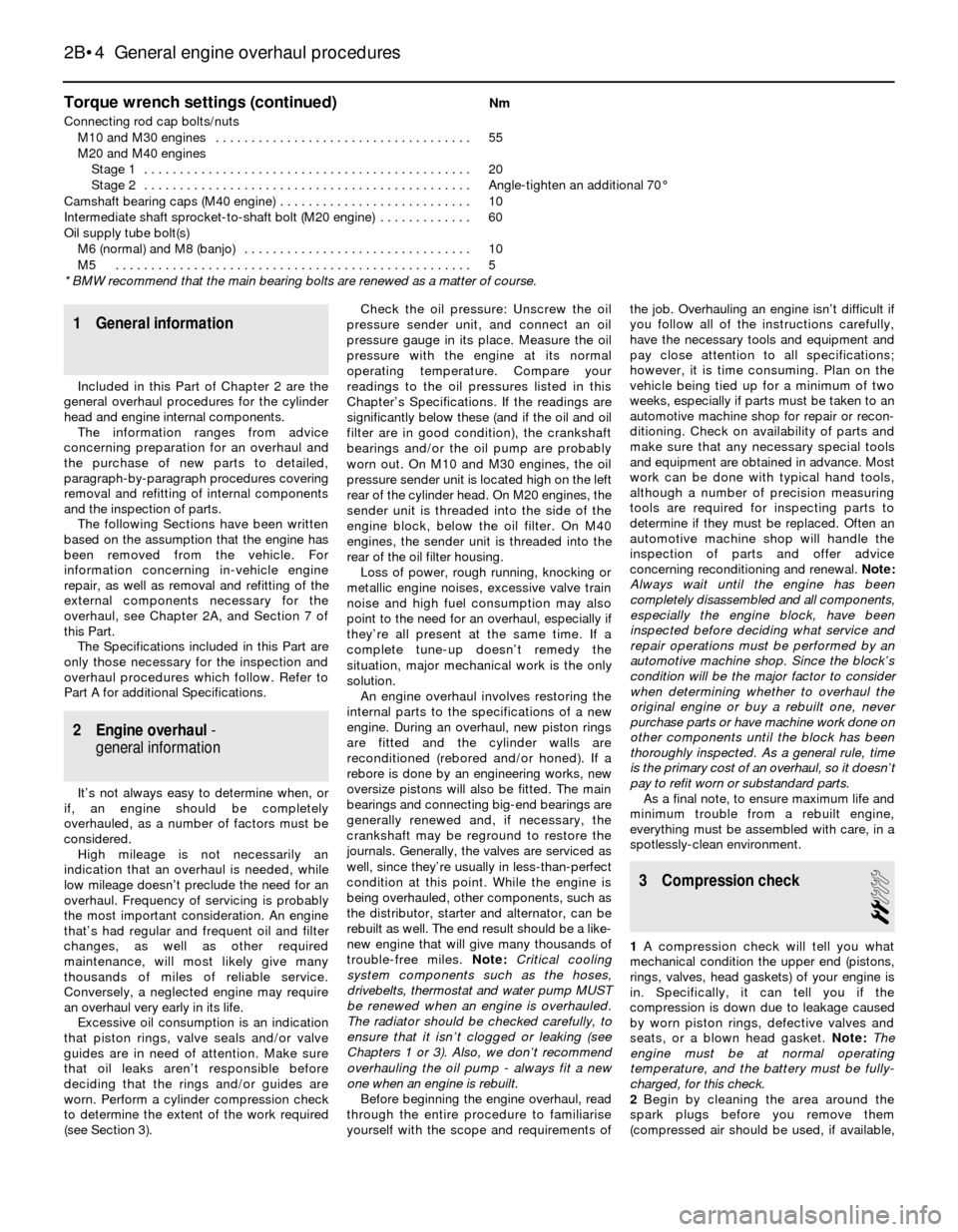
Torque wrench settings (continued)Nm
Connecting rod cap bolts/nuts
M10 and M30 engines . . . . . . . . . . . . . . . . . . . . . . . . . . . . . . . . . . . . 55
M20 and M40 engines
Stage 1 . . . . . . . . . . . . . . . . . . . . . . . . . . . . . . . . . . . . . . . . . . . . . . 20
Stage 2 . . . . . . . . . . . . . . . . . . . . . . . . . . . . . . . . . . . . . . . . . . . . . . Angle-tighten an additional 70°
Camshaft bearing caps (M40 engine) . . . . . . . . . . . . . . . . . . . . . . . . . . . 10
Intermediate shaft sprocket-to-shaft bolt (M20 engine) . . . . . . . . . . . . . 60
Oil supply tube bolt(s)
M6 (normal) and M8 (banjo) . . . . . . . . . . . . . . . . . . . . . . . . . . . . . . . . 10
M5 . . . . . . . . . . . . . . . . . . . . . . . . . . . . . . . . . . . . . . . . . . . . . . . . . . 5
* BMW recommend that the main bearing bolts are renewed as a matter of course.
2B•4 General engine overhaul procedures
1 General information
Included in this Part of Chapter 2 are the
general overhaul procedures for the cylinder
head and engine internal components.
The information ranges from advice
concerning preparation for an overhaul and
the purchase of new parts to detailed,
paragraph-by-paragraph procedures covering
removal and refitting of internal components
and the inspection of parts.
The following Sections have been written
based on the assumption that the engine has
been removed from the vehicle. For
information concerning in-vehicle engine
repair, as well as removal and refitting of the
external components necessary for the
overhaul, see Chapter 2A, and Section 7 of
this Part.
The Specifications included in this Part are
only those necessary for the inspection and
overhaul procedures which follow. Refer to
Part A for additional Specifications.
2 Engine overhaul-
general information
It’s not always easy to determine when, or
if, an engine should be completely
overhauled, as a number of factors must be
considered.
High mileage is not necessarily an
indication that an overhaul is needed, while
low mileage doesn’t preclude the need for an
overhaul. Frequency of servicing is probably
the most important consideration. An engine
that’s had regular and frequent oil and filter
changes, as well as other required
maintenance, will most likely give many
thousands of miles of reliable service.
Conversely, a neglected engine may require
an overhaul very early in its life.
Excessive oil consumption is an indication
that piston rings, valve seals and/or valve
guides are in need of attention. Make sure
that oil leaks aren’t responsible before
deciding that the rings and/or guides are
worn. Perform a cylinder compression check
to determine the extent of the work required
(see Section 3).Check the oil pressure: Unscrew the oil
pressure sender unit, and connect an oil
pressure gauge in its place. Measure the oil
pressure with the engine at its normal
operating temperature. Compare your
readings to the oil pressures listed in this
Chapter’s Specifications. If the readings are
significantly below these (and if the oil and oil
filter are in good condition), the crankshaft
bearings and/or the oil pump are probably
worn out. On M10 and M30 engines, the oil
pressure sender unit is located high on the left
rear of the cylinder head. On M20 engines, the
sender unit is threaded into the side of the
engine block, below the oil filter. On M40
engines, the sender unit is threaded into the
rear of the oil filter housing.
Loss of power, rough running, knocking or
metallic engine noises, excessive valve train
noise and high fuel consumption may also
point to the need for an overhaul, especially if
they’re all present at the same time. If a
complete tune-up doesn’t remedy the
situation, major mechanical work is the only
solution.
An engine overhaul involves restoring the
internal parts to the specifications of a new
engine. During an overhaul, new piston rings
are fitted and the cylinder walls are
reconditioned (rebored and/or honed). If a
rebore is done by an engineering works, new
oversize pistons will also be fitted. The main
bearings and connecting big-end bearings are
generally renewed and, if necessary, the
crankshaft may be reground to restore the
journals. Generally, the valves are serviced as
well, since they’re usually in less-than-perfect
condition at this point. While the engine is
being overhauled, other components, such as
the distributor, starter and alternator, can be
rebuilt as well. The end result should be a like-
new engine that will give many thousands of
trouble-free miles. Note: Critical cooling
system components such as the hoses,
drivebelts, thermostat and water pump MUST
be renewed when an engine is overhauled.
The radiator should be checked carefully, to
ensure that it isn’t clogged or leaking (see
Chapters 1 or 3). Also, we don’t recommend
overhauling the oil pump - always fit a new
one when an engine is rebuilt.
Before beginning the engine overhaul, read
through the entire procedure to familiarise
yourself with the scope and requirements ofthe job. Overhauling an engine isn’t difficult if
you follow all of the instructions carefully,
have the necessary tools and equipment and
pay close attention to all specifications;
however, it is time consuming. Plan on the
vehicle being tied up for a minimum of two
weeks, especially if parts must be taken to an
automotive machine shop for repair or recon-
ditioning. Check on availability of parts and
make sure that any necessary special tools
and equipment are obtained in advance. Most
work can be done with typical hand tools,
although a number of precision measuring
tools are required for inspecting parts to
determine if they must be replaced. Often an
automotive machine shop will handle the
inspection of parts and offer advice
concerning reconditioning and renewal. Note:
Always wait until the engine has been
completely disassembled and all components,
especially the engine block, have been
inspected before deciding what service and
repair operations must be performed by an
automotive machine shop. Since the block’s
condition will be the major factor to consider
when determining whether to overhaul the
original engine or buy a rebuilt one, never
purchase parts or have machine work done on
other components until the block has been
thoroughly inspected. As a general rule, time
is the primary cost of an overhaul, so it doesn’t
pay to refit worn or substandard parts.
As a final note, to ensure maximum life and
minimum trouble from a rebuilt engine,
everything must be assembled with care, in a
spotlessly-clean environment.
3 Compression check
2
1A compression check will tell you what
mechanical condition the upper end (pistons,
rings, valves, head gaskets) of your engine is
in. Specifically, it can tell you if the
compression is down due to leakage caused
by worn piston rings, defective valves and
seats, or a blown head gasket. Note:The
engine must be at normal operating
temperature, and the battery must be fully-
charged, for this check.
2Begin by cleaning the area around the
spark plugs before you remove them
(compressed air should be used, if available,
Page 62 of 228
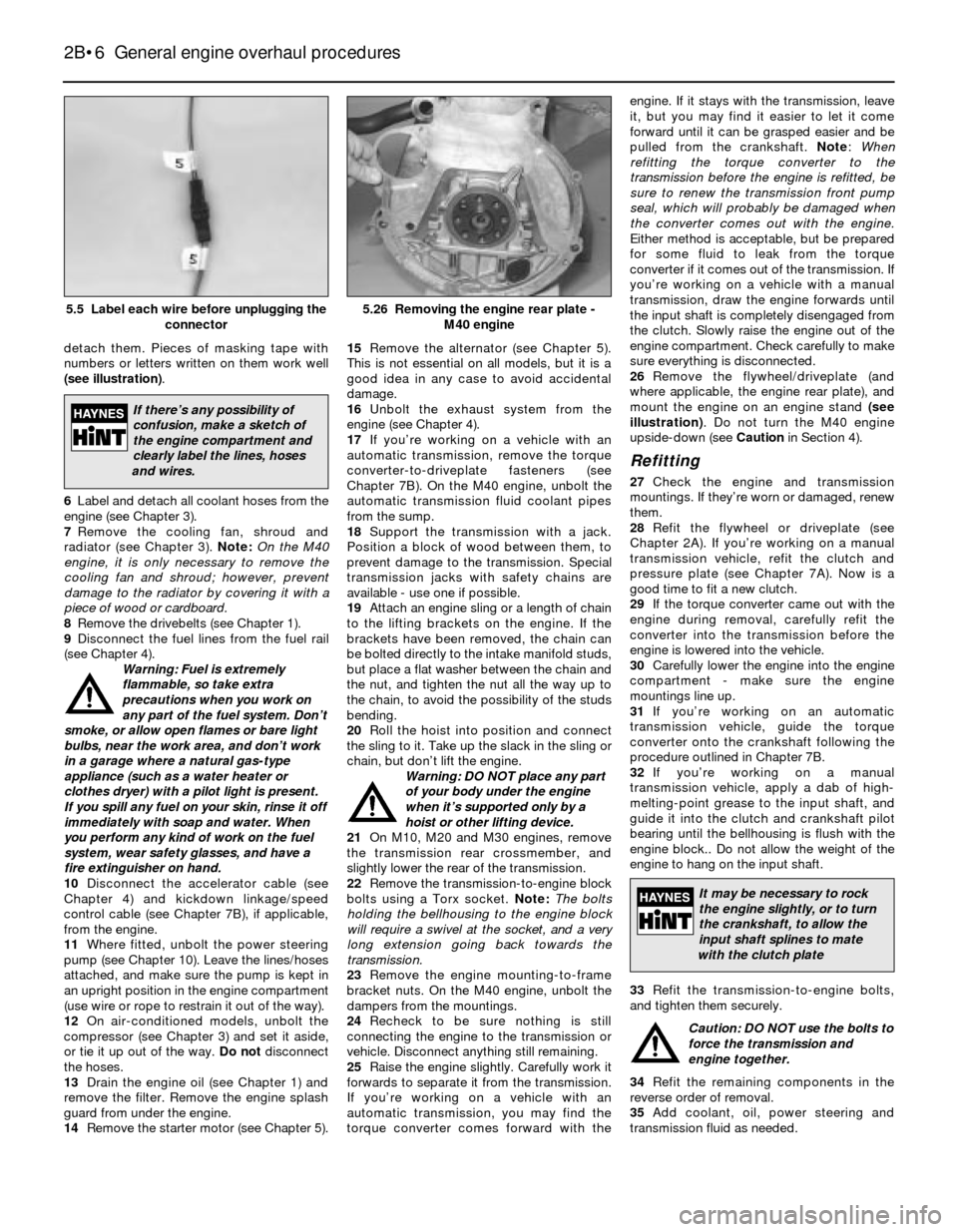
detach them. Pieces of masking tape with
numbers or letters written on them work well
(see illustration).
6Label and detach all coolant hoses from the
engine (see Chapter 3).
7Remove the cooling fan, shroud and
radiator (see Chapter 3). Note:On the M40
engine, it is only necessary to remove the
cooling fan and shroud; however, prevent
damage to the radiator by covering it with a
piece of wood or cardboard.
8Remove the drivebelts (see Chapter 1).
9Disconnect the fuel lines from the fuel rail
(see Chapter 4).
Warning: Fuel is extremely
flammable, so take extra
precautions when you work on
any part of the fuel system. Don’t
smoke, or allow open flames or bare light
bulbs, near the work area, and don’t work
in a garage where a natural gas-type
appliance (such as a water heater or
clothes dryer) with a pilot light is present.
If you spill any fuel on your skin, rinse it off
immediately with soap and water. When
you perform any kind of work on the fuel
system, wear safety glasses, and have a
fire extinguisher on hand.
10Disconnect the accelerator cable (see
Chapter 4) and kickdown linkage/speed
control cable (see Chapter 7B), if applicable,
from the engine.
11Where fitted, unbolt the power steering
pump (see Chapter 10). Leave the lines/hoses
attached, and make sure the pump is kept in
an upright position in the engine compartment
(use wire or rope to restrain it out of the way).
12On air-conditioned models, unbolt the
compressor (see Chapter 3) and set it aside,
or tie it up out of the way. Do not disconnect
the hoses.
13Drain the engine oil (see Chapter 1) and
remove the filter. Remove the engine splash
guard from under the engine.
14Remove the starter motor (see Chapter 5).15Remove the alternator (see Chapter 5).
This is not essential on all models, but it is a
good idea in any case to avoid accidental
damage.
16Unbolt the exhaust system from the
engine (see Chapter 4).
17If you’re working on a vehicle with an
automatic transmission, remove the torque
converter-to-driveplate fasteners (see
Chapter 7B). On the M40 engine, unbolt the
automatic transmission fluid coolant pipes
from the sump.
18Support the transmission with a jack.
Position a block of wood between them, to
prevent damage to the transmission. Special
transmission jacks with safety chains are
available - use one if possible.
19Attach an engine sling or a length of chain
to the lifting brackets on the engine. If the
brackets have been removed, the chain can
be bolted directly to the intake manifold studs,
but place a flat washer between the chain and
the nut, and tighten the nut all the way up to
the chain, to avoid the possibility of the studs
bending.
20Roll the hoist into position and connect
the sling to it. Take up the slack in the sling or
chain, but don’t lift the engine.
Warning: DO NOT place any part
of your body under the engine
when it’s supported only by a
hoist or other lifting device.
21On M10, M20 and M30 engines, remove
the transmission rear crossmember, and
slightly lower the rear of the transmission.
22Remove the transmission-to-engine block
bolts using a Torx socket. Note:The bolts
holding the bellhousing to the engine block
will require a swivel at the socket, and a very
long extension going back towards the
transmission.
23Remove the engine mounting-to-frame
bracket nuts. On the M40 engine, unbolt the
dampers from the mountings.
24Recheck to be sure nothing is still
connecting the engine to the transmission or
vehicle. Disconnect anything still remaining.
25Raise the engine slightly. Carefully work it
forwards to separate it from the transmission.
If you’re working on a vehicle with an
automatic transmission, you may find the
torque converter comes forward with theengine. If it stays with the transmission, leave
it, but you may find it easier to let it come
forward until it can be grasped easier and be
pulled from the crankshaft. Note:When
refitting the torque converter to the
transmission before the engine is refitted, be
sure to renew the transmission front pump
seal, which will probably be damaged when
the converter comes out with the engine.
Either method is acceptable, but be prepared
for some fluid to leak from the torque
converter if it comes out of the transmission. If
you’re working on a vehicle with a manual
transmission, draw the engine forwards until
the input shaft is completely disengaged from
the clutch. Slowly raise the engine out of the
engine compartment. Check carefully to make
sure everything is disconnected.
26Remove the flywheel/driveplate (and
where applicable, the engine rear plate), and
mount the engine on an engine stand (see
illustration). Do not turn the M40 engine
upside-down (see Cautionin Section 4).
Refitting
27Check the engine and transmission
mountings. If they’re worn or damaged, renew
them.
28Refit the flywheel or driveplate (see
Chapter 2A). If you’re working on a manual
transmission vehicle, refit the clutch and
pressure plate (see Chapter 7A). Now is a
good time to fit a new clutch.
29If the torque converter came out with the
engine during removal, carefully refit the
converter into the transmission before the
engine is lowered into the vehicle.
30Carefully lower the engine into the engine
compartment - make sure the engine
mountings line up.
31If you’re working on an automatic
transmission vehicle, guide the torque
converter onto the crankshaft following the
procedure outlined in Chapter 7B.
32If you’re working on a manual
transmission vehicle, apply a dab of high-
melting-point grease to the input shaft, and
guide it into the clutch and crankshaft pilot
bearing until the bellhousing is flush with the
engine block.. Do not allow the weight of the
engine to hang on the input shaft.
33Refit the transmission-to-engine bolts,
and tighten them securely.
Caution: DO NOT use the bolts to
force the transmission and
engine together.
34Refit the remaining components in the
reverse order of removal.
35Add coolant, oil, power steering and
transmission fluid as needed.
2B•6 General engine overhaul procedures
5.26 Removing the engine rear plate -
M40 engine5.5 Label each wire before unplugging the
connector
If there’s any possibility of
confusion, make a sketch of
the engine compartment and
clearly label the lines, hoses
and wires.
It may be necessary to rock
the engine slightly, or to turn
the crankshaft, to allow the
input shaft splines to mate
with the clutch plate
Page 63 of 228
36Run the engine and check for leaks and
proper operation of all accessories, then refit
the bonnet and test drive the vehicle.
37Where necessary, have the air
conditioning system recharged and leak-
tested.
6 Engine overhaul- alternatives
The do-it-yourselfer is faced with a number
of options when performing an engine
overhaul. The decision to renew the engine
block, piston/connecting rod assemblies and
crankshaft depends on a number of factors,
with the number one consideration being the
condition of the block. Other considerations
are cost, access to machine shop facilities,
parts availability, time required to complete
the project, and the extent of prior mechanical
experience on the part of the do-it-yourselfer.
Some of the alternatives include:
Individual parts - If the inspection
procedures reveal that the engine block and
most engine components are in re-usable
condition, purchasing individual parts may be
the most economical alternative. The block,
crankshaft and piston/connecting rod
assemblies should all be inspected carefully.
Even if the block shows little wear, the
cylinder bores should be surface-honed.
Crankshaft kit- A crankshaft kit (where
available) consists of a reground crankshaft
with matched undersize new main and
connecting big-end bearings. Sometimes,
reconditioned connecting rods and new
pistons and rings are included with the kit
(such a kit is sometimes called an “engine
kit”). If the block is in good condition, but the
crankshaft journals are scored or worn, a
crankshaft kit and other individual parts may
be the most economical alternative.
Short block- A short block consists of an
engine block with a crankshaft and
piston/connecting rod assemblies already
fitted. New bearings are fitted, and all
clearances will be correct. The existing
camshaft, valve train components, cylinder
head and external parts can be bolted to the
short block with little or no machine shop
work necessary.
Full block - A “full” or “complete” block
consists of a short block plus an oil pump,
sump, cylinder head, valve cover, camshaft
and valve train components, timing sprockets
and chain (or belt) and timing cover. All
components are fitted with new bearings,
seals and gaskets used throughout. The
refitting of manifolds and external parts is all
that’s necessary.
Give careful thought to which alternative is
best for you, and discuss the situation with
local machine shops, parts dealers and
experienced rebuilders before ordering or
purchasing new parts.
7 Engine overhaul-
dismantling sequence
1It’s much easier to dismantle and work on
the engine if it’s mounted on a portable
engine stand. A stand can often be hired quite
cheaply from a tool hire shop. Before the
engine is mounted on a stand, the
flywheel/driveplate should be removed from
the engine.
2If a stand isn’t available, it’s possible to
dismantle the engine with it blocked up on the
floor. Be extra-careful not to tip or drop the
engine when working without a stand.
3If you’re going to obtain a rebuilt engine, all
the external components listed below must
come off first, to be transferred to the new
engine if applicable. This is also the case if
you’re doing a complete engine overhaul
yourself. Note:When removing the external
components from the engine, pay close
attention to details that may be helpful or
important during refitting. Note the fitted
position of gaskets, seals, spacers, pins,
brackets, washers, bolts and other small items.
Alternator and brackets
Emissions control components
Distributor, HT leads and spark plugs
Thermostat and housing cover
Water pump
Fuel injection/carburettor and fuel system
components
Intake and exhaust manifolds
Oil filter and oil pressure sending unit
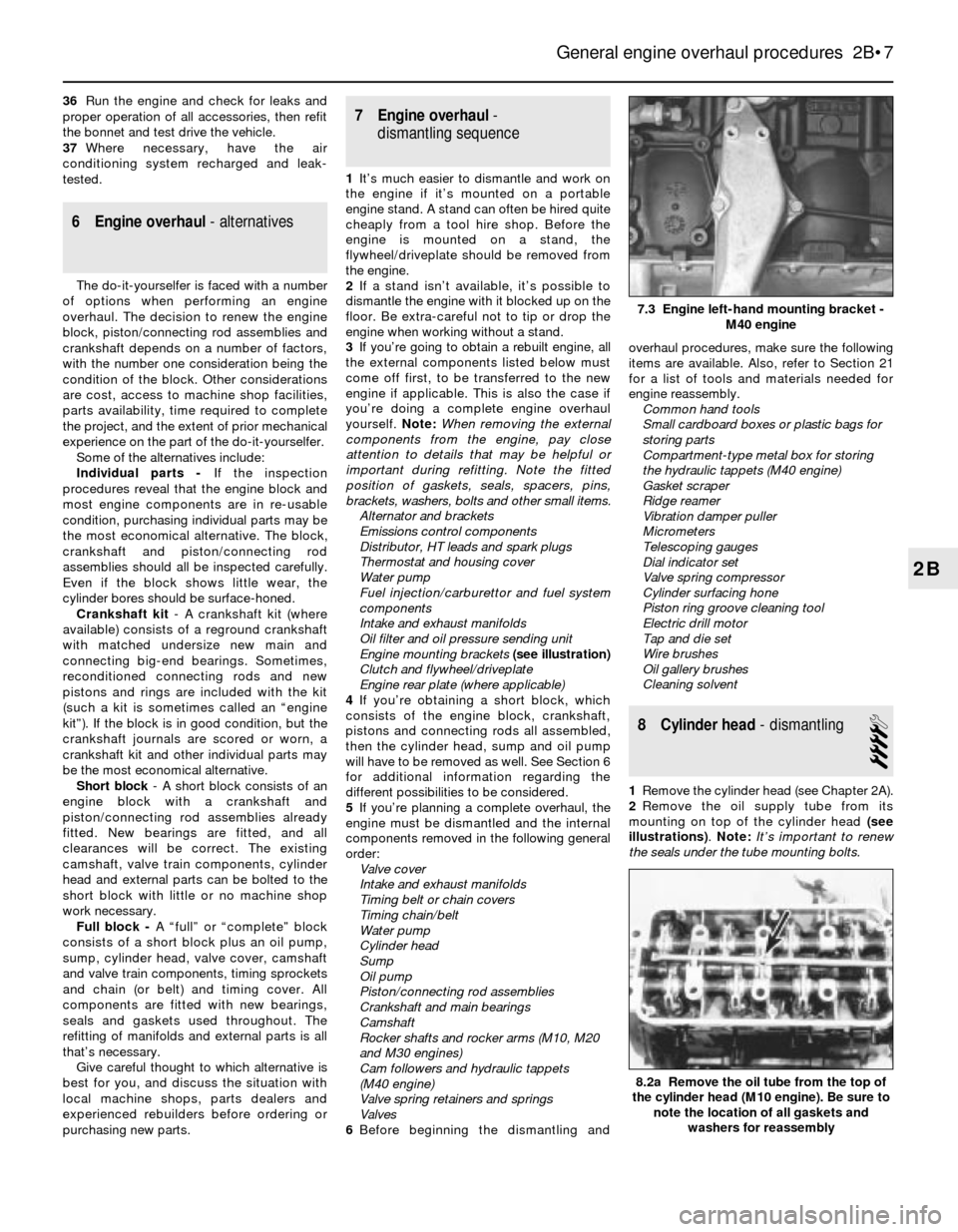
Engine mounting brackets (see illustration)
Clutch and flywheel/driveplate
Engine rear plate (where applicable)
4If you’re obtaining a short block, which
consists of the engine block, crankshaft,
pistons and connecting rods all assembled,
then the cylinder head, sump and oil pump
will have to be removed as well. See Section 6
for additional information regarding the
different possibilities to be considered.
5If you’re planning a complete overhaul, the
engine must be dismantled and the internal
components removed in the following general
order:
Valve cover
Intake and exhaust manifolds
Timing belt or chain covers
Timing chain/belt
Water pump
Cylinder head
Sump
Oil pump
Piston/connecting rod assemblies
Crankshaft and main bearings
Camshaft
Rocker shafts and rocker arms (M10, M20
and M30 engines)
Cam followers and hydraulic tappets
(M40 engine)
Valve spring retainers and springs
Valves
6Before beginning the dismantling andoverhaul procedures, make sure the following
items are available. Also, refer to Section 21
for a list of tools and materials needed for
engine reassembly.
Common hand tools
Small cardboard boxes or plastic bags for
storing parts
Compartment-type metal box for storing
the hydraulic tappets (M40 engine)
Gasket scraper
Ridge reamer
Vibration damper puller
Micrometers
Telescoping gauges
Dial indicator set
Valve spring compressor
Cylinder surfacing hone
Piston ring groove cleaning tool
Electric drill motor
Tap and die set
Wire brushes
Oil gallery brushes
Cleaning solvent
8 Cylinder head- dismantling
4
1Remove the cylinder head (see Chapter 2A).
2Remove the oil supply tube from its
mounting on top of the cylinder head (see
illustrations). Note:It’s important to renew
the seals under the tube mounting bolts.
General engine overhaul procedures 2B•7
7.3 Engine left-hand mounting bracket -
M40 engine
8.2a Remove the oil tube from the top of
the cylinder head (M10 engine). Be sure to
note the location of all gaskets and
washers for reassembly
2B
Page 64 of 228
M10, M20 and M30 engines
3Adjust all valves to their maximum clearance
by rotating the eccentric on the valve end of
the rocker arm towards the centre of the head
(see Chapter 1, if necessary).
4Before removing the thrustplate, measure
the camshaft endfloat by mounting a dial
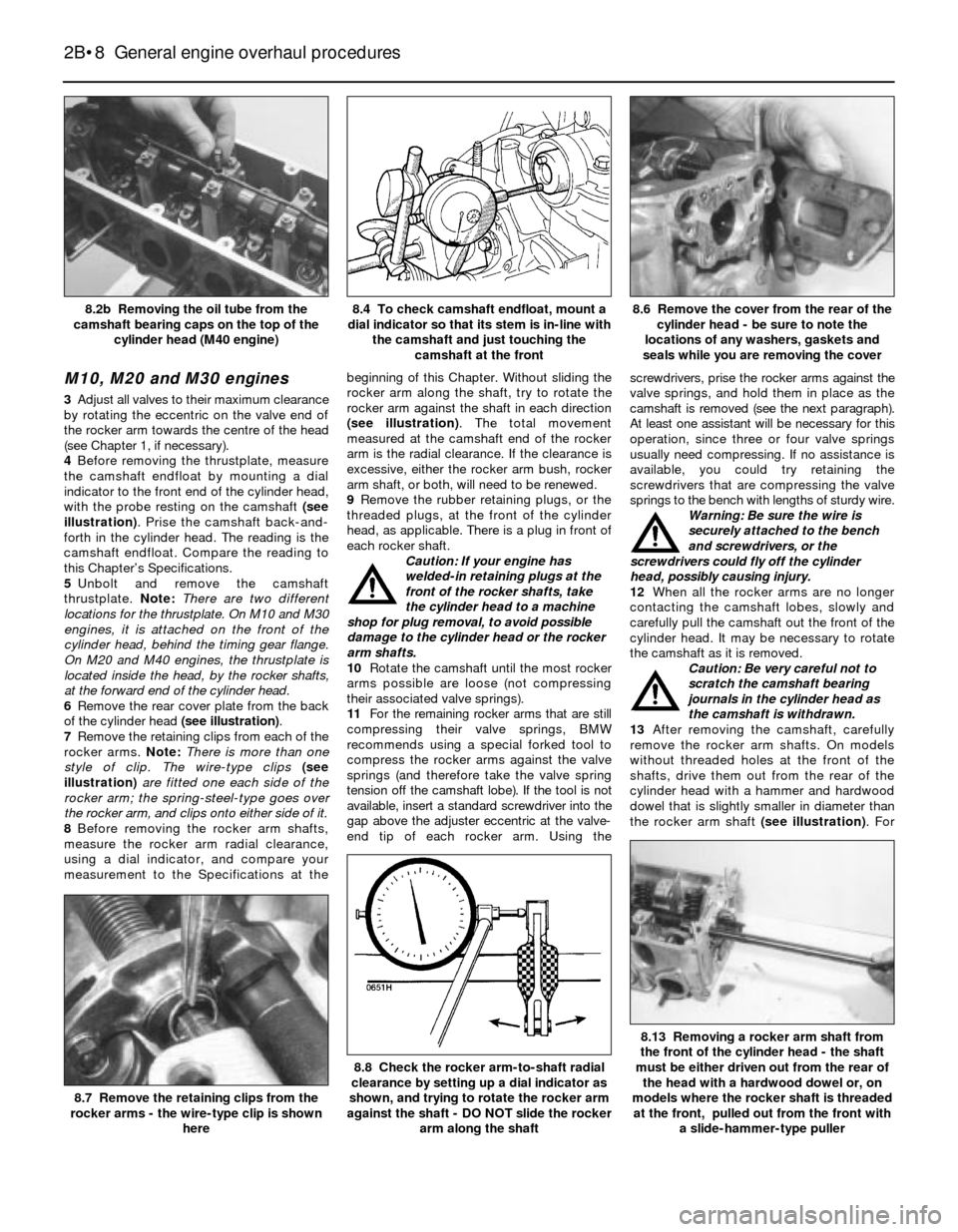
indicator to the front end of the cylinder head,
with the probe resting on the camshaft (see
illustration). Prise the camshaft back-and-
forth in the cylinder head. The reading is the
camshaft endfloat. Compare the reading to
this Chapter’s Specifications.
5Unbolt and remove the camshaft
thrustplate. Note:There are two different
locations for the thrustplate. On M10 and M30
engines, it is attached on the front of the
cylinder head, behind the timing gear flange.
On M20 and M40 engines, the thrustplate is
located inside the head, by the rocker shafts,
at the forward end of the cylinder head.
6Remove the rear cover plate from the back
of the cylinder head (see illustration).
7Remove the retaining clips from each of the
rocker arms. Note:There is more than one
style of clip. The wire-type clips (see
illustration)are fitted one each side of the
rocker arm; the spring-steel-type goes over
the rocker arm, and clips onto either side of it.
8Before removing the rocker arm shafts,
measure the rocker arm radial clearance,
using a dial indicator, and compare your
measurement to the Specifications at thebeginning of this Chapter. Without sliding the
rocker arm along the shaft, try to rotate the
rocker arm against the shaft in each direction
(see illustration). The total movement
measured at the camshaft end of the rocker
arm is the radial clearance. If the clearance is
excessive, either the rocker arm bush, rocker
arm shaft, or both, will need to be renewed.
9Remove the rubber retaining plugs, or the
threaded plugs, at the front of the cylinder
head, as applicable. There is a plug in front of
each rocker shaft.
Caution: If your engine has
welded-in retaining plugs at the
front of the rocker shafts, take
the cylinder head to a machine
shop for plug removal, to avoid possible
damage to the cylinder head or the rocker
arm shafts.
10Rotate the camshaft until the most rocker
arms possible are loose (not compressing
their associated valve springs).
11For the remaining rocker arms that are still
compressing their valve springs, BMW
recommends using a special forked tool to
compress the rocker arms against the valve
springs (and therefore take the valve spring
tension off the camshaft lobe). If the tool is not
available, insert a standard screwdriver into the
gap above the adjuster eccentric at the valve-
end tip of each rocker arm. Using thescrewdrivers, prise the rocker arms against the
valve springs, and hold them in place as the
camshaft is removed (see the next paragraph).
At least one assistant will be necessary for this
operation, since three or four valve springs
usually need compressing. If no assistance is
available, you could try retaining the
screwdrivers that are compressing the valve
springs to the bench with lengths of sturdy wire.
Warning: Be sure the wire is
securely attached to the bench
and screwdrivers, or the
screwdrivers could fly off the cylinder
head, possibly causing injury.
12When all the rocker arms are no longer
contacting the camshaft lobes, slowly and
carefully pull the camshaft out the front of the
cylinder head. It may be necessary to rotate
the camshaft as it is removed.
Caution: Be very careful not to
scratch the camshaft bearing
journals in the cylinder head as
the camshaft is withdrawn.
13After removing the camshaft, carefully
remove the rocker arm shafts. On models
without threaded holes at the front of the
shafts, drive them out from the rear of the
cylinder head with a hammer and hardwood
dowel that is slightly smaller in diameter than
the rocker arm shaft (see illustration). For
2B•8 General engine overhaul procedures
8.13 Removing a rocker arm shaft from
the front of the cylinder head - the shaft
must be either driven out from the rear of
the head with a hardwood dowel or, on
models where the rocker shaft is threaded
at the front, pulled out from the front with
a slide-hammer-type puller
8.8 Check the rocker arm-to-shaft radial
clearance by setting up a dial indicator as
shown, and trying to rotate the rocker arm
against the shaft - DO NOT slide the rocker
arm along the shaft
8.7 Remove the retaining clips from the
rocker arms - the wire-type clip is shown
here
8.6 Remove the cover from the rear of the
cylinder head - be sure to note the
locations of any washers, gaskets and
seals while you are removing the cover8.4 To check camshaft endfloat, mount a
dial indicator so that its stem is in-line with
the camshaft and just touching the
camshaft at the front8.2b Removing the oil tube from the
camshaft bearing caps on the top of the
cylinder head (M40 engine)
Page 67 of 228
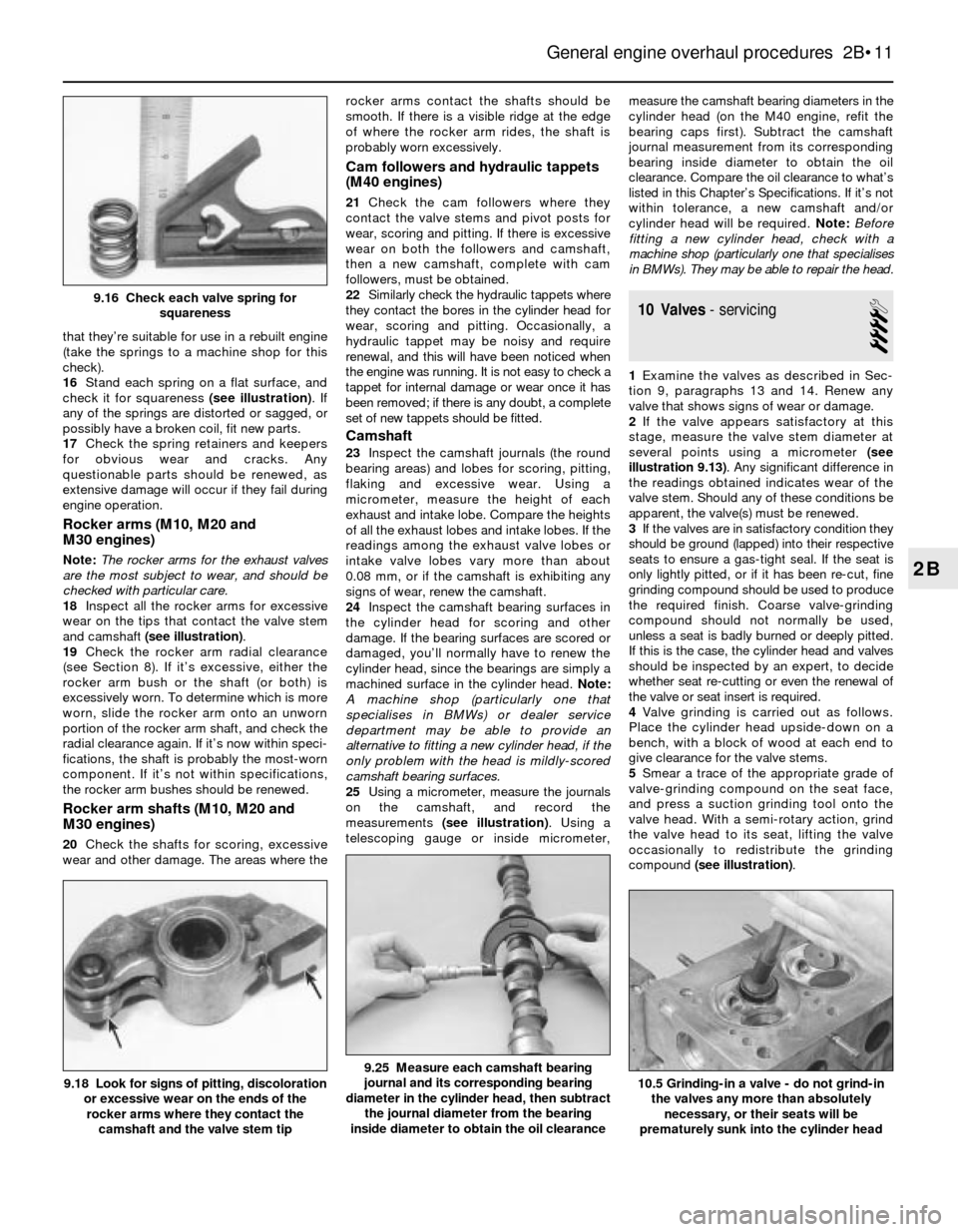
that they’re suitable for use in a rebuilt engine
(take the springs to a machine shop for this
check).
16Stand each spring on a flat surface, and
check it for squareness (see illustration). If
any of the springs are distorted or sagged, or
possibly have a broken coil, fit new parts.
17Check the spring retainers and keepers
for obvious wear and cracks. Any
questionable parts should be renewed, as
extensive damage will occur if they fail during
engine operation.
Rocker arms (M10, M20 and
M30 engines)
Note:The rocker arms for the exhaust valves
are the most subject to wear, and should be
checked with particular care.
18Inspect all the rocker arms for excessive
wear on the tips that contact the valve stem
and camshaft (see illustration).
19Check the rocker arm radial clearance
(see Section 8). If it’s excessive, either the
rocker arm bush or the shaft (or both) is
excessively worn. To determine which is more
worn, slide the rocker arm onto an unworn
portion of the rocker arm shaft, and check the
radial clearance again. If it’s now within speci-
fications, the shaft is probably the most-worn
component. If it’s not within specifications,
the rocker arm bushes should be renewed.
Rocker arm shafts (M10, M20 and
M30 engines)
20Check the shafts for scoring, excessive
wear and other damage. The areas where therocker arms contact the shafts should be
smooth. If there is a visible ridge at the edge
of where the rocker arm rides, the shaft is
probably worn excessively.
Cam followers and hydraulic tappets
(M40 engines)
21Check the cam followers where they
contact the valve stems and pivot posts for
wear, scoring and pitting. If there is excessive
wear on both the followers and camshaft,
then a new camshaft, complete with cam
followers, must be obtained.
22Similarly check the hydraulic tappets where
they contact the bores in the cylinder head for
wear, scoring and pitting. Occasionally, a
hydraulic tappet may be noisy and require
renewal, and this will have been noticed when
the engine was running. It is not easy to check a
tappet for internal damage or wear once it has
been removed; if there is any doubt, a complete
set of new tappets should be fitted.
Camshaft
23Inspect the camshaft journals (the round
bearing areas) and lobes for scoring, pitting,
flaking and excessive wear. Using a
micrometer, measure the height of each
exhaust and intake lobe. Compare the heights
of all the exhaust lobes and intake lobes. If the
readings among the exhaust valve lobes or
intake valve lobes vary more than about
0.08 mm, or if the camshaft is exhibiting any
signs of wear, renew the camshaft.
24Inspect the camshaft bearing surfaces in
the cylinder head for scoring and other
damage. If the bearing surfaces are scored or
damaged, you’ll normally have to renew the
cylinder head, since the bearings are simply a
machined surface in the cylinder head. Note:
A machine shop (particularly one that
specialises in BMWs) or dealer service
department may be able to provide an
alternative to fitting a new cylinder head, if the
only problem with the head is mildly-scored
camshaft bearing surfaces.
25Using a micrometer, measure the journals
on the camshaft, and record the
measurements (see illustration). Using a
telescoping gauge or inside micrometer,measure the camshaft bearing diameters in the
cylinder head (on the M40 engine, refit the
bearing caps first). Subtract the camshaft
journal measurement from its corresponding
bearing inside diameter to obtain the oil
clearance. Compare the oil clearance to what’s
listed in this Chapter’s Specifications. If it’s not
within tolerance, a new camshaft and/or
cylinder head will be required. Note:Before
fitting a new cylinder head, check with a
machine shop (particularly one that specialises
in BMWs). They may be able to repair the head.
10 Valves- servicing
4
1Examine the valves as described in Sec-
tion 9, paragraphs 13 and 14. Renew any
valve that shows signs of wear or damage.
2If the valve appears satisfactory at this
stage, measure the valve stem diameter at
several points using a micrometer (see
illustration 9.13). Any significant difference in
the readings obtained indicates wear of the
valve stem. Should any of these conditions be
apparent, the valve(s) must be renewed.
3If the valves are in satisfactory condition they
should be ground (lapped) into their respective
seats to ensure a gas-tight seal. If the seat is
only lightly pitted, or if it has been re-cut, fine
grinding compound should be used to produce
the required finish. Coarse valve-grinding
compound should not normally be used,
unless a seat is badly burned or deeply pitted.
If this is the case, the cylinder head and valves
should be inspected by an expert, to decide
whether seat re-cutting or even the renewal of
the valve or seat insert is required.
4Valve grinding is carried out as follows.
Place the cylinder head upside-down on a
bench, with a block of wood at each end to
give clearance for the valve stems.
5Smear a trace of the appropriate grade of
valve-grinding compound on the seat face,
and press a suction grinding tool onto the
valve head. With a semi-rotary action, grind
the valve head to its seat, lifting the valve
occasionally to redistribute the grinding
compound (see illustration).
General engine overhaul procedures 2B•11
9.25 Measure each camshaft bearing
journal and its corresponding bearing
diameter in the cylinder head, then subtract
the journal diameter from the bearing
inside diameter to obtain the oil clearance9.18 Look for signs of pitting, discoloration
or excessive wear on the ends of the
rocker arms where they contact the
camshaft and the valve stem tip10.5 Grinding-in a valve - do not grind-in
the valves any more than absolutely
necessary, or their seats will be
prematurely sunk into the cylinder head
2B
9.16 Check each valve spring for
squareness
Page 68 of 228
6If coarse grinding compound is being used,
work only until a dull, matt even surface is
produced on both the valve seat and the
valve, then wipe off the used compound and
repeat the process with fine compound. When
a smooth, unbroken ring of light grey matt
finish is produced on both the valve and seat,
the grinding operation is complete. Do not
grind in the valves any further than absolutely
necessary.
7When all the valves have been ground-in,
carefully wash off all traces of grinding
compound using paraffin or a suitable solvent
before reassembly of the cylinder head.
11 Cylinder head- reassembly
5
1Make sure the cylinder head is spotlessly-
clean before beginning reassembly.
2If the head was sent out for valve servicing,
the valves and related components will
already be in place. Begin the reassembly
procedure with paragraph 8.
3Starting at one end of the head, applymolybdenum disulphide (“moly”) grease or
clean engine oil to each valve stem, and refit
the first valve.
4Lubricate the lip of the valve guide seal,
carefully slide it over the tip of the valve, then
slide it all the way down the stem to the guide.
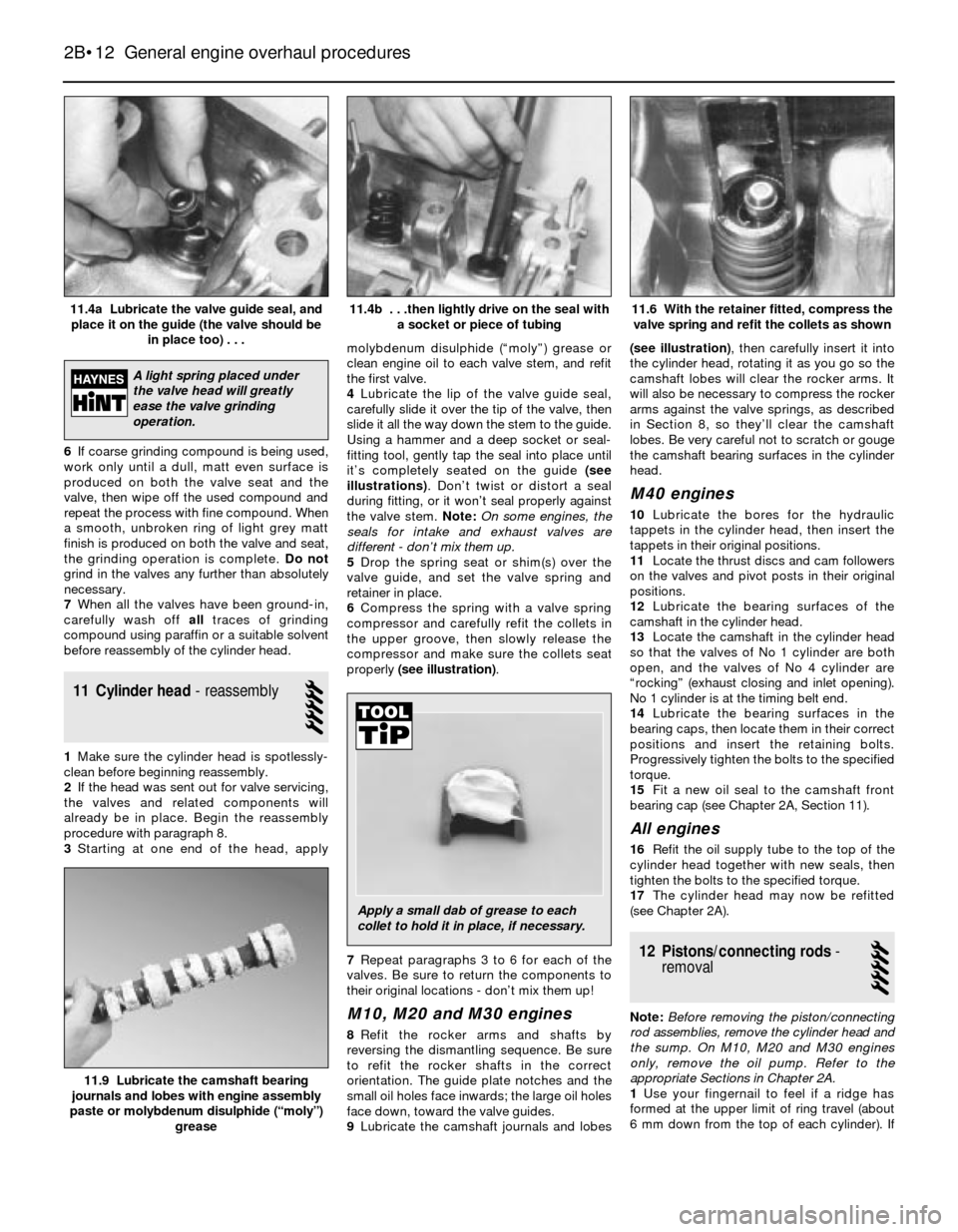
Using a hammer and a deep socket or seal-
fitting tool, gently tap the seal into place until
it’s completely seated on the guide (see
illustrations). Don’t twist or distort a seal
during fitting, or it won’t seal properly against
the valve stem. Note:On some engines, the
seals for intake and exhaust valves are
different - don’t mix them up.
5Drop the spring seat or shim(s) over the
valve guide, and set the valve spring and
retainer in place.
6Compress the spring with a valve spring
compressor and carefully refit the collets in
the upper groove, then slowly release the
compressor and make sure the collets seat
properly (see illustration).
7Repeat paragraphs 3 to 6 for each of the
valves. Be sure to return the components to
their original locations - don’t mix them up!
M10, M20 and M30 engines
8Refit the rocker arms and shafts by
reversing the dismantling sequence. Be sure
to refit the rocker shafts in the correct
orientation. The guide plate notches and the
small oil holes face inwards; the large oil holes
face down, toward the valve guides.
9Lubricate the camshaft journals and lobes(see illustration), then carefully insert it into
the cylinder head, rotating it as you go so the
camshaft lobes will clear the rocker arms. It
will also be necessary to compress the rocker
arms against the valve springs, as described
in Section 8, so they’ll clear the camshaft
lobes. Be very careful not to scratch or gouge
the camshaft bearing surfaces in the cylinder
head.
M40 engines
10Lubricate the bores for the hydraulic
tappets in the cylinder head, then insert the
tappets in their original positions.
11Locate the thrust discs and cam followers
on the valves and pivot posts in their original
positions.
12Lubricate the bearing surfaces of the
camshaft in the cylinder head.
13Locate the camshaft in the cylinder head
so that the valves of No 1 cylinder are both
open, and the valves of No 4 cylinder are
“rocking” (exhaust closing and inlet opening).
No 1 cylinder is at the timing belt end.
14Lubricate the bearing surfaces in the
bearing caps, then locate them in their correct
positions and insert the retaining bolts.
Progressively tighten the bolts to the specified
torque.
15Fit a new oil seal to the camshaft front
bearing cap (see Chapter 2A, Section 11).
All engines
16Refit the oil supply tube to the top of the
cylinder head together with new seals, then
tighten the bolts to the specified torque.
17The cylinder head may now be refitted
(see Chapter 2A).
12 Pistons/connecting rods-
removal
5
Note:Before removing the piston/connecting
rod assemblies, remove the cylinder head and
the sump. On M10, M20 and M30 engines
only, remove the oil pump. Refer to the
appropriate Sections in Chapter 2A.
1Use your fingernail to feel if a ridge has
formed at the upper limit of ring travel (about
6 mm down from the top of each cylinder). If
2B•12 General engine overhaul procedures
11.9 Lubricate the camshaft bearing
journals and lobes with engine assembly
paste or molybdenum disulphide (“moly”)
grease
11.6 With the retainer fitted, compress the
valve spring and refit the collets as shown 11.4b . . .then lightly drive on the seal with
a socket or piece of tubing11.4a Lubricate the valve guide seal, and
place it on the guide (the valve should be
in place too) . . .
A light spring placed under
the valve head will greatly
ease the valve grinding
operation.
Apply a small dab of grease to each
collet to hold it in place, if necessary.
Page 70 of 228
5Gently tap the caps with a soft-faced
hammer, then separate them from the engine
block. If necessary, use the bolts as levers to
remove the caps. Try not to drop the bearing
shells if they come out with the caps.
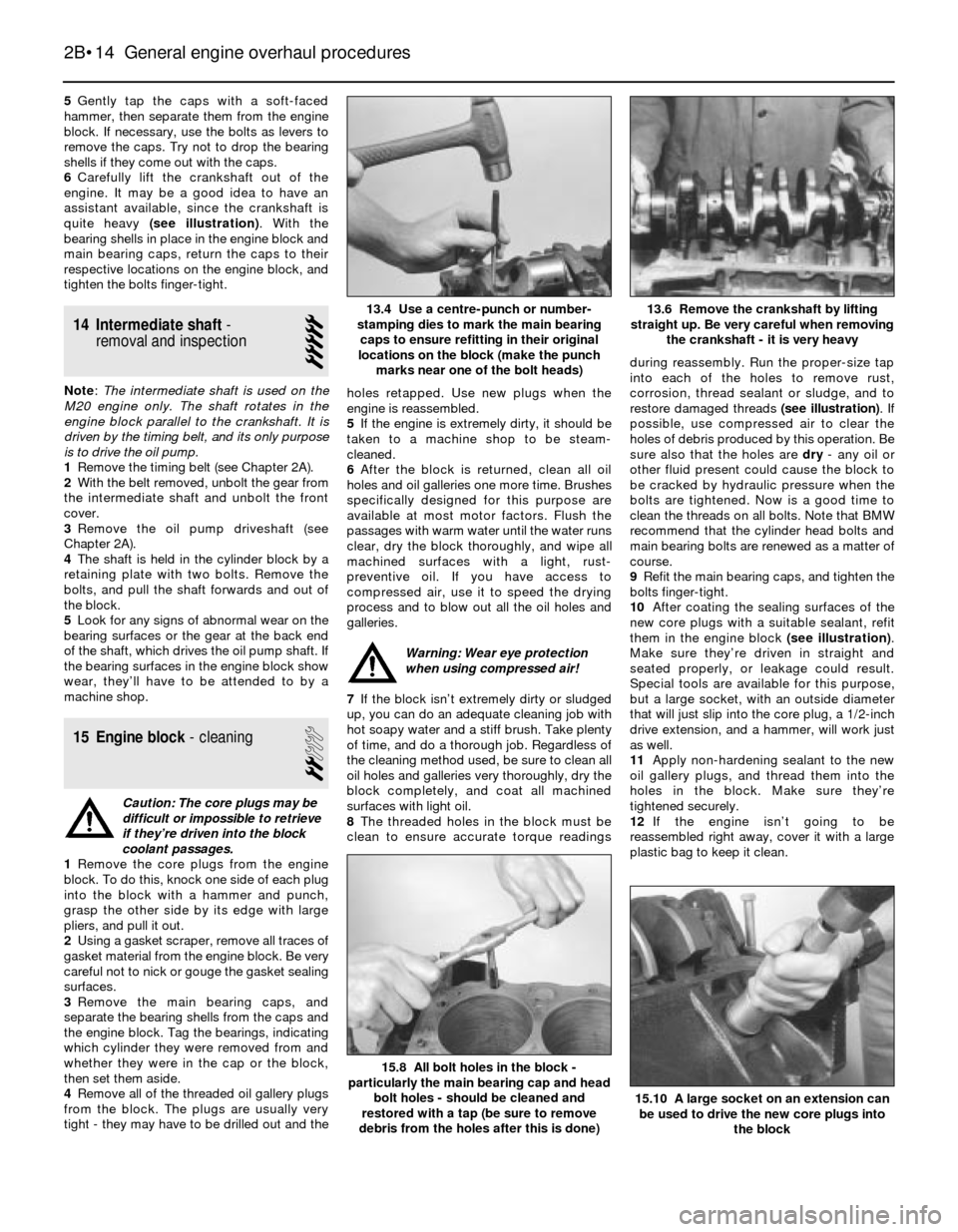
6Carefully lift the crankshaft out of the
engine. It may be a good idea to have an
assistant available, since the crankshaft is
quite heavy (see illustration). With the
bearing shells in place in the engine block and
main bearing caps, return the caps to their
respective locations on the engine block, and
tighten the bolts finger-tight.
14 Intermediate shaft-
removal and inspection
5
Note:The intermediate shaft is used on the
M20 engine only. The shaft rotates in the
engine block parallel to the crankshaft. It is
driven by the timing belt, and its only purpose
is to drive the oil pump.
1Remove the timing belt (see Chapter 2A).
2With the belt removed, unbolt the gear from
the intermediate shaft and unbolt the front
cover.
3Remove the oil pump driveshaft (see
Chapter 2A).
4The shaft is held in the cylinder block by a
retaining plate with two bolts. Remove the
bolts, and pull the shaft forwards and out of
the block.
5Look for any signs of abnormal wear on the
bearing surfaces or the gear at the back end
of the shaft, which drives the oil pump shaft. If
the bearing surfaces in the engine block show
wear, they’ll have to be attended to by a
machine shop.
15 Engine block- cleaning
2
Caution: The core plugs may be
difficult or impossible to retrieve
if they’re driven into the block
coolant passages.
1Remove the core plugs from the engine
block. To do this, knock one side of each plug
into the block with a hammer and punch,
grasp the other side by its edge with large
pliers, and pull it out.
2Using a gasket scraper, remove all traces of
gasket material from the engine block. Be very
careful not to nick or gouge the gasket sealing
surfaces.
3Remove the main bearing caps, and
separate the bearing shells from the caps and
the engine block. Tag the bearings, indicating
which cylinder they were removed from and
whether they were in the cap or the block,
then set them aside.
4Remove all of the threaded oil gallery plugs
from the block. The plugs are usually very
tight - they may have to be drilled out and theholes retapped. Use new plugs when the
engine is reassembled.
5If the engine is extremely dirty, it should be
taken to a machine shop to be steam-
cleaned.
6After the block is returned, clean all oil
holes and oil galleries one more time. Brushes
specifically designed for this purpose are
available at most motor factors. Flush the
passages with warm water until the water runs
clear, dry the block thoroughly, and wipe all
machined surfaces with a light, rust-
preventive oil. If you have access to
compressed air, use it to speed the drying
process and to blow out all the oil holes and
galleries.
Warning: Wear eye protection
when using compressed air!
7If the block isn’t extremely dirty or sludged
up, you can do an adequate cleaning job with
hot soapy water and a stiff brush. Take plenty
of time, and do a thorough job. Regardless of
the cleaning method used, be sure to clean all
oil holes and galleries very thoroughly, dry the
block completely, and coat all machined
surfaces with light oil.
8The threaded holes in the block must be
clean to ensure accurate torque readingsduring reassembly. Run the proper-size tap
into each of the holes to remove rust,
corrosion, thread sealant or sludge, and to
restore damaged threads (see illustration). If
possible, use compressed air to clear the
holes of debris produced by this operation. Be
sure also that the holes are dry- any oil or
other fluid present could cause the block to
be cracked by hydraulic pressure when the
bolts are tightened. Now is a good time to
clean the threads on all bolts. Note that BMW
recommend that the cylinder head bolts and
main bearing bolts are renewed as a matter of
course.
9Refit the main bearing caps, and tighten the
bolts finger-tight.
10After coating the sealing surfaces of the
new core plugs with a suitable sealant, refit
them in the engine block (see illustration).
Make sure they’re driven in straight and
seated properly, or leakage could result.
Special tools are available for this purpose,
but a large socket, with an outside diameter
that will just slip into the core plug, a 1/2-inch
drive extension, and a hammer, will work just
as well.
11Apply non-hardening sealant to the new
oil gallery plugs, and thread them into the
holes in the block. Make sure they’re
tightened securely.
12If the engine isn’t going to be
reassembled right away, cover it with a large
plastic bag to keep it clean.
2B•14 General engine overhaul procedures
15.10 A large socket on an extension can
be used to drive the new core plugs into
the block
15.8 All bolt holes in the block -
particularly the main bearing cap and head
bolt holes - should be cleaned and
restored with a tap (be sure to remove
debris from the holes after this is done)
13.6 Remove the crankshaft by lifting
straight up. Be very careful when removing
the crankshaft - it is very heavy13.4 Use a centre-punch or number-
stamping dies to mark the main bearing
caps to ensure refitting in their original
locations on the block (make the punch
marks near one of the bolt heads)