Gasket BMW 3 SERIES 1991 E30 Owner's Manual
[x] Cancel search | Manufacturer: BMW, Model Year: 1991, Model line: 3 SERIES, Model: BMW 3 SERIES 1991 E30Pages: 228, PDF Size: 7.04 MB
Page 66 of 228
24Repeat the procedure for the remaining
valves. Remember to keep all the parts for
each valve together, so they can be refitted in
the same locations.
25Once the valves and related components
have been removed and stored in an
organised manner, the head should be
thoroughly cleaned and inspected. If a
complete engine overhaul is being done,
finish the engine dismantling procedures
before beginning the cylinder head cleaning
and inspection process.
9 Cylinder head and
components-
cleaning and inspection
4
1Thorough cleaning of the cylinder head(s)
and related valve train components, followed
by a detailed inspection, will enable you to
decide how much valve service work must be
done during the engine overhaul. Note: If the
engine was severely overheated, the cylinder
head is probably warped (see paragraph 10).
Cleaning
2Scrape all traces of old gasket material and
sealing compound off the cylinder head,
intake manifold and exhaust manifold sealing
surfaces. Be very careful not to gouge the
cylinder head. Special gasket removal
solvents are available at motor factors.
3Remove all built-up scale from the coolant
passages.
4Run a stiff brush through the various holes
to remove deposits that may have formed in
them.
5Run an appropriate-size tap into each of the
threaded holes, to remove corrosion and
thread sealant that may be present. If
compressed air is available, use it to clear the
holes of debris produced by this operation.
Warning: Wear eye protection
when using compressed air!
6Clean the cylinder head with solvent, and
dry it thoroughly. Compressed air will speed
the drying process, and ensure that all holesand recessed areas are clean. Note:
Decarbonising chemicals are available, and
may prove very useful when cleaning cylinder
heads and valve train components. They are
very caustic, however, and should be used
with caution. Be sure to follow the instructions
on the container.
7Clean all the rocker shafts/arms/followers,
springs, valve springs, spring seats, keepers
and retainers with solvent, and dry them
thoroughly. Clean the components from one
valve at a time, to avoid mixing up the parts.
Caution: DO NOT clean the
hydraulic tappets of the M40
engine; leave them completely
immersed in oil.
8Scrape off any heavy deposits that may
have formed on the valves, then use a
motorised wire brush to remove deposits from
the valve heads and stems. Again, make sure
the valves don’t get mixed up.
Inspection
Note: Be sure to perform all of the following
inspection procedures before concluding that
machine shop work is required. Make a list of
the items that need attention.
Cylinder head
9Inspect the head very carefully for cracks,
evidence of coolant leakage, and other
damage. If cracks are found, check with an
machine shop concerning repair. If repair isn’t
possible, a new cylinder head should be
obtained.
10Using a straightedge and feeler gauge,
check the head gasket mating surface for
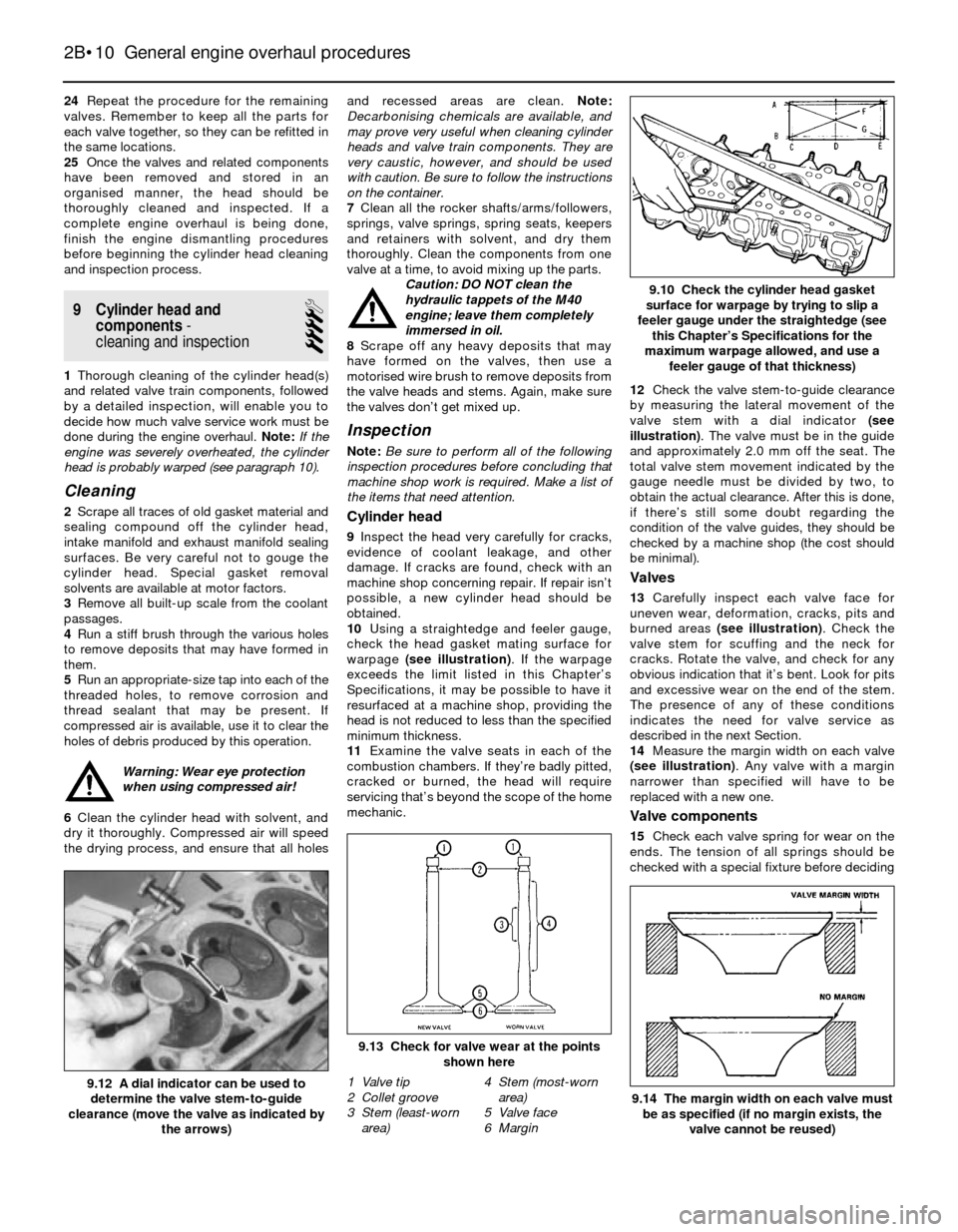
warpage (see illustration). If the warpage
exceeds the limit listed in this Chapter’s
Specifications, it may be possible to have it
resurfaced at a machine shop, providing the
head is not reduced to less than the specified
minimum thickness.
11Examine the valve seats in each of the
combustion chambers. If they’re badly pitted,
cracked or burned, the head will require
servicing that’s beyond the scope of the home
mechanic.12Check the valve stem-to-guide clearance
by measuring the lateral movement of the
valve stem with a dial indicator (see
illustration). The valve must be in the guide
and approximately 2.0 mm off the seat. The
total valve stem movement indicated by the
gauge needle must be divided by two, to
obtain the actual clearance. After this is done,
if there’s still some doubt regarding the
condition of the valve guides, they should be
checked by a machine shop (the cost should
be minimal).
Valves
13Carefully inspect each valve face for
uneven wear, deformation, cracks, pits and
burned areas (see illustration). Check the
valve stem for scuffing and the neck for
cracks. Rotate the valve, and check for any
obvious indication that it’s bent. Look for pits
and excessive wear on the end of the stem.
The presence of any of these conditions
indicates the need for valve service as
described in the next Section.
14Measure the margin width on each valve
(see illustration). Any valve with a margin
narrower than specified will have to be
replaced with a new one.
Valve components
15Check each valve spring for wear on the
ends. The tension of all springs should be
checked with a special fixture before deciding
2B•10 General engine overhaul procedures
9.14 The margin width on each valve must
be as specified (if no margin exists, the
valve cannot be reused)
9.13 Check for valve wear at the points
shown here
9.12 A dial indicator can be used to
determine the valve stem-to-guide
clearance (move the valve as indicated by
the arrows)
9.10 Check the cylinder head gasket
surface for warpage by trying to slip a
feeler gauge under the straightedge (see
this Chapter’s Specifications for the
maximum warpage allowed, and use a
feeler gauge of that thickness)
1 Valve tip
2 Collet groove
3 Stem (least-worn
area)4 Stem (most-worn
area)
5 Valve face
6 Margin
Page 70 of 228
5Gently tap the caps with a soft-faced
hammer, then separate them from the engine
block. If necessary, use the bolts as levers to
remove the caps. Try not to drop the bearing
shells if they come out with the caps.
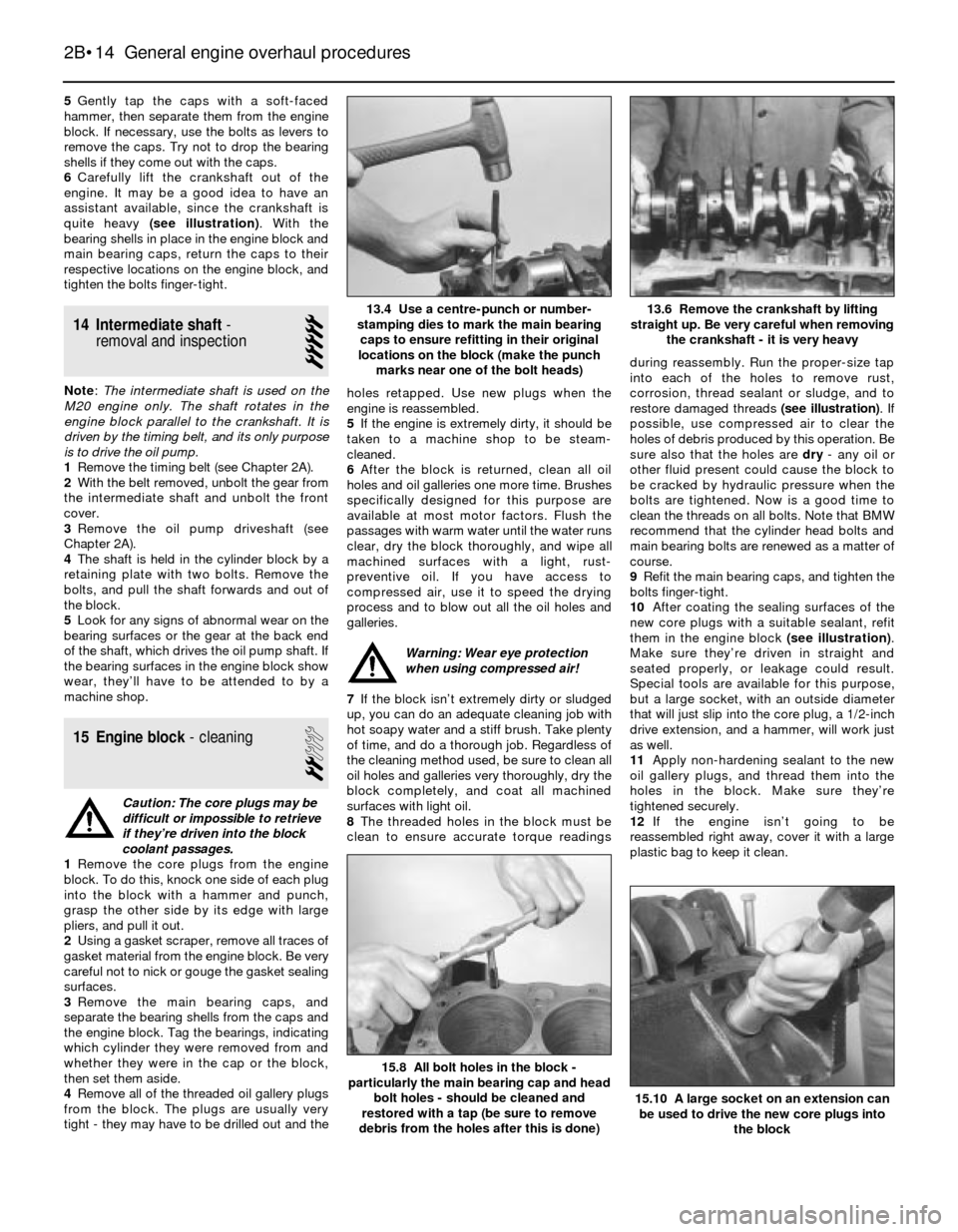
6Carefully lift the crankshaft out of the
engine. It may be a good idea to have an
assistant available, since the crankshaft is
quite heavy (see illustration). With the
bearing shells in place in the engine block and
main bearing caps, return the caps to their
respective locations on the engine block, and
tighten the bolts finger-tight.
14 Intermediate shaft-
removal and inspection
5
Note:The intermediate shaft is used on the
M20 engine only. The shaft rotates in the
engine block parallel to the crankshaft. It is
driven by the timing belt, and its only purpose
is to drive the oil pump.
1Remove the timing belt (see Chapter 2A).
2With the belt removed, unbolt the gear from
the intermediate shaft and unbolt the front
cover.
3Remove the oil pump driveshaft (see
Chapter 2A).
4The shaft is held in the cylinder block by a
retaining plate with two bolts. Remove the
bolts, and pull the shaft forwards and out of
the block.
5Look for any signs of abnormal wear on the
bearing surfaces or the gear at the back end
of the shaft, which drives the oil pump shaft. If
the bearing surfaces in the engine block show
wear, they’ll have to be attended to by a
machine shop.
15 Engine block- cleaning
2
Caution: The core plugs may be
difficult or impossible to retrieve
if they’re driven into the block
coolant passages.
1Remove the core plugs from the engine
block. To do this, knock one side of each plug
into the block with a hammer and punch,
grasp the other side by its edge with large
pliers, and pull it out.
2Using a gasket scraper, remove all traces of
gasket material from the engine block. Be very
careful not to nick or gouge the gasket sealing
surfaces.
3Remove the main bearing caps, and
separate the bearing shells from the caps and
the engine block. Tag the bearings, indicating
which cylinder they were removed from and
whether they were in the cap or the block,
then set them aside.
4Remove all of the threaded oil gallery plugs
from the block. The plugs are usually very
tight - they may have to be drilled out and theholes retapped. Use new plugs when the
engine is reassembled.
5If the engine is extremely dirty, it should be
taken to a machine shop to be steam-
cleaned.
6After the block is returned, clean all oil
holes and oil galleries one more time. Brushes
specifically designed for this purpose are
available at most motor factors. Flush the
passages with warm water until the water runs
clear, dry the block thoroughly, and wipe all
machined surfaces with a light, rust-
preventive oil. If you have access to
compressed air, use it to speed the drying
process and to blow out all the oil holes and
galleries.
Warning: Wear eye protection
when using compressed air!
7If the block isn’t extremely dirty or sludged
up, you can do an adequate cleaning job with
hot soapy water and a stiff brush. Take plenty
of time, and do a thorough job. Regardless of
the cleaning method used, be sure to clean all
oil holes and galleries very thoroughly, dry the
block completely, and coat all machined
surfaces with light oil.
8The threaded holes in the block must be
clean to ensure accurate torque readingsduring reassembly. Run the proper-size tap
into each of the holes to remove rust,
corrosion, thread sealant or sludge, and to
restore damaged threads (see illustration). If
possible, use compressed air to clear the
holes of debris produced by this operation. Be
sure also that the holes are dry- any oil or
other fluid present could cause the block to
be cracked by hydraulic pressure when the
bolts are tightened. Now is a good time to
clean the threads on all bolts. Note that BMW
recommend that the cylinder head bolts and
main bearing bolts are renewed as a matter of
course.
9Refit the main bearing caps, and tighten the
bolts finger-tight.
10After coating the sealing surfaces of the
new core plugs with a suitable sealant, refit
them in the engine block (see illustration).
Make sure they’re driven in straight and
seated properly, or leakage could result.
Special tools are available for this purpose,
but a large socket, with an outside diameter
that will just slip into the core plug, a 1/2-inch
drive extension, and a hammer, will work just
as well.
11Apply non-hardening sealant to the new
oil gallery plugs, and thread them into the
holes in the block. Make sure they’re
tightened securely.
12If the engine isn’t going to be
reassembled right away, cover it with a large
plastic bag to keep it clean.
2B•14 General engine overhaul procedures
15.10 A large socket on an extension can
be used to drive the new core plugs into
the block
15.8 All bolt holes in the block -
particularly the main bearing cap and head
bolt holes - should be cleaned and
restored with a tap (be sure to remove
debris from the holes after this is done)
13.6 Remove the crankshaft by lifting
straight up. Be very careful when removing
the crankshaft - it is very heavy13.4 Use a centre-punch or number-
stamping dies to mark the main bearing
caps to ensure refitting in their original
locations on the block (make the punch
marks near one of the bolt heads)
Page 74 of 228
3When examining the bearings, remove
them from the engine block, the main bearing
caps, the connecting rods and the rod caps,
and lay them out on a clean surface in the
same general position as their location in the
engine. This will enable you to match any
bearing problems with the corresponding
crankshaft journal.
4Dirt and other foreign particles get into the
engine in a variety of ways. It may be left in
the engine during assembly, or it may pass
through filters or the crankcase ventilation
(PCV) system. It may get into the oil, and from
there into the bearings. Metal chips from
machining operations and normal engine wear
are often present. Abrasives are sometimes
left in engine components after recondi-
tioning, especially when parts are not
thoroughly cleaned using the proper cleaning
methods. Whatever the source, these foreign
objects often end up embedded in the soft
bearing material, and are easily recognised.
Large particles will not embed in the bearing,
and will score or gouge the bearing and
journal. The best prevention for this cause of
bearing failure is to clean all parts thoroughly,
and to keep everything spotlessly-clean
during engine assembly. Frequent and regular
engine oil and filter changes are also
recommended.
5Lack of lubrication (or lubrication
breakdown) has a number of interrelated
causes. Excessive heat (which thins the oil),
overloading (which squeezes the oil from the
bearing face) and oil “leakage” or “throw off”
(from excessive bearing clearances, worn oil
pump, or high engine speeds) all contribute to
lubrication breakdown. Blocked oil passages,
which usually are the result of misaligned oil
holes in a bearing shell, will also oil-starve a
bearing and destroy it. When lack of
lubrication is the cause of bearing failure, the
bearing material is wiped or extruded from the
steel backing of the bearing. Temperatures
may increase to the point where the steel
backing turns blue from overheating.
6Driving habits can have a definite effect on
bearing life. Full-throttle, low-speed operation
(labouring the engine) puts very high loads onbearings, which tends to squeeze out the oil
film. These loads cause the bearings to flex,
which produces fine cracks in the bearing
face (fatigue failure). Eventually, the bearing
material will loosen in places, and tear away
from the steel backing. Short-trip driving
leads to corrosion of bearings, because
insufficient engine heat is produced to drive
off the condensation and corrosive gases.
These products collect in the engine oil,
forming acid and sludge. As the oil is carried
to the engine bearings, the acid attacks and
corrodes the bearing material.
7Incorrect bearing refitting during engine
assembly will lead to bearing failure as well.
Tight-fitting bearings leave insufficient bearing
oil clearance, and will result in oil starvation.
Dirt or foreign particles trapped behind a
bearing shell result in high spots on the
bearing, which will lead to failure.
21 Engine overhaul-
reassembly sequence
1Before beginning engine reassembly, make
sure you have all the necessary new parts,
gaskets and seals, as well as the following
items on hand:
Common hand tools
A torque wrench
Piston ring refitting tool
Piston ring compressor
Vibration damper refitting tool
Short lengths of rubber or plastic hose to fit
over connecting rod bolts (where
applicable)
Plastigage
Feeler gauges
A fine-tooth file
New engine oil
Engine assembly oil or molybdenum
disulphide (“moly”) grease
Gasket sealant
Thread-locking compound
2In order to save time and avoid problems,
engine reassembly should be done in the
following general order:Piston rings
Crankshaft and main bearings
Piston/connecting rod assemblies
Oil pump
Sump
Cylinder head assembly
Timing belt or chain and tensioner
assemblies
Water pump
Timing belt or chain covers
Intake and exhaust manifolds
Valve cover
Engine rear plate
Flywheel/driveplate
22 Piston rings- refitting
2
1Before fitting the new piston rings, the ring
end gaps must be checked. It’s assumed that
the piston ring side clearance has been
checked and verified (see Section 18).
2Lay out the piston/connecting rod
assemblies and the new ring sets, so that the
ring sets will be matched with the same piston
and cylinder during the end gap measurement
and engine assembly.
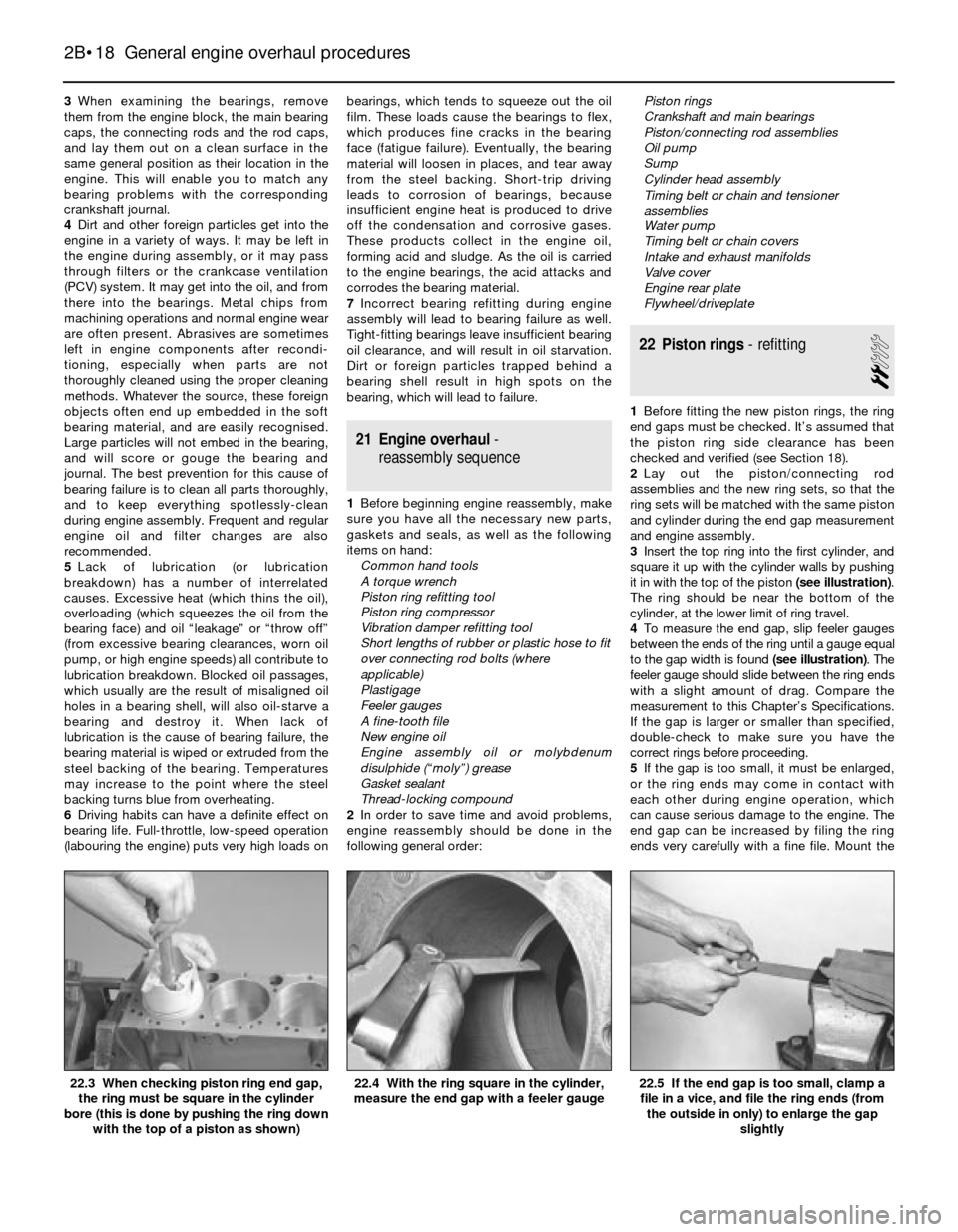
3Insert the top ring into the first cylinder, and
square it up with the cylinder walls by pushing
it in with the top of the piston (see illustration).
The ring should be near the bottom of the
cylinder, at the lower limit of ring travel.
4To measure the end gap, slip feeler gauges
between the ends of the ring until a gauge equal
to the gap width is found(see illustration). The
feeler gauge should slide between the ring ends
with a slight amount of drag. Compare the
measurement to this Chapter’s Specifications.
If the gap is larger or smaller than specified,
double-check to make sure you have the
correct rings before proceeding.
5If the gap is too small, it must be enlarged,
or the ring ends may come in contact with
each other during engine operation, which
can cause serious damage to the engine. The
end gap can be increased by filing the ring
ends very carefully with a fine file. Mount the
2B•18 General engine overhaul procedures
22.5 If the end gap is too small, clamp a
file in a vice, and file the ring ends (from
the outside in only) to enlarge the gap
slightly22.4 With the ring square in the cylinder,
measure the end gap with a feeler gauge22.3 When checking piston ring end gap,
the ring must be square in the cylinder
bore (this is done by pushing the ring down
with the top of a piston as shown)
Page 77 of 228
slowly, and make sure the seal enters the bore
squarely.
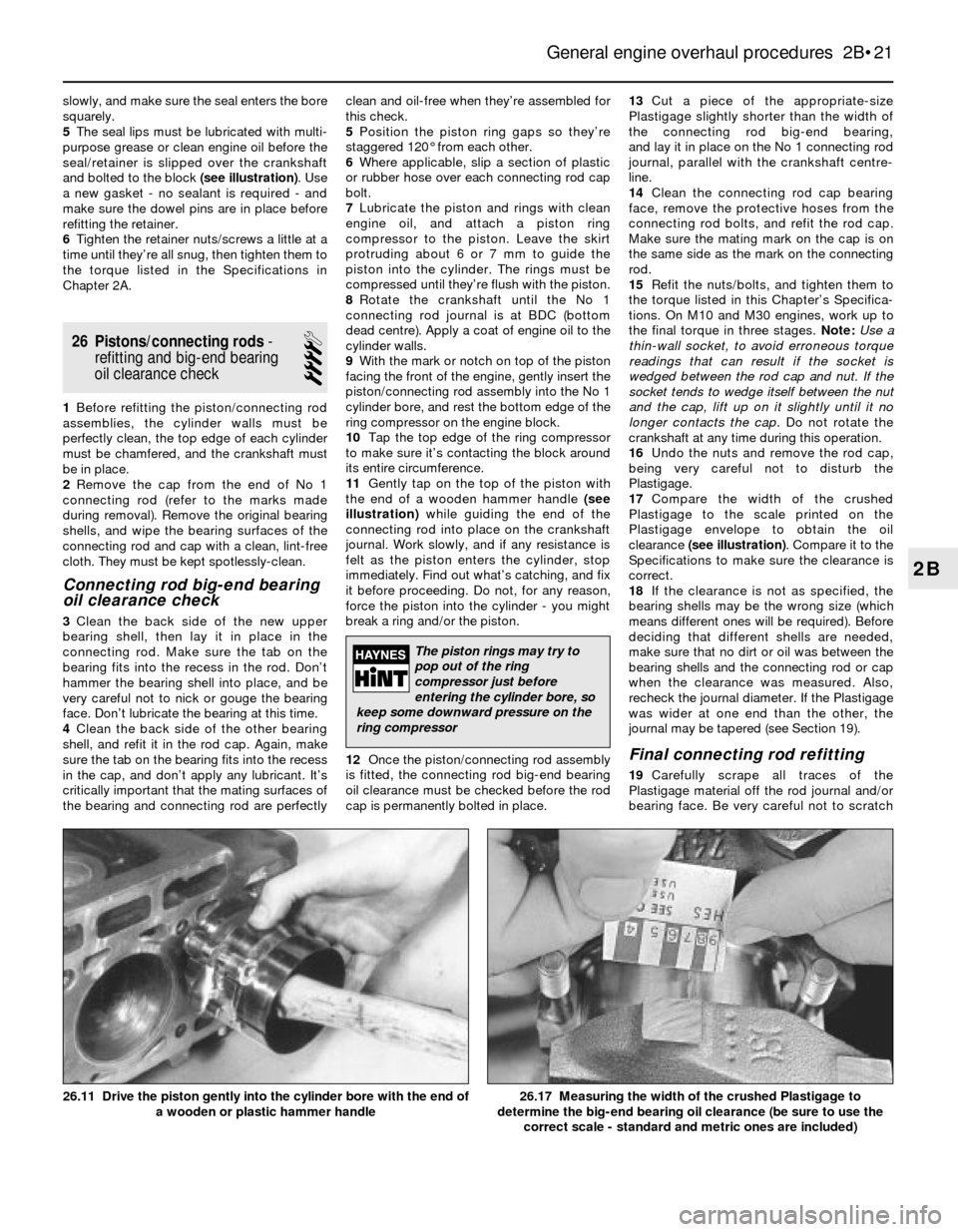
5The seal lips must be lubricated with multi-
purpose grease or clean engine oil before the
seal/retainer is slipped over the crankshaft
and bolted to the block (see illustration). Use
a new gasket - no sealant is required - and
make sure the dowel pins are in place before
refitting the retainer.
6Tighten the retainer nuts/screws a little at a
time until they’re all snug, then tighten them to
the torque listed in the Specifications in
Chapter 2A.
26 Pistons/connecting rods-
refitting and big-end bearing
oil clearance check
4
1Before refitting the piston/connecting rod
assemblies, the cylinder walls must be
perfectly clean, the top edge of each cylinder
must be chamfered, and the crankshaft must
be in place.
2Remove the cap from the end of No 1
connecting rod (refer to the marks made
during removal). Remove the original bearing
shells, and wipe the bearing surfaces of the
connecting rod and cap with a clean, lint-free
cloth. They must be kept spotlessly-clean.
Connecting rod big-end bearing
oil clearance check
3Clean the back side of the new upper
bearing shell, then lay it in place in the
connecting rod. Make sure the tab on the
bearing fits into the recess in the rod. Don’t
hammer the bearing shell into place, and be
very careful not to nick or gouge the bearing
face. Don’t lubricate the bearing at this time.
4Clean the back side of the other bearing
shell, and refit it in the rod cap. Again, make
sure the tab on the bearing fits into the recess
in the cap, and don’t apply any lubricant. It’s
critically important that the mating surfaces of
the bearing and connecting rod are perfectlyclean and oil-free when they’re assembled for
this check.
5Position the piston ring gaps so they’re
staggered 120° from each other.
6Where applicable, slip a section of plastic
or rubber hose over each connecting rod cap
bolt.
7Lubricate the piston and rings with clean
engine oil, and attach a piston ring
compressor to the piston. Leave the skirt
protruding about 6 or 7 mm to guide the
piston into the cylinder. The rings must be
compressed until they’re flush with the piston.
8Rotate the crankshaft until the No 1
connecting rod journal is at BDC (bottom
dead centre). Apply a coat of engine oil to the
cylinder walls.
9With the mark or notch on top of the piston
facing the front of the engine, gently insert the
piston/connecting rod assembly into the No 1
cylinder bore, and rest the bottom edge of the
ring compressor on the engine block.
10Tap the top edge of the ring compressor
to make sure it’s contacting the block around
its entire circumference.
11Gently tap on the top of the piston with
the end of a wooden hammer handle (see
illustration)while guiding the end of the
connecting rod into place on the crankshaft
journal. Work slowly, and if any resistance is
felt as the piston enters the cylinder, stop
immediately. Find out what’s catching, and fix
it before proceeding. Do not, for any reason,
force the piston into the cylinder - you might
break a ring and/or the piston.
12Once the piston/connecting rod assembly
is fitted, the connecting rod big-end bearing
oil clearance must be checked before the rod
cap is permanently bolted in place.13Cut a piece of the appropriate-size
Plastigage slightly shorter than the width of
the connecting rod big-end bearing,
and lay it in place on the No 1 connecting rod
journal, parallel with the crankshaft centre-
line.
14Clean the connecting rod cap bearing
face, remove the protective hoses from the
connecting rod bolts, and refit the rod cap.
Make sure the mating mark on the cap is on
the same side as the mark on the connecting
rod.
15Refit the nuts/bolts, and tighten them to
the torque listed in this Chapter’s Specifica-
tions. On M10 and M30 engines, work up to
the final torque in three stages. Note:Use a
thin-wall socket, to avoid erroneous torque
readings that can result if the socket is
wedged between the rod cap and nut. If the
socket tends to wedge itself between the nut
and the cap, lift up on it slightly until it no
longer contacts the cap. Do not rotate the
crankshaft at any time during this operation.
16Undo the nuts and remove the rod cap,
being very careful not to disturb the
Plastigage.
17Compare the width of the crushed
Plastigage to the scale printed on the
Plastigage envelope to obtain the oil
clearance (see illustration). Compare it to the
Specifications to make sure the clearance is
correct.
18If the clearance is not as specified, the
bearing shells may be the wrong size (which
means different ones will be required). Before
deciding that different shells are needed,
make sure that no dirt or oil was between the
bearing shells and the connecting rod or cap
when the clearance was measured. Also,
recheck the journal diameter. If the Plastigage
was wider at one end than the other, the
journal may be tapered (see Section 19).
Final connecting rod refitting
19Carefully scrape all traces of the
Plastigage material off the rod journal and/or
bearing face. Be very careful not to scratch
General engine overhaul procedures 2B•21
26.17 Measuring the width of the crushed Plastigage to
determine the big-end bearing oil clearance (be sure to use the
correct scale - standard and metric ones are included)26.11 Drive the piston gently into the cylinder bore with the end of
a wooden or plastic hammer handle
2B
The piston rings may try to
pop out of the ring
compressor just before
entering the cylinder bore, so
keep some downward pressure on the
ring compressor
Page 81 of 228
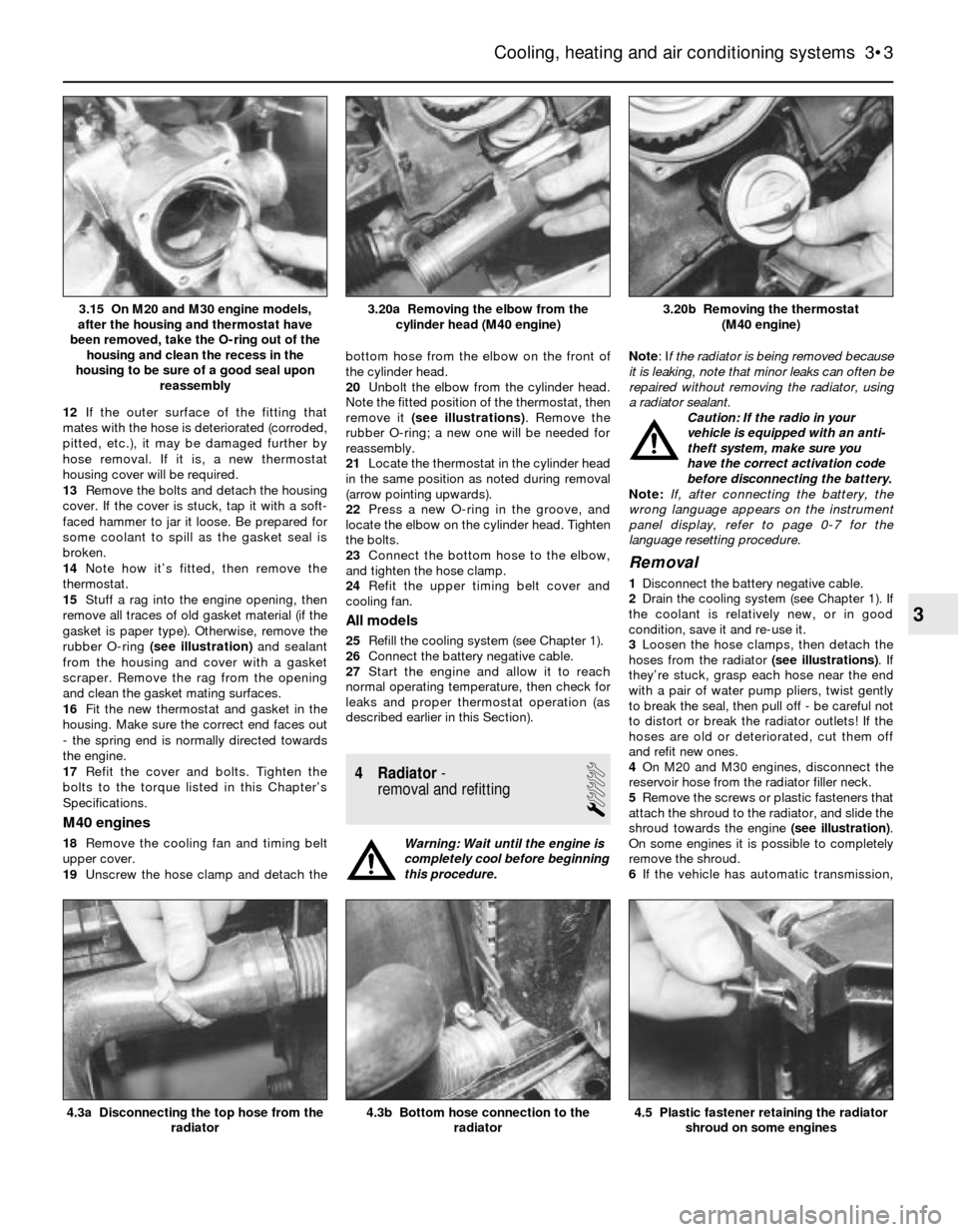
12If the outer surface of the fitting that
mates with the hose is deteriorated (corroded,
pitted, etc.), it may be damaged further by
hose removal. If it is, a new thermostat
housing cover will be required.
13Remove the bolts and detach the housing
cover. If the cover is stuck, tap it with a soft-
faced hammer to jar it loose. Be prepared for
some coolant to spill as the gasket seal is
broken.
14Note how it’s fitted, then remove the
thermostat.
15Stuff a rag into the engine opening, then
remove all traces of old gasket material (if the
gasket is paper type). Otherwise, remove the
rubber O-ring (see illustration)and sealant
from the housing and cover with a gasket
scraper. Remove the rag from the opening
and clean the gasket mating surfaces.
16Fit the new thermostat and gasket in the
housing. Make sure the correct end faces out
- the spring end is normally directed towards
the engine.
17Refit the cover and bolts. Tighten the
bolts to the torque listed in this Chapter’s
Specifications.
M40 engines
18Remove the cooling fan and timing belt
upper cover.
19Unscrew the hose clamp and detach thebottom hose from the elbow on the front of
the cylinder head.
20Unbolt the elbow from the cylinder head.
Note the fitted position of the thermostat, then
remove it (see illustrations). Remove the
rubber O-ring; a new one will be needed for
reassembly.
21Locate the thermostat in the cylinder head
in the same position as noted during removal
(arrow pointing upwards).
22Press a new O-ring in the groove, and
locate the elbow on the cylinder head. Tighten
the bolts.
23Connect the bottom hose to the elbow,
and tighten the hose clamp.
24Refit the upper timing belt cover and
cooling fan.
All models
25Refill the cooling system (see Chapter 1).
26Connect the battery negative cable.
27Start the engine and allow it to reach
normal operating temperature, then check for
leaks and proper thermostat operation (as
described earlier in this Section).
4 Radiator-
removal and refitting
1
Warning: Wait until the engine is
completely cool before beginning
this procedure.Note: If the radiator is being removed because
it is leaking, note that minor leaks can often be
repaired without removing the radiator, using
a radiator sealant.
Caution: If the radio in your
vehicle is equipped with an anti-
theft system, make sure you
have the correct activation code
before disconnecting the battery.
Note: If, after connecting the battery, the
wrong language appears on the instrument
panel display, refer to page 0-7 for the
language resetting procedure.
Removal
1Disconnect the battery negative cable.
2Drain the cooling system (see Chapter 1). If
the coolant is relatively new, or in good
condition, save it and re-use it.
3Loosen the hose clamps, then detach the
hoses from the radiator (see illustrations). If
they’re stuck, grasp each hose near the end
with a pair of water pump pliers, twist gently
to break the seal, then pull off - be careful not
to distort or break the radiator outlets! If the
hoses are old or deteriorated, cut them off
and refit new ones.
4On M20 and M30 engines, disconnect the
reservoir hose from the radiator filler neck.
5Remove the screws or plastic fasteners that
attach the shroud to the radiator, and slide the
shroud towards the engine (see illustration).
On some engines it is possible to completely
remove the shroud.
6If the vehicle has automatic transmission,
Cooling, heating and air conditioning systems 3•3
3.20b Removing the thermostat
(M40 engine)3.20a Removing the elbow from the
cylinder head (M40 engine)3.15 On M20 and M30 engine models,
after the housing and thermostat have
been removed, take the O-ring out of the
housing and clean the recess in the
housing to be sure of a good seal upon
reassembly
4.5 Plastic fastener retaining the radiator
shroud on some engines4.3b Bottom hose connection to the
radiator4.3a Disconnecting the top hose from the
radiator
3
Page 84 of 228
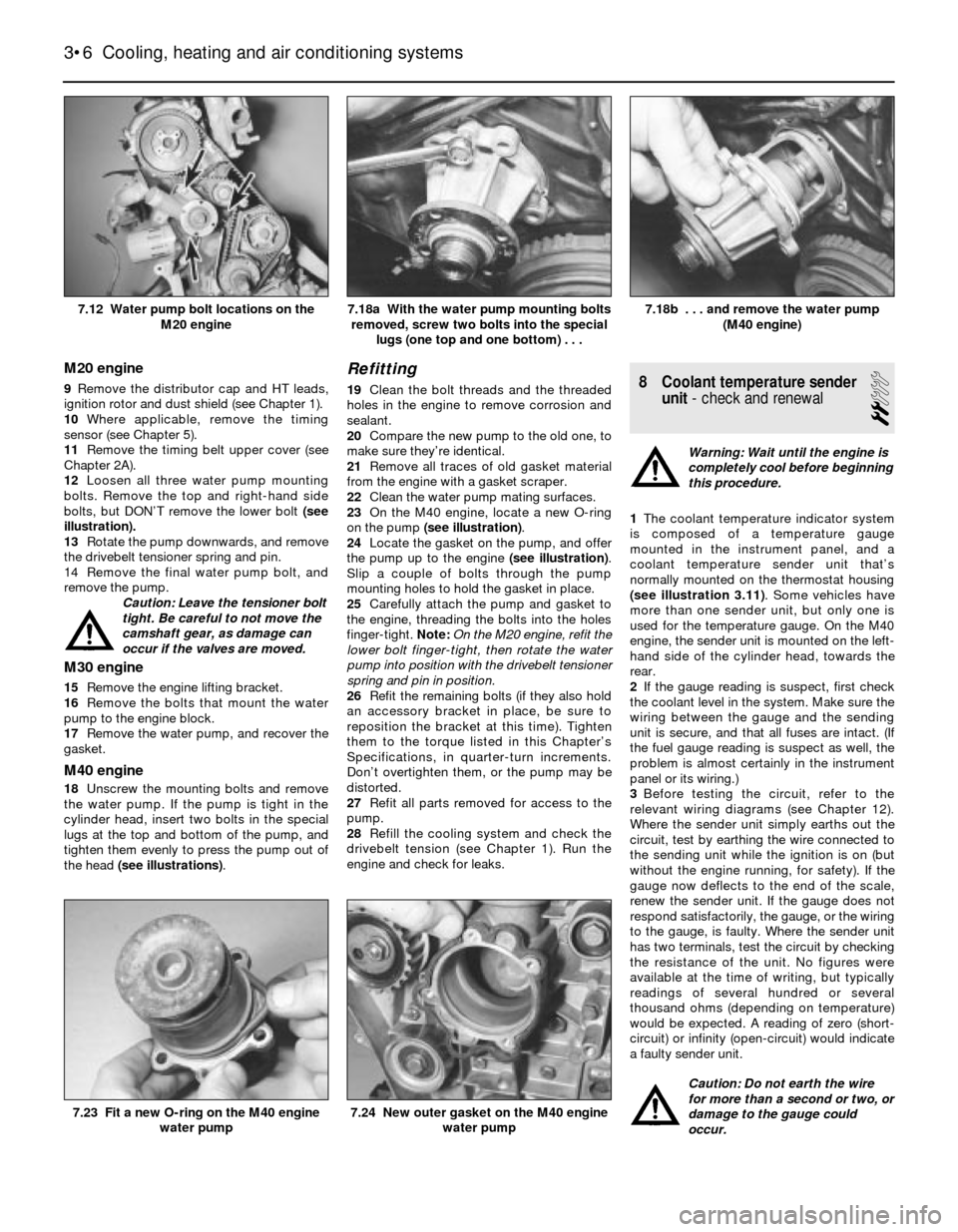
M20 engine
9Remove the distributor cap and HT leads,
ignition rotor and dust shield (see Chapter 1).
10Where applicable, remove the timing
sensor (see Chapter 5).
11Remove the timing belt upper cover (see
Chapter 2A).
12Loosen all three water pump mounting
bolts. Remove the top and right-hand side
bolts, but DON’T remove the lower bolt (see
illustration).
13Rotate the pump downwards, and remove
the drivebelt tensioner spring and pin.
14 Remove the final water pump bolt, and
remove the pump.
Caution: Leave the tensioner bolt
tight. Be careful to not move the
camshaft gear, as damage can
occur if the valves are moved.
M30 engine
15Remove the engine lifting bracket.
16Remove the bolts that mount the water
pump to the engine block.
17Remove the water pump, and recover the
gasket.
M40 engine
18Unscrew the mounting bolts and remove
the water pump. If the pump is tight in the
cylinder head, insert two bolts in the special
lugs at the top and bottom of the pump, and
tighten them evenly to press the pump out of
the head (see illustrations).
Refitting
19Clean the bolt threads and the threaded
holes in the engine to remove corrosion and
sealant.
20Compare the new pump to the old one, to
make sure they’re identical.
21Remove all traces of old gasket material
from the engine with a gasket scraper.
22Clean the water pump mating surfaces.
23On the M40 engine, locate a new O-ring
on the pump (see illustration).
24Locate the gasket on the pump, and offer
the pump up to the engine (see illustration).
Slip a couple of bolts through the pump
mounting holes to hold the gasket in place.
25Carefully attach the pump and gasket to
the engine, threading the bolts into the holes
finger-tight.Note:On the M20 engine, refit the
lower bolt finger-tight, then rotate the water
pump into position with the drivebelt tensioner
spring and pin in position.
26Refit the remaining bolts (if they also hold
an accessory bracket in place, be sure to
reposition the bracket at this time). Tighten
them to the torque listed in this Chapter’s
Specifications, in quarter-turn increments.
Don’t overtighten them, or the pump may be
distorted.
27Refit all parts removed for access to the
pump.
28Refill the cooling system and check the
drivebelt tension (see Chapter 1). Run the
engine and check for leaks.8 Coolant temperature sender
unit- check and renewal
2
Warning: Wait until the engine is
completely cool before beginning
this procedure.
1The coolant temperature indicator system
is composed of a temperature gauge
mounted in the instrument panel, and a
coolant temperature sender unit that’s
normally mounted on the thermostat housing
(see illustration 3.11). Some vehicles have
more than one sender unit, but only one is
used for the temperature gauge. On the M40
engine, the sender unit is mounted on the left-
hand side of the cylinder head, towards the
rear.
2If the gauge reading is suspect, first check
the coolant level in the system. Make sure the
wiring between the gauge and the sending
unit is secure, and that all fuses are intact. (If
the fuel gauge reading is suspect as well, the
problem is almost certainly in the instrument
panel or its wiring.)
3Before testing the circuit, refer to the
relevant wiring diagrams (see Chapter 12).
Where the sender unit simply earths out the
circuit, test by earthing the wire connected to
the sending unit while the ignition is on (but
without the engine running, for safety). If the
gauge now deflects to the end of the scale,
renew the sender unit. If the gauge does not
respond satisfactorily, the gauge, or the wiring
to the gauge, is faulty. Where the sender unit
has two terminals, test the circuit by checking
the resistance of the unit. No figures were
available at the time of writing, but typically
readings of several hundred or several
thousand ohms (depending on temperature)
would be expected. A reading of zero (short-
circuit) or infinity (open-circuit) would indicate
a faulty sender unit.
Caution: Do not earth the wire
for more than a second or two, or
damage to the gauge could
occur.
3•6 Cooling, heating and air conditioning systems
7.24 New outer gasket on the M40 engine
water pump7.23 Fit a new O-ring on the M40 engine
water pump
7.18b . . . and remove the water pump
(M40 engine)7.18a With the water pump mounting bolts
removed, screw two bolts into the special
lugs (one top and one bottom) . . .7.12 Water pump bolt locations on the
M20 engine
Page 93 of 228
19Depressurise the fuel system (see Sec-
tion 2).
20Detach the battery negative cable.
Caution: If the radio in your
vehicle is equipped with an anti-
theft system, make sure you
have the correct activation code
before disconnecting the battery. Refer to
the information on page 0-7 at the front of
this manual before detaching the cable.
Note: If, after connecting the battery, the
wrong language appears on the instrument
panel display, refer to page 0-7 for the
language resetting procedure.
21Detach the fuel feed hose from the fuel
rail, and attach a fuel pressure gauge directly
to the hose. Note:If the tee fitting is still
connected to the gauge, be sure to plug the
open end.
22Reconnect the battery.
23Using a jumper wire, bridge the terminals
of the fuel pump relay.
24Turn the ignition switch on to operate the
fuel pump.
25Note the pressure reading on the gauge,
and compare the reading to the fuel pump
pressure listed in this Chapter’s Specifica-
tions.
26If the indicated pressure is less than
specified, inspect the fuel line for leaks
between the pump and gauge. If no leaks are
found, renew the fuel pump.
27Turn the ignition off and wait five minutes.
Note the reading on the gauge, and compare
it to the fuel pump hold pressure listed in this
Chapter’s Specifications. If the hold pressure
is less than specified, check the fuel lines
between the pump and gauge for leaks. If no
leaks are found, renew the fuel pump.
28Remove the jumper wire. Relieve the fuel
pressure by opening the bleed valve on the
gauge and directing the fuel into a suitable
container. Remove the gauge and reconnect
the fuel line.
Transfer pump pressure check
29Depressurise the fuel system (see Sec-
tion 2).
30Detach the battery negative cable.
Caution: If the radio in your
vehicle is equipped with an anti-
theft system, make sure you
have the correct activation code
before disconnecting the battery. Refer to
the information on page 0-7 at the front of
this manual before detaching the cable.
Note: If, after connecting the battery, the
wrong language appears on the instrument
panel display, refer to page 0-7 for the
language resetting procedure.
31Remove the transfer pump access plate
(on some models, it’s located under the rear
seat cushion - on others, it’s located under
the carpet in the luggage compartment).
Disconnect the output hose from the transfer
pump, and connect a fuel pressure gauge to
the outlet pipe.
32Reconnect the battery.33Using a jumper wire, bridge the terminals
of the fuel pump relay.
34Turn the ignition switch on to operate the
fuel pump.
35Note the pressure reading on the gauge,
and compare to the value listed in this
Chapter’s Specifications.
36If the indicated pressure is less than
specified, renew the transfer pump.
Fuel pump relay check
37Switch on the ignition.
38Using a voltmeter, probe the following
terminals from the back of the relay electrical
connector. Check for battery voltage at
terminal 30 (M20 and M30 engines) or
terminal 15 (M10 and M40 engines). Note:If
there is no voltage on models with luggage
compartment-mounted batteries, check for a
faulty fusible link. The 50-amp link is about
6 inches from the battery, in a black wire.
39Turn the ignition off, and disconnect the
relay from the electrical connector. Using a
voltmeter, probe the connector terminals that
correspond to fuel pump relay pins 85 (-) and
86(+) on M20 and M30 engines, or terminal 50
and earth on M10 and M40 engines. Have an
assistant turn the engine over on the starter,
and observe the voltage reading. Battery
voltage should be indicated.
40If there is no voltage, check the fuse(s)
and the wiring circuit for the fuel pump relay. If
the voltage readings are correct, and the fuel
pump only runs with the jumper wire in place,
then renew the relay.
41If the fuel pump still does not run, check
for the proper voltage at the fuel pump
terminals (see Section 4). If necessary, renew
the fuel pump.
4 Fuel pump, transfer pump
and fuel level sender unit-
removal and refitting
2
Warning: Fuel is extremely
flammable, so take extra
precautions when you work on
any part of the fuel system. Don’t
smoke, or allow open flames or bare light
bulbs, near the work area. Also, don’t work
in a garage where a natural gas-type
appliance with a pilot light is present.
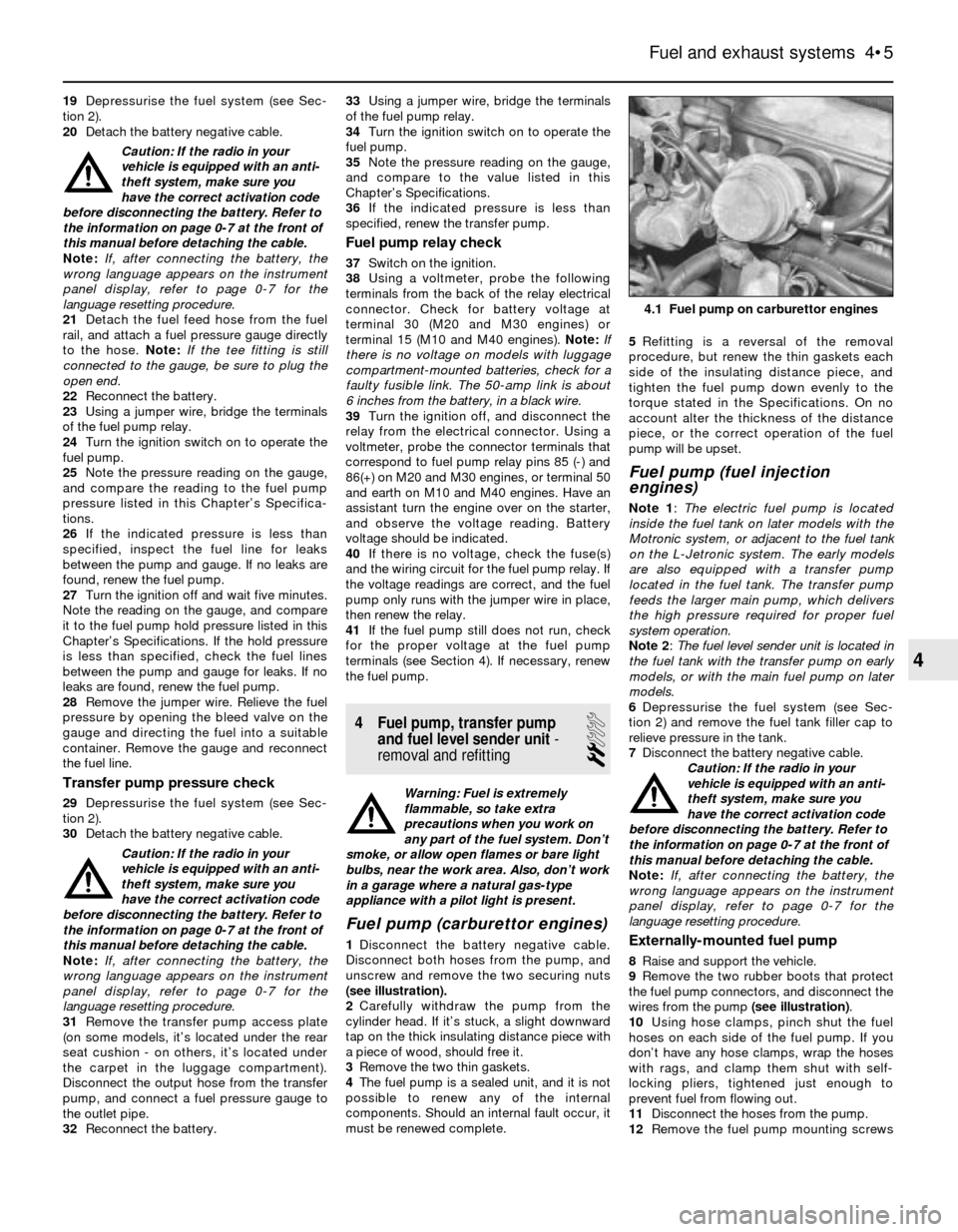
Fuel pump (carburettor engines)
1Disconnect the battery negative cable.
Disconnect both hoses from the pump, and
unscrew and remove the two securing nuts
(see illustration).
2Carefully withdraw the pump from the
cylinder head. If it’s stuck, a slight downward
tap on the thick insulating distance piece with
a piece of wood, should free it.
3Remove the two thin gaskets.
4The fuel pump is a sealed unit, and it is not
possible to renew any of the internal
components. Should an internal fault occur, it
must be renewed complete.5Refitting is a reversal of the removal
procedure, but renew the thin gaskets each
side of the insulating distance piece, and
tighten the fuel pump down evenly to the
torque stated in the Specifications. On no
account alter the thickness of the distance
piece, or the correct operation of the fuel
pump will be upset.
Fuel pump (fuel injection
engines)
Note 1: The electric fuel pump is located
inside the fuel tank on later models with the
Motronic system, or adjacent to the fuel tank
on the L-Jetronic system. The early models
are also equipped with a transfer pump
located in the fuel tank. The transfer pump
feeds the larger main pump, which delivers
the high pressure required for proper fuel
system operation.
Note 2: The fuel level sender unit is located in
the fuel tank with the transfer pump on early
models, or with the main fuel pump on later
models.
6Depressurise the fuel system (see Sec-
tion 2) and remove the fuel tank filler cap to
relieve pressure in the tank.
7Disconnect the battery negative cable.
Caution: If the radio in your
vehicle is equipped with an anti-
theft system, make sure you
have the correct activation code
before disconnecting the battery. Refer to
the information on page 0-7 at the front of
this manual before detaching the cable.
Note: If, after connecting the battery, the
wrong language appears on the instrument
panel display, refer to page 0-7 for the
language resetting procedure.
Externally-mounted fuel pump
8Raise and support the vehicle.
9Remove the two rubber boots that protect
the fuel pump connectors, and disconnect the
wires from the pump (see illustration).
10Using hose clamps, pinch shut the fuel
hoses on each side of the fuel pump. If you
don’t have any hose clamps, wrap the hoses
with rags, and clamp them shut with self-
locking pliers, tightened just enough to
prevent fuel from flowing out.
11Disconnect the hoses from the pump.
12Remove the fuel pump mounting screws
Fuel and exhaust systems 4•5
4.1 Fuel pump on carburettor engines
4
Page 94 of 228
and clamps, and remove the fuel pump from
the under the vehicle.
13Refitting is the reverse of removal.
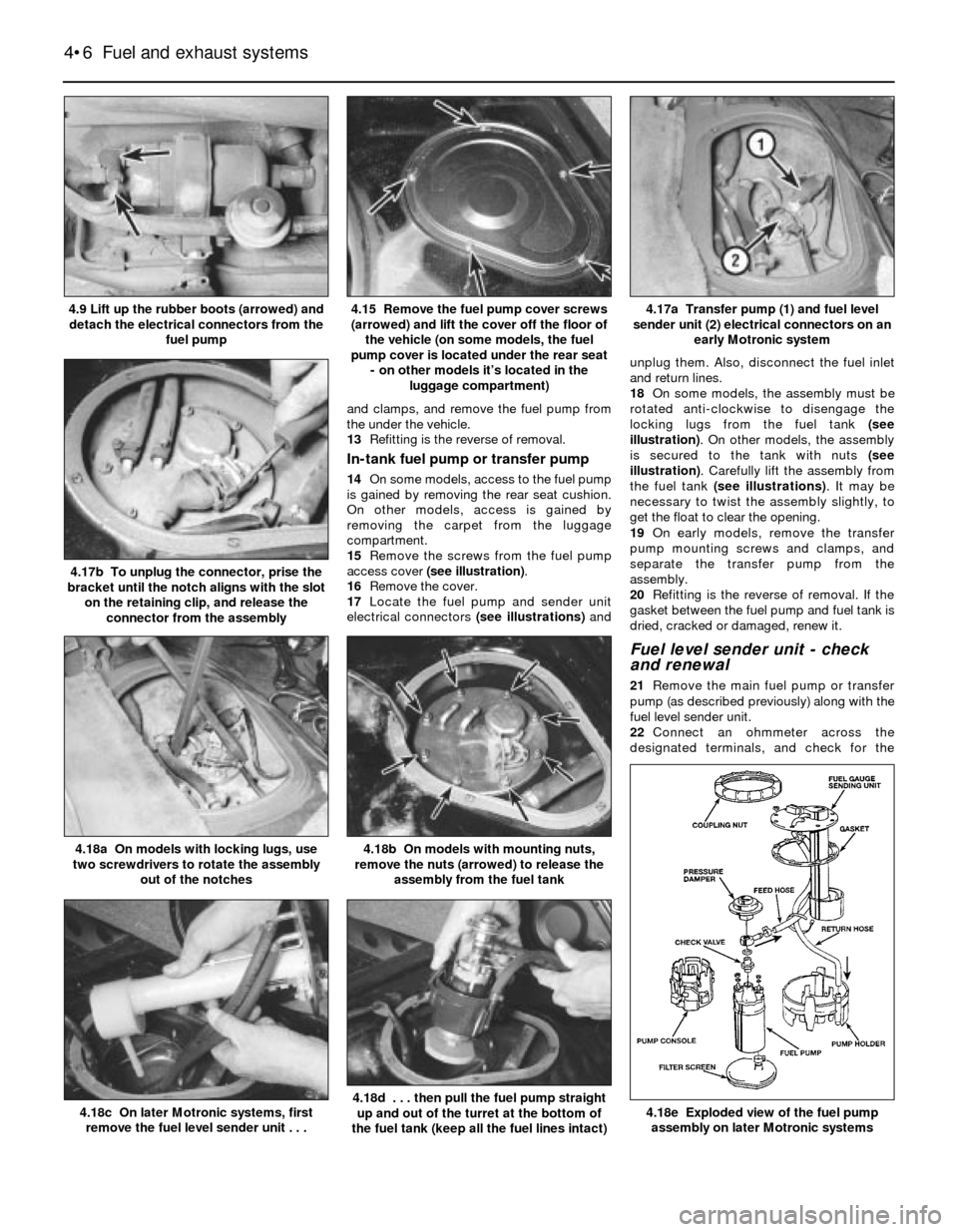
In-tank fuel pump or transfer pump
14On some models, access to the fuel pump
is gained by removing the rear seat cushion.
On other models, access is gained by
removing the carpet from the luggage
compartment.
15Remove the screws from the fuel pump
access cover (see illustration).
16Remove the cover.
17Locate the fuel pump and sender unit
electrical connectors (see illustrations)andunplug them. Also, disconnect the fuel inlet
and return lines.
18On some models, the assembly must be
rotated anti-clockwise to disengage the
locking lugs from the fuel tank (see
illustration). On other models, the assembly
is secured to the tank with nuts (see
illustration). Carefully lift the assembly from
the fuel tank (see illustrations). It may be
necessary to twist the assembly slightly, to
get the float to clear the opening.
19On early models, remove the transfer
pump mounting screws and clamps, and
separate the transfer pump from the
assembly.
20Refitting is the reverse of removal. If the
gasket between the fuel pump and fuel tank is
dried, cracked or damaged, renew it.
Fuel level sender unit - check
and renewal
21Remove the main fuel pump or transfer
pump (as described previously) along with the
fuel level sender unit.
22Connect an ohmmeter across the
designated terminals, and check for the
4•6 Fuel and exhaust systems
4.18e Exploded view of the fuel pump
assembly on later Motronic systems4.18d . . . then pull the fuel pump straight
up and out of the turret at the bottom of
the fuel tank (keep all the fuel lines intact)4.18c On later Motronic systems, first
remove the fuel level sender unit . . .
4.18b On models with mounting nuts,
remove the nuts (arrowed) to release the
assembly from the fuel tank4.18a On models with locking lugs, use
two screwdrivers to rotate the assembly
out of the notches
4.17b To unplug the connector, prise the
bracket until the notch aligns with the slot
on the retaining clip, and release the
connector from the assembly
4.17a Transfer pump (1) and fuel level
sender unit (2) electrical connectors on an
early Motronic system4.15 Remove the fuel pump cover screws
(arrowed) and lift the cover off the floor of
the vehicle (on some models, the fuel
pump cover is located under the rear seat
- on other models it’s located in the
luggage compartment)4.9 Lift up the rubber boots (arrowed) and
detach the electrical connectors from the
fuel pump
Page 99 of 228
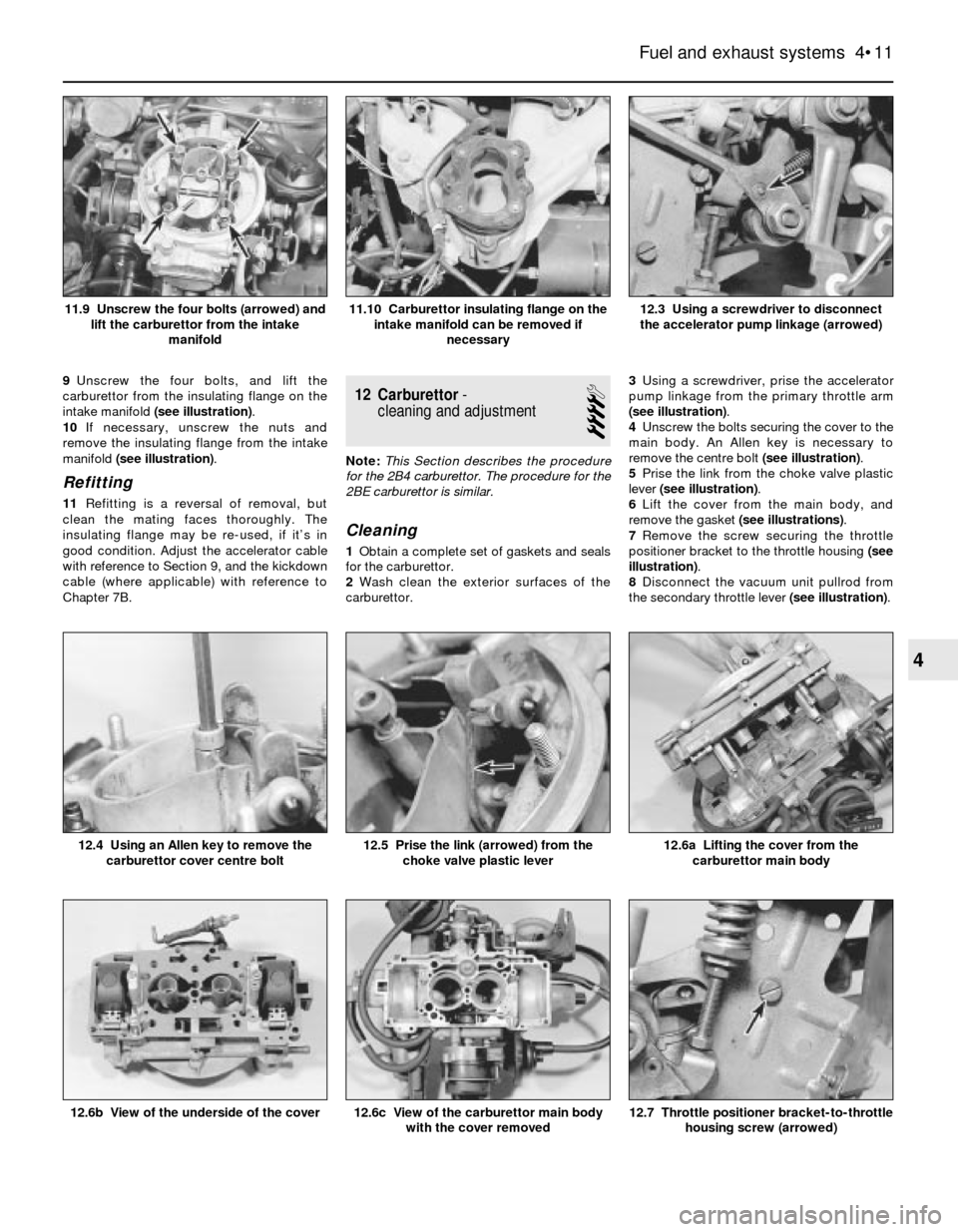
9Unscrew the four bolts, and lift the
carburettor from the insulating flange on the
intake manifold (see illustration).
10If necessary, unscrew the nuts and
remove the insulating flange from the intake
manifold (see illustration).
Refitting
11Refitting is a reversal of removal, but
clean the mating faces thoroughly. The
insulating flange may be re-used, if it’s in
good condition. Adjust the accelerator cable
with reference to Section 9, and the kickdown
cable (where applicable) with reference to
Chapter 7B.
12 Carburettor-
cleaning and adjustment
4
Note:This Section describes the procedure
for the 2B4 carburettor. The procedure for the
2BE carburettor is similar.
Cleaning
1Obtain a complete set of gaskets and seals
for the carburettor.
2Wash clean the exterior surfaces of the
carburettor.3Using a screwdriver, prise the accelerator
pump linkage from the primary throttle arm
(see illustration).
4Unscrew the bolts securing the cover to the
main body. An Allen key is necessary to
remove the centre bolt (see illustration).
5Prise the link from the choke valve plastic
lever (see illustration).
6Lift the cover from the main body, and
remove the gasket (see illustrations).
7Remove the screw securing the throttle
positioner bracket to the throttle housing (see
illustration).
8Disconnect the vacuum unit pullrod from
the secondary throttle lever (see illustration).
Fuel and exhaust systems 4•11
12.3 Using a screwdriver to disconnect
the accelerator pump linkage (arrowed)11.10 Carburettor insulating flange on the
intake manifold can be removed if
necessary11.9 Unscrew the four bolts (arrowed) and
lift the carburettor from the intake
manifold
12.7 Throttle positioner bracket-to-throttle
housing screw (arrowed)12.6c View of the carburettor main body
with the cover removed12.6b View of the underside of the cover
12.6a Lifting the cover from the
carburettor main body12.5 Prise the link (arrowed) from the
choke valve plastic lever12.4 Using an Allen key to remove the
carburettor cover centre bolt
4
Page 100 of 228
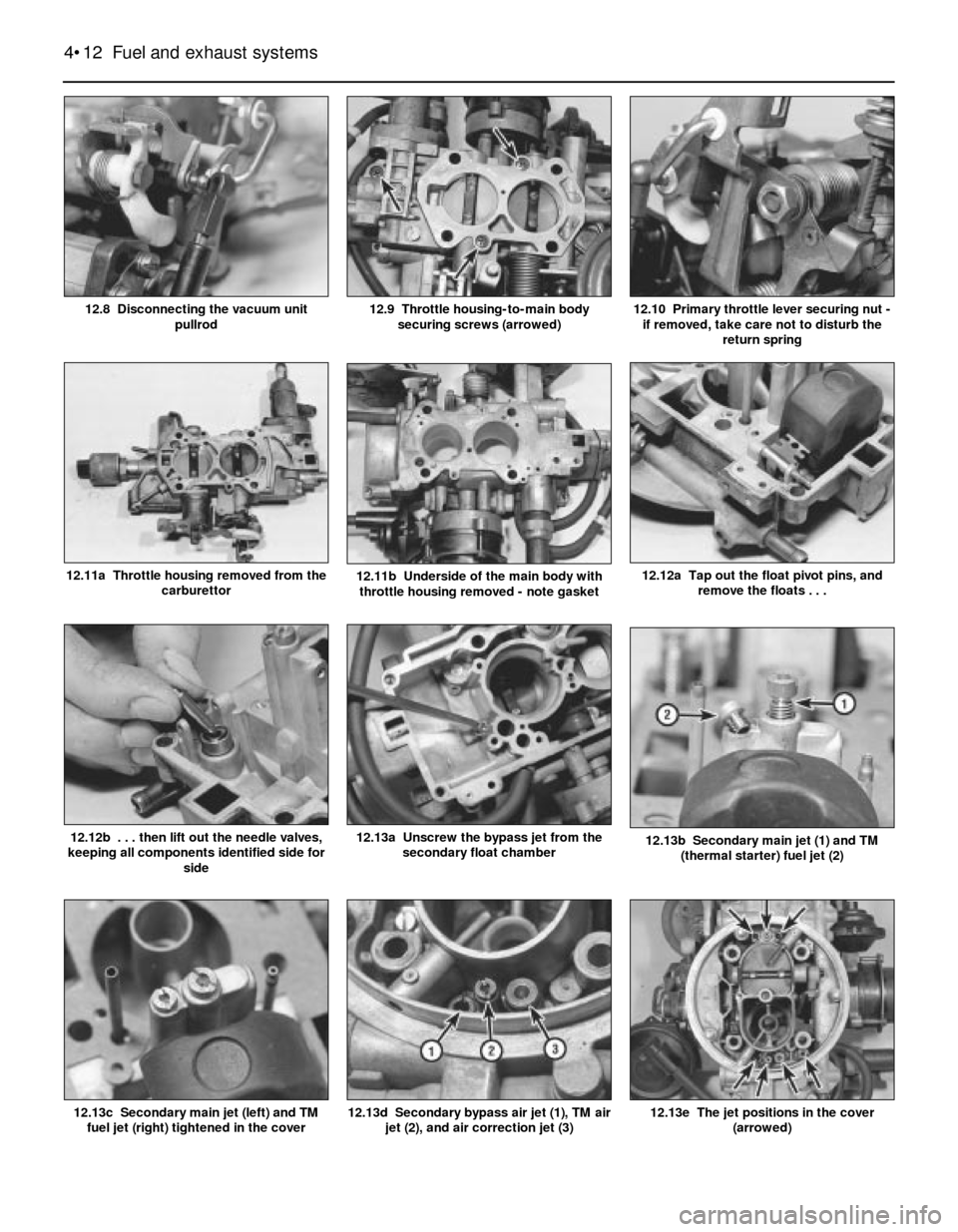
12.13e The jet positions in the cover
(arrowed)
4•12 Fuel and exhaust systems
12.13d Secondary bypass air jet (1), TM air
jet (2), and air correction jet (3)12.13c Secondary main jet (left) and TM
fuel jet (right) tightened in the cover
12.13b Secondary main jet (1) and TM
(thermal starter) fuel jet (2)12.13a Unscrew the bypass jet from the
secondary float chamber12.12b . . . then lift out the needle valves,
keeping all components identified side for
side
12.12a Tap out the float pivot pins, and
remove the floats . . .12.11a Throttle housing removed from the
carburettor12.11b Underside of the main body with
throttle housing removed - note gasket
12.10 Primary throttle lever securing nut -
if removed, take care not to disturb the
return spring12.9 Throttle housing-to-main body
securing screws (arrowed)12.8 Disconnecting the vacuum unit
pullrod