exhaust BMW 3 SERIES 1991 E30 Owner's Manual
[x] Cancel search | Manufacturer: BMW, Model Year: 1991, Model line: 3 SERIES, Model: BMW 3 SERIES 1991 E30Pages: 228, PDF Size: 7.04 MB
Page 67 of 228
that they’re suitable for use in a rebuilt engine
(take the springs to a machine shop for this
check).
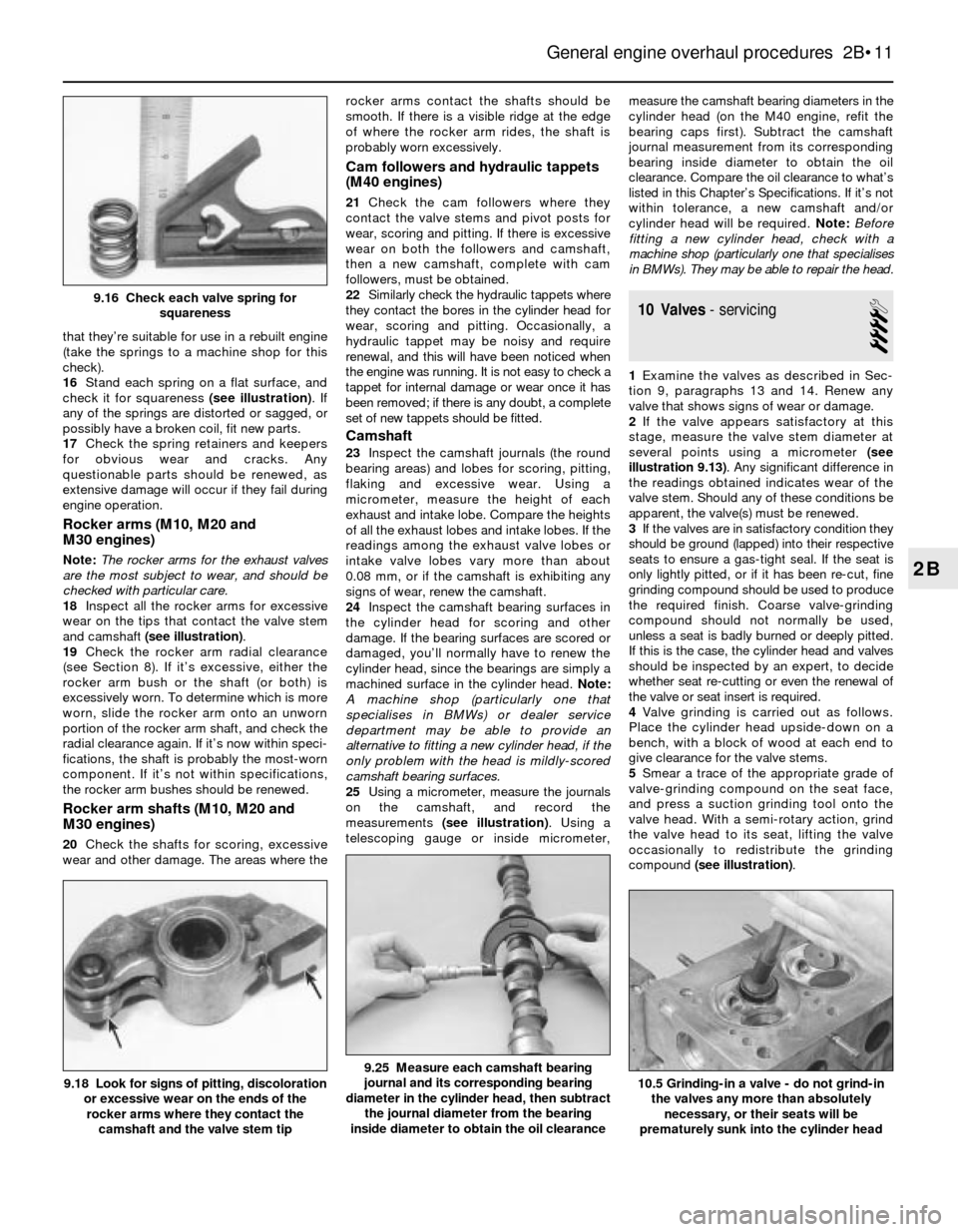
16Stand each spring on a flat surface, and
check it for squareness (see illustration). If
any of the springs are distorted or sagged, or
possibly have a broken coil, fit new parts.
17Check the spring retainers and keepers
for obvious wear and cracks. Any
questionable parts should be renewed, as
extensive damage will occur if they fail during
engine operation.
Rocker arms (M10, M20 and
M30 engines)
Note:The rocker arms for the exhaust valves
are the most subject to wear, and should be
checked with particular care.
18Inspect all the rocker arms for excessive
wear on the tips that contact the valve stem
and camshaft (see illustration).
19Check the rocker arm radial clearance
(see Section 8). If it’s excessive, either the
rocker arm bush or the shaft (or both) is
excessively worn. To determine which is more
worn, slide the rocker arm onto an unworn
portion of the rocker arm shaft, and check the
radial clearance again. If it’s now within speci-
fications, the shaft is probably the most-worn
component. If it’s not within specifications,
the rocker arm bushes should be renewed.
Rocker arm shafts (M10, M20 and
M30 engines)
20Check the shafts for scoring, excessive
wear and other damage. The areas where therocker arms contact the shafts should be
smooth. If there is a visible ridge at the edge
of where the rocker arm rides, the shaft is
probably worn excessively.
Cam followers and hydraulic tappets
(M40 engines)
21Check the cam followers where they
contact the valve stems and pivot posts for
wear, scoring and pitting. If there is excessive
wear on both the followers and camshaft,
then a new camshaft, complete with cam
followers, must be obtained.
22Similarly check the hydraulic tappets where
they contact the bores in the cylinder head for
wear, scoring and pitting. Occasionally, a
hydraulic tappet may be noisy and require
renewal, and this will have been noticed when
the engine was running. It is not easy to check a
tappet for internal damage or wear once it has
been removed; if there is any doubt, a complete
set of new tappets should be fitted.
Camshaft
23Inspect the camshaft journals (the round
bearing areas) and lobes for scoring, pitting,
flaking and excessive wear. Using a
micrometer, measure the height of each
exhaust and intake lobe. Compare the heights
of all the exhaust lobes and intake lobes. If the
readings among the exhaust valve lobes or
intake valve lobes vary more than about
0.08 mm, or if the camshaft is exhibiting any
signs of wear, renew the camshaft.
24Inspect the camshaft bearing surfaces in
the cylinder head for scoring and other
damage. If the bearing surfaces are scored or
damaged, you’ll normally have to renew the
cylinder head, since the bearings are simply a
machined surface in the cylinder head. Note:
A machine shop (particularly one that
specialises in BMWs) or dealer service
department may be able to provide an
alternative to fitting a new cylinder head, if the
only problem with the head is mildly-scored
camshaft bearing surfaces.
25Using a micrometer, measure the journals
on the camshaft, and record the
measurements (see illustration). Using a
telescoping gauge or inside micrometer,measure the camshaft bearing diameters in the
cylinder head (on the M40 engine, refit the
bearing caps first). Subtract the camshaft
journal measurement from its corresponding
bearing inside diameter to obtain the oil
clearance. Compare the oil clearance to what’s
listed in this Chapter’s Specifications. If it’s not
within tolerance, a new camshaft and/or
cylinder head will be required. Note:Before
fitting a new cylinder head, check with a
machine shop (particularly one that specialises
in BMWs). They may be able to repair the head.
10 Valves- servicing
4
1Examine the valves as described in Sec-
tion 9, paragraphs 13 and 14. Renew any
valve that shows signs of wear or damage.
2If the valve appears satisfactory at this
stage, measure the valve stem diameter at
several points using a micrometer (see
illustration 9.13). Any significant difference in
the readings obtained indicates wear of the
valve stem. Should any of these conditions be
apparent, the valve(s) must be renewed.
3If the valves are in satisfactory condition they
should be ground (lapped) into their respective
seats to ensure a gas-tight seal. If the seat is
only lightly pitted, or if it has been re-cut, fine
grinding compound should be used to produce
the required finish. Coarse valve-grinding
compound should not normally be used,
unless a seat is badly burned or deeply pitted.
If this is the case, the cylinder head and valves
should be inspected by an expert, to decide
whether seat re-cutting or even the renewal of
the valve or seat insert is required.
4Valve grinding is carried out as follows.
Place the cylinder head upside-down on a
bench, with a block of wood at each end to
give clearance for the valve stems.
5Smear a trace of the appropriate grade of
valve-grinding compound on the seat face,
and press a suction grinding tool onto the
valve head. With a semi-rotary action, grind
the valve head to its seat, lifting the valve
occasionally to redistribute the grinding
compound (see illustration).
General engine overhaul procedures 2B•11
9.25 Measure each camshaft bearing
journal and its corresponding bearing
diameter in the cylinder head, then subtract
the journal diameter from the bearing
inside diameter to obtain the oil clearance9.18 Look for signs of pitting, discoloration
or excessive wear on the ends of the
rocker arms where they contact the
camshaft and the valve stem tip10.5 Grinding-in a valve - do not grind-in
the valves any more than absolutely
necessary, or their seats will be
prematurely sunk into the cylinder head
2B
9.16 Check each valve spring for
squareness
Page 68 of 228
6If coarse grinding compound is being used,
work only until a dull, matt even surface is
produced on both the valve seat and the
valve, then wipe off the used compound and
repeat the process with fine compound. When
a smooth, unbroken ring of light grey matt
finish is produced on both the valve and seat,
the grinding operation is complete. Do not
grind in the valves any further than absolutely
necessary.
7When all the valves have been ground-in,
carefully wash off all traces of grinding
compound using paraffin or a suitable solvent
before reassembly of the cylinder head.
11 Cylinder head- reassembly
5
1Make sure the cylinder head is spotlessly-
clean before beginning reassembly.
2If the head was sent out for valve servicing,
the valves and related components will
already be in place. Begin the reassembly
procedure with paragraph 8.
3Starting at one end of the head, applymolybdenum disulphide (“moly”) grease or
clean engine oil to each valve stem, and refit
the first valve.
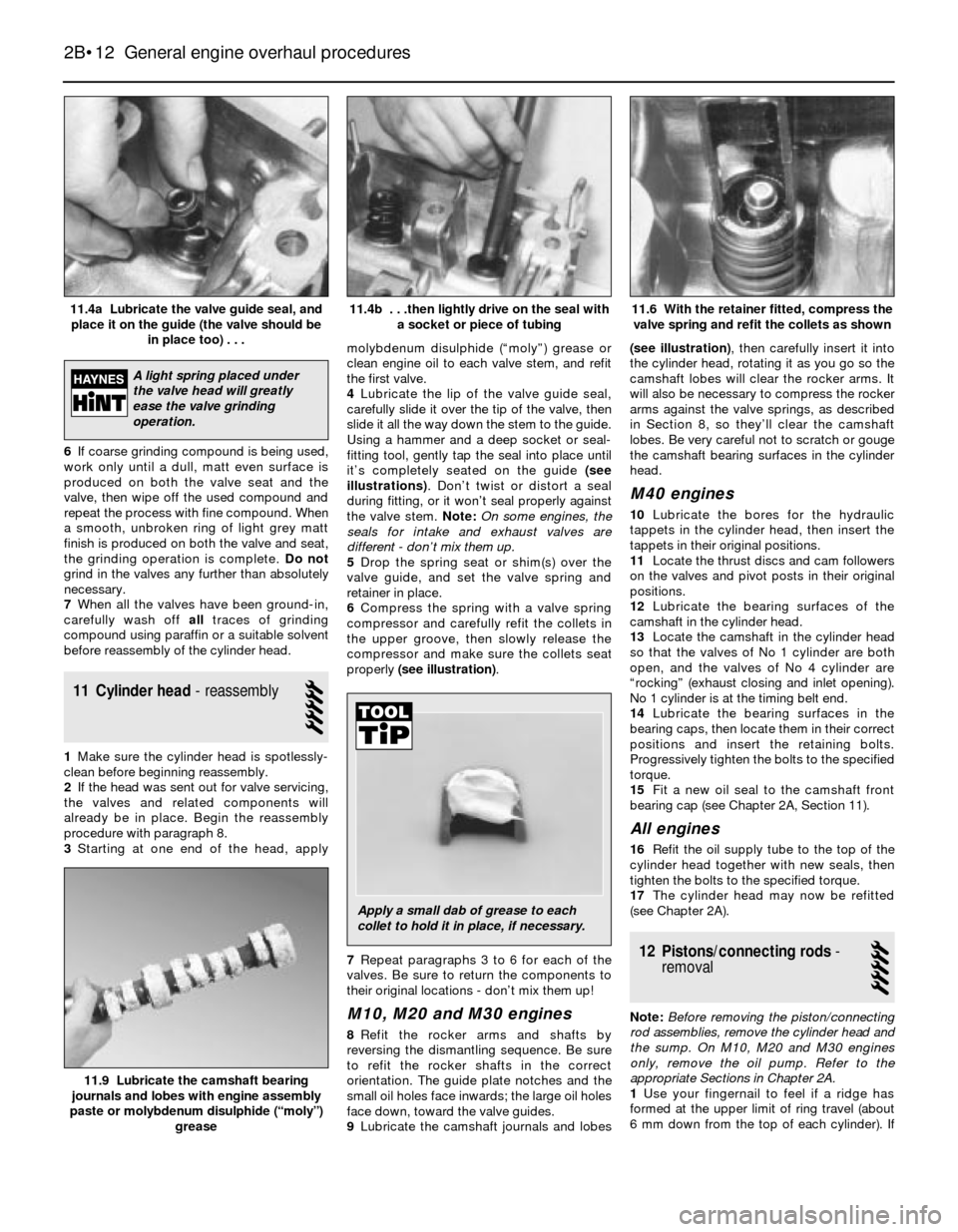
4Lubricate the lip of the valve guide seal,
carefully slide it over the tip of the valve, then
slide it all the way down the stem to the guide.
Using a hammer and a deep socket or seal-
fitting tool, gently tap the seal into place until
it’s completely seated on the guide (see
illustrations). Don’t twist or distort a seal
during fitting, or it won’t seal properly against
the valve stem. Note:On some engines, the
seals for intake and exhaust valves are
different - don’t mix them up.
5Drop the spring seat or shim(s) over the
valve guide, and set the valve spring and
retainer in place.
6Compress the spring with a valve spring
compressor and carefully refit the collets in
the upper groove, then slowly release the
compressor and make sure the collets seat
properly (see illustration).
7Repeat paragraphs 3 to 6 for each of the
valves. Be sure to return the components to
their original locations - don’t mix them up!
M10, M20 and M30 engines
8Refit the rocker arms and shafts by
reversing the dismantling sequence. Be sure
to refit the rocker shafts in the correct
orientation. The guide plate notches and the
small oil holes face inwards; the large oil holes
face down, toward the valve guides.
9Lubricate the camshaft journals and lobes(see illustration), then carefully insert it into
the cylinder head, rotating it as you go so the
camshaft lobes will clear the rocker arms. It
will also be necessary to compress the rocker
arms against the valve springs, as described
in Section 8, so they’ll clear the camshaft
lobes. Be very careful not to scratch or gouge
the camshaft bearing surfaces in the cylinder
head.
M40 engines
10Lubricate the bores for the hydraulic
tappets in the cylinder head, then insert the
tappets in their original positions.
11Locate the thrust discs and cam followers
on the valves and pivot posts in their original
positions.
12Lubricate the bearing surfaces of the
camshaft in the cylinder head.
13Locate the camshaft in the cylinder head
so that the valves of No 1 cylinder are both
open, and the valves of No 4 cylinder are
“rocking” (exhaust closing and inlet opening).
No 1 cylinder is at the timing belt end.
14Lubricate the bearing surfaces in the
bearing caps, then locate them in their correct
positions and insert the retaining bolts.
Progressively tighten the bolts to the specified
torque.
15Fit a new oil seal to the camshaft front
bearing cap (see Chapter 2A, Section 11).
All engines
16Refit the oil supply tube to the top of the
cylinder head together with new seals, then
tighten the bolts to the specified torque.
17The cylinder head may now be refitted
(see Chapter 2A).
12 Pistons/connecting rods-
removal
5
Note:Before removing the piston/connecting
rod assemblies, remove the cylinder head and
the sump. On M10, M20 and M30 engines
only, remove the oil pump. Refer to the
appropriate Sections in Chapter 2A.
1Use your fingernail to feel if a ridge has
formed at the upper limit of ring travel (about
6 mm down from the top of each cylinder). If
2B•12 General engine overhaul procedures
11.9 Lubricate the camshaft bearing
journals and lobes with engine assembly
paste or molybdenum disulphide (“moly”)
grease
11.6 With the retainer fitted, compress the
valve spring and refit the collets as shown 11.4b . . .then lightly drive on the seal with
a socket or piece of tubing11.4a Lubricate the valve guide seal, and
place it on the guide (the valve should be
in place too) . . .
A light spring placed under
the valve head will greatly
ease the valve grinding
operation.
Apply a small dab of grease to each
collet to hold it in place, if necessary.
Page 72 of 228
7Wipe the oil out of the cylinder, and repeat
the procedure for the remaining cylinders.
8After the honing job is complete, chamfer
the top edges of the cylinder bores with a
small file, so the rings won’t catch when the
pistons are refitted. Be very careful not to nick
the cylinder walls with the end of the file.
9The entire engine block must be washed
again very thoroughly with warm, soapy
water, to remove all traces of the abrasive grit
produced during the honing operation. Note:
The bores can be considered clean when a
lint-free white cloth - dampened with clean
engine oil - used to wipe them out doesn’t
pick up any more honing residue, which will
show up as grey areas on the cloth.Be sure to
run a brush through all oil holes and galleries,
and flush them with running water.
10After rinsing, dry the block, and apply a
coat of light rust-preventive oil to all machined
surfaces. Wrap the block in a plastic bag to
keep it clean, and set it aside until
reassembly.
18 Pistons/connecting rods-
inspection
3
1Before the inspection process can be
carried out, the piston/connecting rod
assemblies must be cleaned and the original
piston rings removed from the pistons.Note:
Always use new piston rings when the engine
is reassembled.
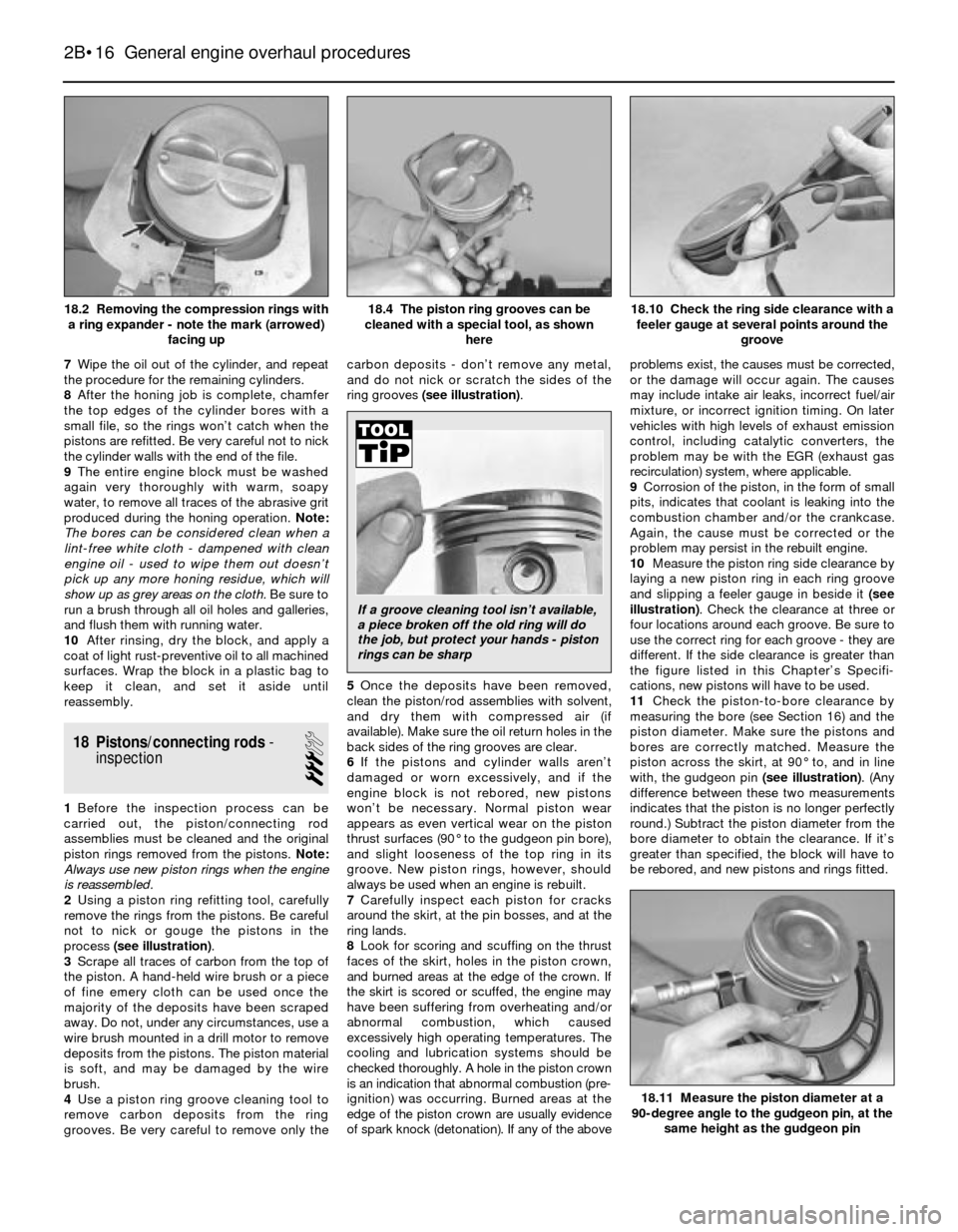
2Using a piston ring refitting tool, carefully
remove the rings from the pistons. Be careful
not to nick or gouge the pistons in the
process (see illustration).
3Scrape all traces of carbon from the top of
the piston. A hand-held wire brush or a piece
of fine emery cloth can be used once the
majority of the deposits have been scraped
away. Do not, under any circumstances, use a
wire brush mounted in a drill motor to remove
deposits from the pistons. The piston material
is soft, and may be damaged by the wire
brush.
4Use a piston ring groove cleaning tool to
remove carbon deposits from the ring
grooves. Be very careful to remove only thecarbon deposits - don’t remove any metal,
and do not nick or scratch the sides of the
ring grooves (see illustration).
5Once the deposits have been removed,
clean the piston/rod assemblies with solvent,
and dry them with compressed air (if
available). Make sure the oil return holes in the
back sides of the ring grooves are clear.
6If the pistons and cylinder walls aren’t
damaged or worn excessively, and if the
engine block is not rebored, new pistons
won’t be necessary. Normal piston wear
appears as even vertical wear on the piston
thrust surfaces (90° to the gudgeon pin bore),
and slight looseness of the top ring in its
groove. New piston rings, however, should
always be used when an engine is rebuilt.
7Carefully inspect each piston for cracks
around the skirt, at the pin bosses, and at the
ring lands.
8Look for scoring and scuffing on the thrust
faces of the skirt, holes in the piston crown,
and burned areas at the edge of the crown. If
the skirt is scored or scuffed, the engine may
have been suffering from overheating and/or
abnormal combustion, which caused
excessively high operating temperatures. The
cooling and lubrication systems should be
checked thoroughly. A hole in the piston crown
is an indication that abnormal combustion (pre-
ignition) was occurring. Burned areas at the
edge of the piston crown are usually evidence
of spark knock (detonation). If any of the aboveproblems exist, the causes must be corrected,
or the damage will occur again. The causes
may include intake air leaks, incorrect fuel/air
mixture, or incorrect ignition timing. On later
vehicles with high levels of exhaust emission
control, including catalytic converters, the
problem may be with the EGR (exhaust gas
recirculation) system, where applicable.
9Corrosion of the piston, in the form of small
pits, indicates that coolant is leaking into the
combustion chamber and/or the crankcase.
Again, the cause must be corrected or the
problem may persist in the rebuilt engine.
10Measure the piston ring side clearance by
laying a new piston ring in each ring groove
and slipping a feeler gauge in beside it(see
illustration). Check the clearance at three or
four locations around each groove. Be sure to
use the correct ring for each groove - they are
different. If the side clearance is greater than
the figure listed in this Chapter’s Specifi-
cations, new pistons will have to be used.
11Check the piston-to-bore clearance by
measuring the bore (see Section 16) and the
piston diameter. Make sure the pistons and
bores are correctly matched. Measure the
piston across the skirt, at 90° to, and in line
with, the gudgeon pin (see illustration). (Any
difference between these two measurements
indicates that the piston is no longer perfectly
round.) Subtract the piston diameter from the
bore diameter to obtain the clearance. If it’s
greater than specified, the block will have to
be rebored, and new pistons and rings fitted.
2B•16 General engine overhaul procedures
18.11 Measure the piston diameter at a
90-degree angle to the gudgeon pin, at the
same height as the gudgeon pin
18.10 Check the ring side clearance with a
feeler gauge at several points around the
groove18.4 The piston ring grooves can be
cleaned with a special tool, as shown
here18.2 Removing the compression rings with
a ring expander - note the mark (arrowed)
facing up
If a groove cleaning tool isn’t available,
a piece broken off the old ring will do
the job, but protect your hands - piston
rings can be sharp
Page 74 of 228
3When examining the bearings, remove
them from the engine block, the main bearing
caps, the connecting rods and the rod caps,
and lay them out on a clean surface in the
same general position as their location in the
engine. This will enable you to match any
bearing problems with the corresponding
crankshaft journal.
4Dirt and other foreign particles get into the
engine in a variety of ways. It may be left in
the engine during assembly, or it may pass
through filters or the crankcase ventilation
(PCV) system. It may get into the oil, and from
there into the bearings. Metal chips from
machining operations and normal engine wear
are often present. Abrasives are sometimes
left in engine components after recondi-
tioning, especially when parts are not
thoroughly cleaned using the proper cleaning
methods. Whatever the source, these foreign
objects often end up embedded in the soft
bearing material, and are easily recognised.
Large particles will not embed in the bearing,
and will score or gouge the bearing and
journal. The best prevention for this cause of
bearing failure is to clean all parts thoroughly,
and to keep everything spotlessly-clean
during engine assembly. Frequent and regular
engine oil and filter changes are also
recommended.
5Lack of lubrication (or lubrication
breakdown) has a number of interrelated
causes. Excessive heat (which thins the oil),
overloading (which squeezes the oil from the
bearing face) and oil “leakage” or “throw off”
(from excessive bearing clearances, worn oil
pump, or high engine speeds) all contribute to
lubrication breakdown. Blocked oil passages,
which usually are the result of misaligned oil
holes in a bearing shell, will also oil-starve a
bearing and destroy it. When lack of
lubrication is the cause of bearing failure, the
bearing material is wiped or extruded from the
steel backing of the bearing. Temperatures
may increase to the point where the steel
backing turns blue from overheating.
6Driving habits can have a definite effect on
bearing life. Full-throttle, low-speed operation
(labouring the engine) puts very high loads onbearings, which tends to squeeze out the oil
film. These loads cause the bearings to flex,
which produces fine cracks in the bearing
face (fatigue failure). Eventually, the bearing
material will loosen in places, and tear away
from the steel backing. Short-trip driving
leads to corrosion of bearings, because
insufficient engine heat is produced to drive
off the condensation and corrosive gases.
These products collect in the engine oil,
forming acid and sludge. As the oil is carried
to the engine bearings, the acid attacks and
corrodes the bearing material.
7Incorrect bearing refitting during engine
assembly will lead to bearing failure as well.
Tight-fitting bearings leave insufficient bearing
oil clearance, and will result in oil starvation.
Dirt or foreign particles trapped behind a
bearing shell result in high spots on the
bearing, which will lead to failure.
21 Engine overhaul-
reassembly sequence
1Before beginning engine reassembly, make
sure you have all the necessary new parts,
gaskets and seals, as well as the following
items on hand:
Common hand tools
A torque wrench
Piston ring refitting tool
Piston ring compressor
Vibration damper refitting tool
Short lengths of rubber or plastic hose to fit
over connecting rod bolts (where
applicable)
Plastigage
Feeler gauges
A fine-tooth file
New engine oil
Engine assembly oil or molybdenum
disulphide (“moly”) grease
Gasket sealant
Thread-locking compound
2In order to save time and avoid problems,
engine reassembly should be done in the
following general order:Piston rings
Crankshaft and main bearings
Piston/connecting rod assemblies
Oil pump
Sump
Cylinder head assembly
Timing belt or chain and tensioner
assemblies
Water pump
Timing belt or chain covers
Intake and exhaust manifolds
Valve cover
Engine rear plate
Flywheel/driveplate
22 Piston rings- refitting
2
1Before fitting the new piston rings, the ring
end gaps must be checked. It’s assumed that
the piston ring side clearance has been
checked and verified (see Section 18).
2Lay out the piston/connecting rod
assemblies and the new ring sets, so that the
ring sets will be matched with the same piston
and cylinder during the end gap measurement
and engine assembly.
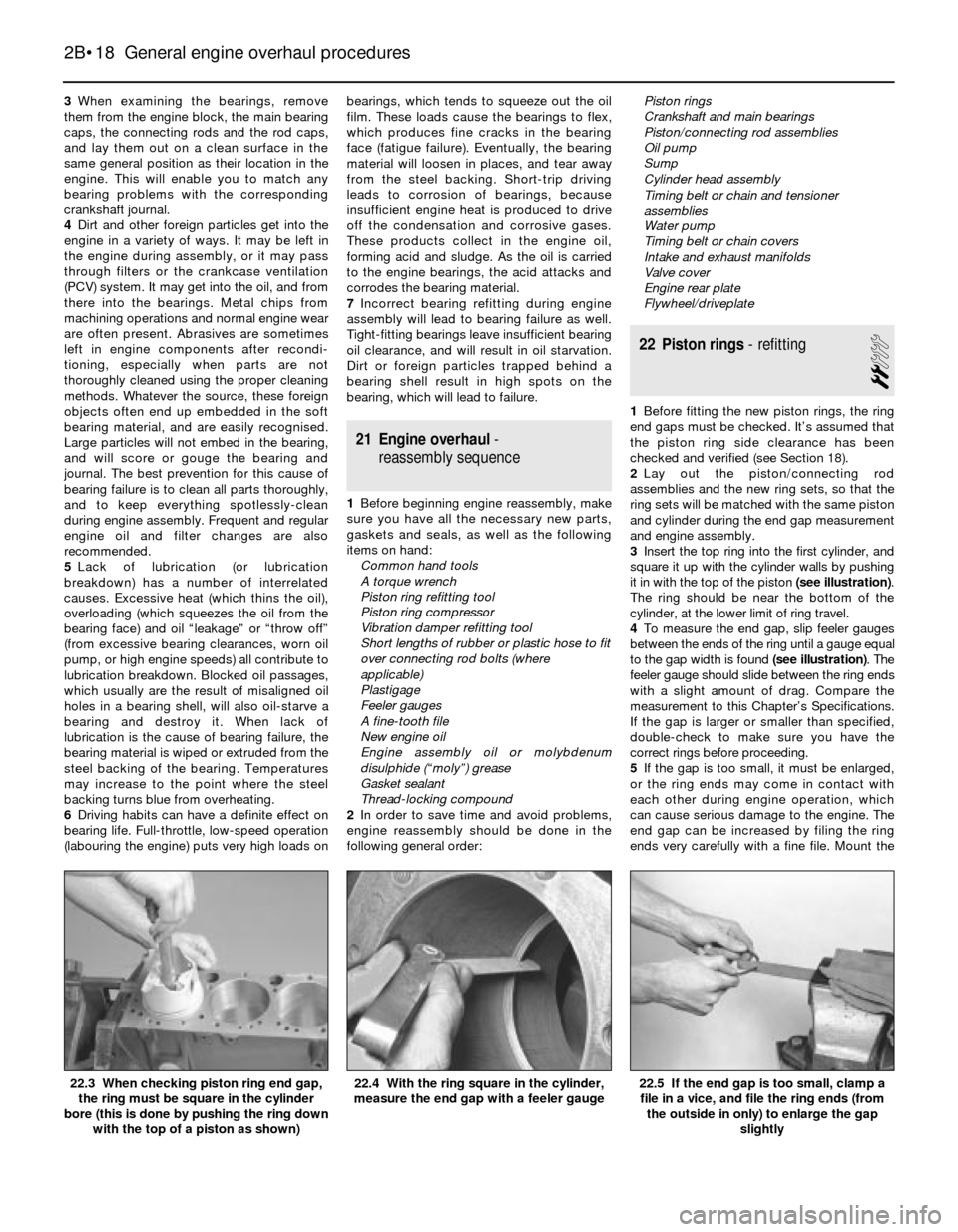
3Insert the top ring into the first cylinder, and
square it up with the cylinder walls by pushing
it in with the top of the piston (see illustration).
The ring should be near the bottom of the
cylinder, at the lower limit of ring travel.
4To measure the end gap, slip feeler gauges
between the ends of the ring until a gauge equal
to the gap width is found(see illustration). The
feeler gauge should slide between the ring ends
with a slight amount of drag. Compare the
measurement to this Chapter’s Specifications.
If the gap is larger or smaller than specified,
double-check to make sure you have the
correct rings before proceeding.
5If the gap is too small, it must be enlarged,
or the ring ends may come in contact with
each other during engine operation, which
can cause serious damage to the engine. The
end gap can be increased by filing the ring
ends very carefully with a fine file. Mount the
2B•18 General engine overhaul procedures
22.5 If the end gap is too small, clamp a
file in a vice, and file the ring ends (from
the outside in only) to enlarge the gap
slightly22.4 With the ring square in the cylinder,
measure the end gap with a feeler gauge22.3 When checking piston ring end gap,
the ring must be square in the cylinder
bore (this is done by pushing the ring down
with the top of a piston as shown)
Page 79 of 228
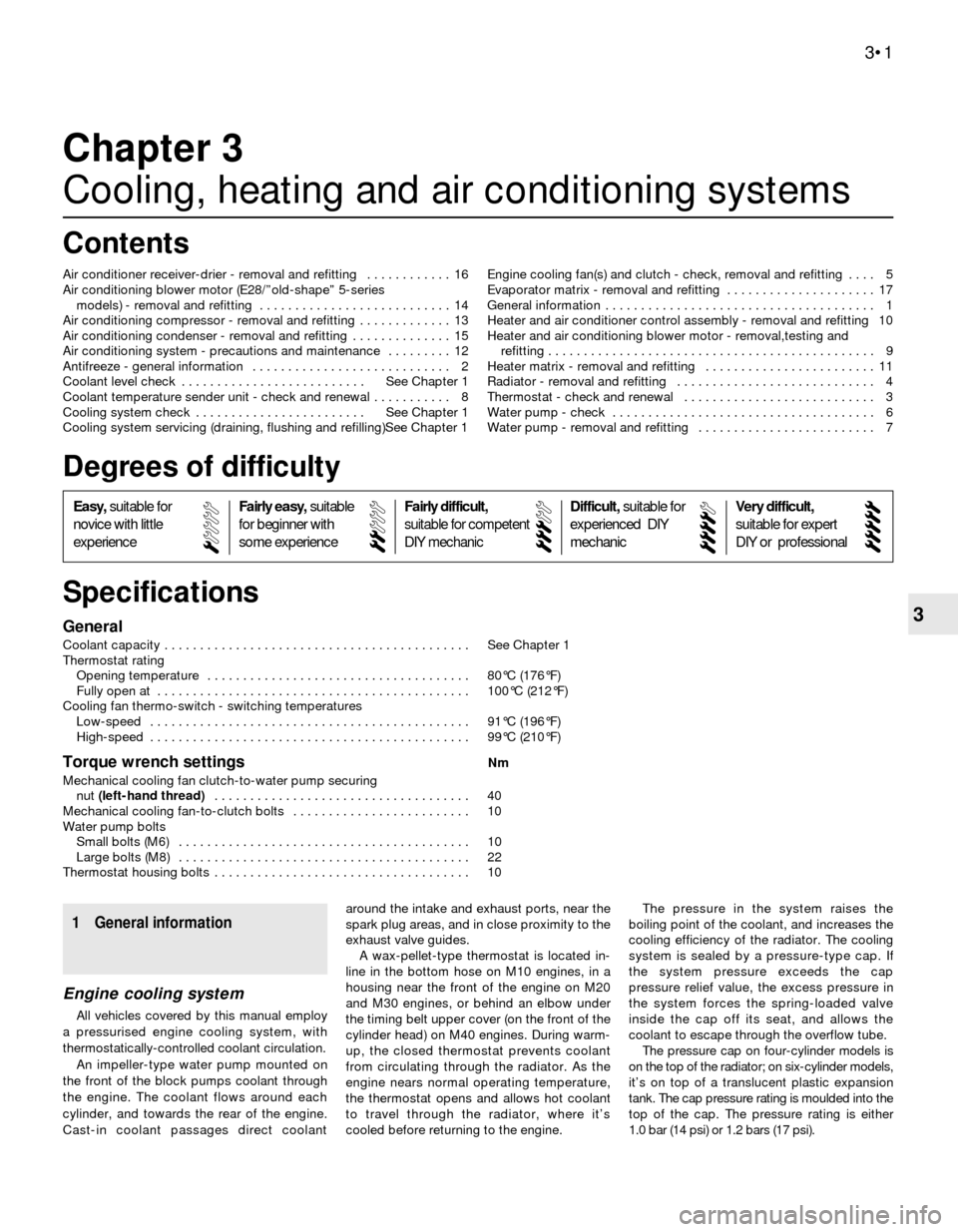
3General
Coolant capacity . . . . . . . . . . . . . . . . . . . . . . . . . . . . . . . . . . . . . . . . . . . See Chapter 1
Thermostat rating
Opening temperature . . . . . . . . . . . . . . . . . . . . . . . . . . . . . . . . . . . . . 80°C (176°F)
Fully open at . . . . . . . . . . . . . . . . . . . . . . . . . . . . . . . . . . . . . . . . . . . . 100°C (212°F)
Cooling fan thermo-switch - switching temperatures
Low-speed . . . . . . . . . . . . . . . . . . . . . . . . . . . . . . . . . . . . . . . . . . . . . 91°C (196°F)
High-speed . . . . . . . . . . . . . . . . . . . . . . . . . . . . . . . . . . . . . . . . . . . . . 99°C (210°F)
Torque wrench settingsNm
Mechanical cooling fan clutch-to-water pump securing
nut (left-hand thread) . . . . . . . . . . . . . . . . . . . . . . . . . . . . . . . . . . . . 40
Mechanical cooling fan-to-clutch bolts . . . . . . . . . . . . . . . . . . . . . . . . . 10
Water pump bolts
Small bolts (M6) . . . . . . . . . . . . . . . . . . . . . . . . . . . . . . . . . . . . . . . . . 10
Large bolts (M8) . . . . . . . . . . . . . . . . . . . . . . . . . . . . . . . . . . . . . . . . . 22
Thermostat housing bolts . . . . . . . . . . . . . . . . . . . . . . . . . . . . . . . . . . . . 10
Chapter 3
Cooling, heating and air conditioning systems
Air conditioner receiver-drier - removal and refitting . . . . . . . . . . . . 16
Air conditioning blower motor (E28/”old-shape” 5-series
models) - removal and refitting . . . . . . . . . . . . . . . . . . . . . . . . . . . 14
Air conditioning compressor - removal and refitting . . . . . . . . . . . . . 13
Air conditioning condenser - removal and refitting . . . . . . . . . . . . . . 15
Air conditioning system - precautions and maintenance . . . . . . . . . 12
Antifreeze - general information . . . . . . . . . . . . . . . . . . . . . . . . . . . . 2
Coolant level check . . . . . . . . . . . . . . . . . . . . . . . . . . See Chapter 1
Coolant temperature sender unit - check and renewal . . . . . . . . . . . 8
Cooling system check . . . . . . . . . . . . . . . . . . . . . . . . See Chapter 1
Cooling system servicing (draining, flushing and refilling)See Chapter 1Engine cooling fan(s) and clutch - check, removal and refitting . . . . 5
Evaporator matrix - removal and refitting . . . . . . . . . . . . . . . . . . . . . 17
General information . . . . . . . . . . . . . . . . . . . . . . . . . . . . . . . . . . . . . . 1
Heater and air conditioner control assembly - removal and refitting 10
Heater and air conditioning blower motor - removal,testing and
refitting . . . . . . . . . . . . . . . . . . . . . . . . . . . . . . . . . . . . . . . . . . . . . . 9
Heater matrix - removal and refitting . . . . . . . . . . . . . . . . . . . . . . . . 11
Radiator - removal and refitting . . . . . . . . . . . . . . . . . . . . . . . . . . . . 4
Thermostat - check and renewal . . . . . . . . . . . . . . . . . . . . . . . . . . . 3
Water pump - check . . . . . . . . . . . . . . . . . . . . . . . . . . . . . . . . . . . . . 6
Water pump - removal and refitting . . . . . . . . . . . . . . . . . . . . . . . . . 7
3•1
Easy,suitable for
novice with little
experienceFairly easy,suitable
for beginner with
some experienceFairly difficult,
suitable for competent
DIY mechanic
Difficult,suitable for
experienced DIY
mechanicVery difficult,
suitable for expert
DIY or professional
Degrees of difficulty
Specifications Contents
1 General information
Engine cooling system
All vehicles covered by this manual employ
a pressurised engine cooling system, with
thermostatically-controlled coolant circulation.
An impeller-type water pump mounted on
the front of the block pumps coolant through
the engine. The coolant flows around each
cylinder, and towards the rear of the engine.
Cast-in coolant passages direct coolantaround the intake and exhaust ports, near the
spark plug areas, and in close proximity to the
exhaust valve guides.
A wax-pellet-type thermostat is located in-
line in the bottom hose on M10 engines, in a
housing near the front of the engine on M20
and M30 engines, or behind an elbow under
the timing belt upper cover (on the front of the
cylinder head) on M40 engines. During warm-
up, the closed thermostat prevents coolant
from circulating through the radiator. As the
engine nears normal operating temperature,
the thermostat opens and allows hot coolant
to travel through the radiator, where it’s
cooled before returning to the engine.The pressure in the system raises the
boiling point of the coolant, and increases the
cooling efficiency of the radiator. The cooling
system is sealed by a pressure-type cap. If
the system pressure exceeds the cap
pressure relief value, the excess pressure in
the system forces the spring-loaded valve
inside the cap off its seat, and allows the
coolant to escape through the overflow tube.
The pressure cap on four-cylinder models is
on the top of the radiator; on six-cylinder models,
it’s on top of a translucent plastic expansion
tank. The cap pressure rating is moulded into the
top of the cap. The pressure rating is either
1.0 bar (14 psi) or 1.2 bars (17 psi).
Page 89 of 228

4
Carburettor (Solex 2B4)
Main jet
Stage 1 . . . . . . . . . . . . . . . . . . . . . . . . . . . . . . . . . . . . . . . . . . . . . . . . X120
Stage 2 . . . . . . . . . . . . . . . . . . . . . . . . . . . . . . . . . . . . . . . . . . . . . . . . X90
Air correction jet
Stage 1 . . . . . . . . . . . . . . . . . . . . . . . . . . . . . . . . . . . . . . . . . . . . . . . . 135
Stage 2 . . . . . . . . . . . . . . . . . . . . . . . . . . . . . . . . . . . . . . . . . . . . . . . . 75
Venturi diameter
Stage 1 . . . . . . . . . . . . . . . . . . . . . . . . . . . . . . . . . . . . . . . . . . . . . . . . 24 mm
Stage 2 . . . . . . . . . . . . . . . . . . . . . . . . . . . . . . . . . . . . . . . . . . . . . . . . 28 mm
Idle/air jet
Stage 1 . . . . . . . . . . . . . . . . . . . . . . . . . . . . . . . . . . . . . . . . . . . . . . . . 50/120
Stage 2 . . . . . . . . . . . . . . . . . . . . . . . . . . . . . . . . . . . . . . . . . . . . . . . . 40/125
Float needle valve diameter . . . . . . . . . . . . . . . . . . . . . . . . . . . . . . . . . . 2.0 mm
Choke gap (pulldown) . . . . . . . . . . . . . . . . . . . . . . . . . . . . . . . . . . . . . . . 4.0 to 5.5 mm
Throttle positioner spring preload . . . . . . . . . . . . . . . . . . . . . . . . . . . . . 22.0 to 24.0 mm
Float level
Stage 1 float chamber . . . . . . . . . . . . . . . . . . . . . . . . . . . . . . . . . . . . 27.0 to 29.0 mm
Stage 2 float chamber . . . . . . . . . . . . . . . . . . . . . . . . . . . . . . . . . . . . 29.0 to 31.0 mm
Chapter 4 Fuel and exhaust systems
Accelerator cable - check, adjustment and renewal . . . . . . . . . . . . . 9
Air cleaner assembly - removal and refitting . . . . . . . . . . . . . . . . . . . 8
Air filter renewal . . . . . . . . . . . . . . . . . . . . . . . . . . . . . See Chapter 1
Airflow meter - check, removal and refitting . . . . . . . . . . . . . . . . . . . 16
Carburettor - cleaning and adjustment . . . . . . . . . . . . . . . . . . . . . . . 12
Carburettor - general information . . . . . . . . . . . . . . . . . . . . . . . . . . . 10
Carburettor - removal and refitting . . . . . . . . . . . . . . . . . . . . . . . . . . 11
Cold start injector and thermotime switch -
checkand renewal . . . . . . . . . . . . . . . . . . . . . . . . . . . . . . . . . . . . . 19
Engine idle speed check and adjustment . . . . . . . . . See Chapter 1
Exhaust system check . . . . . . . . . . . . . . . . . . . . . . . . See Chapter 1
Exhaust system servicing - general information . . . . . . . . . . . . . . . . 22
Fuel filter renewal . . . . . . . . . . . . . . . . . . . . . . . . . . . See Chapter 1
Fuel injection system - check . . . . . . . . . . . . . . . . . . . . . . . . . . . . . . 15
Fuel injection system - depressurising . . . . . . . . . . . . . . . . . . . . . . . 2Fuel injection system - fault finding . . . . . . . . . . . . See end of Chapter
Fuel injection - general information . . . . . . . . . . . . . . . . . . . . . . . . . . 13
Fuel injection systems . . . . . . . . . . . . . . . . . . . . . . . . . . . . . . . . . . . . 14
Fuel injectors - check and renewal . . . . . . . . . . . . . . . . . . . . . . . . . . 20
Fuel lines and fittings - repair and renewal . . . . . . . . . . . . . . . . . . . . 5
Fuel pressure regulator - check and renewal . . . . . . . . . . . . . . . . . . 18
Fuel pump, transfer pump and fuel level sender unit -
removal and refitting . . . . . . . . . . . . . . . . . . . . . . . . . . . . . . . . . . . 4
Fuel pump/fuel pressure - check . . . . . . . . . . . . . . . . . . . . . . . . . . . 3
Fuel system check . . . . . . . . . . . . . . . . . . . . . . . . . . . See Chapter 1
Fuel tank - removal and refitting . . . . . . . . . . . . . . . . . . . . . . . . . . . . 6
Fuel tank cleaning and repair - general information . . . . . . . . . . . . . 7
General information . . . . . . . . . . . . . . . . . . . . . . . . . . . . . . . . . . . . . . 1
Idle air stabiliser valve - check, adjustment and renewal . . . . . . . . . 21
Throttle body - check, removal and refitting . . . . . . . . . . . . . . . . . . . 17
4•1
Easy,suitable for
novice with little
experienceFairly easy,suitable
for beginner with
some experienceFairly difficult,
suitable for competent
DIY mechanic
Difficult,suitable for
experienced DIY
mechanicVery difficult,
suitable for expert
DIY or professional
Degrees of difficulty
Specifications Contents
Page 90 of 228

Carburettor (Solex 2BE)
Main jet
Stage 1 . . . . . . . . . . . . . . . . . . . . . . . . . . . . . . . . . . . . . . . . . . . . . . . . X120
Stage 2 . . . . . . . . . . . . . . . . . . . . . . . . . . . . . . . . . . . . . . . . . . . . . . . . X110
Air correction jet
Stage 1 . . . . . . . . . . . . . . . . . . . . . . . . . . . . . . . . . . . . . . . . . . . . . . . . 140
Stage 2 . . . . . . . . . . . . . . . . . . . . . . . . . . . . . . . . . . . . . . . . . . . . . . . . 70
Venturi diameter
Stage 1 . . . . . . . . . . . . . . . . . . . . . . . . . . . . . . . . . . . . . . . . . . . . . . . . 24 mm
Stage 2 . . . . . . . . . . . . . . . . . . . . . . . . . . . . . . . . . . . . . . . . . . . . . . . . 28 mm
Idle fuel jet
Stage 1 . . . . . . . . . . . . . . . . . . . . . . . . . . . . . . . . . . . . . . . . . . . . . . . . 47.5 mm
Idle air jet
Stage 2 . . . . . . . . . . . . . . . . . . . . . . . . . . . . . . . . . . . . . . . . . . . . . . . . 180
Float needle valve diameter . . . . . . . . . . . . . . . . . . . . . . . . . . . . . . . . . . 2.0 mm
Throttle positioner coil resistance . . . . . . . . . . . . . . . . . . . . . . . . . . . . . . 0.97 to 1.63 ohms
Intake air temperature resistance
-10º C . . . . . . . . . . . . . . . . . . . . . . . . . . . . . . . . . . . . . . . . . . . . . . . . . 8200 to 10 500 ohms
20º C . . . . . . . . . . . . . . . . . . . . . . . . . . . . . . . . . . . . . . . . . . . . . . . . . . 2200 to 2700 ohms
80º C . . . . . . . . . . . . . . . . . . . . . . . . . . . . . . . . . . . . . . . . . . . . . . . . . . 300 to 360 ohms
Float level
Stage 1 float chamber . . . . . . . . . . . . . . . . . . . . . . . . . . . . . . . . . . . . 27.0 to 29.0 mm
Stage 2 float chamber . . . . . . . . . . . . . . . . . . . . . . . . . . . . . . . . . . . . 29.0 to 31.0 mm
Fuel pressure checks (carburettor engines)
Fuel pump delivery pressure (engine idling) . . . . . . . . . . . . . . . . . . . . . . 0.1 to 0.3 bars
Fuel pressure checks (fuel injection engines)
Fuel system pressure (relative to intake manifold pressure)
3-Series (E30)
316i with M40/B16 engine . . . . . . . . . . . . . . . . . . . . . . . . . . . . . . . 3.0 ± 0.06 bars
318i with M10/B18 engine . . . . . . . . . . . . . . . . . . . . . . . . . . . . . . . 2.5 to 3.0 bars
318i with M40/B18 engine . . . . . . . . . . . . . . . . . . . . . . . . . . . . . . . 3.0 ± 0.06 bars
320i with M20/B20 engine (L-Jetronic) . . . . . . . . . . . . . . . . . . . . . . 2.5 to 3.0 bars
320i with M20/B20 engine (Motronic) . . . . . . . . . . . . . . . . . . . . . . . 2.5 ± 0.05 bars
325i with M20/B25 engine . . . . . . . . . . . . . . . . . . . . . . . . . . . . . . . 3.0 ± 0.05 bars
5-Series (E28/”old-shape”)
All models . . . . . . . . . . . . . . . . . . . . . . . . . . . . . . . . . . . . . . . . . . . . 2.5 to 3.0 bars
5-Series (E34/”new-shape”)
518i with M40/B18 engine . . . . . . . . . . . . . . . . . . . . . . . . . . . . . . . 3.0 ± 0.06 bars
All other models . . . . . . . . . . . . . . . . . . . . . . . . . . . . . . . . . . . . . . . 2.5 to 3.0 bars
Fuel system hold pressure . . . . . . . . . . . . . . . . . . . . . . . . . . . . . . . . . . . 2.1 bars
Fuel pump maximum pressure . . . . . . . . . . . . . . . . . . . . . . . . . . . . . . . . 6.3 to 6.9 bars
Fuel pump hold pressure . . . . . . . . . . . . . . . . . . . . . . . . . . . . . . . . . . . . 5.5 bars
Transfer pump pressure . . . . . . . . . . . . . . . . . . . . . . . . . . . . . . . . . . . . . 0.28 to 0.35 bars
Injectors
Injector resistance . . . . . . . . . . . . . . . . . . . . . . . . . . . . . . . . . . . . . . . . . 14.5 to 17.5 ohms
Accelerator cable free play . . . . . . . . . . . . . . . . . . . . . . . . . . . 1.0 mm
Torque wrench settingsNm
Carburettor mountings . . . . . . . . . . . . . . . . . . . . . . . . . . . . . . . . . . . . . . 10
Fuel pump to cylinder head . . . . . . . . . . . . . . . . . . . . . . . . . . . . . . . . . . 12
Throttle body nuts/bolts . . . . . . . . . . . . . . . . . . . . . . . . . . . . . . . . . . . . . 19 to 26
4•2 Fuel and exhaust systems
1 General information
With the exception of early models (316 and
518 models) all engines are equipped with
electronic fuel injection.
Early 316 and 518 models are equipped
with Solex carburettors. The carburettor fitted
is either a Solex 2B4 (early models) or
2BE (later models). The mechanical fuel pumpis driven by an eccentric lobe on the
camshaft.
Fuel injection models are equipped with
either the L-Jetronic or the Motronic fuel
injection system. From 1988, fuel injection
models are equipped with an updated version
of the Motronic system - this system is easily
distinguished from the earlier system by the
absence of a cold start injector. The electric
fuel pump is located beneath the rear of the
vehicle, or inside the fuel tank. The fuel pump
relay on Motronic systems is activated from aearth signal from the Motronic control unit
(ECU). The fuel pump operates for a few
seconds when the ignition is first switched on,
and it continues to operate only when the
engine is actually running.Air intake system
The air intake system consists of the air
filter housing, the airflow meter and throttle
body (fuel injection models), and the intake
manifold. All components except the intake
manifold are covered in this Chapter; for
Page 91 of 228
information on removing and refitting the
intake manifold, refer to Chapter 2A.
The throttle valve inside the throttle body or
carburettor is actuated by the accelerator
cable. When you depress the accelerator
pedal, the throttle plate opens and airflow
through the intake system increases.
On fuel injection systems, a flap inside the
airflow meter opens wider as the airflow
increases. A throttle position switch attached
to the pivot shaft of the flap detects the angle
of the flap (how much it’s open) and converts
this to a voltage signal, which it sends to the
computer.
Fuel system
On carburettor models, the fuel pump
supplies fuel under pressure to the
carburettor. A needle valve in the float
chamber maintains the fuel at a constant
level. A fuel return system channels excess
fuel back to the fuel tank.
On fuel injection models, an electric fuel
pump supplies fuel under constant pressure
to the fuel rail, which distributes fuel to the
injectors. The electric fuel pump is located
inside the fuel tank on later models, or beside
the fuel tank on early models. Early models
also have a transfer pump located in the fuel
tank. The transfer pump acts as an aid to the
larger main pump for delivering the necessary
pressure. A fuel pressure regulator controls
the pressure in the fuel system. The fuel
system also has a fuel pulsation damper
located near the fuel filter. The damper
reduces the pressure pulsations caused by
fuel pump operation, and the opening and
closing of the injectors. The amount of fuel
injected into the intake ports is precisely
controlled by an Electronic Control Unit (ECU
or computer). Some later 5-Series models
have a fuel cooler in the return line.
Electronic control system (fuel
injection system)
Besides altering the injector opening
duration as described above, the electronic
control unit performs a number of other tasks
related to fuel and emissions control. It
accomplishes these tasks by using data
relayed to it by a wide array of information
sensors located throughout the enginecompartment, comparing this information to
its stored map, and altering engine operation
by controlling a number of different actuators.
Since special equipment is required, most
fault diagnosis and repair of the electronic
control system is beyond the scope of the
home mechanic. Additional information and
testing procedures for the emissions system
components (oxygen sensor, coolant
temperature sensor, EVAP system, etc.) is
contained in Chapter 6.
2 Fuel injection system-
depressurising
1
Warning: Fuel is extremely
flammable, so take extra
precautions when you work on
any part of the fuel system. Don’t
smoke or allow open flames or bare light
bulbs near the work area. Also, don’t work
in a garage where a natural gas-type
appliance with a pilot light is present.
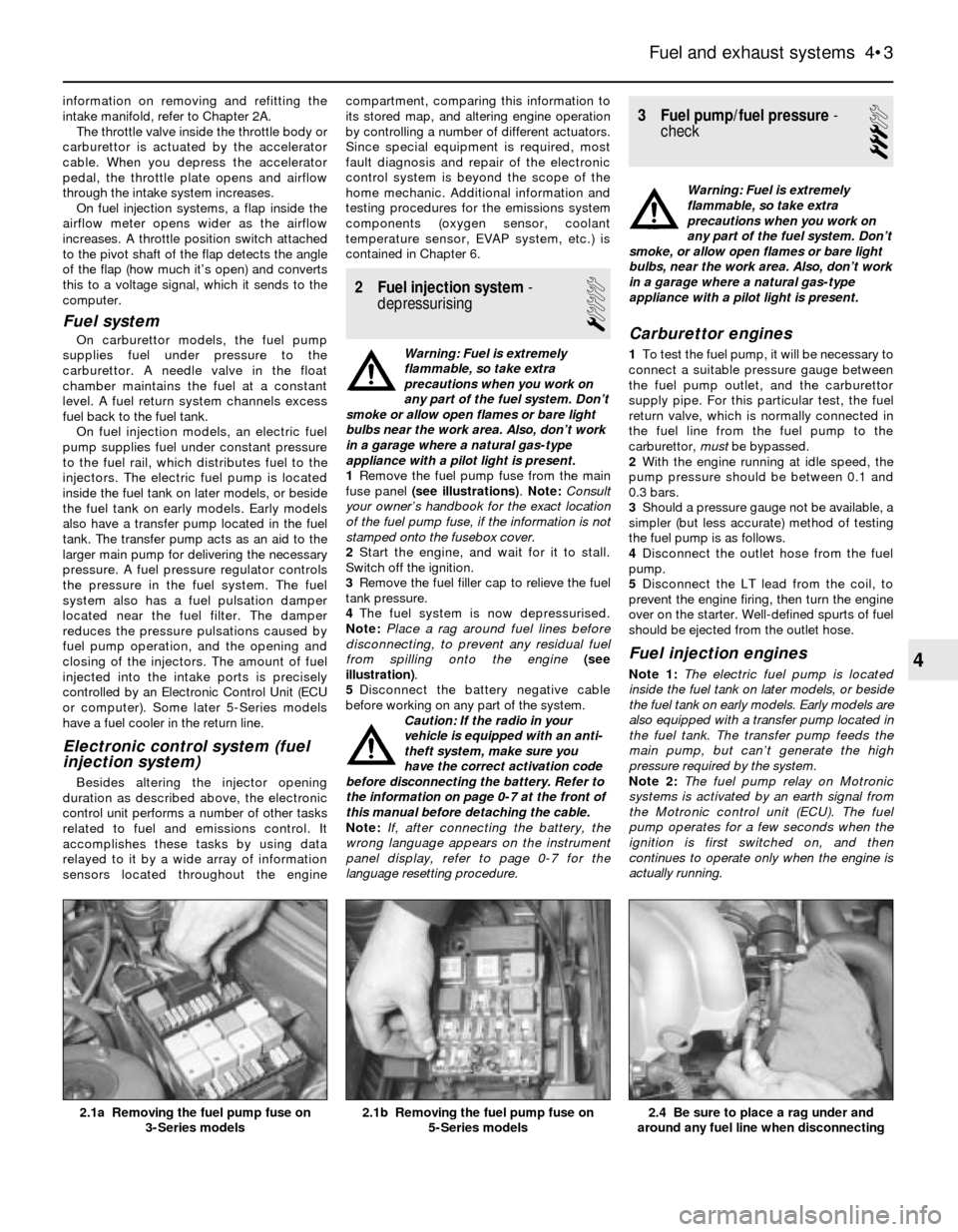
1Remove the fuel pump fuse from the main
fuse panel (see illustrations). Note:Consult
your owner’s handbook for the exact location
of the fuel pump fuse, if the information is not
stamped onto the fusebox cover.
2Start the engine, and wait for it to stall.
Switch off the ignition.
3Remove the fuel filler cap to relieve the fuel
tank pressure.
4The fuel system is now depressurised.
Note:Place a rag around fuel lines before
disconnecting, to prevent any residual fuel
from spilling onto the engine(see
illustration).
5Disconnect the battery negative cable
before working on any part of the system.
Caution: If the radio in your
vehicle is equipped with an anti-
theft system, make sure you
have the correct activation code
before disconnecting the battery. Refer to
the information on page 0-7 at the front of
this manual before detaching the cable.
Note: If, after connecting the battery, the
wrong language appears on the instrument
panel display, refer to page 0-7 for the
language resetting procedure.
3 Fuel pump/fuel pressure-
check
3
Warning: Fuel is extremely
flammable, so take extra
precautions when you work on
any part of the fuel system. Don’t
smoke, or allow open flames or bare light
bulbs, near the work area. Also, don’t work
in a garage where a natural gas-type
appliance with a pilot light is present.
Carburettor engines
1To test the fuel pump, it will be necessary to
connect a suitable pressure gauge between
the fuel pump outlet, and the carburettor
supply pipe. For this particular test, the fuel
return valve, which is normally connected in
the fuel line from the fuel pump to the
carburettor, mustbe bypassed.
2With the engine running at idle speed, the
pump pressure should be between 0.1 and
0.3 bars.
3Should a pressure gauge not be available, a
simpler (but less accurate) method of testing
the fuel pump is as follows.
4Disconnect the outlet hose from the fuel
pump.
5Disconnect the LT lead from the coil, to
prevent the engine firing, then turn the engine
over on the starter. Well-defined spurts of fuel
should be ejected from the outlet hose.
Fuel injection engines
Note 1:The electric fuel pump is located
inside the fuel tank on later models, or beside
the fuel tank on early models. Early models are
also equipped with a transfer pump located in
the fuel tank. The transfer pump feeds the
main pump, but can’t generate the high
pressure required by the system.
Note 2:The fuel pump relay on Motronic
systems is activated by an earth signal from
the Motronic control unit (ECU). The fuel
pump operates for a few seconds when the
ignition is first switched on, and then
continues to operate only when the engine is
actually running.
Fuel and exhaust systems 4•3
2.4 Be sure to place a rag under and
around any fuel line when disconnecting2.1b Removing the fuel pump fuse on
5-Series models2.1a Removing the fuel pump fuse on
3-Series models
4
Page 92 of 228
Note 3:The following checks assume the fuel
filter is in good condition. If you doubt the
condition of your fuel filter, renew it (see
Chapter 1).
Note 4:In order to get accurate test results, it
is recommended that the fuel pressure be
checked from both the main fuel pump and
transfer pump where applicable.
Fuel pump/transfer pump operational
check
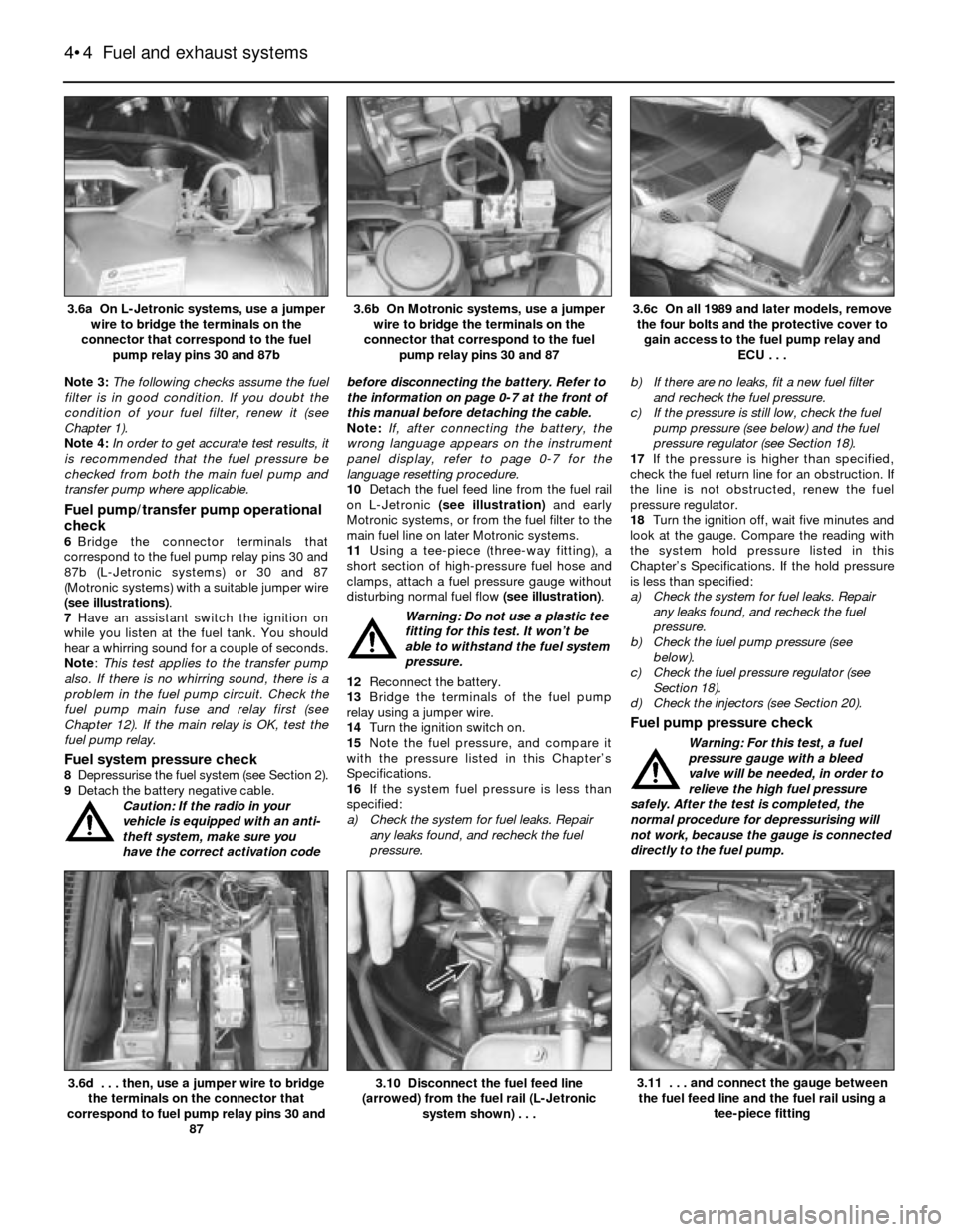
6Bridge the connector terminals that
correspond to the fuel pump relay pins 30 and
87b (L-Jetronic systems) or 30 and 87
(Motronic systems) with a suitable jumper wire
(see illustrations).
7Have an assistant switch the ignition on
while you listen at the fuel tank. You should
hear a whirring sound for a couple of seconds.
Note:This test applies to the transfer pump
also. If there is no whirring sound, there is a
problem in the fuel pump circuit. Check the
fuel pump main fuse and relay first (see
Chapter 12). If the main relay is OK, test the
fuel pump relay.
Fuel system pressure check8Depressurise the fuel system (see Section 2).
9Detach the battery negative cable.
Caution: If the radio in your
vehicle is equipped with an anti-
theft system, make sure you
have the correct activation codebefore disconnecting the battery. Refer to
the information on page 0-7 at the front of
this manual before detaching the cable.
Note: If, after connecting the battery, the
wrong language appears on the instrument
panel display, refer to page 0-7 for the
language resetting procedure.
10Detach the fuel feed line from the fuel rail
on L-Jetronic (see illustration)and early
Motronic systems, or from the fuel filter to the
main fuel line on later Motronic systems.
11Using a tee-piece (three-way fitting), a
short section of high-pressure fuel hose and
clamps, attach a fuel pressure gauge without
disturbing normal fuel flow (see illustration).
Warning: Do not use a plastic tee
fitting for this test. It won’t be
able to withstand the fuel system
pressure.
12Reconnect the battery.
13Bridge the terminals of the fuel pump
relay using a jumper wire.
14Turn the ignition switch on.
15Note the fuel pressure, and compare it
with the pressure listed in this Chapter’s
Specifications.
16If the system fuel pressure is less than
specified:
a) Check the system for fuel leaks. Repair
any leaks found, and recheck the fuel
pressure.b) If there are no leaks, fit a new fuel filter
and recheck the fuel pressure.
c) If the pressure is still low, check the fuel
pump pressure (see below) and the fuel
pressure regulator (see Section 18).
17If the pressure is higher than specified,
check the fuel return line for an obstruction. If
the line is not obstructed, renew the fuel
pressure regulator.
18Turn the ignition off, wait five minutes and
look at the gauge. Compare the reading with
the system hold pressure listed in this
Chapter’s Specifications. If the hold pressure
is less than specified:
a) Check the system for fuel leaks. Repair
any leaks found, and recheck the fuel
pressure.
b) Check the fuel pump pressure (see
below).
c) Check the fuel pressure regulator (see
Section 18).
d) Check the injectors (see Section 20).
Fuel pump pressure check
Warning: For this test, a fuel
pressure gauge with a bleed
valve will be needed, in order to
relieve the high fuel pressure
safely. After the test is completed, the
normal procedure for depressurising will
not work, because the gauge is connected
directly to the fuel pump.
4•4 Fuel and exhaust systems
3.10 Disconnect the fuel feed line
(arrowed) from the fuel rail (L-Jetronic
system shown) . . .3.6d . . . then, use a jumper wire to bridge
the terminals on the connector that
correspond to fuel pump relay pins 30 and
87
3.6c On all 1989 and later models, remove
the four bolts and the protective cover to
gain access to the fuel pump relay and
ECU . . .3.6b On Motronic systems, use a jumper
wire to bridge the terminals on the
connector that correspond to the fuel
pump relay pins 30 and 873.6a On L-Jetronic systems, use a jumper
wire to bridge the terminals on the
connector that correspond to the fuel
pump relay pins 30 and 87b
3.11 . . . and connect the gauge between
the fuel feed line and the fuel rail using a
tee-piece fitting
Page 93 of 228
19Depressurise the fuel system (see Sec-
tion 2).
20Detach the battery negative cable.
Caution: If the radio in your
vehicle is equipped with an anti-
theft system, make sure you
have the correct activation code
before disconnecting the battery. Refer to
the information on page 0-7 at the front of
this manual before detaching the cable.
Note: If, after connecting the battery, the
wrong language appears on the instrument
panel display, refer to page 0-7 for the
language resetting procedure.
21Detach the fuel feed hose from the fuel
rail, and attach a fuel pressure gauge directly
to the hose. Note:If the tee fitting is still
connected to the gauge, be sure to plug the
open end.
22Reconnect the battery.
23Using a jumper wire, bridge the terminals
of the fuel pump relay.
24Turn the ignition switch on to operate the
fuel pump.
25Note the pressure reading on the gauge,
and compare the reading to the fuel pump
pressure listed in this Chapter’s Specifica-
tions.
26If the indicated pressure is less than
specified, inspect the fuel line for leaks
between the pump and gauge. If no leaks are
found, renew the fuel pump.
27Turn the ignition off and wait five minutes.
Note the reading on the gauge, and compare
it to the fuel pump hold pressure listed in this
Chapter’s Specifications. If the hold pressure
is less than specified, check the fuel lines
between the pump and gauge for leaks. If no
leaks are found, renew the fuel pump.
28Remove the jumper wire. Relieve the fuel
pressure by opening the bleed valve on the
gauge and directing the fuel into a suitable
container. Remove the gauge and reconnect
the fuel line.
Transfer pump pressure check
29Depressurise the fuel system (see Sec-
tion 2).
30Detach the battery negative cable.
Caution: If the radio in your
vehicle is equipped with an anti-
theft system, make sure you
have the correct activation code
before disconnecting the battery. Refer to
the information on page 0-7 at the front of
this manual before detaching the cable.
Note: If, after connecting the battery, the
wrong language appears on the instrument
panel display, refer to page 0-7 for the
language resetting procedure.
31Remove the transfer pump access plate
(on some models, it’s located under the rear
seat cushion - on others, it’s located under
the carpet in the luggage compartment).
Disconnect the output hose from the transfer
pump, and connect a fuel pressure gauge to
the outlet pipe.
32Reconnect the battery.33Using a jumper wire, bridge the terminals
of the fuel pump relay.
34Turn the ignition switch on to operate the
fuel pump.
35Note the pressure reading on the gauge,
and compare to the value listed in this
Chapter’s Specifications.
36If the indicated pressure is less than
specified, renew the transfer pump.
Fuel pump relay check
37Switch on the ignition.
38Using a voltmeter, probe the following
terminals from the back of the relay electrical
connector. Check for battery voltage at
terminal 30 (M20 and M30 engines) or
terminal 15 (M10 and M40 engines). Note:If
there is no voltage on models with luggage
compartment-mounted batteries, check for a
faulty fusible link. The 50-amp link is about
6 inches from the battery, in a black wire.
39Turn the ignition off, and disconnect the
relay from the electrical connector. Using a
voltmeter, probe the connector terminals that
correspond to fuel pump relay pins 85 (-) and
86(+) on M20 and M30 engines, or terminal 50
and earth on M10 and M40 engines. Have an
assistant turn the engine over on the starter,
and observe the voltage reading. Battery
voltage should be indicated.
40If there is no voltage, check the fuse(s)
and the wiring circuit for the fuel pump relay. If
the voltage readings are correct, and the fuel
pump only runs with the jumper wire in place,
then renew the relay.
41If the fuel pump still does not run, check
for the proper voltage at the fuel pump
terminals (see Section 4). If necessary, renew
the fuel pump.
4 Fuel pump, transfer pump
and fuel level sender unit-
removal and refitting
2
Warning: Fuel is extremely
flammable, so take extra
precautions when you work on
any part of the fuel system. Don’t
smoke, or allow open flames or bare light
bulbs, near the work area. Also, don’t work
in a garage where a natural gas-type
appliance with a pilot light is present.
Fuel pump (carburettor engines)
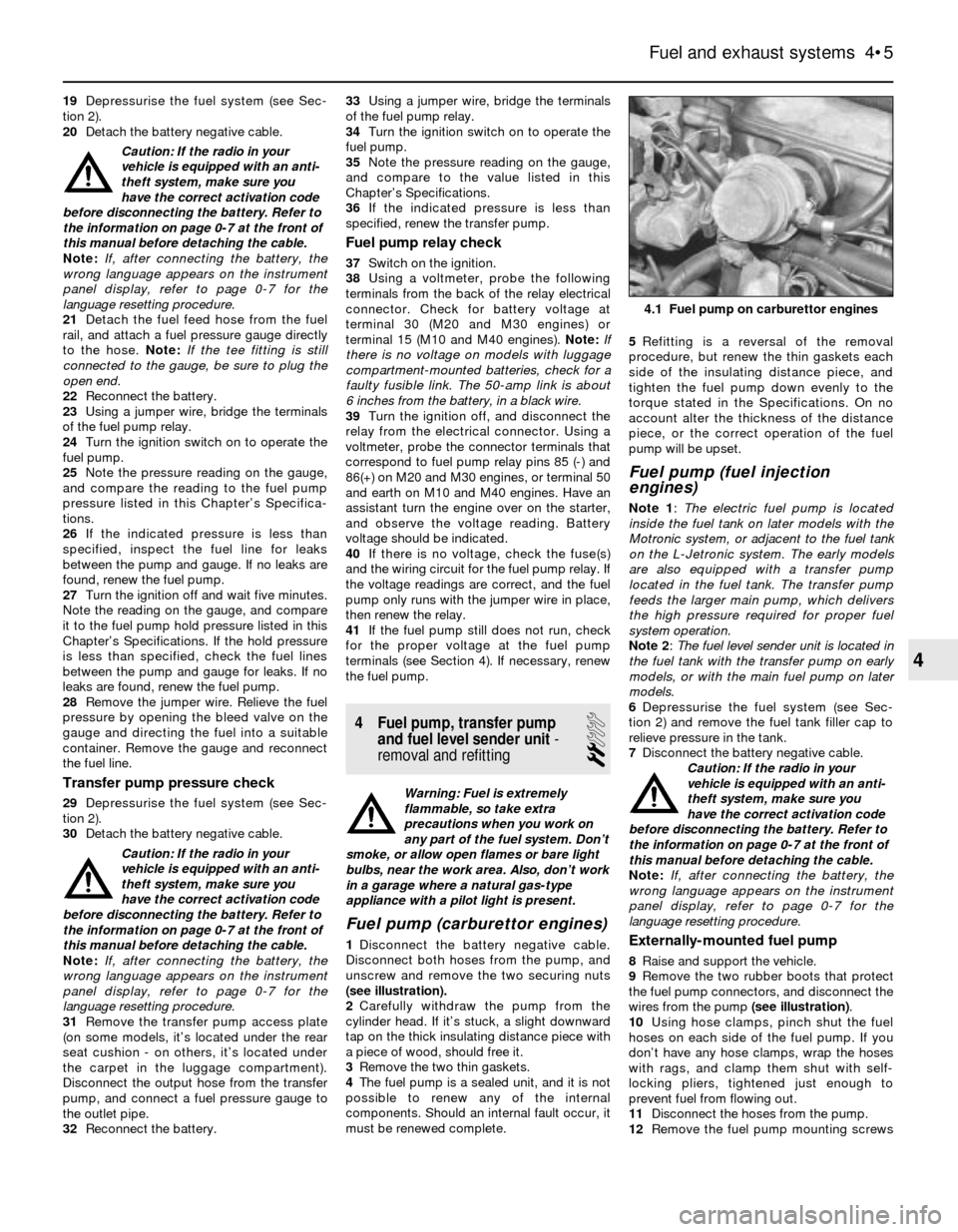
1Disconnect the battery negative cable.
Disconnect both hoses from the pump, and
unscrew and remove the two securing nuts
(see illustration).
2Carefully withdraw the pump from the
cylinder head. If it’s stuck, a slight downward
tap on the thick insulating distance piece with
a piece of wood, should free it.
3Remove the two thin gaskets.
4The fuel pump is a sealed unit, and it is not
possible to renew any of the internal
components. Should an internal fault occur, it
must be renewed complete.5Refitting is a reversal of the removal
procedure, but renew the thin gaskets each
side of the insulating distance piece, and
tighten the fuel pump down evenly to the
torque stated in the Specifications. On no
account alter the thickness of the distance
piece, or the correct operation of the fuel
pump will be upset.
Fuel pump (fuel injection
engines)
Note 1: The electric fuel pump is located
inside the fuel tank on later models with the
Motronic system, or adjacent to the fuel tank
on the L-Jetronic system. The early models
are also equipped with a transfer pump
located in the fuel tank. The transfer pump
feeds the larger main pump, which delivers
the high pressure required for proper fuel
system operation.
Note 2: The fuel level sender unit is located in
the fuel tank with the transfer pump on early
models, or with the main fuel pump on later
models.
6Depressurise the fuel system (see Sec-
tion 2) and remove the fuel tank filler cap to
relieve pressure in the tank.
7Disconnect the battery negative cable.
Caution: If the radio in your
vehicle is equipped with an anti-
theft system, make sure you
have the correct activation code
before disconnecting the battery. Refer to
the information on page 0-7 at the front of
this manual before detaching the cable.
Note: If, after connecting the battery, the
wrong language appears on the instrument
panel display, refer to page 0-7 for the
language resetting procedure.
Externally-mounted fuel pump
8Raise and support the vehicle.
9Remove the two rubber boots that protect
the fuel pump connectors, and disconnect the
wires from the pump (see illustration).
10Using hose clamps, pinch shut the fuel
hoses on each side of the fuel pump. If you
don’t have any hose clamps, wrap the hoses
with rags, and clamp them shut with self-
locking pliers, tightened just enough to
prevent fuel from flowing out.
11Disconnect the hoses from the pump.
12Remove the fuel pump mounting screws
Fuel and exhaust systems 4•5
4.1 Fuel pump on carburettor engines
4